
Founders want to build a business that lasts, but how this feels and your personal motivation will change as the business scales. In this talk, Roan will share what he has learned about personal growth, development, and learning in a 15 year entrepreneurial journey that has gone from three co-founders who initially didn't want to build a big company, to being the CEO of a 270 people organisation today.
← All talks 




Lead Turing Fest 2022
How to Stay Motivated When You're In It For The Long Haul
Auto-generated transcript - may contain errors. Tap a timestamp to jump the video.
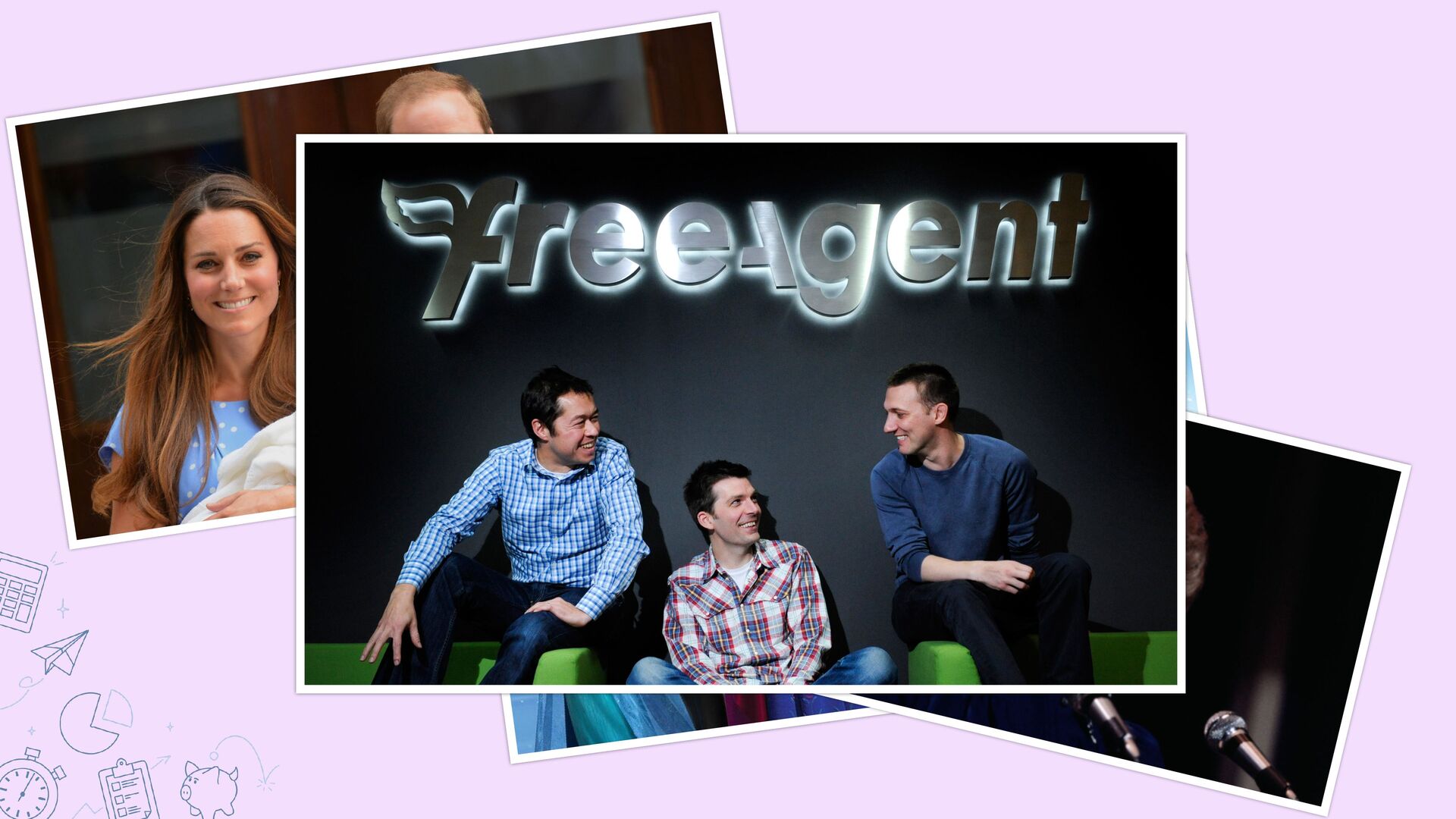
Hey, everybody, how are you all doing? It's great to be back at Turing, absolutely love it here. My name is Ron Lavery, I'm one of the cofounders and CEO of FreeAgent. We're a software company, we're based right here in Edinburgh, and as James says, we've been around since two thousand and seven, so fifteen years now.
It's quite a long time, and obviously I've been with the business for that whole time. Today, what I want to talk to you about is a little bit about motivation, and some of the things I've learned about how to stay personally motivated when you're running a company or with a company for that length of time, and also a bit wider, how do you think about motivating a team and motivating a company as well.
Right, but just before we start, I just want to get something off my chest and then we can move on to the more useful stuff. Humor me for a minute here, alright? I want to talk about an existential crisis that I had. Like I said, I think I was going put some of the stuff I put into a bit more context.
I want you to cast your mind back, years twenty thirteen. I'm sure we all remember it well, right? Simpler times. If you recall, William McKay welcomed little baby George into the world. Fellow Scotsman Andy Murray won his first Wimbledon championship. Frozen was released, and Margaret Thatcher died.
A pretty good year all in all. I grew up in the 80s, so I'm out and make that joke, okay? From a free agent's perspective, we'd been around for about six years at this point, and things were ticking along pretty nicely. There was about fifty of us in the company, we'd just moved into a new office, which was just around the corner from here, actually.
Customer growth was going well, revenue growth was going well, things were ticking over nicely. And then out of the blue, we were contacted by a very large American competitor of ours. If you know this space, you may be able to hazard a guess who that may have been, and they wanted to discuss acquiring the company, buying the business.
So they flew over from America, took us out to dinner, big, brash American guy, Yeah, yeah, let's do this thing, slapped an offer on the table, sign it. And it was a really generous offer, and it would have made the founders at that point a substantial, life changing amount of money, right?
And you might think that would have been great, would have been a really happy, exciting prospect, realizing that start up dream, you know, the big prize that everybody's going for when you start a company. But actually my overriding emotion and my overriding memory of that time was actually being pretty miserable and quite depressed about the whole thing.
Know what you're thinking, world's smallest violin, pro founder, going be owed some money, but it was kind of weird to me that I reacted in this way, and I was like, why am I happier about this, why am more excited about this prospect?
That kind of sent me down this rabbit hole, so I was thinking, well, if that's not going to make me happy, if that's not going to be the happiness I'm looking for, then what is going to make me happy? What's the purpose of life anyway? What's the whole point?
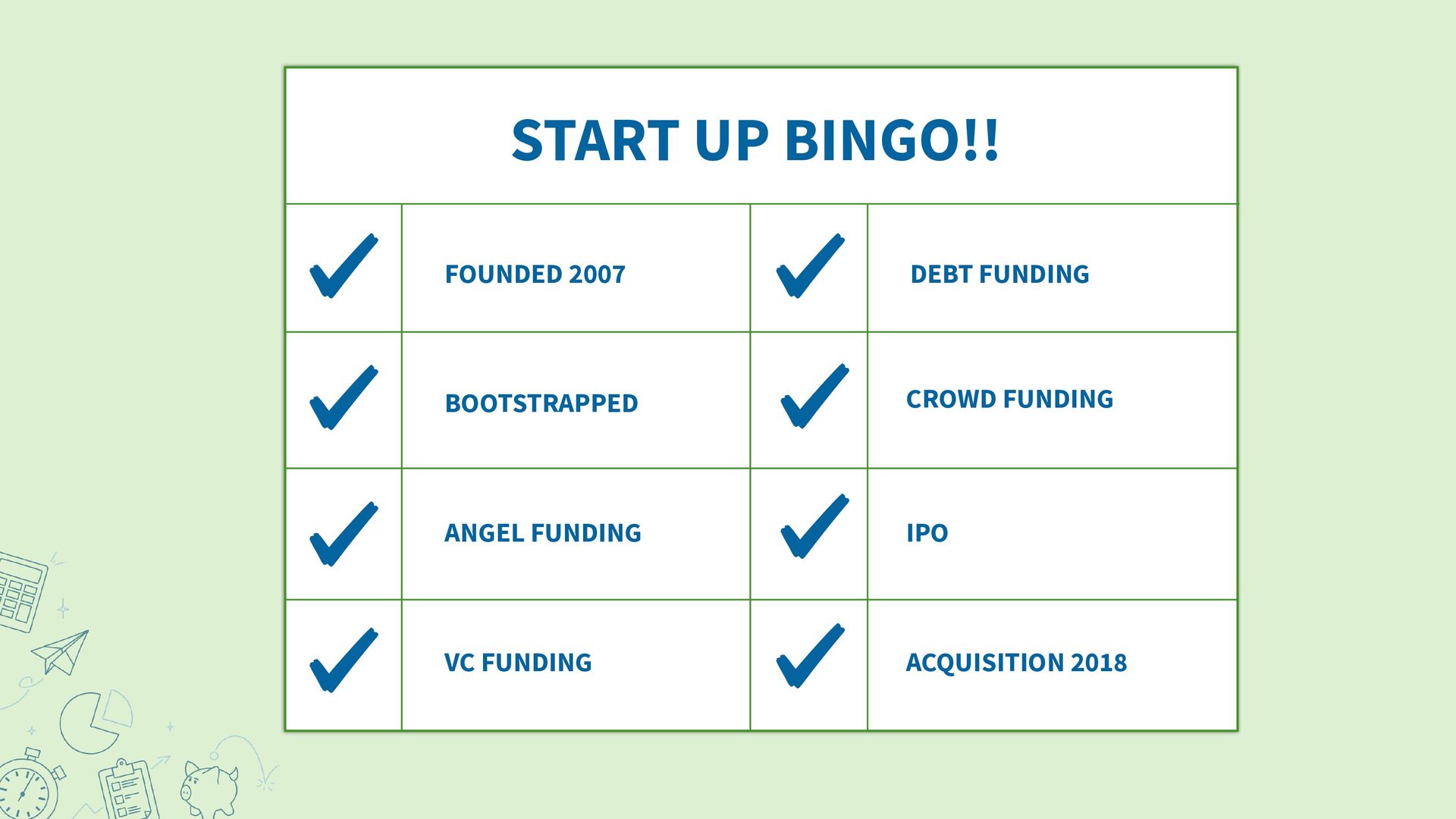
Like I say, self indulgent existential crisis. I'll come back to that later on. As it turned out, we didn't sell the business at that point, it wouldn't have been the right thing for the company. We continued to run the business and grow and scale, and we quite often joke at FreeAgent that we've ticked every box in the bingo scorecard of running a start up.
So founding the business and bootstrapping for a couple of years, various sorts of investment rounds, angel funding, VC funding, debt funding. In twenty fifteen, we did a crowdfunding round, we won't do that again. In twenty sixteen, we actually took the company public, we did an IPO, and we were a publicly listed company for about two years up until twenty eighteen when the business was acquired.
We did sell the company to the NatWest Group, and we've been part of that group ever So that was four years ago, and I'm still with the business today. That sometimes surprises people, I was chatting to somebody about this yesterday and they were kind of surprised to know that after four years post acquisition I was still with the company, because that's not the usual founder narrative, it's not the usual tech or story.
The usual deal is you sell your business, you stick about it for six months, twelve months, whatever your earn is, and then actually you're off. You're figuratively, perhaps even literally sailing off into the But I'm not done that, I've decided to stay with the company, and so I want to talk a little bit about that journey and my motivation across some of these milestones, and across this period of time as well, because my motivation has had to change over this period of time.
What motivates me today as a guy in his mid 40s running a company of two seventy people is very different from what motivated me back in my early 30s with just two other dudes with this side project or side hustle. That's changed a lot.
Just before I get started, there's a couple of pointers to the talk. On some of the slides you'll see little icons. You'll see the magnifying glass, there'll be some keyword terms. Google those you will find more information on the topics or the resources that I'm talking about at that point.
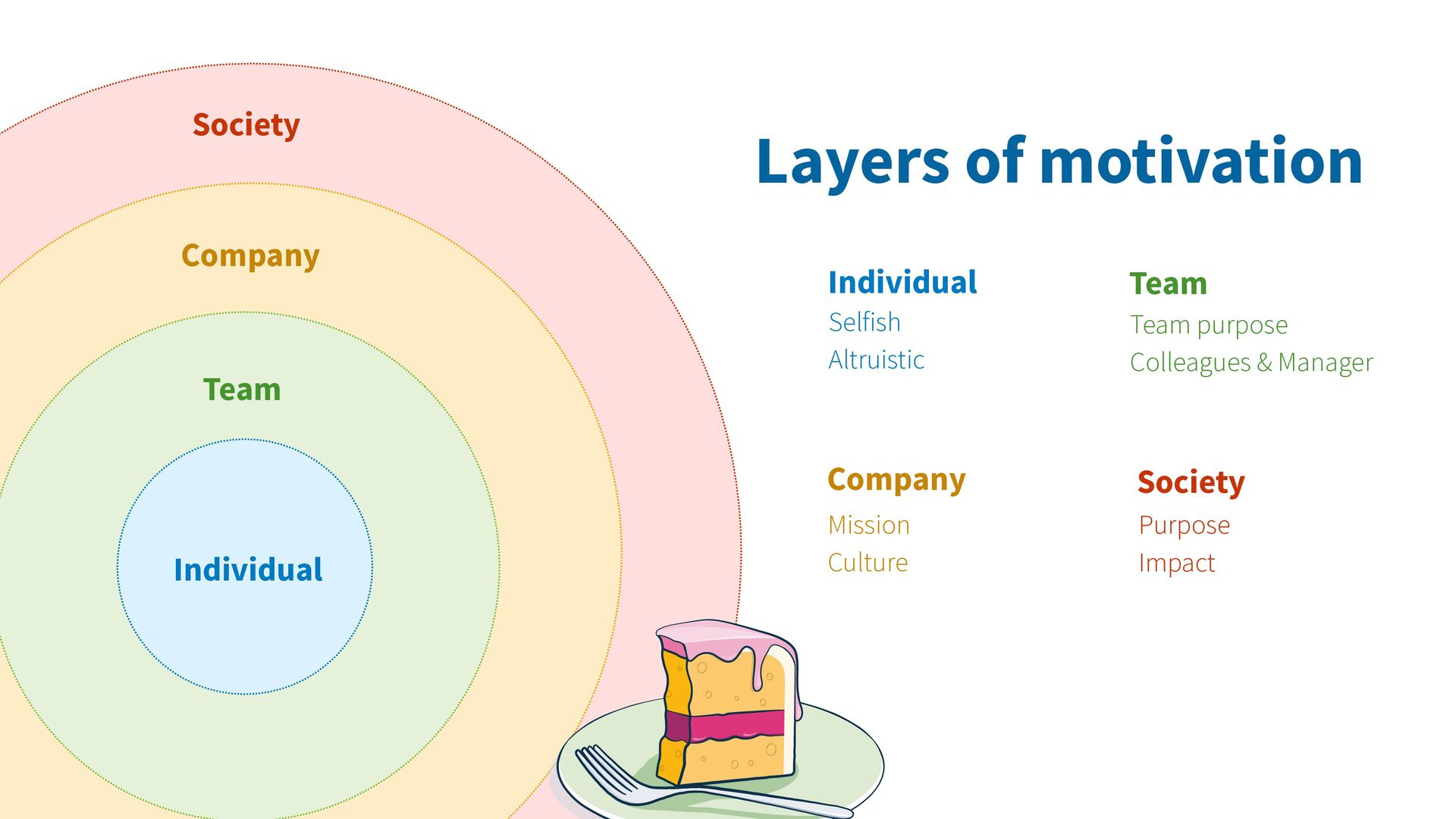
When you see the camera icon, that's generally one of the key takeaways from the talk, take a photograph of that, you can refer back to it later on, and that will hopefully be useful to Okay, so I think when we talk about motivation, it's important to realize that it's a fairly complex and nuanced thing, and we find motivation, we get motivation, from a number of different sources in different ways, and there's different levels to motivation.
And so at the very heart of this, have what's our individual motivation, what's our personal motivation, and even within that, I think there's a couple of ways that we can break that down that I'm going to talk about in a second. Then clearly we've got the motivation from the team that we work in on a day to day basis, our colleagues and our coworkers.
Are there people that inspire us, that engage us, that interest us? Because that can be really crucial. This relationship that we have with our manager as well, that can really be one that makes or breaks our motivation. Then we've got what's the business trying to do, is that something that we feel personally connected to, the mission of that business and crucially the culture of the business as well?
How does that impact our motivation? And then finally we have the widest context of all, and that's the society in which the company sits in. What is the purpose that your business is trying to have within that context of society? What's the impact that you want to have as well?
So there's a bunch of different things here, and I'm not going to go into detail on all of these today, but I'm going to pick out a few of them. I want to start by this one at the very centre here, is about this individual motivation.
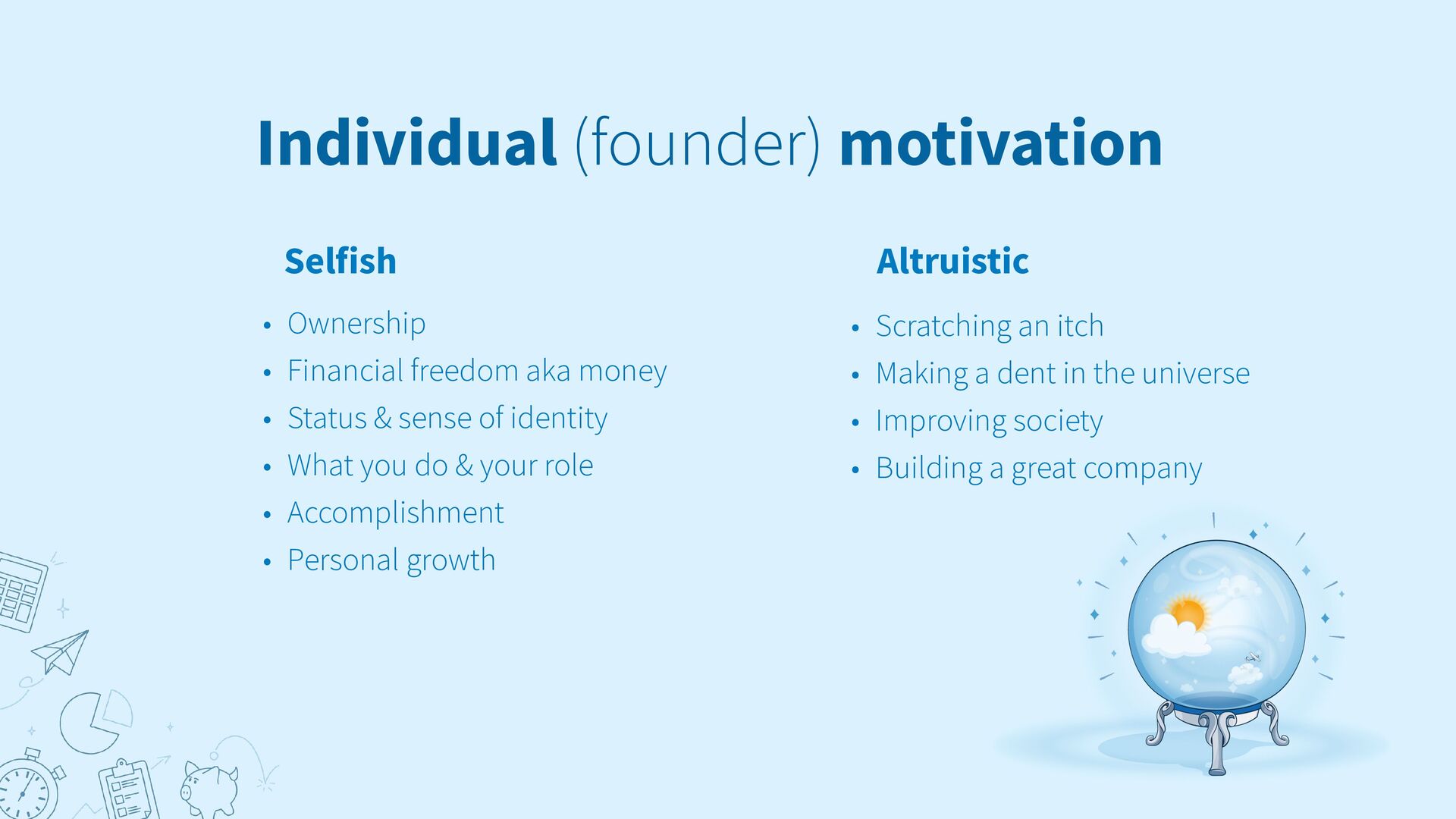
There's a few things on here, and some of them apply to anybody that works within an organisation, and certainly if you've been with an organisation for a prolonged period of time. Some of these things are more founder specific, so I don't know who here today is actively a founder at the minute, or maybe it's just something you're considering on the future, but these will be things that are probably more relevant to you.
This one at the top here, ownership, definitely comes under that category. It's this idea that you and your co founders, in the very, very beginning, you come together and you've got this idea, and you give birth to this thing, this idea is a product, it's a company, and you'll hear people use the expression, It's your baby, or It's my baby.
They use that a lot to describe it. I'm going to talk about that in a second. Then, going back to my existential crisis, to raise this this vision, this prospect of making a life changing amount of money, financial freedom, aka getting minted, which clearly can be a big motivation for running a company.
Then there's this idea about status and sense of identity as well. So we've to be honest about it. Within our industry and even within our society at large, being a founder or tech entrepreneur is kind of cool these days, know, whenever you used to be.
It's kind of like cool. So there's definitely a sense of kudos or status or sense of identity, and is that something that motivates you? Is that something that you feel motivated by? It's okay to admit this stuff, it feels a bit weird and cringey, but it's alright to admit this.
Then we've got whatever it is that you do on a day to day basis in your role, do enjoy your job, is that something that motivates you? Many entrepreneurs are very sort of goal orientated people, so this idea about setting ambitious goals and achieving those before moving on to the next thing and the next thing can keep them going.
Then one that I'm going to talk about quite a bit is this idea about personal growth. So I always say that founders in organizations, and early employees as well, have this almost unique opportunity and a unique privilege to grow and mature and level up their own abilities and skills and experience at the same time that their company is growing and scaling as well.
So let chat about that. Now, I've lumped all of these under this banner of selfish motivations, and the thing is, it's okay to have selfish motivations. Everybody has selfish motivations, but what you'd also like to think is that we all have altruistic motivations as well, and that first one here about scratching an itch, which is like usually when people start a business, it's because they've been aware of some problem, they've been aware of some issue in their life or society that has affected a group of people in some way,
and they've been personally affected by it, and they think, Okay, we can do something here. There's this opportunity that we can do, that we can fix this problem, and that's the way that we think we can make our own little small dent in the universe, and in some way make the world a better place, and in some way improve society or improve life for a group of people.
Maybe along the way, you want to build a great company as well, so somewhere where other people can thrive and develop their own careers. So there's a bunch of selfish and altruistic motivations. I'm going to talk about two of these just now, and the one that I want to talk about, first of all, is ownership.
I use this expression like it's your baby, and it's this idea here that as your co founders, you come together and you create this thing out of nothing, you give birth to this company, you have this real sense of emotional attachment to it.
And in those very early days, in a very literal sense, you and your co founders probably own all of the business. You probably own all of the equity and the shares in that company, but if you're growing the business and if you're scaling the business and you're raising money, you're selling equity in the company to do that, then in a very literal sense, your ownership over that company will decrease and diminish over time.
To the point where if you do ever decide to sell the business, you're not going to own any of the business at all. Today, I don't own any free agent, I'm just another employee. So if your sense of motivation is tied to the ownership over that company, how is that going to feel?
Now being honest here, I definitely felt like my own sense of attachment to the business and ownership over it diminished over time. But it wasn't related to my shareholding, and it wasn't related to the cap table, it was related to something else. One of things I really just said, in the very early days of running a business, say there's five of you, ten of you, something like that, you're actively involved in almost everything within the organization, and you probably know, you certainly know everything that's going on in the company.
But as the company grows, you maybe get to thirty people, fifty people, one hundred people and beyond, you're going to get to a stage where you're definitely not actively involved in everything in the business, and you probably don't actually know some of the stuff that's going on in the company today.
I hear about projects today, I'm like, John Travolta, Connecticut family, I have no idea that kind of thing was going and that's fine, that's totally normal, that's completely understandable. But what I observed as this happened more and more was that my sense of ownership and emotional attachment, not emotional attachment to business, but that sense that the whole thing would belong to me started to diminish more and more over time.
I started to feel like I was a smaller part of something which was much bigger, a small cog in a much, much bigger machine, rather than all of this thing sort of existing under me and the co founders. I think this is all very normal and natural, but if your sense of motivation is tied to either your literal shareholding of the business or this emotional feeling like this whole thing is yours, how is that going to feel over time as both of those things maybe diminish?
And if that isn't something that's going to be an enduring sense of motivation, how do you then think about being motivated in other ways? And I think that one of the most powerful ones is, as I mentioned, this idea of personal growth. So I think founders, early stage employees, they have this amazing opportunity and privilege to be able to level up personally and develop in their own skills and abilities and experience while their companies go hopefully on this journey of scaling too.
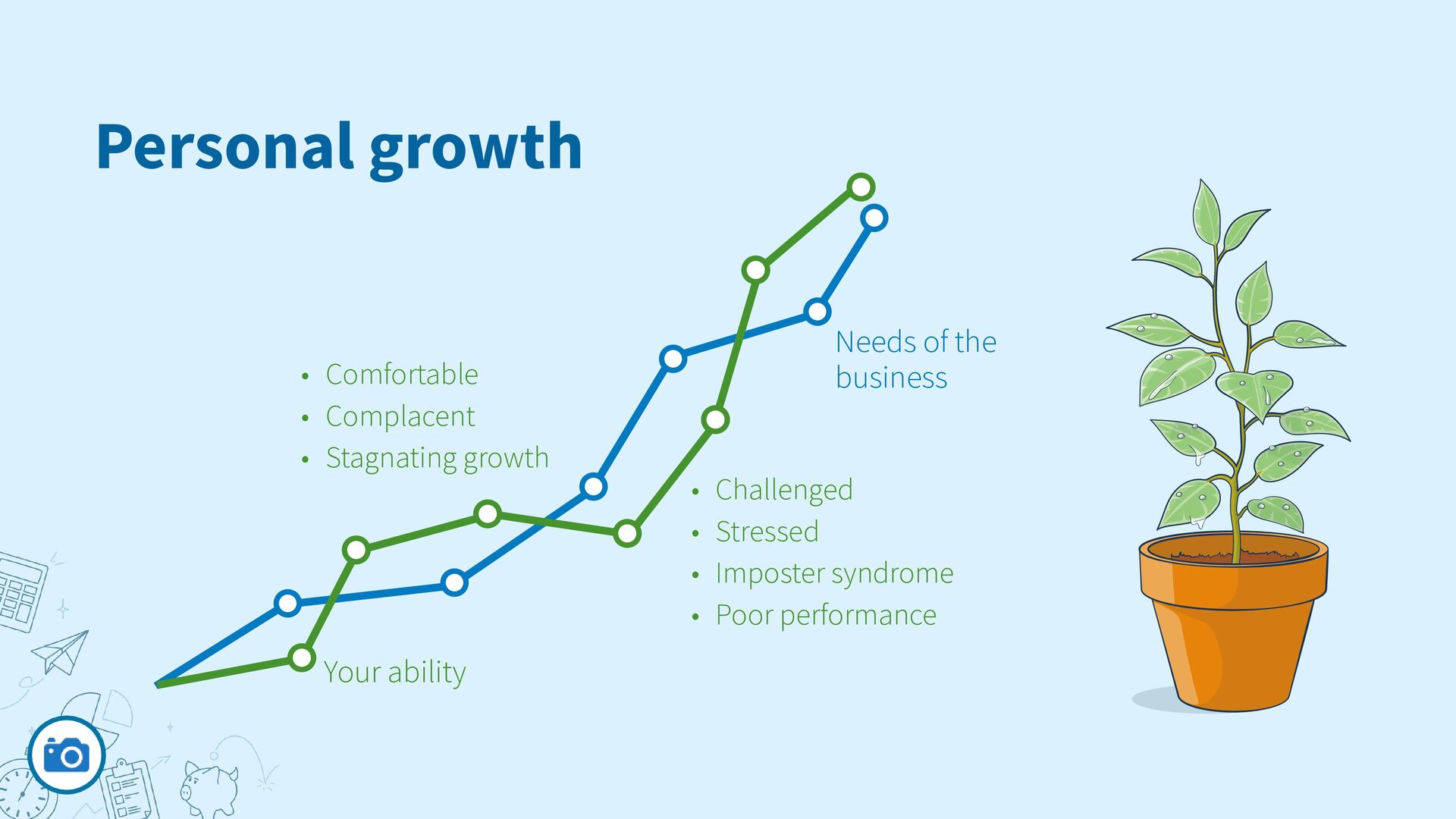
Now, you might think, oh yeah, business growth is really predictable, it's really straight line, it's really linear, but it's never going to work like that. There's going be times when your business feels like it's a bit of a rocket ship. Everything's taken off, everything's changing really quickly, everything's breaking, it's really disruptive, and are just going a bit crazy.
And then there's going be other times when maybe things feel like they're just coasting along, are plateaued and they're just like something ticking over. And of course what we'd like is that our own personal abilities and skills and experience to carefully match the needs of the business at any time.
But again, it's not going to work with that, right? There's going to be times when our own skills and abilities are maybe lacking behind what the business currently needs, and then there's going to be other times when our skills and abilities are maybe above that of what the business needs.
And what is it going to feel like, what is it going to do to your motivation in each of these two states? So if your current abilities and skills are way above that of what the business requires at that time, you're going to feel like in your comfort zone.
You're going to feel like you've got a good handle on things, everything's under control, it's ticking over quite nicely for you. But then if you stay too long in that situation, maybe you're going to start to feel a bit complacent, maybe you're going to start to feel a bit bored, and you know, maybe that idea about personal growth, maybe you're going to feel like you're stagnating a little bit.
Conversely, if your skills and abilities are way below the current requirements of the business, then you're definitely not going to feel in your comfort zone. You may feel overwhelmed, you're going to feel challenged, out of your depth, you may start to feel really stressed, this is where things like burnout might kick in, impostor syndrome, or it might not be impostor syndrome, you just might be genuinely **** at your job at that point.
Controversial, but there we go. But what I think is, again, it's okay to be in each of these states, in fact I think it's actually quite healthy that you spend a bit of time in each of these states over the course of a period of many years, because if you spend too long in either one of these, either being bored or complacent, or being really challenged and overwhelmed, that's when it's really going to impact on your motivation.
I think we were quite lucky in this regard, our free agent, and we had good growth as a business, we've had good growth over the years, but it was never mental, hockey stick, explosive, overnight, we had to triple the size of the business in twelve months.
It wasn't like that. And what I think that meant, at least speaking for myself personally, was it allowed me to mature and develop and level up my skills and abilities at a rate that was roughly comparable to that which the business needed at any point in time.
There was never too long where I felt, I'm pretty bored, not much happening here, and there was never too long where I felt I'm way, way in over my head on this, and it allowed my motivation to balance quite nicely in that regard.
So that was a little bit about personal motivation here. I want to broaden out a little bit to talk about motivating the rest of the organisation, something that's relevant to all sorts of leaders within a company. I'm going talk about goals in a minute, I'm going talk about purpose.
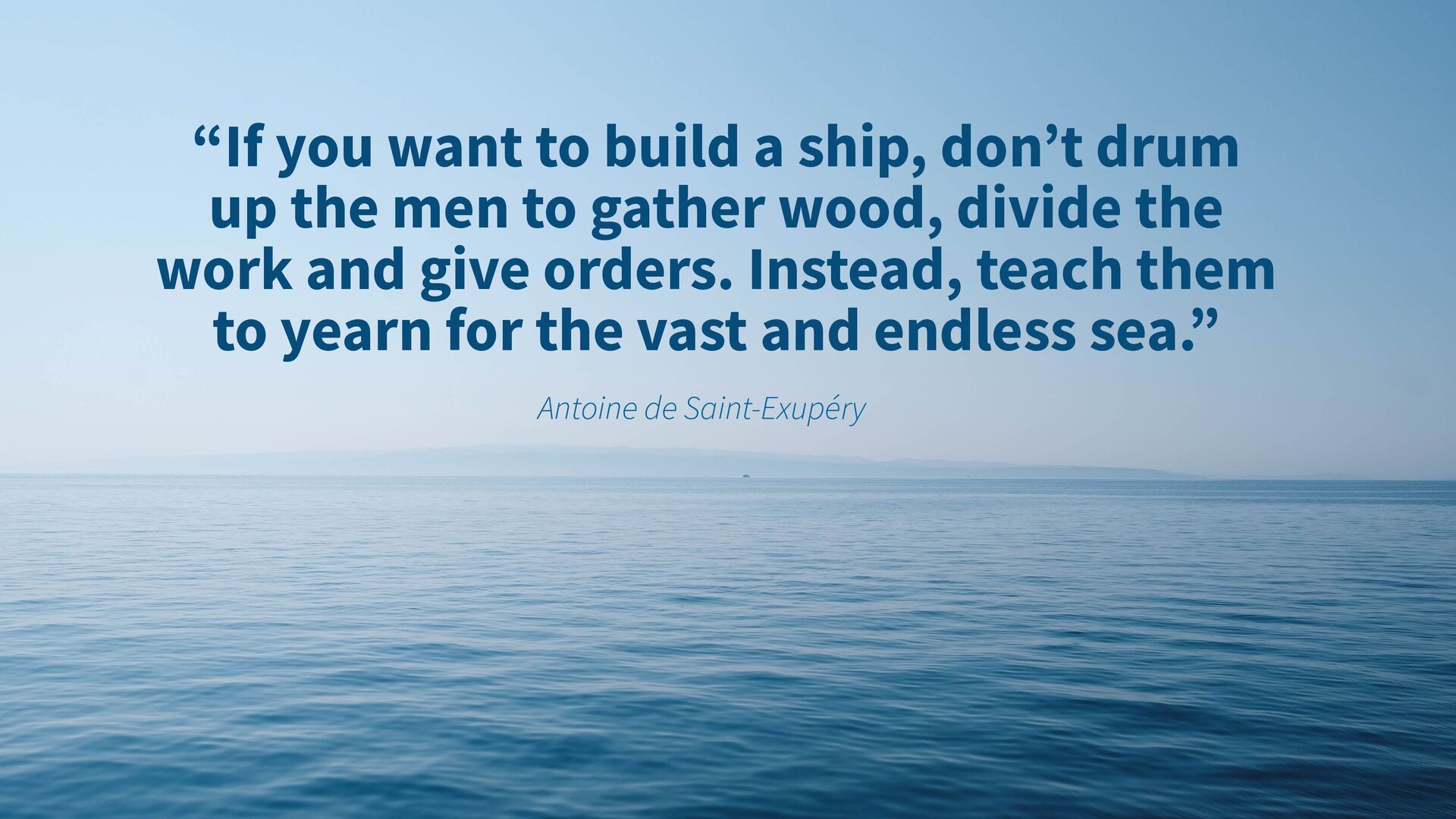
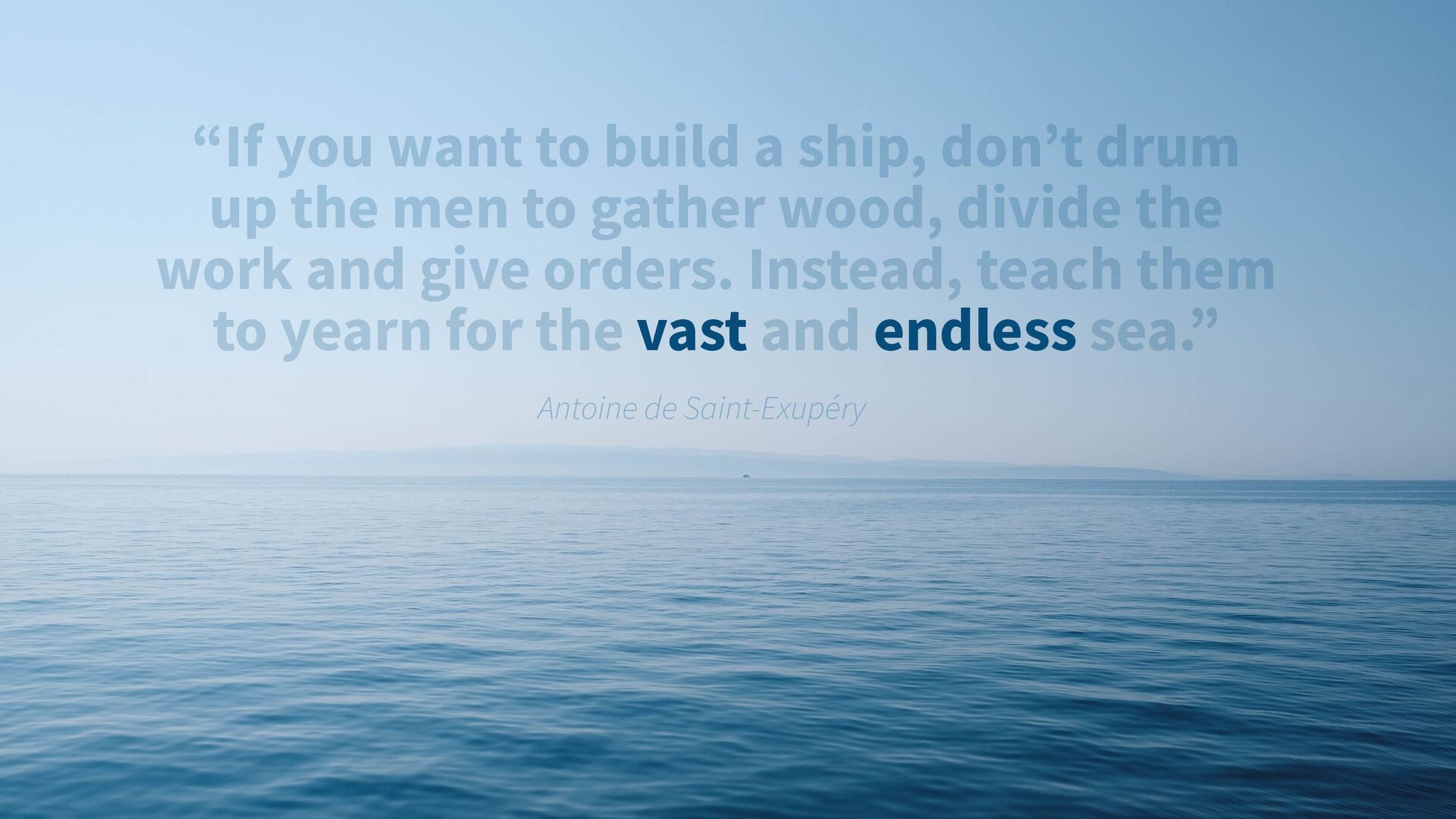
I want to talk, to begin with, about this point here, inspiration, and share with you one of my favorite quotes on leadership. It comes from Antoine de Saint Exupery, who was the author of The Little Prince, and he says, If you want to build a ship, don't drum up the men to gather wood, divide the work and give orders, instead teach them to yearn for the vast and endless sea.
I love this quote. It's really romantic, really evocative. What I really like about is there's two words in this quote that really make it for me, that really jump out, and that's vast and endless. What I really like about these words is that they very much fly in the face of so much of the language that we use on a day to day basis when we're running our companies.
Because when we're running our companies operationally, we're very sort of specific, So we talk about OKRs and KPIs and metrics and targets and we're smart and we're time bound and we're measurable and we're quantitative and we're very definitive about things. Here you have these two words that are just like, nah, Satorade and they're vast, they're immeasurable, unboundable, infinite, they're just beyond all of that.
And I think it makes you think about things in a slightly different way. It brings around to this topic, which I'm endlessly fascinated about, and it's about language and how the words that we use and the phrases that we use on a day to day basis quite quickly constrain the topics and discussions that we have.
Most of the time that's in a good way, it's a useful thing, right? We develop a common language, a common understanding of a problem or a topic that helps us collaborate and we're working on it together. But sometimes I think it could be unhelpful and can not be useful.
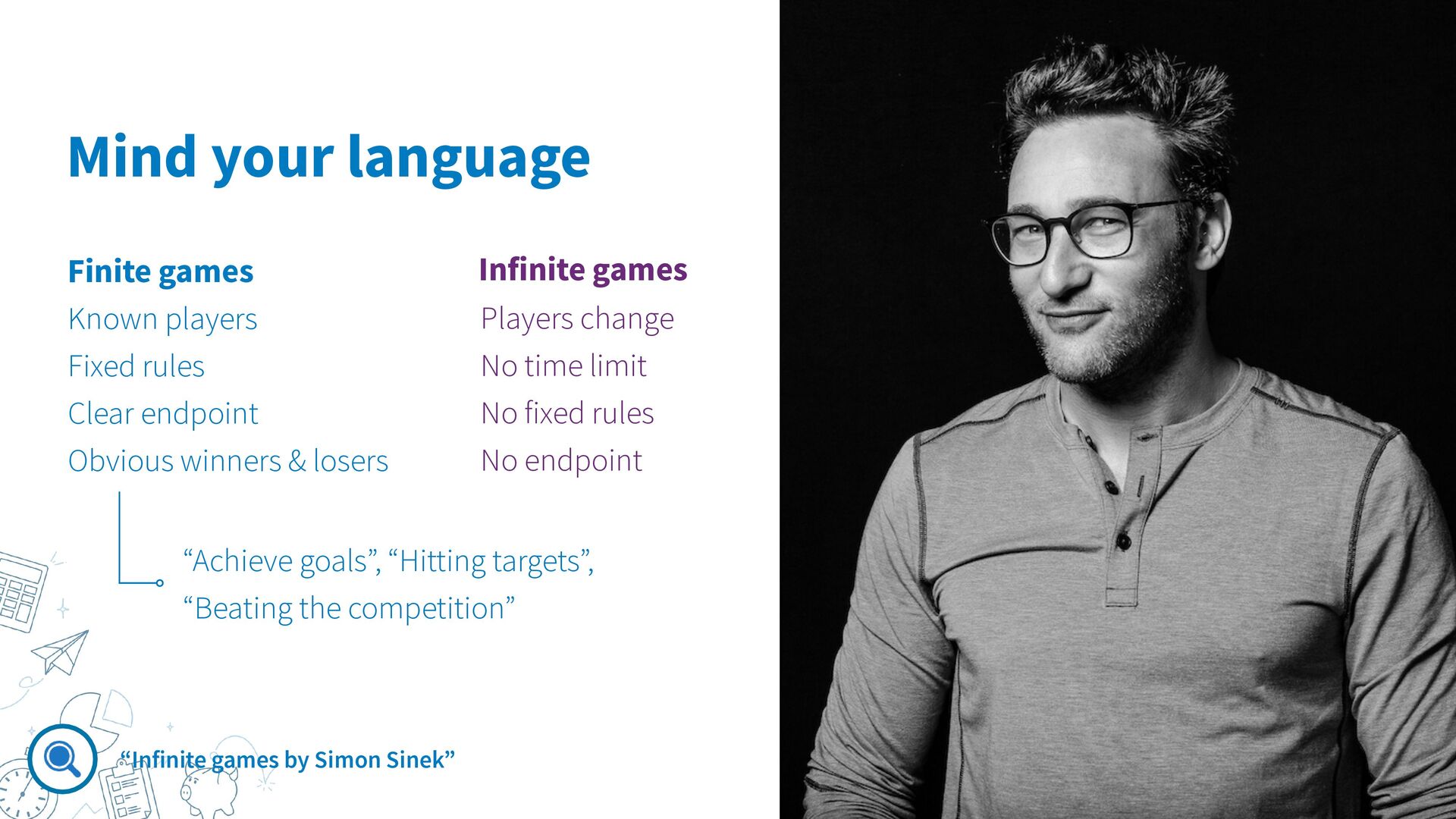
Now you may know who this guy is, Simon Sinek, very famously wrote that book Start With Why, which is all about how to motivate a company. He also wrote another one, a later one called Infinite Games, and in this book he says that there were two different types of games that we can play.
There are finite games, and an example of a finite game is like a sport, so an example would be a football match. And in a football match there are known players, so you've got eleven players in each team, you know exactly who they are.
There are clearly fixed rules in a football match, there's a clear end point, ninety minutes, maybe a little bit of injury time, and at the end of it there's an obvious winner or loser. You have a draw in football, but you get the idea, right?
But he said, Then there are other things called infinite games, and business is an example of an infinite game. Now an infinite game, there aren't any known or fixed players. The players change all the time. So new players join the game, new startups join the market, and other ones fall out of the market, so companies go busted, go under.
So the players are constantly in flux. There's no time limit. There doesn't get a point where it's like, okay, that's it, business is done, everybody go home. Doesn't work like that. It just keeps on going as long as you've got players in the game, in the market.
There are no fixed rules. It's not like everybody gets the same amount of money at the beginning, it's just who uses it the best. It doesn't work like that. And finally, there's no end point. There isn't this point where you add up the score and then the loser says, Sorry, I've got to fire everybody now.
It doesn't work like that. As long as the companies are still going, the game still keeps playing. So we all understand this, right? We intuitively all understand this stuff. But then, so much of the language that we use in our companies on a day to day basis is framed in this sense of these finite games.
So we talk about achieving goals, talk about hitting targets, we talk about beating the competition. But what does it mean to beat the competition? Beat them when? This week, next month, next year? As long as they're still going as a player in the game, you haven't beat them.
It goes into one of the things that think is quite interesting, which is how quickly the language constrains our views on things. And goals is another example of this. I want to talk about goals a little bit more, because I have a little bit of a love hate relationship with goals as a leader.
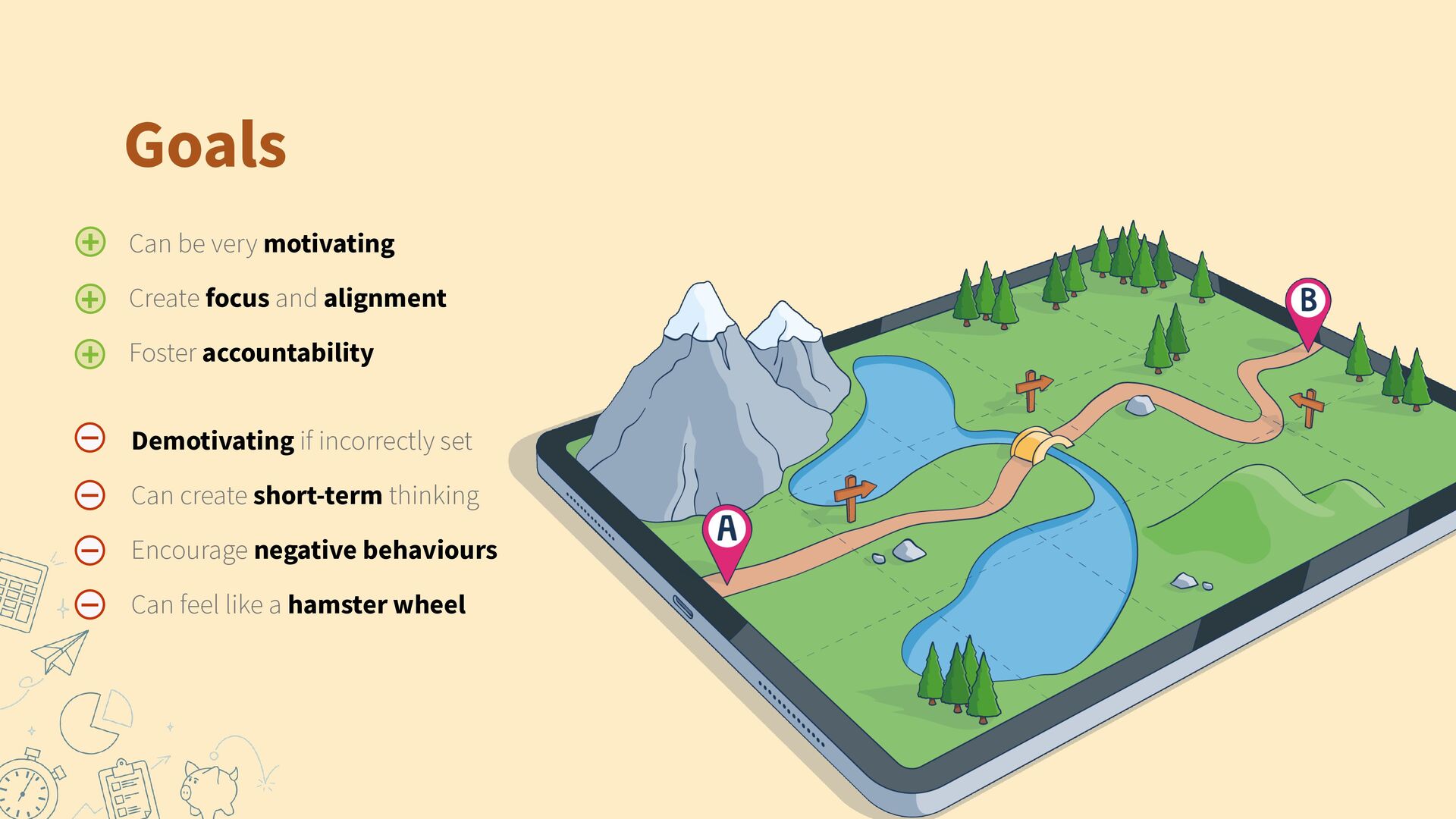
On the one hand, they can absolutely be super motivating and a helpful tool as a leader to motivate your organization. So you say to the company, Right, everybody, this is what we've got to do, we've got this really important thing that we've got to achieve, let's get everybody behind it, let's all go for this and we're going to do it together, and they could be super helpful in creating that sense of focus and alignment.
So everybody's working together, they're collaborating well, communicating well, because everybody knows what the common objective is. And they can also be really useful at fostering this sense of accountability, something that Maria talked about yesterday. Let's hold ourselves true to what we say we're going to do.
So really good, very very positives there. But what I've definitely observed is that when goals are used incorrectly they can be very demotivating. So as a leader, if you're consistently setting over ambitious or unrealistic goals or targets, and people are consistently failing to achieve those, then that will actually have a very demotivating effect over time.
They can also create quite short term thinking. So if you've said to me, Listen, the only thing that matters is this H1 target, then are people going to be missing the long term views or options that are out there, or are they going to be missing stuff that's out to the side because they've got the blinkers on and are just so myopically focused on achieving this short term goal?
Potentially, they could encourage negative behavior if people are incentivized around achieving goals. The obvious example there would be sales targets and sales commission, but I don't think that's the only one. Many of us within our organisation probably use career progression frameworks to manage levels and promotions within our organisation, but if it gets to the stage where people would just think those as I've just got to tick these boxes in order to get my next promotion, is that actually going to end up encouraging the behaviors that you want as a leader?
Maybe not. Finally, I think there's this idea of you're constantly going from goal to goal, quarterly OKR to quarterly OKR, is that just going to feel like you're on a bit of a hamster wheel? Just like, Oh, it never ends, it never stops.
Is that going to lead to things like burnout? I don't want to take away here to be like, Ron says goals are bad, don't use goals, because that's not what I'm saying. Goals can be very useful and very powerful tool in your arsenal as a leader, but just like alcohol, I think you need to use them responsibly.
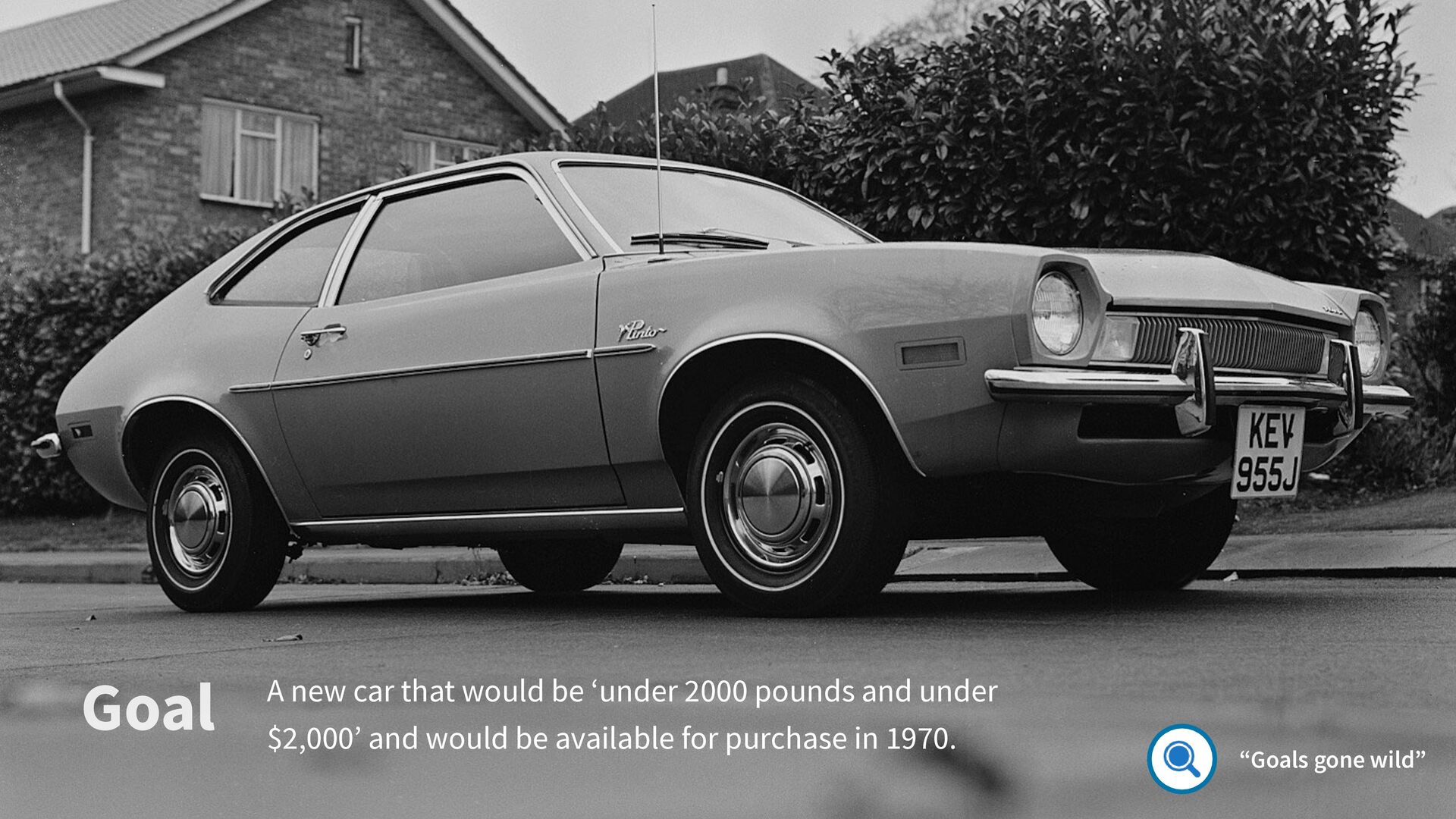
That's the kind of takeaway I want to have here. I think they can have sometimes some negative consequences. I want to share this story with you, and it comes from the 1960s, the car market then, in America, which was undergoing quite a period of rapid change, and Ford Motor Company realized that they had to respond to changes in the market.
So, the CEO of Ford said to the company, Right, folks, we've got this really ambitious goal that we want to achieve. We're going to build a new car, and it's going to weigh under two thousand pounds, and it's going to cost under two thousand dollars, and it's going to be in the market by nineteen seventy.
I think it was actually in nineteen seventy one it got released, which at that time was the fastest a car had ever been taken from concept to production. So Ford Pinto, you can see here. That's a really nice looking car, right? There was one problem.
This thing basically burst into flames anytime somebody drove into the back of it. Dozens of people were killed in car accidents as a result of this unsafe vehicle beyond the road. Now the safety concerns of this vehicle were actually well understood all through that process of construction, but they were ignored or they were overlooked or they were swept under the carpet.
There's a couple of reasons for this. Clearly, the culture of the organization was really important, one where people didn't feel they could speak back against management, they didn't feel they could go against some of the things that management were saying, but it was to do with the goal as well.
The company had been told, We have to achieve these things at all costs, nothing else matters, just this thing. And it led to this real tragedy of human life as a result of this. So again, it's not to say that goals are bad, we just have to think about using them responsibly.
If you Google that term, goals gone wild, there's a fascinating paper where it talks about this example in more detail, and other examples from industries like the banking industry as well. So, if one of the risks of using goals is that they can potentially create a little bit of this sort short term thinking, What are some of the longer term or perhaps more enduring ways that we can instill a sense of motivation within our organisations?
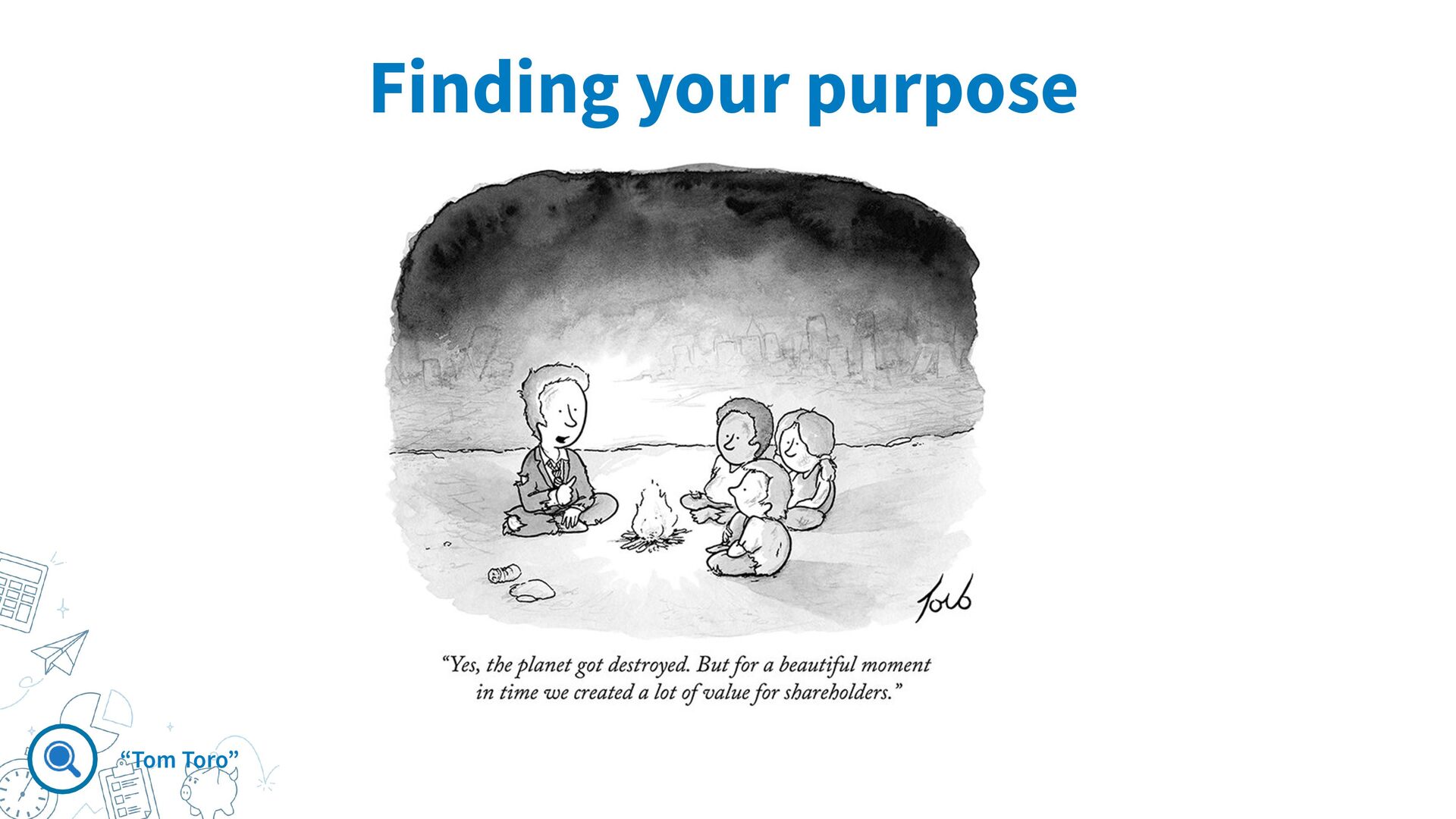
And I think one of them, which I think has come up a few times over the last couple of days, is purpose. Anybody seen this cartoon before? Yes, the planet got destroyed, but for a beautiful moment in time we create all value for shareholders.
Certainly relevant probably because of the weather that we've had over the last few weeks. Now this is funny, right, okay, and it speaks to the cynicism that perhaps many of us have about late stage capitalism, but the thing is it's also not really true, don't think.
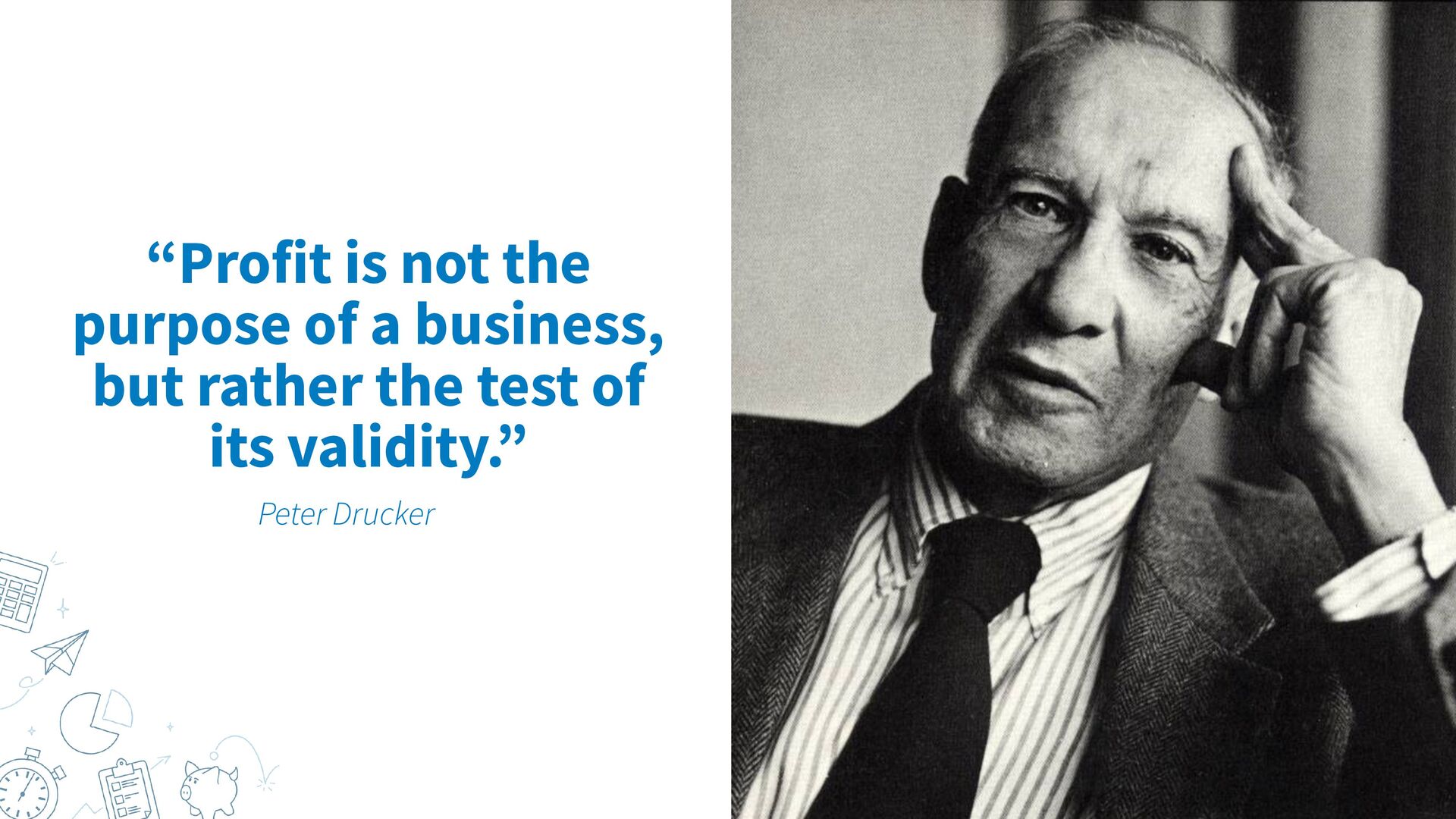
I think even the most hardened capitalist doesn't really think in this kind of way. There's a great quote from Peter Drucker, he says, Profit is not the purpose of a business, but rather the test of its validity. I really agree with this, and I think profit is important in companies because it's the ultimate litmus test for the sustainability of the business that you build.
Are you building something that's going to last? But in and of itself, it's not the purpose of your business. So how do we understand that, how do we understand purpose? I think something that Brian mentioned when he opened the conference yesterday, purpose can be something which is from a business perspective and also from a personal perspective something that can be quite elusive.
So I think it's really interesting, don't know if you had this experience, sometimes you meet people who've just got this amazing sense of purpose, they've got this amazing sense of what it is that gives their life meaning, what drives them, what motivates them, and I think that's incredible.
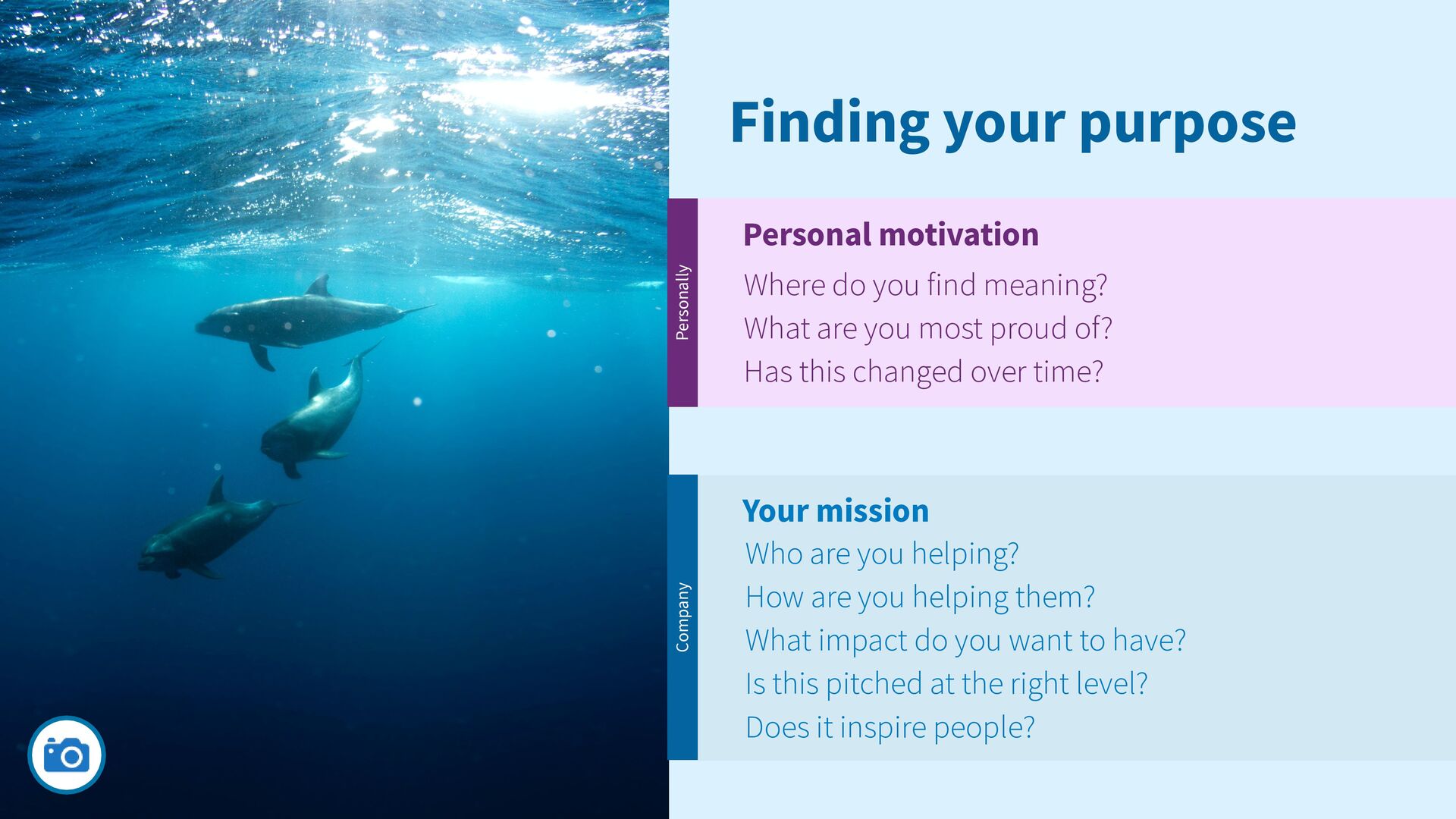
But for many of us, myself included, it wasn't always that obvious, was just, what's the meaning of your life? It's not always clear to us what the meaning and purpose of our life are, but what I have figured over the years is that there's a few questions that we can ask ourselves that help us understand this a little bit more.
And there's this second one here in particular, which has been really useful to me, and that's what are you most proud of? So just ask yourself that question just now, what are you most proud of in your personal life and your professional life?
Now this is something that, as a founder, I've been asked a bunch of times over the years, which has kind of forced me to think about it a bit more. And in the early days, I would always give the same answer to this question.
I would say it's a product that we built and the impact it has on our customers' lives. And that's a good answer, know people were saying we're pretty happy, yeah good answer, and the added advantage of actually being true. But what I've also realised is that over the years my answer to that question started to change.
Now today, I'm still super proud of the product that we make and the impact it has on our customers' lives, but if you ask me today what am I most proud about? It's probably the company that I've been a part of building. That's a little bit weird to me because I'll be totally honest with you.
In the early days I didn't really care about the company that much. I knew we needed people and teams and processes and chairs and desks and all that crap, but I wasn't actually that interested in building the company. All of that stuff was just a means to an end to build this really cool product and get it out there and see the impact it had on customers' lives.
But I don't feel like that now. Now, what I think my legacy will be, when I'm going to an old folks home in twenty years' time or whatever, and I'm looking back, it will be the company I was part building, somewhere that was a really great place to work, somewhere where I could see other people developing, I could see other people thriving as well.
That's what I feel most proud of. That's really been a journey, it's really been something that's changed a lot for me. And this is what I think is important, that you ask yourself this question over the years, If you're starting out in this journey with other co founders, you need to have that conversation with your co founders as well.
So early on, sit down together and say, Listen, what are we trying to achieve here? What are we trying to get out of this? What would personal success look like? What would personal meaning and purpose look like this? And have that conversation early, but you also need to keep on having that conversation over the years, because the company is going to change, the world is going to change, your personal life, your personal circumstances are going to change.
So with all of this stuff changing, it would be crazy if your sense of purpose and meaning remain the same through all of that. It's not, it's going to change. So you need to keep on having that conversation with your co founders to make sure you're still aligned.
If you're not, then you need to have a conversation about what you're going to do at that point. If you have these conversations with your co founders, you've got a good sense of that yourself, there's always then to think about how do we instil and communicate this sense of clarity or purpose with the rest of the organisation?
Think that fundamentally what you have to rethink about here is communicating three really important things, and that's who are you helping as a business, how are you helping them, and what impact do you want to have. Typically these things get codified, get articulated into mission statements, we've got one at FreeAgent, it's to make micro businesses happier and more successful by putting them in control of their finances.
You can see it ticks the boxes of all the things that we've got here. I think the really important thing about this is that you need to pitch it at the right level. So if you pitch it at too low a level, like for us that would be like make awesome accounting software, it's too prosaic, it's too mundane, it's not really going to interest anybody, it's not really exciting enough.
But if you picture it too high a level, like make the world a better place, it's not specific enough to what it is that you're trying to do as a business. How is your company different from all the other companies out there? How is your company different from your competitors out there as well?
What is your unique character, what is your unique DNA that makes you special? Because that is what is going to inspire the people in your organisation. Really that's just the point I want to leave you with. I could think that beyond this hamster wheel of quarterly OKRs and targets and OKRs and metrics and KPIs and all of this stuff, what really motivates most of us is a desire to help people and make the world a better place in some way.
I do believe that that is the vast and endless sea that most of us are yearning for, and it's our role as leaders in organisations to help our company and the people within those companies navigate towards that. Thank you for coming to my Turing Talker.