
Making tough prioritisation decisions is a constant challenge for anyone involved in building products. One of the hardest is the need to drive growth for the business vs building lasting product value to keep customers happy. In this talk Roan, will draw on over 10 years experience of founding and scaling FreeAgent, an online accounting product with industry-leading customer satisfaction scores, to discuss a pragmatic framework that allows for a balanced approach to these sometimes competing priorities.
← All talks 

Build Product Turing Fest 2018
Driving Growth vs. Building Core Value
Auto-generated transcript - may contain errors. Tap a timestamp to jump the video.
Great. Hi there, everybody. How are doing? My name is Ron Ravary. I'm one of the cofounders and the chief product officer of FreeAgent. And I I want to talk to you today about why I think one of the central challenges that all product teams face, and that's our desire to be building out the core value propositions of our product versus the need to drive growth for the business.
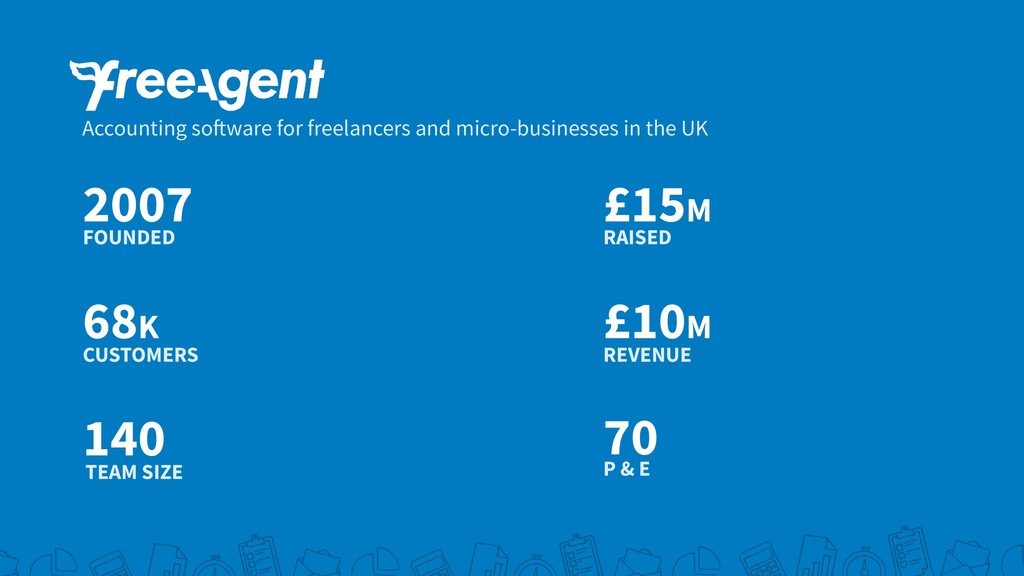
So just before I get into it, I'll tell you just a little bit more kind of about FreeAgent, if you don't know who we are. So, yeah, as we said, we make online accounting software for freelancers and micro businesses in the U. K. Right?
So we're based here in Edinburgh. Our office is just about five minutes down the road. We were founded the company in two thousand and seven. So we've been around for a little while now, it's kind of over eleven years. In total, we've raised about fifteen million pounds in that kind of time, which I used to think was a lot of money, but it turns out that's about the average seed round these days.
And we raised that from a variety of places. We did some angel investment in the early days, we did some strategic investments, some debt, we did a round of crowdfunding. We actually took the company public in twenty sixteen, and we were acquired about three months ago by RBS.
So that's new. We've got about sixty eight thousand paying customers, kind of most of them here in the U. K, and we're doing about sort of ten million dollars in revenue each year. So company wise, the team's about one hundred and forty in total, and about half of that is in what we call P and E, which is product management, engineering, product design and user research.
So, you know, we're not a small company, right? We're not an early stage startup. But this challenge that I'm talking about is one that I think all businesses face regardless of what stage that you're at. So, you know, you probably find some of these things are familiar.
And if you're a big company, then maybe you're hearing them from different teams and departments within your organization. And if you're just a really star now and you're really small, maybe these are just all the variety of thoughts are whizzing through your head at various points in the day or night.
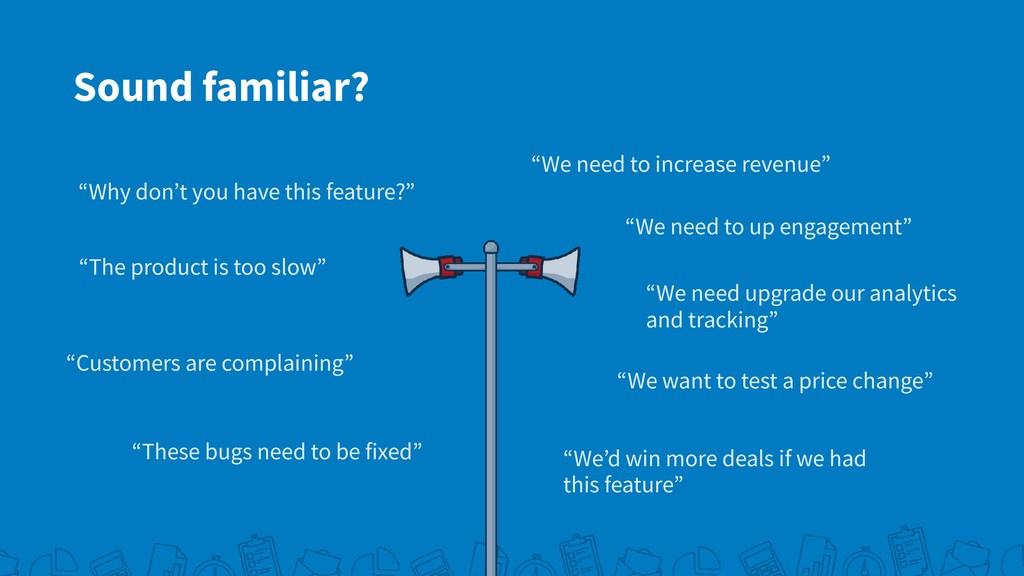
Or maybe you're just hearing them for your customers. So they may be saying, Why don't you have this particular feature? The product's too slow. And then you've got your CEO and your CEO is saying, Oh, no, we need to up revenue or we need to increase engagement.
Or maybe your customer support people are saying, People are complaining about this particular part of the product or the product in general. Or your engineers are telling you that these bugs need to be fixed or we need to be investing in a technical platform.
Or you've got the marketing folks in there saying, We need to be doing more on tracking and analytics, or We need to be doing some pricing packaging changes. Or you've got your sales guys who are saying, We need to do this new feature or we need to do this custom development work in order for us to win deals.
So there's all of these different competing requests and priorities that are kind of going on for all of the businesses that I'm sure you're involved with. And there's different types of things going on here, but broadly, I think we can lump them into one or two categories.
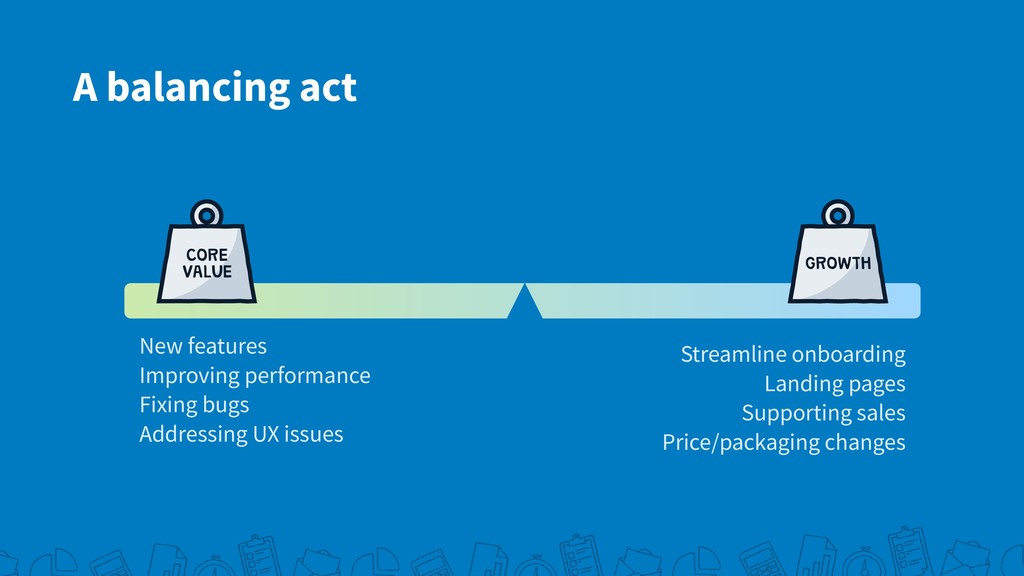
And that's investing in the core value of our product versus the need to drive growth, typically short term revenue growth, for the business. Now, so full disclosure at this point, I'm a product guy, okay? That's where my kind of like heart is. And I'm sure if you're in distracting, a lot of other people are too.
I would love to believe, and a little bit me still does, that we don't have to worry about the growth stuff, okay? That all we need to do is build an amazing product, and that would be enough. We just build an awesome product, people find it, they love it, they tell all their friends and their granny, she uses it as well, and then before you know it, we're all licking our chops in easy street.
But unfortunately, experience has taught me that that isn't always the case. And so we do need to invest in growth. And obviously, we have marketing and sales teams that are kind of specialists in that area, but as product teams, we also have quite a big contribution towards that as well.
So we do things like, you know, streamlining our user onboarding journey or maybe it's creating landing pages to support a marketing campaign. And maybe it is supporting sales and deals by doing some custom development work or maybe it is these sort of price and packaging changes.
But what I do know is that if we're exclusively investing in that sort of stuff, then we're not going to be investing in the long term sustainability and success of our product. So that's when we've gone to things like obviously building new features or improving existing features.
So maybe about improving the performance or the reliability of the product, about fixing bugs and paying down technical debt, or maybe just be about addressing usability or UX issues, okay? And what gets done? What gets prioritized by these two things? Well, that can depend on a bunch of stuff.
You know, maybe it's just who shouts the loudest in your organization. Or, God forbid, maybe it's just what the CEO wants. You know, it's not without our company, obviously. You know, but as a product manager sort of stuck in the middle of this, it can be really frustrating.
It can be really frustrating for the product teams that are responsible for this as well because they're not always sure about their priorities at any one time and there's not enough clarity. But can also be really frustrating for the other stakeholders in the business because they don't understand why decisions are being made and why maybe their thing isn't, you know, top of the list.
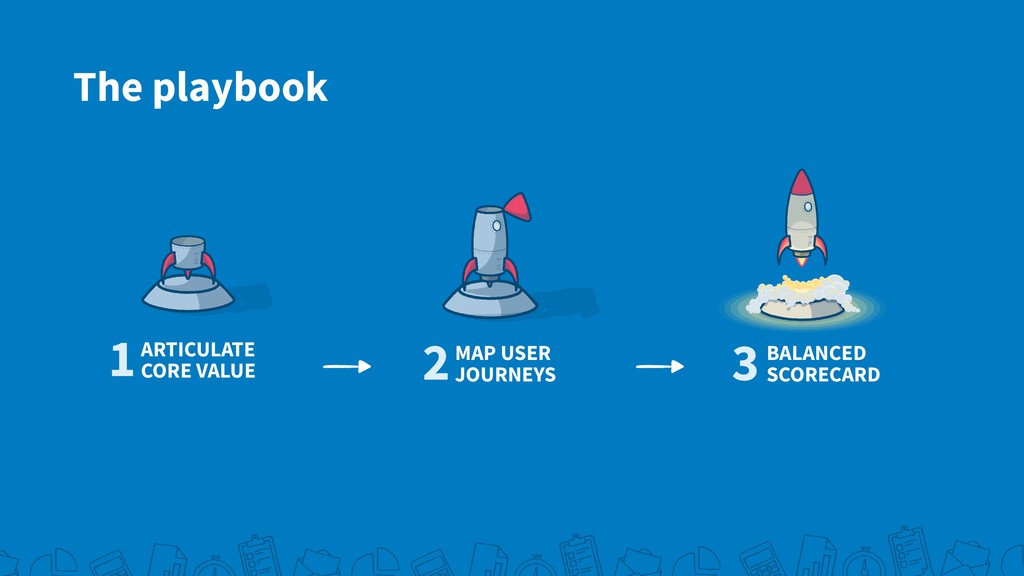
So what can we do about this? What I'm going do is I'm going to introduce you to some of the tools and the processes and frameworks that we use at FreeAgent in order to help us balance these sometimes competing priorities. So I'm going to call this a playbook.
I'm going to call it a play, largely because that's what all the cool kids seem to be doing these days. I kind of noticed that, you know, everybody seems to have to sort of have their playbooks. You can't just sort of get up and have your breakfast and brush your teeth.
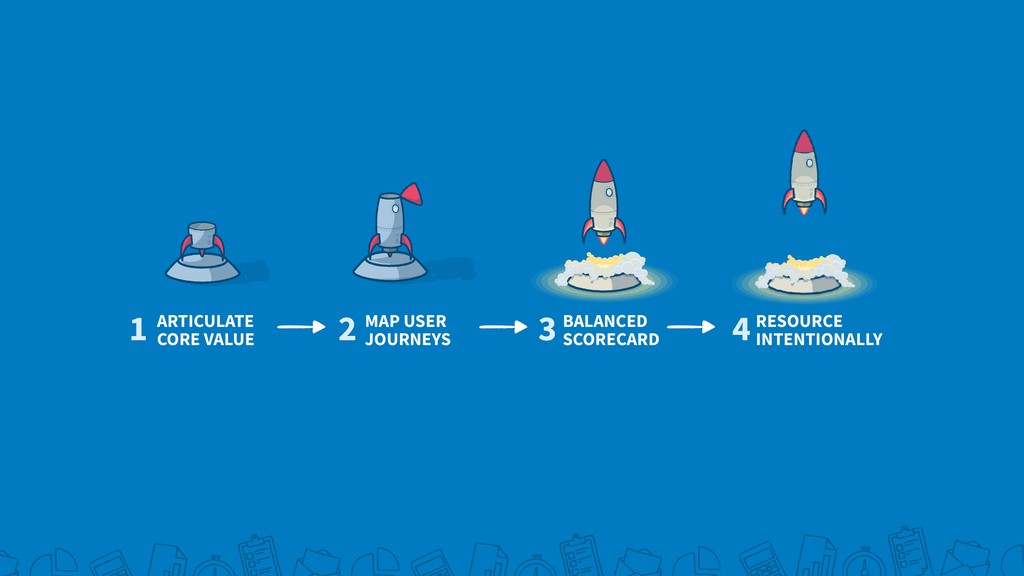
You've got to like run your morning playbook. So this one's ours. So we're going to start off by articulating the core value. I'll touch on what I mean by that in a second. Then we're going to think about how we drive growth by engaging our users with that core value in our product.
And then finally, we're going to create this thing called a balanced scorecard of KPIs and metrics, which is going to tell us how well we're doing at both of those two things and ultimately allow us to make decisions about prioritization. Sounds good, right?
Okay, so now just one caveat before I get into this stuff. With a little bit of luck, at the end of this presentation, you're going to think, Wow, these guys really know their ****. Please don't be fooled, okay? Everything that I'm going to present here is really hard and it's really tough, okay?
You're not going to get this right first time, and we certainly don't. We still struggle with this stuff on a daily, a weekly, and frankly, emotional and spiritual basis sometimes. Okay? So this, honestly, is genuinely hard stuff. Also, I'm going to cover quite a lot of ground in this presentation, so I'm going to skim over the top of some fairly substantial topics.
What you'll see is in the bottom right hand corner of the slides, for some slides, I'm going put some search terms. If you're interested in finding out more about that particular topic, take a photograph of the slide, Google that sort of term, and you'll find articles and resources which we'll kind of dive into in a bit more depth.
So that's that. Okay. Let's start off with step one then, articulating the core value. And you may say, Well, okay, so what is core value? I know what my product does. Obviously, I understand what my product does. But I'm not really talking about what your product does so much as what value it brings to your users and your customers.
Ultimately, I'm talking about what it means to people. So it's not really about the features or even the sum total of your features, but what those features allow your users and customers to do. Now, obviously, the best way of finding this out is to go and speak to them, and I hope that we're all doing that.
Listen to them, find out about their businesses or their lives, find out how they're using their product. But even when you've done that, there's still a piece of work to do to bring that insight back into the organisation, articulate it and communicate in a way that builds a shared understanding of this across your whole organisation and allows your product teams and everybody, frankly, to sort of rally around this.
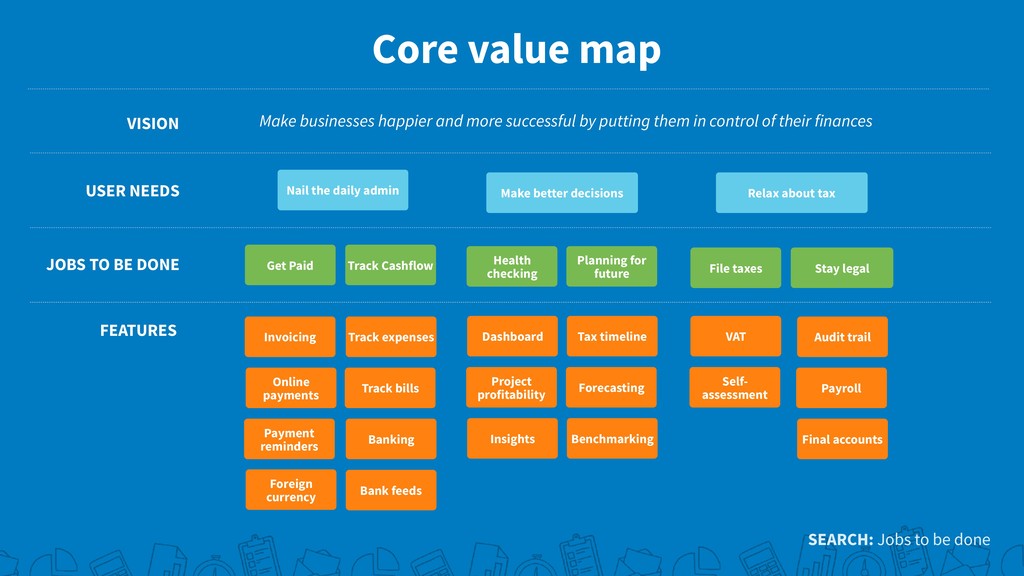
So one of the tools that we use at FreeAgent is something called a core value map, and it's really useful. And what it attempts to do is to join the dots all the way up from your highest level vision as a business all the way down to the granular individual features.
I'll kind of walk you through it, okay? So we're going to start off with a vision. This is ours, which is making businesses happier and more successful by putting them in control of their finances. So this is our why. This is our reason to exist.
Now you'll notice there's nothing in here about software or accounting software or anything like that. It's much more lofty, it's more ambitious. But we then say, Okay, with this vision in mind, what user needs do we believe we need to be meeting in order for us to think we're succeeding at our vision or at least heading in the right direction.
So, you know, this actually took us quite a long time to articulate these so succinctly, but these are the three user needs that we have. So we want to be helping people to nail the daily admin. We want to be helping them to make better decisions about their business and we want to help them relax about tax.
So we believe if these three user needs are being met, then our customers will be in control of their finances and they will be happier and more successful as a result. So these are really powerful as a communication tool throughout the business, but they're not amazingly specific.
They're probably not granular enough to be actionable on daily basis. So this is where we have to take it on one more level to the jobs to be done. Now, if you're not aware of the jobs to be done framework, I highly recommend you kind of look into it.
Essentially, it says is that nobody actually wants to use your product. They merely hire your product in order to be able to achieve some set of outcomes or goals. The classic example is people don't want to buy drills, want holes. Okay? So this is a kind of a jobs framework.
So looking at our jobs and taking them down from those higher level user needs, we see some of the jobs around nailing a daily admin are things about getting paid. Obviously, that's a super important part of running a small business. But it's also about tracking cash flow, understanding money in and money out.
And the making better decisions, it's about understanding how healthy my business is right now. It's also about planning for the future. And on the real acts about tax, well, that's about obviously filing taxes, which you can do through free agent, but also about staying legal.
You might think that sounds like quite a weird job, you know, stay legal, stay out of jail. But when you ask people, How important is it that you don't go to jail? It turns out that's pretty important. And then finally, say, Okay, with these jobs in mind, how do we need to break it down to the individual features that will allow people to do all this stuff?
So getting paid, obviously, that's about sending invoices. It's about getting paid for those invoices. Maybe it's about chasing late payments. On the cash flow stuff, it's about tracking money out of the business in terms of expenses and bills. And these last two I'm going to touch on as well, so the banking and the bank fees.
So we have this really important feature in FreeAgent where you can connect your FreeAgent account with your online bank account. And once you've made that connection, it sucks in transactions on a daily basis and it builds up this real time picture of your cash flow, showing you the money in, money out.
I kind of mention that because I'm going to come back to it a few times kind of later on. And you can see a bunch of the other features that we've kind of got in there. So this is, as I say, it's a really useful tool for building that shared understanding of the core value of your product, all the way down from those individual features back up to the fundamental user needs through the jobs and then how that all kind of represents your vision as a business.
So it's really useful. But obviously, this represents some idealised end state. There's probably none of your users, none of our users that really even use all this functionality or even know it exists. So I'm constantly speaking to customers and they're like, Rowan, you need to build this feature.
And I'm like, Dude, we built it up five years ago. And this is like, it's just natural. People are not always going be aware of all the things that the cool stuff that your kind of product does. So there's something that we need to do here, and that's we need to understand how people discover this core value, which takes us to the second part of the playbook, which is mapping the user journeys towards that core value to help them discover and experience it.
And essentially, the question that we're trying to answer here is how do we enable our customers to get it? Okay. So before I go into the kind of user journey maps, I want to just briefly kind of talk about growth. So we've got a growth track that's kind of going on today, and there's going to be some great speakers and great talks about growth.
And there's going to be different theories and strategies and tactics for how you kind of drive growth within your organisation. I said before that I'm unapologetically a product person, and this is an unashamedly product perspective on how you do growth, Okay? And it's something, as a product guy, this resonates with me, okay?
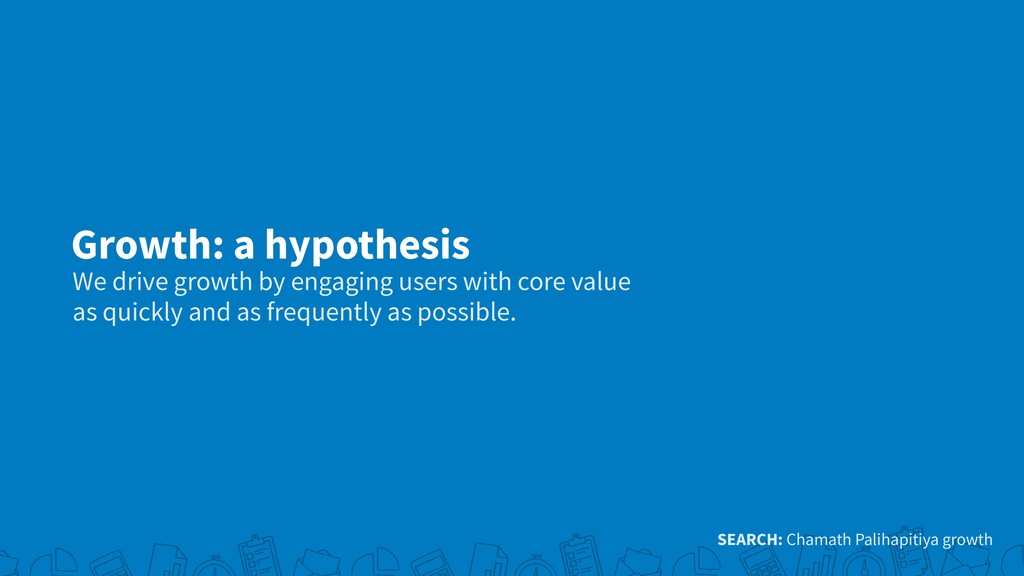
And it comes from this guy called Shmoopalapatayah, who's one of the original growth people at Facebook, a super smart guy. And their initial thesis, their hypothesis for growth in the very, very early days of Facebook was it wasn't about sort of going viral or it wasn't about growth hacks.
They said, No, we're going to drive growth by engaging users with the core value of our product, which for them was adding friends as quickly and as frequently as possible. Now, as you all kind of know, FakeSweet has got about two point three billion users now, so it worked out pretty well for them, okay?
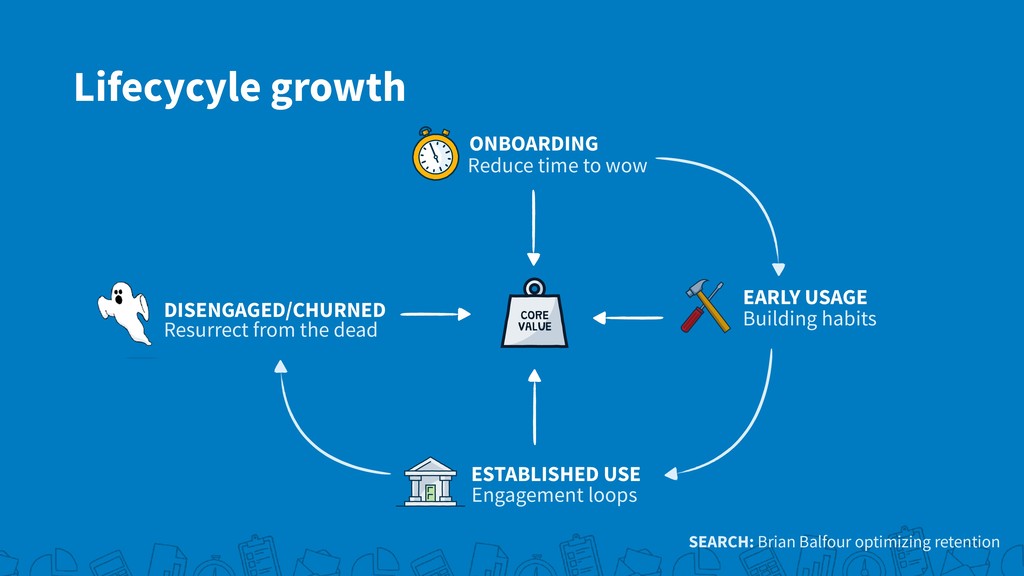
So we're going to use this theory and understand, now we have that core value in mind, how we can map the user journeys to understand how our customers are going to experience it quickly and frequently. And we're going to do that through the entire life cycle of our customer usage of our product.
Now, the obvious point that springs to mind when I talk about this stuff is that initial phase, that onboarding phase. So we are kind of like SaaS product. We have here kind of classic thirty day free trial. And this is the point where it's really important that we are able to engage our customers in the core value product because we want to convert them into a paying customer.
So this is all about reducing the time to wow, that kind of light bulb moment. I'll go into this in a little bit more depth. But it's not just about the onboarding phase. It's about every phase in the life cycle. So even when somebody's become, you know, maybe a paying customer and they're in that early usage period, it's absolutely crucial that you start to build habits around the core value of your product.
The early usage period, that's typically when your churn is going to be the highest. So really at that point, it's all about trying to retain your early customers. But what you also find is that this is the kind of honeymoon period as well, and this is the time in which people are most likely to refer your product to one of their friends.
So investing in this area and getting people engaged with core value will reduce your early churn and will also increase your referrals, and that's how you're going drive growth there. But that job doesn't stop when you get into the established phase as well.
And now you really are thinking about trying to keep up engagement and trying to reduce churn and retain those people. So it's about trying to engage people through something called engagement loops. If you do search for that term, there's some really great resources and articles in that.
And then finally, we get into the period where unfortunately, maybe that user is becoming slightly less engaged or disengaged or maybe they've even churned altogether, but we don't want to kind of lose them completely, so we want to try and resurrect them. We want to re engage them back from the dead again, by trying to engage them with a core Viver product.
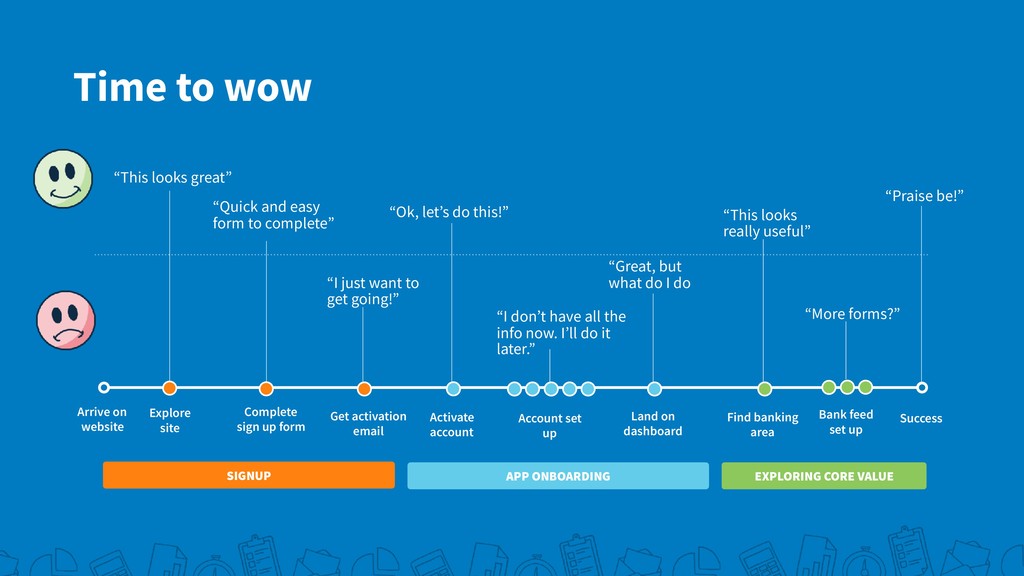
So I'll kind of show you an example of that. So I'm going to focus on that early onboarding phase that I kind of talked about. So this is a user journey that one of our potential user would go on at FreeAgent, starting off with the very, very early sort of arriving on a marketing website, all the way through exploring the website, signing up for a free trial, getting into the product, setting up the product and then finally exploring the core value.
And the point we're trying to get them to at the end there, the success, that's the feature that I mentioned about setting up the bank feeds, so connecting it to their bank account, because we know that's a really fundamental part of the core value.
And what this map does is, obviously, it maps out all the touch points along that journey. Now, some of those touch points are fairly good things and fairly positive experiences and some of them are fairly frustrating and negative. But you can see that the first thing is there's actually quite a lot of them going on here.
So we can now look at this user journey and we can say, How are we going to optimize this in order that we drive growth? So one of the things that we've done is you see this sort of step here where it says, Get activation email.
So when you sign up for a free trial, a free agent, you fill in the sign up form, you hit the submit button, and we send you an email. And you have to go into your inbox, find that email, open it up, click on a link and it takes you back into the product and you can set up the account from there.
I'm sure you're looking at lots of got the same thing. But from looking at the data, what we could actually see was about ten percent to twelve percent of our users were dropping out at that particular point in the funnel. Was actually quite a large percentage of people.
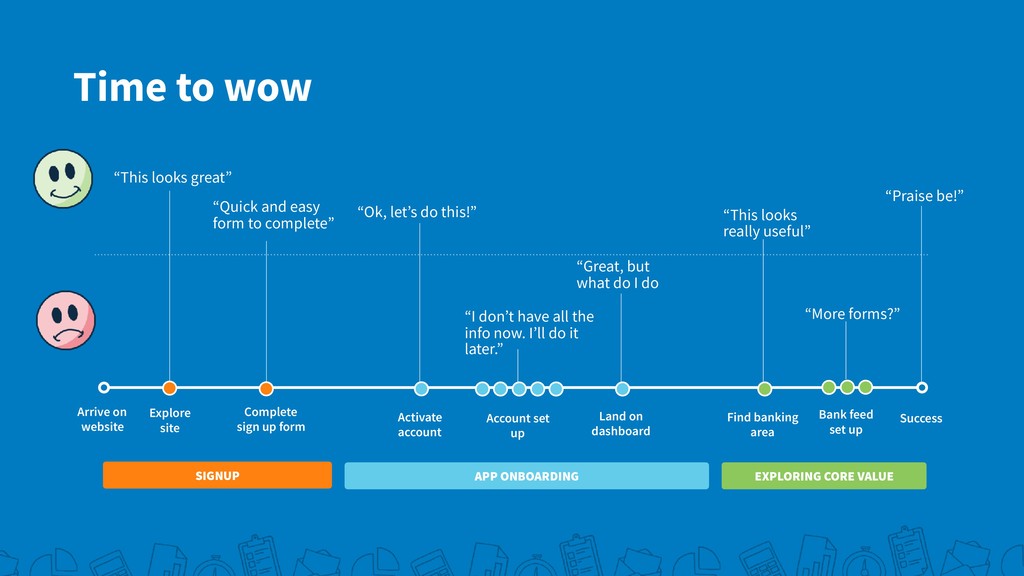
So the obvious thing we did was, Okay, let's just remove that. So that's what we did. So we kind of like said, Look, if we just have people sign up on the form and immediately take some into the product, we're not going to have that particular drop off.
So that was something that we've done. The next thing we do is we say, Okay, we've got this account setup process, and for Regent, that's actually quite complicated. You know, we're accounting software, so we do ask for quite a lot of stuff upfront.
But again, from looking at the data, we can see that, by and large, people were completing this fairly successfully. But what was happening was that people were completing the setup process, but they were landing on the dashboard and then they were just kind of like clicking about aimlessly.
There wasn't enough guidance or hand holding, and they didn't really know what to do. So, you know, maybe they ended up kind of getting to this end sort of point that we want them to, but maybe by more kind of luck than design.
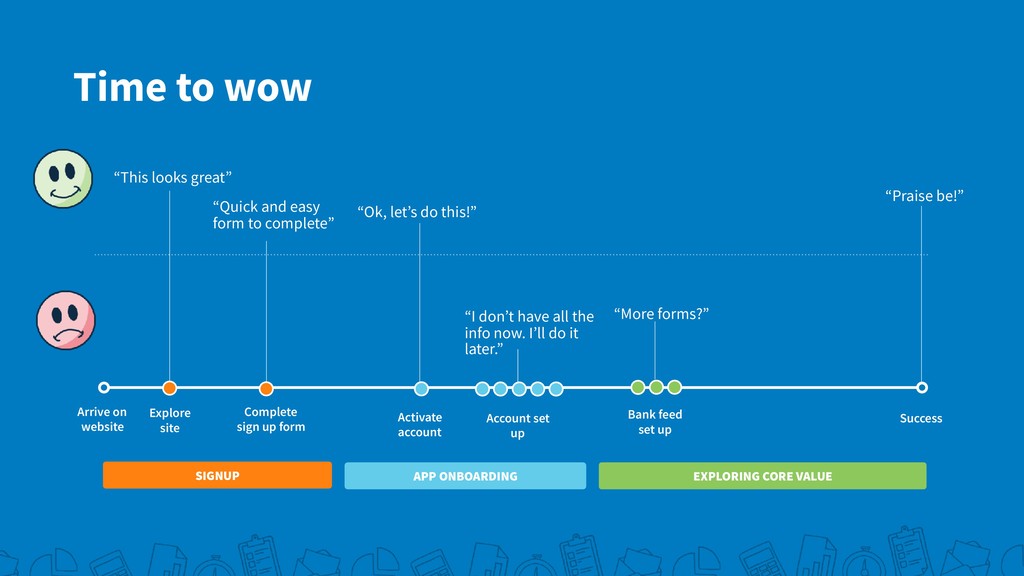
So we did something that was kind of fairly counterintuitive. We said, Let's take this relatively long setup process that we have and let's make it even longer by bringing forward the bank feed setup bit and attaching that onto the end. So we made it even longer.
But what we discovered when we did this was that a higher percentage of people were enabling a bank feed and more importantly, the conversion went up as a result. So even though the journey was potentially more complicated, we engaged them with a core value quicker and we drove growth as a result by increasing conversion.
So this is a really kind of good example of that. Okay, so here we are. So we've got the two things now. We've articulated the core value and we've now mapped the user journeys towards that core value in order for us to be able to sort of drive growth.
The final step is creating this balanced scorecard with KPIs and metrics that's going to tell us how well we're doing at both of these things. And this is really crucial because this is what's going to allow us to prioritize effectively. So to do this, we're going to use another framework, which is the Google Heart framework.
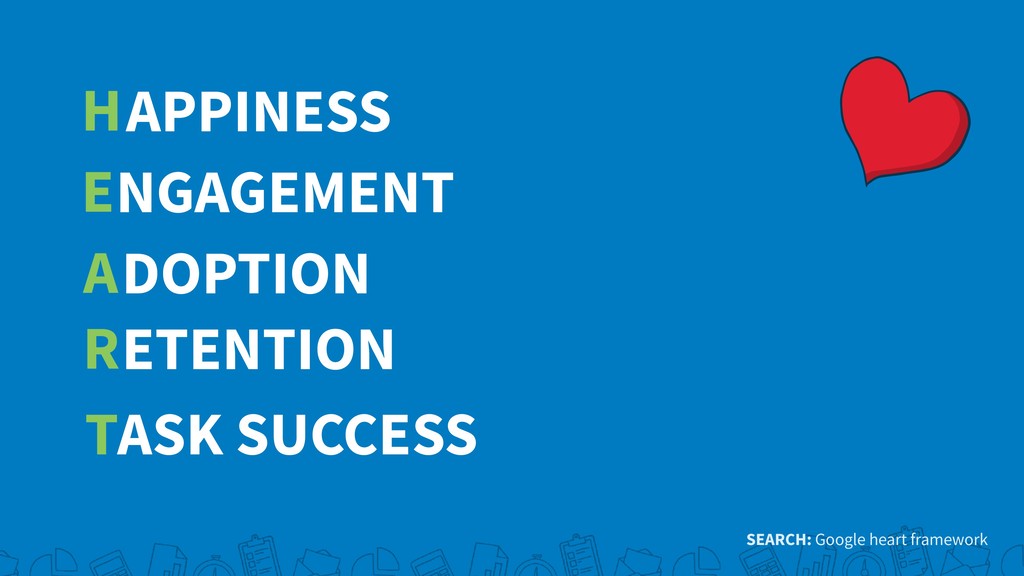
Again, I highly recommend you take a look at this. And essentially what this says is there's five categories of product metric that will tell us how well we're doing, both across core value and across driving growth. So it's things like, you know, how happy are we making our customers?
Obviously, that's something we want to do. How engaged are our users, both with the product as a whole or maybe an individual feature? Are our users adopting the product as a whole? That would be your classic conversion metric or are they adopting particular features?
How are we doing at retaining our customers? And are customers successfully completing key tasks in our product? Now, obviously, that's going to kind of vary quite a lot depending on what your product is. So this gives us a framework for deciding on the metrics that we want to go ahead and measure across all of these different five categories.
But just before we jump into that kind of stage of actually going to the metrics, I think it's worthwhile going through a little bit of a kind of pause and a little bit of a process to actually come up with those metrics. One of the kind of problems that I see quite a lot of time is that early stage companies, there's a tendency because we can measure data so easily these days, there's a tendency to measure all the things.
So you go into like startup offices and you look at the sort of TV screens around the place, and they've got these flashing numbers and lights and dials and things whizzing about all over the place. And I think sometimes it just becomes noise.
People just, like, tune out to it very, very quickly. So I think it's probably more important that, you know, I'm not a huge believer in if it moves graphic philosophy. I think it's better to pick a small number of key metrics that really matter to your business and that are going to help you make decisions and are ultimately going to drive action for your team.
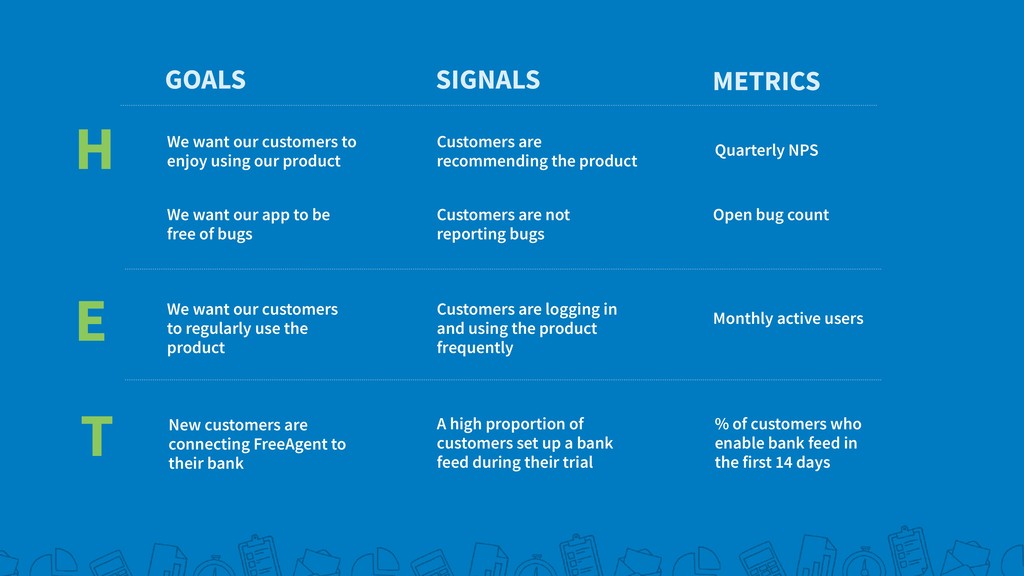
So it's worthwhile just taking a little bit of a pause as we go through into this process. And the HEART framework actually has a really good subsystem for doing this. It says you start off with your ultimate goals as a business and you do them across the five categories.
I'm going to show you some examples from the happiness, engagement and task success. So here's some kind of like fairly sensible goals. So, you know, obviously our goal is we want our customers to enjoy using the product, right? It's a great happiness kind of goal.
But another one might be as well as we want our app to be free of bugs, you know, because if you have a really buggy product and people are going be pretty miserable using On the engagement side of things, we want our customers to regularly using the product.
And for us, one of that tasks I mentioned was we want new customers to be connecting to their bank accounts. Those are kind of goals. With these goals in mind, we now say, Okay, what signals would we need to observe so that we would be confident that we were achieving those goals?
So here they are. So if we were to observe that customers are recommending the product to their friends, then we could be confident that they're happy using the product. That seems like it's a fairly kind of logical connection. If we were to observe that people weren't reporting bugs, then we can be confident that our product is pretty much free of bugs.
If we observe that people are logging in and using the product regularly, we can be confident that they're fully engaged with the product. Now, this might seem overkill. This might seem totally redundant. And it might seem that we're just kind of like duplicating stuff.
But I promise you, going through this little process, this little discipline will help you come up with a series of metrics that are much more actionable. So then we get to the final stages. Okay, we have these signals. What metrics do we need to measure such that we will be able to observe the signals?
So in the case of customers are recommending the product, the metric we're going to measure is our quarterly Net Promoter Score. In the case of customers are not reporting bugs, the metric we're going measure is open bug count and the engagement one is our monthly active users And the last one, a high proportion of customers are setting up a bank feed.
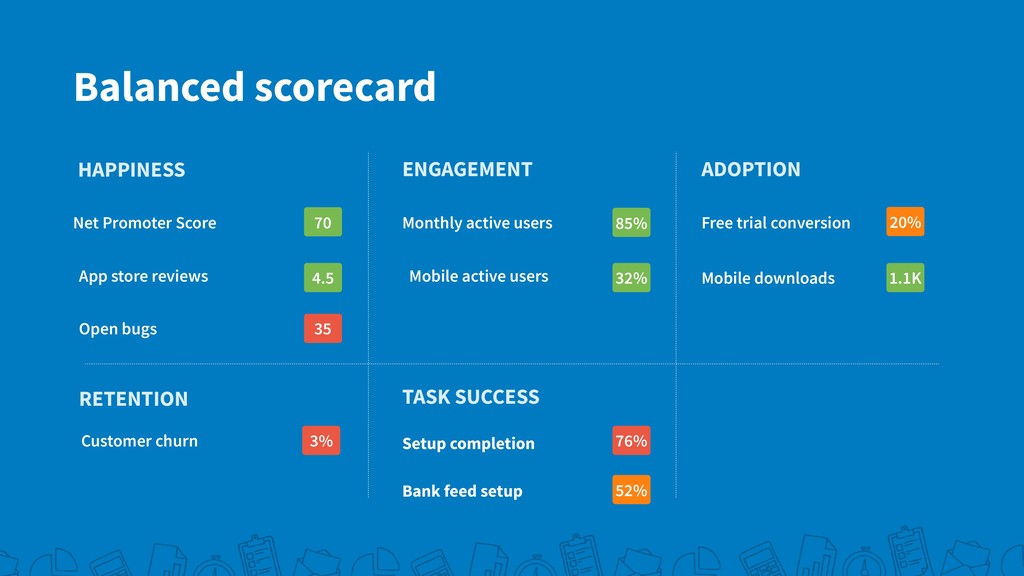
It would be the percentage of people who are enabling a bank feed in the first fourteen days. So we go through this process and allows us to build up a suite of metrics which forms our balanced scorecard, and this is kind of how it looks.
And this is actually kind of what our balanced scorecard at FreeAgent looks like for the product teams. So we have an overall scorecard for the whole product, and then our individual teams have more sort of specific ones to their areas, but the structure is the same.
You see, we've got happiness, engagement, adoption, retention, task success, both measuring how successful we are at delivering the core value of the product and about driving growth. And really, at a glance, this gives complete visibility, not just to the product teams, but to the entire company about where we're succeeding and where we're not doing so well.
And so we can decide where does the priority needs to be? What's the focus right now? And in looking at this one, we see, actually, you know, our users are pretty happy here. We've got some good app store reviews. Engagement's kind of green as well, so we're obviously pretty happy about that.
But the conversion, that's a bit of a concern and the setup completion and these early sort of metrics, actually, they're a bit of a worry. So it's really obvious what the focus needs to be here. Right now, the focus isn't on fixing this conversion and this can early sub stage experience.
So it makes it completely transparent. And that's really powerful for the whole company because it gives us visibility. But it's also a really powerful tool for the individual product teams because it gives them a mandate to focus on what matters at any one time.
And this is where it's really about giving the teams the autonomy. As a business, we set these aspirational targets. We say, We want you to get conversion to X or We want NPS to be this. And then it's up to the teams to figure out how to do that, and they've got the autonomy to do whatever they need to do to get those KPIs in the right kind of spot.
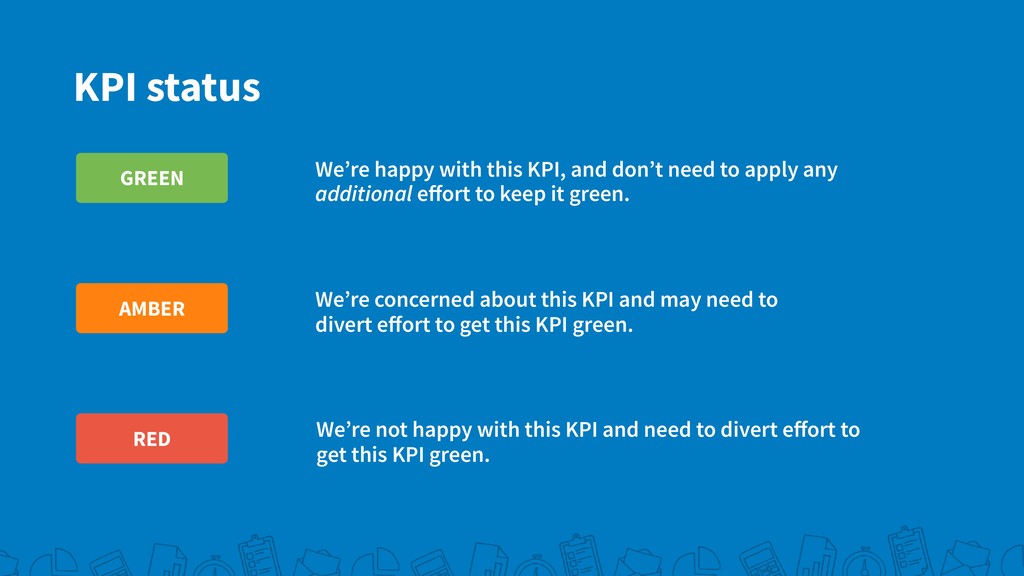
So this is really the connotative of this. Now, what I'm going to do is I'm going to touch on just what the individual color status is like. Obviously, green's good, red's bad, but there is some nuance that's quite important here. So when we say a KPI is green, what we're saying is we're happy with this KPI and we don't need to apply any additional effort to keep it green.
Now, that word additional is really important because what we're not saying is we don't need to apply any effort. There may be some KPIs where actually, if you just leave them alone, they will just be fine and they won't change. Maybe your conversion rate's like that.
It probably won't just change randomly over time if you're not doing any work in that area. But, for example, the bug count, what we know from experience, if we don't have a continued amount of effort on fixing bugs and addressing those issues, they will just creep up and creep up over time.
You know, we're releasing new features and unfortunately, sometimes bugs go out with those. So we always need to have some effort on that particular KPI, even just to keep it green. So we will set aside about twenty percent of our time typically to do that.
When something's amber, we're saying, Okay, we're concerned about this KPI, we may need to divert our efforts to get it green again. And if something's red, we're saying, We're not happy with this KPI and we need to divert effort to get the KPI green.
And this is, again, it's a really important point because what Russ Kanellis saying here is no matter what that team is working on, even though they have this really sort of important high profile project within the company, if one of their KPIs that they're responsible for goes red, they're allowed to stop working that thing and shift their focus back onto this thing here in order to get it green again.
And that's the deal that we make with the team and with the business. And we give them the autonomy and the power to do that, say, Listen, we're responsible for getting this KPI green. We need to stop this and make sure we focus back down on this thing.
So it's a really important part of giving your teams some level of kind of like control. Okay, that's essentially the kind of playbook, those three steps, articulating the core value of the product and understanding how we're going to drive growth by mapping the user journeys towards our core value and ultimately creating this balanced scorecard of KPIs and metrics that's going to allow us to understand where we're doing well and where we're not doing so well.
There is actually a sneaky fourth bonus step, which I don't have time to talk about, unfortunately, and that's how we go about structuring our organisation, our teams, to organise ourselves around this sort of thing and go about allocating resources accordingly. So if you want to learn more about that, kind of come and speak to me at any point today.
Also, if you're here tomorrow, Maria Gutierrez, who's our VP of Engineering, she's going to kind of like pick up on a lot of this stuff and talk about more from an engineering sort of point of view about how we organize ourselves. So come on to that, so the engineering track tomorrow, about half past eleven.
And that's all for me. Thank you very much.