Capturing data isn’t the trick. Analyzing data isn’t the trick. Putting the data to work to drive business outcomes - that’s where the unlock happens. In this insightful session, Michelle will discuss the fundamentals of Decision Science and explore the use of data, analytics and modeling techniques to inform and optimize business decisions. Whether you're a startup, a scale-up, or a large enterprise business, this session is tailored for all tech entrepreneurs and professionals seeking to leverage data science to drive operational excellence and business growth.
Discover the key principles of decision science and how to apply them to your business operations.
Learn how to infuse data science and analytics to inform your decision-making process.
Explore case studies from businesses who have leveraged decision science to drive growth.
1 / 56 Use ← → to navigate
Auto-generated transcript - may contain errors.
Tap a timestamp to jump the video.
Thank you. Good morning everyone. I want you to picture a crucial moment in your business. You're at a crossroads, you've got two very big decisions you've got to make. One's pretty well tested and worn. The other's innovative but unproven. Different strategies you might be considering.
Both have merits, both have risks. And this decision you make could significantly influence the future of your company. Sounds a little daunting and it might be, but it's not a decision that has to be a shot in the dark or a decision made on intuition alone.
As Carolina introduced me, I'm going go really quickly through this. Prior to joining LinkedIn actually, I did lead an end to end data organization consisting of data engineers, analysts, and data scientists for consumer focused publisher. I'm going to talk today about the world of decision science.
Now, in this domain, which you may also hear referred to as decision intelligence, we've bridged the gap between intuition and data, turning decision making into an evidence based process. So as we dive into the heart of this subject, we're going to explore how it can bring clarity and help us navigate some of the tougher choices you might face as a business owner or as a startup, literally at any point in a business decision making process.
So what is decision science? Decision science is fundamentally an interdisciplinary field that employs methodologies and perspectives from several academic areas, such as mathematics, statistics, economics, machine learning, and even psychology to support decision making processes. It's solidly centered around aiding organizations to make informed, rational, and data driven decisions.
Math and stats are used to quantify and analyze data that underlines the decisions. And economics, particularly the field of behavioral economics, helps in understanding the incentives and outcomes associated with your different choices. Decision science is particularly crucial in tech companies, where the landscape is rapidly evolving and competition is fierce.
And the success of an enterprise often depends on a series of very complex decisions. So when we think about what the role of decision science is in any given organization of any size, companies face numerous strategic choices, such as whether or not to enter new markets, launch new products, how to allocate resources and more.
Decision science enables businesses to create models and simulations based on their data to predict the outcomes of the different strategies you might be considering. Decision science is also really crucial to process optimization. It enables you to analyze operations systematically and identify inefficiencies or bottlenecks.
Leveraging statistical models and tools can lead to streamlined workflows, improved resource allocation, and ultimately some cost savings. Now we operate in a fast paced and unpredictable environments. So risk could range from new competitors and technological changes to regulatory shifts. Decision science provides tools for comprehensive risk modeling, allowing companies to quantify and mitigate these potential risks.
So whether it's user behavior, operational behavior, market data, decision science extracts meaningful patterns and trends, informing a wide range of business decisions. So by systematically incorporating this discipline into your operations, you can make decisions that are not only data driven, but more importantly are aligned with your strategic objectives.
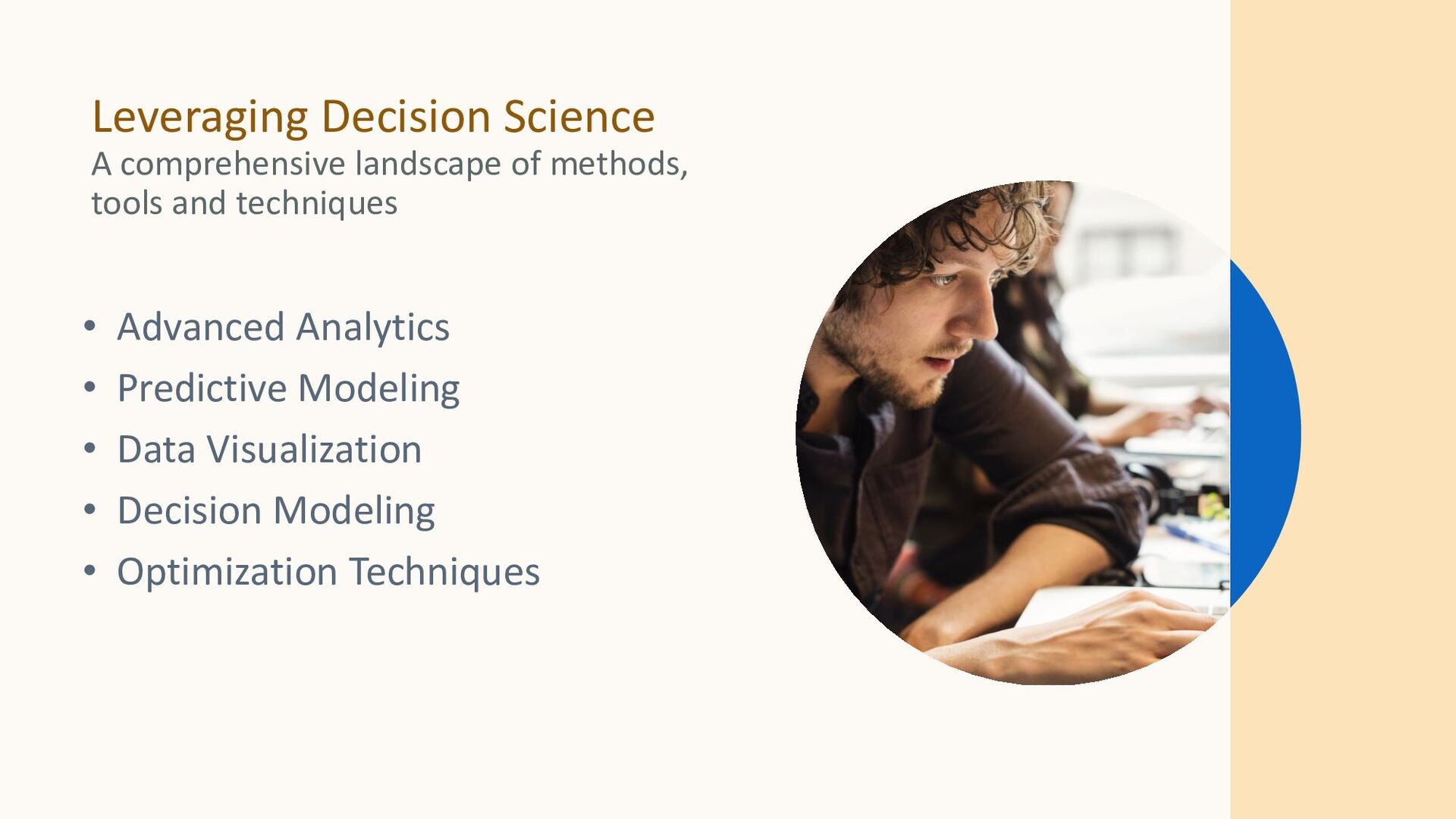
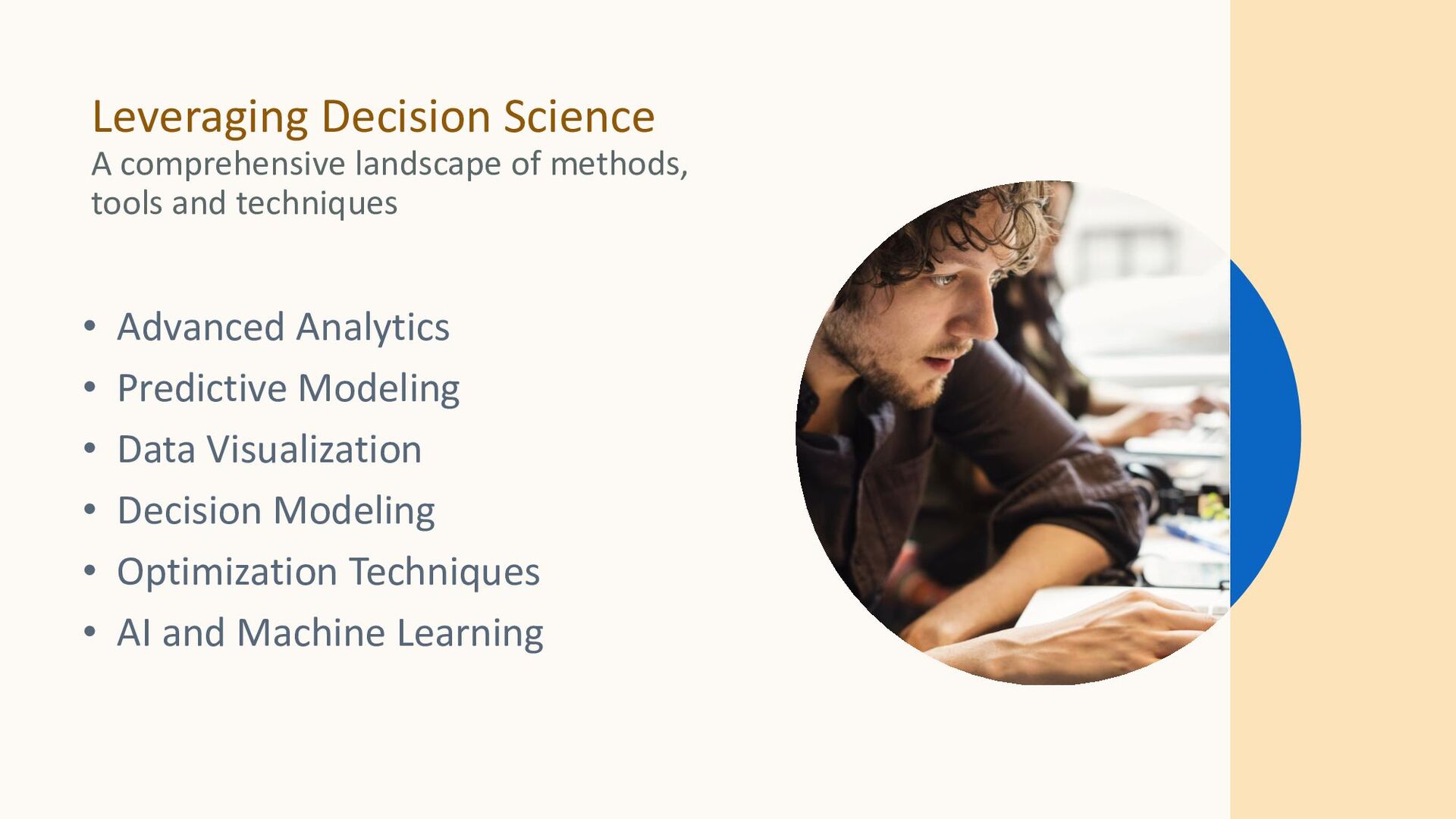
So when we talk about the tools and methodologies most often utilized in decision science, we're talking about advanced analytics. So this involves the use of statistical models to analyze data and extract valuable insights. Techniques such as regression analysis, factor analysis, cluster analysis, these things reveal hidden patterns and correlations within the data.
Predictive modeling uses statistical techniques and machine learning algorithms to predict future outcomes based on historical data. This helps companies anticipate future events and trends, and make proactive decisions, instead of reactive. Data visualization is an effective way to understand complex data sets and glean insights quickly.
It can highlight trends, patterns and outliers that may not immediately be appearance in raw numerical data. Decision modeling involves creating mathematical models to represent complex decision making problems, and can help visualize and analyze various decision paths and their possible outcomes. Optimization techniques help in finding the most effective allocation of resources within constraints.
Techniques like linear and integer programming, for example, can be used to optimize operations and logistics. I'm going to get into a number of case studies that kind of cover all of these different areas. Last, but certainly not least, we've got artificial intelligence and machine learning.
These take decision science a step further, using algorithms to learn from data and make predictions or decisions without being explicitly programmed. By utilizing these methods and tools, businesses can transform vast data resources into actual insights and make more informed, objective and profitable decisions.
Okay, that was all fairly boring. Now that we've set the table for what we're talking about when we talk about decision science, and obviously just even from listening to the description of it, you can understand that it crosses a lot of different disciplines around data.
From just basic data analysis, data visualization, all the way through applied data research. So let's first take a look at a few brands that are really well known. They started out as startups, and they basically have baked into their DNA decision science as a discipline.
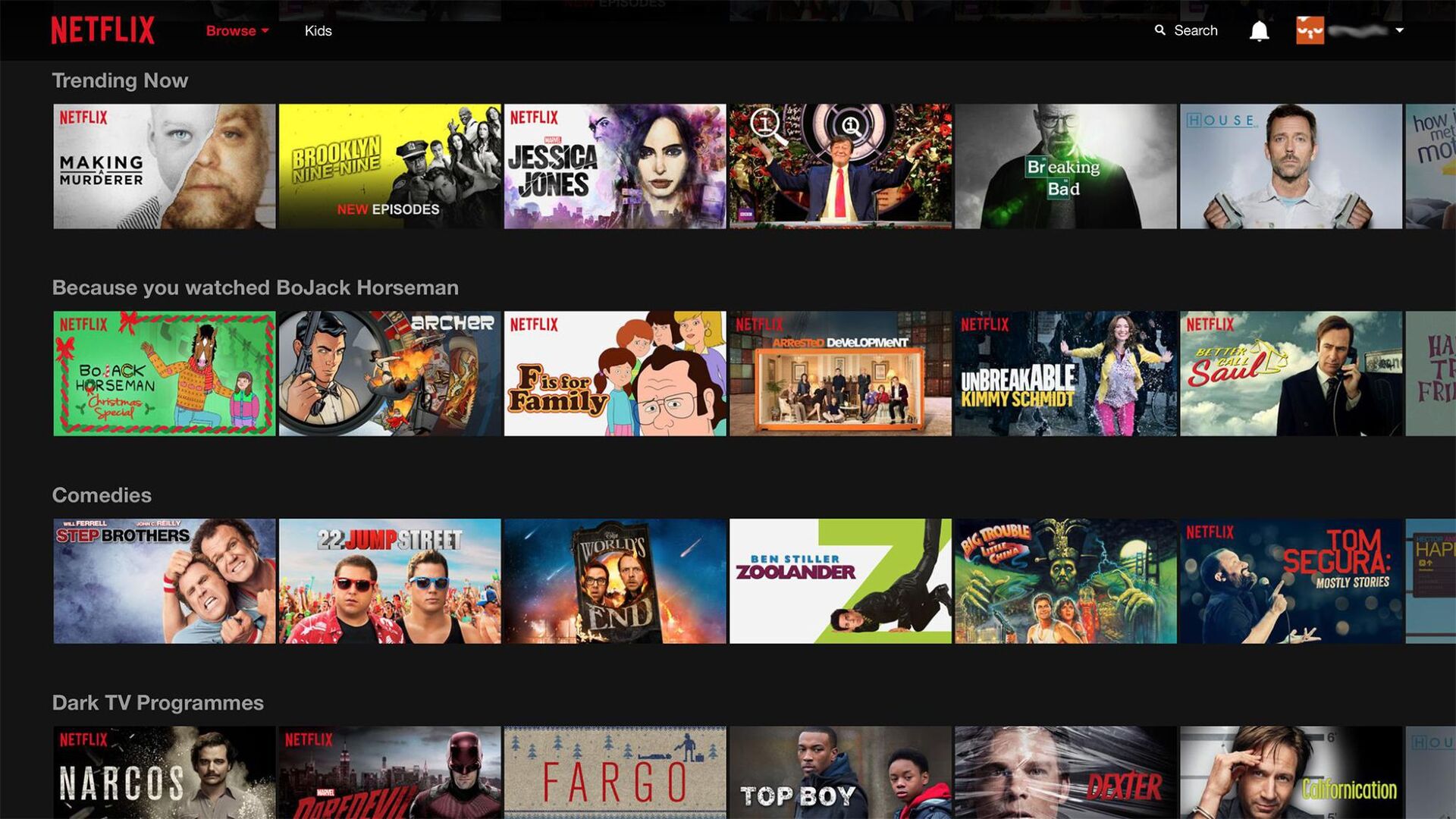
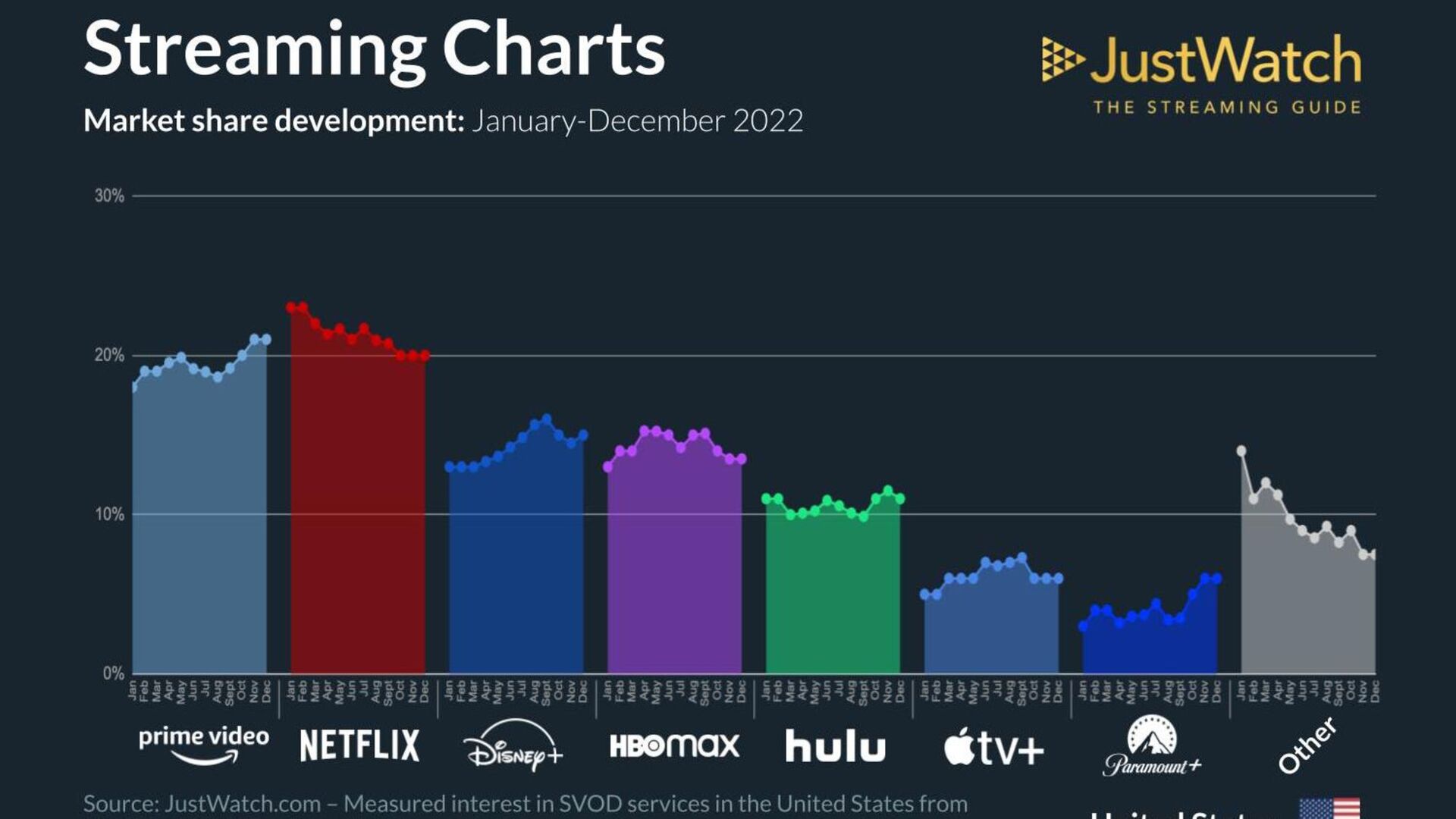
So Netflix. It's one of the leading streaming services globally. They extensively use decision science for content recommendations, for content investments, as well as deciding what they're going to create, kind of content they're gonna provide. Now I suspect we're all familiar with the recommendation engine.
It's one of the most notable ways that Netflix leverages decision science. The company uses sophisticated machine learning algorithms to analyze all aspects of user behavior, including the types of show and movies a user watches, when they watch, how quickly they watch a series, and even when they pause, rewind, or fast forward.
Based on these insights, Netflix can suggest it to a viewer and understand what a viewer is most likely to enjoy. This obviously improves user experience as well as engagement with the platform. Okay, show of hands. How many people remember when this first came online on Netflix? Oh my goodness, okay, there's a few of us.
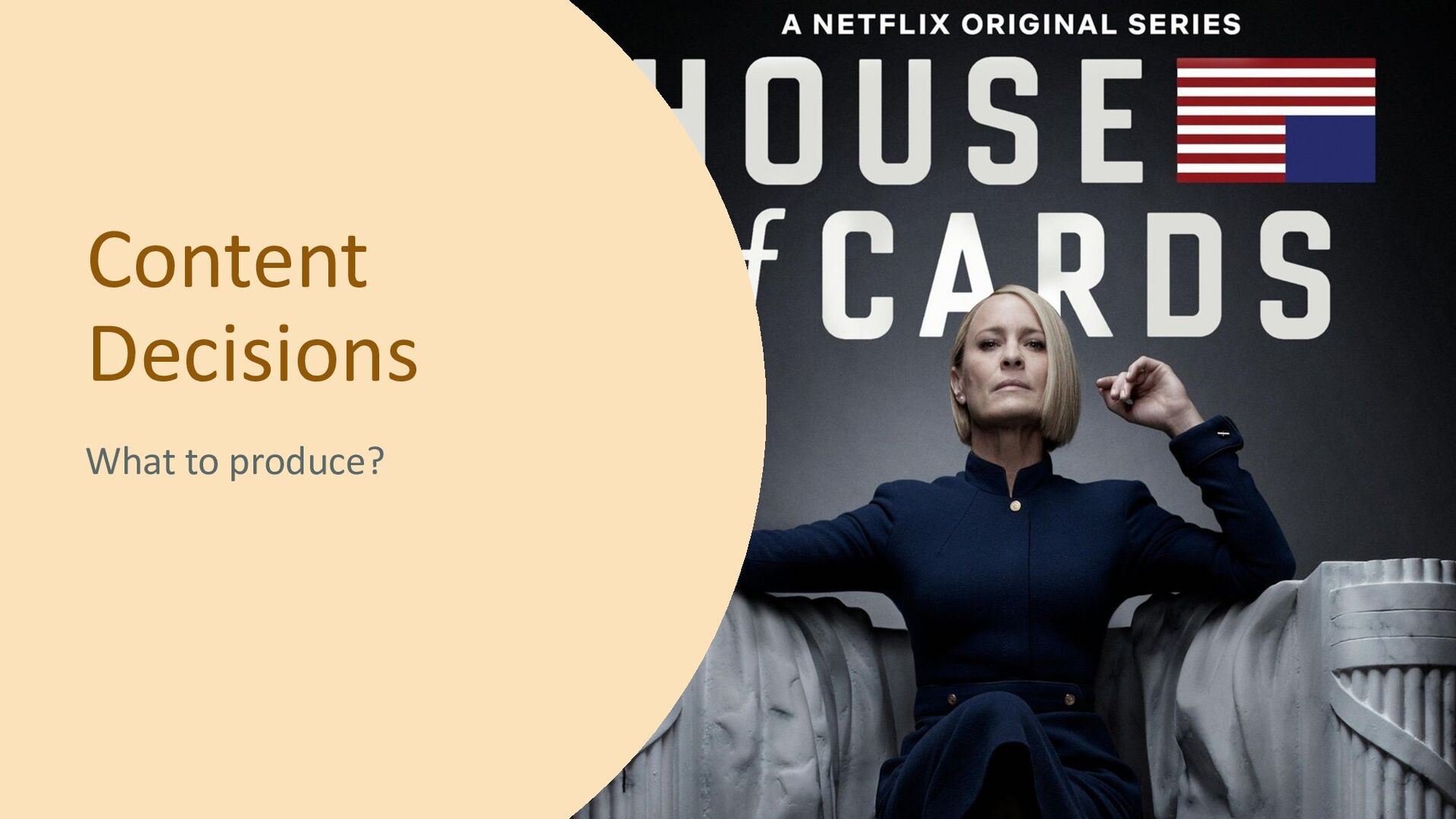
I'm not the oldest person in the room, that's good. I mean I still could be, but this was actually a pretty significant shot across the bow for Netflix to the other large media companies. Because prior to producing House of Cards in twenty thirteen, Netflix relied entirely on other people's content.
Its business model was based entirely on licensing content produced by most of the large media production companies. Now critical to making the transition from being just a streaming company to being a full blown competitive media and production company, Netflix used data to inform its decisions on which shows and movies they needed to produce.
This involved analyzing a variety of data, including viewership content, user ratings, reviews, and broader market trends. By understanding what types of content resonated with its audience, Netflix made more informed and more cost effective, that's the important part, decisions about content production. Netflix also uses decision science to determine how much to invest when licensing content from other partners, as they do still do this as well.
It uses viewership projections and other data to estimate a show or movie's potential return on investment, And this helps Netflix allocate its licensed content budget efficiently, and ensure it's investing in content that is likely to bring value to its viewers and to its bottom line.
Netflix's application of decision science permeates every aspect of its business, from front end user experience to back end decisions about content. The data driven approach that Netflix has taken has been critical factor in their success in the highly competitive market of media production as well as streaming.
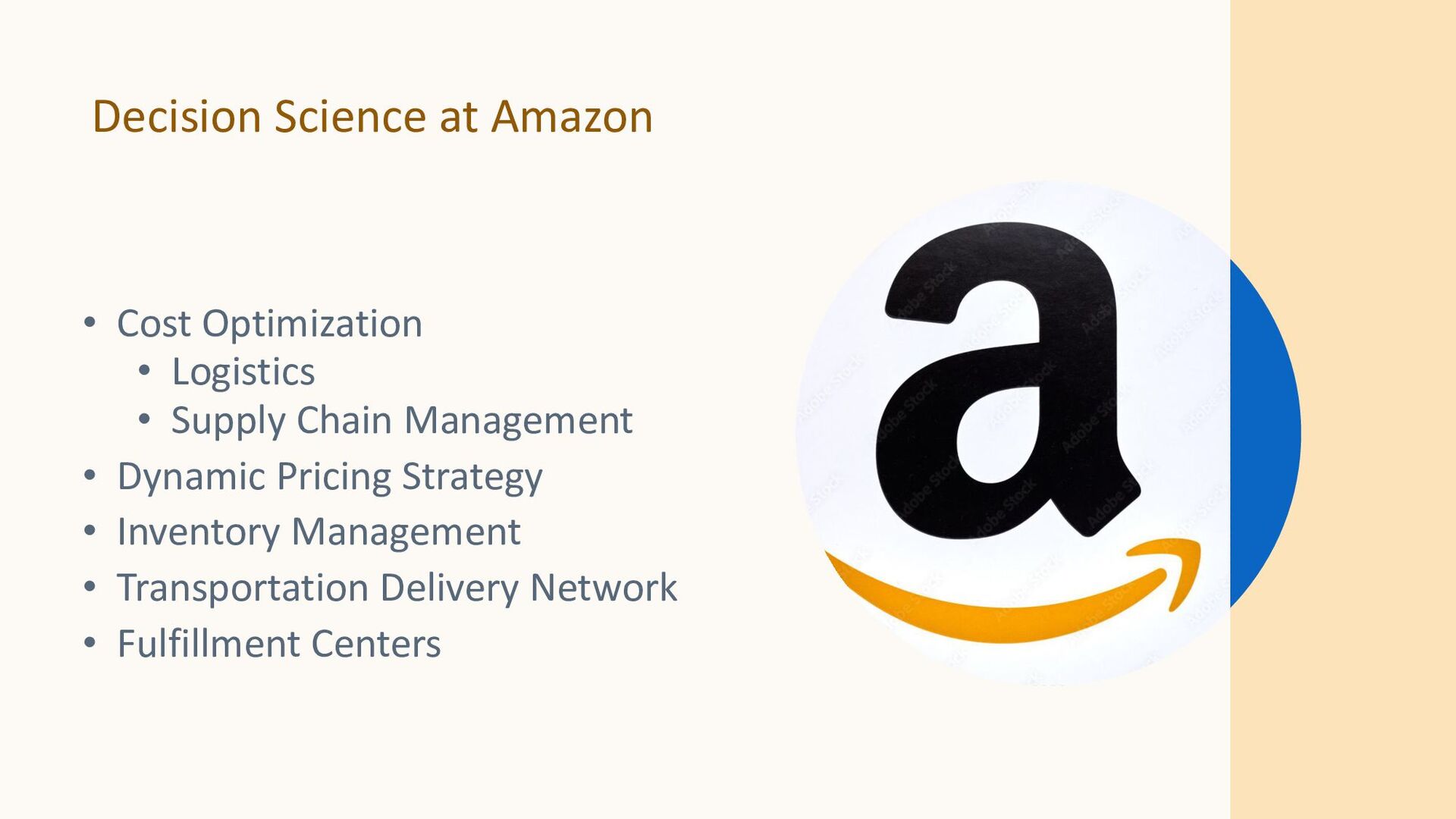
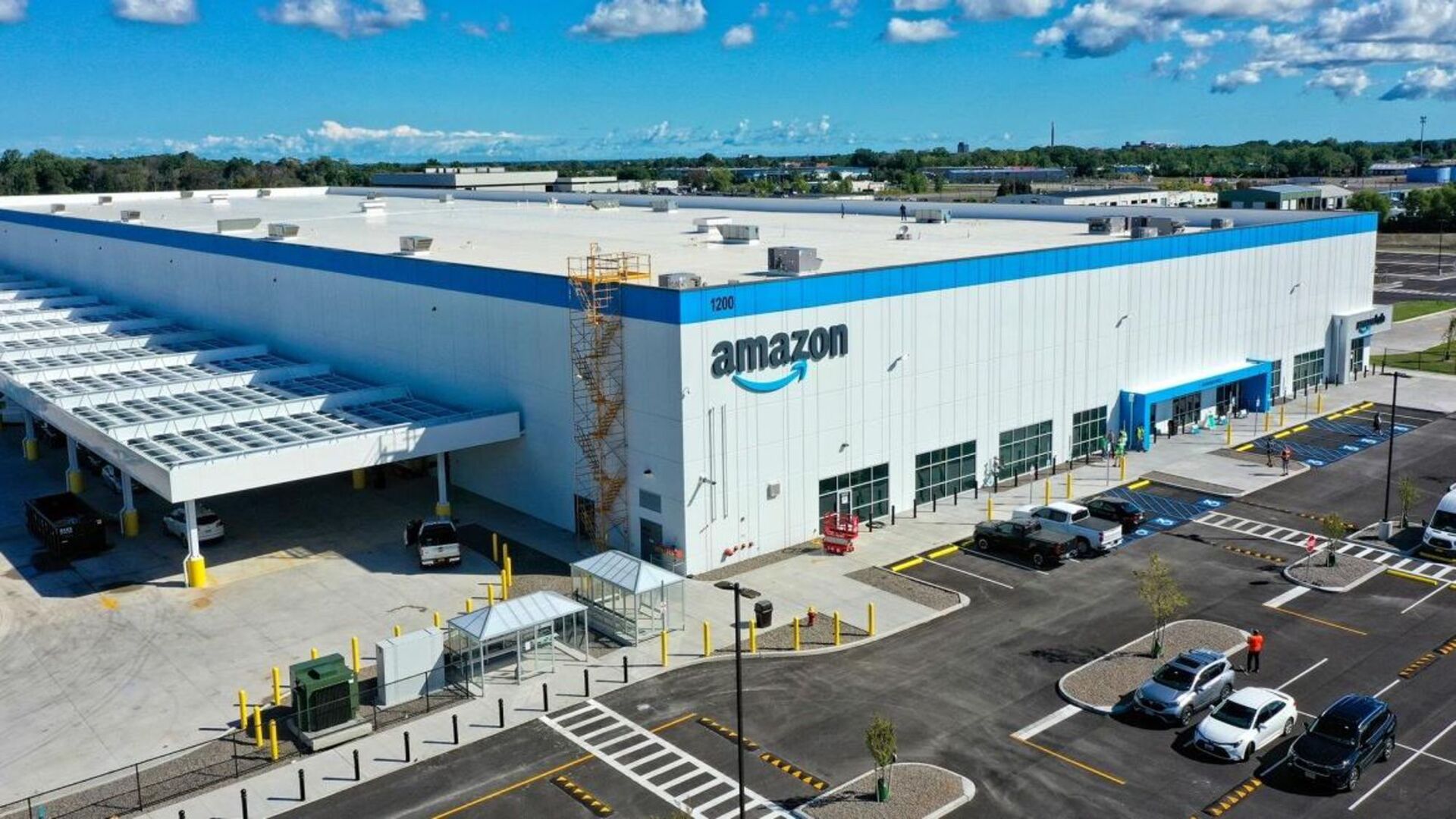
Amazon is another company that has integrated decision science into virtually every aspect of its operations. And one key area is in optimizing logistics and supply chain management. To address the complex task of coordinating deliveries of millions of products each day, Amazon uses advanced analytics and optimization techniques.
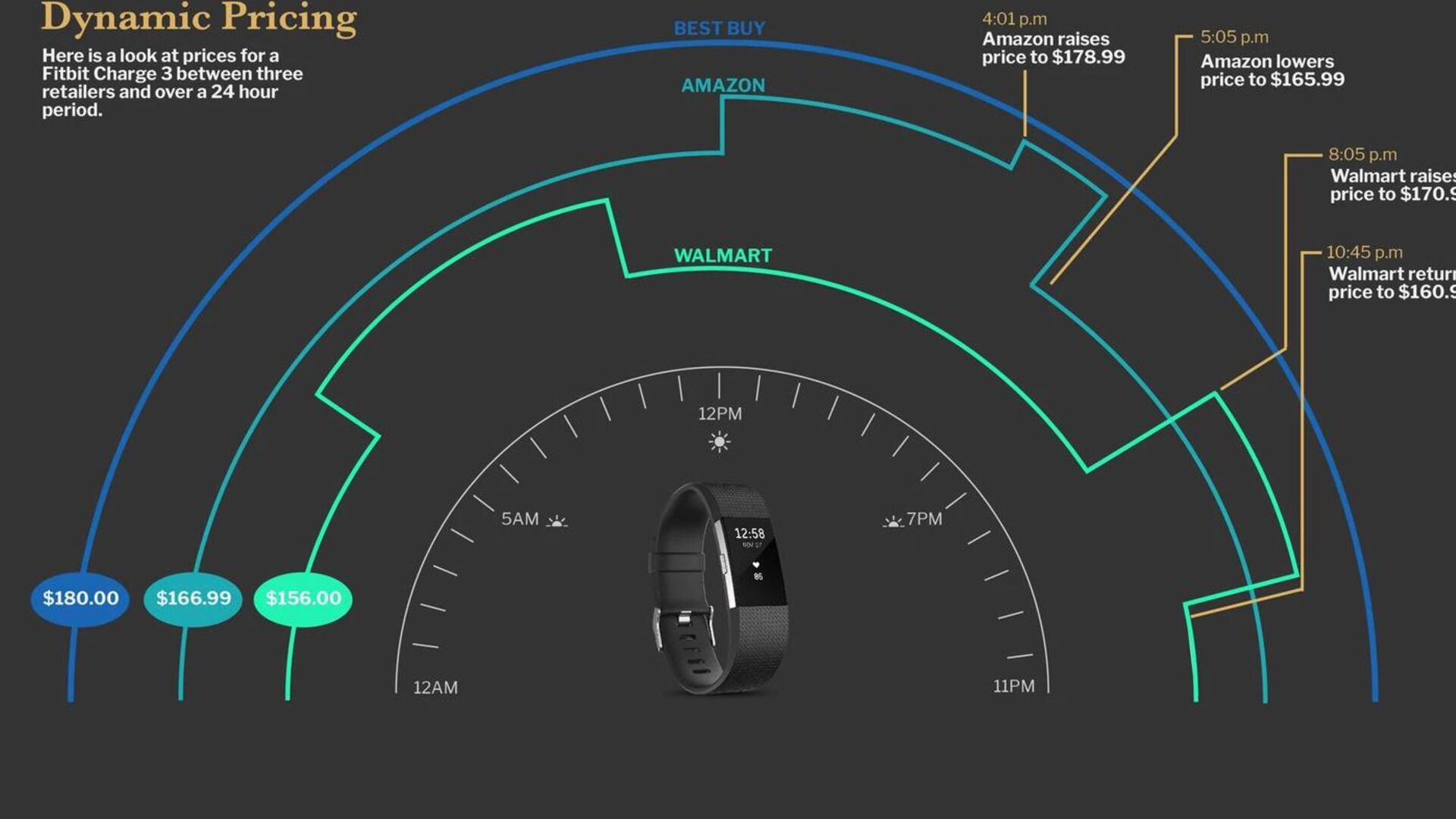
This includes determining optimal warehouse locations, efficiently routing delivery trucks, and predicting future demand to manage inventory. And with this entirely data driven approach, Amazon has significantly reduced cost and raced past competitors such as Walmart to dominate the e commerce industry. Amazon's use of this discipline in cost optimization can be seen in its dynamic pricing strategy.
So the company uses machine learning to analyze a host of data points, such as competitor pricing, product demand, the time of day, and the customer purchasing behaviors. These algorithms can then determine the optimal price for a product that maximizes profit while remaining competitive against other people selling the same products.
Another area where Amazon leverages decision science is inventory management. Amazon's demand forecasting algorithms analyze past sales data, promotional calendars, seasonality and market trends to predict future demand. These predictions help Amazon optimize inventory levels, reducing storage costs and the risk of either stock outs or overstock situations.
And the machine learning models get better over time, so further refining the forecasting accuracy and ensuring continued cost optimizations. Decision science also plays a role in Amazon's supply chain management. For instance, Amazon's warehouse management uses sophisticated algorithms to decide optimal locations for where to store items in the warehouse.
Taking into account the items popularity as well as its size. And this optimizes the picking process, reduces the time taken to ship an item, and ultimately decreases operational costs. They also leverage decision science in transportation and delivery network. Route optimization algorithms determine the most efficient routes for delivery, trucks considering facts like traffic, distance, and the number of deliveries.
These optimized routes reduce full cost, increase delivery speed and enhance overall operational efficiency. And finally, the company's decision to locate a new warehouse or a new fulfillment center heavily relies on all of this data as well. Data on customer locations, delivery times, transportation costs, they're all crunched to decide the most effective and efficient locations for new facilities.
So in conclusion, Amazon's use of data science, as with Netflix, is core to all of its operations and to its success. So let's talk about risk mitigation with decision science. So as you probably know, consumer trust in business is hard won and very easily lost.
Developing a strong brand and a solid reputation takes years and can be lost in a matter of days or in just a few bad PR cycles. Airbnb has faced some significant challenges in maintaining trust among its community of hosts and guests. To address the risks associated with activities that compromise trust in the brand, things like fraudulent bookings, reports of property damage, bait and switch reservations, a lot of these kinds of issues.
Airbnb looks to its data. And the company has developed sophisticated algorithms to calculate a risk score for each and every booking. This score is used to flag risky reservations and take appropriate preventative action. By creating and using this score, Airbnb has greatly limited fraud risks leading to safer and more trustworthy platform for its users.
Now this has been key for the brands. The safety of its users and the quality of the listings on the platform are the core elements of its service, and necessary for its continued growth. In addition to fraudulent bookings, Airbnb applies machine learning to assess risk, specifically related to property damage.
Airbnb's host guarantee program, which provides protection for hosts in case of property damage by guests, relies heavily on decision science to determine the level of risk associated with each booking. This involves analyzing a wide range of data, including the history of the guest, the host, the location of the property and the specifics of the booking.
By understanding these risks, Airbnb can provide better protections for its host and manage its own financial risk associated with this host guarantee program. So this not only protects Airbnb's business interest, but it also enhances the trust and safety of its global community. So in summary, all of these examples demonstrate how decision science can be used in a variety of ways to drive strategic decision making, optimize costs, and mitigate risks.
Okay. So you're probably thinking, well of course Netflix and Amazon and Airbnb are all using sophisticated models. They're massive tech companies. And that's true, but it's important to remember that they weren't always massive tech companies. Probably dating myself here again, but I remember when they were all start ups.
When they reached start ups, they didn't begin as the companies they ultimately became. They became the companies because of the data that they used and the way that they leveraged all of the tools and technologies to really understand that data. Understand not only data they had and could acquire, but data in the market.
Data around their industry in general. So the through line with them is that their companies were really built on a core belief that unlocking growth required capturing, mining and leveraging all available data. And you don't have to and you don't want to wait to adopt a decision science discipline.
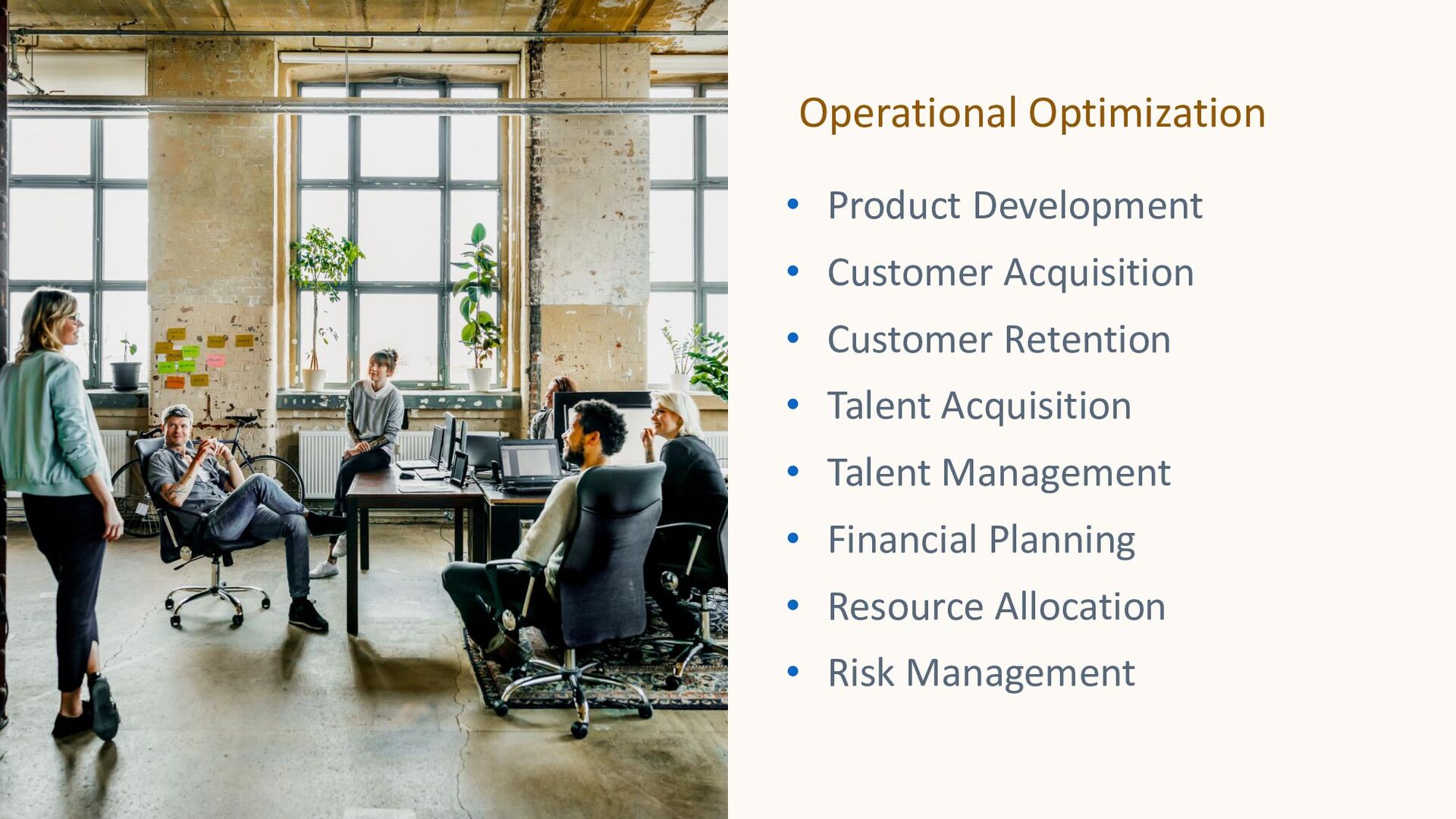
A startup company can significantly benefit from applying these same technologies and tools to various aspects of its operations from the point of inception. From product development to customer acquisition, hiring and financial planning, decision science can guide companies to make informed data driven decisions that ultimately lead to kind of development and sustained growth that the other companies have demonstrated.
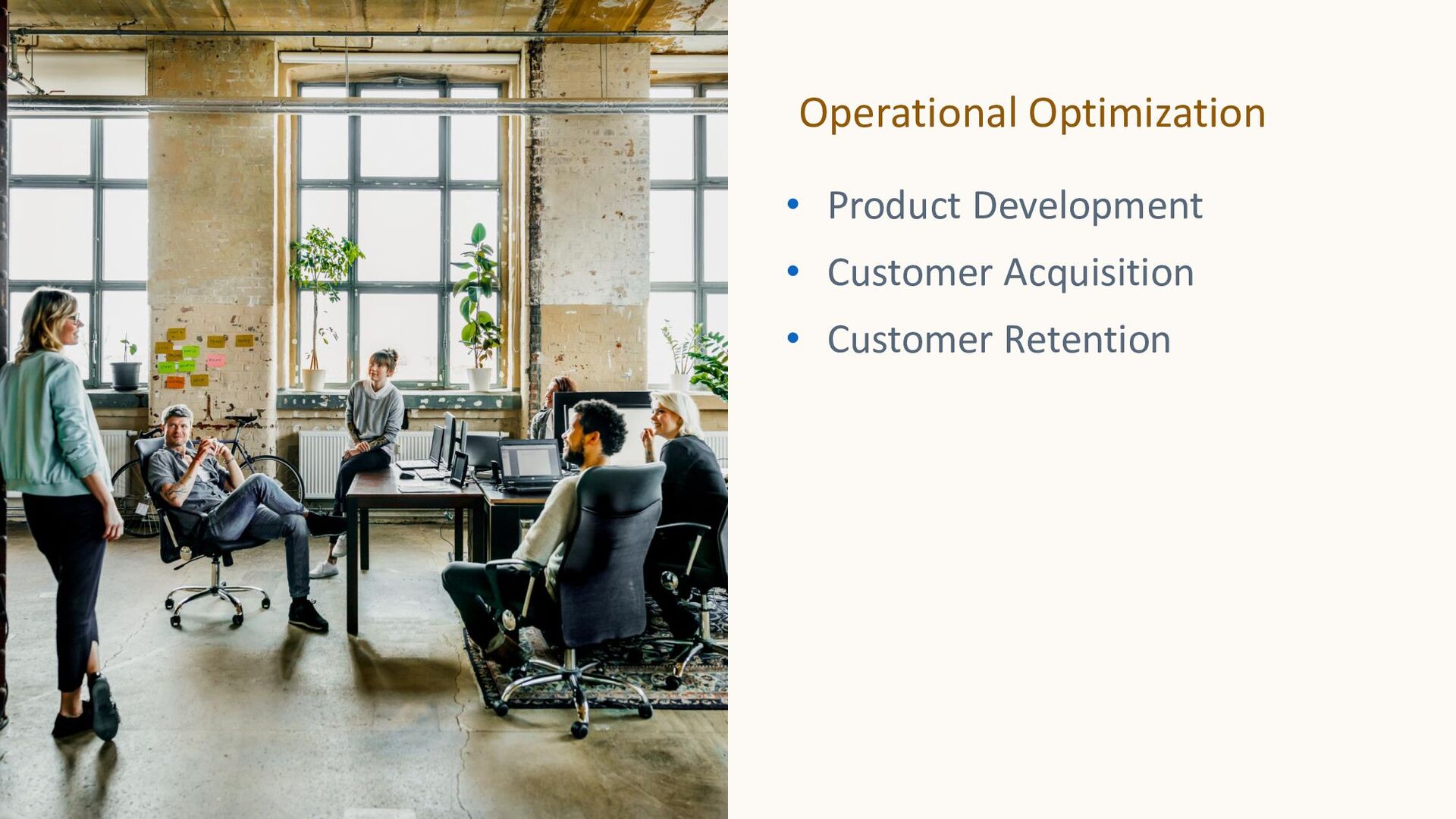
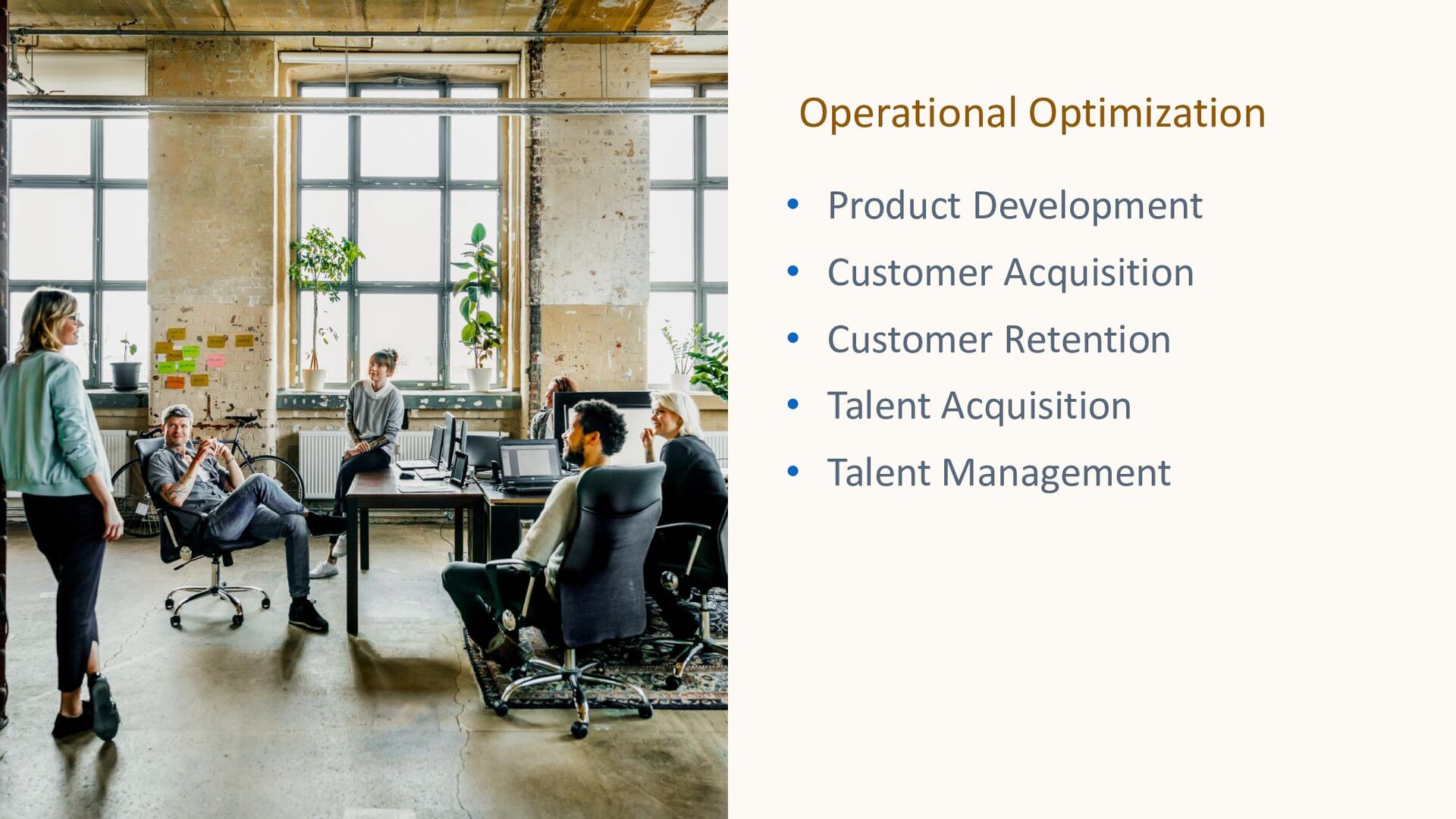
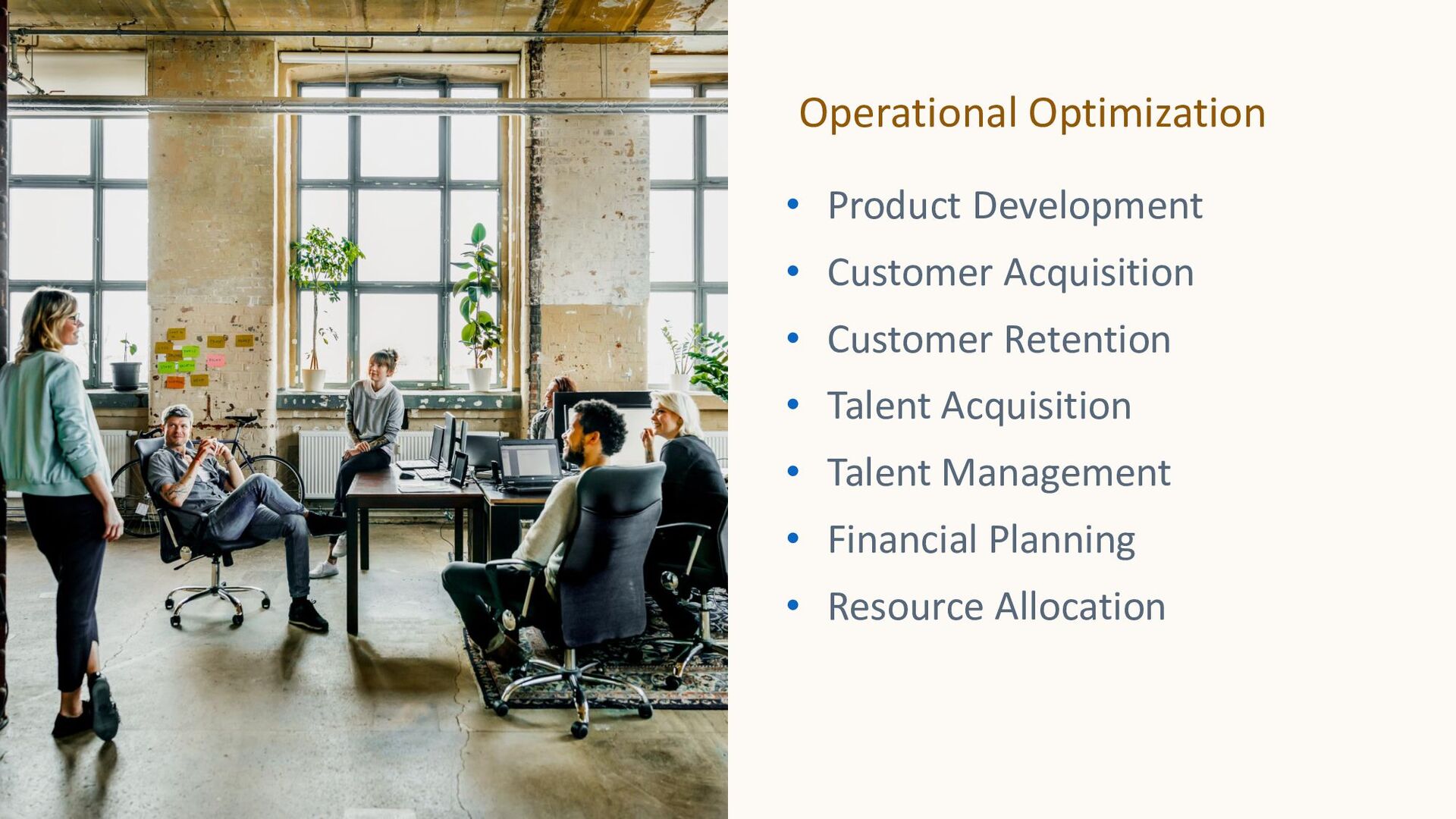
So when we think about operational optimization, we think about how difficult it is to say those things together. First consider product development. Decision science can help startups understand what features are most valuable to your users. By analyzing user behavior, AB testing results, customer feedback, market trends, you can identify which elements of your product resonate most with users.
And this helps you to be able to prioritize your development efforts, focusing on features that will deliver the most value. Secondly, for customer acquisition as well as customer retention, focusing on features, decision science is invaluable. Analyzing data on customer behavior, identifying which marketing channels are most effective, what types of messaging resonate with your target audience, and what factors influence customer retention in turn.
Informs everything you need to know about what you can deliver for your customers, as you're developing new products, as you're thinking about what you want to perhaps not focus on. If you develop something and all of the data comes back with, people aren't really using this feature that we thought was really important, perhaps we should put that to bed and really focus on developing this other aspect of the product that surprisingly to us, they're using all the time.
Looking at your data will help surface those kinds of insights. Also in terms of talent acquisition and talent management, decision science plays a crucial role. You can use data to identify the skills and attributes that are most valuable, and the employees that you're going to need to hire.
So this will help focus your hiring efforts on candidates who are most likely to contribute to your company's success. And additionally, analyzing data on employee performance and satisfaction once you've started staffing up, helps develop more effective strategies for employee development, as well as employee retention.
Financial planning and resource allocation are other areas where startups can benefit from decision science. Typically you're operating with very limited resources, so making efficient resource allocation decisions is table stakes. So analyzing financial data and market trends will help you with this, will help you decide where do you need to put your resources to achieve the most growth.
And lastly, as we discussed with Airbnb, decision science really can assist you in understanding risk management. Analyzing data on a range of factors. We've already discussed including market trends, competitors, competitor activity is another big one, and internal performance metrics. You can identify potential risks and develop strategies to mitigate them, so that you're not reacting to situations that you weren't able to anticipate, or weren't looking for.
So whether it's developing new features, launching a new marketing campaign, or hiring a new employee, allocating resources, all of these things. Really looking at and mining your data using the tools and methodologies provided by decision science is gonna help you make more informed choices and drive your growth.
So we're gonna look at another case study. Stitch Fix. I'm not really sure if they're still considered startup. I don't know when startups begin and end anymore actually. There are some startups that have been around for fifteen years and I'm like, when does that end?
But they're an excellent example of a company that honestly I feel like it's five hundred data scientists in a trench coat. Data is such an embedded part of their culture and their business, that it's just incredibly impressive. I highly suggest, in fact, they have a blog where they write about and talk about all of the different things that they're doing with their data, and it's really worth checking out if you're a data nerd.
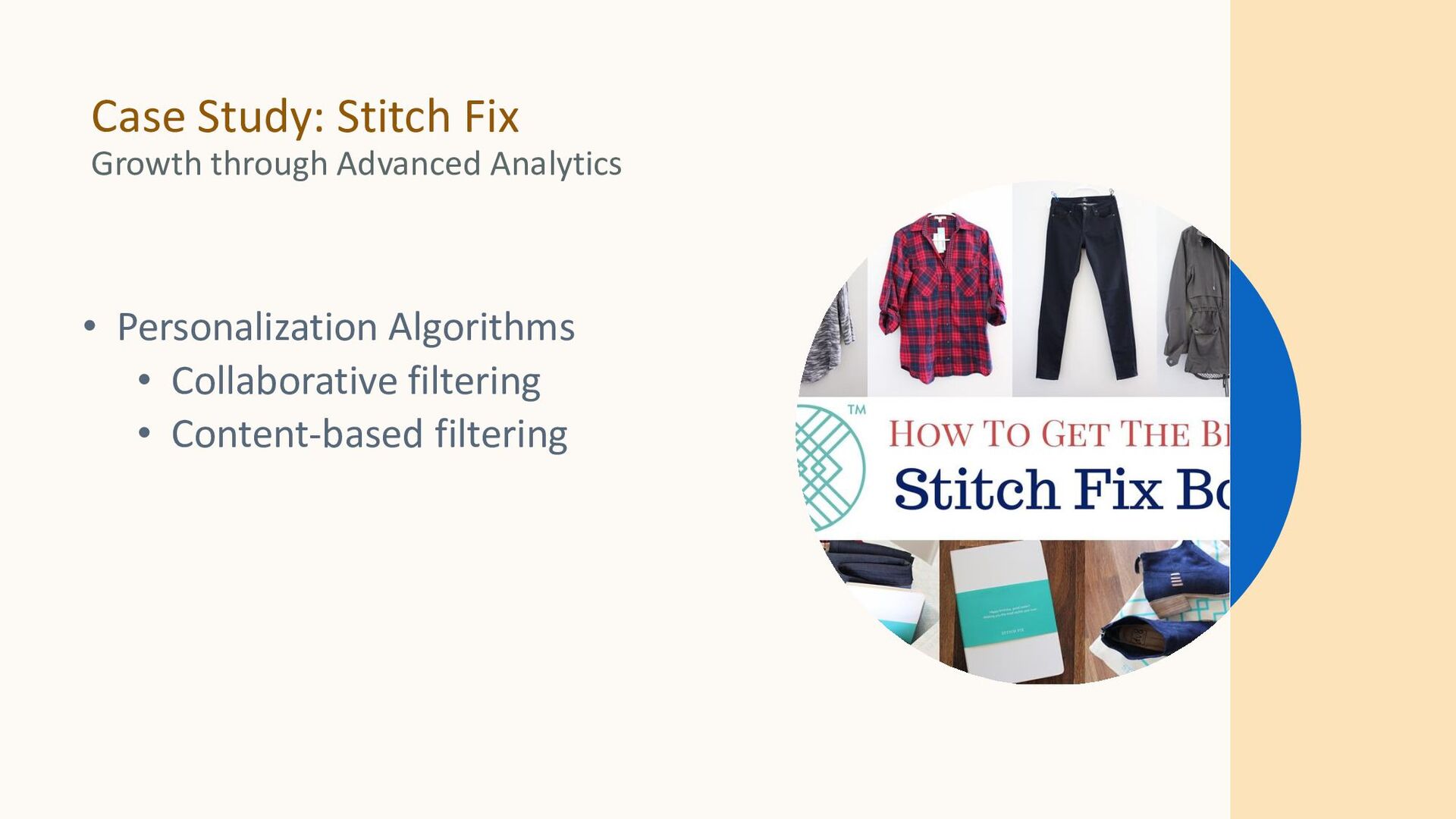
Like me. So let's talk about the way they use it. So Stitch Fix uses decision science in particularly its recommendation algorithm, right? That's kind of the bread and butter of how Stitch Fix has grown to be so popular and so big. So when customers sign up, they complete a detailed style profile which includes questions about their preferences and clothing styles, sizes, price points, all of that.
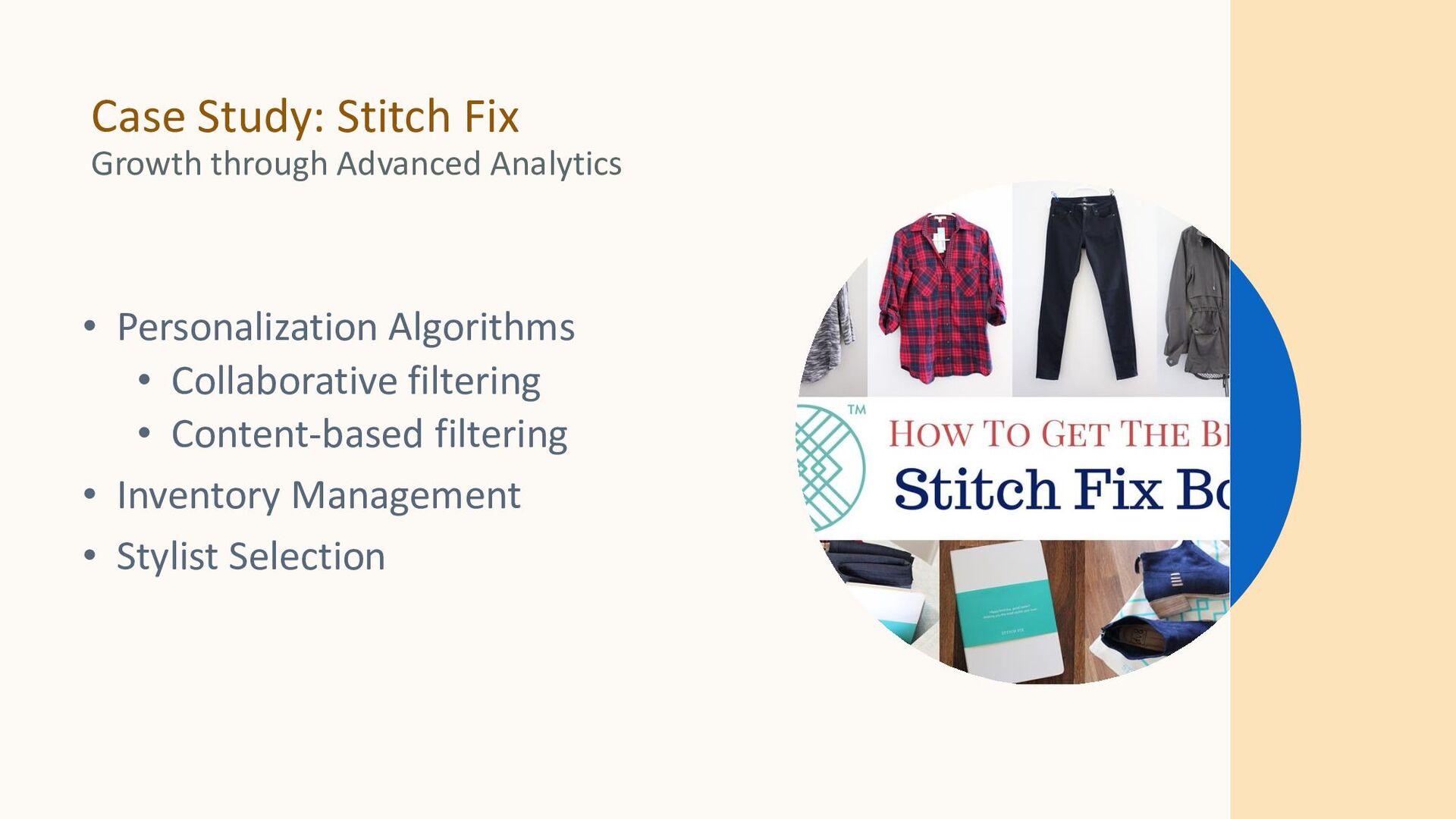
And so they use this data to create unique style profile for each and every customer. And so it's recommendation or algorithm select items from inventory that match that style profile. Now these recommendation algorithms use a mix of collaborative filtering, which recommends items based on a similar customer's feedback, as well as content based filtering, which recommends items based on the attributes of the clothes the customer liked in the past.
So this combination allows Stitch Fix to make highly personalized recommendations and it's the core of what drives their customers retention. Moreover, Stitch Fix leverages decision science and inventory management. Based on the customer data and feedback, Stitch Fix predicts demand for different styles, sizes and price points, helping them manage their inventory more effectively, and to reduce the risk again of either having too much inventory on hand, or not having enough at the right time.
And finally they also use it in their stylist selection process. So each order is assigned to a stylist, not randomly, but based on algorithm which considers stylist performance data, as well as past interactions with the customer if they've had any, and their expertise in a particular style based on the style preferences of each customer.
So these applications have been key to their success and their ability to offer this level of customization is kind of unparalleled still in the apparel industry at the moment. And at the same time, paying attention to their inventory management and stylist selections helps it operate more efficiently, and reduces costs, and improves customer service.
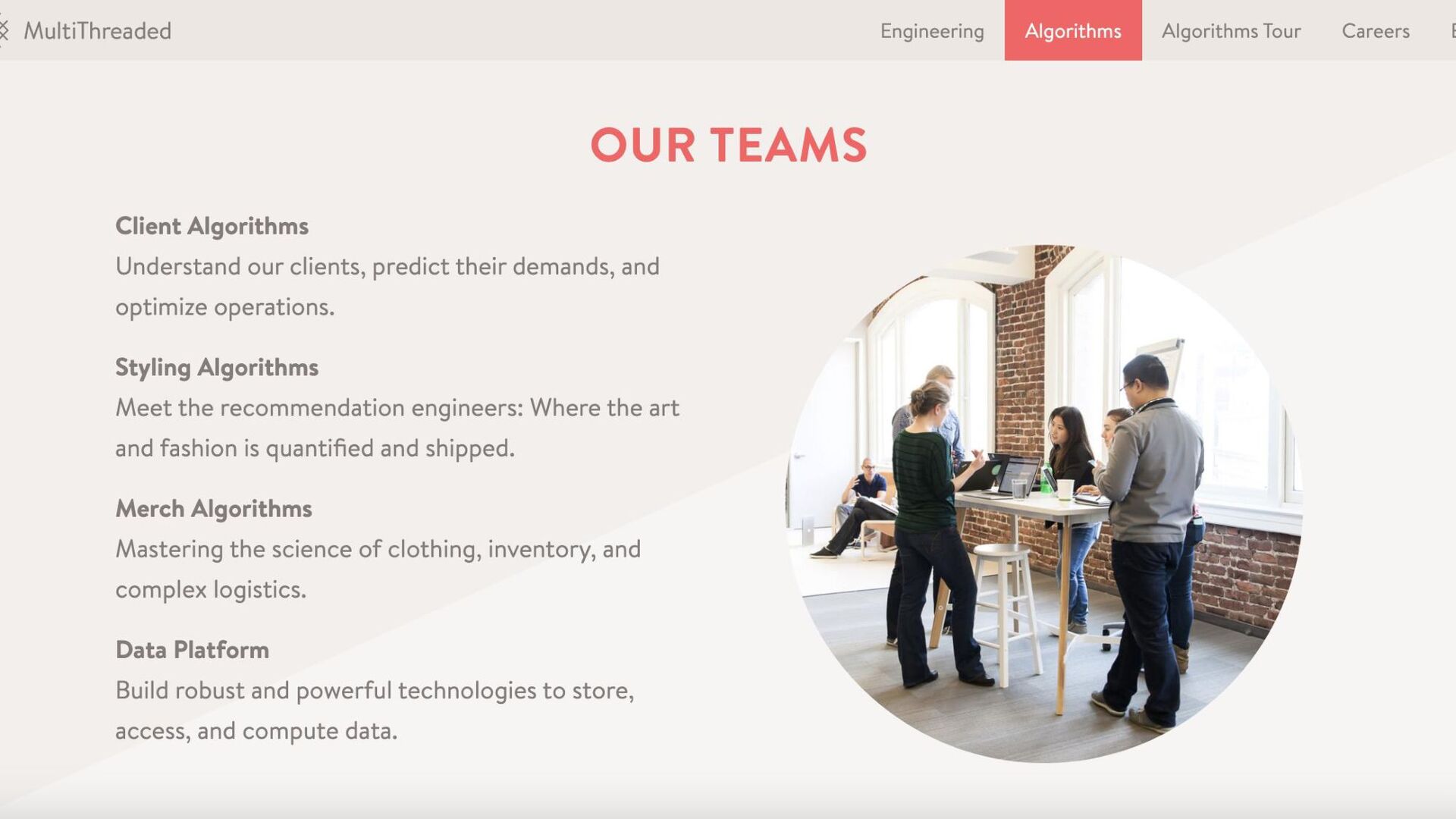
So they're a prime example of a startup effectively leveraging decision science. And here's a list of all of their different algorithm teams, To get a sense of how seriously they take this discipline. So as a company transitions from startup to enterprise level, it faces a variety of new challenges.
Scale ups need to manage growth strategically and maintain competitive advantages. Satisfy a customer growing base while ensuring operational efficiency. Using historical data and predictive analytics, decision science can help you identify promising new opportunities based on market trends, competitive landscape, customer behavior, as well as your internal capabilities.
And additionally, as a customer base expands, maintaining customer satisfaction and managing customer churn become increasingly challenging. This discipline can help you identify key drivers of customer satisfaction and potential red flags for customer churn. Using techniques such as segmentation, and again predictive modeling, scale ups can personalize their customer interactions and proactively address any friction.
Now in terms of operational efficiency, as scale ups grow, you need to manage increasingly complex supply chains and more extensive data. So this discipline assists you in identifying which roles are particularly crucial for your growth, Where the talent pool for those roles are located, and how to best organize your company for optimal productivity.
Predictive analytics is used widely, you probably hear me saying that every other slide, even I'm getting tired of saying it. But it's really fundamental to this practice, because you're wanting to understand not just what happened, but how what happened, how can that inform what you need to do next.
And using data driven insights, startup scale ups can manage your growth really effectively and navigate these challenges. So we're gonna talk about another brand that I'm sure everyone's familiar with, which was also a startup at one point. I don't think we can call them a startup anymore, Uber.
And they really, really successfully leveraged these methods during their period of very rapid growth, very rapid expansion, going from a startup to what is an enterprise company at this point. We're gonna take a look at their dynamic pricing, route optimization, how they approached market expansion and how they approach driver retention.
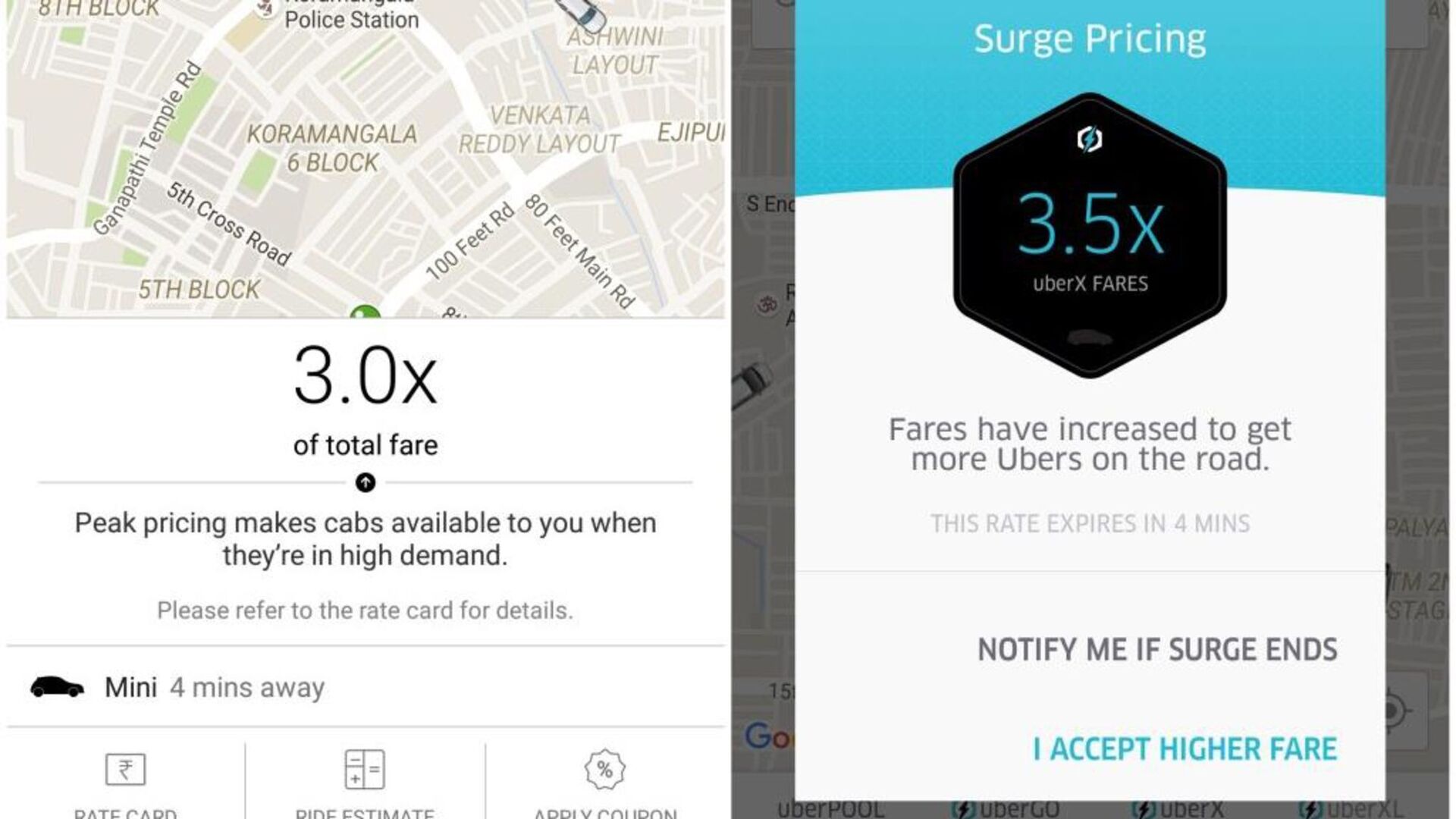
I'm probably gonna go very quickly from this point, because the clock is ticking down and I have so much more to cover. So we're pretty much all familiar with surge pricing, right? We all very much hate it when that happens to us. One minute's one price, one minute's next.
This is actually dynamic pricing in action. And they utilize this because oftentimes the supply of the demand for cars outstrips the demand for drivers. So to encourage more drivers to get on the road, they increase the prices, thereby increasing compensation model for the drivers as well.
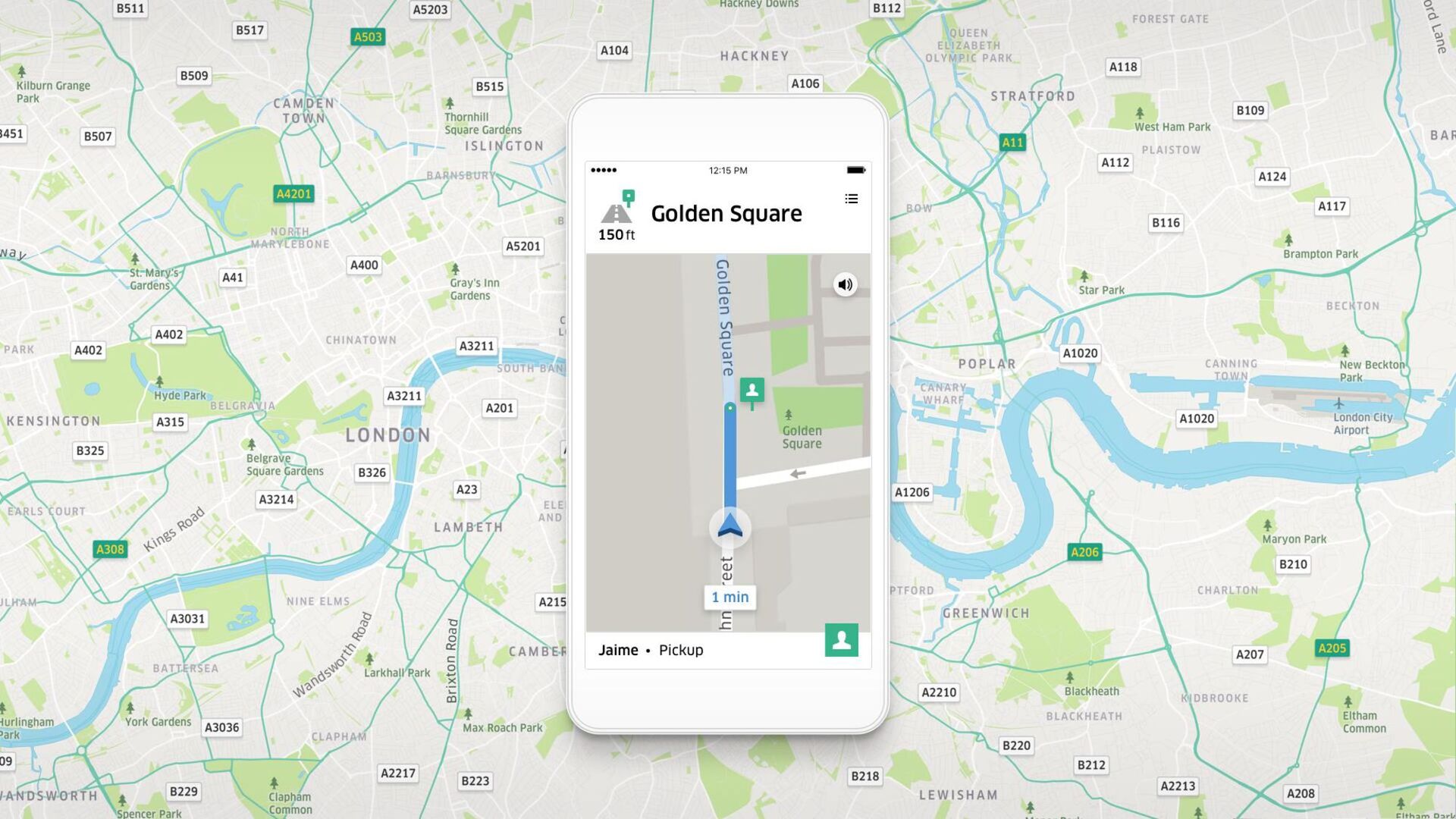
They also use it heavily for their route optimization, similar to what Amazon does. Their algorithms are continually analyzing real time traffic data, road conditions, and other variables to provide drivers with the fastest and most efficient routes to their destination. Now this improves rider experience by getting you where you want to go faster, but it also allows drivers to complete more rides in a given time period.
So in terms of market expansion, Uber used decision science to identify the most promising new markets for their service. And what they did was they looked at population density, public transportation infrastructure, the prevalence of smartphone use, and all of factors together and more, to decide where they would launch their service next.
They also leverage decision science to improve driver satisfaction and retention. Driver retention continues to be a problem for a lot of the ride hailing services actually. So this is a pretty big focus for the brands. And by analyzing data on driver behavior and feedback, Uber can identify factors that impact their satisfaction such as earnings potential, frequency of rides, interactions with drivers.
So based on these insights, Uber can implement strategies to improve not just customer satisfaction, but satisfaction for their drivers and the driver experience of being an Uber driver. Jump ahead to, okay, so building your team. Let's talk about how you'd want to structure and create an end to end decision science discipline.
Can I just ask the room, how many folks work at companies that have fairly large data centers, data people data centers, not data center centers? Anybody? Analysts? Decision scientists? Okay, awesome. You're gonna wanna jump on this. So here are the critical things to consider.
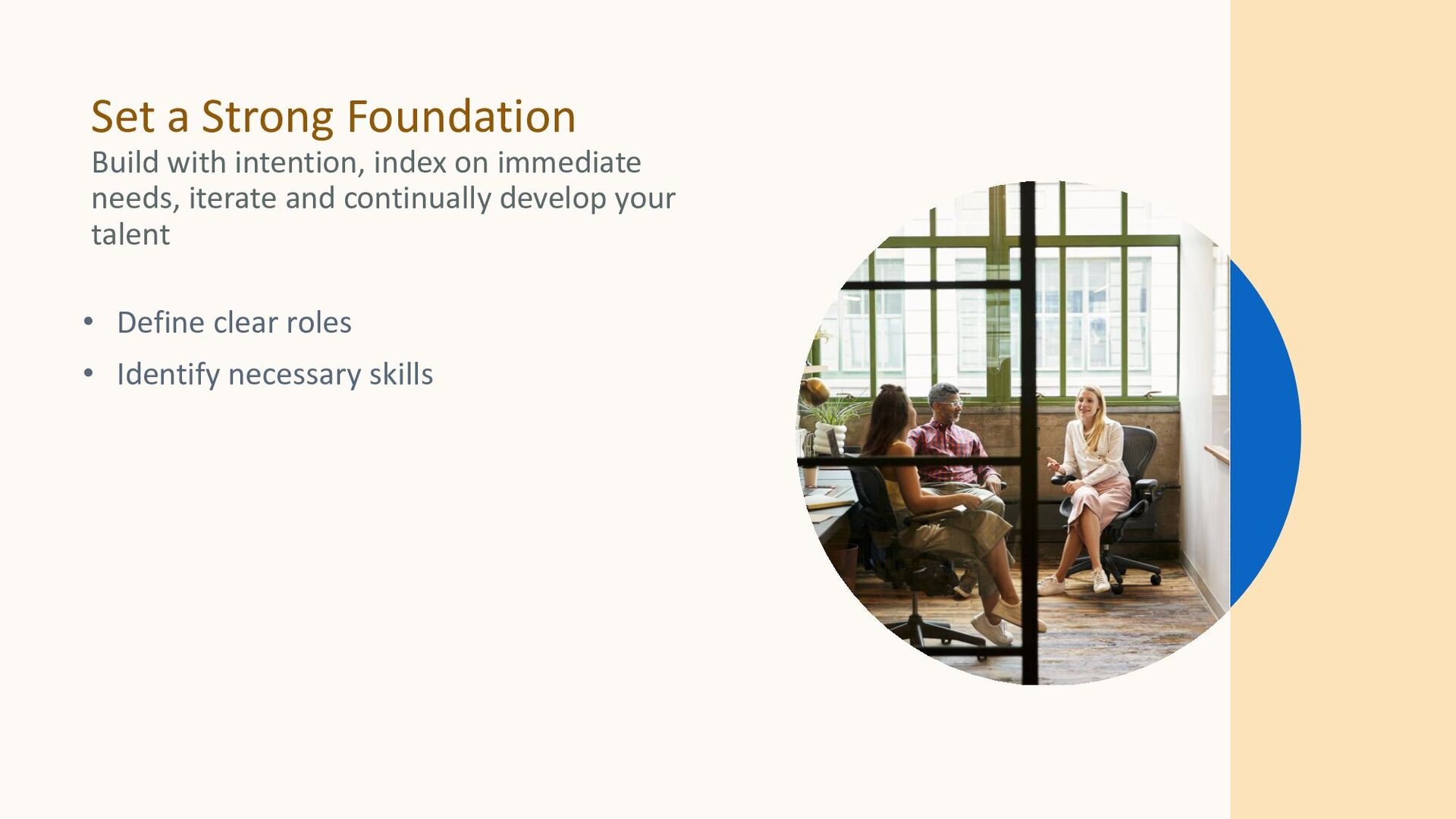
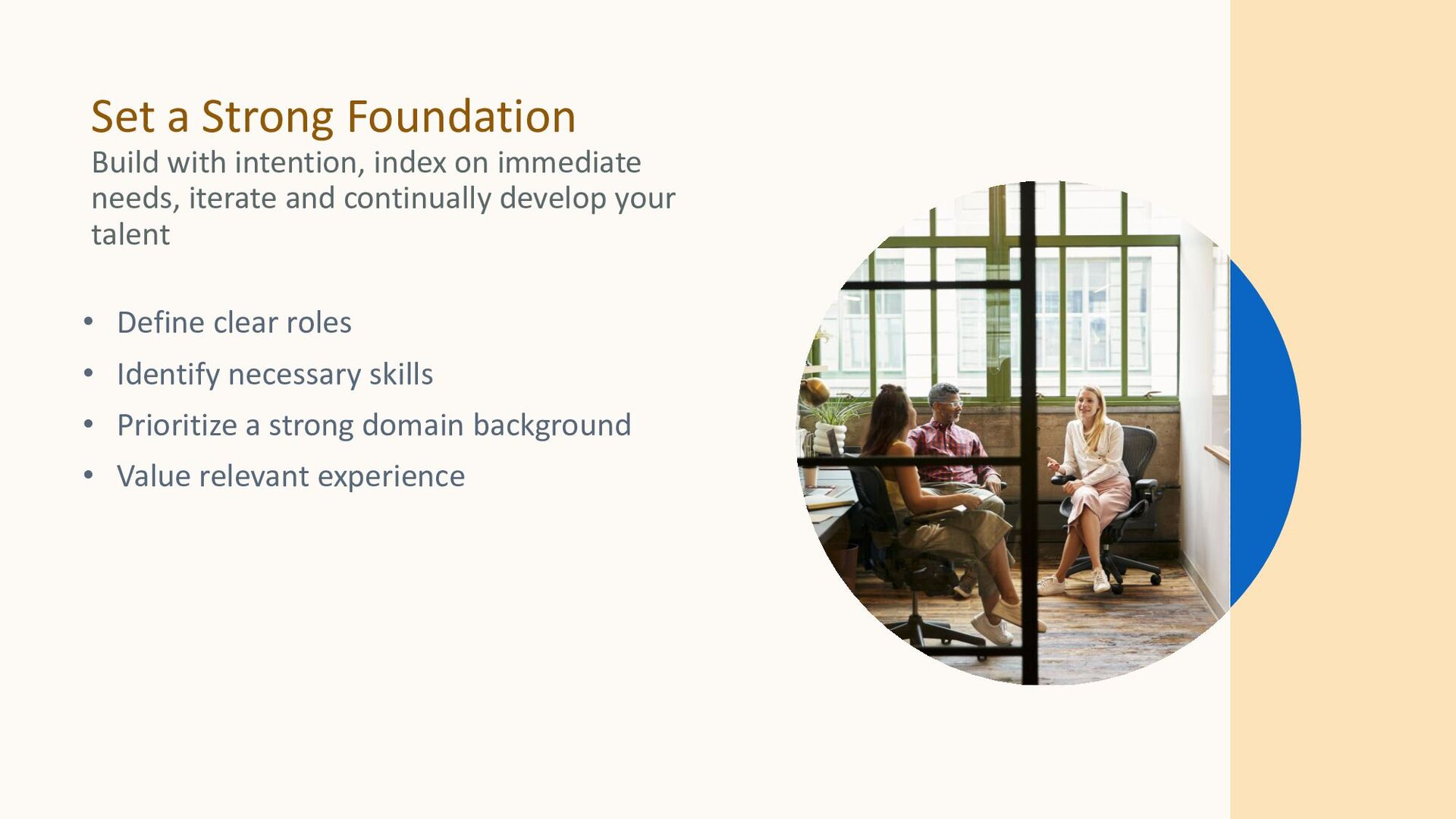
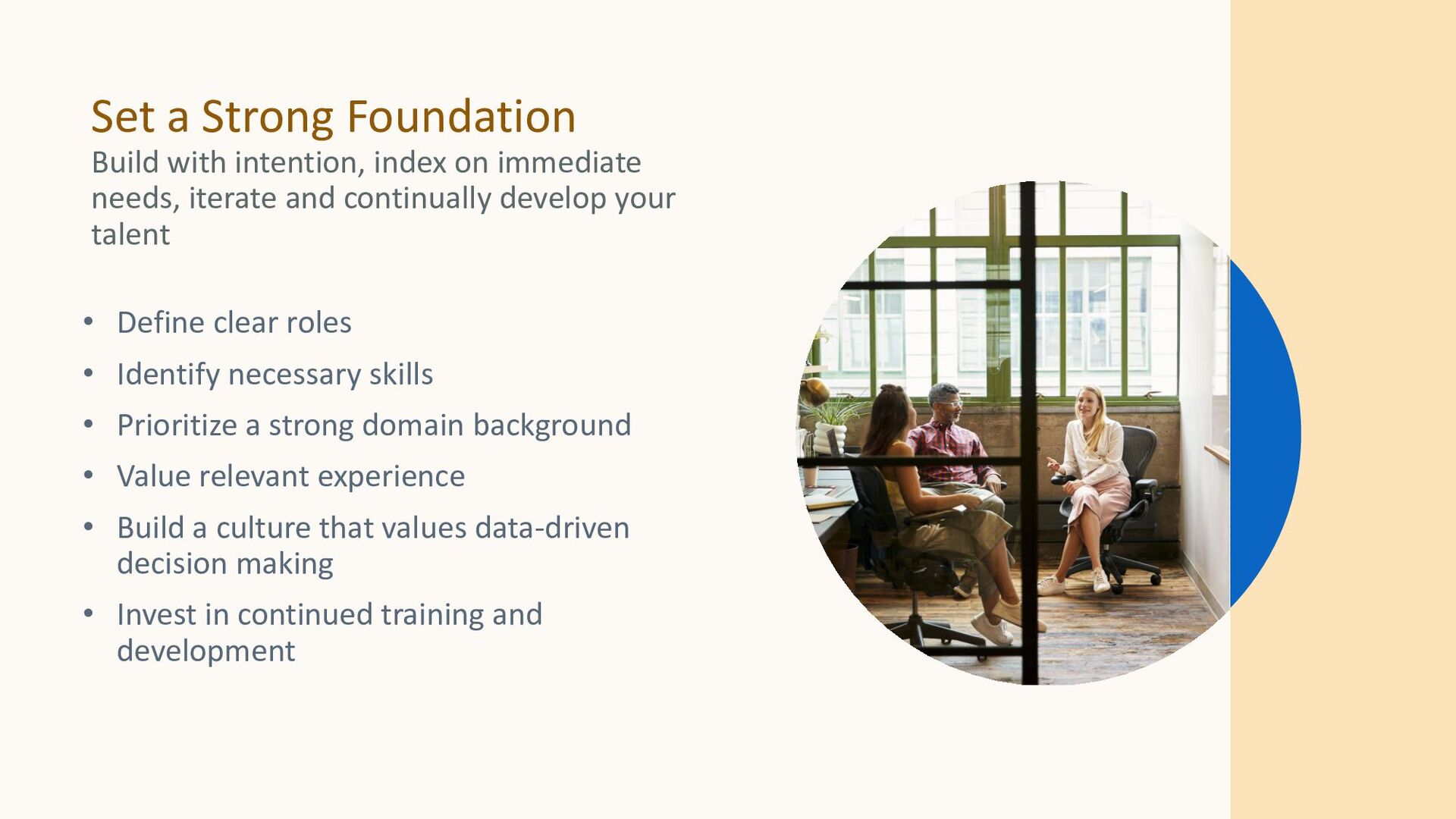
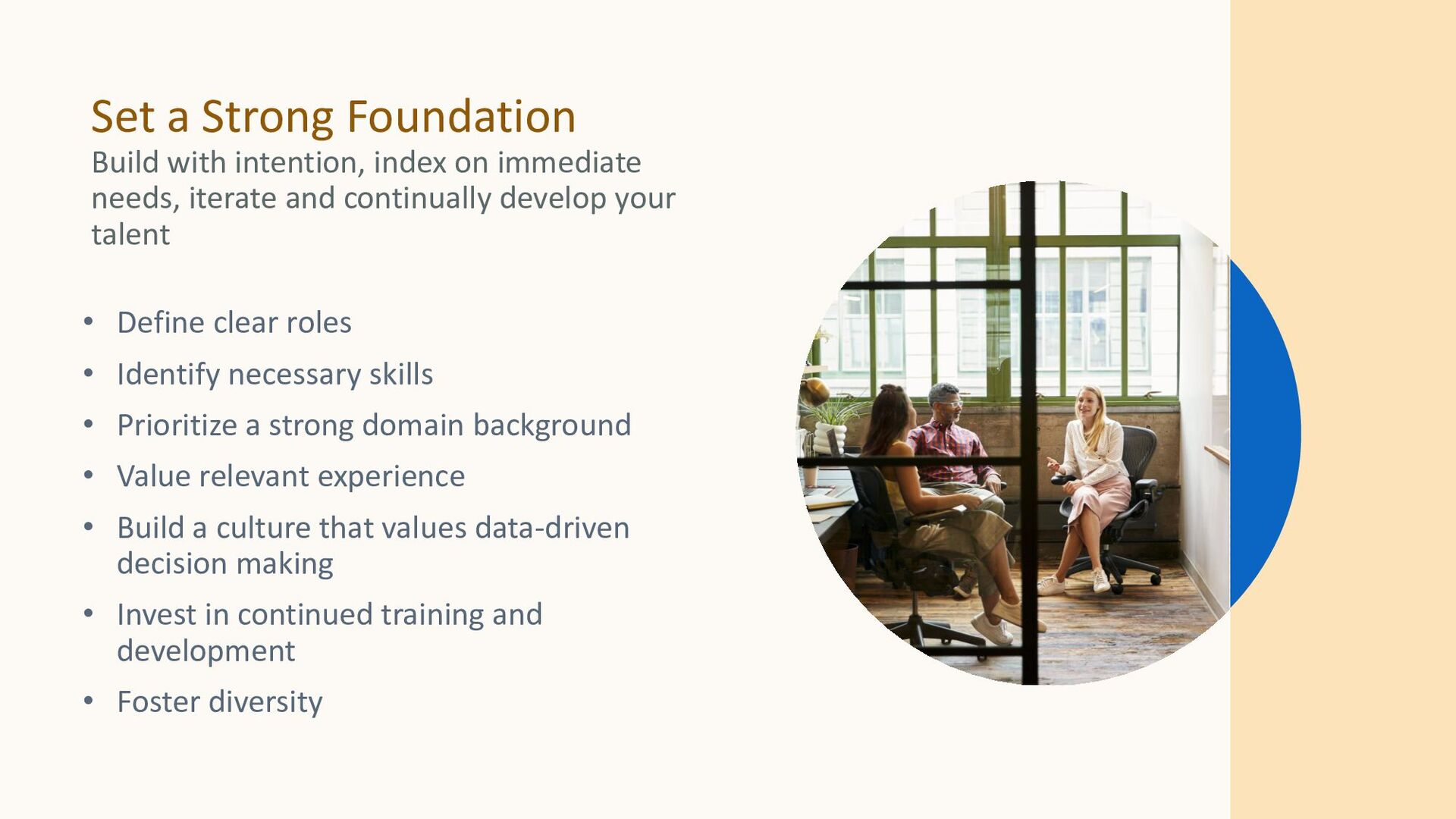
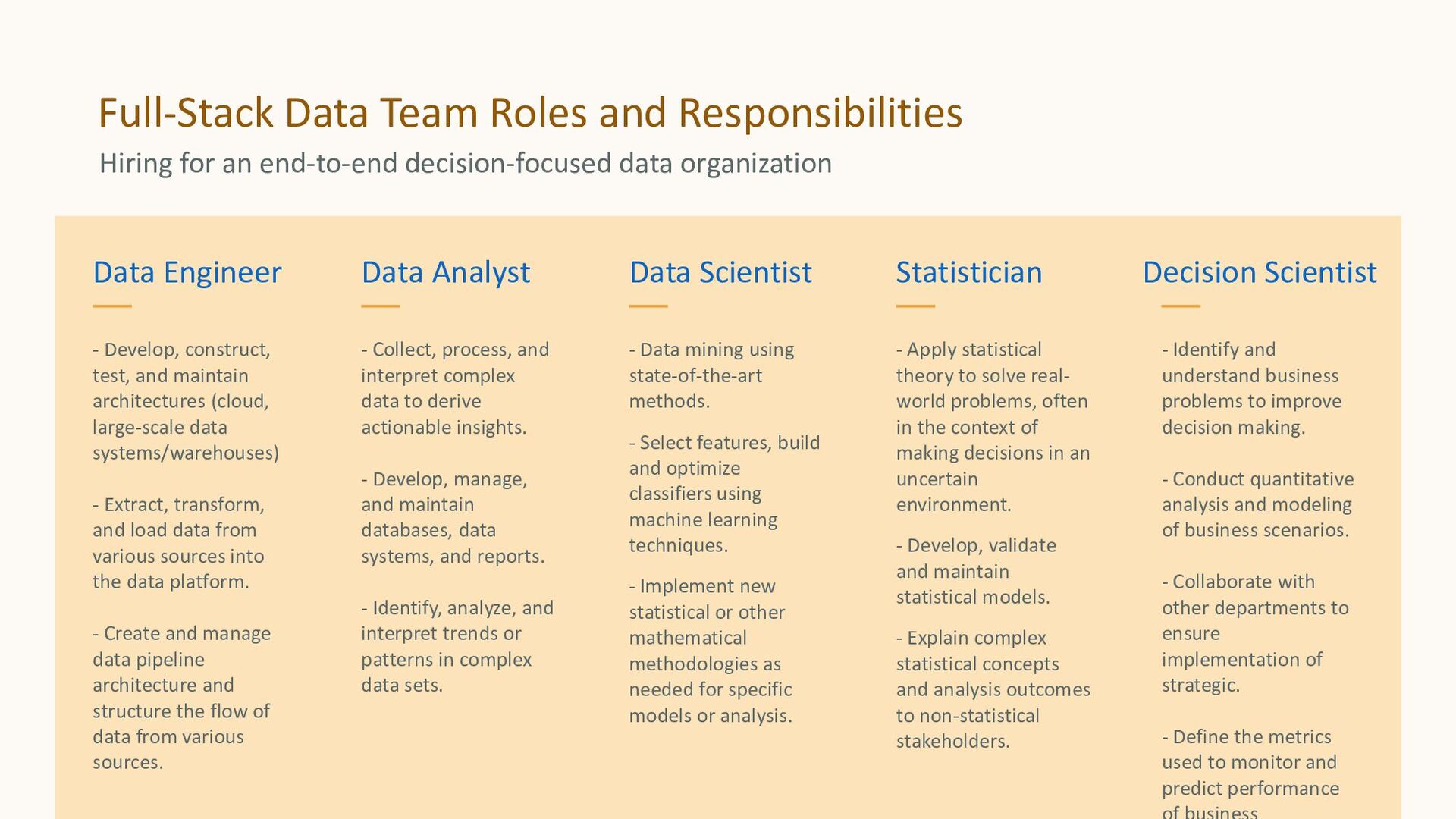
First of all, you have to set a strong foundation. That means defining clear roles and identifying what are the roles you need on your team at this time. So common roles within a decision science team might include data engineers, could include data analysts, data scientists, statisticians, and decision analysts.
There's a lot of overlap among these different roles, but they also each do come from pretty unique and specific disciplines at times and serve different roles within the data organization itself. So you need to identify the necessary skills. Now for these roles, the key skills typically include statistical analysis, mathematical modeling, data visualization, proficiency and relevant software tools.
So this includes things like R, Python, SQL, Tableau, a variety of different BI tools. But really the workhorses are stats, Python, and SQL. So beyond technical skills, you want to look for analytical thinking and problem solving capabilities, as well as excellent communication skills.
The analysts on your team, having communication skills and being able to break down a very large data set, a very complicated problem and explain it to stakeholders, executives, people across the organization, is really critical and is not something that is probably as focused on as it should be when you're thinking about recruiting and hiring.
Communication skills. A person can learn and get deeper on a given tool or technology, but communication skills really need to be table stakes. You're going to want to prioritize a strong educational background. Now this background itself shouldn't be everything that you consider, but it can indicate a level of knowledge and expertise in some of the domains that might be more important to you and your organization.
So preferably, again, candidates would have backgrounds in things like statistics, economics, computer science, those kinds of disciplines. An advanced degree might also be more necessary for more specialized roles in data science, applied research, things like that. But equally important is valuing relevant experience.
So candidates who have experience applying decision science techniques in real world scenarios can be highly valuable. You also want to look for individuals who have worked on projects similar to those that your company has, or has worked with data or really understands the data sets that your company develops.
Having a subject matter expert on the data is really critical. You're also going to want to build a culture that values data driven decision making. Culture plays a really important role here, because often times at smaller companies or at startups, things can be very personality driven.
People just have a good feeling about something, a good sense and intuition. And if you don't support a culture where it says, well I respect your intuition about how you think this has played out or would play out, but here's what the data's telling us.
You wanna have a respect for what you find in the data. I often tell my analysts when we're asked to do an analysis and it comes back with not the best news, And they'll say, well, maybe I need to go back and dig a little further.
I have to stop them and I say, we're in the news business, we're not in the good news business. We give them, we communicate what the data tells us. We don't look for a narrative that doesn't actually exist. That's a really dangerous thing.
And so think about how the incentives in your company's cultures are set up to support data driven decision making. Invest in continued training and development. This field is always changing, the tools, the technology, the capabilities are always changing. So once you do have these folks on staff, you want to encourage their continuing and ongoing development so that your company and your team is using best practices, whatever the state of the art is for the industry.
And finally, foster diversity. This is really important. A diverse team brings a variety of perspectives, and this leads to actually more robust decision making and better understanding of factors, things that if your team looks the same, you're gonna get the same information a lot of the times.
Really encourage you to think about looking at the background. So it's the educational background, it's the experience background, it's demographics background, so all of that when we talk about fostering diversity. I'm gonna briefly dig into the specifics of the types of roles you might see.
So I think I've mentioned before, so data engineer. Those folks can sometimes live on the engineering team, not necessarily within a data organization, it depends on how your business is set up and structured. Then you've got your data analysts. These folks are typically, they're working with BI tools, they're not necessarily digging into the data, the raw data, they're not necessarily creating raw data sets.
These folks are usually just bringing the the top line insights forward. Then your data scientists, as you know, they're gonna dig a lot deeper. These are the folks that they're look at setting up models, creating algorithms, doing some applied research if necessary into specific types of data sets.
So they're really important to have, as well as a statistician, depending on You don't necessarily have to have a statistician in your enterprise, depending on size. I would say it's a really good thing to have if you were dealing with If your customers are public facing, you really need to understand a lot of behavioral information, and you're dealing with a lot of financial information, having a statistician is key.
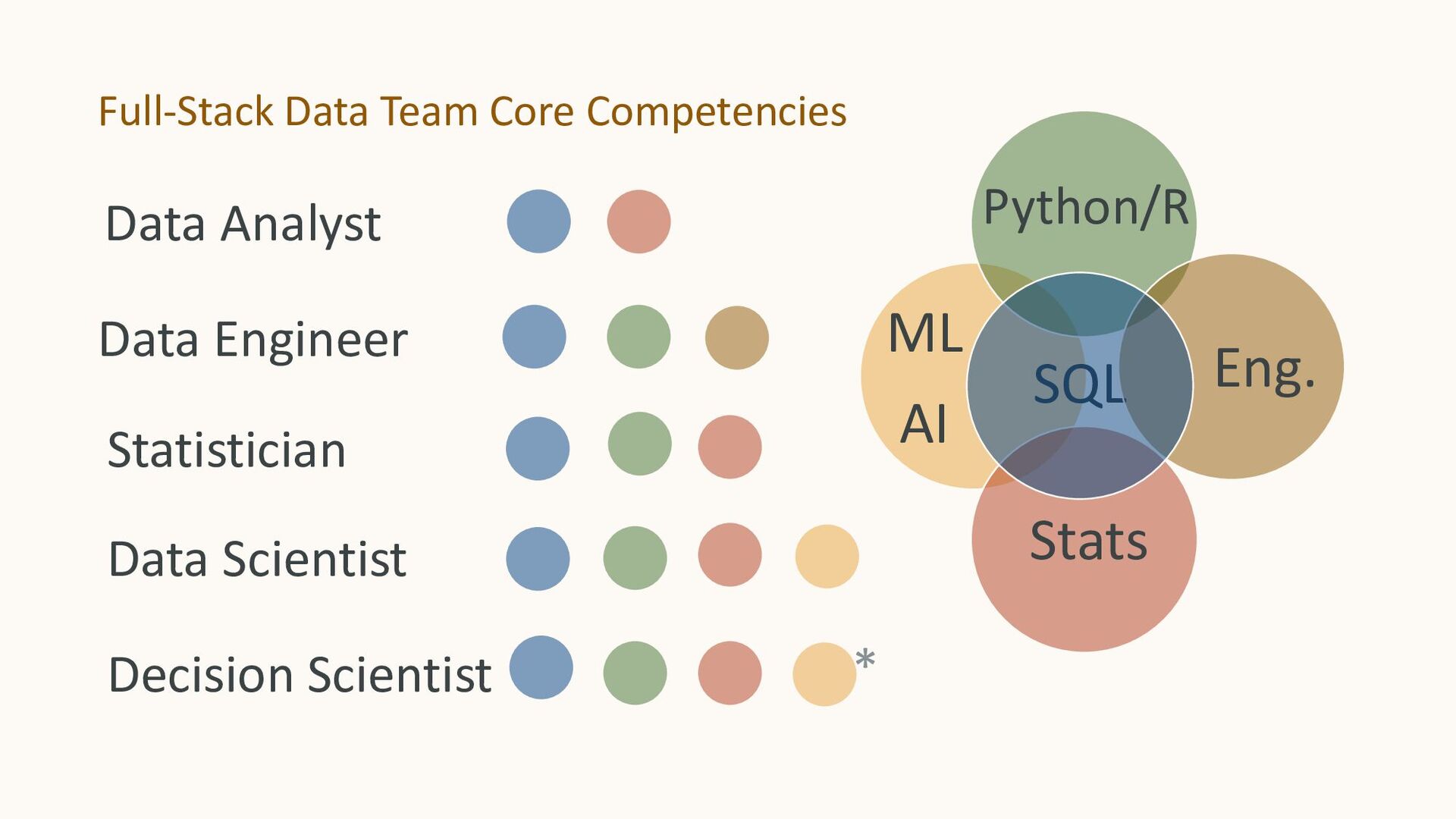
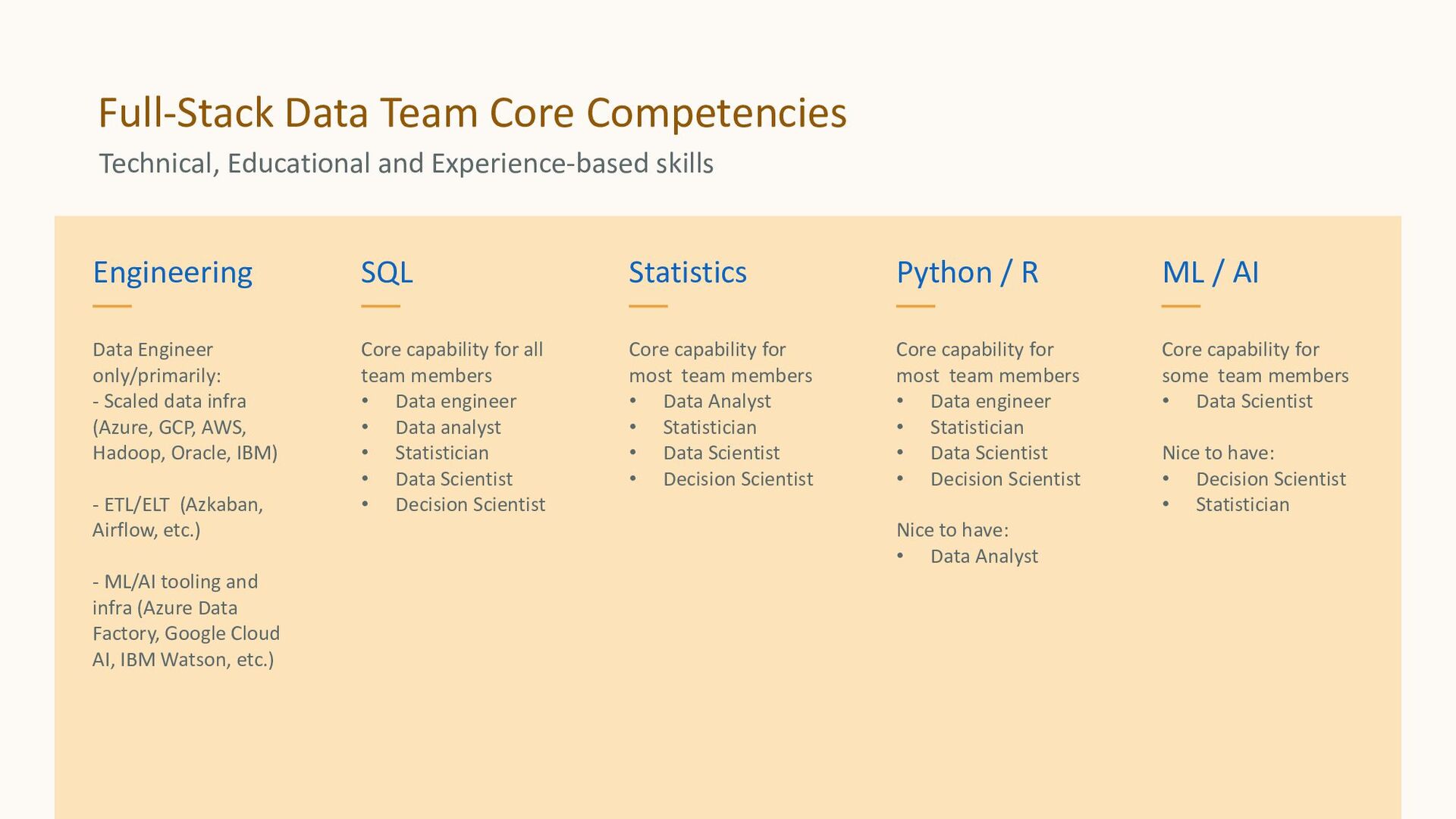
And then finally, the decision scientists. And so the decision scientists tends to be the folks that have the most expertise with the data set, with your industry, with your business problems. And all of these folks work across functions. So when we look at the core competencies, you can see that pretty much, like I said, stats SQL, Python and R, that's across everyone.
Engineering's gonna have a very different background, your engineers will. And your statistician's gonna have a very different background. But for the data scientists, decision scientists and analysts, they're all gonna be fairly similar. This breaks down again which skills and roles, how much similarity there is across the skills and roles.
And the makeup of your team is going to vary. It's going to vary on your needs, it's going to vary on where you're at in your growth stage, and it's going to vary on the type and size of your data. So what's next?
Here's what I'm excited about in the field of decision science, obviously it's all of the advancements we've seen over the past year in artificial intelligence, specifically generative AI. And what's exciting about it is how it can up level and increase the time to insights and the time to understanding your data.
So from coding copilots to data visualization plugins, automatic API selection, there's a lot going on with generative AI that really is focused from my perspective and from my teams on speeding our ability to provide insights, speeding our ability to apply new models, to get new information out there so we can make decisions more quickly and be more proactive, less reactive.
So I'm excited to see where things are going. I encourage everyone to attend the AI panel this afternoon. It's gonna be an open conversation with a number of other speakers. And it's gonna be a lot of fun. So we'll be discussing AI is at and where it's headed.
And thanks everyone. Hope you join me for the Q and A roundtable. I think I have the timing wrong here. I think my roundtable is at ten forty. It's at ten forty. That, happy to dig a little deeper into some of the things I've mentioned and talk about how particularly at LinkedIn in the global business organization, our team addresses some of our challenging business problems and answer those with data.
Thanks everyone. Thank you. Thank you. Thank you very much, Michele.