
Everything that you know about marketing and advertising is based on yesterday's rules. New technologies, changes in consumer behaviour, and the rise of intelligent personal assistants throw those rules out of the window. If we want our brands to survive the revolution, we need to change how we think, and to start preparing now. Jono explores how, why, and where we'll need to level up.
← All talks 


















Grow Marketing Turing Fest 2018
Digital marketing in a post-digital world: are you ready for what comes next?
Auto-generated transcript - may contain errors. Tap a timestamp to jump the video.
Digital marketing in a post digital marketing world. Let's welcome Jono Alderson to TuringFest. Very one, two, we're on. Right, let's go. This is going to be very fast. I'm going to explore five ideas, five concerns, five things which are scaring me and keeping me awake at night.
It's gonna be very, very fast. These are a combination of things I've thought about a lot throughout various experiences I've had as a developer, as an SEO, as a strategist, a futurologist, a bunch of other stuff. Let's go. The first is that the gap between brands and platforms is widening.
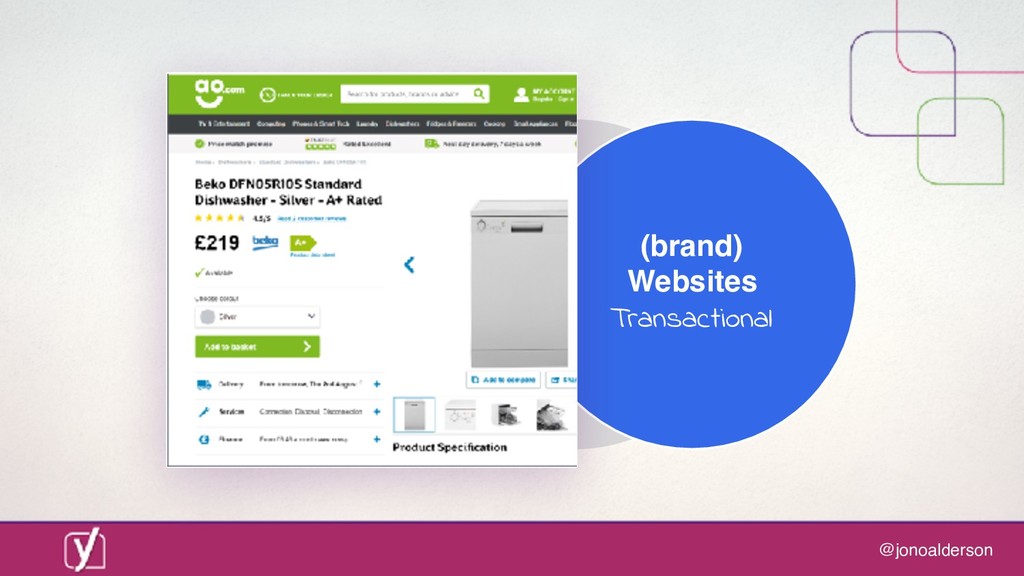
What do I mean? Think about brand websites, the places you go to buy the thing, to do the thing. These exist to provide a specific function and a service. They allow you to read content, to click on links, to add things to baskets, to fill out forms.
These are all singular tasks, and these websites are designed to allow you to complete these tasks on demand. Now, they're where you go to do the thing, which means they're typically not very responsive, not reactive, not personalised, not fluid, not exciting, or not necessarily engaging.
Because transactional experiences like the ones these provide are only interesting to you as a consumer and an audience at the point where you're interested in the thing. I will only go to America Online's website and look at the dishwasher category when I want a new dishwasher, or when I can be convinced that I want one.
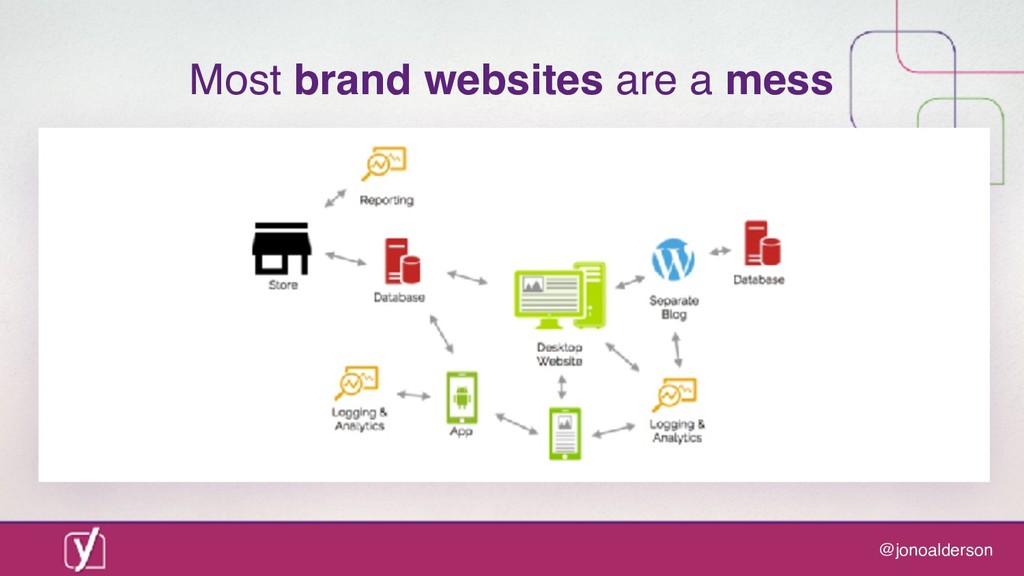
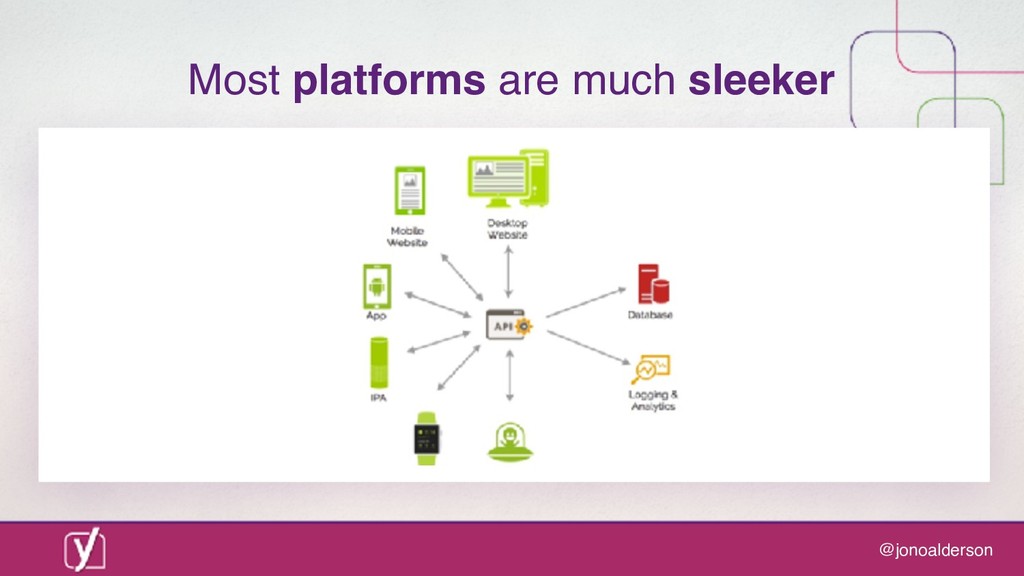
Typically, they're built like a mess. They end up looking something like this, where once upon a time they maybe had a store, or a database, or a blog, and as new challenges and marketing come along, and marketing evolves, the net gets more complicated, they bolt bits on.
They go, okay, now we need a blog, okay, now we need an app, now we need a thing, and this messy ecosystem unfolds. And that's fine, because their challenge is that they have other concerns, they have other priorities. They're running a business, they're servicing their consumers, their products, they're doing other stuff.
But the challenge is that when the web changes, and when we try and tackle all of the new technologies and ideas that we've heard about over the last few days, things like progressive web apps, and speed improvements, and mobile friendliness, These things are very, very challenging.
They're monolithic projects, they take forever, they go wrong, and they're very expensive. Think about platforms as opposed to brand websites. Platforms are where people go to spend time, rather than where they go to complete a task. And the content is typically curated by people on those platforms, they manage their own experiences.
However, the product is the consumer, is the audience, either as a click to a website, or as a series of data points, in the case of Facebook. Now, to brands, platforms are marketplaces for consumers and the data associated with them. So there's a synergy between brand websites that nobody really wants to visit, and platforms which have this audience that they can sell to brands who struggle to attract one on their own.
Platforms are sexy. They're built API first. They use new technologies. They use hub and spoke technologies and models, and they use new technologies like Angular and Node and Vue and all sorts of other exciting stuff, which means that when they want to do progressive web apps, or get faster, or become more mobile friendly, it's infinitesimal.
It's much easier, much faster for them to do so. So traditional businesses are suffering. Traditional businesses are slow, they're clunky, because they're distracted and they're doing other stuff. Platforms where people want to be and hang out and do cool stuff move much faster.
So that gap gets much wider. So there's this synergy where platforms are selling traffic to websites, but they're getting better and better and better. So I think what's really interesting about this is that that gap widens because as new technologies evolve and the web matures and gets more and more interesting, the difference becomes much more palpable.
The best experience people have on websites, where they're personalized, they're fast, where they're responsive, where they remember who they are, where it's clever and intuitive and fluid, that becomes the expectation. And as platforms become more and more like this and websites feel older and clunkier and clunkier, people will increasingly prefer to spend their time and their money on platforms rather than on America Online and conventional websites.
Consumers and audiences will be less and less likely to be willing to visit your website. Think about that. It gets more and more preferable to stay on Facebook, stay on LinkedIn, stay on Twitter, than to go to your website. We're going to explore the implications of that.
It means that we're becoming increasingly reliant on paid advertising. And businesses rely on getting visits and eyeballs from platforms to your content, to your marketing stuff, to your editorial, to your sales messaging, to achieve that pull mechanism we advertise. So Facebook is a platform, AdWords is a platform, even Google's organic search experience is a platform that we're buying eyeballs from.
So we run campaigns, we invest in adverts, etcetera, and we strive to rank highly in SEO, and we buy billboard ads, and we try and buy attention. We try and grab those eyeballs and those visits. We find opportunities to interrupt the experiences that consumers are having in their platforms, in the places they want to be, and the places they want to spend time.
That feels destructive. The model is imperfect. So everyone makes a bit of money, you advertise, you move the people around, everyone sells some things, excellent. But there's a lot of friction involved. Consumers don't generally want to be pulled out of the experience they're having and pulled away from the platform and the content they're consuming.
And platforms don't really want those consumers to leave either, because as soon as they leave, they lose the ability to monitor and track and monetize them. So there's this tricky balance where nothing quite fits in this economy. It's increasingly why players like Google are trying to keep you in their platform.
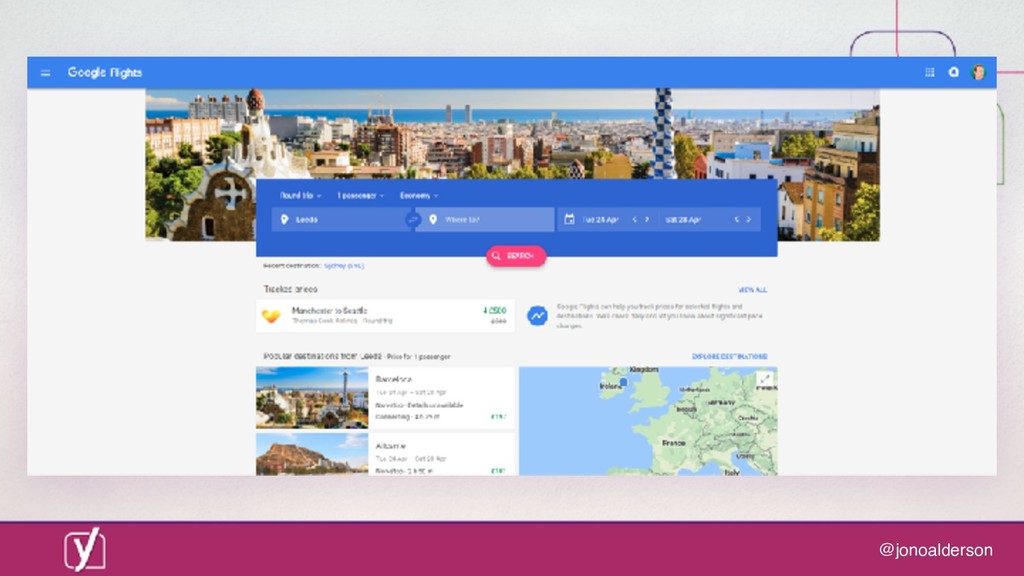
This is Google's newish flight service, which is far and away better than a lot of the competition in the space with the obvious exception of Skyscanner, who are our lovely sponsors today. But they're trying to do this because whilst they control the consumer and they keep them in their platform and their environment, they can continue to make money out of them without introducing the friction of shipping them off somewhere else.
That's why they're moving into more in platform experiences. And consider, all of your content marketing, and your branding, and your media, and your efforts to rank highly in organic search, and to put billboards, and build brand affinity. You're still buying clicks and eyeballs from platforms.
Even if you do loads of great SEO and you rank really highly and get loads of traffic, you've paid somebody's salary to write that content, to optimize that website, to spend that time. You're still buying clicks from a platform. We're dependent on these platforms to get traffic to our websites.
Your content marketing is just another form of interruption advertising. So this is a bit broken. Nobody really wants to visit your website because they're quite happy doing the thing they want to do in the place they want to be, unless they're already at the point of purchase.
But of course, you want to reach a broader audience than just the people who are ready to convert. So how do we do this? Rather than paying for those clicks continually until we all die of boredom and old age, maybe there's less friction in getting your content and your messaging into the platforms.
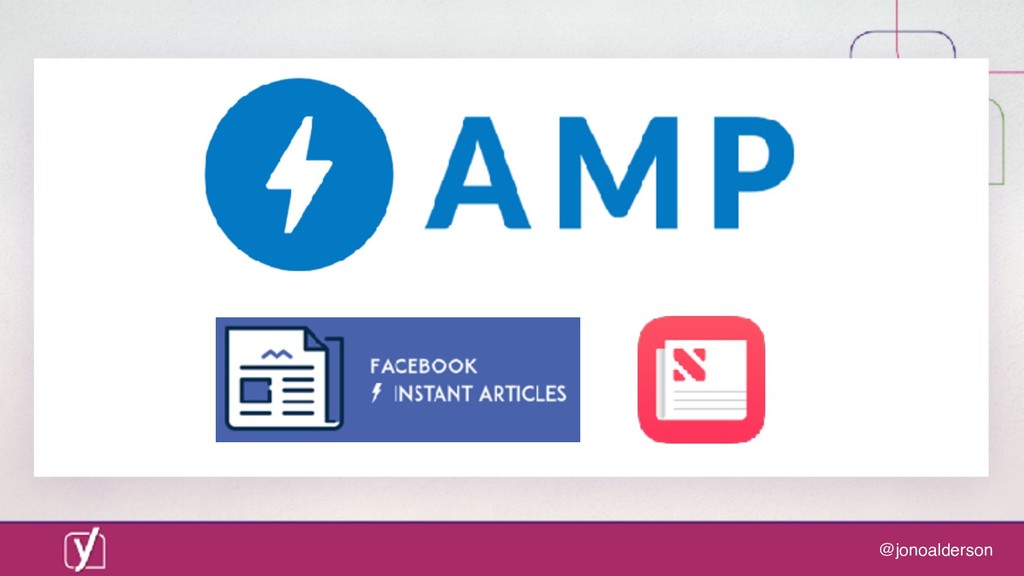
Here's the good news, you can put your content on their platforms for free, like magic. We're entering an age of distributed content, this is point three. Frameworks like AMP, like Facebook Instant Articles, like Apple News, like a whole bunch of others, allow you to take your content and to plunk it straight into their environment, in a way that removes all of the friction, in a way which sits nicely within their frameworks, in a way which is faster and sleeker and better and prettier and nicer than you could probably achieve on your own
website without, however, any of your pesky adverts or conversion polls. So you can put your content in these places where these people are and not disrupt their experience and allow them to engage happily and comfortably, but you're not going to be able to sell to them.
You're going need to try and use a different type of content to engage, to build brand recognition, and preference, and familiarity, and all those kinds of good things. And whilst these look like just new channels, and new fads, and new things, this is you putting your content into other people's environments.
It's not just a channel and a place where you can distribute to it. It's a fundamentally different way of thinking. It won't work if you try and just take what you're doing at the moment. So brands are ceding control and sacrificing ownership of their discoverability, sorry, of their audiences exchange for, and their content in exchange for in platform discoverability.
So in the same way that Google favors AMP results and gives preferential treatment and exposure to people who adopt their standard, so will Facebook and Twitter and other players provide you with rewards for playing along with their formats. And even if you choose to go against this trend, and you say, you know what, I'm going continue to optimize my website, and get my content on my site, and bring customers to me.
That's going to get more and more expensive, because you're gonna be competing against the native formats in the platforms, and your audience is going to diminish. Because there's gonna be a huge number of people who are seeing your competitors' content and messaging, building brand relations and affinities, and making purchase decisions outside of your field of awareness.
And all you're going to see is a diminishing audience size and increasing cost per acquisition. That's pretty scary. So even if you choose not to play along with this, the world is changing and you're still going to be affected. This is a revolution from owned media to distributed content.
A shift from publishing editorial content and trying to pull people to your site, to those consumers encountering you and your brand and your competitors in the places where they are. And nobody quite knows where this is going, but it's a thing and it's established and it's picking up velocity.
So you need to choose how and where you want to play. If you want to convince people to engage with your brand, and ultimately eventually maybe buy your stuff, you're going to need a different type of messaging, and a different type of approach.
Fast forward to tomorrow, to next week, to next year, this will get much harder. Today there's Facebook, a Twitter, an Instagram, LinkedIn, maybe half a dozen of them. Tomorrow there are twenty, the next day there are a hundred. Some of them only last for six months.
How do you choose where to invest? How do you choose which strategies to deploy? None of our businesses, and our software, and our websites, and our CMSs are designed and set up in a way that allows us to easily move this flexibly, but they will need to be.
You will need to make decisions on the fly of which platforms you target which content into, with which prioritization, and you need to be able to turn that around in days, not weeks or months. You need to think about your tech stack and how you do that now.
This isn't about getting your content onto Facebook, it's about getting your content out there rather than in your website. Alternatively, you need to ask yourself, What experience does my website deliver that makes it truly valuable, truly distinct? Enough so that somebody would remember your brand and type your website into a search box, so into a URL in a browser, without going through all of that mess?
What is it that you do that is so valuable that people are willing to distinctly and deliberately visit you, rather than passively consume content in Facebook and LinkedIn and Twitter and encounter other brands there? That's pretty scary. It has huge ramifications to everything, the way we think about brand and analytics and websites, and content, and conversion, and shopping.
All of that stuff starts to come under threat. Because our current paradigm, and this really scares me, is to build the biggest castle. The biggest website, with the most pages, with the most visits, with the highest conversion rate, with the biggest number of sales.
All of our KPIs are these numbers. More of the things, more of the things, get more people in, push them through the funnel. That approach doesn't work in a world where nobody wants to or needs to visit your site because they're finding what they need in the places that they are.
They're building brand preferences, they're developing affinities, they're seeing conversations, they're making decisions about future purchasing options out there. They're not coming to your site. Why would they? Why would the platforms afford them the opportunity? Why would they want that? Why would Facebook ever want a visitor to leave Facebook to go to your website when they can be much more profitable, much more frictionless, much more engaging when they handle it all in situ.
I'm not saying abandon your website and just do Facebook. I'm saying think what your website is, and what your content does. Because transactional experiences are only interesting when I'm at the point of transaction. How does your analytics and your attribution work in a world where nobody wants to visit your website?
How do you build business cases? How do you say to your C level, we need a budget to do this kind of content, because we need to attract these numbers of visitors? None of the maths work, and you can't predict how many people might see your content across a distributed ecosystem.
Everything we know about marketing breaks. This is the least scary bit of the deck. You need to start investing building brand equity in these rented platforms, to start to build equity in people's minds, to move from selling to familiarity in these ecosystems that are transient, and many are complicated, and there's many of them, and some of them come and go.
Now, conventional logic says don't build business equity on rented platforms, because changes in rules, and changes in structures and formats might destabilize your performance, might destroy your foundations, but if your audience aren't visiting your website, and all there are are rented platforms, what do you do?
I don't have an answer, but it's worth thinking about. They're news feeds, content streams, apps, and they're fluid transient things. I think to deal with this, we need a new, maybe new, maybe old marketing model. I think we need to change the relationship between our marketing and our audiences.
Your objective can no longer be to attract consumers to your website in the hopes of converting some small percentage of that audience. At least, not if you want to grow to reach new audiences. If you keep doing that, that audience is gonna diminish and diminish, because more and more people will find what they want elsewhere without visiting your website.
If you want to grow, if you want growth and access to new audiences, you need to change your thinking. The rules of content and brand websites need to shift away from conversion and towards positively influencing brand preference and recall. Rather than my website and my content being part of a system of pulling visitors in and trying to convert them, it needs to be a vehicle to grow my brand's reach into environments where my consumers are.
It's a place where stuff can live and be propagated out of, but it's not necessarily a destination. Excuse me. It needs to feed and manage those conversations around my brand, my preference. I appreciate this might sound incredibly naive. I'm a very technical marketer, and a lot of this feels incredibly awkward to talk about because it's fluffy, and it's brandy, and it's a very different way of thinking.
To a generation of digital marketers who've been trained to think about conversion rates and metrics and visits and numbers and be highly measurable and accountable, this is all a bit soft. But the world's most successful brands have always operated this way. They've on Sit down, John.
Always understood that this is the right What are you doing? Distracting. Look at the It cost me precious seconds. Look at B and G. They are decided the old school. They sell all of the cleaning products in your home, in your bathroom, in your kitchen.
When you analyze their marketing, they look woefully unsophisticated. It's like they've ignored the digital revolution. Many of their websites are big, bold pictures and storytelling of happy, smiling children and families. Very few of them have e commerce, very few of them have checkups, very few of them have product pages.
They all story tell, but that's not an accident. It's because their objective isn't to try and sell bottle after bottle of cleaning fluid. Their objective is to build brand preference and association. Their objective is to be known and loved by you, so that when you're in the supermarket and you see eight different competing bottles, you recognize and you prefer theirs.
All of their marketing is hugely sophisticated. It's just done in a different way than we typically understand. It's a different way of thinking. To do that, you have to influence over. You can't just wait until somebody arrives at your website and try to sell to them.
They're not there, they're not coming. You've got to do it beforehand. You've got to make them want to believe in you, to tell the stories, to engage with them way before they ever reach that point. Just because your conversion mechanisms live on your website doesn't mean your website is just a conversion mechanism.
It's a convenience of the digital world that we can think like that and we can operate, but we've done so at the exclusive sacrifice of anything to do with brand or familiarity or preference. We've forgotten how to market. It's not just P and G.
It's all of the world's biggest, most successful brands, and that is not a coincidence. They all think like this. They all market like this. They have all, always marketed like this. They have optimized for preference and recall and brand awareness. Because they know that at some point down the line, I will make a choice of which brand I want.
And at that point, they can win. It's too late to wait. If I'm already at the supermarket and I don't care, don't recognize the brands, they can't win. It's too late to market to me then. This is going to become increasingly important as we skip forward through a few slides and realize we're about to enter an age when all of this falls apart.
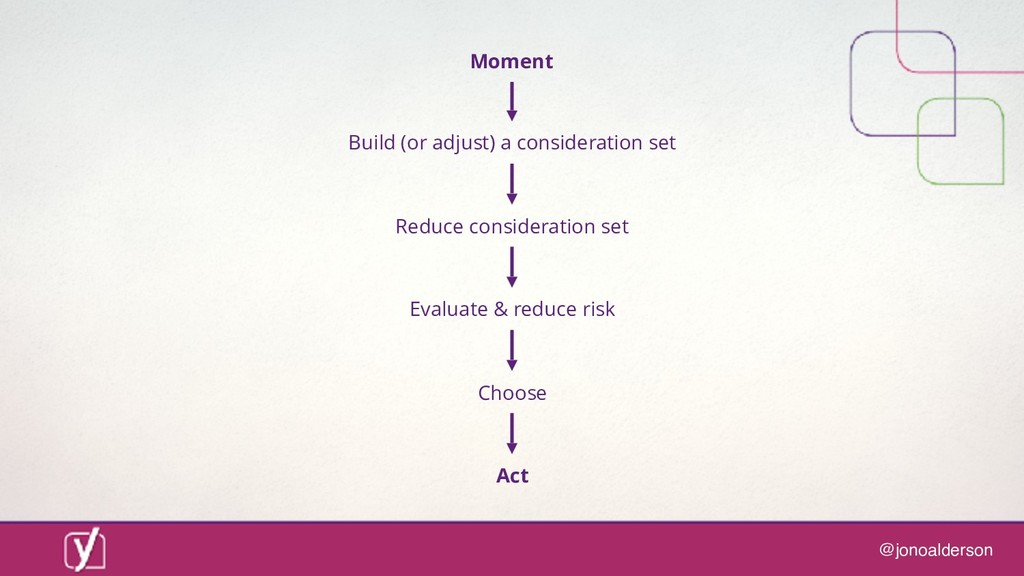
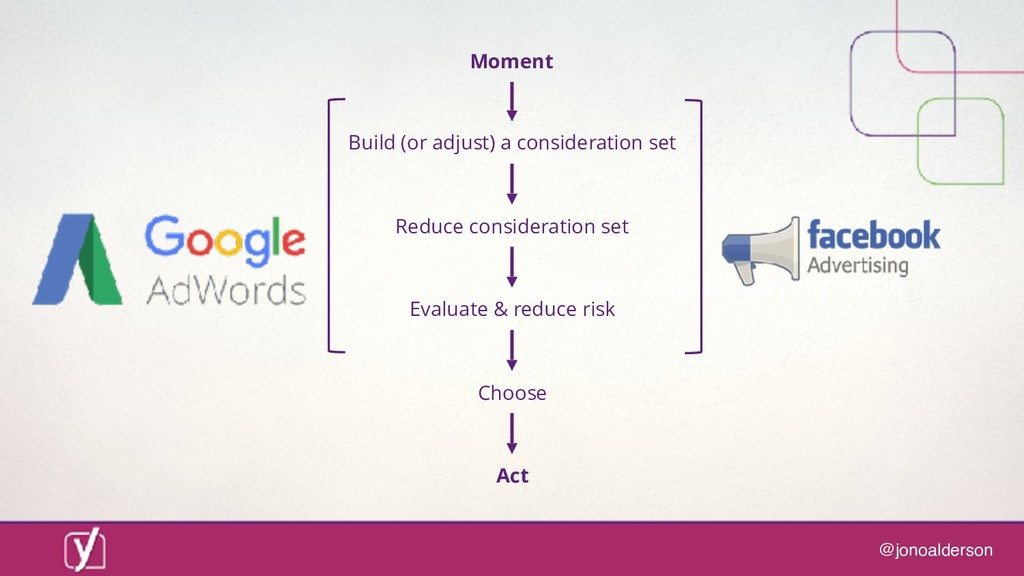
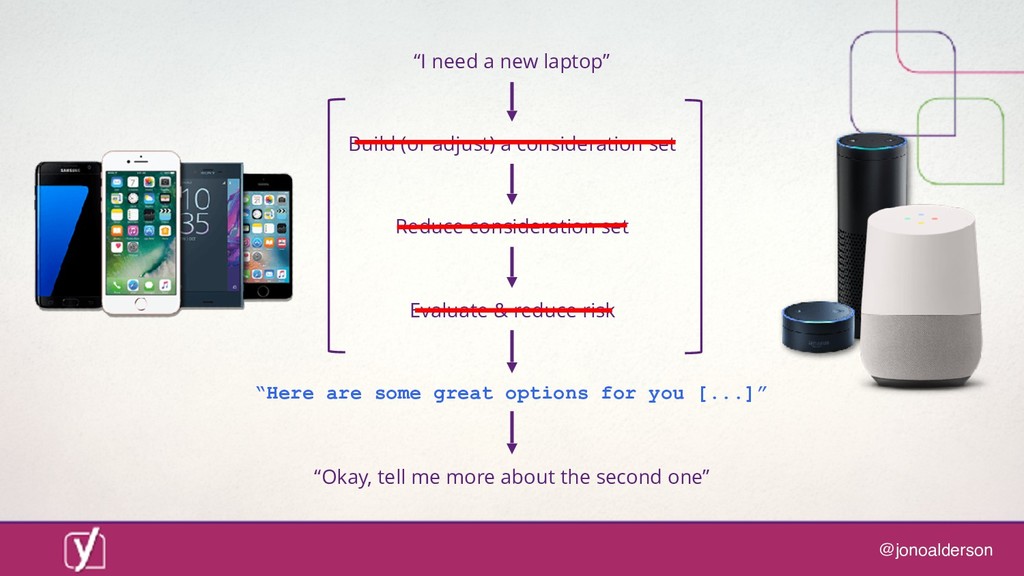
I recently bought a new laptop, so I went through something like this process. This is very close to how Google talk about buying cycles. So I had a moment, which was a my laptop is shot, I need a new one. So I started thinking, I'm going to build a consideration set.
I have some awareness of preferences and some brands. I'm going go Google, search around a bit, ask some friends. I'm to get maybe a dozen or so options, and I'm to compare and contrast, throw away some obviously inappropriate ones. I then refined that process, I reduced the risk, I evaluated, I whittled it down to two or three, I picked one and I purchased.
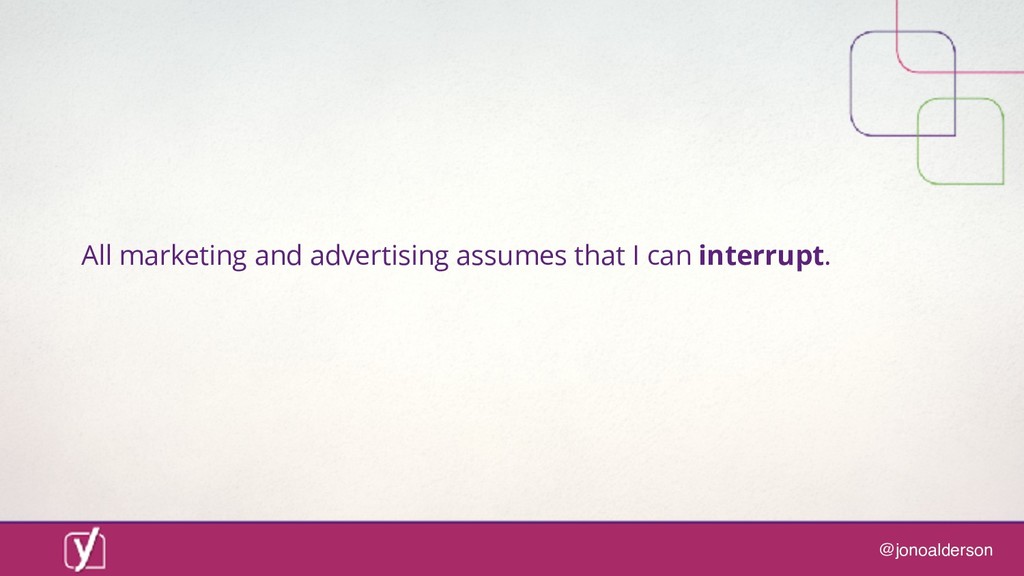
All of our marketing strategies, all of our marketing tactics, every single part of everything all of us do, every single day, assumes that we can interrupt. As a consumer, whilst I'm researching, you can show me an advert, you can rank highly in organic search, you can buy AdWords, you can do a thousand things which change the path of my experience.
That's a slow, complicated, multi phase process buying a laptop, and at any one of those points, you can deploy advertising or marketing which shifts the outcome. All of these parts are susceptible to our influence as marketers. Now, we're entering an age of mobile phones, of personal assistance, of voice search.
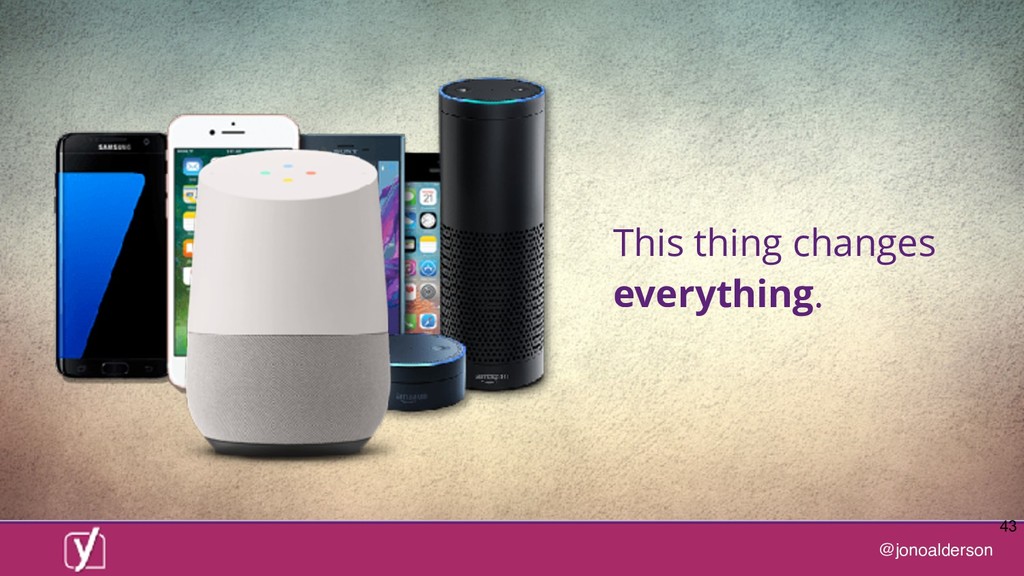
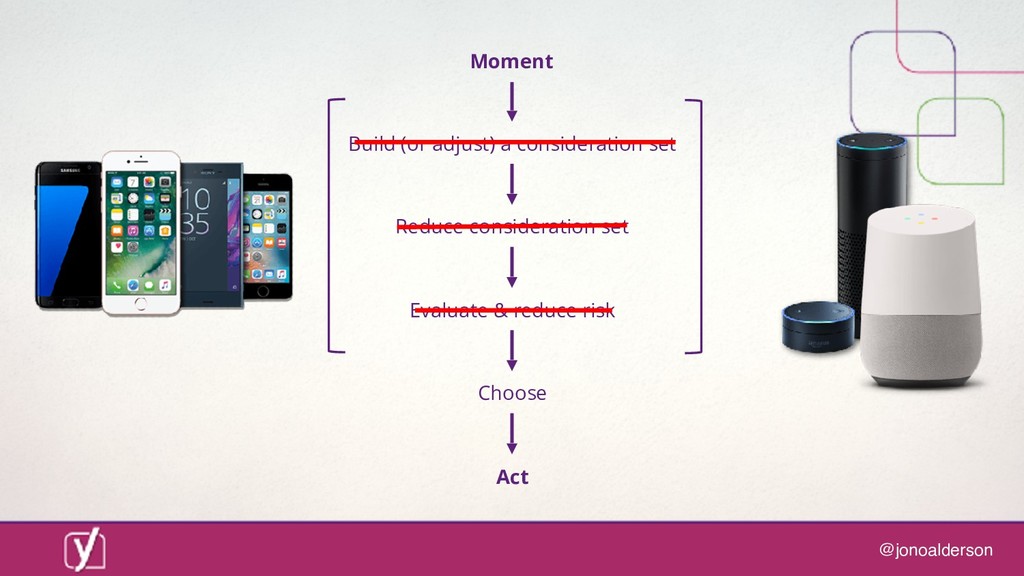
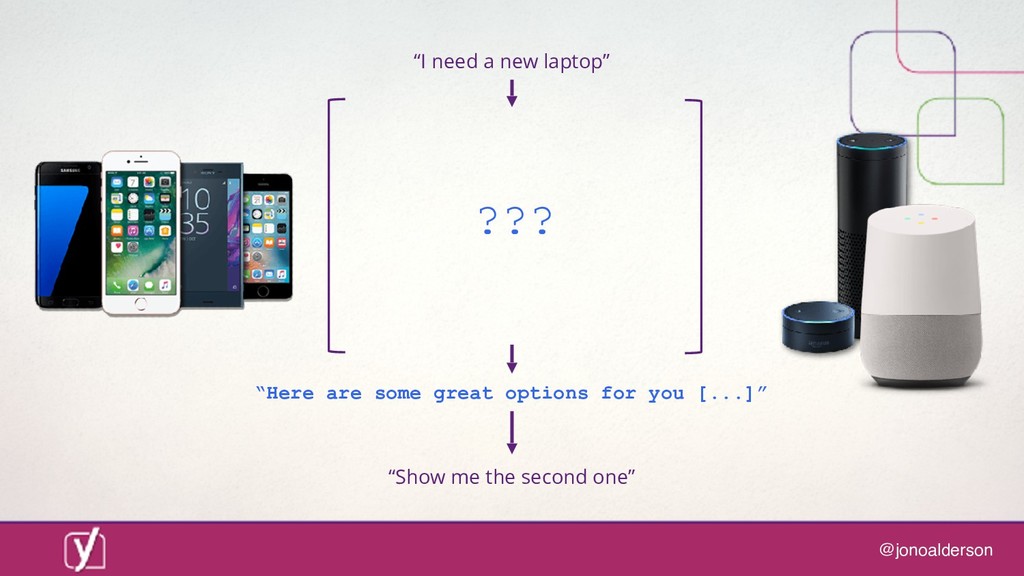
If you saw Cindy talk earlier, a lot of this will be familiar and scary. What happens when these systems decide? When I say, Okay Google, I'm looking for a new laptop. The process of building a consideration set, the process of evaluating suitable options, the process of whittling out and removing obviously unsuitable brands is all taken care of by the system.
So I need a new laptop. Here are some great options for you. Great. Tell me more about the second one. That's pretty scary. How do you influence the consideration set and the decisions the consumer makes when the consumer is not there? All of our marketing, all of our tactics sit there, gone, invisible, silent, in the background, handled by an AI and a machine that we have no control over.
What do you do? What tactics do you deploy? How do you show a special offer? How do you win on AdWords? How do you bid higher? How do you put content in front of them? How do you show them a message? None of that exists.
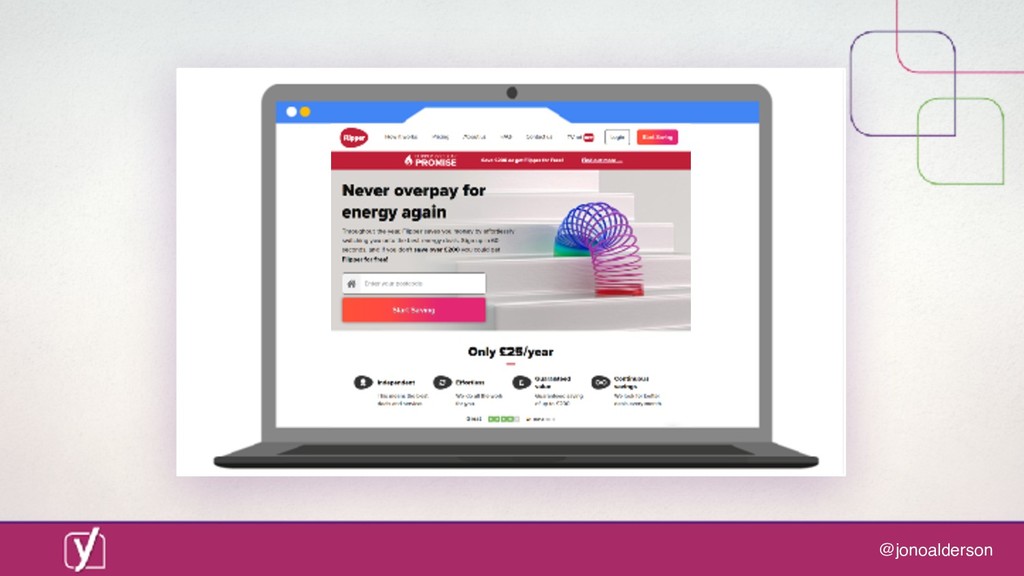
What do you do? Because outsourced ownership is already a thing. This isn't a new concept. Even without AI and machine learning and sophisticated systems, I already have exited the gas and electricity market. This is a service called Flipper that I use that I really, really love.
It automatically scans and evaluates the gas and electricity market, finds the best deal, and changes me silently in the background. What's interesting about that is you can no longer market to me in the gas and electricity market. You can't show me an advert, you can't compete, you can't win my attention, because the point where you could have is handled by a system.
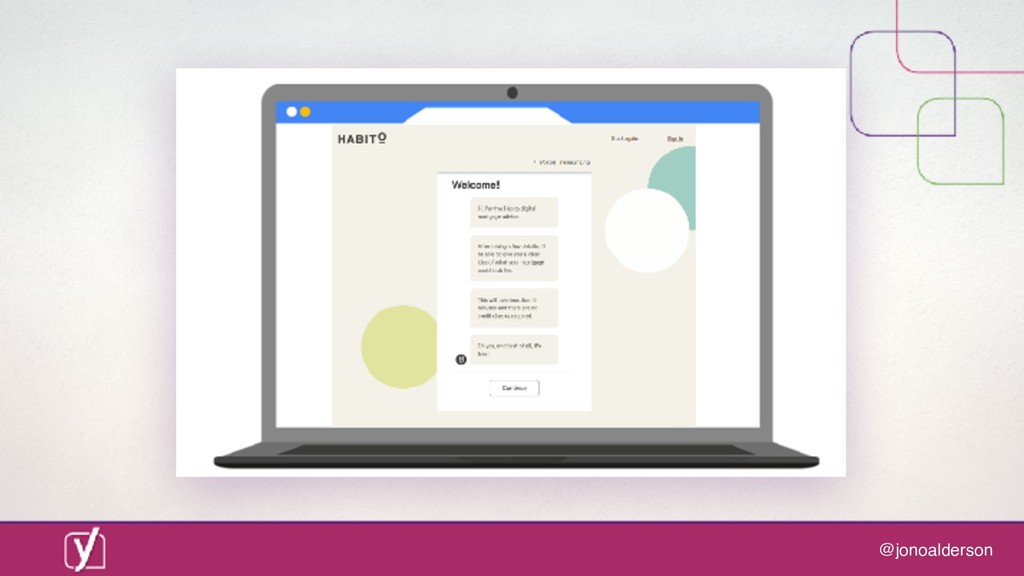
I've exited a market. And sure, that's one little edge case, but I do it with my mortgage too. This is my mortgage. It's handled by an automated third party system called Habitoe, getting quite big in London, who semi automated, semi ish, go away, find the best deal, just make it happen.
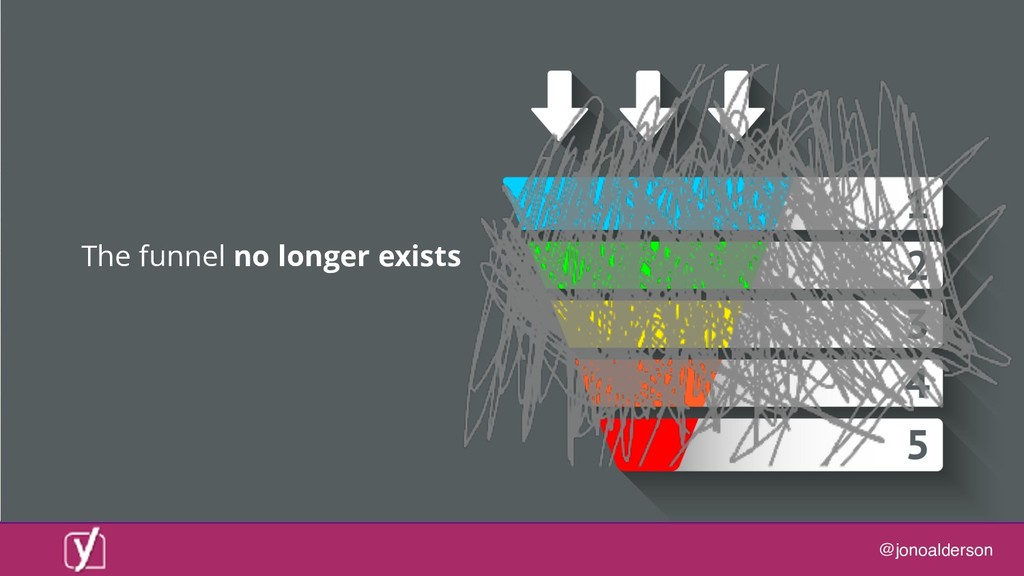
I'm now blind and inaccessible and unmarketable in the mortgage ecosystem. Two industries I've exited in the last six months. How long until that covers insurance and food and a hundred other things? All of our tools fail. The funnel no longer exists. Nobody is coming to your website.
Yes, yes, funnel's dead, thanks Ed. Nobody is coming to your website. Nobody wants to read your content. You cannot reach an advertiser and market to people who you aren't a good fit for. What do you do? To be clear, I'm not saying, really, really clear, I'm not saying that voice search assistance will replace all research processes.
I'm not saying you won't have opinions or input into those processes as a consumer. I'm not saying that you won't need to provide parameters like my new laptop has to have an HDMI port. I'm saying that you're already in a filter bubble where systems like this already choose which brands you don't see.
Google Maps is increasingly showing fewer and fewer closed businesses. If I search for a restaurant, it won't show me one that isn't open yet. That might have been a great fit, but it's decided on my behalf that I shouldn't go there. That applies in so many increasing scenarios.
These systems are deciding what we don't see. If your brand or your product is not the cheapest, or not the best, or not the closest, or not available, not accessible, these systems won't show it, and you won't have all of the tools which we use at the moment to deal with the imperfections of brand and product, of price, of proximity, of advertising, of marketing, no longer apply.
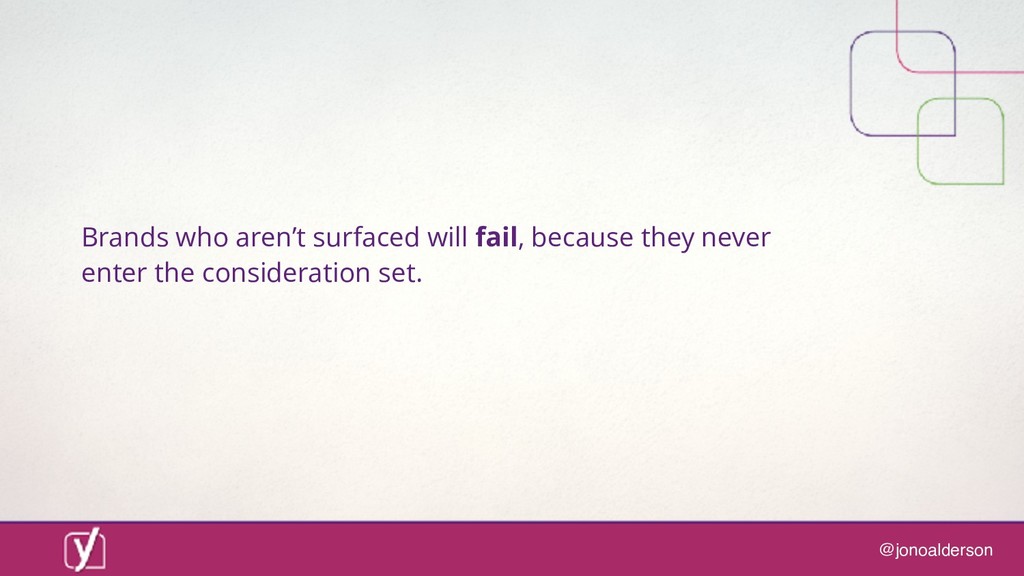
If you're not a good fit, you won't be shown. That's pretty scary. So we're all using these systems, and they're ruling out what we might have seen. And brands who aren't surfaced will fail if you don't have a good product. You currently cope with that by advertising, by bidding well, by having an optimized website, by showing lots of display ads, what happens when none of that works?
The machines aren't susceptible to that. You can't convince them. They're using data that already exists already out there. We'll talk about that in a minute. I want you to take a deep breath and we're gonna do what do we do about all of this in eight minutes and thirty five seconds?
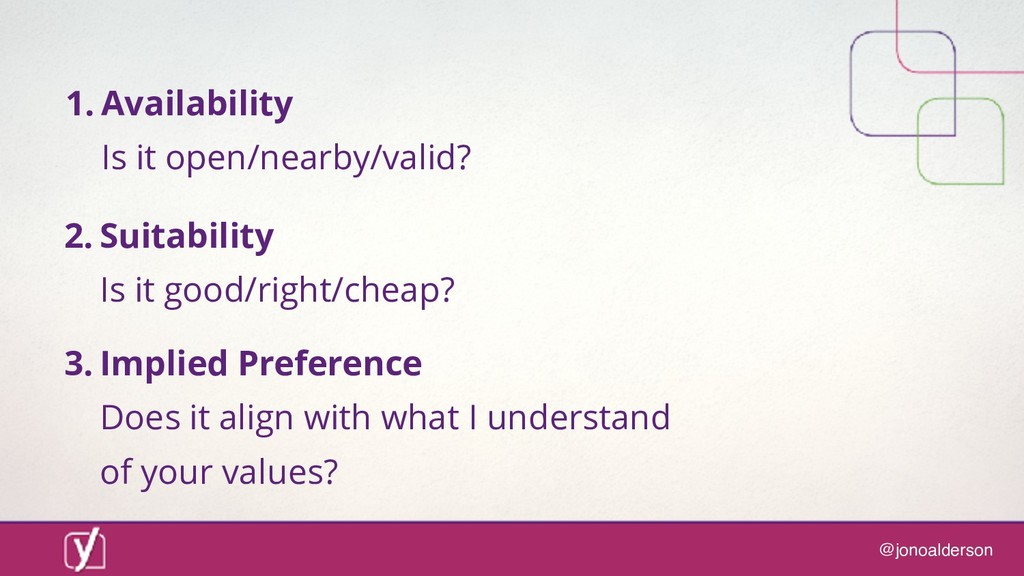
How do we market? I think these systems will use three concepts to make decisions. The AIs, the Alexas, the Amazon homes, your mobile phone, Google, they will use three concepts to decide which brands and which products are shown in the consideration sets. And remember, if you don't get into the consideration set, you'll never see.
You absolutely have to guarantee your brand is there and at least evaluate it, otherwise you've got no chance. I think they'll use availability. This is easy. Is it open? Is it nearby? Is it valid? That's easy data for all these systems to have.
It will assess suitability. Does this look right? Is it good? Is it the right size? Is the right color? Is it a reasonably good fit for the thing that you're looking for? Does it look like it's right? And then it'll look at implied preference.
Does it align with what I understand of your values? This bit's interesting. I want to dig into implied preference. I need to apologize, by the way. All of this is my random, rampant thinking, so feel free to disagree with it. I'd love to be challenged afterwards and to explore any of us' ideas.
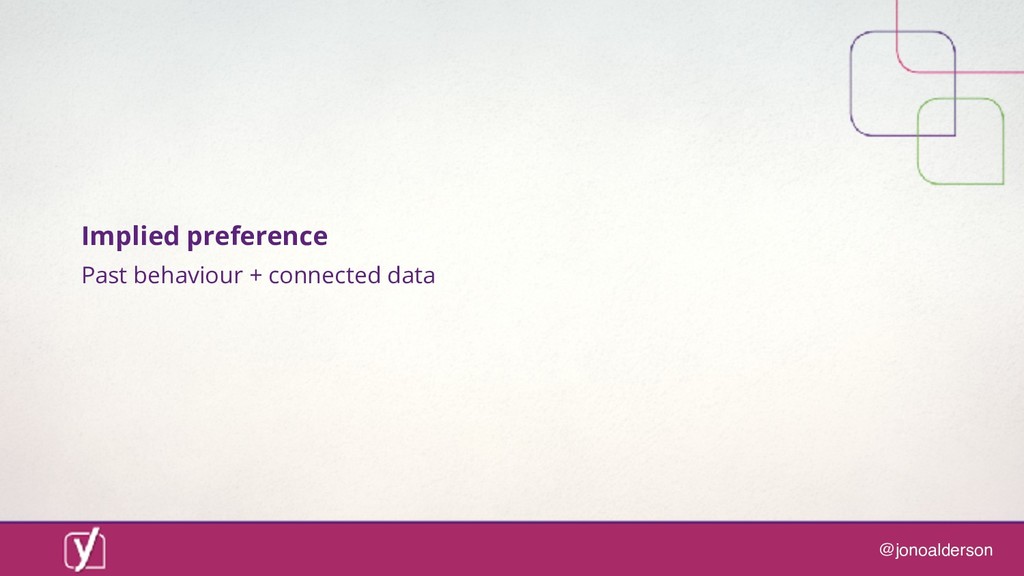
Implied preference is the combination of past behavior and connected data. So at the point where the system has to decide which laptop vendors it shows me, it will say, what have I got access to from all the data I have about you for all your interactions through everything in time, and what other things can I access?
So all of my email, all of my geography, all of my history, all of my chat, and also my Facebook account, because that's all through my Google Home, my shopping, everything else. It can go from all of this data I have access to.
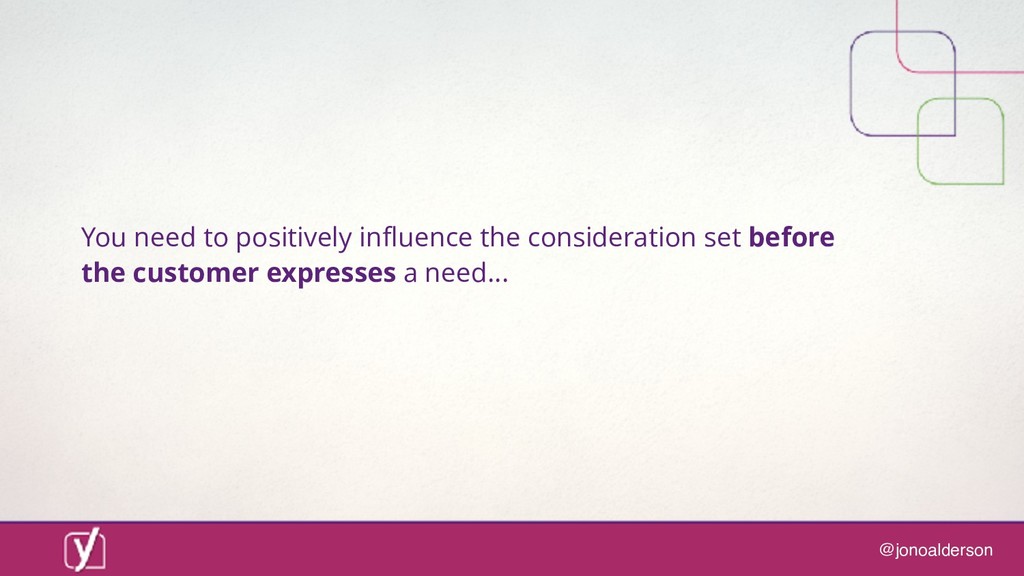
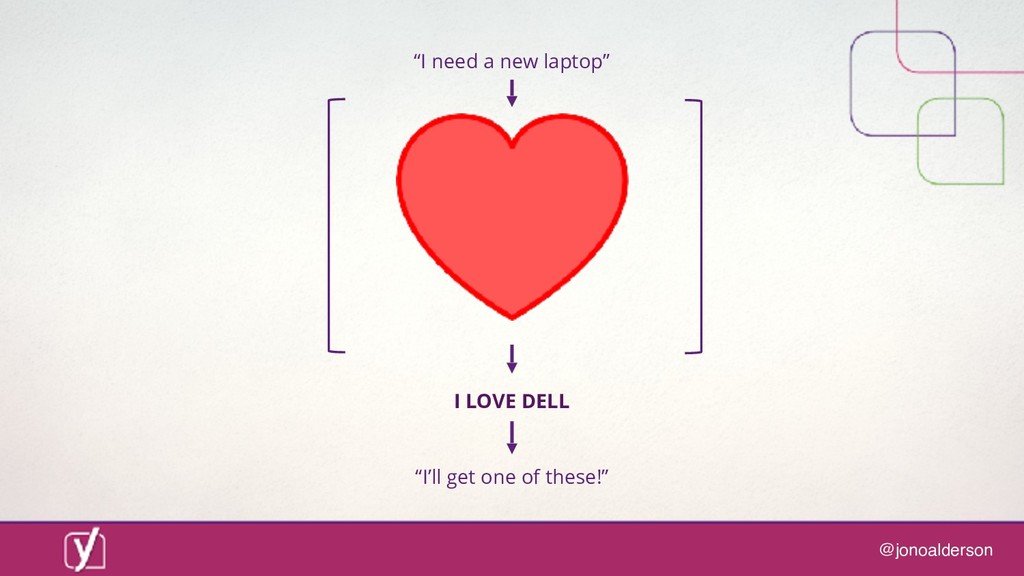
What do I understand about you to imply, to decide which I should show you? So in that world, you need to positively influence the consideration set way before the consumer is at the point of purchase, way before they express a need. If these systems are using data from the past, six months ago I needed to have a positive experience with Dell over their website.
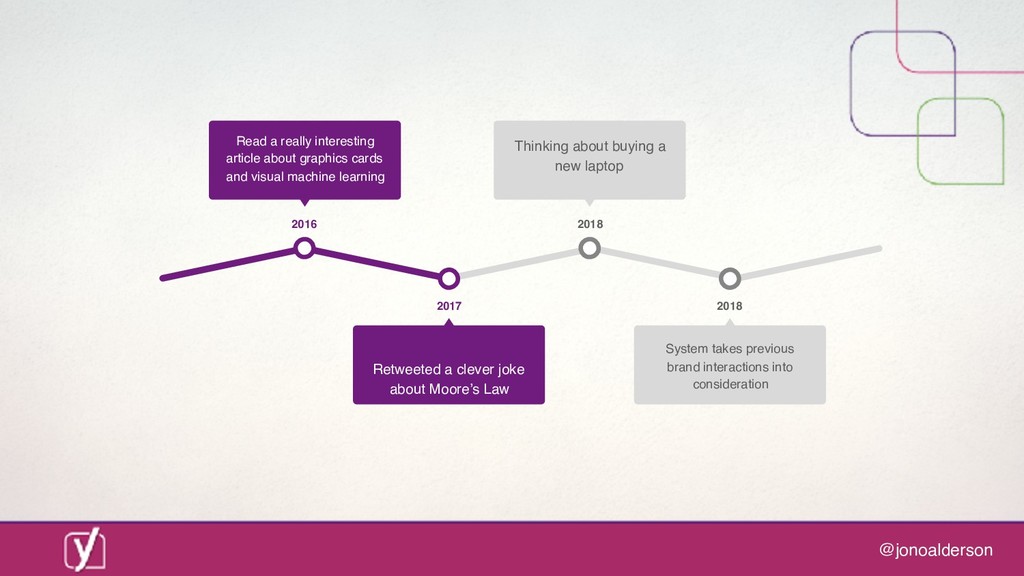
As marketers, we need to create positive brand signals way before the point of purchase intent, when you don't even know these audiences are going to become potential consumers. You need to have created the preference data way, way back. So in twenty eighteen I bought a laptop, but in twenty seventeen I retweeted a clever joke about Moore's Law, and in twenty sixteen read a really interesting article about graphics cards.
These are signals that these systems can assess and monitor and use to infer preference. Do that at scale versus your competitors, and you get into the consideration set. Fail to do this, and there's no evidence that your brand is preferred over another one.
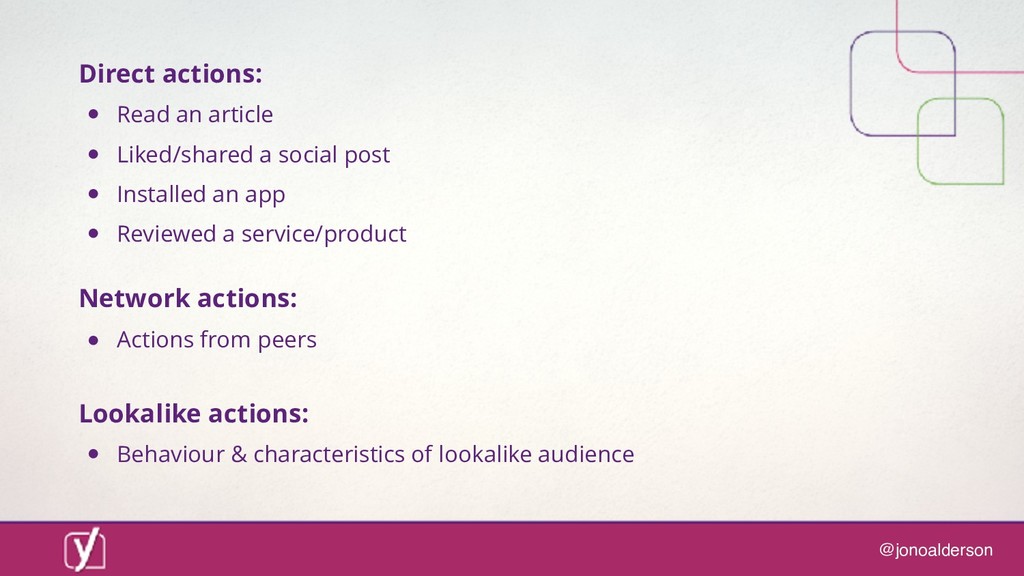
So it can monitor things really easily, like direct actions. I read an article, I liked a post, I tweeted a thing, I followed something, yada yada. But I don't buy laptops very often. It's a fairly rare purchase. So these data points are sparse, certainly not enough for the machines to understand that I want to Dell over something else.
So it can look at network actions. It can say, okay, let's find people you're connected to, and people you follow. What do they do? Come in for. But even then, is quite a rare purchase, so it's not enough. This is where it gets interesting.
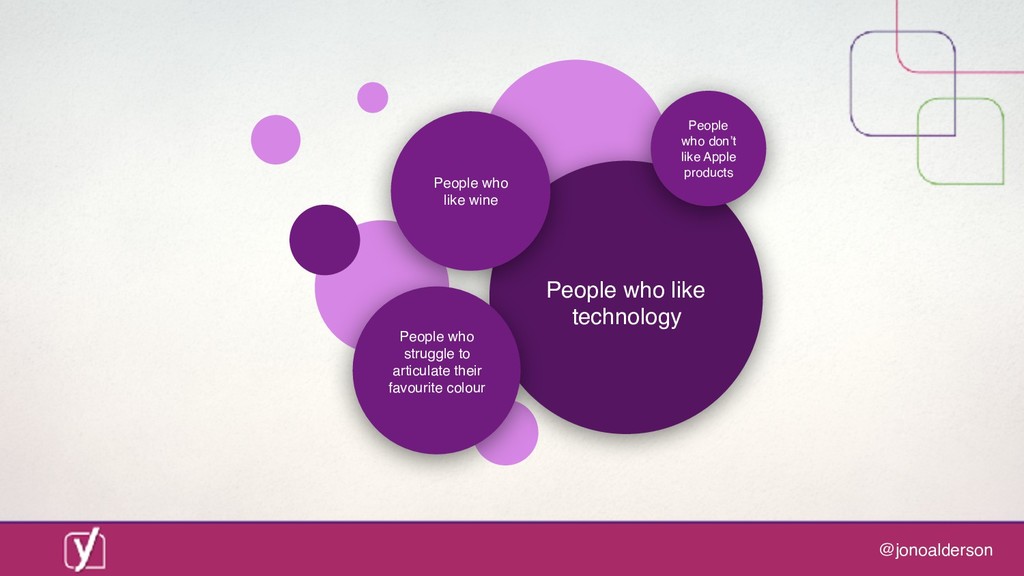
It's gonna use lookalike actions. It's gonna find people who share characteristics with me and say, what are they like? What can we infer? What can we imply? What can we learn? Is everyone familiar with how lookalike audiences work? Ish. So for the sake of those who aren't, this is a ginger geek, this is a woman drinking wine, somewhere in that intersect is me and a whole bunch of other people.
The systems can understand this. They've got this type of data for all of you and everybody else and for everybody in the world, and they can go, here is a similar looking intersect. These people with these characteristics, with all the power of Google's machine learning and other systems, and Amazon and everything equivalent, can go, this is probably a good option.
And it's going to make decisions on what's a bad option and not show it to me. So when I say I need a new laptop, he can go, Jono doesn't buy laptops very often, and I don't know much about his preferences. I do know he doesn't like Macs, because he tweeted something acerbic about Steve Jobs.
I don't want to have to ask him tons of basic questions about how many USB ports he wants, etcetera. However, here are a bunch of people who are very similar, same kind of hobbies, same taste in music, because there's going be patterns that the machines detect that we wouldn't infer as marked as similar job description, yada yada yada.
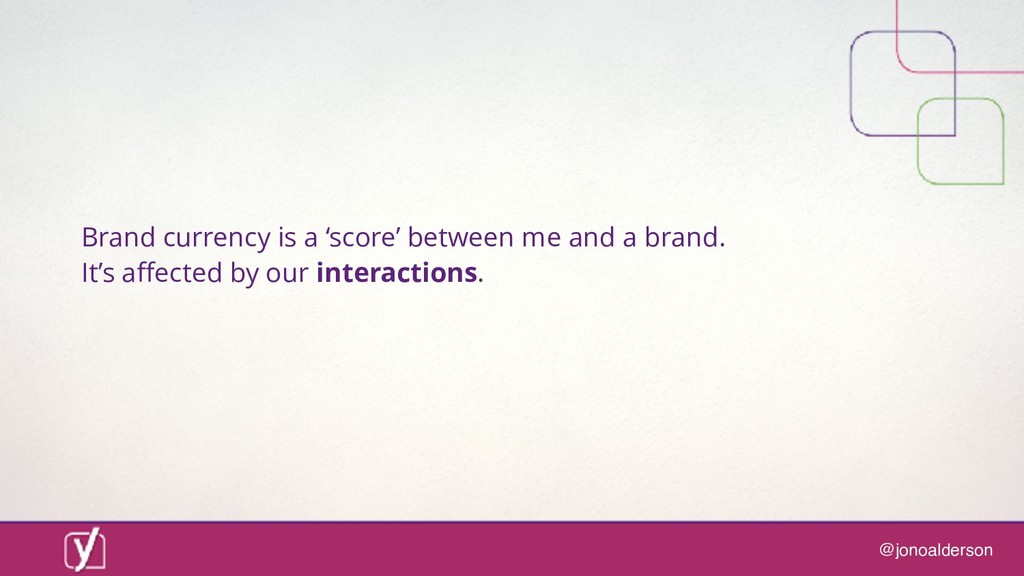
Show me the second one. It will pick, it will infer, it will imply from lookalike audiences. I want to call this brand currency. Brand currency is a score between me and a brand that's affected by our interactions, either positively or negatively. Higher brand currency is higher brand recall, which is higher preference, which is higher propensity to be chosen by these systems.
Four and a half minutes might be tight. You get enough brand currency, you skip this process entirely, because the system goes, obviously he loves Dell so much that we should never even bother to show many alternatives, and it will sort it for me.
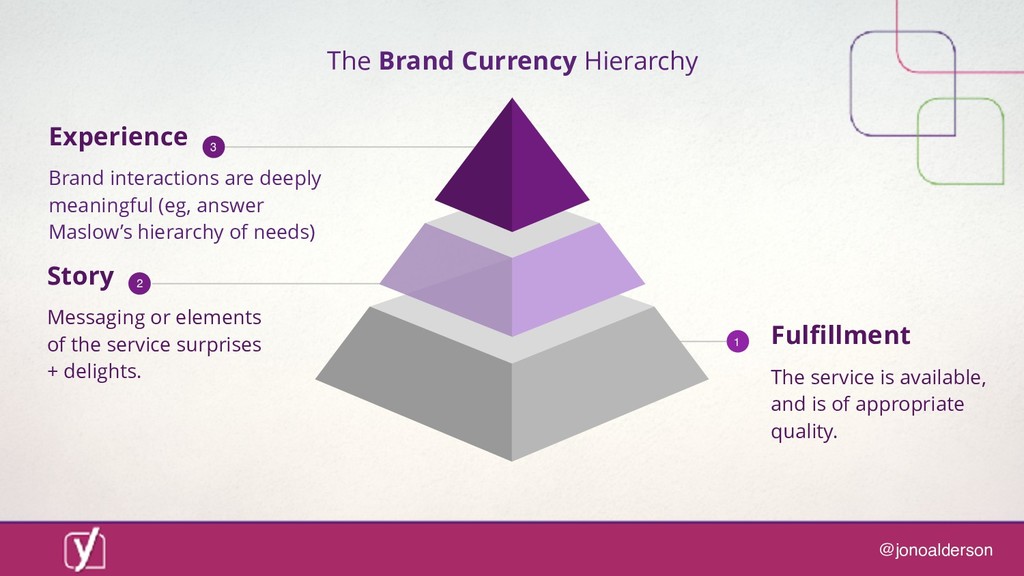
I'm aware that the laptop is not a great example, and that this applies differently for cars, or cabbages, or crisps. But use your own thinking and apply how this works. How do you earn currency? I think there is a hierarchy of types of interactions that we have with brands.
At the very base, we have fulfillment, where the thing I, or the experience I have, and the thing I order is okay, it's not unsurprisingly bad, it exists, it's available, everything is okay, nothing stands out. There's a layer of storytelling, where suddenly elements of the experience or the thing itself resonate emotionally, they create an experience, they are more than just the sum of the parts.
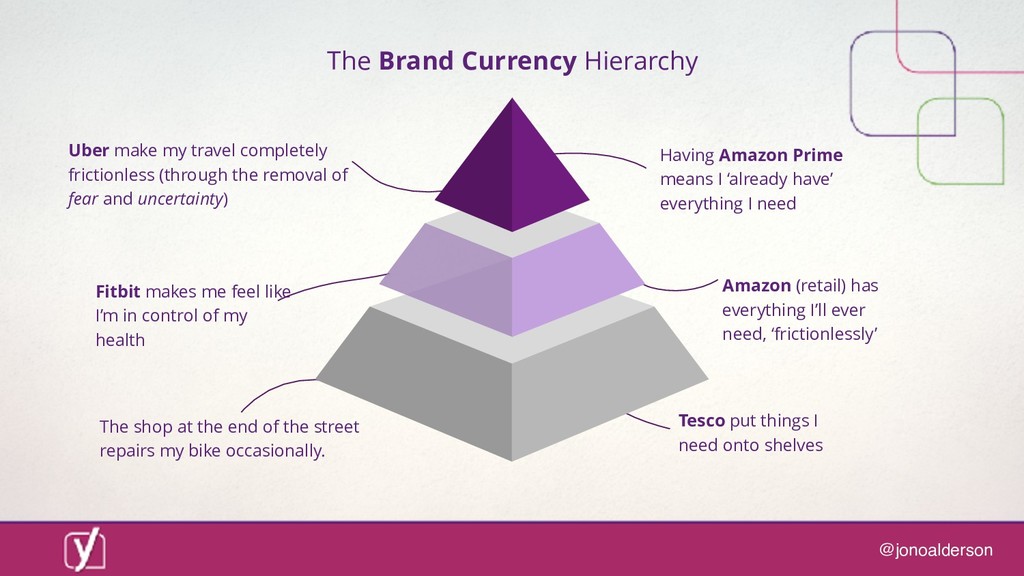
The most impactful brand interactions deliver an experience. Something which is truly meaningful, which answers to a slice of Maslow's hierarchy of needs. I'll give you some examples. The bike shop at the end of the street occasionally repairs my bike. I don't know what they're called, if they're out of business I wouldn't notice, I would go somewhere else if I was anywhere close.
I have no affinity, there's no resonance, there's no experience. Tesco, as a supermarket, puts things I need on shelves. I don't care. I'm not interested in them as a brand. I don't believe their story. I don't think there's anything going on there other than basic fulfillment.
Fitbit makes me feel like I'm in control of my health. They're telling a story that's separate to the product. This is a relationship with the brand, not with the product. That's important. They are scoring points through their storytelling that makes the systems that have access to that data more likely to think that I prefer them.
Amazon's retail arm has everything that I'll ever need frictionlessly. I trust them to be fast, to be efficient, to be sensibly priced, and I will talk about that. I will buy things from them, and I will interact with their brand in a way that leaves signals that these systems can understand.
Uber, despite their terrifying reputational issues, has removed my fear of uncertainty. They do cars and they do travel, what they've really done is they've answered to Maslow's hierarchy of needs, they have removed my fear of the unknown. If I'm in a new city, or I get off a plane, or get off a train, or I'm somewhere, where I don't know what's going on, don't know where I'm going, all of that goes away.
They take care of it. That's a phenomenal level of experience that generates incredible amounts of brand currency, so that when I say, hey, Amazon, hey, Google, order me a car, it knows which brand I want to use. Amazon Prime means I already have everything I want.
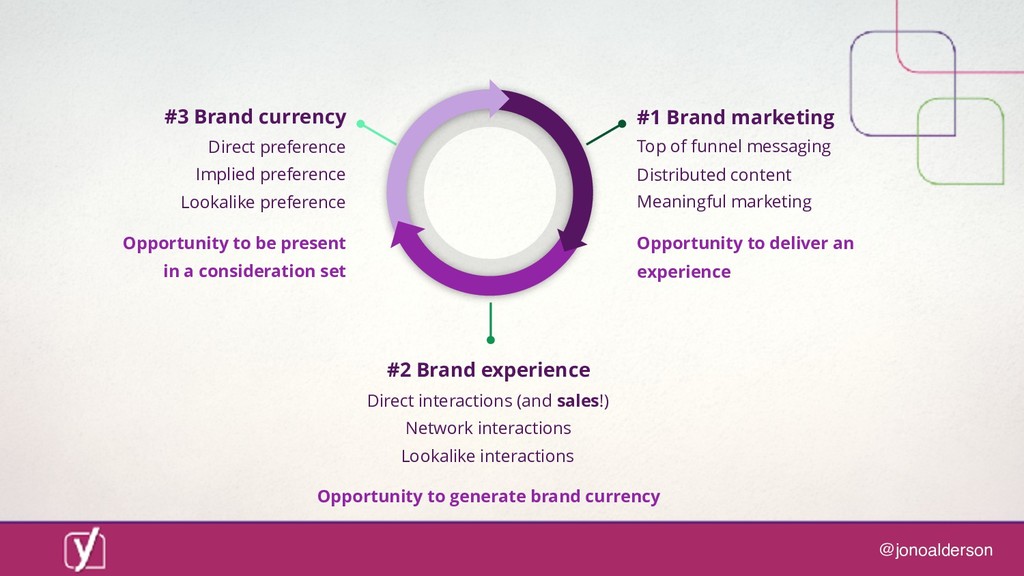
I just need to click on a button. That's incredibly sticky. I'm aware that that's a bit woolly and it's bit personal, so here it is as a model. Do brand marketing, which is top of funnel messaging, distributed content, and meaningful marketing in two minutes ten, which gives you an opportunity to deliver an experience.
That brand experience gives you direct interactions, and if you're lucky, some sales, because some of those people might be ready. That also gives you network interactions, and lookalike interactions, which gives you an opportunity to generate brand currency. Brand currency gives you direct preference, implied preference, and lookalike preference, which gives you an opportunity to be present in a consideration set.
Being present in the consideration set gives you an opportunity to do brand marketing. This works nastily in reverse, where if you fail at these points, you lose brand currency, and you are less likely to proceed to the next step, and less likely to be recommended by these systems.
Don't forget, this is all about whether or not your brand earns permission to show up and compete. Imagine if the whole of Google's organic search was based on brand currency and reputation. That's the world we're moving to. You've got to earn the table stakes.
You've got to earn the ability to be involved. There's a chap called Simon Swan did an interesting write up of some of this in collaboration with me. You should go check it out. It's a little bit more in-depth. There's a link at the bottom.
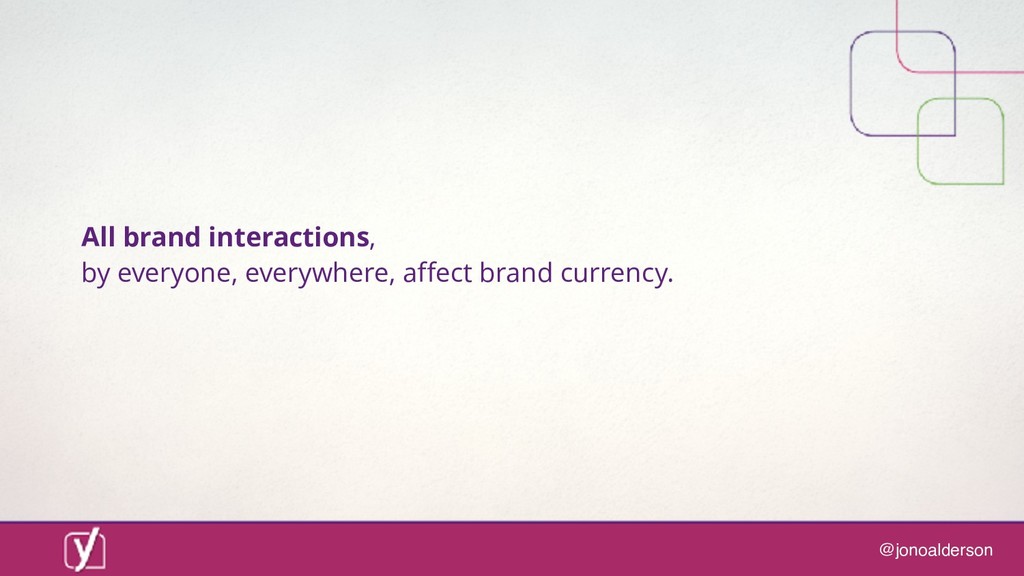
Here's a scary thought to leave you with and start to wrap up. All brand interactions everywhere with anyone at any time affect brand currency, because you don't know who your lookalike audiences are. Every piece of marketing you do or you don't do at everyone at any time anywhere could be the thing that makes a difference between you showing up in somebody else's recommendations or not.
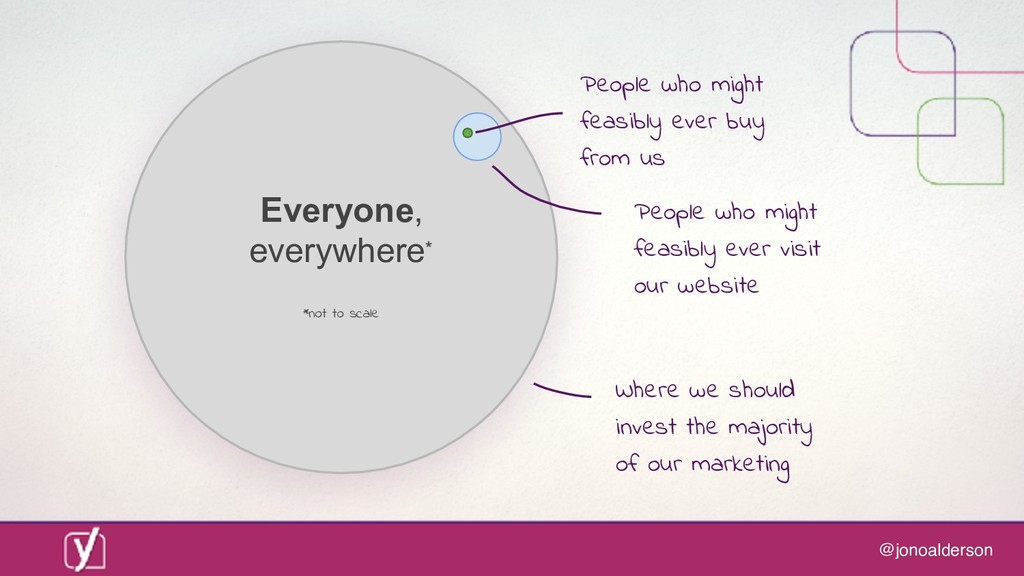
Because they might be connected, might look alike, they might have signals that generally affect each other's behavior. That's pretty scary. That means that here is a tiny circle of all of the people who might ever buy from your brand, and here are all of the people who might ever have visited your website ever, ever, ever, or read your content, and here is everyone everywhere where you need to spend all of your marketing.
Because if one of these guys in the grey circle has a bad experience, that might mean that one of these guys in the green circle doesn't see your brand. I don't know if there's a good answer to how we deal with this, because you can't possibly ask for money to advertise to people who might be a customer from around the world in twenty years' time.
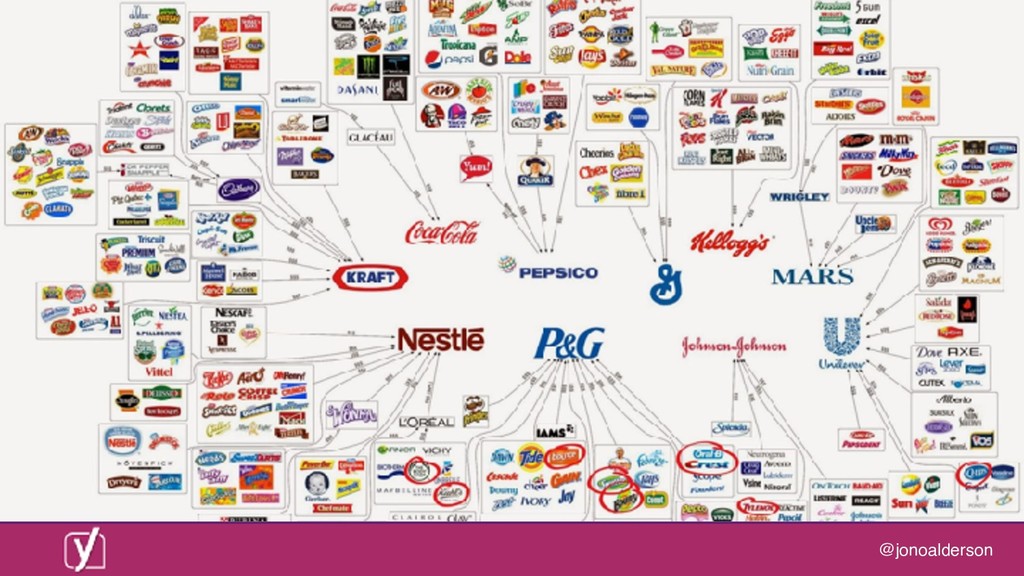
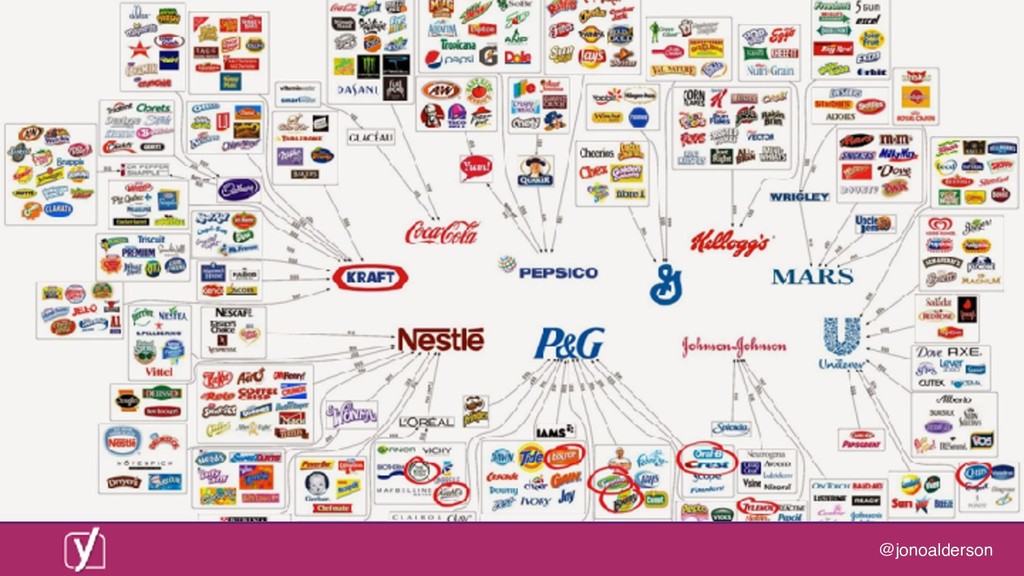
That is a terrifying, terrifying conversation. But maybe it's not that crazy because that's how these guys work. It's how they've always worked. It's how they market. It's how they tell stories. They've always understood that their objective is to build brand currency with everyone.
It's no coincidence that these are the biggest world's most successful brands. It's because they behave this way. I think as digital marketers we've forgotten that. We've been so focused on the practical tactical. I'm out of time, I've got two slides left. Three, maybe four.
This is what all marketing should look like. Okay, so what's next? I don't know. This is new, it's happening now, these are my somewhat unstructured thoughts about where it's all going. I would love everyone else's opinion, because I don't think there are any good answers to what we do, and everything we know about marketing fundamentally collapses and changes.
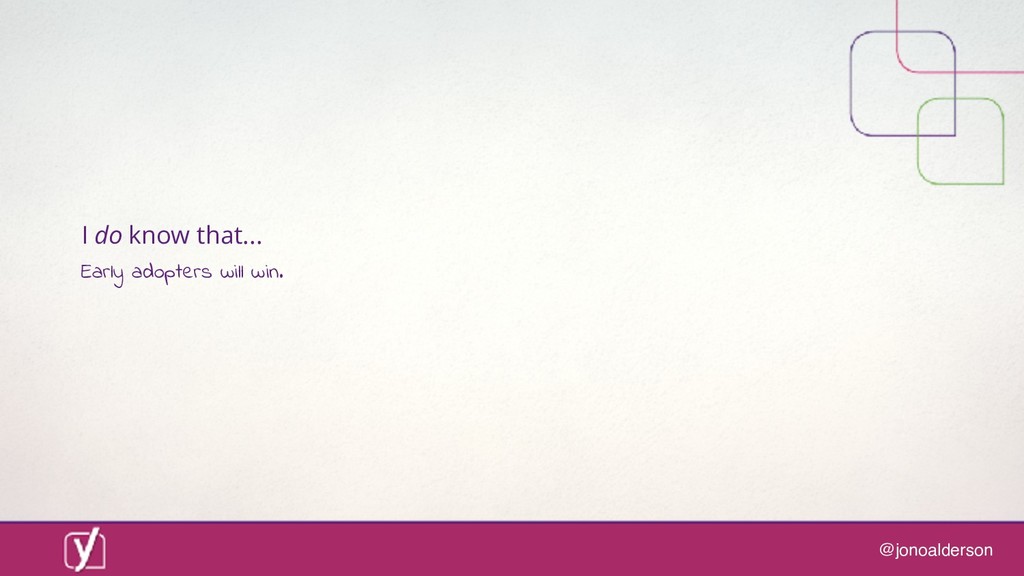
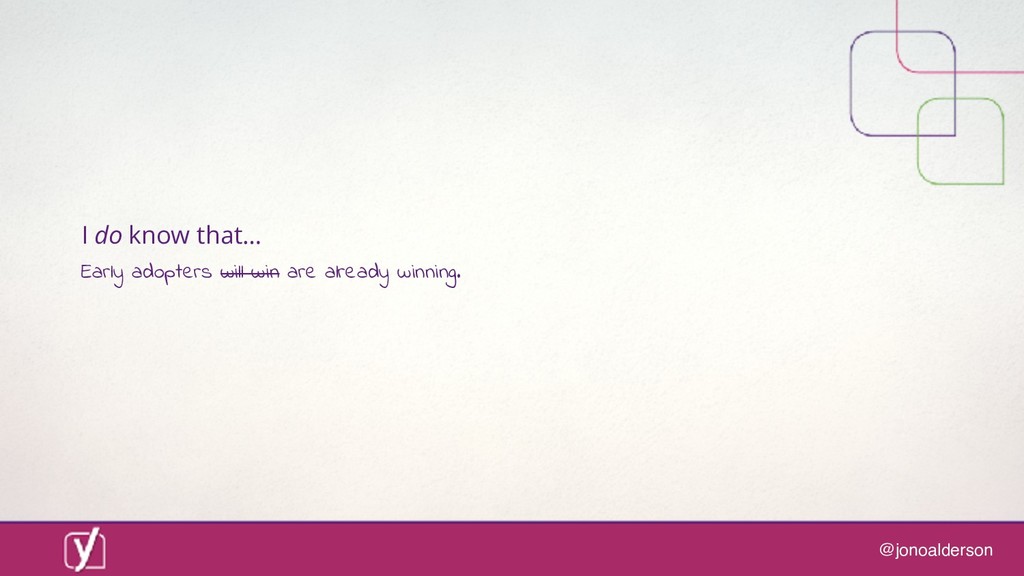
I do know that this is radical and challenging, and it's a talk from a very technical person about going back to fluffy old world marketing, and I apologize for that, but I do know that early adopters will win, because the early adopters are already winning.
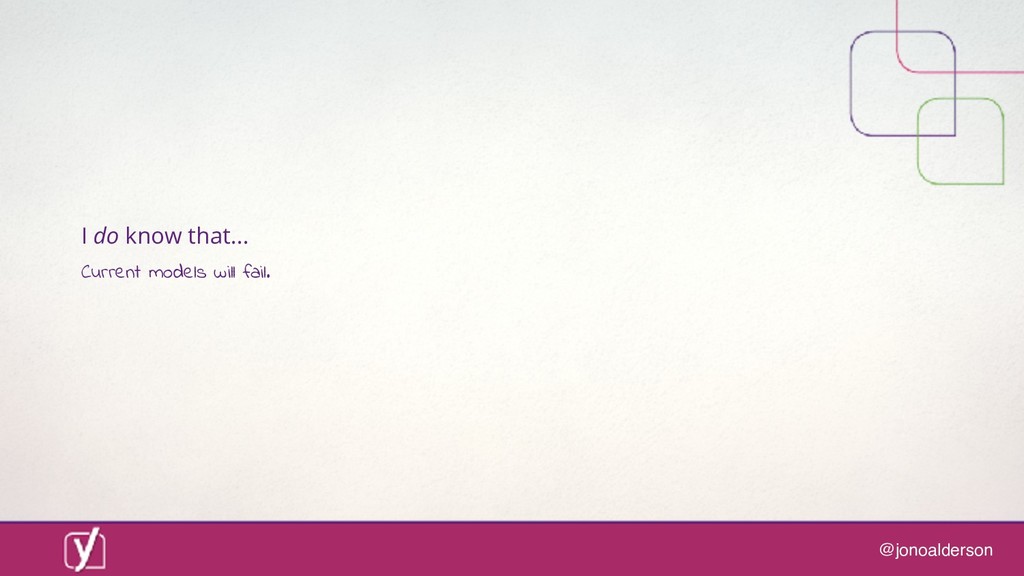
They have always been winning, we're just late to the game. I know that the current model of trying to build a big castle, and get more and more people to your website and into your funnel will fail. You can't rely on magnetizing and sucking in loads and loads of people and converting two percent of them, because that number will decrease and decrease and decrease.
I know that brand, as woolly a term as it is, is everything and the only thing that matters. You're shifting uncomfortably. I'm almost done. Practically, ten seconds, familiarize yourselves with the technologies that are changing the web. The anglers, the nodes, the views, the PWAs, because they will define your constraints and capabilities as we need to start thinking outwards rather than inwards.
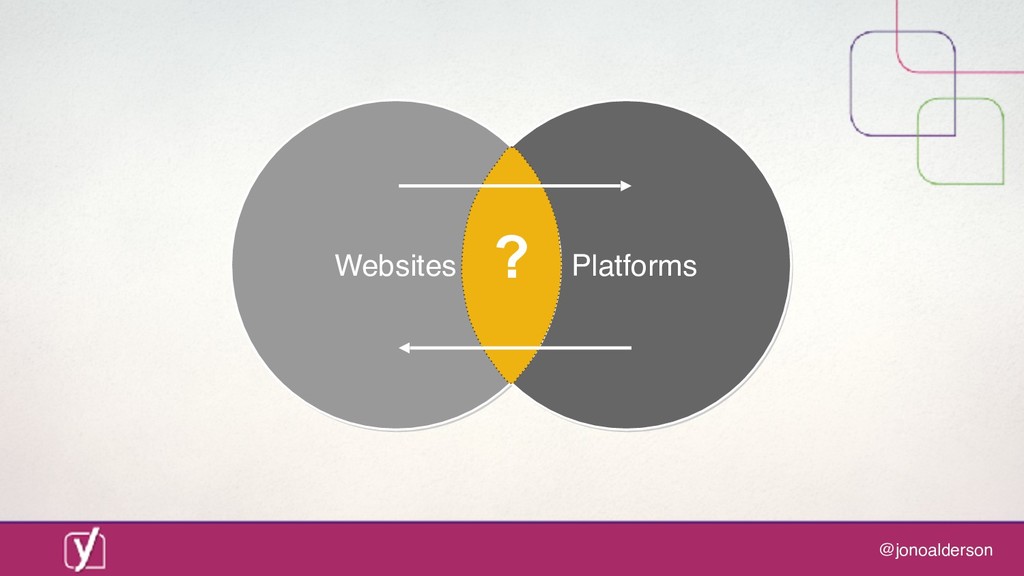
Consider how this is changing consumer expectations and behavior, and what you need to do as a brand. Are you a website? Are you a platform? Are you a bit of both? Do you know? Do you have a plan? What do your audience want, and where do they want it?
Work all of that out. Prepare for a world where marketing will need to influence inferred preference six months or six years before you ever get to the point where somebody might want to purchase something, and consider what value you can deliver to them at that point that isn't just trying to shout and sell something to them.
Start to optimize for experience which deliver a brand promise and generate brand currency and work out what that means for you and your brand. And then probably a whole bunch of other stuff, but good luck. Go out and win like a rainbow unicorn kitten.
Thank you very much. Happy and Jono. Mr. Jono Alderson, everybody. That man can talk. Hold on, fella.