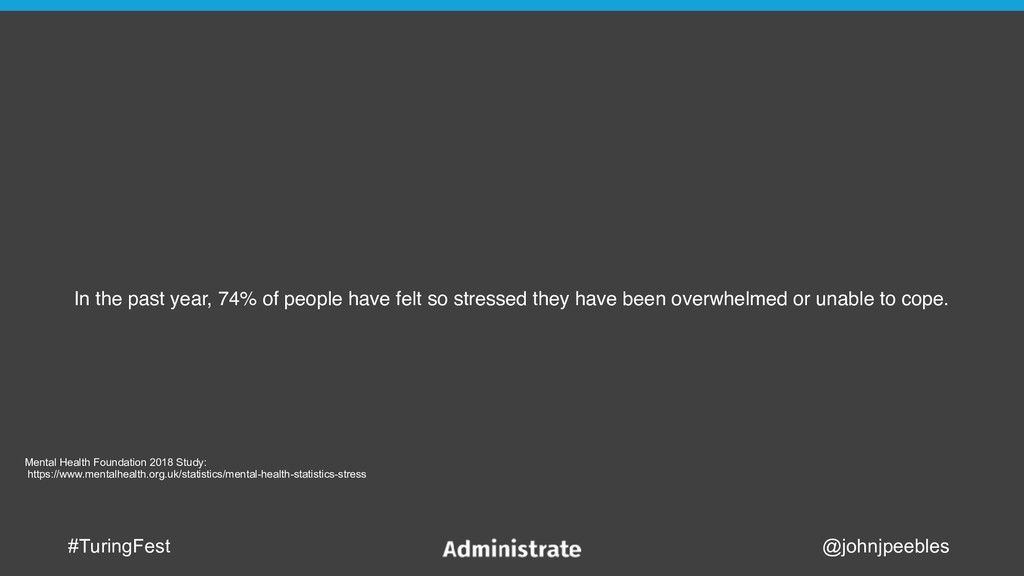
We don’t like to talk about mental health as a society. It’s understandable, but it’s also risky, as mental health issues are far more prevalent than most of us realise. More than 70% of Britons, for example, were so stressed within the last 12 months they felt unable to cope. We also don’t like to talk about failure within the startup community. But again, with more than 90% of tech startups failing, it’s a reality that collides head on with mental health and general wellbeing.
My goal is to convince you that you and your team’s mental health is critical to your success, and share ideas about how you can address this in a safe, positive way that ultimately leads to better outcomes. Self-care isn’t optional, so lets stop treating it that way.
1 / 37 Use ← → to navigate
Auto-generated transcript - may contain errors.
Tap a timestamp to jump the video.
Alright. Thank you very much. So I got a confession to make. I speak at events all over the place, and we have a weekly all hands meeting at administrate, and it's an audience of fifty, sixty people sometimes, and we do it every week.
So I get like fifty reps a year of public speaking minimum. But when I was preparing this talk, I realized the more that I went through it, and I was talking through some things and researching and trying to figure out how to communicate this, I just realized I'm a bit nervous.
Okay? I never get nervous before I speak in public. This time, I am. And the reason is is because we're talking about some stuff that's pretty heavy, that affects all of us, that could affect many of us. I just want you to understand, I'm not an expert on this, but these are some things that I've learned, that we've learned as a team at administrate, and some strategies of how to combat this important issue and deal with this important issue.
So We don't have all the answers. You're going to have to figure out your own answers to this, but we're just going to put it out there because for me, this is a really, really important topic. We've got to engage with it, we've got to deal with it, so here we go.
I grew up in China, the People's Republic of China. My last name is Peebles, and so it was very funny in college because people call me the Peebles Republic of China. Right? But that's what I got to be known for. Okay? I grew up in the eighties in China, and nowadays, you know, a lot of us have been to China, many of us have friends, Chinese students who have studied with us at universities and so on, but it wasn't like that in the eighties.
What it was like is there was less than a hundred foreigners in the province that I lived in, Hunan Province in the south of China, when I was growing up. People sometimes ask, What was it like? I said, Well, have you seen pictures of North Korea today?
And they'll say, Yeah. It looked pretty much exactly like that concrete buildings, big, empty streets. The only type of transportation were buses and bicycles. Everybody wore Mao suits, the same exact clothing pretty much when we got there. And it was a very different place than what it is today.
And I remember I woke up one time, I was about five, six years old, and my father and mother there was nothing to do in China, so we always had dinner together as a family. My father had missed dinner the night before, and he hadn't come home pretty much all night, and he woke me up and sat breakfast, and said, I was like, Where were you last night?
And he said, Well, he'd been driving back in the company's van that we had. This was a very rare thing as well, because there's only about three models of cars. There's a black sedan, a big bus, and an army truck that were produced in China at this time.
This van actually had to be driven all the way from Hong Kong on a dirt road, and it took two or three days to get to where we lived in Changsha. So they were out driving in this van that was pretty unusual, and all of a sudden there was a traffic jam.
This was unusual as well because there just weren't a lot of cars, so why was the traffic all condensed? What's going on here? They realized that there was a guy that was laying out in the middle of the street. He was covered in grime, and and he defecated on himself, and he was just, like, kinda laying there.
And so my dad said, well, stop the car. Let's see what's going on. And there are buses driving by, and people walking by, and bicycles going by, and nobody was dealing with this man out in the street. And my dad started exercising a trait of his, which I find infuriating with computers and things that he asked my help on, like, no, I'm sorry, dad, you can't take the CD ROM drive from your ten year old computer and put it inside your brand new Apple laptop.
Right? I'm sorry, that's not gonna work. And he'll just keep asking me, well, do you don't you think you this very persistent manner, right? Dad, stop calling Apple, they're gonna tell you the same thing, right? But he started exercising this trait, and they got the guy, and he was just filthy and covered in ****.
Right? And put him in the in the van, and they drove him to the hospital, and they said, we've got this guy. We need help. And they said, well, he's physically fine. He's just clearly got some mental problems. We don't deal with that here. Okay?
So they drove him to the police station, and they said, well, we don't deal with that here. And my dad just wouldn't give up. Right? And he kept going and kept going. And finally, I mean, this is it's just strange enough to see a foreigner in China in the eighties.
And then it's even weirder when, like, a van that you've never seen pulls up, and they're going from and finally, the Chinese realized this is not gonna be let go. They found the guy a place to live. They got him a shower. They cleaned him up, and they said, we'll take care of him from here.
This is one of the first times I can remember ever being exposed to any kind of story or anything about mental illness. The second time that I got exposure to this was we were in South Florida, I was running a startup there, and we had an important conference call coming up with a new partner of ours.
And we all get in the conference room, and we were really excited to kind of move this deal forward that we were working on. We dial into the Bridgeline, and the other team doesn't show from the other company. And we're like, Oh, that's weird.
We wait five minutes, you know, and wait ten minutes. Then we call the company, the main desk, and nobody answers. That's really strange. We kind of went home and went on with the day. The next day or two, we heard back that the CEO of that company had shot himself in the conference room, had just blown his brains out.
They shut the company down for the day, sent everybody home, and that company later failed swiftly after. And I'm talking about these stories not to depress us, but this was when I started to realize, maybe mental health is actually a bigger problem than I personally thought, and maybe it's pervading the otherwise safe spaces of building a tech startup that I imagined that we were all operating in.
So, a little bit about me. So, I'm the CEO of a company here in Edinburgh, like was said, called administrate, and we've got offices, we're headquartered here in Edinburgh, but we've also got offices in Beirut and in Bozeman in the US. And we're one of Scotland's fastest growing tech companies, about seventy people just for scale purposes, and we build a learning platform that helps companies manage and deliver training and education to their partners, their customers, really any training that you want to do.
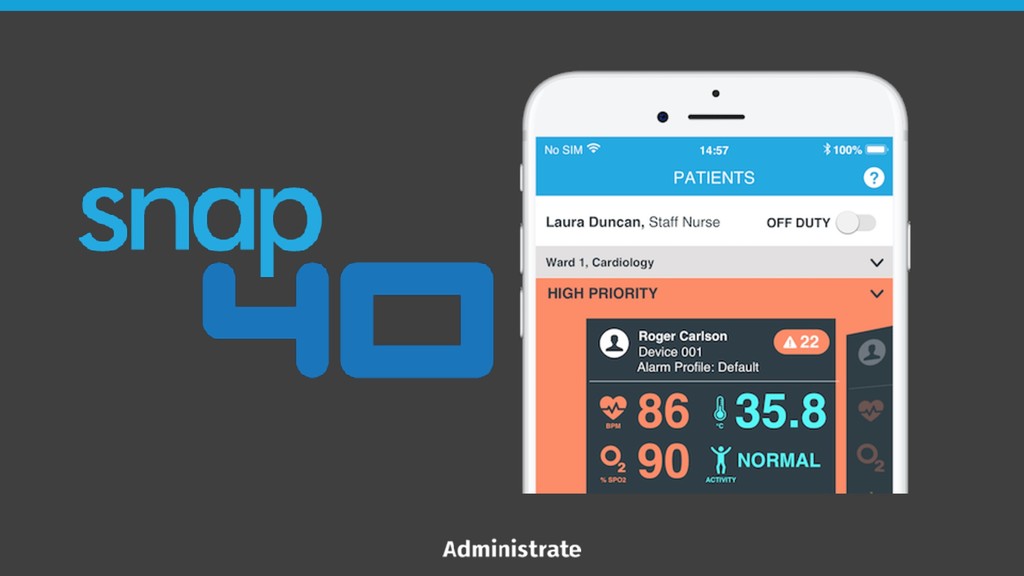
I also help out with a company here in Edinburgh on the board called Snap forty, and it's a really cool company. They're exhibiting outside, but they've got an iPhone sized device that you slap on your arm and it gives you all the vital signs that you normally get from a hospital intensive care unit.
So, I get a good window into the problems of growing startups, from a couple of different seats, right? From the board, from being a CEO, from having done startups before. And I've got some bad news for all of us. This is a study that just came out about a month ago, was done here in the UK, and it's basically almost three quarters of people surveyed in the UK, it's over four thousand recipients, and I've got all these footnoted in the slides, which we'll put out if you want to read the research yourself,
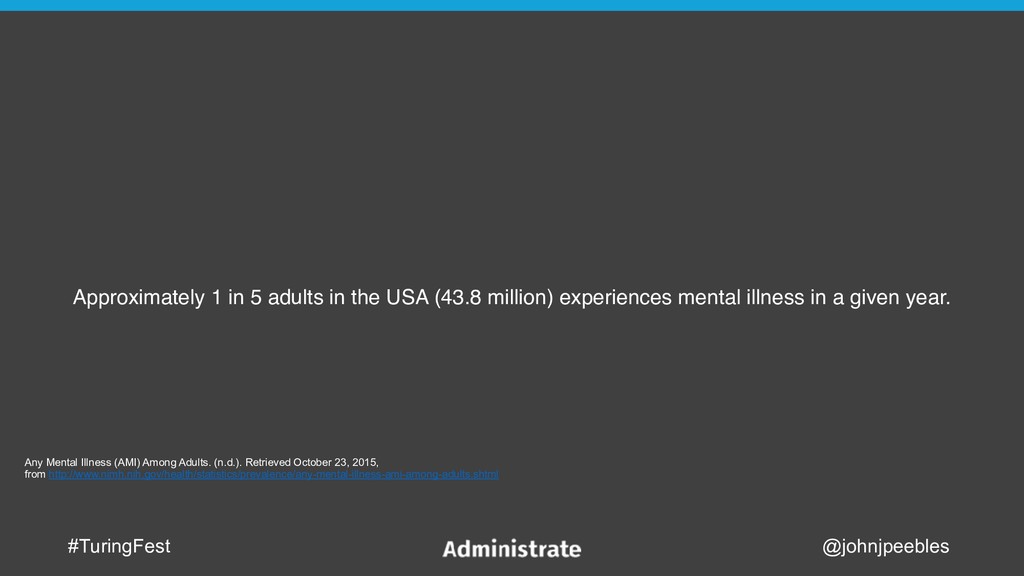
but they mentioned that they've been overwhelmed within the past year, and had felt that they were unable to cope with things. Another study was done in the United States, one in five, that's forty plus million people, had experienced mental illness within a given year.
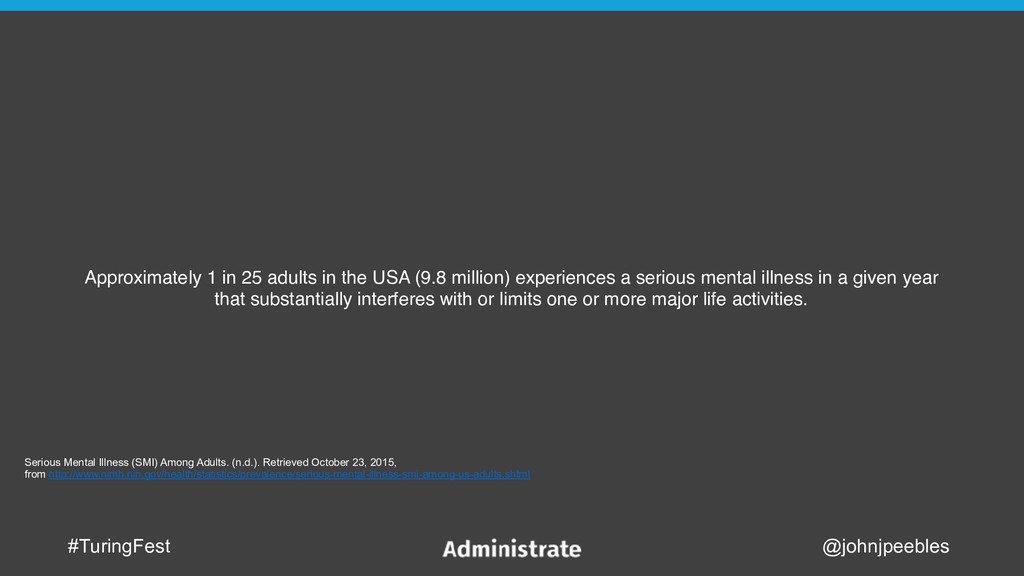
That's really high. Another study said one in twenty five adults had had problems that were so serious that they substantially affected their lives. This is a lot of people, and this is just within the last year. The thing is, start looking at these studies, and there's just more and more and more of them.
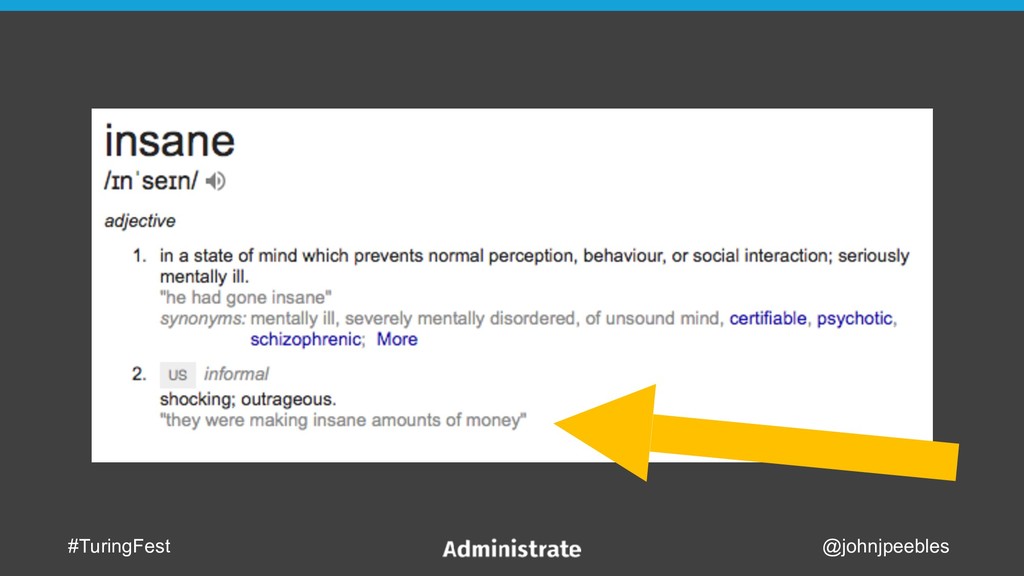
Alright? And my reaction when I started looking into this was that this is really this is insane. Okay? It just really was nuts. And then I thought, that's a weird word to use. Right? Insane. Okay? And actually, I looked up, and one of the definitions for insane, at least in American English, is this idea of shocking or outrageous.
Right? And I think this is why sometimes, you know, this type of vocabulary and and so on is why we sometimes hesitate about talking about this, because we don't wanna feel ashamed, and we don't wanna feel, vulnerable, and we don't wanna put ourselves out there.
So if you look around in this audience today, there are people here that are struggling with some sort of mental illness, and that's important to understand. In this room, there's a significant non zero portion of people that are struggling with some sort of mental illness.
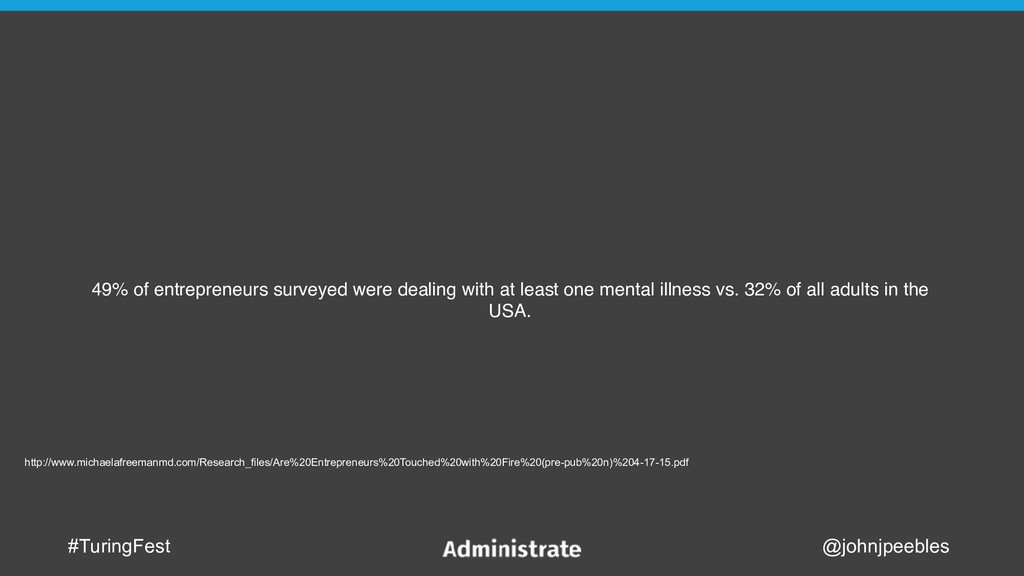
And actually, news gets worse. Okay? And that is that entrepreneurs or start up people are more likely than the general population to suffer from an issue of mental health. So, here's a study that was done, and basically half of all entrepreneurs that were surveyed had at least one mental illness, versus a third in the general population in the US.
Half, alright? Half. Okay. And I want to make sure we understand something really quickly. Sometimes you can go to these events, and you hear founders talking about, Oh, it's really hard being a founder, really hard being a CEO, it's a lonely thing. Yes, that's all true, but also, the entire team is included in this definition.
Okay? It is very difficult to be involved in a startup. Alright? And one thing that I learned over the last few years, and actually had to be pointed out to me, and then I kind of started, yeah, I agree with that, is that stress isn't relative.
Okay? A few years back, I was working in the States. We had, start up was going well. We had about a hundred and twenty people involved, and we had an important release coming up, and it was to be done on a on a Friday, which is always a bad idea, by the way.
So, I had this important release coming up, and on Tuesday, I had, the head of our QA called and he started typing on our, internal messenger, and he said, I've got a I've got a problem. Something something really bad has happened. I thought, okay.
He said, do you wanna have a quick call about it? He he's a remote, worker. And he said, yeah. So I picked up the phone, I called him, and I said, well, you know, what's wrong? And he said, you know and then he just starts sobbing on the phone.
Okay? And I'm like, oh my goodness. Like, his wife died. What could have possibly happened? The guy was just distraught, could barely even speak. And then finally, he gets to the point and he says, my cat died. And I'm like, good. Okay. So you need fifteen minutes to get back to work. Right?
Like, your cat died. Who cares? Right? But to this guy, this is a huge deal. Okay? And I remember just thinking, ugh, people and their pets, cat people are the worst. This is just like, what what do I even say to people? We got a customer that's waiting on this.
And I was like, oh, there's a personal issue, you know, take the day off. The guy was incapable of working. Right? I just remember thinking this is so dumb, but it's just like, well, when you get to a certain scale, you've got a hundred people.
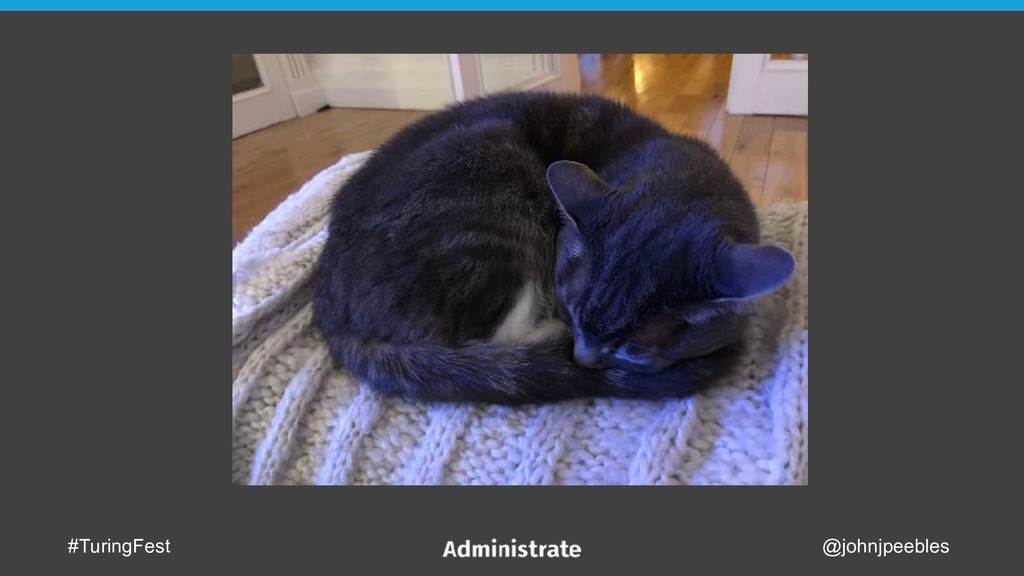
There's just you can't make this stuff up. Right? And and I felt that way for a while until until I got a cat. That's my cat, Eleanor. Right? And I gotta tell you, I'm gonna take a whole week off when she passes away. Alright?
I love this cat. So, you know, stress isn't relative. Just because somebody is at a lower level or doing a different job and they're not the CEO, doesn't mean that they don't feel the same level of stress that you do doing the top job.
And I think that's something that's really important. You wouldn't believe how often when I talk to people at all levels of different companies, including our own, they are really concerned about whatever the challenge is that the company is facing. You know, they're they're worried that we might miss a funding round, that we won't hit our metrics, whatever it is, and people get really stressed out.
And so it's not just this thing where, oh, woe is me because I'm a founder, because I'm a CEO. Okay? So that's a lot of bad news and one cat picture so far. The thing is, you wouldn't believe how long it took me to find the perfect cat picture.
Had hundreds of these. Was cycling through, and I think the people in the speakers' lounge thought I was nuts. But basically, the good news is you are not alone. Okay? You're not alone. And I think that's something that we should know, that should be said more often, but it often feels that we're alone.
So I talk to startups all across Scotland a lot. A couple years ago, we had a startup party here in Edinburgh, and I said, you know, I challenged our community, give thirty minutes every week back to another start up that's behind you in the journey.
Right? Listen to their problems. Help them troubleshoot something, know, vice, whatever it is. So that meant that we had our calendar stacked for the next year. So I've talked to lots and lots of startups, it's actually a really great thing, because I learned a lot through that process.
Hopefully it's helpful. I've probably given a lot of bad advice. Sorry about that. But the thing is, realize, you start to see these patterns, that people are struggling with things, and we struggled with it ourselves at administrate. We were going through a really tough time a couple years ago.
We weren't hitting our numbers. Our product wasn't working very well. We had reliability issues. We didn't know if we had the right team, the right posture, and all this stuff. And I remember I was talking to a venture capitalist, and he said, well, your growth rate's probably not high enough for investment.
I said, yeah, but you kinda need the capital to get your growth rate up. And he's like, yeah, it's just the catch twenty two. And I was like, so you can't get the capital because your growth rate isn't up. You can't get your root with it because you don't have the capital.
And he kinda just interrupts, and he goes, man, ******* sucks. Right? That's the VC saying. He's like, but I gotta tell you something. Every start up has a gap year. Every start up that they'd ever invested in had a gap year. Every big success that he'd ever heard or ever seen or ever talked to his colleagues in the VC industry had had some sort of gap year.
He said, so just figure out how to get through it, don't worry about it, and things will be fine. And I remember I talked to him about eight, nine months ago in San Francisco, we were out there, and I said, you're right. We had our gap year, we're through it, and the metrics are looking a lot better, he's like, that's great, really happy for you, but I'll never forget that.
It's just a really good piece of advice. I think that's something that I've started telling other startups, it's okay to hit a problem or to hit a wall. You're going to get through it. Don't internalize the pressures and the concern, and don't hide all this stuff, don't push it down as you're going through that.
The other thing that I tend to tell people in startups is that, I didn't make this up, this is something we've all heard before, but I think it's really true, and that is comparison is the thief of joy. This is particularly true in Europe or in Scotland, where we're not in the valley, and so you sit there and you're like, hooray, I got my one million pound round done, right, for my angels.
And then you read about your competitor, and they've just raised a hundred million pounds. Right? And you're like, wow. Or the startup down the street raises five million or whatever. You're reading everything is always better that you're reading in the press than whatever is happening to your own startup.
Okay? I would just say comparison really is the thief of joy. Don't compare yourself to other startups. Make sure you have the right capital, that you're focused on the right problems, that you've got the right team, and that you're tackling the things you need to be tackling about.
It does not matter what some other startup's going to do, or has done, or is doing. Alright? You will have your day in the sun one day if you if you get those other things right. Alright? And then, you know, you might hit your gap year.
Okay? So, the other thing that I think is really important, and this is something I struggle with. If you go start leafing back through my Twitter history, you will realize that I have a propensity to rant against airlines and airports. Okay? And so I am guilty of this.
I am guilty of not being kind, particularly in situations where I'm stressed or I feel like it should be a different way, and it's something I'm I'm working on. Okay? But what I thought was cool is this is actually a commonly misattributed quote.
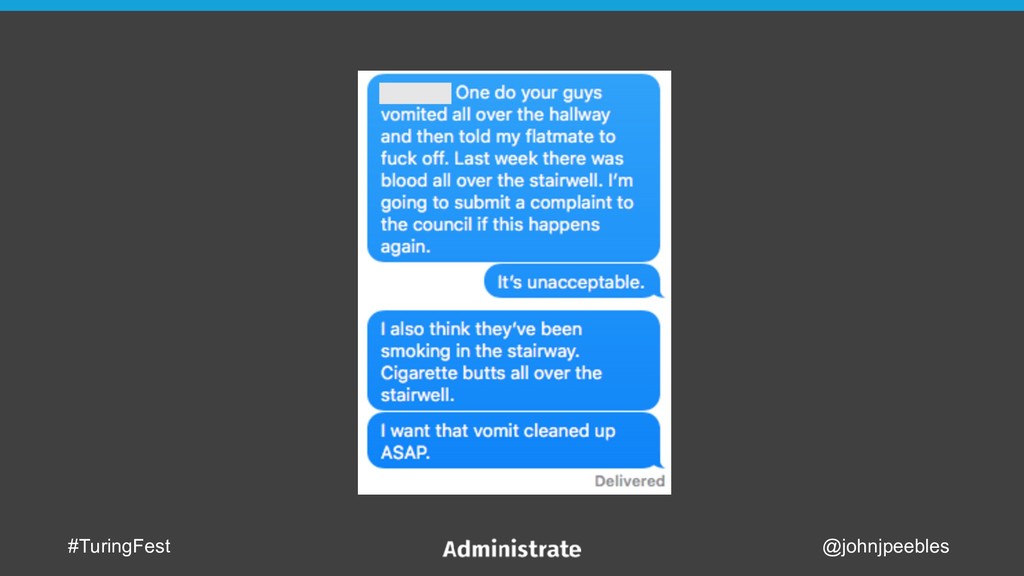
It's actually a Scottish guy, an author, and theologian that came up with this, a couple hundred years ago, and he says, be kind for everyone you meet is fighting a hard battle. And I was reminded of this just a couple weeks ago. This is a text message that I sent to the guy that owns the two flats above the flat that I own here in Edinburgh.
And you might not be able read it very well, but, basically, it just says, one of your guys and I misspelled, you know, of. That was embarrassing right out of the gates. One of your guys vomited all over the hallway, and then told my flatmate to **** ***.
Right? Last week, there was blood all over the stairwell. Okay? I'm going to submit a complaint to the council if this happens again. I don't even know if you can do that. Right? But I just thought it sounded good. Everybody seems to be scared of the council in Edinburgh, right?
And then I thought about it, and you can see I wait for a minute or two, and I say, It's unacceptable, right? And then I keep going, and I say, I also think they've been smoking in the stairway. I hate smoking, right? Smoking in the stairway.
I said, Cigarette butts all over the place. Right? I want that vomit cleaned up ASAP. Okay? So, I told somebody about this. Can you believe this? This happened in my stairwell. I just can't believe this. Somebody said, well, were you your typical self?
I said, no, I was really polite. I was firm, but polite. They said, well, let let me see the text message. Said, see? A person looked at me and said, there's a cultural thing here, I think, maybe, you know, and I was like, okay.
Maybe it wasn't as polite as I thought it would, but that's the text message I sent. Okay? And what happened was I got a callback the next day, and it was kinda one of those calls where it's like, you know, a little testy, and we had a pretty good relationship, but it it just he was obviously on edge.
I was a little on edge, and, it just wasn't the best call. And, a couple days later, I walked out of my flat, and I was heading to the gym, which is rare, but hopefully less rare. Alright? And I'm going to the gym.
I got this evil half Polish, half German trainer who just makes me just suffer, right, at the gym, and and she's like, you must be on time. Right? And so I'm gonna be on time. Right? About ten minutes, the gym's close. I'm walking, I hear this, hey, John, on the street.
I turn around. It's the guy that I'd sent this message to. And he said, look, I wanna apologize for the call that we had, the other day. I was, pretty upset because I just landed in Malta. We were going on a family vacation, and my son had flown in ahead of us, and we landed, and we found out that my twenty year old son had died, and he just passed away.
He just dropped dead. And, I'm just standing there in the street, and it starts to rain, and evil trainer starts texting me furiously, but the guy's telling me the story. And, you know, you can't pull your phone out, and, you know, you can't respond.
He's just telling me what he's been going through with his son dying suddenly like this. Had to get the body back, and that's a real pain. The police have to get involved, because a British national died overseas. And I'm sitting there, and I just said, I really wish you'd told me when I was talking to you on the phone.
It was that day. And he said, Well, you know, I just don't I didn't wanna I didn't know what to say, and we need to be kind. Right? We need to be kind because everyone is fighting the battle, and you don't really always know what it is.
Okay? A couple of years ago, we had an investor presentation scheduled for administrate, It was in twenty fifteen, towards the end of the year, and we made headlines that year because we had moved to a four day, thirty two hour work week at administrate.
Everybody always thinks that this is a fake thing. I can't tell you how many times I've been asked, do you guys really not work Fridays? Really? And people like, once we've had a couple of beers, really? And I'm like, okay, fine. We started this off, and did it in May, and it's an interesting thing, it's part of our commitment to try to build a sustainable work environment and administrate.
As we started that, I started having a personal issue at home. And what that meant was as the rest of the company moved to a four day work week, we were also going through a very tough time, we didn't have enough management bandwidth and so on, there's just too much going on.
I worked every day that year. Every day in twenty fifteen I worked. I would get up on a Saturday, go to the office, I'd work all day, I'd go to sleep, get back up on a Sunday, go to the office, and I did this the entire year.
Okay? So, while we were talking about everybody else working a four day week, which was true, there's some exceptions here and there. We're much better at it now, actually, but I personally was working every day that year. And part of it was to distract from the issue that was going on in my life and personal life.
I really don't recommend having your personal life and your professional life going wrong at the same time. You try to balance that out if you can, but you can't always plan these things. We had an investor presentation scheduled, and so the way that it works when you're getting funded by an angel syndicate like we are locally, is you do a presentation, and you go through your business plan.
It's about fifteen, twenty minutes. There's a little bit of Q and A, and then the angels make their own investment decisions, and on you go. Right? And so, you know, you prepare for these things, and it's usually a pretty decent thing. I remember getting up, and I was going through my bit of the presentation, and I started getting this pinch in my neck, right around here.
I started getting more and more hot, and I started sweating profusely, And I thought, woah, I'm getting lightheaded, and I'm trying to go through and maintain the pitch. And, you know, we finished, and I wasn't feeling well, and I started walking home. And as I walked into the flat, the stairwell of the flat, I collapsed. Okay. So I was in a suit, which I never wear.
I collapsed down on the floor, and I'm laying there, and I can't get up, and I'm sweating, and, you know, it's I'm in physical distress. And I remember thinking to myself, well, at least we've got good key man insurance, because the funding round's definitely gonna go through if I die. Right? We'll be funded one way or the other. Okay?
And then I flew out to a vacation in Tokyo, and I slept for fifty straight hours. No joke. I just slept two days. And I think before I did that flight out, I realized while I was laying there in the stairwell, I need to get some help. Okay? I need help.
And I knew myself, and I knew that like a lot of us, I wasn't gonna go out and actually follow through on getting this help delivered to me. Okay? And so I asked my PA at the time, I said, I've got this issue at home, I need some help, I just need to talk to somebody.
I don't know who to talk to, I don't know what's good, what's bad, whatever. I don't know how to get this done, can you just sort this out? And so she did, and she found a therapist, She made the appointment. She bullied me and made sure that I went, right?
I went in, and I didn't really know what to expect. I was really nervous. I was kind of intimidated. I told her about this, the therapist, a while later, and she was like, Why were you intimidated? I'm like, Come on. This is not normal, right?
You're going in and talking to somebody. I went in and just kind of exploded, right? All the things that have been happening at work and personal life and the overwork and stress, and she's sitting there, she's like, there's this American, he's working all the time.
It was like this foreign person. Anyway, I started going pretty regularly, every other week so, making the appointment, so I wasn't doing it, but I was getting told to go. A funny thing happened. It started to help. Things started getting better. That was one of the clues that I needed to try to say, You know what?
We need to rearrange our relationship with this mental health issue, particularly within the context of a startup. Hopefully, we all agree there's a problem out there. It is more than likely to affect us, particularly if we're working in a start up scenario. How do we tackle it?
I think one of the key things that you've got to do, and this is the culture track at Turing, you really do need to set up those values that are important to you, that are important for your company, and govern how you work, and that inform what your company culture is like.
That's really important, because people need to understand that you value things that aren't just financial. At Administrative, we believe the kind of experiment that we're running is that we believe if we put our customer and our employee team success ahead of the financial goal, that the financial outcome will be much greater than if we'd oriented it the other way around.
Okay? So, by investing and focusing on customer and team success, we have a better financial outcome over time than if we had not done so. And so, that's part of what we've baked into our values. That's part of the reason we do the four day, thirty two hour work week, because we believe it's more sustainable and so on.
It's part of why we began offering a therapist to our team, and I'll talk about that in just another minute. The other thing we need to do is communicate, Right? So we talk about this not all the time. We don't wanna depress people or anything like that, but we mention, hey, there's this thing.
It's called mental health. Right? We need to focus on it. We need to invest in it, and we need to treat it like it's an important thing. Communication, I think, is really, really important. The other thing is transparency. We talk a lot about how we're a transparent by default company, and that means metrics and finances and all this type of stuff.
We share the bulk of that with our team. It also means being transparent about what's going on in our lives as people. I think that's really important. I don't think you can really separate yourself from work. I think you bring yourself to work.
I think you know, what tends to happen is when something's not going well outside of work, people think that they can hide it, and they think they can compensate. But, you know, if we've managed people before, you just know that the productivity is usually up here, and it'll just crater down.
You don't even have to ask if there's something going on, you just have to say, what's going on? Right? Because the productivity will just instantly crater. And so, transparency is just about, look, there's an issue, we don't have to get all the details, it's not about that, I'm dealing with an issue, okay, how are you dealing with it, how can we help, and so on.
I think that's really important. I realized at administrative I was really lucky, okay, because I had a PA that could basically do all the stuff that I would tend to procrastinate or not do to get me in to see a therapist. And that's an important thing, I think.
So, with us, as our companies, we really need to make sure that people have a safe, an anonymous, a viable way of getting the therapy that they need. So, at administrate, every other week for a day, have therapists come in. It's in another part of our building where she works out of.
We don't know who's scheduled to see her, but we just remind people that she's there, and people go and schedule. It's close by the office. It's not obvious that they're going and talking to a therapist. It's right there, and it's free. Okay? And I think those things are really important if you decide to work this into your company culture, and I really hope you do.
And lastly, we want to really make sure that things are sustainable at work. Working every day and then collapsing the stairwell is not good for your investors. It's not good for your team. It's not good for your customers. That is unsustainable. So, build more and more sustainability in your business is a real key thing to combat mental health issue, I think.
I'm not ashamed. Okay? I'm not ashamed. I talk about this a lot. I talked about it with the landlord in the rain, on the way to the gym, when he was talking about his son. I said, You know what? Have you thought about talking to somebody?
And he said, you know, I kinda kinda really have, but I don't really know how to do that. I said, well, I've talked to somebody, and it really helped. And I think just that is enough for a lot of people. Alright? Right now in your life, there's somebody that is laying in the middle of the road, and we don't want to be the person that walks by.
Who in your life needs help? Who in your life needs assistance? Who in your life just needs a gentle prod to go see somebody or talk to somebody, or just talk to you? I'd really challenge you to think through your sphere, whether it's work, whether it's home, whether it's yourself.
Do you need help? Don't be the people that walk by. I think all of us probably felt slightly superior at the beginning when I told that story, that could never happen in the UK, or that could never happen today, or that's just strange, right?
But we're doing it all day, every day, in our own lives, with people who really need help. Alright? Let's be human. I think that's the most important thing. So, my name is John. This is my email address. Really appreciate the opportunity to talk to you today, and let's let's go out there and make a difference.