
Drawing from experience with multiple tech startups across multiple industries, this talk will focus on common mistakes I’ve observed. Mistakes that I’ve made, successes I’ve seen, and opportunities to benefit from advice I’ve been given will be explored. Founders often struggle with how to benchmark themselves, how to grapple with various stakeholders, and how to implement a strategy designed to maximise value, and I’ll talk about actionable strategy and tactics to help make your journey just a little less painful.
← All talks 








Lead Strategy Turing Fest 2017
The Greatest Lies the Devil Ever Told to Startups
Auto-generated transcript - may contain errors. Tap a timestamp to jump the video.
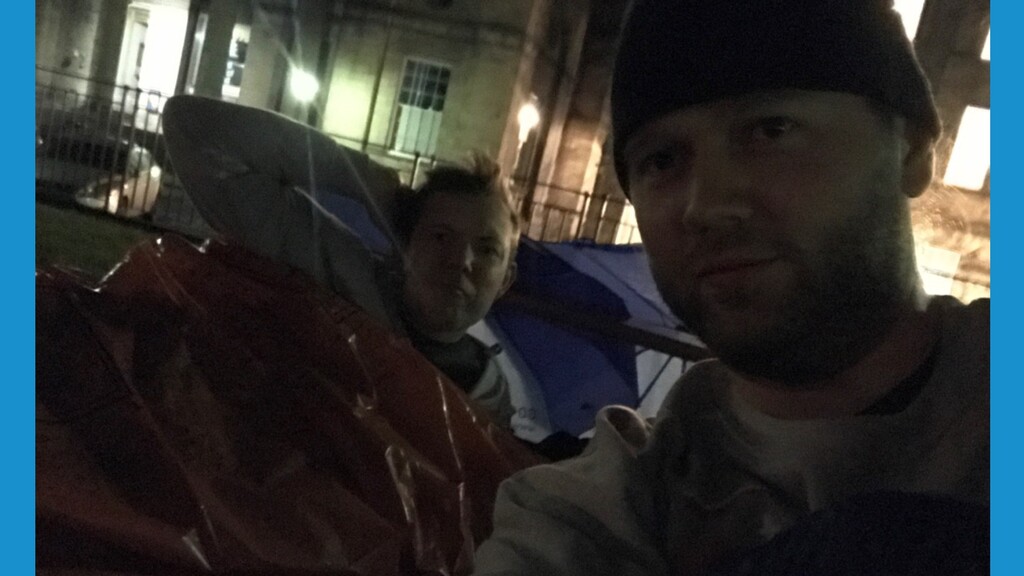
All right. Thank you very much for having me. I wanted to start this talk off with a picture that's probably a little bit hard to see. This is myself and Callie sleeping together And somebody asked me, like, what are you gonna say about that slide?
And I said, really nothing at all. I don't think it needs any explanation. Callie's doing a great job. Malzi's a great thing, and we were out one night, and I was you know, we a few drinks and peep people were getting loud and so on.
And I said something and and I looked over and I said, I'm just my name's Kelly and I work at Malzy. And Callie looked at me and said, nobody would ever believe that you could ever work at a fashion start up, so it's fine.
Alright. So this is a picture of me in December of twenty fifteen. And we were at a party here at Edinburgh, the Startups Christmas party, and we had given them a few hundred pounds or something for food. And it's a great gathering. It's a really neat time for the whole community to come together.
And we said it's the UK, so you got to get up and give a speech at party. So I got up and I thought what could I say to the startup community? And I got up there and I talked a little bit about some of the success that we had had recently and we'd just been through a really tough year.
Twenty fifteen was a really tough year for us as a company and we thought twenty sixteen was going be great and little did I know that twenty sixteen would be even harder. And so here's me very tired gazing into the lights about to crater off into a very difficult year for us as a company not knowing that.
But we foolishly got up there and said let's challenge the community of Edinburgh to give every startup that's behind you on the journey at least thirty minutes once a week. Alright? So every week spend thirty minutes talking with a startup that's behind you on the journey because a lot of us are new here in Edinburgh.
It's a very fledgling ecosystem. We've had a lot of success but we still got a long way to go. And so I got off the stage after saying that and everybody cheered because most people were drinking heavily and you know I had a personal assistant she goes that was a really stupid idea.
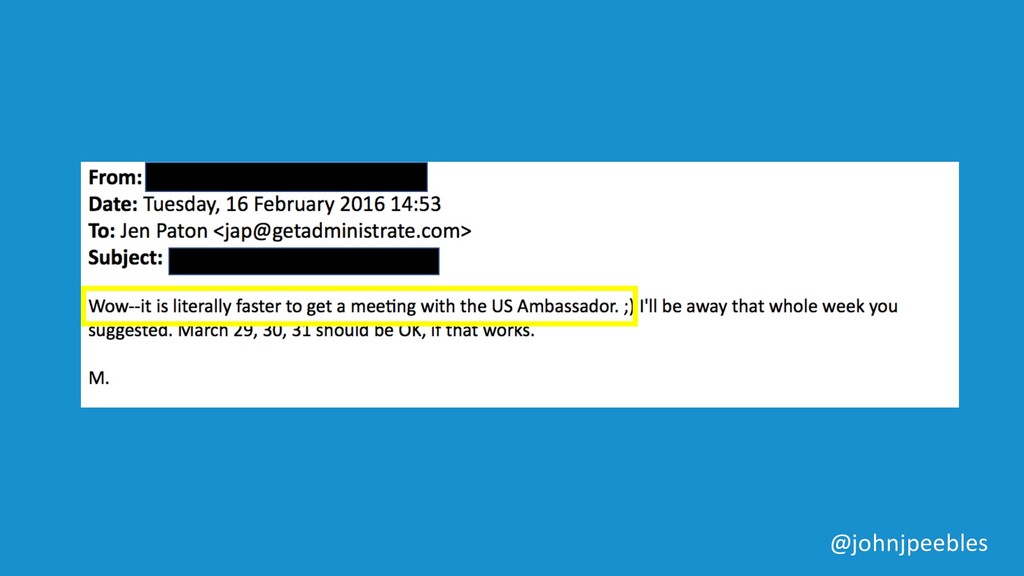
Your calendar is gonna be a wreck. I said I'll be fine right? And so here's an email that I got a couple actually my assistant got a couple months later and it said, you know, you are harder to schedule time with than the ambassador of the United States.
And you know, this is the thing, right? We started doing this and we started put walling off time and it was myself and other leadership at administrate and we did it for about a year. And so what I want to share with you today is some patterns that I've seen over this time of talking with startups across Edinburgh and people that have shared things with me as I've learned things on my journey, and hopefully it's helpful.
Okay? Very quickly, I'm the CEO of a company here in Edinburgh called Administrate. We have a training management solution, and we've got about sixty people at the company just for level setting. We're headquartered here in Edinburgh but we've also got offices in the Middle East in Beirut and the U.
S. In Bozeman, Montana. And that's my day job. I'm also really privileged to be on the board of a company helping out. It's also based here in Attleboro called Snap forty and they've got a really cool device. You should go check it out.
They can ***** ** your arm and take a bunch of vital signs and it's a really fascinating piece of tech and also a really great team. And so those are kind of the things that I do. And these are some of the greatest lies that the devil ever told to startups.
Okay? And I think the first lie that the devil tells startups is that we should all listen to lots of advice all the time, particularly at tech conferences. Right? And I I say this just because one of the things that is very common when people come and talk to me or I'm talking to other founders or, you know, wherever is that people read things and they don't really filter it through the appropriate calibration for whatever the situation they're in.
And so what I mean by that is they'll read something that is geared definitely towards a VC funded Valley b to c startup and then try to apply it to their bootstrapped b to b startup somewhere not in the Valley. Okay? And so please as we're talking about things today remember I'm coming from a b to b background.
That's all I've ever done in my career. All the companies I'm involved with are b to b and that's my worldview. But you need to have your own worldview and you have your own sources of advice and so that's really important. This is my fifth startup, administrative is, and I've had success and failure along the way and you know I've made every one of these mistakes, and so I'm probably making some of them right now.
And fun fact, actually, probably is actually a word now. Did you guys know that? And you you spent, like I got sidetracked for fifteen, twenty minutes reading about this because all of a sudden in two thousand eight, the usage just spiked. I don't know why that is, but I'd love to know.
So we're probably making some of those mistakes right now. Alright? Okay. So here's one of them. This is something that every founder believes. Like, they are a snowflake. Maybe it's just millennials, but I think it's true across the board. Every startup and every founder believes that they're a snowflake, and they believe that the conventional wisdom doesn't apply to them.
And I would say, you know, that's a belief that you can have, but it'll be setting yourself up for some failure. And the key thing here is that we read about these bullheaded founders that against all odds succeed. Right? And we read about that and we hear about that.
We don't realize that we're reading about outliers. We're actually reading about literal snowflakes. And I would say that the key thing in a startup is yes you need determination, you need to be bullheaded, but you need to control those variables down to be bullheaded and and, you know, against all odds and just a few things.
Right? Just one or two things. Don't act as if everything you can be a snowflake in. Pick your variables, one or two, and that's what you need to focus on. Don't try to innovate everywhere across the board. Alright. The second thing that surprises a lot of founders particularly early stage is they're surprised at how hard it is to start a startup.
Alright. This is something that even in the last two years I've had to learn anew. This is super painful. Okay? Starting a company is probably one of those painful things you can do in your life. Alright? And people always kind of think this is a false modesty or like something that people get up and it's like a humble brag or something but it's really true.
There is intense pain, there's intense suffering, you really need to count the cost if you're thinking about starting a startup. And you also need to understand that if you do one you probably need to be set up to do another because otherwise the pain is just not worth it.
All the pain and suffering, the things that you learned along the way for the first one should be then plowed into the second one otherwise it's just a waste of time. Alright. And this is kind of somewhat related. People think it's really cool to start a startup.
It is so unbelievably uncool to be in a startup. Alright? Because most of the time you kind of feel like you're failing and you feel like you kind of have to fake it sometimes and and so on. And I really cringe with this idea that people have nowadays.
It's like, oh, yeah. Everybody should start a start up. People should not go to university and start a start up instead. I mean, okay. That might be good advice, but it is not cool to start a start up. I'll give you an example.
Last week at our all hands meeting, I sat there in front of sixty people on three continents, and I added two simple numbers together wrong. Right? That's the kind and that wasn't even the most uncool thing that I did that day. Right? That's just typical. Right?
That you're just completely uncool when you're starting a startup. This is not something that you get into if you want to be cool. Another thing that people sometimes talk a lot about actually when they when when I was talking with them is that they think that their friends and the family will understand or they're surprised when they don't.
I'll give you an example. I was talking to a founder a few weeks ago and they'd been through a really difficult thing. Something problem had happened. And, you know, they called me as at night and evening and they said, know, I think we're not gonna able to fix this. This is a problem.
And I said, well, first off, you're gonna get through it. You're gonna fix it. It's not a big deal. And I said, second of all, you need to probably go home and apologize to your partner. And they're like, what? How did you know?
Right? I said, well, because you came home and you you you're frustrated and they said, how's your day? And you snapped at them and they said, well, what's the problem? And you told them and then they said, well, you're gonna get through it.
And you said, you know stop saying you have no idea what the situation is. You have no concept of what's happening here right? And then you kind of stormed out and that was that right? And they're like how did you know that that's what happened right?
Because that's what always happens right with your friends and family And and this is the thing, they're right. Okay? The friends and family they don't understand what you're going through but you will get through it and that makes them right and that makes you an ******* and so you better apologize and just understand.
Yes they won't understand what you're going through but they are ultimately right. You will get through it. Okay? Here's a concept that I see more and more as people think they're going to make tons of money. This is statistically just not true with startups.
Most startups fail most of the time. Even the ones that succeed sometimes end in these glamorous things called acqui hires, right, which just means nobody made any money. And this is just something that if you're in this for the money, if you're focused on the money, if your mission is financial, if your primary mission is financial, be prepared to be disappointed.
You can have a wonderful career doing a lot of things in a lot of areas, making a lot more money with a lot less stress than starting a startup. But this is this idea that pervades and I think it's a it's a mistake.
This is one the most insidious lies that the devil tells startups, and that is that the company is more important than yourself. This is something that I really want everybody in this room to hear, and I'm guilty of this just as much as anybody, and that is you're focusing too much on your company and you're not focusing enough on you.
And when I say you, I mean you. You need time to yourself. You need to exercise. You need to get habits in place to set yourself up for long term success. Okay? I really mean that. One of the best things you could do as a founder right now today is recommit to the idea that you're gonna go and spend thirty minutes exercising every day.
Alright? It's scientifically proven. We all know this to be true. None of us do it. We're in high stress jobs. This is a very stressful exercise or very stressful experience. You need to exercise, and of course I am also guilty of this, but we all need to understand that this is one of the best things we could do is to invest in yourself.
Invest yourself mentally, invest in yourself spiritually, invest in yourself physically. You need to spend time in yourself because if you fail, the company will certainly fail and and it's something that people just never really think about. Another idea that is pretty common with startups is they think that the time horizon for the typical company success is kind of two to three to five years.
Okay? Not a long time. And and I think that that's really misguided. If you are truly wanting to build a world beating company that is great, that does incredible things, it's gonna take you at least ten years. There's a pretty famous essay that was written a while ago and it's talking about great software takes ten years to build.
Great companies take at least a decade to build. Think about that in the context of the previous idea where, you know, if you're putting the company first every day, all day, you're not exercising you don't have your habits in place you can do that for about three to four to five years and at that point things are gonna fall off a cliff, your body's gonna start breaking down, you're getting older, can you imagine that?
You're actually gonna get older and it's gonna catch up with you. Alright? And relationships will start to break down and friendships will start to break down and these are things that are important. It's a ten year journey if you really want to build a great sustainable ongoing business.
This is something that is hard to hear. It was hard for me to learn. It was hard for I think it's just hard and it's the idea that your first startup is gonna be the end all be all or you're gonna hit that first startup and ride it off into a blaze of glory.
Okay? Most first time founders fail, most startups fail, we're an incredibly risky business and you need to get comfortable with the idea that your first startup may or may not be the one. It may be the one. You could be an outlier. You could always be that snowflake, but it's probably not the one.
Alright? You're probably going to learn a whole bunch of things, make a whole bunch of mistakes, fail, and then you'll do it again and you'll plow a lot of that hard won learning hopefully back into your second or third or fourth or fifth startup.
Alright. I've never once heard of any story anywhere about technology choices or poor tech killing a startup. Okay? And yet we obsess over this as founders particularly for technical. Alright? A lot of times when people would come and talk with me they would say oh you know I'm really worried about the tech stack you know it's not working right.
We've got to get to micro services. Right. And I would say like who cares about any of that. Right. And they're always surprised by this and I think we need to really understand that technology has really nothing to do with anything at a tech startup.
Yes it's important. Yes I like it. Yes I really enjoy building great tech but it's not the reason you're going to succeed or fail. It just isn't. There are other factors that are more important that are in play. This is something that I think is at the crux of kind of what I'm trying to communicate today and that is this is a journey and involves more people than just yourself.
You've got to get ready for this, and you need to seek out mentorship. One of the things that seems to be prevalent is people say, put all available time into your start up. Don't think about anything else, don't talk to anybody else, that's okay, and I think that's a huge mistake.
Early on in administrate I was so fortunate to have interactions with people that were far ahead on the journey from where we were. That's why we're trying to give back to people that are behind us on the road. And that's easy to say I guess if you're sitting out there thinking well maybe administrate's more successful than our startup, maybe they've got more experience, whatever.
And I would say that's not true. Okay? Everybody's got something to offer. I remember last year after I was speaking here at Turing, I walked out and you know this crowd of people and it's fairly big crowd as people are getting coffee and so on And the founder came up to me and they just kind of burst into tears.
And it was you know it's like woah so just quick hug. Right? And you know I'd there'd been a nerve that had been touched where we're talking about this is hard and you can't always be perfect and so on. And it was one of those moments you just you just didn't wanna do, so you just you just default to hug.
Right? And so there we are and we're kinda hugging and moving out of the crowd a little bit, and it was fine. Right? I I didn't think anything of it. It's just pretty normal actually. And about five six months later, saw the same founder again and kind of said, well, how's it going?
And just just kind of it's not going very well. And I feel like every time you see me when we talk things aren't going well. Oh, that's okay. It's fine. And then I bumped into the founder a couple days ago I said, how's it going?
And they said, well I haven't been drinking. Right? Was like nine AM. Right? Oh okay. And they said I'm just throwing out the beer bottles and wine bottles from last night and I got some got some of it on me. Said oh what's going on?
You celebrating something? He said yeah. I said what are selling? We're profitable. Things are going really great. Right? That's what we're talking about. You need that community. Okay? You need those people that can that can be peers, that can listen to your problems, tell you you're full of ****, tell you you're right on the right track, give you hope, give you encouragement.
When we were going through twenty fifteen and twenty sixteen, it it was just really hard at a couple points. And I remember I was sitting at the Blue Blazer up the road, and I was talking to another founder who's a who's a close friend of mine, become a close friend, and the basically I was sitting there and he kinda I was just saying this is really hard.
I'm really upset about a few of these things. This is a struggle. And he kinda just said turned to me and said, I just want you to know something. I really love you, man. Right? And we're in the middle of the blue blazer.
It's not like some hipster joint. You know, people are not okay with crying in the blue blazer. I'm I'm sitting there and kinda you know, tears are kinda just I'm, like, really trying hard. You know? And it's it's one of those moments where it's a simple thing to say, and it's a it's a small thing, but it really matters.
And you'll need that at some point along your journey. You need to able to give that to others at some point along your journey. It really matters. Okay? You need to invest in your community. I'm really passionate about that because Edinburgh has given me so much.
We try to give back. It's not perfect. Sometimes the advice I give is terrible, but you should still do it and you often learn a lot along the way. Alright. Something that I see that happens from time to time is you have people coming in and they haven't really matched their business strategy to their funding plan and vice versa.
And I think this is kind of an insidious problem. If you come in and you've got these aspirations of building a super huge business within eighteen to twenty four months and you're not thinking about going after VC capital, you're doomed to fail. Right?
Because that's a capital model that is matched to kind of your your aspirations. On the other hand if you're thinking about bootstrapping then why are you talking to VCs if you just want a lifestyle business? And I think in kind of less developed ecosystems that are outside the valley you see this more and more and a lot of founders come in and they don't really know, should I be raising money?
Should I not be raising money? How do I raise money? And you really need to understand what your end goals are and what you think you can attract capital wise and make sure that they match. Because if you don't you're just on a runway to certain frustration and possibly even failure and that's no good.
I see that quite a bit when people come in and ask questions or talk things through. This one is very, very common and it's common when the founder is technical and that is they're really focused on the product and they're not selling. You need to be selling something from day one. Okay?
If you're not selling from day one, you're not getting this wonderful thing called feedback from the market. Alright? And you know I know it's hard. I know you don't want to sell vapor and you shouldn't go out and sell vapor, but you should just be transparent about what you're trying to do and have an idea of how you're gonna get to that first sale.
A customer is not a customer unless they're paying you this thing called money. Okay? A customer is not somebody that signed up to use your product. A customer is not somebody that's using your product. A customer is somebody that's paying you money. They don't even have to be using your product to be a customer.
Right? We confuse these terms and that's a recipe for disaster. If you put off sales until after V1 of the product or V2 or whatever, you're going to have to learn everything that you should have learned along the way and it's gonna cost you a lot more and it's gonna be very embarrassing, expensive, possibly cost you your company.
This is a corollary to that and that is your product is your most important thing. Product is not the most important thing insofar as the thing that we think of when we think of a product. Your product needs to be broadened in your mind to include things like your team, your service, your out to market and so on.
Okay. It is not just the piece of software, the app, the widget, the gadget that you're selling your product is broader than that and when we think of product and we focus on the product and we ignore things like sales or customer service or whatever we think that we can put those off to later, then we are setting ourselves up for failure.
Okay? This is another lie that is told, and by the way, I don't care if you don't believe in the devil and I know you this acute thing with the usual suspects, whatever, but these demons are real. We all have them in this audience, and these demons are whispering to you and you have your own.
You have your own unique flavor of these. And so when I want you to stop and think about that for a little bit. When you have these whispers of doubt, of lack of confidence, maybe it's something somebody said to you or whatever. These things are demons that you need to address.
Maybe they're right, maybe they're wrong, but you need to address them. And these are some of the things that we're talking about. Don't worry about the people stuff is a demon that's whispering in many of our heads right now. If you neglect the people part of your startup, you will certainly fail.
It's the most important ingredient. It's more important than a tech. It's more important than anything you're doing. It's about recruitment. It's about motivation. It's about building a culture that people want to thrive in and and work with and grow within and all that.
If you ignore this stuff then you're really doomed. I would say hire that HR person earlier and don't think of them as HR in the stodgy all negative ways just like you don't want to be thought of in negative ways when people say the word programmer, right, or salesman or whatever.
There are great HR people out there and they're so important. You need to hire them about fifty hires earlier than you probably would. Most first time founders wait until the company gets about a hundred to a hundred and twenty or so before they hire their first HR person.
Don't make that mistake. Hire them in earlier. Usually twenty to twenty five is kind of what I recommend. This is another lie that gets said, and I get it. Right? Startups everywhere are killing it, just not your startup. And everybody's got that growth and I love the slide from the previous speaker because that is true.
Right? Everybody wants the straight line up into the right or even the hockey stick and the reality is is that almost never happens. I was talking to this great VC that I heard out in the valley when I was out there last and he was just super honest and and he's kind of he kind of gets warmed up and he's a little bit unsure when he got on stage and he'd like kind of dropped an f bomb and everybody's like loved it and then he dropped like five more
and he's like super transparent. Anyway I had a conversation with him afterwards and we were saying yeah twenty sixteen twenty seventeen twenty sixteen was a little bit difficult for us and we kind of gross slowed down we think it's gonna pick back up and it did.
And he said you know what dude he's like every startup has a gap year. Every single one. And if anybody tells you they didn't have one they're lying. Right? And I just thought that was really interesting. So just take that to heart. Right?
Everybody's always killing it. Everybody's always raising more money. Everybody's always doing something better than you, and it doesn't matter. It's irrelevant. Focus on your problems, and these things are seasonal. Right? You will be the hot start up in Edinburgh at some point, and then you will not.
And then you will and you will not. It's a roller coaster and just don't fall for this type of thing. Here's another lie. You need to be in Silicon Valley. We're in Edinburgh. We're headquartered in Edinburgh. We're in weird markets. Okay? There's probably not very few startups with a collection of weird offices like us, Edinburgh, Bozeman, and Beirut.
But it makes sense to us, and we do not feel like we need to be in the valley. You might need to have a small presence there. Depending on your funding, you might need to go there, but you can build a start up anywhere, and that's something that we've seen time and time again.
It really shouldn't be obvious or really doesn't you know, it should it should just be obvious, but it isn't. And more and more, you're seeing that people recommend putting a smaller presence in the Valley and doing their development and sales and service elsewhere.
This is another lie that I hear a lot, particularly from first time founders, and that is that they kind of view their investors and sometimes their board as opposition. Alright? And they kind of feel like they have to blow smoke up their ass all the time, and they kind of have to prepare these like song and dances at their board meetings and so on.
I think that's really a bad idea because if you believe like I do that startups, all startups are a roller coaster, you know, that works really well and you get the investors excited and right as you're on the going up. And then you kinda stutter and you you take a little bit of a a dip.
And if you're used to this idea that only good news can be presented and you haven't been transparent along the way and you haven't shown your work on how you're thinking about decisions and so on, that's when it really gets hairy, and that's when you kind of realize that you have squandered a lot of opportunities to build trust along the way.
And now you're trying to build trust in a trending down or negative environment or a struggling environment, and that is very, very difficult. And so I would really advise you to be transparent with your board. Don't feel like you need to be reading your press releases to them at every board meeting.
You know, it's a little bit jarring at first, but I really think if you pick the right investors and you treat them like they're part of your team because they are, then you will just that'll pay off just over and over and over again and you'll learn a lot and you'll have these relationships that are long term and sustainable.
This is something that I hear and see a lot is I would say most first time founders come in with a b to c start up idea. Alright? Kind of along that nobody's a snowflake thing, I swear to you, in the last twenty four months, I've had four or five start up ideas come, and they all have the same two or three ideas.
The first is they want to be some sort of scheduling app for local community events like pickup basketball games, right, or football games or whatever. And literally, that's four or five people have walked in with the exact same idea in the last twelve to eighteen months here in Edinburgh, which is not a very big city. Okay?
The second idea that everybody has ever had all the time is that it's an app where as you're walking down the street, a coffee shop can buzz you and say, hey. Looks like you're nearby. Come on in for five pounds off. Right? Everyone has had that idea, and I've been pitched that personally three or four times as the idea of the future.
Right? And the reason is I've got this theory. Right? And this theory is that because most of startups are started by younger people or that seems to be the the the the trend, Young people haven't worked in a variety of jobs, and they probably haven't worked in a big boring business career.
Right? And so they just are inventing problems that they're trying to solve problems that they experience in their life. Right? And that tends to be b to c problems. And that's really hard because b to c problems are really only solvable with one thing, that's lots of capital.
Alright? And to get lots of capital, you really have to go to one place because there's lots of risk. And that one place is Silicon Valley, and you really need to be lucky for this to work because there's probably four or five other great ideas or that are just the same as yours that are getting funded at the exact same time.
If you think about it, all of the b to c companies have had a few competitors that are very close to them in their space until somebody finally wins. Alright? That's not true in b to b. B to b, you don't have to have as much capital.
You can get customers from day one. A lot of b to b customers are willing to pay for you before your product is even delivered. You can get a lot of feedback from your customers. It's very easy to do that without pushing out a survey to your tens of millions of users.
You can monetize it. Right? The smartest people in the world are sitting there trying to figure out how to monetize Snapchat right now, and it's not going so well. Right? And think about that when you think about what type of startup you wanna you wanna build.
And it doesn't have to be that hard. Right? Just tweak your b to c idea slightly to turn it into a b to b idea, and it usually works out much better. Alright? Very quickly now, don't worry about your metrics. This is a lie.
You need to really be fluent in your metrics, and this means that you need to read a lot, and this means that you need to really genuinely understand the metrics that drive your business. For us in b to b SaaS, we think a lot about MRR, ARR, growth rate, churn, LTV, cost customer acquisition, all these things.
You need to understand these very well because you'll be asked about them and you'll be benchmarked against them, not because people like to keep score, although they do, but because these metrics paint a really good picture on the underlying health of your business.
And if you're fluent in them and you use them and you train your team on them, then you will be able to address, find, and discover problems in your business much easier. All of our team and administrate gets an MI pack every month that's got every metric of our of our business trended over the last year.
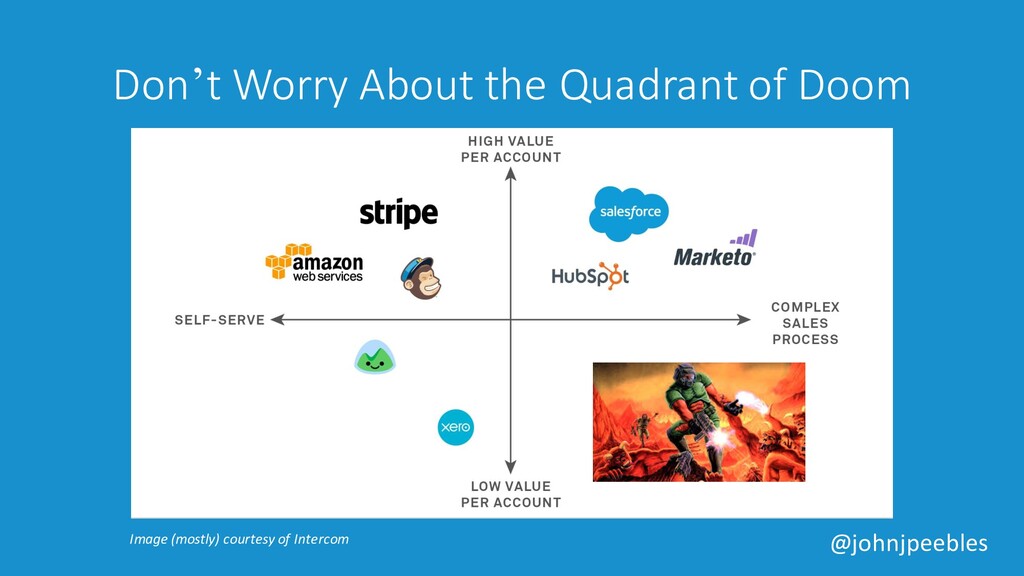
Okay? And we have a training session with every person who comes on board in the company about what these metrics mean, and that's really important. This is one of the most common mistakes that I see with startups is they price their product too low and they are fixed firmly within the quadrant of doom, which is right there, which is low value per account and complex sales process.
Okay? That is bad. You can kind of survive in the other three quadrants, but the fourth is the quadrant of doom. You would not believe how many startups are firmly fixed in the quadrant of doom. Administrative was in the quadrant of doom about five years ago, and it takes a lot of work to get out of it.
And I wish we'd done that harder, faster, better than we are. But, you know, once you're out, it it makes a huge difference. This is the last lie that the devil tells startups and you and you, and that is you will be finished if you do not succeed.
Alright? This is a lie. You will be just fine if you do not succeed in your startup. You may find that you go on to bigger and better and greater things as a result of things you've learned. You are not going to fail in life if your start up fails.
Okay? I know it feels that way. I know I feel that way. We all feel that way, but it's a lie. We can embrace that as the lie that we know that it is and reject it. Alright? This is an old Persian saying. Right?
And I think it's more true with startups than anywhere else in the world. This too shall pass. The good times will pass. The bad times will pass. We're on a journey. You're trying to build something that's sustainable and long term. Help each other out.
Make sure that you don't fall prey to some of these common mistakes. Invest in your community. Invest in yourself. Invest in your teams. This is these are my details. If you ever wanna chat, I'd love to hear from you. Thank you very much.