
The Head of Product role is alluring in many ways - it was Gabrielle's dream job when she was a PM and it is the dream role of many product people. In this talk, Gabrielle shares her assumptions about the role and which assumptions she learned are right, wrong, and which ones are very wrong. This talk walks through learnings as a Head of Product, highlighting the challenges and lessons learned while building great products and, most importantly, great teams.
← All talks 
Build Product Turing Fest 2022
Confessions Of A First Head Of Product
Auto-generated transcript - may contain errors. Tap a timestamp to jump the video.
Awesome. Well, I'm so excited to tell you all the confessions of a first header product. I'm going to start by explaining the title. I'm both a first time header product, aka this is my first time doing the job, And also, this is, thank you, necessary, I'm the first head of product at this company.
So it comes with all sorts of interesting nuances, and I'm gonna tell you all about it during the talk. I actually started writing this talk about six months ago when I joined. I literally had a note on my phone, and anything interesting that I learned, I would write it down.
And I mean, it looks a little better than the note on the phone, hopefully by now, And I have boiled it down to eight lessons that I learned, ideally so that you don't make the same mistakes that I did. And these are like tips, tricks, real like stories from like war and trenches that is building product, as many of you know.
But before, I'm gonna introduce myself a little bit. My name's Gabrielle, but you can call me Gabi just like everyone. I started off as a product manager, became a senior PM, became a group PM, and then took the leap of faith and joined an early stage startup as their first head of product.
I was looking for a few things in this role. I wanted consumer because I like building stuff for a lot of people. I also wanted something that's truly great for the world. So I didn't want to have to connect any dots. I wanted a company that I felt like was doing something awesome.
I wanted a team I could fall in love with, and I also wanted this role, and I wanted to be the first. So I mean, that's a lot of criteria, and I talked to a lot of companies and landed at Little Otter, and we do mental health for kids and families, and it's pretty awesome.
I'm liking it so far. And would love to get a coffee. I mean, by now it's probably like a drink, right? Like no one's trying to drink coffee at this point. But we'd love to get coffee or a drink with anyone and get to know all of you a little better, talk about product, talk about head of product role, or talk about Little Otter.
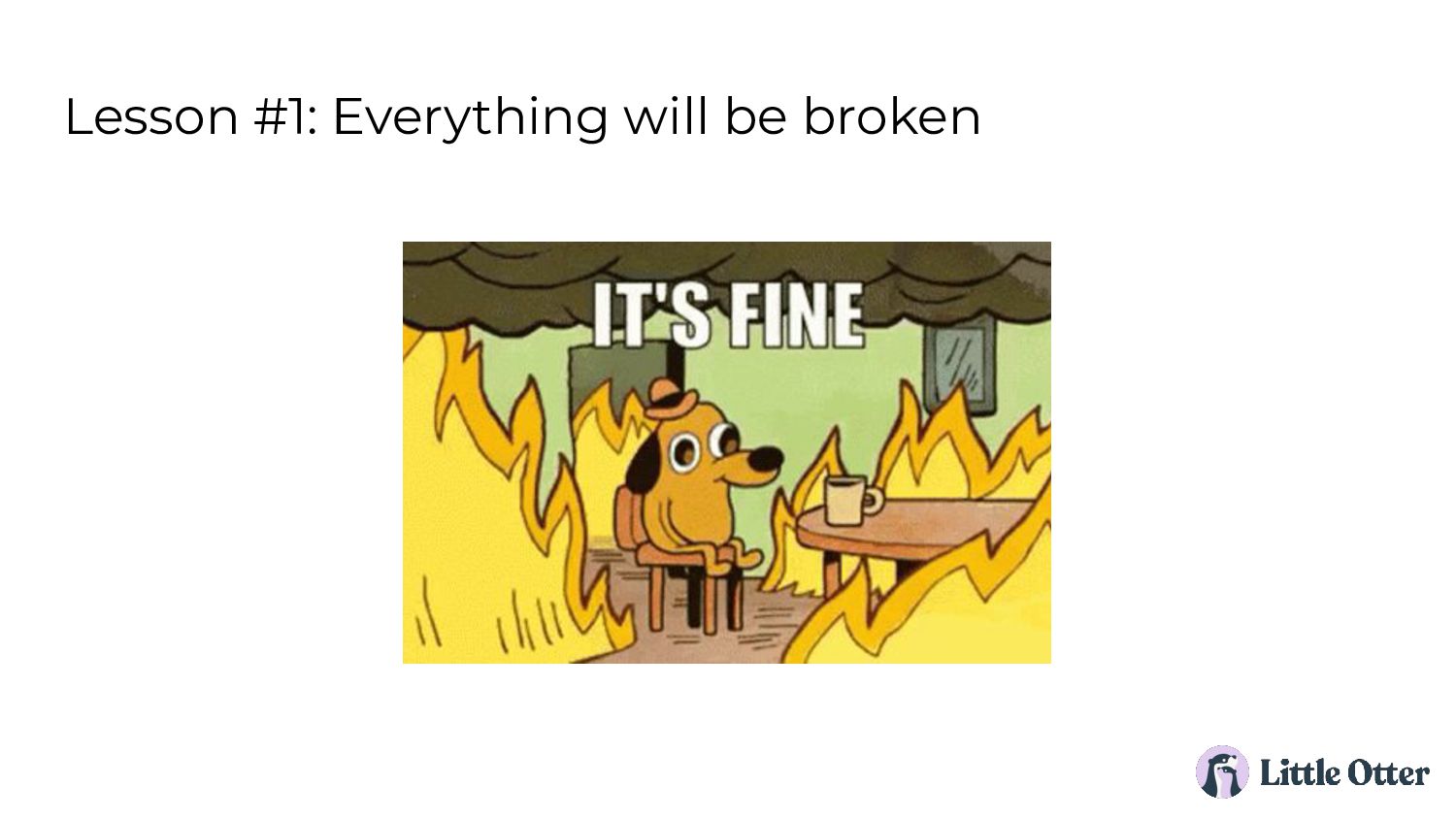
Without further ado, let's get started. Lesson number one. Everything will be broken. This is very important to know, and honestly, I am happy that everything will be broken because that's why they hired me. They would not have hired you as the head of product if things were fine, if things were okay.
The other piece is that everything will be broken and this is the state of any early stage startup. I think the best analogy that I have to describe is that let's imagine you're like an airline and you are flying a plane while you're building it mid air.
You have real customers that are on this flight that actually expect a certain level of service. They expect to get there. They might want some peanuts, water, whatever. And they expect you to land the plane at the destination that you promised them that you would.
That's how it is. And it's really crazy and it really takes a lot of work in terms of figuring it all out and putting it all together. But just knowing that everything will be broken is so much better because that was literally the first word I had after my first day.
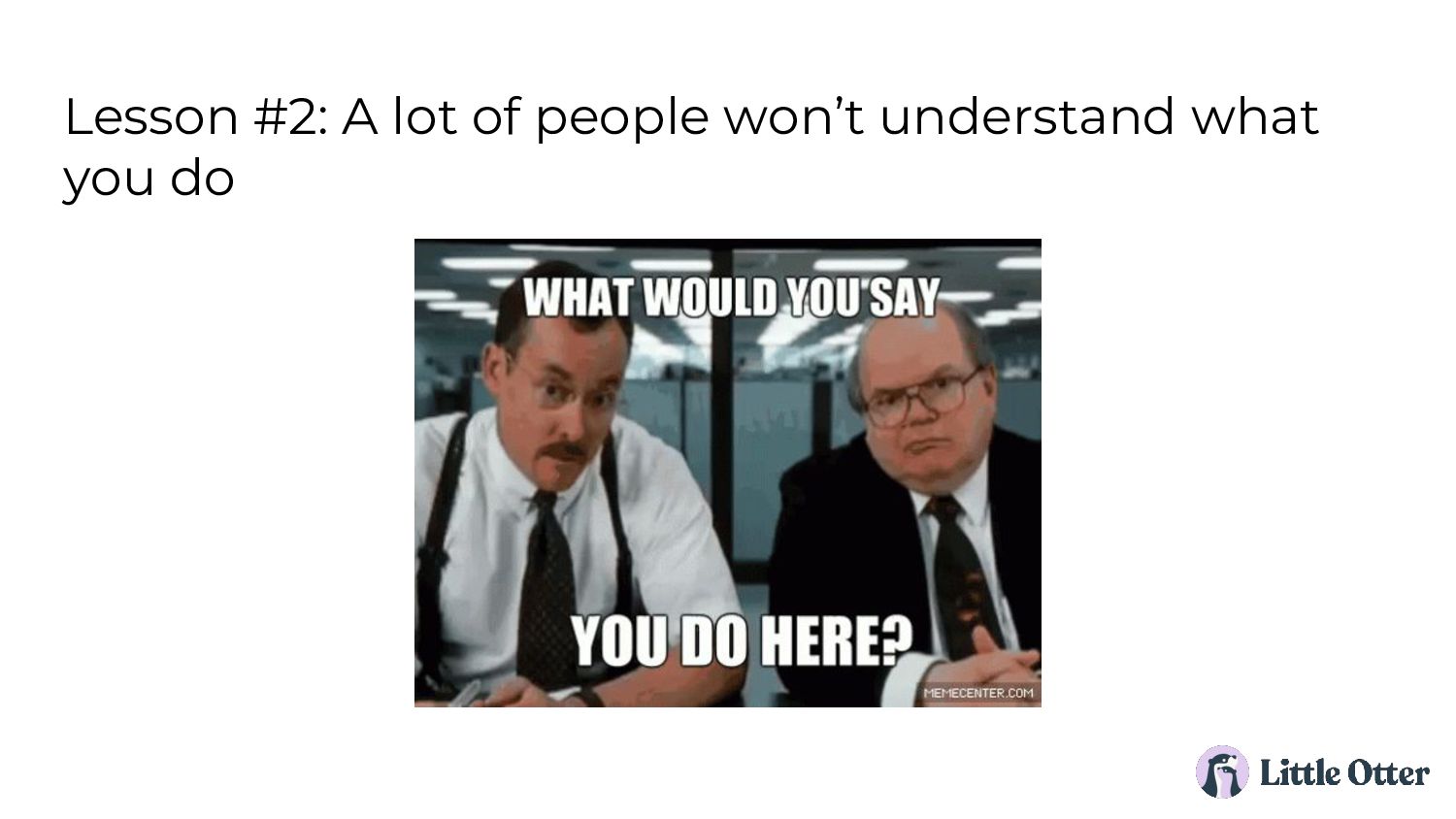
I opened the door and I told my partner like, oh my god, everything's broken. So no, it's going to be the case for you and it's fine. You'll make it. That's why you're there. Lesson number two. A lot of people will have no idea what you do.
I mean, this has been our problem for a while, right? I mean, no one has asked me like per se like what would you say you do here, right? But people have a look, they have like a certain clear confusion on like why you?
Why are you here? And this has been like a PM's problem forever. I mean, engineers build things, very clear. Designers design things, and product does what? Always been around. And I think with the head of product role, it's even more. Because you're coming in, you're leading a department, there's a certain level of expectation, you're on the leadership team, and I say that very good PMs need to be extremely good communicators.
And it's on you to tell people what you do. It's on you to teach them how to work with you. Because ultimately, you're not like a one woman show or a one man show. You need all these people in order to do your job.
So it's your job to reach people and speak their language And be a good translator between where you are, where they are, and how to communicate with them. I heard from someone recently that you need to say something seven times for it to stick.
So here's the stuff I've been saying again and again and again. Life hack. If you can't place yourself within two things that people already know what they are, do it. It is better. It gives you an immediate sense of credibility, and it's nice.
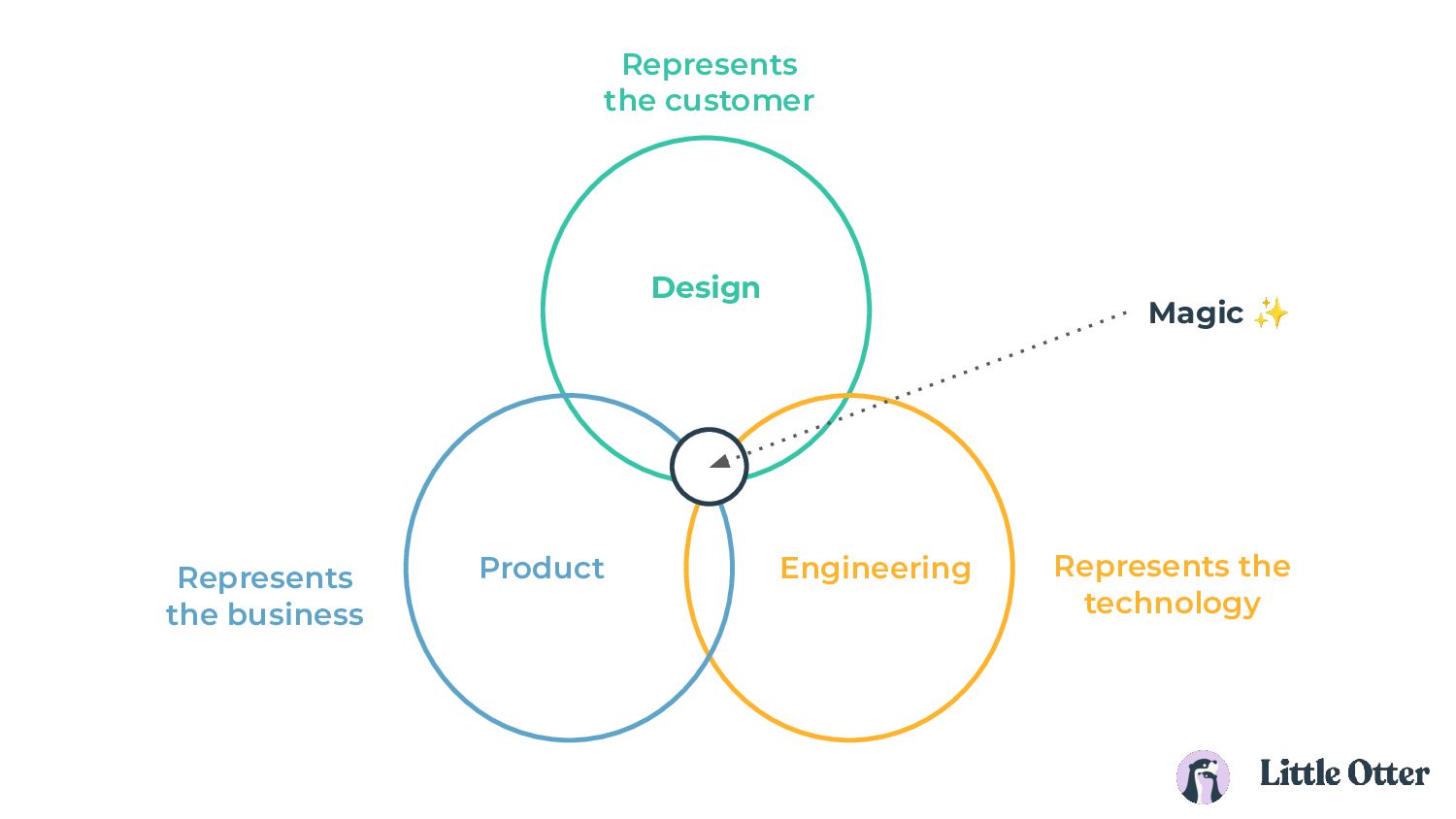
So this is one of the sites that I literally used at one of our first company all hands that I was there. And I explained that designers represent the customer. They're always thinking about what are the problems that we're going to solve? How are we going to solve them?
How are people going to use it? Is it actually going to work out? I mean, they're not the only ones that are responsible for that, but they're bringing that perspective. Engineering is always thinking about how do we build this? Like, can we actually scale it?
What's the actual right way for us to do this? And then product is thinking about the business because someone needs to think about the business because products with no business are a hobby. And whenever I explain that to people, they get excited. They're like, okay, okay, cool.
You're going to help us move some metrics up into the right, which is great. And I tell people that at the intersect of all these things lies magic. And that's delight, that's happiness, that's actually features that get used by people. It's metrics that actually improve and go up into the right.
It's a really, really exciting intersect. And it only works when you have design, engineering, and product working together. I also had this slide. And I was like, is this like too short? Are people gonna think that my job is easy? They don't. That's like the short short version of this.
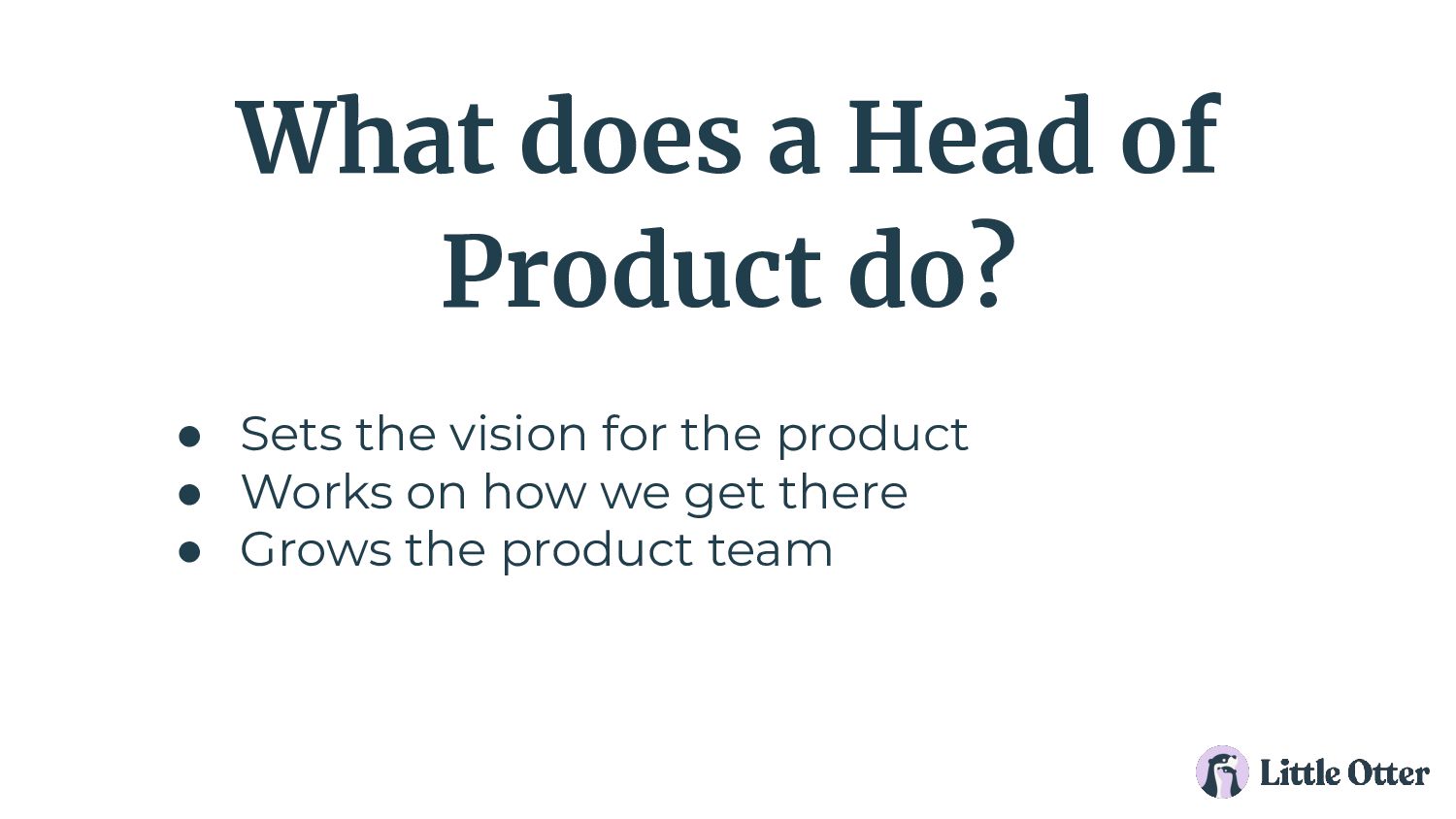
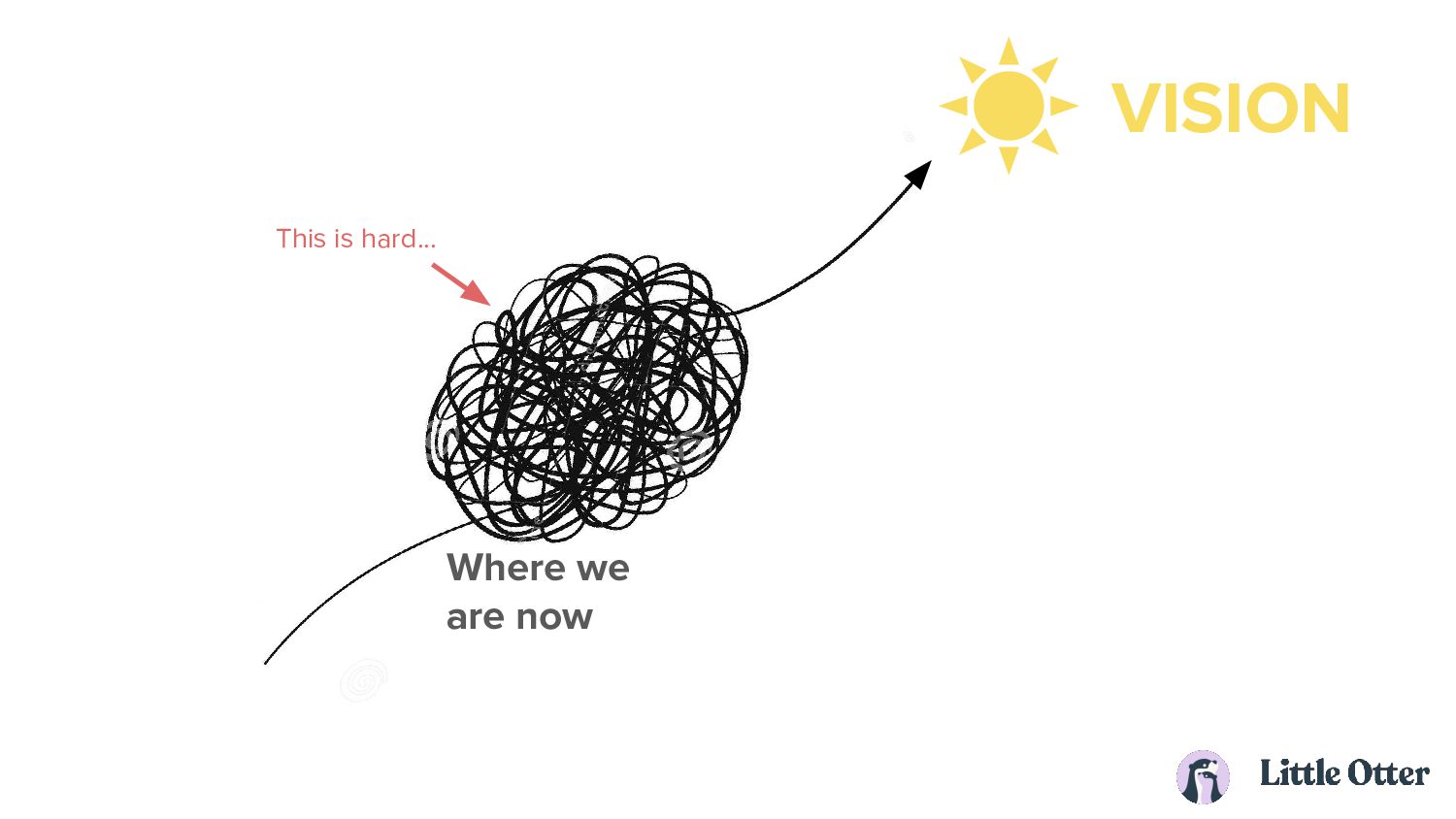
They don't think it's easy, even though it's super short. So I tell people that a core part of the job is to set the vision for the product. So like really imagine and dream up what that land could be. What that place could be that we are in a few years from now when this product actually makes it.
Then comes the hard part, like dreaming that up really, really fun. But then you need to work backwards normally and figure out how you get there. So what are the first thing you build, the second thing you build, the third thing you build, the thing you might have to rebuild and then completely rebrand?
That's also on you. And I mean, back to my point of you not being a one person show, you need to grow the product team. So when I joined, I was the only person on the product team. So I really, really needed to grow the product team.
So I hired a designer, I hired PMs, and as you can see, for us, design sits within product. And there are true advantages to that in the super early stage. I mean you're super aligned. We also like just don't have the headcount to have a design, like a head of design.
I think the most important thing is I have a lot of opinions about design, and our designer will attest to that, but I know that I'm not a designer. I hired someone that is very good and very independent. I also have a lot of design friends that are awesome, and I can connect her with them if that's necessary.
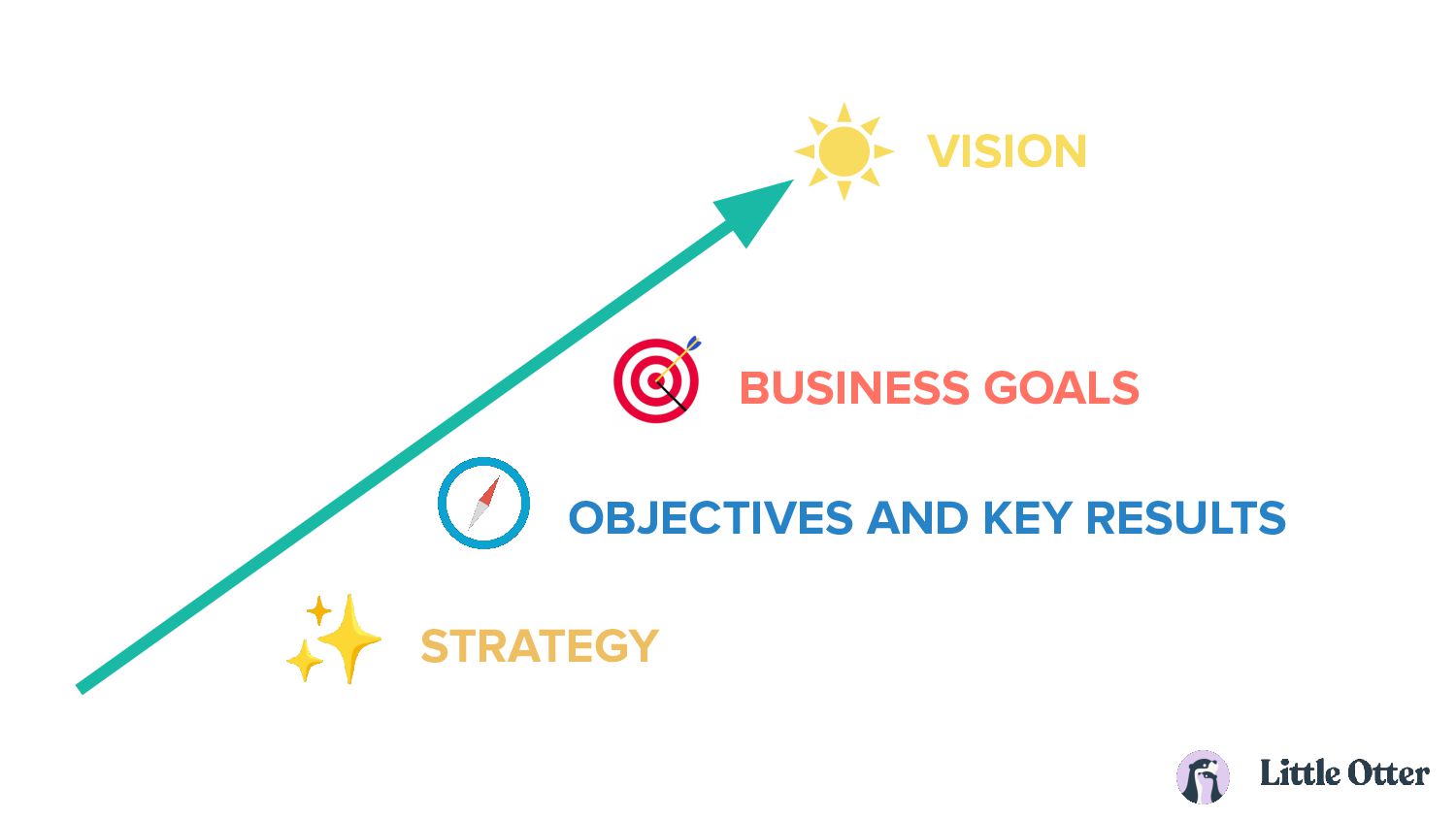
So I know my place, I know my opinions, and I know when to literally step away so that I stop being a blocker. I also found it helpful to do some sort of visuals for people. Explain like, yeah, the sun, the vision, like this is where we are going.
I am part of that. Then I am part of connecting that to our business goals and breaking that down into smaller business goals, which I mean, we, a lot of people call them OKRs, objectives and key results. Those need to be specific, they need to be measurable, they need to be achievable by the team, very important, otherwise they will hate you.
You also need to be able to measure them, and they really kind of set the tone for what the business goals are, and immediately give you kind of like a go no go if you're doing well or not. And then comes the hardest part, and that's why it has like the sparkles and the beauty product strategy, which includes everything from like what problems you solve, what problems you don't solve, what you build, what you don't build, and ultimately it all boils down to decision making.
The truth is that it's never like this. Like this arrow is so fake news, but this looks so ugly, like on a slide, right? Like it does not look great. But that's what it actually looks like, and it's hard, and we're here right now, right?
I have to tell people that there is science to the madness. And there is. I mean, there's lots of frameworks. We heard about a lot of them today and yesterday. There's like a path to getting there, but it looks super confusing and it's super difficult, and it's also why like you're there and why you have a job.
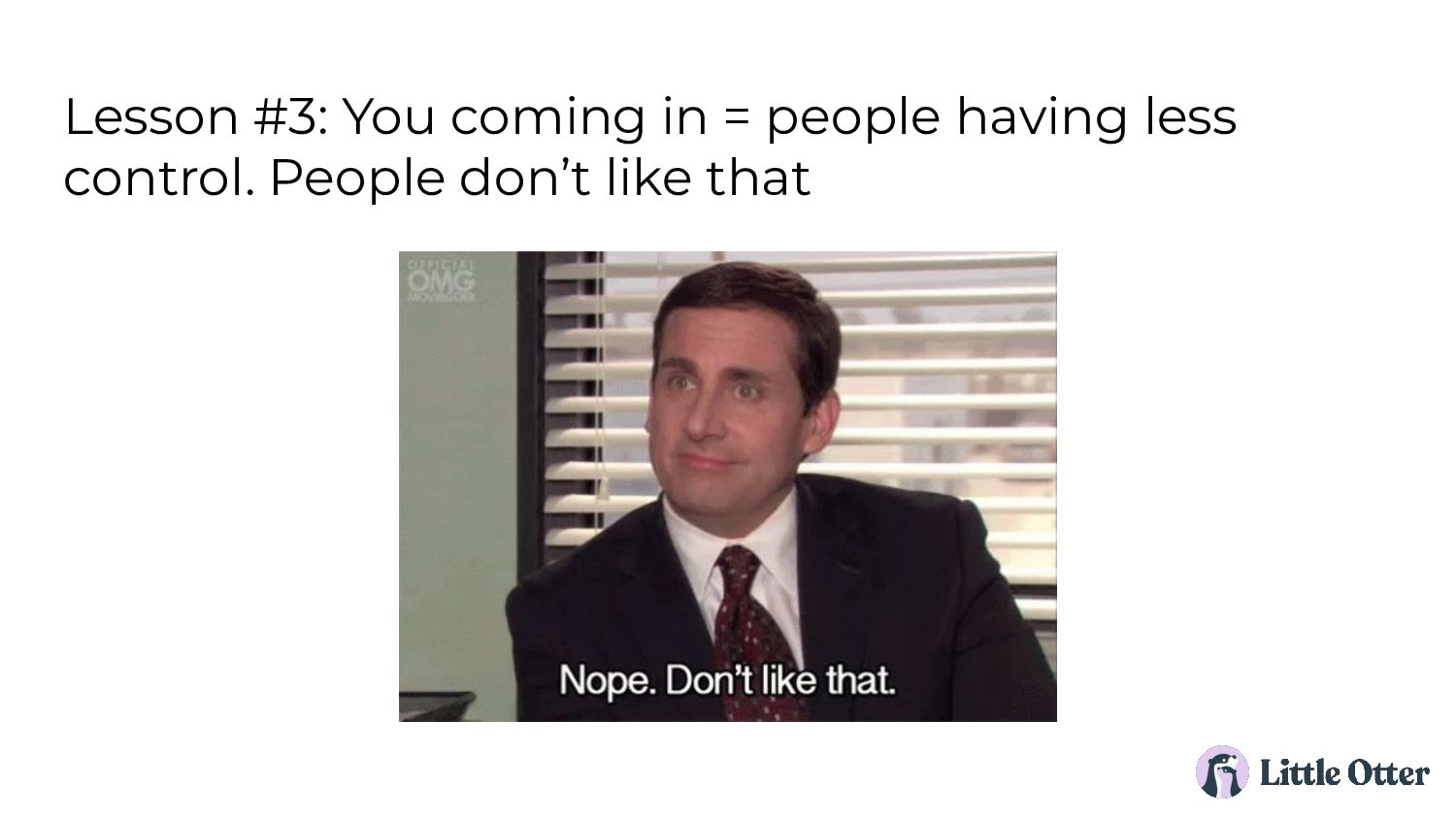
So very important. Nice. Lesson number three. You coming in means people having less control. People don't like that. Here, Michael Scott, honestly like the hero of middle management. I love The Office. If you haven't watched it, highly recommend. Completely irrelevant to product, but like really really good watch.
I mean, he's like, yeah, no, I don't like that. I think the biggest thing that I realized is like when I came in, there was a product already. Right? Like there was like stuff out there. I came in, was like number fifteen on the business side.
Like there were fourteen people before me that were building this product. They all had a lot of responsibility around the product because I didn't exist. Like there was no one there in my role. And people like responsibility. They like to have a say. They like to be involved.
They like all of these things. So when I explained my role, it brought clarity to people, but it definitely didn't bring happiness. So they were like, wait, so are we now not involved? Like how does that work? It was tough. I mean, was really difficult.
And I needed to get people to want to work with me. Right? Like I can't like just come in and like command. I need to come in and get these people on board. So my recommendation for this, because it will happen, right, like you join as head of product, director of product, anything that didn't exist before, this will happen to you.
You need to approach it head first. It's an awkward, difficult, and intense conversation. But I met with everyone, and I was like, hey, I know that me coming in means that you have less opportunity to contribute here. I know that it means that you have less power. I'm sorry.
I want to make sure that we can leverage all of your learnings and experience that you've had at this company in order to build a better product. So how do you want to be involved? Like, literally had a bunch of these conversations. The reality is people want to be way more involved than you need them to be.
So also be ready for that. And it's your job to overlay what they want with what the business needs. And then it's your job to communicate back and be like, you know that thing you wanted? Well I hear you, we are gonna do something different.
This is what we're gonna do, this is why, and this is how you're gonna be involved. They're not gonna like it, that's okay, but they will respect it because they will have felt included in this decision and they will feel like they know what's going on, they know why, they know the plan, and it will start building a little bit of trust, which is super important.
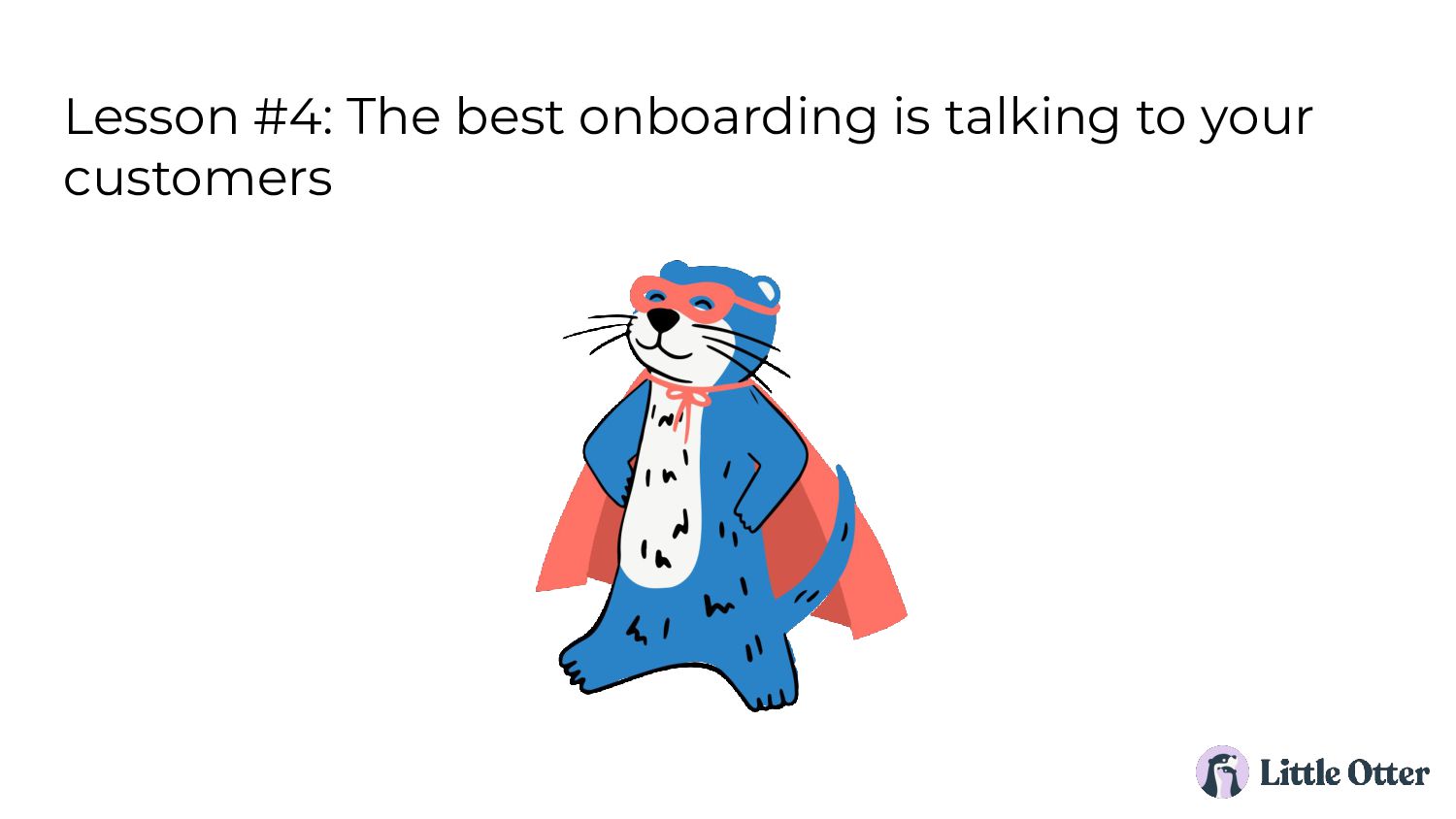
Lesson number four. The best onboarding is talking to your customers. I will say we have really cute illustrations at Little Otter, and I really tried to find an opportunity to insert one in the slide, and I did. I promise it's going to connect back to the Super Otter, but just wanted to like highlight illustrations because it's a core part of my job and it's awesome to just look at them.
So cute. On that, back to the lesson. Basically, you come in, it's so easy to be overwhelmed by like docs, your teammates, understanding the business, understanding people, like just getting to know everything, getting settled. There's so much to do, so many decisions needing to be made.
Clearly, there was no one there before doing this, or maybe there was a gap or a transition. Like there's so much to do, and it's so tempting to spend that time meeting your teammates, reading docs, understanding the business, like learning stuff. And the danger of doing that is that you start to create a view of your customers and their world through proxies.
You start to have hypotheses on what they want, what they need, what problems they have, based on what other people have discovered. And these other people are not in your job, right? It's not their role to understand what the customer does necessarily. It's their role to do a bunch of other things.
So I'm not advocating for you not to talk to your teams or not to learn the business. I'm just saying that the one thing that was the most important thing than any other doc I read, any other meeting I attended, was picking up the phone and calling one of our customers.
And there is a very simple way for you to do that. You just came in. Use that to your advantage. Send them an email. Be like, hi, I'm Gabby. I'm our new head of product. I'm so excited to meet you and make your life better, do you want to talk to me?
Like ninety five percent of people said yes. It was amazing. Like everyone that opened up, read, said yes. And we also leveraged this opportunity to add a survey, to like get a post on the product. So I got both quantitative and qualitative data just from this one email that I sent out.
And I say this all the time to everyone on my team, but like truly talking to customers is what gives you superpowers as a product person, because ultimately your job is to build products for them, right? Like if you don't solve their problems, they will leave.
They don't care about your problems or the business problems. You build products for users that work for the business, And understanding what they need is truly what makes you successful. Lesson five. There is a weight to what you say and you can't take that away.
So I've always prided myself in being extremely transparent with my teams. And I've always wanted to give them as much context and as much information as I could about every single thing that we're doing. If it's super early stage, super nascent, super new, I'd always be like, yeah, this is like a half baked idea or this is like a half baked thought.
And recently in our company's entire off-site, so we're all remote, we all got together in one place, I of course had a slide about our roadmap. And in the slide about the roadmap, I put things that were product improvements, things that were one thing in particular that was a new product kind of line or idea that we were thinking about.
And I explained to people like, hey, this is like a gradient, right? Like the stuff that is right now, we know a lot about. Like we have a ton of context, a ton of information, we're ready to go. Everything that's more to the right is more uncertain.
So like the longer the time horizon, the more uncertain we are. And that's normal. I mean, if that wasn't the case, we would be following like waterfall and we wouldn't really be reacting to the market and to what our users actually want. So I gave all of that explanation, I put the thing there, I called it something, and honestly, it was a disaster.
Like, we had to rebrand this thing. That's how bad it was, because people saw it and they're like, oh, new product, new thing, very exciting, let's start working on it. There were engineering docs being written about this, people were having meetings, people were like, oh my god, I'm not like super included in this.
I was like, yeah, I mean no one is. Like, we are not working on it yet. So I learned that I need to communicate and over communicate and I've also been thinking a lot about the ways of communicating these things to everyone. So I like to think about there's like a now communication, a next communication, and a later communication.
So anything that's happening right now, I wanna give as much information to people as possible. And I want them to know why we're doing it, what their role is, what we expect of them. They should know it all. Anything that's coming up next, they need to know everything that we know, all the things we don't know, like all the hypothesis and the questions and the things that we actually need to go and figure out in order to be able to actually deliver that.
And they need to know that they shouldn't work on it. Very, very important. And then all the stuff that's coming up later is mostly around inspiring people. It's mostly around telling them like, hey, we're super excited about this future opportunity. Right now, it's not a you problem at all.
This is like a me problem and maybe a future us problem. But I will let you know whenever this is actually a problem that we all need to think about. Because right now, it isn't. Right now, it's just me and like a few other people, and you have very important roles to play for this company that don't include thinking about this.
And I found that like really, really sectioning off that communication has helped. And I mean, to be honest, we've rebranded, it's all good, we're all in a happy place, and we actually started working on it, and it's looking pretty great. So even if you make a mistake, there is a way to turn it around, but just know that your words now are amplified.
They just like hold a different weight and you're not like just someone on a team anymore. And that comes with a lot of exciting opportunities, but also a lot of responsibility. Lesson number six. You need to get people comfortable with building the thing that works for now, not the best thing.
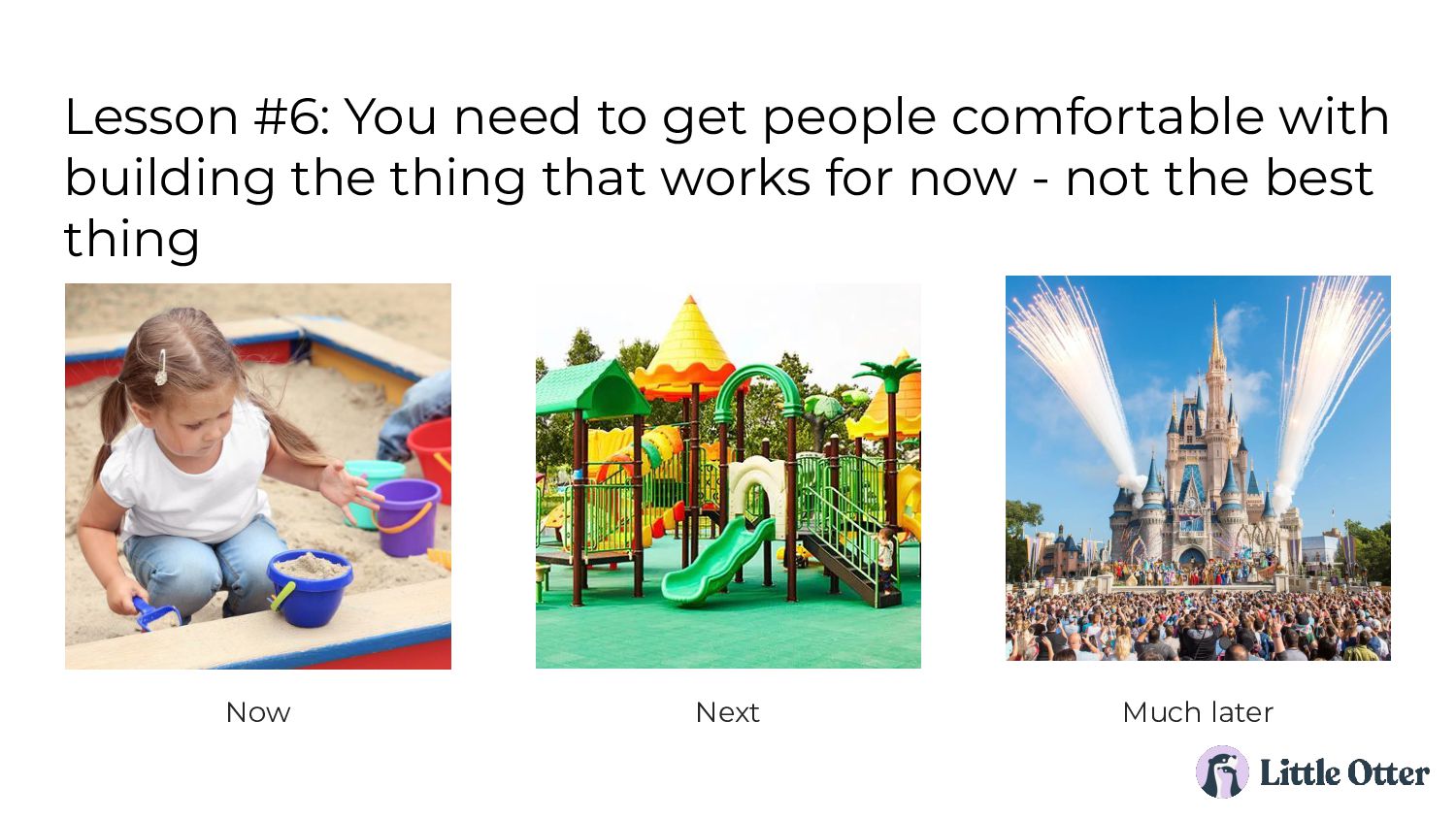
So I'm using a like childhood analogy here, maybe because I am in like the mental health for kids space, but also because like I freaking love Disney World. I think it's awesome, and that's like an entire other talk about like all the cool things that Disney does that we could like take into product.
But I will start by saying like, people always are thinking about the much later stuff, especially people that join early stage companies. Like they join, they're like oh my god, grand vision, grand mission, like I want to do all of this. And you hire these amazing people, we hired incredible engineers.
They want to write really, really high quality code. They're like, yeah, we need to test everything, we need this, we need that. I'm like, I hear you. Awesome. We also need it to be done today. So like, how we make that happen? We hire awesome designers, and they want to build the best experience.
They're like, yes, this is the best thing. This tested the best. This is like grand and beautiful and awesome. Super fair. We also have stakeholders. I mean, people don't go anywhere. Believe me, any stage that you join, they're still there. And as usual, they want everything.
Like stakeholders, they're just like, they're like, yeah, I want these one hundred things, when can you get them to me? And it's normally my job to be like, I hear you, what is like the first thing that you would want? And we can probably do two.
So very much like a common problem. And everyone has like really good reasons. And honestly, it's not their job to necessarily be thinking about the next, it's your job. It's your job to tell them like before we existed, kids were playing on the grass, like on the floor with no tools.
Maybe they found like a butterfly and they were like kind of happy. With us now, we built them like a little sandbox, and they have like little buckets and little things, and they can play and it's nice and exciting. Great. Awesome. Next, we are going to improve this sandbox and we're going to make it into a playground.
There will be like swings and slides, maybe like cute little palm trees, like that's what we're working on now. But ultimately, we want to get to Disney World. Like we all want to build Disney World, but if we try to build Disney World right now, we are going to run out of money.
And I mean we're on a down market. There's no way that we can just like spend all of our resources and build for like a future that's two years out. We need to deliver value now. We need to build something that we can ship next month, maybe this week.
And so keeping that tension of inspiring people and telling them about the grand vision while still getting them really excited about solving a really small, maybe annoying technical problem is where the beauty of the role lies. And I found that you need to like really make this playground seem very exciting for people to be excited about it.
And tell them like, maybe we're gonna build such an awesome playground that there will be spot for it at Disney World. Maybe Disney World's gonna want it, and then I mean, awesome. But if they don't want it, we can rebuild it, and it's totally fine.
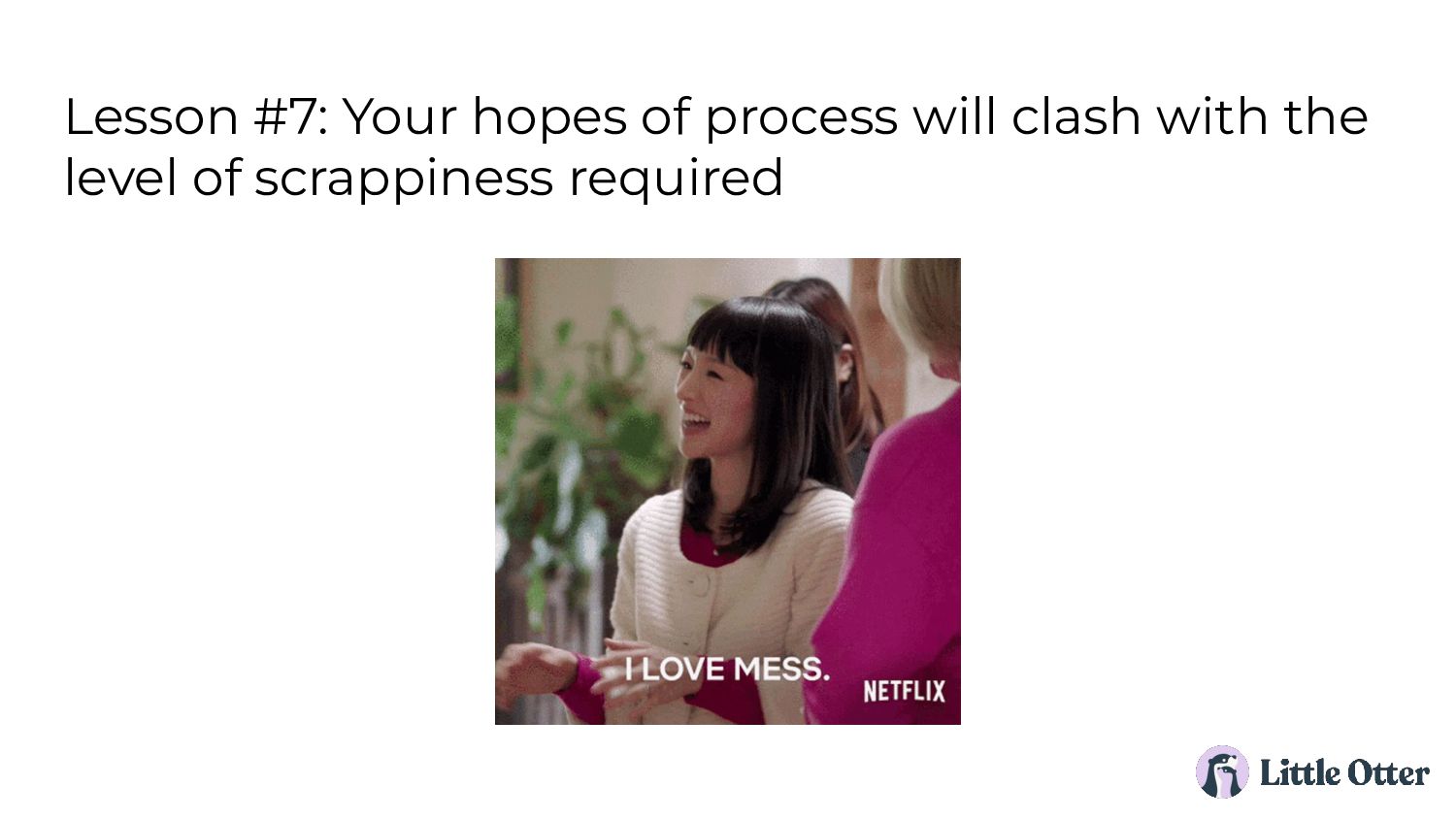
Lesson seven. Your hopes of progress process will clash with the level of scrappiness required. This one is a tough one. I was so excited coming in that I was going to be able to pick the tools, right? All the tools. I was going to be able to pick the process.
I was going to have ownership of it all. I was like, this is going to be amazing. Like my claim to fame at my previous job was that I was called Marie Kondo by my team. Because I would show up, everything would be a mess, and then I'd like, okay great, here's how we streamline this, how we streamline that, this is what we do here, here's how we make this process more efficient.
And I was so excited to do this at my own like place, right? Like this was my opportunity to come in and shine and Mary Conno the world for what we're building. And I showed up. There is no time to do that. There's absolutely no time.
And I will say we do just in time process. Like whatever it takes for us to get the thing over the finish line, for us to feel confident that we're solving the right problem in the right way, and that we're moving probably the metric in the way we want to move it, that's as much process as we do.
And it's a little uncomfortable, I'm not going to lie. Like I used to have a way more streamlined world, but I feel like a lot of the uncomfort is actually what drives some of like the best innovation that we have. And the fact that like things are unclear and that we need to figure them out on the spot as a team and that nothing is more important than getting that thing over the finish line, like that's where the beauty lies.
And I will say in this time that I've been there, it has gotten better. Okay, so like don't worry, you joining an early stage company doesn't mean that you're signing up for like years of like terrible process. Like it's been six months, we've doubled in that time, so a lot of new people, like a lot of like things to involve and improve.
And we even have a like how we work doc now, which is awesome. It has illustrations, it has like all the double diamonds that you can imagine, they're all there. It's like a really, really beautiful thing. But it took us about six months to write it because we had really, really high hopes, really, real pressure, and like real goals that we needed to achieve.
And they all came before process. So I really had to kind of take a step back and think about what actually matters. And what matters is like shipping really good product and actually building the right thing. So we do whatever we need to get there, and everything else will come later, and that's fine.
Lesson eight, this is like the final lesson. That making suboptimal decisions, trying to save money will cost you so much money. I would say whenever you are super early or even when you have like not a ton of resources, I bet a lot of people are empathizing with the situation, everything looks like a fire or everything feels like a super tricky hard situation.
And you need to be able to separate yourself from that feeling of like, oh my god, everything's burning, or oh my god, this is like so tense, so crazy. You need to be able to separate yourself from that feeling and actually evaluate the decision for what it is.
And the way I like to think about decisions is that some decisions are high impact, some decisions are low impact or less impact. And the decisions that are high impact, you need to think about them and you need to spend the right amount of time with your head straight, whatever it takes for you to get there, if that's like coffee, yoga, meditation, like you do it all, and you think about the decision.
I'll give an example. Like when you're thinking about like buying versus building. Really, really big decision. And it could seem so easy for you to just like, oh, I'll just buy this thing, like it's easier to implement, we're gonna get it ready in two weeks.
And then what's the cost of that? First, you're like paying for something, maybe forever. You've like completely changed your data structure so that it fits that thing. It's impossible to scale it. And you might have to completely rebuild it, right? I'm not saying don't do things that don't scale.
What I am trying to say is that you need to spend time evaluating decisions, because ultimately time well spent will save you a lot of money, while rushing to a decision might cost you a lot of money. And it's nuanced and difficult to decide which one to do.
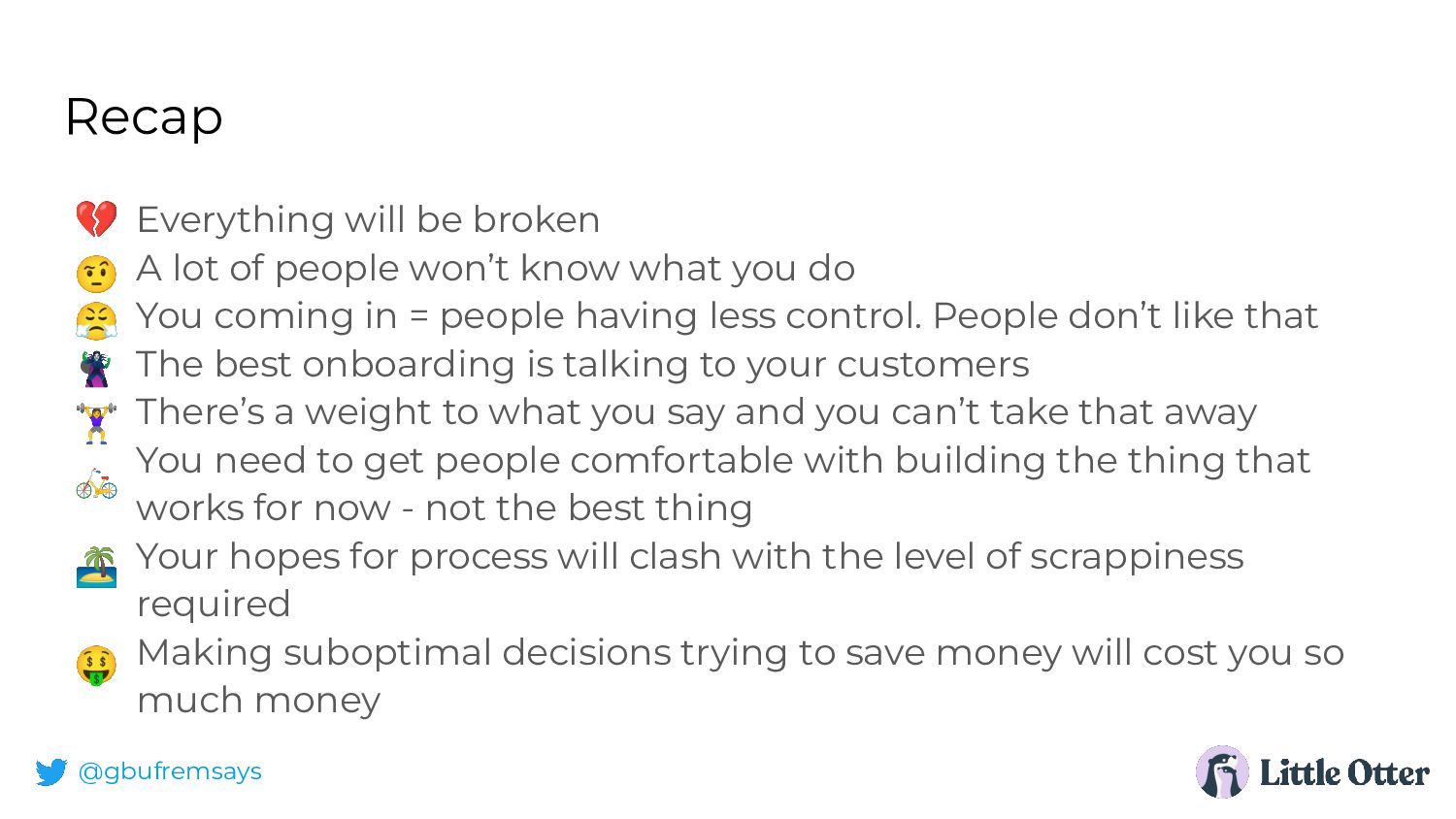
Now I'm going to do a little recap and like tie it all together. I think the first thing, kind of going back to the beginning, and this is like the slide that you take a picture of to say that you came to the talk, right?
Like if your manager is like, hey, did you attend anything? Like you show a slide like this. There's always one in any talk. And it also like ties it all together and they're emojis, it's nice. So first thing, everything will be broken and that's actually fine.
I've met a lot of big companies where everything is also broken. So it's not only people that are at an early stage company that are suffering with this. It's also your job to fix it like, and you should like fixing stuff. I mean building products is really about fixing a lot of things and building new stuff, which is great.
A lot of people won't know what you do. That's normal. It's actually your job to explain to them and to get them to wanna work with You coming in means people having a lot less control. And people don't like that, it's uncomfortable, you also need to get the same people to want to work with you and to just get used to you being there, and to their new role, and figure out a way to like keep them involved.
The best onboarding, always talking to your customers. It does give you superpowers. It's pretty amazing. There's a way to what you say. You can't take that away. It just like comes with a row and it's really difficult. But it's also why product people need to be really good communicators.
And this is just like an additional challenge that you have. You need to get people comfortable with building the thing that works for now, not their dream. And kind of killing the dream sometimes feels really difficult, but just get people excited about the new dream.
Right? Be like, yeah, know a playground is not as exciting as Disney World, but it's really great, and here's why. Your hopes for process are definitely gonna clash with the level of scrappiness that is required for you to succeed and for you to build something.
That's normally the case, but I mean you thought you had it all. You thought you had that ability. So just be okay with like letting go. And also making suboptimal decisions, trying to save money, will probably cost you a lot of money later on.
Thank you so much, would love to stay in touch with anyone, so grab me for a drink or something later.