In this session, we'll explore how you can get started with product-led sales, and why you should. You will learn:
What is product-led sales and how does it fit in with current product & sales motions?
Why product-led sales is important
How you can get started Real examples from Amplitude.
This session is designed for Marketing & Product folks, as well as founders & execs of SaaS companies.
1 / 15 Use ← → to navigate
Auto-generated transcript - may contain errors.
Tap a timestamp to jump the video.
Hello, everyone. It's great to be here. Today, we'll be diving into a topic that I have spent a lot of time over the past two years. We're going to be talking about product led sales. I'll be diving into what product led sales is, why it's important, and what you need to get started with product led sales, and how it all works.
I'll be I'll also be sharing some real life examples from some of the work that we've been doing at Amplitude around product led sales for the past two years. So my goal is to leave you with something tactical and tangible that you can bring back to your business and hopefully get started with as soon as next week.
How does that sound? Whoo. Alright. Before we dive in, a little bit about me. I head up the growth marketing team at Amplitude. My team oversees new user acquisition. We own our website, paid, and organic channels. We have a retention pod that focuses on driving activation and engagement in our product.
And then we have a monetization squad that focuses solely on driving up sell and cross sell all on top of our product, aka product led sales. So I work with PMs, designers, engineers, and sales people every day as most of my work evolves around getting users into our product, make sure they use our product and see value from it, and then ideally, eventually, pay us for it.
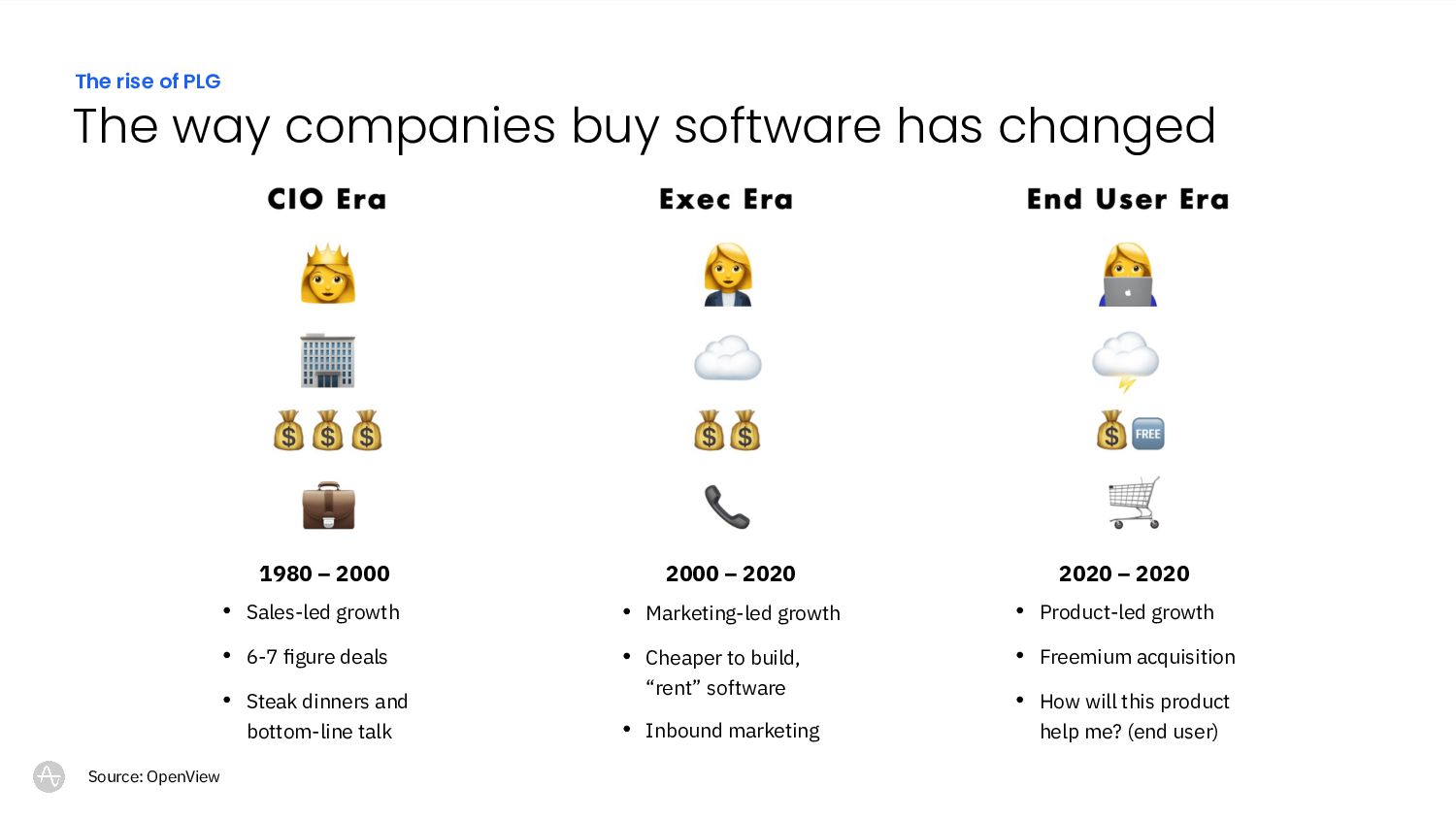
So I wanna set the scene a little bit. Why am I even here talking about product led sales? Well, that's because the the way people buy software has changed dramatically over the years. I'm not gonna pretend that I was around before the year two thousand selling software.
Very young as you all can see. Super super young. But we've all heard the stories. Right? So back in the day, it was purely sales led growth. Steak dinners, convincing c level people to make large upfront investments into a software with huge implementation costs and years for implementation.
That was how business was done and that how that's how software was sold. Fast forward to the two thousands, we saw the rise of inbound marketing pioneered by companies like HubSpot. Software became cheaper to build, cheaper to sell, and it became rentable, aka SaaS.
There was more pressure on marketing teams to drive the demand, and sales was closing the deals. Today, that has changed again. End users wield more power, and end users like us, we wanna try something before we buy it. We wanna experience whether this is a product that's gonna fit our needs.
And if we don't like what we see, we're not gonna stick around, and we're definitely not gonna pay for it. That puts a lot more pressure on your product to do a lot more of the heavy lifting. So what does this mean for how you grow?
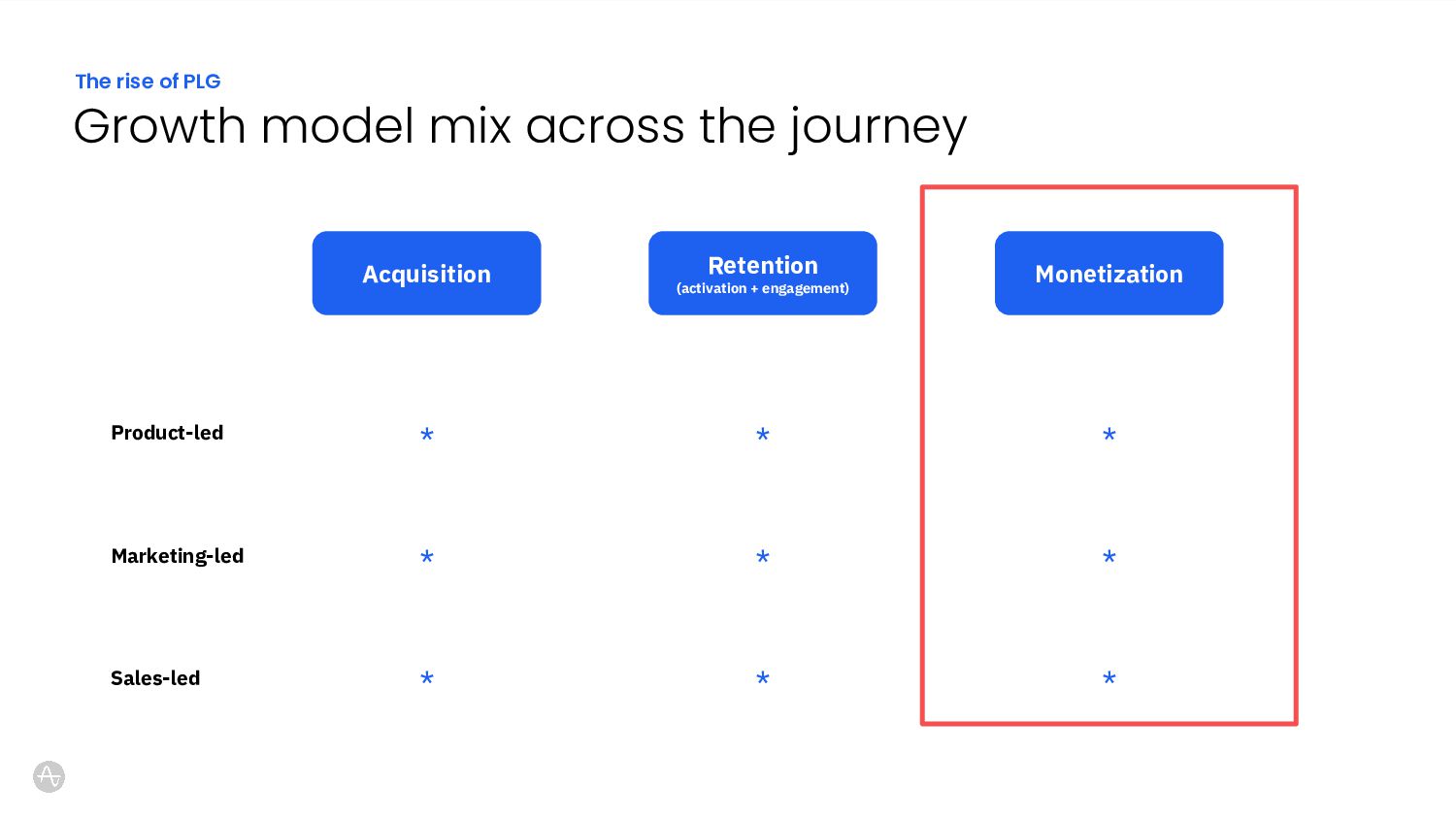
It means that you probably need to employ a mix of product, marketing, and sales led growth. So the right kind of mix of growth models really depends on your product, your user base, your market, the stage of where you're at as a company.
But I think it can be helpful to think about your growth model across the key stages of the customer journey. Let's take two quick examples here. Let's look at Calendly. Everyone knows Calendly, their PLG poster child. They have product led acquisition. Someone signs up for Calendly, start sharing their calendar link around.
Everyone else who gets that link gets to experience the power of Calendly, and some of them will end up signing up. True product led acquisitions, magical and beautiful. They also have product led retention. It's easy to sign up for Calendly, get started, and continuously use the product.
They also have product led monetization. Right? If you reach a paid feature wall or you need more advanced features, you can just swipe your credit card. Now let's look at Amplitude. We rely on marketing teams like mine to drive demand. We have professional services teams that help our users get started and see value from our product.
And then we have big sales teams that do all of the monetization work, both for land and expand. It doesn't mean that Calendly doesn't have marketing teams or sales teams that drive expansion and enterprise pipeline. It doesn't mean that Amplitude isn't investing in the product led journey.
That's because most successful companies employ a mix of models across the customer journey. And what we're going to be talking about today specifically is how you mix those models around monetization specifically, product led sales. And even though the name doesn't include it, marketing should be heavily involved.
So let's start by defining what product led sales is. Product led sales is a monetization tactic that focuses on generating revenue from your existing user base, leveraging product signals. Now let's unpack this a little bit. Existing user base. Now this means that either you have a free trial, a free plan, or you're focused on generating more revenue from your existing paying customer base, aka expansion revenue.
For us at Amplitude, we've been focused heavily on converting our free customer base into a paying customer. That's because we are lucky to have a free plan. And fun fact, only fourteen percent of our customers pay us a day. So that's a huge opportunity for us, right, to convert more of these free customers into paying customers.
The other thing to unpack here is product signals. Now using product signals isn't necessarily new. Customer success teams have been using signals for churn prediction. Even sales have been using signals to drive upselling cross sell. But the wealth of the data we have available to us for analytics purposes today means we have a lot more data that we can gather and arm our salespeople with.
This mean we can share all this data with them in a digestible way so they can have higher quality conversations with their prospects. So why should you bother with part of its sales? Great question. I have data to back me up here, but first, want to just do a quick pulse check.
How many in here know what an MQL is? Really? How many of you in here are gold on MQLs? Yeah. Okay, I feel your pain. MQL in general, not to get bogged down in definitions, is a prospect that has engaged with your events, they've downloaded a white paper, they've gone on your website, they look like your ICP, and they've done some kind of behavior that indicates that maybe they're ready for a sales conversation.
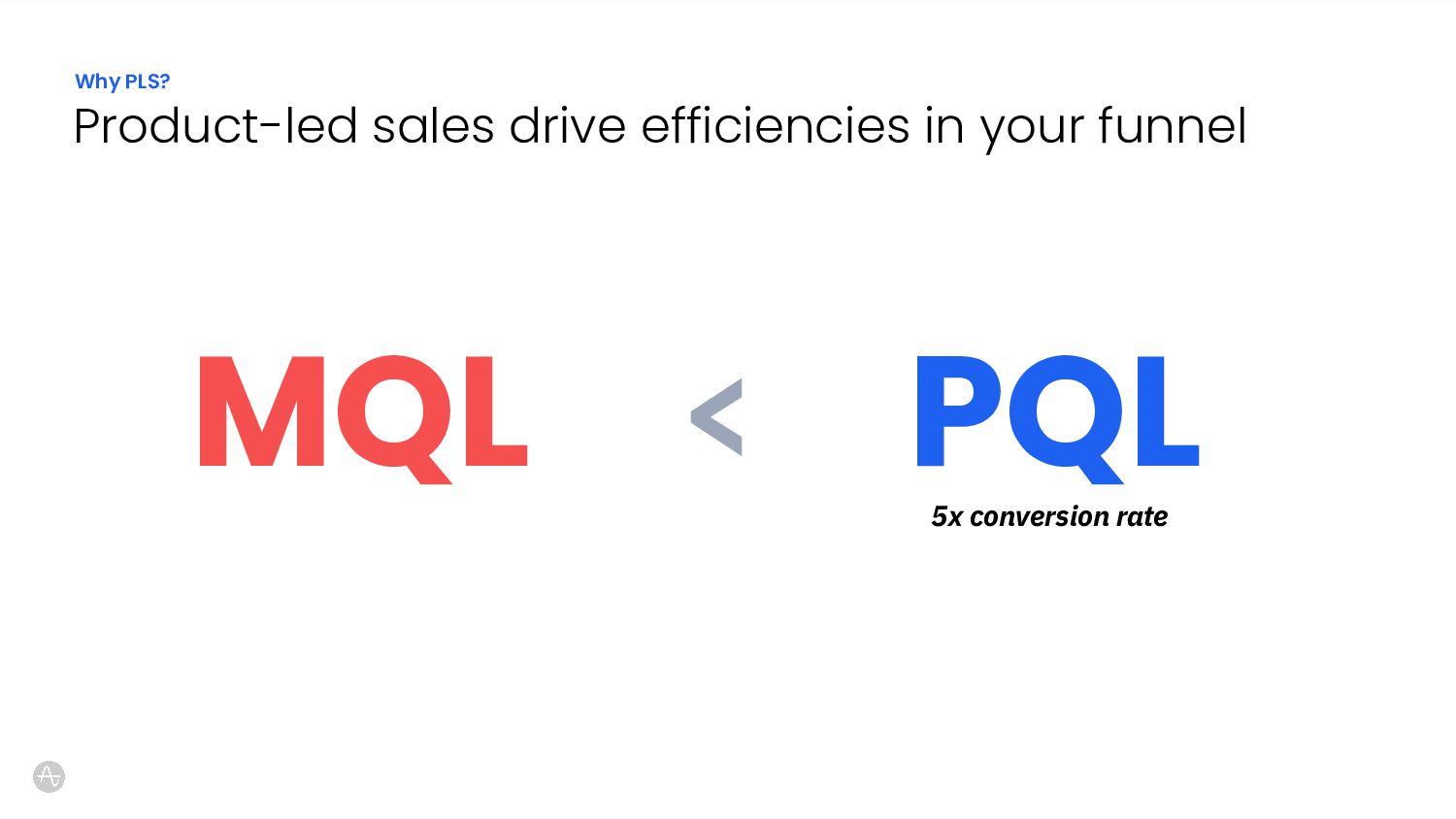
A PQL is a user who has interacted with your product and is showing signs of maybe being ready to talk to sales. Now definitions aside, it doesn't really matter how we define these things. At Amplitude, we don't even have PQLs. We call them product MQLs.
The big difference here is that a PQL has interacted with your product before talking to a salesperson. That's a game changer. Right? They've seen the value of your product firsthand as opposed to downloading a white paper. Now I'm not saying that all MQLs are bad.
Well, maybe a little bit, but don't tell anyone, especially not my boss. But the value of having to seeing the product firsthand is is massive. Right? That's a huge game changer. And for us at Amplitude, when we take users through the product experience, we see an up to five x increase in conversion rate.
Taking users through the product experience alleviates pressure on sales and marketing. There's no more telling how great the product is and wow, so fancy sales *****. They can go and see see it for themselves firsthand, but they have to like what they see.
Shifting pressure from sales and marketing onto product is difficult, and chances are that you're not ready for it. I can't stress enough how important an excellent product experience for the end user is to have any kind of success with product sales. You can't hide behind lofty marketing messages or fancy sales decks anymore.
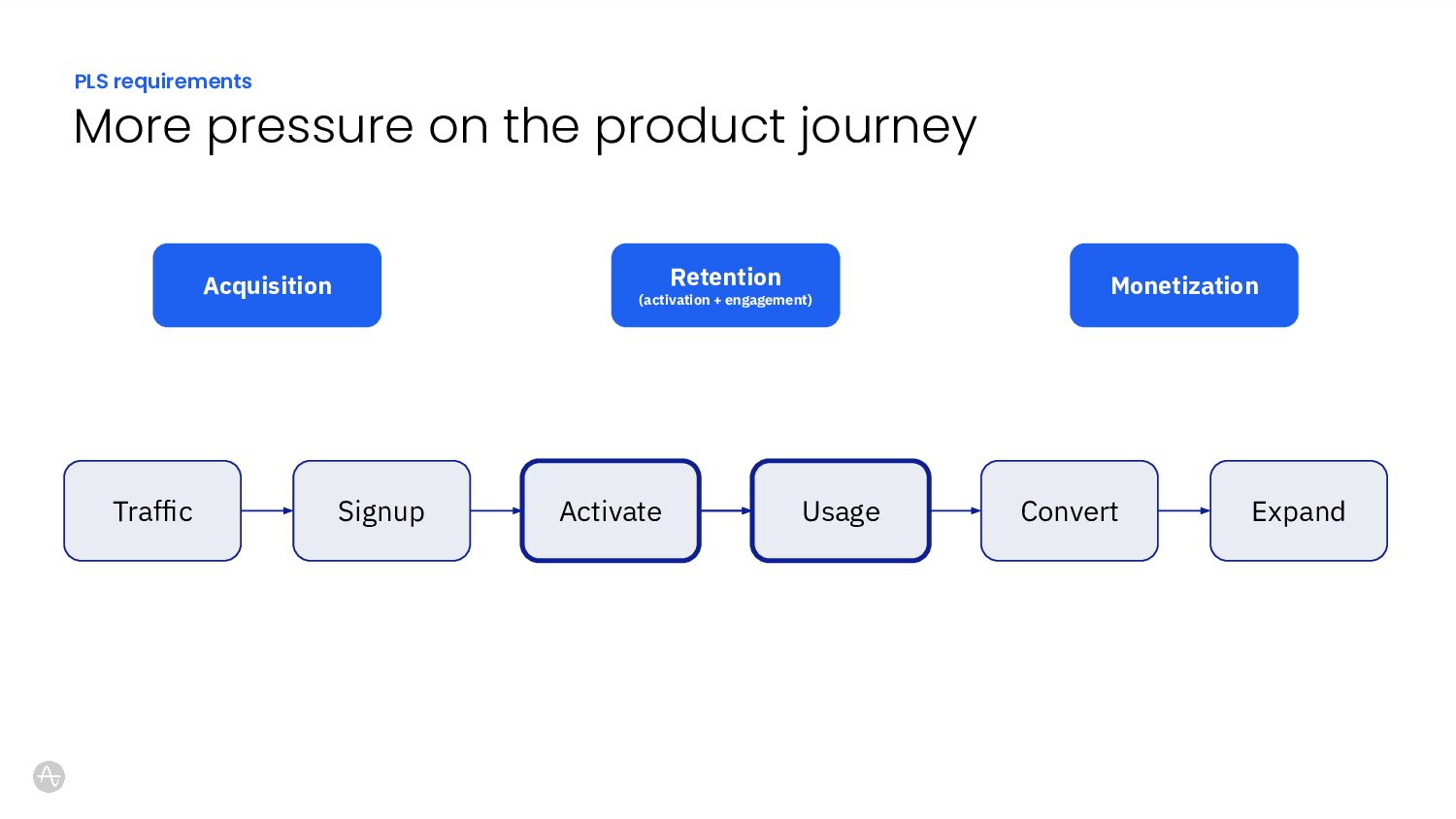
The product is out there for everyone to see see value from, go buy, or move on from. Now, if you have a free trial or a free plan, your customer journey is gonna look something like this now. And product might be responsible for some of these, if not all of these key stages in the customer journey.
Now that means that product needs to focus heavily on driving new users to activate and continuously engage with the product. And if you have self serve monetization, that means the product also has to cover conversion as well. That means product will have to really shift how they're thinking about their road maps and their bets.
Right? Now metrics that matter are things like activation rate and engagement rate. That means that what you're choosing to put on the road map isn't about feature adoption or or something else. It's really about how is that feature gonna help improve our activation rate, or how is that feature gonna help drive users to come back.
Now that's easier said than done. Again, we can take Amplitude as an example here. If you're new to product analytics, it can be super daunting to get started. You need a engineer, you need a tracking plan, you need to connect the data source, and if you're lucky enough to get all your data into Amplitude, now you need to generate insights from it.
Super daunting, super difficult. What are my questions even? That's why we have several product pods at Amplitude that focus only on improving activation and engagement in our product. You also need an improved out of product experience. You need every team to get involved here.
You need up to date documentation. Maybe you even wanna unlock support during activation for common questions and help with troubleshooting to improve activation rate. We have a dedicated pod in my team, and all we focus on is improving activation rate and engagement rate.
We collaborate collaborate closely with our product growth team, and then we build emailing email programs and life cycle programs, one to many onboarding workshops. Anything we can do to help get users to see the value for our product. It's a company wide investment, and it's an investment that makes sense.
Because the more users and accounts we activate, the more of them will eventually monetize. So now is the time where half of you or I don't know what the percentage would be in here, but you will tell me something like this. Francisco, we can't afford to have a free plan.
We're a for profit business. Or maybe you will say that our product is too complex. End users won't get it. Or maybe you have a really stubborn leadership team, and they will never buy into this. Maybe you have all three. First off, I hear you.
I work at Amplitude where we're really lucky to have had a free plan for many years, and it's part of our DNA. We know the value that this brings and our leadership team know that well. So we keep investing in it and we keep protecting it.
But I've also worked in other SaaS companies where we did not have a free plan or even a free trial. And I've seen firsthand how much harder everyone had to work in sales and marketing to convince every new customer to sign up and try the product.
So I'm here to convince you that there's another way. So we can build the business case for a free plan. We already talked about how a free plan unlocks monetization for you. Right? Five x conversion rate to pipeline. I've seen numbers out there that are double that.
Maybe we haven't gone the whole way on the on the efficiencies that we can do at Amplitude. I've seen thirteen thirteen x for for for PLG led companies. So build the business case around how this would potentially unlock monetization for you. And don't forget what it would do to your acquisition efforts as well.
By having a free plan or even a free trial, you completely remove the friction upfront for users. They don't have to think about budget or getting approval. They can just go in, sign up, and see if this is useful for them. Now, I don't have any nice numbers for you to build your business case here, but what you can do pretty easily is to run some painted door tests on your website and see the demand there is in the market for a free plan.
Look at what it does to your conversion rate on your website. Now, I know you don't just introduce a free plan overnight. It's a massive, cross functional, difficult task. So you don't have to start there. You can start with a free trial or even with something like a sandbox where users can go in and in a simulated way see the value of your product experience.
If that's too much of a heavy lift too, try unlocking POCs or or your your your product during POCs and work with your sales teams to make sure that every every other lead in the pipeline gets to experience the product as part of the sales process, and then measure what that does to your conversion rates once the product is introduced.
Now the caveat here is that you really need a great product experience because if your conversion rates go down, it's probably because your product is not ready for this. You can't give me this, Francisco, we're an enterprise company. This is not relevant for us. Again, I have the data.
Eighty five percent of our new enterprise customers at Amplitude have been in our product experiences before they signed on as a customer. This is critical for everyone now. And focus is very different than your TAM. At Amplitude, we also focus on enterprise. That's where we make the most money.
That's our bread and butter. But we still have to target and land the enterprises of tomorrow. And right now, there are nimble startups that either don't want to pay or want to pay us very little. If you're still not convinced by by the data, my experience, or my biased opinions, you can start with expansion use cases with PLS.
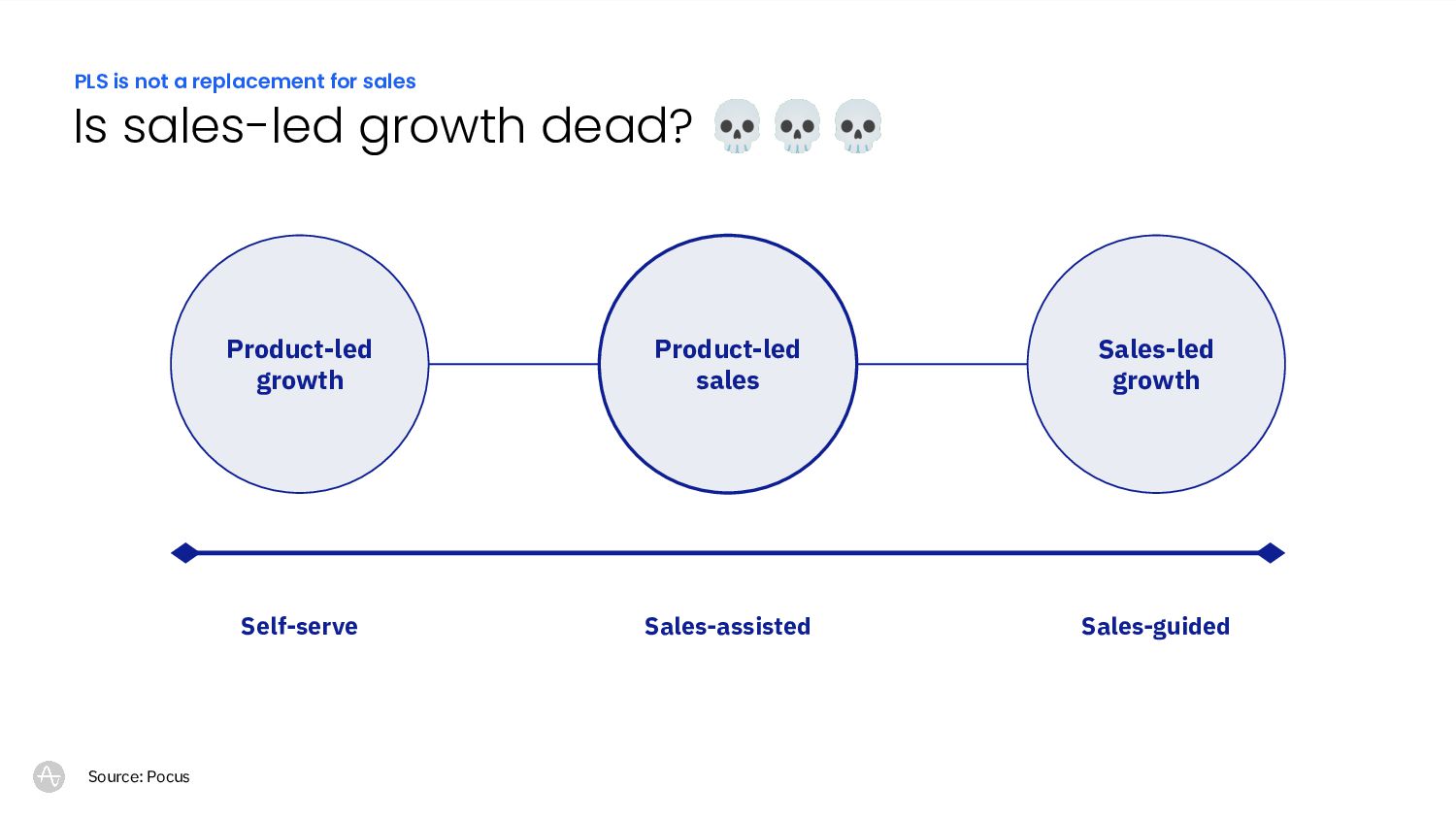
Focus on generating more revenue from your existing customer base and prove value with that before you dive into landing new paying customers. Now, I wanna make something clear because sometimes I give of this vibe that sales led growth instead, product all the way, we're taking over the world, goodbye to sales.
That's not really true. It's very much not the case. Sales is very much alive and kicking and a crucial part of product led sales. Right? We'll be nothing we'll be nothing without the sales team. What's important is that product and sales should coexist alongside each other.
If you invest in product led monetization, you can drive the cost of sales down to zero, and you can offer lower priced plans that wouldn't be possible in a sales led growth world or at least not economical. Right? Allowing the product to be responsible for revenue, sales can focus on driving larger expansion deals and enterprise accounts.
Now this idyllic coexistence on this nice little graph here is very hard to achieve in reality, especially if you're introducing one motion in an existing world where the other is thriving or maybe not even thriving. I could do a whole talk on this slide alone, but I wanna dive into more things today.
So hopefully, Turing Fest will invite me back next year. Who knows? So now we've squared away what product sales is, why it's a powerful growth lever, and how you get started, no excuses. Let's dive into some examples and learnings from Amplitude that we've done over the past two years.
Now, these examples are gonna be around free to paid conversion mostly, but anything that I'm sharing in the next slides will be applicable for expansion use cases as well. So the most powerful play for us so far has been surfacing product signals to our sales team.
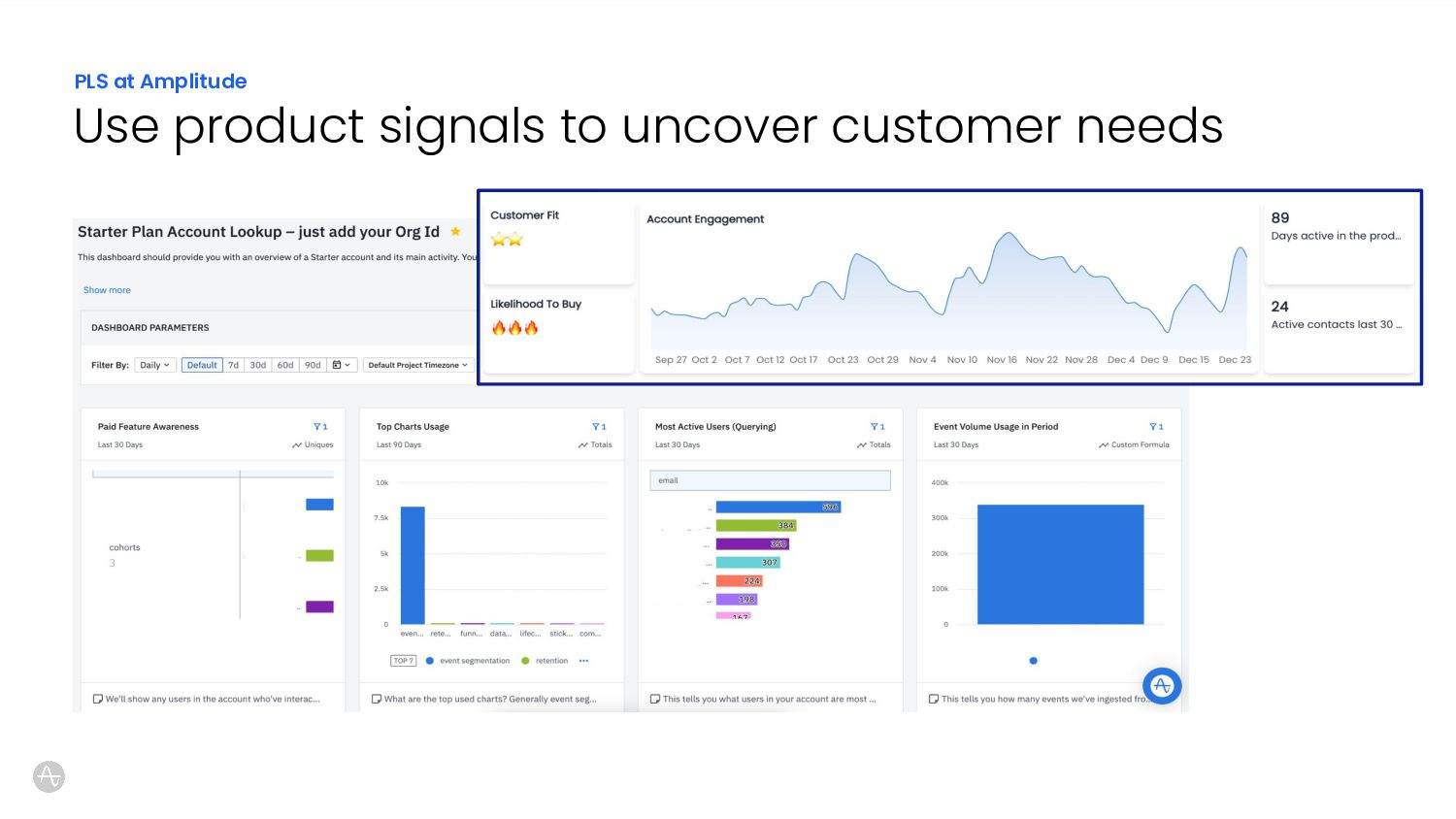
We show them things like who is clicking into paid features or the in product pricing page, who are the power users and what are they doing, what kind of product usage are they having in the product, what kind of features are they using.
And we surface this data in different places for sales to leverage. We have aggregate dashboards inside Salesforce where our sales reps can prioritize their accounts according to all these product signals. We also surface this data directly on the account object in Salesforce, so it's always at the sales rep's fingertips.
And then we build detailed dashboards in Amplitude where an account rep can go in and look up their account and get into the weeds about how this how this customer is using the product today. They can look at who the power users are, what features they're using, what features they're not using.
Maybe they're dormant users. Maybe usage has gone up. Maybe usage has gone down. They get access to all this wealth of data to have higher quality conversations with their prospects. Now to start, what we did was that we worked closely with our product team, we talked to sales a bunch, and we talked to our customers.
We started to try and understand what kind of data would be impactful and helpful in these sales conversations. Once we built v one of all these product signals, we built a solid feedback loop with our sales team where they tell us what signals are working in conversations and what kind of data they need to be the most successful.
And this has been huge for us. Remember, we have a a free product where we have tens and thousands of accounts using our product. There's no way that our sales team can go and reach out to all of them. So being able to prioritize accounts based on usage and not m q l's has been a huge game changer for us.
It's also improved the conversations we have with our prospects. We're not doing big platform demos and showing them all the stuff. We're talking about how they're using the product and what they could be doing better or differently or what features that would apply to their use cases.
Remember, when you do this, don't just show a fancy dashboard to sales and say good luck to you. Okay? It doesn't work. There's lots of enablement needed here. This is a whole new way of selling, and you need to ensure that your sales teams are up for this newer way of selling, that they understand the product signals and can take what they understand of those product signals and drive the right kind of conversations.
It's not easy. Right? It's not a script. It's like going in and looking at the data and then figuring out what makes sense for this account, what makes sense for that account, who is the power user, what does that even mean? This is super critical to the success of product led sales.
Another thing that we have learned is that sometimes surfacing accounts proactively to sales has performed better for us than optimizing for generating hand raises in the product. So we've done a lot of work on building what we call product qualified account score or PQA score.
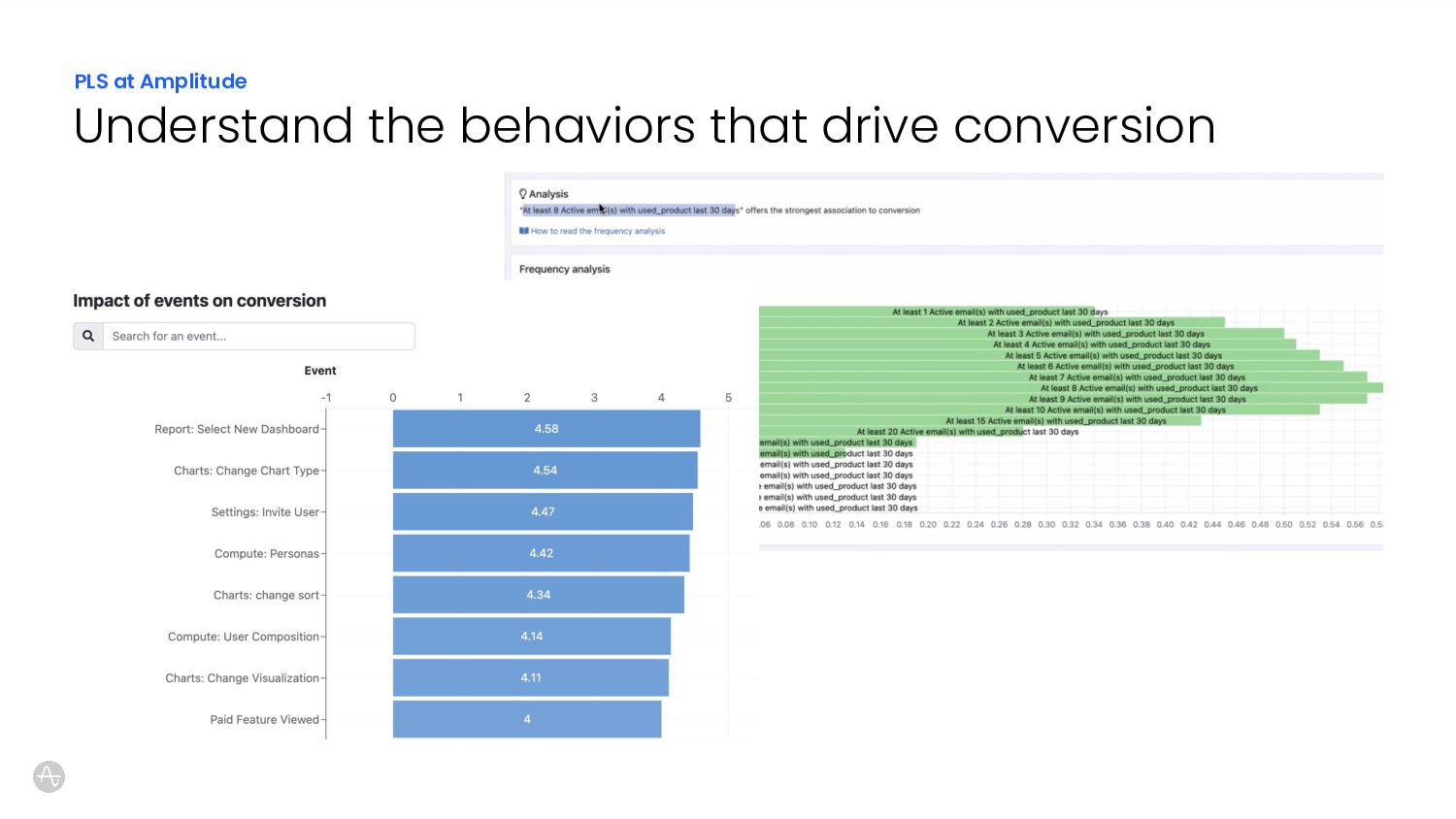
We've had a data science team build a model for us. We've been using tools to identify monetization features and patterns. Most recently, we've actually gone back to basics and looked mostly just at users and kind of usage. What's common for all these ways of of building a PQA score is that you look at your recently closed won accounts, and then you find commonalities in their behavior.
Then you apply those commonalities to your free user base, and then you rank those accounts accordingly. Now I'm saying this because you don't need a fancy data science team to just get started. You can build a simple rule based model using the data that you're already collecting for analytics purposes.
And I hope everyone here is already collecting data for analytics purposes because otherwise we need to have a different conversation. So things we have identified so far for us is that having a critical amount of users in Amplitude means that you're most likely ready for an upgrade conversation.
Doing some more advanced things on our free plan also indicate that you're possibly ready for an upsell conversation. Now, none of this is rocket science. Right? More users, more value, check. Advanced things, advanced features, check. I'm trying to make a point here that you don't need a fancy set data science team.
You don't need fancy tools. You can get started small. Even if you just have an assumption that certain kind of usage might indicate that they're ready to monetize. Pull some of those accounts out, give them to sales, and see how it goes. Get feedback from them, and then improve from there.
Your product team has to be involved too. Because if you have identified, like we have, that having more users in the product makes them more likely to monetize, we need to make it extremely easy to invite users. Right? We need to make that as easy and painful painless as possible.
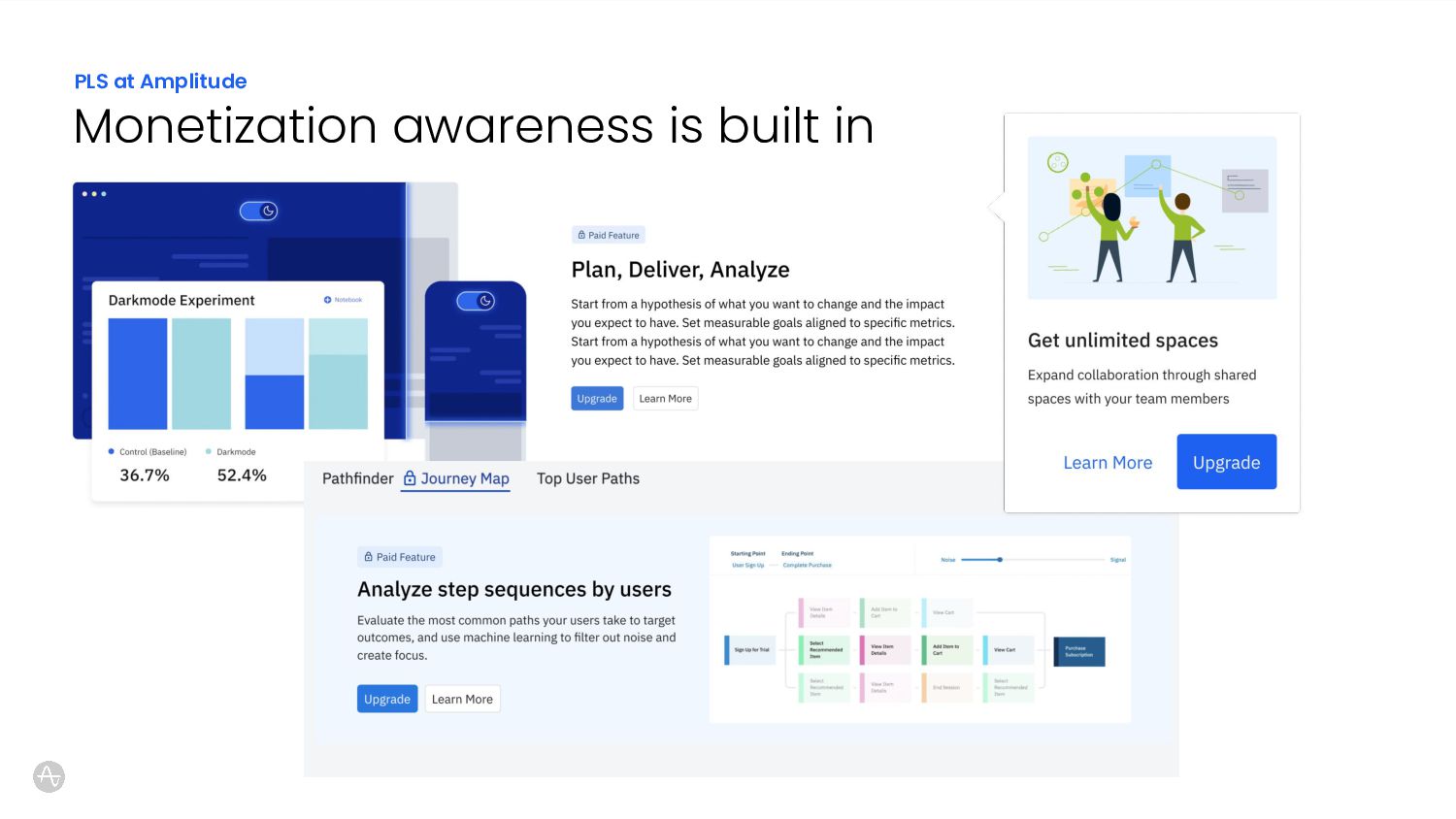
We want to optimize that in the experience, even manufacture that behavior and make sure that users do that in a contextual, meaningful way. And speaking about product, product led sales is nothing without a proper monetization awareness experience in the product. This is around creating monetization awareness, upsell experiences, and trials.
The whole point of product led sales is that the product has to do all the heavy lifting. Maybe not all, but most of the heavy lifting. Path to monetization starts at sign up, and it's critical that we invest in ways to make the product sell.
For us at Amplitude, it means building trial experiences where users can see value of certain features before buying. It means we're building upsell pages and contextually placing more advanced features when it makes sense in the product experience. It also means evolving our pricing and packaging in a way where users can get a taste of some of our features on the free or lower level plans.
But to see the full value of something, they have to upgrade to one of our higher pay plans. Really living and breathing the try before you buy and show value before you capture value. Now, make sure you stay very close to sales through all this.
Don't make the same mistake as we did. When we just got started building a lot more monetization awareness into the product, we were gold on the number of hand raises we could create from the product. We made it so easy to hand raise.
It was a one click experience. Many users were hand raising. They were not they didn't even know what they were doing, but we were improving our numbers quarter over quarter, more hand raisers. Yay. We're doing great. Pat on the shoulder. And then we looked over to sales to see how much pipeline they were they were generating from all these great leads that we were surfacing.
There was no pipeline. That was quite a shock for us. We didn't share accountability through the journey. We optimized for quantity and made it too easy to hand raise. Now we share a pipeline target and we have a close feedback loop with our sales team.
So we optimize for quality, and we make sure that we create the right amount of friction in the product experience to make sure that the people who hand raise are ready to talk to sales and know what they're talking to sales about. So you might have noticed by now that product led sales is highly cross functional.
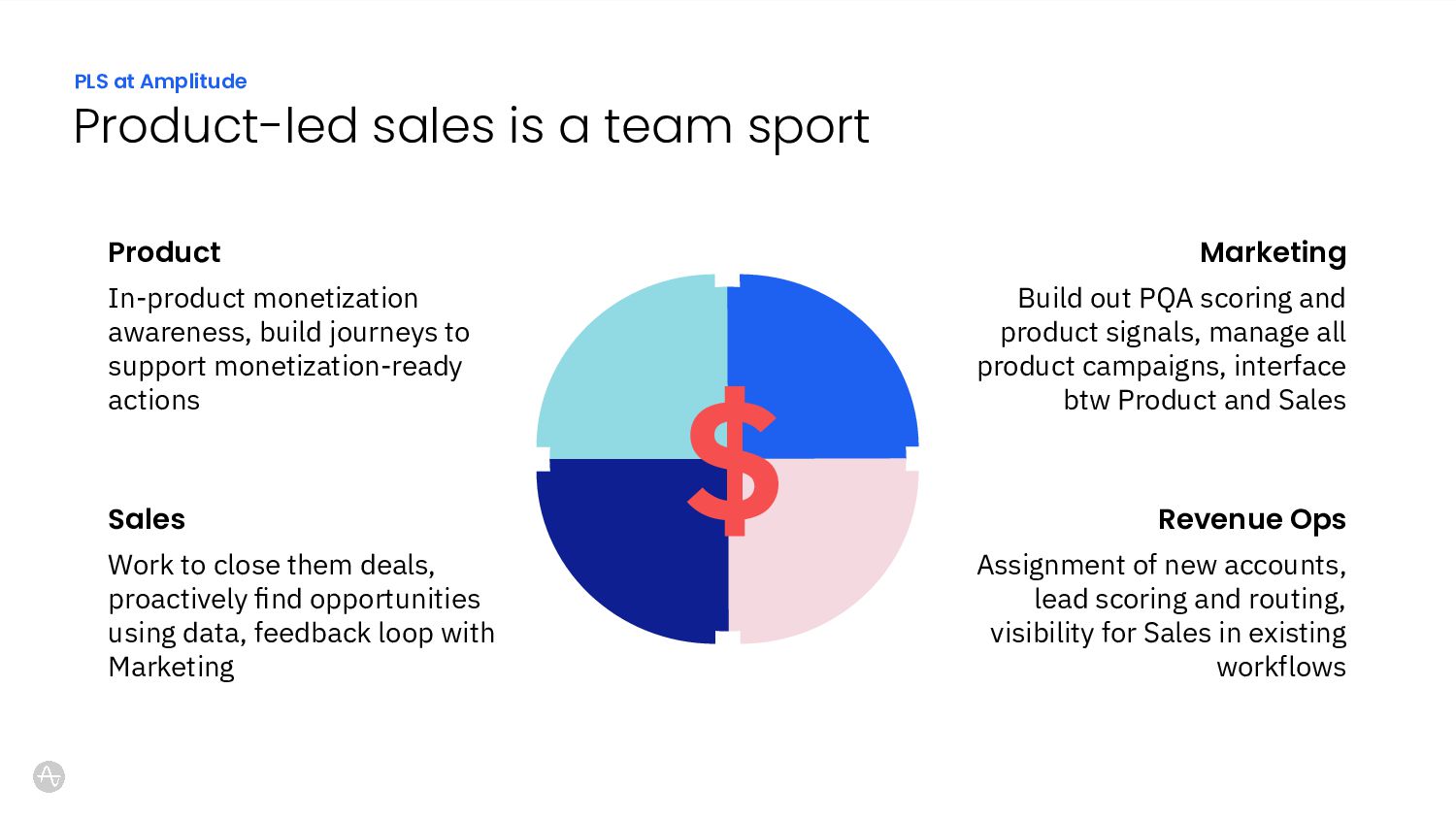
At Amplitude, we collaborate across product, marketing, sales, and revenue ops. We meet regularly to discuss roadmaps, look at how the metrics are doing, share feedback, and make sure that we are all aligned as one team. For us, the product team is obviously responsible for the in product monetization awareness experience.
Marketing and my teams, we're responsible for our PQA score, surfacing the product signals. We own all our product campaigns, and then we work extremely closely with revenue ops to make sure that they're assigning accounts based on the right product signals, and making it easier for sales to get the data they need using their existing workflows and processes.
Because that's extremely important. I don't know if there are any salespeople in here and they will be offended, but it has to be at the salesperson's fingertips. Otherwise, it doesn't exist. And then sales, obviously, they close the close the deals for us. Depending on your org structure, you might want to build a centralized teams a centralized team that own this experience end to end.
For us at Amplitude, this cross functional setup is working really well. We have marketing and my team in the middle kind of interfacing between product and sales. We understand the product, we understand the product experience and what kind of behavior drives monetization, but we also have a deep understanding of the sales process and what makes a good lead.
So this interface makes a lot of sense for us. Now, what makes collaboration for cross functional teams in general and especially for product led sales is that you share the same target. And that target has to be sales pipeline or new ARR. Like the example I just shared about optimizing for quantity.
We don't have shared accountability. We're optimizing for different things. It's critical that you share a pipeline target with your sales teams, with your revenue ops teams, with your product teams. You've got to come together and share the responsibility end to end and share accountability across the customer journey.
Now if being accountable for pipeline is new to your product team, make sure you take them on the journey with you. Product development can sometimes be far removed from the go to market process, which means that it can be kind of daunting to suddenly have a revenue target on your back.
So make sure that you empower them and let them know what kind of help is needed and what a good experience looks like and educate them on the sales process itself. There will be a much better partner for it. Thank you so much. I hope this was helpful.
Whether you're just getting started or you're further along than than we are at Amplitude, I hope there was something tactical or tangible that you can bring back to your business and get started on. And I'd love to discuss it more at my roundtable session later.