
We operate in insanely crowded markets, trying to reach customers who are completely overwhelmed with choices. We’ve tried to break through this noise using better, stronger, faster marketing and sales tactics, but all that gets us is….noisier markets. But there is another way. This talk will teach you the secret to making market forces work for you, not against you. This session will show you how to apply the secret to using strategic positioning to help your products stand out and sell.
← All talks 





Grow Keynote Turing Fest 2023
Positioning to Unlock Growth in Noisy Markets
Auto-generated transcript - may contain errors. Tap a timestamp to jump the video.
Hey, everybody. So great to be here. Today, I'm gonna talk about positioning. Positioning in my opinion is one of the most powerful tools we have at our disposal as start up people, product people, marketing people, but it is also one of the most misunderstood.
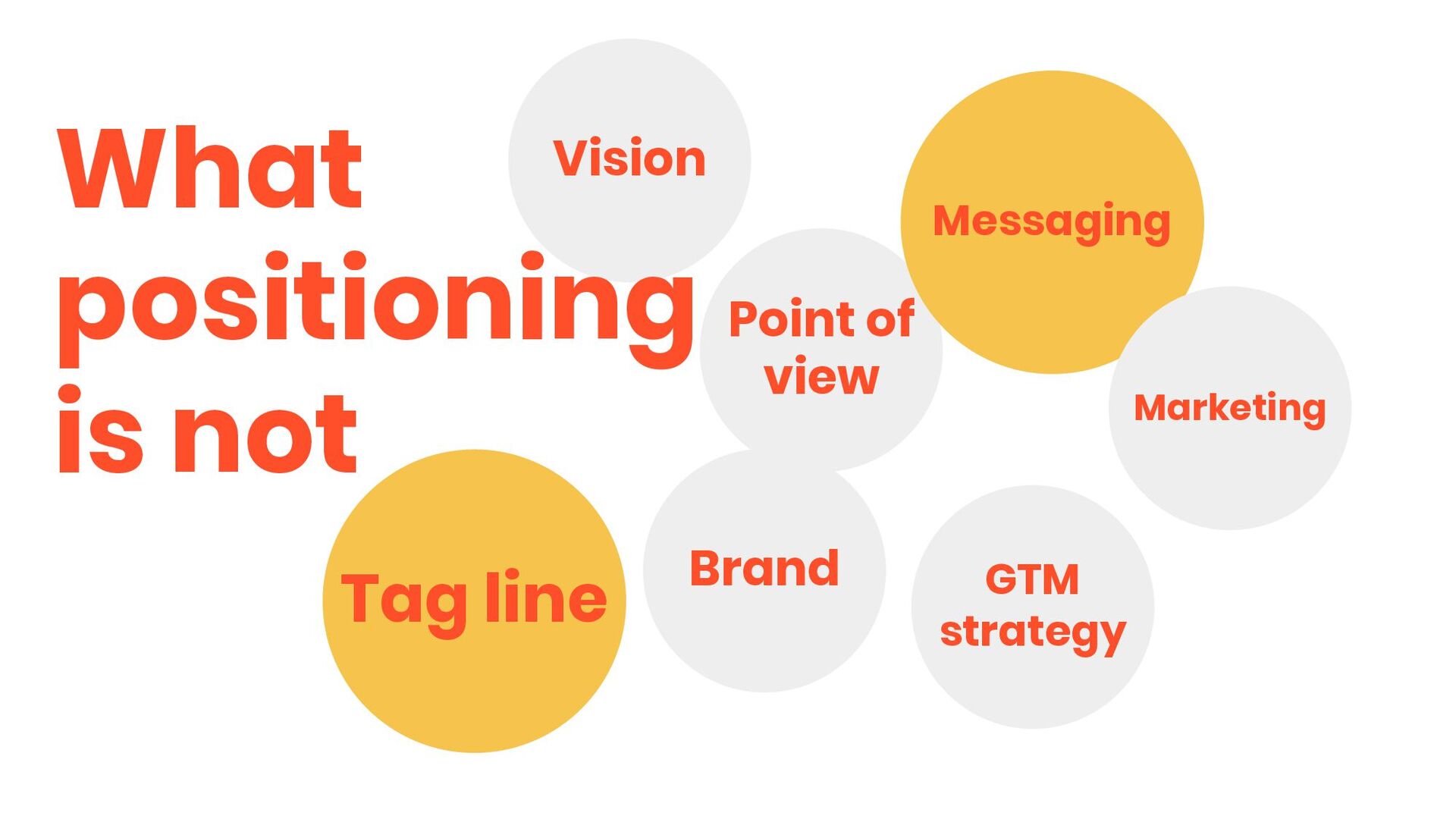
Now, I'm a positioning expert. So the funny thing about being a positioning expert is whenever I talk about positioning, generally I have to start by talking about what positioning is not. So when I tell people, yeah, I do positioning work to say, oh, that's just like messaging.
And I'll say, not exactly or they'll say, know what that is. We're making a tagline. Right? A tagline? No. Actually, it's more than that. My my personal pet peeve is when people talk about brand positioning, which drives me crazy because I think there is branding and there is positioning, and those two things are actually completely separate.
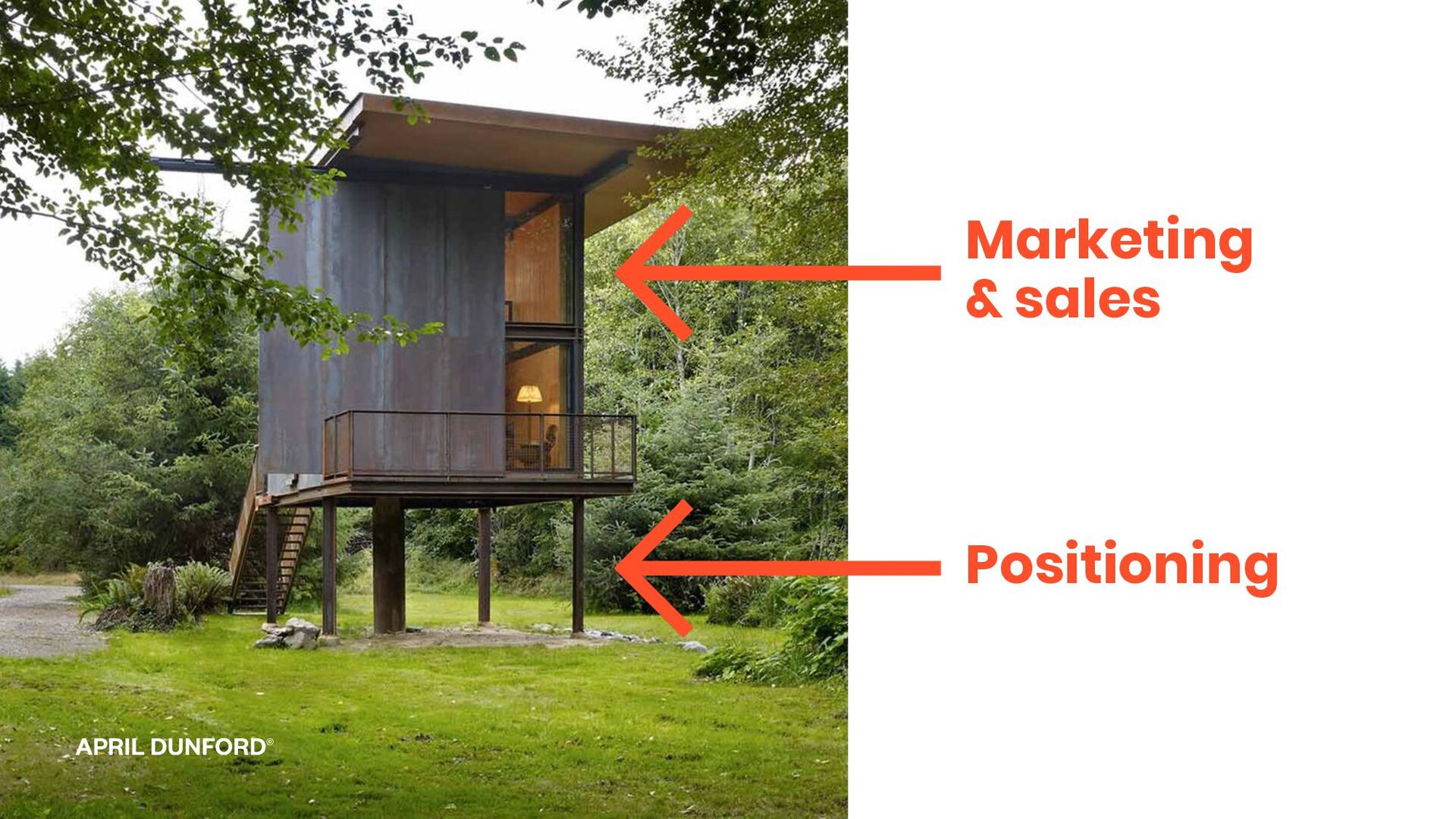
In fact, almost everything you see on this slide is something that we do with positioning once we have it done, but positioning actually has to come first. It works a little bit like this. If everything we do in marketing and sales is the house, positioning is the foundation upon which the house is built.
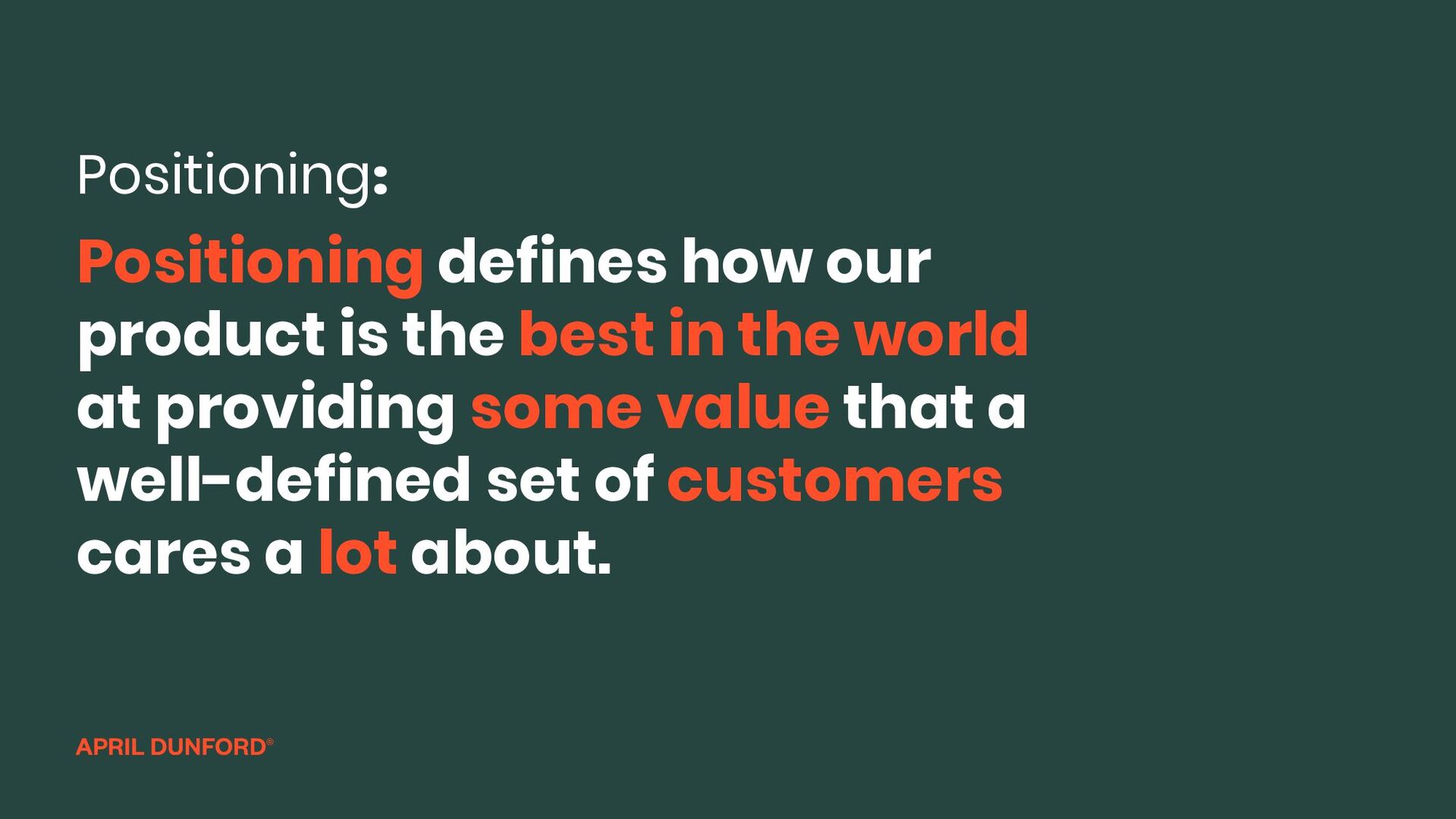
Here's my definition of positioning. Positioning defines how our product is the best in the world at delivering something some value that a well defined set of customers cares a lot about. Now, that's a mouthful and I don't like I invented that definition, but and so admittedly, it's not great.
But think about it this way. It's a little bit like context setting for products. Context is really important because that's how we make sense of the world, particularly new things or things that we've never encountered before. I'm gonna give you a stupid example that has nothing to do with tech, but then I'm gonna give you a tech example.
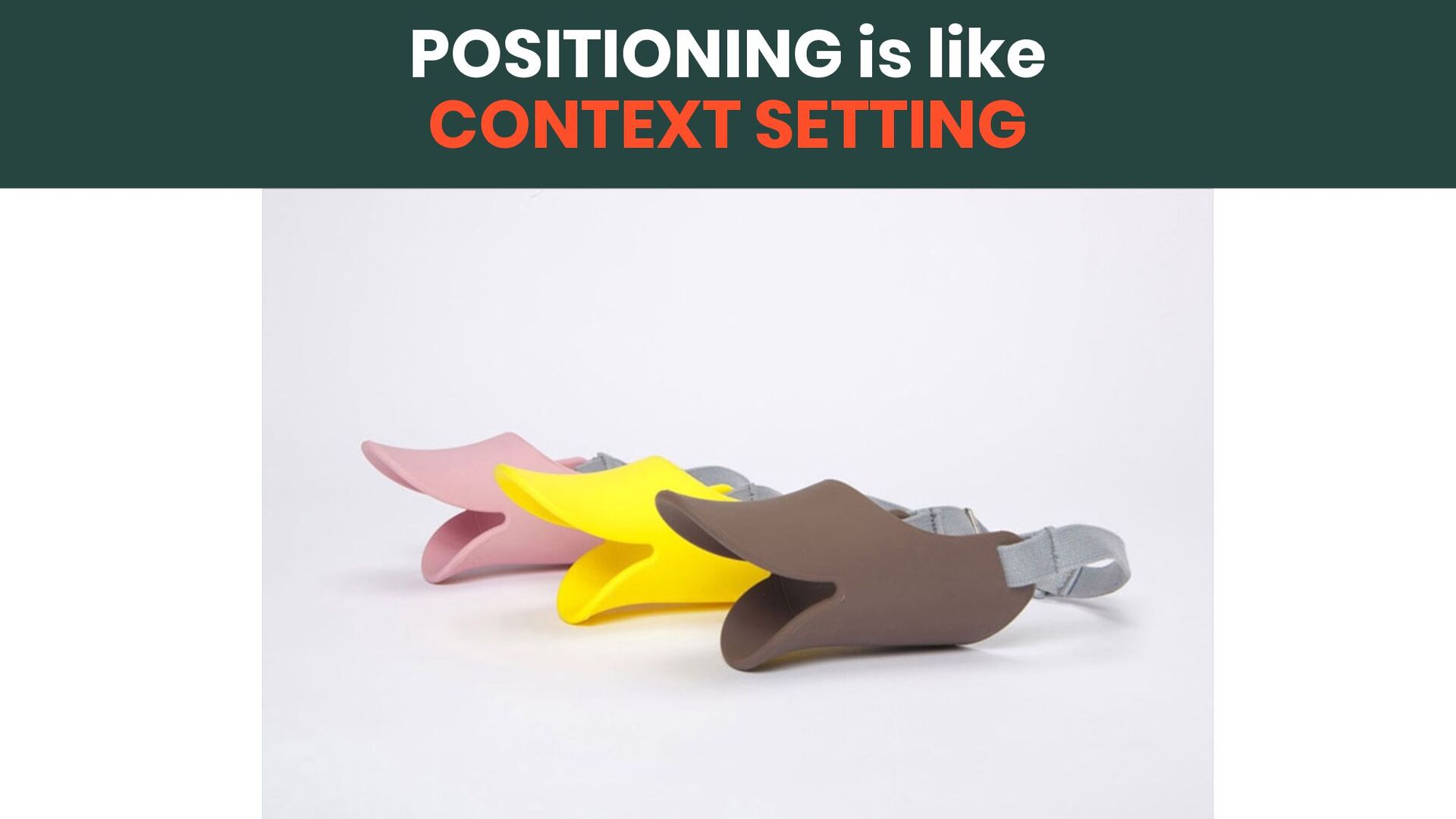
So, you know, bear with me on this one. So Here's an example of a product that I encountered once completely out of context surfing around on the internet. And so I encountered this product and that you know what I thought this product was?
I thought it was a shoe. Yeah. Like, you know, crocs, they specialize in super ugly footwear. Well, like, the geniuses at crocs, were sitting around the table and said, how do we make this thing even more ugly? Oh, I know. We'll cut open the toe, and then we'll put this thing on the and then we'll end up with this super, super ugly shoe.
I took a screenshot of it, sent it to my friend. Look at these hideous things. Then I saw the product in context And then it became obvious what the product actually is and what it's good for. What it is is the dog muzzle, and what it's good for is embarrassing your dog in public.
Now, even a hint of context can actually change the way we think about products. So I show you this, and then I show you this other thing, and you'll be thinking, oh, I'm on to her now. She's into the dog stuff. And so you probably think, oh, this is one of those things that you know, your dog goes to the vet or whatever.
It comes out with the cone on. And you would be totally wrong. This is actually a cone for people going to the noodle house, and it's for keeping the noodle drips off your hair, something. I don't know what this thing is, to be honest with you, but the genius marketing people, they they they put some things in here for context so that you could figure out what this is really for.
So they they put that guy in there. And so You know what this thing is for? It's it's for making people fall in love with you. It doesn't work. It doesn't work. The marketers lie. Sometimes they lie. The point is a shift in positioning can completely change the way we think about a product.
Now as marketers, we don't have the same set of tools at our disposal as the other things, but one of the big ways that we can set context for a product is through the use of market categories. And that's really important because the markets that we operate in are intensely crowded.
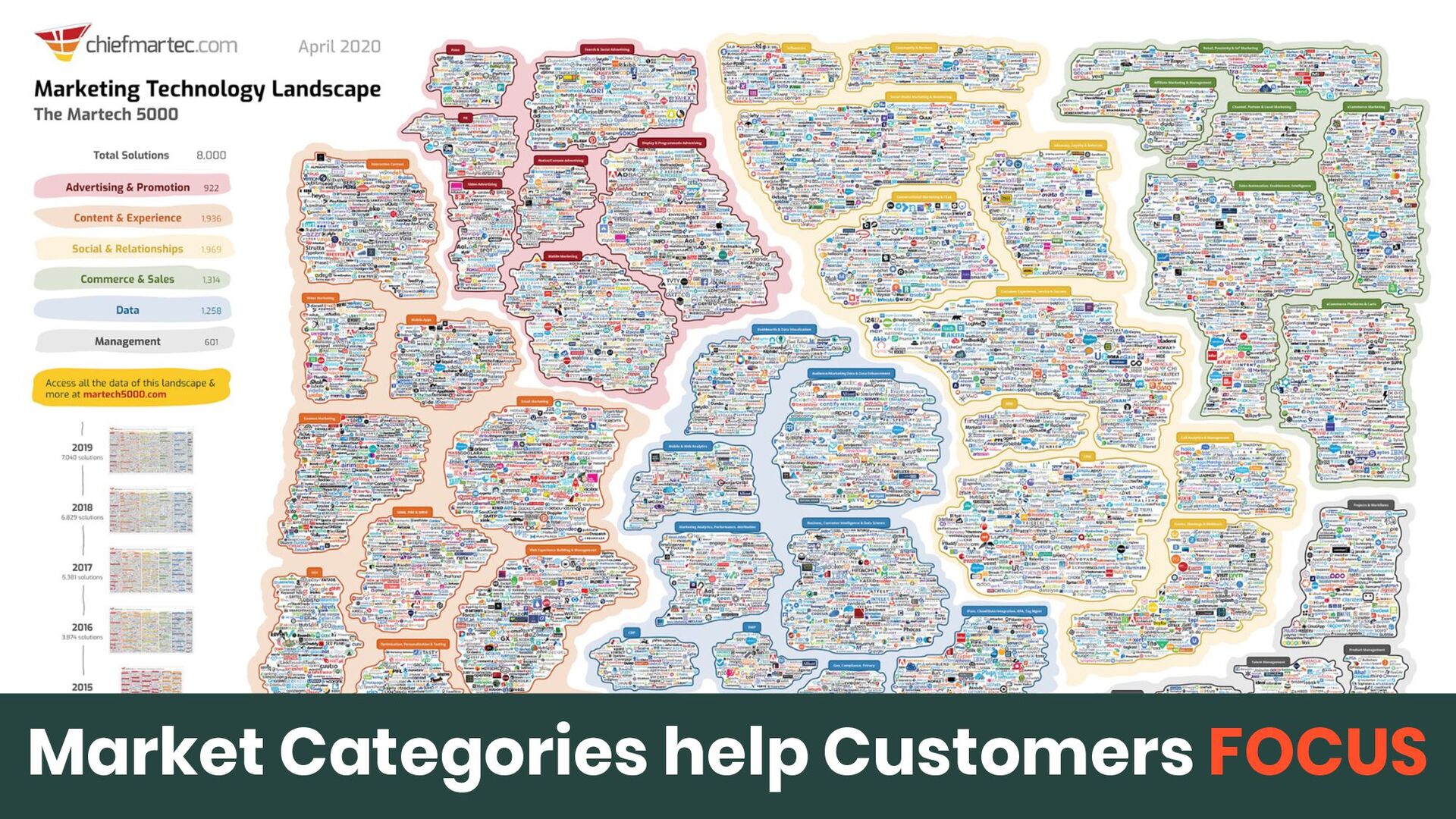
How crowded you might ask? Well, I like to use this slide as just to strike fear into your hearts of how crowded the market is. So There's a guy that puts this chart out every year. If you can imagine, like, all the software in all the land, to do all the things this guy produced a chart every year called the Marketing Technology Landscape.
This is just the software to do marketing things. And look at this thing. It's terrifying. There's eight thousand companies on there. If you were a vice president of marketing and you were trying to buy some MarTech, How would you ever figure out what you have to pay attention to and what you don't?
Well, one of the ways you do that is through market categories. So you can see that the guy that builds this chart, he's actually split this landscape into categories. He's got macro categories, which are the colors, so you know, red is sales and orange is content.
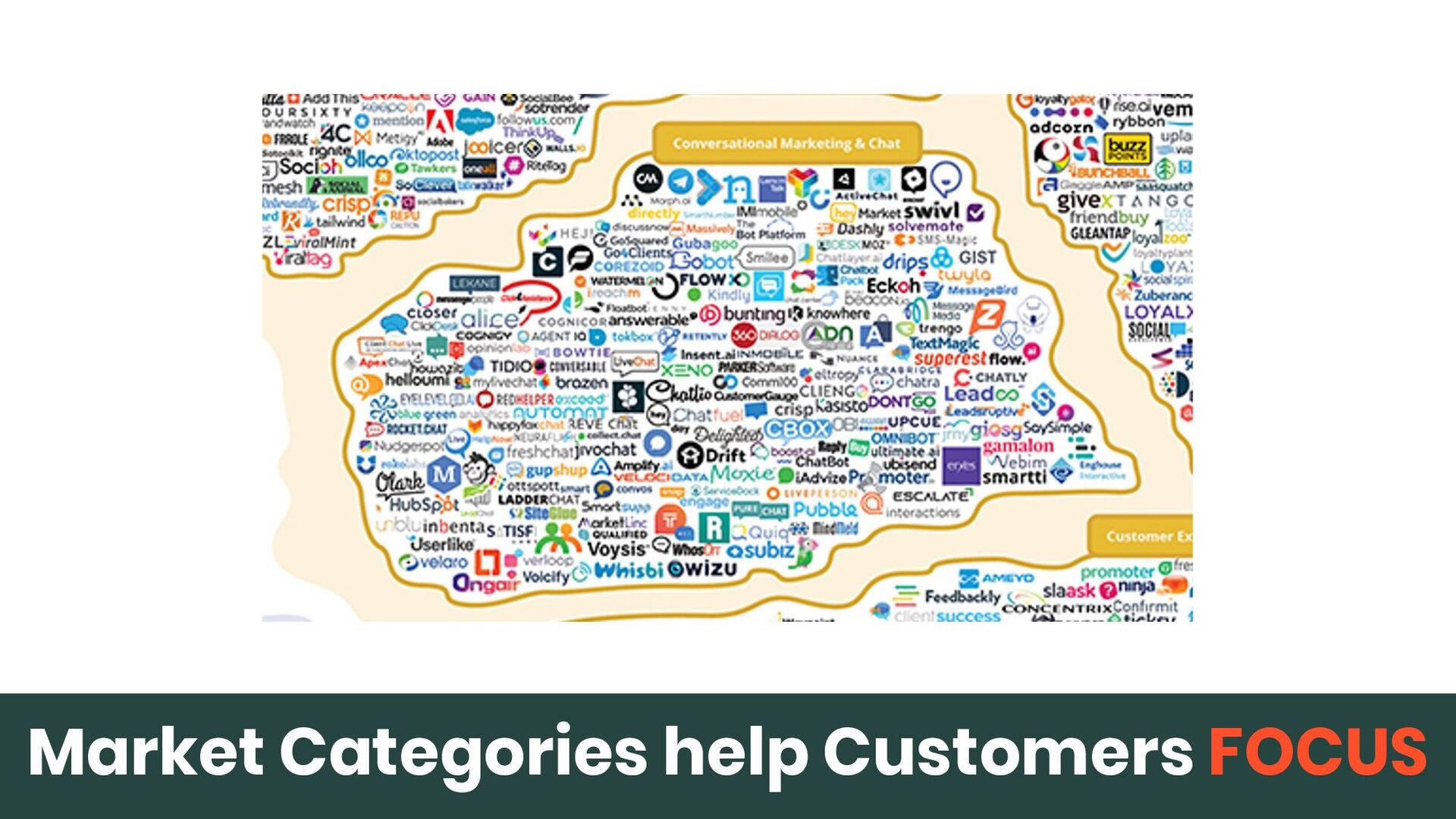
And then each one of those individual islands is a micro category inside that. So let's say you're a vice president of marketing and you're you're thinking about putting live chat on your website. So you're like, okay, live chat. That sounds a little bit like social, which is the yellow.
And if I squint my eyes in there, oh, sure enough, there's a little bubble in there. And that's called conversational marketing and bots. That that's good. So the good thing about this is now I don't have to pay attention to all eight thousand things anymore.
I just have to pay attention to, well, you know, to be honest, it still really sucks. There's way too many products on there, but at least it's not eight thousand. But that's not all positioning your product in a certain market does. It doesn't just narrow down the competition.
What it does is it actually sets off a very powerful set of assumptions in the minds of customers about what your product is all about. So it works a little bit like this. Like, have you guys ever seen, a pitch contest? Do you know there's that show?
Oh, it dragons den or, what do you call it? Shark Tank? I'm not sure what they call it here. But, you know, the people go in with a new product and they pitch it to the investors. Well, let's say we're doing like the weirdo version of that, but it's the version of that where we go in, but we're only allowed to pitch the market category, and that's it.
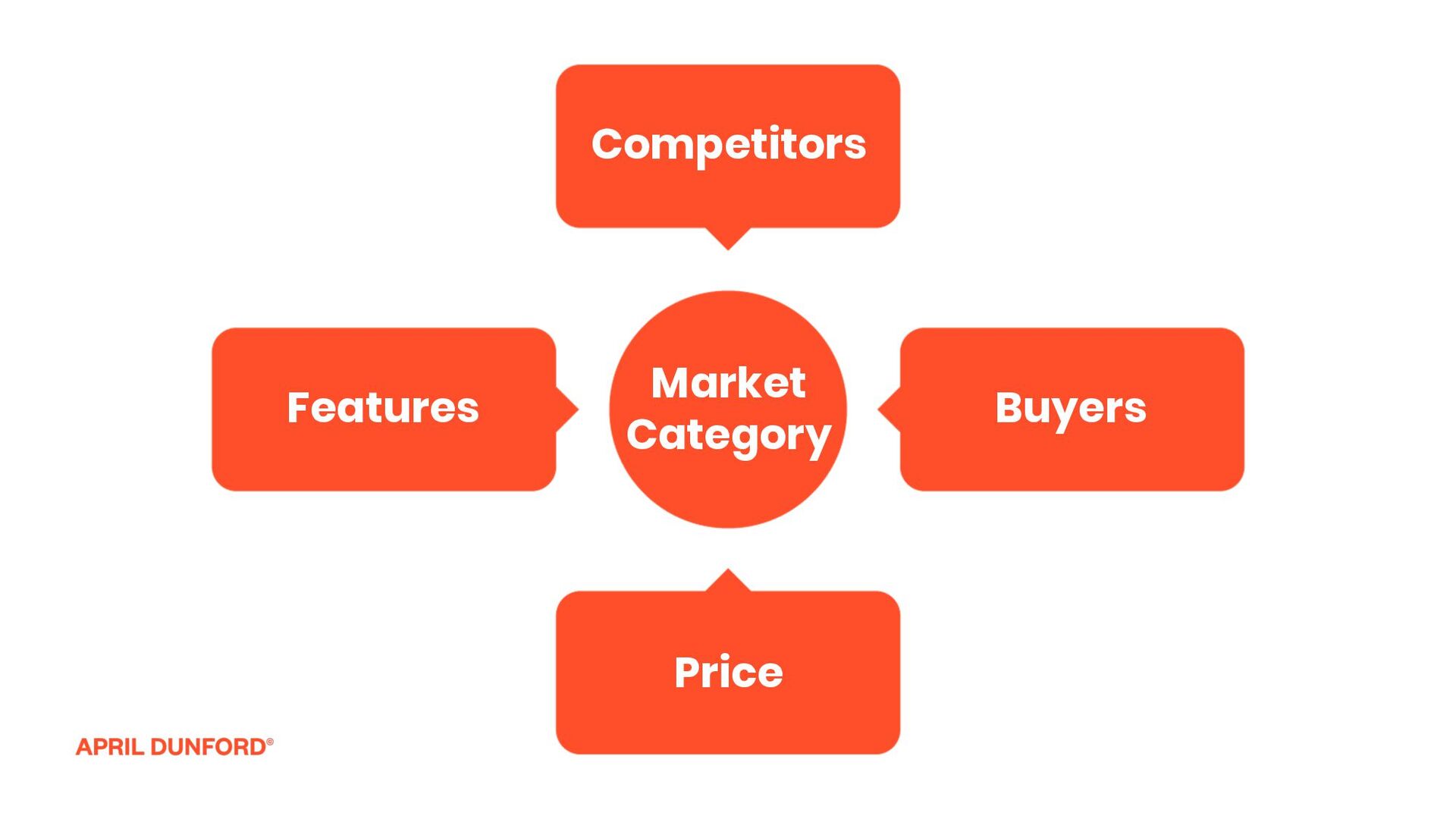
Okay? So I walk in and I say, Hey, investors. I'm here to pitch you my revolutionary next generation, never been seen before. Absolutely fantastic new CRM, customer relationship management. And that's it. That's that's all you get. You don't get anything else. Who's my competition?
Yeah. That's right. Salesforce. They're they're the leaders in that market. You would just assume I'm CRM, their CRM that obviously we compete with them. And could you name me three, four different features that you would expect this product to have. Yeah. Track tracking deals through a funnel, tracking account CRM stuff.
What is the title of the person that I sell my CRM to? I would just assume that's to the vice president of sales, head of sales. That's who buys a CRM. Here's where it gets crazy. How much does my CRM cost? Now how would you know that? How would you know my pricing?
Well, I didn't tell you anything about this product. But if I say it to CRM, you assume that I compete with Salesforce because they're the leader in that market, then you would assume I'm not charging more than them. Am I? So just by positioning myself in a market category, I have established an upper bound for pricing.
So here's the way this works. If I do a good job and I position my product in a market category that sets off a chain of assumptions in the minds of customers. And those assumptions are correct. Fantastic. Fantastic. I just say marketing and sales, a whole lot of effort.
Don't have to tell you who my competitors are. It's assumed. I don't have to list every single feature that my product has. Half of that stuff is table stakes for the category. Unfortunately, it works the exact same way if I do a bad job of it.
So if I position my product, in a market category that sets off a set of assumptions about my product that are not true. Now, marketing and sales has their work cut out for them on doing the damage that you're positioning has already done.
Let me give you an example. So, few years back, I get a call from Old boss of mine, who is now a v c in Silicon Valley, And he calls me, and he says, April, I, I just invested in this company, and I love them.
Part of the reason I invested is customers love them. I talk to their customers, but they have this problem. Like, in their marketing material and in their first sales call, Nobody can quite figure out what this thing is. So I think maybe this is a positioning problem.
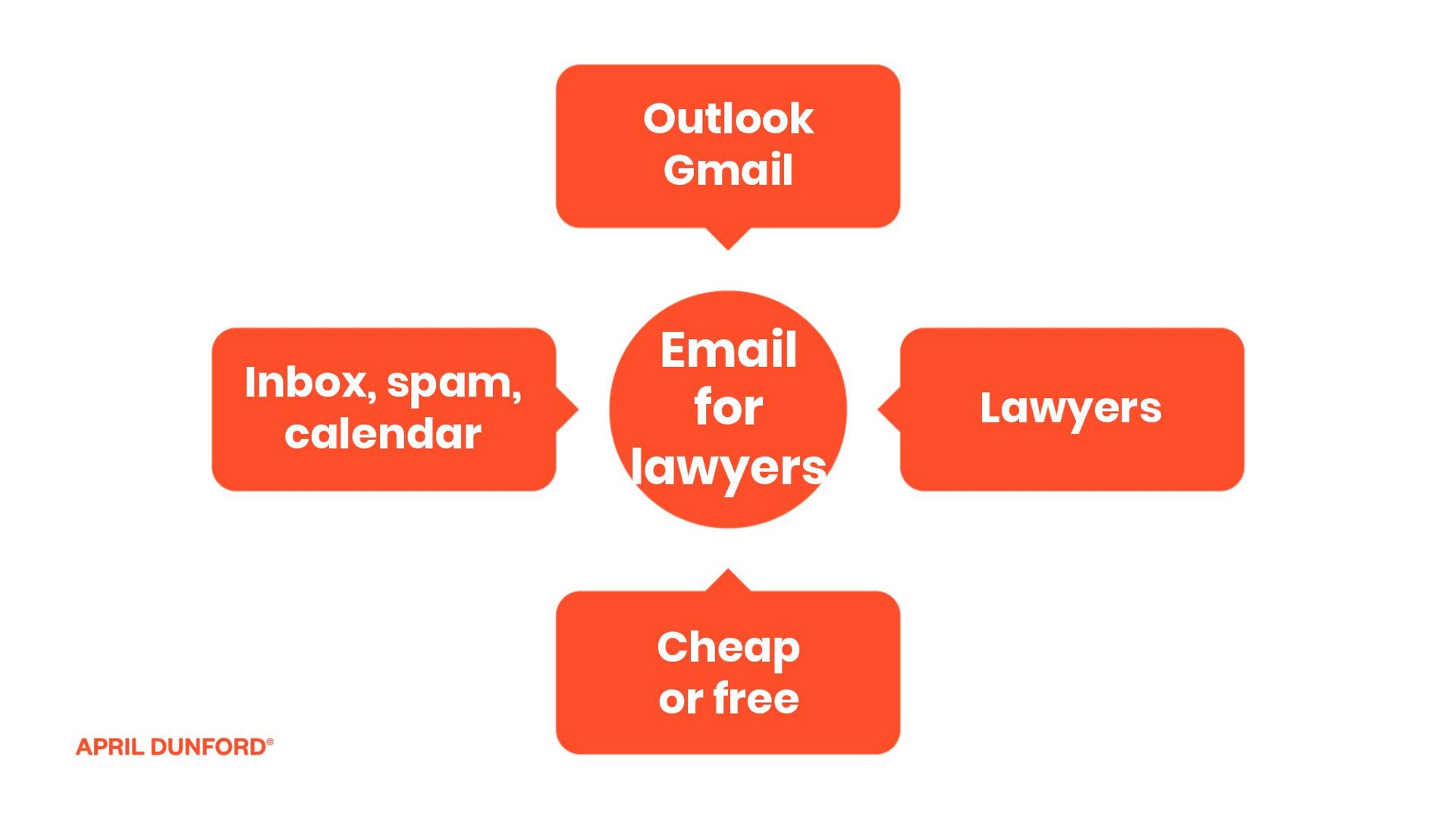
Can you help them? I said, let's get them on the phone. So I get on the phone, the the the the founding team shows up. And I said, so what's your story? And they said, well, we're lawyers, ex lawyers, and we decided to build this product for lawyers, and it it's email for lawyers.
And I was like, email for lawyers. Who knew the lawyers needed their own email? But, okay, guys, you know, I don't know any I'm not a lawyer. Thank God. Anyway, so email for lawyers. Got it. So then they jump into the demo, and they're going through the demo.
In the demo, there's the lawyers, and there's their clients, and they're collaborating on stuff, and there's a thing kind of looks like an inbox. And I'm like, Hey, this looks really cool. So I said, so tell me something. How does the calendar work on your email for lawyers?
And the CEO says, oh, you don't have a calendar. And I'm like, but wait. How do you replace Gmail if you don't have a calendar. And he says, we don't actually compete with Gmail. We don't compete with them at all. And I'm like, wait.
So you're telling me the lawyers are gonna have two emails. Now, like, how does that work? So at this point, I'm super confused. And I'm like, back up, back up. Your investor told me that customers love this thing. So what is it that customers love so much about these things?
Oh, actually. We have this feature at school. We got a patent on it. And what it does is you got the lawyers and you have their clients and they need to collaborate on documents. But those documents are, you know, confidential, so not everybody should have access to them.
So what this thing does is it figures out who should have access to these documents, puts them in a super secure place, and it automatically only gives access to the documents, those are people that are supposed to have the documents. Like, that actually sounds super cool.
I could see why the lawyers are pretty excited about that. But you know what else? You know what that thing isn't? He's not email, man. Like, if I needed to solve this problem, would I go out by email to do it? Absolutely not.
So what I have is an amazing product, an amazing product with amazing technology that customers love masquerading as kinda crappy email. It doesn't even have a calendar. So what if What if I took that product? And I'm not even gonna touch the product.
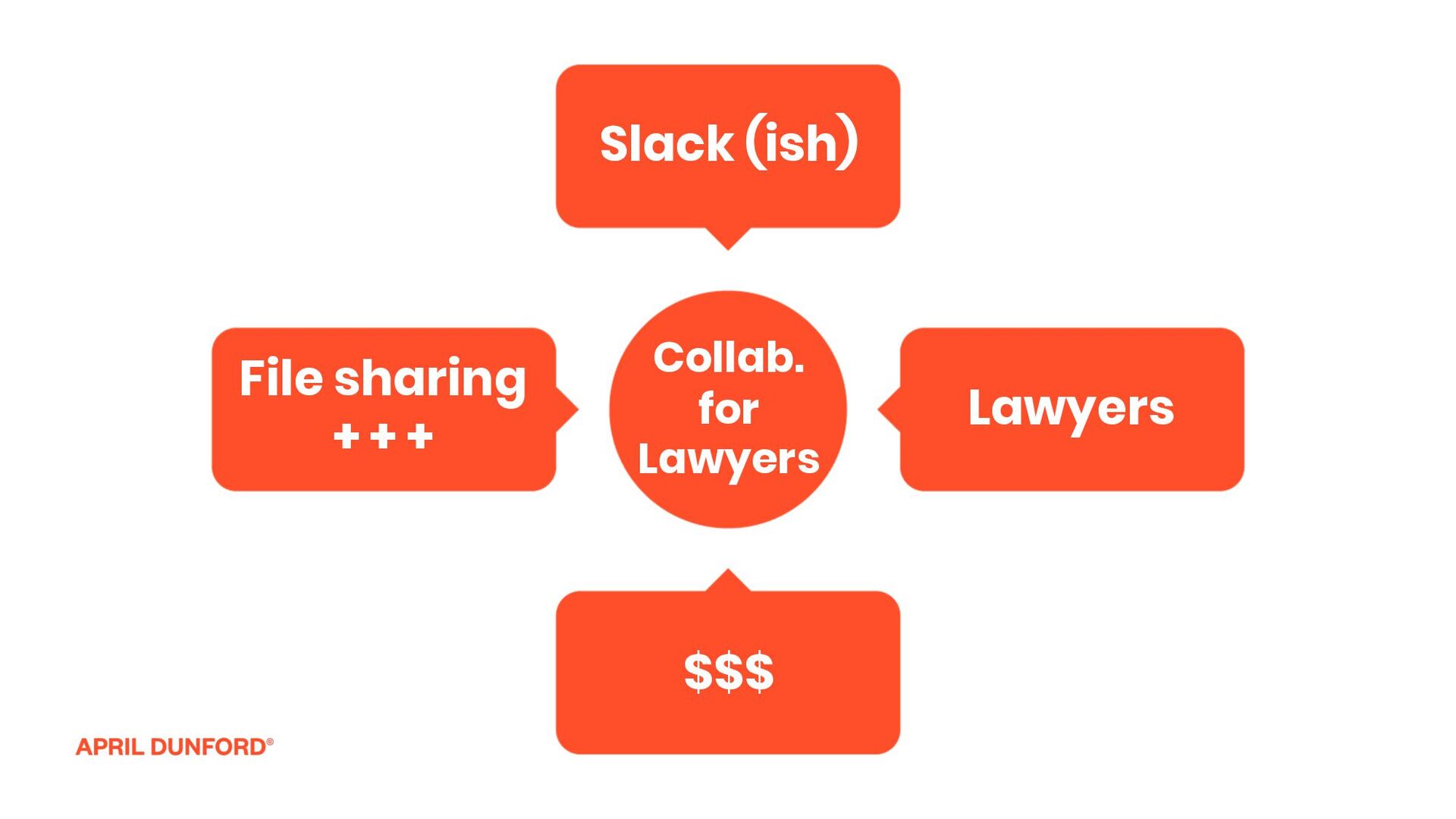
All I'm gonna do is recontextualize it. I'm gonna take that product, I'm gonna take it out of the email category, and I'm gonna put it somewhere else so that you can understand it better. So let's say instead of calling this thing, email for lawyers, what if I position it as team collaboration for lawyers?
Or now, that's different. That's completely different. Who's my competition now? Let's not Gmail. Now I'm competing with Microsoft teams or, Slack. And, and then what would you expect that product to do? I certainly wouldn't expect it to have a calendar anymore. Would I?
I would expect it to have some whiz bang collaboration features for lawyers, and that's exactly what it has. Super secure context aware file sharing thing. The neat thing about this one too is the impact on the price. Contextually, when they were positioning it as email, people are used to playing practically nothing for email.
They repositioned it as team collaboration for lawyers. We pay a lot more for that. They put the price up times ten and the pipeline actually increased. This also is a good example of the problem that we don't tend to actually position our products deliberately.
Most of the time, how products get launched is they get launched like this. The founder wakes up in the morning and says, Hey, you know what sucks? Email sucks. I'm gonna make better email, and then they build the thing, and then they put it out there.
Customers say, I love this bit, I hate this bit, they change some things, and then they put it again, they put it again fast forward a couple of years. And your thing that you still think of as email inside the company, outside the company, the customers like I don't know a man, but I don't know what that is, but it ain't email, and I'm super confused.
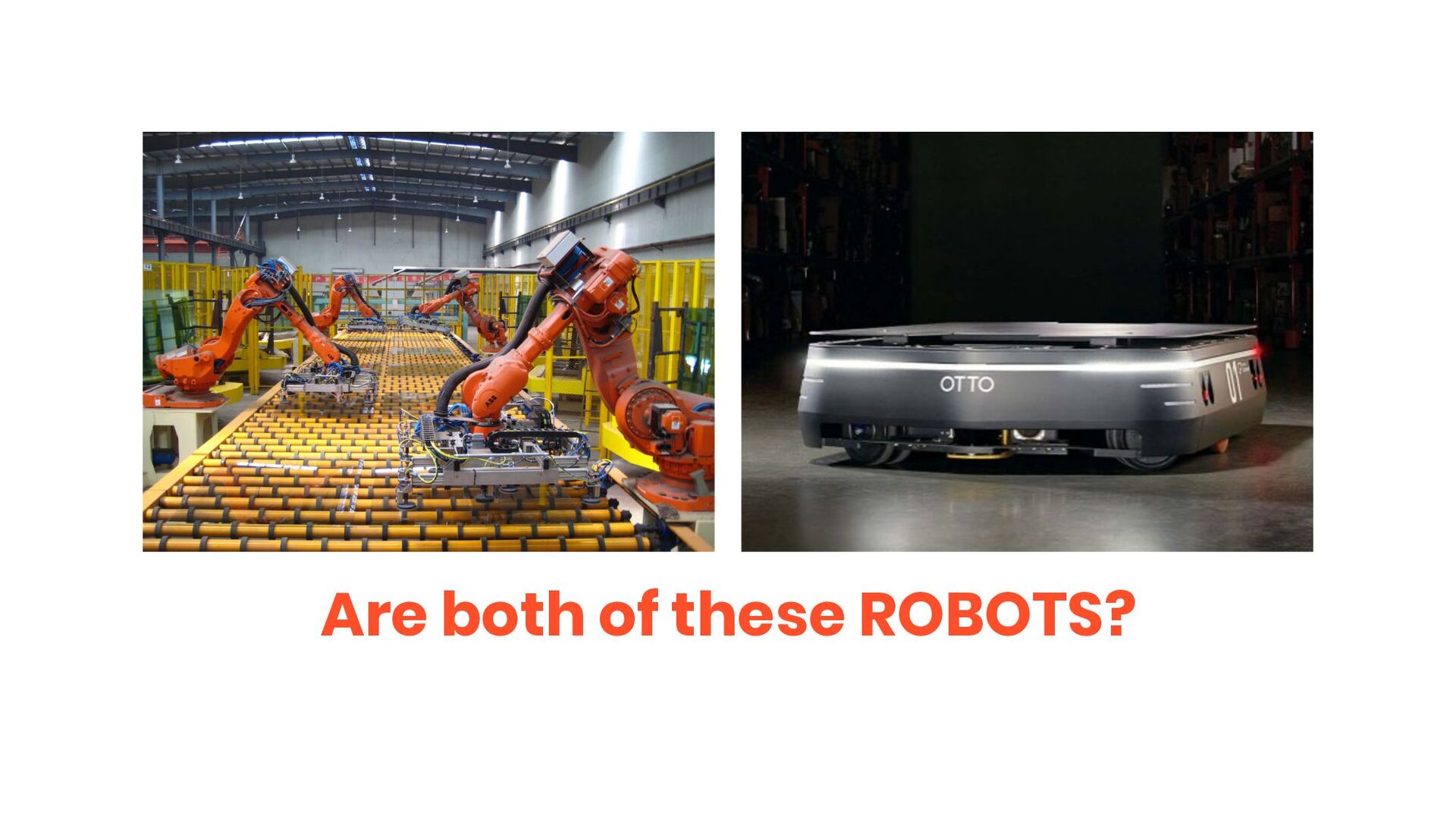
So let me give you an example. So this is a company that I worked with there in Canada. They're called Clearpathrobot eggs, and it founded by two guys with advanced degrees in mechatronics Engineering, their robot guys, and they start start up building robots.
And so that's the robot on the right hand side there. What this thing does is it drives around a manufacturing plant and it delivers things from one place to another. Now, if you're like me, you don't know too much about robotics, you might think, well, that doesn't sound like it's so hard.
Turns out that's actually super hard. This thing is full of mapping, and sensors, and artificial intelligence is a miracle of modern technology. So they build this thing, and they're gonna sell it to the person inside a manufacturing plant that buys robots. So they walk in the first call, they walk in and they say hi, We're Clear Path Robotics, We're here to sell you some fancy new robots.
Now, if you hear the founder tell this story, the founder says, the minute we said that word, robot, You could see, like, the buyer is sitting there going. Robots. Yeah. You know what? We've been buying robots for like ten years. And you know what we've got?
We've got approved robot vendors. You are not one of them. And why is your robot so expensive? We know what robots cost, and your thing is like way, way too expensive. And the founder says, then we're tap dancing. We're like, No, no, no, you're a standard special special robots.
Special robots would like, you know, driving around sensors mapping robots. Robots like the world has never seen before. After a while, I had this idea, like, maybe positioning this thing as a robot isn't actually doing us any favors. So they go back to the office, they sat down, and they said, What's so special about us?
Like what's so different about us? It's it's mobility, it's driving around, it's It's mapping sensors, artificial intelligence. What drives around and is full of mapping sensors, artificial intelligence? Eventually, they said, maybe what we built is a self driving car or autonomous vehicles for industrial uses.
So they repositioned it as a self driving car. That is a completely different starting point for a conversation with the customer. So now they walk in, Hey, you know, we've got this thing. It's autonomous vehicles for industrial uses. Well, of course, that drives around.
Of course, that's full of mapping sensors and artificial intelligence. Of course, I don't get it from the same vendor that sells me a finger to pick up a jar of vitamins and put it in a box. I would expect it to cost more, too, wouldn't I?
What I really love about this example is if you look at the industrial design of the device itself, like it has white headlights on the front and red brake lights on the back, and those two really nothing. It's a robot. It doesn't actually need any lights to get around, but that's just there to reinforce this idea that this thing is like a little car.
So positioning is super important. Why do we suck at this? Like, we should all know how to do this. Right? And that's what I assume when I started out. So so here's my secret. I did not go to marketing school. I went to engineering school.
And straight out of engineering school, I got a job at a startup, and I got assigned a product that was not selling very well. And we got the genius idea to reposition And when we did this repositioning, we had no idea what we were doing.
We were kinda monkeying around until we got something that worked. And when it worked, it really worked. So the thing took off. We got acquired by a big company in Silicon Valley, Ten minutes later, my boss decided to quit, and I just happened to be standing in the hall outside the room when my boss quit, And they came out and said, you, you're the vice president of marketing now, which is kinda hilarious because I'm two years out of engineering school.
I don't know what the hell I'm doing. And, and I've said, Well, that sounds pretty good. And then they said, Oh, yeah, by the way, here's three or four products that don't sell very well. Just do that repositioning thing that you did with the other one.
And I'm like, Oh, shit. Now, what do I do? And so I thought, well, marketers must know how to do this positioning thing. I'll just go to school, figure that out. I'll talk to some people and figure out how I'm supposed to be doing this.
So I read a lot of books. I take a bunch of courses. I'm having coffee meetings with all the vice presidents of marketing that will have a coffee meeting with me. And what I'm getting to is like, everybody's just kinda monkeying around till they get something that works.
And I'm like, well, that's can't be the way we do it. And so, eventually, I took a class at, Northwestern University, which is the fancy pants marketing school, if you're in the United States. So I'm taking this class and a professor comes out.
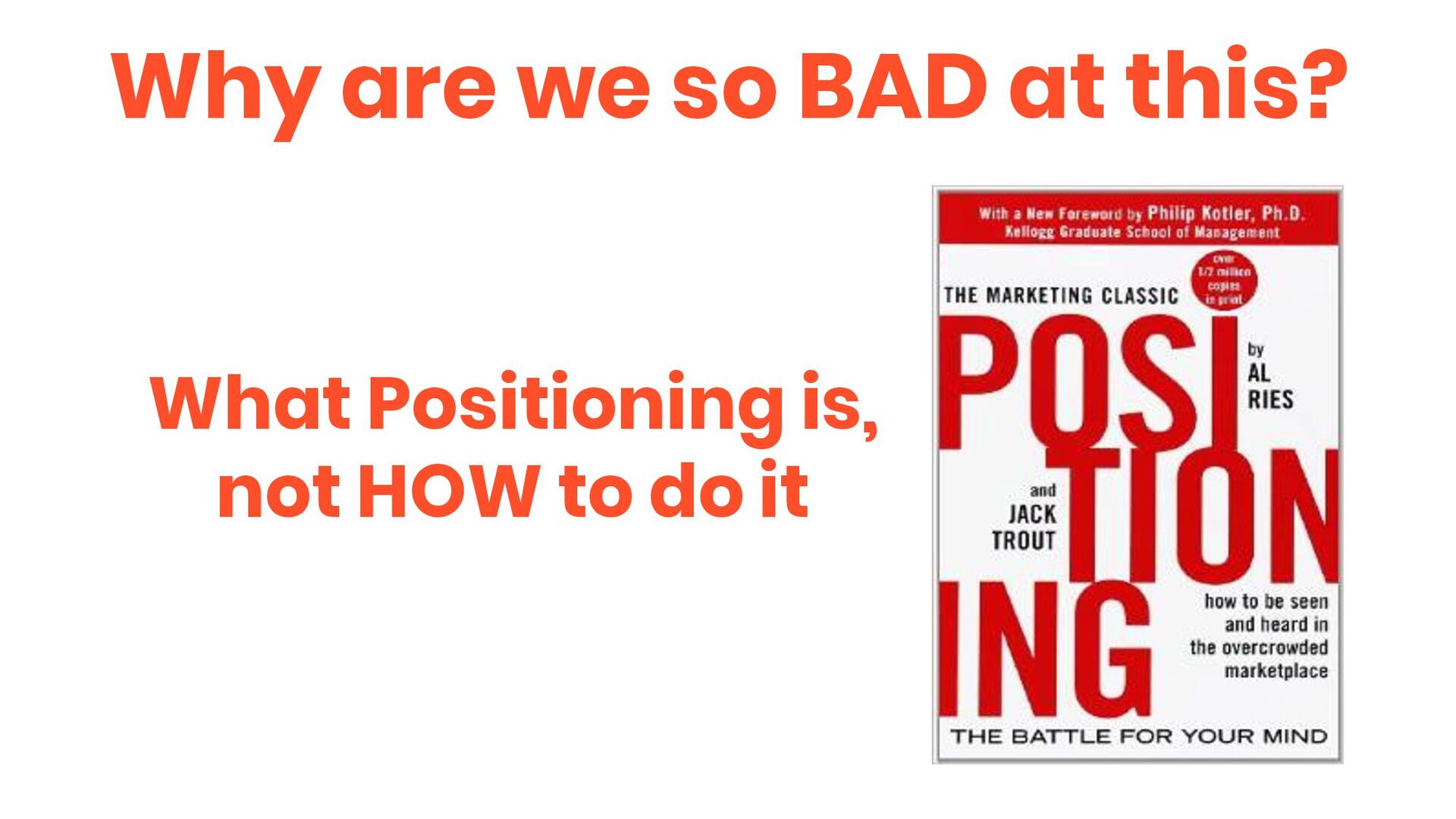
The first way to read this book. So so this book is called positioning The battle for your mind by these guys Reason Troout. Great book. Awesome book. If you're interested in positioning, you should read it. But what this book does, is it spends the first half of the book explaining what positioning is and getting you all jazzed about positioning, so you're all excited about it.
And then the second half of the book has a bunch of examples. Like, here's what the positioning looked like before. Here's what it looked like after. And the examples are literally all over the Like, at one point, they're repositioning the country of Jamaica.
So they so we got these examples at the back. Nowhere in the book, does it tell you how to do it? So I get to the end. I'm like, where's the how to do it part? You know, and then it's not there. So we read this book and then and then finally we're gonna do the class.
So the professor shows up and he says, okay, today we're doing the class on positioning. And here's how we do it. He puts up this thing called the positioning statement. Many of you ever done one of these, if you're in marketing, it's it's hard to avoid this thing positioning statement.
And it is like A mad lives fill in the blanks exercise, where it says, we are a blank that does blank, unlike blankety blank, And so for example, one of those blanks is market category. And so this guy gets up and says, okay, here's what you do.
You fill in the blanks, make this sentence and then you're done. Okay. Good. Now you know positioning we're moving on to another topic and I'm like, wait. Wait. Wait. I'm at the back. And I'm like, that can't be. That can't be it. So I broke my hand.
I'm like, my dude. My dude, this can't be it. This can't be how we do it. Like, I'm trying to give my example. I'm like, you know, I had this thing, and, you know, we thought it was robot, and there was a self driving car.
So I'm giving them all kinds of examples, And and I'm like, so you gotta blank this as market category, but as far as I can tell, every product could get positioned in multiple market categories. So how do I know I got the best one?
And you know what the guy said to me? He gave me this whole professor business. He's he was like, up at the stage, these glasses on, And I said, Hey, hey, how do we do it? He was like, who said that? And I was like, me, me, I'm up at your top.
Like, how? You know what? I'm giving them the big example? And he like, look us up with me and he get his whole squinty eye, and he says, And I'm like, how do you do it? How do you pick the best one? He says, trust me, April.
You'll just know. And I'm like, what? Buddy? Like, that's what smart people say when they don't know the answer. You just know. And at this point, I was like, oh, man, we actually don't know how to do this. Nobody knows how to do this.
And for me, I just felt that's unacceptable. Now, at the time I came to this realization that there wasn't a methodology for doing positioning, I had actually repositioned three or four things. So I'm starting to see the patterns. I thought, well, maybe maybe I could figure this out.
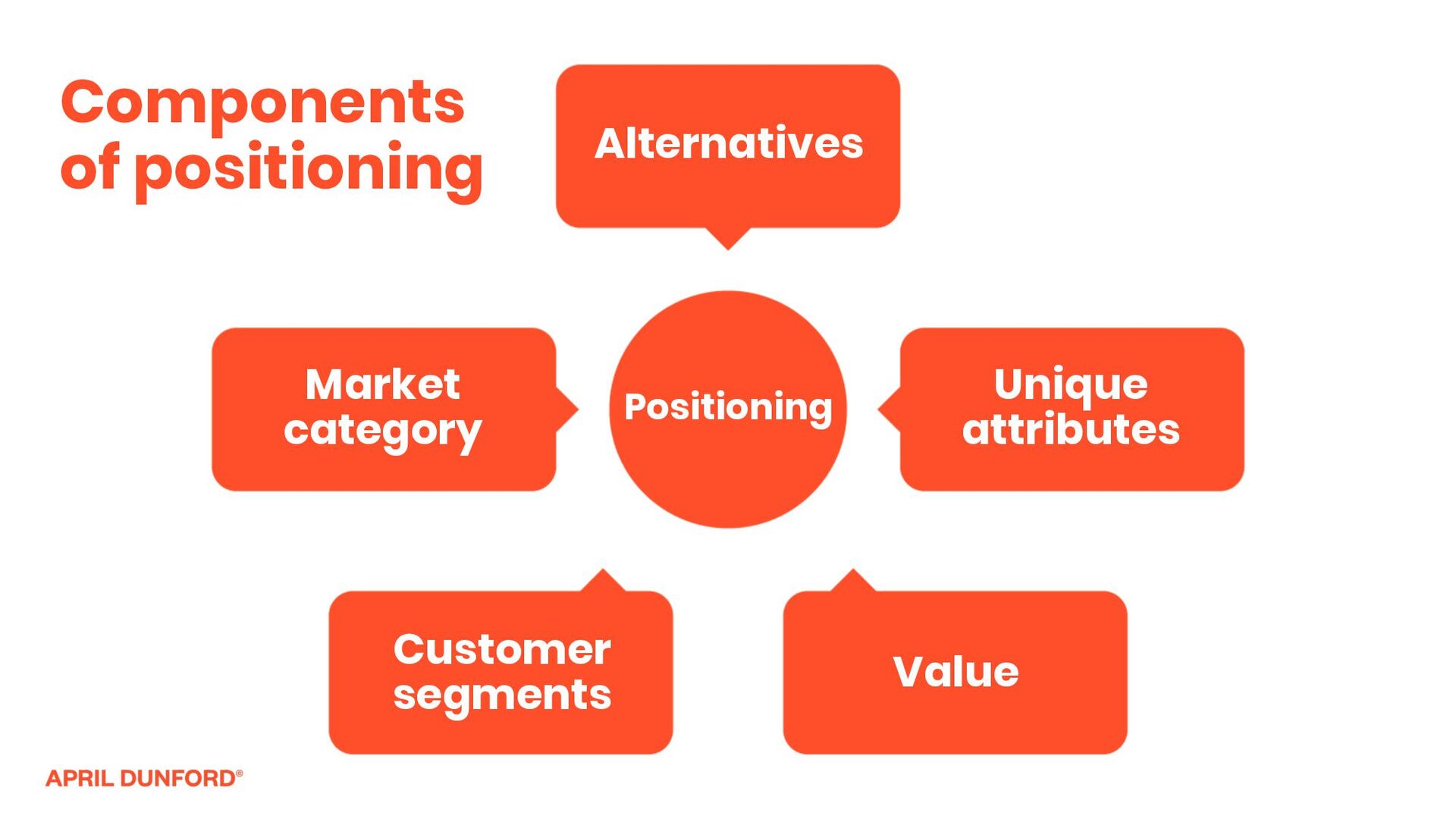
So here's how I work my way through it. So first of all, in my little engineering brain, I decided, well, if we wanna solve this problem, we take positioning, break it into the component pieces, solve for the component pieces, smash it together and then voila, good positioning.
And so fortunately, breaking the positioning into component pieces is actually super easy because we kind of agree on what the components are. It's more or less the blanks in the positioning statement. So there's five things. So the first one is competitive alternatives. So if you didn't exist, what would a customer do?
So what do you have to position against? The second one is, unique attributes or capabilities or features. So these are the features of your product or your company, things you can do that your competition can't do. The next one is differentiated value. Differentated value is actually super important.
Nobody cares what your features are. What they care about is what do my features enable for the customer's business? So differentiated value is the value we can deliver to customers that no one else can. The next component is target customer segments. We're not trying to sell to everybody.
We're trying to sell to folks that are really good fit for our product. And then the last one is market category. Am I robot or a self driving car? Am I email or team collaboration? So those are the five things. So I get to that and I'm like, good.
All I gotta do is figure out the best answer for each of those things, you know? And so I'm looking at it and I'm like, Oh, actually, this is more complicated than you thought. So the first thing that you figure out when you break it apart like this is that that each of the component pieces actually has a relationship to the others.
So if I take anything here, let's take differentiated value. The value that my product can deliver, that no other product can is completely dependent on what. It's dependent on my differentiated capabilities or my unique attributes, right? I don't get to just make this up.
Like it comes from the stuff we can do that the competitors can't. But then when you think about it, my unique capabilities are only unique if I compare them to a competitor. So those three things are actually really tied together. You just figure out one without figuring out the other.
And then I've got customer segments. What is the definition of my best fit customer? The definition of my best fit customer that's a customer that really, really, really cares a lot about the value that only I can deliver. So those things are tied.
And then market category is a little more esoteric, but if I think about it, if market category is my context, like my best market category is the market category that makes my value kinda obvious to the people I'm trying to sell to. So, man, this sucks.
Everything has a relationship to everything else. So where do I start? And for two years, I decided that's why we don't know how to do positioning because this just sucks. And so what you have to do is like pick one. Let's start with features because we're comfortable there.
Work your way around the wheel, get candidate positioning, go out to the market, test it if it wins, great, you run with it, If it doesn't, you go back to the drawing board and you go do it again. Do you know what the problem with that is?
This is terrible. I did this for two years. It's legit, terrible. So you come in, you're the brand new vice president of marketing. They're like, do that fancy positioning thing you do. You're like, I got it. So you work around the wheel, you get the candidate position, you get it out there, you're testing it, and stuff.
If you get it right the first time, you're hero. Everybody wants to give you a bonus. They're like that April. Best thing we ever did was hire her. She's amazing. But if you go out and you take that thing and you test it and the test fails, you're bum.
Like, you go in to talk to the CEO, you're like, yeah, we've been fooling this thing for two months doesn't work. I need another two months. That's a really good way to get fired. So this was very stressful this. I couldn't actually recommend it to anybody.
And so how I got out of this thing is a super long story that I don't have time to tell, but the short version of it is Clayton Christians. So what happened was I I got into Clayton Christianson, and I got reading that stuff and jobs theory of jobs to be done.
A few folks are conference, the last talk of this conference is Bob Mesta. He's gonna talk a bit about that stuff. But, I got really into that, and, and, and, and what came out of that was I had a bit of an epiphany, and the epiphany was this, we actually have to start with competitive alternatives.
If we don't start with competitive alternatives, what we get is positioning that sounds good in the office, but when we take it out, it is insufficient differentiated from the other things outside and therefore it doesn't win and then we and then we have to go back and do it again.
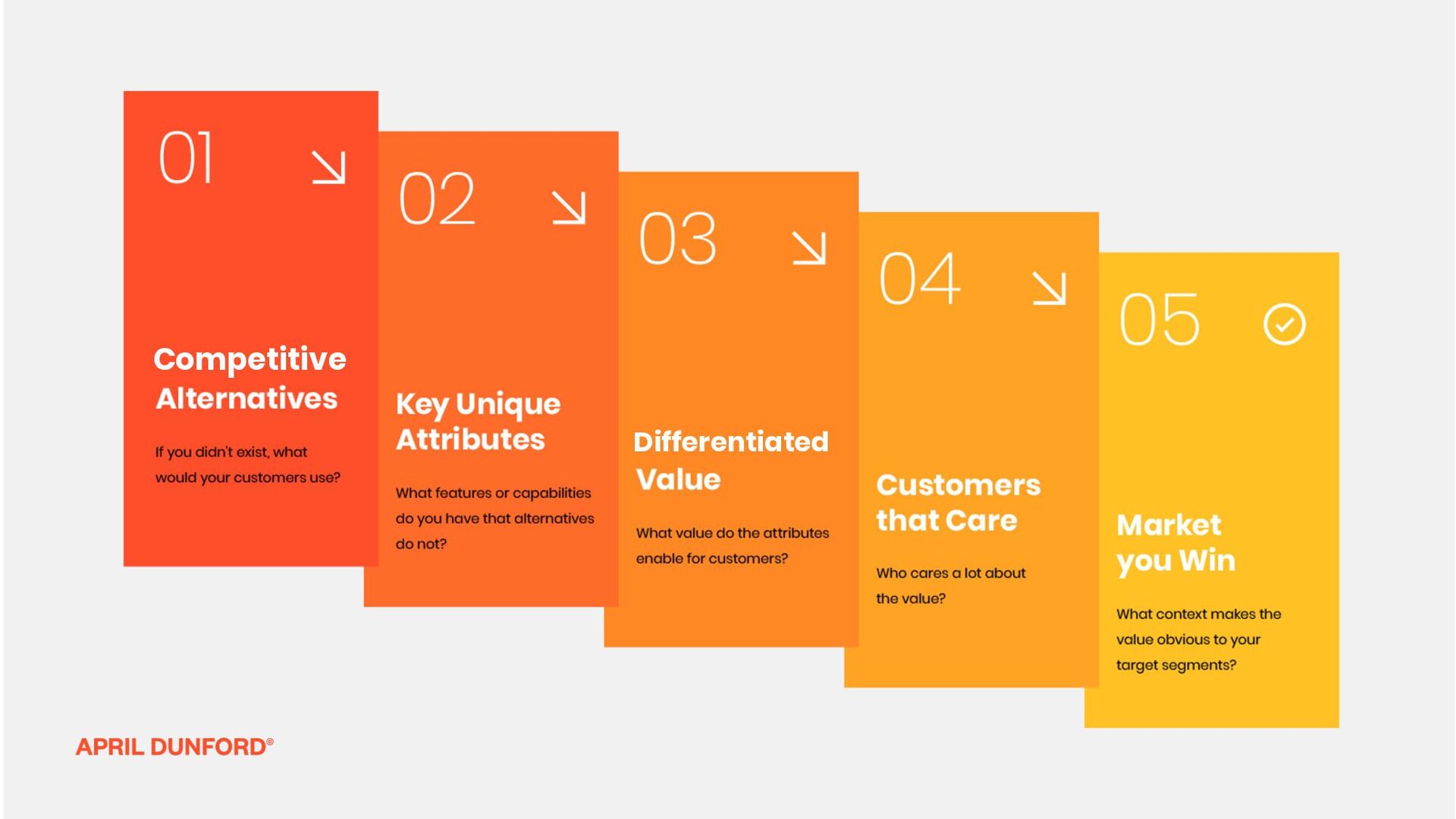
So it works like this. First step is competitive alternatives. If you didn't exist, what would a customer do instead? So this is like, what do I have to position against in the minds of customers? And then once I have that, that's my stake in the ground.
And then I can say, well, what have I got that they don't have? That's my differentiated capabilities or unique attributes. I can fill up a whiteboard with those, and then I can go down that list of attributes and say, Okay, feature number one, I have the advanced AI, whatever machine learning, things so what?
Why does a customer care? What is the value that that feature delivers for customers? That's gonna get me to my differentiated value. Once I have that, then I can say, okay, I could sell this thing to anybody, but what are the characteristics of a target account that make them really, really care a lot about the value that only I can deliver.
That gets me target customer segments or best fit customers And then I can actually figure out market categor, I can say, Alright, What is the context that I positioned this thing in, such that this value kind of makes sense for these people? Now it looks easy, but there's a thousand ways to screw it up.
The most common way to screw this up is you don't actually really understand who your competitors are. It might seem obvious, but for a lot of companies that I work with, it is not. So about every week I get a call from a little startup and they'll say, Hey, we've got this thing.
It's really amazing. And I'll say, okay, well, who do you compete with? And they'll say, Oh, all these little art ups and they'll give me a big list of companies. Nobody's ever heard of. Like two guys in a basement in Silicon Valley. And I'm like, okay, that's your competition.
I'll say, well, how do you beat them? And they said, well, ease of use. That's how we do it. If you use them, it takes fifty nine clicks to do a thing, but if you use it with us, it only does one click.
And so ease of use, that's our thing. And I'm like, I never heard any of those companies. Do you actually lose any deals to those companies? Most of the time they'll go, no. No. We beat them every time. Like, we we never lose to them.
And I'm like, but you lose deals, right? And they're like, oh yeah, lose deals all the time. When you lose, what happens? Like, oh, we lose to no decision. But they still have the problem, right? So how's the customer actually solving the problem?
And they'll say, oh, well, they're just doing it with a spreadsheet or they're hiring intern to do it. And I'm like, oh, so your positioning is all about ease of use, but your actual competition is the intern. Like, do you think you're gonna beat the intern on ease of use?
No. The intern is super easy to use. You're like, joey? Give me a coffee. Fill out the spreadsheet. Come on back. No. You're never gonna beat the intern on ease of use. But the intern sucks at all kinds of stuff. Like, Joey quits on you, and then what do you do, right?
And then Joey doesn't remember the whole profile of your customer and all that stuff. There's lots of ways to position against the intern that work, but you gotta understand that you're competing with the intern first. I'm gonna give you an example of this.
This is my favorite example, and I use it every time, but too bad. I'm gonna use it again because it's my favorite story. So when I was when I was young, and stupid. I took a job at a a software company, and we were positioned as enterprise CRM.
So this was a long time ago, and Salesforce was in the market, but everybody forgets this. They were only selling to small businesses. At the time, there was a giant company that was the king of Enterprise CRM, this big company in Silicon Valley called Sebel.
And so we were positioned as enterprise CRM. They were the kings of enterprise CRM. So unsurprisingly, we would get a meeting with a customer, and the customer would say So how are you better than Siebel? And the answer to that question was, we kinda weren't, like, in any way, better than them.
Like, They had eight thousand employees. I was like employee number twenty. They had four hundred customers. We had five or six. Were doing two billion revenue. We were doing two million revenue with a m. But we had two things that were actually really differentiating from them.
The the the first one was we had this feature. And what this feature was is you could model a relationship in the CRM in a very different way. Than any other CRM in particular from Siebel. And not only that, it looked really good in a demo.
So when we went in and had meetings with customers, we'd show them the demo And, and the meeting would go like this. They'd say, so how are you better than Sebo? We're like, we got this thing. So we'd show them the thing and they'd go, oh, that looks cool.
What do you do with that thing? And we'd say, anything you want And they'd say, I don't know what I'm gonna do with that. What else you got? Then I'd hit you with the other thing we had, which was absolute desperation to close business.
And so if you asked us for a discount, we'd give it to you, and he would basically give the software away. This is not a way to build a business. Let me tell you. So So things were not going well. And how we got out of this was a bit of done luck.
So how we got out of this was we hired a new sales rep, and, so not surprisingly, we weren't selling anything. So our sales reps were always quitting, so we were always trying to interview and hire new sales reps. And so we had a sales rep come in for an interview.
And, the CEO of my company was kind of a notorious jerk in interviews. I don't know why, but that was his stick. And so the sales rep comes in and my CEO pounds on the table and he goes, give me one good reason why we should hire you to be sales rep at our amazing startup.
And this guy was from New York, so he had a little bit of attitude. And so he got all up in my CEO's face and says, I'll give you one good reason why you should hire me. Because my buddy is the head of investment banking at Goldman Sachs, and I'm going to get you a meeting.
And we're like, Can you start on Monday? And we hired the guy. And then, and then we hired the guy, and he gets us the meeting with the head of investment banking at Goldman Sachs. We're all happy about that. And I decide I'm gonna tag along on the meeting mainly because I wanna see what the office of the head of investment banking at Goldman Sachs looks like.
And let me tell you, it's about the size of this room. It's got a helicopter pad outside. That's not a lie. Anyway, so we go into this meeting with that investment going my rep is in there and he's doing a great job. And so he's doing a demo and things are getting good.
And he gets to that part where he shows the thing. So he gets to the thing and he's like, look at this thing. And the guy squints at it and says, what do you do with that? And he says, well, you can model any kind of relationship, like, any kind of relationship, and he's like, any kind of relationship, like, if there were two people and they sat on a board together, but they actually work at different companies, you could model that.
Like, yeah, yeah, we could. He's like, Wait. So if two people are a member of the same golf club, you could model that, like, yeah, yeah, we can't use, like, hang on. I need the vice president. He runs down the hall, comes back with a couple of guys.
He's show them the thing show them the thing. And we're like, show them the thing. And they're like, oh, like, if two people belong to the Harvard club, they actually used to work together, but they don't work together anymore. You could actually model that.
And we're like, yeah, yeah, we can. And then they all turned to each other, and they all started speaking their weird banker language. Like, they were like, like this. And me and my rep are in the corner, and they started jumping up and down and getting really excited me and my rep are over there.
Like, have you ever been in a room full of really excited investment bankers? It's terrifying. And so we're in a corner, and then they turn around and they're like, we gotta have this thing. And like, we closed the deal, and we're so happy.
And we're like, Wow. Maybe investment bankers really dig our stuff. So we end up getting this meeting at Merrill Lynch. And the same thing happens We go in there. We show the thing. The guy's eyes pop out of his head. He starts freaking out.
Their bankers are jumping up and down, and then we close some business. We're like, this is amazing. We close any business and ages. And so all of a sudden everything everything's going good. Revenue's going up to the right. We're all excited. And importantly, it's sparked this conversation back in the office, like, are we actually enterprise CRM?
Maybe we're CRM for investment banks. Now, let me tell you that might sound like a small change. That was not a small change internally. Like, in the company, everyone was like, Well, wait. Does that mean if someone calls us and they're a telco, we're not gonna sell to them?
Like, we're just gonna sell to investment banks. And like people got really stressed out about it. Like it seemed like kind of a small market like how many investment banks are there. And so it took us a while to get our heads around it.
And so here's how we convinced ourselves first, but then we had to convince the board. Like, you know, really hated it, the investors. The investors were like, Wait, we wrote you a check to go wipe Siebel off the face of the earth, and now you're gonna be this little lifestyle business where you just sell the investment banks How are we ever going to get rich doing that?
And so here's how we convince them. So the first one was they're like, well wait, what happens when the other companies call you and they're not investment banks and we're like, Nobody ever calls us, buddy. Like, we haven't selling anything in years. Like, we're not giving anything up here. Let's be serious.
Like, we're doing two million revenue. Like, so that was the first thing. And the second thing was, we said, look, positioning is not a thing that you carve in stone and you never look out again. Here's what we're gonna do. We're gonna be CRM for investment bankers because we win all day there.
But once we're established in investment banking, then we're gonna start selling to retail banks. And then we're not gonna be CRM for investment banking anymore. Now we're gonna be CRM for banking, all kinds of banks. And then after we do that, that's actually gonna give us permission to start getting into insurance.
And then we're gonna be CRM for financial services. And if we are successful at doing that, Well, that's a giant market. We'll be a giant company by then. Then we're gonna take on Sebel, we wipe those guys off the face of the earth.
We're all gonna be billionaires. That's how it's gonna So they gave us permission to do it. And so we did the repositioning, and this was absolutely transformational to the business. So the first thing was we never got in a head to head competition against Sebo again.
So we would walk into the bankers and they would and we'd say, we're CRM for investment banks and they're like CRM. Like, wait. So, don't you compete with Sebo, and we're like, Sebo. Oh, we love those guys. They're fantastic. We love them. They're amazing. They're like, oh, so big, so many customers.
Like, They're like the world's greatest general purpose CRM for like, I don't know, call centers or manufacturing plants or something, but not to WulfA Wall Street. You need something special. Let me show you the thing, right? And then we might show them the thing and close the deal.
So, the other thing was that because we were making this signal that we refer investment banks, the investment banks called us. And so the transformation was we went from doing about two million revenue to like in about eighteen months, we were doing around eighty million revenue, which was a crazy ride.
And then Sivo got so sick of us kicking their tail up and down Wall Street that they came and acquired us for one point seven billion dollars. That was fun going to the next board meeting. We're like, you guys didn't think we were gonna make any money.
But that's it. So if you're interested in this stuff, two resources for you. One, I wrote a book on this that kinda captures that methodology. And if you wanna know how to do positioning, that's a good place to start. If books aren't your jam, I have a podcast like everybody on the planet.
But this one is, me going deep on specific topics on positioning. And that's it. So thank you.