
How can we foster inclusivity in teams and processes? What does inclusion entail for startups in their early stages, mid-sized companies, and enterprises? As a leader, how can you create an organization or a team that reflects the diverse perspectives of your product's users and the world we inhabit? How do you measure progress and identify areas for improvement in terms of inclusion? What does inclusivity look like on a larger scale? Feeling overwhelmed? Let's start small. Where and how can you begin incorporating inclusion into your thinking? Join Annjana as she discusses practical and actionable steps to build a more inclusive organization. This talk is designed for CEOs, founders, and leaders in product/tech/business who want to gain insights and implement strategies towards fostering inclusivity within their companies.
Inclusion As A Product: Making It Work For Everyone
Auto-generated transcript - may contain errors. Tap a timestamp to jump the video.
Inclusion as a product sounds like a controversial idea to some people, but I think that's the way we should think of it. I'm Anjanar Ramesh, and as Denae mentioned, I've worked in tech for a decade. I've had experience across big tech and startups, and I'm here to talk to you on this topic.
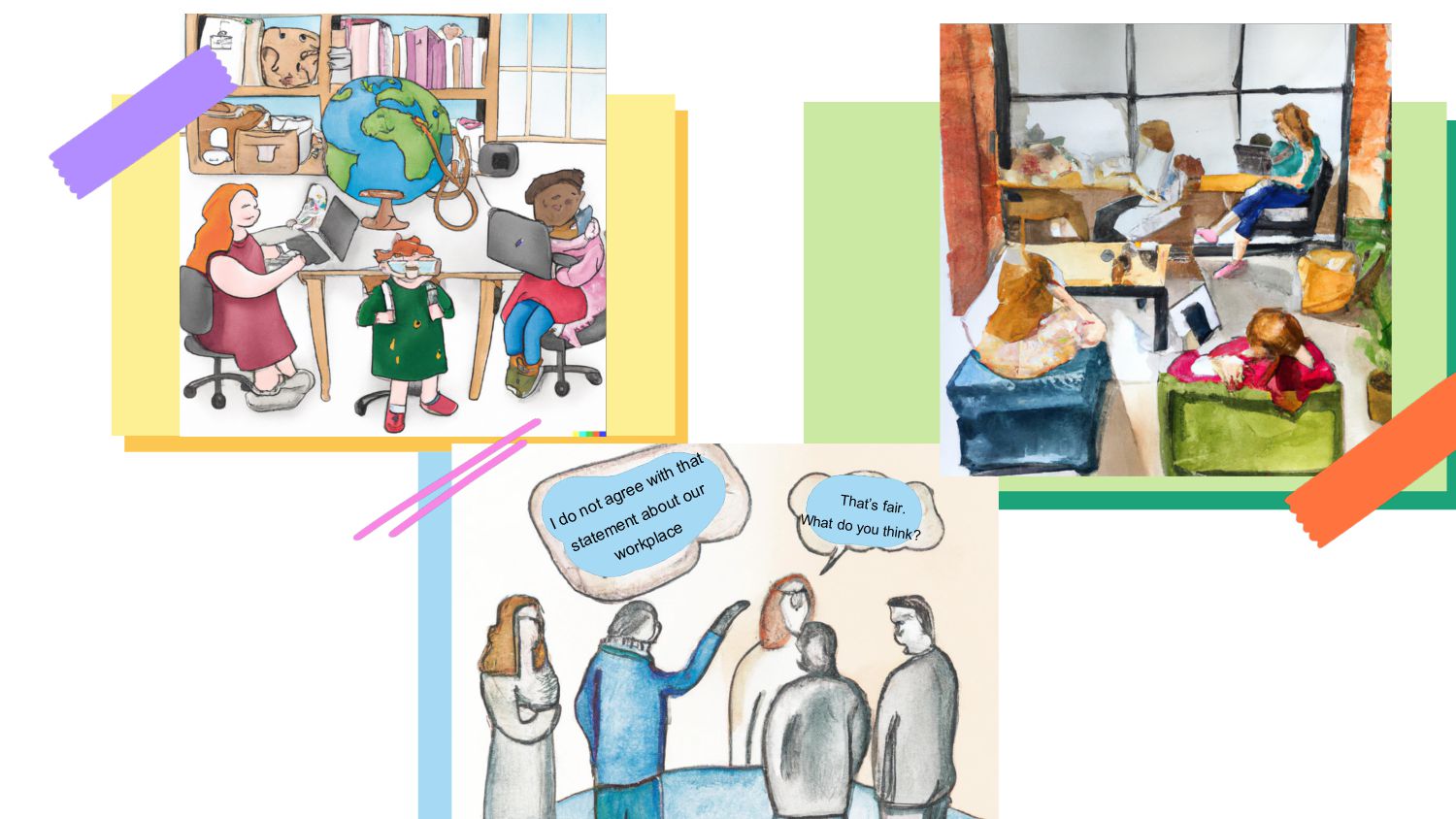
Let's get started. So what does inclusion look like? Is it when everyone can bring their best selves to work? Is it when people can have flexibility? Work from anywhere? Work even from a cafe while breastfeeding? Is it when people can disagree respectfully and take interpersonal risks with each other?
Is it all of the above? DALI created these images for me, so I'd like to thank them for actually putting in very inclusive pictures. I was quite surprised. Inclusion is all of the above, and inclusion is a lot more as well. Inclusion transcends sex, religion, race, gender, anything you can think about.
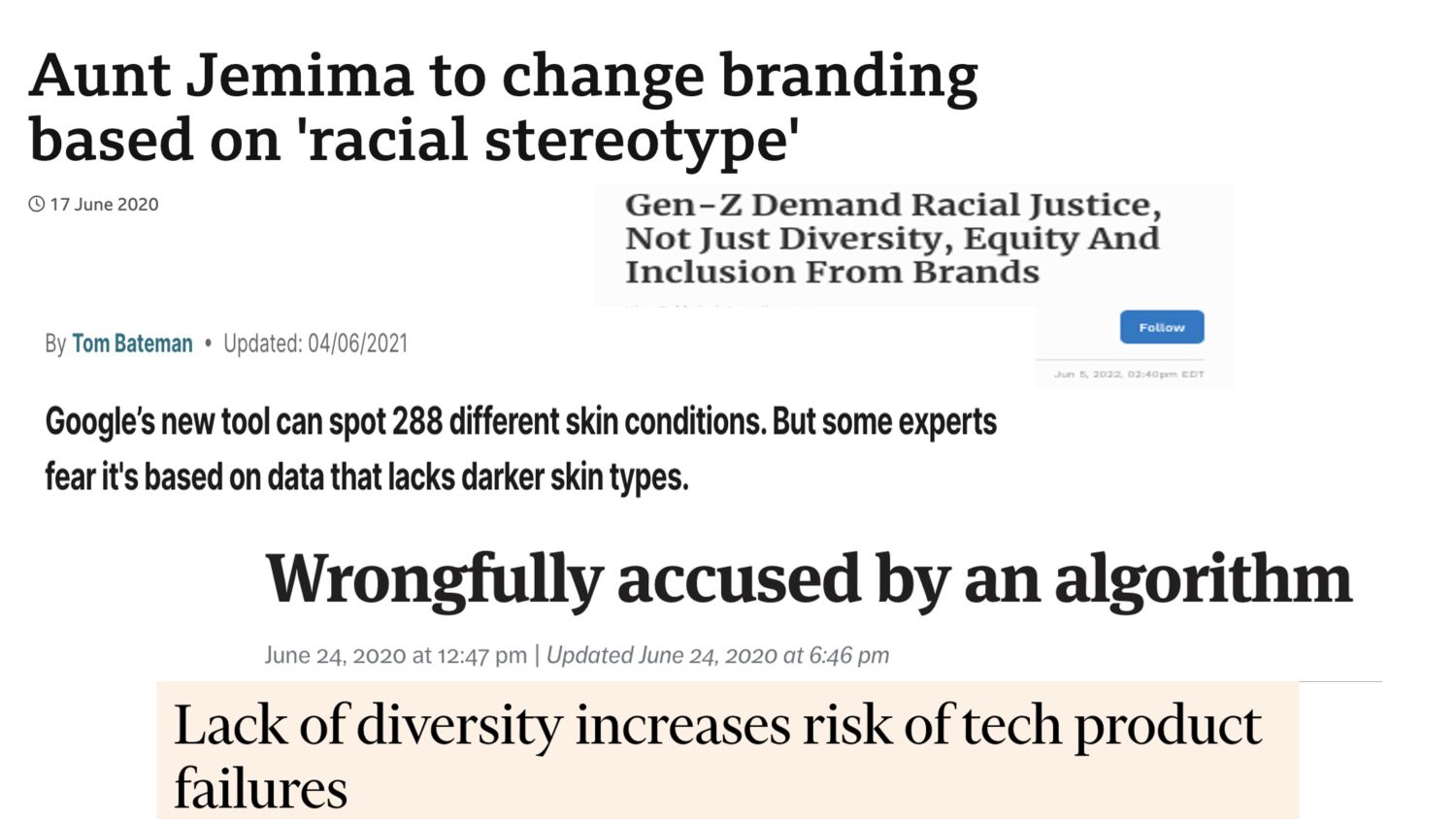
Inclusion is how everyone feels included in your company. Inclusion happens after you've hired people. Inclusion is keeping them in your company. Inclusion is making sure that everyone has equitable opportunities to succeed in your company. And it's not an easy task. And let's talk about what happens when you fail at this, when you fail at inclusion.
These are some of the headlines. I'm not going to go through everyone and you can take a look for it yourself. But inclusion, when you fail to build inclusive products, it can take lives. Specifically, I want to point at where someone was wrongfully accused by an algorithm and it was the first time that it happened and it's happened a couple of times beyond that.
And while you building a product of that image recognition software can say, Well, it's in my terms and conditions. Wet only, ninety nine point nine nine percent accurate. Great. But that zero point one costs someone their life, right? So I think it's important to think about as you're designing inclusive products, how does your company reflect those values that you put out there?
And another one, which is Gen Z. Gen Z makes twenty percent of our workforce today, and it's only going to continue growing. And they not only want inclusion, they demand racial justice and much more beyond that and justice for everyone. So nobody's included till everyone's included.
And why am I here? I know you're all interested in this topic, and that's why you're here. So I don't have to convince you why inclusion matters because you all agree and that's brought you here. What I'm here to tell you about is a shared framework that we can all process and implement in our companies, be it early stage, be it mid sized, or be it enterprise.
No matter where you are in your startup journey, you should be able to implement this framework and then build an inclusion product. And to give you some stats, thirty six percent of companies are more profitable if they have inclusion. So that's thirty six percent of margin that you can have against your competitors if you build an inclusive company.
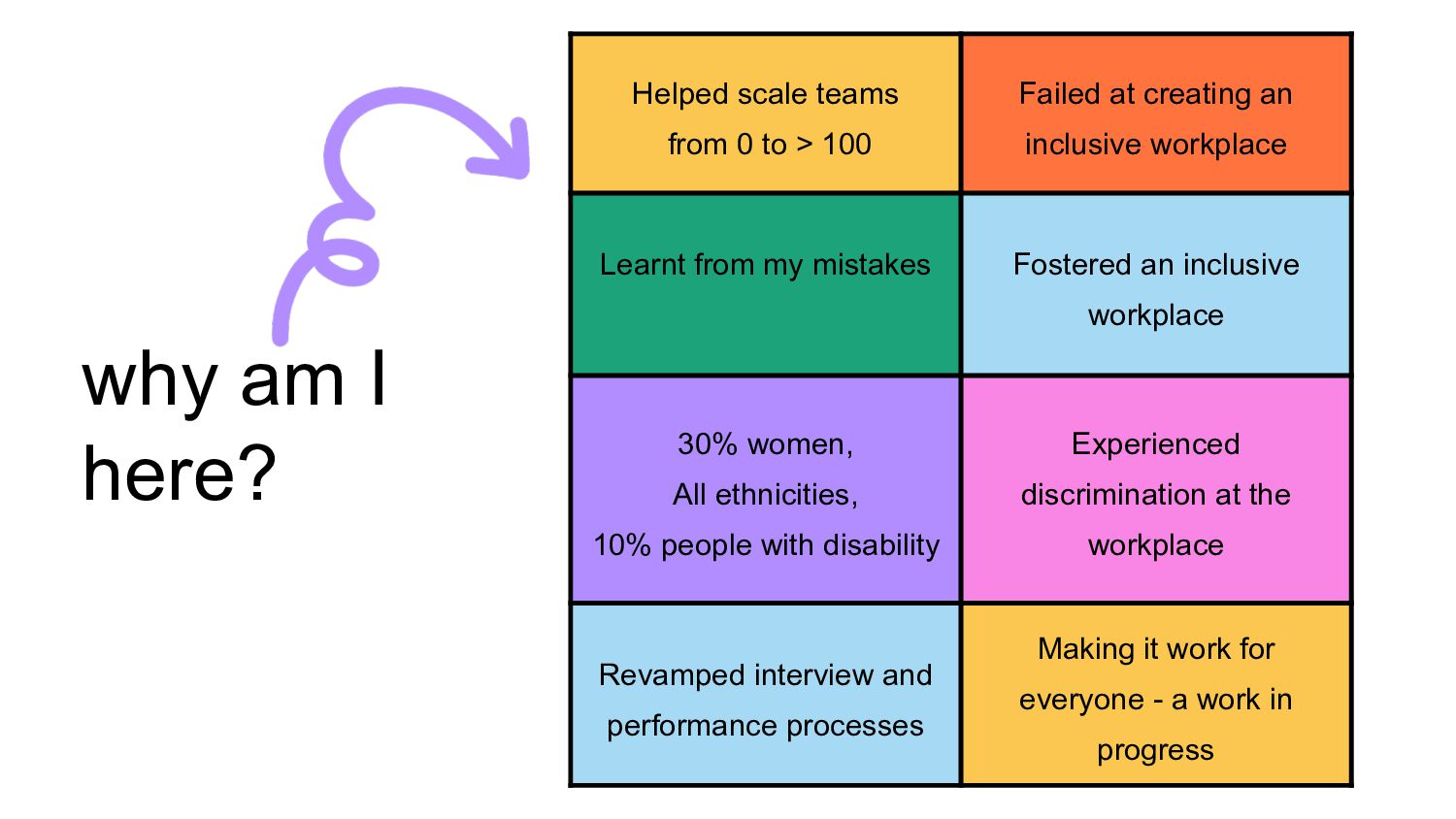
So a little bit about me. I've helped scale teams from zero to over one hundred. I failed at creating an inclusive workplace because I was hiring fast, I was hiring quickly, we're gonna talk a lot about that. And that's one of the big mistakes you can make.
I've learned from my mistakes, and I've gone on to foster inclusivity in the workplace. Put some numbers out there of how my teams are usually comprised and how I make sure that those are my bare minimums, those are my baselines. And I've experienced discrimination at workplace.
I'm sure many of you have. And you know what good is not, at least. So that's a great place to start. I've revamped interview and performance processes because you realize that that's where the gap is. That's where people get excluded. And it's important to figure that out.
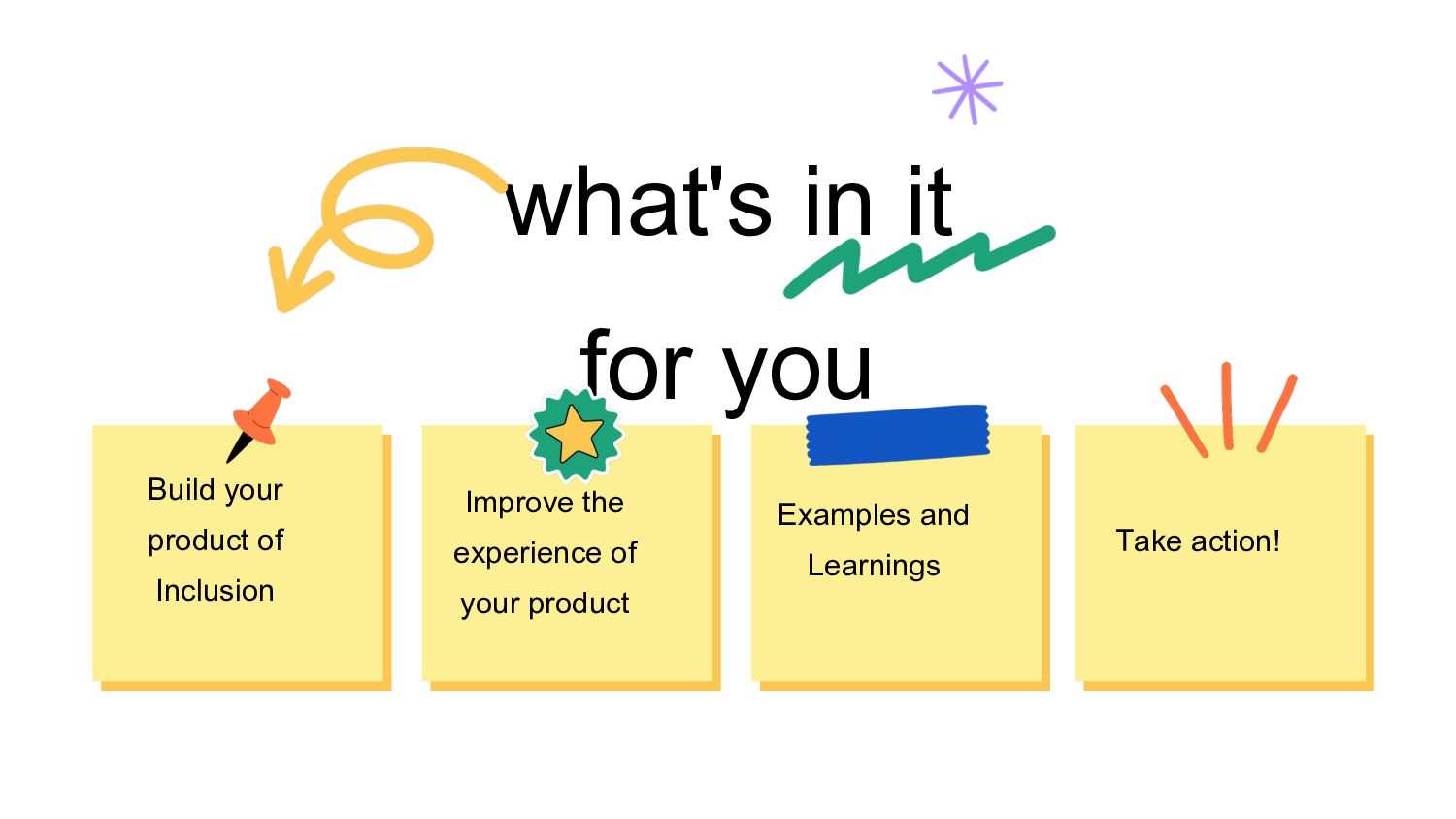
And I'm still here making it work for everyone. May not always do it right, but it's a work in progress. So what's in it for you? As we go through this, I want you to think about your company. Think about the company you work at.
Think about the company you own that you've started. What does it look like to have your product of inclusion? Feel free to take notes on your phone or on a pad or whatever you have. So think about how you're going to build your product of inclusion.
And we're going to talk about how you can improve that product experience of the product and what does it take. And some examples and learnings. For those of you who like Easter eggs, I have a bunch of tools and practical tools, articles, podcasts, things that will really help you in slides.
I'm not going to share them, but you can go take a look at it later if you're interested. Most importantly, take action. We can talk about this for hours. You can go to every single one of these diversity and inclusion talks, but nothing is going to change if you don't take action.
If you're not there every day taking action to a more inclusive world and a workplace to begin with, nothing changes. We're just going be here talking about this year after year. So what comes first? Let's have a show of hands. How many of you think inclusive policies and an inclusive workplace is needed before you hire diverse talent?
Okay, here here. Okay. How many of you think that you need to have diverse talent and then you can think about inclusion? Nobody? Okay. All of you are right and all of you are wrong. This is actually a trick question. There's no chicken and egg here.
It's honestly like a hamster wheel. You need to think of it as you're constantly spinning on that hamster wheel and you're constantly trying to improve it. So there's no right answer. You want to have a base product, and we'll talk about that. So it's not one comes after the other.
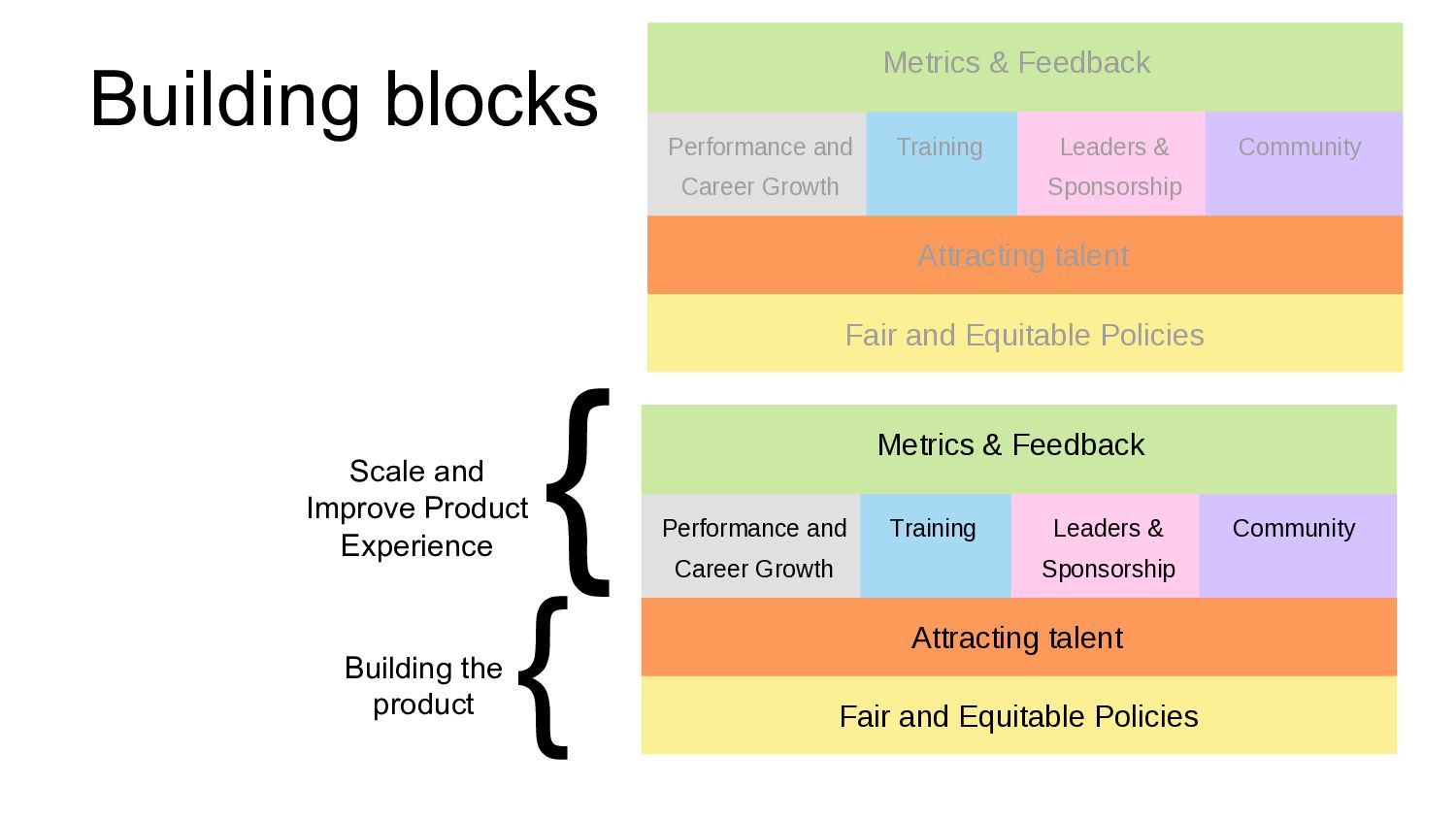
You need to have it simultaneously from the beginning. And here are the building blocks, the way that I see it. First, you want to build the product. And here I'm talking about attracting talent and fair and equitable policies. That's the base product that you have.
And then we're going to talk about scaling and improving the product experience. And that could be in terms of metrics and feedback, and that's key to your product. And what does that look like? Where are some of the areas that you could implement these metrics and feedback?
It would be in performance and career growth, training, leaders and sponsorship, and building and fostering a sense of community. And the reason why I've stacked them one up or the other is quite intentional. You have to iterate. You have to iterate through these two iterative blocks.
And start small, but grow tall. That's really the message here. You need to start somewhere. So now, let's go ahead and build your product of inclusion. So if you're an early stage company, I know what you might be thinking. You don't have the time.
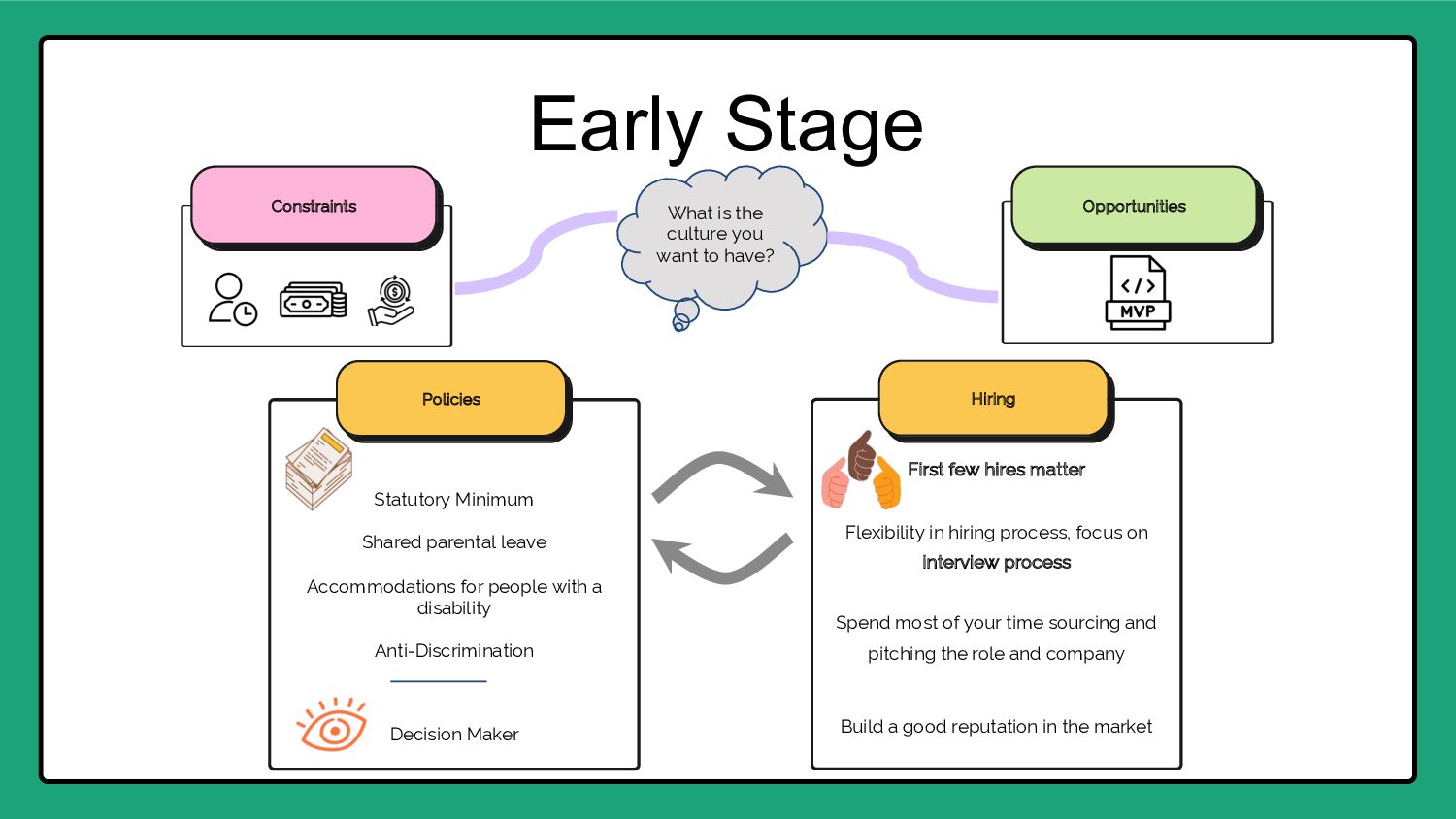
You don't have the money policies, to go and hire all the talent that you want to. It takes time. It takes energy. And you may not also have the right people in place to go do that for you. You're probably a one person trying to do it all.
But the key question you need to ask yourself is, what is the culture you want to have? Before you think about making these excuses for yourself, and I've been there, done that, and I can tell you that's why I failed to create an inclusive workplace, you need to think about what is the culture you want to have.
If the culture you want to have is an equitable workplace and an inclusive workplace, start thinking about it early. Because the opportunity you have in early stage, which you don't at a later stage, is that you can build your foundational product. You can put your reputation out there in the market.
You can build your MVP, a minimum viable product that is inclusive, that people know of. And that's going to get you more traction. And that's going to make you more profitable from an early stage. In terms of policies, the good thing is we're not in the US.
I mean, if I was giving the stock in the US, none of this would hold true because they don't have a statutory minimum. They don't have anything to begin with. So you're dealing with a complete different landscape. In the EU and the UK, we have a statutory minimum.
That's not enough, but that's a base. You can take that. If you're in an early stage, take that. Take that as a start. Build on top of it. And the few policies that I believe that everyone should have, and I've linked in my slides templates and links that you can go follow and read up on it without needing much of a legal support, which is great.
Shared parental leave. This often goes missed completely. I used to work at a workplace where they only had a maternity policy and if you gave birth to a child. So it didn't include adoption. It totally excluded the LGBTQ plus community. And it just wasn't right.
Next one is accommodations for people with a disability. We've also worked in places where there's stairs everywhere. And there's literally walking into that is a hazard everywhere. And what does that mean? Does that mean now if you hired someone with a disability, they wouldn't be able to access the workplace?
That makes sense. If you're in early stage and you're like, you know what? We don't have the money. I took the cheapest rent I could find, and this is what the space is. That's Okay. Then accommodations. You need to provide ways that that person can work remotely, can be successful remotely.
Or can you have off sites once a month where people can come together and in a more accessible space? And the last one is anti discrimination policy. This one is key as well because what you're going to realize is very soon, things will start popping up and you won't have a way to proceed through the layers.
You wouldn't know where to begin and where to end. And the key here is decision maker. No matter what policies you put in, we need an unbiased party. We need someone who is fair, just, who's outside of the power domain, who can make these decisions.
So you need to pick that person. You need to pick who is going to be the person making these decisions. When there are issues, who are your employees going to escalate to? Is that person fair? Is that person unbiased? And now we come to hiring.
And the reason why I talk about that, the base product that we discussed. We want it to be both policies and hiring. And when we think about hiring, the first few hires matter. The first few hires is where you can make a difference.
The first few hires are your spokespeople. They're the people that everyone in your company are going to meet. The first five people or even the first two people are going to be every single person that you hire after are going to meet these people.
They're founding members of your team. And that's why I would say flexibility in hiring process is what you need to focus on when you're early stage. It's not about fancy interviews. It's not about calibrating your interview. It's about what does your hiring process look like.
Can you be a bit more flexible with it? For example, like in engineering, can you give them a take home test versus a live coding test? That relieves anxiety immediately for people. Simple changes that you can make in your hiring process at an early stage that will attract the talent that you want and will set your company up for success.
And the second one, like third one, is spending most of your time sourcing and pitching your company. I can tell you that like almost the last two jobs that I've taken, I've been reached out directly by one of the C suite members or from a VP of engineering or someone that is directly responsible.
So then I can see that they care. I can see why they want to hire me. I can see more about it. So if you're a founder, I'd say the best way to spend your time in an early stage is spend your time sourcing.
Reach out to those people that you want to hire because they will respond better to you than a recruiter. I can promise you that. And the last one is, again, when you put all of these things together, you're starting to build a good reputation in your market.
You're starting to have a good plaza review or anything. You're just starting to build that foundation where people value your company. Employees like to work at your company and they rate it highly. Again, as I mentioned, we are not looking for exhaustive product building here.
We're looking at let's start small, let's build the basics in policies and hiring, and let's iterate over it. And remember, you're constantly going to be iterating through this loop. If you're a mid sized company, and I'm here talking about anything above fifty ish people, you're dealing with scale.
If you're of that size and you want to go to two hundred, you want to go to three hundred, you're battling scale. And with scale comes numerous challenges. You could have built the best inclusive workplace when you were ten people. But when you scale to fifty and one hundred and a two hundred and a three hundred, that's where things start to go wrong.
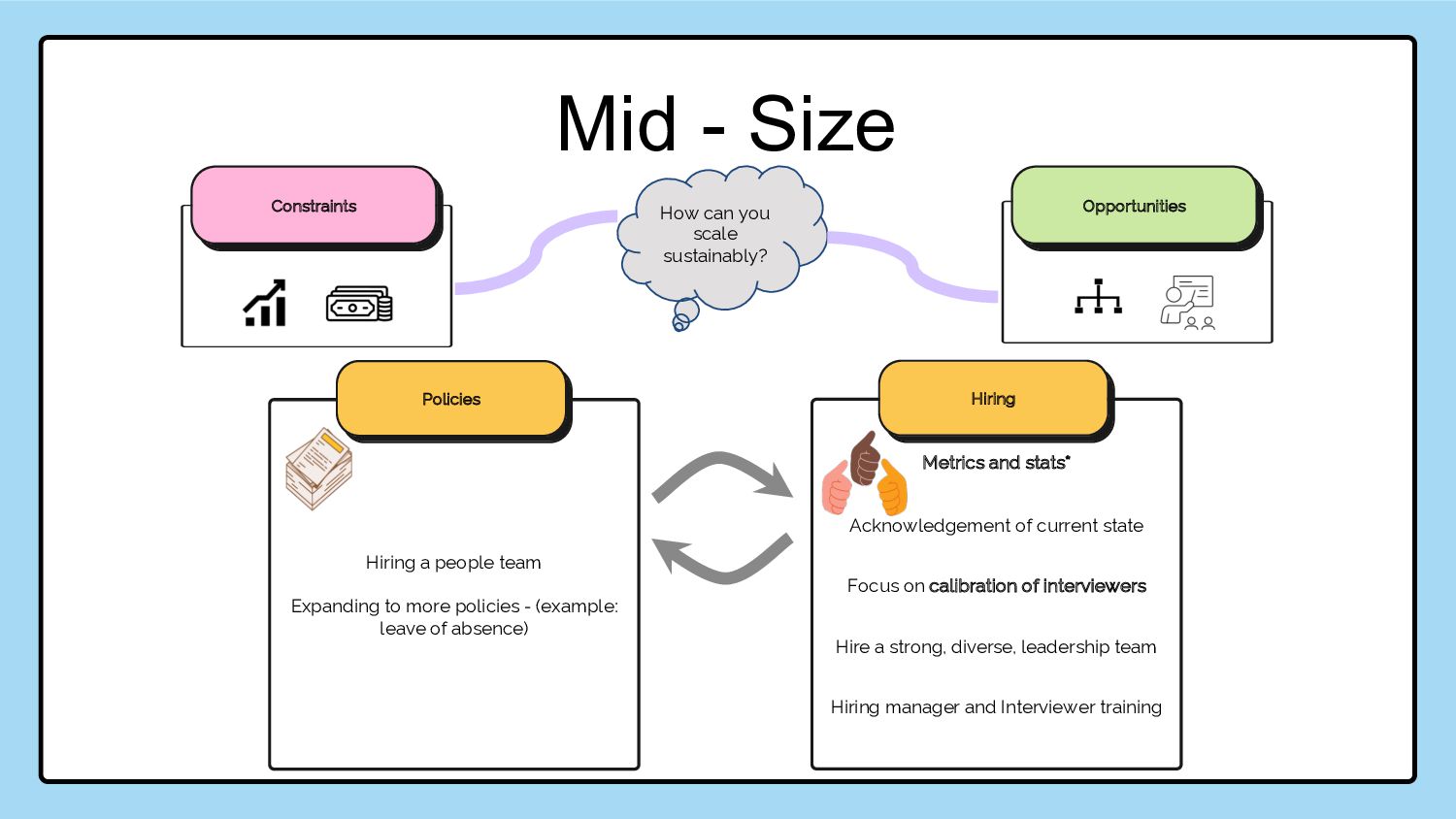
Most companies fail in this stage because they haven't followed through with it. And really, the question you have to be asking yourself is, how can you scale sustainably? Do you have the environment where you can scale? The opportunities here for you is this is the time when you hire experienced leaders and you hire diverse leadership as well, you want representation at this stage.
You want people who deeply care about this issue, who you can trust to make the right choices. And you can trust them to in turn hire other leaders directly reporting to them who again foster that sense of inclusion. You're building a chain of trusted parties that care about the same values that you care about and the base of the company that you built it on.
And secondly, you're looking at training. Because by then, when you're transitioning from early stage to mid sized companies, you're giving a lot of opportunities to internal hires. So you might have someone who graduated right out of college joining you. They were amazing. You've now said, hey, you know what?
Do you want to take on a leadership role? Maybe you want to start managing people. You've given them the opportunity. But did they have the training? They're really good for the job. And they're probably amazing as well to lead because they're a subject matter expert.
But do they have the right training in place to be the best leader that they can be? And training is going to be so critical in this segment of your company's growth. And policies. Again, I spoke about few policies that you absolutely must previously.
And here I'm talking about this is probably when you start hiring a people team. When you're fifty, it's when you don't do it yourself. You start hiring people that can do the job better. And you do what you do best. And then expanding to more policies.
So I can give you an example. One of my team members, they had lost someone in their family. And they wanted to take bereavement leave. We didn't have that. They said, Hey, can I take a month off? And I was like, Yeah, sure.
I don't mind that. But let me just check with our company's policies if that is something we do. But we don't do it. So then what does that mean? I came up with, Okay, we need a bereavement policy or we need a leave of absence.
We need something a bit more structured in place. So people are comfortable taking that and they know that the company supports them. And now in terms of hiring, metrics and stats. This is when you can start introducing it. You can start figuring out how your processes are.
Because when you have a team of ten, it's very hard to find out common themes because everyone might have a very different problem and you're constantly shifting back and forth on which problem you want to solve. But in this stage, when you have metrics and stats, you will realize that there's common themes appearing.
There could be themes appearing that people are dropping off in the interview process early on. People are dropping off after they get hired. You could find gaps that people are not getting promoted soon enough. This is also when you'll realize unconscious bias. You'll come when you have metrics and stats that, oh, wow, Okay.
We have a bias in this company because we're not catering towards this community or whatnot. And the second thing is acknowledgment of the current state. If you're a mid sized company and you haven't thought about inclusion the way we are discussing it now or not as much, you want to acknowledge the current state.
So much happens when you just say, Yeah, you know what? We can do better. We're not there yet. And we should be there. And that goes a long way with your employees because at least they know that you're empathetic. You realize what the issue is.
You're acknowledging it. Hopefully, take action as well and prove it to them. This is the stage when you also start calibrating interviewers. Because previously, when you're early stage, you're probably interviewing every single person. You can see if that candidate reflects the values you want to uphold in the company.
But when you're a mid sized, you don't really have that. You expect people to interview. You want more interviewers. Are they calibrated? Are they calibrated against the values you think are necessary for the company? Do you have a culture interview where you actually talk to people about where they are and your scale and what you want.
And then again, as I mentioned, you want to hire a strong, diverse leadership team. Again, representation matters. And I'm sure I don't have to say it anymore. The last one is hiring manager and interviewer training. So in my previous company, we realized that people didn't know what the job of an interviewer was.
They were going into an interview, Hey, I'm interviewing you. With that attitude of, I'm going to see if you're good for the job. But they're also interviewing you. The candidate is also interviewing the company. And ideally, if I'm hiring anyone, every interview I go into, I want the candidate to succeed.
I don't go ahead who the candidate is. This is the person I want. And I'm going in with that attitude. Because then I'm not trying to catch them up. I'm not tripping them up. I'm trying to really help them get comfortable, help them ease into the interview, and so that they can do the best they can.
And I can see if that measures what we are expecting or not. And they also realize what kind of culture you have in the company. If you put someone at ease in the beginning of the interview and you give them clear expectations of everything you're going to do in the interview and why you're doing what asking the questions you're asking, you will realize people are immediately at ease.
And you will see they do so much better. And such trainings are needed. And I constantly urge you to put together such training. And I can assure you, I've tried it, ChatGPT gives you a great one. It's a great base. It's not the best, but it's a great base.
I actually took rubrics out of CHAD GPT and I completely changed it. But I was amazed to see how well it attributed to certain skills I'm looking for, at least in technical roles. Again, it's an iterative process. It is not exhaustive. Please keep turning on that hamster wheel till you feel like we're all ready to get off.
We're all on the wheel. Enterprise companies. I always thought, Oh, it's a big company. They'll have everything figured out. They have five hundred plus people. They have the money. They have so many people. I'm sure they've got all the inclusive policies that I'm looking for.
It's going to be great. Most inclusive company ever. Then I realized, no, actually. Because to do one small change, I need to jump through so many hoops. And decision making is such a long, tedious process that nothing actually changes. So the policies they have are stuck in time.
The policies they have is from five years ago when they just haven't bothered changing things. And to change it takes longer. So while the industry is changing, while startups are changing, like mid sized companies are changing, enterprise companies find it hard to change.
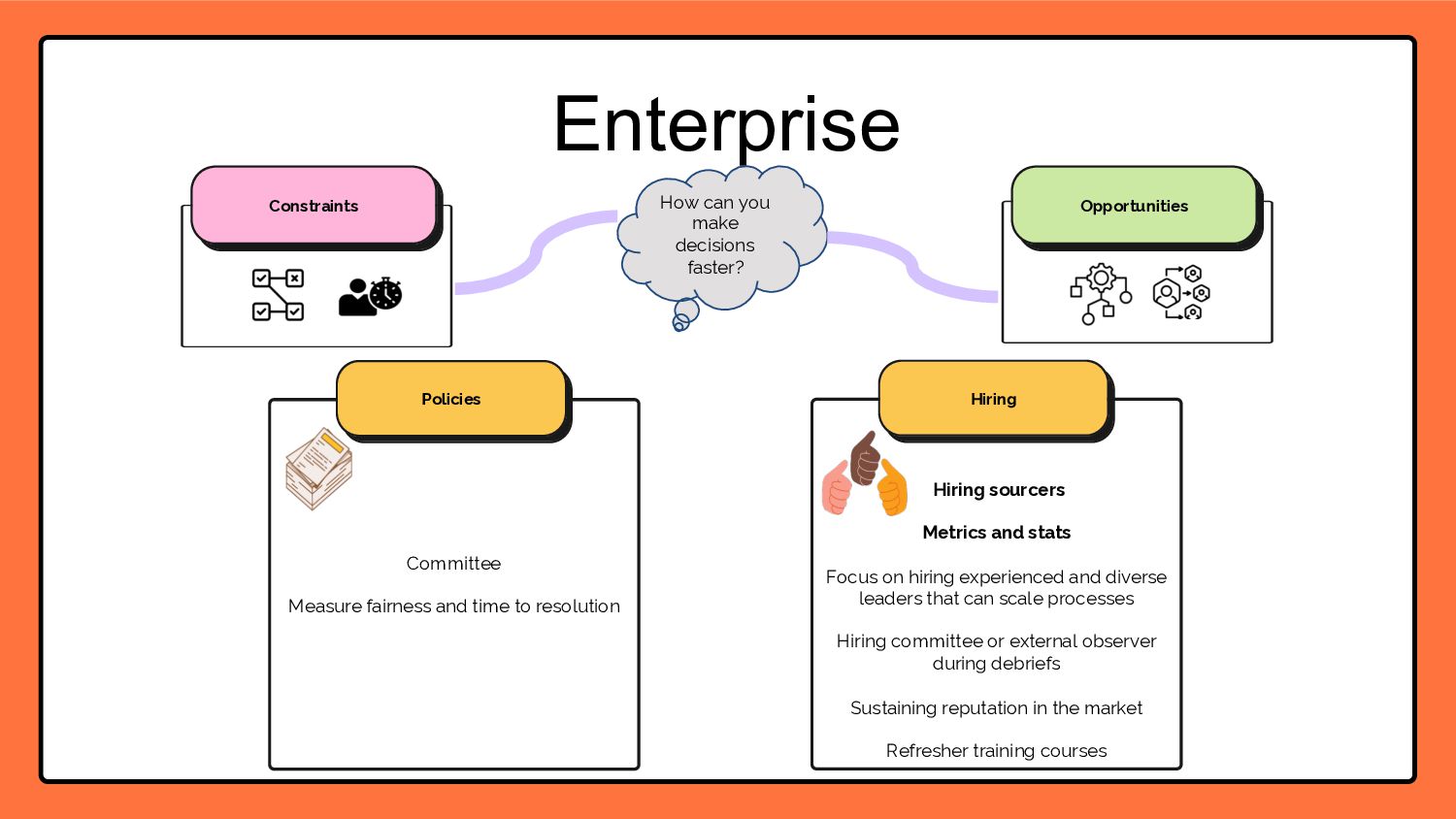
Here, you're thinking about how can you make these decisions faster. And to that, honestly, you have two options. Delegate. Delegate to your trusted leaders. Can't stress that enough. You have to let go of control. I've been at companies which is mid sized trying to become an enterprise.
And yeah, the amount of control that leadership wants, the amount of control that the C suite still wants when they're at that stage, it's not sustainable. You can't do that. You need to trust people. You need to let go. You are not the person leading and doing things anymore.
And that's the mindset change and you need to do that. And the other thing again is decision framework. We all know a good RACI matrix or a good RACI matrix where you have a driver. You know who is driving this project or an initiative.
You have the person who's approving it or who's really going to say, Yes, that's great. Go ahead. Get it done. You have the person who you've consulted who are probably subject matter experts. Have those are the people that are more of FYI. Hey, just for your knowledge, this is what we're up to.
This is a classic matrix. Matrix. But you'll still be surprised how many of us don't implement that when we're trying to do something. We all get confused. Who's making these decisions? Who should I go to to get an approval for this? It is so confusing.
So put together a decision framework and delegate. Please delegate. And the policies here, it's going to be slightly different. Here is when the unconscious bias is going to be at the peak. You'll think otherwise, but no. This is actually when your unconscious bias is at peak.
You need an unbiased committee for every policy that you're implementing, everything that you're doing. You need a third party. You need legal or you need third party that work in the best interest of your employees and not you as an employer. And that's extremely important at this stage.
And the second thing is you want to measure fairness and time to resolution. Again, you as a founder or an employee shouldn't measure it. This committee should measure it and keep track of it and hold you accountable to those. And hiring, this looks very different when you're an enterprise, when you have a large company.
This is the time you hire sourcers. That is fantastic. Sourcers are magicians, if you get the right ones. You want to hire sourcers who can source all the talent, like Skaudia, to find the right person for the role. And then metrics and stats.
They take a whole different level. You'll start seeing people be brutally honest at this stage. Because you have the size of employees where nobody can tell who's who anymore. Even previously, you never should. All surveys are anonymous. But you can still kind of tell when there's fifty people.
Or when there's five hundred people, this is when you're going to start seeing the real teams emerge. People are truly honest and you have a lot of work to do. And you want to focus here again on experienced and diverse leaders that can scale processes.
You should have already had that in your midst, like when you're mid sized. But if you haven't, there's no time like now. And the second one, I think I already mentioned that. Hiring committee or external closer during debriefs. Similar to how you have an external committee for policies, have an unbiased party looking at your debriefs.
Because this is when you've delegated all the hiring, you've pushed it all to so many layers, and you don't know if they're making the right decision. And you don't know if they're having a biased decision. And that external party is there to check your unconscious bias or any employee's unconscious bias and call it out.
Why are we rejecting this candidate? Is it the right thing? They performed really well. I can tell you an example from recently. I was hiring for a role and one of the people in my company came in to the debrief saying that, Hey, so yeah, this interview went well, but the candidate stood like this the entire time.
She was very nervous. How do I react to that? Said, so? What are you trying to tell me? Is that anything I should know about? Why is there even something that people tend to bring up during interviews? Behavioral cues. Doesn't matter. Why do people bring up communication?
Oh, this person communicated. It took time for them to communicate. Why does it matter? Can they do the job? Are they able to communicate well? Do you have any biases that you're exposing towards them? Are you placing it on them unfairly? And this is what I'd expect the hiring committee or the unbiased external party during debriefs to watch out and call you out on that and ensure that you improve yourself.
And the last one is sustaining reputation in the market. This is key. When you're an enterprise sized company, anything beyond two hundred, three hundred, you have a reputation in the market to uphold. One small mishap can tarnish your image. And this is why issues like this are very critical.
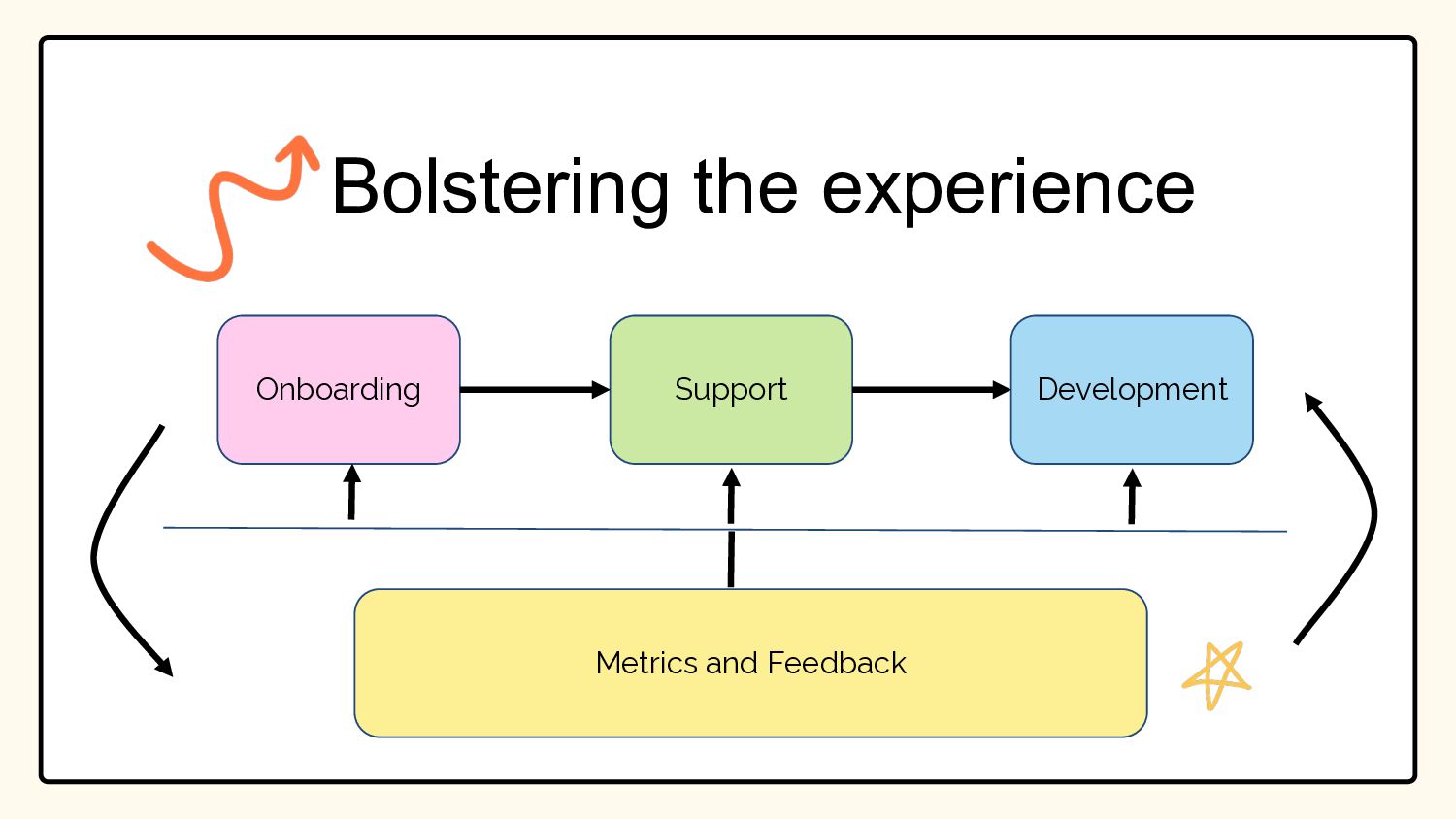
You want to be careful about what you're doing. Okay. So hopefully, you all have an idea of what changes you could make, where you are in the scale of inclusivity in terms of your product building, your base product. And now let's bolster the experience.
Let's take it to the next level. This starts with metrics and feedback. And no matter what stage you are in, you want to be measuring. Whether that measurement has something actionable or not is different. In early stage, you probably won't have those measurements actionable because they're far and few in between.
But you still have to measure them. And what are you going to measure? I think of them in three large buckets. Onboarding. Onboarding is when you have people join your company. And then you have support. Support is, are they well supported? Do they have the right opportunities to grow?
Do they have training courses to up level themselves, upskill themselves if they lack a certain skill? The last one is development. Is everyone growing in a timely manner? If not, is there the right intervention in place? Is there right coaching in place? Are your leaders coaching or are they mentoring?
Are they coaching or are they reprimanding? These are things you want to focus on in these three segments. The way I do it for onboarding, I have everyone who joins my organization have clear I first set clear expectations. What does their three months look like?
What does their six months look like? What does success look like in their role? And ask them for feedback in two to three months. Where are we going wrong? Where are we lacking? How could we improve? And then support. Support and development, I group it in one bucket because I tend to measure time and role.
How many people are getting promoted? When are they getting promoted? Who's getting promoted? Is that a theme there? Are we promoting men faster than we are women? Why? What's lacking? Are we not providing that equity? And that's important to measure. So I constantly talk to people.
So I have one on ones with my leaders who in turn have one on ones with their direct reports. And they bubble up the issues. As well as pulse surveys. They're great and we'll talk about that a bit more. But this is going to be key to your bolstering experience of your inclusion product.
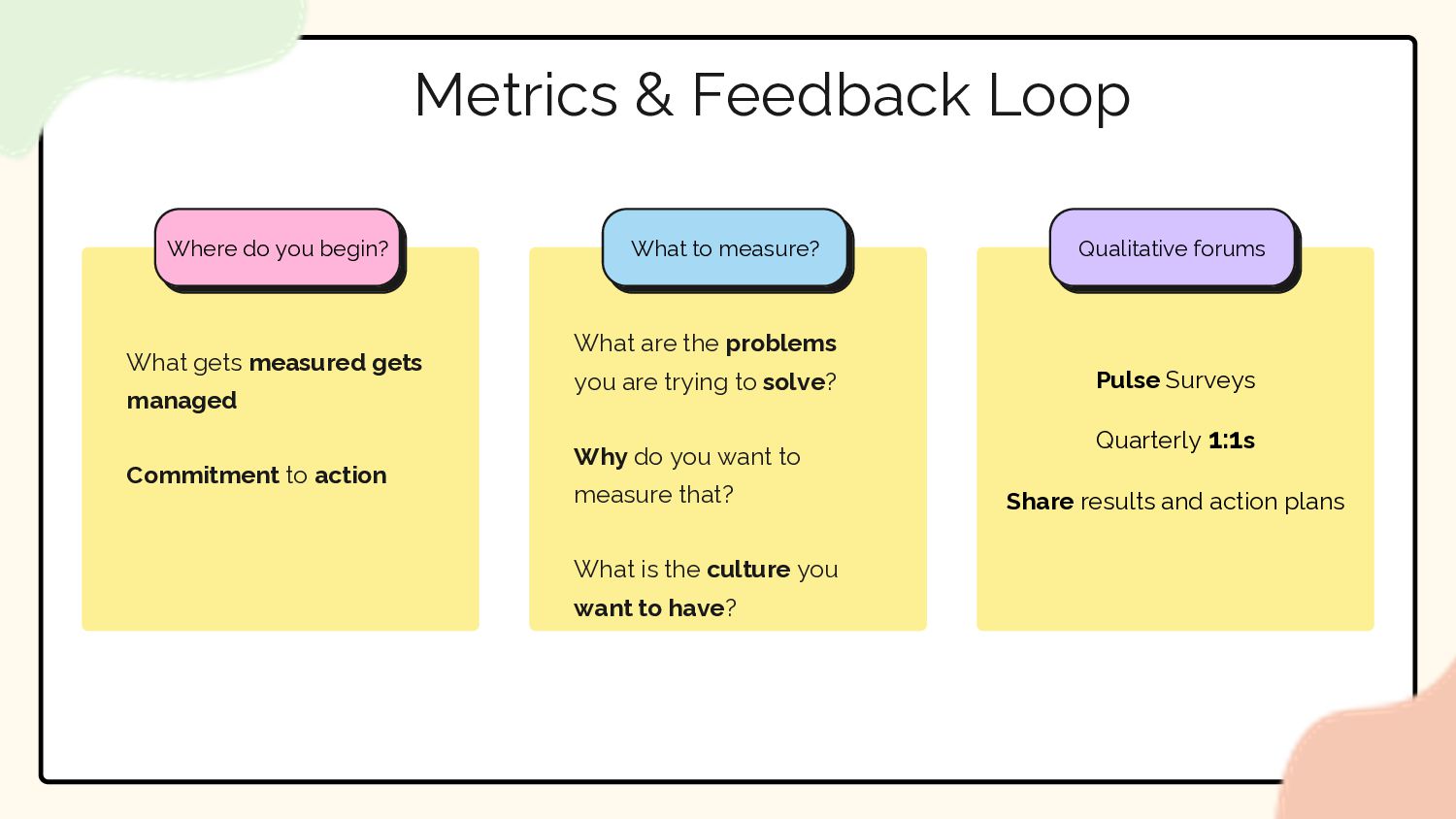
Now let's start with where do you begin? Because you're like, great, I have a product. What do I measure? What do you want to measure? As Peter Drucker said, what gets measured gets managed or you want to commit to action. If you're measuring anything, be ready to action.
Be ready to first acknowledge that you're measuring it. Be ready to state that you are going to take action and improve it for the better. If you're not going to do either of these two, don't measure it. But people will know you're not measuring a key metric that you should be measuring.
What do you measure? I think of them as what are the problems you are trying to solve. Why do you want to solve them? To solving them, what is the impact of that solution? And last but not the least, what is the culture you want to have?
Everything ties back to these three questions. So I'll give you an example of one of the first companies I worked for. We wanted to measure how often people came into the office. And this is way before COVID. And you think, why? Why do I want to measure that?
What am I going to get out of that? The answer was we wanted to build collaborative spaces where people can come together. People can come together, chat, discuss things, be more opinion ated, share feedback, brainstorm. But in order to do that, we needed to know how often people came into work.
So we could figure out we could take a portion of the seating that was desks and put some couches, put some whiteboards there. And that's important. So that's why we were measuring what we wanted to measure. And what is the impact that it's going to have?
It results in more collaboration, which results in more inclusivity. People are able to disagree with each other more respectfully. And people are able to bring their best ideas and put them out there for everyone to see. And that shows the culture you want to have.
But if you're not clear about why you're measuring what you're measuring and what would that result in, you're leaving people guessing. And you're leaving people wondering what you're doing with that data. What are you doing collecting all that information about me? I haven't seen you action anything.
Why did you have to know what my sexual orientation is if you were not going to do anything purpose of the data you're collecting? And we talk a lot about measuring things, which is more quantitative. But there's also qualitative forums. And this is where pulse surveys come in.
I'm not sure how many of you have responded to a pulse survey or sent out a pulse survey, but that is one of the best quarterly surveys that you should be sending out. It is simple questions such as, how do you enjoy working at XYZ company?
Do you see yourself working here in two years? Do you like your manager? Does your manager give you enough advice for your career growth? And absolutely anonymous. This has to be anonymous. So you let people give their honest opinion about it. And then quarterly one on ones.
This is much harder to do if you're a larger company. But you can delegate this to your trusted leaders. So if you're an early stage, if you're less than twenty people, I suggest you as a founder have chats with every single person every quarter, at least once a quarter.
Chat with them about how they're doing. Chat with them about how you can improve. Chat with them about what are the gaps in the company. If you're a mid size or a late stage like company, then you want to delegate that. Delegate that to your leaders who can then have one on ones with every single one person in their organization every quarter, and you bubble it up.
And you're constantly thinking about where you need to grow as a company. It's not just the products you put out that make the money. It's the people that put out those products. So you need to focus on the people. And the last one, which I've seen many companies not do.
I've actually filled out at least three surveys in my first company, and I didn't know what they did with it. I had no idea. I got no response as to what that led to. This is important. When you send out a survey, make sure that you follow-up.
Make sure that you're telling them these are the results. And these are the action plans we are going to take. And be honest about what you're not focusing on. So for example, I had feedback on communication within my organization. People were getting into silos.
There were ten meetings to solve one problem, which could have been literally been an email. That was one of the big themes that came out. And onboarding was another team that came out. You can either try solving all the problems that come out of these surveys or you can solve one by one.
But make it clear what you're going to solve. So what I told my team was, we are going to solve the problem of communication this quarter. Let's take that action item. What are ways we can make it better? What are some of the silos that we can destroy?
And make sure that we're all sharing knowledge regularly and outside of meetings by emails and asynchronous communication. That's that's why it's important. Share your action plans and tell them what you're not working on. The key of that message was not just what I was working on, but also what I'm not.
Make that clear because no one's left wondering. No one's left wondering, wait, you told me that there's issues with onboarding process, but you're not doing anything about it. Well, yes, we'll take it another time. Make it clear. Okay. I'm actually done. Let's wrap it up.
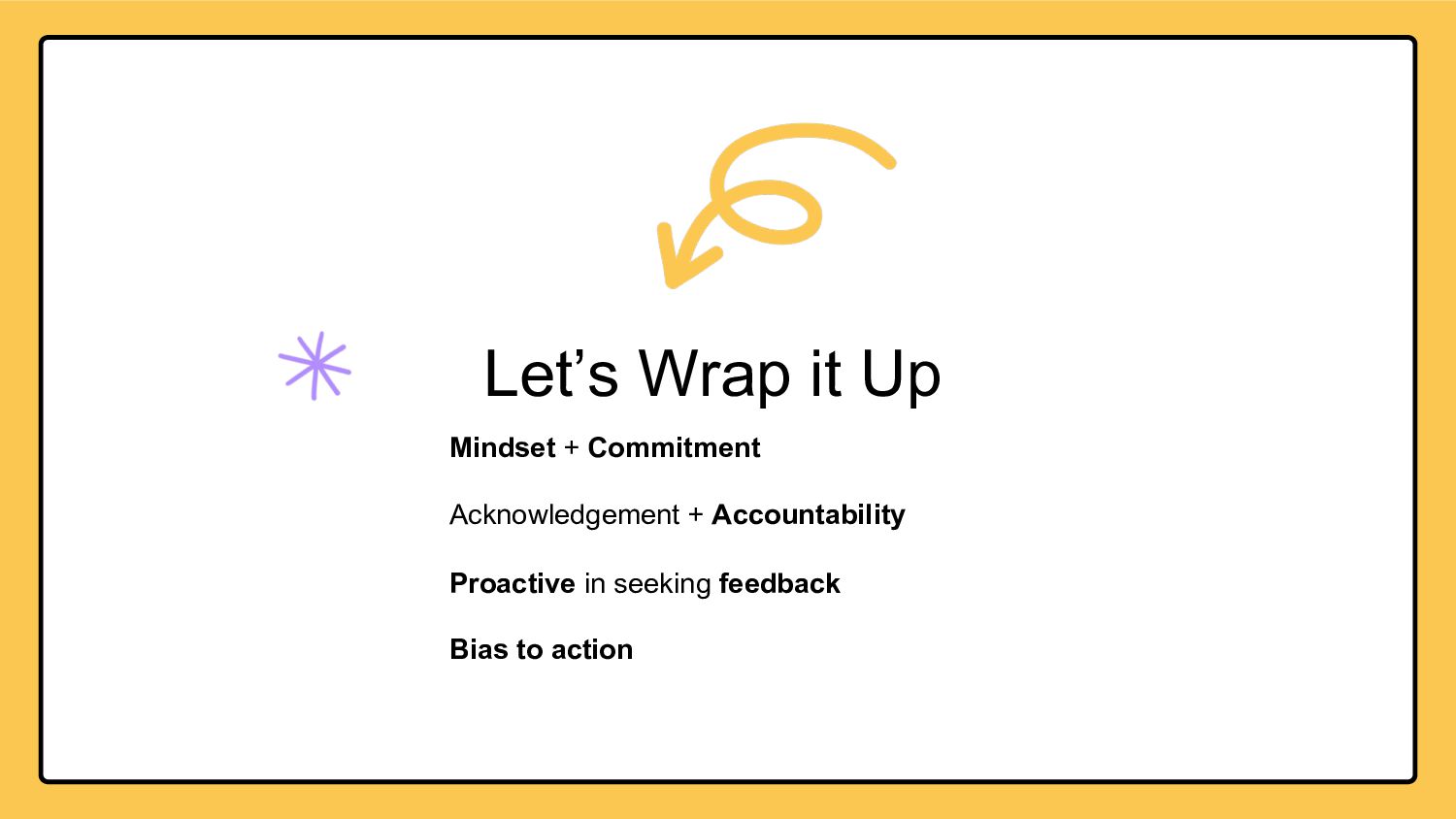
First thing, mindset and commitment. None of this is going to change if you do not commit and have the mindset to get your workplace to a more inclusive state. The second one is acknowledgment and accountability. Do you acknowledge the state of your company?
Do you acknowledge that you have a long way to go? And do you take accountability for it? Or do you deflect it? Do you say there's not enough people in the market? Which is definitely untrue. Third one is proactive in seeking feedback. Seek feedback constantly.
Always continue to improve. And the fourth one is bias to action. Again, we can talk about it. We can write about it. We can even come up with plans. But if we don't execute them, if we don't implement them, nothing changes. So you need to have a bias to action.
And I strongly urge you all to do that. We have some time, so I would love for you all to think about the state of your company. What is the state of inclusion in your company? Do you feel included? Do you know someone who doesn't feel included?
And what is one thing you can do to change it No matter who you are. You could be the founder. You could be an employee. What is one thing you're going to action? And I'd like you to kick it off today. I'd like you to put that in your notebook.
Then I'm going to if you're a founder, set some time for yourself. I'm going to solve this issue. If you're an employee, put that meeting with the person that you need to have that discussion with, the person that you need to give that direct feedback to.
Do it today because the answer to every time someone says, when should we have had inclusion? It was always yesterday. So today is already a bit too late. So don't delay further. Thank you. That's awesome. Thank you so much, Angela.