
Within customer success, you’ll often hear founders and CEOs say ‘I’d love to scale my CS program and make it a revenue center”, in fact it’s probably something you’d like to do at your own organization. When investing in a customer success team that is focused on revenue growth there are 4 things that every startup and scaleup should consider: people, process, tools, and repeatability. In this talk, Anika will discuss the top challenge most startups, scaleups, and enterprise B2B CSM teams face when scaling for revenue growth and share the tips, tricks, and learnings they have encountered in their career and how to overcome them. Ultimately this talk will help you make customer success work at different stages of revenue growth for your business.
Customer Success for Revenue Growth: people, process, tools, and repeatability
Auto-generated transcript - may contain errors. Tap a timestamp to jump the video.
Thank you for that lovely introduction. I'm super excited to be back at Turing. I was here in twenty one, but it was the first one after COVID. So it's so nice to see Turing back in full force. As already mentioned, I'm gonna be talking about customer success for revenue growth and talking about people, process, and tools and repeatability, which I think are the four pillars of how you're gonna get your customer teams into a revenue state of mind.
Mind. And I have the joy of being one of the few speakers that are talking about the customer side of the business. Now I know Turing is usually really focused around product and marketing and product led growth, but what's really funny is you're building product for a customer.
Right? And you're also marketing to customers. But we forget that customers actually hold the majority of revenue and cash for our business. And I think a lot of times in business, we we tend to forget the value that is extremely important when it comes to investing in your customer success teams, but also how do you even build it?
Where do you start? What do you do? How do you end up being in the revenue side of customer success? So a short introduction of me before I jump into everything, Anika Zubair. The accent is misleading because I am Californian, but I've spent the last twelve years in Europe, four years in Berlin, Germany, and eight years in London.
So I am California, but I'm also British, and I'm waiting for that accent to come in. But I am super lucky, excited, and I guess, had the joy of being at a number of startup and scale ups. My two most recent roles was VP of customer success at Carbon, a B2B SaaS product, as well as Incited, another B2B SaaS product that was recently acquired by Gainsight and Vista Equity Partners.
So, I have seen the gamut of startup scale up and customer success from pre Series A all the way to acquisition. And that's what I really want to talk to you guys about. Two other things I'm just gonna say is I do have a podcast.
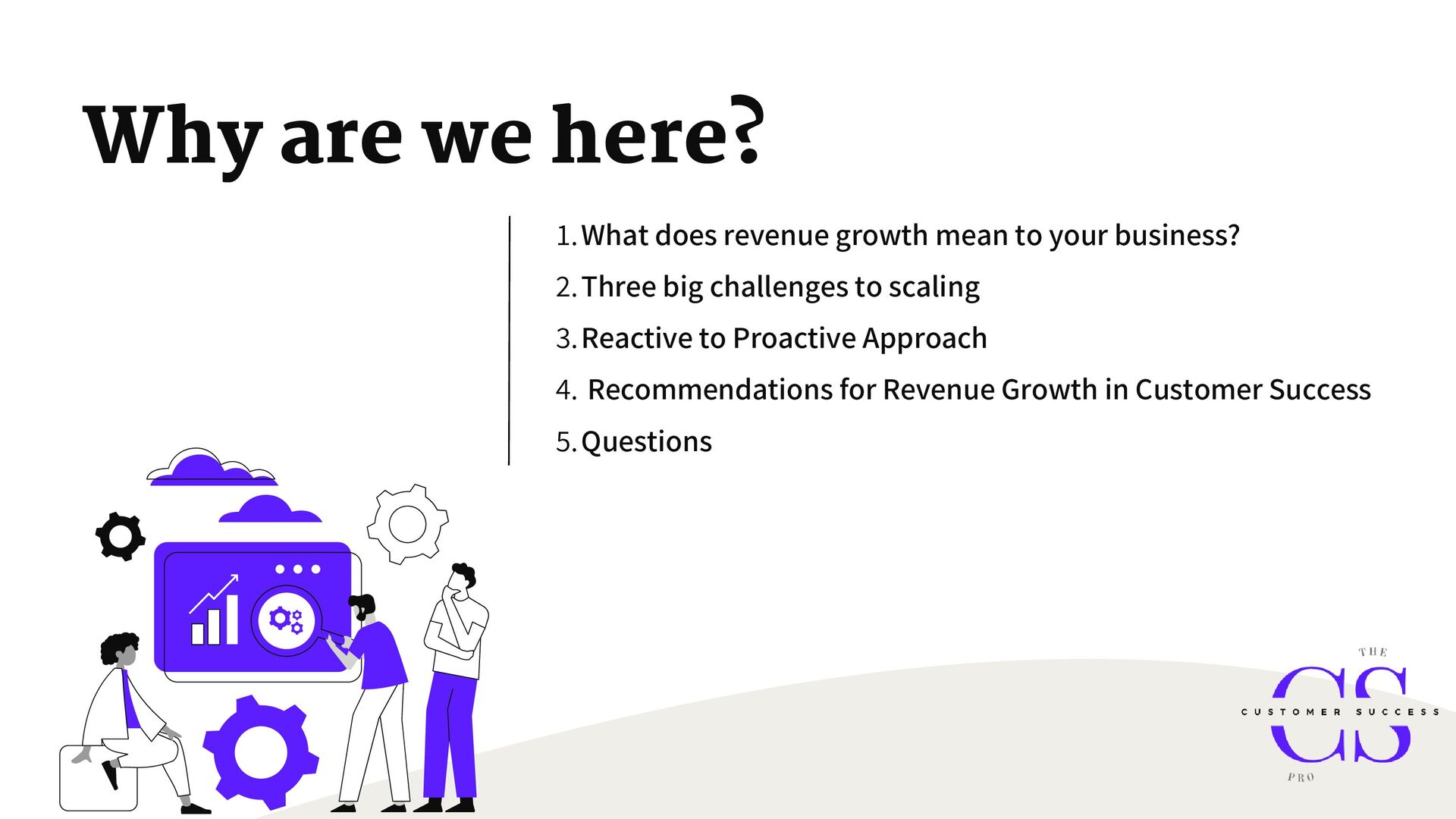
A lot of people recognize my voice before they recognize me. So if you wanna hear more about customer success, I have the customer success channel. And I also am an award winning leader as well. So on that, why are we here? You guys could go to a number of different talks today, and I wanna make sure you guys are getting the value of what you're here to learn about, which is what does revenue growth mean for your business today, the three big challenges to scaling, a reactive to proactive approach,
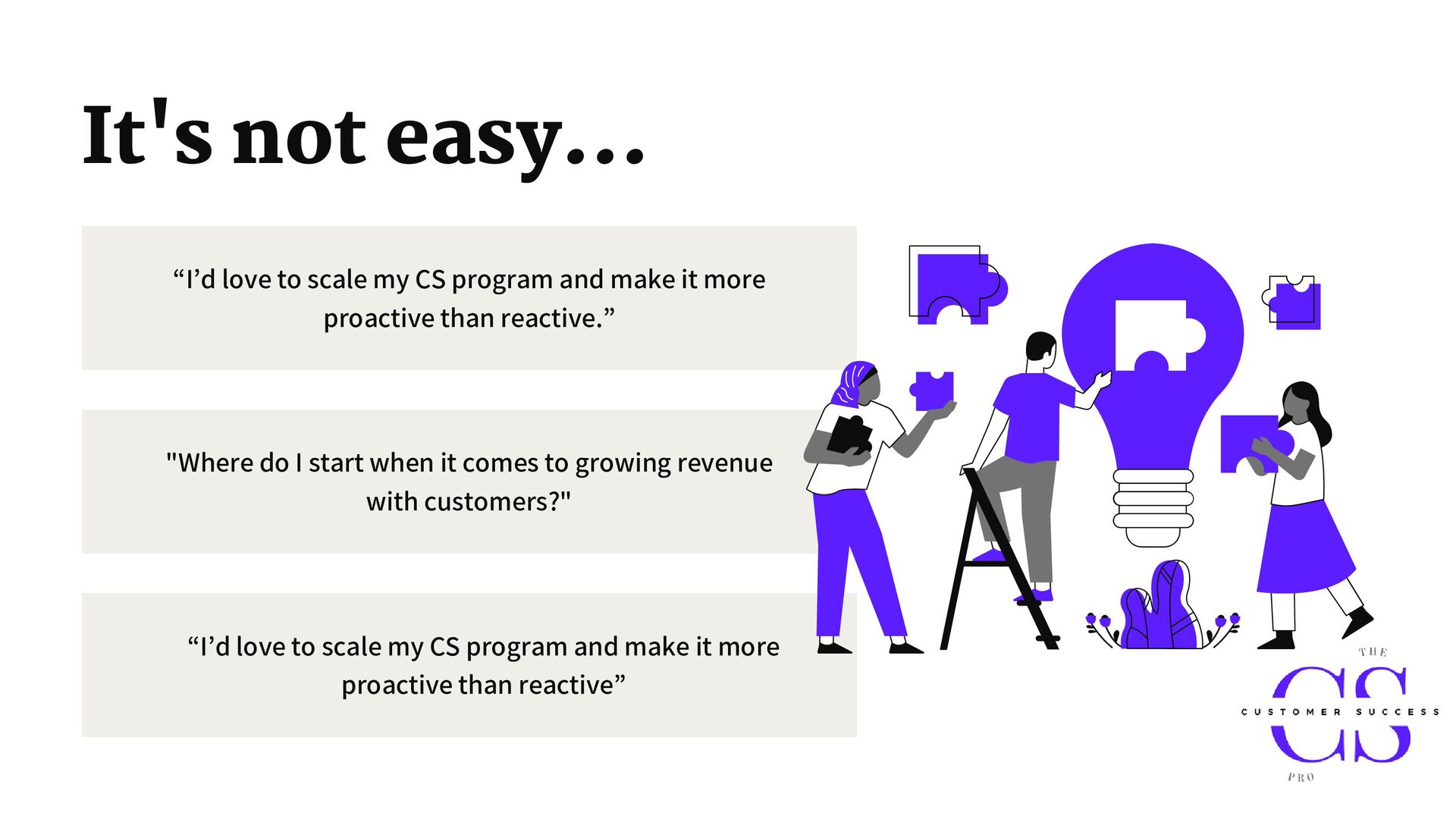
and then recommendations for revenue growth in customer success. And then finally, the question side, which will be at the round tables, which if you guys do have questions, I'm happy to answer or chat anything customer success after, this talk here. So just to be really clear, it is not easy.
I work as a customer success consultant currently, and I have founders, CEOs, fellow leaders always telling me things they wish they could be doing. Some of the things is I wish I could scale my customer success program and make it more proactive rather than reactive.
Another thing that I hear very often is where do I start when it comes to growing revenue from my customers? And then, again, I'd love to make my CS program more proactive. That is just the number one thing I hear, because a lot of people are reactive to customer needs, whether it's support tickets, a bug, something's gone wrong.
But how is it that we can engage our customers in a meaningful way that we're able to drive some sort of revenue from that customer growth as well. So really quickly, what does scale mean to your business? This could be a number of different things depending if you're an early stage startup or if you're moving into the enterprise space or if you're prepping for IPO.
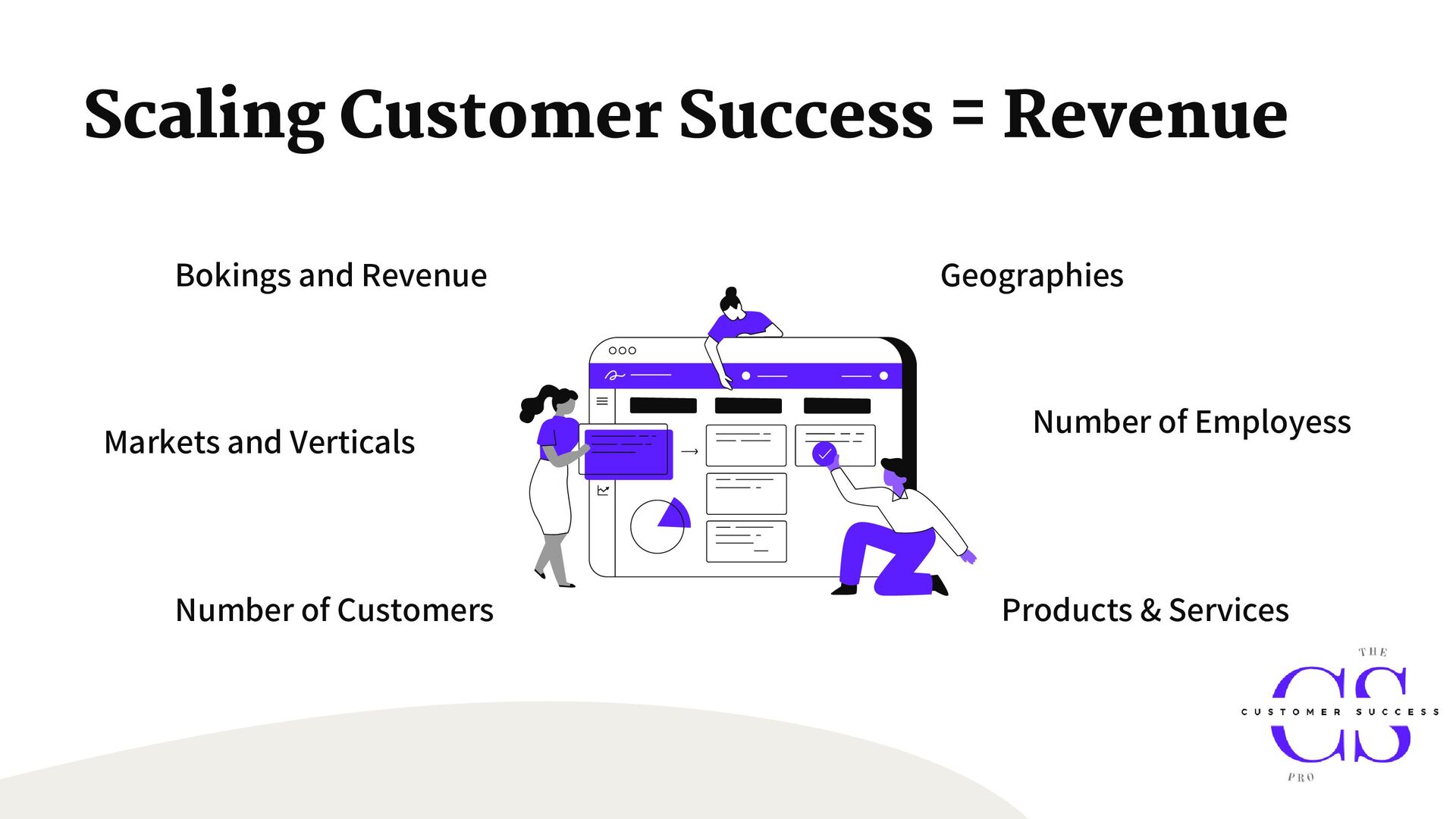
It means a lot of different things at different businesses. So what that means in my experience and then you're scaling customer success is it has a lot to do with a number of different things that you see on the screen right now. But for me, scaling means moving into new geographies.
It also means the number of employees you actually have at your business or the number of employees you're looking to hire. Your products and services, because sometimes you can start as a single product software, and you can move into multiple products or multiple different services as well.
Another thing that very much contributes to your revenue growth is obviously the number of customers you've now acquired. And then markets and verticals, very important. You might be someone who's based out of Europe here, and then you are expanding into North America or APAC.
Or maybe, again, you've started in insurance as your number one customer and vertical, but then maybe you're moving into some other vertical as well. So growth and scale can mean a number of different things at your business. But at the end of the day, when you are scaling, it is going to equal in some way revenue.
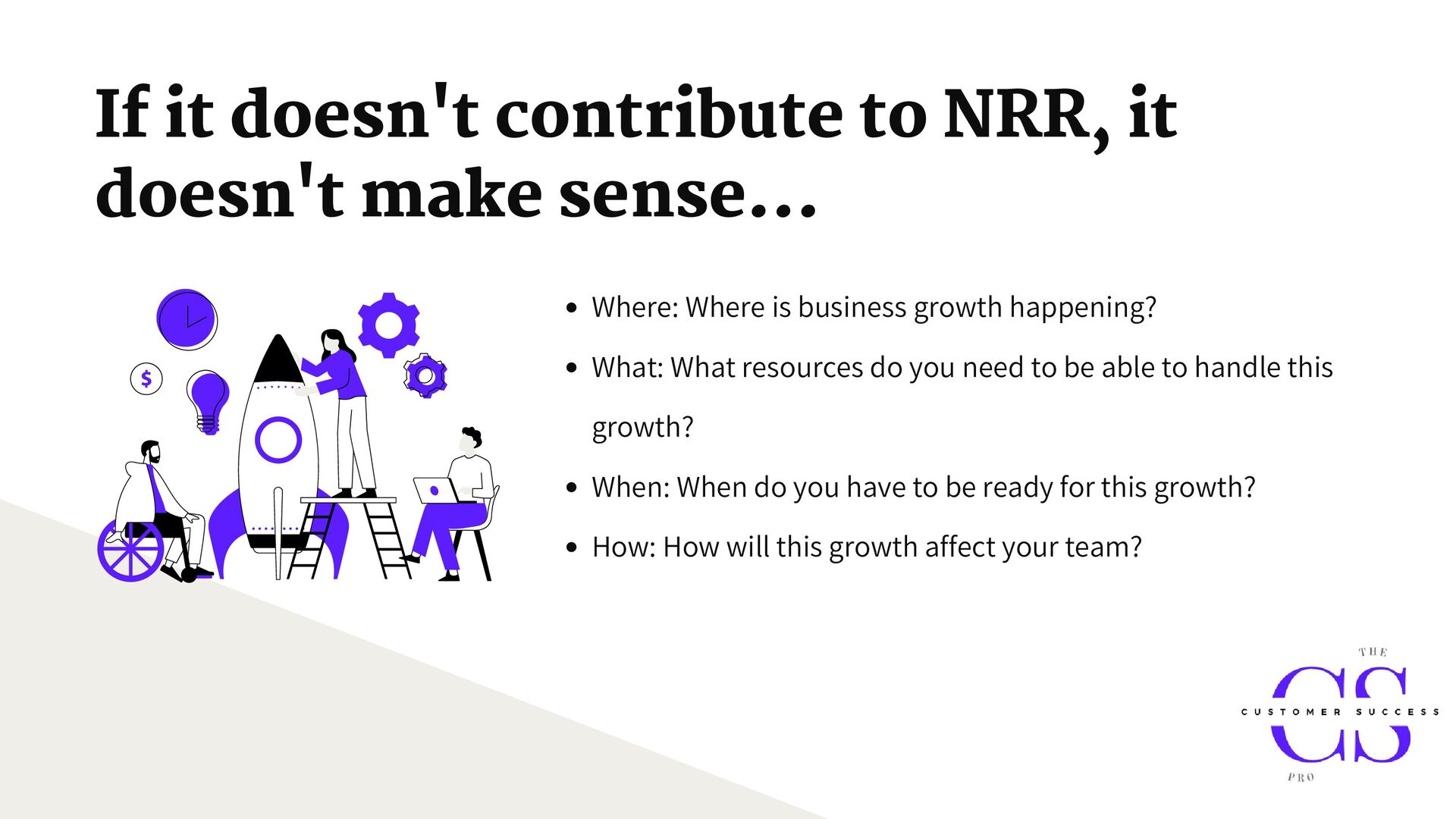
But it depends on which bets you take, which is what I'm gonna talk about as well. And that being said, if it does not contribute to NRR, it does not make sense. So a real quick poll here. Does anyone know what NRR actually stands for in the room?
Oh, one. Oh, I love it. Okay. NRR is net revenue retention. So what that means is really how many of your customers are leaving and then how many are growing, and that is the net result. So really it's the money at the end of the day.
So if you had ten million at ARR today, so annual recurring revenue, and you lost about, let's say, a hundred thousand of that due to customers leaving, but you actually gained two hundred thousand in upsells, cross sells, and more revenue growth from your customers, you're gonna end up with an NRR over a hundred percent.
And that is what leading SaaS software companies are doing. A great example, Zoom. Another great example, Snowflake. They are actually growing their customer base ten x, three x, whatever the x is. They are growing more than they are losing. So if your business is not doing something that isn't contributing to net revenue retention or net dollar retention for the US people in the room, that is not going to make sense for your business.
So the questions I would want you guys to ask yourselves is the where, the what, the when, and the how. So where is your business growth happening? Is it in acquisition? Is it in customers? Really figure out where is that growth happening. Next is what.
What resource do you need to have in order to make sure you're fulfilling that growth metric? And then when. When do you have to be ready for this growth? I think a lot of people think, you know, in the future, someday, it'll be nice to have.
But more likely than not, the when is now. And then how? How will this growth affect your team? Some teams start as little as ten people, but then you might be a thousand in a few years. How is that growth gonna look like at your business?
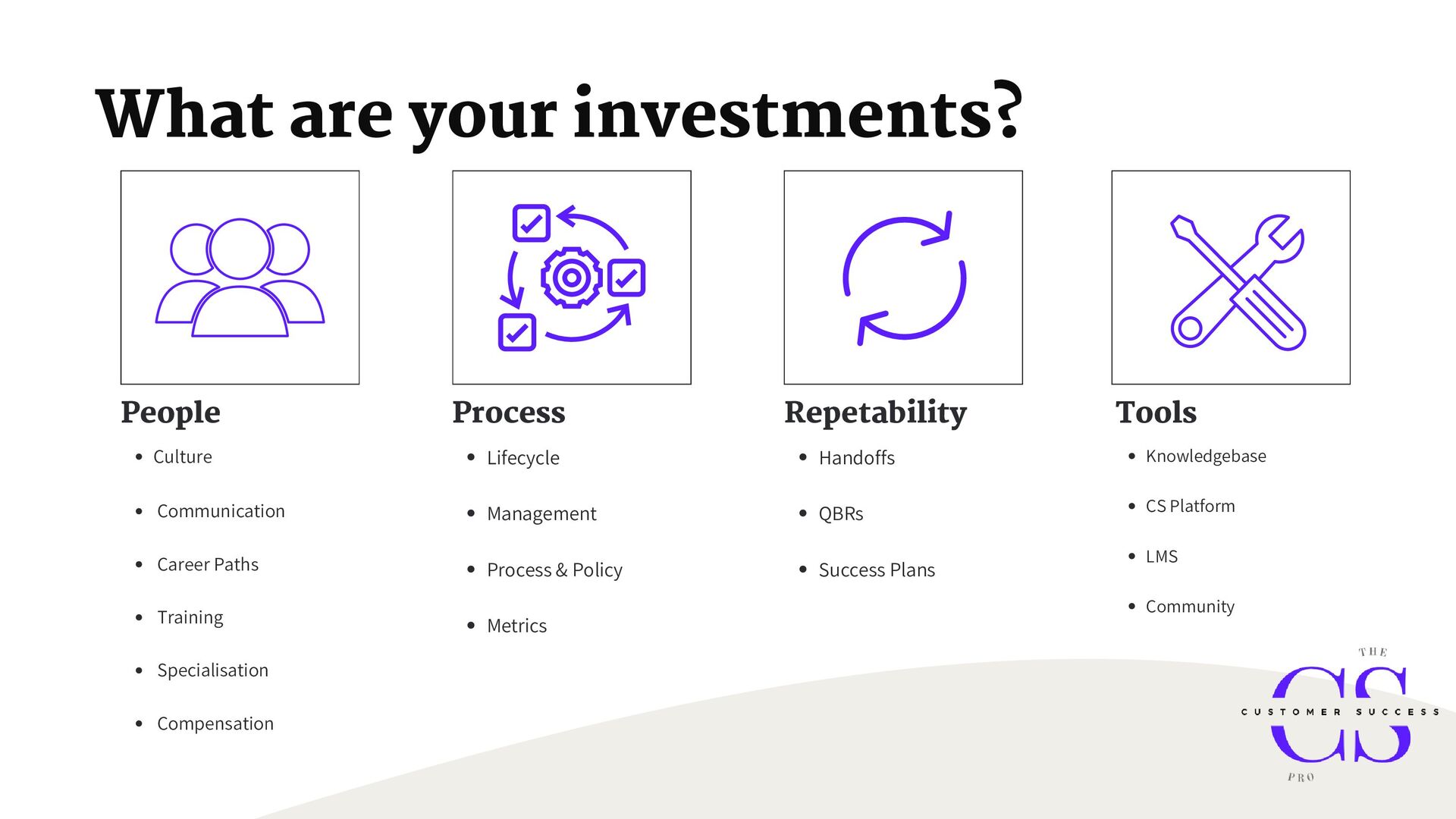
The next thing that I would love to make sure that everyone focuses on is what are your investments? Because all those things that we were talking about, all that growth that you're thinking about, there are four steps that I think, when you're thinking of customer success and revenue growth, that are extremely important.
And the reason they're on the screen in this order is because I very much believe, at the five startups I've been at, that this process, like, this flow is the most important to follow. The first is people. So I think investing in the right people, whether that's an individual contributor or a leader or someone who's done it before or someone who's doing it for the first time, you need to start building the people around what it is you're doing with your customer teams.
What does that mean? That means the culture, the communication, career paths, training, specialization. That also means compensation because I think a lot of that comes back to your people. And I do think that that is the most important pillar and the first pillar you should focus on no matter what size of organization you are.
The next is process. I very much believe when you have the right people in your entire organization, you start building a process around it. What does that look like? Like, life cycle management, that looks like team management, that looks like process and policy, that looks like metrics.
Because if you don't have those sort of process in place, you're never gonna see success with your your customer success teams. Next is repeatability. So when you want to grow and you are thinking of that growth engine, you need something to do over and over and over again, and you need to build that process before you get into repeatability.
So I would say you need to have strategic quarterly business reviews with your clients. You need to have a said sales to customer success handoff, and you also need to build success plans with your customers. And the final piece, and I say this last because I think a lot of companies will be like, if we get this customer support tool or if we get this CRM or if we have this knowledge base, everything will be fine with our customers.
Tools is last. Tools is absolutely last. And a lot of people ask me this because they're like, oh, what is it that I should put in place so that my customers can self serve? Or what is it should I do to make sure that my customers understand our product, whether it's a video knowledge base or some sort of ticketing system?
My number one thing to this is until you have people, a process, and a sense of repeatability, the tool is gonna do nothing for you. Because if you buy a tool, like today, let's say you go buy a CRM software and you have no customers to put in it, no data to put in it, or no one's even actually use the tool, what are you doing with it?
So I always say that this flow is usually the most strategic in ways that you can end up with the revenue growth within your customer team. The next part I wanna talk about are some of the challenges that you are gonna face when you're thinking about customer success and as a revenue center.
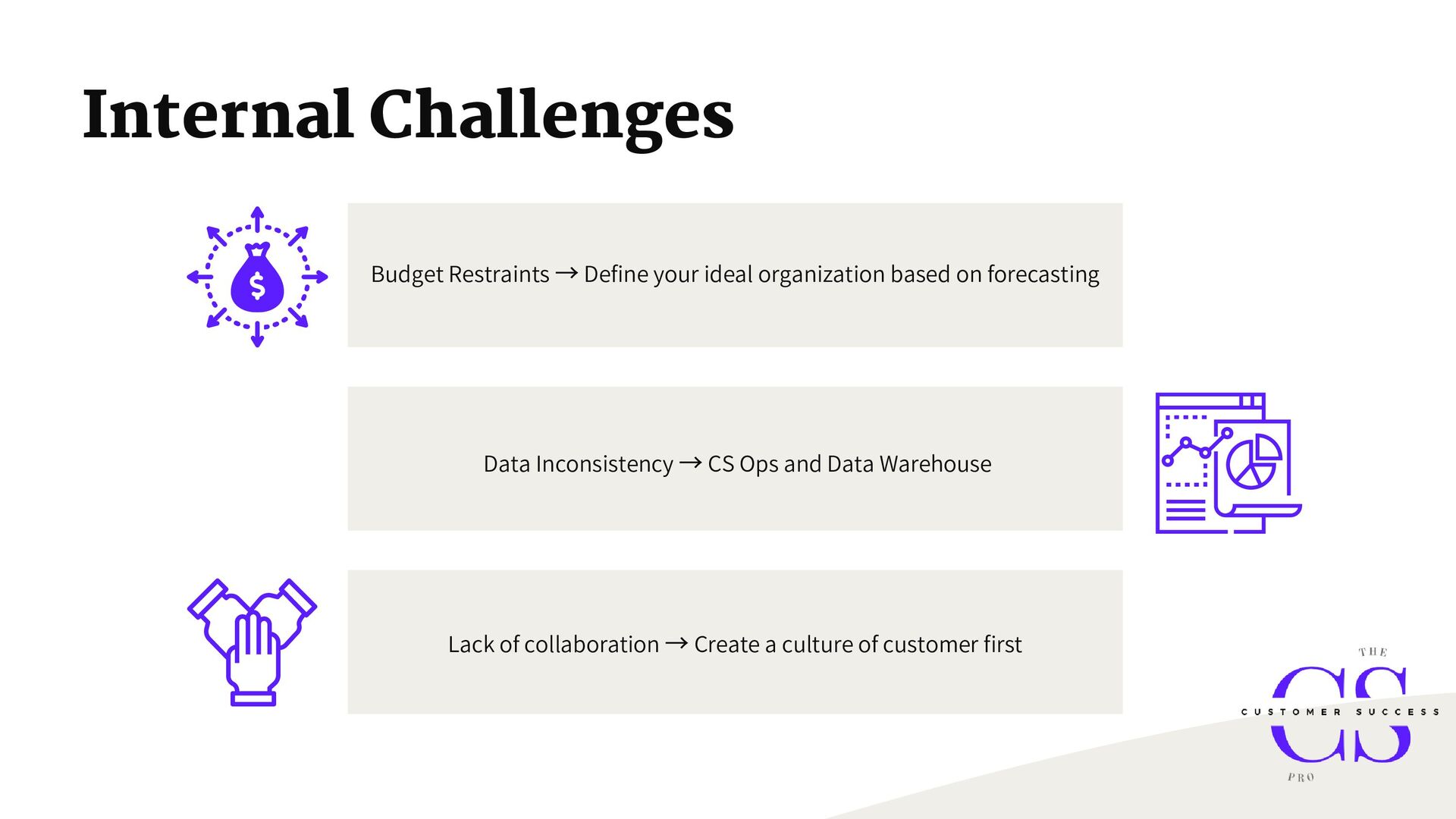
The first is budget restraints, now more than ever. I think in tech, we're in a very interesting place where everyone is watching their budgets. A CFO is not gonna grant you everything that you want or need to grow your revenue center. And I my challenge to this is define your ideal organization based on forecasting.
So much like the sales or marketing team has a quarterly revenue target or they're trying to say, okay. This quarter, we're gonna hit hundred thousand in new business or a million in new business. Well, if your sales are forecasting this, then you should be also forecasting what your customer team will be doing as well.
So if you have a million in in new net new revenue, you should be also thinking about how are you going to support that one million in net new revenue. Another challenge you're probably gonna see in the customer side is data inconsistency, and this is really common.
I'd say more companies than not. I have yet to walk into an organization where they were like, hey. Here's all your customer data, and it's perfect and fine, and everything is great. Because if anyone has a company like that, I'd love to be a part of it.
But more times than not, you're gonna see data inconsistency, and you're gonna see things like missing missing customer names or product usage metrics that don't align or, actually, customers that aren't even with you anymore. And my solution to this or my challenge for you to take away to your teams is have a CS ops person or someone in operations or data really leverage this for you because another part of what I'm gonna talk about is it is key to know your customer.
Yes. You can know them through conversations, but the data at the end of the day is gonna tell them how they're using your product. You can build a brilliant product, but if you're you do not know how your customers are using it, then then what's the point?
What are we doing here? And the last part of an internal challenge is a lack of collaboration. So I like to say at every organization I'm at, if you are at this company I know the salespeople might say otherwise, but you're at this company, you're part of the customer team.
Everyone's gonna say everyone's in sales. Right? Great. Everyone's selling the product and business, but we have customers. They are using our product. We are marketing to our customers. We are trying to keep our customers. We're trying to support them. So I like to say that you need to create a culture of customer first.
Now what does that mean? I think a lot of businesses wanted the idea of customer first. And it's really important to think of, like, hey. What what are we building for our customers? Or how is it that we're fitting this into a market problem at the moment?
But a lot of people forget to put the customer first. And I say this because I have firsthand experience where everyone's like, yes. We're customer first. But customer first really means, are we building for our customer? Are your product teams on a customer call?
Can I get a raise of hands? Anyone in product here? No? One So a few. Can you let me are you guys also on customer calls by any chance? Yes? Yes? Amazing. Already ahead of the game. But I think that a lot of times to build that customer first environment is actually getting people to speak to your customers.
I say the same thing of every CEO. I challenge anyone in here that is reporting or knows their CEO. Ask them, have you talked to our customers this week? Have you actually gotten on a call with a customer? Because the only way you can build a customer centric environment is by actually talking to them.
We can look at all the forecast, all the metrics, everything we wanna look at. But if you're not speaking to them and you're not actually hearing what they have to say, it's an echo chamber. And your customer team is gonna end up in an echo chamber if you aren't getting your engineering, your product, your marketing, your sale well, sales and marketing talk to customers a lot, but I'm just saying the whole business does have to talk to your customer.
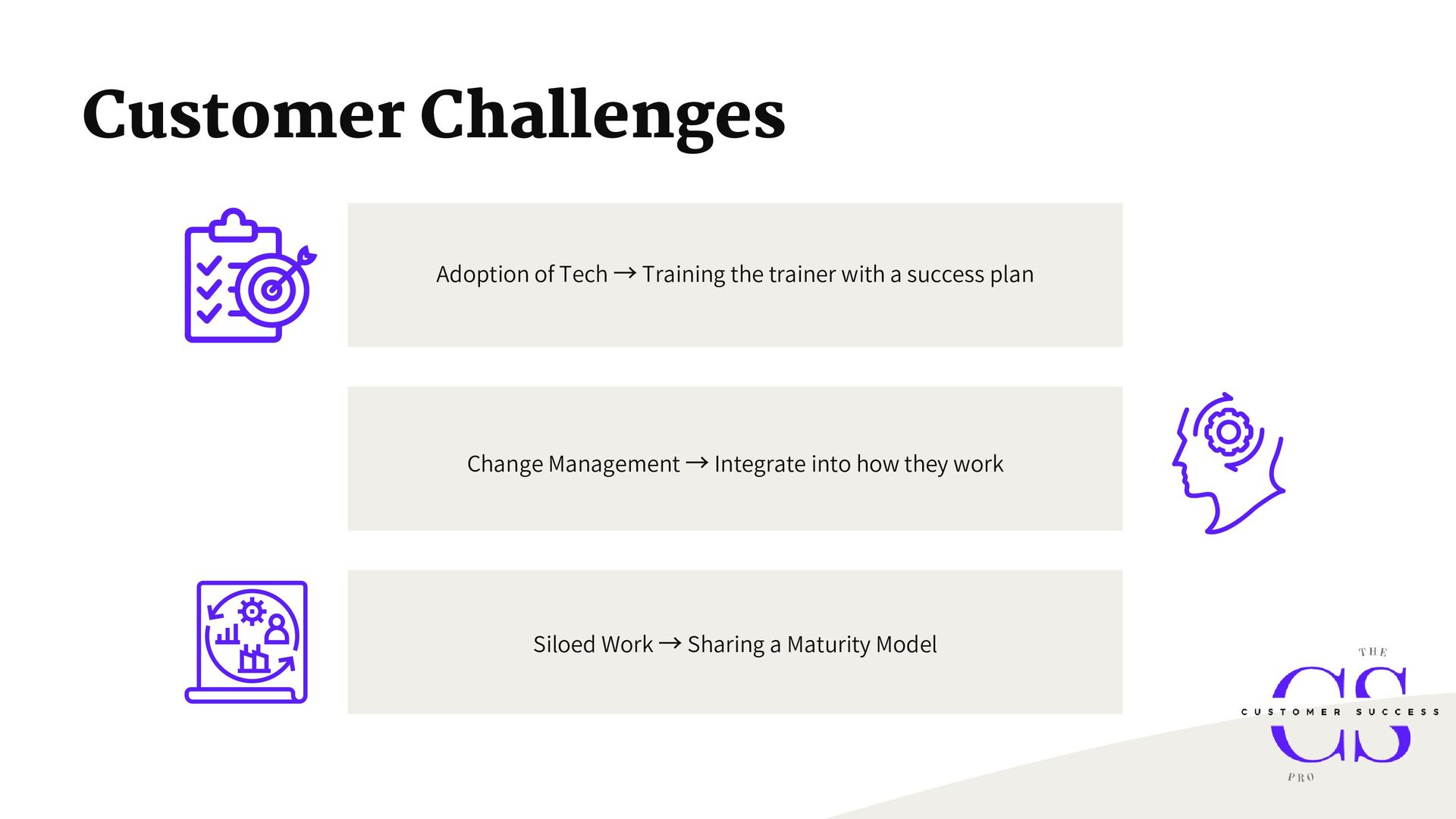
Now some of the customer challenges that I see that happen quite often is adoption of tech. So I think that we live in a very interesting era of SaaS and b two b or just SaaS products where customers are not just buying your product and just paying for nothing.
We're no longer in perpetual software anymore where you sell to a customer and that's it. You have to now get your customer to not only onboard and use your product, they have to love it. They have to be using every new feature you release.
They have to really be onboard. And this takes time. It takes patience, and it takes the customer team to be there to involve themselves. And I think that you definitely have to do some sort of success planning with your customers. Now a lot of businesses say, okay.
We'll onboard the customer, and that's enough. It's a first step, but I think the longevity and the success of your customer is not about the first three months. It's about six months or six years after they have onboarded. You have to really think about, if you're releasing a new feature, how are you educating that customer?
How are you ensuring that their goals when they bought your product are still aligned to this new feature release? All of that comes into play when you have a customer success team that has a success plan with your customer's goals at the heart of that plan.
The next customer challenge you're probably gonna face is change management. And this happens a lot with software that has, let's say, people that are less accepting of adopting tech into their into their day to day business. I've worked at companies that sell to accountants, for example.
They're great people, by the way. Your accountant's amazing. They love partying, but they are very difficult to adopt when it comes to tech. They are really, really tricky. I mean, I think about back when before QuickBooks. I'm like, they used to do things in just Excel sheets.
And so if you think in that way, you need to do change management with your customers in order for them to really understand your software. And when they understand more of your software, they are going to end up with that revenue growth piece for your business because the more of your software they use, the more that they end up spending likely with you as well.
And then finally is siloed work. A lot of times with our customers and the way that we interact with our customers, we're working with one champion or one person within that customer within that whole organization and sharing a maturity model and how a customer can actually mature with your software.
What do I mean by that? So share best practices. In thirty days, you should be doing x y z with our product. In ninety days, this is what you should be doing. Customers love knowing a road map of what it is that success looks like with your product.
I'm telling you, most of your customers, they buy your product for one reason or another, and they usually are like, yes. We're gonna solve this problem. But there are so many other problems that your product can probably solve for your customer that they have no idea about.
And the only way that you can do that is through constant education, but also showing them what does a maturity model look like with our product or what does a road map look like with our product. Coming back to the data piece and also the maturity model.
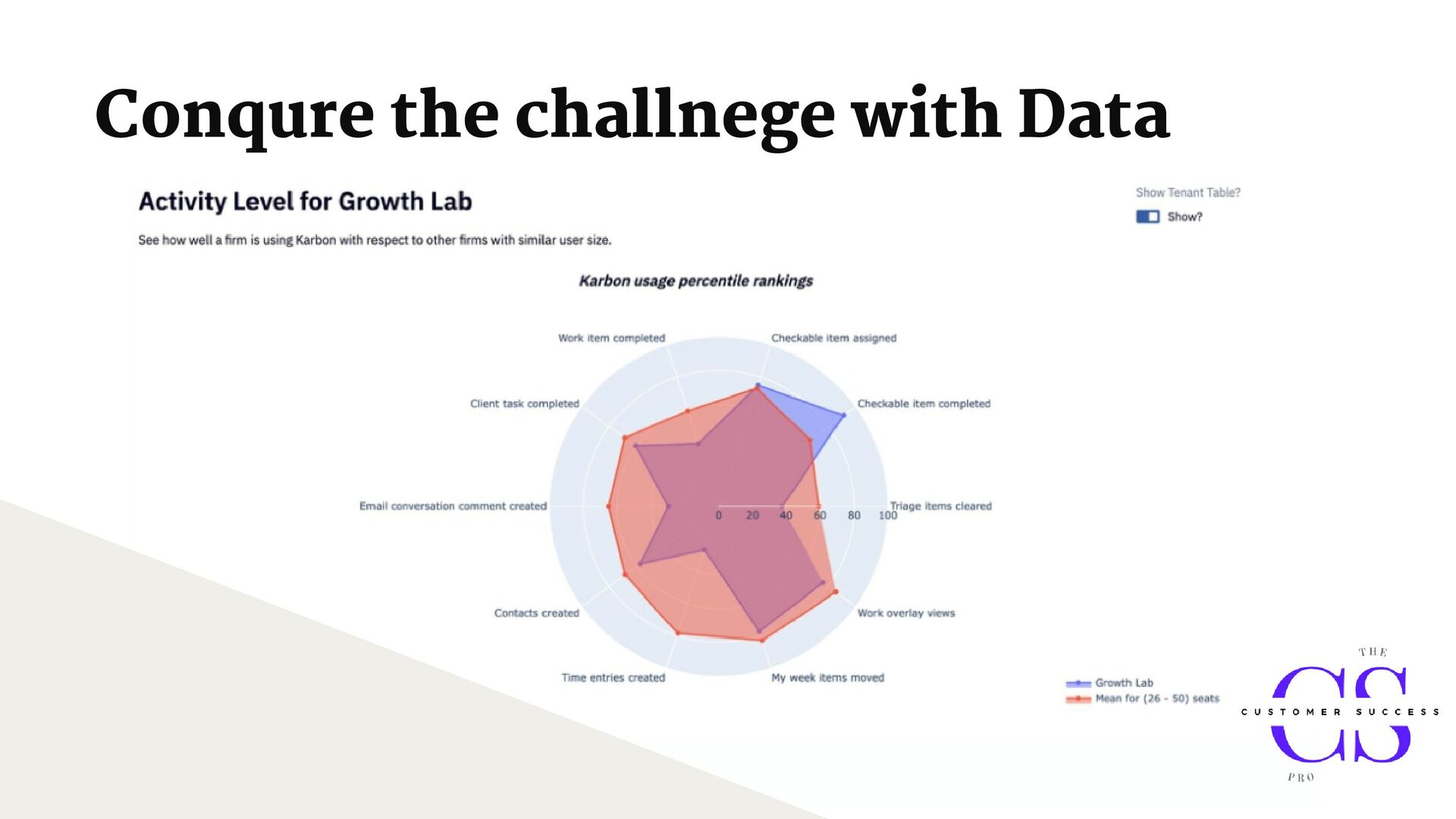
At my previous organization, sorry for the slightly blurry screenshot there, but we used a lot of data to show our customers where they would map out. So we would basically use all the different features of our product, which you can see around the circle there.
And then I would also show the plots of how our customer, which is the blue, is using certain feature functionality on there. But what we also did with all our data is we create benchmarks. Your customers really want to know how are they using it compared to a firm that has similar number of seats or users as they do.
So we just map this out saying someone else that as at a similar company that has twenty six to fifty seats are using our product in this way, and this is where you stack up against them. Customers really do wanna have a road map and an understanding of how their competitors or other people that use your software are using your software.
Great. Now jumping into the people, process, tools, and repeatability based on your business maturity. Now I've decided to do this because I know there's people in this room that are probably series a or small startups or even pre series a up to hundreds, if not thousands, of people at their organization.
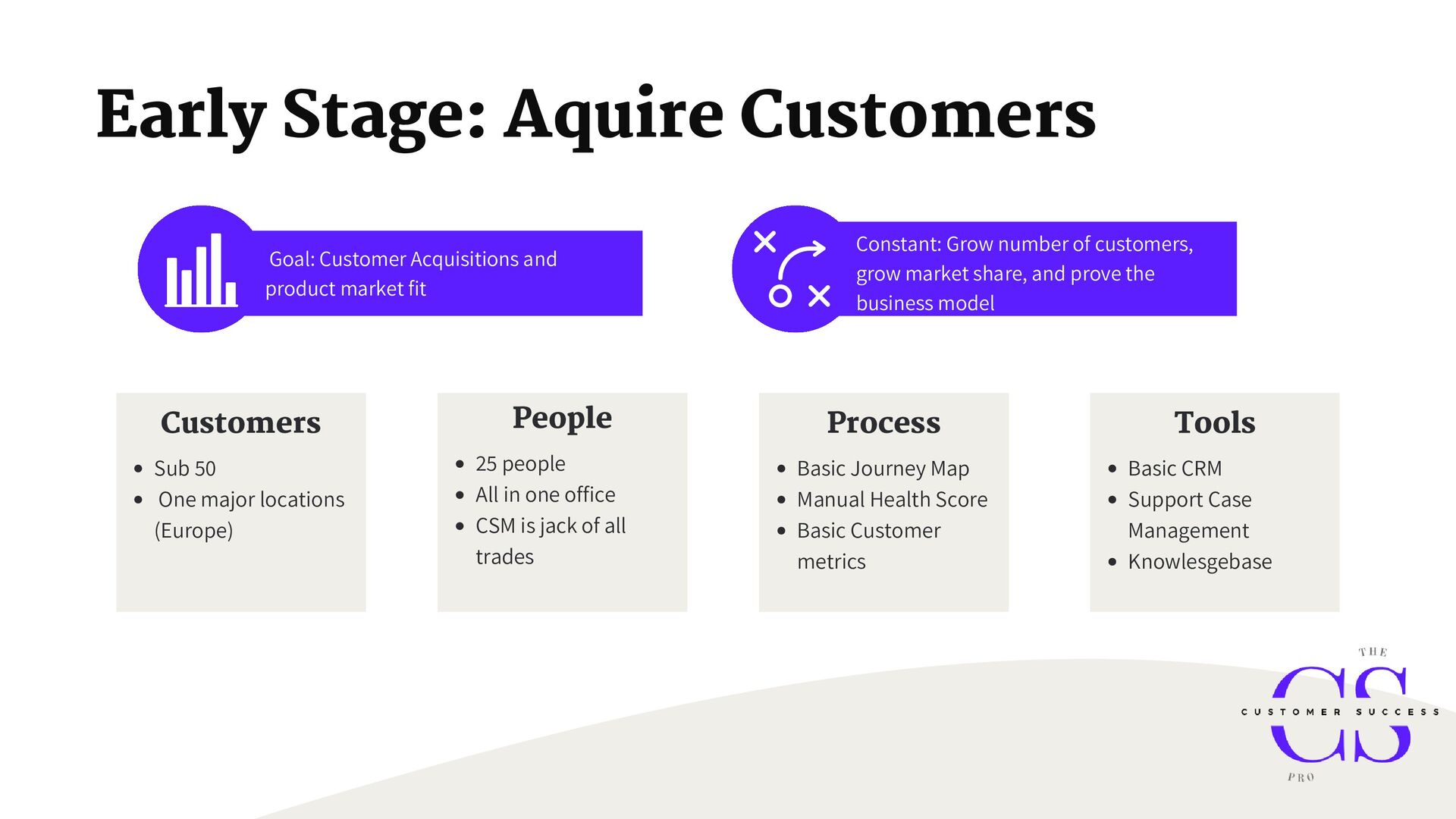
So I really wanna break this down into the stages of maturity growth for your business. So the first stage, I would say, is early stage or acquiring customers. And your goal at this point is customer acquisition and product market fit. You're probably fairly small, and you're con like, you're probably growing the number of customers, growing your market share, and probably trying to prove out your business model.
In this early stage, coming back to that people, process, and tools thing, I wanna say that your people is probably around the twenty five mark because you're, again, you're figuring it out. You're figuring out your market, and you're probably all in one office or remotely based in one location.
And your customer success manager is probably a jack of all trades and someone who is doing everything, meaning they're onboarding the customer, they're answering support tickets, they're probably also doing the training calls. And that's fine because you're at a stage where everyone is contributing toward that that customer goal.
Your process is probably pretty basic. You have some milestones and timelines in place saying, okay. If you're a customer, this is what we expect you to do with our tool. And then you probably have some sort of manual health score or some sort of basic customer success metrics.
And, again, your tools are probably pretty simple. Whenever I'm at an organization like this, usually, I'm told use the CRM or use the marketing automation tool or use an Excel sheet or use something similar because at this point, we just need to get data into place, and we need to just do what we need to do to get our customers onboard.
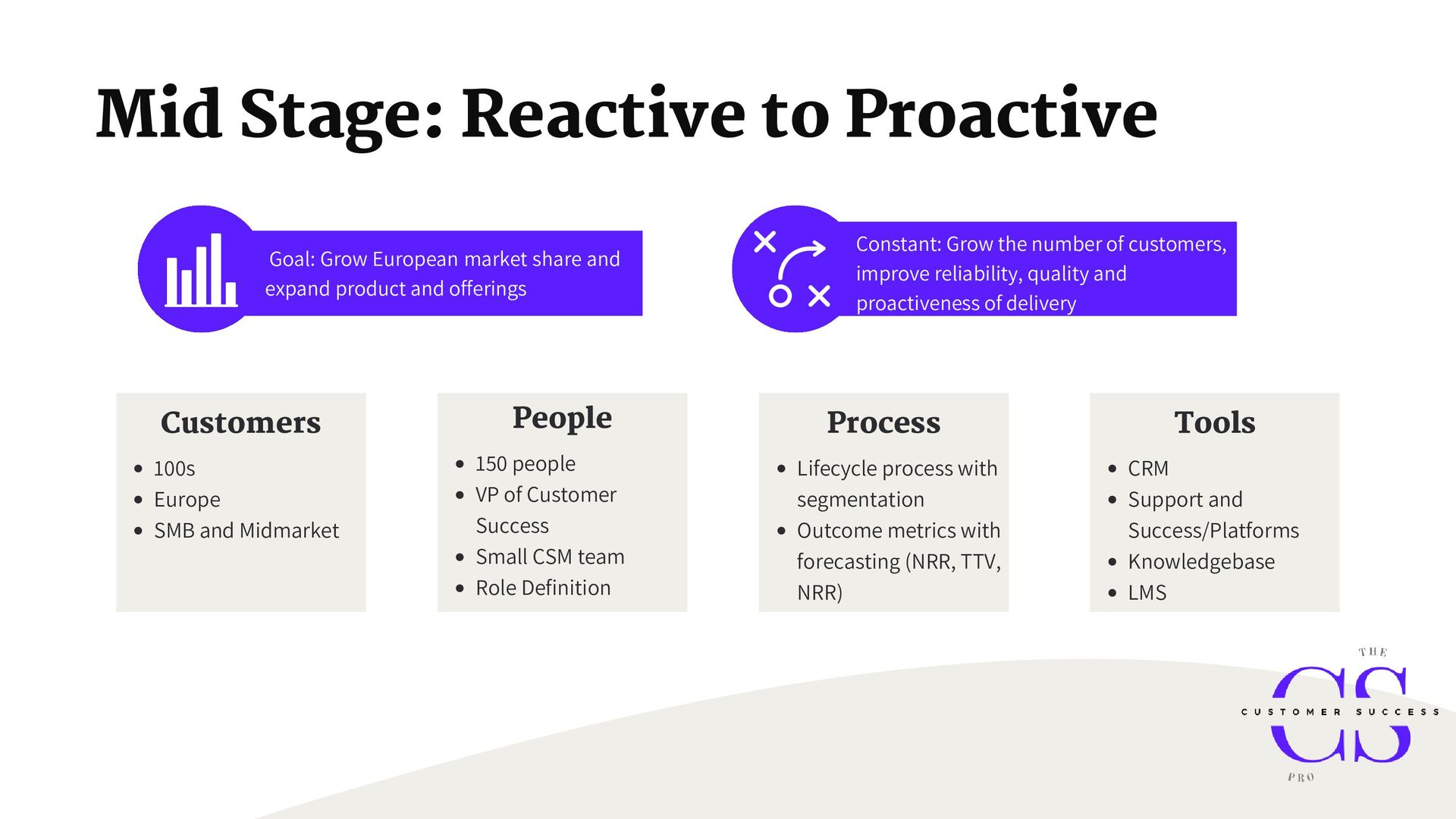
When you're at mid stage, I would say this is the point where you're getting reactive to proactive. What this means is most likely you have a pretty fair set of customers, probably in the the hundreds, if not more. You've now expanded past your one region.
Maybe you've expanded further into Europe or maybe even further into North America. And you're now at probably a hundred to two hundred employees, and you have small customer success teams, and you have more rolled up an issue here. So you have different people that are doing onboarding versus customer success management versus support.
And at this point, you are very focused on outcome metrics. What does this mean? This means your customers are giving set goals and set definition of what they're looking to get out of your business and out of your software, and you are now able to forecast net revenue retention or time to value or gross revenue retention and churn.
All these metrics are now a part of your process. And then finally, at this point, you're probably implementing something a little bit more mature when it comes to your customer success tooling or a more robust knowledge base or maybe even a learning management software, all of which comes back to being at a mid stage.
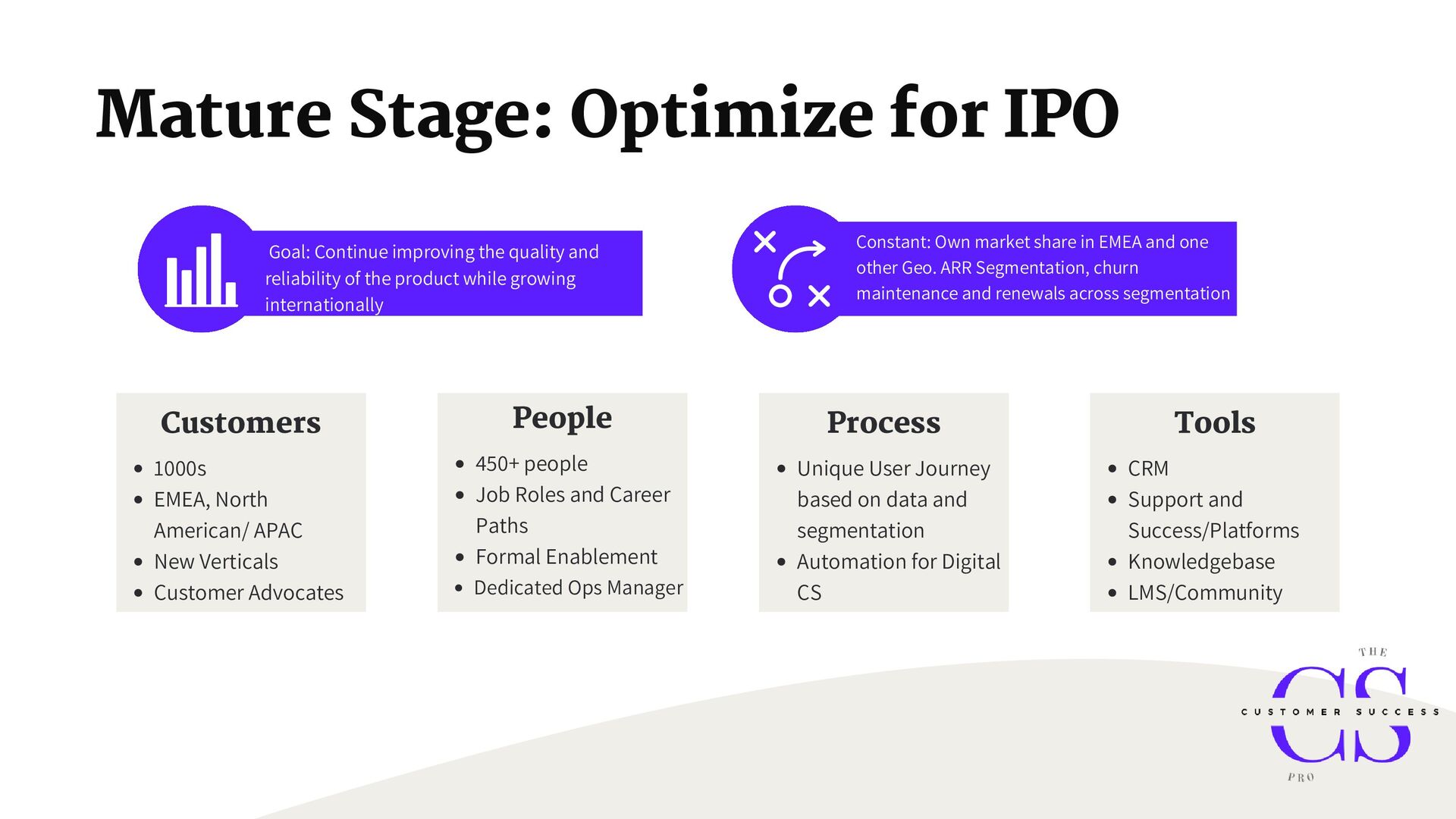
When you're more at a mature stage or you're optimizing for IPO, your goal is still to improve the quality of your product while growing internationally at this point. And you're probably doing a little bit more than the market share in your current region, and you're trying to expand into new regions.
And you are now segmenting your customers. Maybe you now have four hundred plus people, and you have thousands of customers across multiple geographies. And you also maybe have new verticals. Maybe you have new products as well that you're expanding into. All of this results in a unique user journey.
At this point, your customers aren't going to be using your software the same. At this point, you're gonna have SMB or Tech Touch customers that are just maybe mom and pop or one or two users. You're gonna probably also have a large chunk of the mid market, which is maybe your your target audience.
But you're probably also expanding into enterprise at this point, and you're gonna have a different model and different level of repeatability process for your customer success teams when they are looking at your different customer journeys. And then finally, I would say at this point, you're probably gonna also automate for digital.
This is something that's really big in customer success at the moment is we cannot be everything for everyone. So when you have customers that are maybe paying you a little bit less or they're on a freemium model or maybe they're just, you know, self-service customers that don't need that assistance or guidance, you're probably gonna have some level of digital customer success where I think AI at the moment can really bring in a lot of value there, and you're gonna have a completely different journey for your customers when they are in that digital realm.
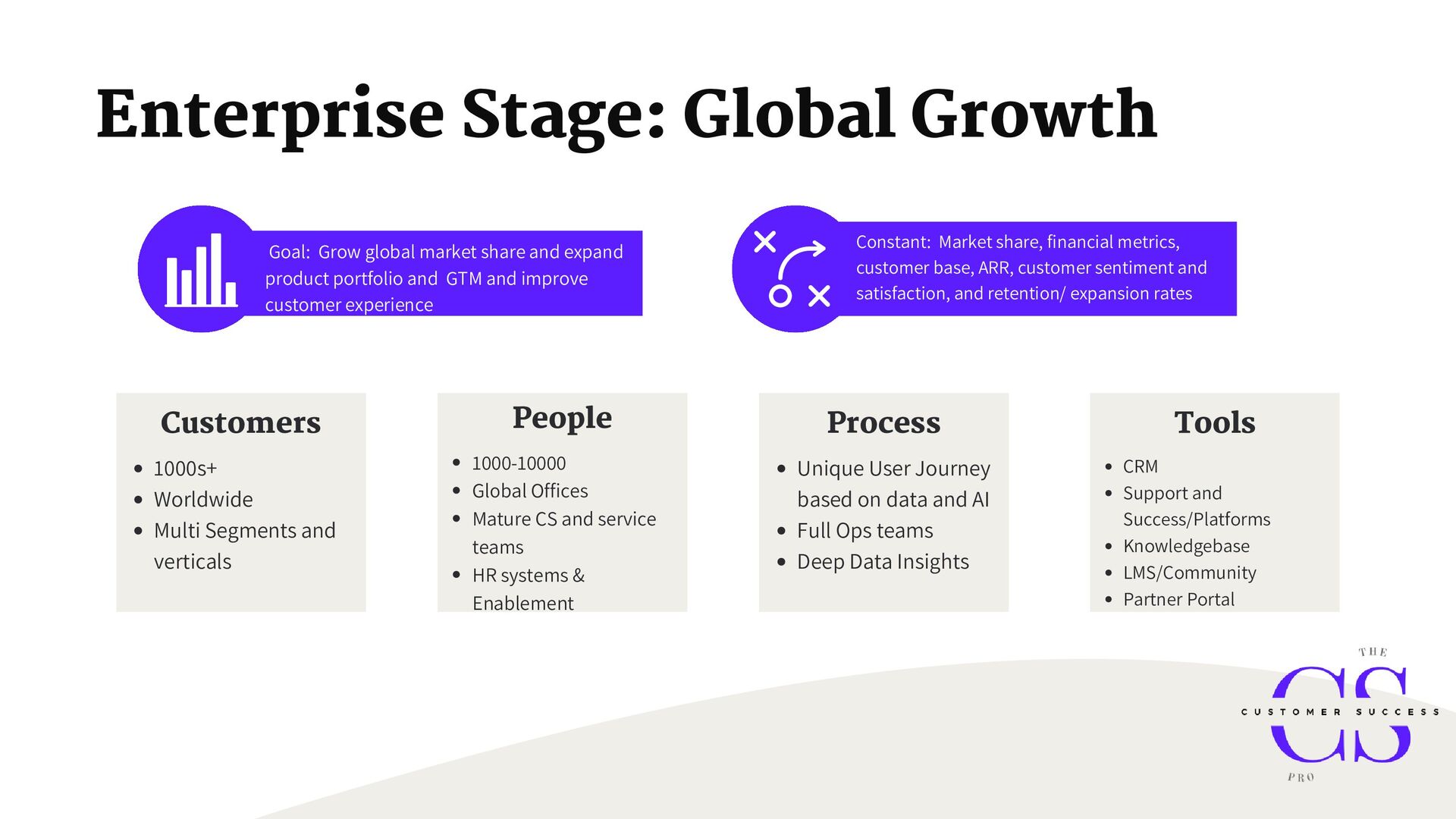
And at this point, everything stays with tools, but you might have a community or you might have some sort of additional piece to your customer success tooling. And then finally, the last stage I would say that's important to think about when you are growing is the enterprise stage.
And at this point, you're definitely market share leader. You are trying to improve your GTM models, and you are also trying to think of your full customer experience, not only post acquisition, but even in the acquisition market as well. And then at the core of all of this, I think the only thing that really changes here is having mature customer success and services team.
So you no longer are just customer success. Likely, you are professional services. Likely, you have an education team. Likely, you have an entirely different support team. And the process of all this is, again, back to that unique user journey that you're building and full ops teams as well as data insights.
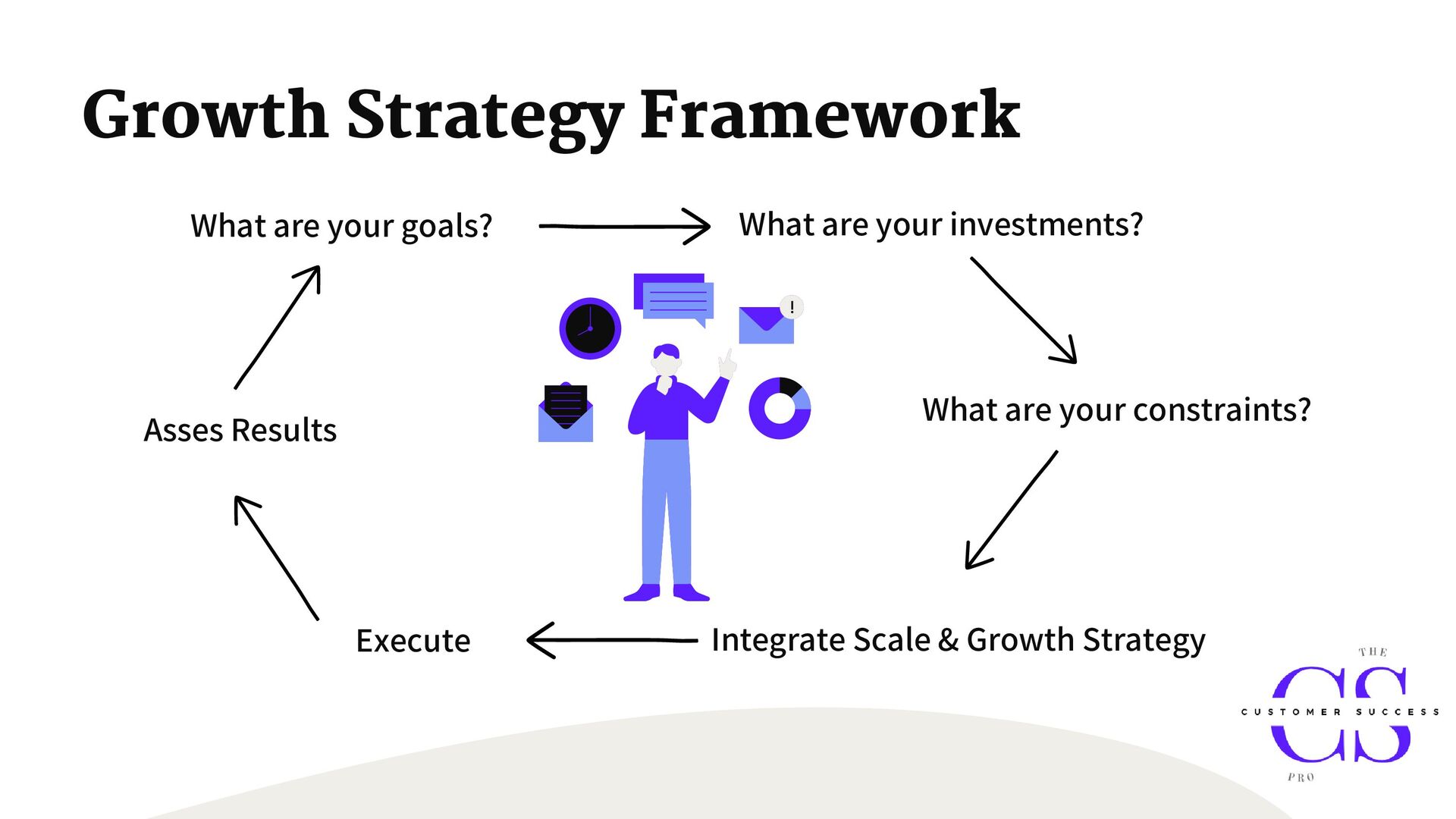
So my last little bit is recommendations for revenue growth and customer success, which I think is something that we all are here to to think about. So my growth strategy framework is what are your goals? And just think about that. Write that down.
What are your goals for your customer? One, two, or three. Just think about them. And then when you look at those goal, which investments are you gonna make? Are you gonna make investments in people? Are you gonna make investments in process? Are you gonna make investments in tools?
Just understand those goals should be tied back to an investment because you are gonna have to put in some money to make some money. And then what are your constraints as well? When you are thinking of your constraints, are you tied to a certain geography?
Are you tied to a certain segment of your customers? Are you only selling to SMB or product led growth companies? All of these are constraints, and you need to make sure you're very, very guarded with the investment that you are making. And then you're gonna wanna make sure you integrate a scale and growth strategy.
So let's say you've decided my investment is is that I'm investing in my customer team to focus on SMB or PLG led clients. Right? And so what is your growth strategy for that? When you have PLG clients that are paying you maybe a dollar a seat or something or even a freemium model, how much are you gonna grow from those customers?
What is your growth strategy behind that? And then execute on it. And then assess the results, understand where you went wrong or maybe where you went right. And then you go back and do it again. And the thing is is it's never gonna be right, and it's never gonna be perfect, and it's gonna be an iterative process.
But the one thing I can say is that when you do have goals and they are around growth and strategy, make sure you have guardrails around everything you're putting. Because when you are building a great company, which I'm sure a lot of you got in this room are, you get really excited and you wanna be, oh, I wanna wanna be the best at this, but I also wanna do this, and I wanna grow here, and I wanna do this.
And the speaker before just said how CEOs get so into it that they forget everything that's around them. So when you are building your growth framework, make sure you do have guardrails in place to ensure that you are focused on where you're growing.
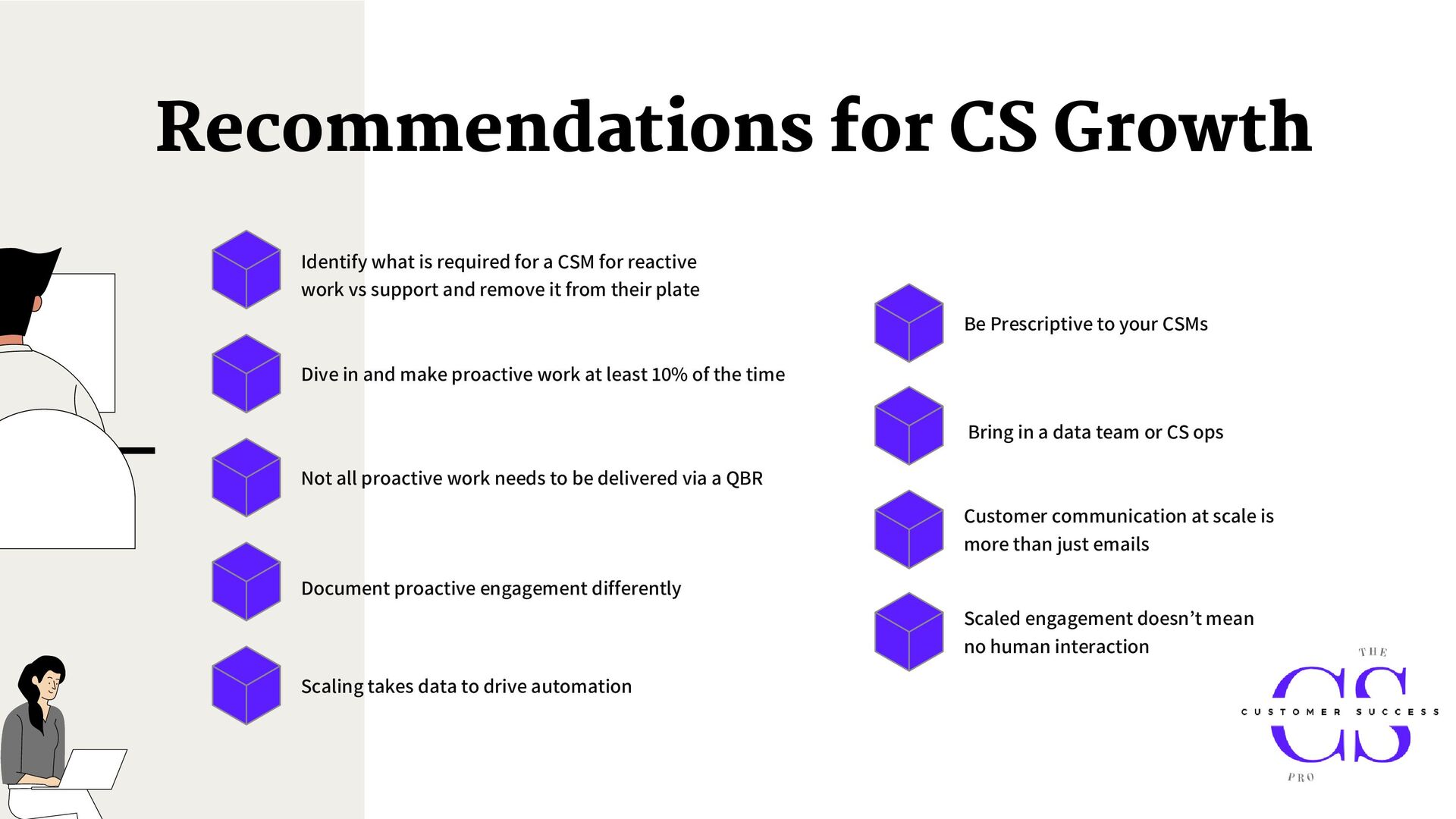
And then I wanna finish off with my building blocks or recommendations for customer success growth. So my first step is to identify what is required for a CSM in reactive work versus support and remove it from their plate. So like I said, a lot of companies see customer success as support, but support is quite reactive.
What happens? Customer has problem. They submit a ticket. A support agent answers it. How are you ever gonna get revenue if you're only ever going to react when a customer has a problem? You should be actually thinking, how can I be proactive? What does that mean?
Does that mean education of the of the customer? Does that mean expanding their horizons of new feature functionality? Whatever it is, take one little reactive piece away from your customer team and give them a proactive opportunity, whether that that is, like I said, through education or expansion.
Just take one thing off their plate. And dive into and make proactive work at least ten percent of their time. So, again, you if you look at customer success teams, a lot of times, they're just having meetings. But what are these meetings doing?
Are they fixing a problem? Are they just having a meeting to have a meeting? Make sure that they are driving revenue out of each one of those meetings. I say to many of my teams, if you go into a meeting and you don't have an outcome as a CSM, there's no point of that meeting.
Your customer is gonna come with a a request for that meeting likely. They're gonna want something out of you, but you should equally make sure that you are delivering something and you have your own desire of what you want out of that meeting.
And then another tip is not all proactive work needs to be delivered via some sort of review. So in customer success, we usually have quarterly business reviews with our clients, and not all of our data, not all of our intentions, not all of the things that we wanna say to our customers need to be in a formal review.
I've worked with marketing teams in the past that we made a customer success newsletter, and none of that was in a one to one meeting. But we were delivering value in a newsletter, and that made sense for our customers that were paying us less than our enterprise.
Another thing I would say is document proactive engagement differently. So as you move from reactive of tickets and answering customer queries and just being in that world, when you do have a great proactive approach, whether that's a type of meeting you're holding, whether that's a webinar series, whether that's a way that a customer is doing a case study with you, document it.
Because I think more times than not, you'll forget what you've just done, and then you're gonna be like, oh, that was great, but how do we build repeatability? We need to document it. Another thing is scaling takes data to drive automation. Like I said earlier, please do have your data or ops team or anyone who's data savvy within your business really start documenting how your customers are using your product.
Because, again, if you wanna build a customer newsletter and you see that ninety percent of your customers aren't using feature x, you need that data to know that, hey. They're not using this feature, so let's push a newsletter about it, or let's do a webinar series about it.
Another thing is be prescriptive to your CSMs. So as a customer sales manager, you wear many hats. You're onboarding customers. You're implementing the software. You're then supporting the customer. You're doing professional services or one off meetings or whatever it is. And a lot of times, a CSM can be pulled in every direction.
And they're like, okay. Well, I'm doing a meeting in the morning. I'm doing a support ticket in the afternoon, but what is it that they're actually driving? Revenue. How are they driving it? Making sure that every call comes back to product adoption and more seats used or bought.
That's it. Keep them on track of what the ultimate goal is. If they're having a webinar series that's just about, I don't know, brand recognition of your product in the market, that's not driving direct revenue to your customers today. So, again, make sure you're prescriptive to your CSMs about what they're doing day to day.
And then the data part, I know I'll keep coming back to this, but it's so, so key. Like, I think a lot of times people forget about the customer data. Everyone's really busy on, like, let's get the data to acquire customers or let's get the data to make sure that we close new SQLs or whatever it is.
But no one's really worried about what happens with the data, like I said, one year, two year, three years down the line. And to keep your customers is actually seven times cheaper than acquiring a new one. And I think we're always so focused on the acquisition side, but it's actually better in today's, you know, economics that we have today in the world to actually keep your customers, and the data is gonna help you do that.
And then come customer communication at scale is more than just email. I think a lot of people are like, hey. Let's send an email, or we'll do an email drip campaign or this. And nothing wrong with that. I do think that's a great sense of communication.
But one thing my team was doing is we took inspiration from TikTok, and we did ninety second QBRs. Why did I say ninety second? Most executives that take or look at our business reviews don't even have a minute to read an email. So what we did is we did a ninety second video where I challenged my CSMs to give as much information that is valuable to that client in that ninety seconds.
So how are they using our product, what new features, and how can you reach me for more questions? That's all. Those were the three things covered in that ninety second video, and that got more of our customers engaged than any email campaign that we did.
So, again, utilize something else other than email to engage your customers when it comes to scale and growth. And then finally is scaled engagement doesn't mean no human interaction. I think a lot of people get worried as you scale as a business and grow that you forget, oh, let's just send emails or videos, or let's just, you know, interact in a in a chat rather than in real life.
A lot of digital has to be part of your entire customer journey. And what I mean by that is if you're having regular engagements with your customers and talking to them about new features and growth of your business, you need to also supplement that with the emails, the videos, the webinars, because one way is not the right solution for everyone.
And in the world that we live in and the customers that we have, there's no one way that's going to to get us to the right result. That brings me to the end. I'm only forty seconds over, but thank you so much for coming to my talk.
I will take questions at the roundtable. And if you guys have any other questions that you wanna follow-up with me, all my information's on the screen, but thank you so much.