
The biggest barriers to success often come from within. Our brains default to negativity, we find it hard to adapt, and we get bogged down in problems. This dynamic and actionable session will give you practical strategies to foster confidence, boost adaptability, and find sustainable, lasting confidence within yourself and your team.
← All talks 










Lead Turing Fest 2024
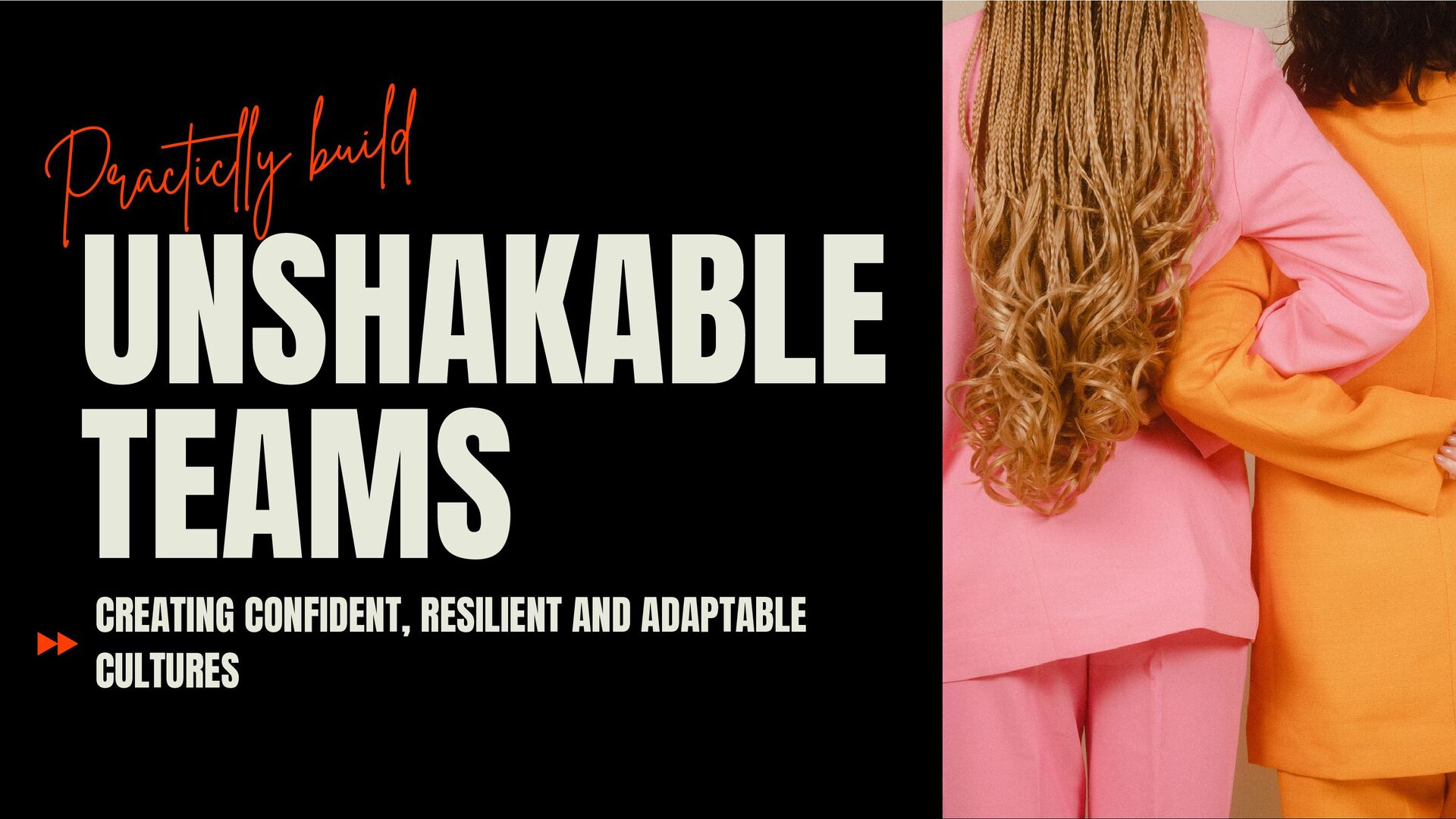
Unshakable Teams: Creating Confident, Resilient and Adaptable Cultures
Auto-generated transcript - may contain errors. Tap a timestamp to jump the video.
We shall soon be nothing but transparent heaps of jelly to one another. That's a quote from a New York Times article from eighteen ninety seven about the invention of a then terrifying technology, the telephone. A female passenger's body will simply melt at speeds of over fifty miles an hour.
When trains were first invented, this is what people thought. There was a really well respected writer that made this whole case, that if a woman travels at speed, her uterus will stay in the same place, and her body will continue traveling. Like, that's what people thought, like, genuinely.
Have I done the world good, or have I simply added menace? This is a quote from Marconi. Does anybody know who Marconi is? Marconi was the inventor of wireless technology. So the inventor of radios, essentially, famously was plagued by morality about whether his invention was ultimately good for the world, or whether radios were just going to add menace to our cultures.
I'll let you decide on whether he did or he didn't. So the reason I'm telling you this is humans, we are scared little weirdos. Like, it's a universal fact. The thing that brings us together, there's some knowing nods from some scared weirdos in the audience, the thing that brings us together is actually history tells us that we don't like change, that we're more likely to focus on the negative impacts and the positive.
We have a natural inclination to get, to get scared. We focus on losses, weigh more than gains. And I don't know about you, but our world is currently changing and changing quickly. And so it's important that we acknowledge this, and we know this kind of like dynamic that we're working with, but we absolutely can do this.
We can build practically unshakable teams, teams that are confident, resilient, and adaptive, even though perhaps our fundamental nature might not be. And I know this because in two thousand and fourteen, I was stood in a stairwell of my then office crying. I'd just been promoted to lead a team, and I got given some feedback that I was playing favorites, that I was micromanaging.
I thought I was the worst manager in the world, and honestly then, I certainly wasn't very good at leading. Now, a few years later, I've trained Fortune five hundred companies, leadership skills all over the world. Now, I have spent my life, truly my life, watching lawyer shows.
Like, I love them. Legal dramas, I love everything about them. I like the outfits. I like how people walk around in heels and they have coffees, and they go, you've been subpoenaed. Like, I don't know what that means. Like, it is my life goal to walk up to someone and go, you've been subpoenaed.
Now I have spent so long watching these that I genuinely think I'm qualified to give sound legal counsel. Like, I I don't know what the bar is, but I'm pretty sure I'll pass it. Okay? So, this talk is not your standard talk. I'm not going to just tell you things.
What I'm going to do, my friends, is I'm going to use my knowledge from the thousands of hours of legal dramas I have watched, and I'm going to make a case. I'm going to make a case, and I'm going to give you a series of evidence as to why things are hard, and how we can make it, and I'm going to end with a closing statement.
The case I'm making is why is this true? It is true. I'm sure many of you here have people issues in your business. I'm sure many of you struggle with things like attrition, people not doing what you need them to, telling people to do something a thousand times, people saying, oh, we just can't do it like that, people saying no to your ideas, constantly getting blockers.
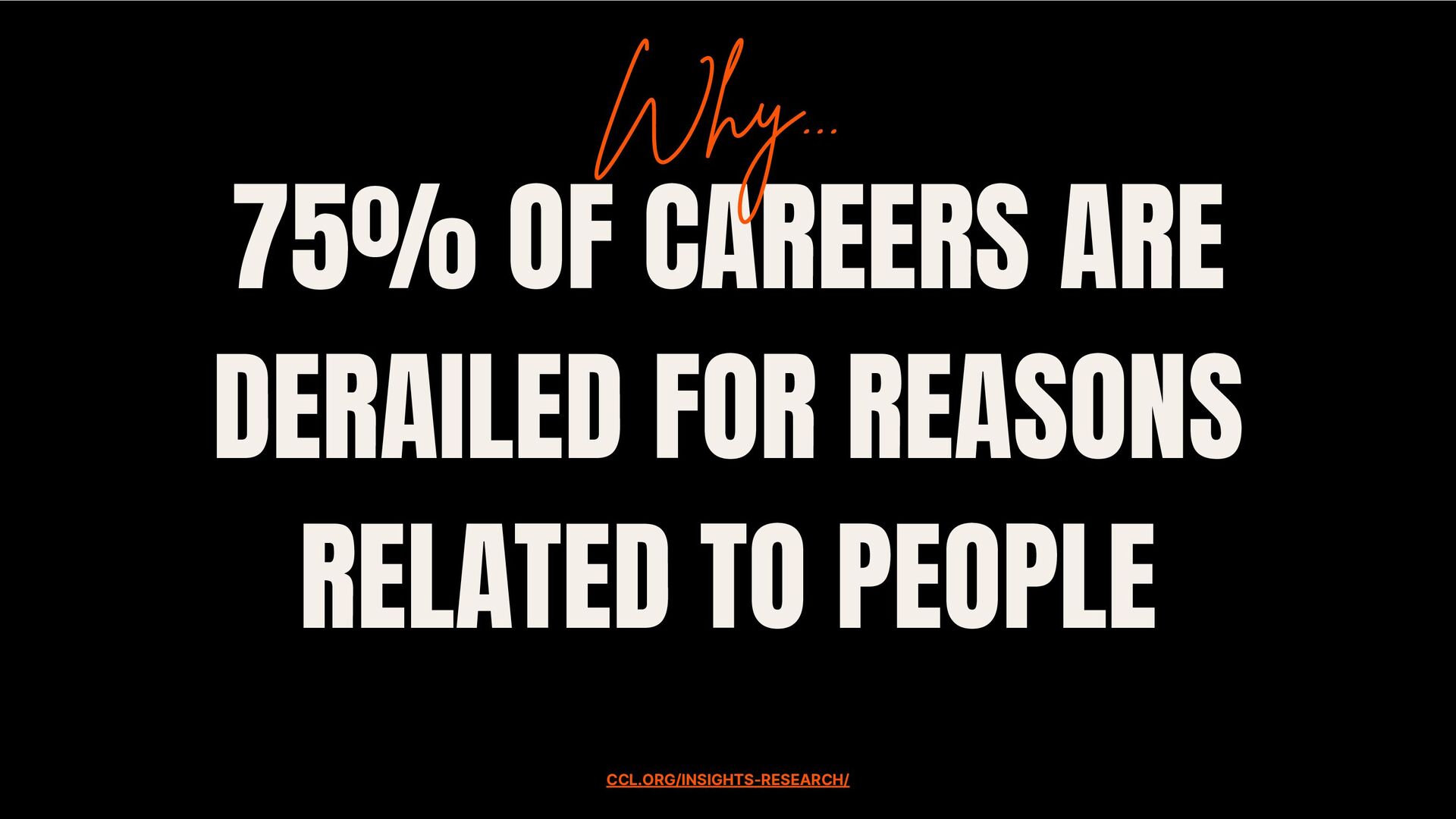
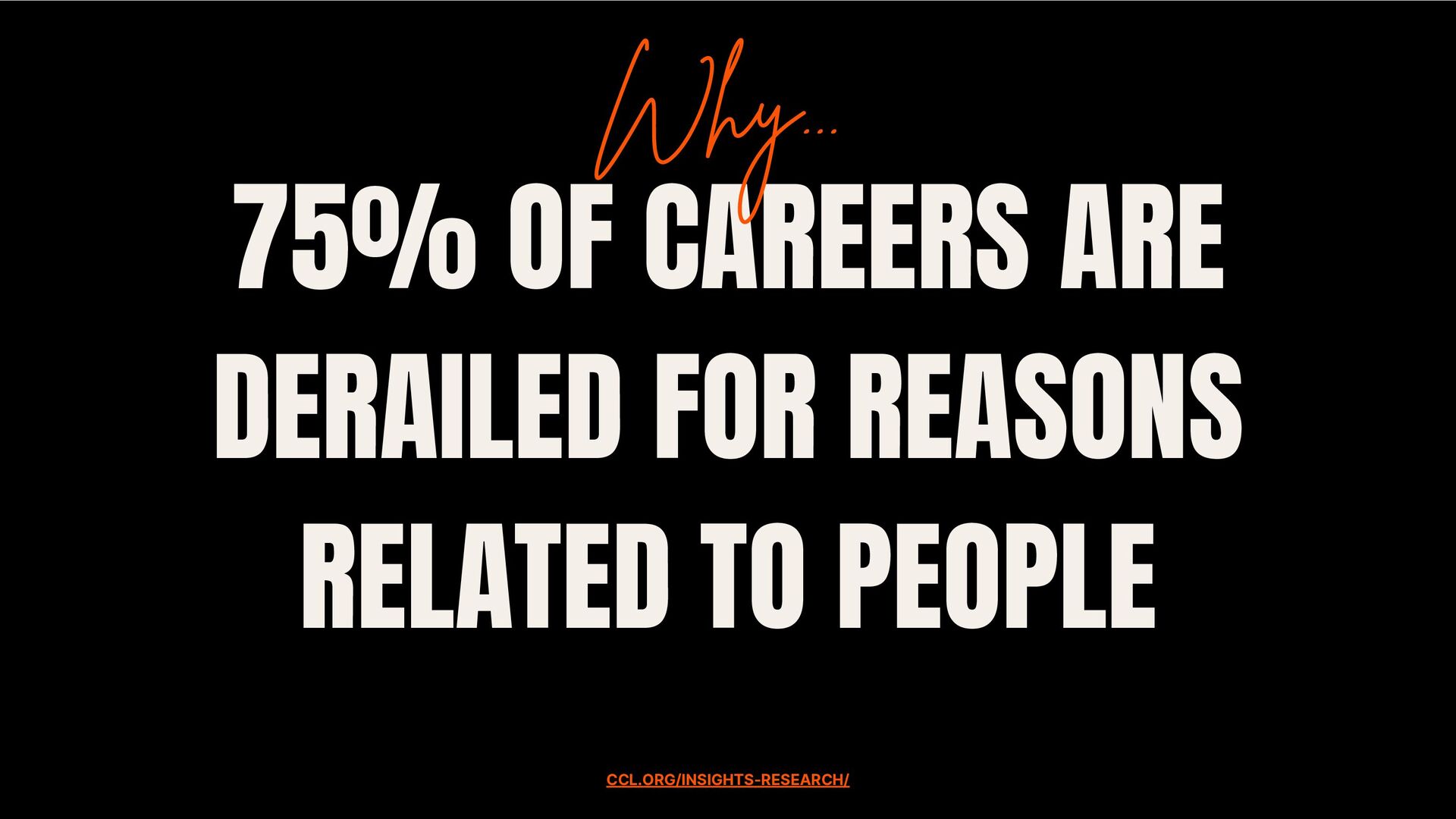
Seventy five percent of careers are derailed for reasons related to people. Businesses are derailed because of reasons related to people. So from this place, how can we practically build behaviors that help us consistently perform in chaos? Because it is chaos. Whether you're a start up or an established business, the world we're working in now is fast moving and chaotic.
So let's start here. Why are seventy five percent of careers derailed for reasons related to people? I could I've spent years learning about this stuff now. I could give you thousands of reasons why people are often some of the stickiest challenges in a business.
I'm just going to give you five. I'm going to give you five I've picked at random, five reasons why. So I run a conference, it's called Confidence Live. It's in its second year, and I made was it a mistake? I don't know. I decided to do it in my hometown.
So my hometown is oh, and does anyone mind if I swear? Thank you. I thought I'd ask permission. My hometown is a notorious shithole. Honestly, it is one of the most economically deprived towns in the country, so I thought I would like to give back to the community that made me.
So I put on this event, poured my heart and my soul and my money into it, took loads of risk. The first year, my mom came. Like, you're doing something scary, and then your mom's there, makes it so much worse. Or or doesn't it?
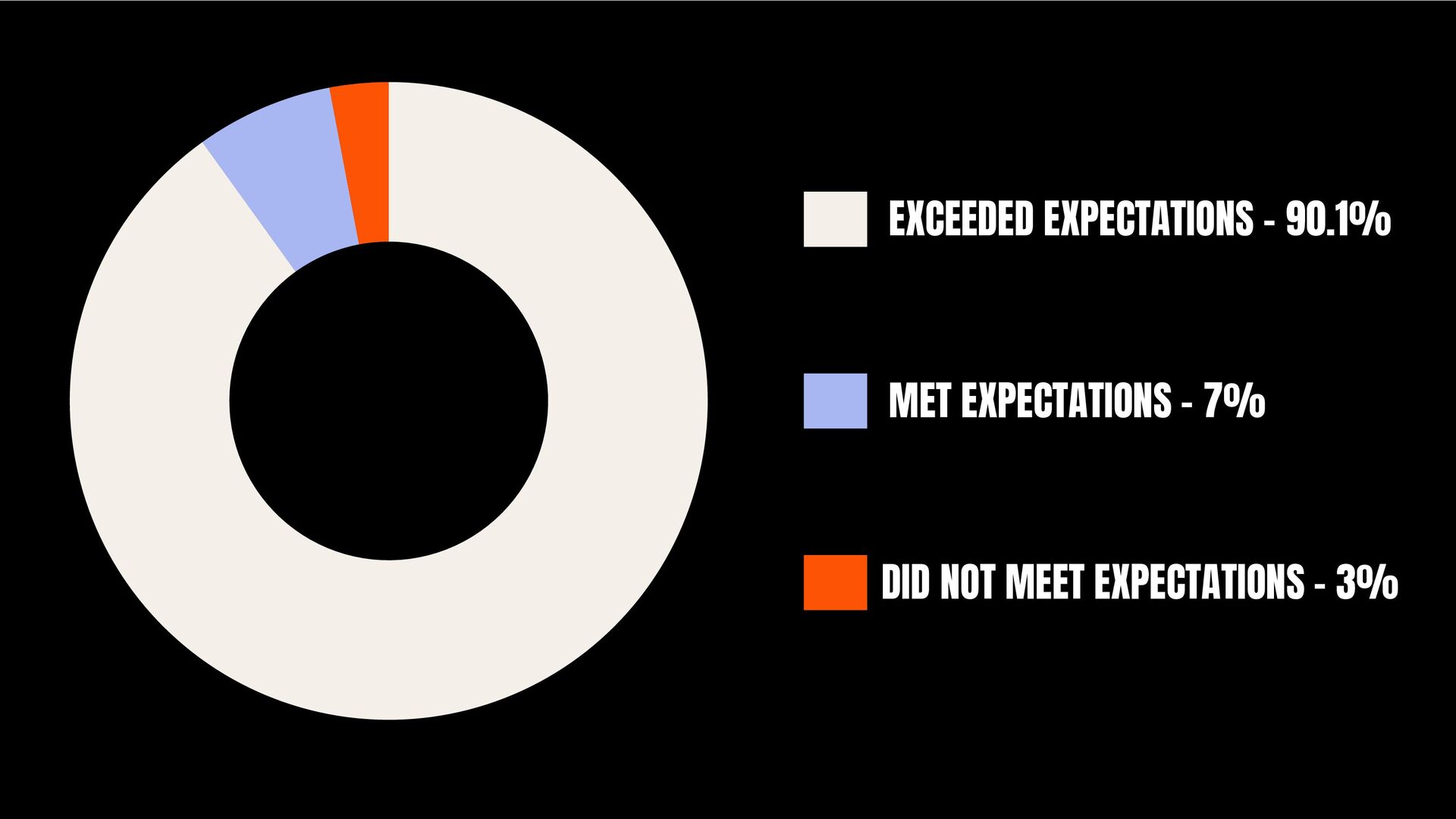
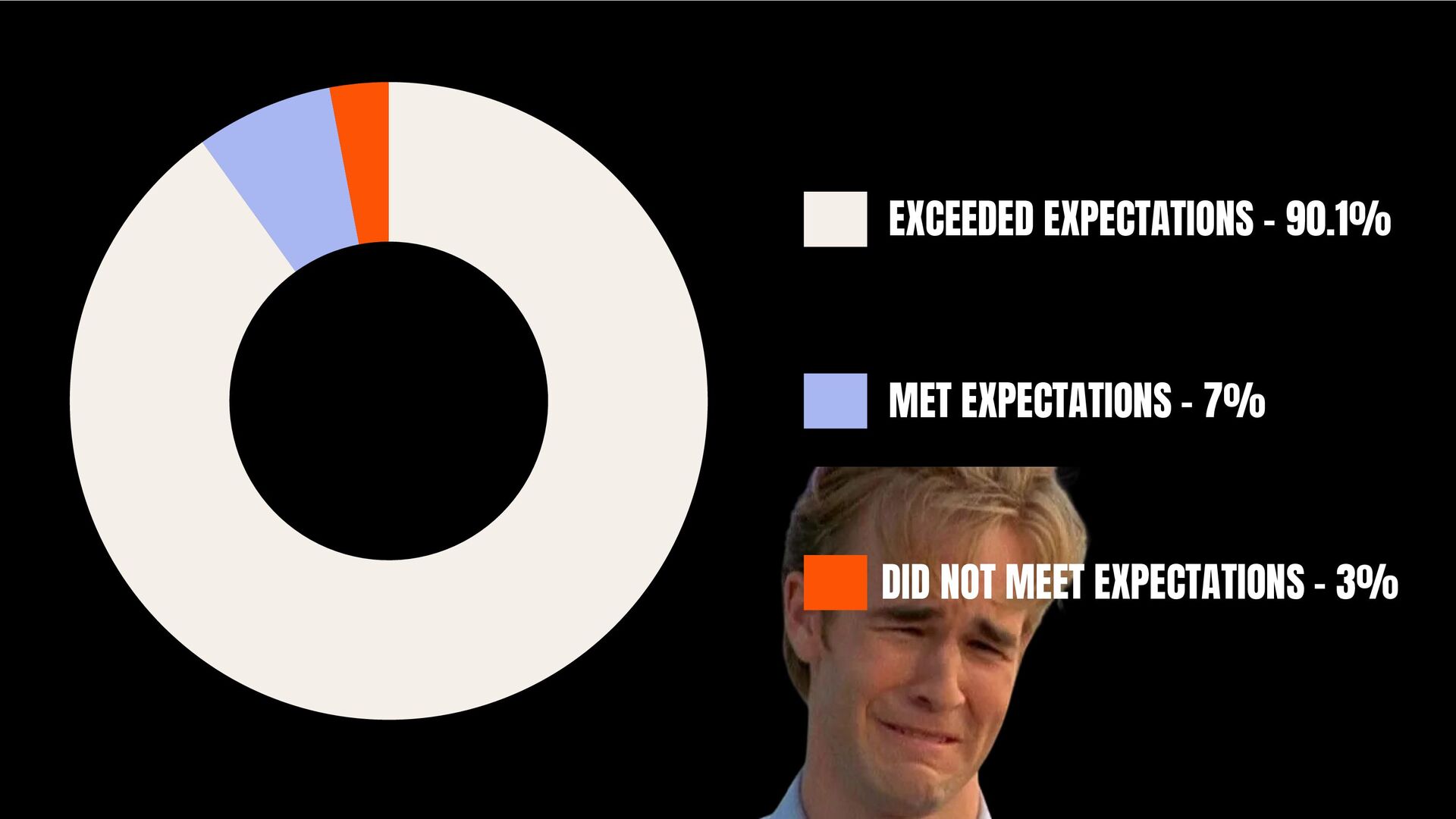
And afterwards, it was so vulnerable for me, and afterwards, I got the feedback. So ninety point one percent of people said that it exceeded expectations. Seven percent said it met expectations. And for three percent of people, it didn't meet their expectations, they were disappointed by the experience.
Which one did I focus on? Like, so much. I teach this stuff, my friends, and I honestly, I got that feedback, and I was like, oh, God, that was a disaster. I truly thought it was awful. I was reading the negative stuff like some kind of addict.
My friends were like, Kirsty, it went really well. I was like, No, because Dave said something mean. Like, I really, really, really found it difficult to have a balanced perspective at that time. And I know that you do this, and I know that maybe you could stand in a presentation, and you're nailing it, you're bringing your A game, you're like, yeah, I've got this.
But then if you're anything like me, just halfway through, you just say something a bit weird. I don't know why you've just said something weird halfway through the presentation, and then you leave and you spend two hours, three hours, three months obsessing over that one little weird thing you said in an otherwise amazing presentation.
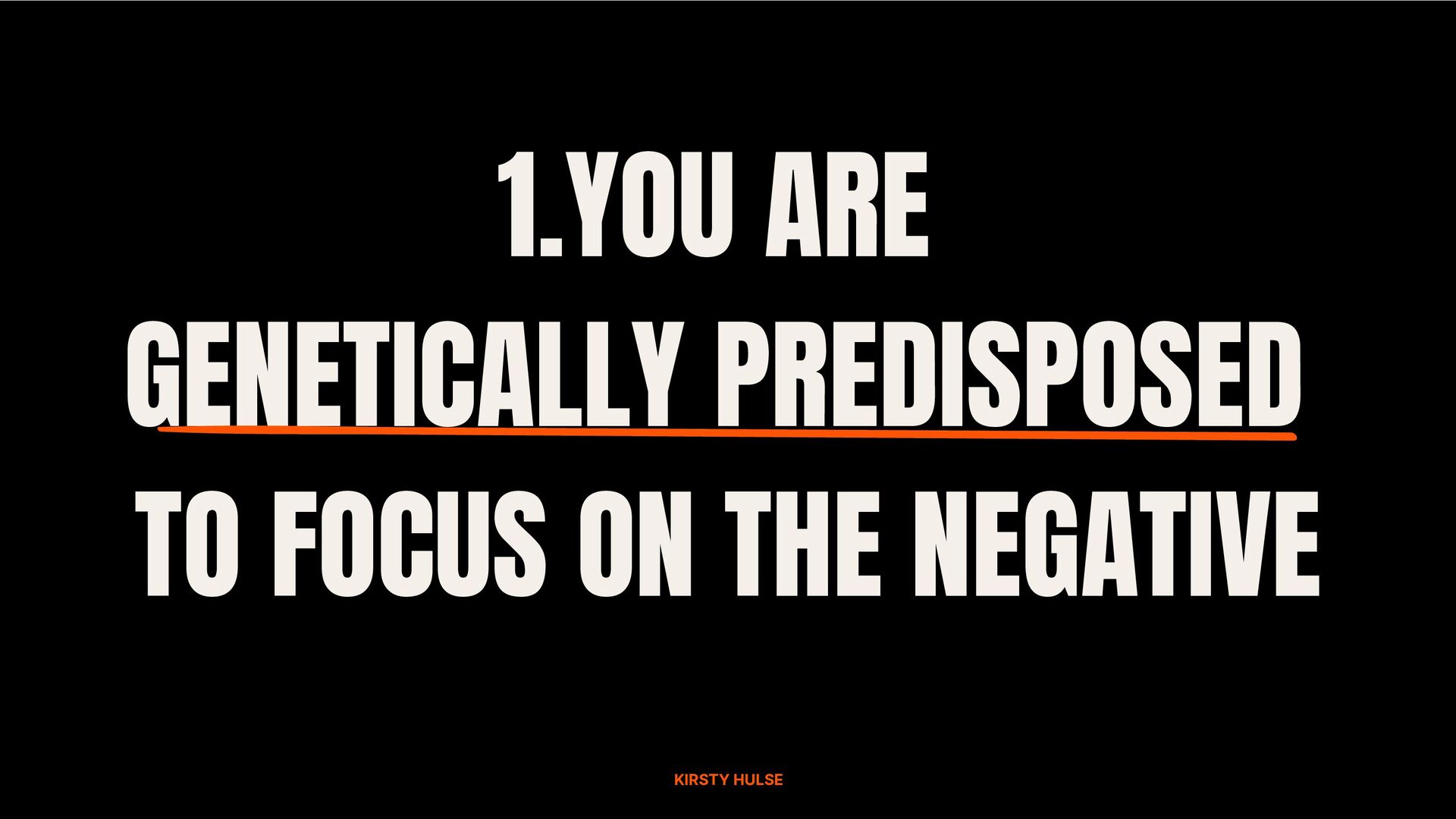
Every single person in this room, every single human you've ever met is genetically predisposed to focus on the negative. Now, some of us grow our way through this, but as humans we have a genetic baseline to focus on the bad stuff more than the good stuff.
It's just an evolutionary mechanism. You know, we didn't evolve to move through the world being like, yes, queen. We kind of have to do that for ourselves. If you think about the early stages of human evolution, we haven't really changed since then. So let's imagine you're walking through the plains of the Savannah and you see a tiger.
It's in your interest to focus on that tiger. You're not gonna stand there going, oh, I've got a fantastic relationship with my family. You're gonna be like, there's a tiger there. Only now it's not a tiger. It's reports, it's investors, it's teams, it's standing on stages, public speaking, awkward conversations.
You could do a thousand things right, and you mess one thing up. That's what we often focus on. Founders are made slightly different, but you might feel these behaviors in yourself. Yeah. Confounders tend to be a little bit less, feel this so intensely, so you either see this in yourself, and you might also see it in your teams.
What a narcissist. Right. So that's me, when I was like two or something, and I honestly think you can trace back all of my extroverted performance tendencies to that dress. So I was about two years old, and I was already starting to display and demonstrate some of these things that I'm sharing with you now.
As humans, we have a couple of fears built in. So, does anybody want to guess, actually, just for a laugh? Does anybody want to shout out a fear that you think every single human has? Projection. You've got it my friend. Round of applause for this legend here.
There you go. Every single person is built with a fear of social exclusion. Neuroscientist Matthew Lieberman has done lots of studies on this, and he's identified that in our brains we feel emotional pain in the same place as we feel physical pain. So if say, for example, I called one of you out of the audience now and was like, you friend, could you come stand on this stage?
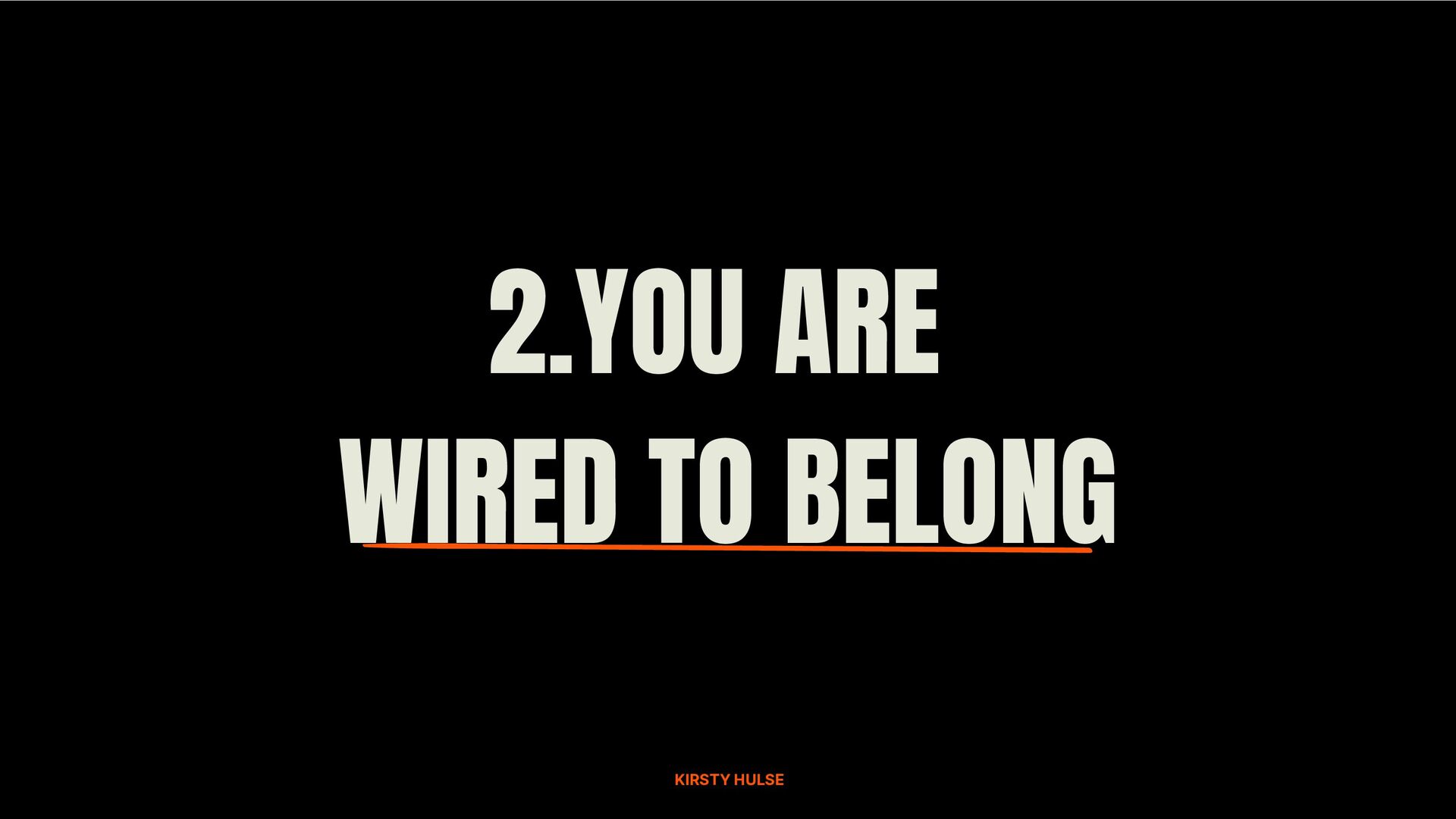
You'd be like, no. Obviously no. You know when you're on a Zoom call and someone asks you and you've got to say your bit, and you're like, oh my God, I've got to talk to people. Like as humans, we are wired to belong.
So if you struggle giving feedback conversations, if you struggle telling people they're not doing a good enough job, if you're scared of public speaking, if you don't like pitching, if you don't like speaking to investors, if sometimes you worry that you're not good enough, if you worry about letting your team down, your friends down, your family down, hello friends, welcome to your fundamental humanity.
You you actually weren't built to go out on your own. So certainly, if anybody has started a business, if anybody leads teams, there is a part of you that that is akin to threatening your survival. We evolved in packs, we evolved in groups, so stepping outside of that pack, it's actually quite challenging for us.
In my early twenties, I went on holiday to Cyprus with, a friend I then had called Carly. We were early in our careers, we've become very fast friends. Now, we were in Cyprus in this beautiful, cultural, historical island. I don't know if any of you have been.
So we're there in our early twenties, and we're enjoying the museums and the galleries. We're going to see art. Obviously, we weren't doing any of that. I was in my twenties. You piece the rest together. So me and Carly had this fantastic time.
We went clubbing, we went drinking, we stayed up all night, we shared those kind of fun experiences you tend to have when you're a little bit younger. A week later, I'm sat in a boardroom in front of Carly with the HR director talking to her about how she was underperforming at work, because I'd been promoted to her boss.
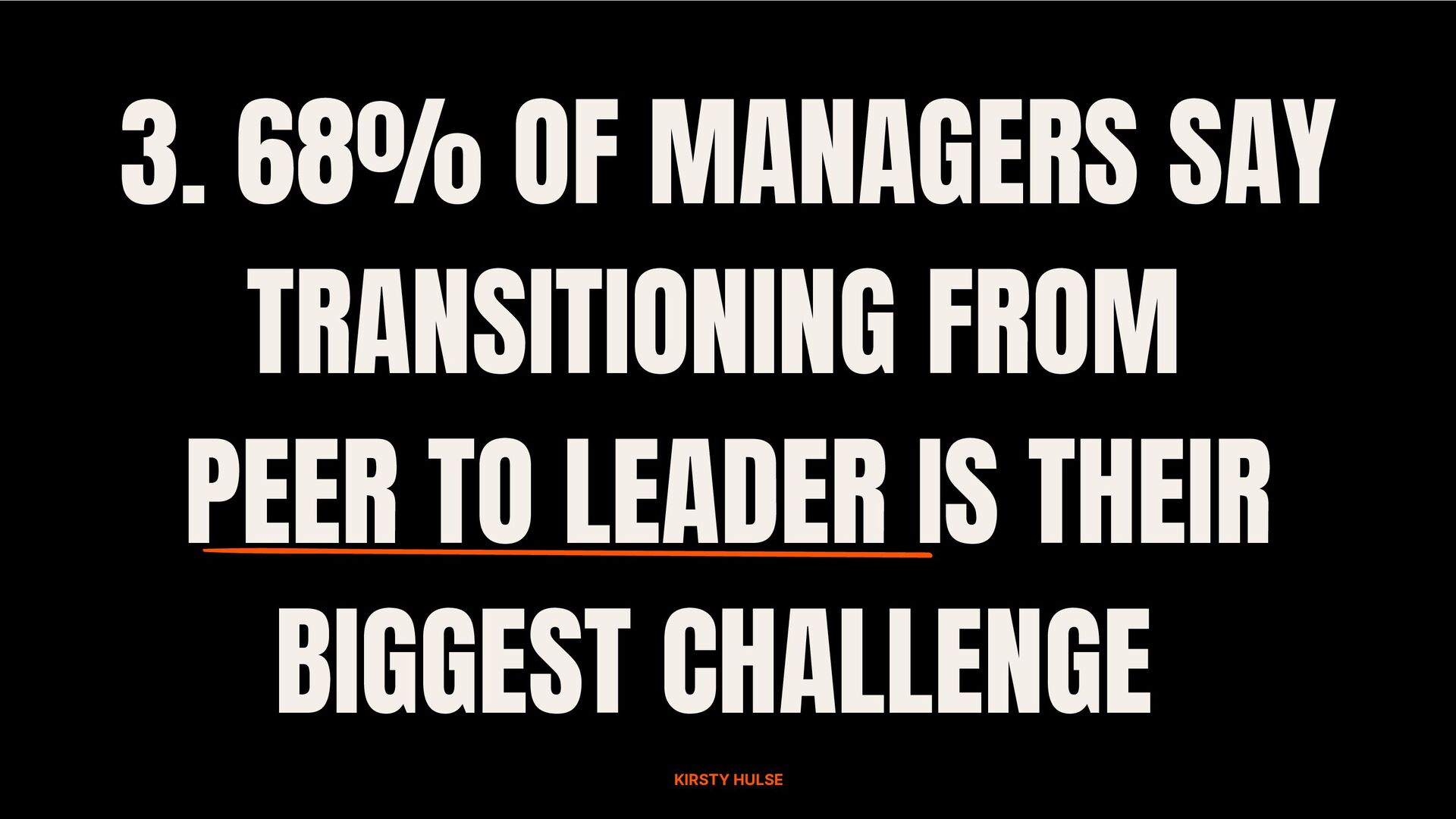
Has anybody ever had that? Sixty eight percent of managers say transitioning from peer to leader is one of their biggest challenges. I don't think we talk about this enough, that one day you're there having beers with your coworkers and then suddenly you're having to do performance reviews with them.
That's really, really hard. And when I had to do this, the whole advice I got was suck it up. And that's actually really difficult when you want to be kind and empathetic. I do like to think that I'm probably quite a kind and empathetic person, and one of the things that I've invested a lot of time and energy in over the years is trying to level the professional playing field.
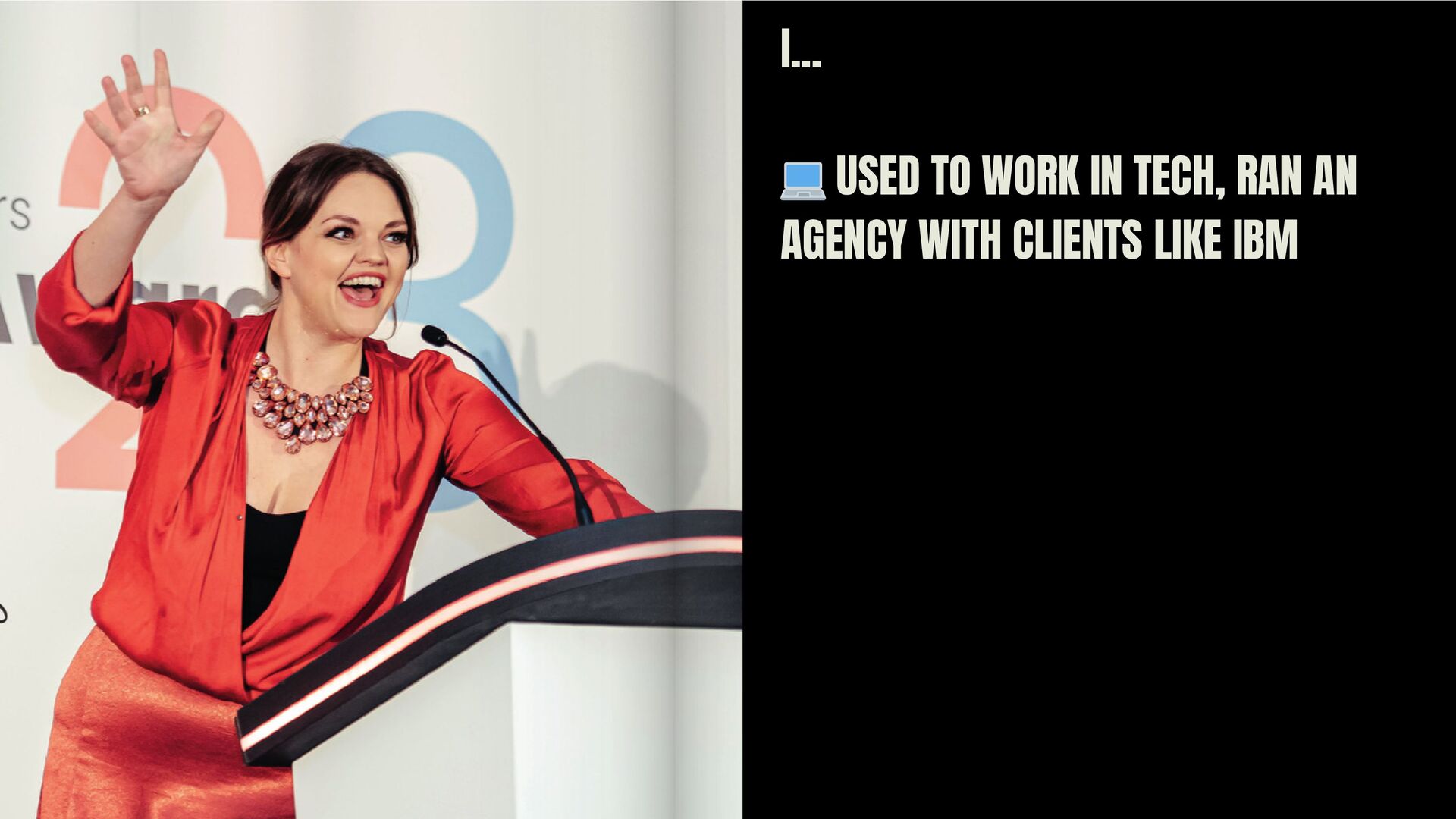
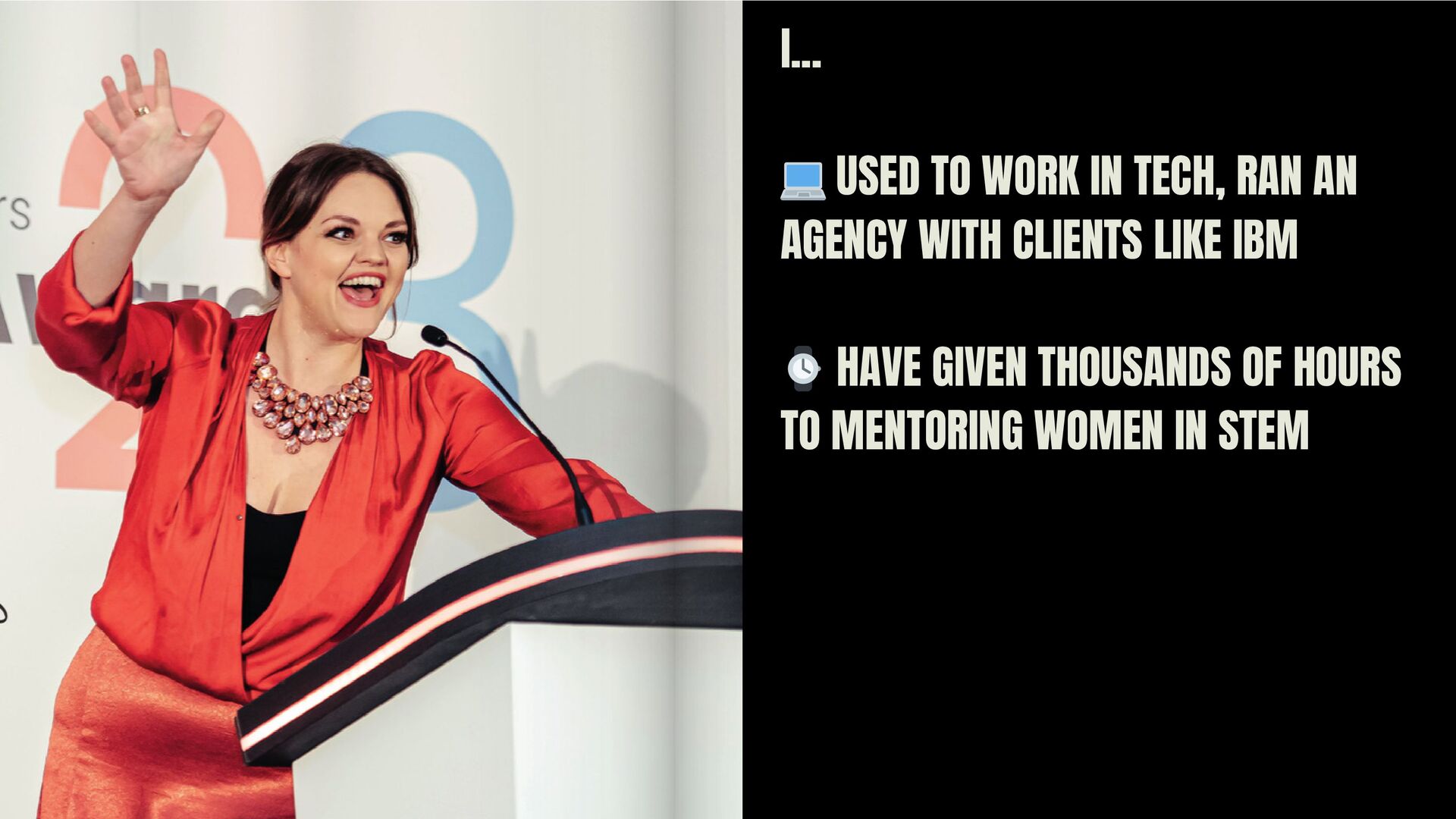
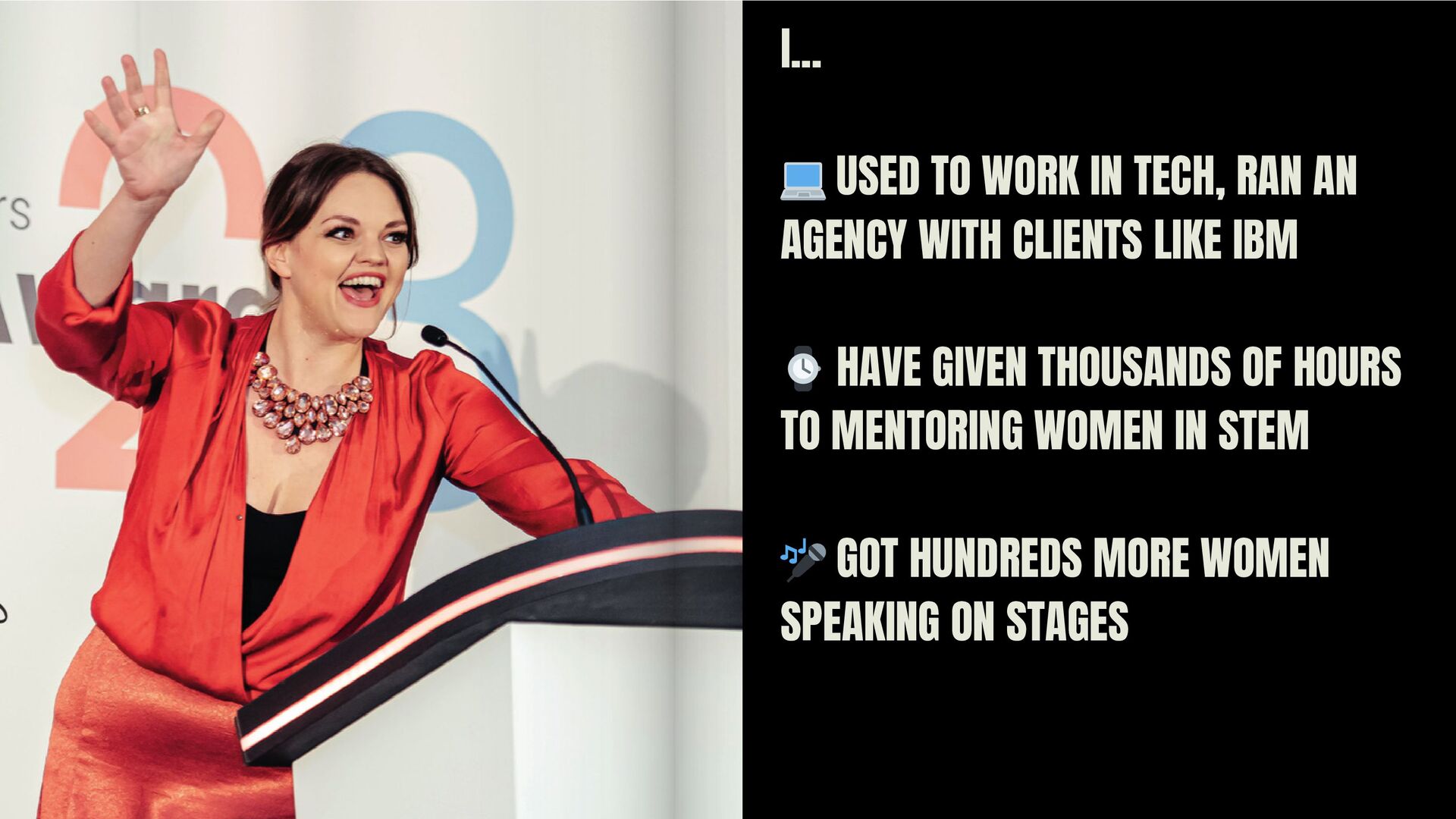
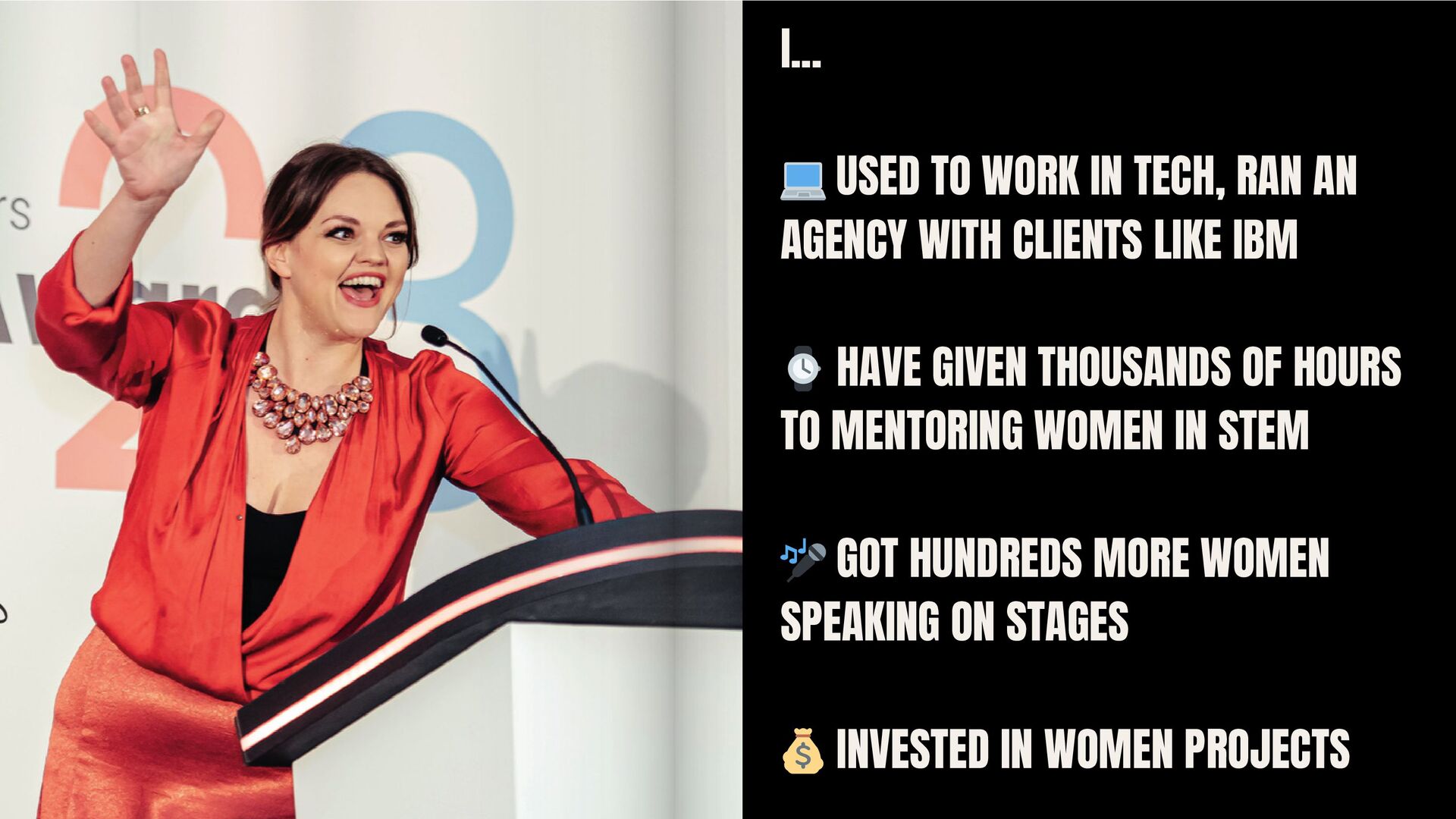
So I used to work in tech. I I work in culture and leadership and development now, but I used to run an agency with clients. I was having meetings with the senior c suite at IBM. I've given thousands of hours truly to mentoring women in STEM.
I genuinely think I'm not exaggerating if I say there's hundreds, if not thousands more women speaking on stages as a direct result of the work that I've done. A lot of my business a lot of my personal capital, I'll invest in female founded businesses.
I am incredibly passionate about the fact that women don't get funding in the way that men do, that women have amazing ideas. It's one of the things in my life that I've spent so much time and energy on. And do you want to know a secret?
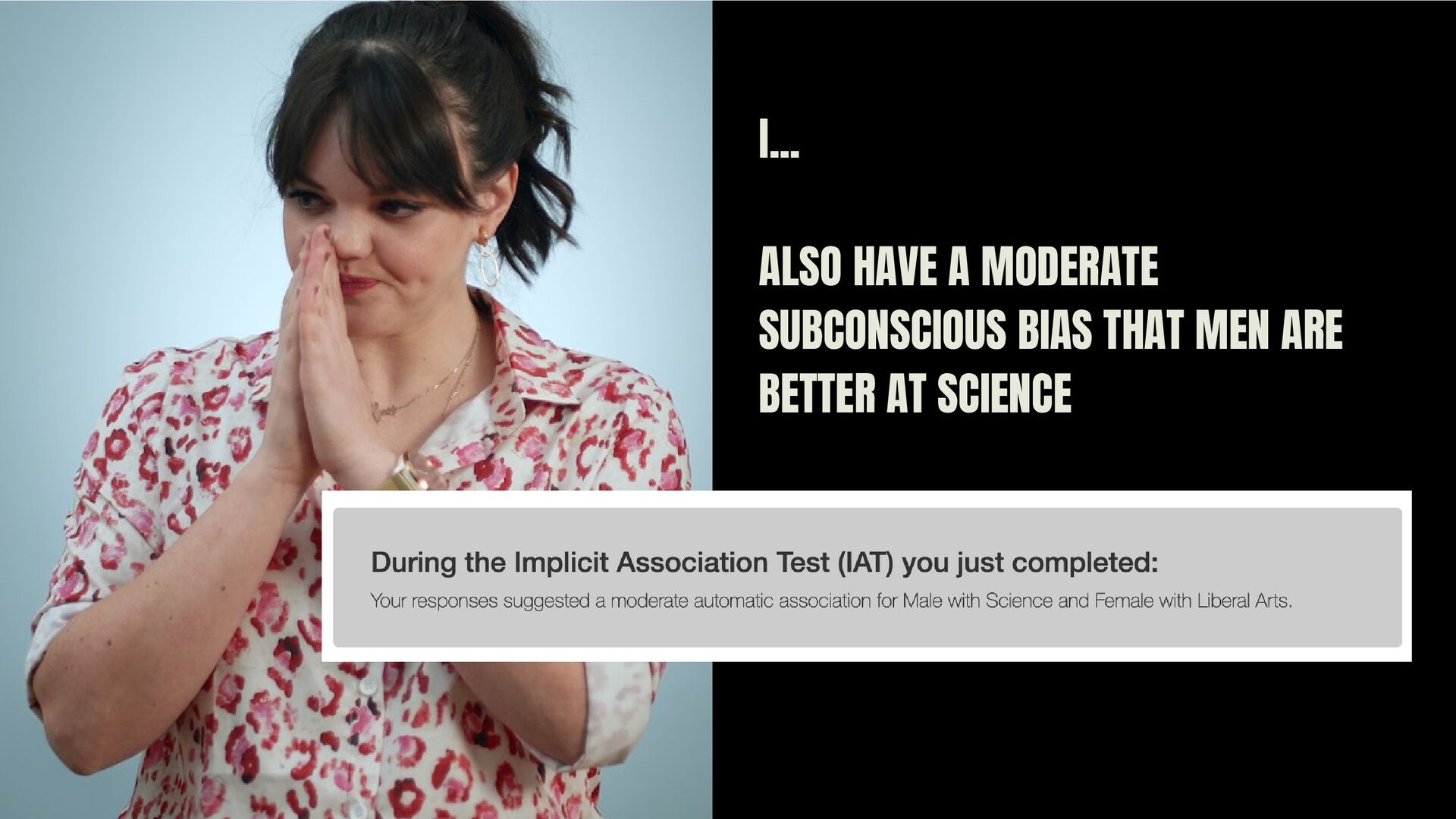
I also have a moderate subconscious bias that men are better at science. That's true. True. And when I shared this with my friend, my friend was like, you're going to tell people about that bias on a stage. And I said, of course I am.
Of course I'm going to tell you that I was raised in a world where I saw men doing maths and girls doing art, and that's going to have an impact on me as an adult. Because the importance with bias is we don't shame it, we actually acknowledge it so that we can work with it.
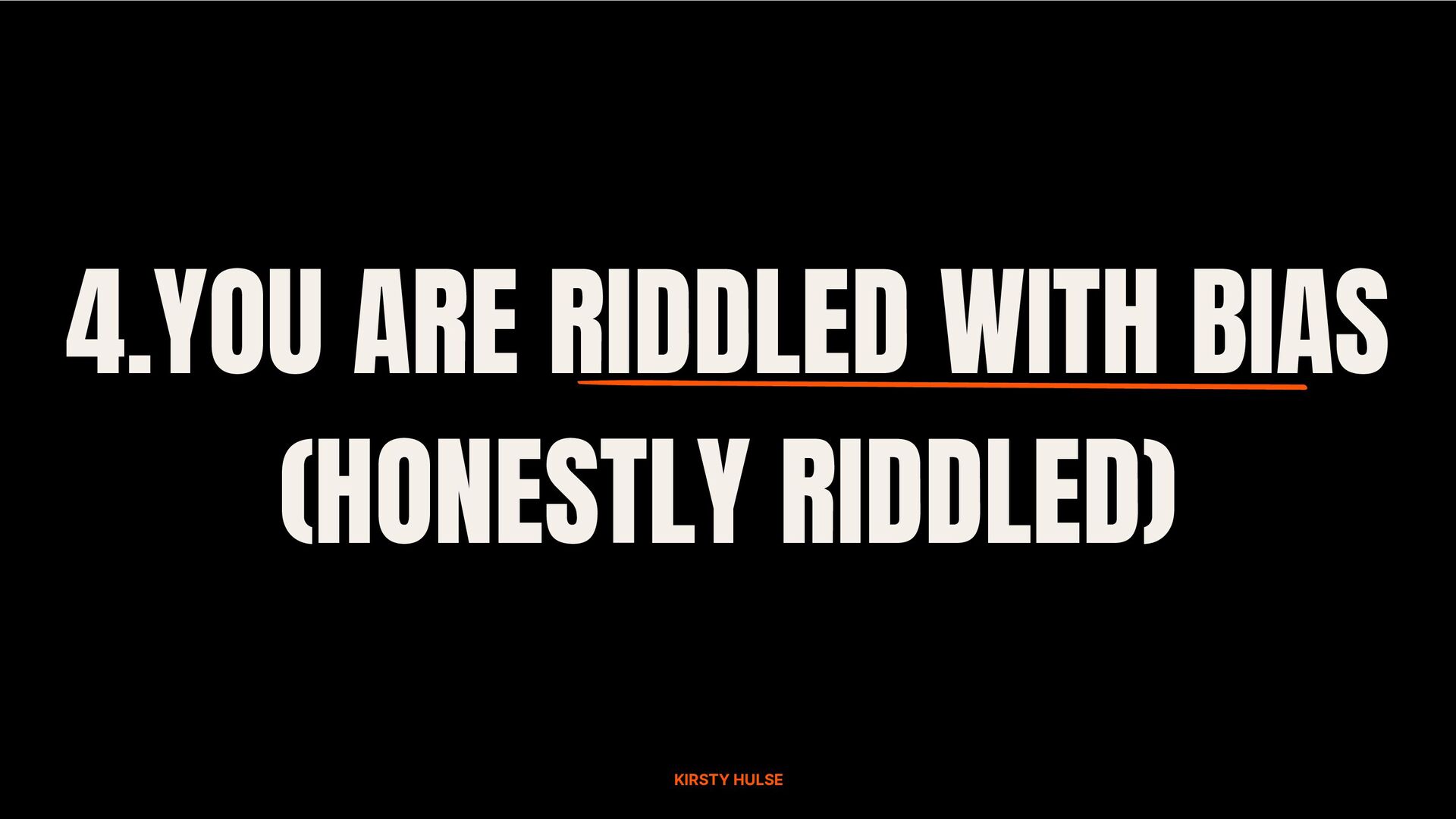
If you're sitting in the audience thinking, oh no, that's not me, I don't have that bias, I would call that confirmation bias. So my friends, you are riddled with bias. Think like a medieval peasant and lice. You are absolutely riddled riddled with bias.
I think if you take one thing away from this talk, let it be that you are just so biased as humans we are. This is and often we add a lot of moral judgments to this, whereas we really, really don't need to. You know, you have millions of pieces of data and information pouring into your brain at any given second.
We have to do something called approximation. Approximation is what allows us to make decisions quickly. But if you sit in this audience thinking you don't have a gender bias, you don't have a race bias, you don't have a sexuality bias, you're almost certainly wrong.
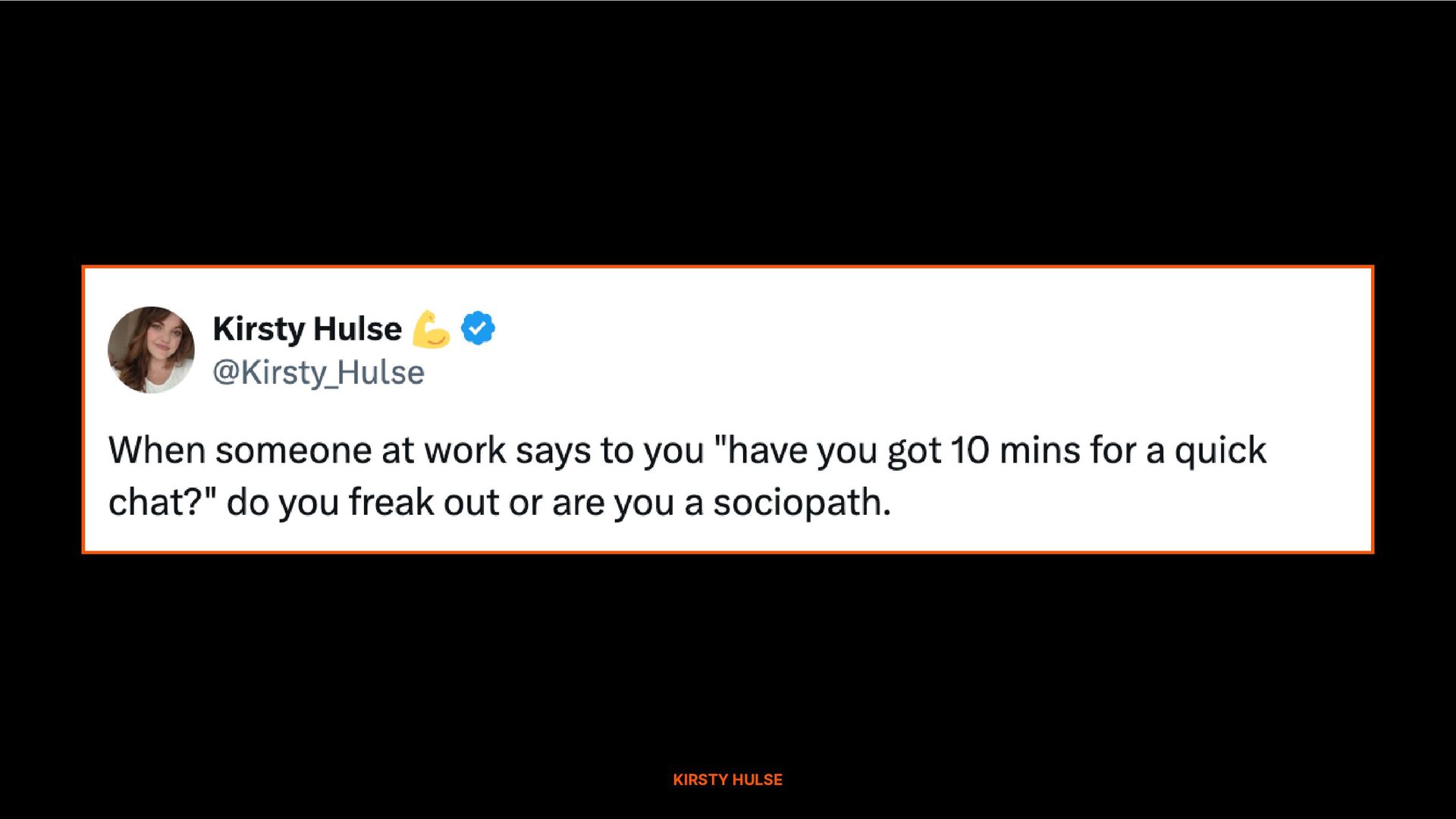
It's true for all of us. This is another reason why things like this might happen. Imagine for a second that I'm your boss, nobody wants it, nobody needs it, but imagine that I was, and I text you, and I was like, ten minutes for a quick chat.
Your entire career flashes before your eyes. Let's make it even more. Let's imagine it's your partner. If your partner is like, need to talk, you're like, oh my god, I need to move out. Have I got enough savings? Will I make it on my own?
And they're like, lasagna or beef? Like, this is just what we do because did you know that ambiguity for us will always be perceived negatively? If you give someone an ambiguous statement, like quick chat, we're gonna go to the negative. In any given context, if we're giving people ambiguous information, then of course we're going to perceive that negatively.
So there's just a few things that can get in the way of why it can be difficult to build resilient, adaptive, happy to have feedback, open to growth cultures. So how can we practically build behaviors that actually help us to overcome this? So I've done it Kirsty has literally solved all of our people problems.
It's one of the things that my client said to me. I'm not going to be able to solve your people problems in fifteen minutes, but I'm going to try. I wanted this to be as solutions focused as possible. So I started this talk with five reasons why cultures can be messy, and I'm going to give you twenty five practical things that you can do right now.
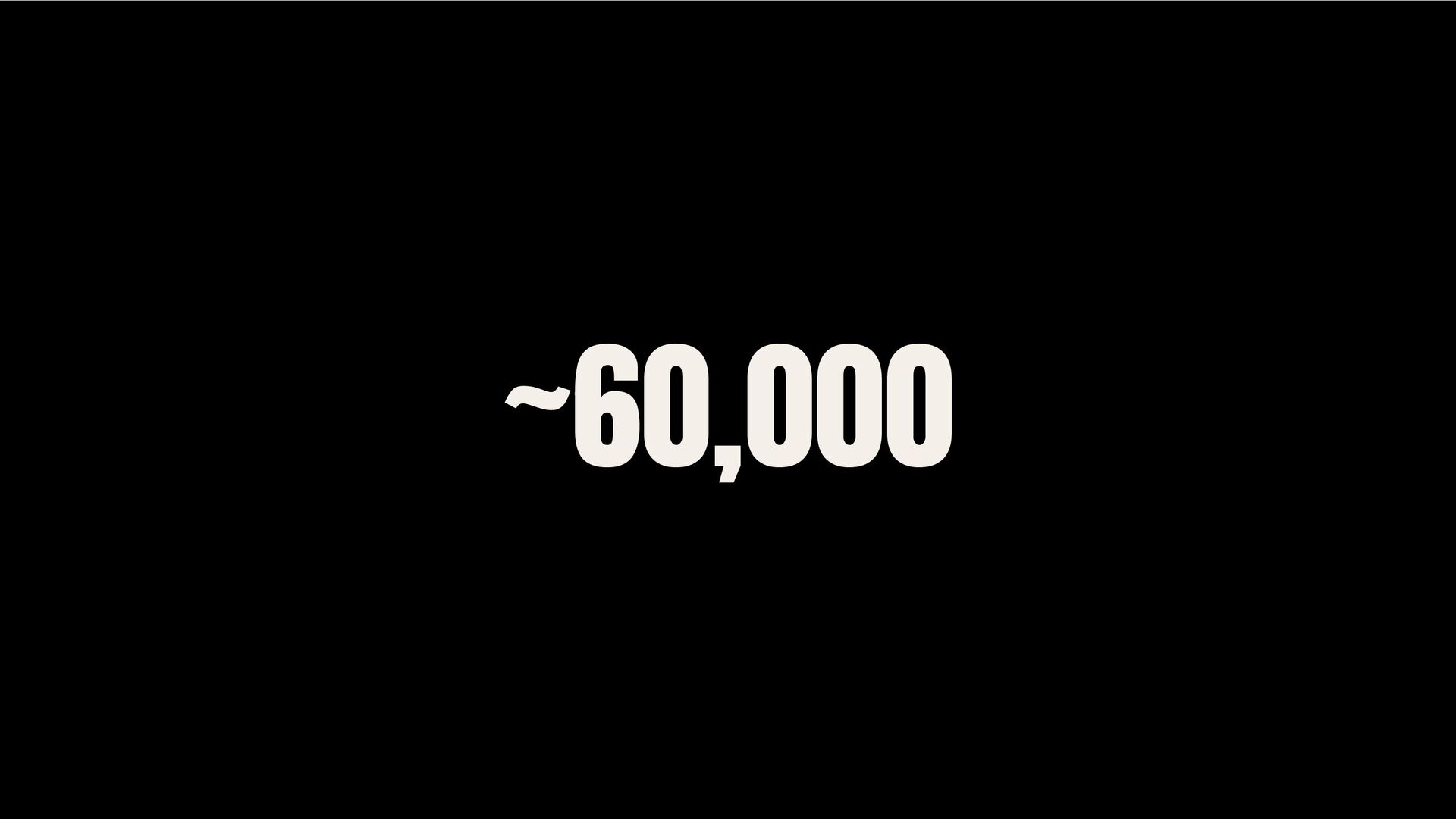
Now, you can apply this to your friendships, your partnerships, your teams, any given context, because what I'm talking about is essentially just how humans human. Sixty thousand is roughly the amount of individuals I've trained at this point. I have met leaders in different sectors, different cultures, all over the world, and honestly, I think I've met two that actually really managed to create a culture where people work hard, get things done, but it's respectful, where people work hard and are productive, but there's none of that like janky intensity.
I've seen two cultures that manage to really create meaningful work life balance for their employees. Out of all of the teams I've met, so prevalent to these difficulties. One of them was, ex performing, really high level athletes, like top of his game athletes.
The other leader of one of these teams was a Buddhist who'd spent some time in his monastery in his youth. So these two people had really, really, really learned not to sweat the small stuff. We don't need to go and become monks unless, of course, you want to.
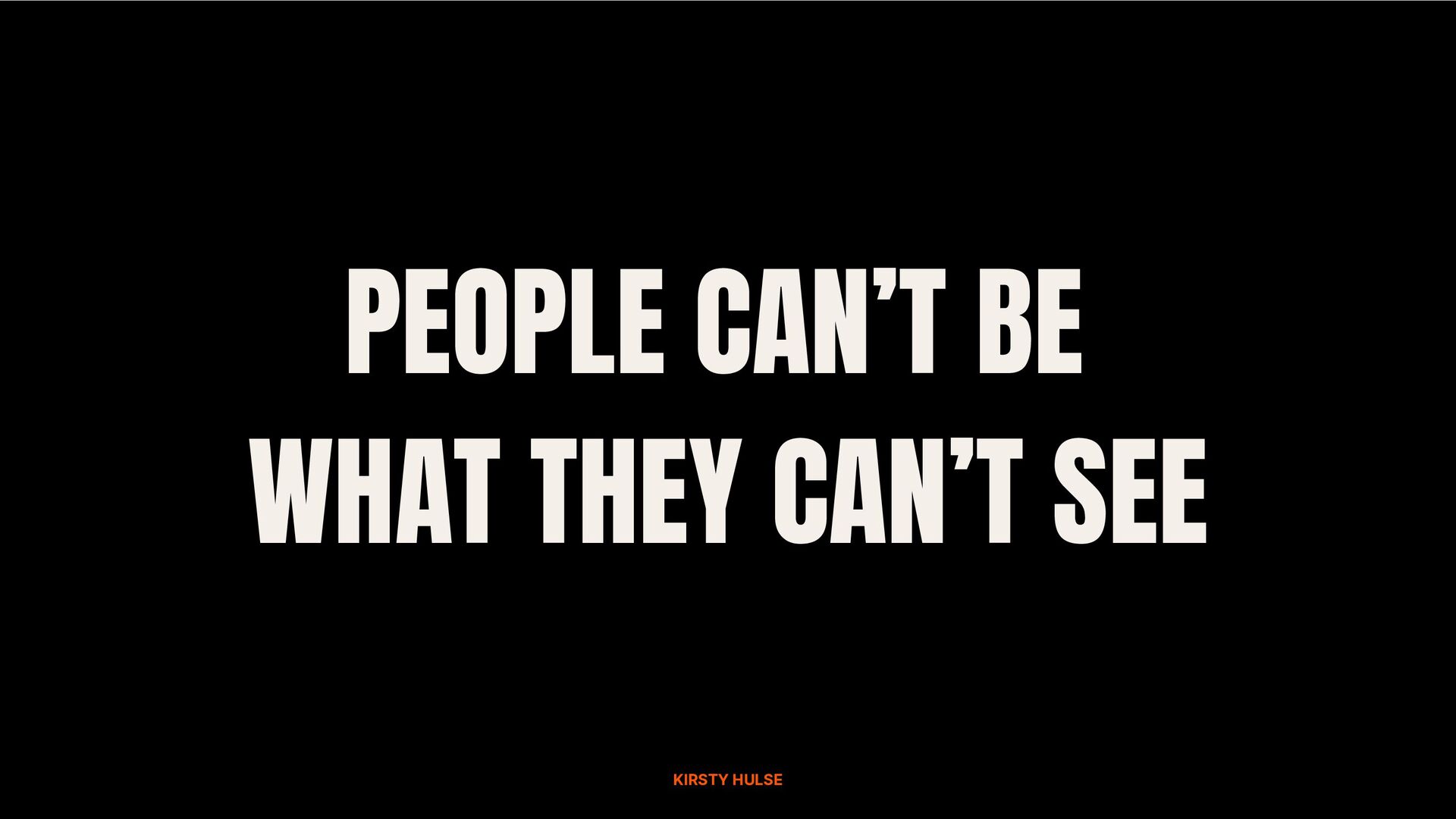
I would respect that choice. That's awesome. But that's not necessarily what I'm saying, but what I am saying is what these two leaders had really learned is how to model the skills that they want to see in their business. People can't be what they can't see.
And so often what I see is founders, managers, leaders, whether you're managing two people or two thousand people, this doesn't make a difference. If you want your team to be focused, confident, calm, productive, you have to be that first my friends. Good leadership is an inside out approach.
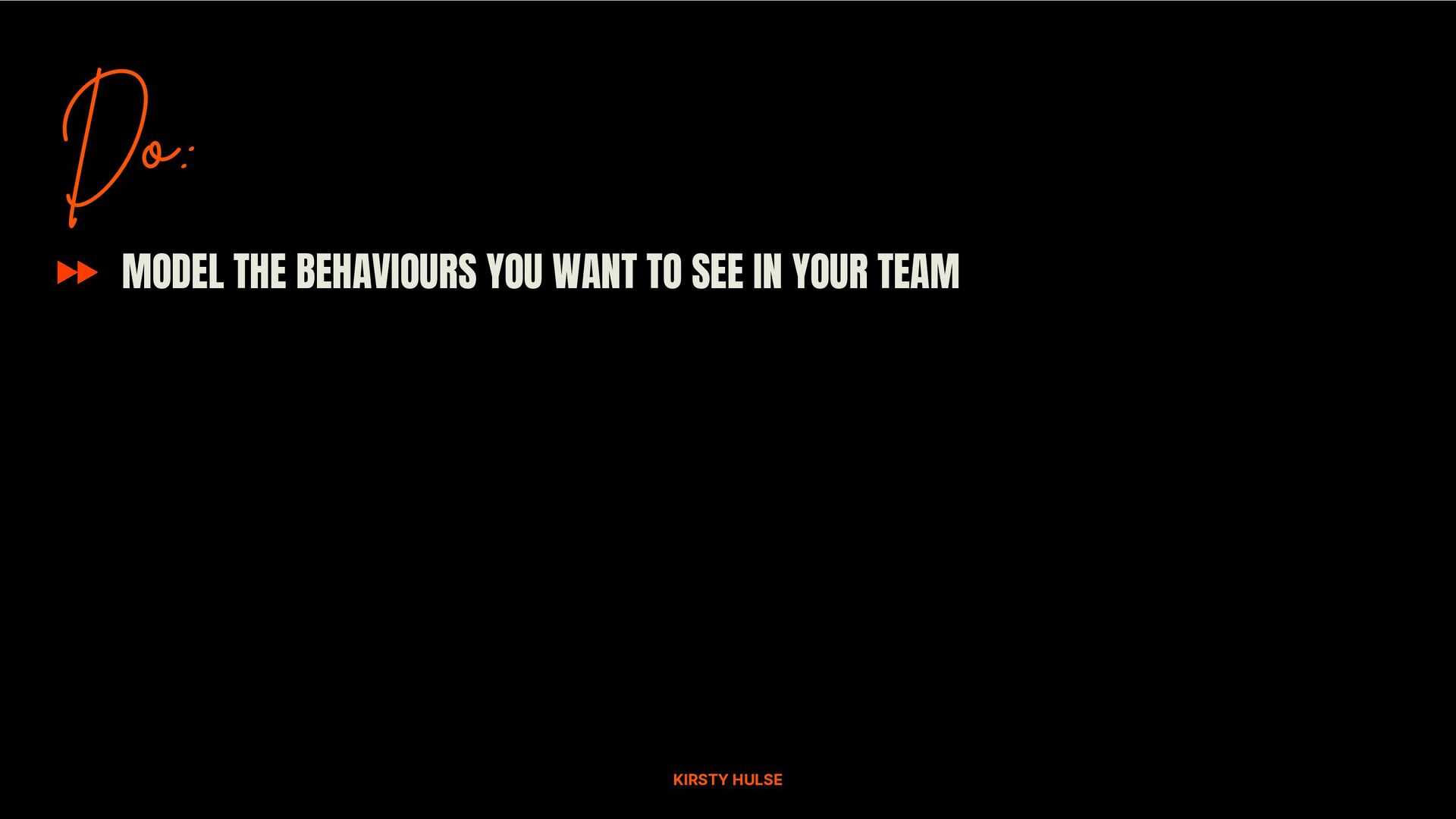
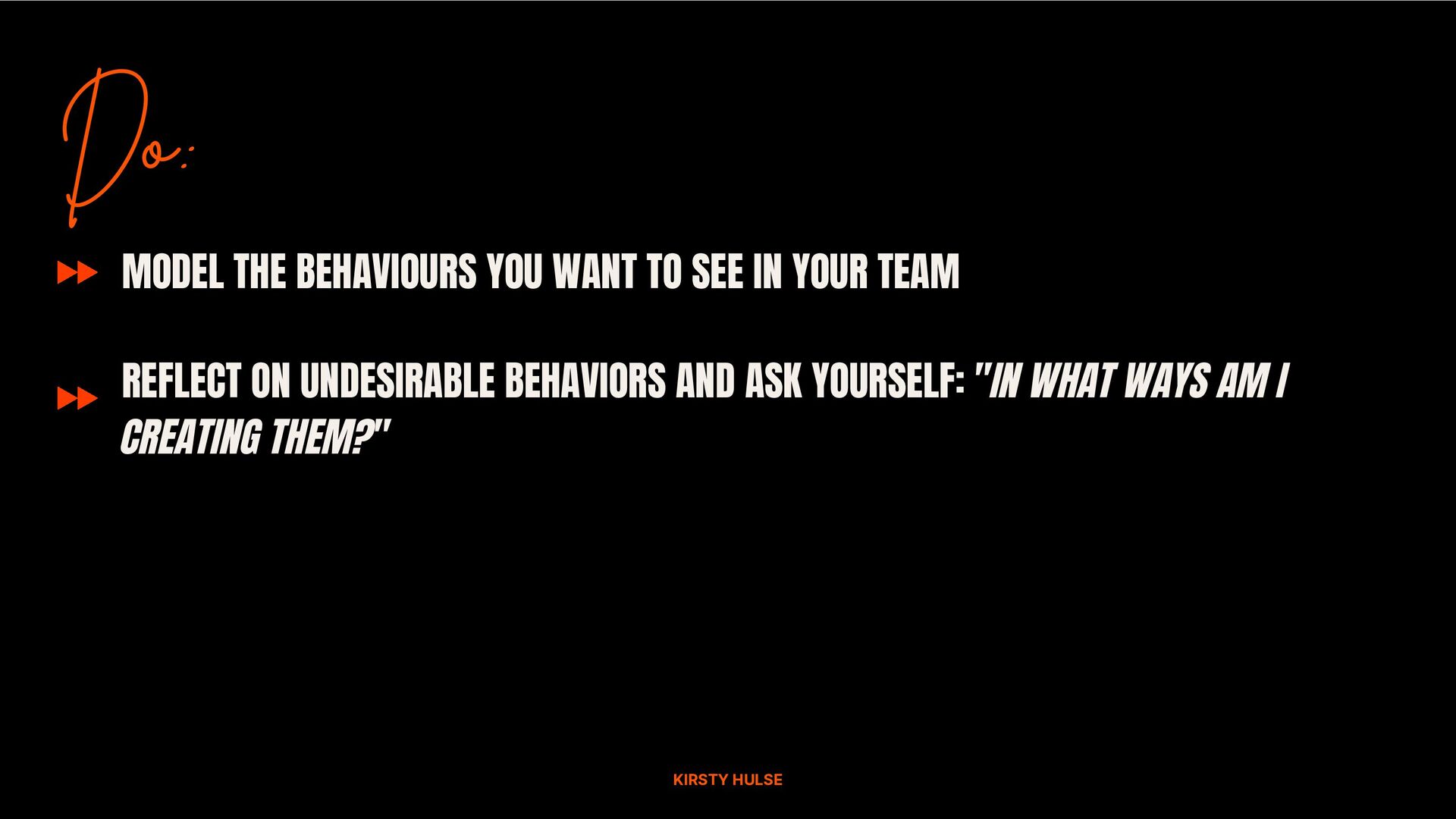
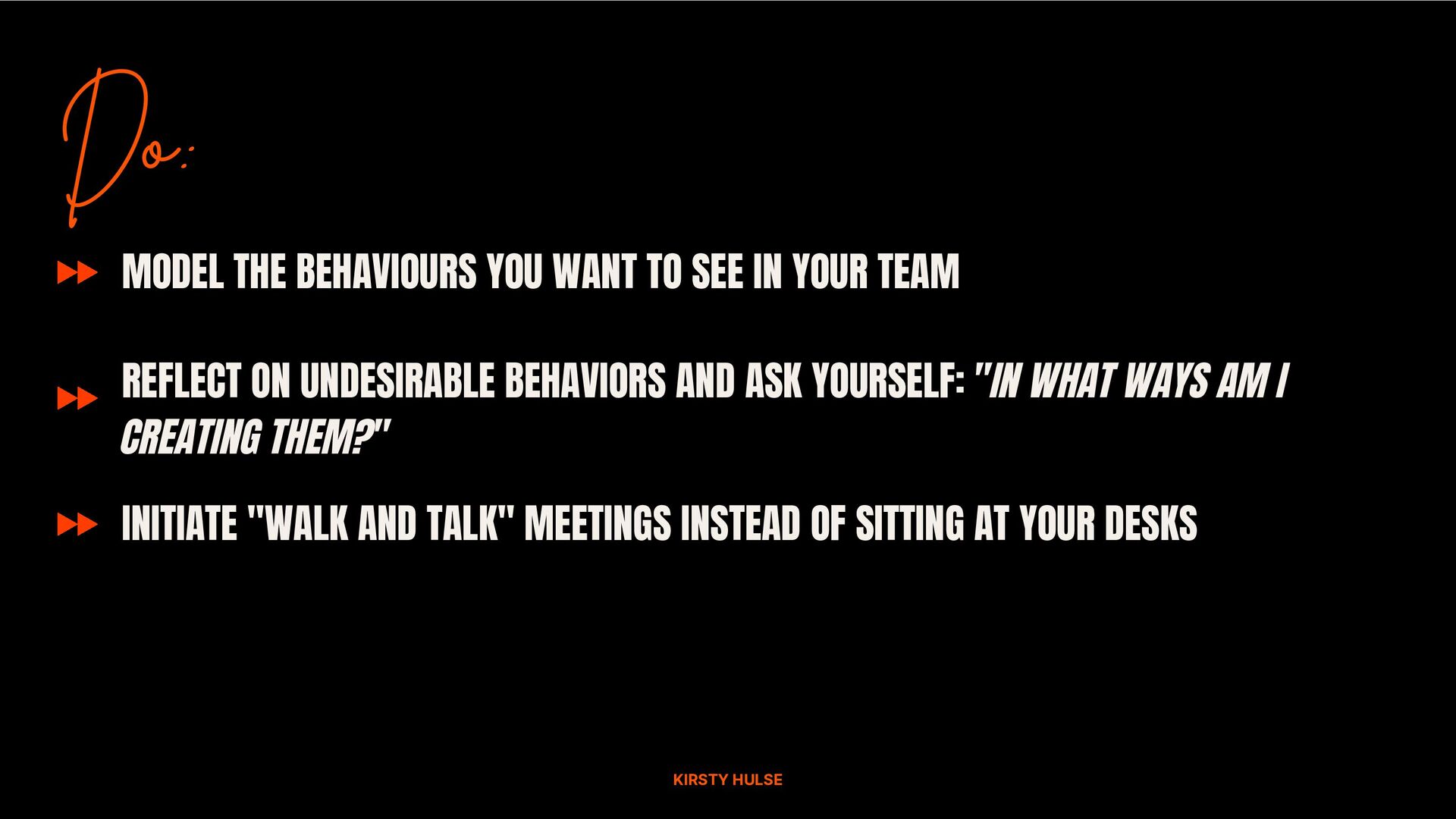
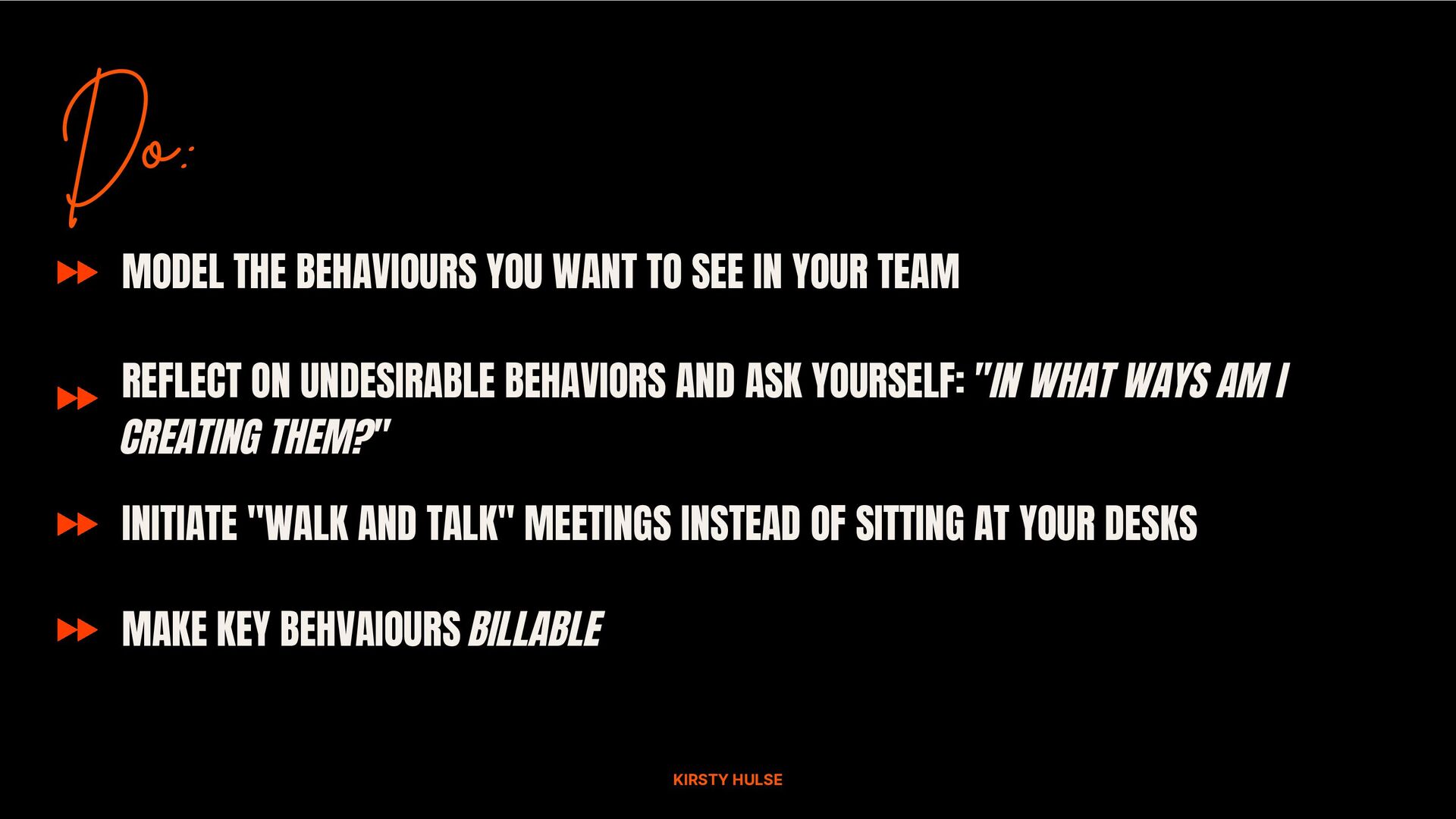
We model the behaviors that we see in our teams. So here's some things that you can do. So model the behaviors you want to see in your team. Reflect on undesirable behaviors and ask yourself, in what ways am I creating them? This is one of the first things I get teams to do when I'm doing leadership training.
So I'll give you an example. Does anybody here have a team who maybe they come to you all the time with questions? They're like asking you questions all the time, like, what should I do about this? What should I do about this? And you just want them to trust themselves and have some initiative, I guarantee you respond with the answer.
I bet you do. Now, if you want to build teams where they believe in themselves and they trust themselves, you have to make sure that you're facilitating that. It's something as simple as walk and talk meetings instead of sitting at your desks. Make key behaviors billable.
Desks. Make key behaviors billable. This is especially important if anybody here works in an agency. If you want a creative, innovative team, you have to make creative, innovative thought billable for the business. If you don't make the behaviors you want to see in your team billable, I.
E. Considered to be revenue driving, people will never implement them. Another thing that my Buddhist monk friend did was this. Now, as humans, we tend to think that motivation kind of just happens to us. By the way, I'm a motivational speaker. This is my day job.
It is my day job to stand on stages and make you believe in yourselves, and some days I cannot be arsed. Like, some days I wake up and I'm like, no, not today, not feeling it. The good thing about motivation though is we think it's either there or it isn't, whereas actually we do have a little bit of agency over it, just a little bit.
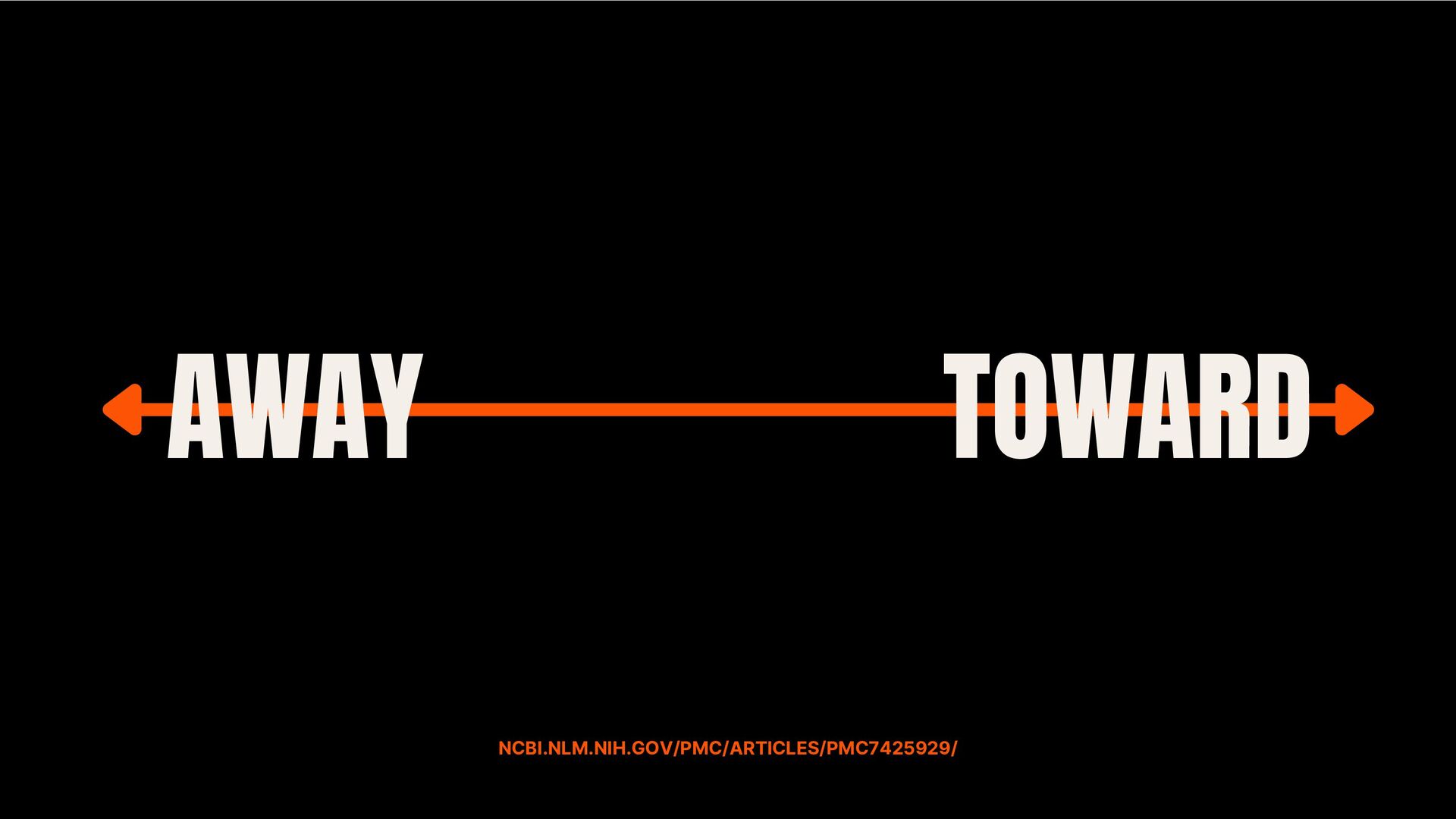
As humans, we're kind of binary. We have something called a waste state motivation and something called toward state motivation. A way state motivation is kind of what it says on the tin. So a way state motivation is when your brain and your body perceives a negative, and you try to move away from that negative.
So this might be going like, don't want to lose a team, don't want to run out of money, don't want to run out of funding, don't want to let people down, don't want people to think I'm lazy, I have imposter syndrome, I don't want people to think I'm not good at my job, I'm going into this meeting and this client's really difficult.
This is all a waste state motivation. This is when we motivate ourselves essentially through fear. As a result, there is a physiological response to that. When we use a waste state motivation, research has shown our cortisol gets higher. Some of you may know what cortisol is.
Cortisol is our stress hormone. I don't want to give anyone an existential crisis in the afternoon, but there is no such thing as a stressful situation. Stay with me. That was slightly click baity, but stay with me. Of course, there are stressful situations.
But where does the stress live in the situation or you? The stress lives on you. So what this means, if you have high cortisol, your adaptability to the stressful situation goes down. So let's say you've got one of those days where you wake up and you're like, I've got this.
I've totally got this. And then the same situation, another day can feel crippling. When we use a significant amount of away state motivation, everything gets a little bit harder. My nan, Vera, was a psychic spiritualist medium gypsy. She was a vibe. And she used to say, the onions are in the soup.
What I mean by that is you don't need to now go away and take the onions of the soup of your waste state motivation out. I don't know if that metaphor works. What we want to do is add more in. I'm gonna get you to do something weird.
I feel like we're we're vibing. Okay. So just please do this, otherwise it's gonna be weird for everyone, and I feel like we're friends. Aren't we friends? Yes. Thank you. Okay. So what I'm gonna get you to do, just shout out, a food that you would put in a soup.
Carrots. Carrots. Give me some more. Celery. Celery. Yes. More. Chicken. Thank you. We've got a protein. Give us a carb. A ramego. Yes. Yes. Lovely, lovely. Fantastic soup. Delicious. It is our job to add more into the soup for our and our teams.
So most people will naturally motivate themselves with a waste state motivation. It's just what we do. We're negative, naturally, we are given it when we are raised. Anybody here only really capable of getting things done unless you're like really close to the deadline?
Oh, you've had weeks to do it. You've had weeks, but you're not getting it done. That's a perfect example of a waste state motivation. Let those onions be in the soup. It works. Just add in more towards state. Now, I'm not making this up.
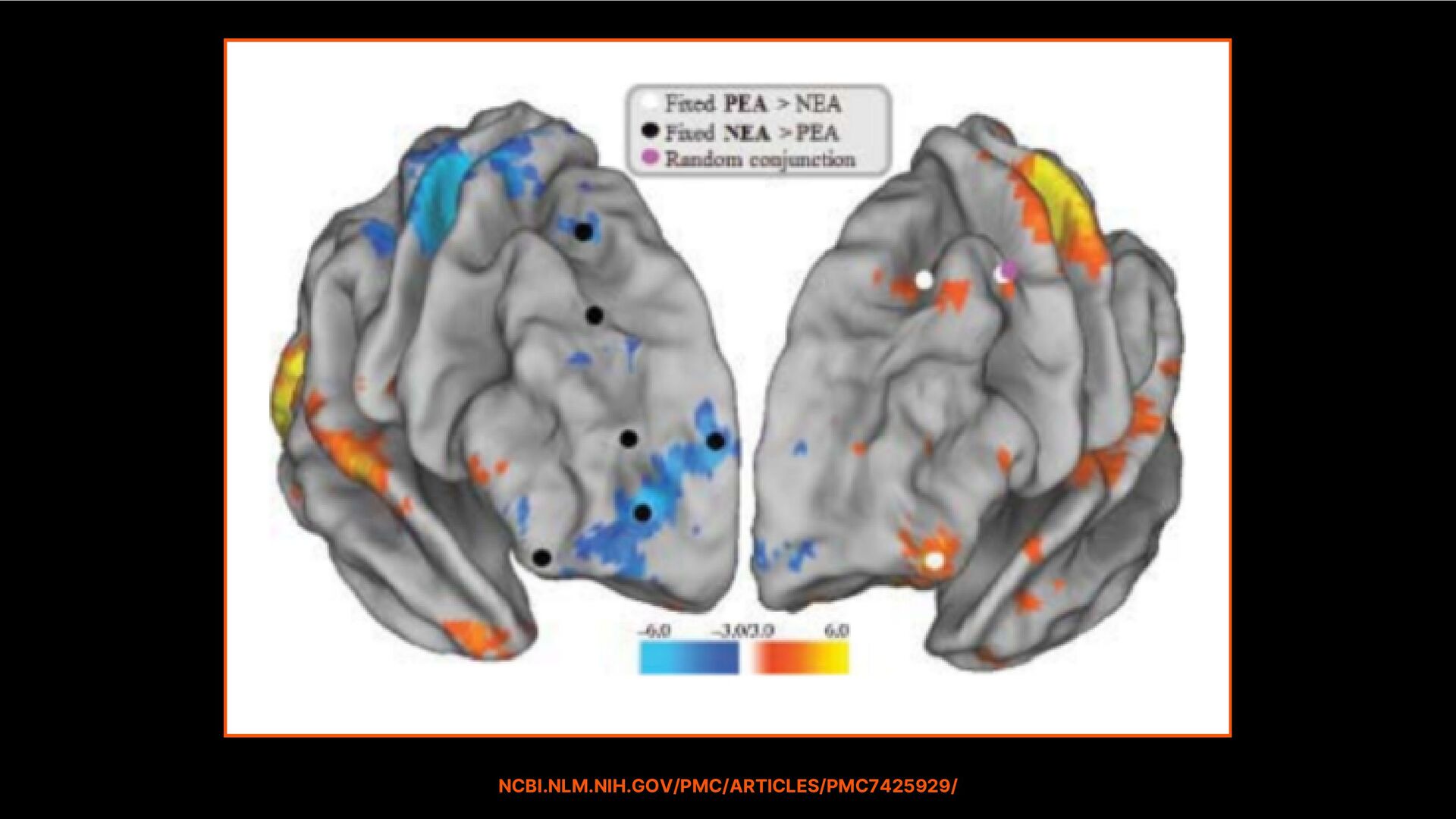
Towards state motivation is simply when we're moving towards an exciting positive rather than moving away from a scary negative. Neuroscientist David Rock has shown when you motivate people with towards state motivation, their entire brains light up. Motivational processes engage, we become more open, we become more receptive, we become more innovative, more creative.
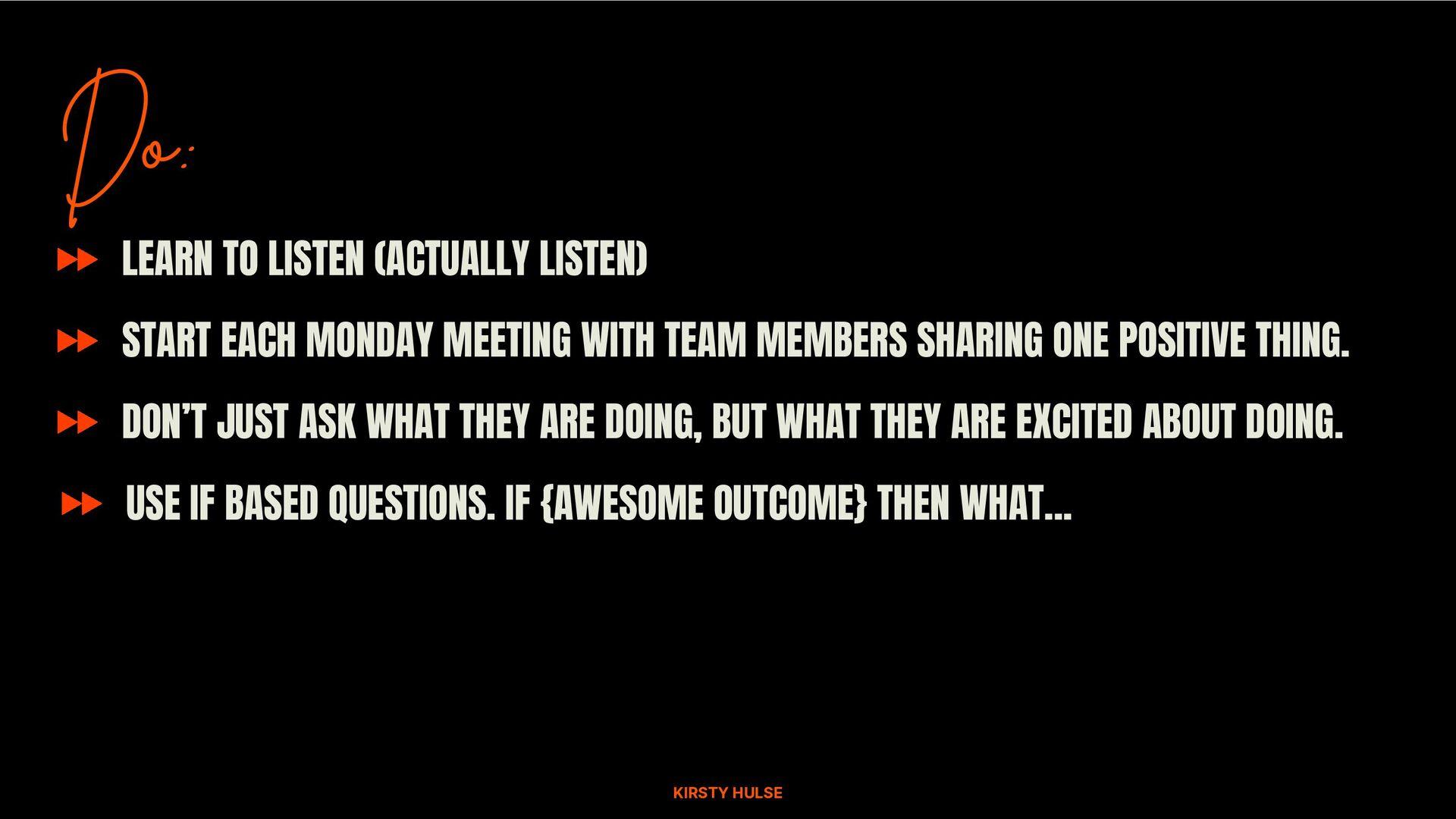
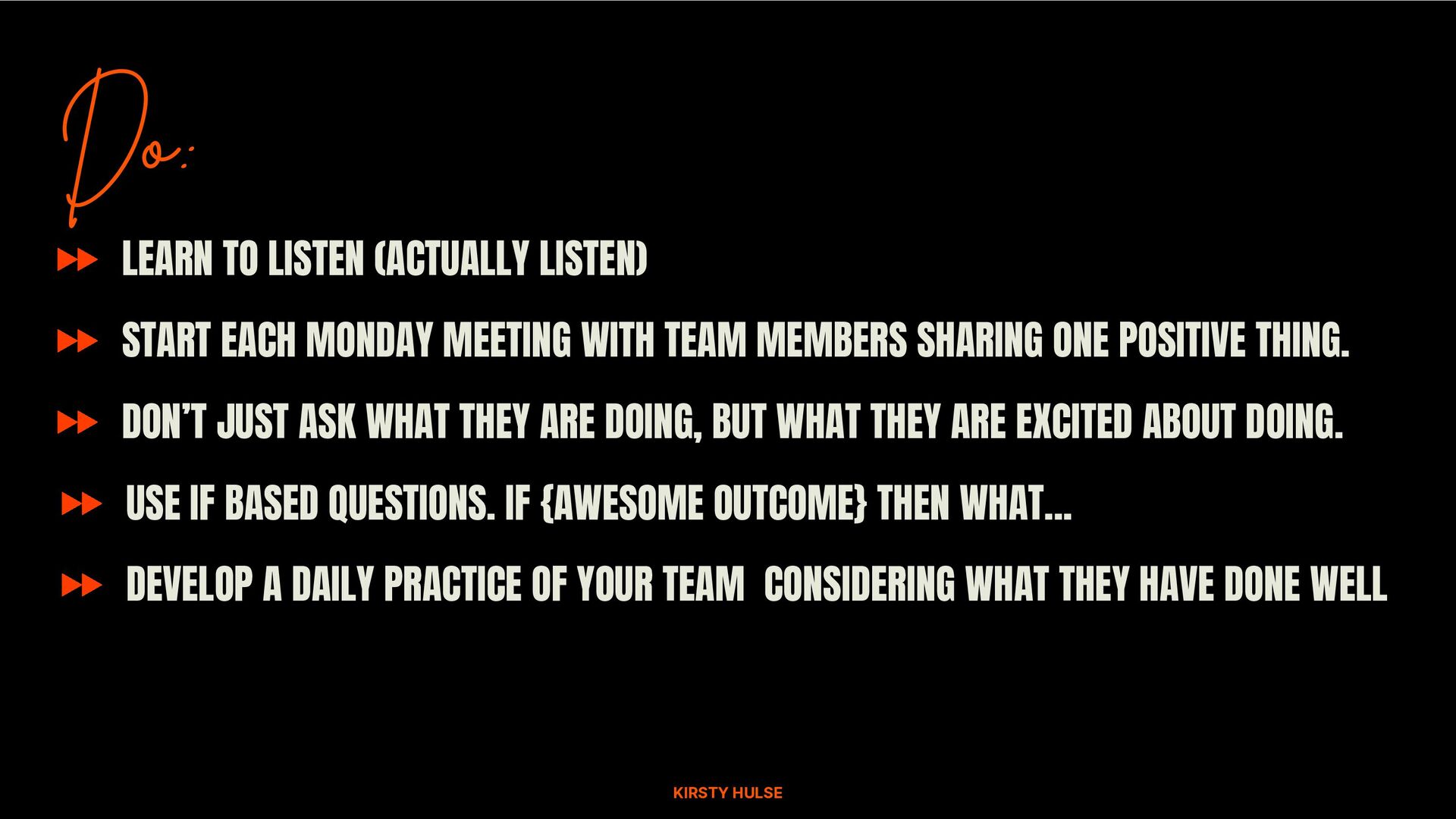
If you need people to be creative, solve problems, come up with new solutions, we need towards state motivation. But don't worry, I've got you. Here's how you do it. First, you need to learn to listen, actually listen. It's hard, and it can be person to person dependent, but I genuinely don't think I ever listened to anyone until I was about twenty nine years old, and I'm not even exaggerating, because I didn't learn.
I'm not necessarily naturally a listener, I get excited, I want to talk, you have something to say, I have something to say, whereas, what true listening is, is giving people your presence in the moment. That's when someone's talking to you, and you're not in your head scripting what you're going to say next, you're not thinking about what you're going to eat, you're just giving them your presence.
One of the reasons this is so important is when we feel listened, and heard, again our quarters are lower, something called oxytocin increases, which is how we build rapport. You can't learn this overnight, but next time a friend, a colleague, a co worker, a partner comes to you with a problem in particular, try and just listen.
This is what will happen if you've never learned it. If you've never learned it before, you'll listen for like a second and then you'll be like, I'm doing it. Oh, yeah. I'm doing it. I'm doing my listening. And then you'll be like, I really did like that song.
What was that song I used to listen to in the eighties? Wait. No. Yeah. Listening. You'll go in and out. So it's a skill that you practice. Start each Monday meeting, with team members showing one positive thing. This is important. Don't just ask what the people If you manage people, don't just say, what are you doing this week?
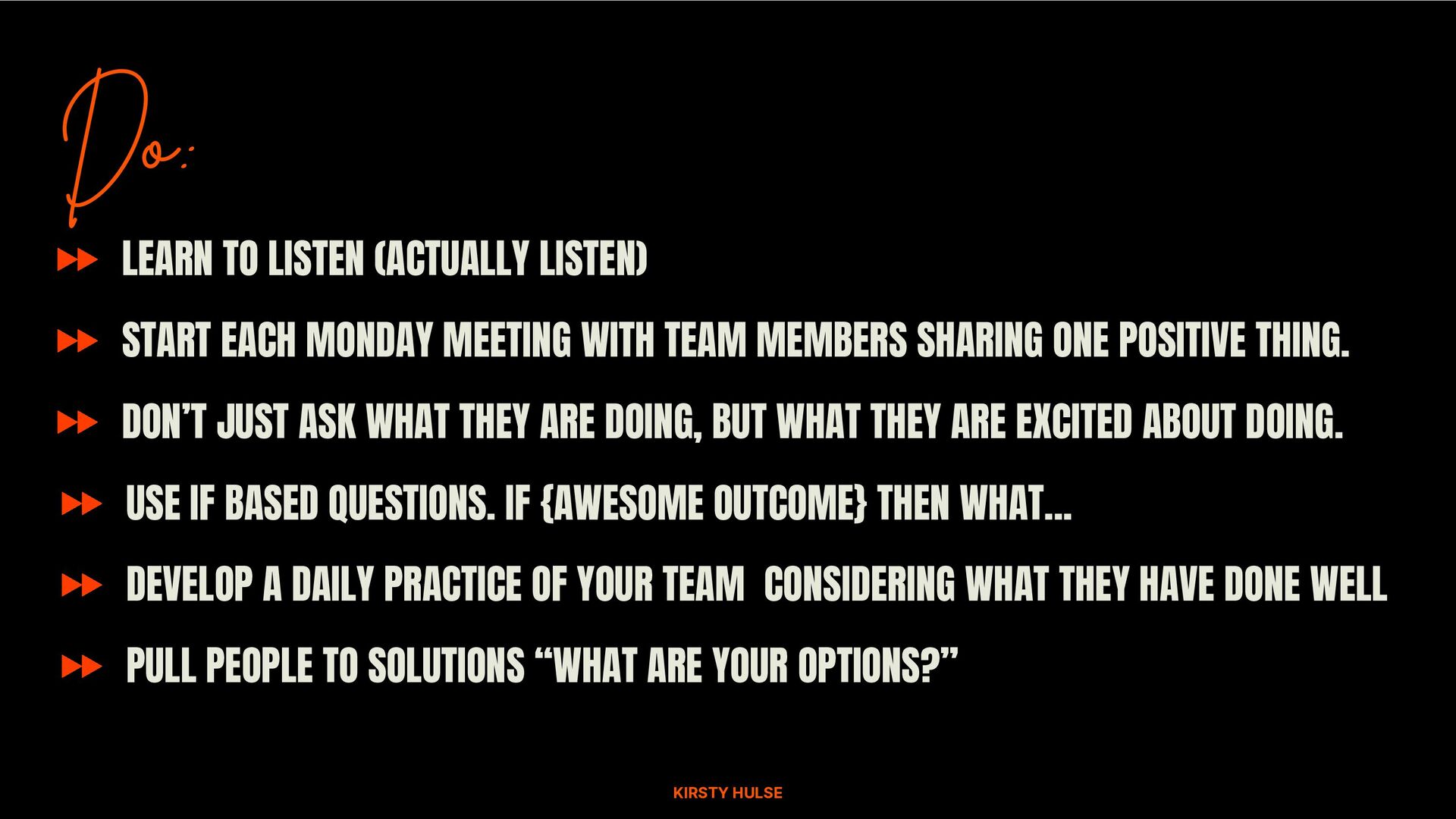
Say, what are you excited about this week? It's a tiny semantic shift, but it does make a difference. Use if based questions. Oh, I love this. I'm gonna go through this quite quickly, but stay with me. This is maybe one of the most transformational skills I learned.
I learned this when I was still running my agency. If based questions, again, come from a neuroscientist called David Rock. And when he put people in the MRI scanners and he asked people if based questions, again, all of that good neurological stuff happened.
An if based question is instead of saying to someone, why have you done it like that? It's saying, if you were to do this even better next time, what would you do differently? Instead of saying to someone, why won't you sign this idea off?
It's saying, if there were no obstacles, what would we do? The reason if based questions are so powerful is it pushes people into that towards state thinking, and then gets them to action plan. If you have someone on your team who's consistently underperforming, say to them, if you were delivering your job even better, what would be good?
If you want people to set goals and motivate themselves, if you loved working here, what would you be doing differently? If based questions are fantastic, develop a daily practice of your team considering what they have done well. If you have a team and you want them to believe in themselves and stop building confidence, stop telling them that they're good.
It doesn't work. You know when you're like feeling a bit down on yourself, and your friend goes, oh, but you're awesome. You're not like, ah, yes, you're right. Thank you. That's not how it works. If we want to start really believing in ourselves, we have to start telling it to ourselves.
Pull people to solutions with what are your options. Again, one of the challenges that you might have, I don't know, is people come to you with their problems all the time, don't they? They're like, I can't do it because of this, and then Dave and accounts did that, and then we don't have the budget, and then that person did that, and then that person did that.
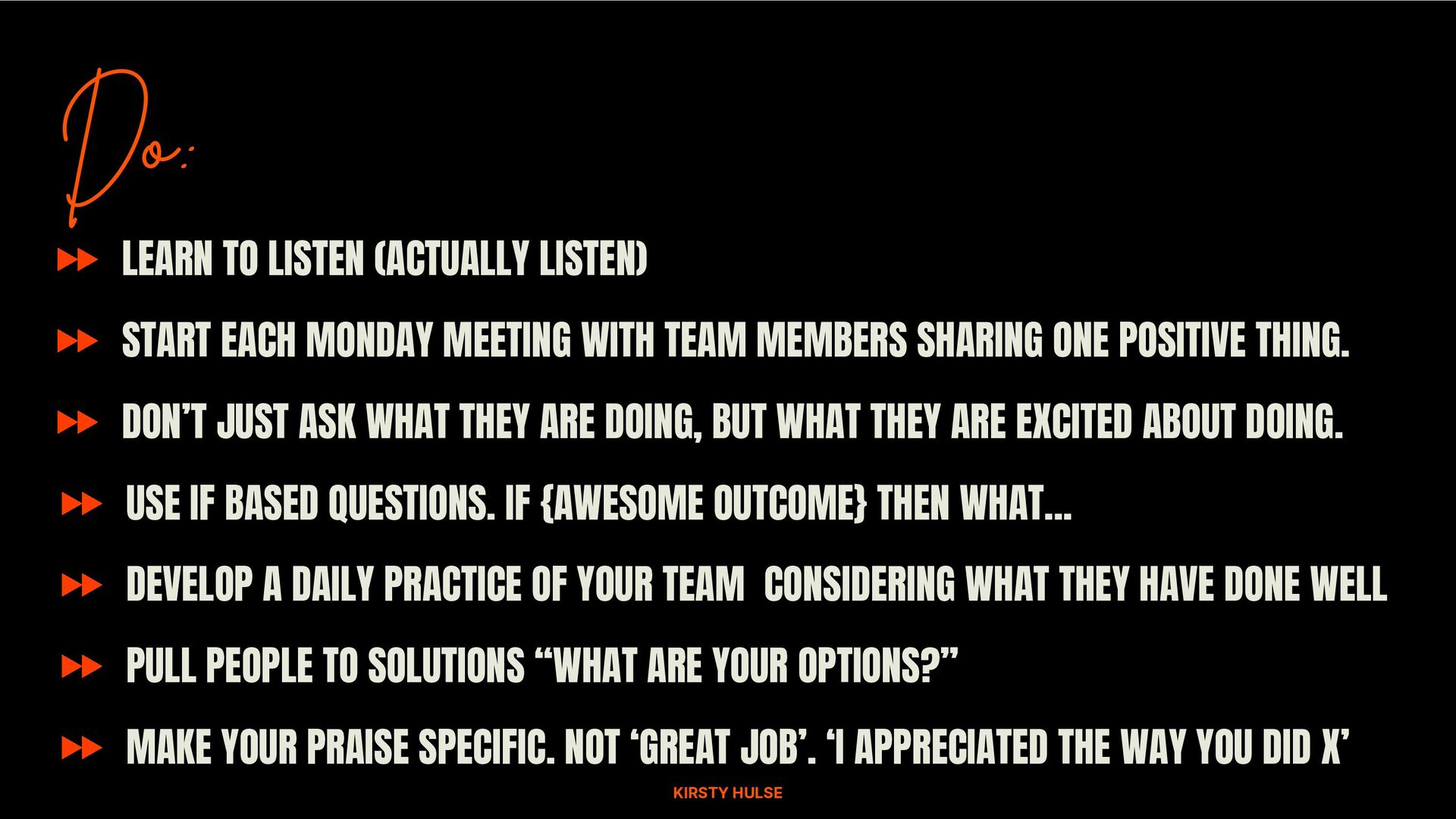
That's okay. Listen to them, engage that listing, and then say thank you for sharing that with me. What are your options? What are your options? Stop giving people the solutions. What are your options consistently? Make your praise specific. Stop saying to people, great job. It's rubbish.
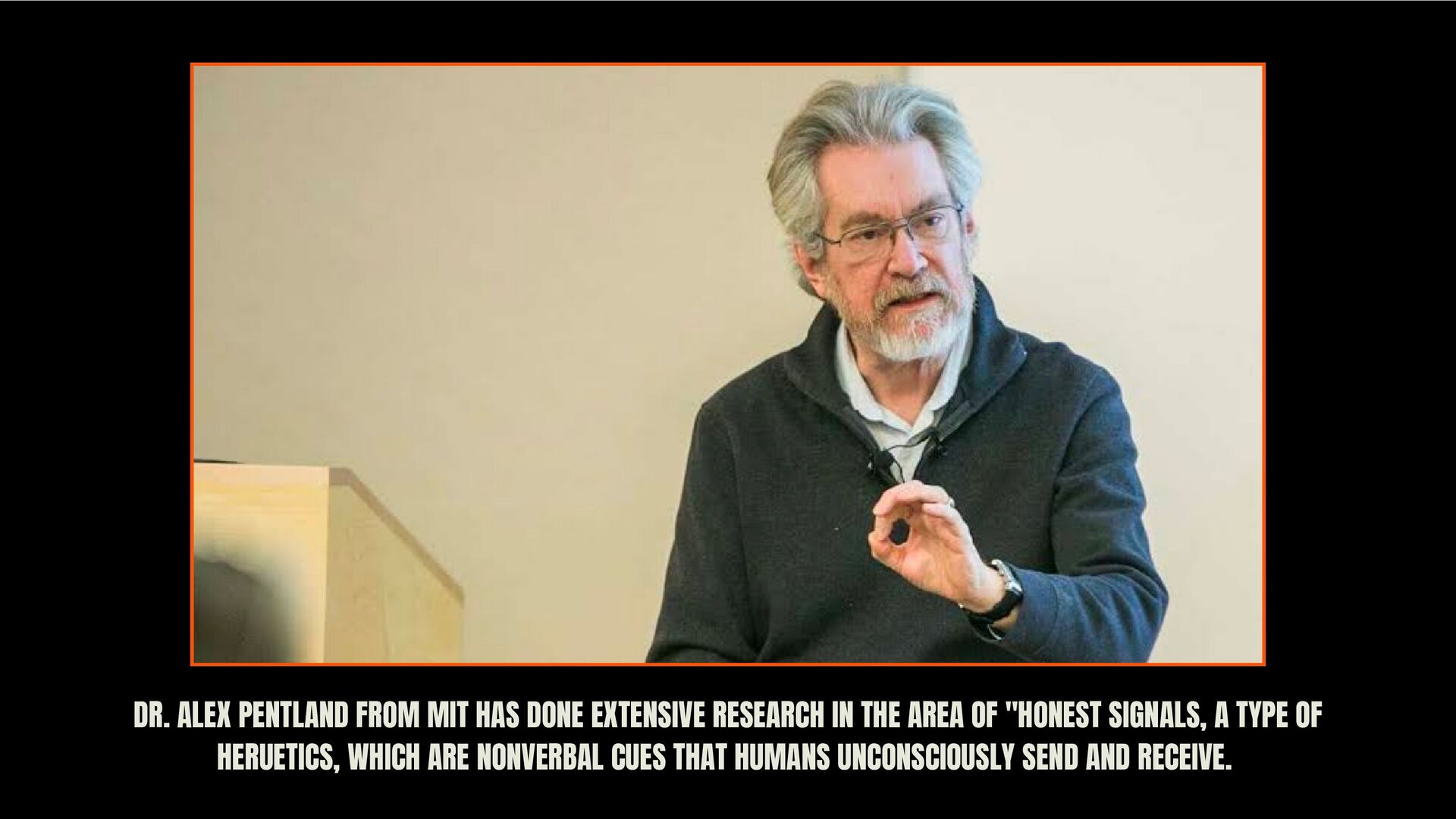
Instead, say, I really liked how you color coded those cells on the spreadsheet. Specific compliments are easier to take. Those are some simple things that you can do to stop building confidence. This is doctor Alex Pentland. Doctor Alex Pentland is from MIT, and he's done some research on something called honest signals.
Honest signals are essentially what makes us connect as humans. Now, the reason this is interesting for us is, Alex Pentland was at a business conference with a business professor from Harvard, and I like to imagine them having a chat over a glass of Scotch, and, the business professor was saying, oh, I've just taught my MBA students how to write a good, really good pitch, a really good investor deck.
And Alex Pentland is like, pointless, you you don't need to do that. It's pointless, you you don't need to do that, it's a waste of time, because that's not how people make decisions. The business professor I just burped, that's fine, let's keep moving.
The the business professor was like, obviously this is important. And so then Alex Pentland was like, right, let me give you a wager. Let's do a wager. So Alex Pentland was like, give me all of your incredible, amazing founders and people running businesses, and I will be able to guess who gets investment, not from the business plan, not from their smart data, not from the slides.
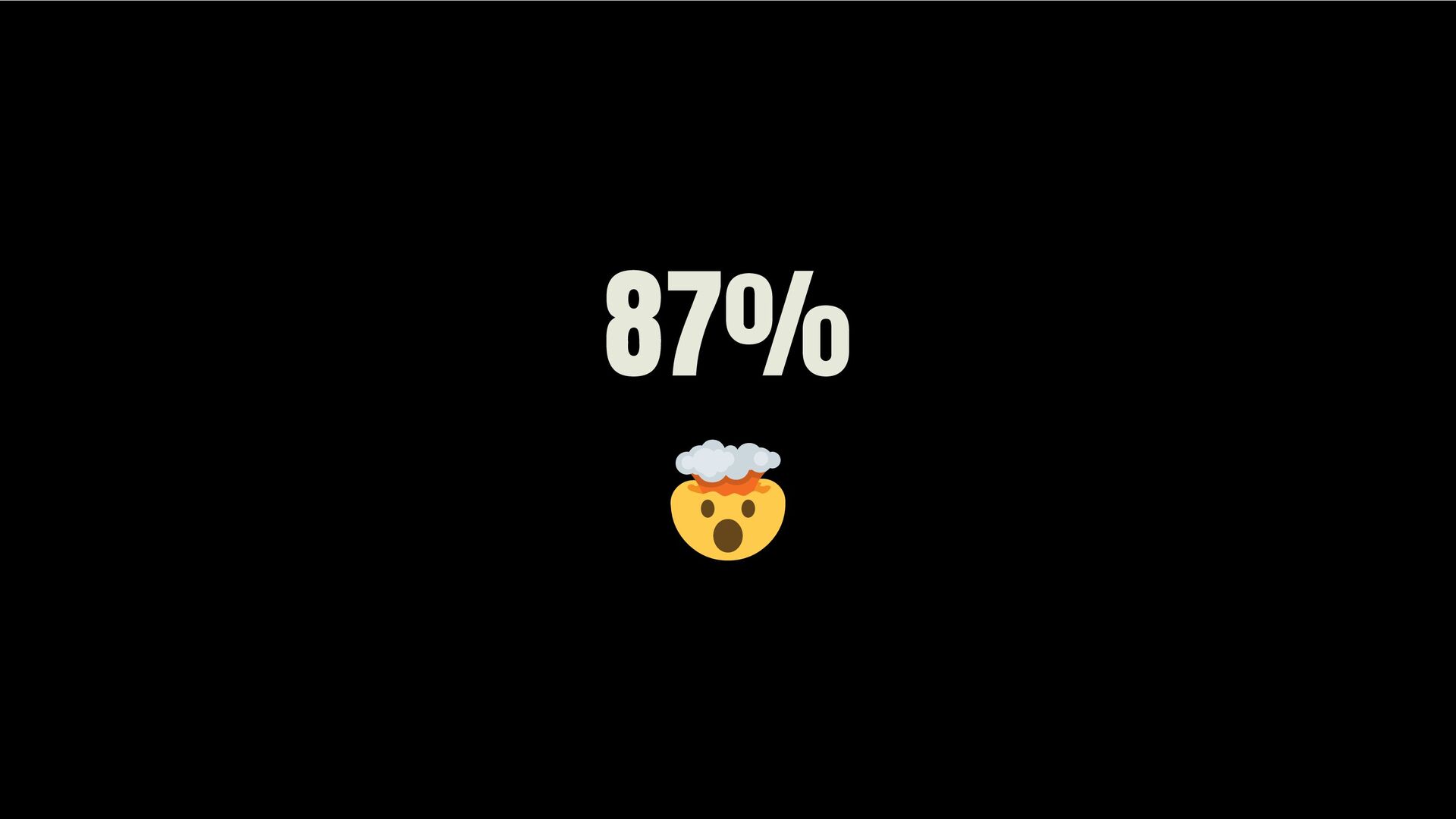
He didn't want to see anything. The only thing that doctor Alex Pentland wanted to see was the first five seconds that somebody entered the space. That's it. That's all he saw. As a guest for me, with how much accuracy could him and his team, guess who got the investment?
Some shout outs. Eighty five percent. Eighty seven percent. Eighty seven percent. It is not your data, it is not your business plan, it is not your information that is cool, it is necessary, but what makes you succeed is the energy you bring into the space.
Also, by the way, research has also shown that investors are more likely to invest on a sunnier day. These are hard hitting VCs. The idea that you are rational, data driven, not emotional people is a myth. All of the decisions you make are emotional.
If you're sitting in the audience now thinking, I don't believe that, that's an emotional response. Hello, I see you. We are fundamentally emotional people, so warning, this next piece of advice is so helpful, a client literally painted it on his office door. If you want to be a better leader, if you want to make more money, just be mindful of the energy you bring into the space.
Now that's cool because I think you already know how to do that. You already know how to do that. So what do we need to do? We need to understand that humans are mostly emotional, messy, and complex. After meetings, attendees write and share a two sentence summary of key points you're biased.
We take information in different ways. Test your bias without judgement. If it If you do a test and it comes out that you're really biased, that's okay. That's how we get better at this stuff. How do I want my team and my client to feel?
If you want, a client, an investor, your team to feel a certain way, you have to feel it. That's non negotiable. Use the framework thoughts, feelings, actions, results. Okay. So research has shown that your thoughts impact your feelings, your feelings impact your actions, and your actions impact your results.
And it kind of goes like this. So in other words, if you go into a situation and go, oh my god, I'm going to hate this, they're going to ask me really difficult questions, and I don't like it. You're going to show up ever so slightly differently in that.
So just make sure when you go into a situation, you're mindful of the thoughts you think before you're doing it. Please stop assuming that the people you interact with are dickheads. Like, we do, don't we? Imagine if for a second I was stood there going, that audience, look at them.
Like, I wouldn't be able to connect with you or show up in this kind of way. Okay. I'm going to close very quickly with something called growth and fixed mindsets. Is everyone familiar with growth and fixed mindsets? I'm not going to teach it to you now, I'm not going to spend too long on this, but ultimately, this is people with a fixed mindset.
The reason I'm telling this audience, raise of hands, who here was academically smart as a kid? Right. I'm a professional, I could almost guarantee you've got a fixed mindset. So fixed mindset people want to do well, they don't like to fail, they're often perfectionists.
I think the school system breeds it in people who've done well. Growth mindset, anyone who is academically quite poor, we don't mind, we're comfortable with failing. So growth mindset people are better at failing. We tend to be able to kind of like see setbacks as an ability to grow and learn.
I'm gonna share you can test what you are, but I first learned about this in about two thousand and sixteen. I was doing some leadership training because I'd established that I was a really bad leader and a really bad manager. So I started, training myself on this kind of stuff.
Now I did this quiz, and I came out as somebody with a strong fixed mindset, really on the fixed side of the spectrum. That's not bad. It's okay. It just means I was a bit of a perfectionist. I really wanted to do a good job.
I started walking myself through a process that I'll share with you, the exact one I started walking myself through. This was in about two thousand and sixteen ish, I was fairly early in my speaking journey. I hadn't done much speaking. I got invited to speak at this really, really, really big conference.
You don't need to know my life story, but I grew up in an economically deprived town, in an economically deprived family. I did not expect to have any kind of level of success. So my imposter syndrome was raging, but I was like, I'm going to go, I'm going to give it my best shot.
So I go to this conference, it was in the US, it was the first time I'd ever traveled outside of Europe. I go to this conference, there's this huge big stage, there's hundreds of people in the audience, and there's two big screens projecting my image just like the world's worst Beyonce.
And so I start going, and I don't know about you, but sometimes if I'm nervous or excited, I I kind of stop talking quite quickly. It was a really inclusive event, so they had someone live subtitling everything that I was saying as I was saying it.
So I'm going, I'm delivering my talk, and then suddenly the whole audience erupts into laughter. And I had no idea why. I thought I'd been accidentally hilarious, so I carried on, And then I go, and then suddenly the audience is laughing again, and then it happens again.
It becomes very clear that I'm being laughed at. I'm not looking down at myself, like, am I naked? Like all of the worst things that could happen to a person are happening to me in that moment. And then I stop, and I go, sorry, what are you laughing at?
And this big booming voice in the front row goes, the person subtitling can't understand that weird accent. Thank you. I felt that big. Like, I'd already decided I wasn't good enough to be there, and now people were laughing at my voice, and so I left.
Now, I had a fixed mindset at the time. To fix mindset, what did I say to myself about public speaking? Never again. Thank you. I can't do it. I'm bad at it. I'm never going to do it again. That's how I lived. I stopped public speaking, but then I started developing a growth mindset.
I got some feedback through. What did my fixed mindset want to do with that feedback? Burn it to the ground. But what would a growth mindset person do? A growth mindset person would open that feedback. Once a nerd, always a nerd. I took that spreadsheet and I pivoted the data, and I opened it, and I was like, okay, well, there's lots of stuff I need to work on.
The reason I'm telling you this is I can't teach you a growth mindset now. I can't teach you how to teach it to your teams, but what I can do is tell you that there is absolutely no way, no way I would be stood on this stage having process of growth mindset.
Because you don't know when you're going to mess up, you don't know when you're going to fail, but unless we help ourselves teach us and teach others, our friends, our family, our parents, our children the ability to nurture a growth mindset, we'll end up just not doing stuff and not being aware of it because of our fixed mindset.
So my closing case is that this stuff is hard, you are awesome, and it's all stuff we have to learn. We don't just become great leaders, it's a framework and skills and tools that we can learn over time. You don't need to remember everything I've covered today, but here's a bunch of stuff, a treasure trove of free resources, training, how you can develop growth mindset in your teams.
I hope that was helpful. Thank you so much. Thank you, thank you, thank you. Have an awesome day. Thank you.