
Join Tricia Miller, senior director of EMEA marketing at Twilio, and peek into an insider's guide to getting more leads. During her tenure in marketing, she has worked with a wide range of companies from early-stage startups to multi-billion dollar corporations. In this session she will discuss how to create highly targeted marketing programs reaching senior decision makers within the tech industry, to create and execute integrated demand creation strategies - to maximize your leads.
← All talks 




Grow Growth Turing Fest 2019
The Insider's Guide to Getting More Leads this Quarter
Auto-generated transcript - may contain errors. Tap a timestamp to jump the video.
Good morning. Thank you all for being here. I don't have any chocolate or biscuits, but I did have a spinal tap moment earlier where I got lost backstage. So hopefully, we'll have a bit of fun this morning. So yeah, I'm here to talk to you about generating more leads this quarter.
As we all know, startups need growth. To fuel that growth, you need leads. And I'm gonna show you how to do that this quarter in this talk this morning. But I'm also gonna talk to you about not just how to increase the flow of leads into your business, but also how do you ensure that those leads deliver what your business really needs.
And that process starts before you even begin investing in getting leads into your business. It adds up to more to do this quarter, so sorry your to do list is going be a little longer than you might have thought, but it will ensure that the leads are going to generate the business value that you ultimately need from them.
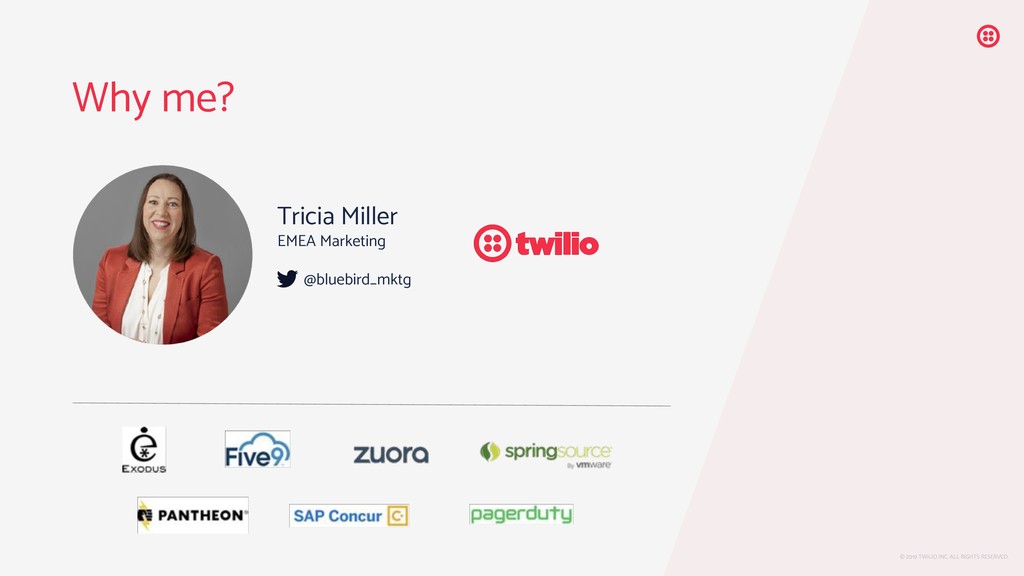
So why am I the person to help you do that? Well, to put it simply, I've spent the last two decades, generating leads and demand for high growth SaaS and startups, across across the industry. Twenty years ago, I, after brief stints at Sun and Oracle, I was the first marketing employee in Europe for a company called Exodus Communications.
It was nineteen ninety nine and it was like the height of the dot com boom, and the parties were great. Don't if anyone's old enough to remember that. Basically I was put in charge of developing the pipeline to fuel the growth. After a stint in London, I then moved to Sydney to basically repeat the model for the AustraliaNew Zealand region and across APAC.
But the story isn't always that simple. So following the dot com boom was the bust, and then nine eleven, and I was unemployed in Sydney for six months on the beach, which I highly recommend. It's actually quite good. But basically, after that, I spent the next two decades earning some battle scars, working with some of the fastest growing startups, so some of the companies that you see here, and helping them to to really build pipelines and to develop the leads that they need to fuel their business.
Yeah. So as as Loki said to Thanos at the beginning of Avengers Infinity War, I consider experience experience. It's not all great. Some of it, you know, but you learn from the good and the bad. So everything I've learned in the last twenty years, I'm actually using in my role at Twilio today.
So in case you don't know who Twilio is, if you have ordered food from Deliveroo or Just Eat or if you get your meals delivered from HelloFresh or you've hailed an Uber or Lyft or used Airbnb, you probably used the Twilio platform in some shape or form.
So we are essentially a communications platform as a service and we power all the communications experiences between you and leading brands. So we're a very well kept secret, but if you're a developer, you know who we are. We we do this for really big companies.
So Box, Salesforce, like I said, Airbnb, Lyft, but, we also work with a lot of start ups. Earlier this year, we acquired SendGrid, which brought email into our platform, and we are able to help companies build engagement and customer engagement experiences that are magical.
And and I believe that that whole process of having amazing experiences with consumers and with customers starts with your funnel as well. So about five years ago, I got an email from a startup founder, and I'd been referred to him by a VC in Silicon Valley.
And he said, help. I need more leads. I need more leads this quarter. And I'd heard this before. And I said, I'll come to your office in downtown San Francisco. And I said, give me access. I wanna see Google Analytics, your marketing automation platform, salesforce dot com, product info, you name it.
And as I poured over the systems and the reports, I was able to build a picture of the health of the business. And what I realized was not unlike a lot of other startups, he didn't really need more leads. What he needed was a better way of engaging and converting those leads into what they ultimately needed, which was more paying customers.
Basically, needed revenue. His website visitors were not converting because the calls to action were unclear and not prominent. Those who did sign up weren't converting to paid customers because they weren't doing a good enough job of explaining the business value of the solution.
And finally, people who did wanna convert, people who filled out a form and said, have a sales rep call me, weren't getting a call for two days, and often the moment had passed. He didn't need more mice. He basically needed a better mousetrap.
And that founder was not alone. I've had this conversation with startup founders and marketers within startups time and time again. No business wants just leads. You want what the leads can deliver ultimately, which is paying customers and revenue. The more efficiently, the better.
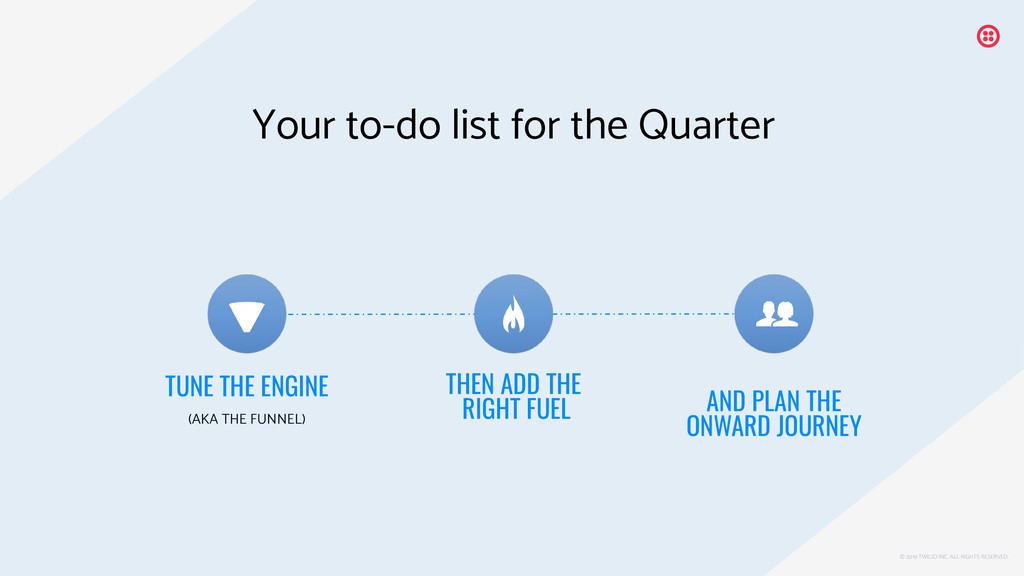
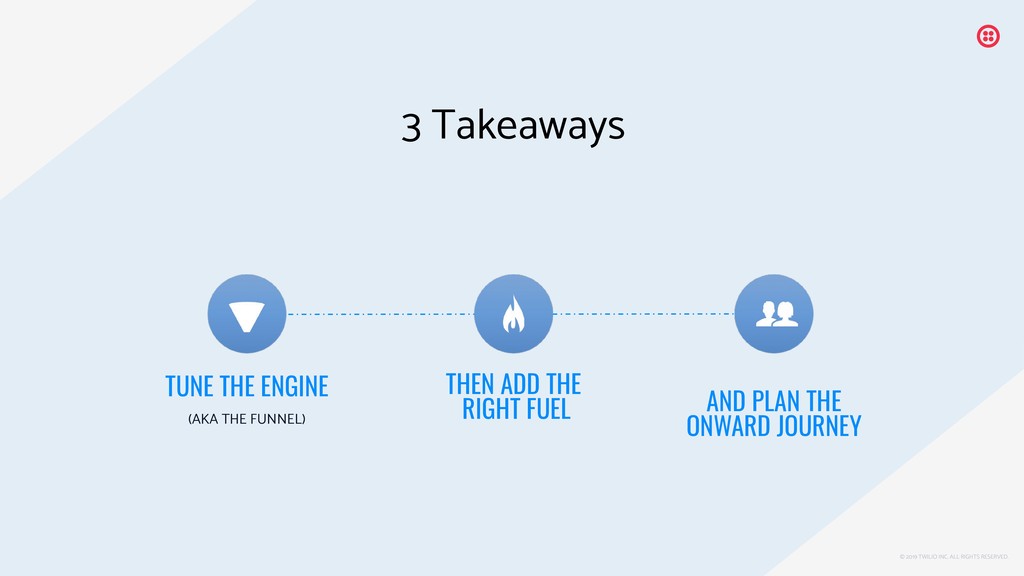
So like I said, your to do list for this quarter isn't just getting more leads, it's three things. But ultimately, if you can deliver on these three things, you'll get the value that you're really looking for from the leads. First, you need to check and tune the engine.
Right? This is your funnel, making sure that it's working efficiently and that you've plugged the leaks and the gaps. Only then can you add the fuel, and you wanna make sure that you're adding the right fuel. So this is the marketing activity that's gonna fuel that engine.
And finally, you need to make sure that the engine has somewhere to go. So you need to line up the right resources for the onward journey. The good news is that the right approach is gonna get you what you're ultimately looking for, which is more revenue.
That's what we're gonna talk about today. So like I said, first things first, make sure your lead generation engine is working before you start fueling it. So I've been in marketing for a long time, and the way that we monetize and incent incentivize marketing people has changed a lot over the years.
And I believe firmly that compensation drives behavior. So what happens when you incentivize a bunch of marketers to generate a lot of marketing qualified leads? Who by the way are also the same team who are defining what a marketing qualified lead is. It's like letting the fox mine the hen house.
Marketers are really smart. Right? Like, we're just gonna go out and do that. So what did we do? We used to go to these really big trade shows where we'd host a ton of webinars where we knew we were going to get a lot of marketing qualified leads in a very short span of time.
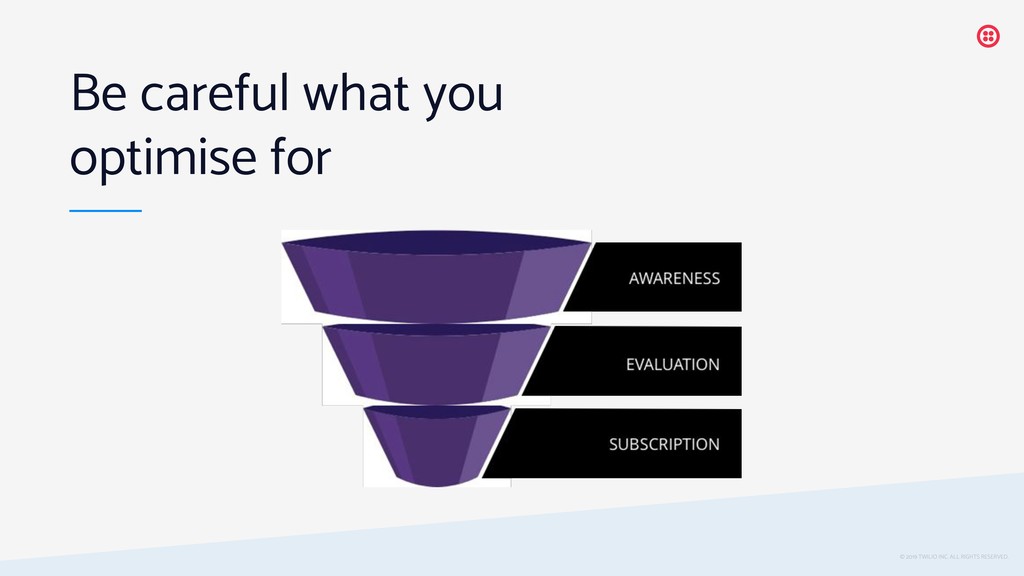
That doesn't always translate to pipeline. So it's not just about generating the right volume of leads, it's about generating the right type of leads. Leads that are actually gonna convert to paid customers. So before you start spending your money, you better figure out what are those types of leads that you need to get and make sure your engine is optimized for those types of leads.
Otherwise, you literally could just run out of money and you won't be able to raise more. Okay. So more leads doesn't necessarily mean more deals. But effective lead generation means finding the types that are best for your business. And you probably have plenty of information at your fingertips to figure this out.
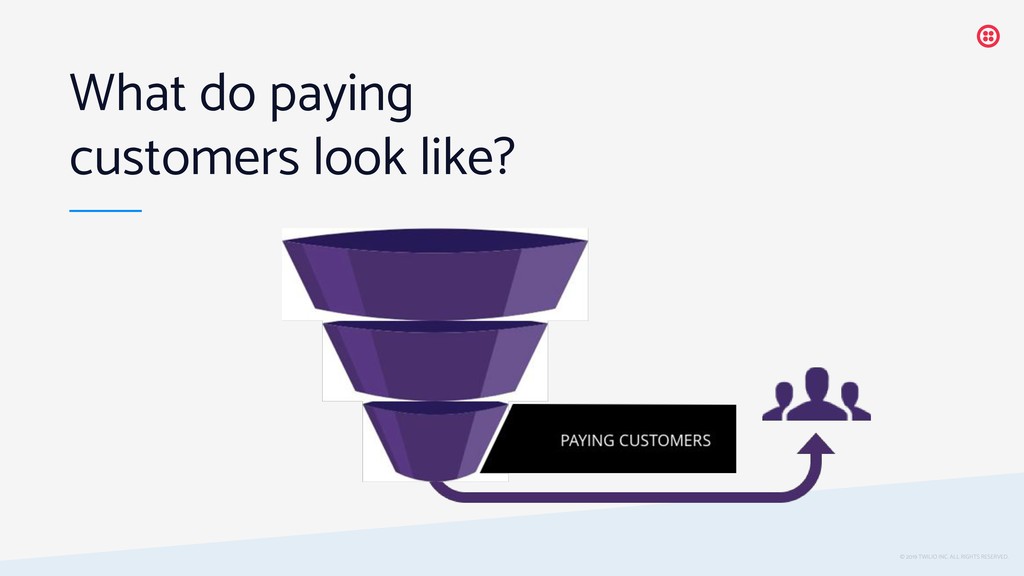
Do you have paid customers? What do they have in common? Are they all from the similar industry? Are they same company size? What is it that prompted them to come to your business? Is it a funding event? Is it a new hire like a CFO, for instance?
Regulatory compliance issues in their industry. Try and understand what the drivers are, the business drivers are that are bringing those paying customers, your happiest, satisfied, your advocates. What is bringing them to you? And then you really need to optimize the experience around that.
So first you need to know who they are, then the entire experience needs to be optimized around that. So how do you do that? You've got to look at what the process is just making sure I'm on right slide. That's getting those right customers through your funnel.
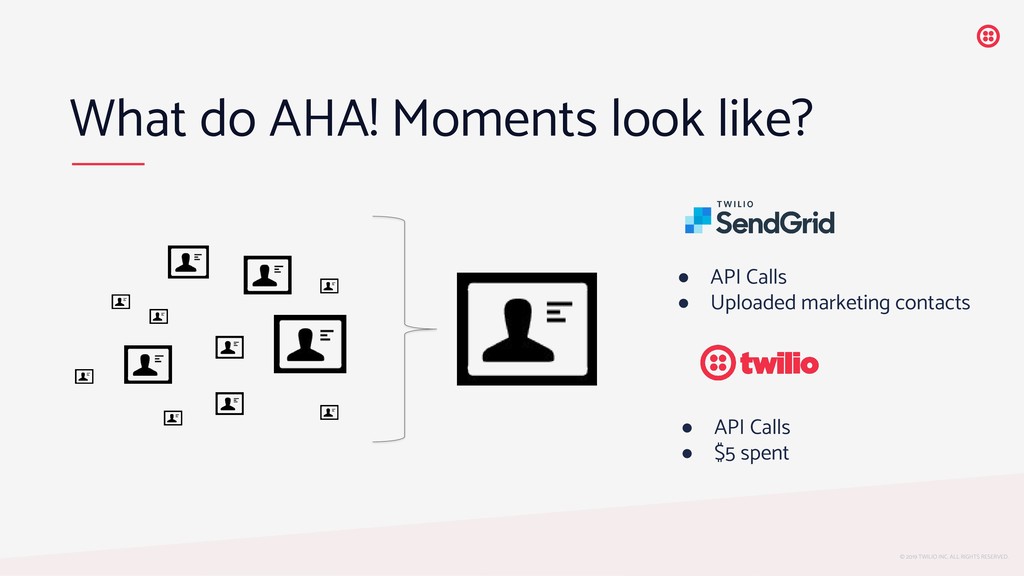
What is common about their onboarding experience, about their path through the funnel, and how do you optimize for that? So, we acquired, as I mentioned, Twilio SendGrid. Acquisition closed in February of this year, and Twilio SendGrid calls this the moment. We call it the Twilio magic. And it's very simple.
Basically, in Twilio SendGrid's world, if you send in a certain number of API calls or you upload a threshold of marketing contacts, you have a much higher likelihood of becoming a paid customer. Within Twilio, not surprisingly, we also have an API call metric and a five dollar spend limit or spend threshold.
Those two pieces of information can tell us how likely you are to convert to a paid customer. So what did we do? Both companies said, okay. Look. We need to make sure that our onboarding process is optimized around people reaching those milestones. You can't just leave it to chance.
How do you remove friction in your process to make it possible for people to have that moment? So think about your business. What are the moments in your business? This information is really pretty easy to find. I mean, there's reports and systems that you can access, but also talk to your best customers.
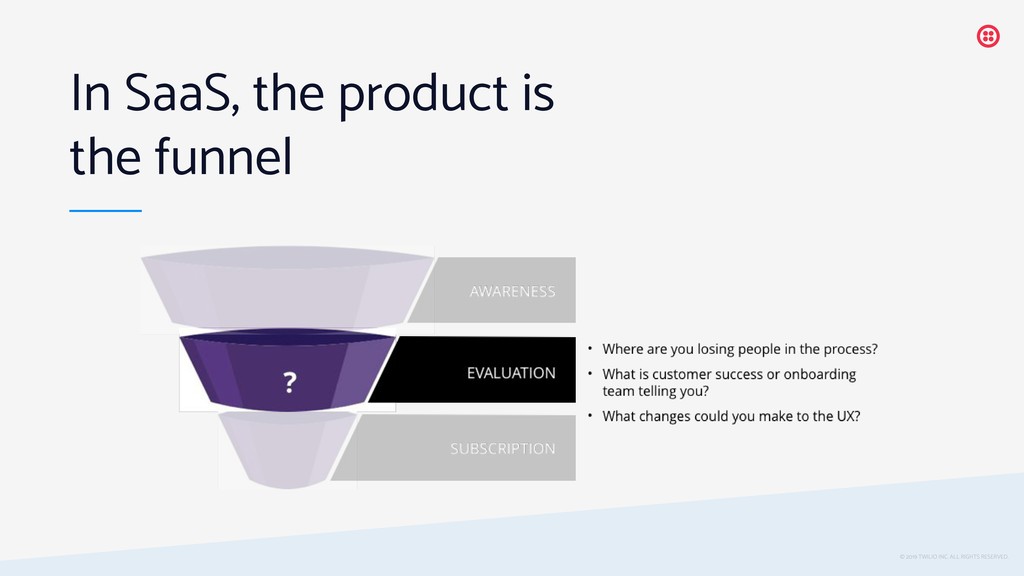
How did they find the onboarding experience? What was it that made them go, oh, I I get it. Find that out and optimize your process for that. And this really matters because for for SaaS businesses, the funnel and the product are one and the same.
Right? This is not the old days of like Oracle where somebody would come at a trade show and like after two years of negotiations and a professional services implementation, users are finally touching your product. Users are touching your product now. In the onboarding process, in the sign up process, your user experience needs to convey the value that your solution ultimately brings to them.
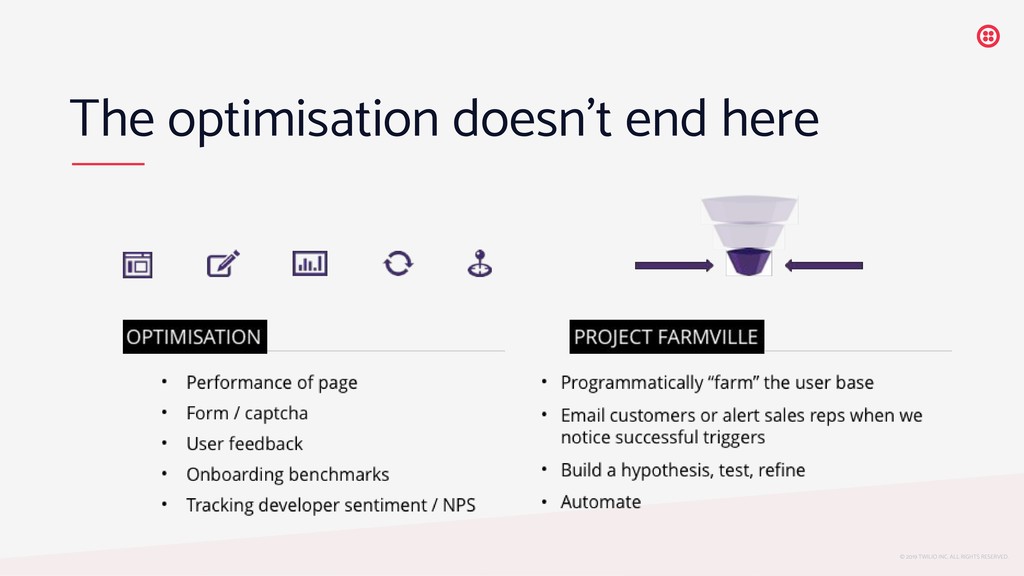
So you need to look at how can you remove friction in that process. Are there fields you can remove from your forms? Are there just UX improvements that you can make? How fast does the page load? All these things have an impact on on how well you're going to be able to convert traffic and ultimately users.
Is your messaging clear? Is the call to action clear? So these are all things that you need to think about in your funnel and in your in your onboarding process. Okay. So you've checked and optimized your engine. You're ready to ready to start applying the fuel.
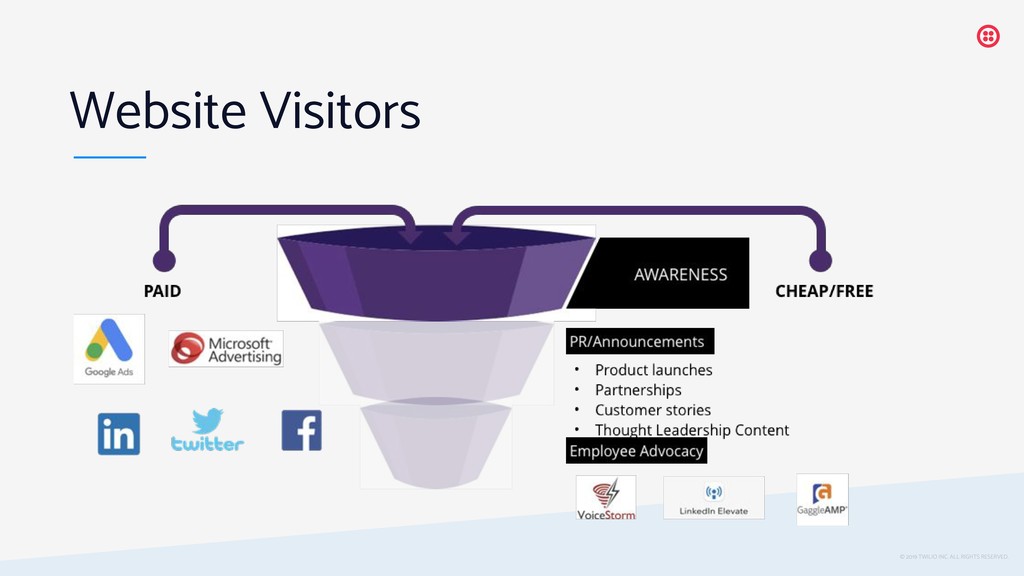
Confident in the results that you're going to get at the other end. So when it comes to driving traffic, there's two camps. Right? There's you've to spend some money on one side, and the other side is sort of like what I call cheap slash free.
On the paid side, there is really no better way to generate qualified traffic in a short period of time than paid search. You're gonna get people who are searching on terms that are relevant to your business, and it's really the jumping off point for a lot of other lead nurturing tactics like retargeting, email marketing, and conversion optimization.
If you're trying to target certain titles, LinkedIn might be your platform. They have a ton of advertising products that can help you do that. But also, don't discount other social media platforms. Twilio has been very surprised at how effectively we've been able to sign up developers from Facebook.
You gotta try everything and figure out what's gonna work for your business. Now, on the cheap slash free side, there's a lot of things you can do. Really, this is just about generating buzz for your business. How do you get people to know who you are to be searching on your on your on your branded terms and on other keyword terms?
SEO is really important. I'm not an SEO expert, but it is a longer term process. So this talk is all about this quarter, so I'm gonna focus more on on the other stuff that you can do this quarter. So think about things that you can announce. Right?
What is newsworthy? What is gonna get people writing about you and talking about your business? Do you have a couple of features that you could package up together and make a release? When I was at Zohra, this was a long time ago, this was back in two thousand and nine.
In August of two thousand and nine, we launched Zohra for Media. And it was a demo. And and basically, it was like two new features to the product. But we had read business information as a customer who was willing to say, we're using Zohra for Media.
And we got a ton of press hits. We got a ton of traffic to the site. But what was interesting about it was it wasn't just a PR exercise. It was a fully integrated campaign. We had blog posts. We had an email blast to our existing user base.
We had, you know, the the press announcement. We had a webinar. And we had a drumbeat that kept going. And actually, we got a ton of news out of really what was just a couple of extra features and a customer who was willing to advocate on our behalf.
So, you know, think about what you have, what news do you have. Do you have a partnership? We sometimes call these like a Barney deal, like I love you, you love me. Is there a partner who also is trying to get some news?
Can you sign an agreement and issue a press release about that? Thought leadership tools. Research. Have you done, you know, byline articles? There's a lot that you can do to sort of raise the level of buzz around your business that doesn't cost a ton.
Finally, do not forget about your employees. Employee advocacy is critical. Research suggests that the combined reach of your employees is probably ten x at least your company page. So you've got to make sure that the employees are sharing the information, sharing the news, whether that be blog posts, webinar invitations, news about speaking events.
You've gotta make sure that your employees are engaged in the process. There's a bunch of tools out there that are relatively inexpensive to help automate that. I highly recommend you check it out. We had a meeting with LinkedIn, with our LinkedIn team in Ireland, they said, you guys are leaving money on the table because your employees just are not sharing.
We've implemented one of these solutions, and the results are are phenomenal. So I highly recommend you look into that. Okay. So couple case studies. Here's what happened when we optimized our engine at Twilio and then really started to fuel it. In January of twenty seventeen, George Hu joined Twilio as our COO.
Now George had spent thirteen years at Salesforce dot com. I don't think anybody knows more about building a SaaS business than that guy. And and after eight years of having a very developer focused go to market strategy at Twilio, he comes in and says, right.
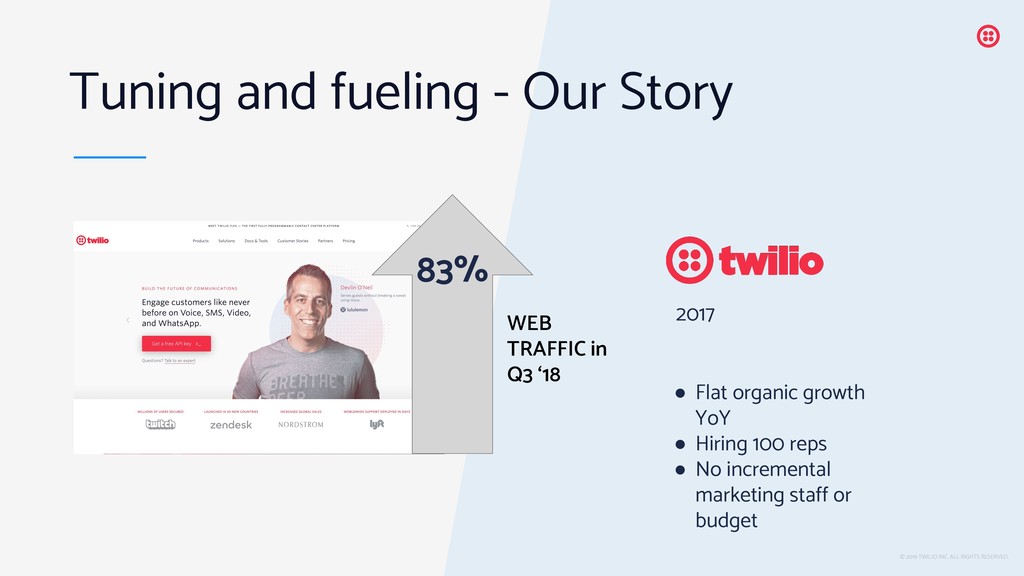
We have an amazing market opportunity in front of us. We're gonna hire a hundred reps this year. Oh, and marketing? You're not getting any more head count and you're not getting any more resources. Go figure it out. Now mind you, this was in a in a sort of landscape where we had flat organic website traffic year over year.
So everybody's sort of looking around going, how are we feed a hundred sales reps with the existing lead flow? Well well, we're not. Right? So in January, also from Salesforce dot com, we hired a CMO, Sarah Varney. And she said, okay. We need a growth team.
So we took developers, we took business intelligence people, and we took marketers and put them in a team and said, alright. Go figure this out. And the results were pretty pretty amazing. What I would say is that growth team treats our sign up process and our onboarding process like a product, which means it's never done.
But essentially, in just three short quarters, they were able to really significantly increase the website traffic year over year. And they did that in a couple of different ways. One was really serendipitous in a way. The search traffic on the search volume on WhatsApp API was growing really, really rapidly.
We happened to time that really well with an announcement of WhatsApp API. So that we got a ton of sign ups incremental just out the gate because we had a well timed product. But also, we spent a lot of money on SEM, on paid social, on out of home advertising.
We spent money, and that drove a lot of increased awareness for the brand and traffic to the site. And finally, a lot of UX improvements. So that little growth team was digging into the reports, understanding where were the frictions in the in the product and in the sign up experience, and where we're go combing through tons and tons of user feedback that had just basically sat somewhere with no one really looking into it.
And just combing through the product and trying to understand what were the little tweaks we could make here and there. Now, I will admit, thirty six percent year over year growth was from organic. So there was a huge investment in SEO, huge investment in SEO, paid off.
But like I said, this is about this quarter, So that's longer term play. But paid product announcement, user experience tweaks had a huge impact. Okay. So like I said, remember, we're treating the funnel like a product. Some other really interesting little nuggets that came out of this whole growth team was people had been complaining on Twitter for a long time about the reCAPTCHA the CAPTCHA login piece on on sign up.
So we experimented with a lighter weight version that was tough on bots and easier on humans. That unlocked a ton of new sign ups. We basically just looked at the entire process, like I said, and found little tweaks here and there. One business analyst wrote a thirty page report called the state of the user, where she was the one who literally come through all of these surveys and user feedback and research and had basically come up with a stack ranked list of these are all the user experience challenges that our users are having and
where we can unlock the biggest benefit. So it's basically just a project. Start at the top where you can have the biggest impact and work your way down the list. As you make your way down the list, we're adding more constantly. So again, we treat it like a product.
Another thing that we've just initiated this year as well is what we call Project FarmVille. So again, this is really basic. We sat down with some of our top performing sales reps and asked them, how do you find nuggets and good leads within your territory?
How are you determining where you spend your time? And a lot of them were like, well, you know, I run this report that looks at usage in the last two weeks versus the two weeks prior to that. And anybody who has more than fifteen percent growth in the two weeks prior versus the two weeks prior to that, I send them this email and it just says, hey, I noticed you're sending more SMS with us or your voice traffic has increased.
Would love to connect with you and understand how we can help you optimize your your communications and your your use of Twilio. That's it. Something so basic. Right? So the growth team said, okay. We've got like they they took like ten of these from from two or three of the highest performing sales reps and said, We're gonna build a little hypothesis.
We're gonna test it, and we're gonna see if it works. And they did. And then what do they do? Now it's automated. So now those sales reps don't have to do it. They get emails sent directly to their inbox, or in some cases, the users get the email sent directly to them on behalf of the rep.
So the rep only has to worry about the people who reply and say, yeah, let's get on the phone. It's it's like magic. Right? So this stuff is not difficult. It just requires sitting down and and thinking about it and treating your onboarding process and your whole sales process like a product.
Okay. So we've got our flow of leads working. We've optimized our approach to get the right types of leads in. We've optimized the engine to get them flowing through. That's great. But let's pause for a minute and think about what does does a lead represent?
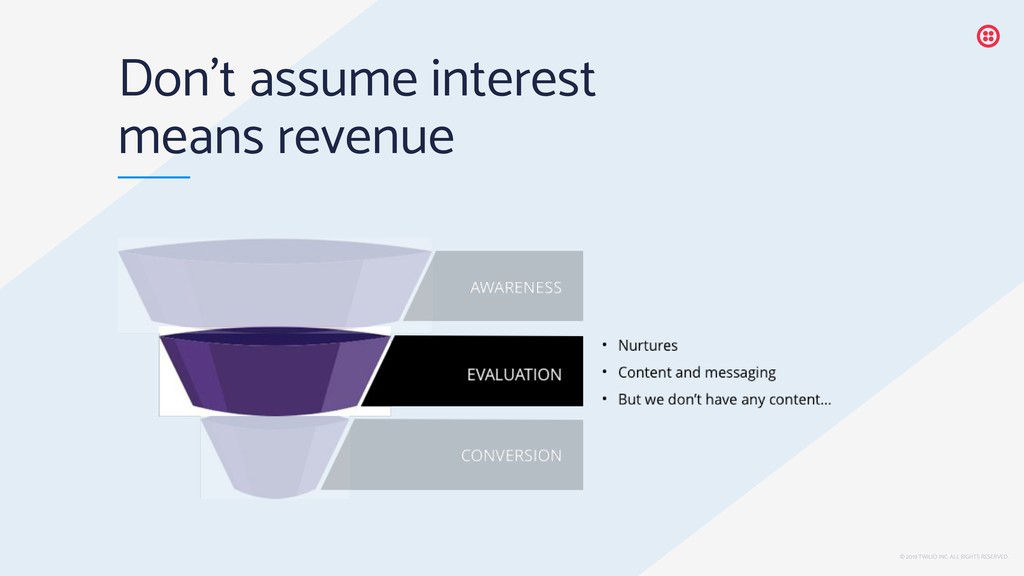
It's it's interest. Right? This is just someone saying, I'm interested. Right? Maybe they're identifying with a business problem. Maybe they've signed up for a free trial or maybe in the Twilio case, it's a developer just like trying stuff out with a credit card.
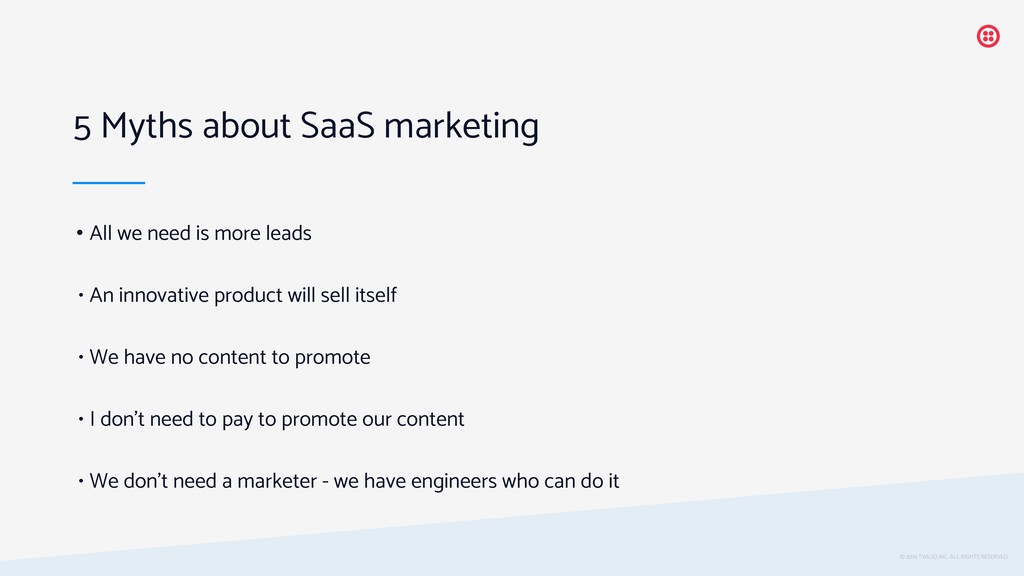
But what you really need to do is figure out how do you then convert that interest into paid customers. Right? Innovation alone is not gonna sell your product. It's the biggest mistake that SaaS companies make is to assume that, like, if I build it, they will come.
No. No. You have to actually spell out to people what is the business value of the solution. Okay? So the onboarding experience needs to be great, you also need to tell them. Talk about ROI. Talk about the business results that your customers are getting.
It's really, really critical. And how do you do that? Content. Okay. So you're like, content. Yeah. I don't have any content. I've heard that so many times. That's not true. You have content. Definitely have content. What's on your blog? Do you have e books? Do you have webinars?
Do you have customer stories? Do you have byline articles? Do you have stuff that, you know, some developer wrote or a marketer wrote or somebody wrote on their personal blog? You've got content. You just need to find ways to package it up and also to make sure that you're putting some muscle behind it.
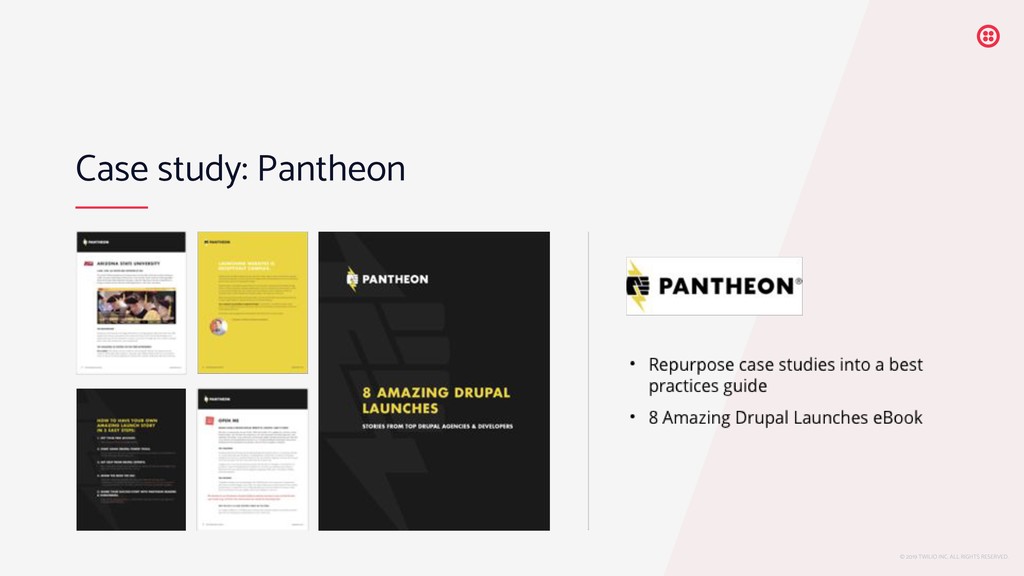
Again, just because a blog post is there doesn't mean anyone's seen it. Right? Sometimes you gotta put some money behind it and make sure people see it. So here are some examples, excuse me, from my my career. So this is a company, Pantheon.
They are a web hosting platform. They do they host Drupal and WordPress websites. So I was the acting VP of marketing for about a year there. And when I got there, they'd done something really, really clever. I love this. I always use this example.
They had a blog that had eight different case studies on it. They took the case studies together and they turned it into an e book called eight amazing Drupal launches. And each individual story was basically just repackaging the content that they had on their blog, but each one talked about a unique aspect that made that a very successful launch.
And the underlying theme there was all about how the Pantheon platform enabled them to launch faster, more efficiently, and to reach a bigger audience. Very easy to do. Next, LinkedIn. Alright. And I know what you're all thinking like, oh, LinkedIn, that's a big company.
They have so much money. Not this group. This was LinkedIn advertising. LinkedIn marketing solutions, LMS. Right? It's kind of like the red headed stepchild of LinkedIn. Sorry. My husband used to work there. Anyway, this is his project too, but it's it's amazing. Okay.
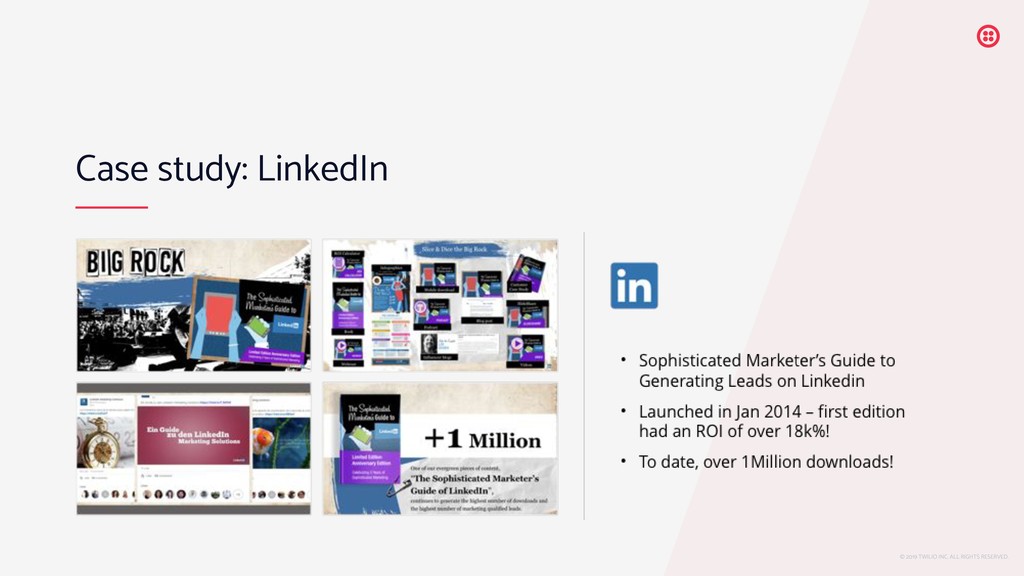
So the first thing they did was they launched this piece of content called the sophisticated marketer's guide to LinkedIn, January of two thousand fourteen. It was wildly successful. Why? Because it answered questions that their audience had, which was how am I gonna generate more leads on LinkedIn?
People were asking this. They they were like, we know all the the people are there. We know the professionals are there. We just don't really know how to do it. So what did they do? They wrote a guide. Here's how you do it.
Explain it. Explain the business value. And it was so successful, they spent like very little money on it. They had an eighteen thousand percent ROI. That's because they didn't spend a lot of money on it. But to be honest, it really resonated with their audience.
Now, could they have stopped there and said, well, everybody's seen that sophisticated marketers guy. What are we gonna do next quarter? How are we gonna top that? No. They're still at it. This was two thousand and fourteen. They have issued five versions of this.
They've translated into seven languages. They launched a podcast, which has had seventy five thousand downloads. They took the podcast on the road to ConLyon. They even launched a magazine. This is a content franchise that all started because they had one asset that explained how people can generate leads on LinkedIn.
They were answering the question that their audience was was asking. They already knew all of it. They know how to use they knew how to use LinkedIn to generate leads, but their audience didn't. So they just explained them. This is how you do it.
This is how you generate value on our platform. Okay. So my husband Jason Miller is here. I told him not to come, but he's here anyway. He's a content marketer, a brand aficionado. Anyway, he says there are no new ideas. And I actually think he's right.
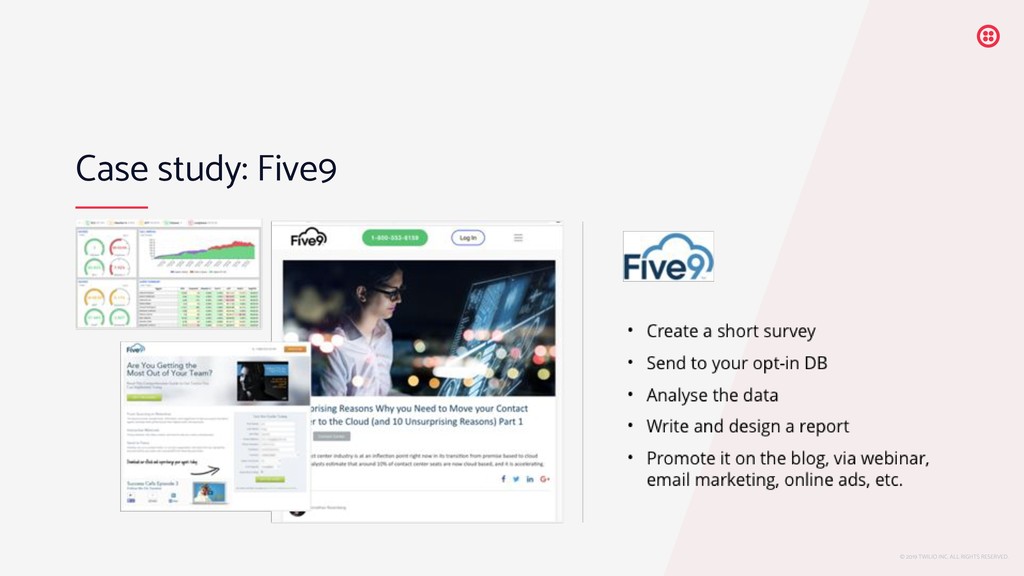
This one is so old, there's no screenshots. This is from two thousand and five, I think. Yeah. Two thousand five. So way back in the day, was working at Five nine, and we were a super small marketing team. And we didn't have any money for, like, big launches or big trade shows.
So I used to share an office with this guy Randy, and he was a product manager. And I was like, Randy, I think we need to do we need to generate some content. He's like, okay, what are we gonna do? I was like, what if we just did a survey?
We'll just come up with like ten questions, and out of the ten questions, maybe like three or four of them are like demographic, firmographic. Like, what industry are you in? How many employees do you have? Things like that. I said, okay. And the whole premise of the survey was like, where are gonna invest in more in like two thousand six?
Are you gonna spend more on, you know, in your contact center on email or chat or whatever, like whatever it was back then. Right? There were like two channels back then. And so we sent this out to our opt in database and said, if you fill out this SurveyMonkey survey, you'll get a copy of the e book.
So we sent it out, we got a bunch of people to respond, and then we took the data, sliced and diced it, hired a graphic designer, hired a copywriter. So just two freelancers, put it into a layout, and then we promoted the heck out of it.
But we didn't just promote the e book. Right? We did email marketing. We did a webinar talking about the results. We had the head of product management talk about what the trends meant. We talked about the differences between how our customers were doing versus non customers, and really talked about what people were doing in the contact center space and established sort of thought leadership for Five9 at a time when nobody had ever heard of us.
So really, you just have to be creative and think about what it is that your audience is interested in. What are they going to respond to? And how are you establishing yourself as a vendor, as someone who is gonna bring value to them in their day to day job?
It's not always just about how the product delivers value, but how can you bring value to them? Okay. So now you're like, well, who's gonna do all this? Right? You you gotta hire someone. Like, I'm here to tell you, like, you would not have a marketer build your software.
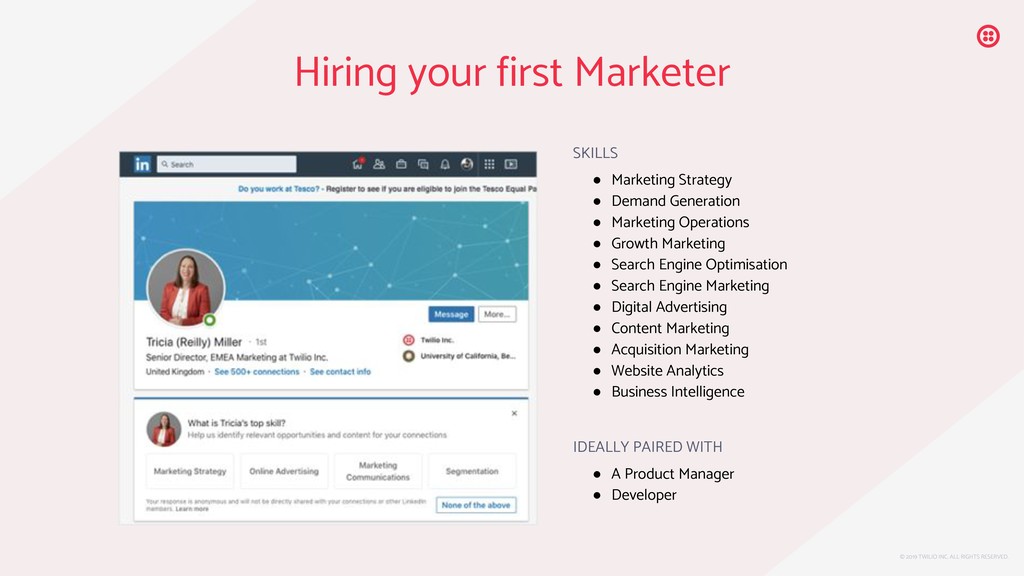
Do not put an engineer in charge of marketing. Like, just hire someone who has the right skills. Get the right skills. Right? Not me, but, you know, but this is what you need to be looking for. Right? Trust me. The journey is so much easier when you have someone who knows what they're doing.
Right? So these are the skills you need to be looking for. Ideally, somebody who has worked with developers, product managers, technical people. Because to do a lot of this stuff, you are going to have to sit hand in hand with either a product engineer or a developer or someone who's going to help you automate and build some of this stuff.
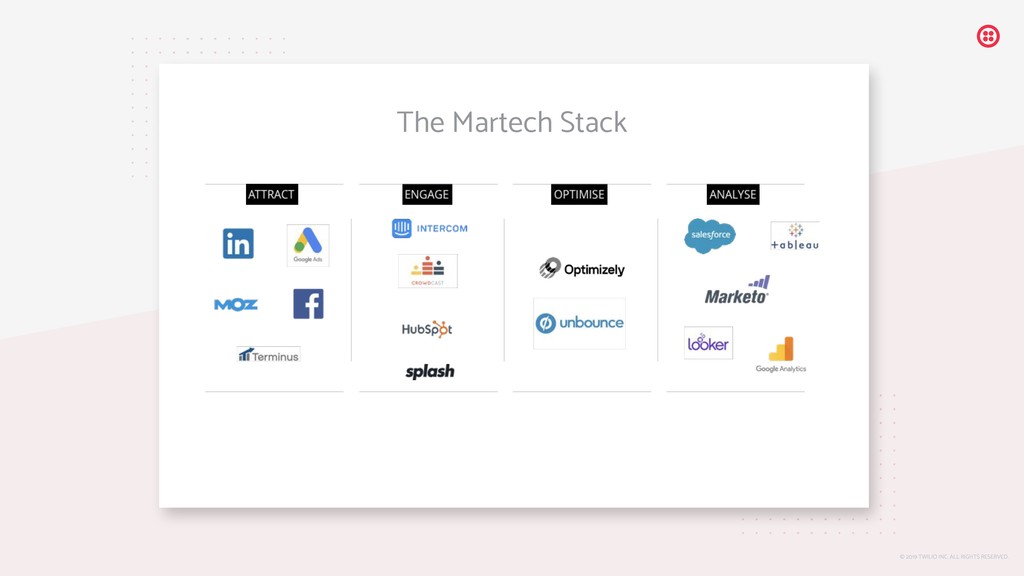
This is all out of the box. As much as a lot of these martech vendors wanna tell you it is, you need someone to stick all these pieces together. Oh, and also you need to make sure that they're a good writer too. That's like high on the list.
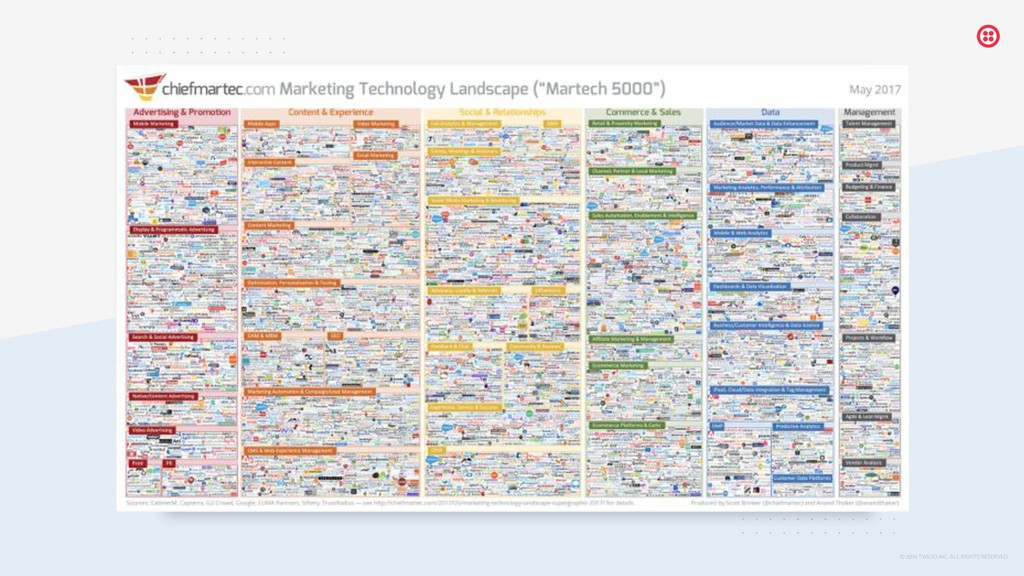
I didn't have that in the skills list, you definitely want someone who can write, ideally creative and analytical. So this is from, like, two thousand seventeen. This is, like, the Martech five thousand from two thousand seventeen. That list has just gotten longer. Right?
There's a lot of technology out there, but the right people know where to focus their efforts. So again, getting the right person, get the right resources lined up makes this a lot easier. It's a lot more manageable than it looks. Okay. So hopefully, I've sort of helped dispel some of the myths around marketing and SaaS.
You know, I think, you know, it's not just about leads. You really need to think about what it is that your business is trying to ultimately achieve and who are the right types of leads and what is the right experience for those leads, and getting the right resources lined up to help you do it.
Right? This stuff is achievable. You don't have to have multimillion dollar budgets. You don't have to have massive teams, but you do need to be creative and curious and understand where are those points of friction in your business and how you can reduce them for your team.
So don't forget your key takeaways. As we say at Twilio, can't wait to see what you build. Thank you for your time today, and I'd love to connect with you on LinkedIn. Fantastic. Well done. Thanks so much. Thank you. Cheers.