
Hear about blockchain’s origins and key design principles. Get beyond the hype and learn about how it might disrupt a variety of industries and civic life by transforming business and operating models. Learn how to frame promising use cases and proofs of concept.
← All talks 
Lead Strategy Turing Fest 2018
Blockchain Unraveled
Auto-generated transcript - may contain errors. Tap a timestamp to jump the video.
Good morning. Delighted to be here. And I'll start by asking you to think about the first time you heard about blockchain. Give it some thought. Think about your reaction, your feelings, what you were thinking. Were you thinking, oh my goodness, this is this is crazy, this is amazing, this is going to change the world.
Or maybe your reaction was, oh my goodness. This this is crazy. This is gonna change the world and not in a good way. The blockchain community has those extremes at some level, because here we are in the strategy track, not the engineering track.
Why? Because it is fundamentally provocative. It is about ideas. And what has played out in the last number of years, and certainly for me, five years ago when I was in that moment, wow, this is amazing. Oh my goodness. It's gonna require a lot of change.
Whether you're with a startup, an SME, a corporate as I was in financial services, wearing the hat of head of risk, but also corporate development, the two sides of the brain saying, my goodness, in different ways. Or you're in government service, or you're here and you are emboldened by the promise of the technology about how it might allow individuals to, as some suggest in the community, take control of their data again.
This this journey is as much a story about historical context and origins as it is about where we are today and where we're going. So what I hope to cover is some of that history, but also in context, the origins of that history.
Talk about applications and use cases in sectors of society, as well as get specific around how to think about use cases. What kinds of challenges are posed, but opportunities exist around business models, operating models, thinking fundamentally different about how things function. And then finally close out with common challenges regardless of where in the community you find yourself.
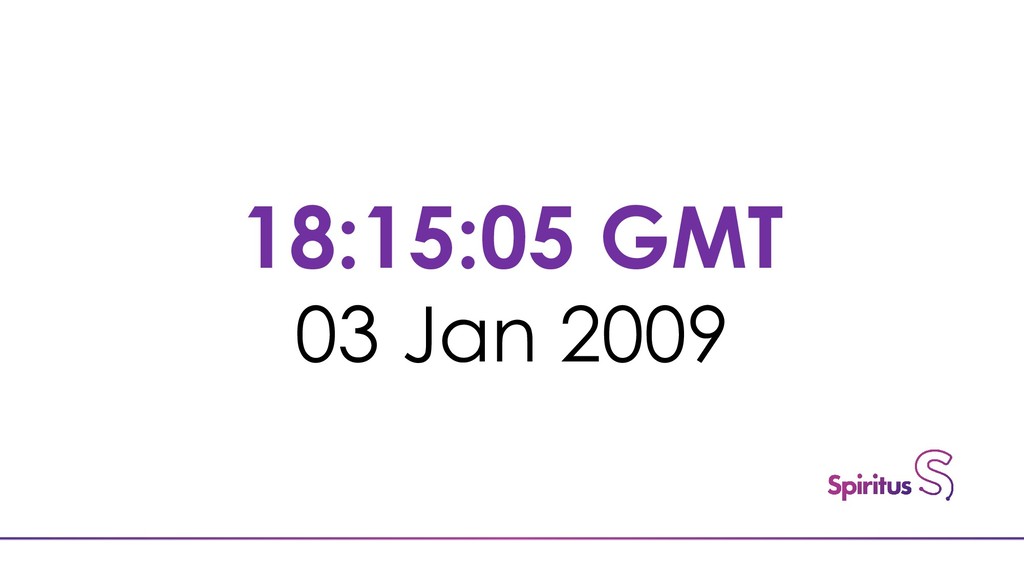
I'll start with this. Who recognizes this? Anyone? You don't count. Anyone recognize this? This is the timestamp for the genesis block for the Bitcoin blockchain. The genesis block, the original block. So almost ten years. And accompanying that block was a text message. The text message referred to a time story, a headline.
The chancellor is bailing out another bank on the brink. And in fact, if you read the nine page paper that sits behind the Bitcoin blockchain and protocol, only nine pages. I remember the moments I read this. I remember scratching out notes to myself in a Starbucks in New Jersey.
There's only nine footnotes to this, but it was a unique moment in the sense that it brought together concepts around distributed systems, game theory, statistics and cryptography that had been around for years. In fact, the footnote on statistics dates back to nineteen fifty seven, a reference to nineteen fifty seven.
The other references in those other disciplines, the early nineties, including one around something called hash cash. So you can imagine for those in technology who had more libertarian inclinations that this was a lightning rod and an opportunity. And what started in two thousand and eight, two thousand and nine quickly started to take flight.
How about this? Anyone recognize this reference? A DAC is a distributed autonomous corporation. That might be a little bit of a cue of where this is coming from. So for a little over four years later, this is the white paper issued by Vitalik Buterin.
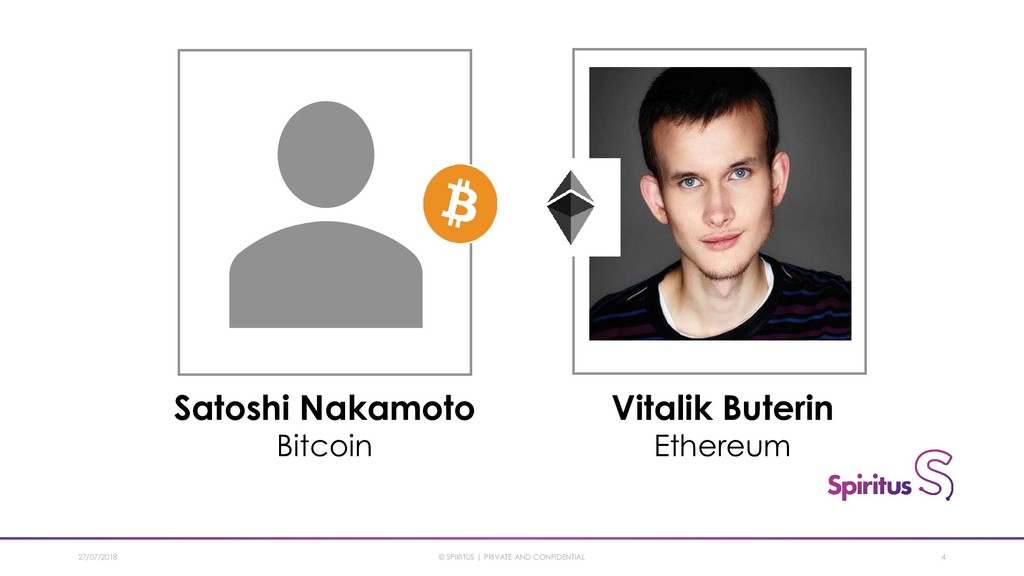
And Vitalik Buterin ended up stepping out on behalf of a group of founders of Ethereum to posit that in fact, far from just disintermediating banking institutions and creating a cryptocurrency, which was the project, the design, the intention of peer to peer cash and Bitcoin.
That a more ambitious design that could disintermediate many aspects of the institutions and controls functions that we have in society, the way things work. That we could actually remove management from the equation that was in the paper. Can we remove management from the equation?
Can we actually have a resource democracy? So let me go back here. This is from Standard Chartered when the banks that back in twenty thirteen, fourteen, like many large banking institutions, like the organization I was working for when I brought blockchain to the executive team and to the technology teams.
This was the description of just what a blockchain transaction is. So two parties, A and B, wish to have some interaction or transaction. They assign cryptographic keys, public and private keys to the transaction. That transaction broadcast to a network. A network that is performing some form of consensus mechanism, in this case relying on what's known as proof of work.
What problem from a design standpoint did the consensus allow for? What's known as proof of work, which is referred to as mining. It allowed for the majority to prevail based on CPU power, the difficulty of the calculations. And the presumption that's made by Satoshi Nakamoto, the anonymous author of that paper is that gaming the system would require having CPU power in excess of the cooperating malicious parties.
So that was the design insight that brought these various elements of distributed systems, cryptography, game theory and the like, and create incentives for good behavior. Coming from finance, putting aside cryptocurrency, many like myself looked at this and said, my goodness, if we could take some of the friction out of our back and middle offices, if we could allow parties that are in different organizations, yet are in routine processes, payments, trading, settlement, movement of securities.
If we can take out the friction and reconcile between parties on a shared registry, a permissioned registry, not an open public one, but a permissioned one where the parties agree, we could achieve great efficiency and productivity gains, we could reduce our counterparty risk.
So not surprisingly, particularly since it emerged in the crypto around currency, the financial community likewise embraced this. In two thousand and fifteen, the first consensus event occurred in New York. There were three hundred people there. This last spring, there were over eight thousand at that event, and if you pay attention, you know there are events all over the globe attracting interest.
From the Ethereum community came the insight that you could go beyond the currency and have something called a smart contract that you would enable. And this is what is the proposition that you can through code enable if then statements that rise to the magnitude of a commitment.
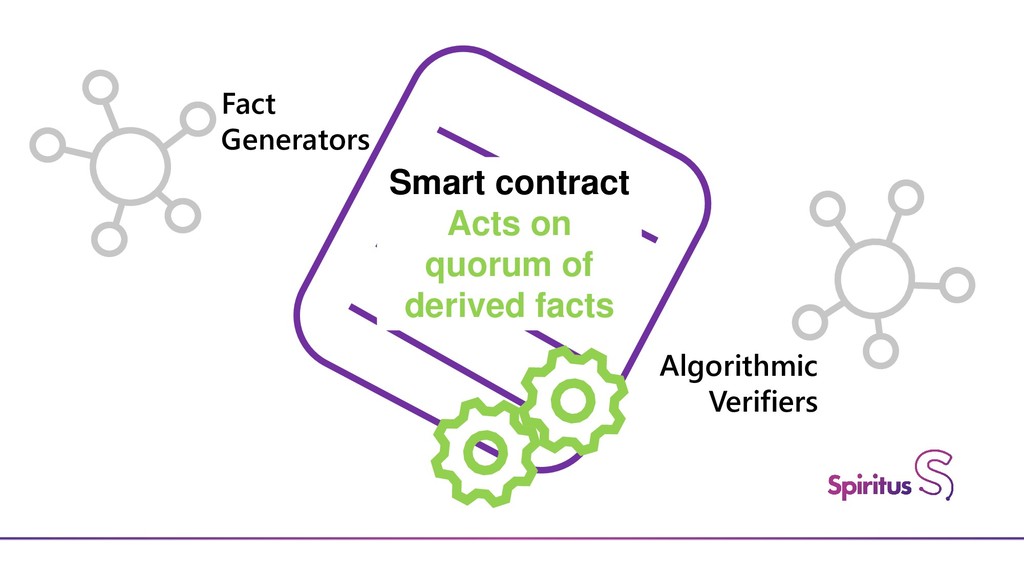
In this case, the parties agreeing and arriving at consensus and trigger activities. And that in some level, they would govern projects. What we now know as corporations, interactions, people coming together to perform some some good or outcome. In the end, blockchain really amounts to having some set of fact generators and algorithmic verifiers with this layer over the top, ambitiously if you wanna take it into other sectors of society around a quorum being agreed, around a set of facts and from that driving activity.
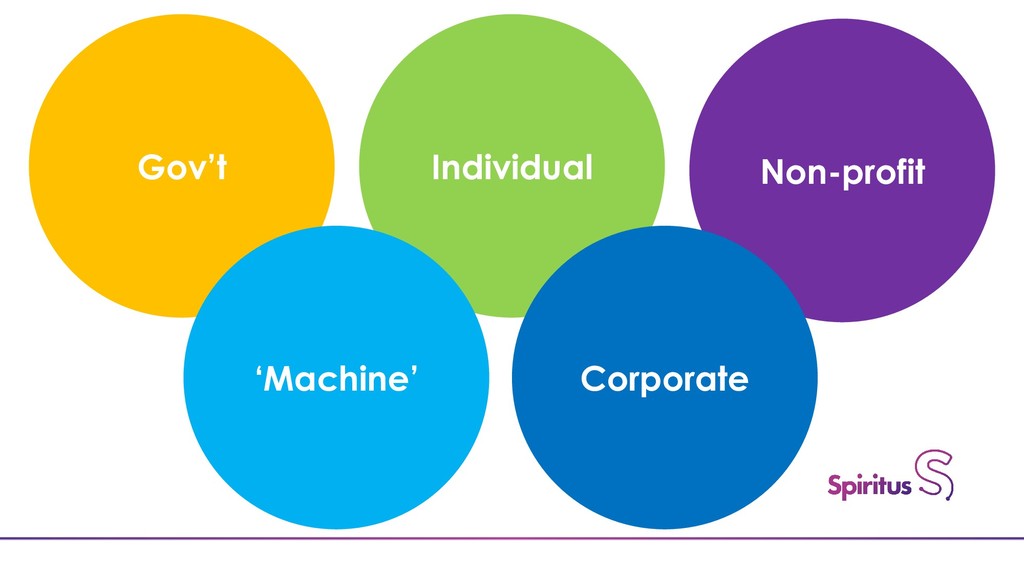
So whether you are coming at this, looking to enable individuals from corporate sector as I had, a non profit, government agencies. This is decidedly ambitious and aggressive. And we'll talk a little bit about where some of those use cases are coming from, but as you may have learned, we could reinvent the world according to some people.
Literally, almost every problem, in some cases, a blockchain related project somewhere where somebody proposes to address the societal issue through this enabling technology, which is in a reductionist sense about maths and science and computer hardware. We'll talk as well about machine, because in the end, some suggest and there are certainly projects that would suggest that in an IOT enabled world, blockchain could help mediate the interactions between machines, IOT devices, machine learning.
That you could verify the identity and validate the identity of two devices that are coupled to one another in some fashion or another, and mediate the movement of data. So for me as an individual, potentially into the corporate sector, that far out world of IOT, and then enabling non profits, government as well.
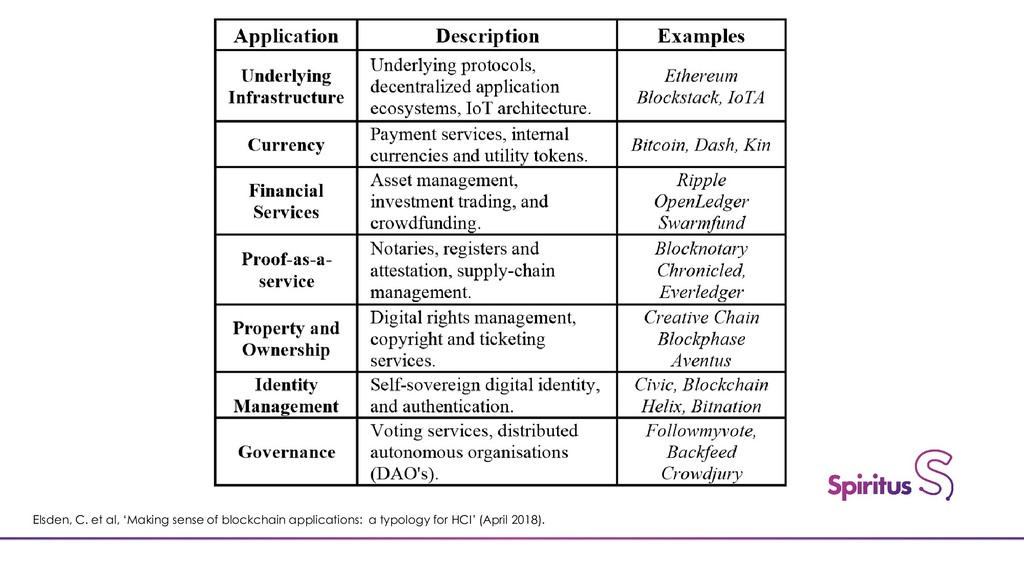
There are experiments and ideas that have taken root, substantial funding. As I looked at sources to really define what I'd call a topology of use cases, and I hope you can see this in the back. It's actually some researchers here in the UK that recently issued this paper in April.
It gives you an idea of major categories if you will, of work that are being done. And I think it's a good summary. So you have the underlying infrastructure, the actual protocols. You may hear of work around blockchain as a service, certainly the work in the various communities, the supporting infrastructure and protocols.
That certainly is a key element and a lot of the work that needs to be done is being done at that level. There are the cryptocurrency applications. We only have a half hour, so I will stay away from the ICO mechanisms and like.
But I will say in that next third category, asset management, certainly there's reason to think that there is a bit of a shutter among venture capitalists because the ICO phenomenon has illustrated that it is possible to raise funds whether within or without the confines of current regulation around investors and investors being qualified, whether or not something's a security or not.
But around asset management broadly understood, whether it's plain vanilla stocks and bonds, derivative instruments, private equity, hedge fund, or these new vehicles. There is a lot of experimentation and work being done. So I'll take those two, the cryptocurrency piece and the asset management piece and conflate them at some level.
Projects more generally offer proof as some form of service. Proof of what? I've heard proof of publication, proof of existence, proof of narrative, there's a lot. But some form of proof because the record that's coming off of the registry, whether it's open and public and guided and governed by the consensus mechanism and the controlling protocol of proof of work mining, or private and permissioned.
Some form of proof that is traceable, verifiable and auditable. I will not use the word immutable. I think tamper evident is a better term. So, tamper evident. There are many aspects of our lives where we're relying on an intermediary to apply that validation and verification as to whether something is valid or not.
So proof as a service, we have illustrations from the authors here in the public sector. There are others as well. Property and ownership, everything from land registration to what's been illustrated here. I saw two days ago, stories across industry sectors where in a sharing economy sense, physical assets can be readily shared among parties that are recognized by by the system.
Identity management. I'll crack that open a bit more. This is the central, a central issue around this. Identity for us as individuals, but also identity for assets. Physical assets, digital assets, legal entities as we know and understand them. And then governance. At some level, there's this odd spiral that exists within blockchain.
It is both proposed as a means by which to achieve governance across many sectors of society, yet as we find out, it has governance issues itself. There is a human in the middle. There remains a human in the middle. Now we're stalled. Okay. Identity.
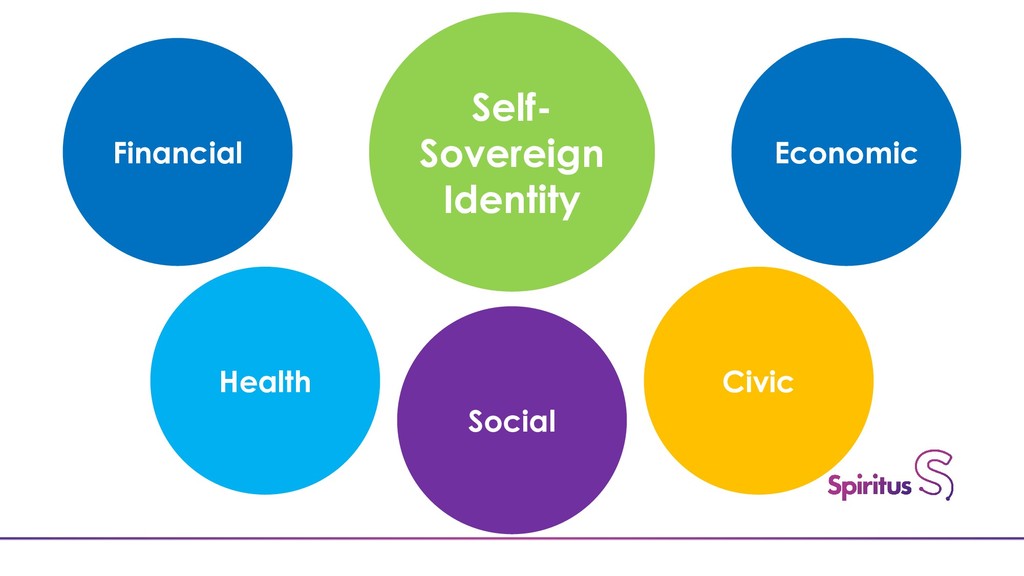
A concept that has become prevalent, self sovereign identity. Some two years ago at Scott Chain sixteen, Christopher Allen came from the United States to talk about this. He's been active around identity for years, one of the creators of TLS. This concept of self sovereign identity says, I am in control and there are verifiable claims that I will make in terms of sharing data selectively with others.
I'm in control, you have access only to the data that's necessary for you agreeably from my standpoint to engage in a transaction. Self sovereign identity. What aspects of our lives would that include? Our financial lives as a depositor, a creditor, an investor, somebody who's making philanthropic gifts or a pensioner.
In our economic lives as an employee, employer, consultant, in that sharing economy sense. In my health, I'll come back to that point that this is a very significant area of work. There are over a hundred and fifty projects that have been identified around the globe that are working on identity.
Whether it's trans global and and goes beyond states, or specific to a particular country and around a certain aspect of our lives. Civic self and then social. I was at a conference where someone suggested that actually our virtual selves will be more ourselves than our physical selves at some point, the social element being a piece of that.
Verifiable claims around our identity. There is a workshop actually that got started about two and a half years ago that convenes every six months. It's been here in Europe several times. It's in the United States as well that Christopher runs. It's called the Web of Trust Design Workshop.
I got a chance to participate in one of the first sessions, coincident with ID twenty twenty. ID twenty twenty occurred at the UN. It's around a sustainable development goal for all people to have identities, if you will, and overcome some of the issues around developing countries that exist around that.
ID twenty twenty was staged at the UN. They had this workshop, And that's an opportunity for me to say to you that it's not just the folks in blockchain who have very radical ideas and hope to take back, get a second kick at the can and take back web three dot o, whatever you wanna call it.
But people as well who've worked in corporate setting, worrying about identity for systems. And they are collaborating together to solve around use cases to take to the w three c. That may involve refugees. In fact, in twenty sixteen when the conference occurred, it was coincident with a high tide unfortunately of the Syrian refugee crisis.
So there is still and remains work. If you wanna look up the web of trust design workshop, you'll see white papers that have been vetted and worked on over the last three and a half years or so that represent some of the best thinking and the use cases that will go to the W three C.
So when we think about identity and self sovereign identity, it's ineluctably woven into visions around blockchain. That said, this group, and I think sensibly is saying, if we're talking about lifespans that are gonna extend to eighty, ninety, a hundred years, while we may be designing today for an identity I have control of selective sharing with other parties, really being able to control my data.
We need to provide for the fact that the underneath technology, the enabling technology could evolve. Excuse me. And that that evolution should be supported, that my identity can be ported to that future state. These are big concepts. Folks in the Bitcoin community, the Ethereum community, as I mentioned, the corporate community are working on this and working on this closely.
So if you have a strong interest around identity and self sovereign identity, there's a wealth of information out there, and an opportunity to contribute. Okay, use cases and applications. Let's dig a little deeper. I'll do it through the lens of healthcare. I mentioned I came from finance.
It was that time in my life to step out and do something differently. Had the benefit of my professional career from sales, to product development, to IT, to risk management. And my co founder coming from a career with data at its core for the big IT consulting firms and others coming together and saying there's something more we might do.
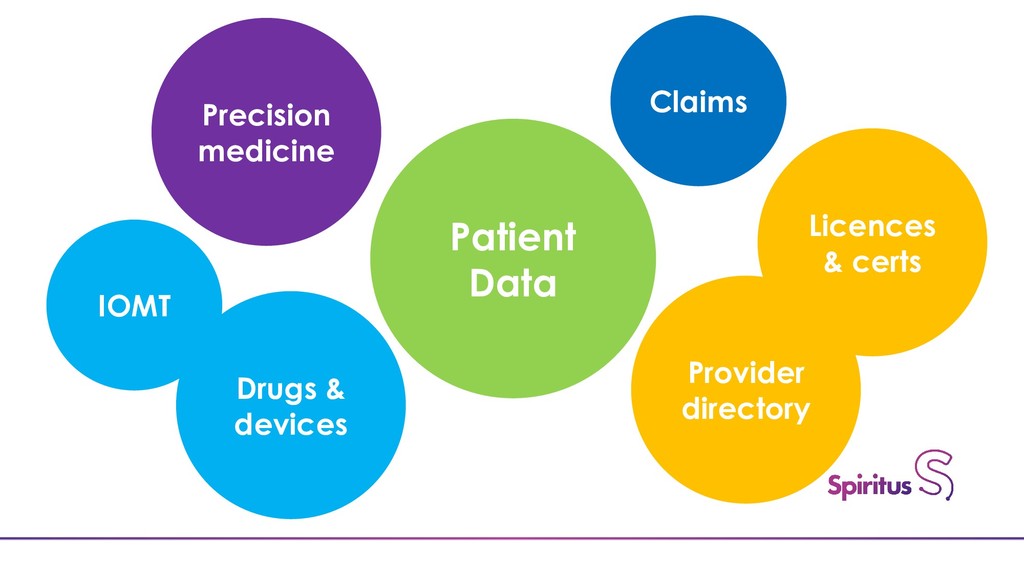
So we've gone into healthcare. Patient data is at the core, as much as there are over a hundred projects around identity management. There are well over one hundred and twenty projects. Most of them ICOs, focused on giving patients control of their medical records, patients control of their data.
It's a complex, difficult problem, but it's at the core. And ultimately, if you're going to help to change and improve healthcare, you've got to address the patient record. Not the same thing as the electronic health record. The systems that can be confining and binding and difficult to deal with.
It's a big problem in the United States and a huge issue. But just to give you an idea of how to think about use cases in a in a sector of society, let's talk more about this, and you can generalize to areas that you may consider of interest, wherever you're coming from.
Licenses and certifications, that paperwork, that validation. I did graduate with a medical degree. I did serve my internship. I am certified as a medical equipment technician, whatever that might be. You can understand that that kind of administrative process could get the level of traceability, verifiability, and auditability that would streamline allow you to bring that to bear.
In the United States, one of the most significant blockchain related endeavors that involves unfortunately major corporates, I say unfortunately because US health system is lumbering the large insurers, the large providers. They've gotten together and said, we're gonna sort through this, one of our first use cases should be around a directory of providers.
So three or four of the largest players in US healthcare, both from the insurance and the provider side have gotten together, and they're putting together in effect a master provider directory. That reference registry around which claims processing can occur. I've had an episode of care, I've had these treatments, I've had these studies authorized, now the claims process can be supported, a building block.
So I've illustrated these three on the the right hand side. These are the administrative financial activities. They too tie to patient data and patient records. But these parties are collaborating now, and have been collaborating. They're just looking for efficiency and productivity gains. Supply chain use cases certainly come to the fore.
Our work is around medical devices, ensuring they're safe and in good order and secure through their operating lives, across long life cycles involving many different parties. At the coalface, that's what we're concerned about. Drugs, traceability of drugs for counterfeit, this is an important area.
In the United States, there's a law that is summarized as serialization and a requirement from ingredient through the pharmacy, you'll be able to trace as a pharmaceutical firm, you have that regulatory obligation to be able to trace. So there is a significant initiative involving a consortium of drug makers working together to see how they might enable this with their supply chain.
So supply chain use cases that may extend globally, that sit within a regulatory framework, that would be an illustration that you might take to another sector in your field. The internet of medical things, smart cities, the IOT world, machine to machine I was just referring to.
I've seen data that suggest fully fifteen to twenty percent of the applications and devices that are on a smart city network, five g enabled down the road, will be in some sense the internet of medical things. We can think of it as that wearable, that health and well-being wearable, but it may be a sensor enabled asthma inhaler.
It may be an implantable defibrillator that's software enabled. So the internet of medical things, the opportunity to step from an acute care setting to a community setting, to me in my day to day life, managing my health in a preventive, self enabled way.
If you think about Scotland's clinical strategy and the shift globally in the more advanced countries to trying to get people to manage their care actively in a preventive sense, but also enabling people to stay at home with the support that they need. CareSourcer here is a great example of supporting that.
Then blockchain may be in a position to support again, the mediation of this device and that device, verify their identities and mediate the exchange of data. And more profoundly, clinical trials. Now I can, if I have the consent of patients, virtual clinical trials involving many more thousands of patients gathering much more data for populations.
Play that back into precision medicine and be able over long periods of time for an individual to bring together their electronic health record, their family history with their genomic information and that patient generated health data, and bring that to bear and really deliver care for that individual.
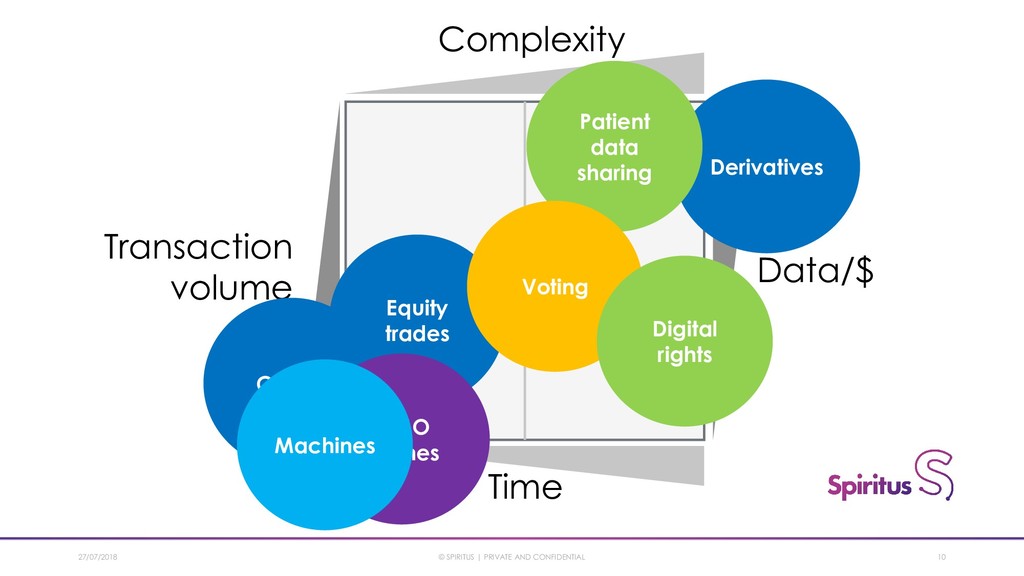
Precision medicine is as well an area where blockchain in healthcare is being contemplated. So to help you frame and think about in your field of interest, I created this graphic some time ago to help me understand the world as as it was evolving in front of me in finance, but I think it applies across sectors and hopefully I can illustrate this.
There really are four dimensions you wanna think about and they are relative. In terms of a transaction has occurred, there's some period of what's known as clearing in finance. We agree, sounds a little bit like the consensus mechanism. We'd agree this is good.
To an actual settlement of the transaction. Transaction clearing and settlement. So across our lives and enabling it in finance, in that lower left hand corner happening in milliseconds, happening millions of trades per day on the New York Stock Exchange with latency out to clearing and settlement of three days by design.
By design, the time from transaction clearing settlements three days soon to become two. But in theory, it could get to near real time. Transaction volume extremely high in the millions as I mentioned, and time stepping out could be days, could be weeks. And this is where the derivatives use case comes into mind, involving potentially hundreds of millions of dollars on both sides, quite sophisticated.
I could be buying crude and selling the Japanese stock index over some time horizon as a future. As a banking institution, I have a lot of paperwork I'm sharing with the other party, and it's very tedious, can take weeks to get everything set up.
Then, you're moving cash and collateral as frequently as you can. Well, that cash and collateral, instead of being moved overnight, could likewise be moved in milliseconds. This is the reason that Wall Street has been chasing behind the scenes this opportunity. It's not just about efficiency and productivity gains.
If I have lower counterparty risk, if I reduce the timelines that I'm exposed to that counterparty and getting that exchange, I don't have as much capital in my balance sheet. I can turn to the Federal Reserve or the FCA and say, why should I keep ten percent of the value against that when I've taken all the friction and counterparty risk nearly out of it?
That would bolster the returns of banks dramatically. This is why banking institutions besides the efficiency and productivity gains are going hard after what blockchain might bring. So let's now come back to healthcare Claims, I described it. That sounds a lot like millions of transactions, relatively low latency, an efficient process, but one that you potentially could gain more efficiency.
Patient data sharing, way out there. Clinical trials, my patient history over time, longitudinally a long period. Up in that upper right, almost by definition, the long timelines are associated with the complexity of the number of parties that are involved, the amount of data or the dollars at stake.
So when you look at the world around blockchain and blockchain use cases, whether you're concerned with enabling individuals, thinking about government applications, civic, a non profit, I encourage you to push your business model and operating model thinking in these two directions. Some would choose to come in and just remediate those utilities down in the lower left.
Good for them. But it is an opportunity on both ends. So let me take it back to some of those other use cases and give you an illustration of where things might fall today and where they might might be taken. Massive multiplayer online gaming.
Scale, why wouldn't that fit that label potentially? I'm recognizing the individual, there's interactions, there's mediation, it's happening at scale with the verification and validity that comes with it. The machines, I referred to that. Billions of devices and sensors, One of the private and permissioned opportunities and protocols that's been presented through the Hyperledger project, which the Linux Foundation got started around finance, but now has corporate members from around the globe as well as many startups.
Sawtooth Lake is the protocol that Intel has brought to bear within the context of the Linux hyper ledger project. It is explicitly designed to support an IOT world of billions of devices. Contrast that with finance, where the hyper ledger project is supporting fabric.
Private and permissioned enabling corporates, but nonetheless at machine speed with machine volumes. That's a lower left experiment. Voting happens infrequently, certainly in developing countries, a lot of manual processes involving weeks. I know in India it takes weeks to gather up at the various states the voting results.
Voting, arguably, you could move it significantly from weeks to days, from days to hours and rely on those records, falling chads or not. Digital rights and digital rights management, that was one of the ones that was covered in the the proof of proof of service, you will.
Proofs of service. Digital rights management, whether it's the creative arts and physical things, or music written. There are a number of initiatives around music. I just saw another announcement today of blockchain enabled music that would put control and compensation back more directly in the pocket of artist and the creator.
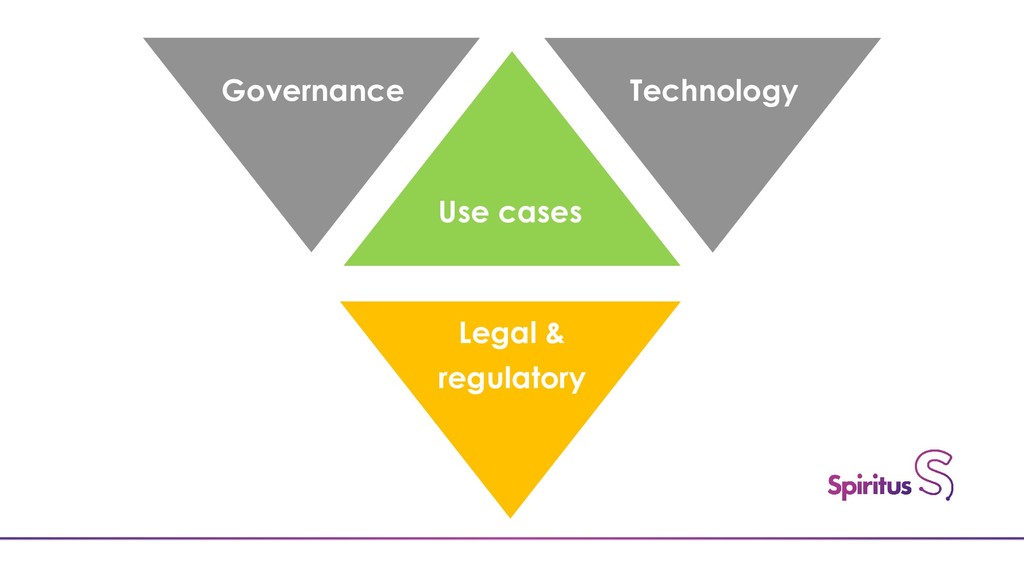
Use cases, governance, technology, and legal and regulatory issues. Common problems across sectors. Quickly on technology, interoperability, standards, the convergence. Much of what I've described depends on machine learning, IOT, AI, AR, VR. It is the convergence of the technologies that are of great interest.
Governance is a nettlesome and problematic issue. The argument in the open community is that you can actually create self governing mathematically driven protocols. I'll argue that human affairs is a little more complicated than that, and exists within a legal and regulatory framework. I'll finish with this, and it's a it's a an appeal if you will.
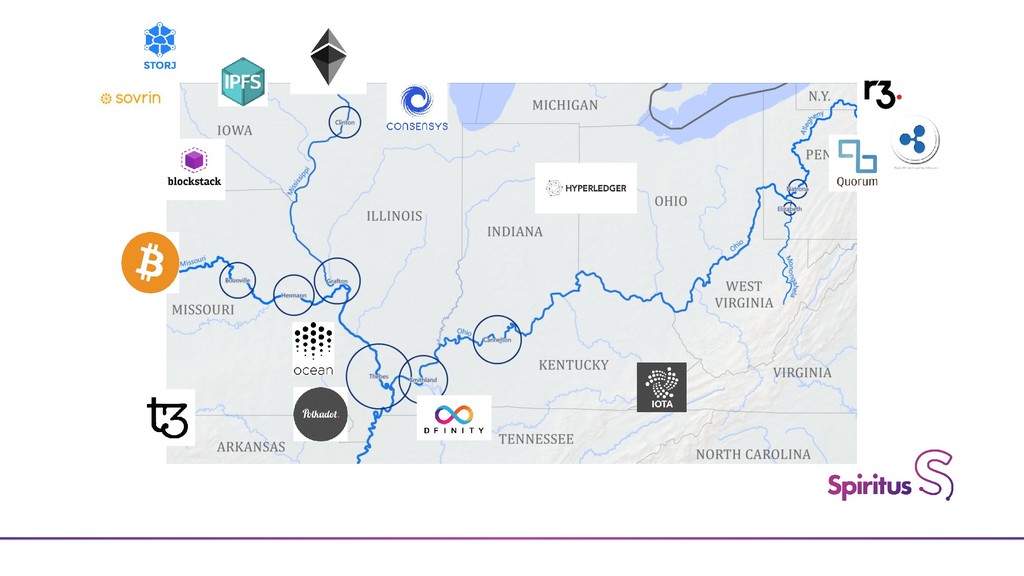
I've represented these extremes of the community, the private versus the public in the open. For lack of a better metaphor in the United States, I've thought of it in terms of this grand river basin that is the Mississippi and the tributaries. And we have, and if you are committed to the vision of Bitcoin or Ethereum, understand and be in the high ground, the wellsprings of those, let's know and understand that and be respectful of those because there is a grand confluence that is occurring.
And that confluence, yes, picks up other projects that are associated with those communities, whether around identity or storage or whatever it might be. But importantly, in finance, the major projects, the r three quarter project involving many banks, JP Morgan's Quorum coming out of Ethereum, but likewise envisioning that community, and Ripple.
Hyperledger, I've mentioned really explicitly while open Linux foundation driven, really trying to get after corporate type issues and problems for the enterprise. More ambitiously still downstream as this confluence occurs going beyond some of the original concepts and enabling vast pools of data, machine learning algorithms, AI algorithms through ocean and IOTA, very much explicitly designed around that IOT world.
Very ambitious around the governance. And finally, downstream the the confluence that is chains of chains, chains of block chains, meta chains, relay chains. This is what Polkadot and Gavin Wood out of the Ethereum community is focused on through parity technologies and Definity. I'll close with this thought.
John Muir, who is known in the United States as that great naturalist, and the explorer and environmentalist who founded the Sierra Club and really made the case to the US government in the late nineteen hundreds for our national parks, was a Scott, born in Dunbar, some thirty miles from here.
And something he said has struck me about what we ought to do within this community. He said, whenever you pick up one thing, it is hitched to the whole world. It is hitched to the whole world. So the ambitions and the promise around blockchain, these communities, I I encourage everyone respectful, to be curious, to challenge one another, but to do it in a civil and responsible manner.
There is great promise, and we're gonna unravel that promise and deliver it. We need to understand when we pick up one thing, it has hitched the whole world. Thank you everybody. Thank you. Thank you. Thank you so much.