
Once an effective flywheel is developed, scaling is the next challenge in the product strategy spectrum. Supriya’s talk focuses on understanding how effective product scaling occurs, what internationalisation means, and how to create disruption in the flywheel. Supriya shares her experiences from her work at Amazon.com, Priceline.com, Zynga and other startups.
← All talks 




Lead Strategy Turing Fest 2017
Past the Initial Flywheel: What Companies Can Learn About Product Scaling
Auto-generated transcript - may contain errors. Tap a timestamp to jump the video.
I'm gonna use the next thirty minutes to talk a little bit about myself and tell you a little bit about what I've learned in terms of product scaling. I know this is not a q and a session, and I'm just gonna have my but you have something you want to talk about or discuss, feel free to raise your hand and we can get into a Q and A session for it.
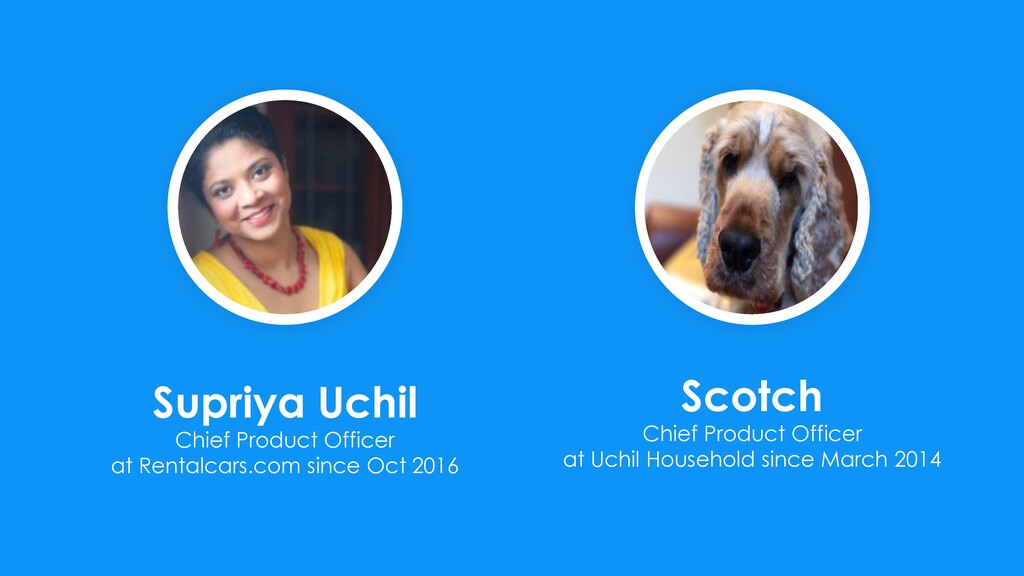
This is me. I just started as a chief product officer for rentalcast dot com nine months ago. This is my dog, Scotch. He's the chief product officer of the Uchil household. His sole purpose in life is to find create happiness for the Uchil household.
And if he had to, you know, rate who would be a better chief product officer, he wins. Like big points. I grew up in lovely India, spent the first twenty years of my life there. A very middle class community, options were either engineering or medical.
And I went to head and became a computer engineer. And then I spent around twenty years in the United States. I went to Philadelphia, have an MBA from Wharton Business School, which came to some use, but very good use. I stayed in Seattle for over ten years working in various roles at Amazon dot com and we're gonna talk a little bit about that.
And then I spent a couple of years by Lake Superior, is like way up north. That lake is like forty degree Fahrenheit throughout the year. So a lot of time there. And then I spent a couple of years in San Francisco working for a bunch of startups.
I started three companies there, two which failed really quickly, really fast, which is always a good thing. One which kind of kicked off and was alive for a couple of years, I sold that one. So I was happy about that. I made zero money out of it.
So product at Amazon for ten years. It started in two thousand when most of us were trying to figure out how to scale products, right? We were at ten million categories. Ten million books, how do you get to one hundred million? Hey, you have books, how do you get to music, DVD and video?
Hey, you have books, music, DVD and video, how do you get to consumer electronics? How do you really understand the customer segmentation? How do you start forecasting? How are your distribution centers aligned to make sure that you're optimizing everything so that you don't have to go through various distribution centers to pick items for our customers?
So a lot and lot of product scaling and what we would call typical crossing the chasm. I was responsible for things like Mechanical Turk which is Amazon's first intent test on how Amazon Web Services would work. And we tried that as a dogfooding exercise, it's still alive and up and running right now, used by hundreds and thousands of users.
And then I left and went to business school and a bunch of startups and came back to Amazon. And my second stint at Amazon, we're really trying to solve the problem around customer engagement and loyalty around Kindle devices. And when I say Kindle, I just don't mean the reading device, I mean the entire ecosystem of devices that Amazon owned and really trying to figure out what does loyalty mean for that customer.
Typically in the digital world we look into what is called as content hoarding. Does anyone know what content hoarding means? Okay, this is very good. Content hoarding is, assume you go to a bookstore to buy a book. What do you do? You go ahead and you buy one book, you come home and then it either lies in your bookshelf for years or you tend to open it up and read it a little bit.
And then you go to the bookstore and go buy the second book. And assume the same thing happens in the physical world. You're trying to buy a book on Amazon dot com. You go ahead and you buy the book. It comes to your house and you can choose to keep in your bookshelf or you can choose to open it and read it.
But now assume that you're in the digital world and every book is available for ninety nine cents. Typically go into what is called content hoarding, which is like, oh, I like that book, I like that book, I like that book, I like that book.
And you download all of those books and then you forget about it. Well, that's not engaged. That kind of behavior is not an engaged customer. That's a content holder, someone who's gathering content but not really doing anything with it. So we looked a lot into devices, things like the Amazon Dash, which is used in kitchens, things like the Amazon Echo and Alexa.
And what would that mean for really exploring Amazon getting into the kitchen or Amazon getting into the household? So did a lot of work around that. In my last role, was the technical advisor to the senior vice president of Kindle Devices, really trying to figure out the ecosystem of devices and how do they all interplay and work together to create an extremely highly loyal customer.
So that's stuff at Amazon. And what I'm going to do today in the talk is use a lot of examples from Amazon in terms of what I learned. And hopefully that'll help you in terms of understanding what scaling really means. I worked for a bunch of startups in San Francisco and in Seattle.
One is called Pro dot com, which is a service oriented model helping you find your plumber or a carpenter and finding the best price for that. How many of you heard about Zynga or FarmVille? Yeah, so I was at Zynga and FarmVille working on a product called FarmVille, really hit to like thirty million active users while I was there and was the largest online game in everyone from ten year old kids to fifty year old people really engaged in that product.
So I learned a lot about gaming mechanics and social behavior. And then I worked for several startups like lockers dot com. I started a bunch of startups in that whole spectrum, a couple in India. A lot of people ask me the question why rentalcars dot com?
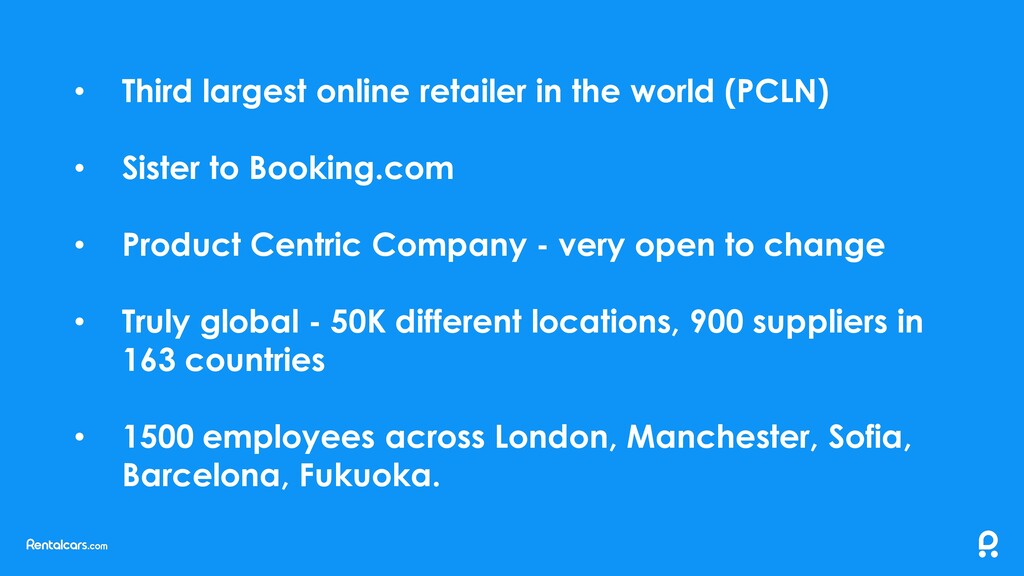
I think the simple answer is didn't know which city to speak, Seattle versus Manchester. Both of them are super rainy. I was like okay, move from one rainy city to the next rainy city. But really, it's the third largest online retailer in the world, right behind Amazon and Alibaba and the numbers change every single year.
It's a sister to Booking dot com. So we're one point six billion pound company, rental cars, a one point six billion pound revenue company that sits behind like a hundred billion pound behemoth. And that's super helpful from a strategy perspective because it helps us in our risk mitigation and our risk tolerance.
We're a very product centric company. Simon Smith, please raise your hand. Who's sitting right here is from Rental Cars and he's joined me today. And he's been really helpful and responsible for kind of like moving us to an agile and a product centric company.
And I have a talk this afternoon around what does product centricity and what does failing fast mean that I'm trying to inculcate as a culture at Rentalcars. It's truly global. And this is super important for product scaling. We had fifty ks different locations, nine hundred suppliers in one hundred and sixty three different countries.
I was talking to Kelly about it just a few minutes ago. What does product scaling mean when you go international? Do you really have a product, one product that fits all? And does it work ubiquitously? Or what do you have to do and change?
And then if you do decide to change now, are you creating a hodgepodge of customer products to suit every customer? And that's a really important aspect that you have to think about for product scaling. And we have fifteen hundred employees across London, Manchester, Sofia, Barcelona and Fukuoka.
That's a good size for me. So one of the things that I've learned is if I can meet people and talk to them and engage with them and recognize faces, that creates a feeling of community for me. And so this was a good size of a company for me.
So now let's go to the talk and really try to figure out, Okay, product scaling. So here you're a founder or a company or a product owner or a designer or a CEO of a company, and you've figured out what your initial flywheel is.
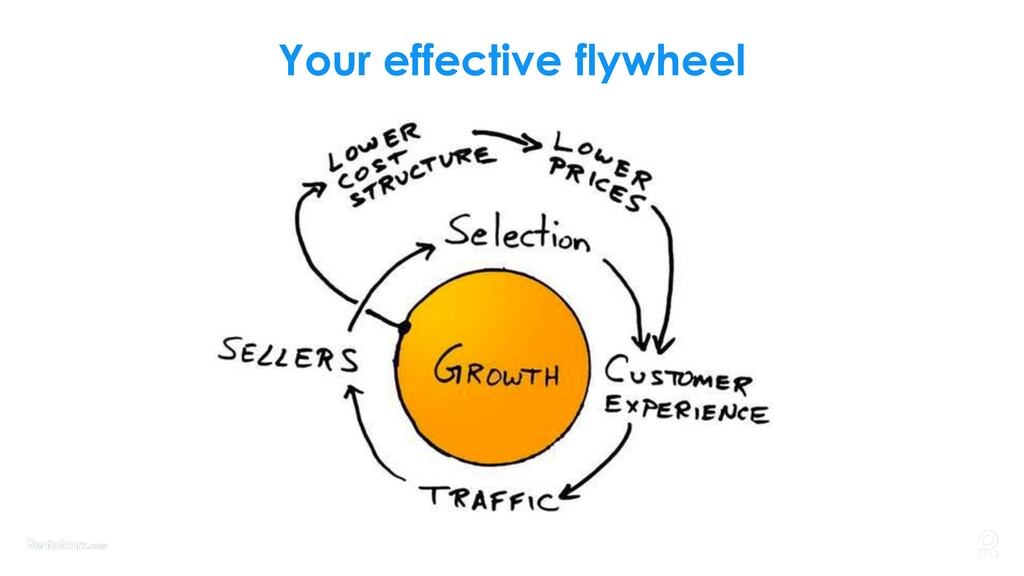
And the initial flywheel seems to work. You've run a bunch of intent tests and like, hey, is this going to work? Is that going to work? And you said, okay, well here's one that's like the Amazon flywheel. You focus on the customer experience, you get traffic to the site, you make sure that there are enough sellers on the platform, and boom, that helps you selection.
That's your primary pattern. And then you lower costs and you've created the flywheel effect for every single customer. So now, this is what Jeff drew on a napkin two decades ago. But I'm sure each of you have one. And this is what the reality of life looks like, right?
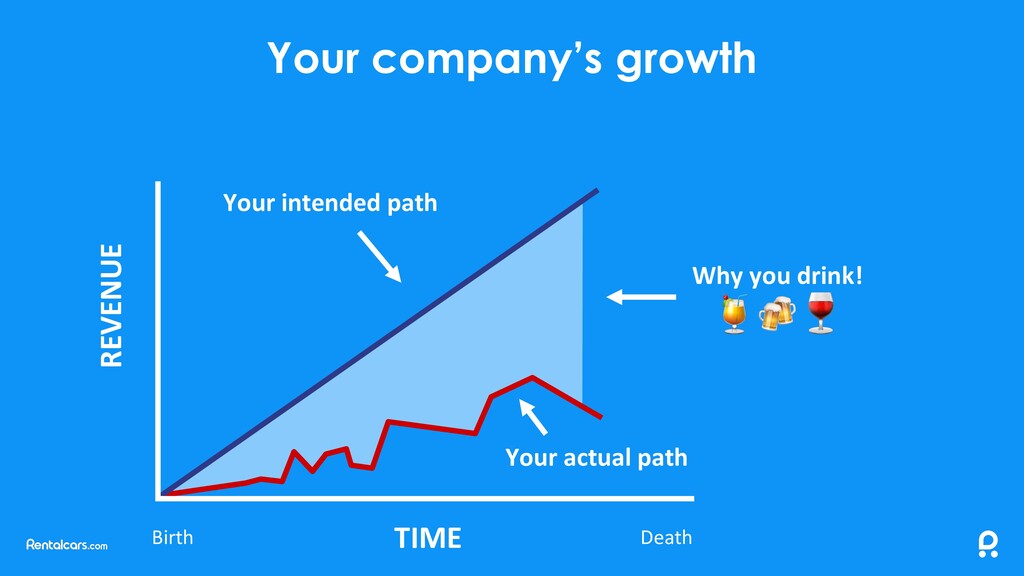
This is your company's growth. This is what you aspire will happen. You're hoping for that hockey stick effect right at the endpoint. This is really what actually happens. Things go on and off, on and off, on and off. You're still trying to learn what that customer base is.
You're like, oh my god, my customer acquisition strategy is really working, but they're never coming back again. And you really start to deal with this ups and downs of your industry and this is why you drink. It's like why you drink? It's because what you're dreaming and aspiring doesn't line up with what your company and your customers' growth patterns tell you.
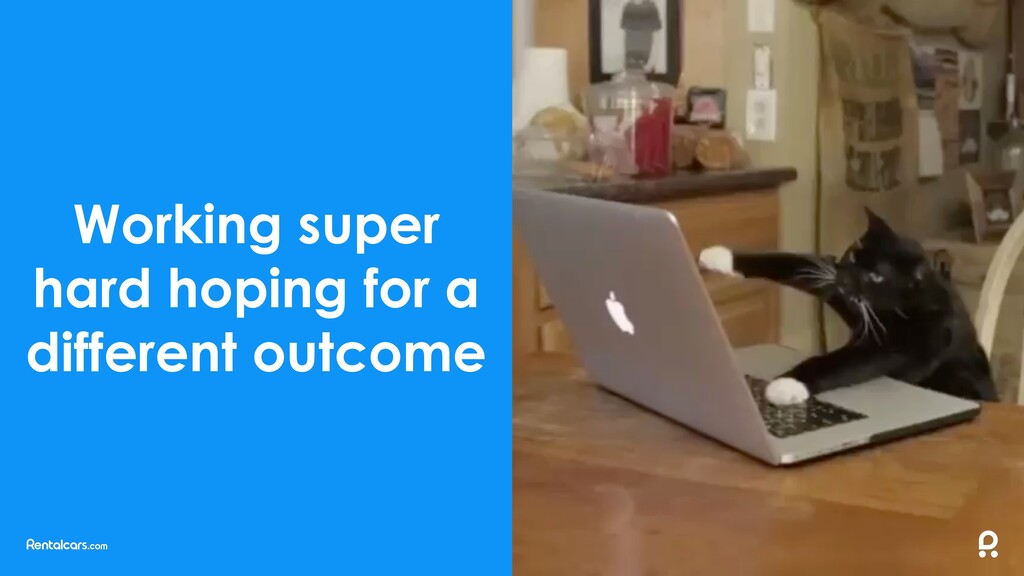
And then you try to work super hard hoping for a different outcome. You're like, oh my god, I'm down in the cliff period. I have to kind of get my wheel going again. But sometimes that just doesn't work. So your board of directors is giving you input on how you should scale.
Your customers are giving input. Someone calls from Barcelona and says, hey, can I start using your product? I don't want to pay those shipping costs that I have to pay. Someone from Dubai is saying, why can't I use Netaporte or YOOX in Dubai?
Why do I have to pay these costs? Your partners are telling you what to do. Really your dog is telling you what to do as well. So what I'm basically saying out here is you have a bunch of different people or entities telling you how to do your product scaling.
And that can be very daunting because you're getting a whole bunch of different inputs from a whole variety of sources. And so then you have to kind of deal with are you explaining all the opportunities, right? And this is something that we saw at Amazon.
Okay, well should we go into China? What should we do if you think about going to China? Or we think about this at rental cars, should we go to Seychelles? And if you go to Seychelles, what does that mean for us? And you do this due diligence around what that means for you and then you go into the country and the reality of what is there in the country totally does not match your expectations of what you had thought.
World would be like before going there. But you have to kind of explore all the opportunities and you have to figure out when to give up. In some cases you're like, okay, a really good example is there's Uber that gets into China, works for a few years, and then decides to get out.
Example of Google, example of Amazon. Plenty of companies that have gone in and made big huge investments as part of their product scaling and strategy in a given country or locale and then have had to kind of regress back. Because the learnings of the economies of scale that they get within that local context does not bear well when they think of the overall international arm, right?
And so world dominance does not actually work when you think about it from a strategy scaling perspective. So you think of category expansion in different companies have different portfolios of it, right? And in nineteen ninety seven is when we moved from books to music.
And at that time at Amazon, we had a fairly good customer base and we thought we knew things about books, but music was a totally different world. And then came video and then came DVD. And then we thought, well, now we figured out the mechanics of what we would call BMVD at that time, books, music, video and DVD.
And then we went to consumer electronics and boy did we fail, right? Because we did not understand consumer electronic patterns, At some point Amazon bunch of companies that dealt with dog food. Well, didn't really think we're like, okay, well we should buy this company.
We didn't realize well dog food is really heavy. It's like a fifty pound bag. The Shipping on that is going to be enormous and that's going to kill us. And so there are all these thought process that we take and then we only learn about it when you tippy toe inside.
But our normal process for tippy toeing is going headlong. The Priceline strategy has basically been an acquisition strategy. Priceline dot com, Booking dot com, Rentalcars dot com. Expedia strategy has been an integrated solution. Skyscanner strategy has been different. And so every company kind of figures out what works for them within their business model.
Acquisitions have their own issues. Eight out of ten acquisitions do not succeed. And part of that is the company does not know what the synergies and how to capitalize on them. It's the same learning for international expansion. This is something that we've learned at Amazon and something that we've learned within rental cars.
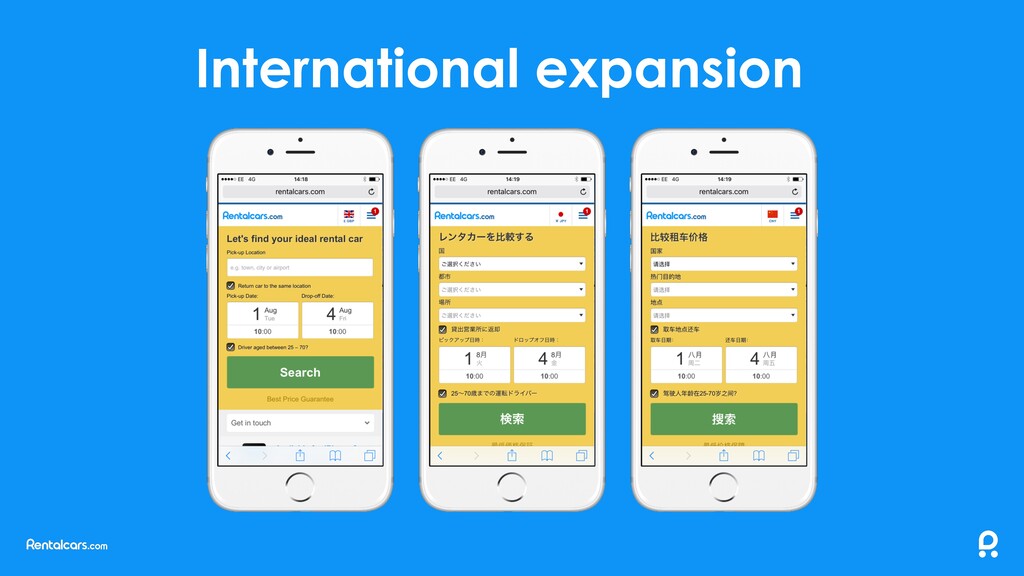
You build your mobile site for UK and then you translate it to Spanish and you translate it to German and it just doesn't work because maybe your Japanese customer has a totally different search pattern than your UK customer. Or maybe a German customer needs more data upfront.
So that's when you start thinking about, hey, if you fine tune the product for the customer, then are you really having one hundred different code paths that are going for the customer? And this is where personalization really helps. Data mining and personalization for the customer really gives you indication of how do you tailor the product to the customer versus the locale that the customer is coming from.
And so a lot of work has been done around, you can think of a ubiquitous product and that's fine. But if you really focus on personalization as a paradigm, then that kind of helps you tailor the needs to the individual customer. And that is product scaling at its most.
It's like can you figure out how to tailor the product to an individual customer? Wikipedia defines strategy as this, a plan of action designed to achieve a long term or an overall outlook. Michael Porter talks about strategy in this way. Michael Porter says, hey, there are a bunch of unique and valuable positions around activities that are difficult to repeat.
Well that's as we've all realised it's super easy to say. But when you are within the system how do you realise what activities are within your company that are unique to you and which are defensible enough? And then how do you create alignment between those activities so that they are reinforcing and they can then be a competitive disadvantage?
And operational excellence, optimizing something to make it faster or better, process improvement is really not according to Michael Porter's strategy. One thing to think about is, hey, you're willing to go to a new country or new category, can you figure out how to intent test your strategies?
Intent testing is really figuring out, it's really in that iteration disruption innovation spectrum, the forced aspect of it. So if we decide as rentalcars dot com, if we decide to go to a new country, we run a bunch of intent tests around that new country.
And intent tests are small things that we can learn about customer focus and behaviour that makes us fine tune our tactics for a strategy. So if you decide to go to India, we write up what we think is like our view of what the world is.
And then we go and run a bunch of intent tests in India to see how our view has changed. That is extremely superbly important for us. To continuously intend tests and not assume that a strategy is a point of view and that it's going to be fixed.
A strategy is just a point of view in time. And as soon as you've written your strategy doc, you immediately have to figure out what the real world is telling you and how that delineates itself. At Amazon dot com, this process works really in terms of the horizon of thinking of what success looks at.
If you're a Series A company, then your VCs might ask you for a return of investment on your strategy in twelve to eighteen months. Maybe they'll push it to five years. But they're really looking if your customer acquisition strategy is to grow by X by this particular channel, they're looking to see in three to four months, are you on the right track or not?
Because if they're not, then they're gonna ask your doctor to tell you what to do or your partner to tell you what to do or they're gonna tell you what to do. Your horizon of thinking of success is totally depend on your risk tolerance.
So if you're a one point six billion company that sits under a portfolio of a one hundred billion pound business, the horizon of thinking and the investment that you're going to make is solely different than if you were a one point six billion pound company by yourself, right?
An important thing to think about is if you think about your products, so your strategies being alive for thirty, forty years, right? Where you may not be in your company at that time. Does it now change your strategy in terms of how you think?
If you widen the horizon, your perception of how you deal with portfolio will change. And so really expanding from seven to twenty to thirty year horizon, does that change your thinking? And being able to be very articulate and clear when you define your strategy that the outcome of that strategy is not like in eighteen months, two years.
People develop a strategy and then say, hey, this will happen at some point in the future but to define what that outcome is, intended outcome is at point X. I mean the final question that you're trying to really answer is are you creating a company or a legacy?
And if you look at like Elon Musk or Steve Jobs or Jeff Bezos, they're trying to create a legacy. And that legacy exists outside of them and outside of their lifetime. And when you think that way, product scaling or your strategy is just a much smaller time horizon.
You're willing to take much bigger risks than you normally would. So that's where I'm going to kind of leave you in terms of what does product scaling mean for you in your company? And is it just really tied to the horizon of your thinking and your risk tolerance?
I have eight minutes left so I can take questions if anyone has any. Simon. This is why you bring one person along because when the audience doesn't ask a question, you can rely on somebody. Okay. This really isn't prepared. So what's your biggest learning at rental cars that's different to how Amazon operates?
What's my biggest learning at rental cars then with regards to how Amazon operated? I think my biggest learning to rental cars is that we need to do fewer things better. Okay, and that means we need to be really rather than being broad and shallow, need to be deep and narrow.
And I think we are trying to focus on three to four strategic things every year that we can deep dive on. And you'll all know that, right? I mean, based on where you are in the life cycle of companies, if you stretch yourself too thin, you're never going to be able to see the return of investment that you can deep dive on that gives you the next billion pounds, right?
Because you scattered yourself across too thin. So I think that's the biggest learning. Look, it worked, it worked. Now I have several questions. Yes? Any suggestions on product scaling for, let's say, smaller companies, or companies maybe up to fifty employees? I think the same principles always apply, right?
When you're thinking about I was talking to Cali, who's twenty four people right now in his company, And he's thinking about scaling on his side. It's irrelevant. Once reach like a hundred thousand users, you're going to start thinking about, hey, how do I scale to the next round?
And the aspect of figuring out whether strategy is just a point of view in time, is super important. That there is a point of view of a very intelligent person at some point of time, but the reality is going to be different is one aspect to think about it.
Ensuring that you intend test whatever you're trying to do is another way to make sure that assurance of success, so you're learning along the way. And if you're at one hundred thousand, how do you plan for a million? How do you plan for ten million?
How do you plan for one hundred million? And does the same product portfolio work for one hundred million users as it works for one hundred thousand? Ideally, your product design is set up in a really clear way, it should work. You mentioned intent testing and how you change things based on the individual customers.
What things did you discover that surprised you most? I mean, every day is a surprise. So we just ran some intense tests in Alicante because right now we are rental cars and we feel like our biggest, strongest pain point is when you have to go pick up the car.
You've landed in an airport in a foreign country and you have to go pick up a car and you don't know how long that time will take. So I land in Manchester, then from the airport I have to take a bus shuttle to go somewhere.
I go to something called a car rental area. Then I have to wait in line, then I have to sign a bunch of things. And I may have forgotten that I'm supposed to get my know I'm supposed to get my driver's license and my passport, but I may have forgotten to get some other pieces of information.
Then I feel anxiety around the fact that, wow, now I have to pay insurance because I'm in a foreign country, likelihood of things going wrong. And so what can we do? We learn a lot, right? What we learn is like, if I'm a mother with two kids, that is like a big huge hassle.
A big huge hassle to take both the kids from the airport after a five hour flight and then get to the station and I'd do anything to be able to shorten that time horizon. And so what we didn't know, what surprised us was how frustrating that experience was for a certain set of our customers and how we were not serving their needs.
But we learn that every single day. We learn about customer behavior patterns through intent testing every day. So every day is a surprise because it's a point of view. You wake up in the morning and you think, oh, this is how it works.
And at the end of the day, you're humbled because you're like, okay, this is how the customer really wants it. And even if you can be right one out of one hundred times, you give yourself a pat in the back because you're like aligned with the customer.
Any other questions? Yes. So data is always a backward view of time. Use data intelligence to do predictive analysis. So you say, okay, well here's what the scope of what I think the world is based on what I've learned. But no amount of data actually assures you for the reality of the situation.
So you have to do both. Your data intelligence helps you figure out what is your hypothesis under which you're going to build your strategy. And then intent tests are getting into it tells you what is happening on the field. Does that help? Yes. Okay.
One more question and then I have to go. Someone out here raised their hand. Yeah, was just going to ask what kind of take. That's a really good question. What kind of shape and form your intent test take? It's all over the spectrum.
I mean, we'll have people do focus groups, we'll do interviews, we'll go to the field. Wherever possible, we'll try to engage with the customers and try to emulate what they're trying to do and just learn from them. And if we don't have that methodology, I don't think rental cars would be where it is today.
Webbooking dot com would be where it is today. Really, really intense test and we are very open and cognizant to not letting our customers, not shaping our customers' needs, but really figuring out what they're trying to do. So yes, a large portion of our design and product organizations just go do intent tests.
For me, like gorilla testing or focus groups. You do not have to have a lot of money to do intent tests. People think like market research just means I have to put in so much money, seven thousand into it. No, that's not true.
Just like talking to five customers like once a month gives you that same amount of insight. You understand that you might be biased in which customers you pick. But as long as you're cognizant that you're in learning mode, you're going to get the best out of your intent tests.
Thank you for your time.