CodeBase was recently announced as Scotland’s first Tech Scaler. But what is Tech Scaler?
Steven’s presentation sets out to answer this question by, firstly, looking at tech ecosystems in general and then, secondly, explaining the new specific role Tech Scaler is aiming to play for the local ecosystem.
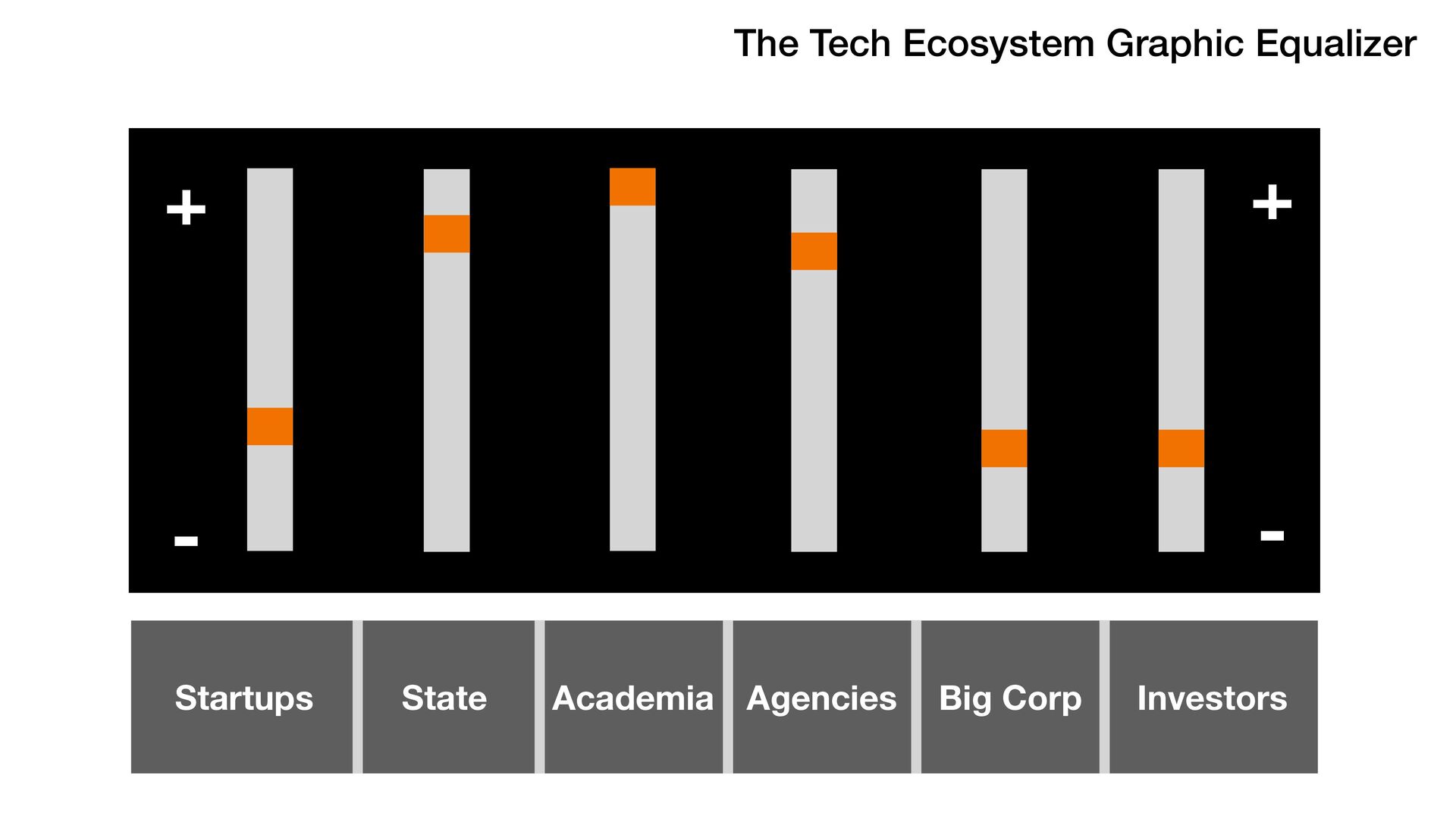
The presentation comes in four parts, culminating in a suggestion for how to create a more startup focussed Scotland. In the first part, Steven zooms out to look at tech ecosystems, focusing on some key questions, such as “how are ecosystems defined?”, and “by whom?”, “what are their constituent parts?”, and “how do these constituents see the world?” In the second part, he will then show how different ecosystems can look depending on how much of a voice the different constituent parts each have. He captures these different distributions of voices via the metaphor of the “graphic equalizer”. In the third part, he looks at some ecosystem equalizer settings from across the globe. In the fourth part, he suggests an equalizer setting for the local Scottish tech ecosystem, and lays out how Tech Scaler can help create the required conditions for that setting.
1 / 27 Use ← → to navigate
Auto-generated transcript - may contain errors.
Tap a timestamp to jump the video.
Hey. So first of all, thank you very, very much for coming. It's a great honor to be able to speak to you today. I'm going to talk about a bunch of stuff, basically kind of three things. Firstly, I'm going to talk a little bit about what an ecosystem is.
So I'm sorry, it's yet another definitions kind of thing about ecosystems, but I'll try and keep it sort of interesting, I hope. The second thing I'll talk about is what the TechScaler is. Just a quick show of hands or vocally, does do people know what the TechScaler is?
Ish? Okay. Okay. But they've heard the words Techscaler? Yes. Okay. Oh, god. All right. So yes. So we're talking about Techscaler. And finally, a very short amount of time, I'll be talking about what why we're doing all this stuff and give some thoughts on that.
So in more detail, these are the kind of bits we'll be talking about. And I talk about ecosystems a lot, frankly. And today, I'm going to try and focus on what ecosystems are, specifically who kind of who defines an ecosystem, what these things look like, see if we can see any patterns there and see if the usage of the word ecosystem is kind of creating a new way of understanding how to build stuff.
I'll then build up to this sort of metaphor. Did people see the MartinLogan talk earlier? Yes. So the graphic equalizer, the metaphor will raise its head. So we'll be talking about that a little bit. And then seeing what that how does that pertain to Scotland and then again, talking about a bigger question about why the hell we're doing all this stuff.
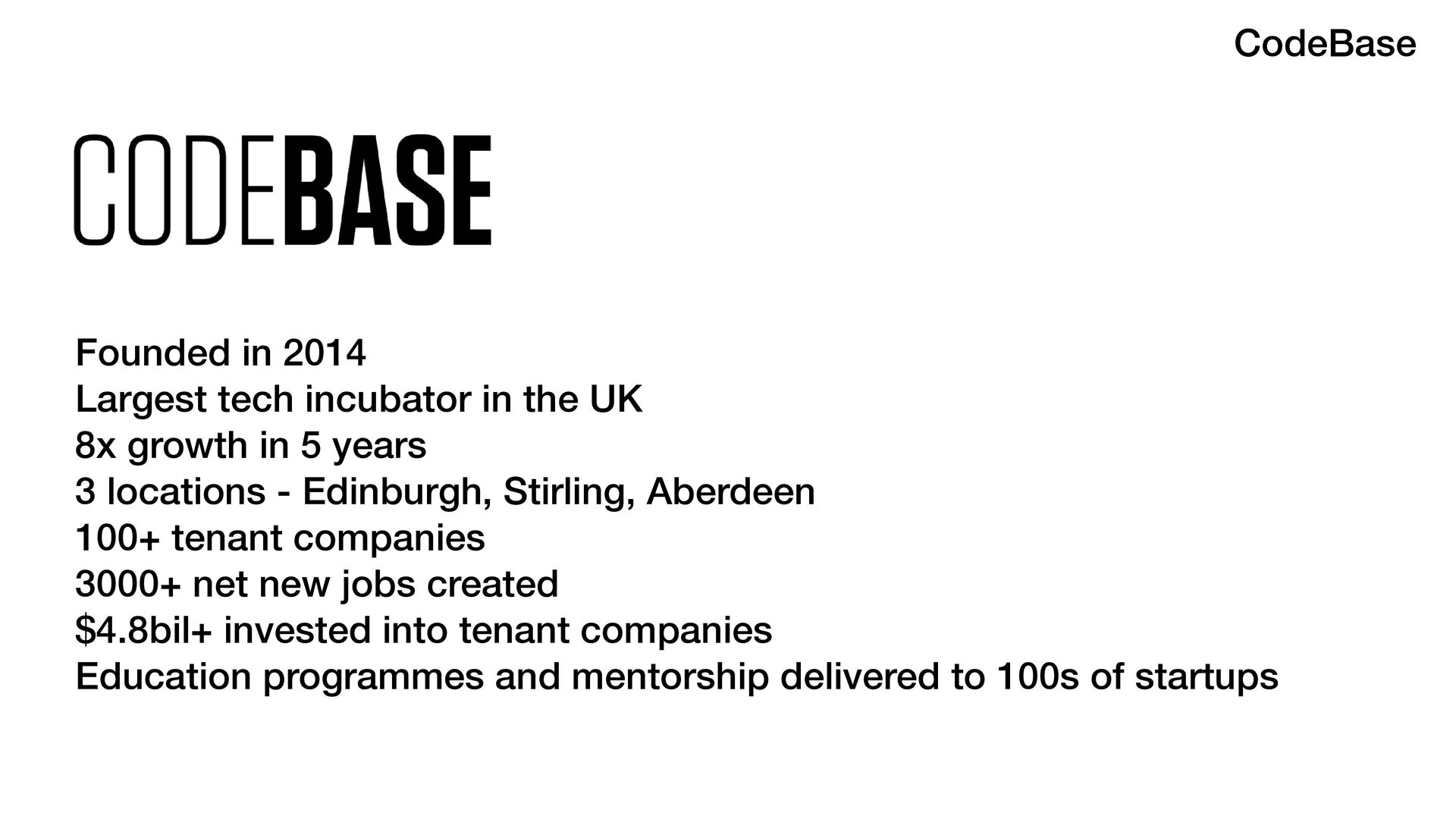
Okay. So very quick introduction. Codebase, we've been around since twenty fourteen. Essentially, we started out as a kind of institution that gathered the momentum that was created by Skyscanner, created by FanDuel and a bunch of other start ups in Edinburgh. And we sort of captured that momentum a little bit and created a space where those start ups could grow and expand.
And so at the very beginning, what we did was very much focused on space, just being a tenant play for companies. Over time, that kind of morphed, and we added a bunch of sort of educational programs we do. We built a partnership with Barclays.
Maybe people have heard of Barclays Eagle Labs. And that shifted us away from just providing space for companies towards sort of going through playbooks, building programs that are educational but also trying to connect people to investors, to hires, etcetera, etcetera. So it's kind of been the the code based journey.
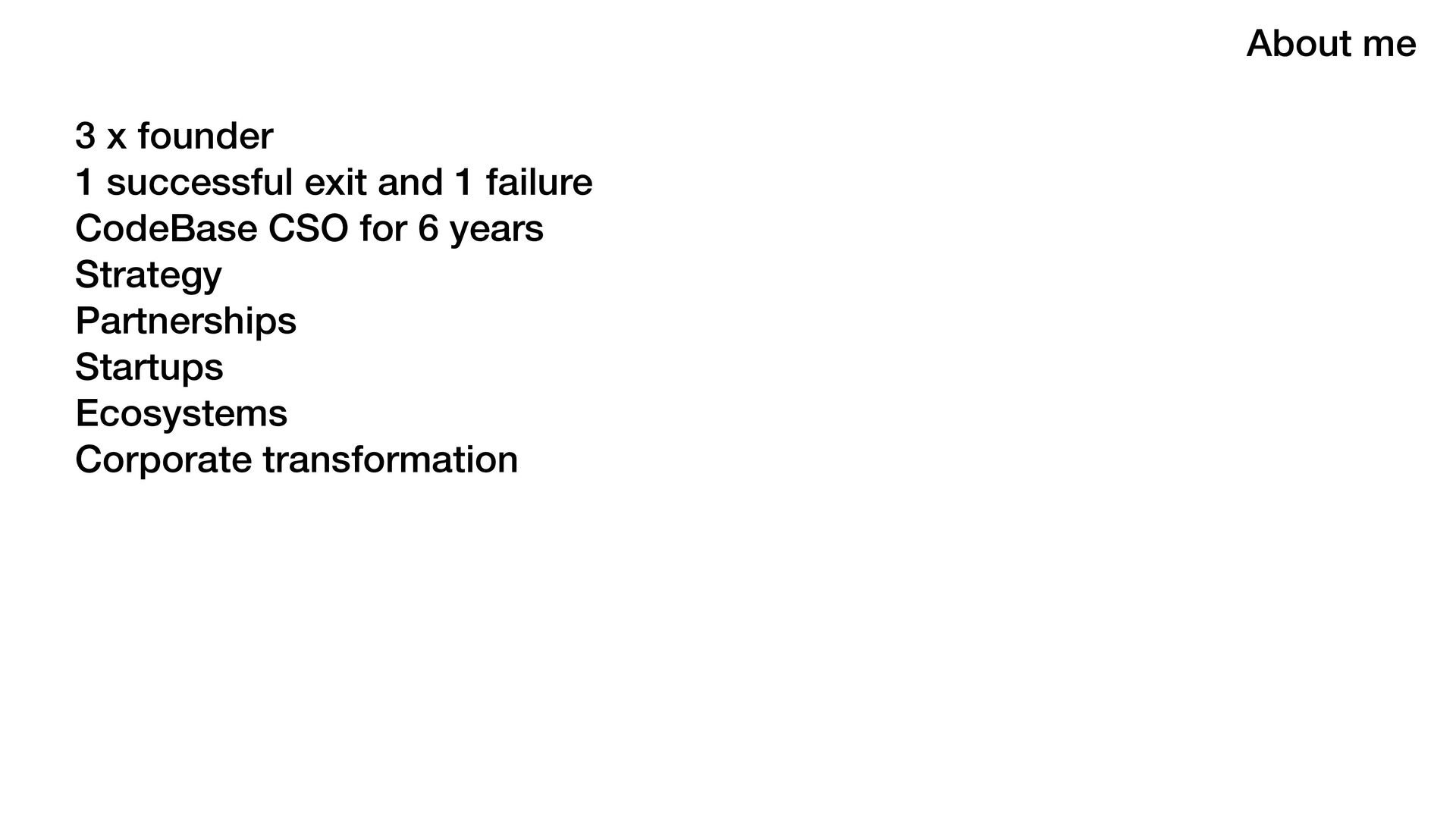
My own personal journey, just mercifully short, I'm a start up person through and through. So I graduated. I never had a kind of job, really. I never did a sort of graduate training thing or never never joined anything. And, you know, immediately kind of built my first start up.
It it worked. I thought I was super smart, and I was just really lucky, to be brutally honest with you. The next startup I built didn't work out. It took about five years to fail. I wish it had taken three or so, to be honest.
And since then, I joined CodeBase six years ago. I'm kind of a late founder at CodeBase, so I'm one of the directors and, you know, got skin in the game, all that kind of stuff. And the stuff I'm really interested in is strategy, partnerships, how things grow, reaching out to corporations, that kind of stuff.
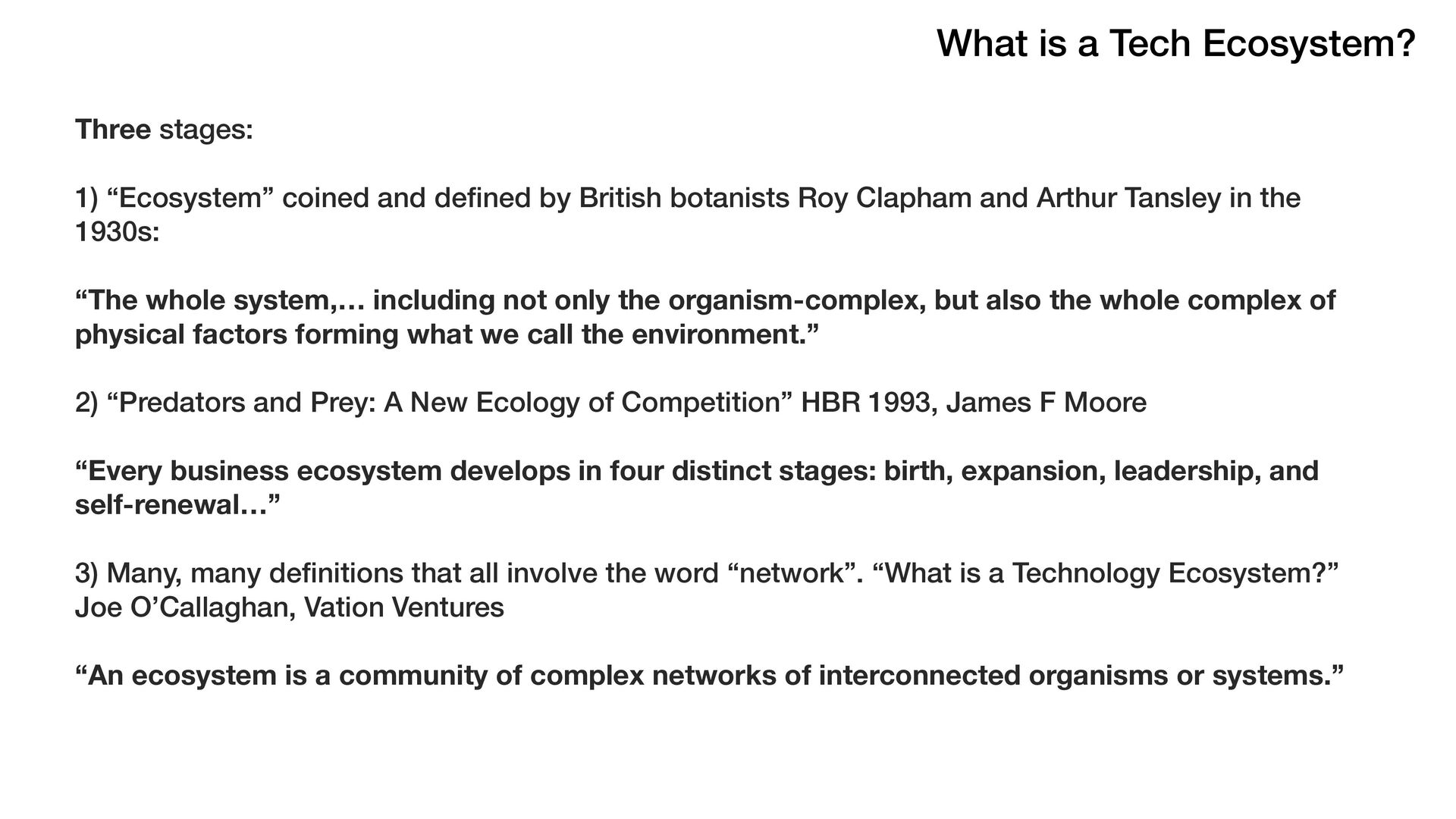
So that's me. So a lot of text on this. Read it at your leisure, but I wanted to sort of investigate the concept of the word ecosystem a little bit through language and through history. So there's a bunch of interesting stuff there for me.
The first thing is that the words started to be used in the '30s, and it was the output of a sort of pen pal friendship between two botanists who were basically talking about systems and starting to understand organisms and complexity and things being in context with each other and environments and all that kind of stuff.
So point one for me is just really kind of interesting to see that the whole idea of looking at the world via ecosystems is not even one hundred years old as a concept. So that's the thing that kind of struck me as being really kind of interesting.
And if the word was coined in 'thirty five, it took like fifty eight years for that word to become a metaphor and map across into the business space. And there's a kind of seminal piece, which is really recommend it's a really, really interesting piece from James Moore in the Harvard Business Review in nineteen ninety three.
And it's basically the beginning I'm sure everyone's heard of like disruption theory and those kind of metaphors of what startups are trying to do. I think that stuff starts round about that time in the sort of early '90s where people are looking for patterns in business, and they're looking to lots of different other realms of meaning, realms of understanding, and they're using things like biology and language to make these things clear.
So that happens in the '90s, and we start talking about ecosystems. And if you were to sort of Google trend search the usage of the word ecosystem, it's in the '90s where it really goes crazy and really takes off. If we fast forward today, we're looking at many, many, many, many definitions of what the hell is an ecosystem.
And frankly, I'll go into a few just to keep it pretty short. But basically, they all start to feature the word network or complexity or system, things like that. So we've now created a kind of history where, in super abstract terms, in the '30s, in last decade, in the last century, we have this kind of moment of things like the birth of sociology and things like that, where we're starting to see things, aspects of the world, not in isolation but in context.
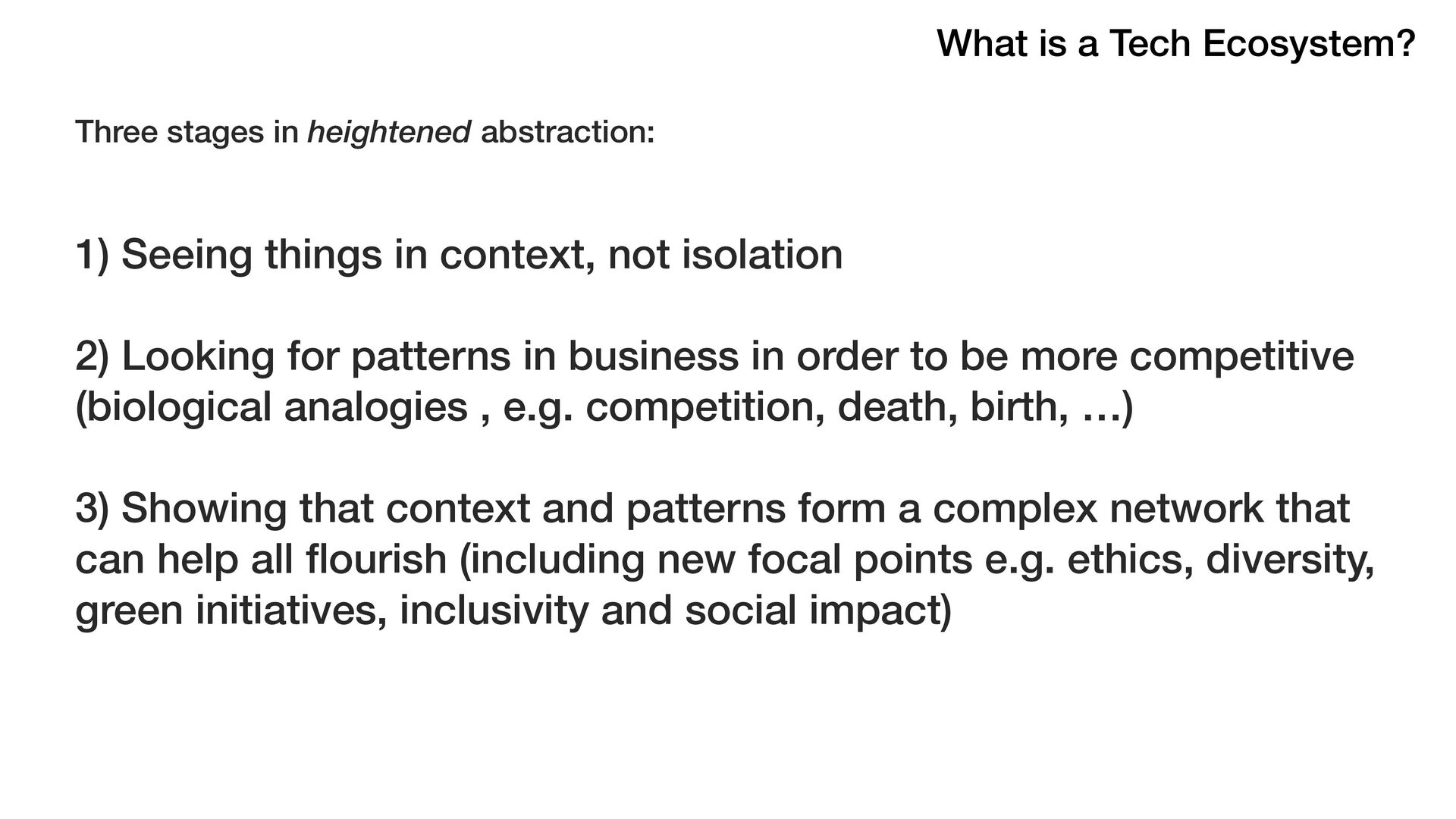
And I think that's the first kind of moment of sort of emergence of using the word ecosystem. The second bit then is to map that across and focus very much on understanding the metaphor in order to sort of crush the competition and win in business and all this kind of stuff.
And I think if we look at the world now, and again, you might disagree with this, this is just an opinion, but I think there are strong sort of data points for this, and I think it's a growing thing, actually. I think ecosystems now are used to describe a kind of space where there are different entities and they can compete against each other.
So the biological Darwinistic stuff about winning and losing and death and rebirth and growth and innovation and all these kind of things still hold. But I think in this decade, certainly in this century, I think we're sort of rethinking how these things can work, and we're adding bits that are kind of ethical to it.
And, you know, earlier, you might have seen Logan talk. He mentioned the word flourish. He uses that a lot. And I think that flourishing in general, but specifically also focusing on diversity, on sustainability, on inclusivity, social impact, etcetera, I think that's the new kind of stuff, for lack of a better word, that we put around ecosystems when we think about them.
So again, ecosystem shows us that we're not just things in isolation, shows us that there's a context behind things we do. That's in the 1930s. Fast forward to the 1990s, people are starting to use that insight for business, starting to look how to map that across, but trying to do that to become isolationists, to become the only thing.
But now we're at this world where, at least in some corners, those kind of points that go beyond sort of pure capitalism are becoming more and more important. So that's the kind of journey, I think, that the word ecosystem has gone on. And I want to look at that in a little bit more detail just with some examples to see if what I'm saying is not total nonsense.
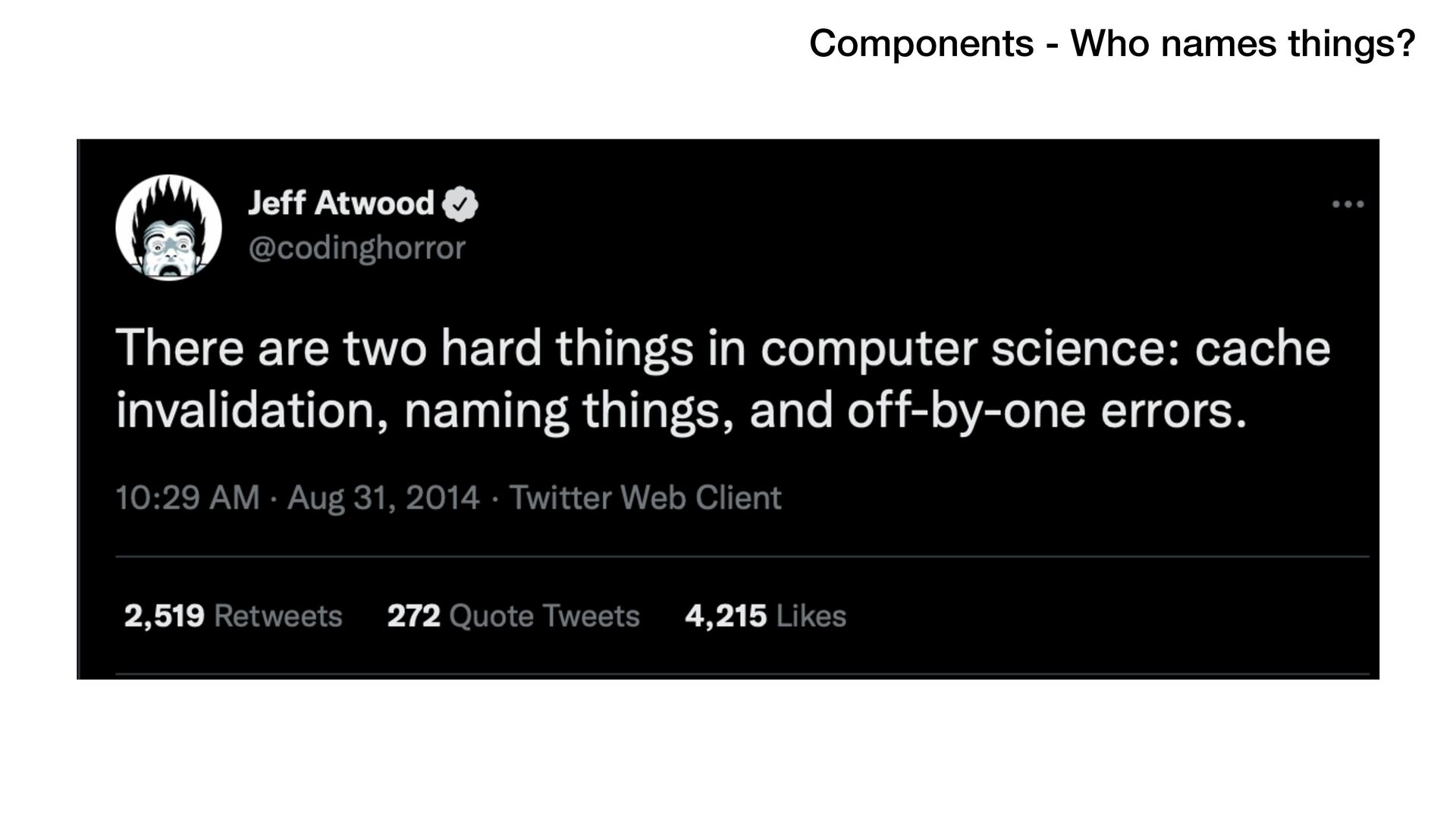
So the next thing I want to look at is if we look at ecosystems, one of the big things is like who gets to name the different components of an ecosystem? Who gets to name the different parts? And how do these parts see themselves?
And I think, again, we live in a world where naming things is becoming more and more important and actually kind of, like, politically super, you know, super important. We've got identity politics and people self declaring or declaring differently or etcetera. And so I think the naming thing is super important to understand what's going on.
I think it's something that's in the air in our culture. And so I wanted to sort look at that a little bit because I think I've seen some pattern, and I'd like to sort of share that and show that by having seen that pattern a little bit, I'm trying to check my own kind of ********, for lack of a better word, to see if I'm thinking about it in a biased way too.
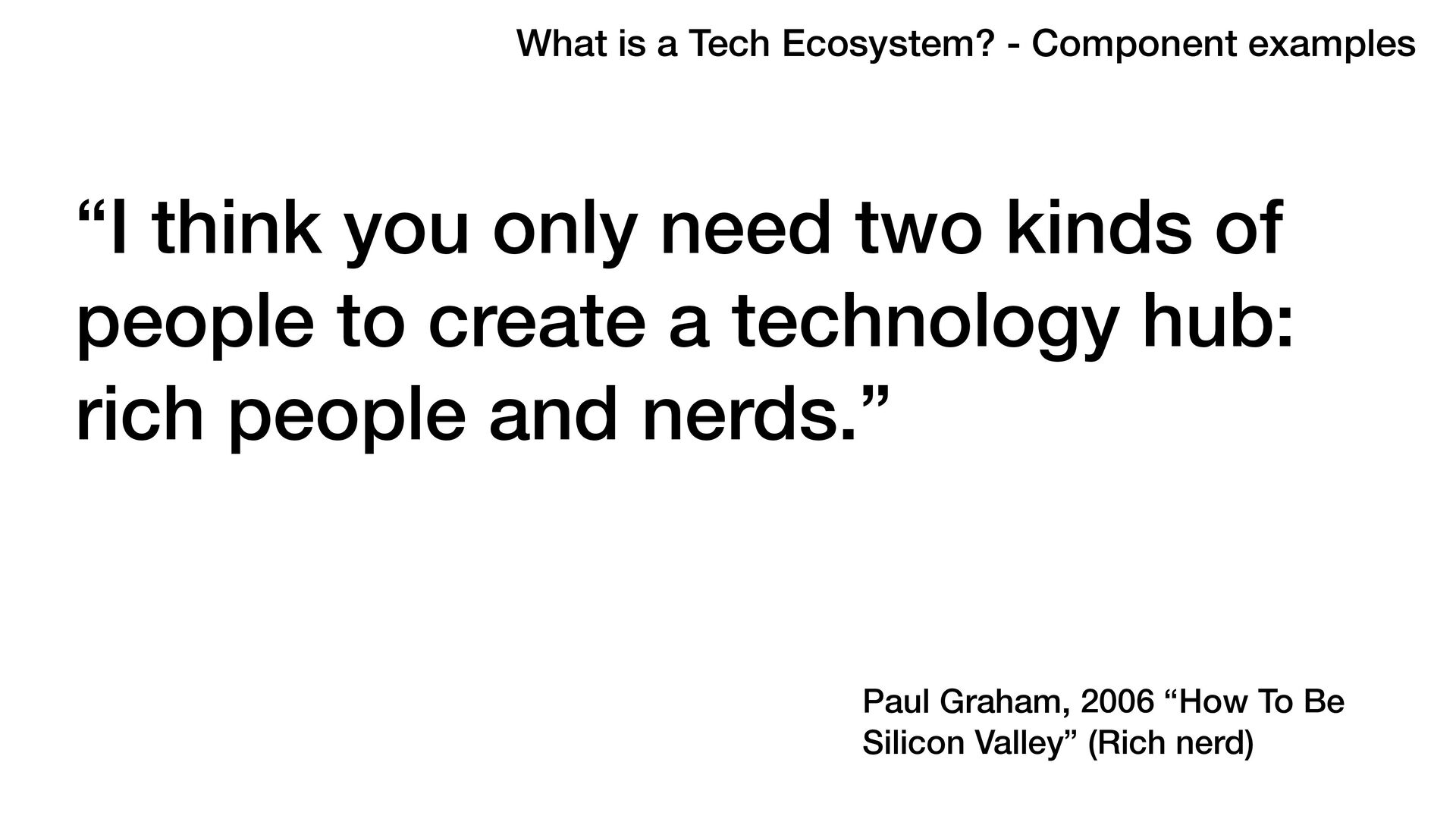
So many of you might know this phrase. So it's from Paul Graham from the early 2000s. It's the most libertarian, thin description of what the hell an ecosystem is, and it's famously nerds and rich people and a place they both want to live.
And I've heard many, many, many, many people talk about this, and it's like, is that the kind of libertarian thin state kind of solution we need or, you know, that kind of level of of of discourse on it? But what struck me the other day was if you look at this of two key components here, you've got nerds and rich.
And if you look at Paul Graham, he's a rich nerd. And it just struck me that maybe when we start to describe what the sort of basic ingredients of an ecosystem is, it's kind of revealing to how we see the world. And I took that for a walk, that thought, and looked at different data points.
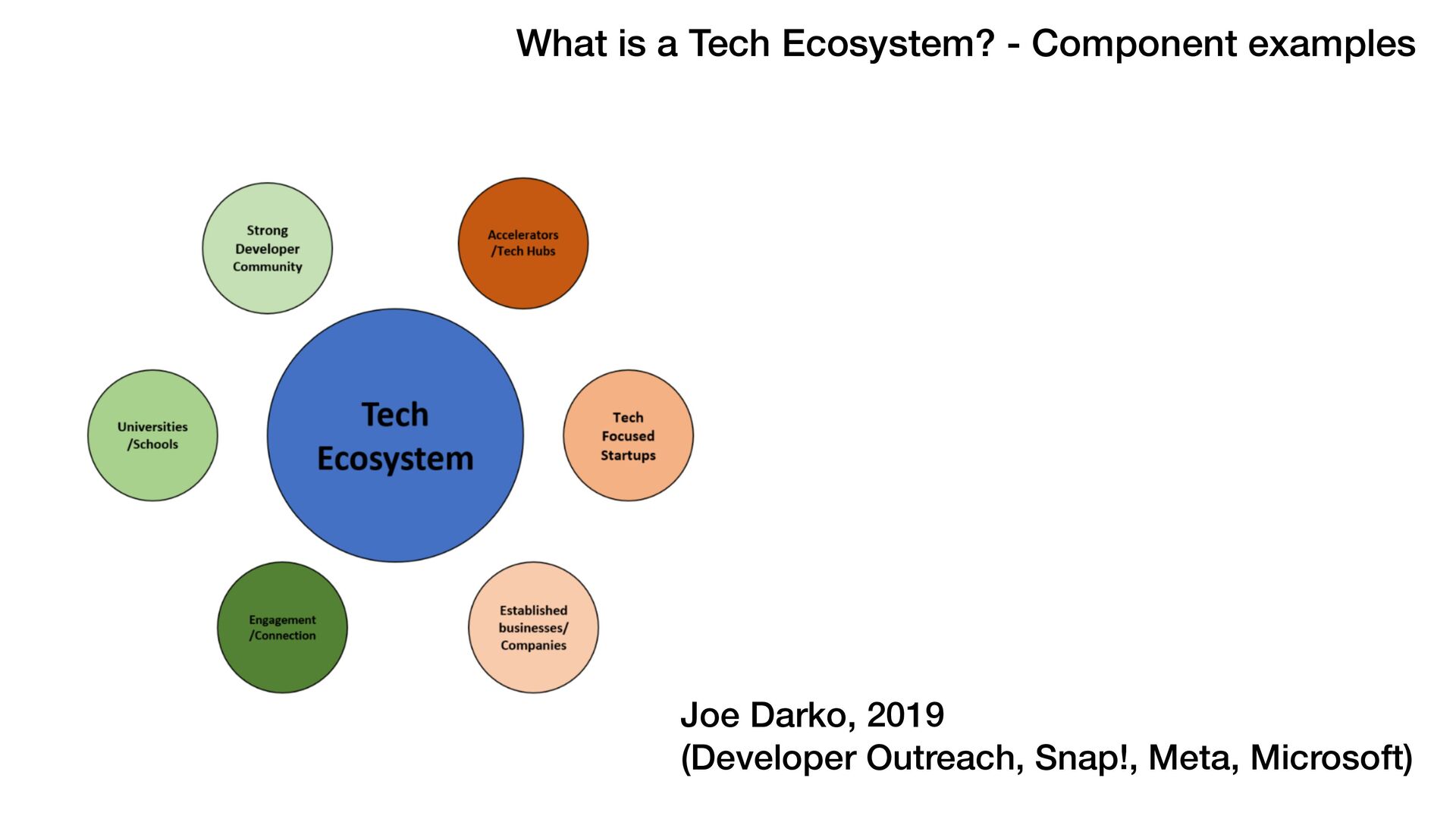
And this is fairly anecdotal, but it's quite robust, I think. So if we look at, for example, a guy, Joe Darko. Joe Darko was developer outreach at Snap. He used to do it at Facebook or Meta and before that at Microsoft. So developer outreach, his sort of main part of an ecosystem is a strong developer community.
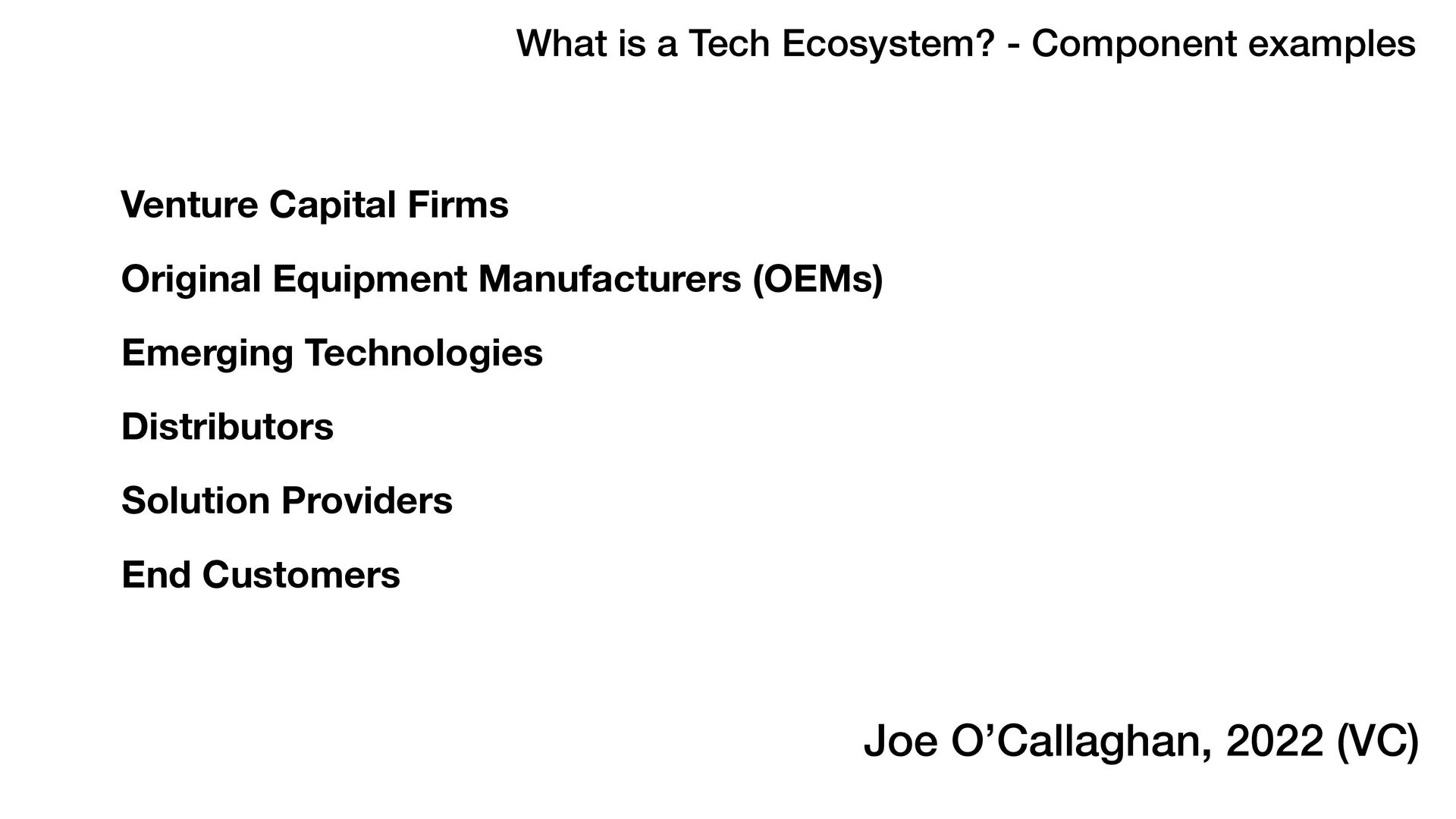
So like, you know, that's interesting, that someone who looks after developers thinks developers are really important for an ecosystem. And if we go further, this is just one example. There are loads and loads and loads of VC examples. They tend to think that VC is really central to an ecosystem.
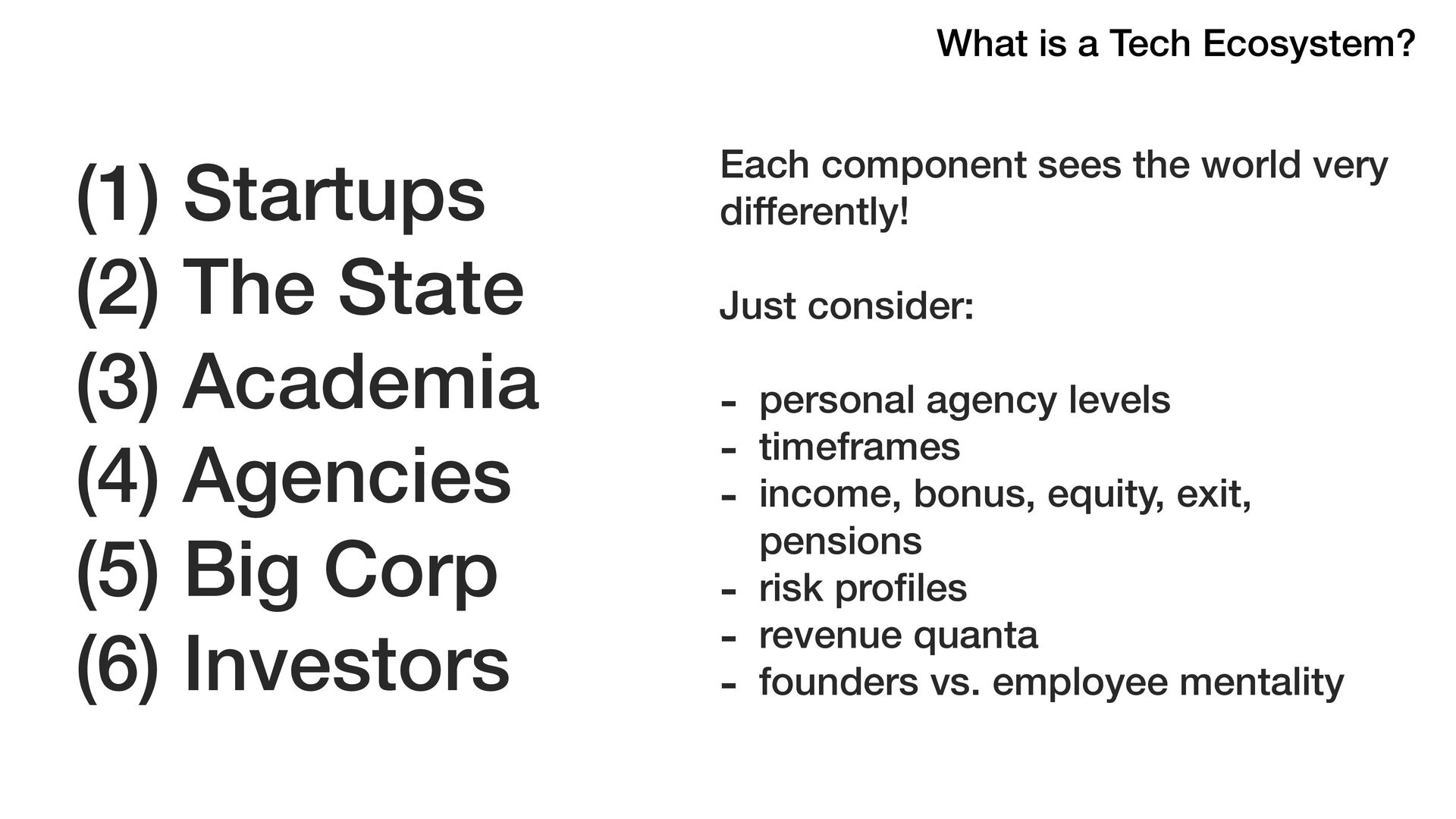
So I think we're seeing that we've got those kind of definitions of ecosystems. We've got the different players who are naming stuff and seeing what the important components are. And I'm doing that thing, too. So my way and again, people might disagree is I think those six components are the ones that we kind of see very strongly in Scotland.
So start ups, the state, academia, agencies, big corporations, and investors. And one thing I sort of wanted to make clear today is that each of those components see the world very, very differently from each other. Just consider things like, you know, if you work at a large corporation, you might earn, like, a higher wage than you would at working at a start up, but you maybe have less agency, right?
You're not your, you know, your main worry is maybe not to mess things up or keep the ship afloat, whereas in a start up, you're trying to build the ship in the first place, so you're doing lots of crazy stuff. If you work in academia, you've got a bunch of different priorities.
If, you know, just the way people see time frames. Again, if you work in a big, massive institution, you might look at things in a yearly basis or a decade's strategy or something like that. Whereas if you're an agency, you'd be much more, sort of opportunistic, and you might go from month to month or every three months, or you might die in six months if you don't get a new client or something.
And so we have these different components, and they see the world differently. They see it differently culturally. They see it differently mostly with a sort of risk appetite, so pensions versus equity versus exits. There's this old phrase that says that founders are sort of temporarily embarrassed millionaires.
So you've got a kind of risk profile where people are just super optimistic and super believe and good things are going to happen versus people who are like, No, no, no. I'm not going to exit ever, but I'm going to have a strong pension, and this thing is going go.
So what I'm trying to say is all those different components in an ecosystem have different kinds of voices and different kinds of strengths and weaknesses and different bits of awareness and different ways they communicate with each other, right? So they'll go to the same places on holiday.
They wear the same kind of clothes. And they'll think certain things are acceptable and certain other things are just crazy, etcetera, etcetera. So each of those different things, different view of the world. And as they come together in an ecosystem, I was just wondering what would be a good metaphor for sort of working out how they could all interact with each other.
One of the big things we always try to at CodeBase is trying to introduce startups to big corp, right? So how can you get a proof of concept gig or how can you do that dreaded thing called corporate navigation, go through and meet different people, see if you can sell your product, etcetera.
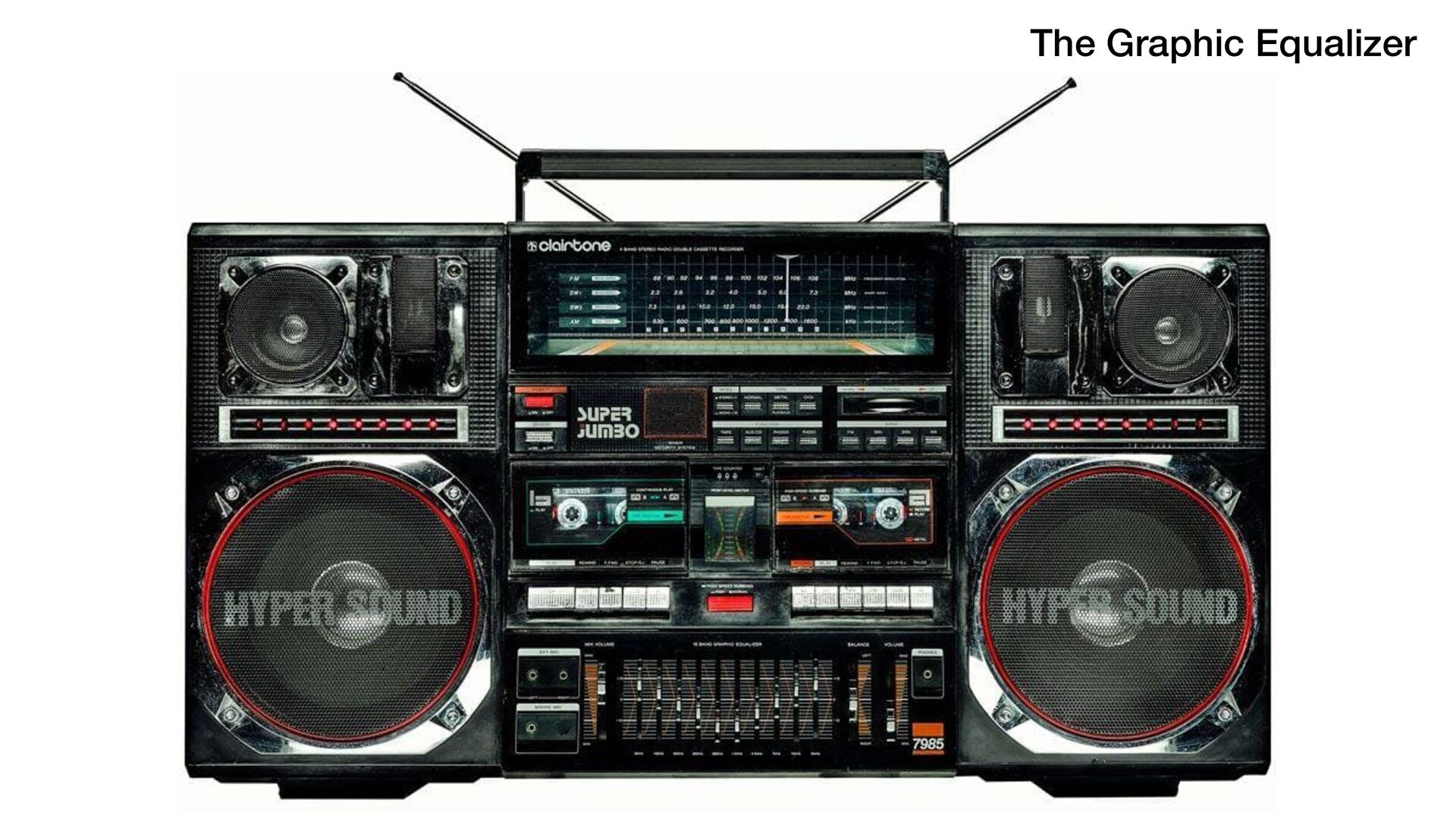
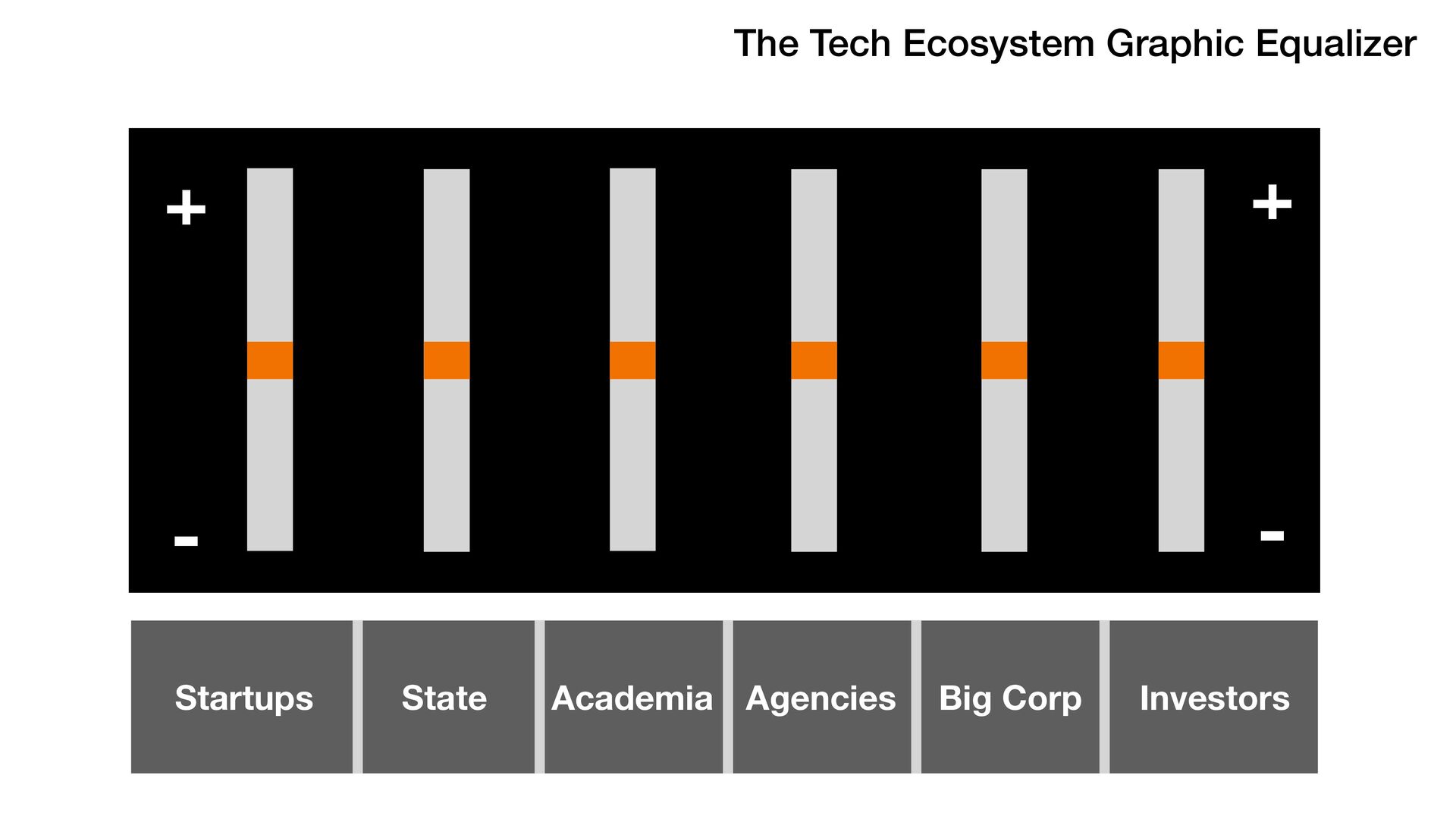
And just that tiny part of connecting two different components can be super fraught with difficulties, almost like two entities speaking with each other through different languages. So I wanted to sort of dwell on this a little bit. And the metaphor I was going to use was that of a graphic equalizer.
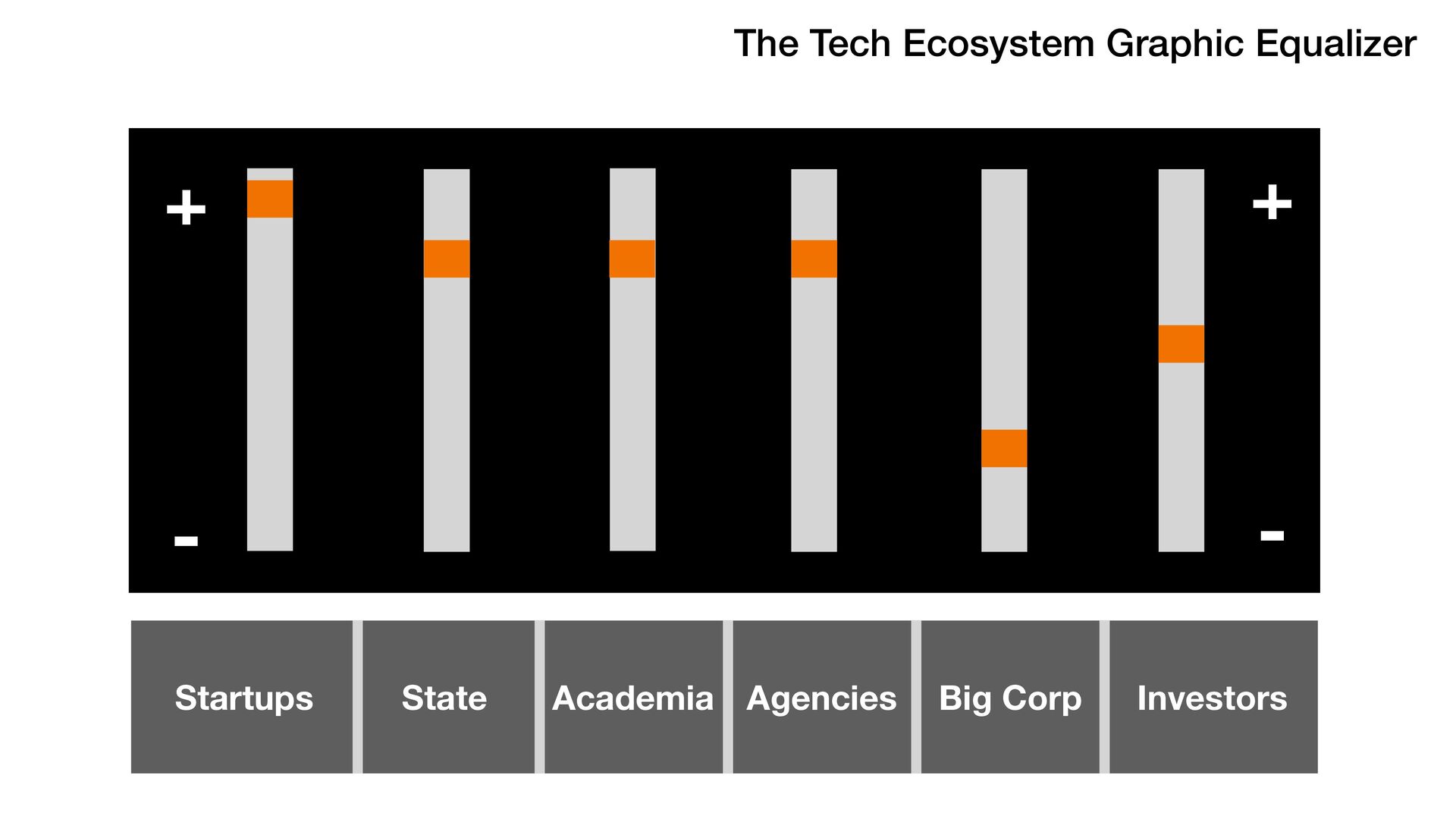
So I hope this makes sense, but graphic equalizer down there. And the idea was you've got these different levers. And if you push them up and down, what's the thing going to sound like? Is it going to be sweet music, or is it going to be a cacophony of nonsense?
So I thought I'd do that. And to put some texture on it yes, I spent four hours making this. I'm so sorry for all the graphic designers or people with taste in general. Sorry about your eyes there. But, yeah. So I was thinking, if I make this and, you know, plus, minus, you can push those sliders in the middle, the orange ones, beautifully colored, up and down.
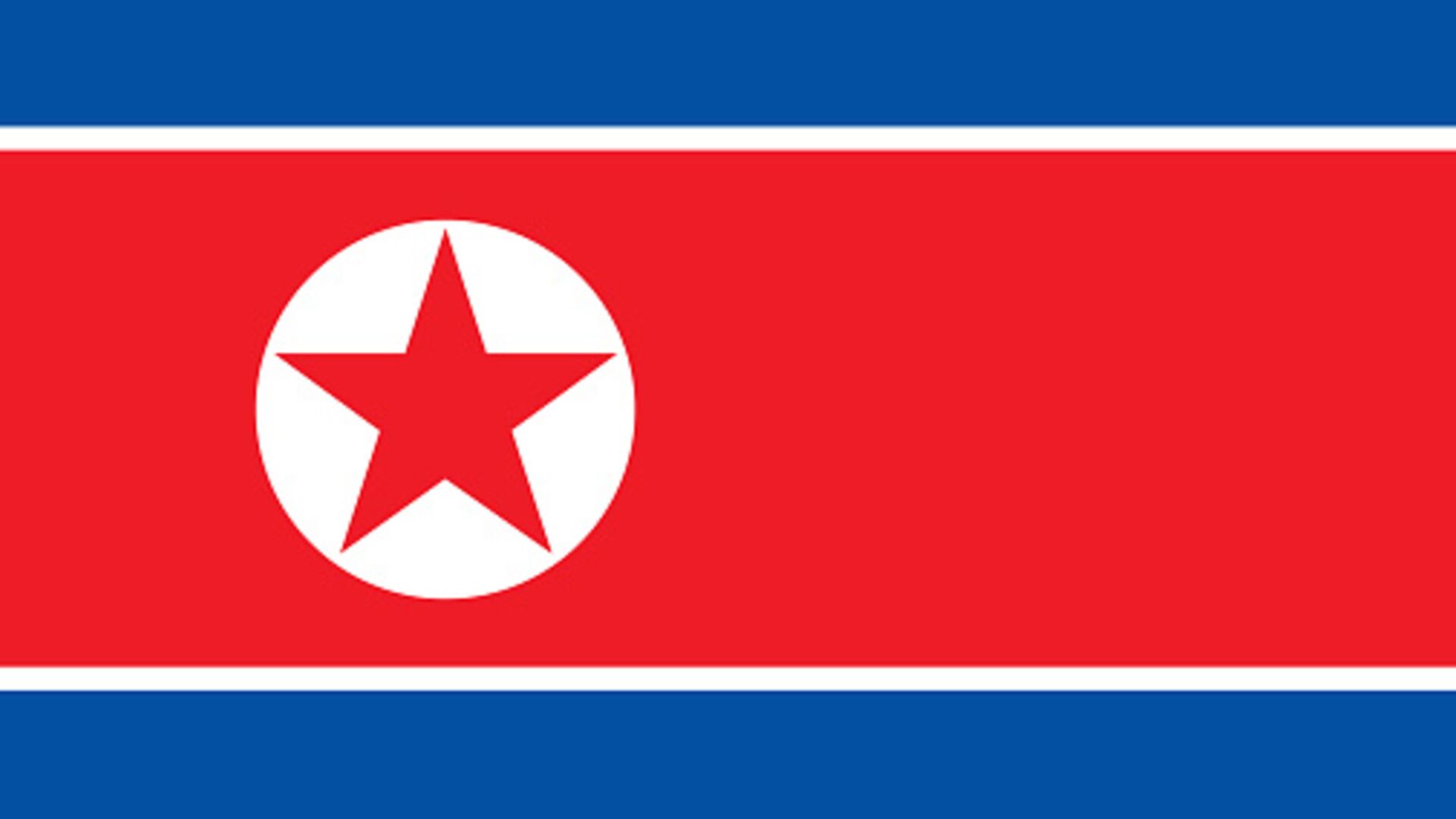
And so what would it look like if we started to push those sliders? So I'm going try and make a game out of this. Anyone imagine what country this would be? So very low start ups, very strong state. Academia, I don't really know.
No agencies, no corporations, no investors. North Korea. Close. Close. Again, this is like anecdotal. This is me just riffing, but I think that's a good way of looking at it. What about this place? This a lot less freestyle riffing. This is actually talking to people who live there.
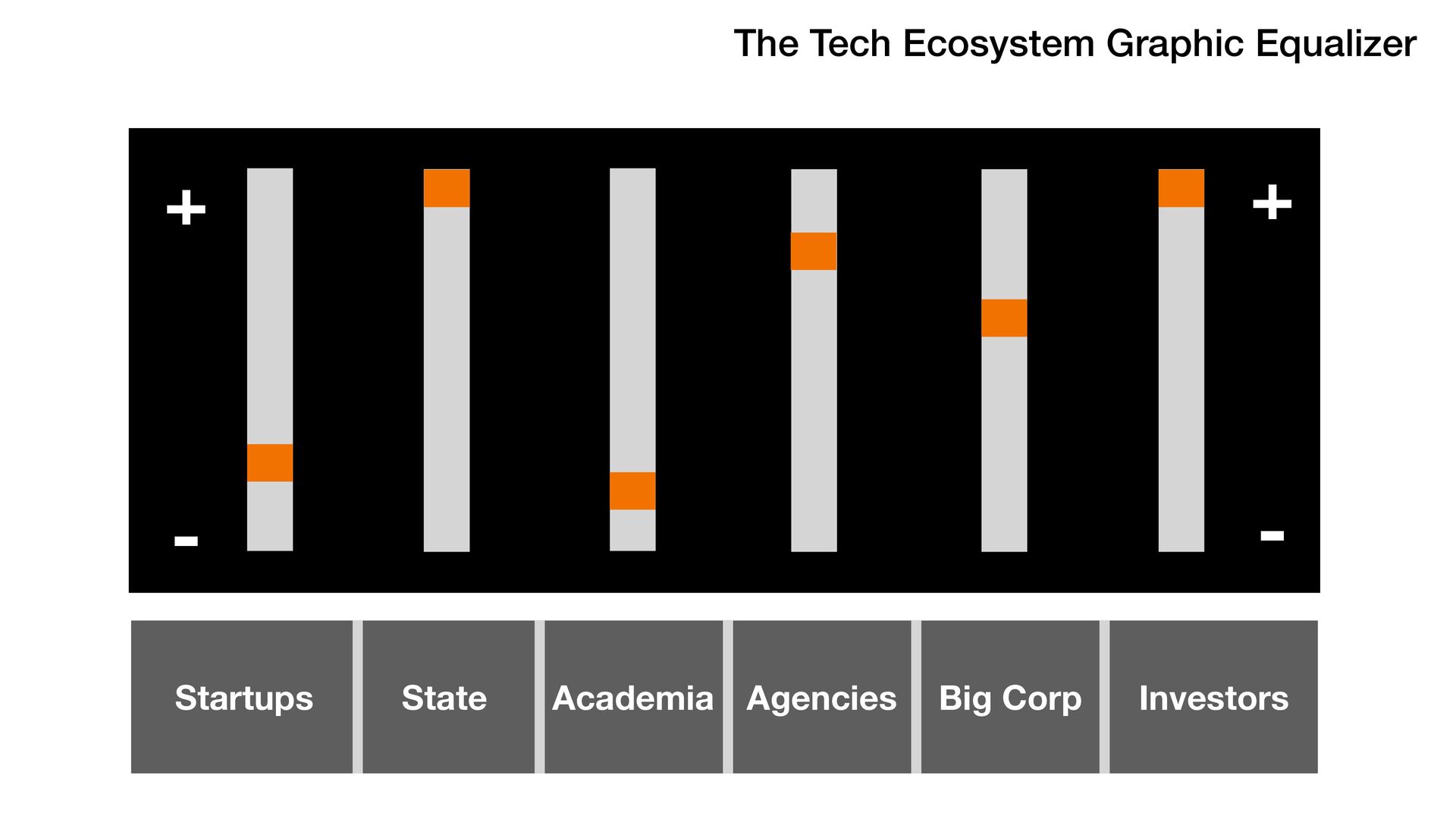
No. There's lots of startups in China. This is Dubai, UEA. Loads of agencies, very few startups. State is really strong. Academia is really low. There's no real universities there. There's partnerships with external universities. Big corps, big but very small presence, really. Tons and tons and tons of investment cash, right?
So hopefully, you can start to see what does an environment look like where there's very sort of little human capital or human talent but tons of money, for example. What could these places look like? What's the music there? What are the songs people saying?
What are the stories they tell each other? What food do they eat? Do they all go and have sushi and quinoa? Or do they you know, are they vegan? Or what's going on in those places? So here's another one. Anyone think what that could be?
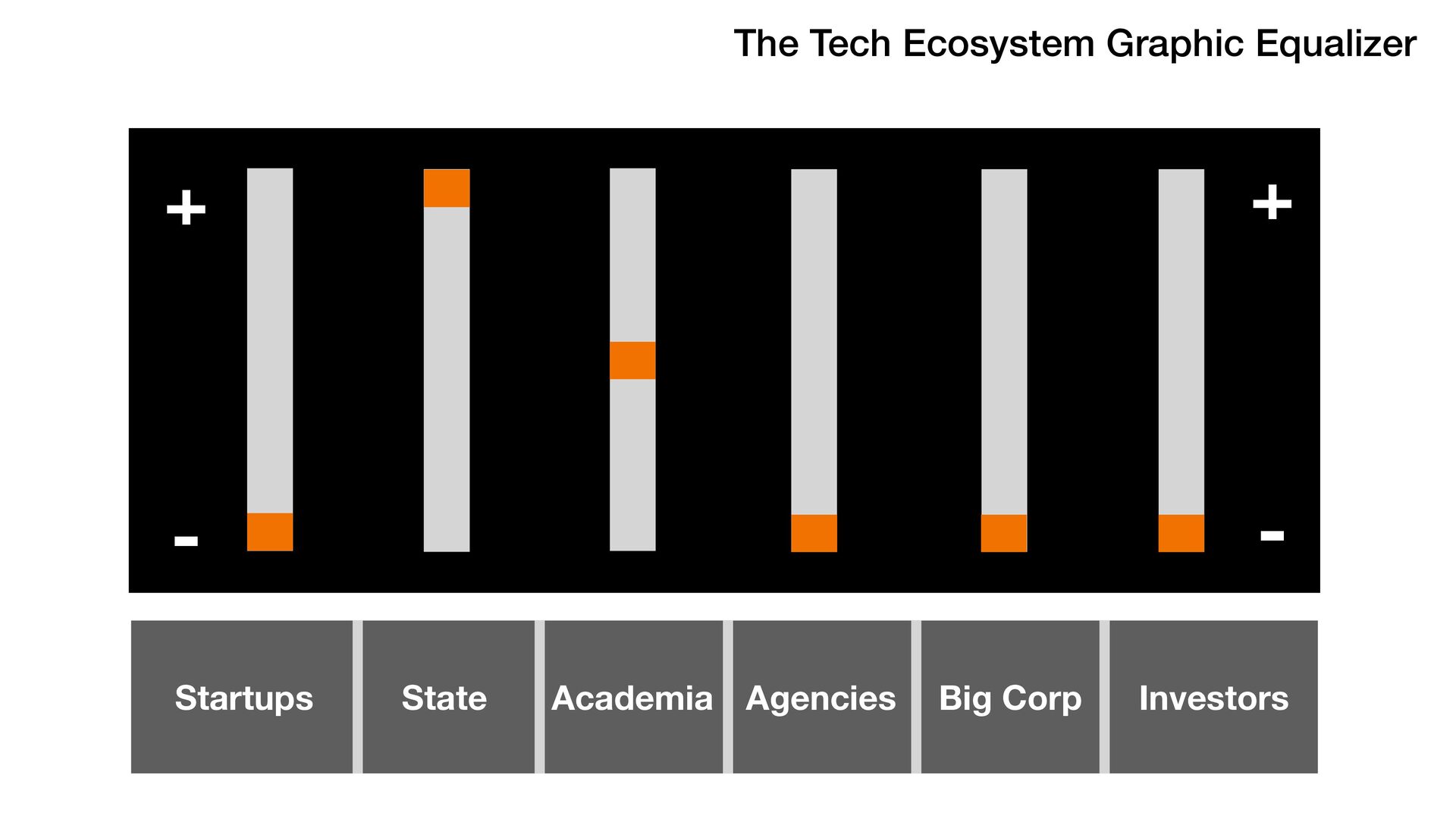
Nice. So super controversial. I can already feel the what? But this is crowdsourced. I'm talking to my five best friends. But look, I would argue start up's pretty low. We could do better. State, pretty strong. SE, grant money, all that kind of stuff that enables lots of stuff.
Academia, super high, high in the sense that they get lots of money, high in the sense that they create loads of superhuman, very, very, very, very good human capital, but also high in the sense that I think universities also think they can help out with start ups.
Agencies, really, really high. Big corp, almost no presence in Scotland. Investors, really low. And this has some consequences. I'll give you a quick anecdote on that. I remember when I had my first failed start up in Scotland, we would go to meetups and stuff, and you would see agencies talking about, oh, we got this microsite for Nike, and we launched it in a Empire State Building in New York, and we got twenty million hits over a week or something.
And we would sit there with our little pie chart that could open and close, and you could add a bit of data on it. And it just looked ridiculous, but it's because the journey of a start up building an MVP thing that grows and grows and grows versus an agency that has to hunt for, like, new clients and build new stuff and go to the next one, etcetera, etcetera, and be much more polished, again, sees the world completely differently.
So this brings me then to the question of what is Techscaler? Why are we doing this? And so trying to show you some thoughts on ecosystems, trying to show that they're fairly complex things. It's not just about understanding the components. It's also about understanding who names stuff, who decides what component is, what are the biases and all that kind of stuff.
Try to show you some examples of what that graphic equalizer thing can do. And now I want to talk about Techscaler. So Copace recently won the tender to be the Techscaler for Scotland. And our big mission now is to explain what the hell Techscaler is.
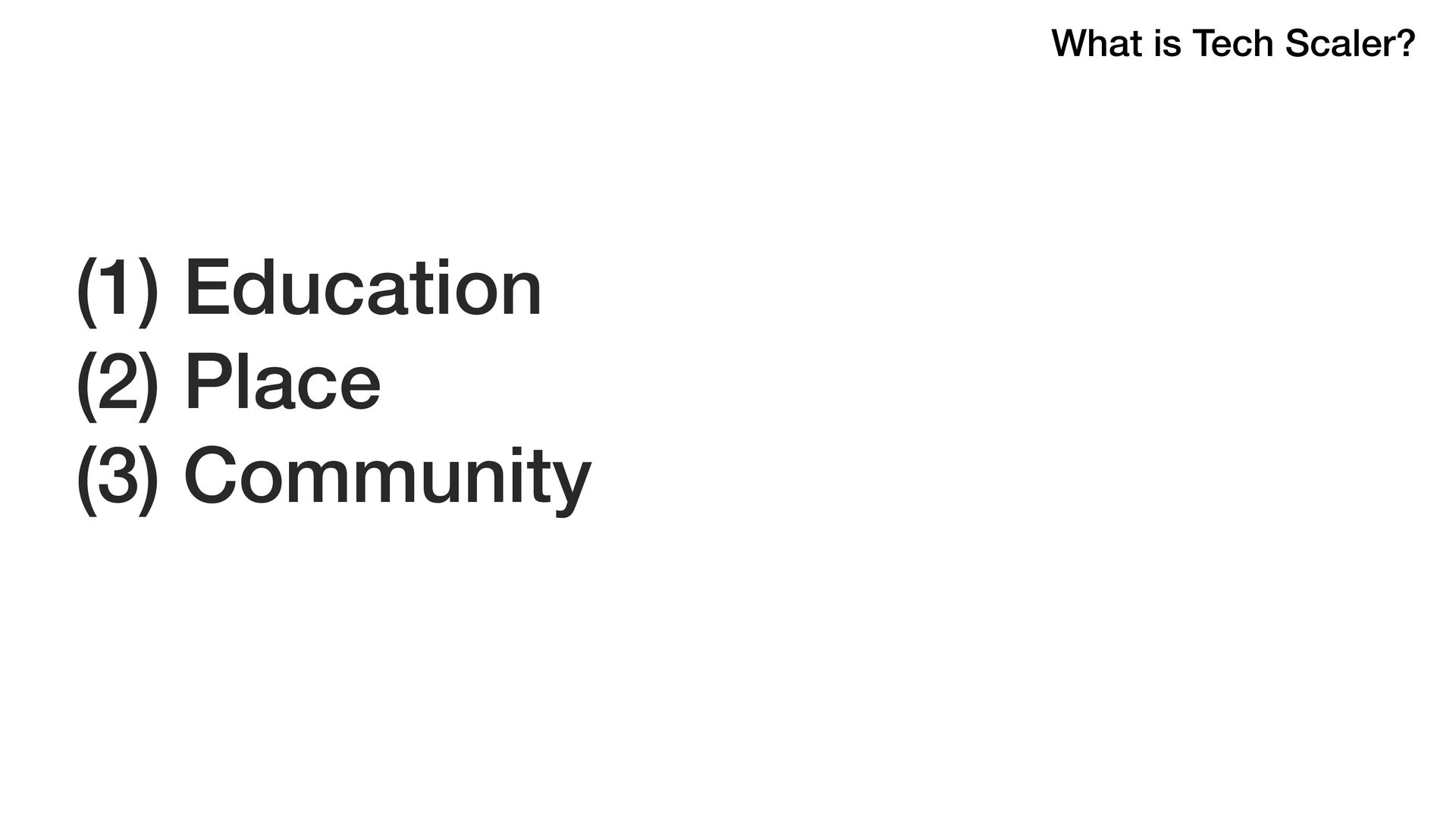
So here we go. Techscaler has three main components. One is education, one is place, and one is community. The community word is a difficult one. Maybe you heard Mark Logan earlier speak about market square. It's it's interesting. Market square is almost the most libertarian word that exists.
It's almost almost the most capitalistic word. Maybe marketplace is more capitalistic. And community is almost the most communitarian word there is. So I'm not quite sure we're going to end on that, but for now, education, place, community. Education is going to be split into basically creating a journey for start ups.
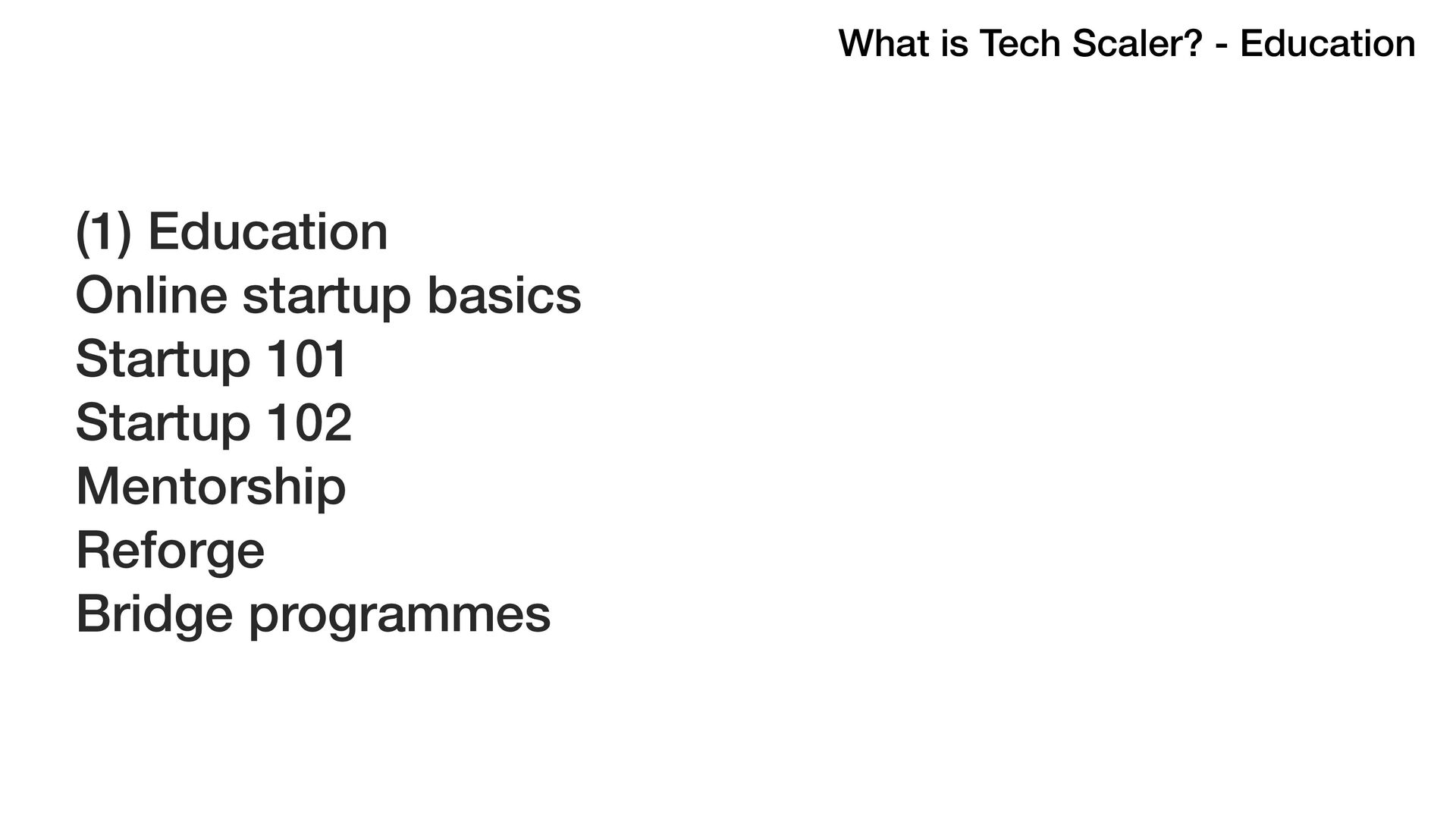
And I hope if there's start ups here in the room, I hope this can generate some excitement for you. There's a bunch of steps that will map out a sort of ongoing journey. And the idea is that when you finish one part of the journey, you have a destination or a place to go next to your next part.
So it'll be online start up basics. Start up one hundred one Online start up basics is anyone who vaguely knows what a start up is, has got an idea and wants to see what that stuff looks like, there'll be a bunch of content for you.
Startup one hundred one is like you've gone through that content and you're committed. You're like, Yes, want try and build something. So we'll show you what that could look like, what that can be. Startup one hundred two is you've built that stuff. You've gone into that.
You want to know what the next steps are. Mentorship is hopefully self explanatory. We've got a pretty, very good, actually, mentor network. Most of the work we've been doing in mentorship has actually been outside of Scotland. Most of it's been through Barclays in England.
But now we have the chance to connect veterans, people who've done stuff locally with start ups, and we're going to really, really push that very far. We're really excited about that because we've got a bunch of people we're already working with. Then there's Reforge. Anyone heard of Reforge?
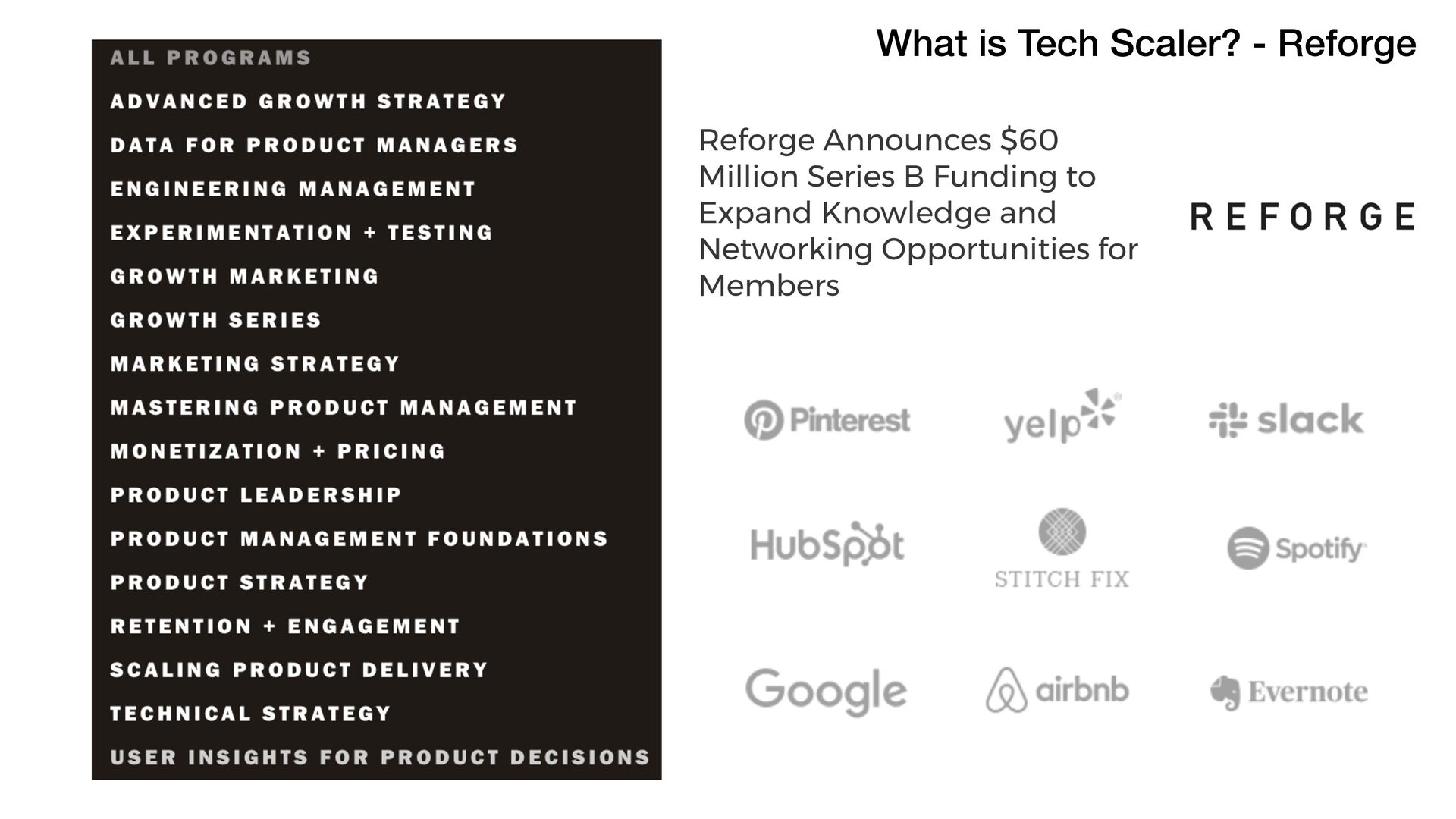
People heard of that? So Reforge is a San Francisco based startup, frankly, an education startup that takes playbooks and best practice. It's basically a bunch of people who used to be in Twitch, Slack, Uber and HubSpot specifically. And they're basically they've got playbooks and community around what the next steps are.
So they'll show people if you've got the vicinity of product market fit, we'll show you how to scale, where to go next. And frankly, we just think that locally, we don't have anyone or very, very few people have got that experience, and Reforged do.
So we're super excited about that. And basically, a chunk of people ask where the money is going to go for Techscaler. A bunch of it is going to go in that direction. And finally, have bridge programs, which are going to be specific to different industries, and we're going to connect incumbent industry players with start ups who are trying to build stuff in that vertical.
So that's what the education piece looks like. Here's just some deeper dive stuff on Reforged just to give you some sort of social proof on who they are. So those are the lists of the different programs they have. These are the people they work with.
And they just raised another sixty million dollars from Andreess Norwood. So the idea is that you'll have that kind of learning, but you'll also be connected to a cohort of people who have received proper VC. So yes, we're super excited about that. Okay. The other part, second part is place.
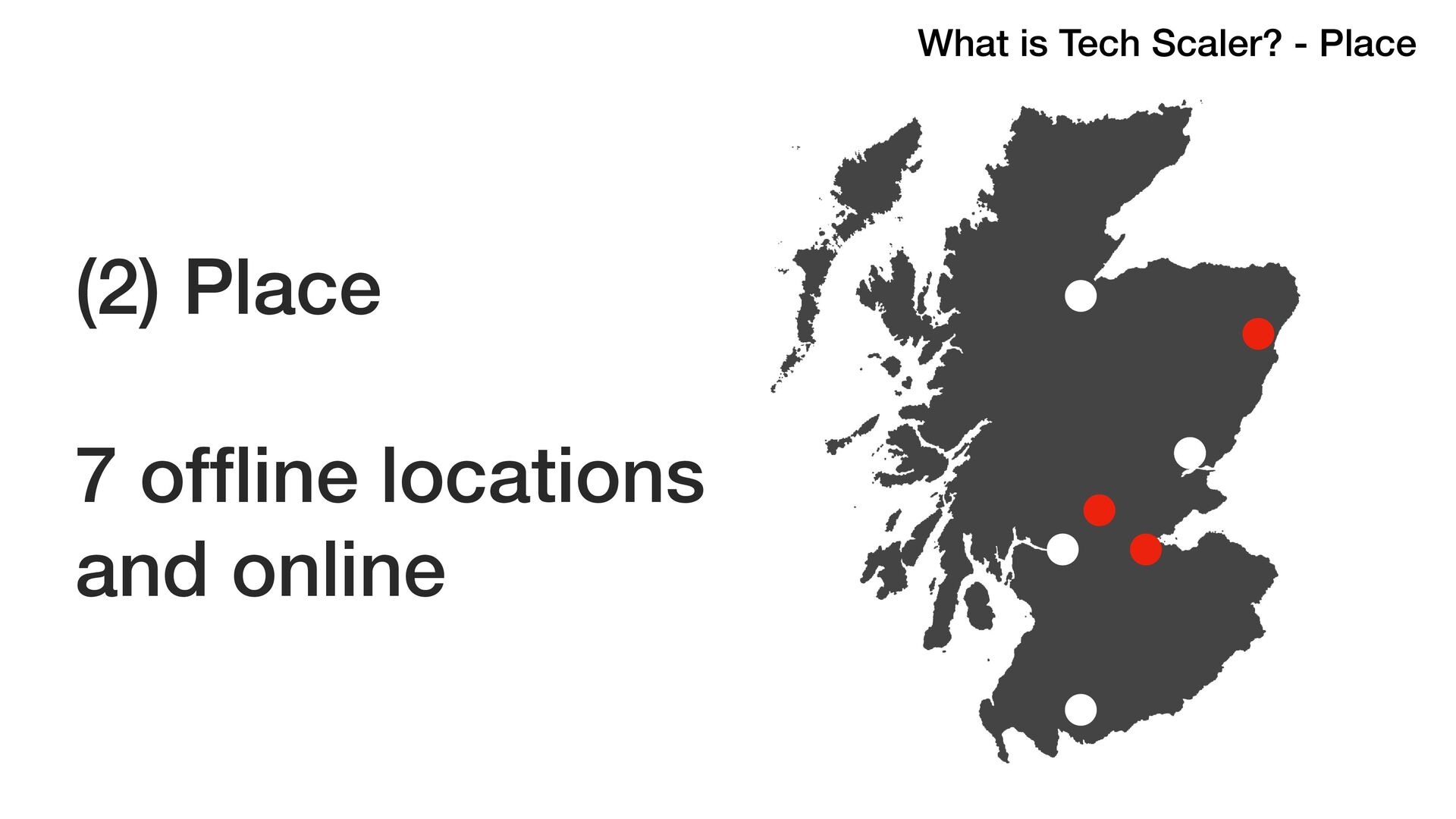
So we're currently in Edinburgh, Stirling and Aberdeen, the red dots, and we're going to add Inverness, Dundee, Glasgow, which we're really excited about, and Dumfries and Galloway in the borders. So there'll be more space throughout Scotland. And again, we are hopeful that the network effects of connecting all these different parts together will build something that's greater than some of its parts.
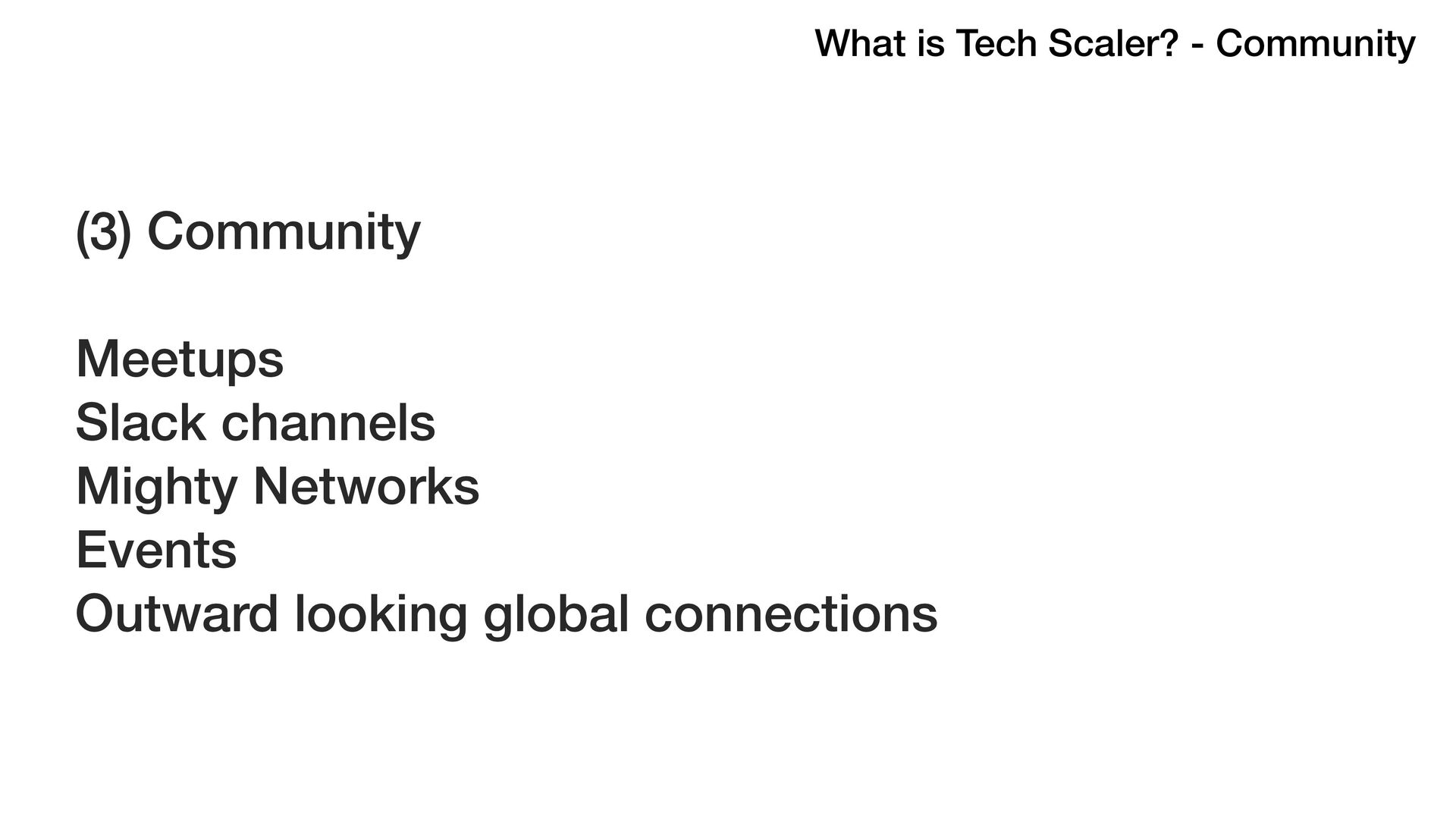
The next part then is community or marketplace, where we're going do a bunch of meetups but also in person stuff, but also have a bunch of stuff that's going to be online. So we'll have Slack channels, micro networks, events. And again, I'm really happy that everyone's here today because Brian does such a great job with touring, and events are really important.
So I hope we can grow that and do more. And finally, we want to do a bunch of outward looking stuff. So we don't want this to be an introspective Scotland whatever thing. We want it to be super connected to the rest of the world.
We want to connect start ups. We want to connect investors. We want to connect best practice playbooks. We want do all that kind of stuff and have one eye to be on Scotland on that. That could be as close as England and as far away as China or the States or whatever.
So those are the kind of things we're talking about with community. So again, education, number one. Number two is place and number three is community. That's what we're trying to do with Techscaler. It's a five year gig. We're very hopeful and certain, frankly, that Techscaler in year three will be different than year one and year five will be different than year three.
So we'll have to iterate. We'll have to build something really cool. And it's a huge challenge. It's not going be easy. And we're going get stuff wrong and all that. But we come to you with a super cool will, a goodwill, a bunch of momentum.
We want to partner with people as much as possible. Think of us as a kind of layer of a kind of operating system. We want a bunch of apps on top of it that we can do stuff together. But those are the three kind of core bits we're looking at.
If you have more questions or any questions, frankly, on Techscaler, I'm going to do a podcast at four forty five, I think. So if you've got any questions in the live lounge area, I'll be there with my dear, dear friend, Mark Farooja, who's wearing a white shirt today.
He normally only wears black jumpers. It's a joke just for me. But we'll be there. And you've got any questions at all, just please come. Challenges, questions, sort of anything at all, and we'll try and clear up and try and inform you what that stuff looks like.
Okay. So back to the key metaphor. What we're trying to do is we're trying to I hope you can kind of remember what it first looked like. I don't want to slip back. But the start ups bit was kind of here. And essentially, we just want to push that up.
And the nice thing about this metaphor, hopefully, is that we can then say, what we're trying to do, if you think of it in a music way, we're trying to say, hey, we want to create more cool bands that can write brilliant music.
So we'll give you sort of rehearsal room. We'll teach you how to sing and play guitar and keyboards and all the other stuff. And we'll connect you to promoters, and we'll help you go on tour, and we'll help you sing better and all that kind of stuff.
That's what we're really trying to do as Techscaler, just push that lever up for start ups. Although the lever is super cool, happy to help them, too, but we're really here to stand up and be the voice of start ups and push that because in my mind, that's the tech ecosystem that's the most promising one.
It's the one that's led by start ups and led by founders, led by companies that are growing things, not so much by advice or by big corporations or investors, etcetera, etcetera. It's actually people going out there and building new stuff. That's the bit that excites us, and that's what we're trying to sort of bring together.
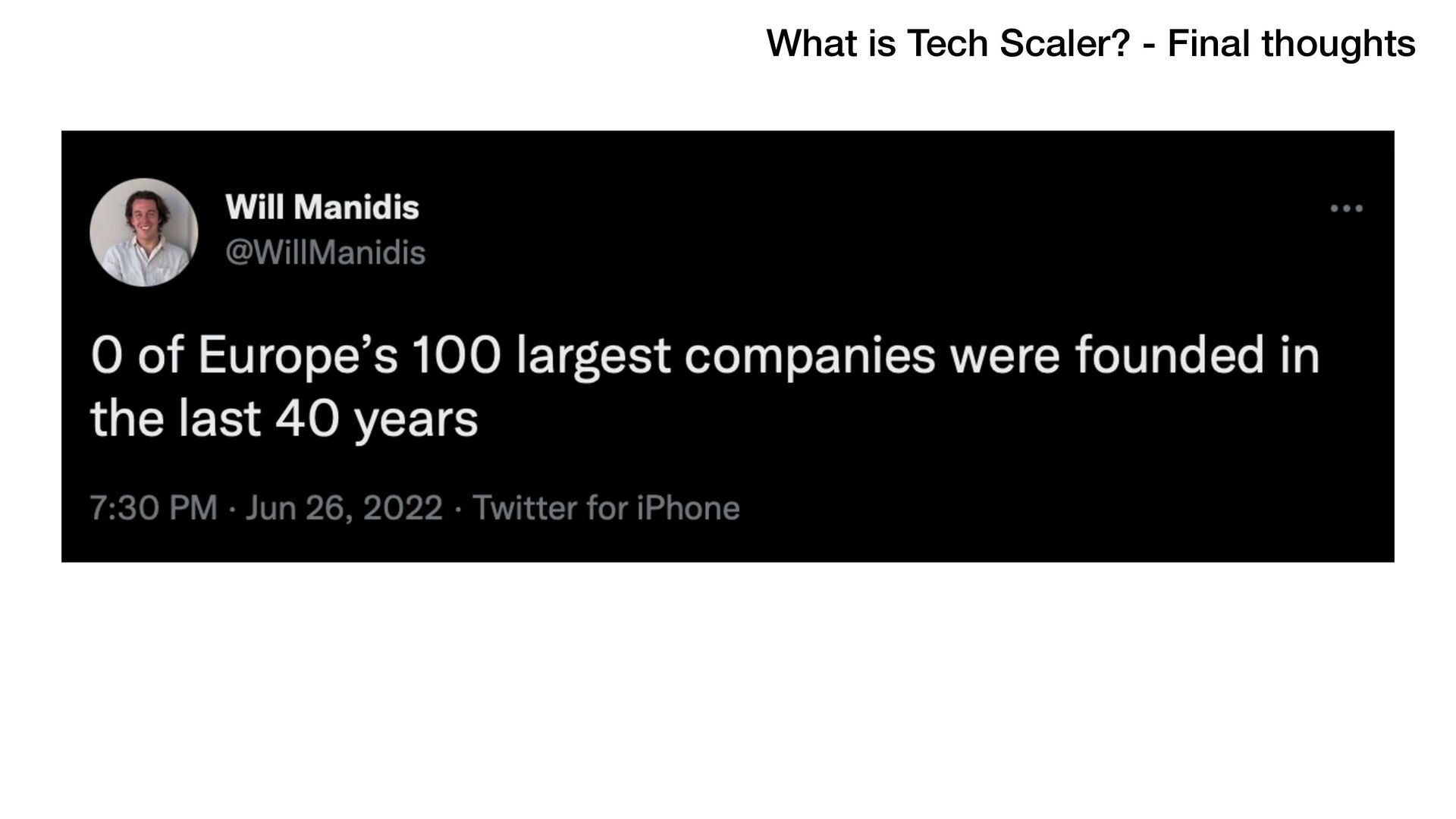
Cool. So third and final part of what I want to talk about. This is true, okay? This is true. I've looked it up. The last company that got into any sort of big numbers is the holding firm, so basically Zara, the fashion brand founded in nineteen seventy five, I think.
So we're just not growing stuff. We're just not. And we're living in a continent that's kind of living off of stuff that was built in the past a long time ago. And we're sort of becoming employees of those things. And then those things are not growing.
They're just not growing. They're also dividend stock companies. And the challenge is, can we, in this continent, build new stuff? Can we just actually build new stuff? And ideologically, you could say that the US is building tons of stuff. China is building tons of stuff.
It's both and even China. It's a kind of hypercapitalist way. So I think the challenge for us is, can we take hypercapitalist libertarian playbooks about how to grow things and how to move things and break things and all that kind of stuff and go fast and see some kind of risk that's not just looking at staid stuff?
Can we do that in a way that's still fair and still looks at diversity and looks at disability and looks at different people having opportunities to do cool stuff? I think that's what we're trying to do, and that's the kind of vision, at least for me, that I have over Europe.
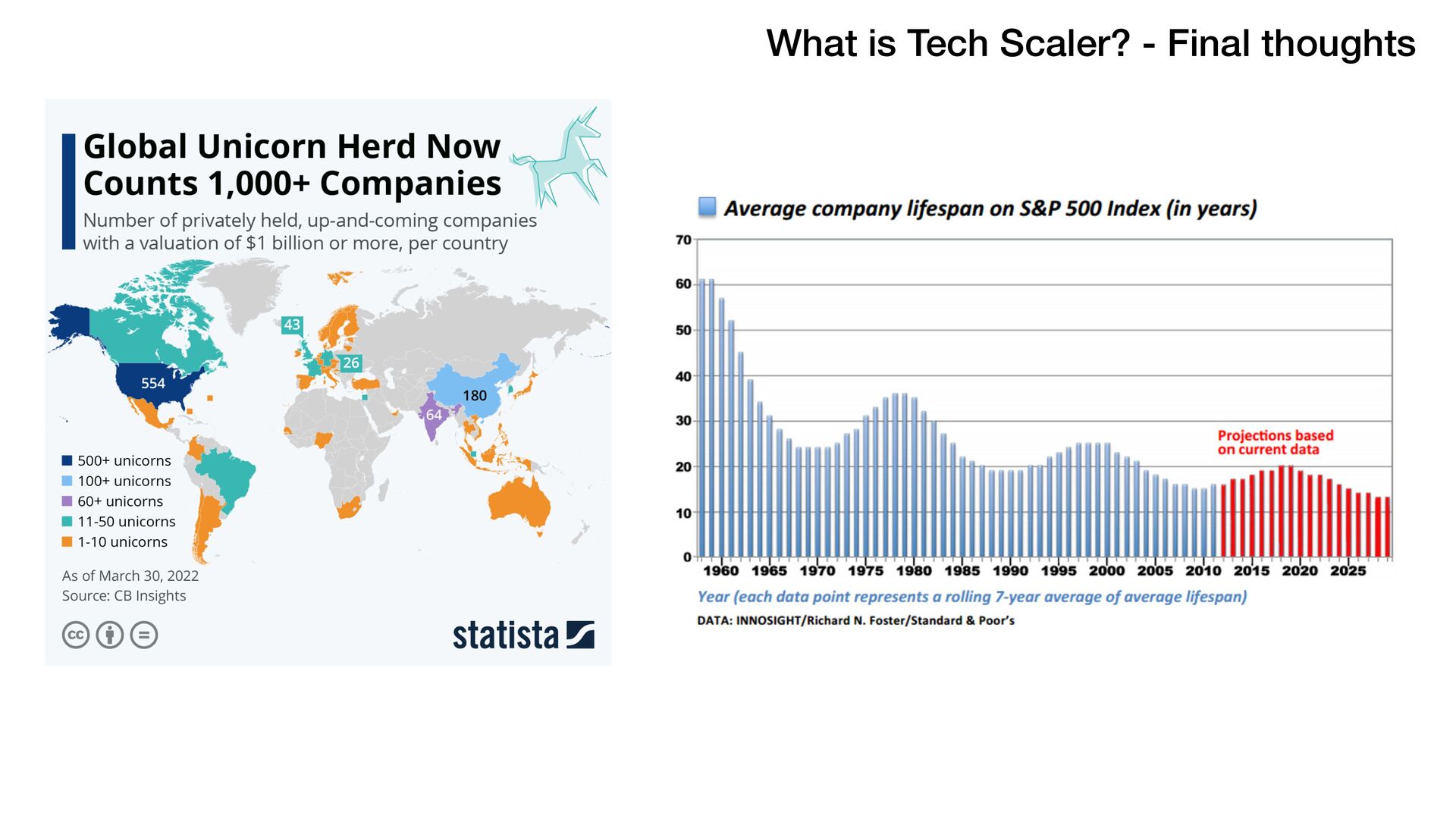
We can't be this kind of continent that's built a bunch of stuff a long time ago, and we're just sitting on it because these things aren't growing. Look at this graph here, the one on the right. I love that graph because it's always easy to remember for me.
So in the 1960s, the average lifespan of an S and P five hundred company was sixty years. On twenty twenty two, we're now at seventeen years. So the big memory thing was twenty twenty is twenty years, nineteen sixty, sixty years, but that's actually going down even more.
So we're just we're in a space where we're not growing enough stuff, and the existing stuff that was safe as houses and all that kind of stuff is actually on the downswing. So as a society, as a group of people, you know, we have to normalize that building stuff is cool.
I'm sorry to get sort of political on that, but I think it's just worthwhile to take all the recent wins on equality and fairness and all that cool stuff that ecosystems in twenty twenty try to sort of outline, give a kind of European flavor to that and see if we can grow things.
That's why I'm doing this. That's why I'm in it for. And if we look at how many unicorns and unicorns, just as a proxy, so there's other ways to build companies, we're just totally underperforming. And the U. K. Numbers are also like they're not real, but we're we're underperforming.
So so the idea, and Mark spoke about it earlier, is to try and instill some kind of optimism, some kind of hope that we can do this. There's lots and lots and lots of really clever people here. Just don't have the next steps playbooks.
We just don't have those next stories to tell. And we're trying to give people a platform to grow together, to build this stuff, to have access to people who can tell in the next five kung fu moves in a way that we're not trying to just people who are, like, three thousand steps ahead of you or three hundred, but maybe thirty or three, and that can help companies grow and prosper in a way that's befitting how we understand how a good life should be in twenty twenty.
It's not about crushing people or destroying them. It's about understanding that this contextual thing, it's coexistence or noexistence, right? The sustainability angles, there's all these different parts. They're super, super important to what we're trying to do. So in a nutshell, TechScale is trying to take that message to Scotland, trying to enable a bunch of people to do that by partnering, by offering those three different things: education, place and market square or community.
That's what we're trying to do. And please accept this as a big invitation to everyone to be part of that and to help us do that. Thanks very much.