
Companies that focus on user experience from the very beginning and put it at the centre of what they do build better businesses more efficiently. A lot of business advice focuses on business model, marketing, sales, etc, but not nearly enough focuses on user experience and its impact on KPIs and business efficiency - this talk does.
← All talks 

Lead Strategy Turing Fest 2017
Why Focusing on UX Makes Business Sense
Auto-generated transcript - may contain errors. Tap a timestamp to jump the video.
There you go. I'm gonna talk about user experience, which is something that if you work in product and product design, you probably hear a lot about. But if you work on the business side or you're in venture, you unfortunately don't hear too much about it.
And I think that's a shame because I know a lot of VCs that only think about it too much. I also know a lot of founders that don't think about user experience too much. And it's a shame because I think focusing on user experience is one of the best ways to achieve amazing KPIs and reach your business goals.
So we're gonna talk a little bit about that. But first, a little bit of background on me. So I'm a VC. I'm American. I'm thirty seven. I've been a VC now for about a dozen years. I was previously with another venture fund, and then five years ago, along with two partners, I started Connect Ventures.
We are a London based seed fund. We invest across Europe. We write checks of about five hundred k to a million pounds. We've made thirty six investments so far, twenty five of which are still active. We've couple of funds, the latest fund which we started investing out of last year is about fifty million pounds, and those are some of the companies that we've invested in.
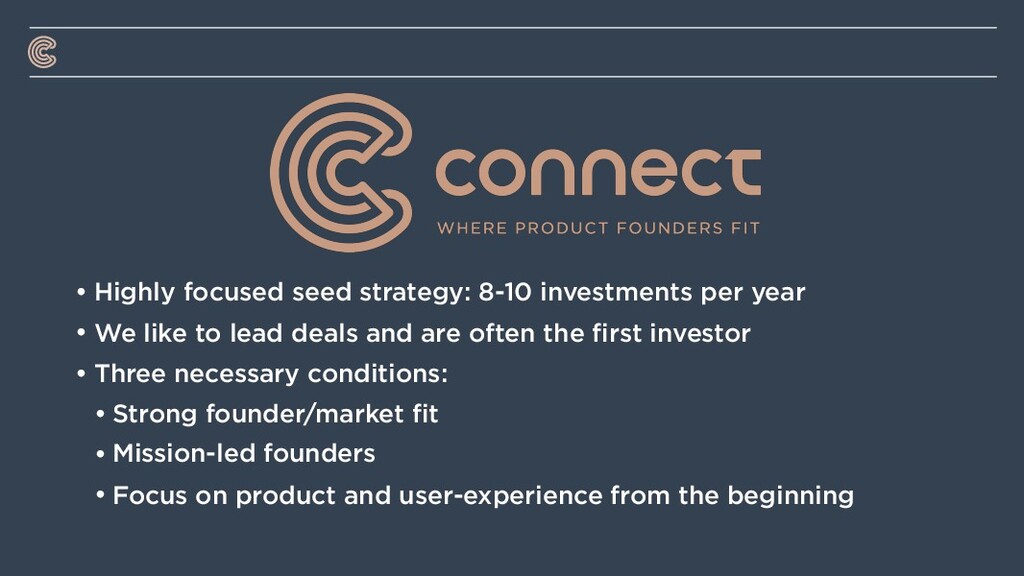
So the connect strategy. We're pretty focused. We make about eight to ten investments a year, and we like to lead seed deals, and we're often the first investor, sometimes we're the only investor. There's three things we look for before we even consider an investment.
One is really strong founder market fit. So does a founder really understand the market that they're building the company and product in? Mission led founders, so founders who are looking to do something more than just get rich. They're trying to solve a problem that they have, or something they want to see exist in the world.
And then a really strong focus on product and user experience from the beginning. The first two, I think a lot of VCs look for. The third is one that sets apart a little bit. So we look for that in the beginning, and I'm going to explain to you why that is.
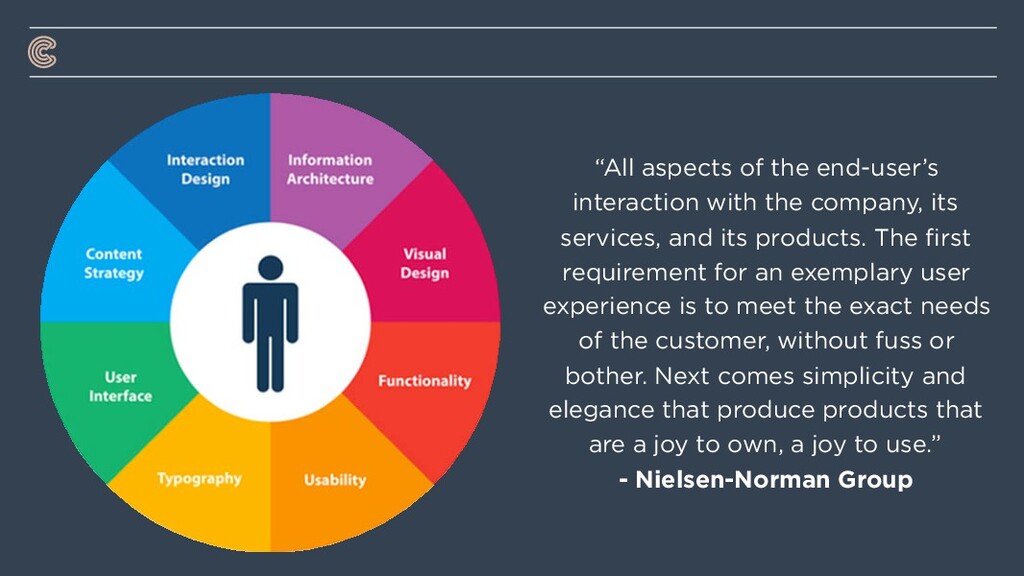
But before we do that, I think it helps to talk a little bit about user experience itself and what it is. I think this quote covers it pretty well. So user experience is pretty comprehensive, right? It's the company, the service, the product that a user interacts with.
Another way of looking at it is a company that is focused on user experience puts the user at the center of everything they do. So when they design their feature set, when they design their user interface, when they think about their customer service experience and their marketing, they're really thinking about the user first and how the user is going to experience that.
That may seem really, really obvious, but I think you can probably think about a product interaction you've had recently, possibly even today, that was just ******* terrible. And you probably use a product and you just thought, I'm pretty sure no human being actually used this before they launched it.
That happens way too often, and I think it's because a lot of times you prioritize a lot of things above user experience. But this is pretty comprehensive, and it's a bit overwhelming. And we don't really expect teams that we back, and a lot of teams we back are just founders initially.
We don't expect them to have all of this under their belt and to be focusing on all of it. By definition, they wouldn't be focusing if they did. What we really look for is for them to focus the product user experience. So we look for people who put that at the core of what they do initially.
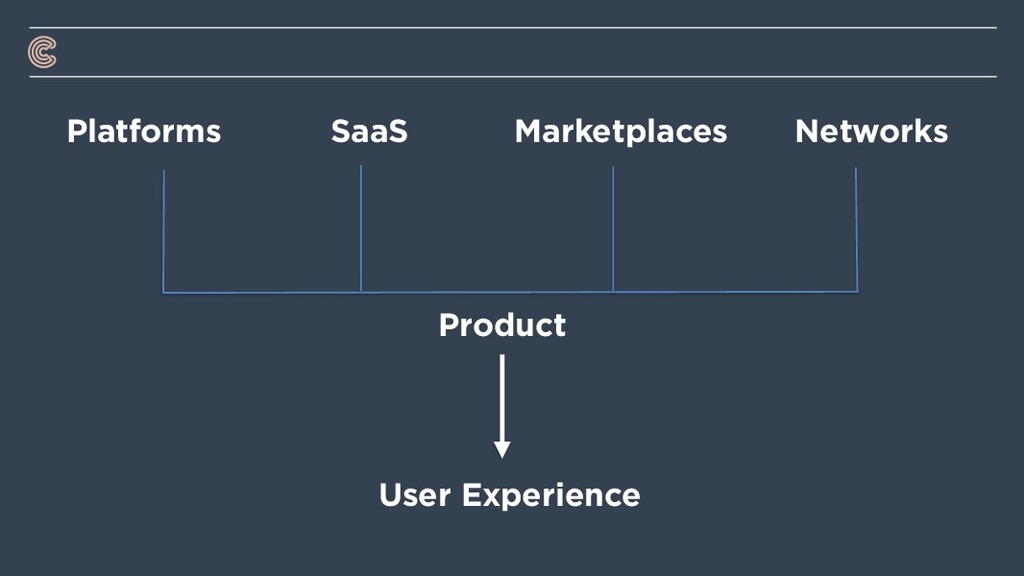
Now, why do we focus on that? Because and I'll talk about some of the companies we've backed in a little bit, but no matter what you're building in tech, whether it's an API platform, whether it's a b to b SaaS company, a marketplace, some kind of networked business, you have a product.
And that product has a user experience. And the product is going to be the first, probably, and the primary interaction point your users have with your company. And we think that the better that user experience is, the better the KPIs of the business would be.
I'm gonna talk a little bit more about that in a bit. But first, we're a seed stage fund. Right? So why do we talk about user experience at this seed stage? There's a few different reasons. But, you know, a lot of times when VCs talk about what they look for, they talk about market size, the business model, network effects.
It's not that we don't care about those things. We actually care about all of those things. We just think, if you're in a great market and you have a great business model, but you have a terrible product, you're just making it really, really hard for yourself.
So instead, we look for companies that are in great markets and have great business models, but also have great products that they're building. Then there's also a personal reason, which is I really really don't wanna help people build more terrible products. There's a lot of them out there. I really hate them.
I don't enjoy interacting with them. I don't know anyone who does. I don't really want to inflict more of them on the world. And I think, you know, if I have a legacy, it'll be like I never funded a ****** product. That'll be on my tombstone.
So on a personal note, I just it's what I want to do. But it's about much more than that. Right? It's about DNA. Companies have a DNA, and it's set very, very early. The culture of a company, what it cares about, how it thinks about the customer, how it thinks about product design, who's, you know, the most important group in the company.
Is it marketing? Is it sales? Is it product and engineering? All of that is set very early by what the founders care about, who they hire, what skills they look for, whether they look for people that are empathetic to users. That's all set really early.
And what we found is changing DNA in companies is like changing DNA in people. It's extremely difficult. So if you don't care about users initially, you're probably not gonna care about them two or three years down the line. So these are some of our companies that we've backed.
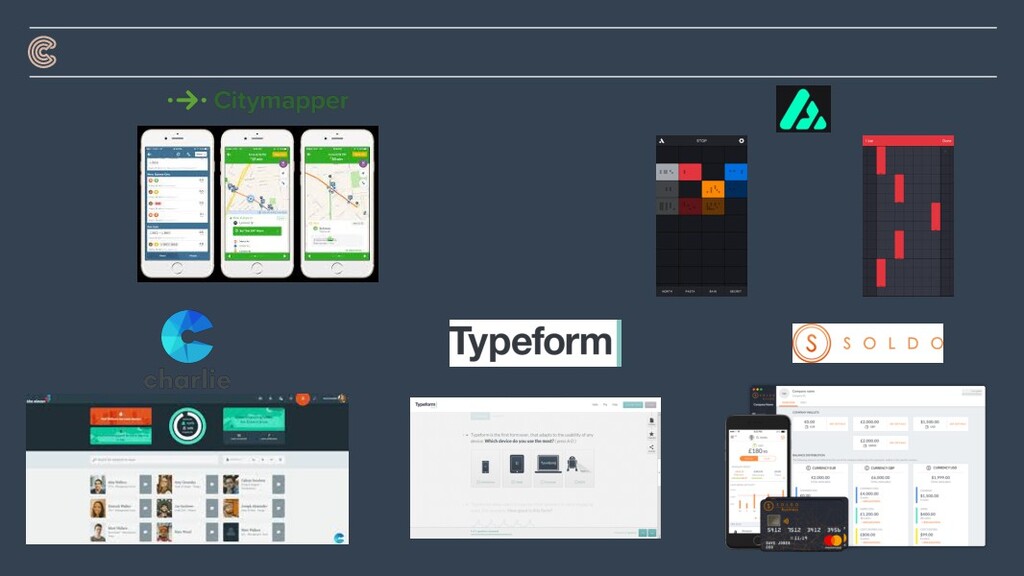
They're in a variety of spaces. Some are more well known than others, some are more recent than others. So CityMapper is one that's pretty well known at this point. We invested them in twenty twelve. It's a transport planning app, helps you get from A to B.
Seems pretty obvious now, but when we invest in them, the biggest feedback we got from people when we told them about the investment was, but Google Maps exist, so why would you ever need anything else? I think that's pretty typical of people that don't understand user experience actually, that you're solving a specific problem that a general mapping solution wouldn't.
Oxy is a music sequencing app. Charlie HR, which I was here at NextGen last night and a few of you guys were mentioning that you used it, is an HR software. Typeform does forms and surveys, and Soldo is an integrated card and expense management software for small and medium sized companies.
These are all completely different markets. Right? Some are B2B, some are consumer, Soldo is both. They have different business models. Soldo is a combination, it's fintech, so it's a combination of the transactions as well as subscription. Charlie and Typeform are both subscriptions. Oxy has in app purchases.
CityMapper's gonna run a bus, which is probably the most unusual business model we've ever backed. They're all really different. What they have in common is they're extremely focused on user experience. If you've ever used these products, you know that they stand apart based on how easy they are to use, the usability, how much they think about the users in everything that they do.
And so I'm gonna talk a little bit more about why focusing on that user experience makes business sense. I think you can all understand why it's nice. Right? As a user, as a customer, as someone who uses software products, it's nice to have products that think about you, that are elegant to use, but you guys are backing companies and you guys are building companies.
And so why should you care about user experience? Right? How does it help you actually achieve built your goal, which is I think for most people, building a successful company. So I'm gonna do a little bit of a case study on Typeform, which is the company that I talked about a little bit, which is a foreman survey company.
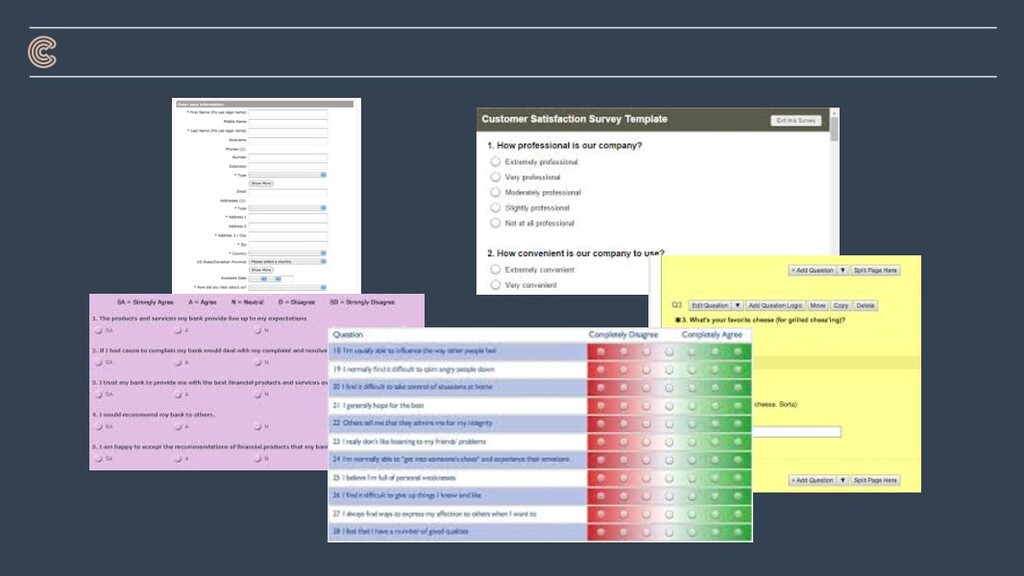
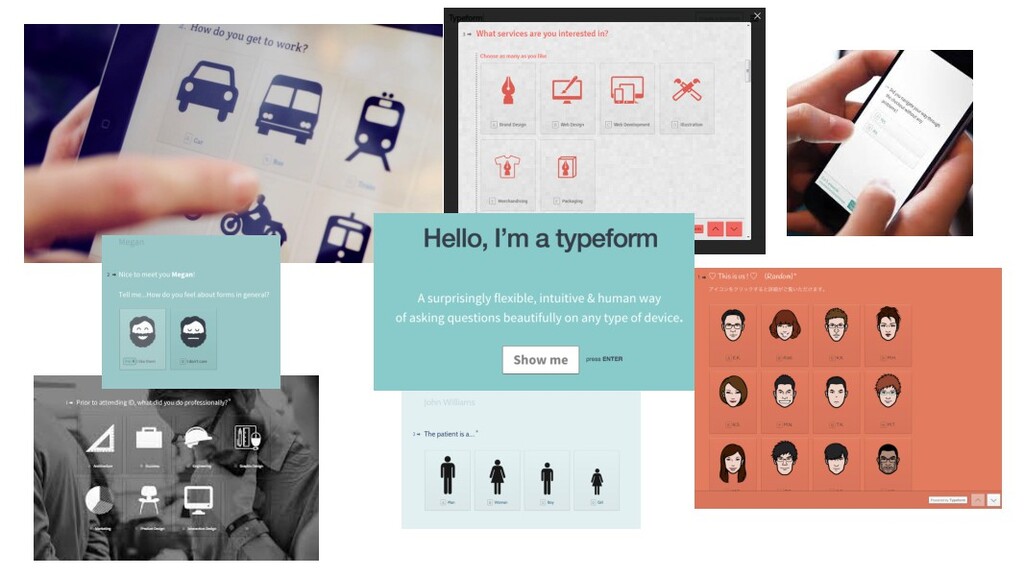
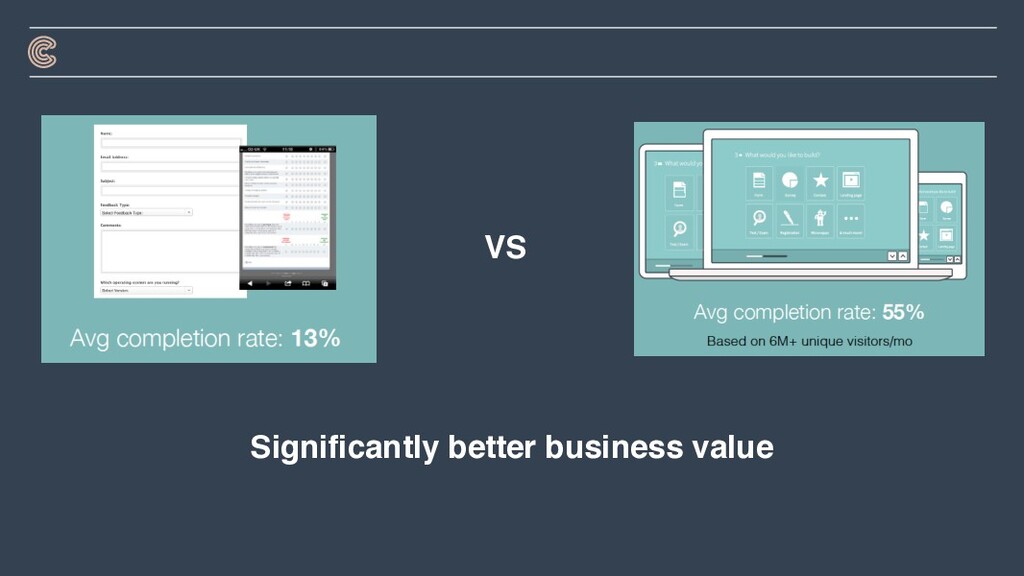
It's based in Barcelona. These are not Typeforms. These are horrific. These are forms and surveys that existed, still exist now. This is what Typeform is trying to end. They are not mobile friendly. They're not particularly attractive either. And they're not particularly usable. These are typeforms. They are everything these are not.
They're highly visual. They're mobile. They're engaging. They do exactly the same thing. Right? These two companies are doing the exact same thing. They're asking questions. The difference is, I think, the Typeform founders, David and Robert, realized that human beings are going to be answering the questions, so you should possibly treat them with a little bit of respect.
I am not sure what these people thought when they were designing these, but I don't think they were thinking about actual humans answering the questions. So that's nice, but what effect does it have on the business? Typeforms have four times the completion rate of other forms and surveys.
So if you're sending out a survey, and you send it out with Typeform, you send out a hundred, you will get about on average fifty five responses. If you send it out with one of these guys, you'll get, you know, twelve or fifteen if you're lucky.
So that's great. It's great for the users. It means, you know, when you send out a form or survey, what you really want is the information back. So you're gonna get four times as much, or put another way, you need a quarter as many sent out in order to get the same amount of data.
So that's really great for customers, but it's also really great for Typeform. Because for every eighty nine Typeform sent out, a new user signs up. So if you were at Andy Jung's talk earlier, you heard about, you know, product growth. Eighty percent of Typeform's users come from interacting via Typeform.
So if you think about so the first business KPI, customer acquisition cost, which is one of the most critical. Right? If you're gonna grow a company, you need users. Eighty percent of Typeform's users come from the product. They come from the product because people like using the product.
They send out lots of surveys. You answer a survey, eighty ninth person signs up, you send out more surveys, and it just goes on and on and on and on. They have tens of thousands of paying customers. They have hundreds of thousands of users.
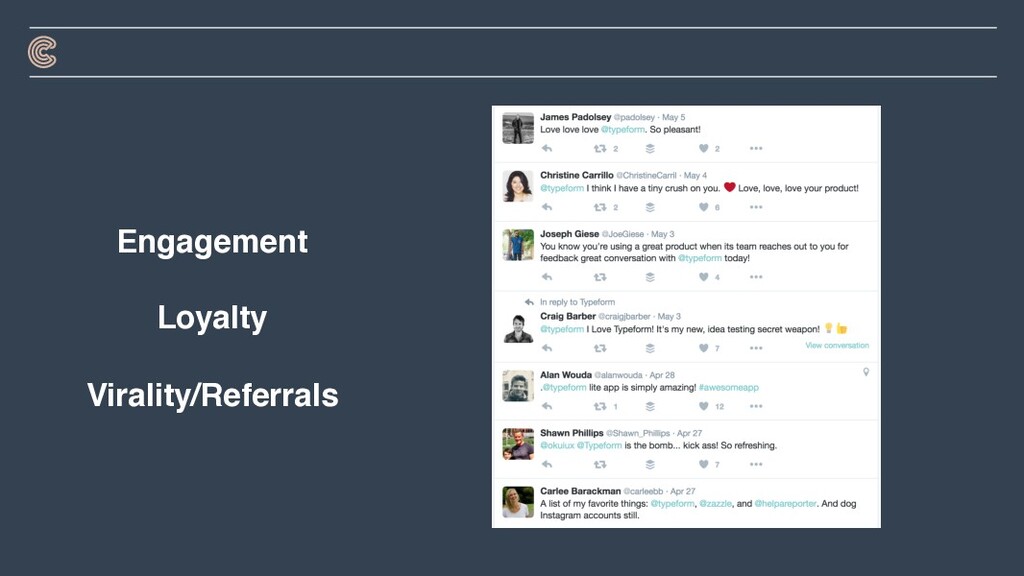
And they've acquired almost all of them through a similar process to the way Andy built his first company, which is he just said they sent it out to a few people, and it grew from there. Some other KPIs. Right? Engagement, loyalty, and referrals.
This is what, Typeform calls their Twitter wall of love. People tweet about Typeform. It is a survey and form company, and people are actually taking time out of their day to tweet about it. This woman on the bottom likes it as much as she likes dog Instagram accounts.
People really like this thing. And you think about it, and you're like, you think about the things you're willing to actually take time out your day and tell other people about. And these guys are willing to do it for a piece of software.
When you really, really focus on user experience, especially when you really stand out from the other experiences that are out there, you have this really positive effect. Right? Virality is just another word for people like using my software, and they're gonna tell other people about it.
You can you you can add fuel to the fire, and you can make it easier for people to tell about it, but you can't make people tell other people about something they hate. Oh, actually, you can. And they'll tell them you hate it, And then they'll never use your product.
So what you want them to do is say, I love this product, and I'm gonna tell other people about it because it's so good. People tweet like every single day about a form and survey company simply because it's just a really great experience.
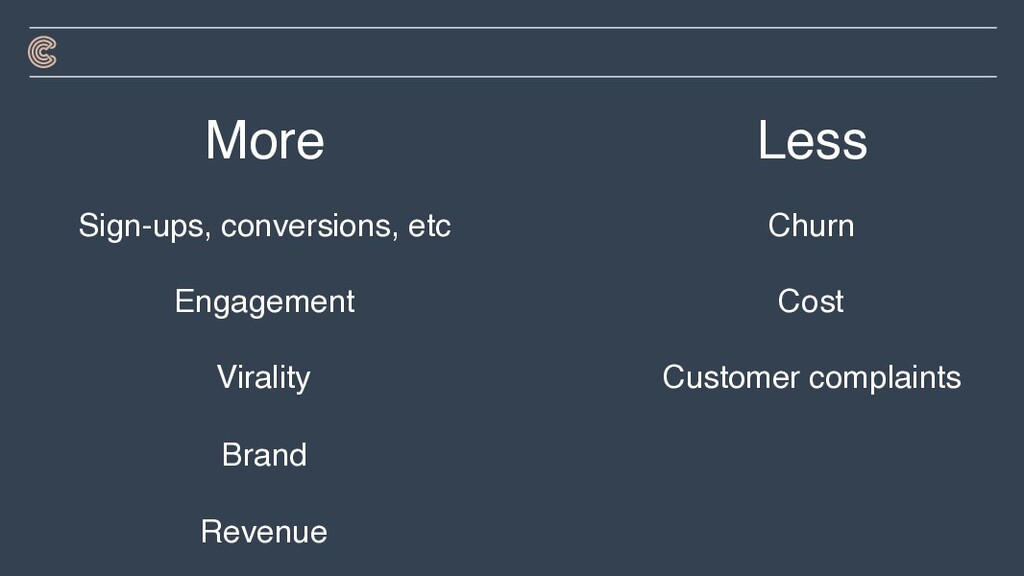
And in the end, what Typeform gets is more of everything a company wants and less of everything it doesn't. Right? What they get is more sign ups and conversions. They get a higher engagement rate from their users. They get great virality. They have an incredible brand.
They and all of it feeds into the ultimate kind of metric which they have, which is revenue. Right? They have lots and lots of revenue, and it just grows month on month on month. And all this means they have less of all the other stuff.
Right? They have less churn. Their costs are lower. They get less customer complaints. So those are all KPIs that are really important to companies. And I think if you look at the contra of it, you look at what bad products do, you know, there are some really terrible user experiences out there.
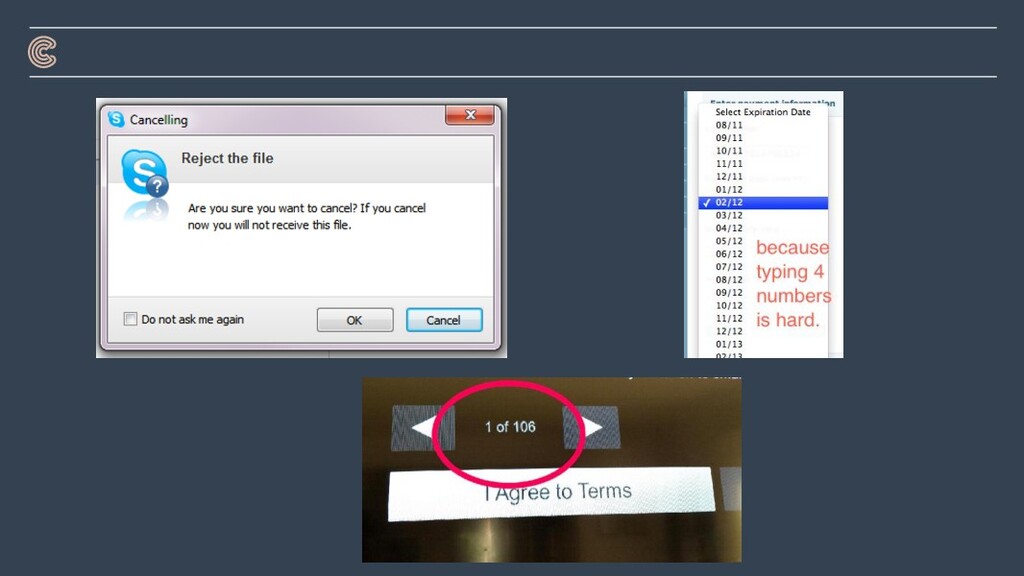
Like, I still don't know how to answer this Skype pop up. And I don't know what the person was thinking who designed it. I don't know if they showed it to anyone else, but I can't imagine that they showed it to like ten people, and those ten people didn't tell them, that makes no sense.
I genuinely don't know what the answer is to that question. Why would you have a hundred six pages of terms to go through? Why would you have a drop down to pick a date on your credit card form? These seem like really, really obvious things.
These are all real. I didn't Photoshop anything. This exists. And I know I find it painful, but I also am kind of shocked that it exists. But I think it's what happens when you don't really put the user at the center of what you do.
Right? The product is just something you get out there, and then you move on to the next thing, which is growing the business. What you're growing is something that is kinda horrible. And you think about as a founder or as as an investor, you're backing companies or you're building companies.
And, you know, what is the drop off rate of these interactions? Is someone gonna come back if they have a better alternative? Are they gonna keep using your product? Are they gonna tell people they had a great experience? Or are they gonna share But this is like all over Google.
Like, are they gonna share the terrible experience that you've created? Right? And so you have to think about it, what is it that focusing on user experience does? And I think a lot of it comes down to how companies design their products, right, and how they do their product management.
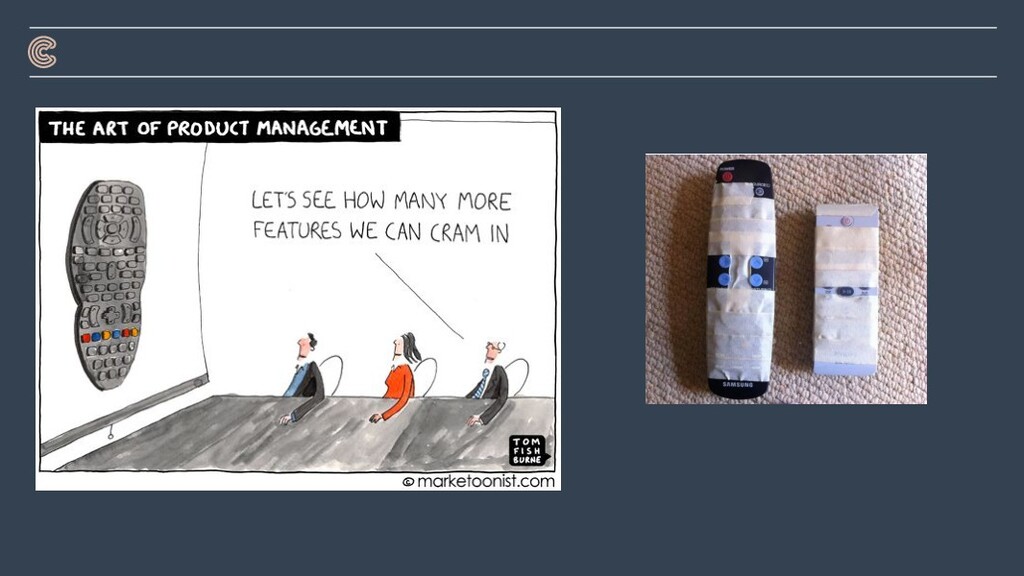
I think a lot of product management ends up being like the comic on the left. And then you get these products that, you know, instead of solving the problem that your users have, they solve like a whole bunch of problems no one has.
And then the one solution that they need, they have to struggle to find. Right? And so I I've actually been in some product management discussions like the one on the left, which is like, let's just build more features. When really a lot of times the answer is you take away features.
Right? Because you can't figure out what the solution is to the problem because the software is just too bloated. So a lot of the the art of user experience is really, really figuring out the the key problem you wanna solve, And then solving it, and that's when you get the really really positive effects.
So I like for talks to be practical. And I think, you know, one other thing that that I I think might be helpful to founders is, so we look for user experience focused companies. What does that mean? What do we look for and what is our process?
And so beforehand, know, we all like user experience. That's nice, but you can't just look at products all day. You do actually have to read and learn about it. There's a lot of really good literature out there about it. A lot of it comes from the product and design world, which is great.
So it tends not to be in kind of the business section necessarily. It's more in the oftentimes in in design or even art. But it's pretty useful. Before we have a meeting, we tend to use the product. If they don't have a product, we'll look we'll ask for prototypes.
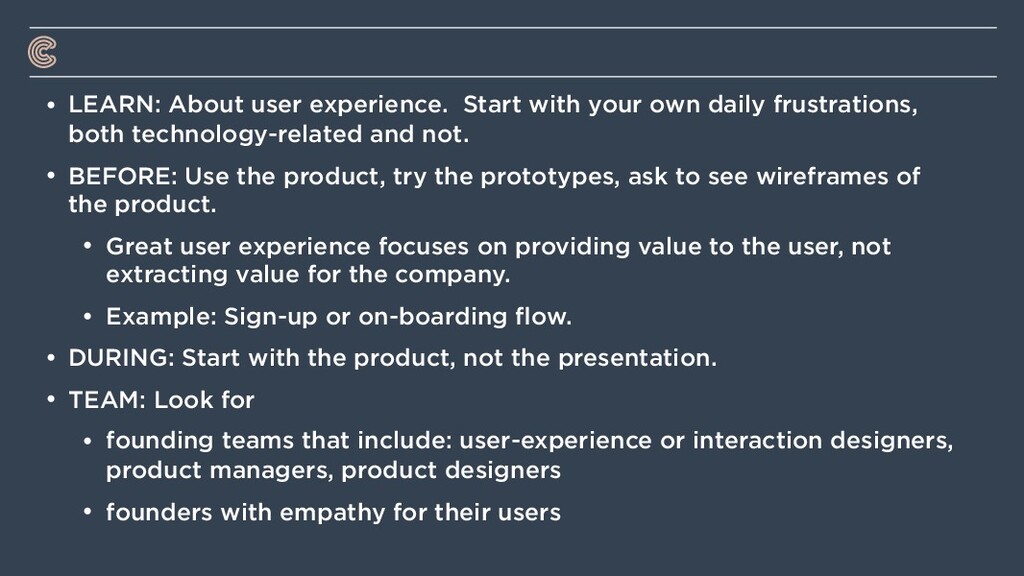
Prototypes and wireframes can teach you a lot about how founders think about the product. I think great user experiences focus on providing value to the user, not extracting value for the company. So as an example, one of the things I always do is the onboarding process for any company I'm looking at.
Right? And one of the questions I ask is, when are they asking for the email address? Right? I think that's a really good example of when are you trying to extract value for the company versus when are you trying to give value to the user.
The number of marketplaces where just to browse the marketplace, I have to sign up. I don't really understand why you would do that. I haven't even seen anything yet. Why would I sign up to your service? I have no idea if you have what I need. Right?
It's really asking for the right information at the right time, such that you've given value to users before you try to get value for the company. And the user's willing to give you that information. Right? The value of an email address that's completely unqualified is pretty low.
And so really thinking through those things, I think, is important. And so rather than go through a series of questions, just do the onboarding flow, and you can learn a lot about how how they're thinking about it, and then ask questions about it.
During the meeting, we start with the product. It's almost always a dive straight into the product and start going through it, ask questions if I already spent time on it. Presentation, we'll go through, but more often, we'll spend a lot of time on the product and ask questions about that, the product roadmap, kind of where are they headed with it.
And then the presentation can always kind of look at afterwards and ask questions by email, etcetera. But while we have them in front of us, we really wanna know how they're thinking about this. And it's interesting how people respond to that, right? So really a product centric founder is relax.
And they really open up and they get pretty excited. Whereas others kind of wanna go right back to the script that they've done, and go right back to the presentation, because they're not actually that comfortable talking about the product. And then on the team side, what do we look for?
We look for founding teams that include either user experience or interaction designers, product managers, product designers. But above all, we look for people that have empathy with their users. And a lot of that is just about asking questions to the founders. Why did you make this choice?
Why are you building this feature? What are the features you've removed? What are the things you tried before? And, you know, it's because I think really great user experience is about having empathy with with with your users. There's of course There's always this idea that, you know, if you build a great product, you get it out there and it'll just like that's magic.
And it'll happen really, really fast. It's not. It's like almost everything in life other than actual sprinting, it's not a sprint. It is very much a marathon. Do you guys know who they are, by the way? Yeah, okay. So it is very much a marathon.
And it takes a really, really, really long time to get to a great product market fit. So as an example, CDMapper is a five year old company, and it's just starting to hit its stride. It's taken a long time for it to get to this point.
Typeform, from when it started to when it launched its beta, took one year. From its beta to its full public launch, took almost another year. That's almost two years to build a product that was in a market that you could say was crowded and already had a lot of solutions in it.
It takes a really, really long time to get to a great product. It's a grind. Right? Like product market fit is a lot of work. It's absolutely not something you just launch and then it's done. Right? There's a lot of customer discovery involved.
There's just, it's just a really, really long process. I have yet to work with a company that has just launched a product and it's really taken off. So similar to what Andy said, almost all of the curves look, they might be growing, but they're like linear growth.
And then it, the slope changes and changes and changes. I've never seen anything actually grow exponentially. Even networked businesses like SoundCloud, which at one point were growing really really fast, even there it was a linear growth curve where the slope just kept changing, and it took a really really long time to get there.
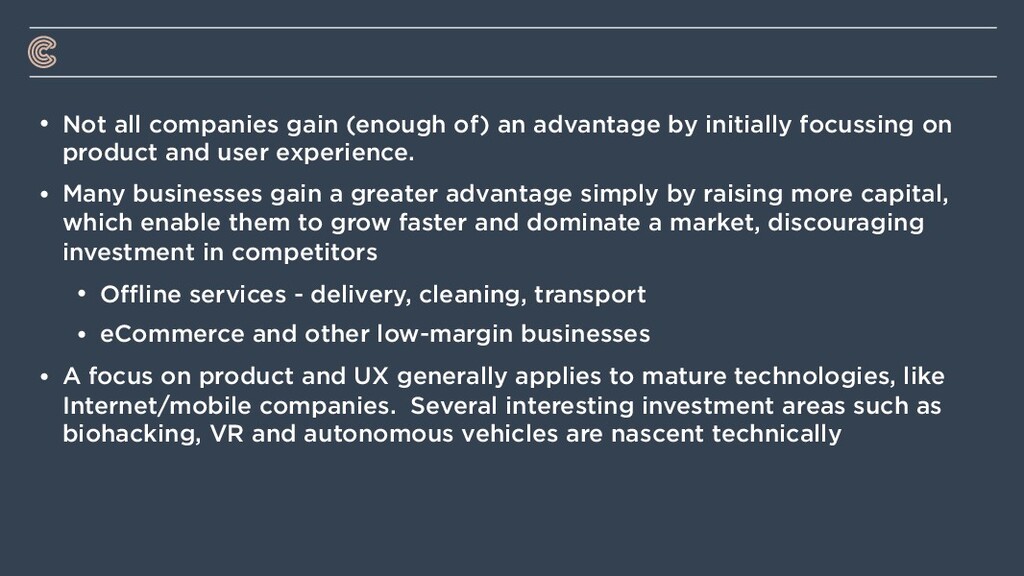
And then the final thing I'd say is everything I just said only applies to a subset of companies. So there's a lot of companies where frankly focusing on user experience is just not enough. One of them is a lot of businesses that have an offline component.
So if you look at things like Deliveroo, or Uber, or cleaning marketplaces, really the best user experience is massive liquidity and really low prices, and that only comes from raising a **** ton of capital. So you can have even a terrible user experience, but if you have really low prices and your car is always available, you're probably gonna be fine.
And so those are sectors we just tend to stay away from. They're great businesses, and you know, you can build really great businesses in those sectors, you can make a lot of money in those sectors, but they're just not ones that we focus on because user experience isn't a strong enough differentiator.
And then a lot of low margin businesses like e commerce, again the same thing. A lot of the strategy is around raising lots of capital rather than any kind of user experience that really differentiates you. And then the final point is one thing that we're exploring now is how much user experience applies to more nascent technologies.
So we made a couple investments recently that are definitely in the more technical space. One is an autonomous drone software company, another is in medical imaging that uses AI. We're not sure yet. We suspect it may not be actually that critical, but we're finding out.
But in those areas, it's probably much more important to have really deeply technical founders that can actually build the thing that's probably really hard to build rather than a product designer. And so so so those are a couple of sectors that it it doesn't apply to.
And I think you have to think about what is the company you're building, what is the market that it's in, and whether or not this is actually gonna be the key differentiator. But if you're not in one of these sectors, I encourage all of you to go back to your product, or if you're an investor, back to your portfolio, use the product, try to imagine you're using it for the first time, and ask yourself, is this actually a user experience that I enjoy?
The answer is probably no. And that's just, you know, it's unfortunate, but it's also an opportunity, because there's a lot to be gained from improving the user experience of your products. And a lot of the gain is in your KPIs, and it's a financial gain.
I actually have five minutes left, so I was told I couldn't do questions, but **** the rules. Does anyone have any questions? Anyone? No? Yeah. So actually I think, you know, the thing with the Internet is that there's only really like two business models.
Right? You sell people something or there's advertising. And that's kind of it. Right? The only difference in your business models would be, do you get a lot of cash upfront? Are you doing prepaid? Are you getting people to pay for a year upfront?
But business models are actually pretty basic. There's not a lot of variety in them. There are people that really really like, for example, SaaS, right? They really really like recurring revenue, and that's kind of all they focus on. There are other people who are We're pretty broad in our business models.
We will both, you know, do advertising funded stuff, although we haven't yet. Most of our investments are in areas where you're buying something. Whether it's software, or a good, or in the case of city map, or a bus ride. You're buying something, and that's it.
Like that doesn't really change actually, relative to the user experience. But you might think about things like whether you want people to pay for a year upfront, or whether you want them to do a prepay or something. Yeah, Sherry? Yeah. Yeah, so actually, we found the problem to be a different one, is product founders tend to be too obsessed with product, and they think it kind of solves all problems.
So actually what we found is, as companies scale, kind of have to help them be a bit more commercial. So like, for example, the type form founders, and they'll tell you this themselves, are really not commercial. Like, I'm I'm pretty convinced the company can making even more revenue than it is now if they had a bit more commercial DNA, but then they wouldn't be the founders that they are.
Right? So it's something we've had to work with them a lot on. I mean, until last year, they didn't have any sales. Like, they didn't have a salesperson in the company. Marketing, distribution, these are just things that we had to work a lot with them on.
So because we now have a lot of experience working with with, you know, very product centric founders, We we know the areas that we have to help them on and help to, you know, build as time goes on. But yeah, the the the problem tends to be be the opposite one, which is you can't really solve all problems with product.
And you have to give credit where credit is due. Marketing is really important. Distribution is really important. You know, your your sales strategy is really important. And it's more getting the founders to realize the importance of that stuff rather than keeping the focus on product.
Yeah. Tell us more about the bus. The bus. Sure. If you wanna know more about the bus. So it's gonna be initially in London. What Cinemap has done is because they have millions of users, a couple million in London, they know where people are going, like all the time.
And they know where people need to go all the time. And they know what is served by bus routes and what is not served by bus routes. And they know what's served by train routes and what's not served by train routes. So what they've determined is basically places that are underserved, but have just really high demand.
And so they're doing it with the transport authority, so they have a license from TFL, and they're gonna be running a night bus along an area of East London initially, that you just, you know, you can pay on your contactless. It doesn't work with Oyster yet, fortunately, but they're working on it.
But yeah, you just pay on your contactless, and it is a software powered bus. So, yeah. Anyone else? Cool. Good. Thank you.