
The typical startup narrative includes a garage, a brilliant idea, and boatloads of venture capital. But with the shrinking costs of starting up, bootstrapping is as viable as it's ever been. Add to that the rise of "Indie Funding" - angels and smaller funds that are willing to invest in companies without the expectation of billion dollar exits - and founders and their teams have a lot of options to weigh as they grow their company. There are many trade-offs between these approaches, and there is no "best" path to travel. This talk explores the trade-offs that not just founders, but also management and employees should expect when they choose to work in a bootstrapped vs. a funded company.
← All talks 
Lead Turing Fest 2022
The Trade-Offs Of Bootstrapping vs. Raising Funding
Auto-generated transcript - may contain errors. Tap a timestamp to jump the video.
Thank you for welcoming me here. This is awesome, to be here on stage finally at Turing Fest. I've been a fan from afar for several years, and I was, really happy when Brian invited me to fly out and speak. So yeah, I'm gonna be talking about trade offs to bootstrapping versus raising funding.
And I'm not just gonna stick to venture funding. There is this in between now that's developed, and I'm gonna spend a little time on that. I'm calling it indie funding. I've heard people call it alt funding or alt VC, but it's a track of raising some money where you don't have to necessarily become a unicorn or explode.
So today, we're gonna be covering, really after I define some terms, we're gonna walk through four bullets. One is, what funding can buy you. I talk to a lot of bootstrappers. I actually bootstrap five ish, maybe six of my own companies, depending on how you count.
When I talk to I run a community for bootstrappers. I have a podcast for bootstrappers. A lot of people will say, well, I don't know what I would do with money. If you give me a half a million bucks, I don't know how I'd grow my business.
And so I want to talk briefly, spend about two or three minutes for kind of a mental model around that. Because I used to say that too. Ten years ago, I would say the same thing. And now I've changed my tune. I at least understand the advantages of doing it.
And then we're going to talk about bootstrapping, pros and cons. We're going talk about venture funding, pros and cons. And indie funding, pros and cons. And the good news is I have never ever been in the camp of, you should always do x or never do z.
Because I while I bootstrapped all of my companies until the most recent one, I wrote a book in twenty ten as I was bootstrapping, and there in the introduction, I say, I'm not anti VC. I'm anti that being the only narrative. That's the only story.
It's the only script. Do you want to go start a software company? Well, certainly, you should raise a bunch of money. And there's an alternative narrative, and I'm proof of that as well as the thousands or tens of thousands of folks that that I speak with and interact with in my community.
So as I said before, I bootstrapped six companies, and that includes an event series, an online community called MicroConf. It includes three software as a service companies. And then there was a consulting firm. So I have kind of the gamut of doing this.
So I bootstrapped a lot. And the first time I well, I'll go with this. The last SaaS company that I started in twenty twelve, I sold it in twenty sixteen. And it was to a venture funded company that had thirty eight million dollars in venture.
So I came aboard that team for about two years. And so there, I was serving as a senior leader. I ran product, the VP of product for them. So I was basically venture funded for two years, where I didn't have to raise the money, but I had the money at my disposal.
So I saw all the trade offs, both positive and negative, of how fast we could move, but also some of the maybe headaches or some of the bad decisions we made because we had too much money. And then now I've invested in about one hundred startups, mostly software.
Twenty personally and eighty across the accelerator that I run. So I like to come at it from like, I bootstrapped, I've quote unquote been venture funded, and then I've also been in this indie funding space now for about four or five years, which is almost as long as it's existed.
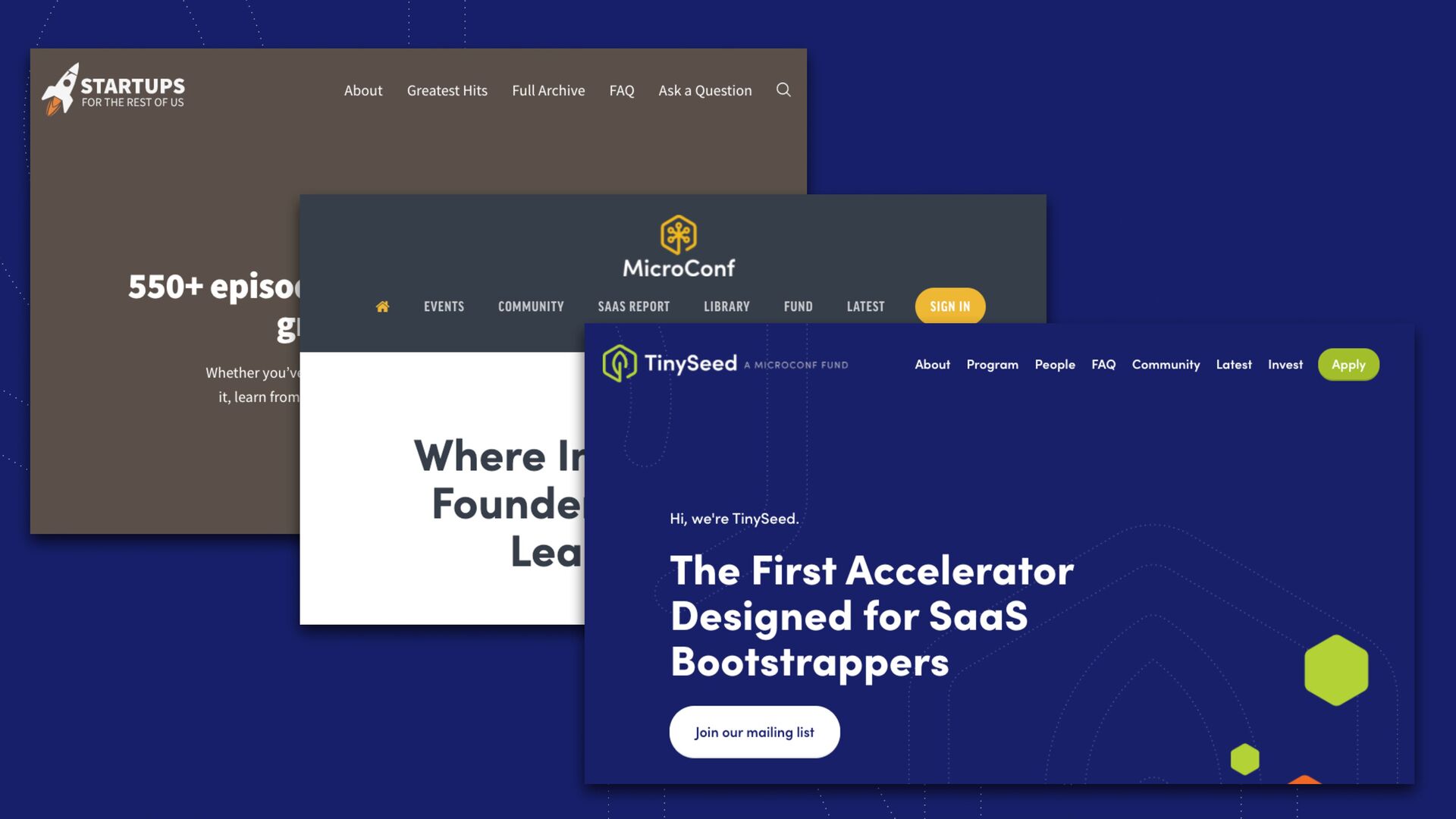
So these are the angles I come from. I got into this. I started a podcast in twenty ten. And the whole point of it was it's called startups for the rest of us. And the rest of us is that most people would say, let's start a startup.
Let's raise VC. And that usually is the one percent case. Right? We should actually raise funding or actually raise venture. So I started talking about this every week. We have six fifteen episodes now, and it's thirty, forty minutes talking about this kind of stuff and thinking through.
We don't talk so much about funding. We just think about, let's just grow a business. If you have money, if you don't have money, let's just grow a business. There's so much more in common between a bootstrap and a funded company than most people act like.
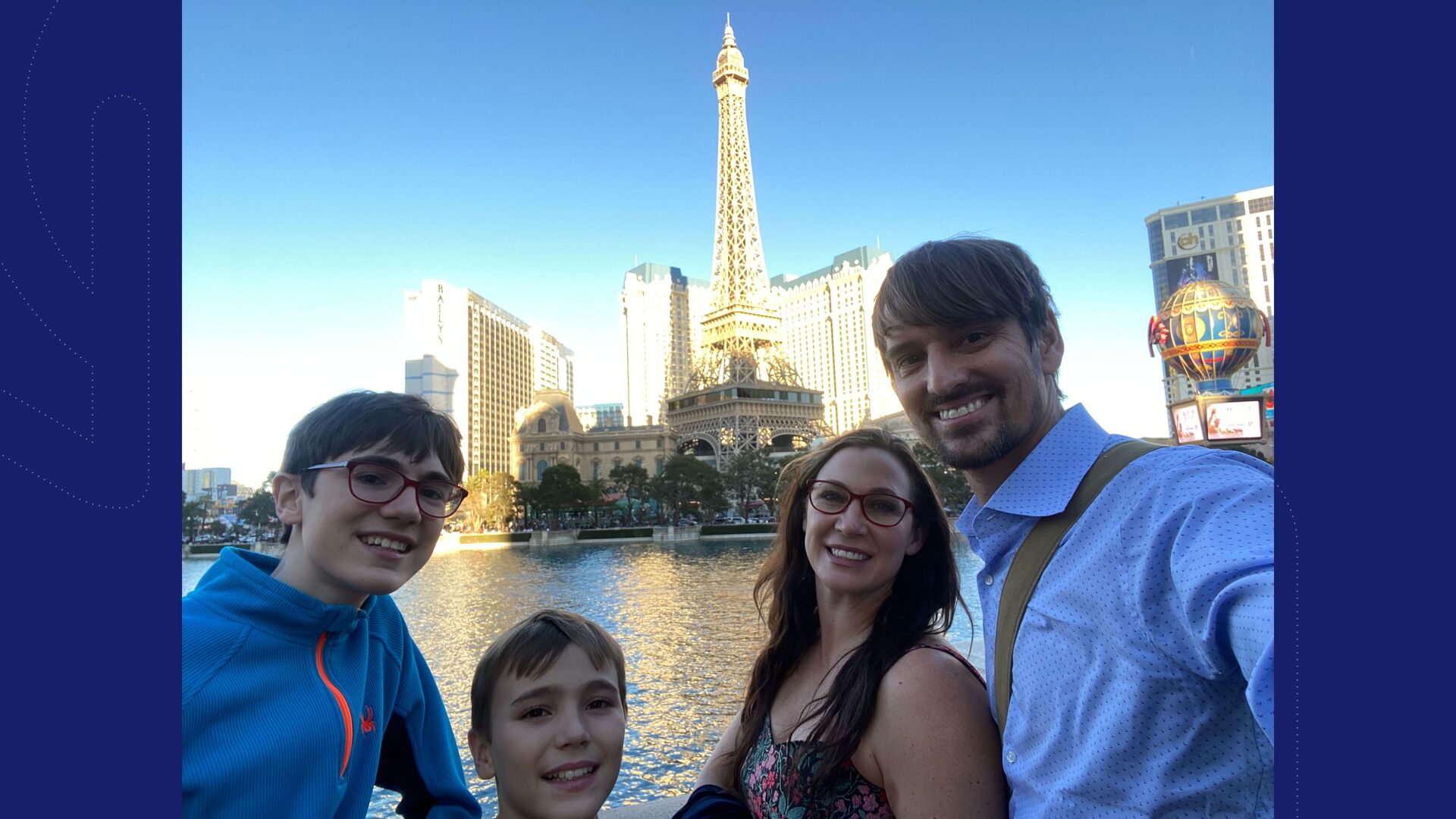
I run an online community, I mentioned, and then Tiny Seed, which is the accelerator, that I run. And I like to throw a picture in every talk I do of the actual most important part of my life. Right? I've done all these things. I've written books.
I have podcasts. I run an accelerator. But this is my why. So that's me, my wife, who spoke here yesterday, and our two boys who are back in Minneapolis. And we are in Paris in front of the hotel in Las Vegas. So that's the Paris Hotel in Las Vegas.
And we're having a great time. This is last year. And so honestly, I started software companies for the lifestyle. I started them for the freedom, so that I could spend time with these folks, so that I could pay for their college, so that we could have a life that we enjoyed.
So keep that in mind. Whenever I'm listening to a speaker, want to know what's their narrative. Right? Are they doing it because they want to grow a billion dollar business? Because I never did. But I did want to be a decamillionaire, because I knew that it would change our lives.
So I didn't do it for the money, but I did it for the change to my life and the people in my picture. And so I think knowing your why is critically important. Okay. So now I'm gonna dive into first, I'm going to define the three terms that I've said bootstrapping, VC, and indie funding.
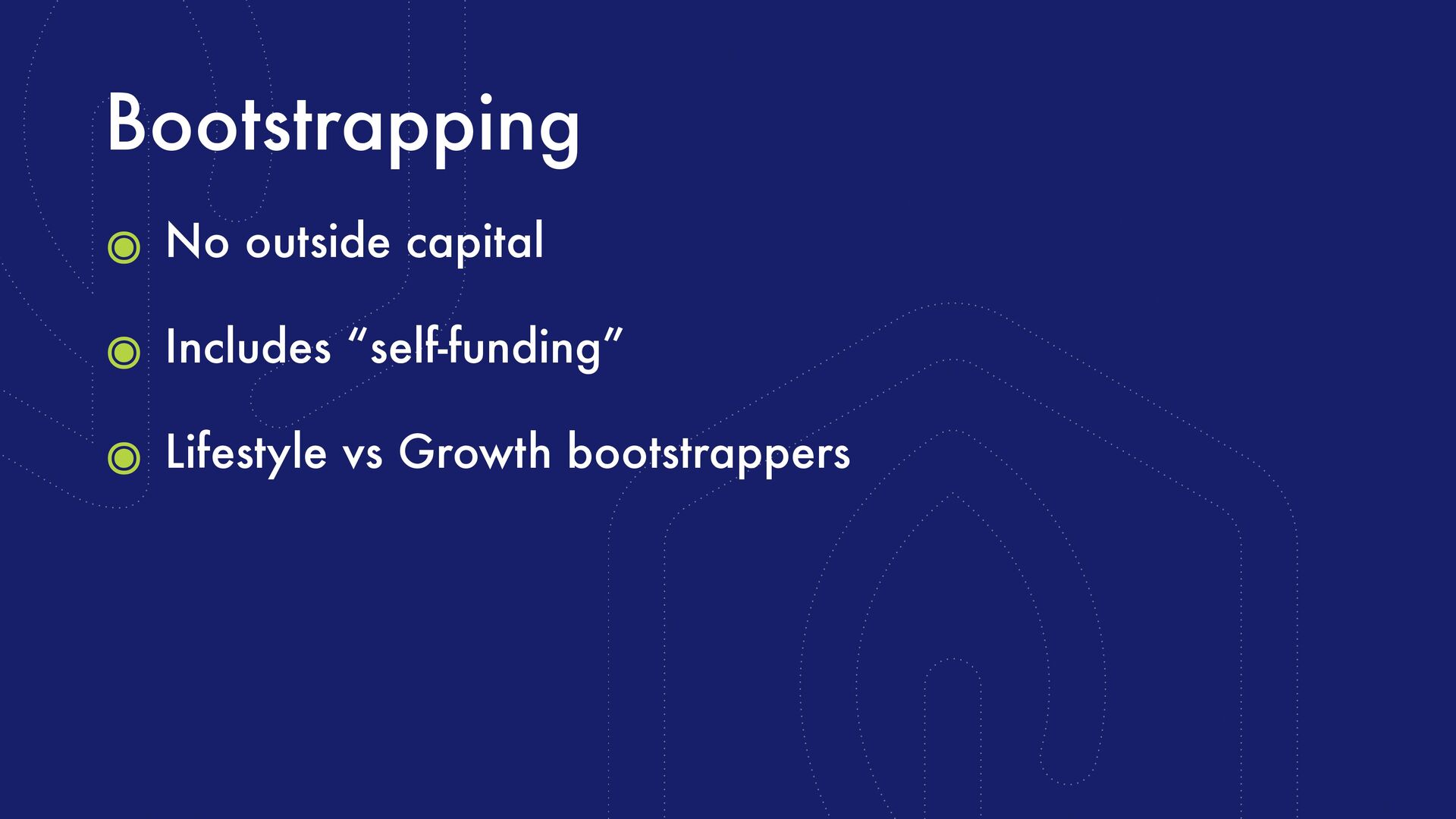
And then we'll go through some oh, and then I'll talk about what to do with money and then pros and cons. So these are pretty simple. I'll zip through them. Most of us know that bootstrapping is when you take no outside capital. Now I also include self funding.
You know, it's at least bootstrapping, affiliate. So I talked to someone the other day who said, I bootstrapped my company. And then he felt guilty. And he said, well, to be honest, I had sold the prior company, and I had two hundred thousand dollars in capital.
So I didn't technically bootstrap it. But he almost felt sheepish, like I don't get the bootstrapper cred because somehow I built this other thing and had this money. Right? So to me, I call that self funding. I almost angel invested myself. So I did the same thing. I built five companies.
Each one was a little bigger than the prior one, and each one allowed me to build the next one. So by the time I built Drip, and I sold that in twenty sixteen, I had about in the neighborhood of about one hundred fifty, two hundred grand from a prior company.
So I would call that self funding, but it's bootstrapping ish. And then I won't spend too much time on this, but what you'll notice in the bootstrapper crowd is there's the true lifestyle bootstrappers. It's like, I want to work ten hours a week, and I want to make two, three hundred thousand, four hundred thousand a year.
Don't really want to put in more time than that. Don't really want to grow. And that's okay. I actually had a great business like that called Hittail. Threw off about two hundred fifty, three hundred grand a year. Did it for eighteen months. Worked ten hours a week.
So fun. So boring. At the end of it, I was like, I have to do something more. Actually, was like, one night, my wife, she's a psychologist, she's a founder consultant, I was crying. And she's like, what's wrong? And I'm like, I'm so bored, I don't know what to do next.
I need to do something more ambitious than this. Right? And that's where I became a growth bootstrapper of like, I wanna build something seven, eight figures. I wanna do something bigger and have an exit. That eventually is what turned into DRIP. So this is bootstrapping. Right? No outside funding.
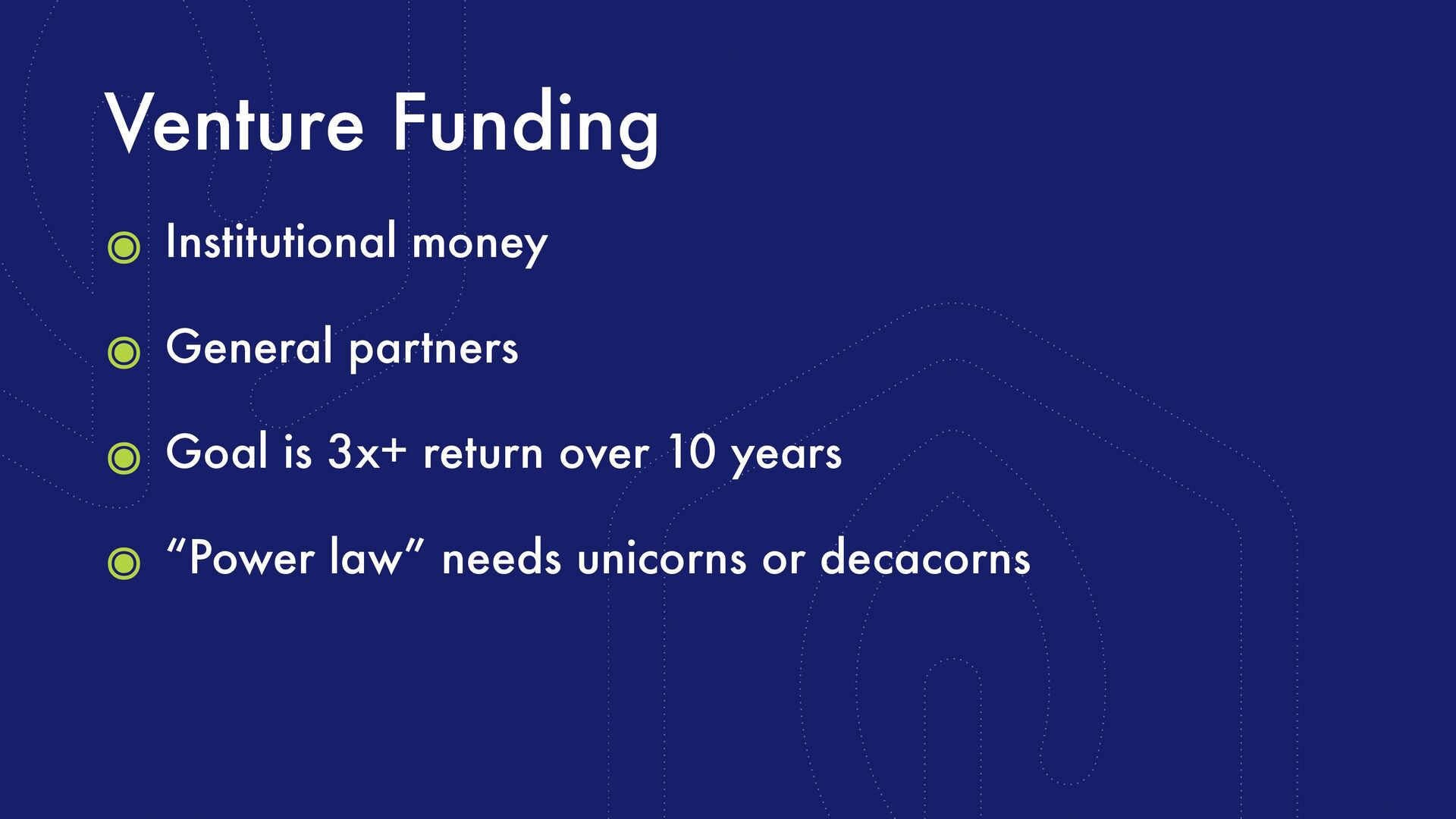
Venture is what most of us think of when you say the word funding. Everyone instantly goes to venture. I actually think that narrative needs to change. Venture funding is institutional money. This is where you get a couple general partners. They are the founders of a fund.
They're founders of an LLC, in essence. And then they go raise money from external investors, limited partners. So they're accountable. Not their money, right, the people who start a venture fund. They are accountable to these investors. Therefore, they want they want big returns, and they have to provide bigger returns than the stock market.
Otherwise, they can't raise another fund. The goal is to return their goal is to return at least three x in ten years. Three to five x is the usual range. Now I believe the numbers are eighty percent of venture funds don't do this, or eighty percent don't beat just investing in a REIT, a real estate investment trust, a public index fund.
So most of them don't work. But that is the goal. And as a result of the power law, you need they need unicorns. They need billion dollar companies, or they need decacorns, which are ten billion dollar valuation companies. If without those in larger funds, the funds are not viable.
They cannot raise their next fund. So the whole game of venture has been has become, you approach them and you say, I have this amazing idea, or I have a business that's doing like a million a year. I think I can get it to ten million a year.
At that point, it's worth I could sell it for fifty, sixty million if it's a SaaS app. And they say, no. Fifty million doesn't return our funds. We can't do that. So where is the funding for that swath of life changing business? And that's where this indie funding has started to come about.
I first heard of this in twenty thirteen, when customer. Io raised a single small round of about a quarter million dollars. And they said, I don't think I ever want to raise again. And I was calling the founder. I was like, you can you can do that? And he's like, yeah.
I think it was twenty twelve when they did it. I was like, who does that? He calls it fund strapping, which I think is interesting. But since then, there are now funds like the one I run where we've raised outside capital, funds that invest in it.
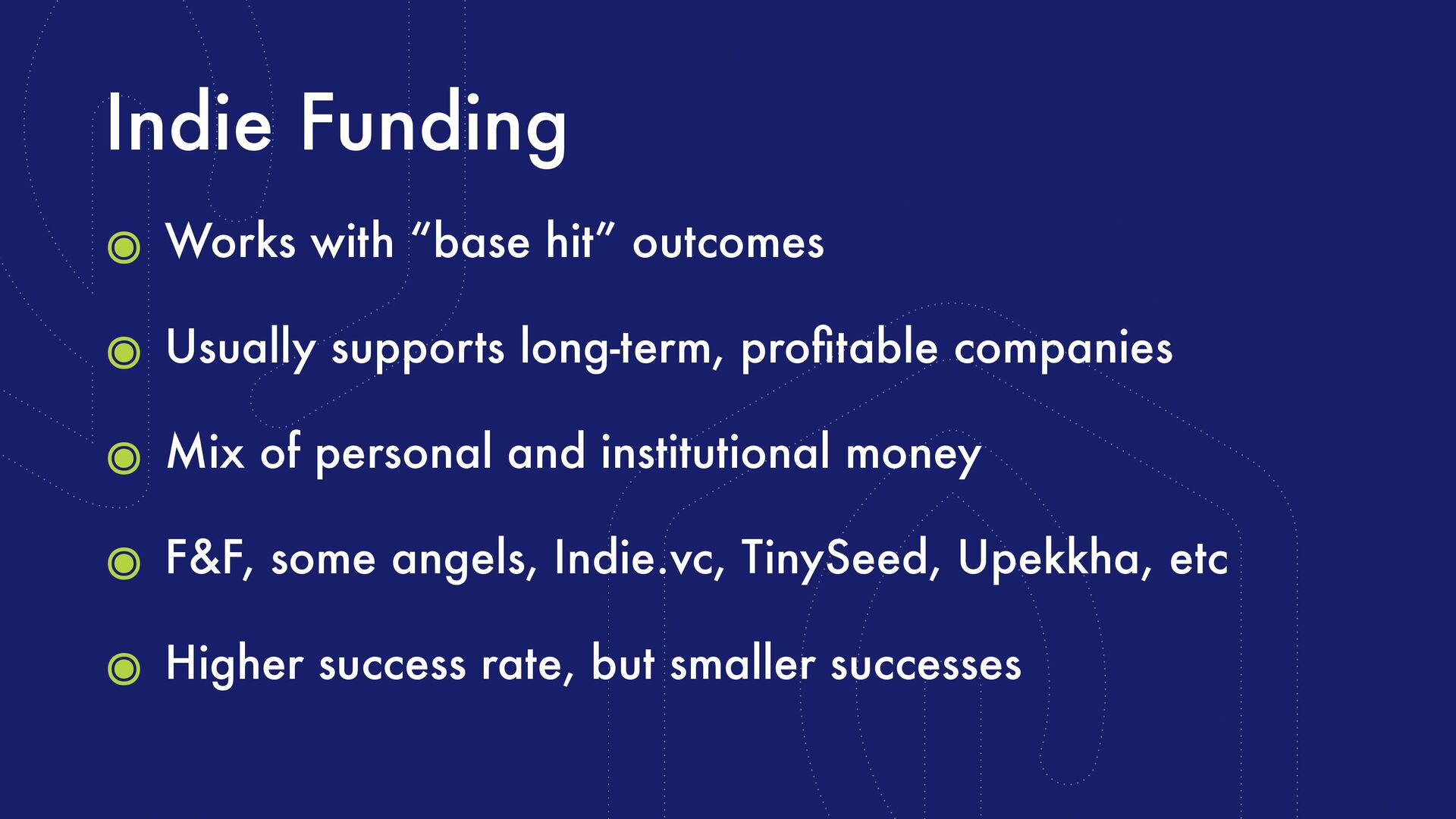
K? So indie funding is a little different here. And I'll get into pros and cons later, because it's not a panacea. Right? It's not the solution for everything. It's just another option. There are trade offs with it. So indie funding works with more base hit outcomes.
Ten million dollar exit, twenty, thirty million dollar exit can work with indie with indie funding. Because well, I'll get into why later. Some indie funding investors and some indie funding indie funds some helpful, they will actually invest in companies that are that are pass through entities and that will throw off a profit.
Right? So an actual imagine this. An actual business that just makes profit. Right? Venture venture fund they don't want it. VCs don't want that. They don't want profit. They say, make it a in the in the US, it's a c corp, and I think it's a is it a UK limited here where it's like it's an encapsulated entity, and if you pull money out, you get double tax.
So they don't want profit. They want an exit. It's all about the exit. Right? So if funding says, look. You wanna run for five years, ten years, twenty years and pull out profits? We can do that. Right? We'll make an arrangement. Not all, but some.
It's a mix of personal and institutional money. Because the indie investments that I've seen are friends and family. There's a mix. And some angel investments. Those are gonna all be private money. Right? Indy dot b c was really the first fund that ever did this, and it was, I think, in twenty fifteen, sixteen.
They are now they're no longer investing. They're I won't say defunct, but essentially, they've stopped taking money. TinySeed was us. We launched in twenty eighteen. Upeka is in India, and they're investing in SaaS in kind of this indie funding capital efficient model. You may have heard of the Zebra start up movement.
It's all about, like, how can we be we're not bootstrapped, but I use the term mostly bootstrapped. When you raise two fifty, five hundred k, you're not on the venture track, you're mostly bootstrapped. You have money, but it's not enough money to hire thirty people.
It's like you still have to be pretty capital efficient. And what's interesting is when you invest in venture, or when venture investors go, they do four, four and two, which is like ten companies. Four are gonna fail. Four are gonna break even, return one x.
And then one or two need to return this power law of a hundred x, or some incredible number. With Indie Funding, I would say it's more like well, it's like three five and two, if those numbers add to ten. You know, it it's there's a lot more higher success rate of companies that stick around and sell for a two three four x, but there's not gonna be a hundred x.
Right? It's unlikely. But maybe you get a ten x or one twenty x, and that's the equivalent. So it's just a different it's the same math, but at a different curve. And much like the eightytwenty rule, you've heard that thrown around all the time, the eightytwenty rule says eighty percent of the results come from twenty percent of the effort.
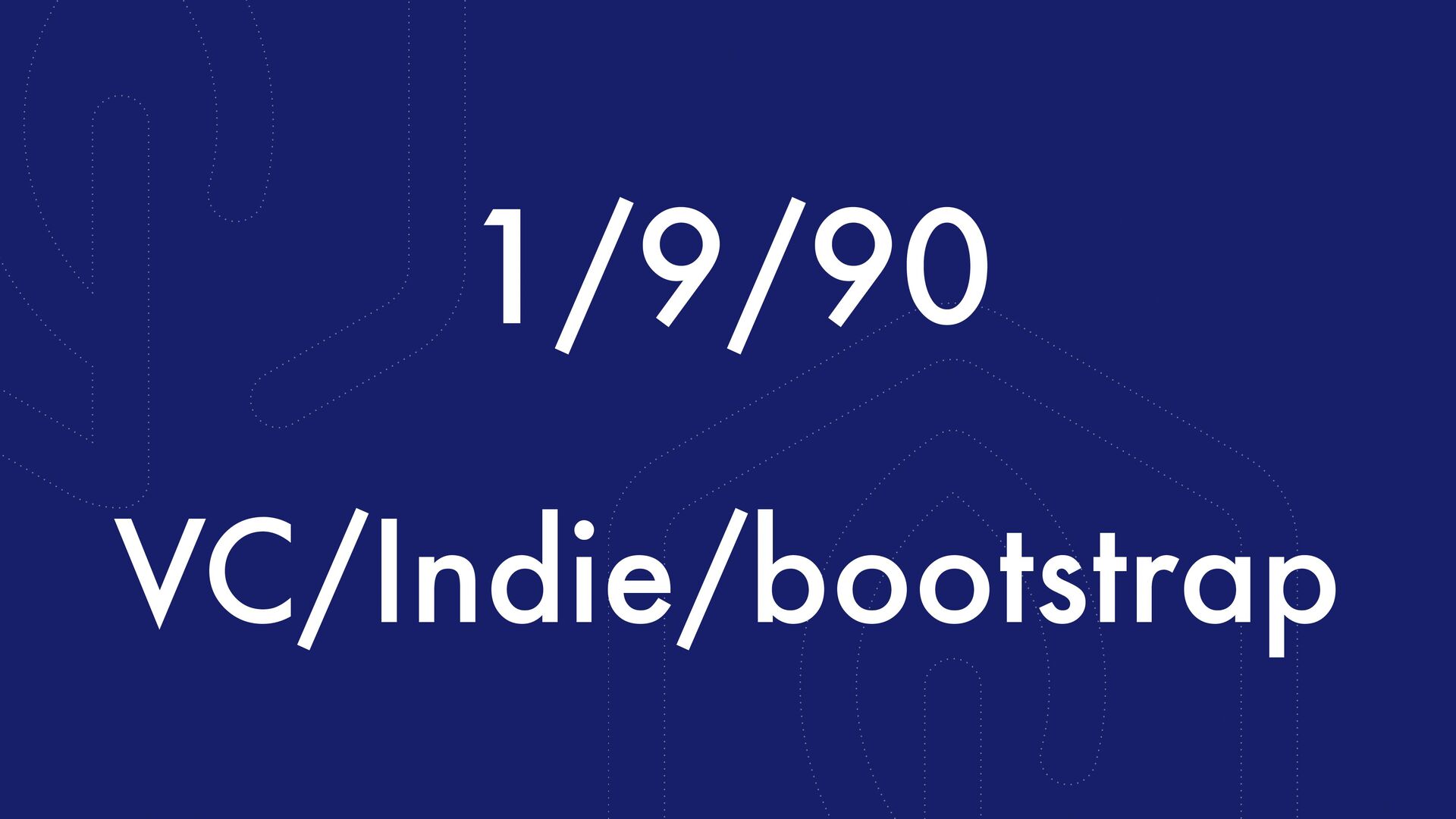
That's not exactly right. Right? Usually it's seventy fivetwenty five or it's eighty fivefifteen. Well, I have one that's the one nineninety. Not exactly, but give or take, I think, based on being in this space for the years or the decade and a half that I have been, I think around one percent of tech startups should consider and should consider and are viably a venture backable company.
And I think the actual number is like point seven or something, but let's one percent, give or take. Right? And I think about nine percent should probably consider some type of indie funding or friends and family around whatever. And then I still think that the vast majority, whether it's eighty or ninety or whatever the exact number is, I still think that the vast majority of companies should probably be bootstrapped.
Okay. So I'm gonna talk about what funding buys you. It's like four slides here, and then really dive into the pros and cons. As I said before, the reason I even I almost hid this whole section, but I get this question very often.
On the podcast, I answer listener questions. And every few months, I hear this. I don't know what I would do with the money. Right? If you put I have a company doing ten grand a month right now. I don't know what I would do with two hundred fifty k or five hundred k.
And the answer usually is, trust me, you would find some good ways to spend it. And if not, then let me help you find good ways to spend it. Right? If you take nothing else away from this talk, these next two slides, I want you to remember.
So in your personal life, money saves you hours. Because you can hire someone to mow your lawn and to take care of your laundry, take care of your kids. You can do Instacart. Have Uber to get around here. Right? In your personal life, money saves your hours.
And oops. I went backwards. Sorry. In your business, money saves you years. That's what money does. It just gets you there faster. You have to know how to use it and such, but it skips over a bunch of stuff that you have to grind out if you don't have the money.
So I asked a couple founders who had bootstrapped successfully to at least mid six figures. These are two SaaS founders, but it's irrelevant. At least mid six figures, some into the sevens. And then took money for either that idea or the next one.
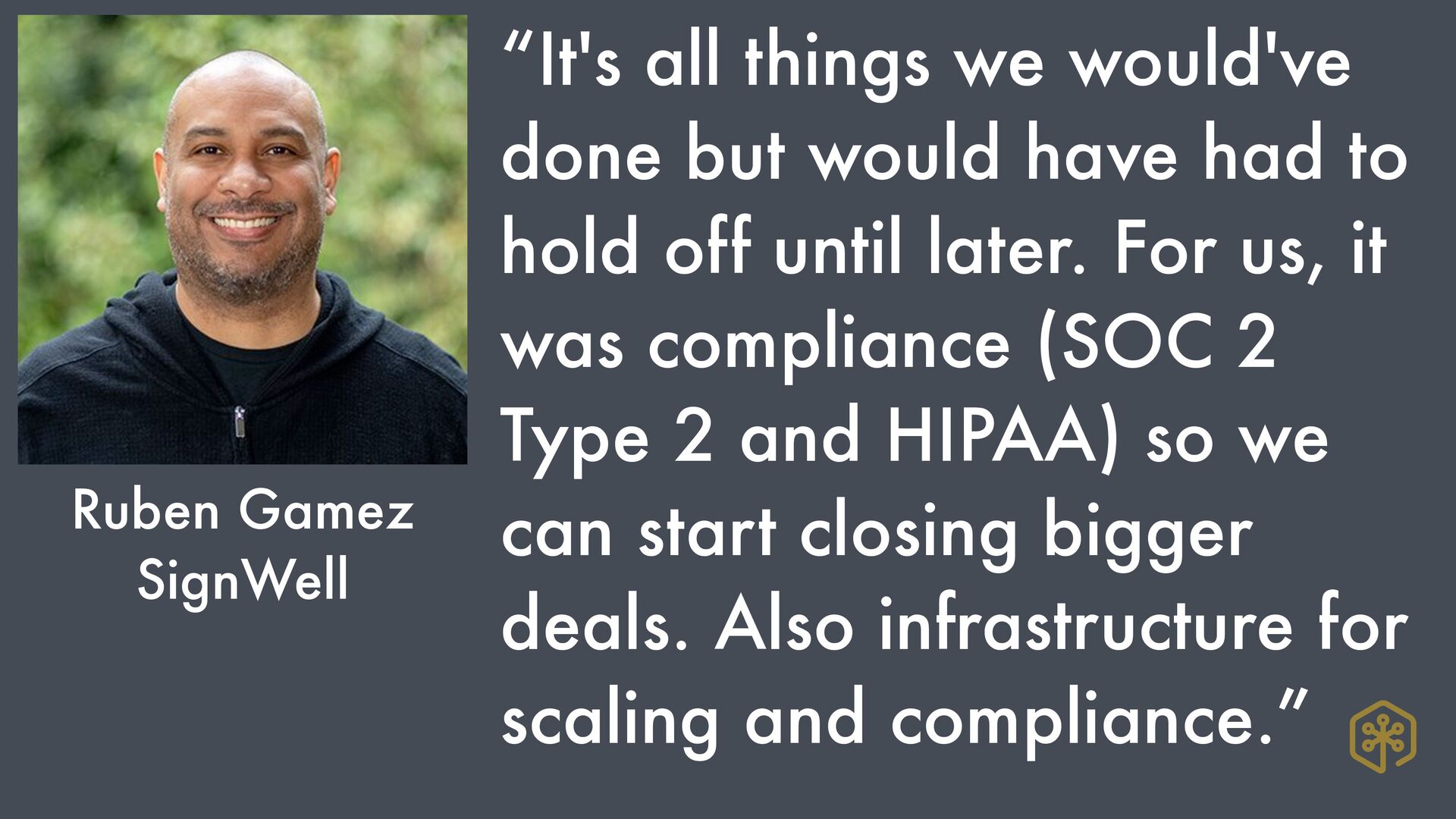
And I said, well, why did you decide to raise money this time, right, rather than bootstrap it? And so Ruben, who's the founder of SignWell, which is an electronic signature app, he said, we're doing all the things we would have done, but would have had to hold off until later.
So for us, it was compliance like SOC two and HIPAA. So we can start closing bigger deals now rather than in a year when we have the money to get these clearances. And it's infrastructure for scaling and compliance. And then Craig Kuin is the founder of a podcast hosting app called Castos.
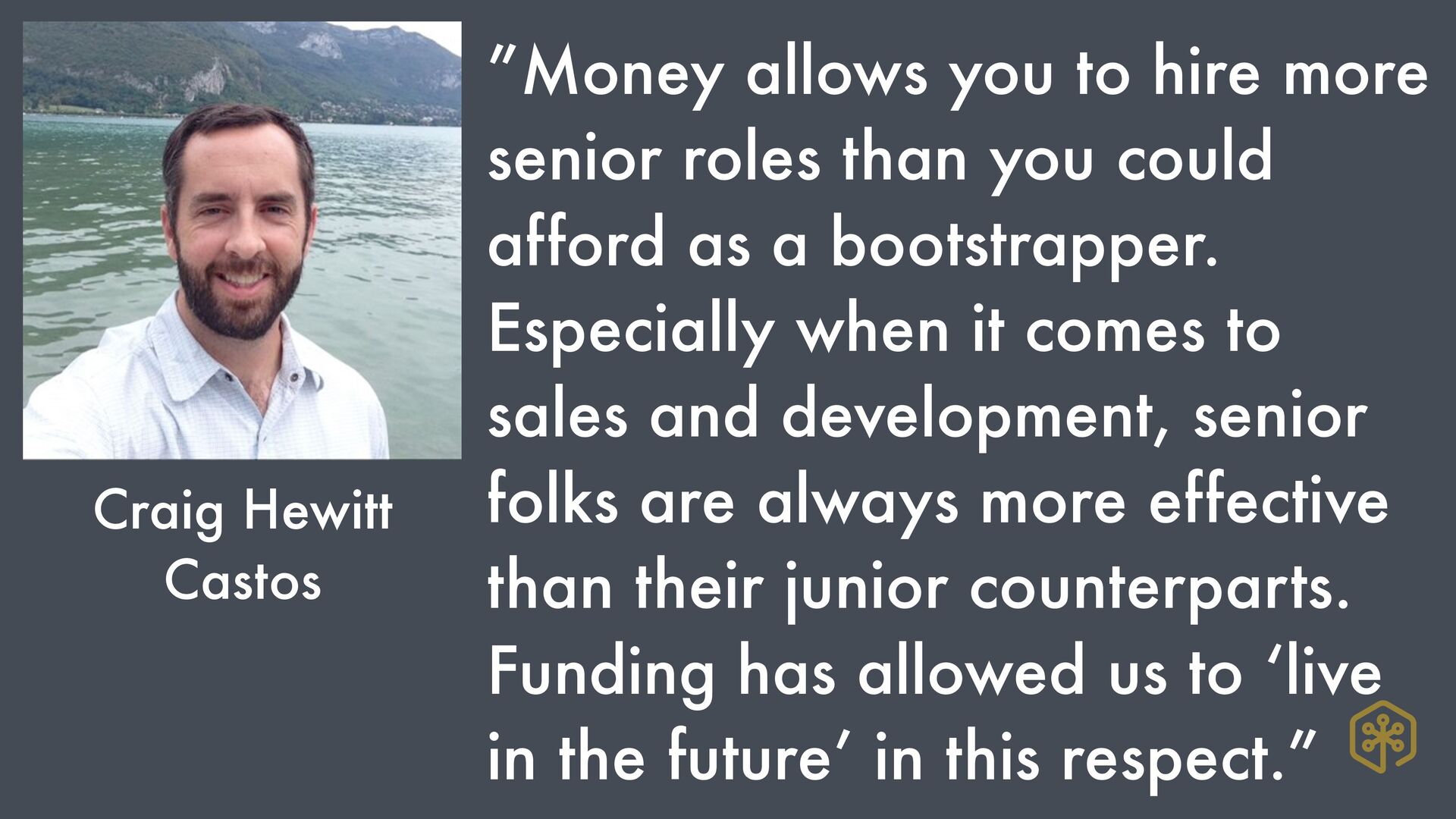
And he said money allows you to hire he's raised I believe he raised from us, and then he raised about seven fifty in mostly funding. Money allows you to hire more senior roles than you could afford as a bootstrapper, especially when it comes to sales and development.
Senior folks are always more effective than their junior counterparts. Funding has allowed us to live in the future. I love that phrase. It allows us to live in the future in that respect. Because he doesn't have to wait three months to grow another five k to hire that person.
He can hire out above revenue. Okay. So that's what you can do with money. So now we're just gonna go through bootstrapping, venture, and what's the last one? Oh, yeah. Indi. And we are and then we're gonna wrap. So I'm gonna walk through pros and cons as I see it.
Again, I've done all of these things fairly extensively. I started launching products in two thousand and five. I had my first success in two thousand and six. And then I quit my consulting in two thousand and nine. So I've been depending on how you count, I've been doing it for a while.
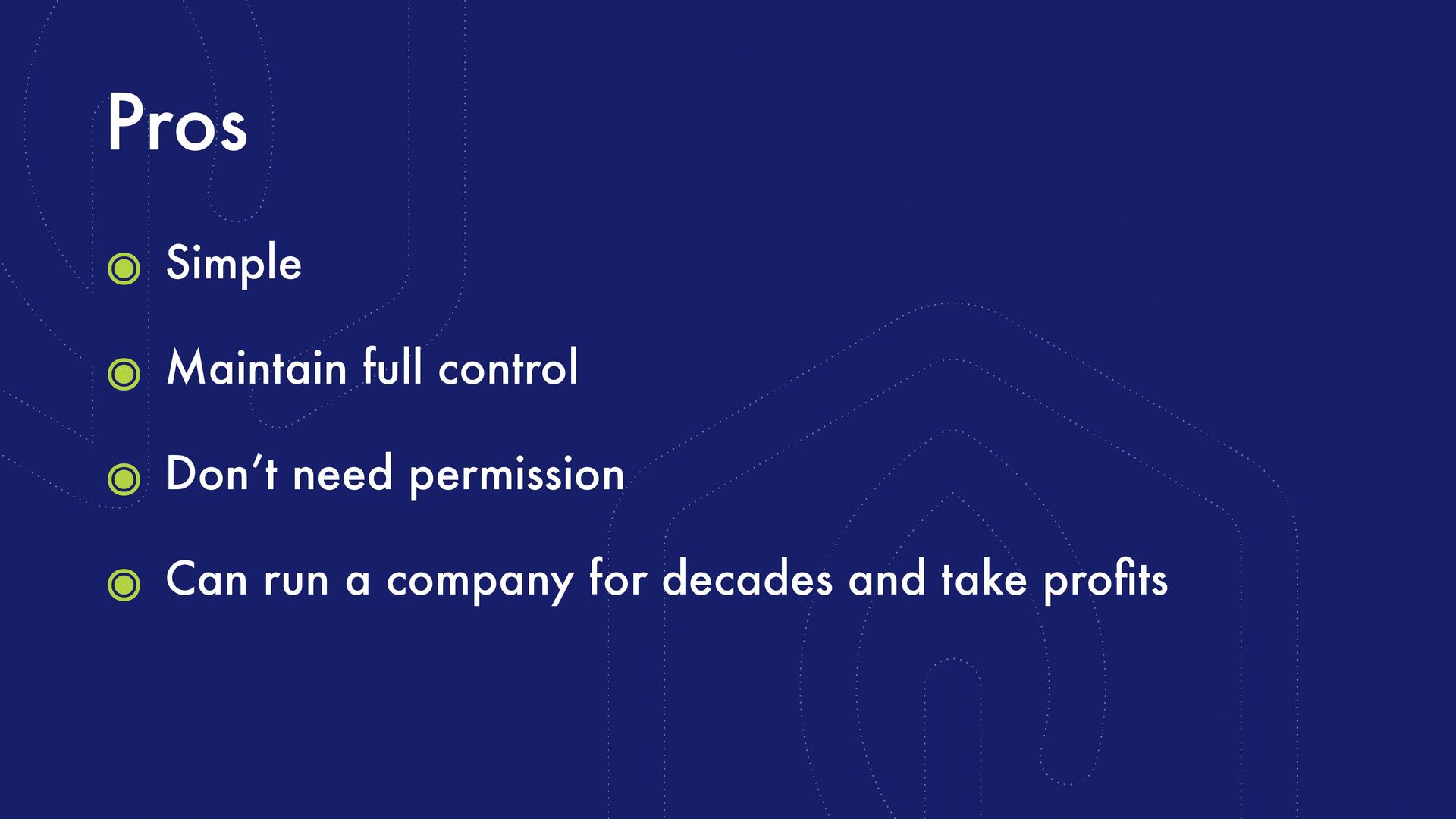
So the pros of bootstrapping are, I'll say, maybe obvious to most people. Right? It's the simplest form. You can just start doing it. You maintain full control of your company. You don't answer to anyone. You don't need anyone's permission, which is a big thing I talk about.
Permissionless entrepreneurship. If you're a writer, don't get permission from a publisher. Go start publishing. Go publish online. Print on demand. If you're if you wanna write if you wanna make movies, don't go ask for a movie, you know, a film studio's permission. Go make your movie.
If you're an entrepreneur, don't ask for permission. Build your business instead of your slide deck. I say that all the time. Build your business instead of your slide deck. I'm not even if you're raising funding, the best slide deck is revenue. The best slide deck is traction.
That tells your story. So anyways, I can get off on it. I can do a whole, like, five minute rant on that. But, so bootstrapping, you don't need permission. And you can you have the option to then run that company for decades, take profits if that's what you wanna do.
Now I will say most people say they wanna do this, and actually everyone sells. Like, there have been so many companies that I never thought would sell, including me with my last company, DRIP. And it just someone comes along and says, here's an offer you can't refuse.
You know? Or you eventually get burned out, or your life changes, or you have your second child, or whatever it is, something changes. And so I wouldn't go into it thinking I'm gonna do this. But there are some folks, I believe in tiny seeds.
So we funded eighty two companies. And the original premise was we thought a lot of people would wanna do this, like keep it for years. I believe it's around twenty percent or twenty five. I did an informal poll on our Slack. And I said, who wants to exit at some point?
And who wants to just run it kind of forever, whatever that means. And again, was about a fifth to a quarter that said that. And I even think probably half of those will sell if they grow. So bootstrapping's great. You've all this freedom.
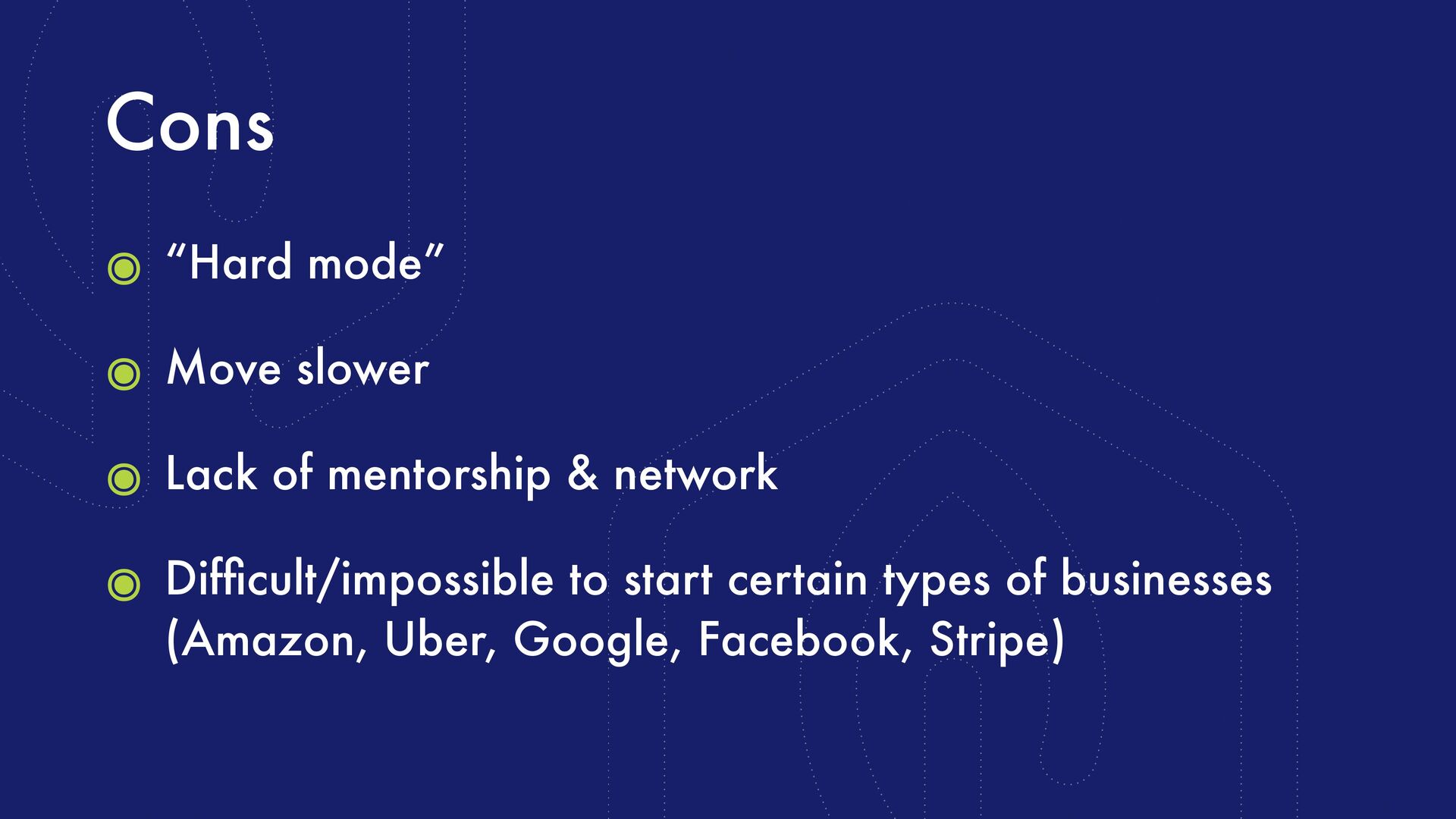
You can do whatever you want. The cons, of course, are it is hard mode. I have done it, then I've done venture, and it is hard. It is hard to not have the money to grind it out. I worked longer hours when I was a bootstrapper.
You know how we have that image of, like, I don't want to do venture because then I've got to work ninety hour weeks. And it's like, no, I worked ninety hour weeks when I was bootstrapping because I didn't have anybody else. And when I was venture backed, I hired a team of twenty people, and I was managing them.
But I didn't have to work weekends at that point, because I had coverage. So it's this interesting trade off. So bootstrapping's tough. You absolutely move slower. You just have to. You cannot live in the future. You cannot hire I didn't hire senior people.
In fact, one of the biggest mistakes I made that I don't know if I could have avoided, but I had a lot of junior people because that was all I could afford. And then I was the backstop for all that. So I started burning out eighteen months, two years into the journey because I didn't have senior leaders because I couldn't afford a hundred thousand dollar salary.
Right? I'm in the US. It kinda sucks there. So, one that I it's funny. I've only heard about this in the or I only thought about this when someone said it on my podcast, but they said, you know, when you're bootstrapper, you're you're really alone.
You have no network. You have no built in mentorship. And while I won't claim that every venture capitalist has or indie funding fund has this amazing, you know, mentorship network, there does come something there does come a value with being in a group of people, a cohort of other people who were funded by someone, or a network of mentors.
Going through an accelerator is very much a communal process, and the mentorship there, there is a lot of value to that, that you can't get when you bootstrap. And lastly, probably least lastly and leastly, it is you couldn't bootstrap Uber, Google, Facebook, Amazon, Stripe.
If you wanna start one of those companies, then just don't don't bootstrap. Like, it's not bootstrap as far as you can with whatever money you have, and then you kinda you just have to raise funding. They're just too big. There's a bunch of reasons for that I don't have time to go into.
But, so those are the those are the cons of bootstrapping. And now, since friends don't let friends listen to me talk very fast for thirty minutes, I always have an intermission in my talks. And they usually have a video that is completely unrelated to anything I'm talking about, to give everyone a break.
Alright? So this has audio. I know this I think the sound guys are on it. It is most of it's in English. Parts of it I'm in Europe, so I picked one from from Europe. Parts of it are in Norwegian, but you kinda you get the gist.
And it's about the dark side of our digital voice assistants, of which I have six in my house. And Play jazz. Playing jazz. Smoothie. Making smoothie. Calendar. No meetings today. Remember, at nine thirty. Fire off. Fire off. Open door. Door open. Open door. Wrong voice command. Open door.
Wrong voice command. Open. Open door. Repeat that. Open door? I didn't understand that. Please open door. Play on the fruits. So I thought that was still and my cofounder's Norwegian too, he was translating what the guy's saying. So it was funny. Alright. Now that I've said that, think it might be Swedish.
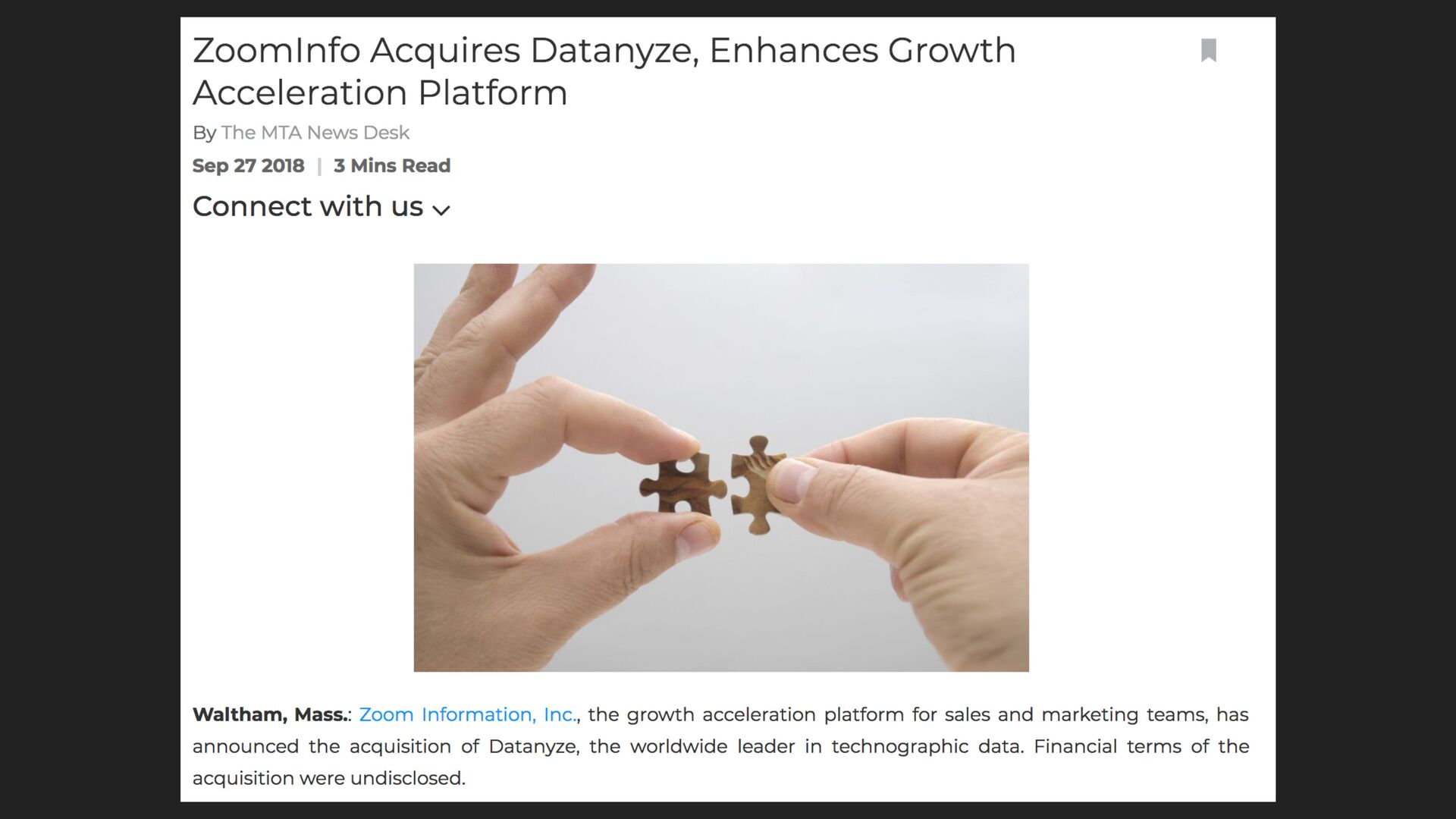
I'm sorry if I offended anyone in this room with that. All right. So now we're gonna go through similar, like pros and cons of venture. Now I have a little story to tell you along with this one. It's the founder of Datanize, which is a competitor of BuiltWith, which is like a sales kind of it's not prospecting, but you can get data about you can say, who right now is running HubSpot on their website, right, if they have a JavaScript snippet.
Who right now is hosted on WordPress. Who is running Infusion software? Whatever. You can pay for that because they crawl the web and look for all the JavaScript snippets. Who's running Google Analytics? That kind of stuff. So anyways, Datanize, this is back twenty twelve, 'thirteen, let's say.
And the founder is a bootstrapped developer. And he lives in the Bay Area, San Francisco. I live in Fresno, which is three hours away. And he's read my first book, which is called Start Small, Stay Small, A Developer's Guide to Launching a Startup.
It's all about bootstrapping. Not anti VC. Right? It has a whole snippet about it. But it's just like, you're gonna bootstrap, think through this stuff. So he reads the book, and he's he's he's starts dating eyes. Well, it starts taking off. And it's growing like five it's just him, and he's doing like sixty k a month six months after launch.
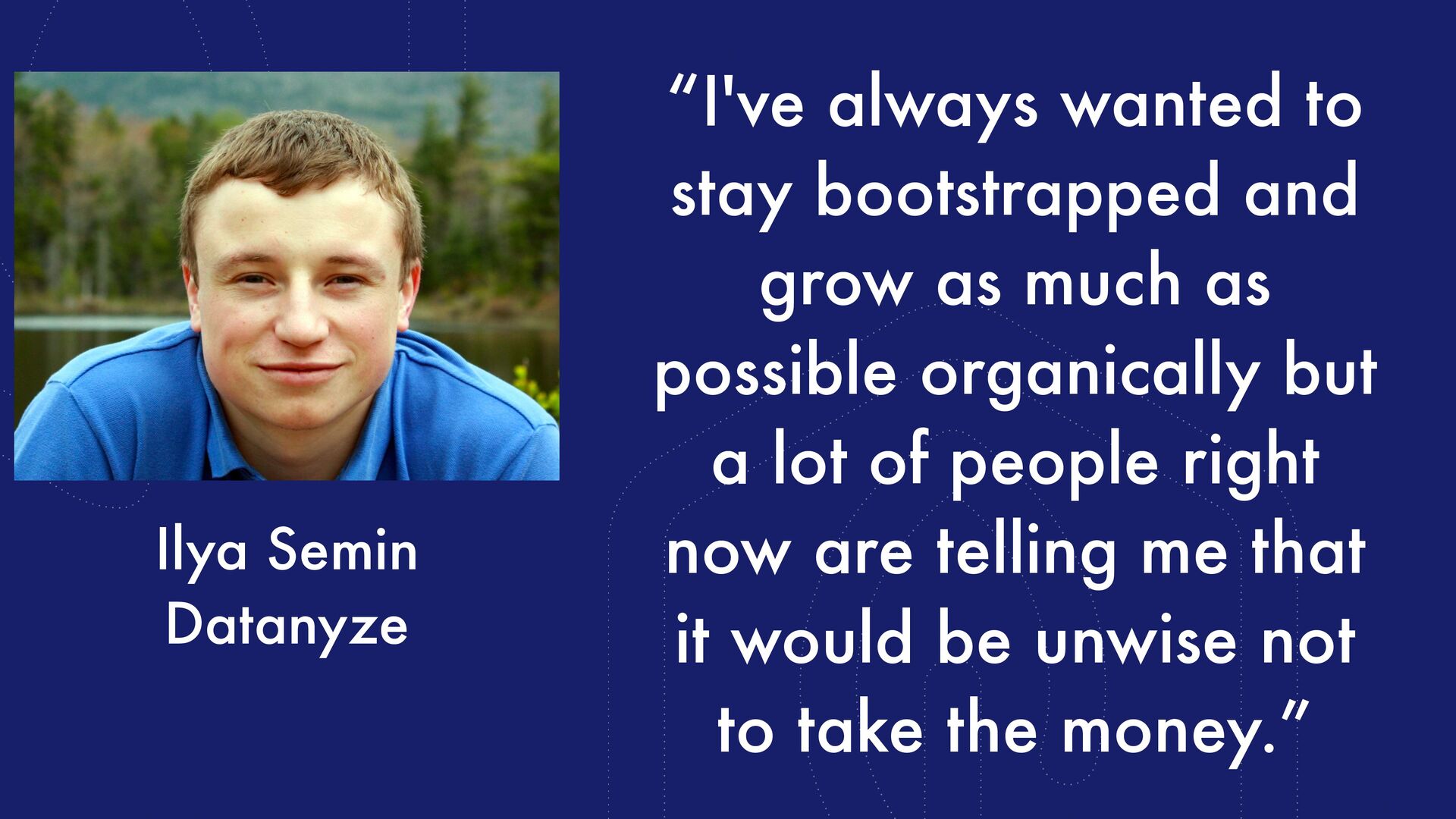
Just crazy. It's like growing five k a month. So he emails me and says, you don't know me. I read your book. I've always wanted to stay bootstrapped and grow as much as possible organically, but a lot of people right now are telling me it would be unwise not to take money.
And I said, yeah. Mostly investors tell you it would be unwise to take money all the time because they wanna invest in you. But he said, I wanna drive down three hours each way, and I want you to talk me out of it.
And I said, well, I'm not sure I can do that, but I can at least bring up why you shouldn't. Right? These are these are the cons. Like, how many board seats are they gonna have? Are they gonna have control of the board? And he said, no.
I have two or three term sheets, and they either have one board seat and I have three or whatever. Like, they they didn't have it. But this is one thing a lot of people fear is they're gonna wrench the company from my grasp.
Control of the company is a separate thing where the voting chairs can be more, blah blah blah. Do they have control of the company? Are they gonna pressure you to hire, and are they gonna pressure you to grow at a pace that is stupid?
Right? That just doesn't make sense for your business. And eventually, got to the point these are not the person cons, by the way. This is just the questions I was asking him at the time. And he got to the point where I believe I think it's public, because I think was on AngelList.
But, like, he raised at a ten million dollar valuation. And he raised whatever amount he raised, a million ish. So he sold ten percent of his company for a million bucks. And I remember thinking, that's not a bad deal. I would do that.
And so about three years ago, I was writing a talk. And I went back and I said, why did you take the money? You know, I know we talked through it. I couldn't convince him not to. Frankly, I didn't have a very good reason.
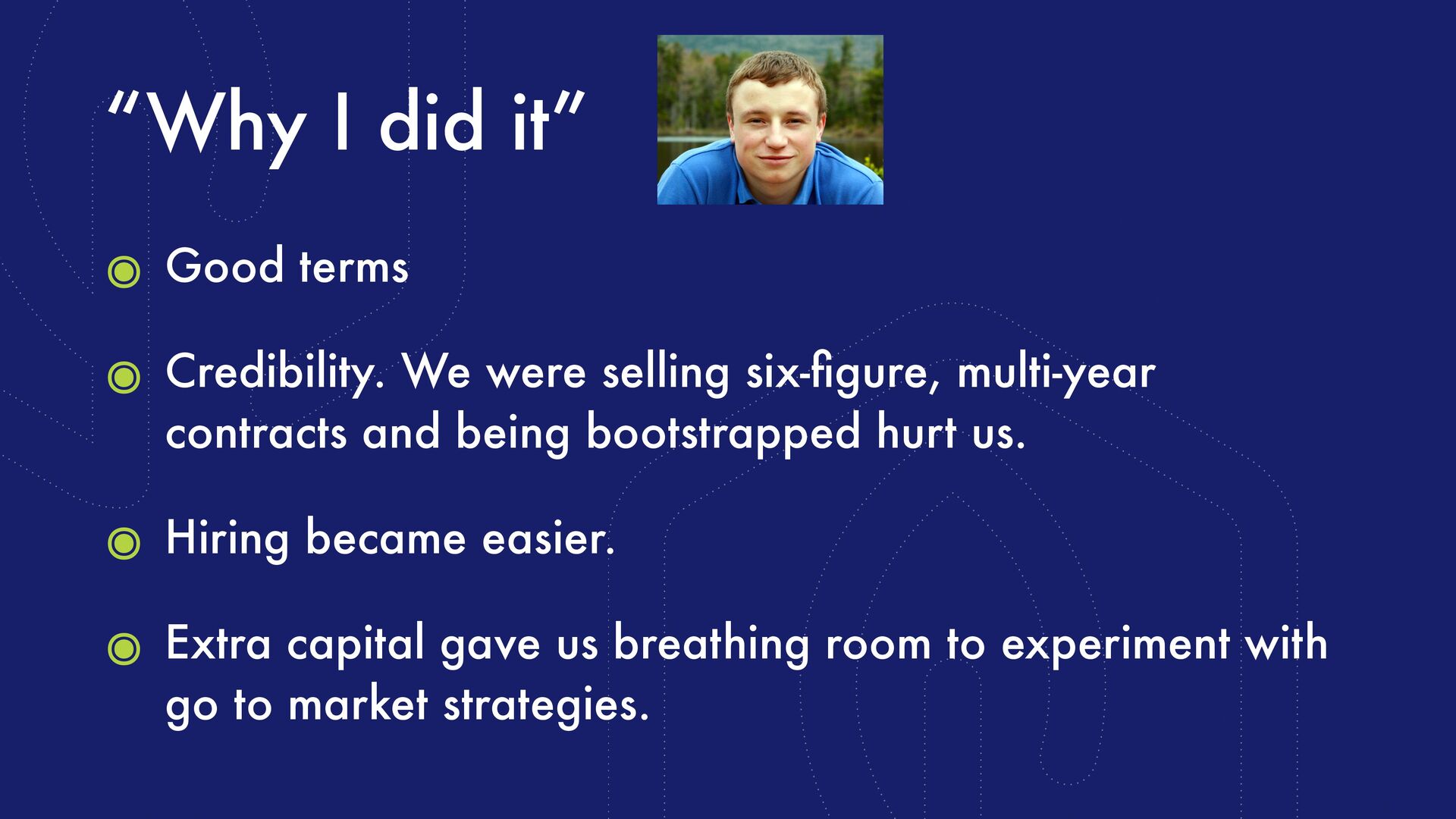
But he later told me these other reasons, which I think were really some I was not aware of, basically. Number one, he said the terms were really good, as I just said. Number two, the credibility that having funding gave him. I don't want this to be our world, but the facts are if you raise a chunk of money from a reputable funding source He said we were selling six figure multiyear contracts, and being bootstrapped hurt us.
Because you get credibility from being associated with these and being backed by these larger players. Hiring became easier. Similar. Who you know, when I was a bootstrapper, trying to hire someone away from a stable job, when they had a spouse and a child and a mortgage, it was hard for me to justify.
Having some type of funding cuts for those who'd raise it and unfortunately for us bootstrappers, like, it does become easier. And then lastly, he said the extra capital gave us some breathing room. They could live in the future. Right? They could experiment. They could hire. He ran that company for about six years.
He had an exit in twenty eighteen. I was a very minority investor. I threw in ten ks, ten thousand dollars in an angel list syndicate. And it was good outcome for him. It was not an amazing one, but it was a base hit.
And it was an interesting story because that was another time remember how I said in twenty twelve, 'thirteen, I heard the customer. Guy say, I'm going to raise and not raise again. And I was like, you can do that? And this was similar where I was like, ExVenture is not as the terms are actually becoming a lot more founder friendly.
They really are. So let's talk about pros and cons, and then we'll do indie funding, and and we'll wrap. So pros of venture, of course, you can move really fast. I've already beat this to death. You don't save months you don't save hours.
You do save years if you use it well. Hire senior people. You can hire them early. You don't waste mental cycles on small expenses. I can't tell you the amount of hours that I spent telling my engineers, can we shut off these EC two instances this weekend?
Because if we do it four weekends in a row, we're gonna save four hundred dollars, and that's gonna cover our x y z expense. Like, it was crazy now, thinking back, that I had to do that. And I don't know that I had to, but I did need the money to pay for stuff.
You don't do that. You don't do that when you venture back. Don't even think about a thousand a month. You have that instant network and the advice, assuming you take money from people, smart money, right, people who know what they're talking about. And market credibility per what Elias said. Right?
Of like, the market kind of at least gave us the benefit of the doubt when we came knocking, because they were backed by somebody that people recognized. There are probably a few other pros as well, but you know, these slides are only so big.
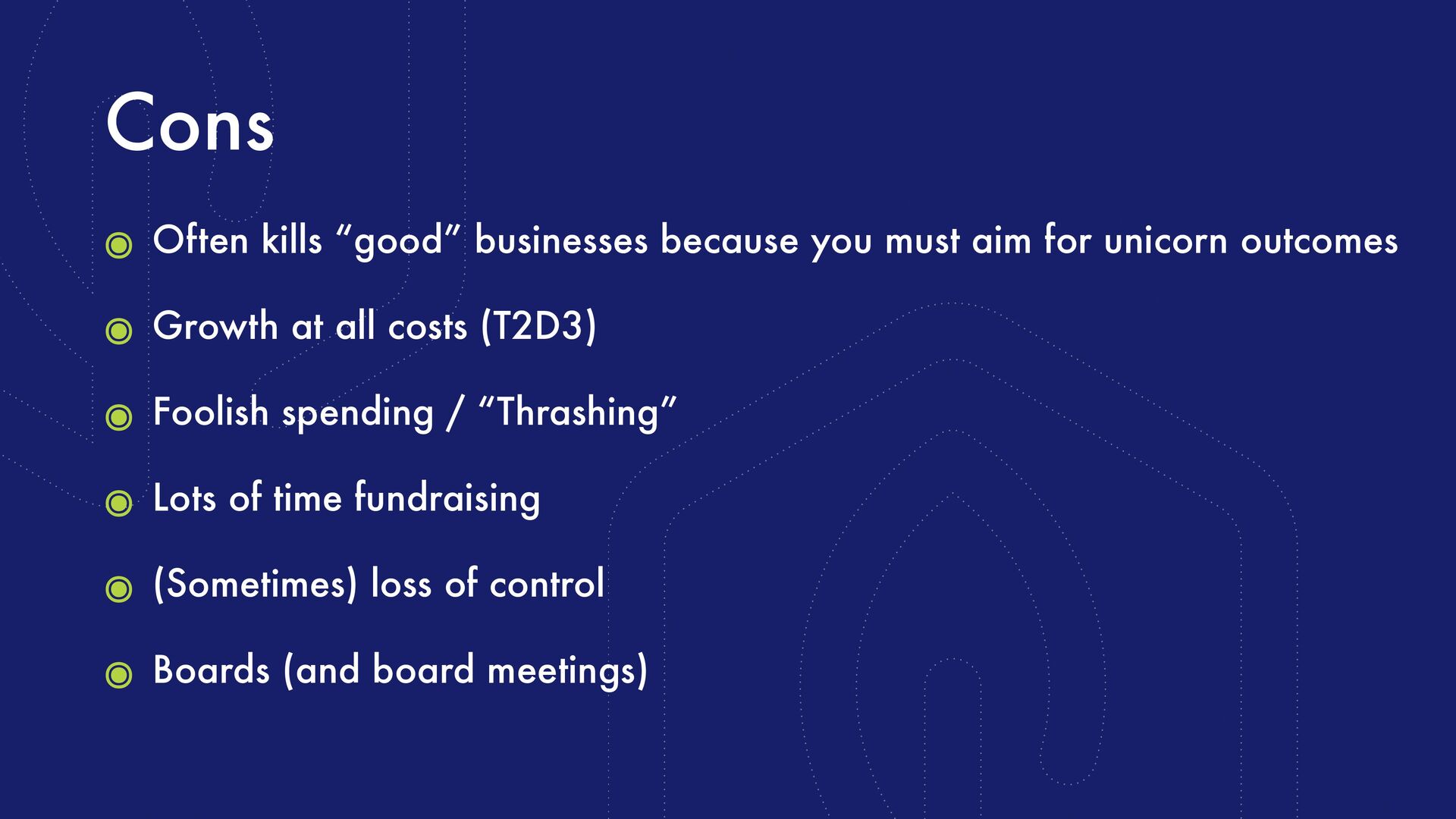
And then the cons are hopefully, there's a few here that you've thought of, and hopefully some that you've not. This is the one that often kills me is you can have a great business, and you're like, I'm at ten million ARR. This is amazingly valuable business.
And if you then go raise venture, they say cool. So you wanna get to a billion dollar valuation, usually means seventy five to a hundred million in ARR. Oftentimes, you have to break your business. You have to go to that, or you basically implode.
And we see this, right, as the as the market started correcting in the past six, eight months, how many businesses have we heard that are just imploding because they were shooting for the billion. Right? So when you shoot for the stars, you can you you you fly too close to the sun.
That was two mixed metaphors. Sorry. But it something about wax wings, the stars isn't they're not that hot. So good businesses, you must aim for unicorns. So this is one that I think if you're into Bootstrap or Indie Fund, if you just wanna do a ten, fifty million dollar business, like, that's still trust me, it changes your life.
Growth at all costs tied to that, triple twice, double three times. I won't go into it due to time. But if you Google t two d three, that's the growth trajectory they want. I worked at a venture funded business, and there were a lot of people there that I don't know what they did.
And I would say, why do we have six people who are like kind of managing this same thing? It was like, course, because head count. Because they told us we needed more people. Because if we're not hiring, then we're not succeeding. And that to me was just dumb. Right? Foolish spending.
So you get in these meetings with fifteen people, where the same meeting at my ten, twelve person company would be three of us. You know? And we'd get **** done. And you needed twelve, fifteen people, because they just didn't know what to do.
So I'm not saying every venture funded companies run like this, but trust me, a lot wind up in this way, especially when they get a big influx of cash. As founders, lots of time fundraising. Sometimes you lose control. I actually think this one is more overplayed.
I don't think it happens nearly as much as it to, to be honest. But you still risk it. Of course, boards and board meetings kind of suck. You'll find interesting it's probably the least important one. What you'll find interesting is a lot of things I've said this entire talk, even if you're not a founder, like even if you're a developer, even if you're gonna run product, even if you're gonna run customer success, these things impact you.
Because the thrashing, the foolish spending of money, the we have to grow, it's a pressure that goes through every employee. Right? And look, there are pros of going to a venture funded company. You're probably gonna get paid for the next twelve to eighteen months, at least.
You're probably gonna have better benefits than bootstrapped. You know, there's all these pros of being an employee at these companies. But the cons are that you have to deal with this. Right? You have to be on board for that. Lastly, in the last couple minutes we have, let's just talk briefly about indie funding.
And again, indie funding is not the solution. It's just another option. I often get asked, what types of companies take indie funding? So Rand Fishkin left Moz, which is doing forty five million, venture backed, SaaS app. And he started Sparktoro, which is also a SaaS app.
And he raised about I don't actually remember what the number was. Probably half a million. I'm I'm an investor. But probably four hundred, five hundred thousand. And he's doing it as just an indie funded long term company. He's not gonna raise venture. Rand Fishkin now is doing indie funding type stuff.
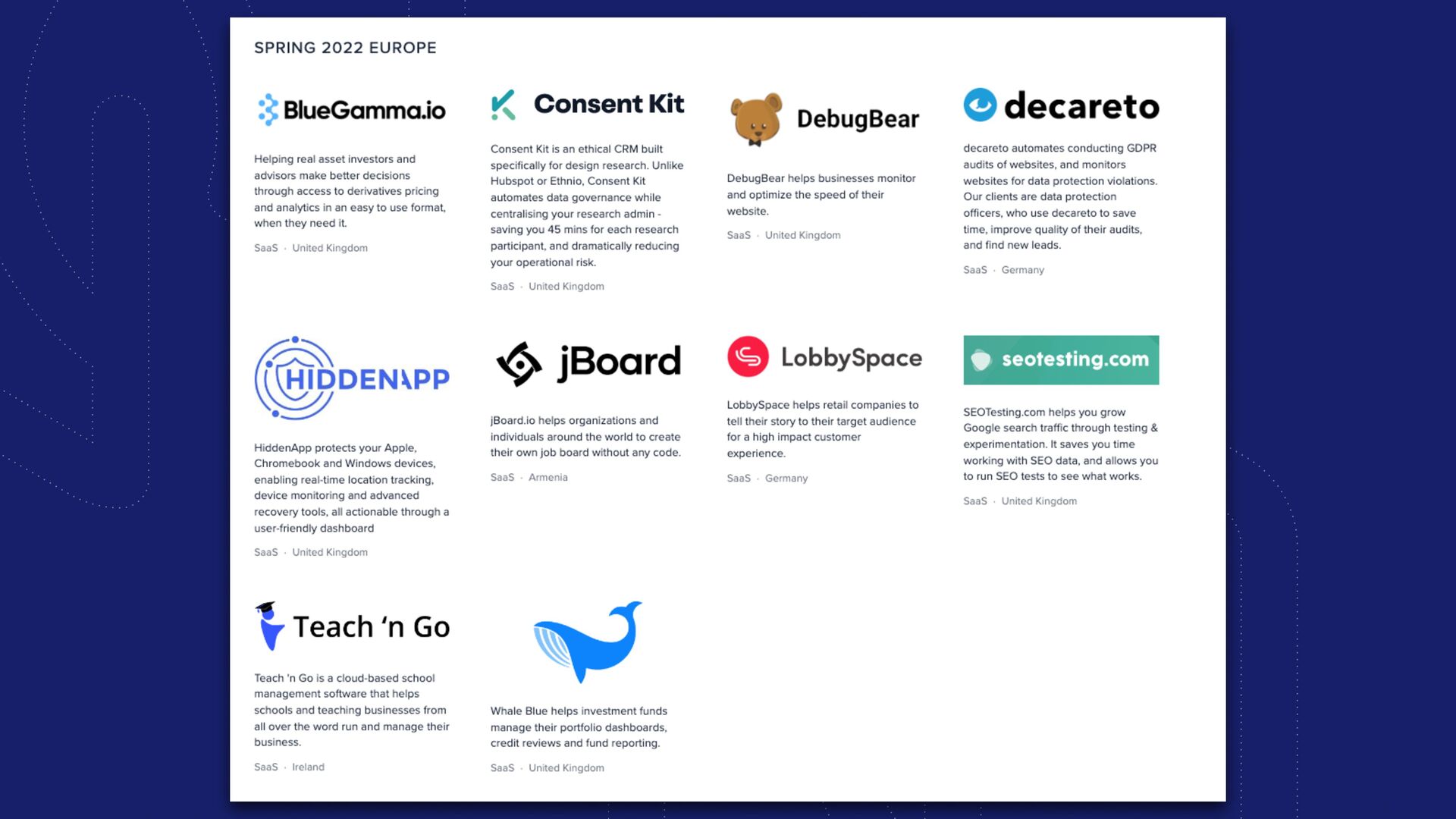
There's a company called CartHook, LeadFuse. Let me think of any others you might have heard of. Like RightMessage did this. Brennan Dunn and Shai Schechter. They're mostly indie funded. And then this is just we have funded eighty two companies, but I think there's about there's ten in our Europe batch we just funded, and there's maybe another five in previous batches.
But if you look at the types of companies, some of these could go after venture. Like, j board is a job board SaaS. You could absolutely make a pitch that, like, this is a this could be a billion dollar company. But he really he sees the value of, hey, I can get to twenty, thirty million.
Like, this is a this is a clutch for us. Lobby space is an interesting one, because it's like it's the software to run the image, you know, on your monitors in a hotel. And you could see that being a billion dollar business, could see it being an amazing ten, twenty million dollar business.
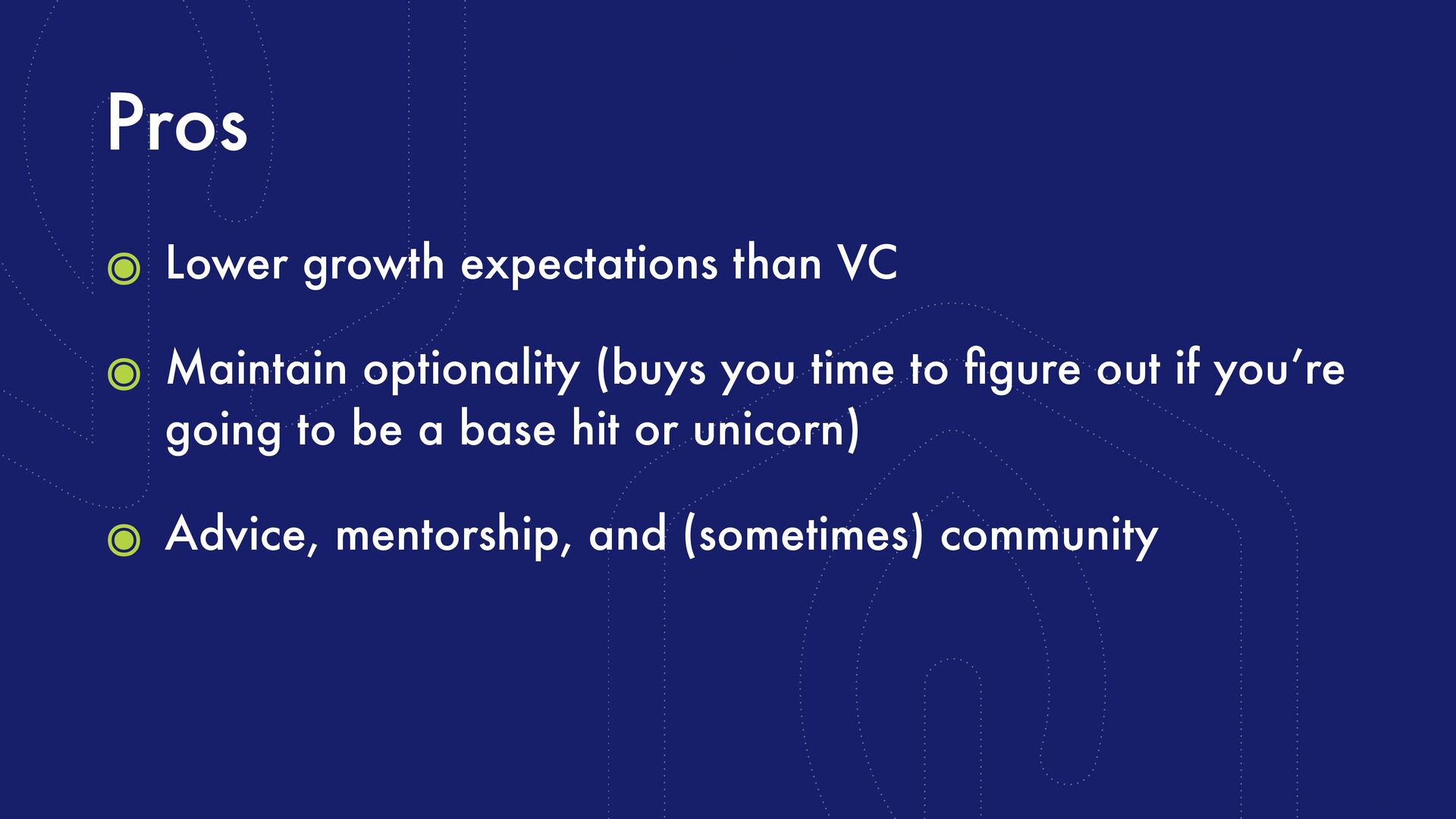
Some of these can go both ways, and then other ones, I think the markets are probably smaller than you could get there. So going through it. Your pros are frankly, the growth expectations are not like venture. You maintain the optionality. Right? It buys you time.
It's like if I'm at five hundred thousand a year, do I know if I'm going be venture or not? Do I really know that yet? And so it buys you time to figure that out. And then at least if you're going through a fund, you do get the, I'd say, venture comparable advice, mentorship, and community.
And the cons I believe this is the last slide is in order to make indie funding work, the valuations are lower. Right? It's like when you raise venture, there were people were getting, like, fifty x multiples on their revenue to raise venture rounds before the collapse here over the six Fifty x thirty to fifty x. Was crazy.
Indie funding was always in that whatever. I don't know if it's five to ten x. I mean, was just a smaller, you know, a smaller range. And that's that allows them then to to make money at a twenty, thirty million dollar exit. And that's why, venture can't. So valuations are lower.
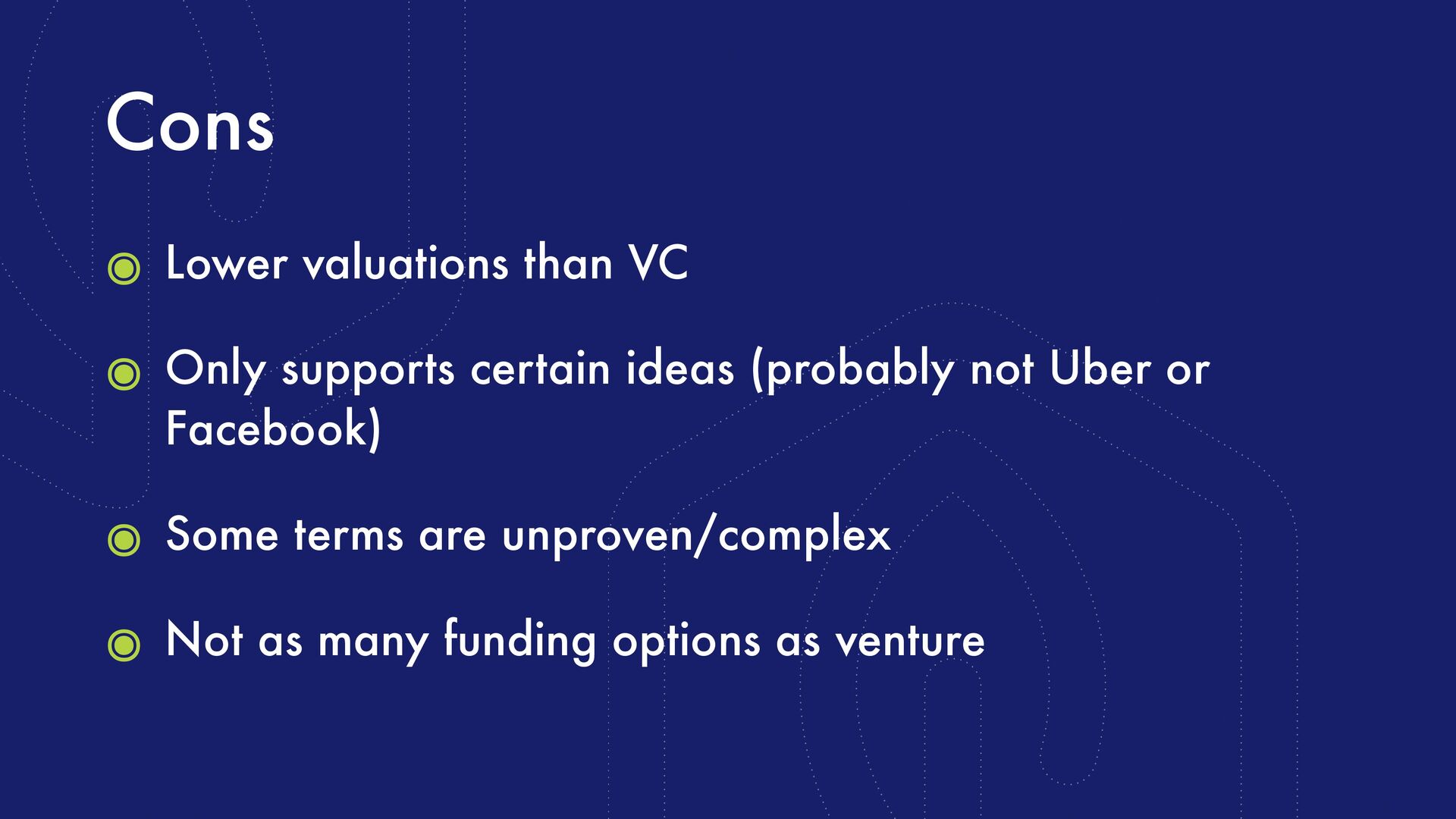
You're gonna give away a little more of your company. Again, probably shouldn't have indie funded Uber or Facebook. Right? So you can only do certain types of companies. Some of the terms in the space are unproven or complex. We decided to go with straight equity.
But there are some terms that are in other funds that are like if then elses. Right? It's like you can buy back some equity, but if you don't buy this time and you sell, then this happened. And it's like you really have to read through it.
So this is not as simple as a safe or convertible note in some cases. And frankly, there are just not as many indie funding options. Right? If there are a thousand VCs in the world, there's one to two thousand. There are probably ten, maybe twenty indie funds.
And then there are I know there are hundreds of angel investors, because we have hundreds of LPs, investors in our fund. So I know there are least hundreds of people who back the message, but it's not huge yet. But I will tell you, I knew like five investors back in twenty fourteen who were into this.
And at least today, know hundreds. So could we have thousands here in the next few years? So that's it for me. Thank you so much.