When a company has clear differentiation (the reason their customers choose them over others), everything in the business gets easier.
But a company’s differentiation only lasts as long as their ability to improve faster than others can copy. And one thing guaranteed about being successfully differentiated, is that you will be copied. Therefore speed of executing new differentiation is critical.
Success also means growth: more people, more teams, new roles. And as a company grows, it inherently becomes more complex. Complexity will kill momentum, which kills moving fast. Sadly, the default is often to slow down, get copied, get beaten by someone faster.
If you’re fast, this is your opportunity. If you’re slow, this is your biggest threat.
The good news for all sides is that moving fast is something you can control. As Intercom has grown from 10 to 100 to over 1000 people, we have obsessed with speed at every stage. And every time we have slowed down, we have been able to introspect, adjust, and move fast again at our new scale. This talk will explain how we do it, with pragmatic advice for all sizes of team.
1 / 79 Use ← → to navigate
Auto-generated transcript - may contain errors.
Tap a timestamp to jump the video.
Hey folks, thank you. First of all thanks to Brian and the team for having me here. It's fantastic to be in Edinburgh finally. It's the first time I've spoken at a conference in front of a live audience in a long time, so thanks for all coming out this morning.
So what I thought I'd talk about this morning is the journey that Brian just described. I joined Intercom when we were just over ten people nearly ten years ago. We're now just over a thousand people. So going from ten to a thousand has been a pretty crazy journey.
Loads of highs, loads of lows, we've made countless mistakes. But one thing that I think we've done well is that we've managed to keep shipping product as we've scaled. So at every single step along that journey, sometimes we slow down, we were always able to speed back up again.
Last year we shipped one hundred and fifty product updates, which is three a week. Some of these are like small changes to the products, they're all customer facing. Some are like totally new products themselves. We're obsessed with this, obsessed with speed. And we think that speed is the single most important thing any company, whether you're big, small or otherwise, you should be obsessed with it too.
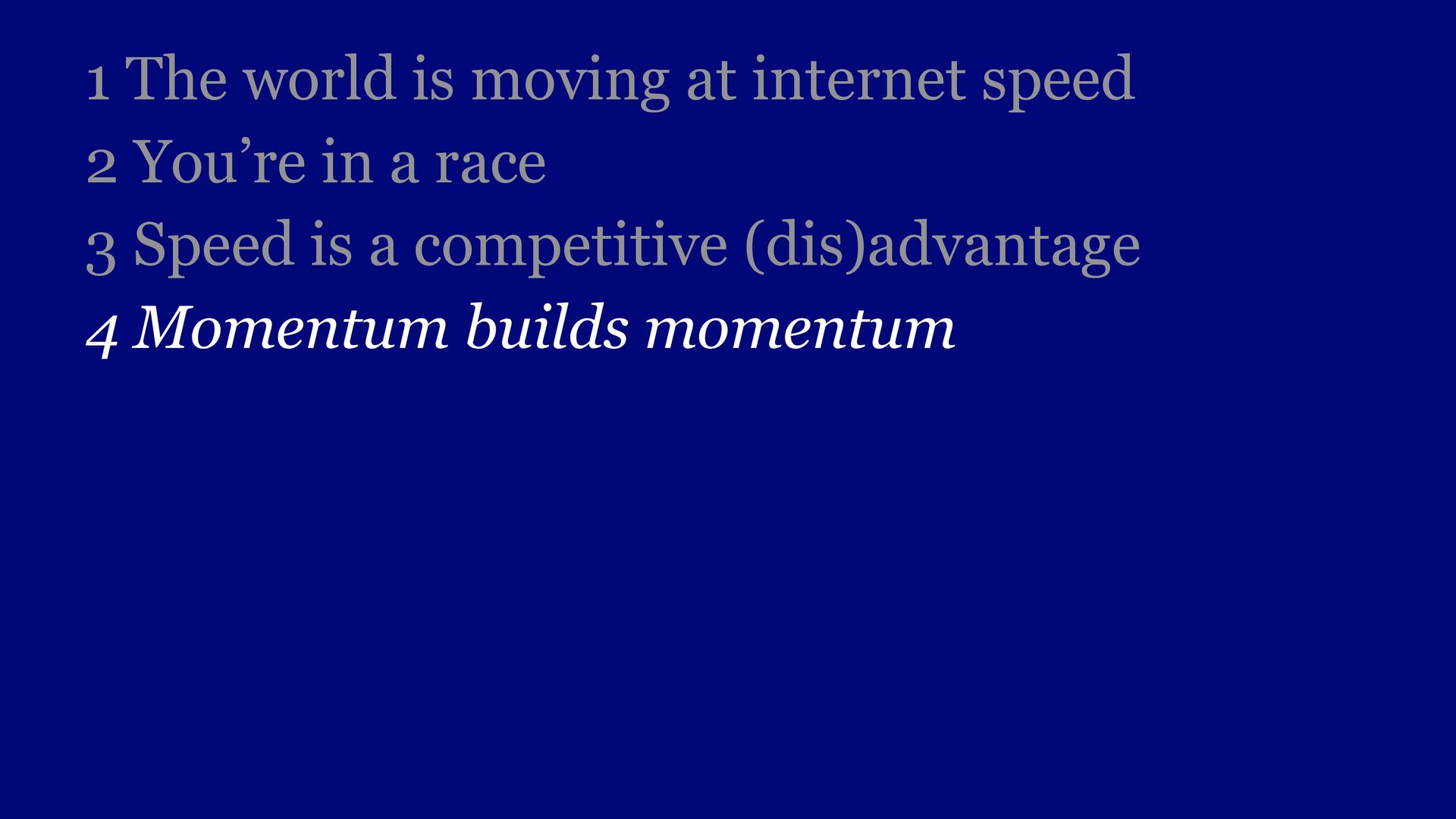
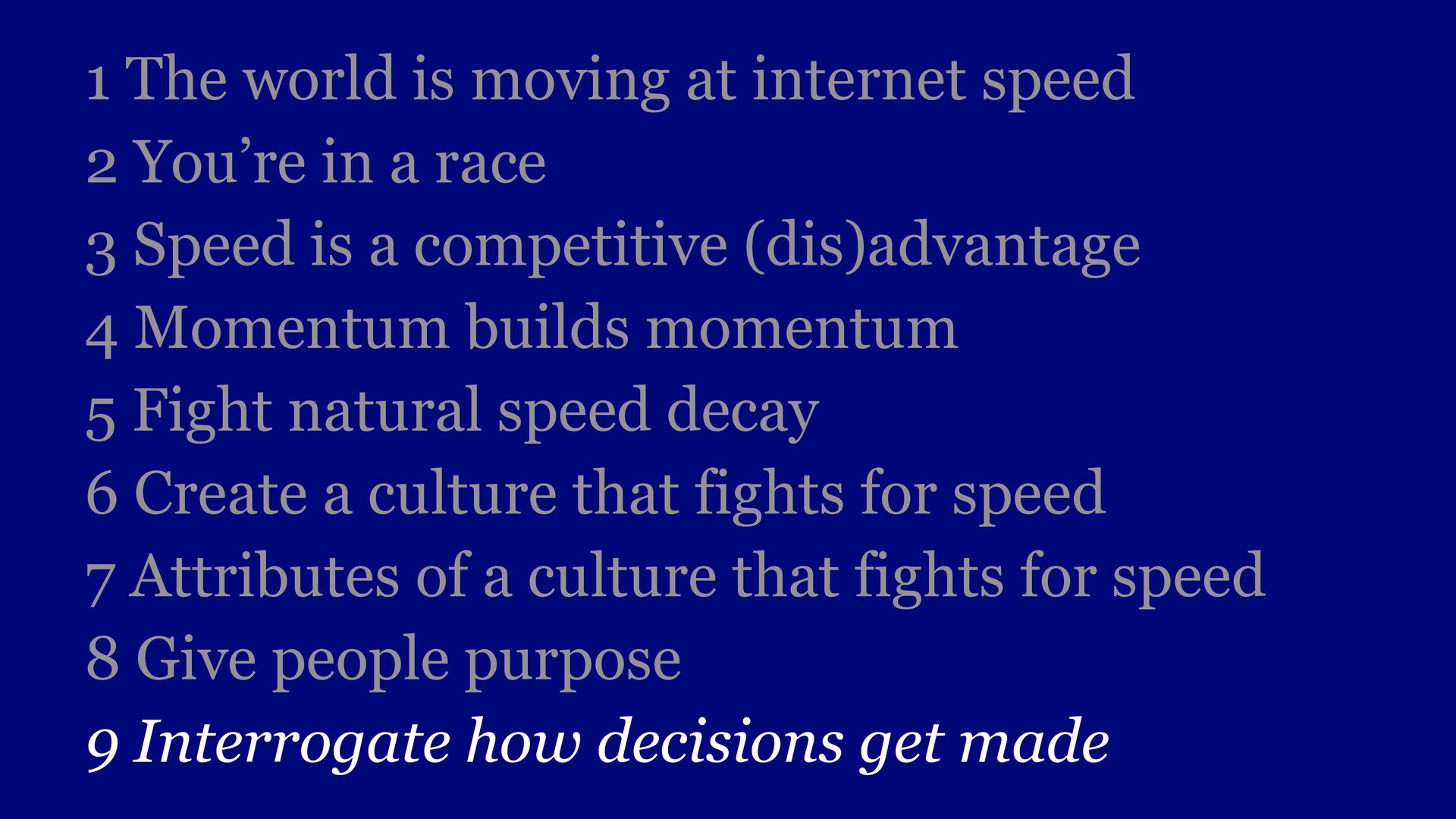
So this is what I'm going to talk about. There's a lot of things in here. Akin to the talk, I'm going to talk at speed. So the very first thing that I want to convince you of is that the world is moving at Internet speed, and you need to move at Internet speed.
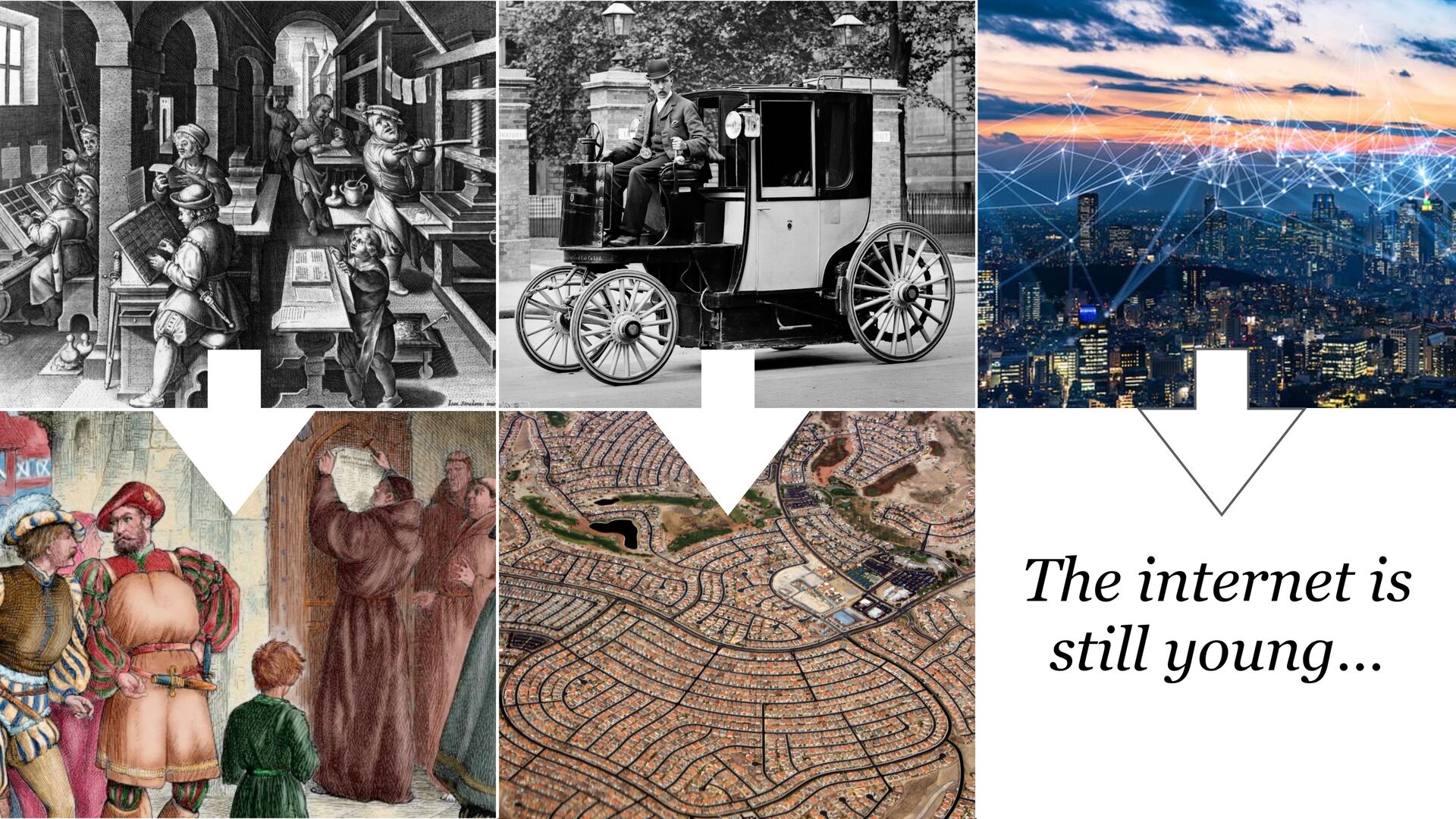
So this is a picture of the Internet, apparently. And I'm assuming if you're here at Turing Fest, you are working on Internet software. The Internet is just a transformational technology. I think we just don't even understand it yet. Top right, another picture of the Internet.
Top left is the printing press, led to the dissemination of information, completely changed how humanity works and operates. The same for the combustion engine led to things like suburbia, Walmart, McDonald's, all sorts of weird and wonderful things that could not have been imagined when the combustion engine was invented.
Same for the Internet. The Internet's very young, twenty years old or so, and it is transformational. And when I think about the Internet and the defining characteristics of the Internet, I think one of the most defining characteristics of it is that you can transfer data at speed.
What that means is that people can build things really fast. You can use Internet technologies to get better and better and better, to create and build. And you see it every day, whether it's on Product Hunt or other places. There are new startups and new products and new ideas.
Every single day. Every single day. And so the question I often ask people is, when you think about your own company, your own team, are you moving at Internet speed? In other words, the Internet is evolving and technology is evolving and companies are evolving incredibly fast.
And the question is, is your company moving as fast as the other things? That is what Internet speed is for me. And if you are moving as fast as the Internet is overall, you're in a phenomenal position. If you're not, you're in a very precarious position.
And it doesn't matter who you are. It doesn't matter if you're a big company, or you think you work in some service that has some mode around it. There are very, very few businesses out there, government, that can't be disrupted by the Internet.
And so it's really important. When I talk about Internet speed to people, I often say to them that you're in a race. You're in a race. And I hope you like races, because I'm going to talk and show you races today. You're in a race.
Whether you like it or not, you're in a race. And different companies move at different speeds in this race. Oftentimes smaller companies move faster, bigger companies move slower because they're more complex, but that's not always true. Sometimes small companies really struggle to move at speed, and sometimes big companies really transform themselves and get to move at speed, at least in places.
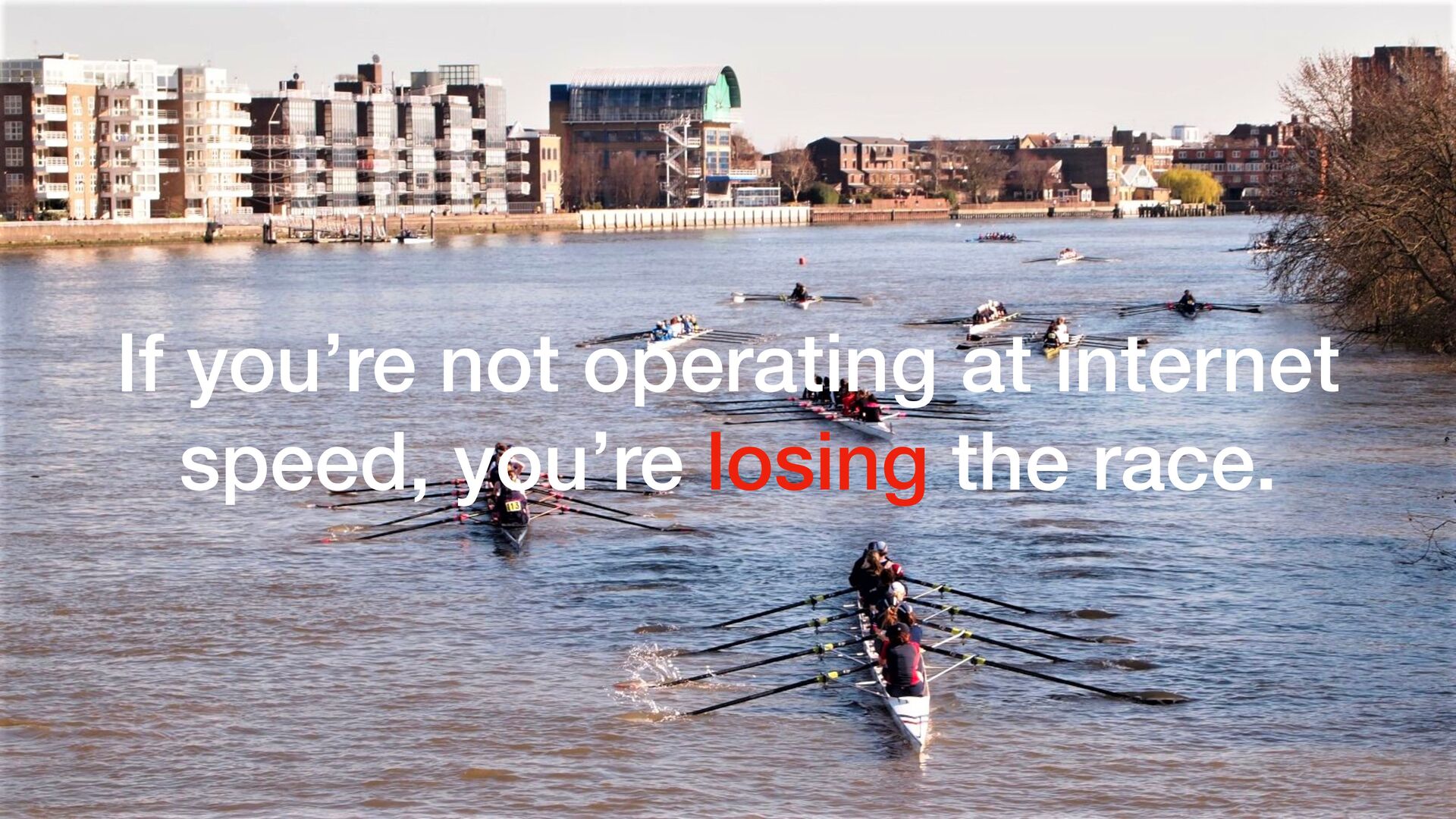
And so in this race, no matter what your market is, it's different for all of us, but we all have competitors, and we're all in this race together. If you're not operating at Internet speed, you're losing the race. You're losing the race. And it may take months or it may take years, but if you're not operating at internet speed, someone is going to catch up with you.
And the reason this matters is because when people think about what product they're going to buy, look at all the competition, they don't, subconsciously or otherwise, don't always think, is this product good enough for me today? They're thinking, is this product good enough for me today and into the future?
They look at the product and think like, is this current generation? Is it next generation? Does it just feel like it's modern? Does it feel like this thing is going to last? And more importantly, is it changing? Can I see this product is going to get better and better?
So what I'm buying today will continue to just get better and better and better. And so businesses have to think about this. You've got to think, are you ahead of the curve, or are you building yesterday's technology tomorrow? You have to think about this.
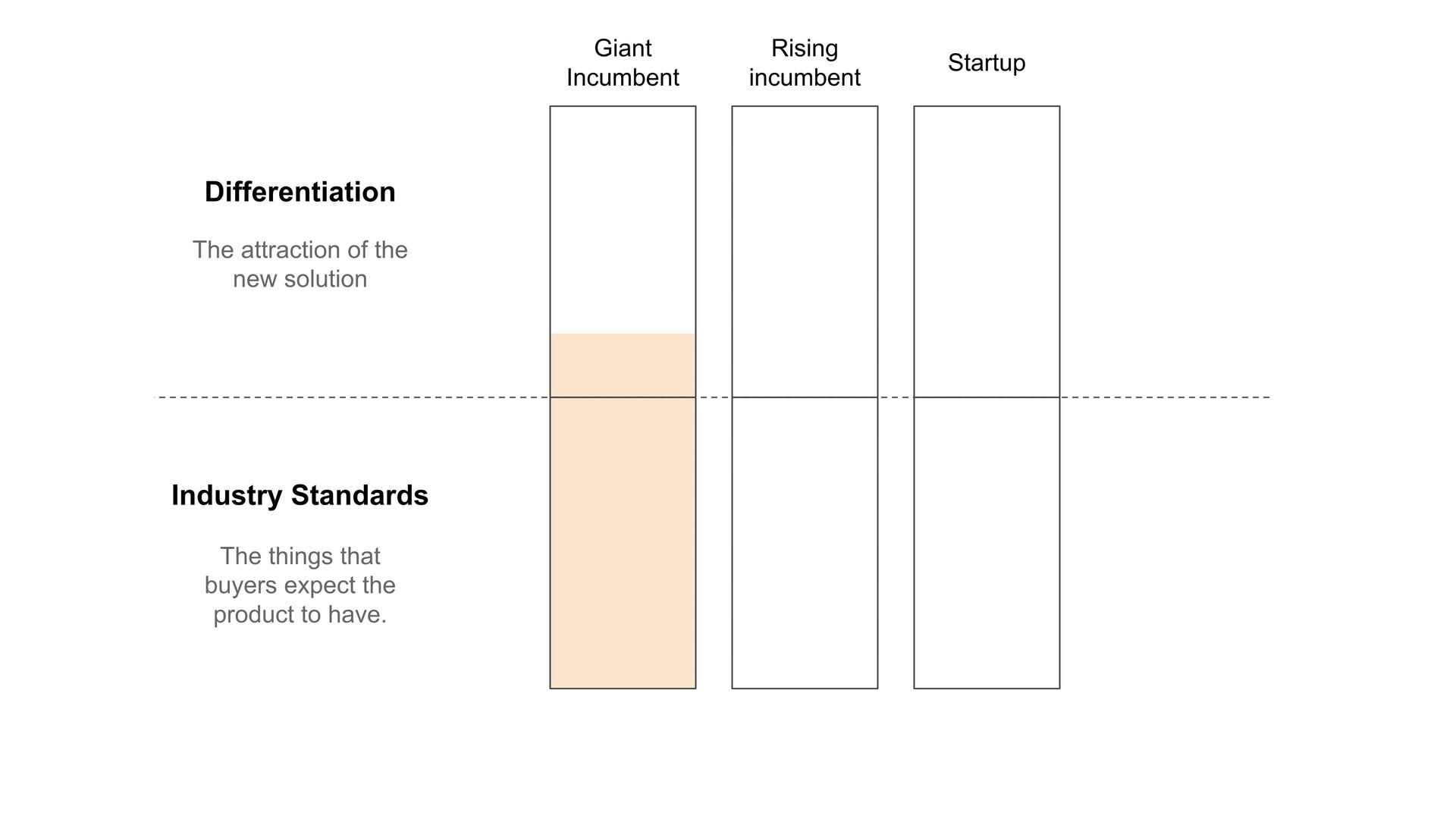
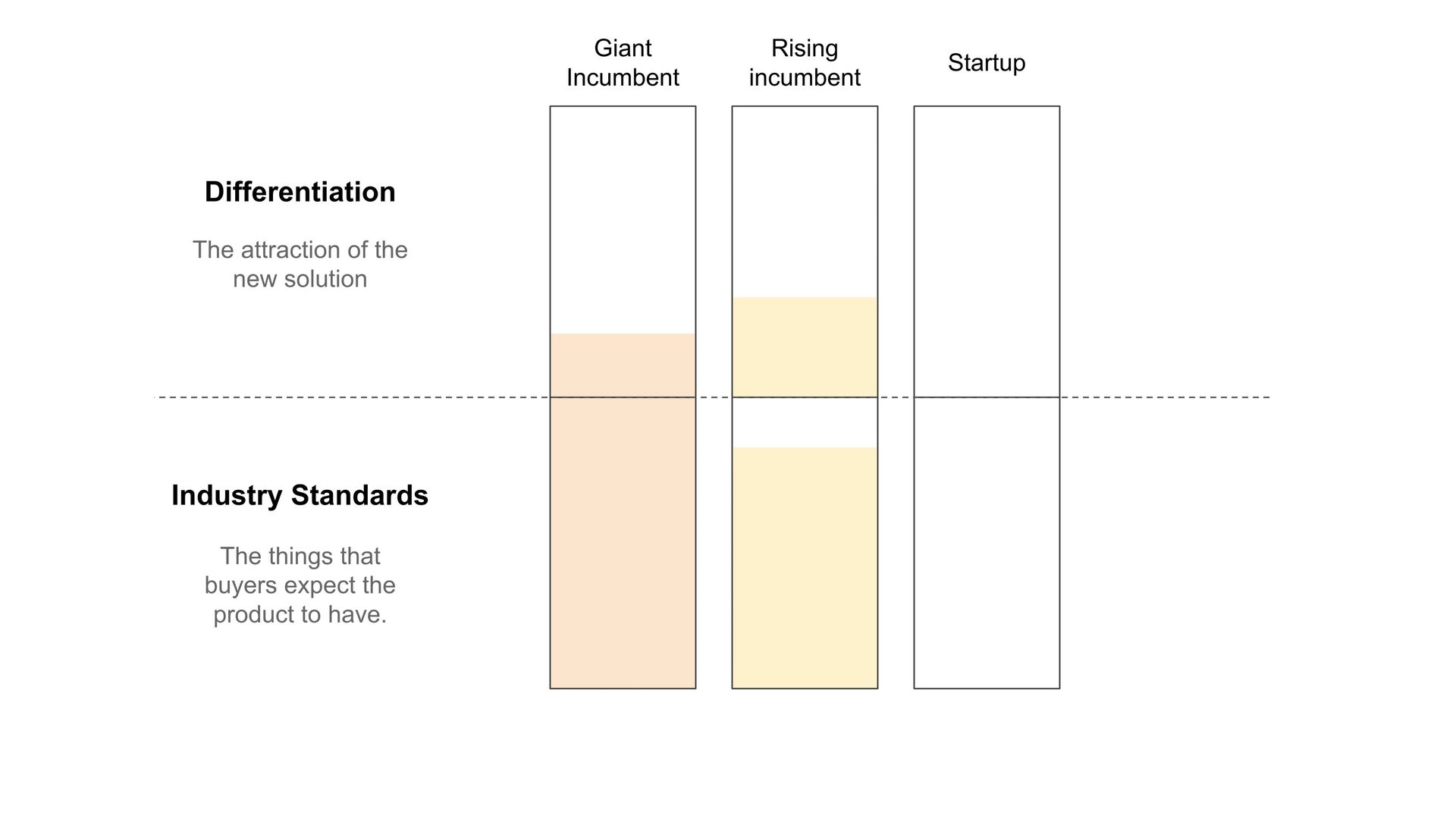
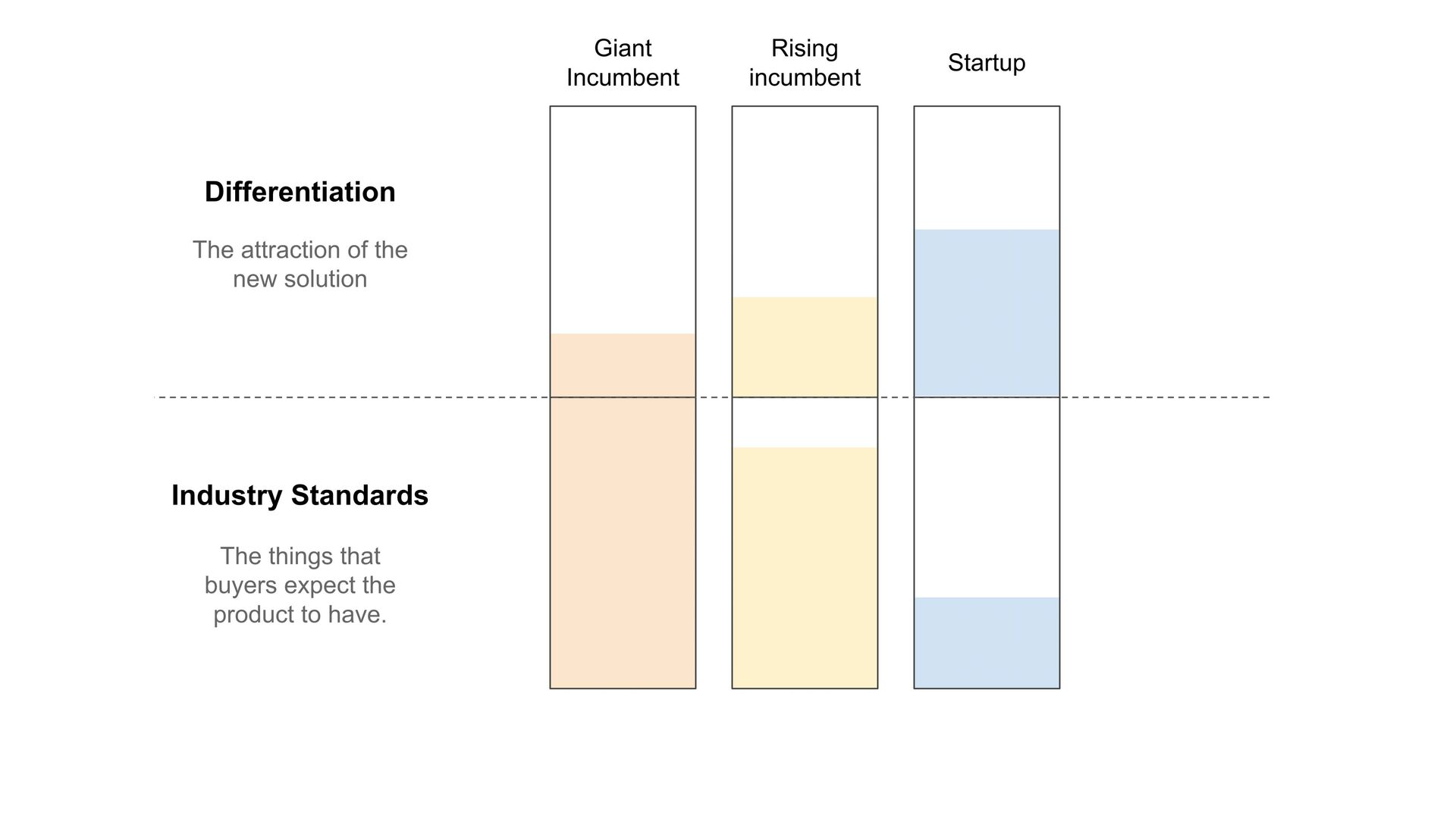
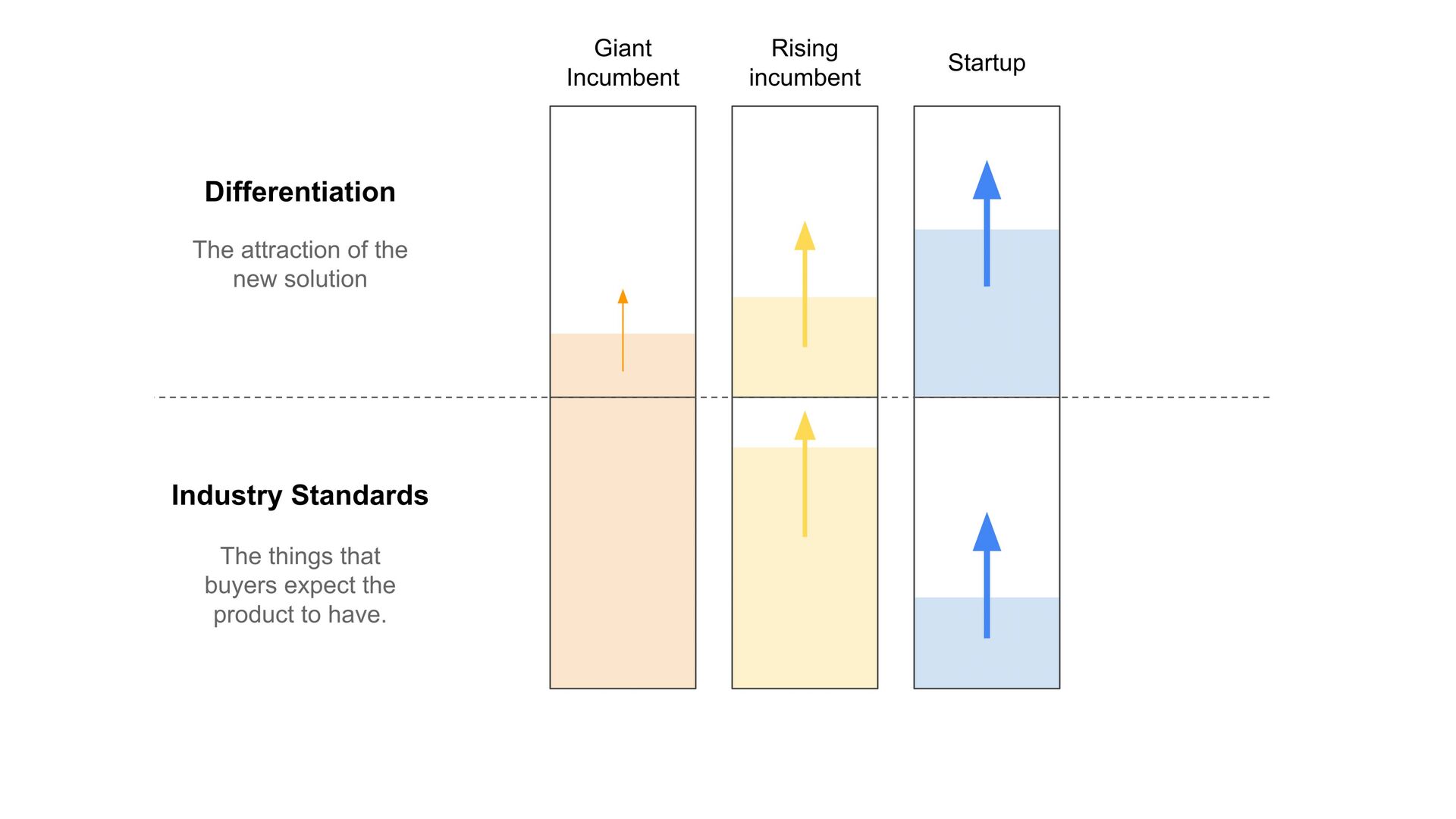
This is oftentimes how I describe this to people, and I think this more or less applies to everyone too. There's on this chart, have two different types of features you can build. You can build differentiating features, which attracts things that are different and better.
They attract new customers to your product to make them want to buy the product. Then there's industry standard features. These are things that in your market, people have come to expect. And you have different types of companies too. You've got big, giant incumbent companies being around for a long, long time.
You've got these rising incumbent companies who are pitched as the next giant incumbent, the people who will disrupt this big giant incumbent. And then you have startups. And then maybe there's a fourth scale ups, if that's a thing. It's kind of in the middle here somewhere too.
But if you look at this, the big giant companies who've been around for probably decades they've all the industry standard features. They've literally spent years and years and years building them. They've got them all. But they're not that differentiated. The reason you choose them is because they're just the one that's you it's like you don't get fired for buying IBM.
And so if the kind of like bar here is the full feature set, they have a lot of the industry standards, not that differentiated. The rising incumbents have to be more differentiated. If they're not more differentiated, why the hell would you choose them over the giant incumbents?
Right? It's just a riskier thing to do. And they're typically younger, so they don't have all the industry standard features yet. And then in start up land, these companies need to be extremely differentiated. Extremely differentiated. Otherwise, you would never choose to buy the start up's product.
It's just why would you? You can buy the rising incumbent, still looks pretty differentiated, still looks pretty good. The startup, because it's young, doesn't have industry standard features. Because it takes years and years to build this stuff, and honestly, years and years to understand it, and understand what the industry expects.
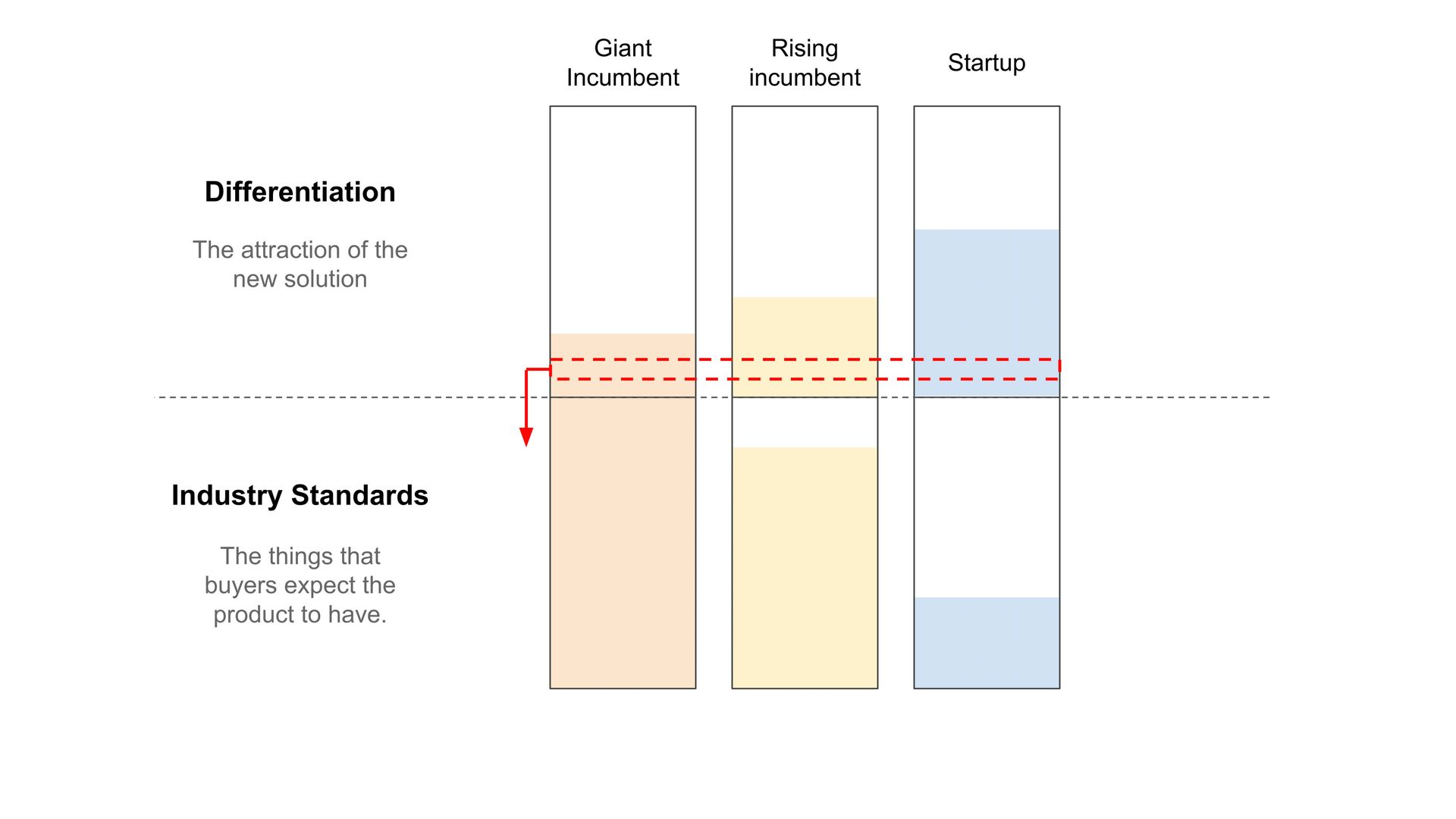
And so this is kind of how this plays out. As time passes, the big companies copy the small companies. And if you have great, brilliant, amazing, differentiated features, they will be copied. They'll be copied over and over, and it is depressing, let me tell you, but it's real.
It's just a reality. And then, you know, sometimes you realize, maybe we can copy other people too, which is kind of our journey. And so, as things get copied and everyone gets the differentiator, it moves down. And suddenly now it's an industry standard, and this is how these markets evolve and technology evolves.
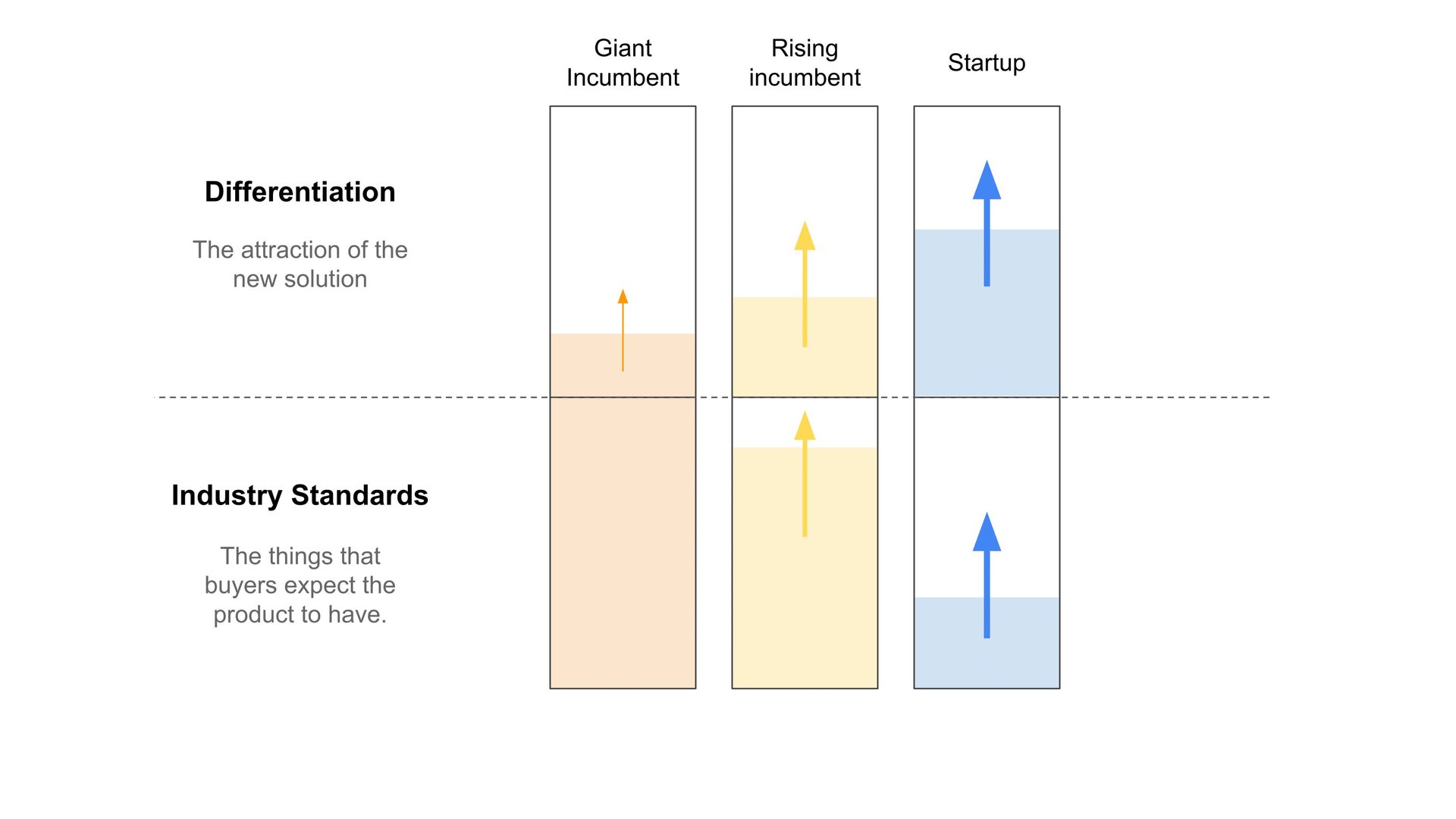
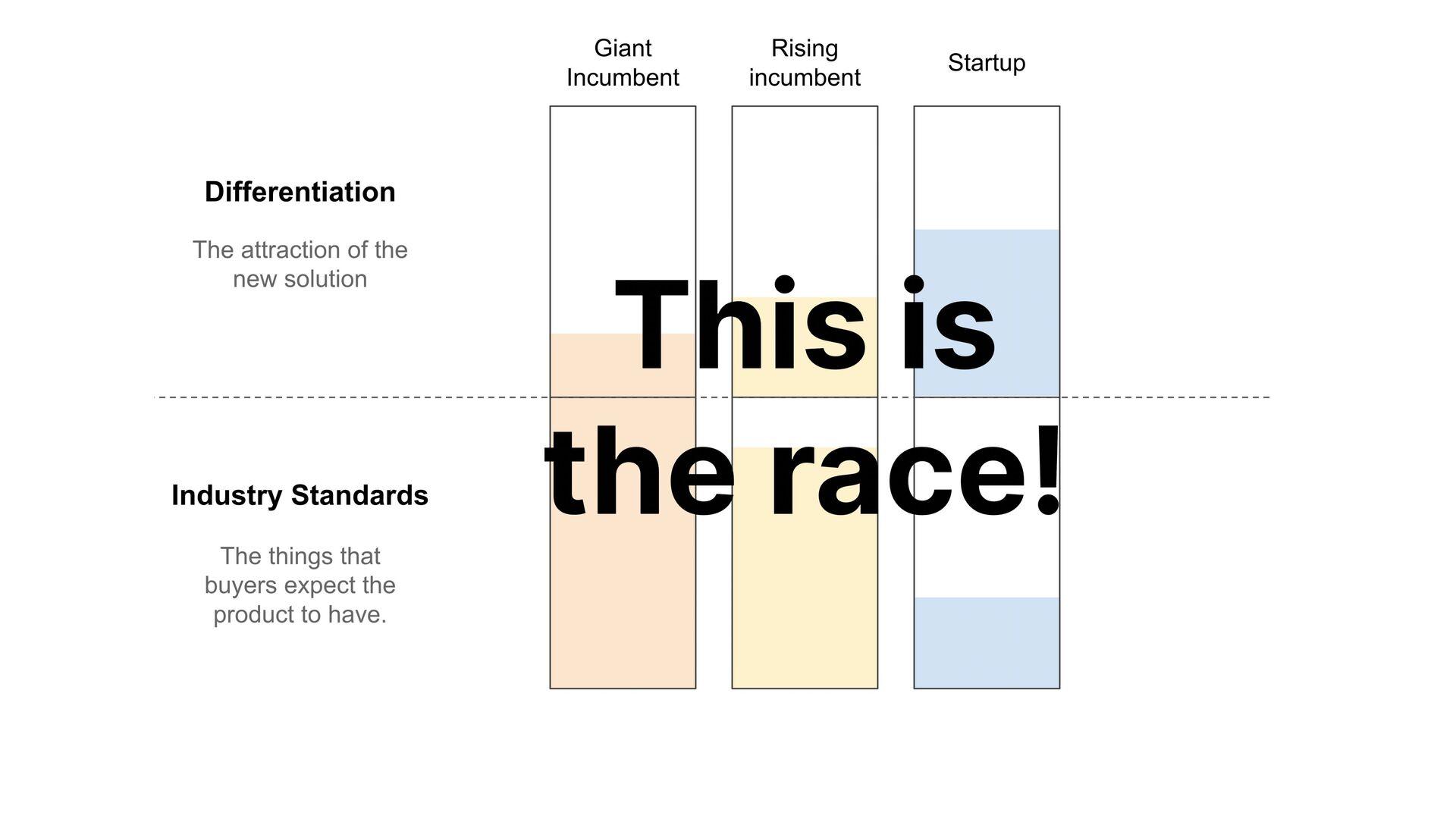
So is kind of how this works. And when you look at the full picture, there's obviously a race happening here. These bars are moving up at different paces depending on the companies. And the question is who's moving the fastest? And this is literally the race.
This is literally the race that I think everyone here is in. And you can be out in front, you know, known as the innovator, the new thing, the hot thing, the next generation thing. You can be somewhere in the middle, where you're copying these features fast, which is a very valid strategy too, or you can be lagging behind.
And the thing about this is it doesn't just impact the product and your customers, it impacts your brand. Your brand suddenly becomes known as the company out in front, the next generation thing, or the laggard, the company who are still just getting in the way of themselves.
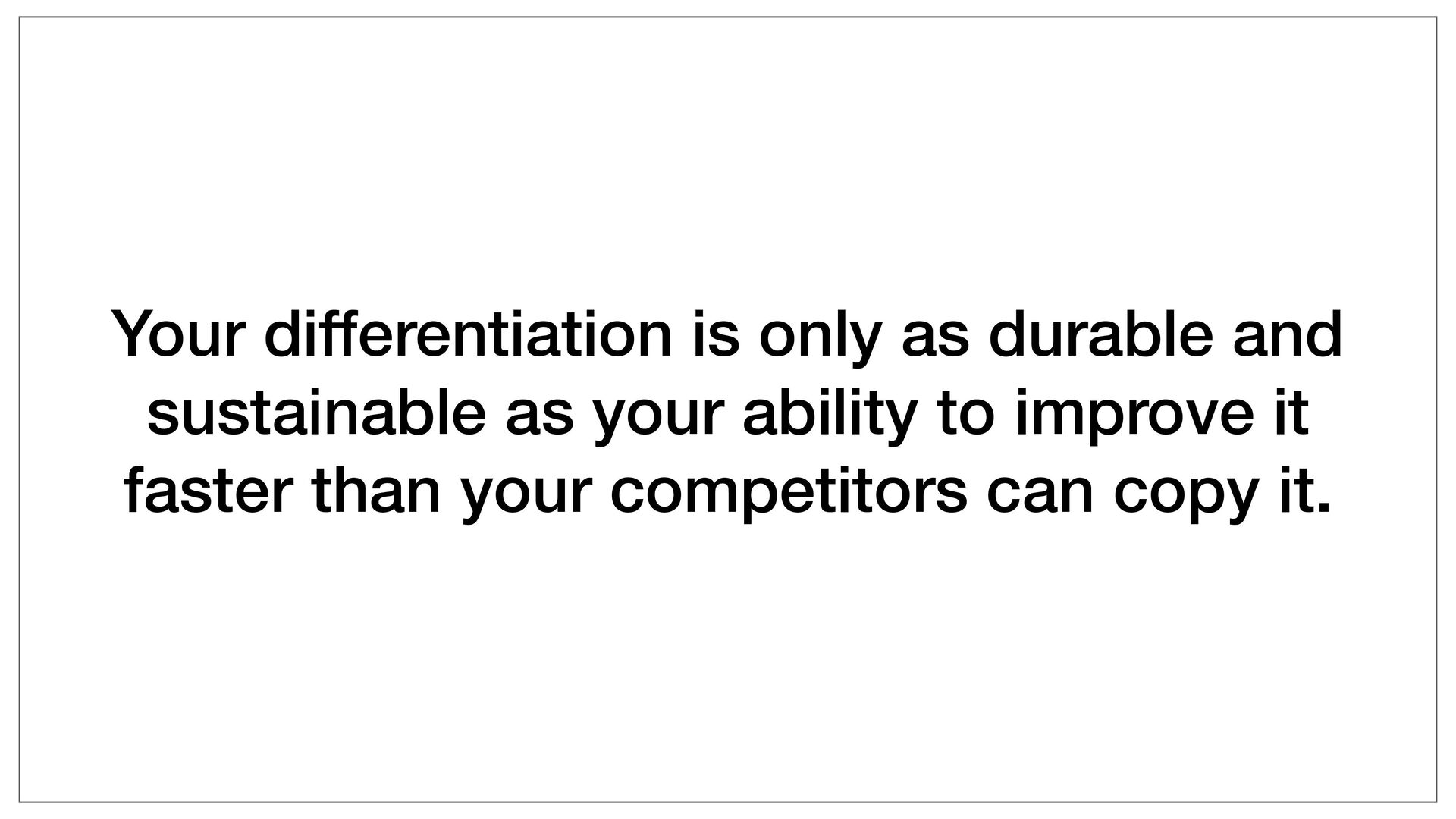
And way that I think is most powerful to think about this is that your differentiation is only as durable and sustainable as your ability to improve it faster than your competitors can copy it. And once you're copied, there is no reason to pick you anymore, and you will be copied.
And actually, cooler you are and the the most amazing, you'll be copied even faster. Even faster. So this is this is this is what people need to think about, in my opinion. You've to think about how you're How is your company doing in this race?
One of the tricky things about this race is that it can be very misleading. You can think you're kind of one of these boats here out in front, and look at these red and yellow circles behind, and you don't know how fast they're going.
And we've all seen sports, watching the Olympics or whatever, where suddenly someone comes out of nowhere and wins. And that happens in our world too. It's really important that you can look around and know and understand who's moving at different speeds, Because if you get it right, it's a massive advantage, a huge competitive advantage.
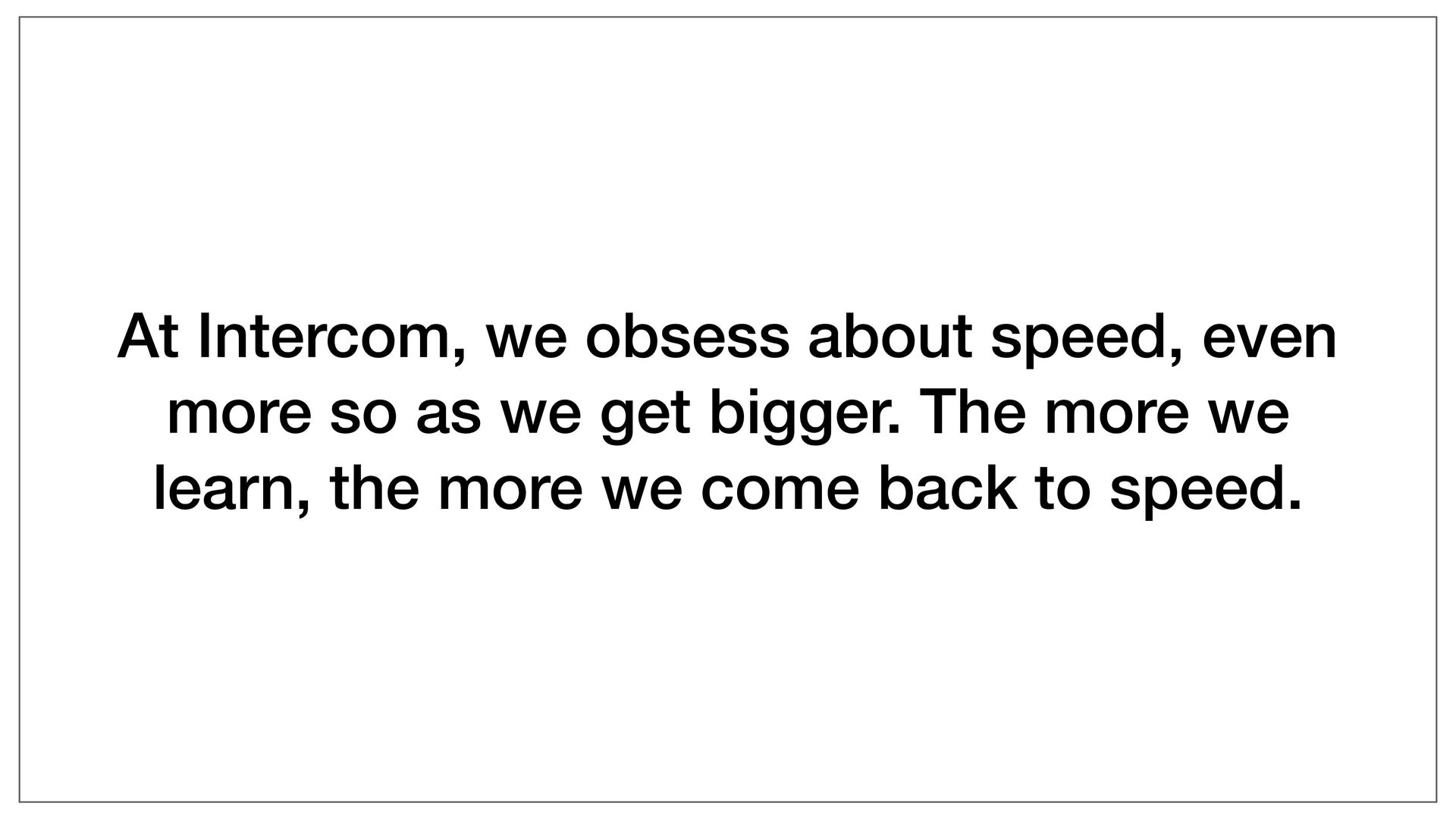
And if not, it's a huge competitive disadvantage. And so this is why we obsess about speed. We obsess about speed. And even as we get bigger and bigger, we obsess about speed even more. We just keep coming back to speed. We have all sorts of challenges and problems and highs and lows, like I said.
We make tons of mistakes across the company, across orgs, but we keep coming back to speed over and over and over again. Another kind of powerful way to think about this is that you can be fast or you can be good. Fast gets good quicker than good gets fast.
So people often look at small companies, look at startups, bigger companies look at the smaller companies and say, they're product kind of ****. They will get fast. Sorry, because they're fast, they'll get good. They'll get good because they're fast. And this is again going back to internet speed, the faster you can improve, you'll get better and better and better.
So if you can outperform on speed, you will win. I think you will win if you can outperform on speed. When I think about speed and talk about speed to people internally, I actually often talk about momentum instead of speed, which sounds a confusing because I just talked about speed for like ten minutes.
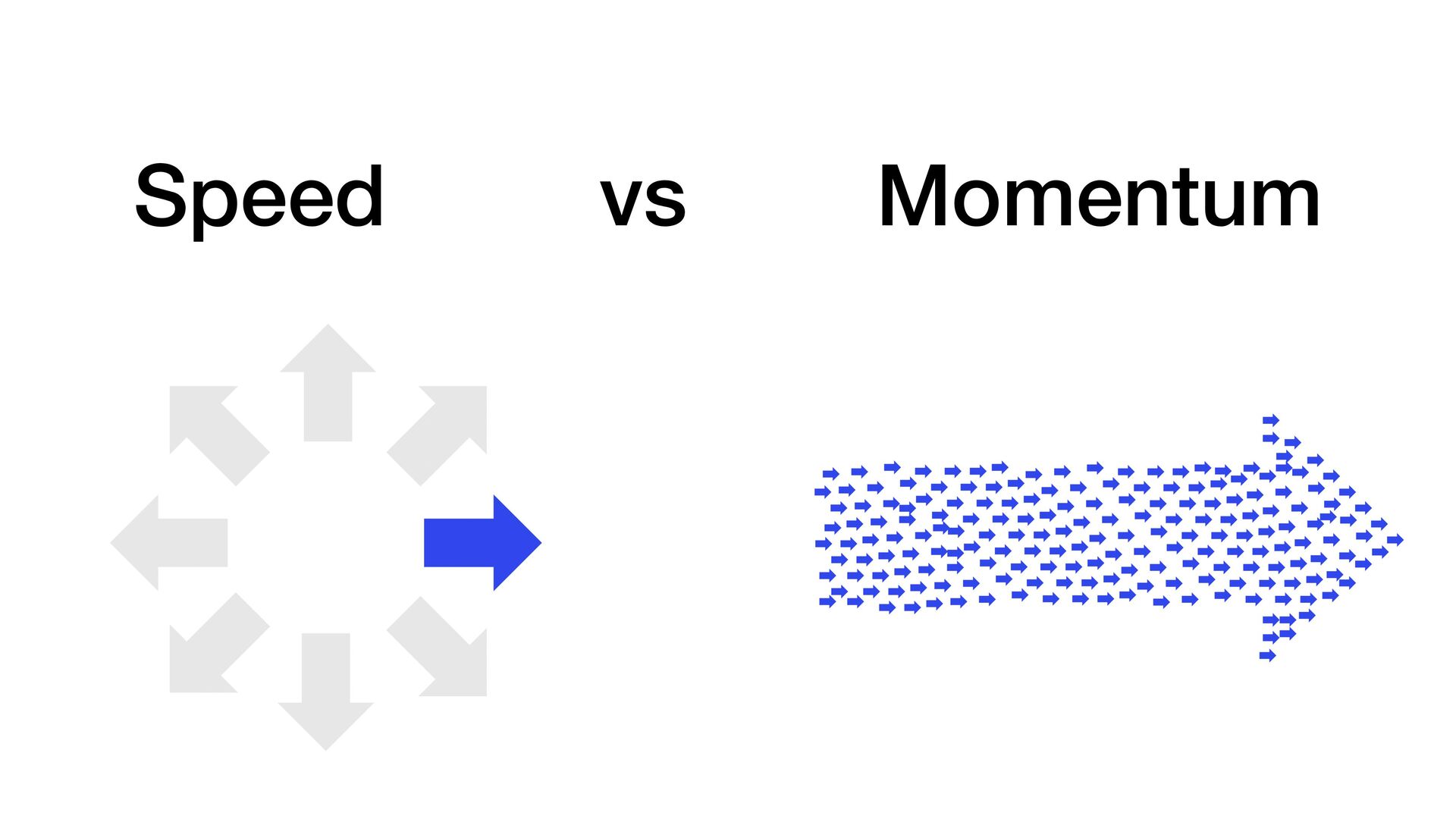
But I talk about momentum. So what's the difference between speed and momentum? And why do I often talk about momentum and tell people, hey, we've to build momentum because momentum builds momentum? What's the difference? Well, with speed, you can go fast in any direction.
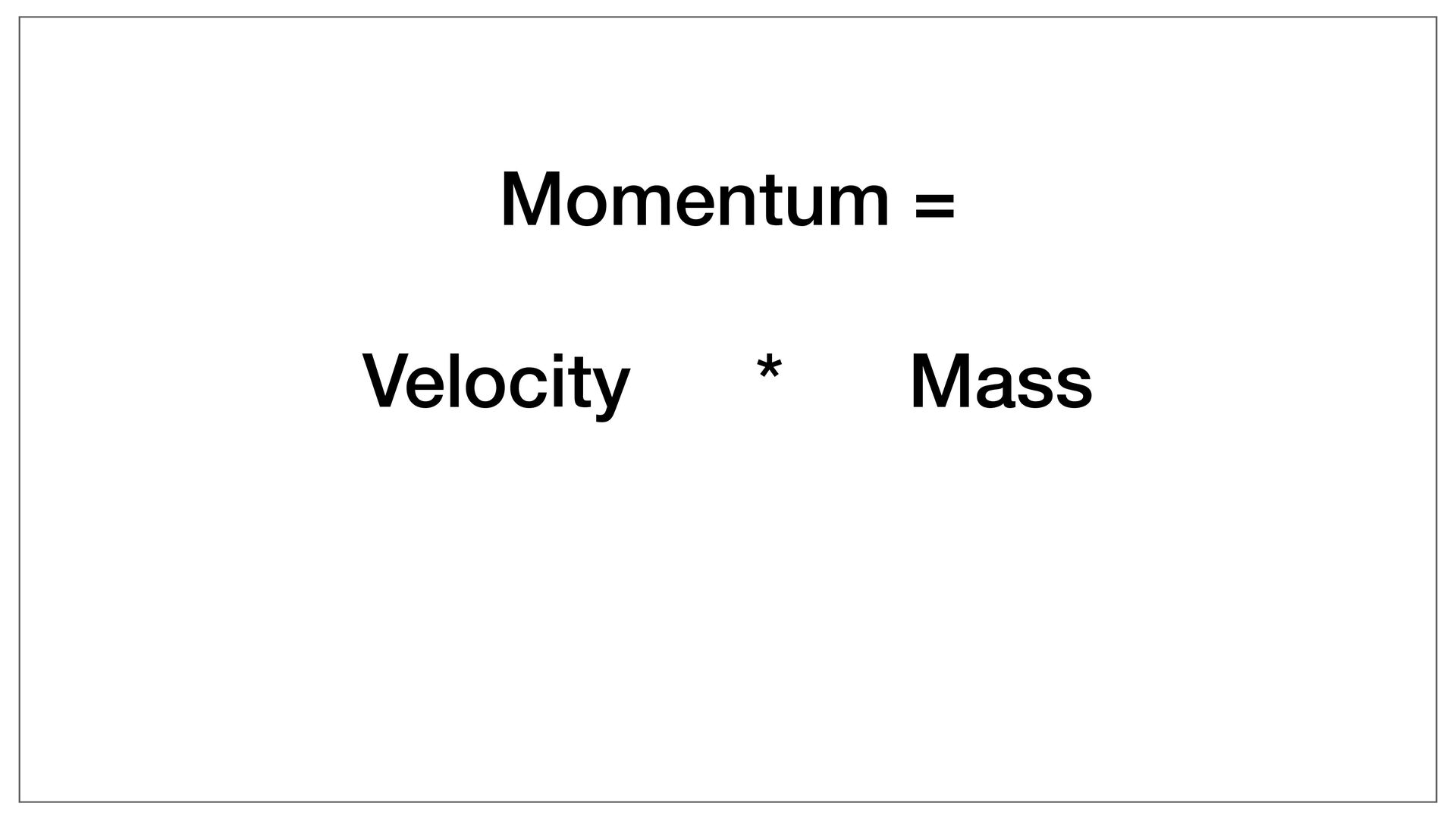
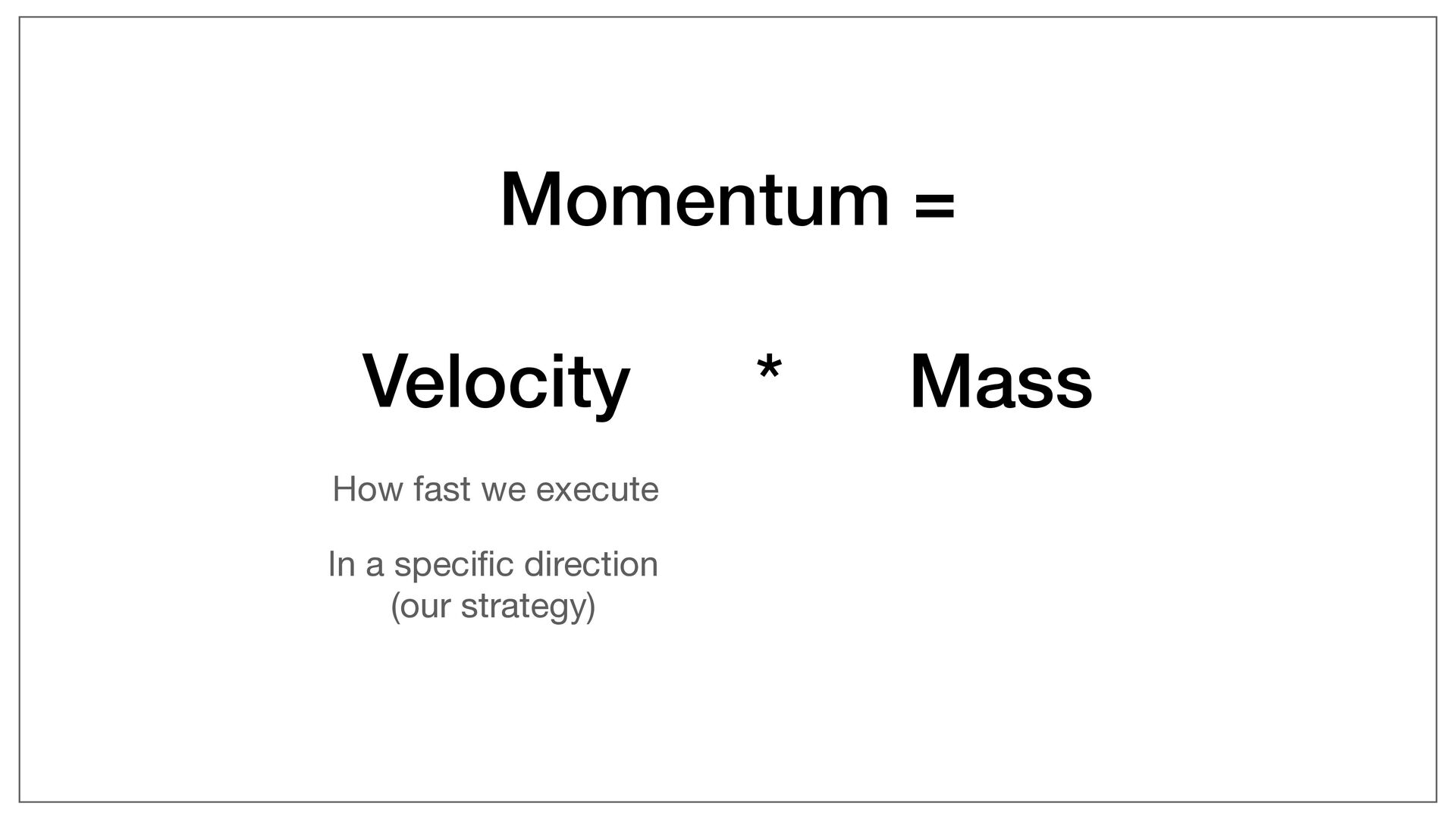
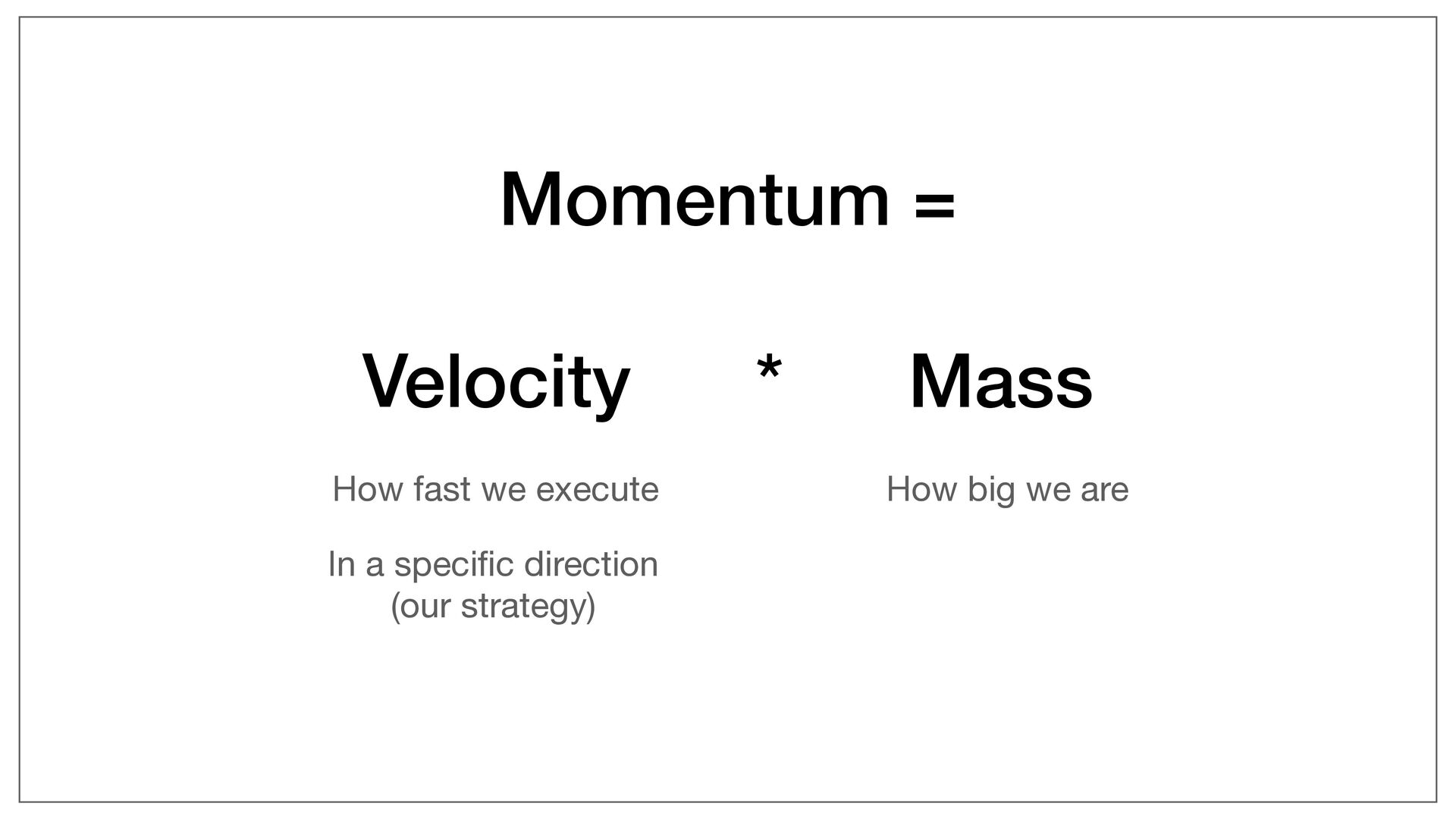
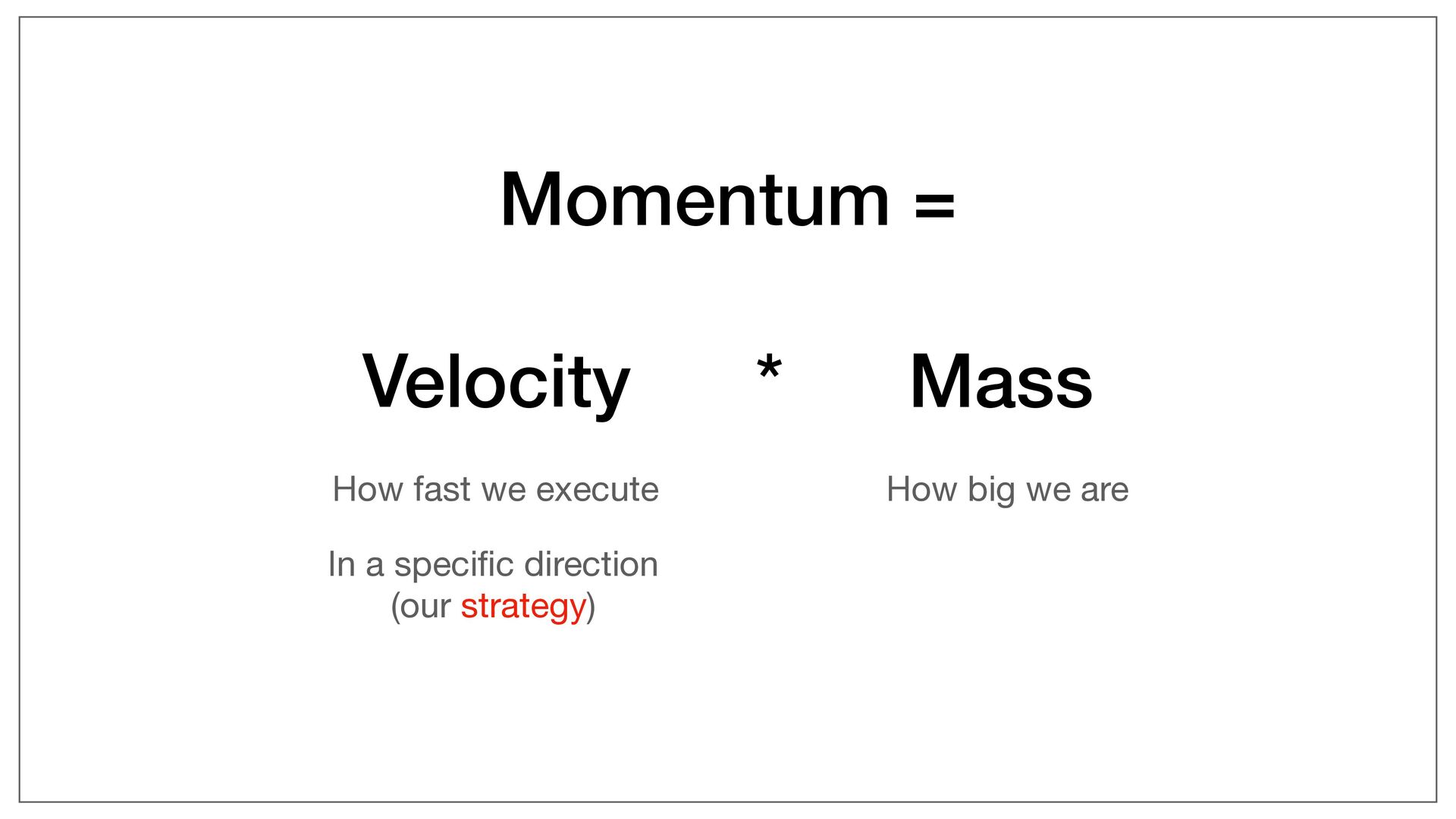
I've often seen this. Companies, teams, especially when I worked in bigger companies before intercom, people go in it like really going really fast, but in all different directions. They weren't really following the same strategy. Momentum has direction. Momentum is velocity times mass. And I apologize for the basic physics that someone's going tell me isn't even correct later.
But velocity is speed with direction. And the direction is your strategy. The direction is your strategy. So this is people moving at speed in a specific direction, not just moving randomly. And mass is how big you are. Like how big is the team?
How have you broken down the teams into sub teams? How big do you need to get to execute an idea? My first lesson in this about momentum and understanding how momentum works, was when I joined Facebook. Before I became at Facebook, before then I was at Google.
I lived in Silicon Valley and left Google, worked on all of Google's social products, and left for Facebook, which at the time was incredibly stressful. I was leaving for the enemy. This is Facebook's reception room at the time, or sorry, the lobby at the time.
And the reason I made the choice to move was because when I left Google, it felt it felt like this this diagram here on the left. It felt like that. But when I walked into Facebook, it didn't. It just I could you could feel that this company was moving incredibly fast.
It was visceral. You could just feel it. And I think if you think about your own company, your own team, when you walk into your office, if you walk into your office anymore, or if you get on Slack with people, what does it feel like?
You just know. Like, I know you know now listening to me whether you're fast or not. You just know it. You can feel it. And it's infectious. Like, if you're moving fast, it's easier to move faster. And so the big question for me is, does it feel like you're moving fast?
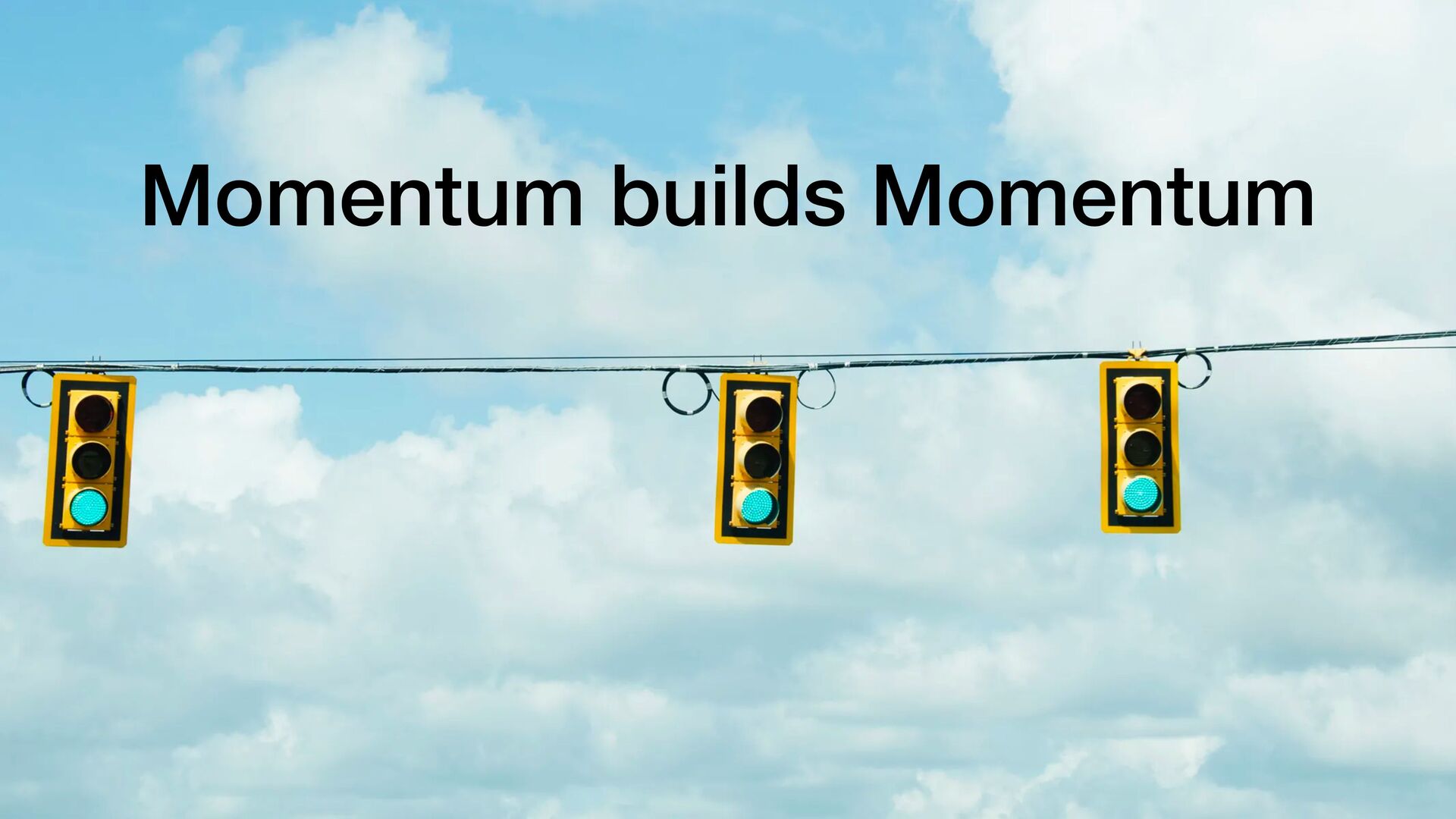
If it feels like you are, amazing competitive advantage. If it feels like you're not, you've got to ask some hard questions. When you have momentum, it's really easy to maintain it. By the way, I've lots of traffic light photos now. Hope you like traffic lights.
When you're going fast, can feel it, and it's just like green lights. It feels like green lights. It feels like you're in a car, you're like green, green, green. Right? And you can move at speed. And honestly, it's just enjoyable. It's fun. And this is the idea. Momentum builds momentum.
But, and I apologize for my questionable Photoshop skills here, imagine these are the same set of traffic lights. If there's amber lights, you slow down. I think again, you're in a car, you're going towards the traffic lights, amber, you slow. And what happens? The cars behind you slow.
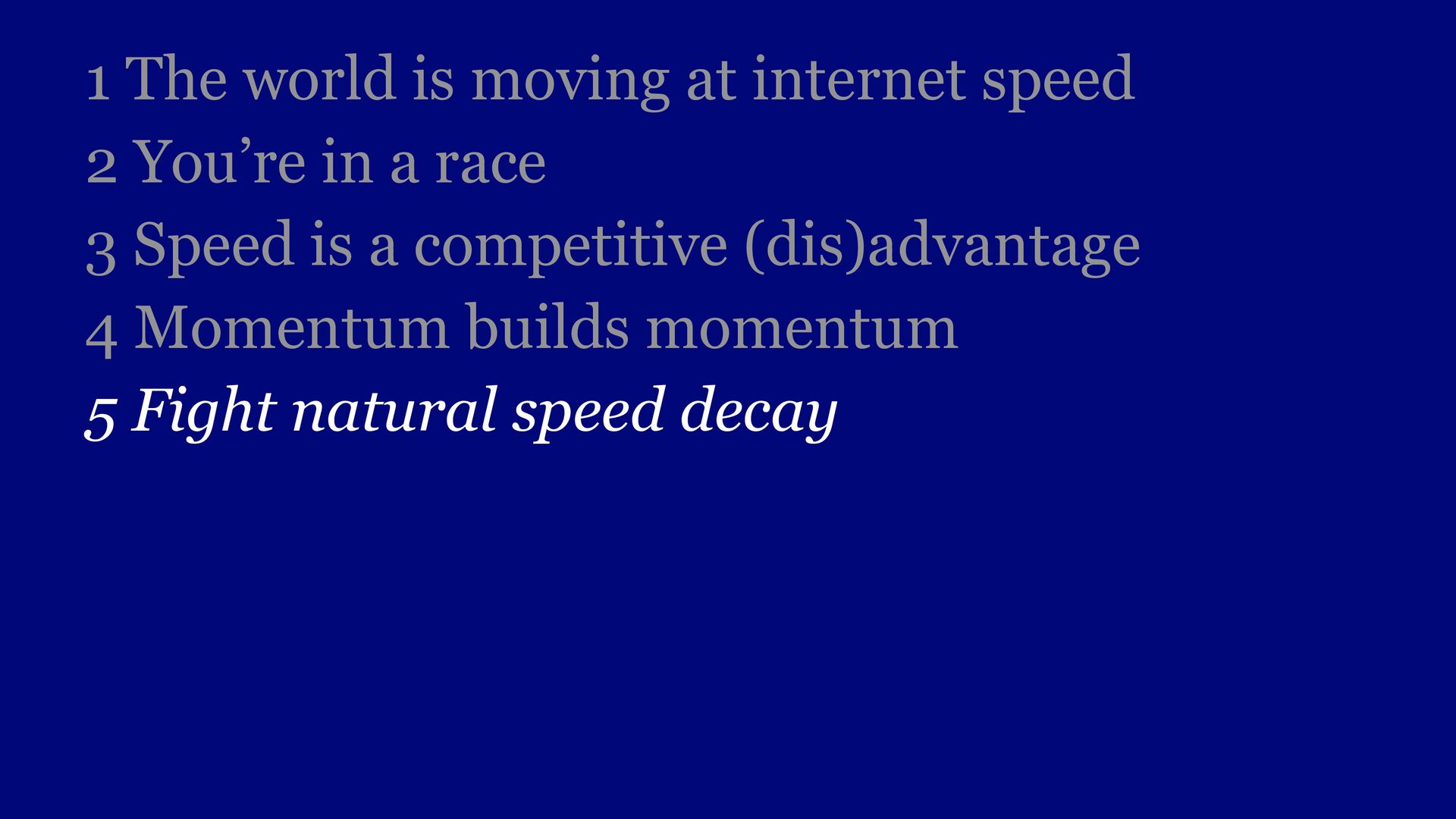
And things just start to slow down. They just start to slow down. And the default is that things just get slower, even with amber lights, not even red ones yet, and it's a competitive disadvantage. So the way you've got to address this competitive disadvantage with these amber lights is to fight natural speed decays.
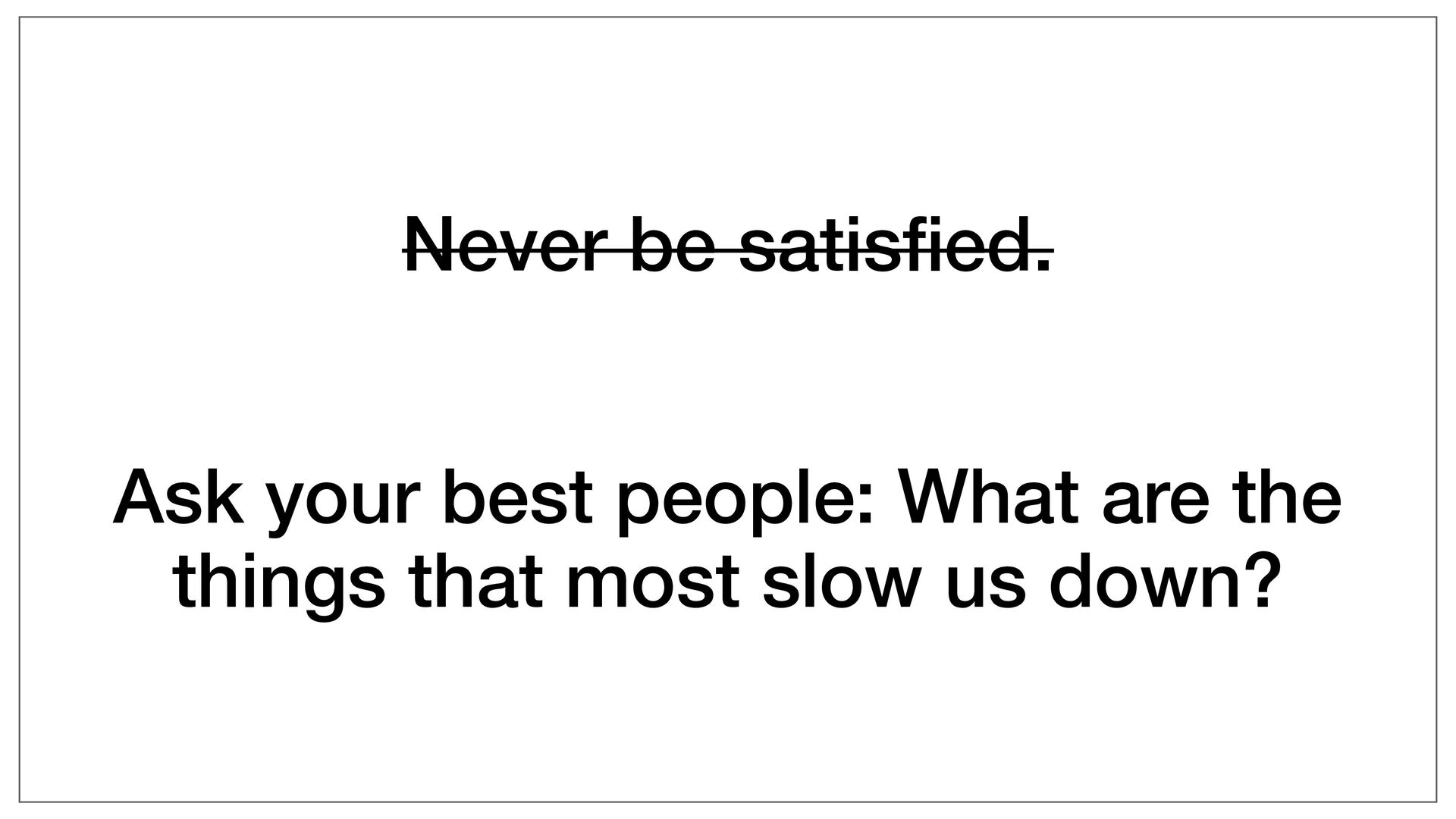
It's natural to get slower. As you get bigger, get more complex, you get slower. And the way you fight natural speed decay is to never be satisfied. And that's the end of the talk. Never, ever be satisfied. Never be satisfied. And my team hate me for this.
I live a life of dissatisfaction. It's quite an enjoyable life, but they don't see it that way. Never be satisfied. Never be satisfied. The minute you are satisfied with how fast you're going, you are introducing complacency. And you're going back, there's faster boats than you.
You should never be satisfied. And the reason is because slowness is viral too. Just the way that momentum is infectious, it's also viral. Eventually you'll start getting red lights. And when people start seeing red lights, the culture changes. Amber lights is one thing.
Amber's like, okay, we've got to slow down, but we can get through. Let's try and get faster. Red lights is, I know when I get to that stage of the project, we will stop for some reason. So why bother getting there fast? Why bother?
The red lights there will just go slow. We'll take our time and get there more slowly. This is just culture. It just changes how people think and react. And again, everyone slows down. And red lights means other people stop, and eventually the whole company kind of grinds to a halt.
These red lights, these bottlenecks, are created by people. If only we didn't have to work with each other. They're created by people. They're all the bottlenecks for our people. And mostly, they're created by people wanting to get involved in things. Like how many leaders in the room or other people in the room leaders just like getting involved.
They really have no business getting involved, but they just like getting involved, and it slows the thing down. So how do you change this dynamic? How do you remove these bottlenecks, get faster? I've got good news and bad news. The bad news is there's no one answer, but I will give you something to do.
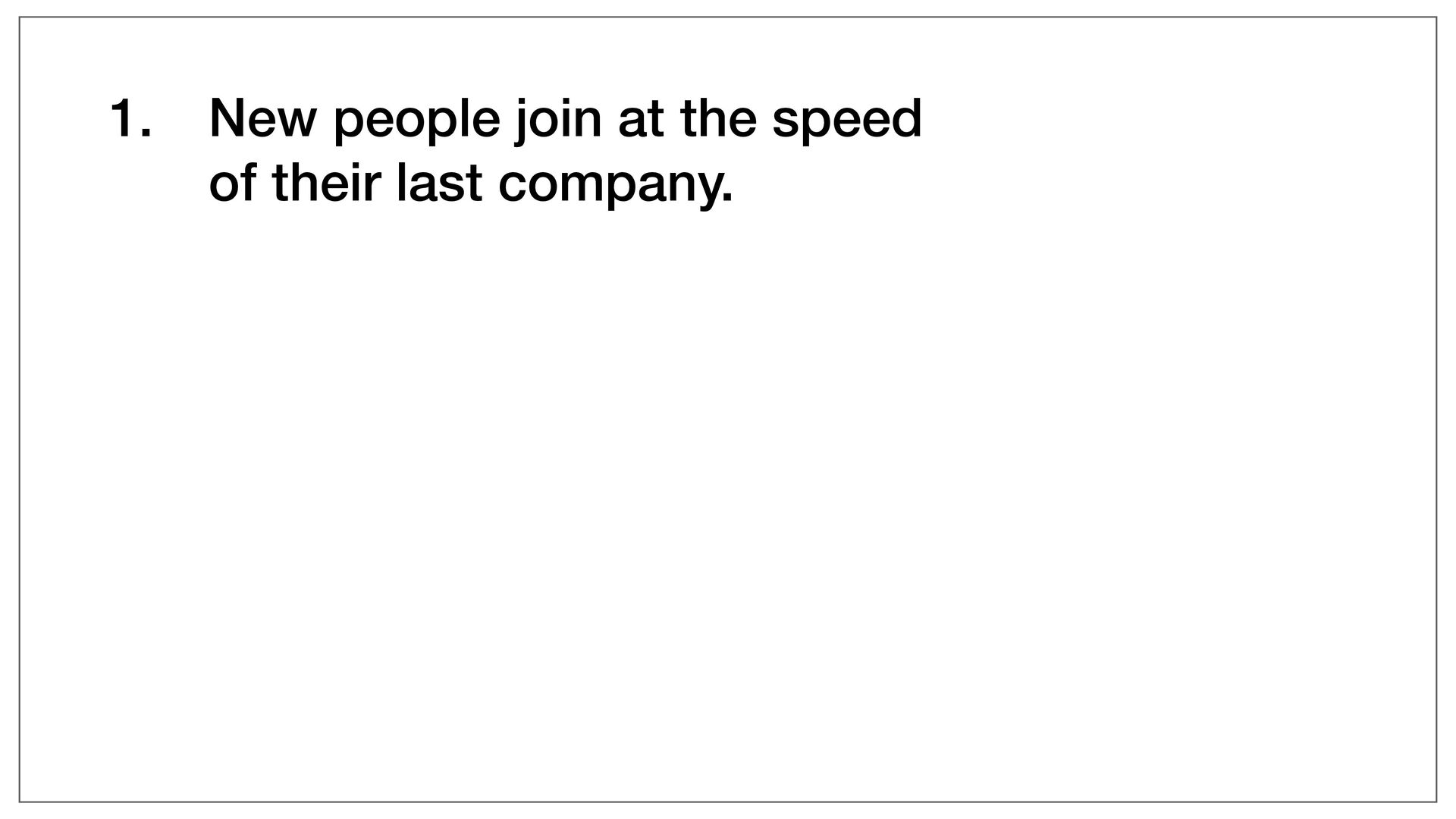
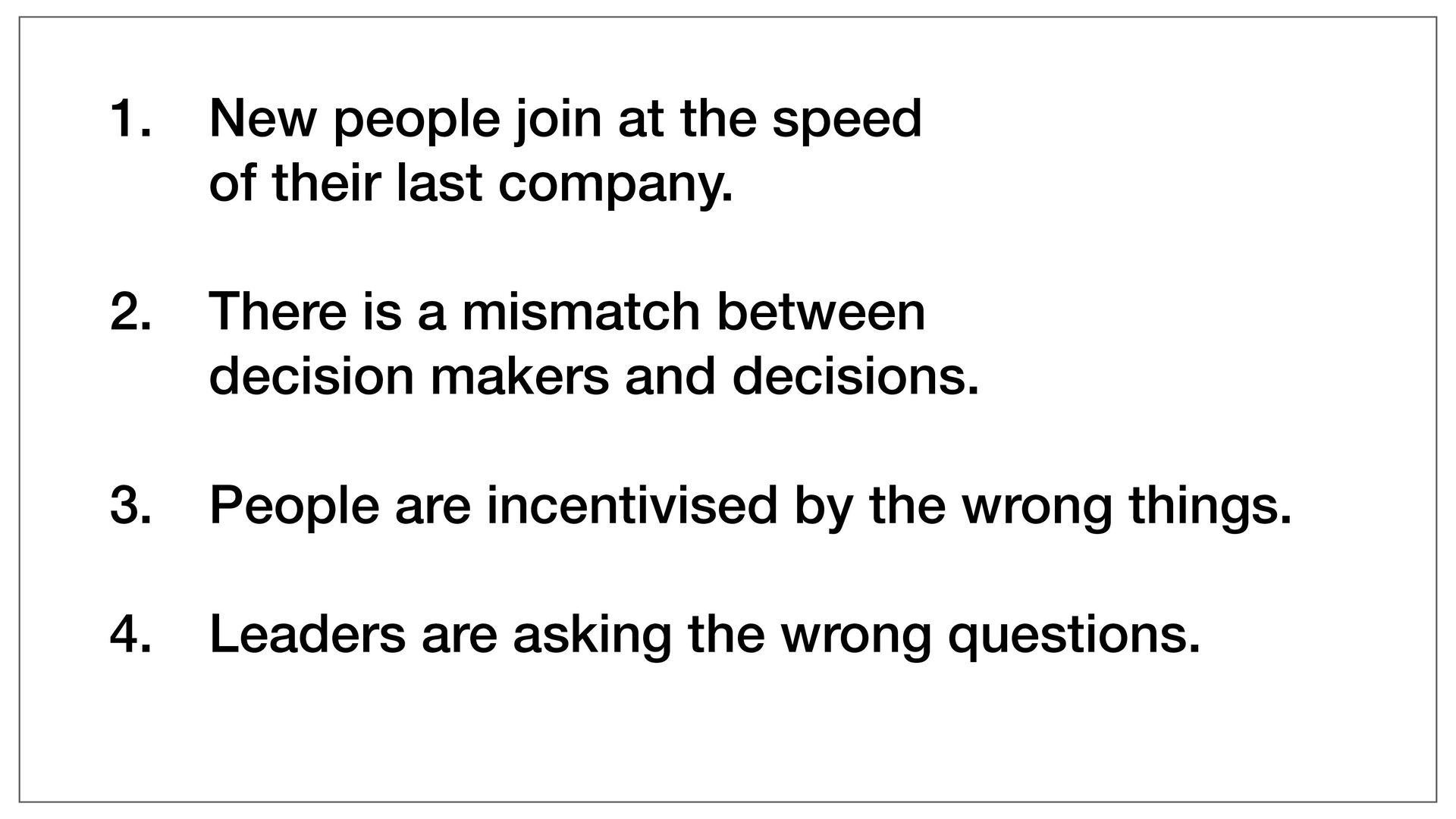
The good news is you can start to see patterns. And these patterns aren't universal, but there's four patterns I see that may not appear in every company, but there are things to look out for, for sure. The first one is that new people join your company at the speed of their last company.
So we learned this the really, really hard way at Intercom. We were like a small company. We thought we needed to better understand these industry standard features. We didn't really fully what as go up market, get bigger customers, it gets more complex, it gets a bit harder.
These industry standard features, well people who work at those bigger companies know all about industry standard features. They can teach us. So we hired people in from these bigger companies, and they came in at the pace of the bigger company, which typically was slower.
It was slower. And so they then bring in the same speed into your company. And this, by the way, often looks good. The slowness looks good. They say things like, hey, we should just slow down a bit here, and look for more data, and we should interrogate this a little bit.
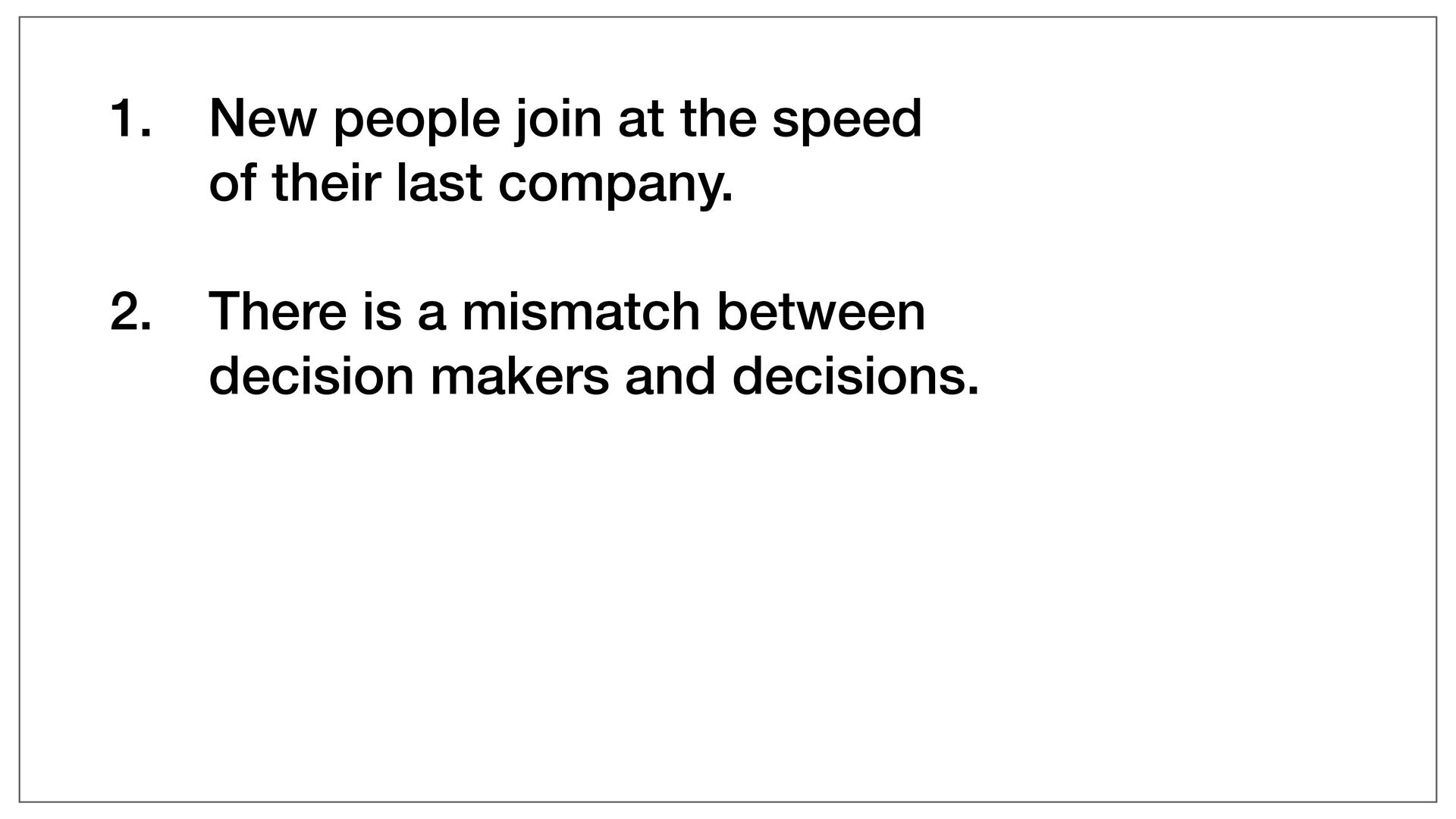
I'm not sure about the data. There's good ways to describe slowing down. But it's again infectious. When you start to slow down, you just get slower and slower. So that's the first one. The second one is that there's a mismatch between decision makers and decisions.
Like I said earlier, leaders just love talking about the craft. They love it. They were once a PM, they were once a designer, they were once a marketer. And their favorite thing to do is to talk about the thing when they have no business doing it anymore.
And everyone knows this. And again, this happens. Unless you design it out, it just happens. I'm not involved in any product decisions at Intercom. None. And I haven't been for years. I lead a product team. I've been there since the very start. I'm involved in no product decisions. Absolutely none.
I work on strategy and a whole bunch of other things. Some people think it's kind of hard to believe, but the reason is because I was just ruining everything for everyone. Was literally a big red traffic light walking around. People just see me like, Oh ****, Paul's here.
But it's true, and it just slows the thing down. And so you've got to figure out when should people be involved at different Zoom levels of decision making. And certainly, know, CPOs have no business in making product decisions. No in execution. No business at all.
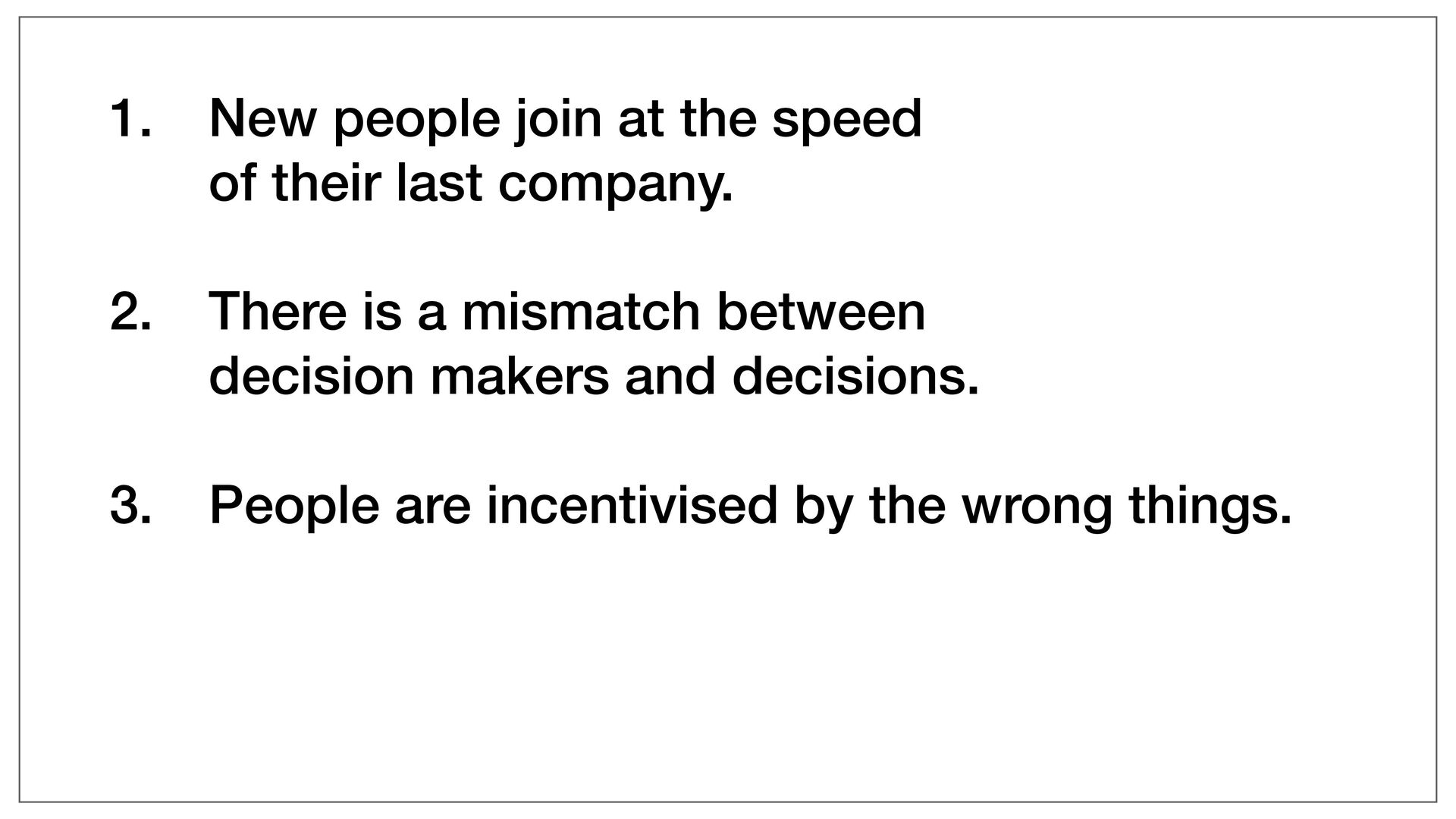
Same for any leader of a function. You need to get the Zoom level right. The third one is that people are incentivized by the wrong things. So we've had lots of different experiences at Intercom over the years where we learn by looking into this, oh ****, people are doing that because they think that's what you should do to get promoted.
They're not thinking about customers, customer value, shipping product anymore. They're thinking about other things. And it's not their fault, it's ours for setting them up wrong and setting the system up wrong. So people can get incentivized. They don't put the company first. They're putting their own career first.
And the last one is that leaders are asking the wrong questions. When they look at speed, look at momentum, they're just asking the wrong questions. So here's a really bad question. We need to move faster. How are we going to do that? That is like everyone just panic mode.
Know, let's move faster. Okay. Let's move faster. Right? And especially comes from leadership. It's just you don't know. That's not really an actionable question. There's much better ways to ask questions. This is the single kind of one thing I think is universally true for everyone.
So never be satisfied. I still think you should never be satisfied. But it's not very actionable. So instead, you should ask your best people, what are the things that are most slowing us down? What are those things that are most slowing us down?
And this is very, very specific. You should ask your best people. And by the way, if you're not a leader or manager here in the room today, ask your manager and leader to do this. The reason that you should ask your best people is because the best people hold the highest standard.
They're the ones who are also never satisfied. They hold the highest standard. And so you'll learn the most from them. If you ask people who are not your best people, it's just not as insightful. They're more tolerant. People are just typically more tolerant of things getting a bit slower.
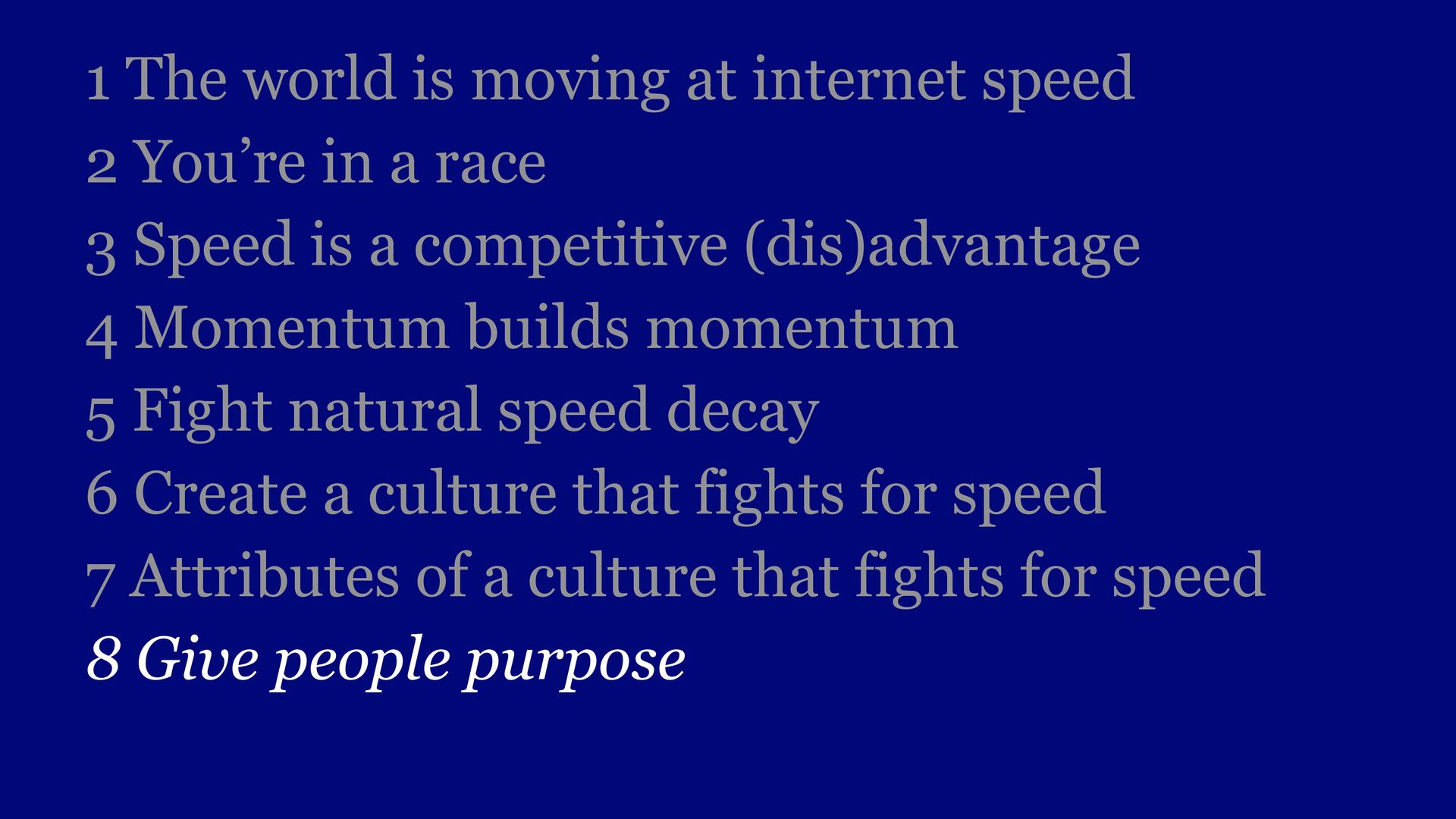
So it's really, really important that you ask these people. And then this is the first step. This question and the answers to it is the first step in creating a culture that fights for speed. So what we've learned is most people want to move fast.
Most people want to move fast. When you talk to them about their job and why they have their job and why they care about Internet technologies and so on, they don't want to live in Google Docs all day. Don't think there's very few people who are like, my favorite thing is being in Google Docs all day long, never shipping anything, but making really great docs.
Most people not all people most people don't want to do that. They want to ship software. They to get things in people's hands. They want people to use the thing. They want to learn and get some kind of gratification for it. They want to feel and know that their job has purpose and meaning, and that people's lives are getting better because of the thing they're building.
Right? So people want to move fast. And when you survey people and ask them why things are slow, what's getting in the way, you've got to be very vulnerable and open to what they say. Oftentimes, for leaders especially, it's probably your fault. They're probably right, and it's probably your fault.
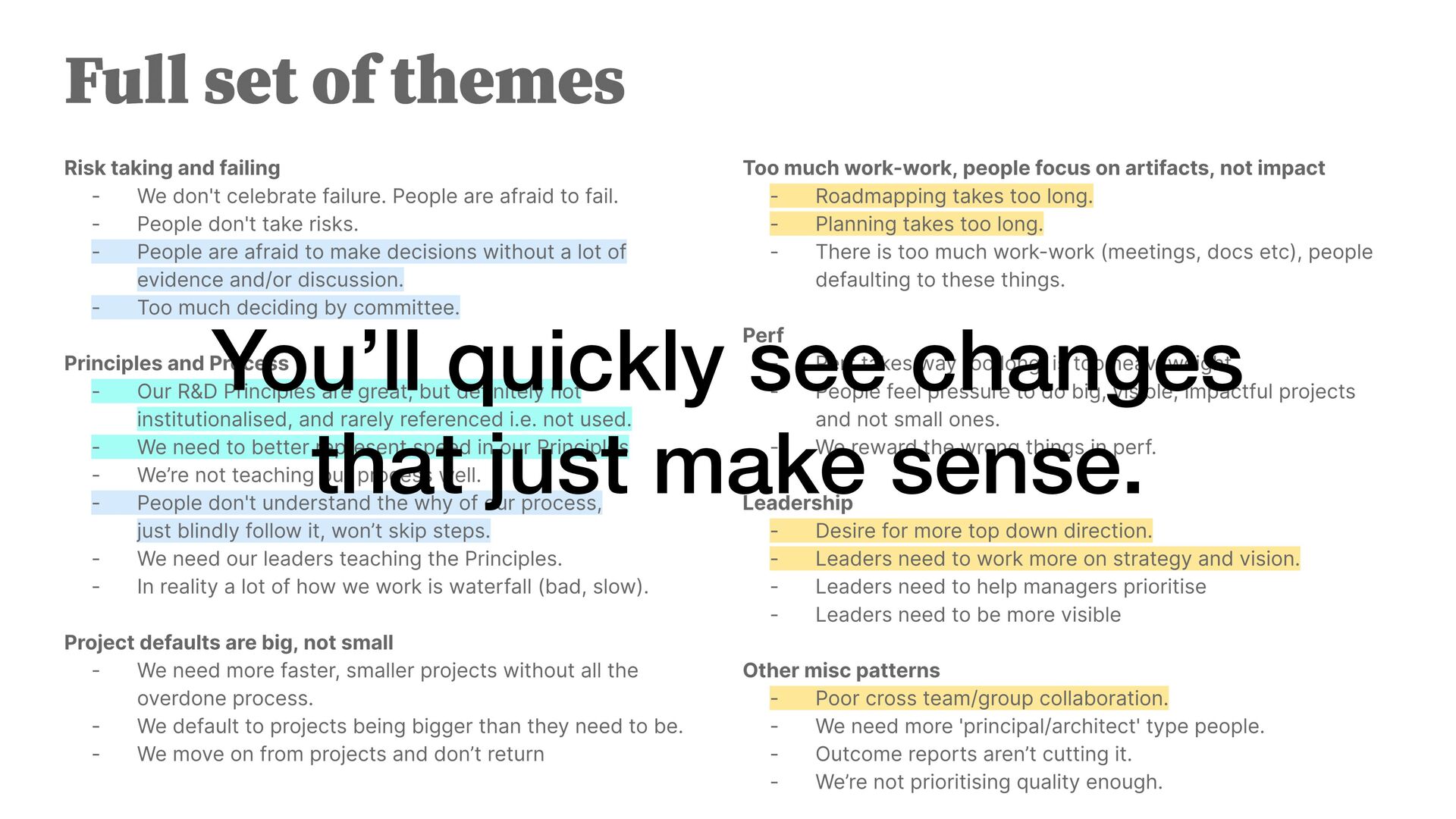
This next slide is a real full set of themes from us, from a survey we did. This is the slide I showed our leadership team. This is what we heard from Serving, all our best people. Serving was both in person and asking them to fill in some questions and forms and stuff.
We've done this lots of times by the way. If you read the list, you can't really read it here somewhat deliberately. It looks like Intercom is the shittest company ever. Everything's on this. Everything. Perf is ****** and the strategy **** and everything's on it.
And so you're going to hear this and you've got to be very open and vulnerable to go, okay, this is reality. And obviously, everything's relative, and some of these things are the strategy is not as clear as it used to be. So all these things are relative.
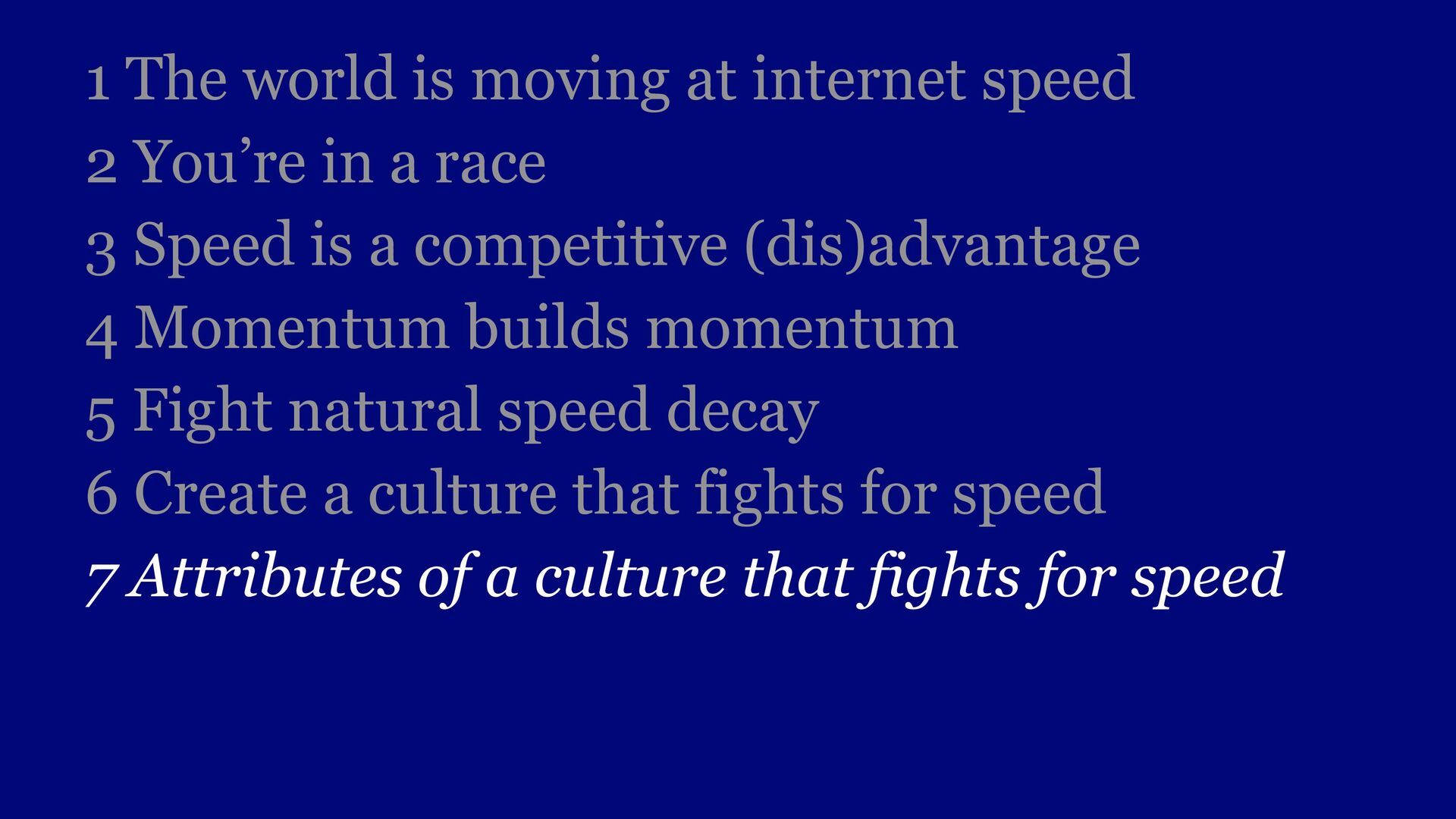
Intercom isn't as bad as it looks on the slide. We'll quickly see changes. You'll just quickly see changes from getting people's feedback. And what you can do then is start to identify attributes of a culture that fights for speed. And the attributes of a culture that fights for speed, I have three here that we see all the time.
And they're kind of universally, hey, if teams are moving fast, you see these things. And if they're not, you don't. So the one thing is a culture that fights for speed asks momentum building questions. And this might sound a little bit subtle in a second, but it's very real.
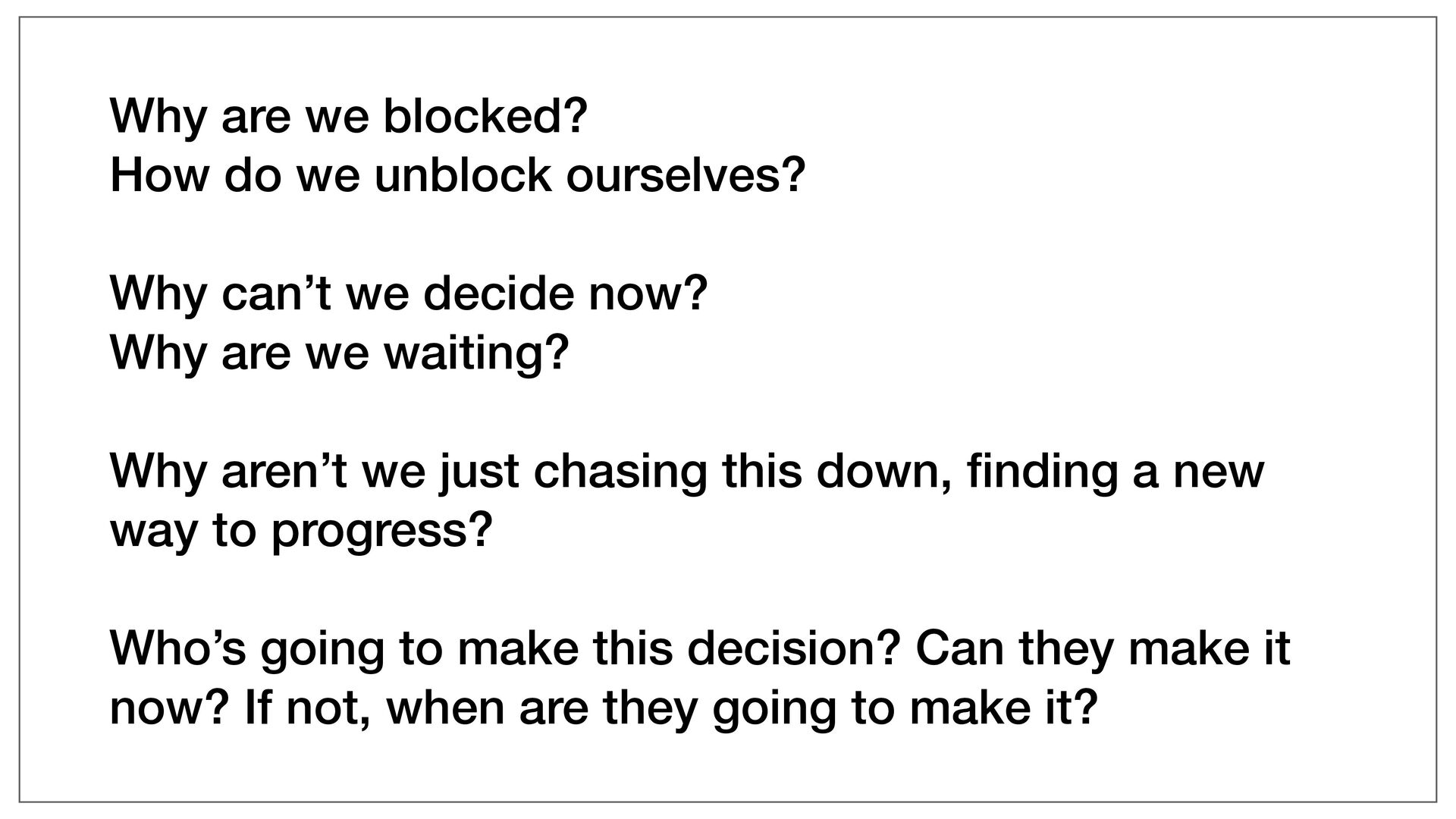
There's night and day differences between teams who do or don't do this. They ask momentum building questions. And this is day to day, hour to hour, meeting to meeting. These are momentum building questions. Why are we unblocked? How do we unblock ourselves? Why can't we decide now? Why are we waiting?
Why aren't we just chasing this down, finding a way to progress? Who's going to make this decision? Can they make it now? If not, when are they going to make it? These are the questions people ask in meetings. There's a million answers. My boss is on holidays.
We just don't have any data. You can invent all sorts of different reasons for why all these things can be true. This is all red light territory, amber light territory. To get the green lights, you've got to be able to answer these questions in the meeting, in the room, on the day.
And oftentimes, you can. You can do it if you try. And this creates a vibe and I apologize to whatever company I stole their logo from. This creates a vibe which is that infectious feeling, that visceral feeling that the company is fast. When you're in meetings when people are saying like, okay, how do we unblock ourselves?
How can we decide today? Let's decide today. Let's not wait till someone's back from holidays. This is a design decision. Our designer's out for two weeks, then they're coming back. We can't make a design decision without our designer. Why not? You know? Why not?
It's early. We do it all the time. But why not? Right? If the culture is set up correctly, people will know that when they come back from holidays in two weeks, a bunch of decisions will have been made. And nothing is ever irreversible.
We can change things. But if you've a good culture, other design team members can come and help. There's lots of ways in which you can set up a culture where you don't need to wait, and you can make all decisions. And it creates this vibe, this feeling, this intensity, and it also identifies all the bottlenecks.
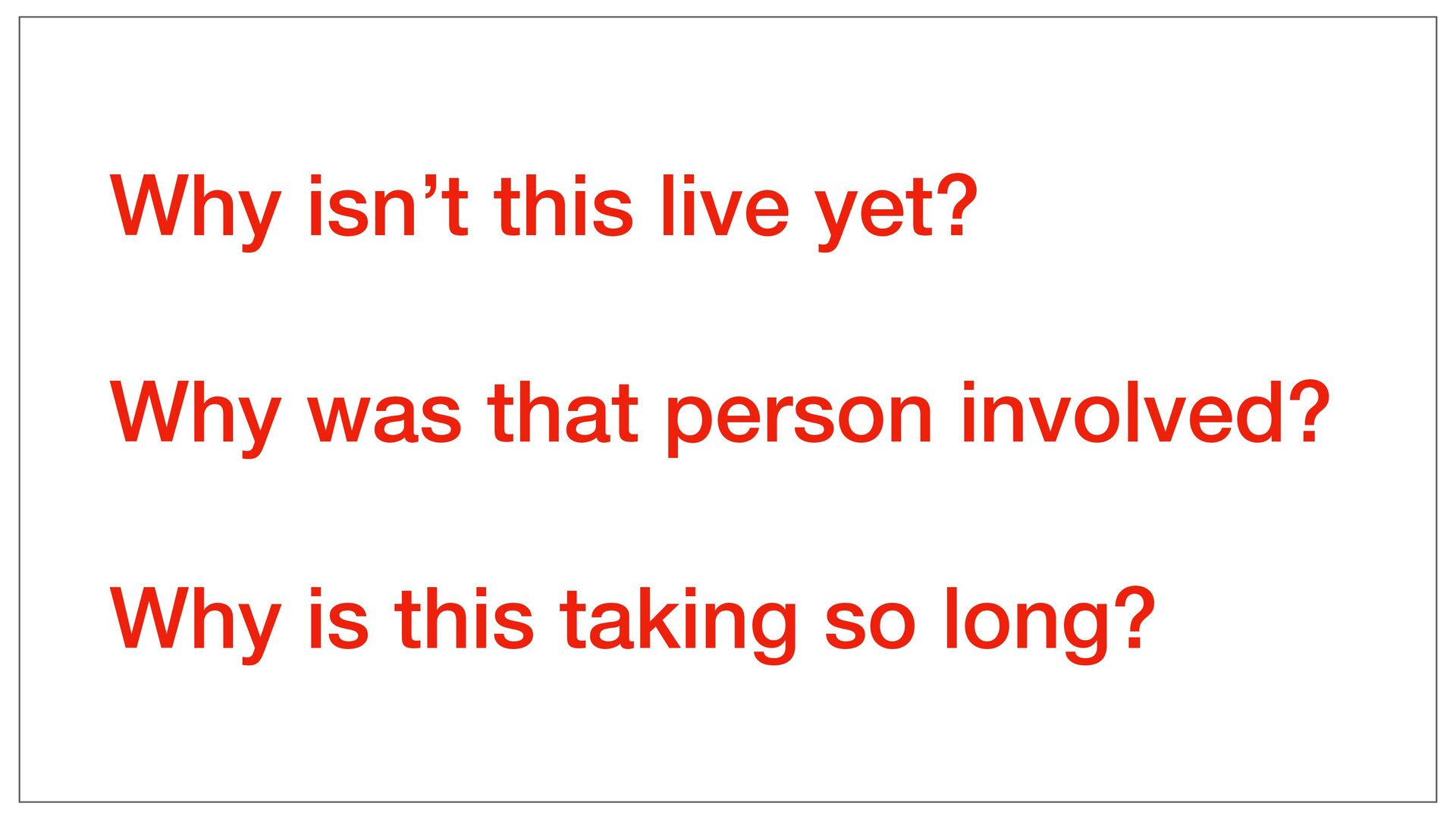
All those questions identify the bottlenecks. If you get really good at this and create a really safe environment to ask these questions, you can ask harder questions. Why isn't this live yet? I made these red to make them feel kind of worse. Why isn't this live yet? Why was that person involved?
We probably shouldn't say it like that. Why was that person involved? Why is this taking so long? You can start to ask very direct questions and people know that the intent is positive. The intent is positive. People aren't trying to judge people or single people out or finger point.
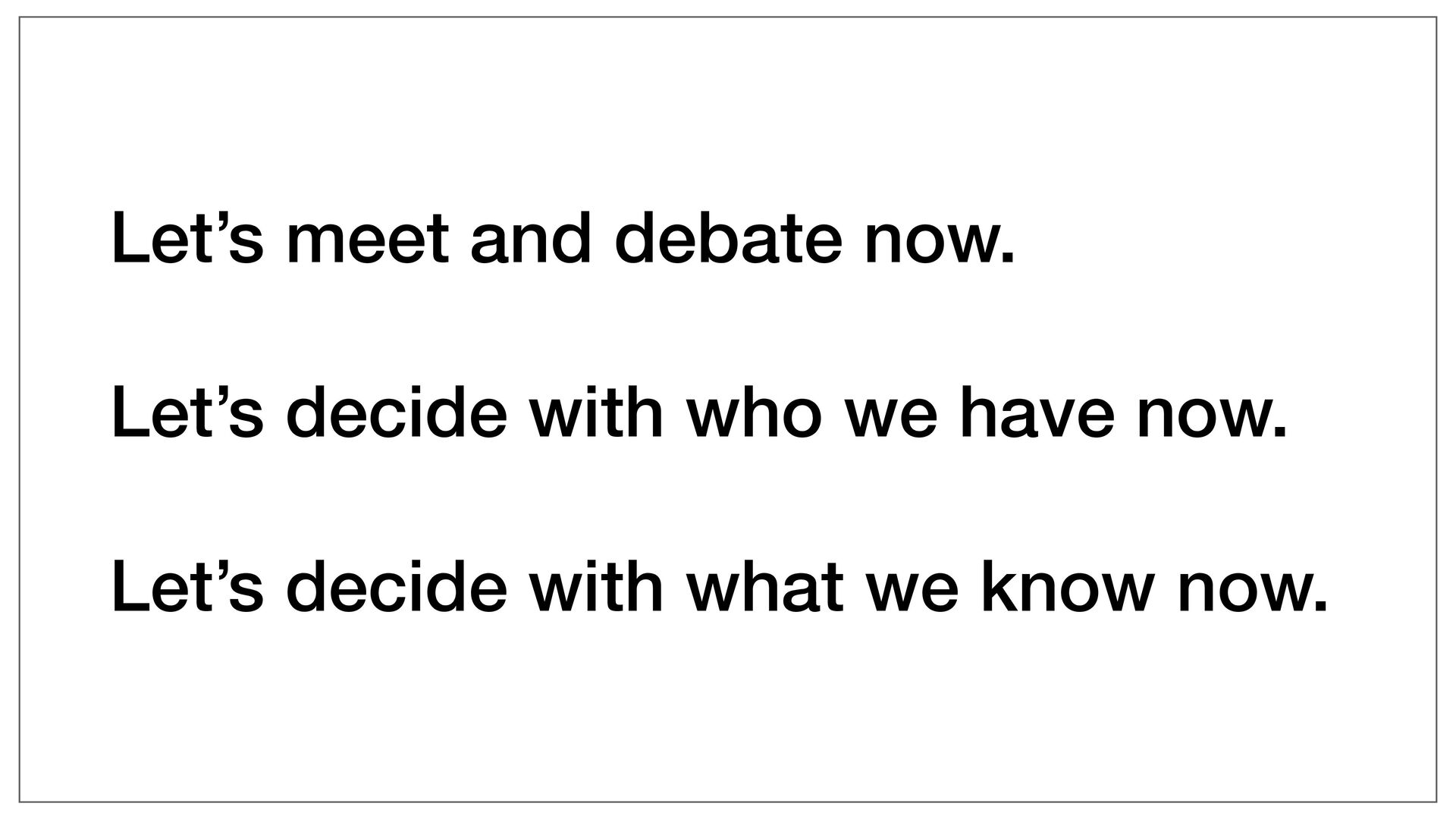
They're just trying to move fast. Just trying to keep the culture from moving fast. Number two, that was momentum building questions. Number two, a culture that fights for speed takes momentum building actions. These are momentum building actions. Let's meet and debate now. Let's meet now. Let's just do it now. Do you have a meeting?
No. Are you free? I'm free. Let's talk. Get on a call. Meet in a room. Let's meet and debate now. Let's decide with who we have now. Let's decide on what we know now. We don't need more data. We're eighty percent sure. Eighty percent sure is pretty good.
If we wait two weeks, a month, we might be ninety percent sure. And these are even good numbers. Even then, you still have to ship, and by shipping you always learn that you're more wrong than you realized. So let's decide now. And the last one is a culture that fights for speed makes every day count.
This is one of our company values at Intercom. We make every day count. What does that mean? Well, it means that every single day people finish the day and look back and go, that was a good day. I did things that I set out to do.
And it's actually a mindset. Making everything a mindset. You go into the building or you start your day, however you do these days, at home or wherever, and you have a mindset that you're going to have a good day, and that you start the day with goals.
You say, today I'm going to do X. I'm going to get X done, then that's going be a good day, and I'm not going to work crazy hours. I'm going to work and fight for X and get X done. You may or may not get X done, but that intention usually leads to way more progress.
I often visit other companies and people just **** around half the day. Right? Which is fine, but then they end up working fourteen hours and then feel **** at the end of it all. Know, you don't have to do that. You can go into your day with intention, work eight hours or nine hours, which is what most people at Intercom do, and we don't work weekends.
None of us ever work weekends. Because we believe that if you go in with intention, make every day count, you can go home then and live your life, and do all the other amazing, wonderful things that aren't in work. And this is very real.
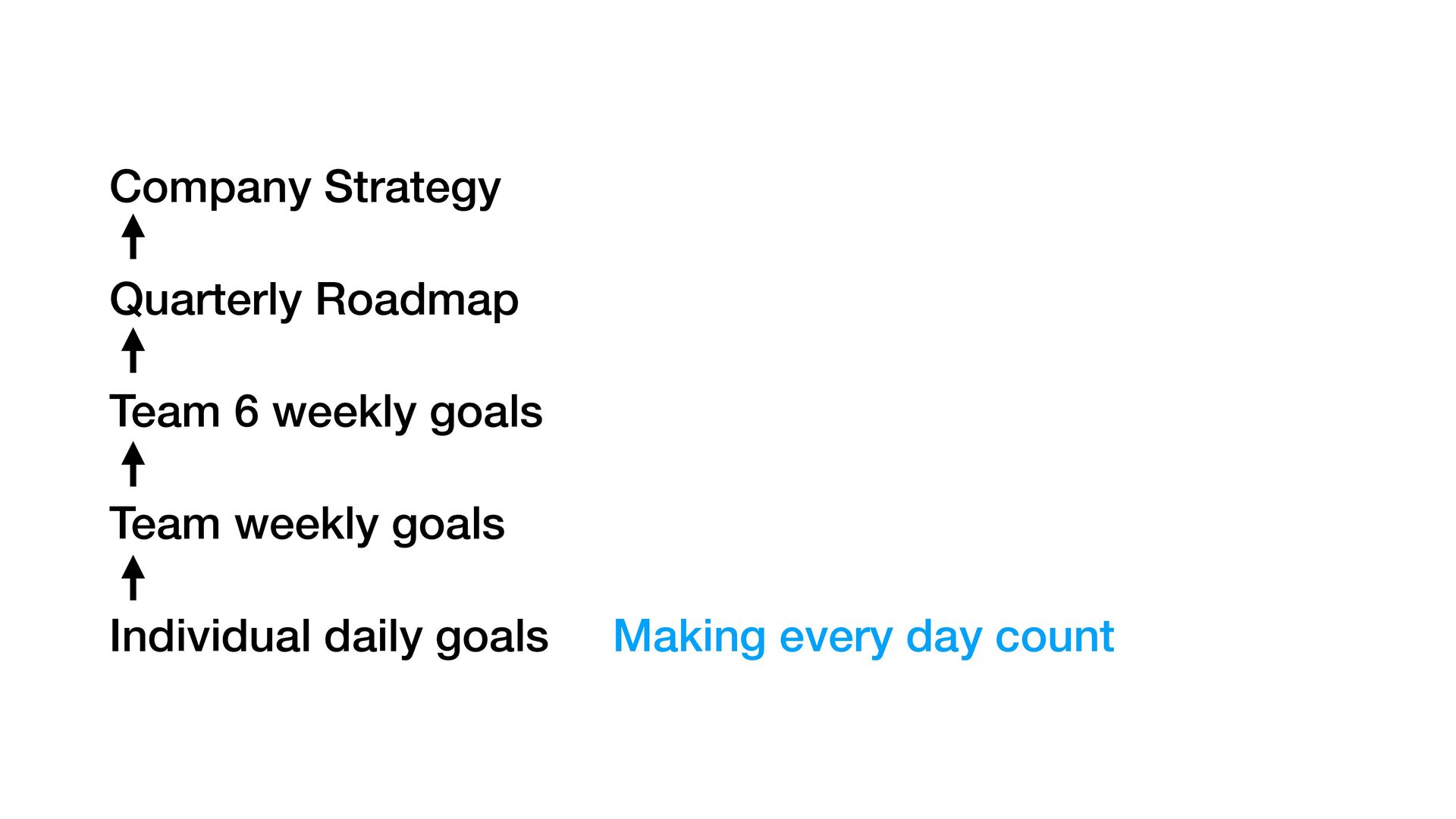
And it's all connected. The system is all connected. So at the bottom, have people who have individual daily goals. Hey, my goal today is to make every day count as X. Those ladder up into weekly goals. There's a stand up every morning where the team will talk about their daily goals and weekly goals.
Then we work in six week cycles. We have six weekly goals, which is obviously mapped to a roadmap, which is mapped to a company strategy. Again, we're not perfect at this and we get slower at times, have to fix it and all sorts of stuff.
But the system is very robust. This is years and years old. And I truly believe by making Everyday Count, you can live a very happy life. Okay. So how do you generate that Everyday Count mindset? How do you generate it? Give people purpose.
That's how you do it. You have to give people purpose. When you look at this beautiful physics formula here, you can see strategy. I've highlighted strategy in red. You have to give people purpose. People have to feel everyone, me, everyone you have to feel like your job has meaning, and that there's a good strategy, and that it's clear.
And if you do that, you'll just realize people want to make every day count. They know what they're doing and they know what direction they're going in. I promise you, this is my last traffic light picture. You avoid situations where the direction's unclear and the strategy keeps changing, or goals keep changing and moving around, and you start rethinking things and replanning.
Every time you're doing that and we do it, to be fair. We do it. And it introduces amber lights and red lights, it slows us down, and we've got to get back out of it again. But you've got to realize, every time you change strategy, change a roadmap item, do a different thing, you're bringing in these amber lights, red lights, and it just slows the whole system down.
So like I said, most people need to believe that what they're building matters. That it matters to customers, that it matters to the company. That it's got impact for the company. And they all seem to believe in the process by which they build.
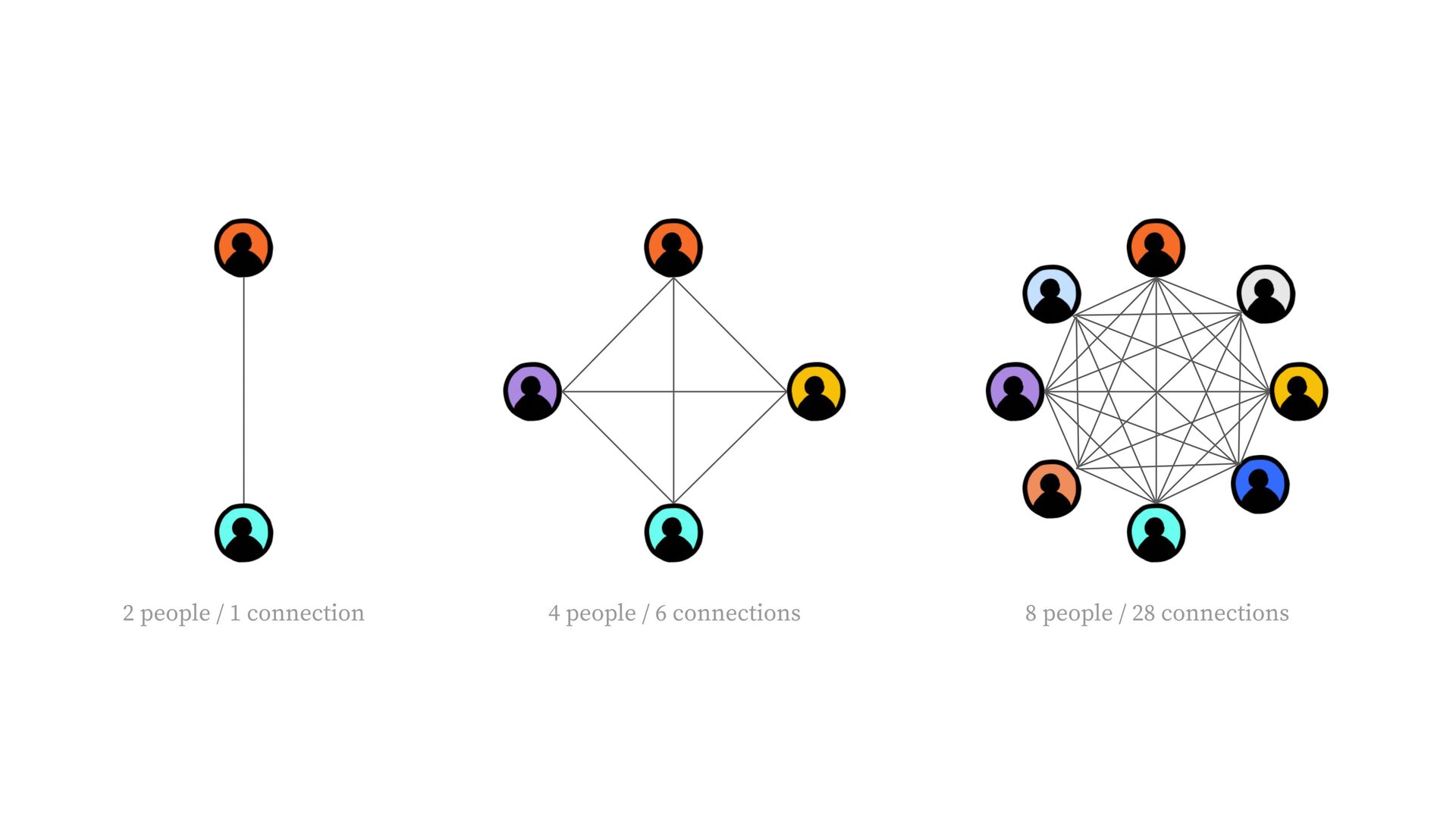
And so the way that we I'm not going into process here, it's a whole other talk. But one thing that we do do is that we split the company into small teams. Really, really, really small teams. And the reason is because building teams is quite counterintuitive.
Here you can see when there's two people in a team, there's only one relationship there. If you have a four person team, you've got six relationships. If you have eight people in a team, you suddenly have twenty eight relationships. So every time you add a person to a team, how can you go help that team out?
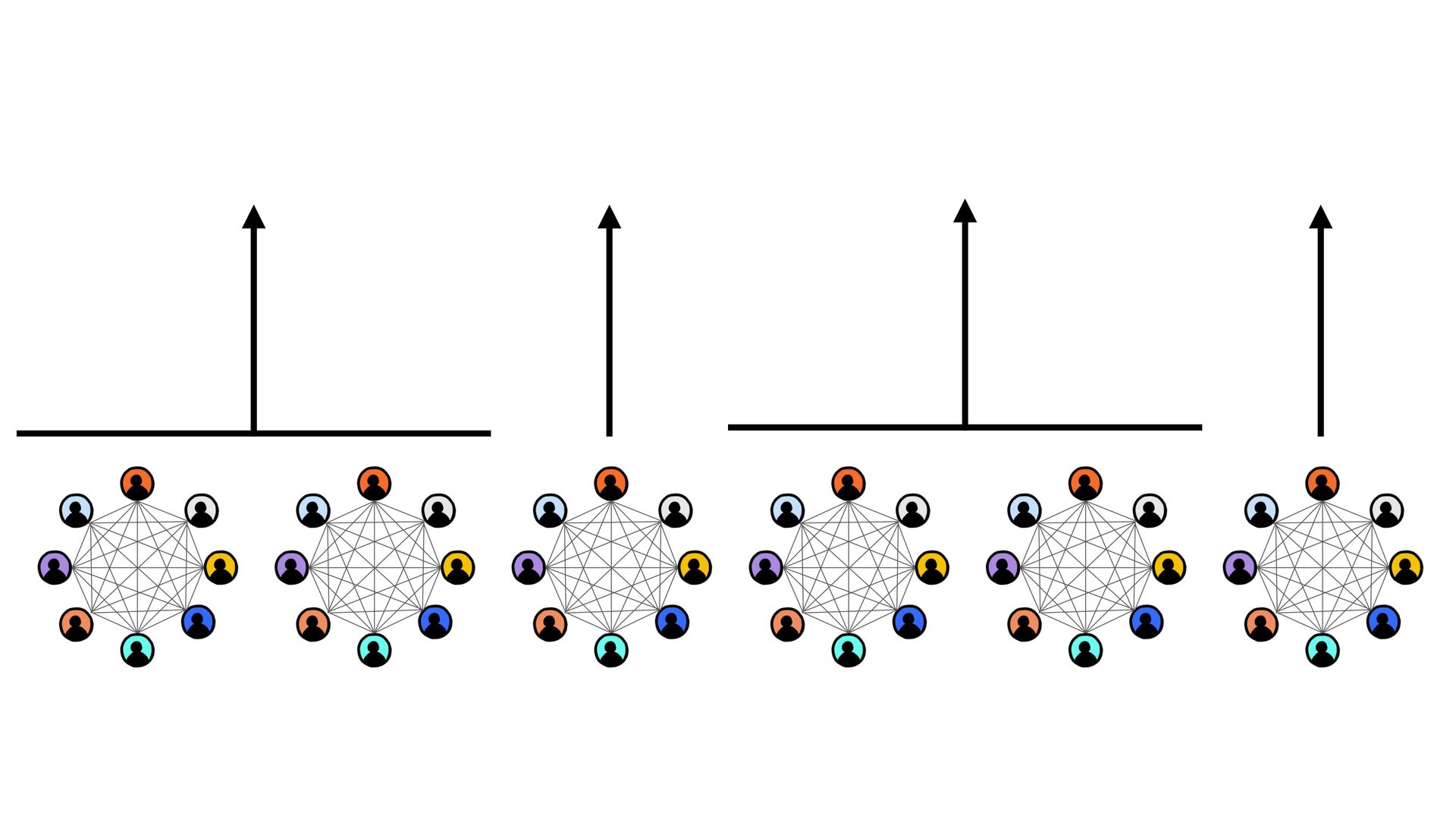
If I'm adding someone to the eight person team, there's now eight new relationships that have to form. So we try and keep teams really, really slowly, and we have them work like this. They work very autonomously, very independently, and they're all moving in the same direction per the strategy.
They're all moving in the same direction, but they're working in small teams. And that reduces the complexity. And this is literally how we've scaled product engineering to hundreds and hundreds of people. We add new teams in these small groups, and they can work at speed because they've got a small number of relationships, and they have a clear strategy.
That's the idea. Again, move faster and slower at different times, but generally this has worked. Can keep scaling. Don't know what number this ends at where we can't keep doing this and can't keep shipping at the same speed. Okay, last piece, just to finish up.
You have to interrogate how decisions get made. Have to interrogate how decisions get made. A lot of this honestly comes down to decision making. You could even say this whole talk comes down to how you make decisions and how decisions get made. Getting slow is a bit like boiling a frog, which is a horrible thing.
And I don't want to give you a picture of a frog being boiled. Instead, here's a happy frog. You don't realize it's happening. You don't realize it's happening. It kind of happens piece by piece, amber light by amber light, all around you, and it's just slow.
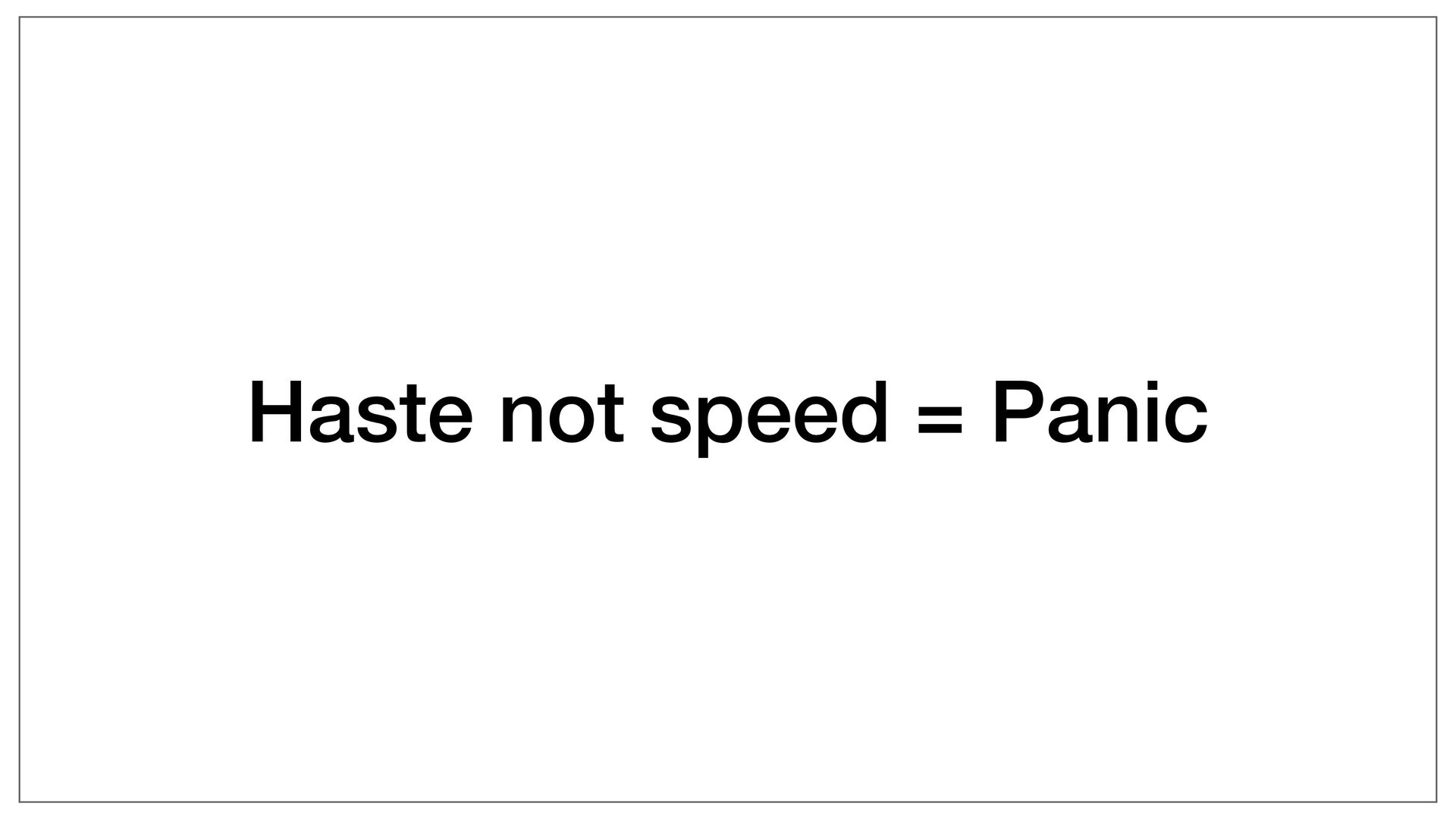
And then suddenly you wake up and go, ****, we are slow. We are slow. And one reaction to that, the wrong reaction, is to panic. And there's, again, a subtle distinction between haste and speed. And oftentimes you can try and move faster back to that bad question of how do we get faster, we need to get faster, let's get faster.
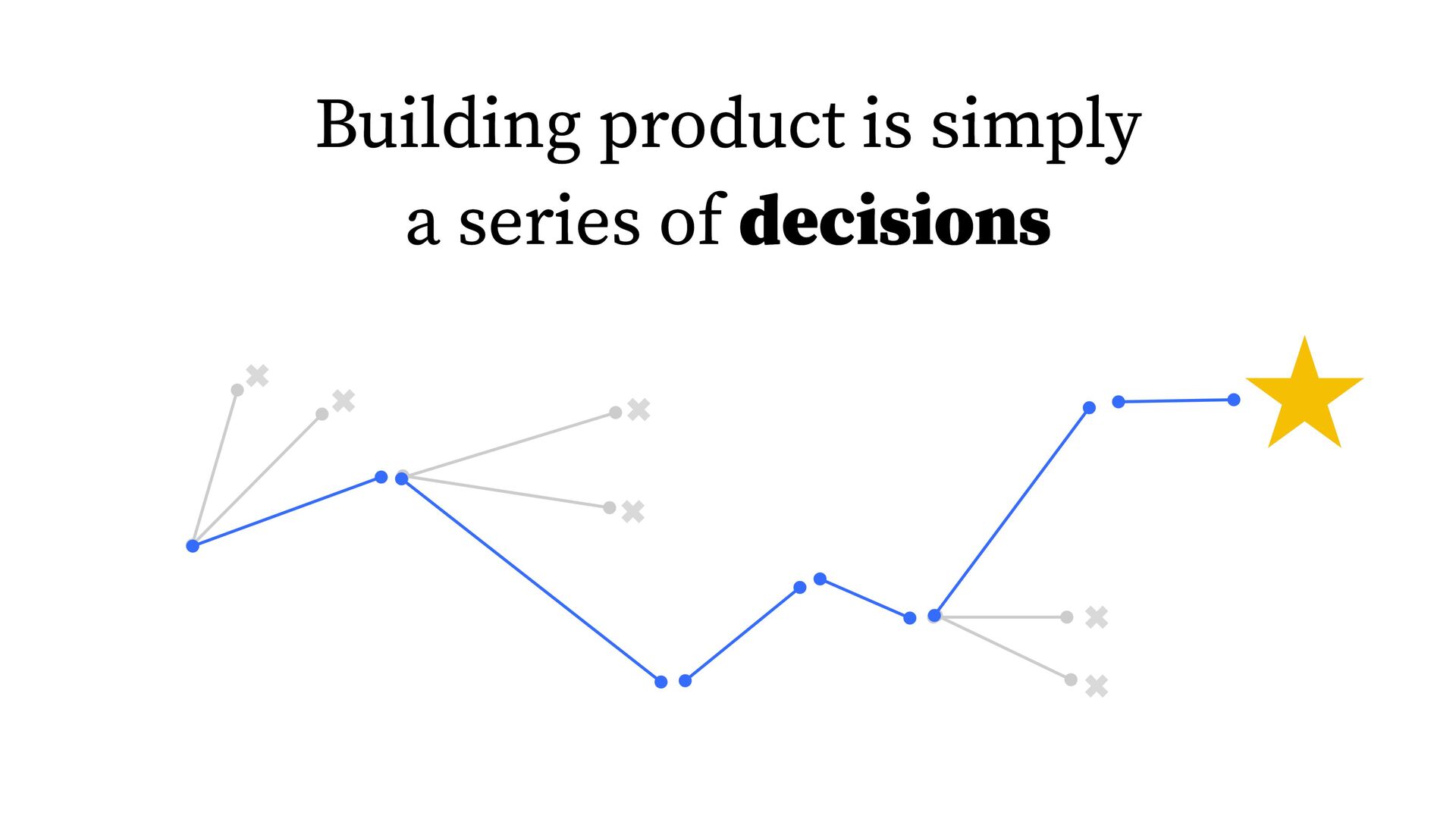
That introduces haste, bad decision making and panic. And instead, you need to look at decision making. And this is like a gross oversimplification, but I think building software is just a series of decisions. And that sounds kind of **** and boring. It's more exciting than that.
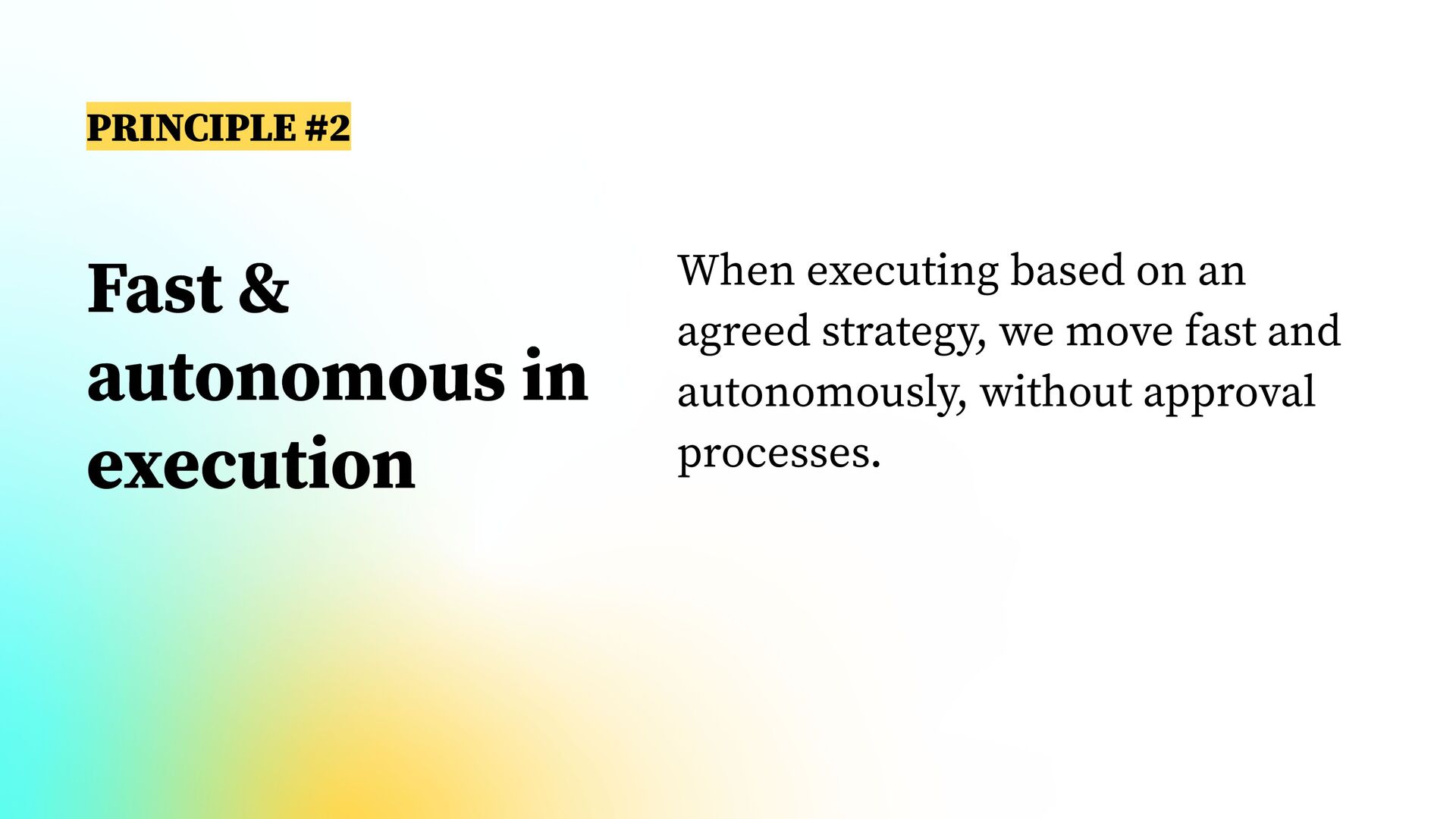
But it's just a series of decisions. Decision after decision after decision after decision. And the question is how do you make good decisions and high quality decisions at speed? The way we do it is through principles, which again is a whole talk in and of itself.
But we have principles for how we work. And these principles mean that people like me, big red, red light walking around the place, don't get involved when we shouldn't be. And through these principles, can make sure that all these anti patterns that we learned by serving our best people by serving our best people, we learned what all the anti patterns are.
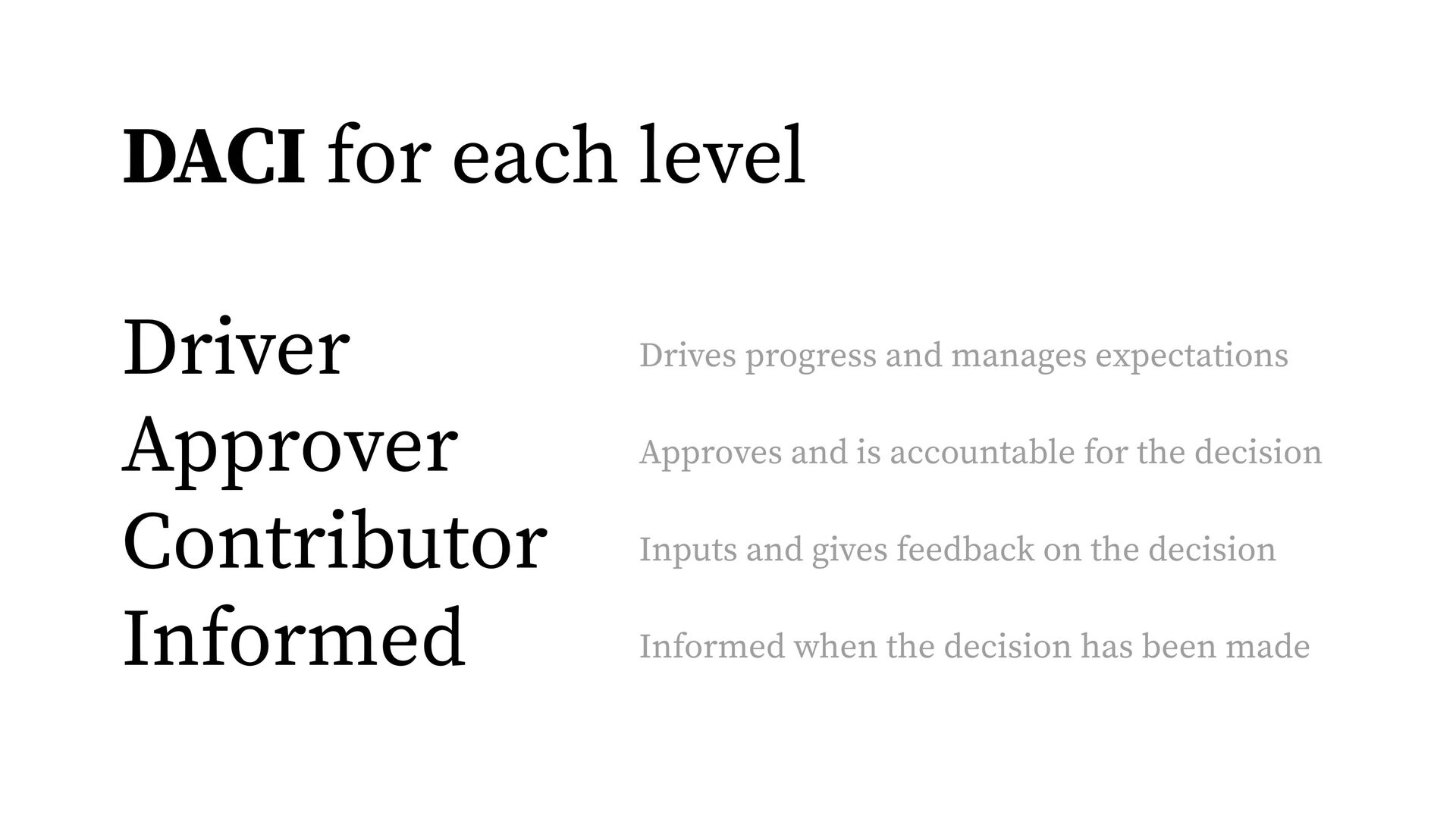
We encode them in principles, follow the principles, and you avoid all those amber and red lights. Roles and responsibilities is a thing that keeps coming up over and over again, having clear roles, clear responsibilities. Who's driving? Who's approving? So for example, if I'm not involved in this Dassie, if I'm none of these roles, I'm not involved.
I'm not involved. If I'm an approver on something, I'm only involved in very specific ways at very specific times. And the last piece is, if you're a leader or manager especially, you've got to find out what people say when you're not in the room.
You've got to find out what people say when you're not in the room. Again, you can survey people, you can ask people. But if people are talking in your company of any size, if they're talking about the process, or if they're talking about how decisions get made, or if they're talking about people, it means you're slow, because they're not talking about the product.
They're not talking about building the product, they're not talking about customers, and it's a trade off. Every time you don't talk about customers and don't talk about the product, you're talking about these other things, and that's not what will help you win the race.
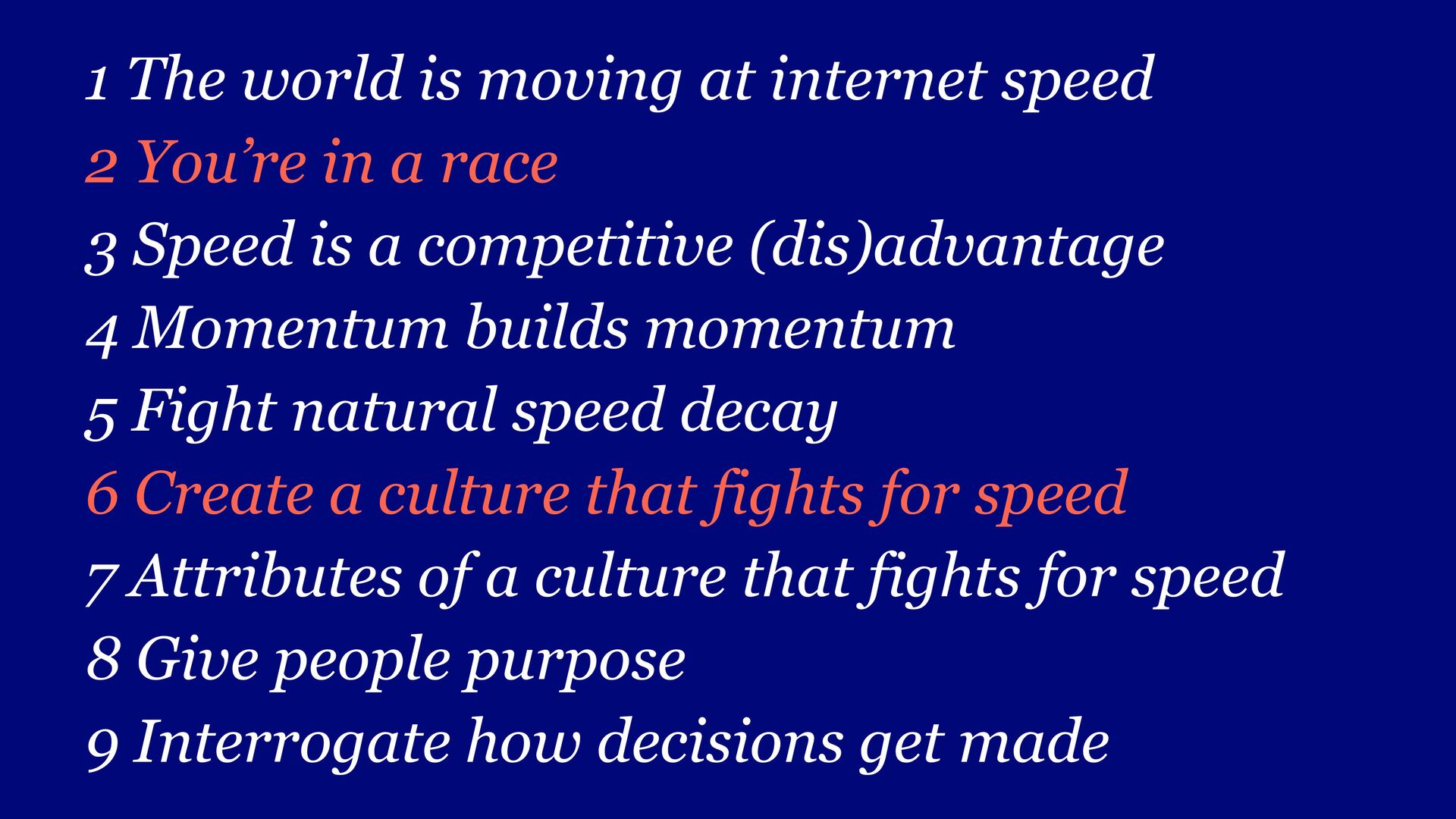
So that's it for me. I kind of highlight these two in red, because I think they're the two most important things from this list. I'll share this deck afterwards to you, so people can access it and look at it again. You're in a race. I can't overemphasize that.
You're in a race. Whether you like it or not, or think it or not, you're in a race. The internet is young, it's disruptive, you're in a race. And especially now, the greatest tech bull run of all time is over. Valuations may never be the same again for tech companies.
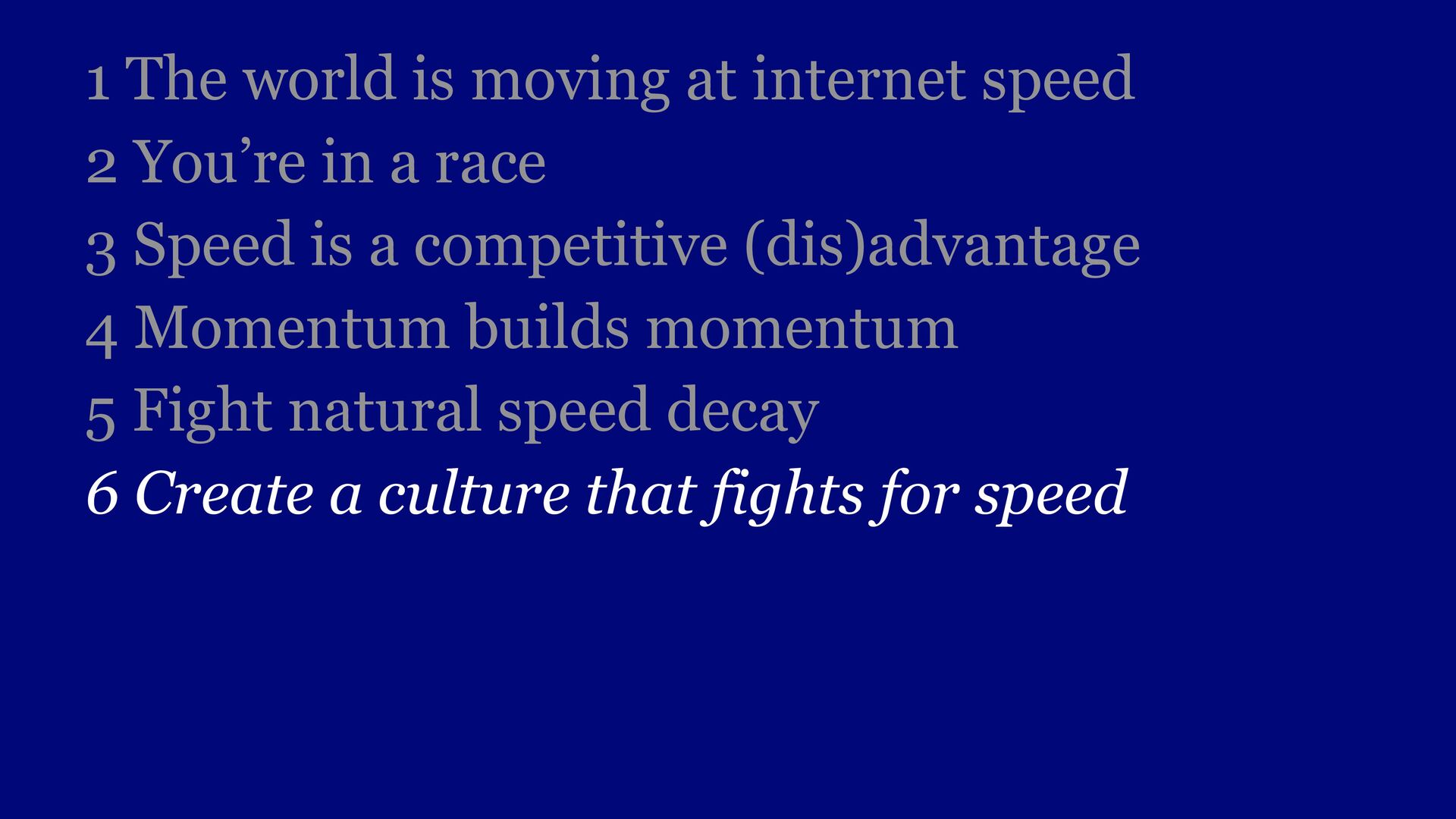
You're now really, really, really in a race. And it's really important to internalize that and talk to your team about it. And the way you win this race is to create a culture that fights for speed. You've got to create a culture that fights for speed.
Speed decays naturally. You've got to fight for it to continue. That's it for me. Thank you so much.