
In this talk, Mike will explore the skills required to be an effective and desirable modern marketer. It's not as clear-cut as you may think; Mike has learned this personally via his own career, but also via the building of marketing teams. What attributes really make the difference between 'meh' and 'yeah!'? Mike will tell you in his usual straight-to-the-point manner. Who knows, he may even throw you a biscuit....
← All talks 






Grow Marketing Turing Fest 2016
Got the Marketing Skills to Pay the Bills?
Auto-generated transcript - may contain errors. Tap a timestamp to jump the video.
Good morning everybody. Thanks for getting out your beds and crawling here with much anticipation for a fantastic day. As Brian correctly said, I'm Mike McGrail, it's good for the MC knows your name. That wasn't the case last month, another event. Before I start talking about anything, I would like everybody to become better acquainted.
So if you can all stand up please. I mean it, I'm not joking. And fist bump the person to your left and the person to your right. You may be seated. If I always wanted to say that in a church. Turns out for years, by the way, great action there.
I even saw a few. Like, we're here to learn. It turns out for years, I've been calling this a fist pump. A fist pump's like a boom, like that. So, you maybe don't want to confuse those because if somebody puts their fist out like that and you go boom, they're just gonna get a bit aggressive.
But thanks very much for doing that. That was more for my amusement than anything else, to be honest. I spoke on this stage last year. Well, this stage and clicker gate. There we go. I spoke on a different stage at the same conference last year about social media advertising and how it's done very badly.
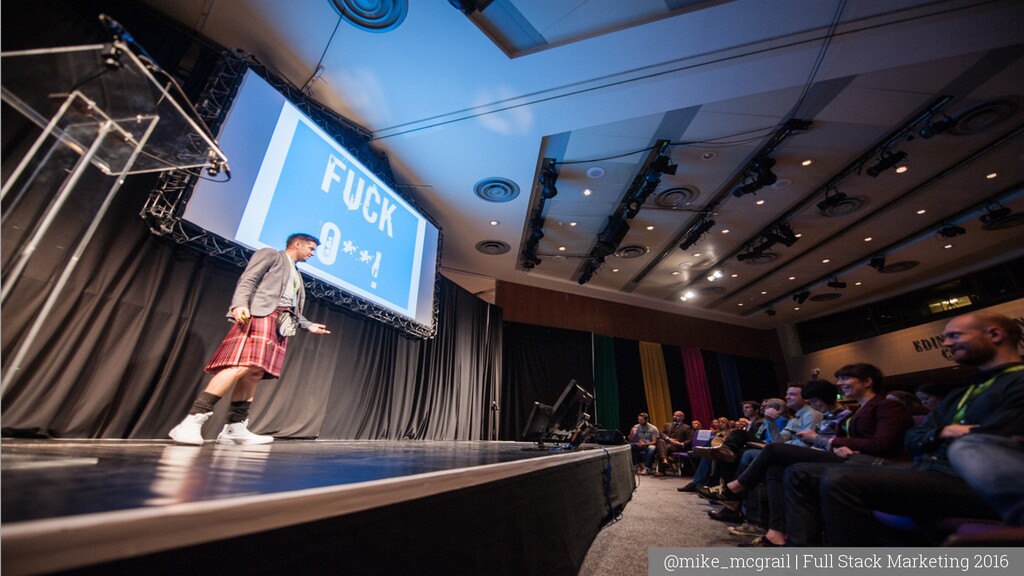
I misplaced some asterisks as you can see there and I'm really sorry for the f bomb early in the day, especially in this setting. But the point of that was that that was the reaction that most of the social media ads I was researching got.
So, last year, the reason I spoke about that was I was running a consultancy at Edinburgh called Velocity Digital, and I was very much involved in helping clients make the most of social media. But things have changed a lot for me since then.
In January, I joined administrate. Many of you will have seen John Peebles speaking yesterday if you were here. You would have had to have been here to see him. And I'm sure some of you know of us. And I joined in January as the marketing director.
And that was a big change for me from running my own company for nearly four years, having worked in agencies previously. All of a sudden I was in this environment of we have this one goal. And that is to create this phenomenal educational technology product, but also the ultimate human organisation.
And I started to really think about my talk for this. And I want to talk about the story of why I'm gonna talk about what I'm gonna talk about today. And I can't tell you that now, would ruin everything. Things have changed for me.
And one of the first things I started to look at when I joined the ministry, among others, was what technology we're using in this company. What are we using for marketing automation? What are we using for social media management? So on and so forth.
And I started to think well, maybe that would be a great talk for full stack marketing next year. I could come up here and recommend a bunch of tools that can make all your lives easier and yourselves more successful and on behalf of your businesses as well.
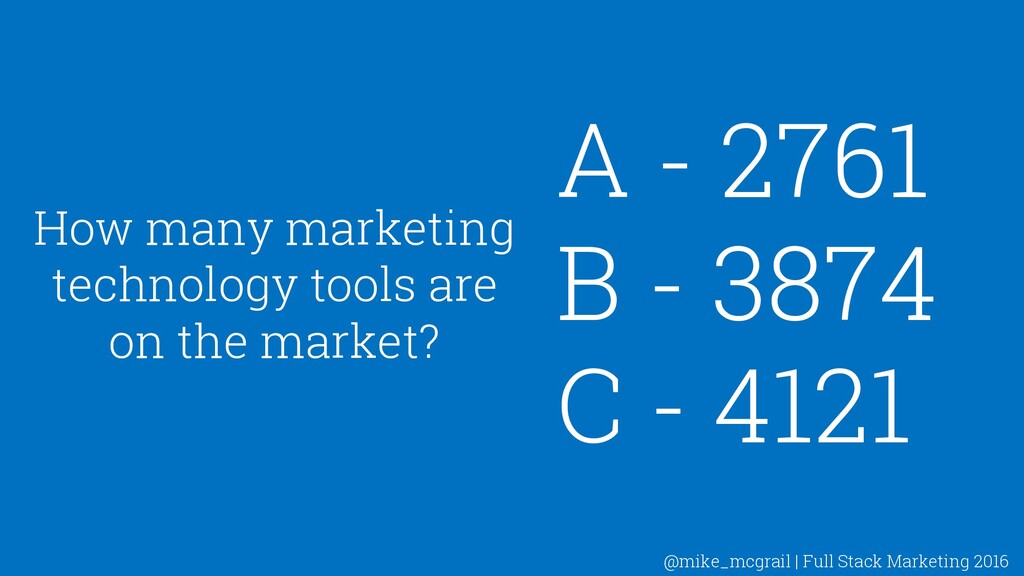
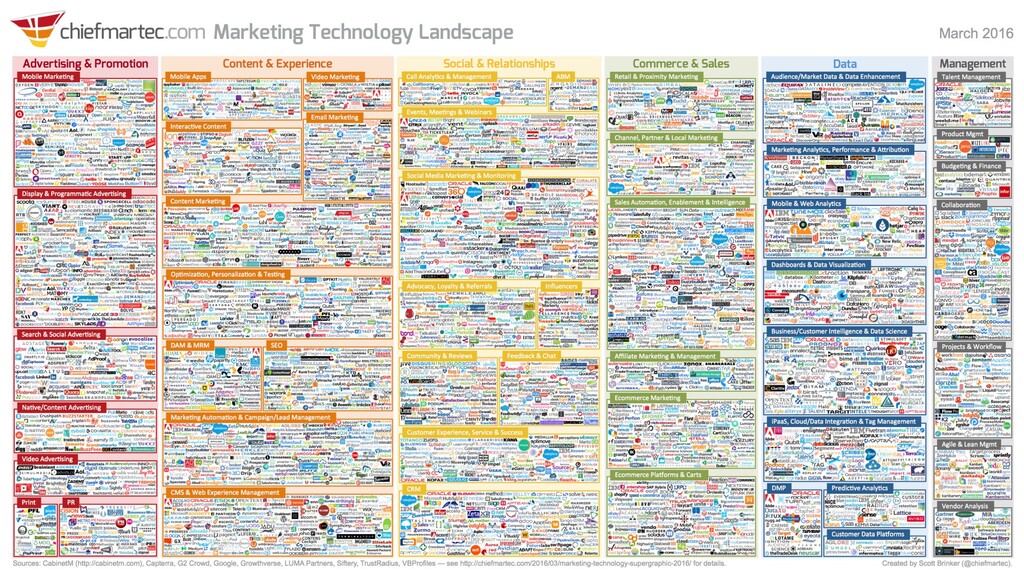
Before we go any further, it's quite staggering how many tools are out there. And without further ado, sorry, might get sued for that image. I want us to undergo a little quiz. Now, here's the question. How many marketing technology tools are on the market?
Is it a) two thousand seven hundred and sixty one b) three thousand eight hundred and seventy four or c) four thousand one hundred and twenty one? If you think it's a please raise your hand now. Not a soul. If you think it's b please raise your hand now.
A. And C, finally. Thank you. I'm on this note. Fantastic. Interesting. Okay. Sorry. Right. So, I am not going to tell you the answer. I have a star from overseas who's who's gonna join me on the stage, well, via video link to tell you the answer.
Oh, hey. How's it going? This is Jay Baer, president of Convince and Convert, New York Times bestselling author of a bunch of books that nerds like and the most retweeted person in the world among digital marketers. What are you guys doing right now? What's up?
What? You're doing what? Oh, you're listening to my man, Mike, give a masterful presentation in Scotland? Good on you. Fantastic. I hope you are having a terrific time. Meanwhile, the answer to the question is b. Three thousand eight hundred and seventy four different pieces of marketing software are available.
How about that? Enjoy, Mike. See you later. Big thanks to my man Jay Bear there. Please do follow him, tweet him, tell him you saw him on the stage. Would absolutely love that. Morning. How you doing? It's fringe time. I think you answered b.
I think I saw you get that correct. What was your name? Sophie. What company are from, Sophie? Cyberduck. Cyberduck. Cool. That sounds great. Listen, because you've got the answer right, I have a present for you. A caramel wafer. Enjoy that. I'm about to walk backwards up the steps.
Okay. So, that's quite a staggering number. Three thousand eight hundred and seventy pieces of marketing technology are available today. And this super graphic they call it, this is created by chiefmartech dot com every year. And it shows every piece of marketing technology that's on the market.
That was in March twenty sixteen. We're obviously advanced from there now. I'm sure there's more. There's probably eighteen seventy four new social media management tools. Saturated market guys. Why? Nobody needs more. You know, I started to think that crowd at Full Stack Marketing is probably the savviest marketing audience in the world.
They don't need a guy in a skirt with really **** hair telling them the best technology to use. You all know where to go to get the peer recommendations and your technology stack is absolutely fine. I'm sure. Something I've always been interested in is what marketers need to excel in their jobs, to be self fulfilled as a marketer and to do good for their businesses or the businesses they work within and their teammates.
And I thought actually I'm gonna explore that. That's what I'm gonna explore at Fullstack. I'm one marketer in a massive sea of marketers and I wanted to dip my toes into that sea. This is a weird salt based analogy. So I I went to somewhere that if you do not spend any time as a marketer, you're in a bad way.
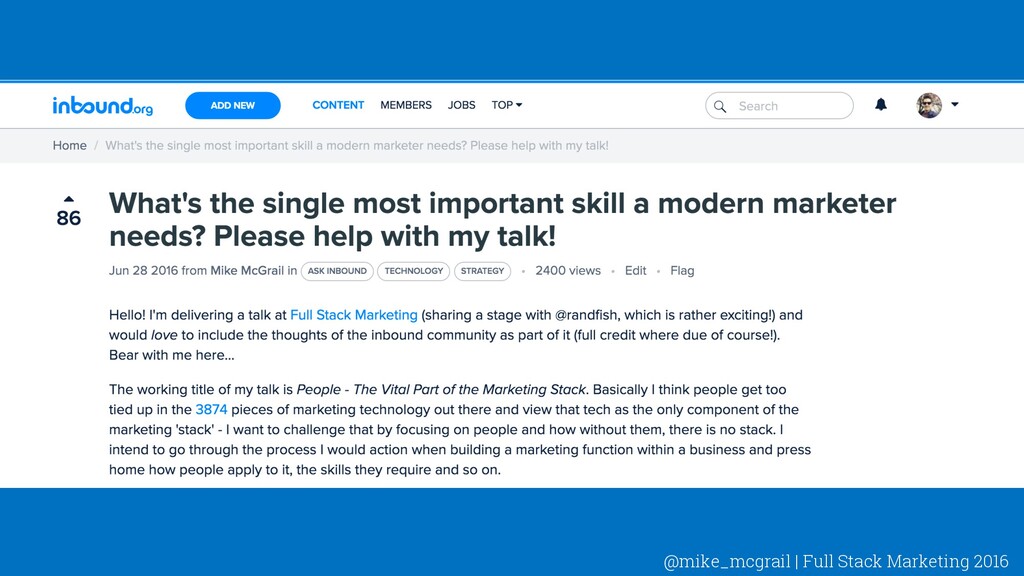
Inbound dot org. Which is actually co founded by a fellow full stack speaker, Rand Fish And I thought I'm gonna go and ask that phenomenal community there what they think might be the top skills a marketer needs to have today. So I spent twenty minutes writing this post telling them the story.
Guys, I'm thinking about this. I'm going to do a talk about technology. But then I thought no, I'm not going to do that. So I told them. And I listed eight skills that I wanted the feedback on. Now this very quickly got a lot of traction over on inbound dot org, which can actually be quite hard to do.
At the time eighty six up votes, two thousand four hundred views, but that didn't matter. I got over one hundred and twenty really in-depth responses. And it turns out I got it sadly wrong. Sadly wrong. Sad face at the clicker. Yep, I got it badly wrong.
And they were quick to tell me that. I even got two tweets. One of them was passive aggressive. I'm trying not to spit my coffee out all over my PC at the idiotic suggestions that Mike McGrail has made on inbound. I'm like at least do it to me directly and use a Mac.
I actually wanted to show that tweet but it's been deleted by the guy because I started to debate with him back and forth and now we're best buds. Yeah, it was quite strong but that's good. Us marketers tend to make sure that we get our opinions across.
The reason I got it so badly wrong was I had focused on hard skills. I had said SEO, AdWords, analytics, so on and so forth. Now, that I know that wasn't the right way to go. What I did enjoy was that people, albeit they told me I was a ****, They did answer the question but then carried on into how they felt.
And I'll talk more about that. It's still interesting though what the community thinks the top three hard skills are. And I'm going to cover those now. Nadine, how you doing? Good, thank you. I'm gonna ask you a question. That's why I'm standing here.
Could you have a stab at one of those top three? That guy can tell the future. You should employ him. Writing. Writing. Okay. You can have a biscuit too for stealing that guy's answer. Thanks whoever that was. Cheers. Yeah, writing. That was overwhelming. I went through every response.
And I tallied them all up and writing was the number one hard skill that they felt and I believe that marketers need in this day and age. If we can't write, no matter what that is. If it's an e book, a white paper, an email, the little tiny bit of text we get in some ads.
We can't convey what we need to convey. We can't communicate with the people we're marketing to. We can't push them further towards where we want them to be as marketers. And writing is a difficult skill. Some people say I'm just not a natural writer.
And one of the things that we're trying to work on right now at administrate is really empowering our team, every person and every team to be able to write and be a voice within the organisation. Key part of our strategy is thought leadership as I'm sure it is for most of you.
And we're looking at there are people who say I don't want to write. I don't like writing. I'm not very good at it. So, we're trying to put some tools in place. Some guides. Some templates and things that will help them at least be able to create a nice digestible blog post for example.
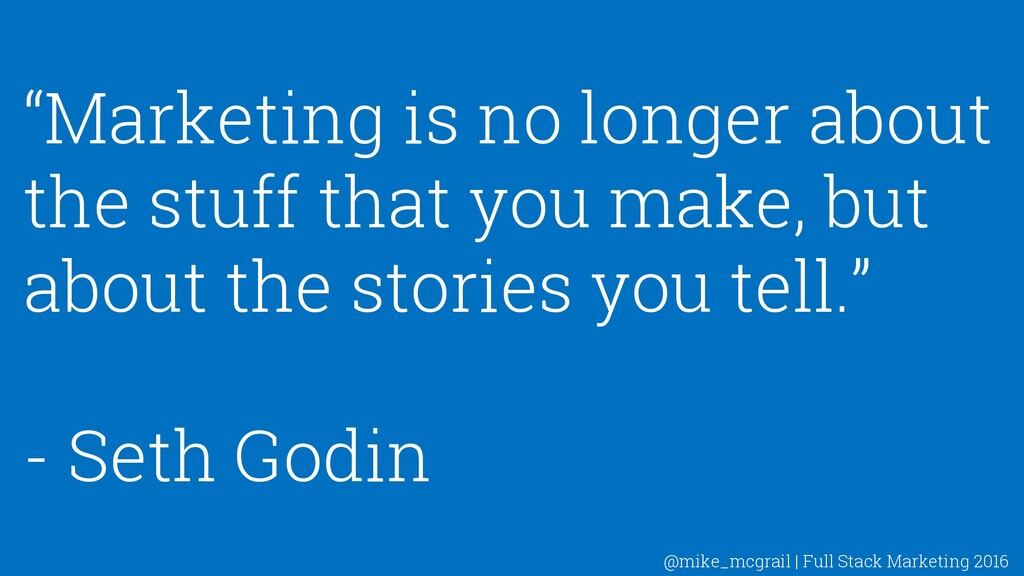
The next one focuses on stories. And sorry, this is tied into writing. I just want to talk about this. So Seth Godin is somebody that I've got massive respect for and I'm sure a lot of you read his stuff. And he says marketing is no longer about the stuff that you make but the stories you tell.
And it's true. We should be using these skills we have to tell stories about the business. But also this storytelling thing is getting a little bit out of hand. There's times when a well written ad with a great image will get what you need as opposed to a series of blog posts.
Now that would that latter thing is what I would try and do at all times. But I was in a meeting when I was consulting and the client said to me, Mike, Mike, I've got this piece of content. It's a technical manual for this.
It was galvanizing company in the Highlands. How do we storitize this manual? I said, if you ever say storitize again, we will not be working together anymore. But people people that aren't as embedded in marketing as we are get carried away when people with huge influence start to say, write stories or get on social.
Snapchat, get yourself on there or you're missing out. And people that aren't that into it and don't understand, they get panicked. I don't like that. So, the number one skill was writing. The next one was CRO. Conversion rate optimization. This surprised me a little bit.
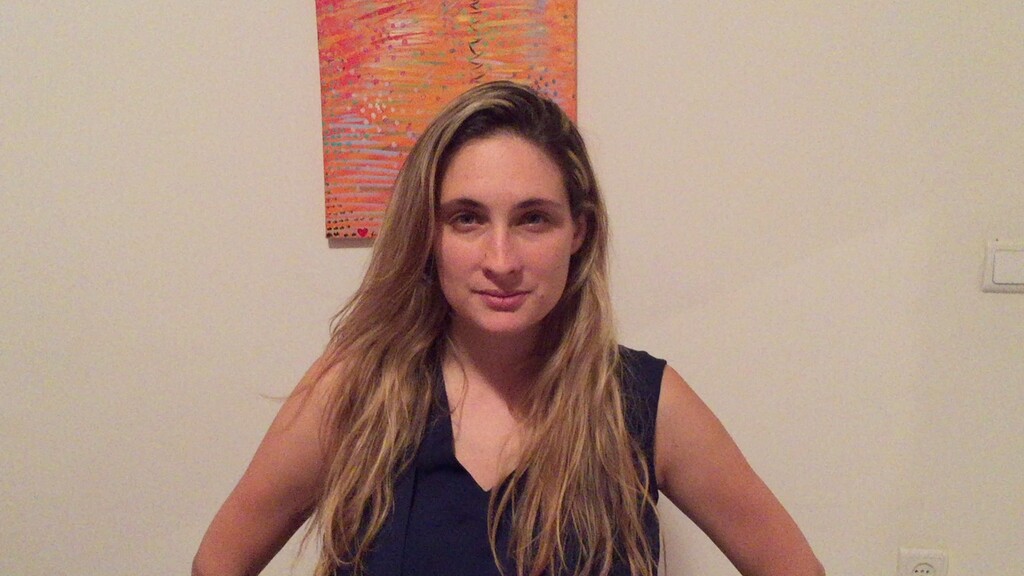
Not because it's not important but I was really quite mystified at the fact that it was number two. I've got another guest who's gonna tell us why CRO is so important. Hi, guys. I'm Tally from Banana Splash, and I hope you're having a great time with Mike.
CRO is one of the most important parts of marketing as it's not only a fantastic way to optimize your site, gain more sales and increase your conversion rates, but it's actually a way to gain a lot more information about your customers and understand them, what they're looking for, what they need, and provide a better experience for them.
So I hope you have a great time today. Thanks Talia. There's a punchline going again. Thanks Talia. Really interesting person again to follow, and please do say hi to her. She's one of the top people. Now I'm not gonna talk about CRO for too long because Ollie Gardner's on the stage later and that would be very unwise of me.
However, we've just been speaking about writing and we can write until we're blue in the face until the cows come home. Get people to the part of the site we want them to from ads or get them really absorbed in the blog posts we're writing.
But if we don't think about how we're then going to convert them to take the action that we need them to, all that could be in absolute vain. If we want a trial sign up. If we want a newsletter sign up. If we want them to add something to a basket.
How do we do that? And CRO at a basic level that's what it's about. The thing that Talia said there at the end is that it gives us information on how our audience act and that's the important part. It's not just about we've split tested two landing page and the image with the lady converts more clicks.
It's not that gives us the data but then we need to deep dive into that and say what do our people that we're trying to sell to or the customers that we're trying to retain and upsell to. What do they want to hear from us?
The final hard skill, oh. Sorry, that's an error on my part there. I'll move on swiftly. The final skill is analytics. Jesus. I said Jesus in church as well. Skill is analytics. The fact is folks we have so much data at our fingertips it's almost painful.
Whether it's web data through the likes of Google Analytics. Whether it's ad data we get from the ad platforms we use. The problem is what do we do with it? The skill isn't going, I made you this lovely reports, mister CEO. And it's got some metrics and stuff in it.
And it's got a cool little graph. Like look, our reach is expanding up. That doesn't matter. What matters is saying here's the data, mister CEO. And here's what we're gonna do based on what we've learned. And that is the hard part. That is the hard part indeed.
So writing CRO analytics. CRO analytics, lots of data being created. How do we deal with that in the best possible way? The fact is though we are not we're not robots as humans. We are highly intelligent, driven by emotion and that comes down to something that we term as soft skills.
The personalities, the traits that make us all different as individuals but really empower us to do our jobs. Humans drive marketing. Technology doesn't drive marketing. Hard skills, we can learn hard skills. Writing's quite tough to learn. And you're not necessarily gonna be world class at all of these skills that we we need to get our jobs done.
But it really for me comes down to how we are as people. People are the organization. We need to be marketing to humans so if we don't act like humans and think like humans, it's not gonna work. The talk on inbound dot org was pushing further and further towards soft skills.
And soft skills is always what I have thought of. I've hired people in marketing for a long time now. When I worked at other agencies. When I was running my own consultancy. I'm doing it right now at administrate. I've also had to fire people.
That's always horrible. And I can honestly hand on heart say that the reason for me having to fire them in the end was probably seventy percent my fault. Because I've been guilty in the past of hiring based on our job spec. What level of experience do we need them to have?
What skills do we need them to have? And when you get a CV in and you go, yes, this person ticks every box. And you go and you interview them and you maybe get them to do an exercise. And I've been guilty of not looking at the person enough.
Are we gonna have the rapport to be able to work together? Do they have the right abilities, personality and traits wise to be a valuable member of this team and offer value to the people that we really need to offer value to. Which yes, is our our prospects and our customers but also our teammates.
So I think we can all be guilty of of not hiring in the right way and for the right reasons. The number one skill, soft skill wise, that the community thought and it's one that I I've always been really interested in is curiosity.
I've always had a massive frustration with the lack of curiosity of some people I have worked around and worked with in the past. No desire to learn everything about marketing. To learn everything about the business they are in. The industry they are in.
The people they are working with and the people they are for. It's been a big frustration for me over the last ten, eleven years. There's a thing though that we can all be curious and read and read and read and read and listen to podcasts and watch videos and we've all got somebody in our teams that send you twenty links a day.
This is great, this is great, this is great, this is great. Brilliant, thanks for sharing that. But what are you gonna do to go and execute on all this knowledge you're absorbing? It does happen, doesn't it? And I've been guilty of that in the past.
My Twitter feed used to be like fifty things. Boom, boom, boom, boom. No. I'm better just maybe sharing two or three things and then saying here's what I would do with that. So we can read and read and read. We can learn and learn and learn.
But we need to go and execute, learn, adapt and move on from there. It's also down to the organizations to foster curiosity though. Something we do at ministry is every member of staff must read a book a month. A relevant book and write a report on it.
And we're gonna move those into blog posts soon. That allows us to take the knowledge and share the knowledge. But then everybody has think about how am I gonna apply that to my team in a way that suits the wider business. If somebody wants a book, they see it on Amazon.
We'll buy it for them and it's theirs. It's it's not like you go out and buy a book. We facilitate that and we really encourage this learning. And I've never seen that in an organization before and I think it's a great thing. So curiosity.
Curiosity The next one's adaptability. Curiosity has played a huge part in my career. It led me to in two thousand and nine start the Social Penguin blog. At the time I was working in a very small digital agency in Edinburgh and my job every day was to write two to three hundred AdWords ads and a **** ton of metadata for websites.
Back then it was like meta titles, meta descriptions. The CMSs even still had the little keyword field that you were like these are the words I want a feature for. It did **** all. I started this because I quite frankly was bored out of my mind.
And I'd got onto Twitter around the time and I started following some of the the marketers over in the states. Guys like Mark Schafer, Mitch Joel, the late Trey Pennington. And these were people that were starting to see social media could be a great marketing channel.
And we do that as marketers don't we? Well there's something shiny and new and people use it. And people buy our stuff. And we're gonna go and ruin it for everybody. And that's what's happening with every social media platform we see at the moment.
It's like snapchat snapchat peach peach. What the hell is peach? Don't even know it's gone. But I thought I want to learn more about social media. So I started to interact with these guys. Ask them questions. And then it was quite nice because one of our clients at the agency I said look I want to set you guys up on Twitter.
They are quite a well known chemist chain here in Scotland. And they said yes Mike, Great idea. We've got a special on tampax. Pardon? Well, our weekly special is tampax. And I'm like, I'm not gonna start tweeting about that. I'm not sure that's what the audience is gonna react to.
So, I was allowed to experiment though and we started doing things like making They sold hair straighteners. So, I said I'll come with a video camera and we'll film somebody getting their hair curled with the straighteners that you sell. We'll put that on your website and we'll start tweeting about it.
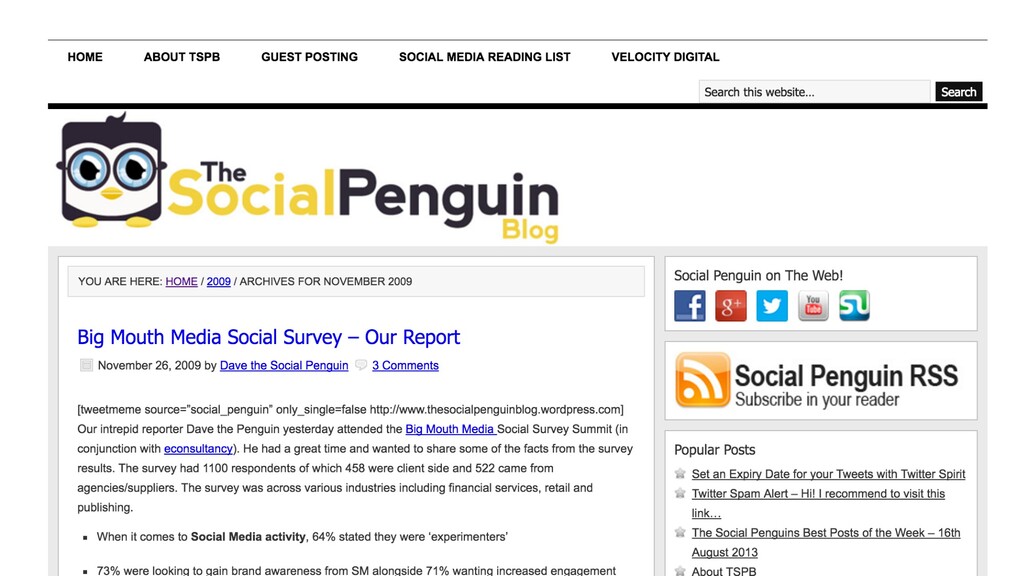
And bloody hell it worked. It was nice. Anywho, I wanted to dive deeper so I started writing the Social Penguin blog. And I was writing that right up until the middle of twenty twelve. And so before I started my consultancy. We had five or six writers at one point.
A really nice audience. The reason I'm talking about this is not to be like, look at me. I made a dreadful looking website. This is the reason that I am able to stand on a stage like this in front of way smarter people than me and talk to you about marketing.
I thoroughly believe if I had not done that, I would not have been able to build a career that I've gained so much from and I'm and I'm proud of. I'm not I'm not No qualms in saying I'm proud of what I've managed to achieve.
And that that is what we all need to strive to be. Is that Not me. The curiosity. That curiosity factor is absolutely key. When I interview people, I ask them can you tell me the top three blogs or podcasts or writers that you learn the most from?
It's not all about reading and listening but that question has been choked on so many times. So many times. And that astounds me. Some of them even say mashable which makes me wanna cry. So curiosity. The fact that you're all sitting here shows how curious you are to learn.
And if you know marketers, if you've got friends who are marketers and they didn't try their ass off to get to get a ticket for this. You tell them they should be ******* ashamed. This is the best lineup you will see in the UK this year.
Everybody should be striving to get tickets for this. Curiosity. Number one. Can anybody guess what the next one was? Adaptability. Keeping the transformers theme going after John Peebles had one on the stage yesterday. Got four year old at home who speaks like Bumblebee all the time.
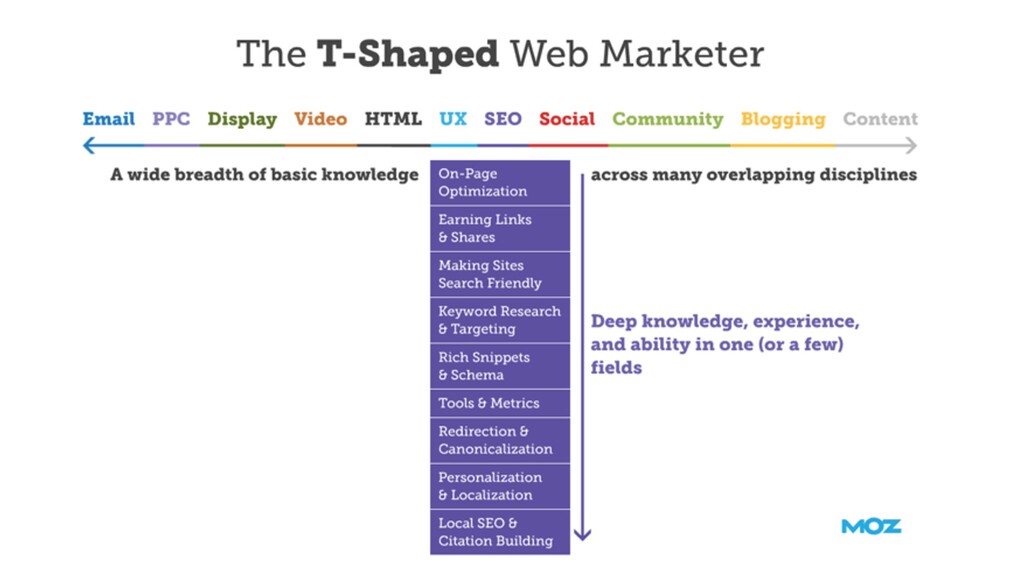
It's pretty wearing. Adaptability. Yep. This is the t shaped marketer. And it kind of feels like Moz and Rand are the basis of my talk after I used inbound dot org for my research. And this is a post that Rand wrote on the Moz blog in twenty thirteen.
And it takes the concepts of the t shaped employee and morphs it into marketers. What we have on the top bar is a bunch of hard skills. The idea is that marketers should be able to at least have a basic idea and understanding of how these play a part.
And then can inform and talk about those. The fact is everything we do has to be integrated. So if we can be across the top of that bar, we offer value to our businesses. But one of the biggest things we do there is we build respect with our colleagues as well if we know we're all striving to be as rounded as we can.
Then the bottom bar is one, two or three skills that you're specialist in. What are the ones that you become the go to person for? Over the years, I kinda morphed into social media and content creation. I would like to see this revamped though with everything we've been talking about today.
So the T and the S. So, the soft skills. How do we build those into it as well? Just a great thing. The game most of us are operating in is pretty hard. It changes a lot. Sometimes it feels like it's changing daily.
So, we need to be adaptable from a skills perspective but we also need to be adaptable from the fact that we can take quite hard knocks. There's a guy who I spent a week on a course with about two weeks ago, I think some of you were there.
Bill Ollett from MIT. And he's got this, he's based in Boston. He's got this phrase he uses, anti fragile or anti fragile as he would say. And it's basically about no matter what you do for your work or to earn money. It's about when a change comes, you shouldn't be downtrodden by that.
You should see it as an opportunity and capitalize on it. And one of the biggest things that has changed over the years is SEO. I have a pathological fear of pandas and penguins now. When those algorithms came into play on Google, it was the biggest change to how Google indexed content ever.
And it was brilliant. Because the ultimate aim of it was to put the best and most relevant and high quality content in front of people. So all the nasty stuff that I had been doing back in two thousand and nine. Building all this infrastructure infrastructure infrastructure.
Still important but not the number one thing. What happened at that point in time? A bunch of blog posts from SEO gurus saying this is ridiculous. I can't do this. I don't know how to write. How do I do it? And it's just like, oh, just dry your eyes and move on.
Actually they were the crap SEOs. They've probably gone out of business or shockingly some of them are still operating doing that terrible old school work in SEO. And they still get paid to do it, which is fairly scary. So it's about being adaptable as people with skills.
It's about being adaptable as colleagues and adaptable to change. Really, really important. The last one. Who can tell me what this might signify? Sorry? Empathy. Nothing says empathy like perfectly formed lattes, pastel shades and wonderful cheekbones. You've got a love shutter stock. What is your name sir?
Brendan. I'm gonna give you a biscuit just because you're smiley. And you're gonna get an ACDC t shirt. And I've not worn it. It says clean but I hope you wear it with pride. Empathy. Bing. The fact is we are as marketers, our job is to put ourselves in the shoes of the people we market to and our customers.
If we cannot see ourselves through the eyes of their lives and the problems they need to solve in their businesses and the emotions that not being able to solve problems can create and the emotions that are created when somebody does come along and solve a problem for you, we're really gonna struggle.
It's not about being great at SEO. It's not about being great at CRO. Curiosity and everything all comes together but this one for me is the absolute killer. But it's not just about having empathy with the people outside that we're trying to market to.
It's about having internal empathy. Every team and every business has its own problems and we all rely on each other in many ways. If my team at ministry isn't doing our job, the sales team don't get the quality leads. Always quality leads. They don't get the quality leads they need to go and sell and increase the revenue and give us the money that we can then build the product with and build that ultimate human organisation.
If the product team aren't creating a great product and progressing that product, it becomes hard for my team to market it. Because we market on benefits. This will automate your horrible horrible manual processes that you've been doing like this for years and allow you to take your training product and make it better.
That's what we want to do. Why do we want to do that? Because the people that learn through those training companies will be better educated. Better educated. I'm not sure that's right grammatically or ironically. And that's, we've got empathy with two sections there.
We've got empathy with the people running these training companies but also with the learners as we call them. That's really important. So, we need to understand the problems that our colleagues are facing and how we can all work together. And that empathy is an absolutely huge part of that.
I don't actually think we can be truly empathetic outwardly until we have that real empathy internally. And also understanding ourselves as individuals. It's hard, it's hard. Everything, you know, yesterday people are up here pouring their hearts out, know, founders of companies about how difficult it's been.
That bit of self reflection is so important. So, if you can be curious, adaptable and empathetic, you will win. I do twenty of those every morning. Thank you so much.