We already know that diverse teams are more creative and deliver better results. We've seen this play out in repeated studies and in bottom line financial results of companies across many industries. Sadly many organisations lag behind in adequately representing the population, but those that are making strides are also outperforming the competition.
So we know WHY but what about the HOW? In this talk, we’ll explore a framework for how to think about diversity and inclusion, and practical things you can go and do to make your organisation and culture genuinely inclusive. Because that’s the only way to attract, recruit, promote and most importantly retain a wide range of people. And THAT is the only way to have the highest-performing teams possible.
1 / 74 Use ← → to navigate
Auto-generated transcript - may contain errors.
Tap a timestamp to jump the video.
Thank you all for being here. Morning. Brian and I had a whole debate about whether this kind of terribly clickbait title was the right thing to do or not, so I hope so. That's what I said. I'm I'm Mary. I'm a technologist by background.
I'd started off as a hardware hacker as a kid. Weirdly, ended up building part of South Africa's first satellite through a weird set of circumstances when I was in high school. Who of you have parents? I'm not a parent yet, but I have great parenting advice.
Don't let them do anything cool when they're young. I sold her something that went into space when I was sixteen, and it's all been ******* downhill since then. But I've had a I've had a an eclectic career, as somebody referred to it once.
But I'm now very happily ensconced at Monzo leading an awesome technology team there. And I also help run the the LEAD Dev Conference, which is a conference for technical leaders that runs in a few cities around the world. I'm always delighted to see speakers who we've had there becoming popular at other conferences too.
So like, no hard feelings, Brian, you've stolen literally like a third of the lineup over the last couple of years. It's fine. Share the love. But today, I'm not here to talk about Monzo or any of anything particularly deeply technical. I wanna talk about how we can help our teams outperform other teams by being more inclusive.
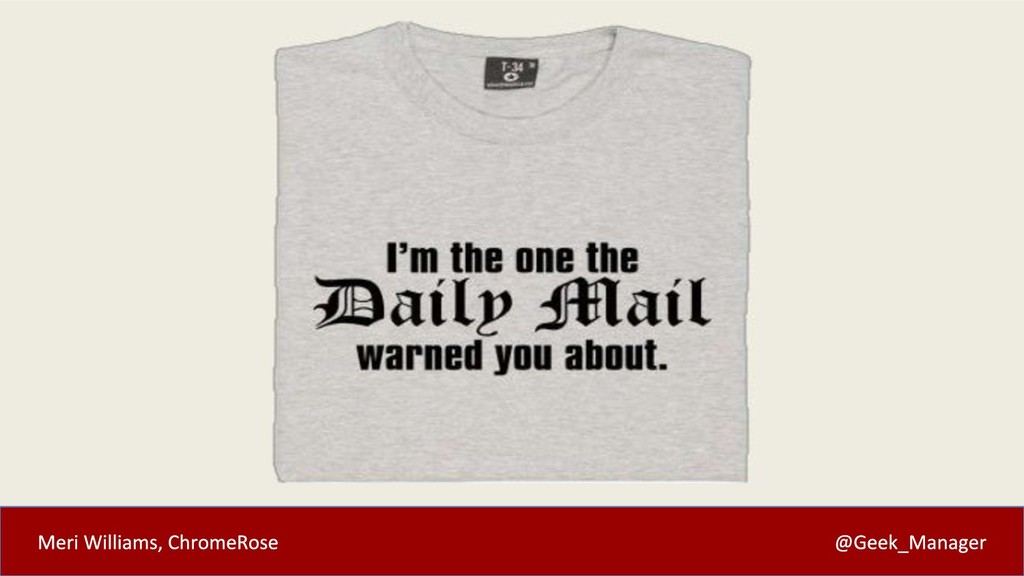
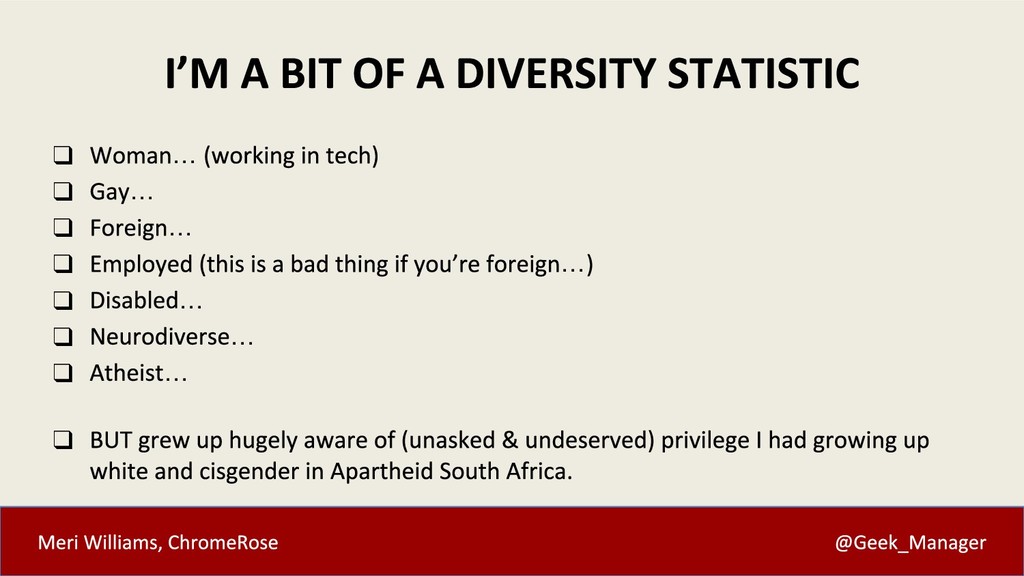
But I'm gonna start with a confession. I am the one the Daily Mail warned you about. I'm a woman working in tech. I'm queer. I'm an immigrant with a job, which I think is worse than if I were living off the state. But I'll be honest, I have to regularly check the headlines.
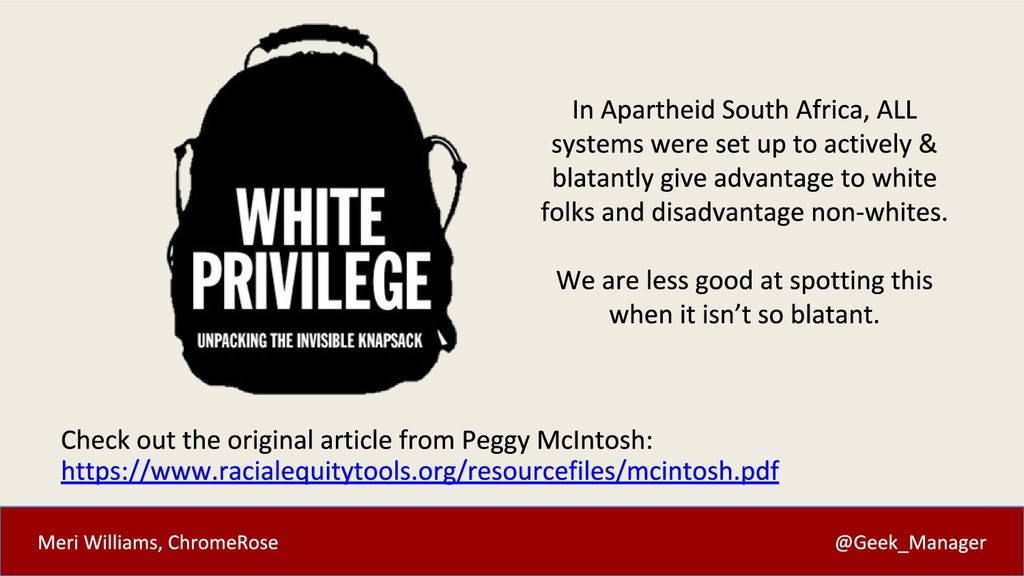
I have a physical disability. I'm neurodiverse. I'm godless. My wife is British, so I'm literally over here sealing your women and your jobs. That joke is growing on her ten years in, but, she mostly mostly likes it. But I grew up white in apartheid South Africa, and so I really, really understand what being having undeserved and unasked privilege feels like because of the because of nothing I did right.
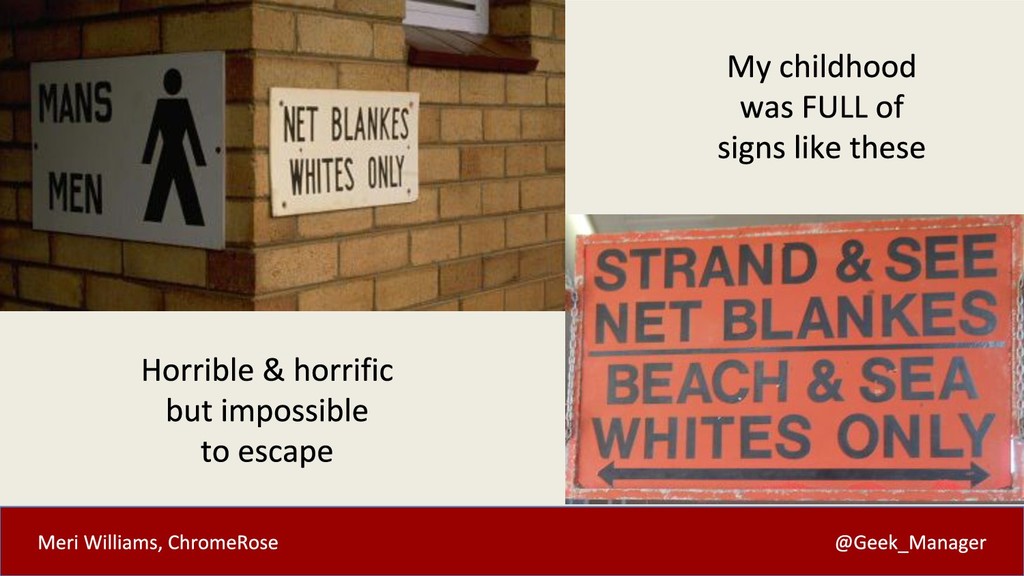
I happened to be born this incredibly pale, very Scottish resonant color. And I got educational opportunities. I got all sorts of benefits because it's something I didn't choose at all. It just happened. And my childhood was full of signs like these. Ned Ned Blankers just means whites only, and that was a sign that you saw on beaches and toilets and everything.
Everything was marked as anything anything good was marked as whites only. The beach and the sea were whites only in most places. And it was really horrific. And I found it horrific and I wasn't even negatively like, wasn't denied anything because of it.
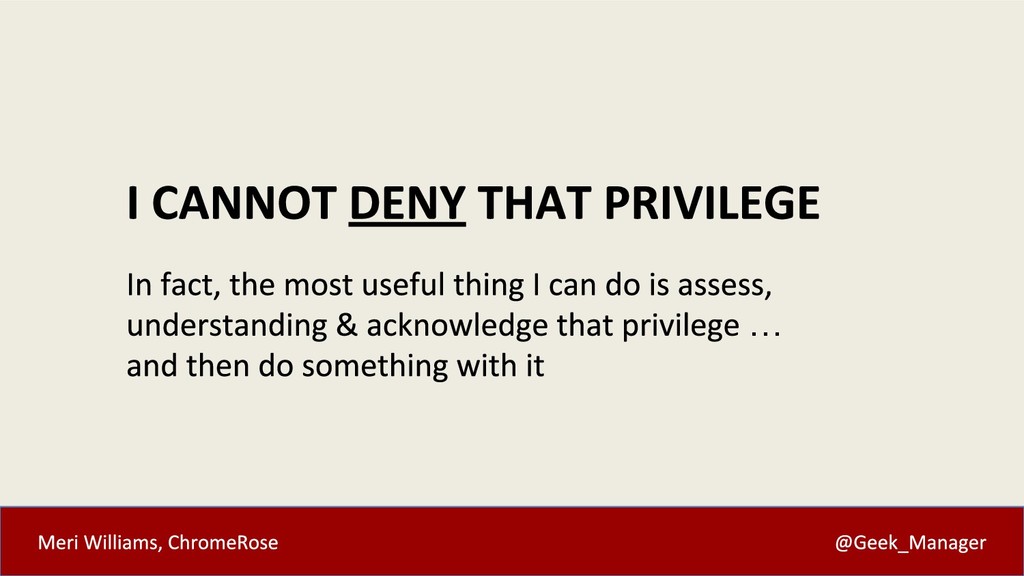
I just thought it was terrible. But even though I thought it was terrible, I still benefited from it massively. And denying that privilege isn't helpful. Right? It doesn't doesn't help any of the people who were hurt by it for me to go, oh, well, I didn't ask for it or I didn't need it or I didn't want to benefit from it.
So I've figured that maybe the best thing I can do is to assess it and understand it and then try do something with it. I hope you enjoy this talk today, but the other talk that I want to, like, very genuinely recommend to you is one by a guy called Anwan Simmons, who's a African American technology leader in in the States.
And he does an amazing talk called Lending Privilege about really specific things you can do to take whatever privilege you have and help to to leverage it for others. He starts with a great anecdote about how in the original Star Trek series, the the actor who played Spock found out that the actor playing Uhura, who was the only woman of color in the cast, was paid significantly less than him.
And he refused to do the next series until they matched her salary to his. And that's a quintessential example of lending privilege. And so please do go watch that talk as well. If you haven't one thing I've one thing I found really surprising, leaving South Africa and and working in lots of different countries and and traveling the world a lot was it was all very blatant in South Africa, but, like, the laws were very actively racist.
They were very deliberately so. And if you want, you know, some fascinating stories, talk to me later about how you learn about World War two in a country where racial segregation is the law and the good thing. Very strange to learn about World War two in history as like, yeah, like, Hitler went a bit far, but, like, his core ideas were good.
Right? Like, seriously, I I'm I'm of an age where, emancipation came and our first democratic elections came when I was in high school. And I remember having textbooks, which my school couldn't afford new textbooks yet. Maybe the new textbooks hadn't been written yet.
So they literally would have us go, turn to chapter eleven. We're gonna cross out the first three pages. That's not real anymore. It was an experience. But the most useful thing that I've found for people in maybe less blatant environments to read and to understand this better is Peggy McIntosh's amazing article.
It's quite quite well well known now called Unpacking the the White Privileged Knapsack. And I would strongly recommend, if you haven't read it yet, to have a look. It makes you aware of all the things that you don't think of as advantages that you have.
And I remember reading it and being like, oh, ****. This resonates with me. I I was at school, and the high school I was at was unusually inclusive. They actually had multiracial classes before it was legal, and they had to keep the number of kids who were who were not white at a very specific percentage.
The percentage you could explain away with a bad stomach bug going around. Because when the inspectors came, there would be a intercom announcement for a teacher that didn't exist to please come to the staff room, and that meant hide. And when I was there, it was mostly after this period of time, but there was still a book room with all the the windows blacked out.
And there was still checkers games and chess games and board games and stuff in there because all those kids, if the inspectors turned up for a surprise inspection, would have to mission over and hide in that room to not be not be seen.
But I think I remember realizing that there were kids in my class who their grades were lots better in summer. And when I read this unpacking the the invisible knapsack, I was like, oh, ****. It's because they lived in shacks that didn't have electricity.
And so they could they had light to do homework by in the summer, and they didn't in the winter. And I don't know if you've ever tried to do, like, maths by candlelight. It's not a it's not a particularly educational experience except in how **** candlelight is.
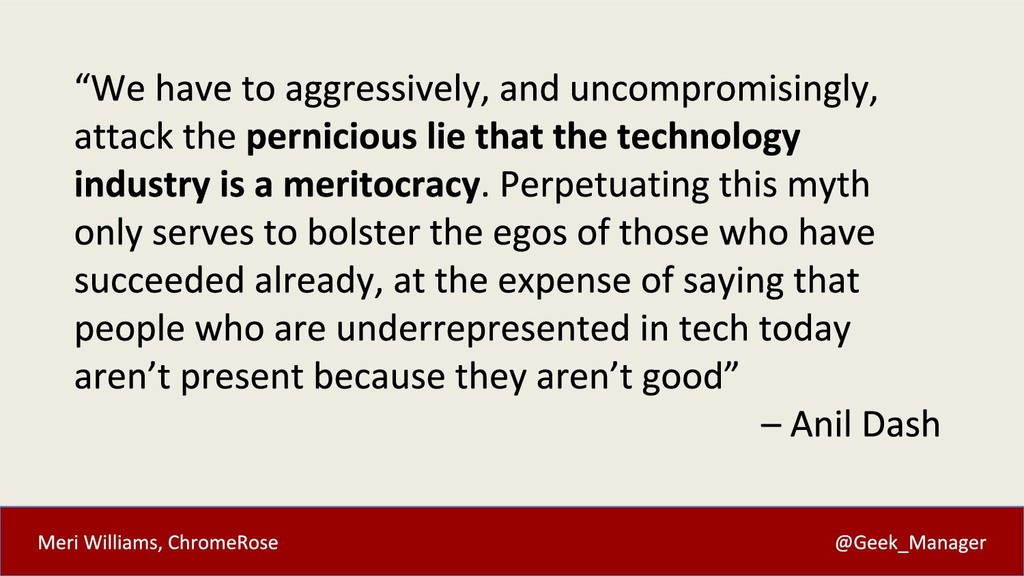
For and these things that we don't even think of as as a benefit or as a privilege are are really important to to face. And Neil says this much better than I do, I just have his have his quote. If any of you are here going, oh, but you know, on the Internet, nobody knows you're a dog.
They all definitely assume that you're an angry twenty three year old white dude though. Like, we do not have a meritocracy. And if you you need convincing on that minor point, like, that's that's the zero zero one precursor to this talk. I will let you Google it yourselves.
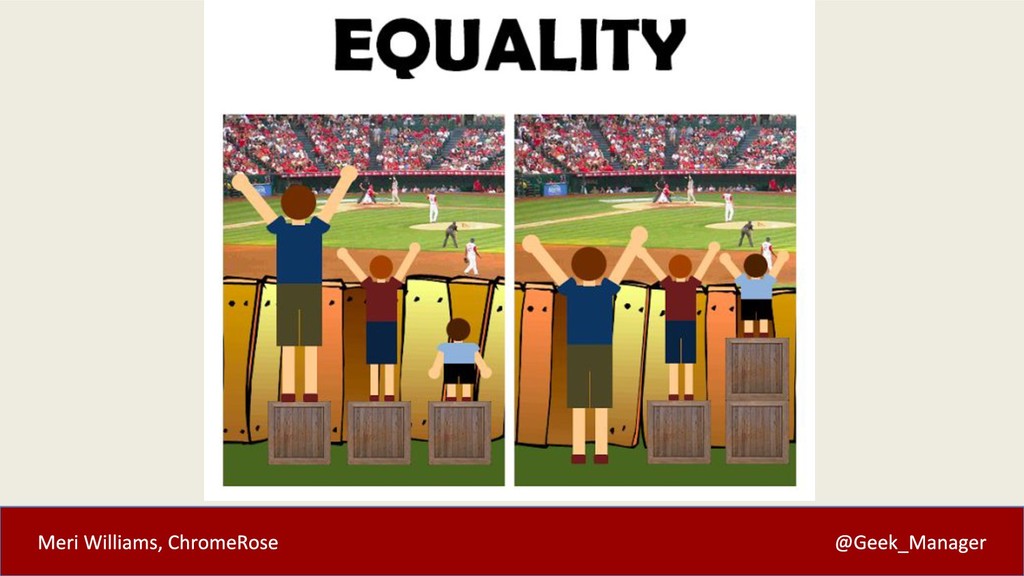
But look, when we when we think about these things, the other important kind of core concept here is equality is not about treating everybody the same. Equality is about realizing that some people are in a different spot, and equality of opportunity and equality of experience is about adjusting appropriately.
So just treating everyone the same when some people start ten meters in front of the the starting line in the race doesn't lead to more equal outcomes. And not not discriminating is important, like legally at least. In in the UK, we there's literal laws about this.
It's illegal to discriminate on a number of basis. But I think for too long, we've been aiming for tolerance. And tolerance is a terrible word. Like, my little brother kinda hates me, but he we're related, so he tolerates me. Do you wanna be tolerated by the people you work with?
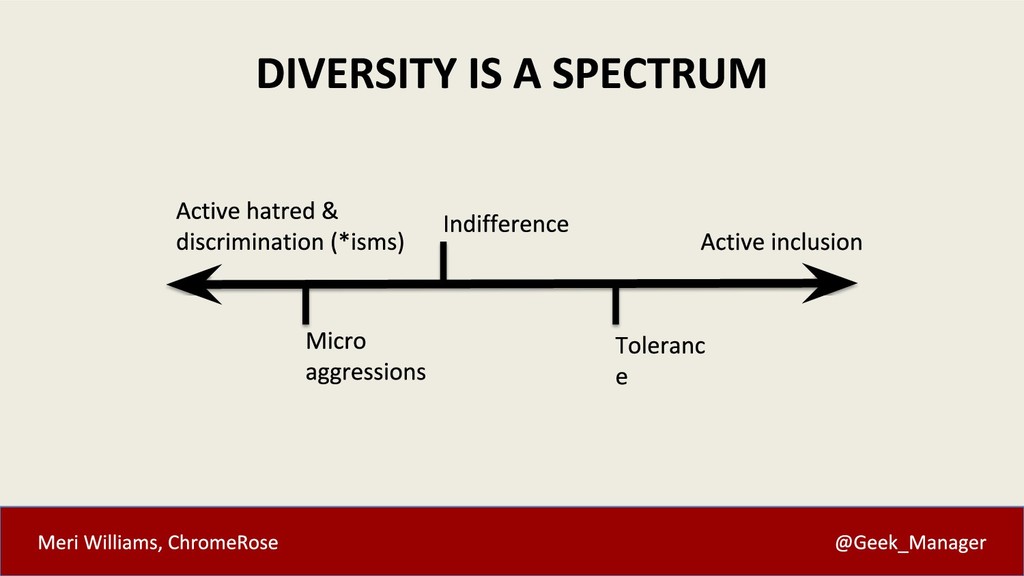
Do you want them to put up with who you are? I I don't think it's the thing to aim for. I think a fully inclusive environment is what we should all be all be aiming for. And so diversity is a spectrum with kind of active hatred on one end and active inclusion on the other.
Maybe tolerance is an improvement, but it's it's not the destination. It's not where we should be aiming for. And indifference is even worse. Pretending it doesn't matter. I just don't see color. Only a certain set of people don't get to get to not see color.
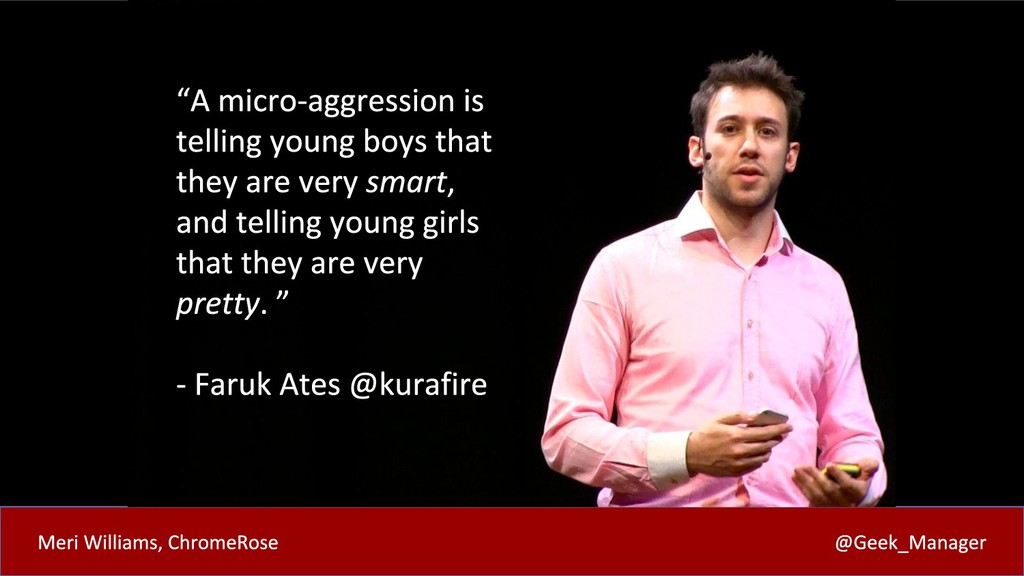
And though we're at a point where mostly people will be pulled up on it if they're very actively using hate hate hate language, microaggressions are still rife. If you don't wanna if you don't know what a microaggression is, I think a good example of one is telling young boys they're very smart, but telling young girls they're very pretty.
Reinforcing in small ways what value or lack of value there is about someone. My favorite microaggression that I experience is well, there's two. People going, which of you is the man to me and my wife? Neither. Kind of the point. And and my other favorite one is people going when they when they realize I'm foreign, because I don't tick I don't sound it.
I actually, like, this isn't my real act. My real accent's quite strong, and nobody understands me, and I start switching into other things, and I'm I swear even more than I do in English. So I find I'm treated better in this country if I sound like you, and I find I'm treated better in the US if I sound like them.
I had a team once who used to play a game where they would try to figure out who was in my conference call by how my accent changed in each question I responded to, like a sweepstake going on. It's not deliberate. I can't do impressions.
I just have, like, a survival instinct thing that makes me sound like, whoever I'm talking to. But but my favorite one when people realize I'm foreign is like, oh, your English is very good. I'm like, thanks. It's my mother tongue. Been speaking it my whole life since birth.
Not since actual birth. I'm not like a prodigy or something. I I'm sure I learned to speak at the normal age. But anyway, why why do we even give a ****? Like, morally, there's a good reason to care about this. Like, we shouldn't be oppressing people.
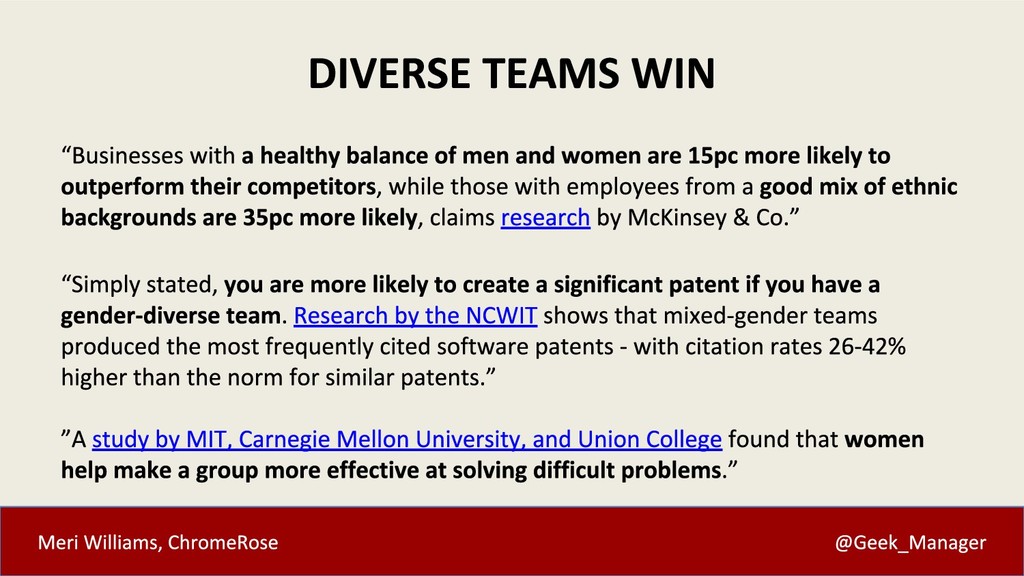
But if you if you need financial reasons to care, I have a whole bunch for you. So there are so many studies that show that diverse teams outperform homogenous teams. Those businesses with a healthy balance of men and women are fifteen percent more likely outperform their competitors.
Those with a good mix of ethnic backgrounds, thirty five percent more likely. What wouldn't you give to be thirty five percent more successful than your nearest competitor? You're more likely to create a significant patent if you have a gender diverse team. Women make a group more effective at solving difficult problems.
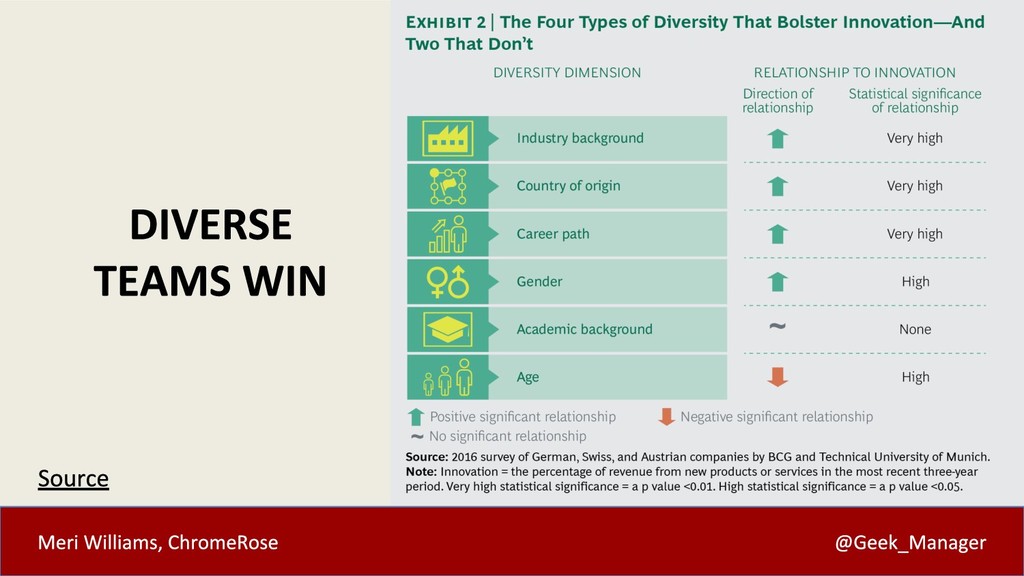
There are a number of types of diversity that bolster innovation, including what industry background someone comes from, their country of origin, their career path, their gender. Academic background, not so much. Age, negative impact. That one was a bit weird to me. I'm looking forward to reading the full detail of it.
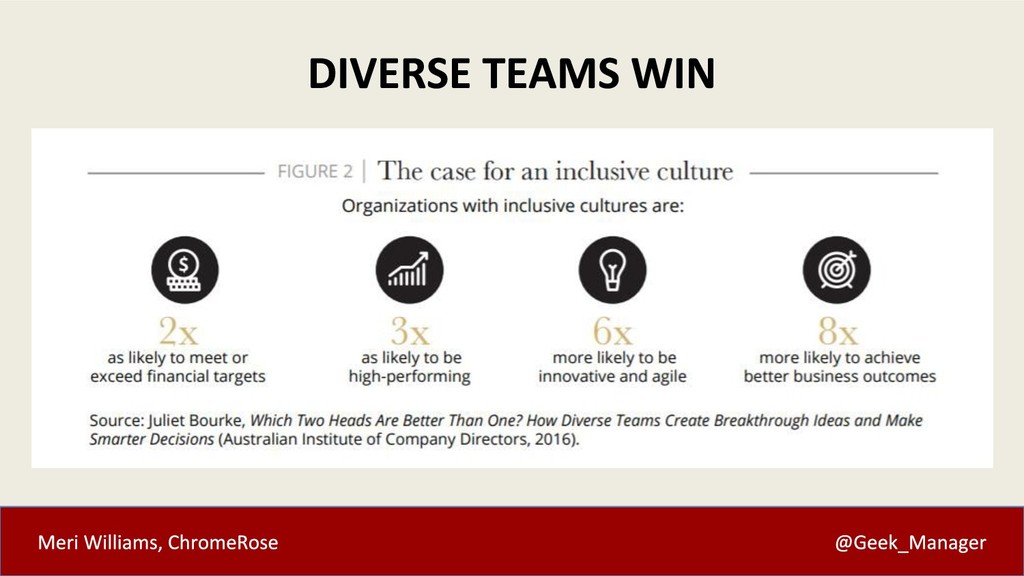
Where inclusive teams are twice as likely to meet or exceed financial targets, three times as likely to be high performing, six times as likely to be innovative and agile, and eight times more likely to achieve better business outcomes. And come this isn't just about one aspect.
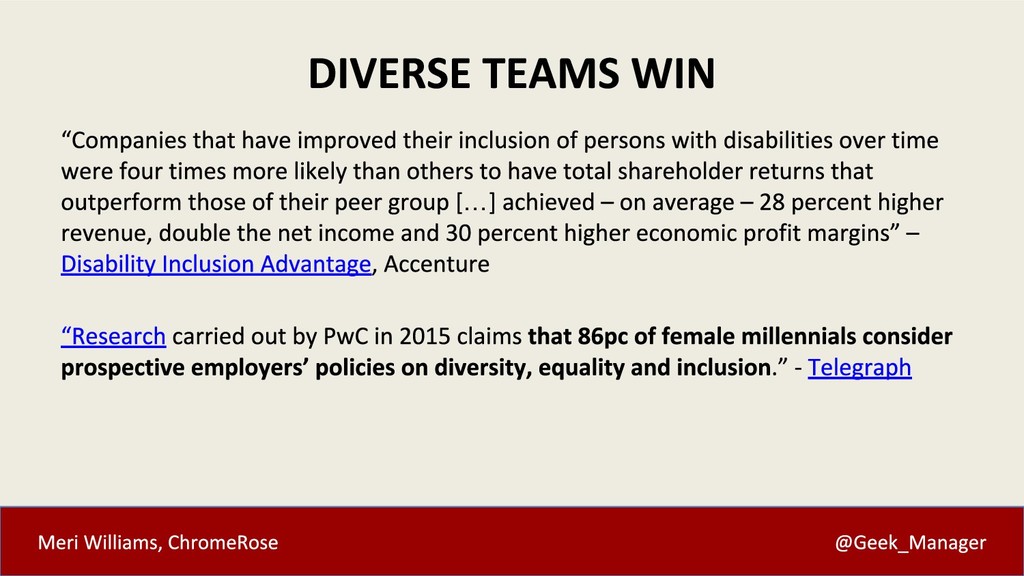
It's not just about gender or about race. Companies that improve their inclusion of people with disabilities were four times more likely to have total shareholder returns outperforming their peer group. Twenty eight percent higher revenue, double net income, thirty percent higher economic profit margins.
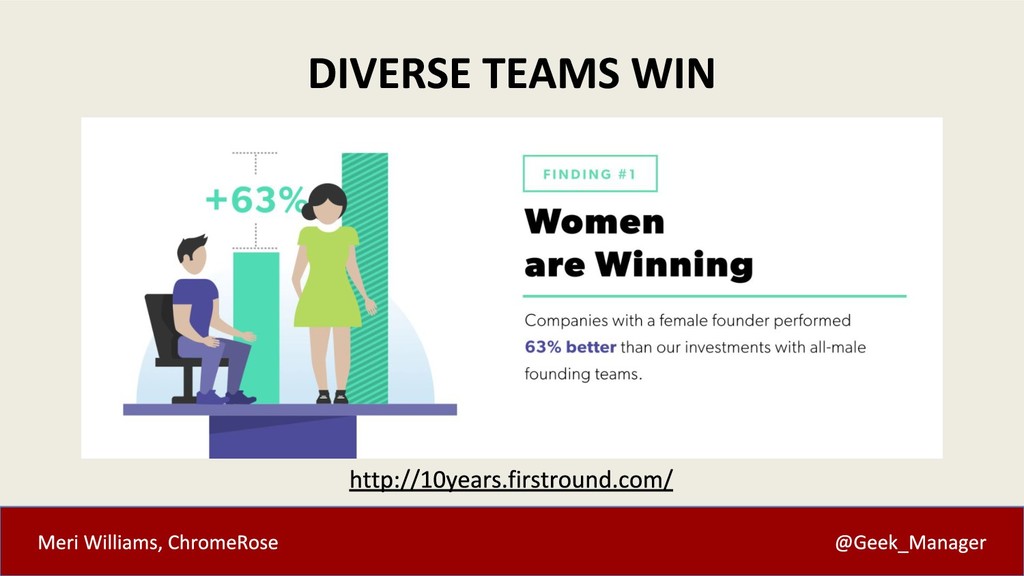
Those are very real numbers. And it's starting to really matter to people as well. Eighty six percent of female millennials actively look for your stance on these things before they decide whether to work for you or not. There's a recent First Round published their research on their kind of the results of their first ten years, and the all male teams were outperformed all male founder teams were outperformed by teams with at least one female founder that did sixty three percent better.
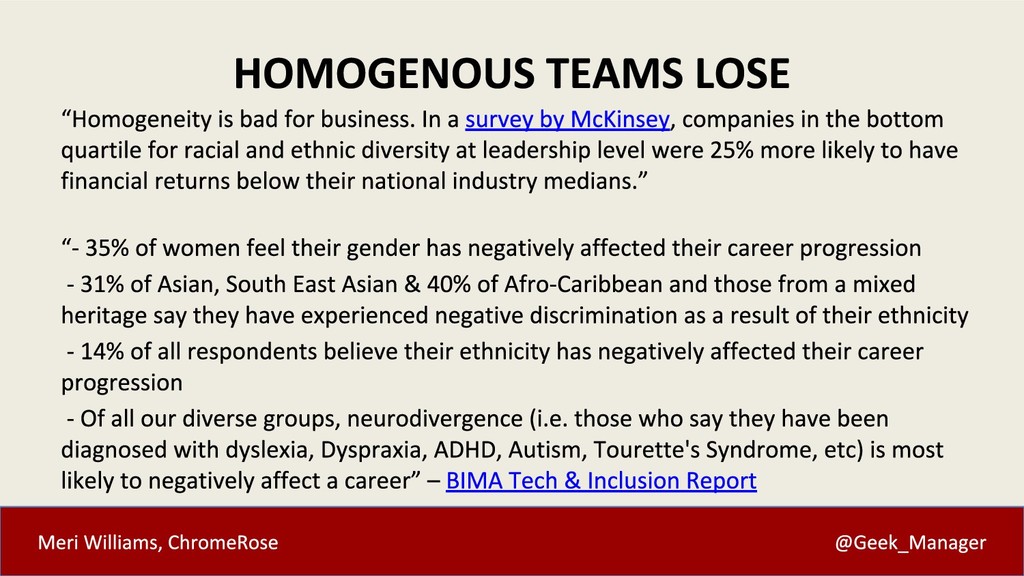
And it's not just that diverse teams win, it's that homogenous teams lose. Companies in the bottom quarter for racial and ethnic diversity at the leadership level are twenty five percent more likely to have financial returns. But below the the national industry median, which is really not the thing you should be aiming for.
Like, aiming for the median is not the success strategy. But what's really sad is this second quote from a from Bemer's Tech and Inclusion Report that very genuinely people are actively experiencing negative impact of discrimination today in twenty nineteen in the UK. This is happening to you and to your colleagues, to your reports, to your managers every day at the moment.
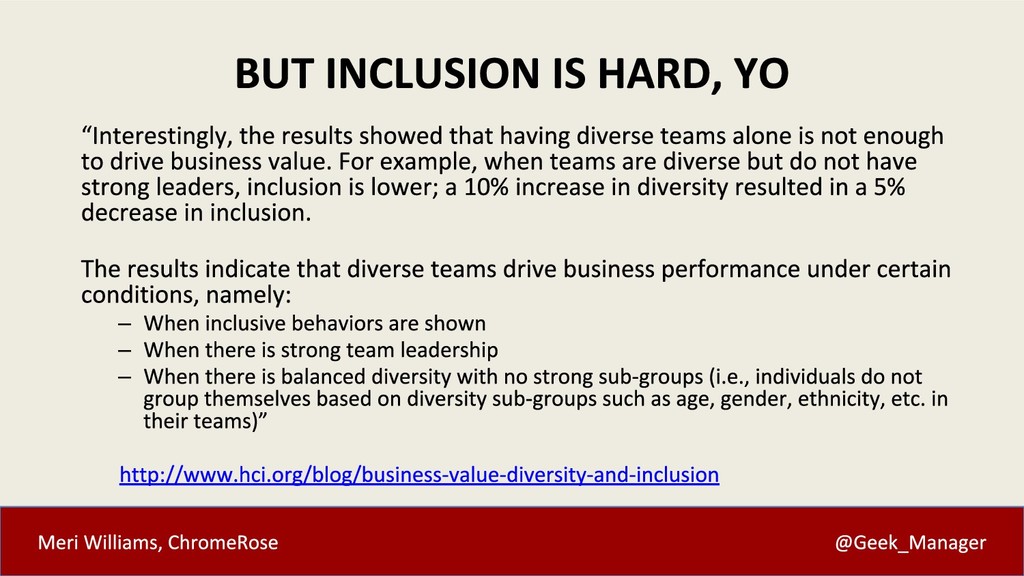
And I think people sometimes have the wrong mental model of this. They're like, oh, if I just sprinkle some magic, if I just add some people, it'll all magically get better. I genuinely think that the reason diverse teams outperform is because it's harder.
Because getting a genuinely different set of opinions and backgrounds and experiences, people who are coming from all different vectors to agree on what the right thing to do is takes more work. You need to work harder to understand the problem, to communicate and collaborate with each other.
And so just just adding people who are different isn't isn't what brings the results. What brings the results is actively showing inclusive behaviors, leadership that values it, and balance adversity so you don't have weird little clique things happening. And it really matters to have that representation at the leadership level.
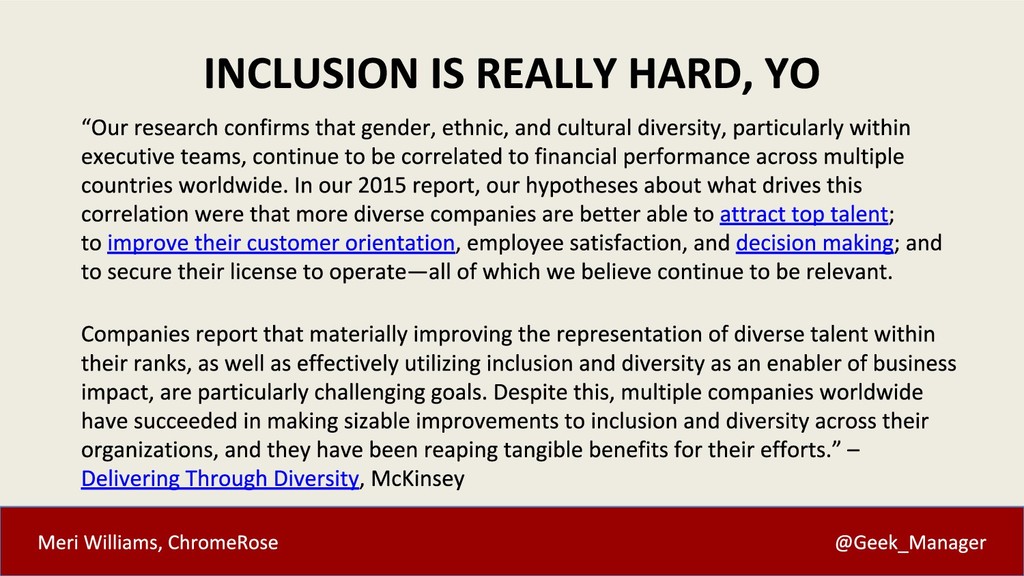
It helps you attract top talent, improves your treatment of customers, improves your employees' satisfaction, and your decision making. And so it really, really matters. And so though I joked about it being a really clickbait title, genuinely one of the things you can do to outperform some of your peers is to get better at this stuff.
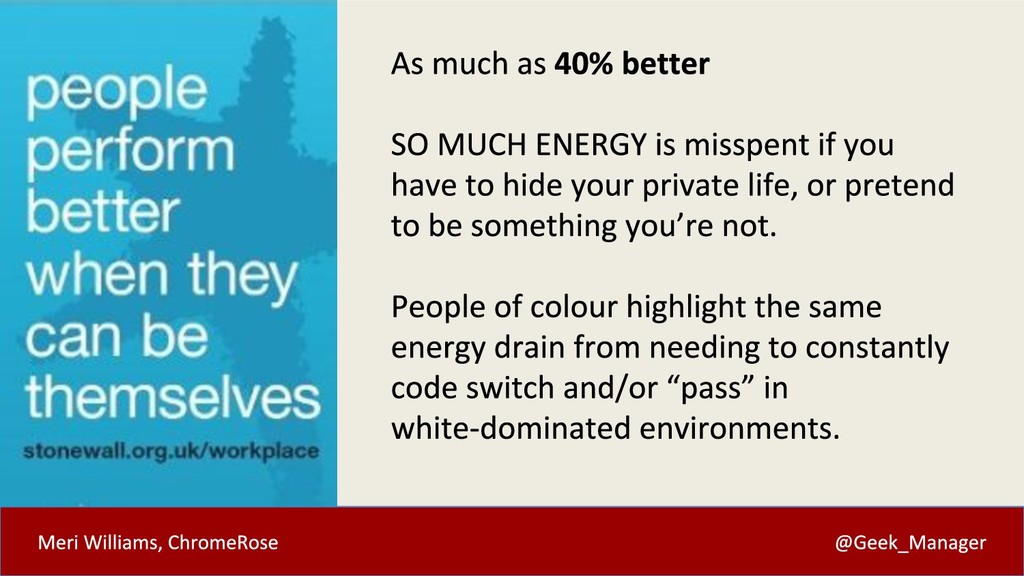
And people perform better when they can be themselves. Stonewall did research a few years ago. They're the leading LGBTQ rights organization in the UK, disclosure, I'm on their board at the moment. But they found that people are forty percent more productive if they can be themselves.
They feel like they're comfortable being out at work because the energy expended in pretending to be something you're not, never mending for LGBTQ people, it's often not mentioning the gender of your partner or not being really upfront about what you were doing at the weekend because it might give you away.
And people of color report the same energy expended in having to to pass, having to code switch, having to pretend to be different than they are. So the depressing bit's mostly over. Everybody take a deep breath and out. Cool. So how do we do move the right way?
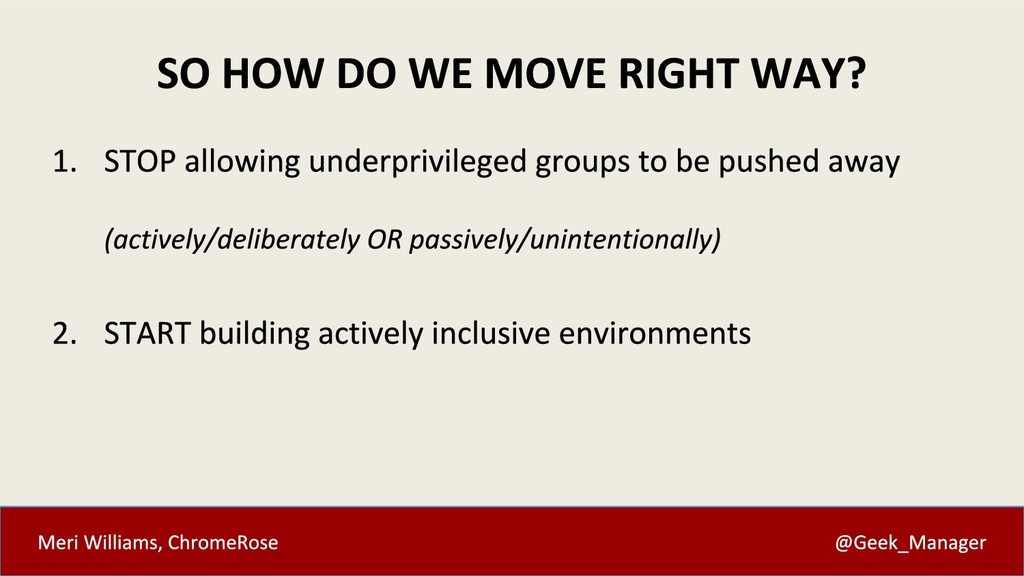
We, like, we stop discriminating against people, and we start including people. Sounds simple. I've worked on this. I've I'm as I said earlier, I actually have that Daily Mail shirt, and the HR department at the cabinet office when I was part of the government digital service officially requested I not wear it to work, because they were genuinely worried that some journalist was gonna catch me exiting a government building wearing it, and it was going to cause a furore.
But, like, I I care about this because I'm affected in in many ways, but I don't only care because I'm affected. I care because I think it genuinely makes my team is better if they're much more representative. And I've been frustrated over the years that there's not there's a lot of talk about how like, why it's important and what is important, but not enough about how you practically do this.
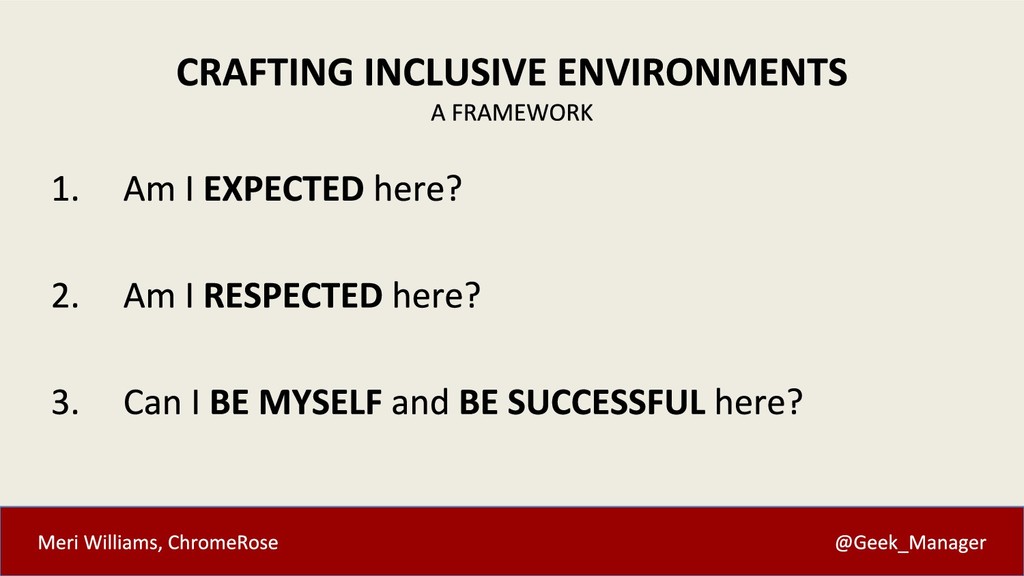
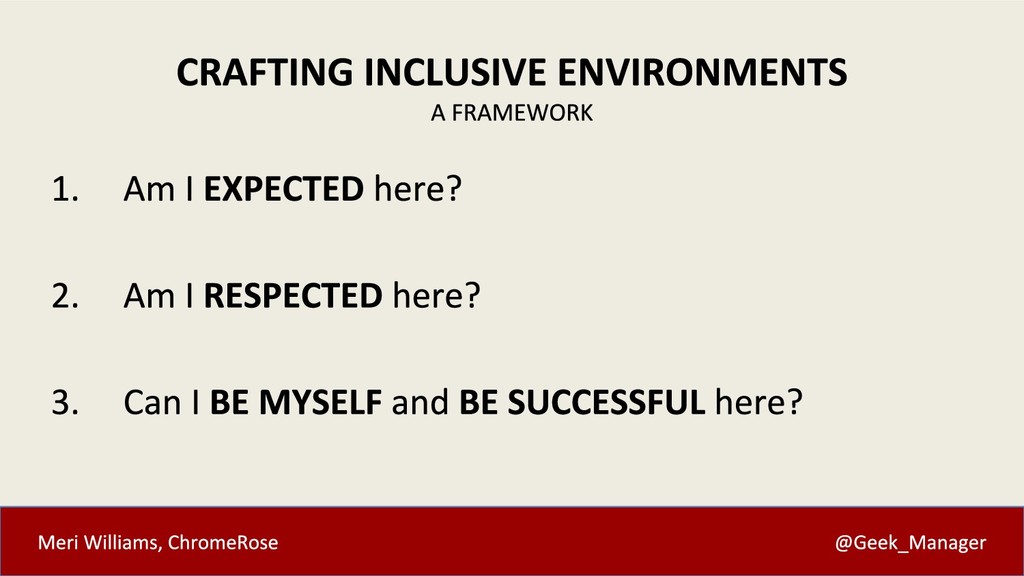
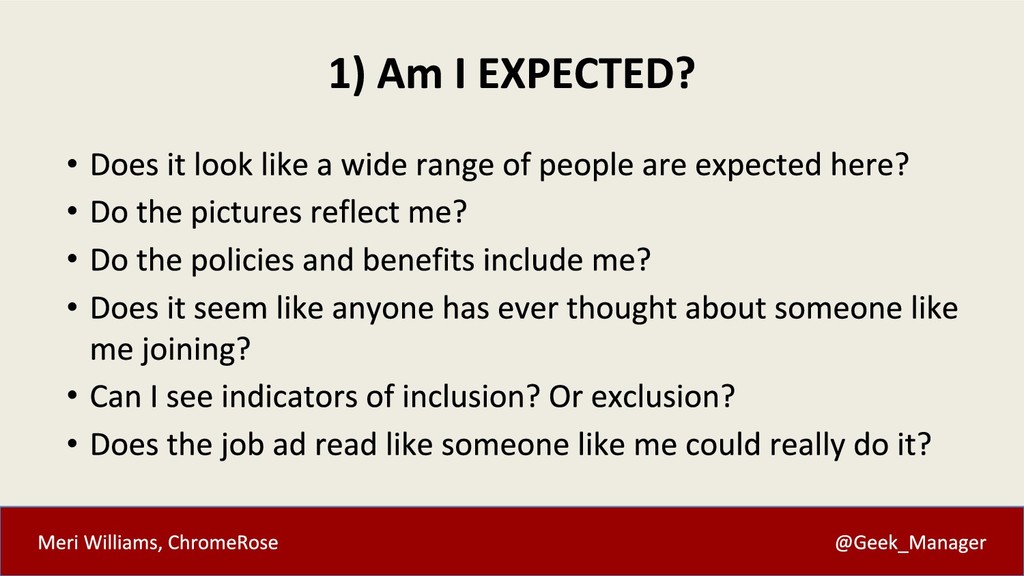
And so this is a framework that, like, I made up because I couldn't find a good one. Use it. It's I hope you find it useful. Which is basically to go people, consciously or subconsciously, are asking three questions when they're deciding whether to join your organisation, when they're deciding whether to stay, when they're deciding whether to say yes to that offer or no.
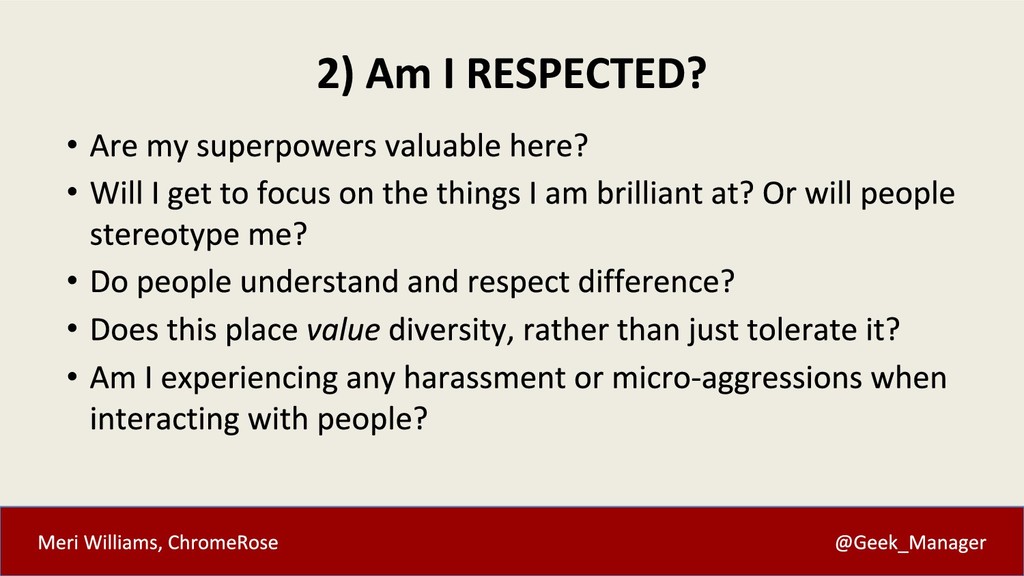
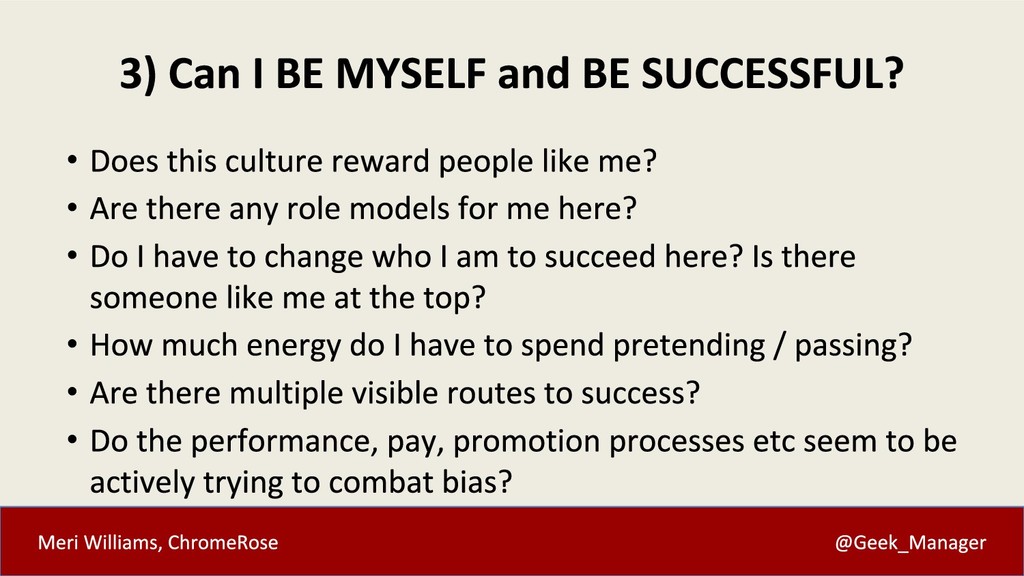
When they're deciding to say yes or no to that promotion, people do say no to promotions. And so your ability to attract and recruit and retain and develop a broad range of people is about how well people can answer these questions. So first is, am I expected here?
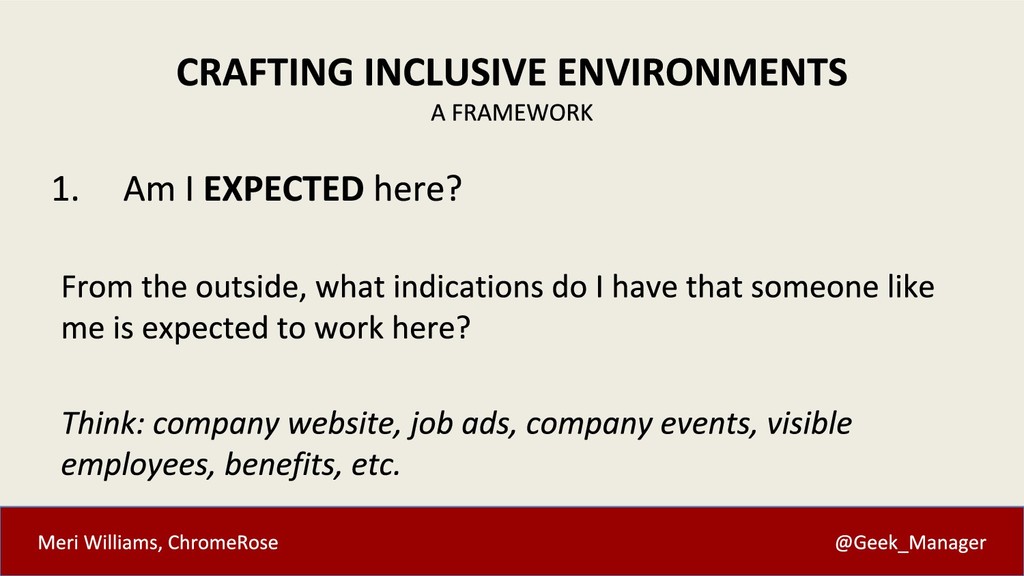
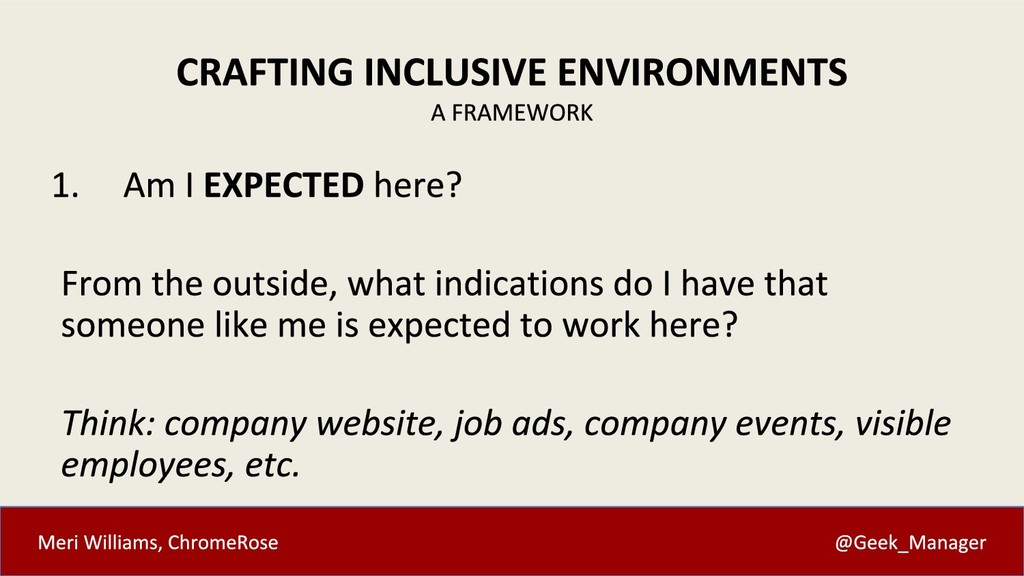
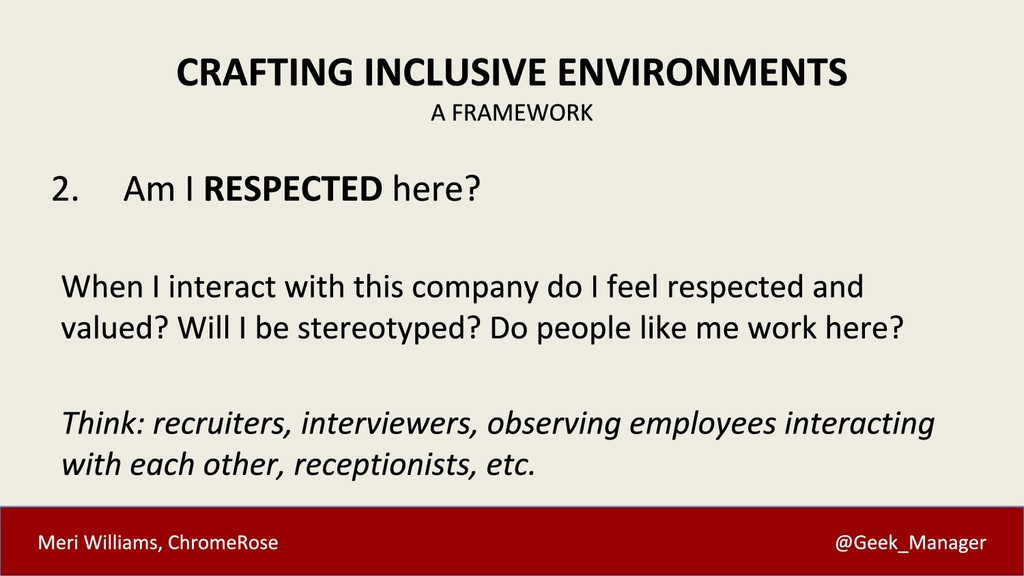
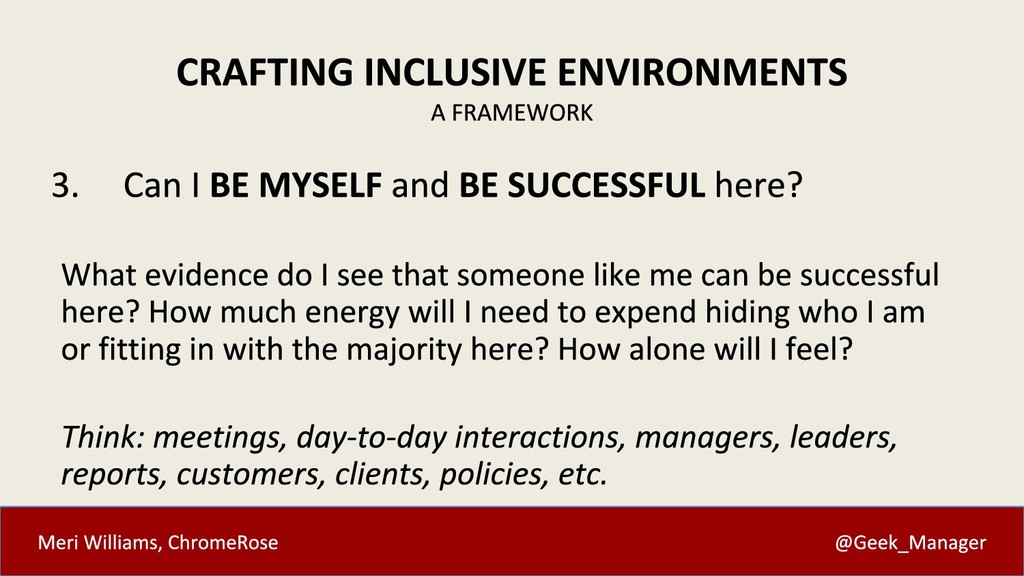
The second is, am I respected here? And then the last is, can I be myself and be successful here? How much am gonna have to bend and shape myself into something I'm not to do well here? And so let's step through them. Am I expected here is about, from the outside, what indications do people have that someone like them is expected?
Think about your company website, your job ads, your company events, who the visible employees are out in the world, being your spokespeople, being speakers at conferences, on your booth when you're a sponsor or or similar. What benefits you offer and how you talk about them.
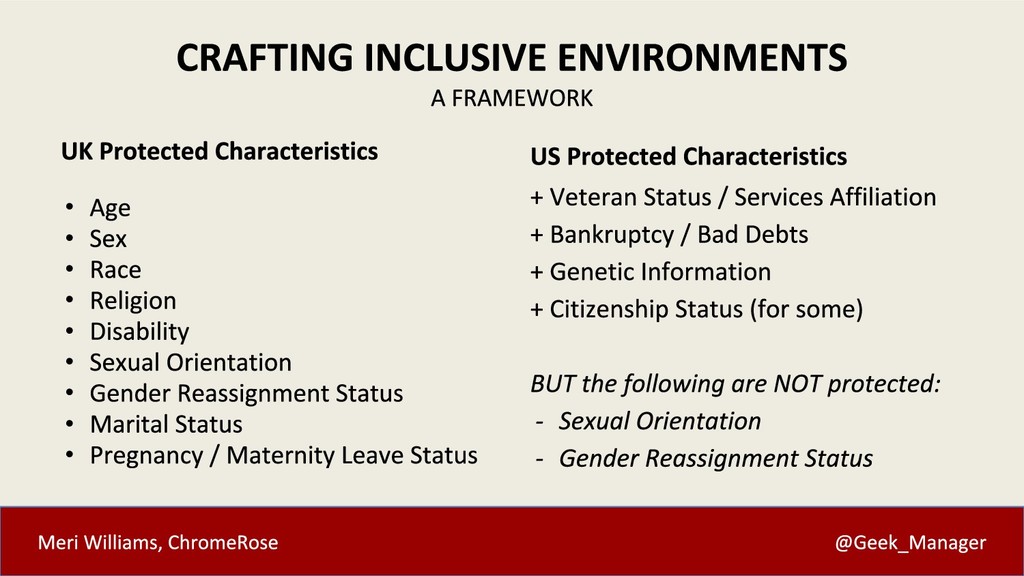
And just to take us back to legalities for a moment, like, there are a set of protected characteristics in the UK, which include age and sex and race. Race is very broadly defined in the UK law as it's also about it's not just about color, it's also about ethnic background, it's also about cultural background or nationality or kind of country of origin.
Religion, disability, sexual orientation, gender reassignment status, which hopefully in the not too distant future will become much stronger trans protection. Marital status, pregnancy, or maternity leave status, where again, I'd hope that becomes parental rather than just mat. In the US, assuming many of you may have colleagues there as well, there's some others which are added.
So veteran status or which branch of the military you're affiliated with, bankruptcy or bad debt history, genetic information, which I thought was a interesting one, and then citizens citizenship status. Oh, can't say that word this morning. You heard about the fire alarm. Right?
So but that's the exact details of that are worth looking up. But there's no national level protection for sexual orientation or for or for trans folks in the States. Companies that are really getting good at this stuff, you'll start to hear them talking about other things too.
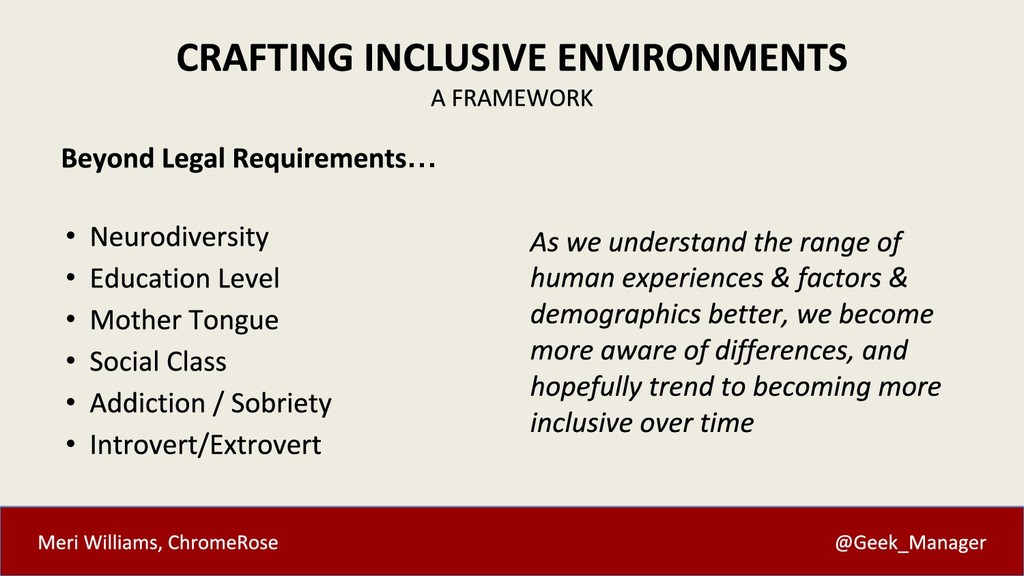
Neurodiversity, education level, mother tongue, social class, addiction, and sobriety, introversion, extroversion even. And there's definitely a set of people who are like, oh, it's all just political correctness gone mad. This list is never ending. Like, as we understand humans better, we're gonna add to this list.
Like, stop viewing it as political correctness and stop viewing it as like, oh, evolution is a thing and we learn some ****. Great. It's one of the benefits we have as a species. We can write stuff down and pass on knowledge efficiently. Like, if only we could value that rather than letting fake news happen.
But but yeah. So I I think in general, remember that people who are in who are intersectionally affected, so they're in multiple of these groups that are prone to be discriminated against. They're the most affected people. So when you say, oh, we're only gonna care about gender this year, especially when you treat gender as if it's binary, as only men and women, there's more than two genders, then you're you're immediately going, I don't care about all the rest of you.
And that signals a very strong signal, a very negative signal to send. So what do you do? You put the hat on of being in each of these groups, and you audit the stuff that you got. You look and you go, hey. What indication do I have that someone like me is expected here on your company website or a job ad or or everything else?
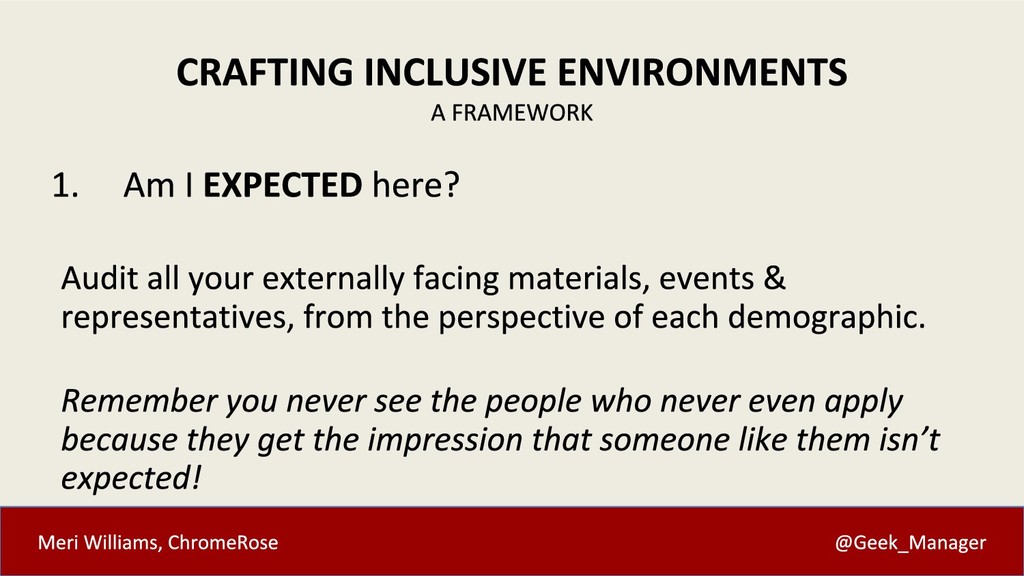
So you audit all of your externally facing materials, your events, who your representatives are from the perspective of each of those demographics. This is best done in a workshop with a bunch of people who first represent whatever groups they are actually in and then have to represent a group that they're not in, but have to put themselves in the in the shoes of those folks.
And the most important thing here is to remember and reinforce that your hiring funnel, the people you never see are the ones who don't even apply because you've already inadvertently put them off. Like, people go when people tell me, oh, you know, we'd love to have more women devs or more people of color in the engineering team, but we just don't see any applications.
Like, they must just not like technology. I'm like, literally, the only benefits listed on your website are beer Wednesdays and foosball. Is it really that surprising that, you're not seeing anybody over the age of twenty three applying for a job here? Seriously? I get really snarky when people ask me stupid questions, particularly when I haven't had enough sleep.
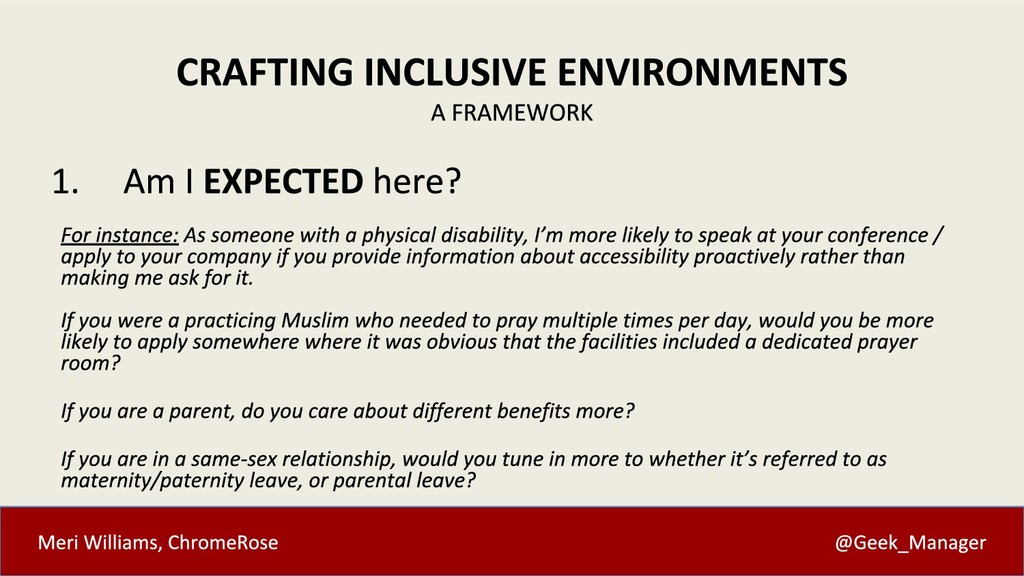
So some specific examples. Have a physical disability. Today, I can walk. Some days, I can't. I'm often on crutches. I notice when I'm looking at a company whether it's clear what whether the office is accessible. Because it genuinely matters to me. It's the first thing I look for after the code of conduct when I'm considering whether to speak at a conference or not.
Because I'm now senior enough that I'm like, I will be the squeaky wheel who goes, hi. How do I how do I get around this building if I can't do stairs today because my knees are dislocated? But it there are a lot of people who would just nope out at the at the first time because it's so awkward to ask these questions, And it is a clear sign that you're maybe not welcome.
If you're practicing Muslim, you're much more likely to apply if if it's upfront that there's a prayer room, a dedicated prayer room, that it's not gonna be used by the CEO on his phone calls every five minutes, which I've seen in an organization.
If you're a parent, you're going care about different benefits than somebody who isn't. Life insurance matters a lot more to you if you have dependents or whether you're a parent or other forms of dependents. If you're in a same sex relationship, you're gonna be tuned into exactly how, like, parental leave is phrased and framed.
One of the most common things that happens to queer people in the workplace is they're denied benefits because managers assume they don't apply to them. I've had people where their partners weren't given the travel allowance to go visit when they were on an extended, like, six month business trip because the manager assumed that this relationship didn't count.
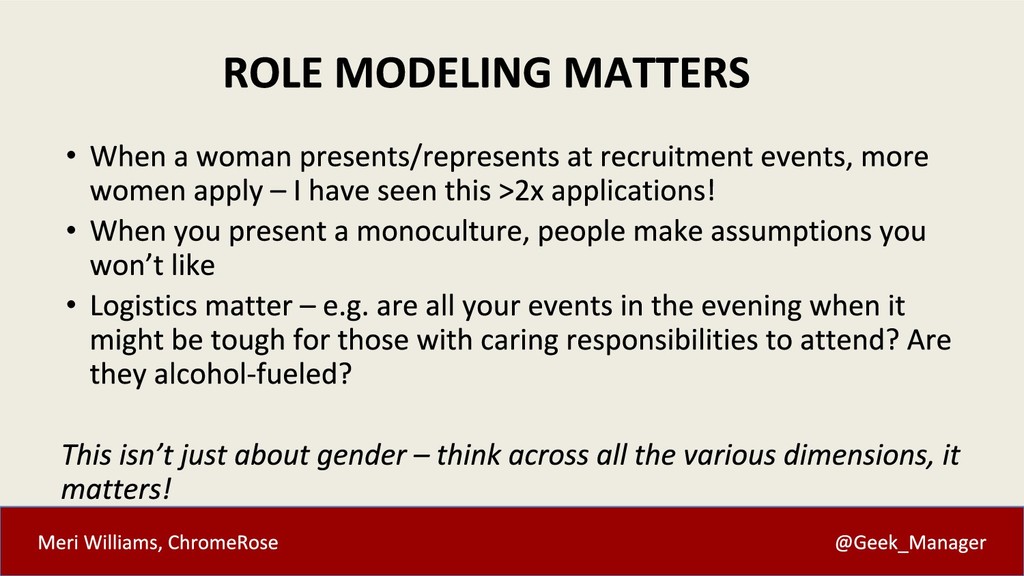
We've had people denied parental leave because people make the same assumptions. And remember also that role modeling really matters. I used to think this was ********. I was I did computer science at uni. I was very much in the minority there. And so I personally didn't find it mattered to me that much.
And then I was in charge of recruitment for the first company I ever worked for for tech for a bit as my kind of twenty percent time. And we literally got two hundred percent application rate if there was better representation in the people who who visited campus.
So I was like, ah, ****. Doesn't matter to me. Matters to a lot of people. We should invest in this. And remember that logistics matter. Like, if you only ever do things in the evening, you're inadvertently excluding quite a quite a large group of people.
And think again across all these different dimensions. What are the it it's as important to show that you can be c level without having a degree, with that you can get to a leadership role when you're from a working class background. Like, it it's not just about one dimension at all.
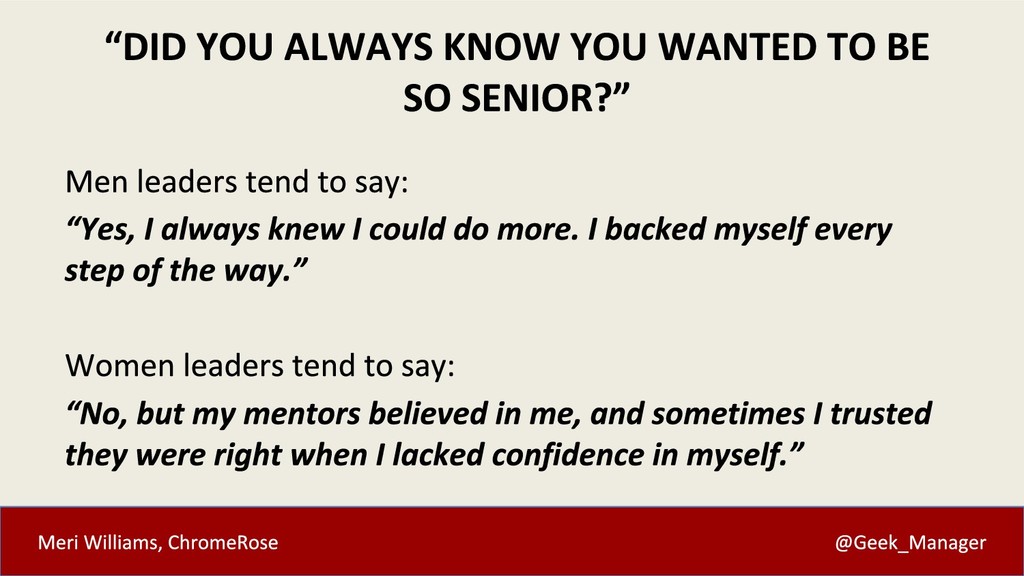
One of the most interesting things I found when I when I ran the internship program at P and G was we'd have, like, a role modeling session and some very brave second year undergrad intern would go like would ask the very senior kind of director or VP, did you always know you were gonna get this far?
Did you always, you know, did you always have the ambition to get to this level? And I noticed after a couple of years that the men all said, yeah. And, you know, I I always knew I could do more, and I I believed in myself, and I pushed hard, and I and I got there.
And the women all said, no. I had no idea. And really honestly, sometimes I was so afraid to take the opportunity or the promotion, and it was because my mentors trusted in me, and I relied on their confidence when I didn't have my own.
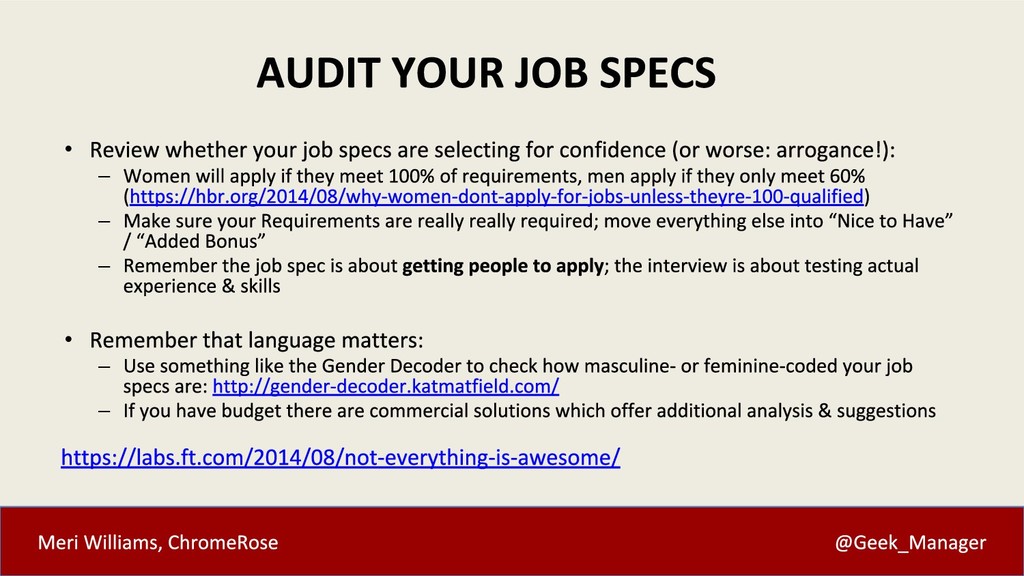
It made me go back to work the next week and much more actively tell people that I believed in them and why, and that I think made me a much better manager. So, also, remember to audit your job specs. There's a great tool that Catmap Fields made available, which is a gender decoder.
If you've money to spend, there's lots of companies selling you services around making your job specs more inclusive. Remember that there's some research that shows women will only apply if they meet a hundred percent of the requirements. Men will apply if they meet sixty percent of the requirements.
I leave you to draw your own conclusions about relative confidence levels. So if you have a immense laundry list of requirements, you are, whether you like it or not, you are filtering for arrogance. Same if you've used rock star and ninja and that kind of like, rock stars break everything and get really high.
Ninjas murder people in the night unseen. Like, I don't think this is what we should be aspiring to. FTLabs wrote a very a very brave article a few years ago now back in twenty fourteen, the the link to it's there, about how everything's not awesome, like and needing to to be more real about that.
So that's that's what we mean by am I expected, and you can, like, literally, you can go back to work tomorrow and do some of these things, and it will make you better. In terms of respected, this is more about when people interact with you as a company, do they feel respected?
Do they feel like they're gonna be stereotyped? Is the thing that they're good at gonna be valued here? This is evident in your recruiters, your interviewers. The observations you can make of employees interacting with each other in the office, on Twitter. It's even the receptionists and, know, everybody who someone interacts with, they're they're forming an opinion.
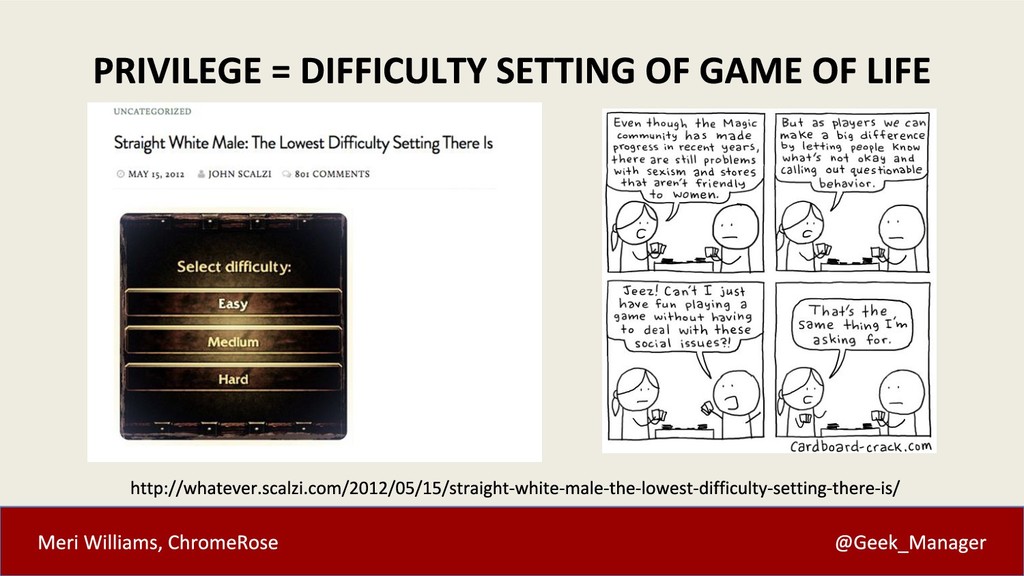
The main useful thing you can do here is to educate yourself and others about privilege and implicit bias. And I know I talked a little bit about what what privilege is earlier on. John Scalzi's definition is my my favorite one. I think it's very accessible.
He's a sci fi writer, and he says, privilege is the the difficulty setting of the game of life. And straight white dude is the easiest setting of the game of life. But like with video games, it doesn't mean that there's no challenge in it.
It doesn't mean that it's easy. It just means that it's easier than for everybody else. And this is another thing that people misunderstand when we talk about privilege. They're like, oh, but, you know, I worked really hard. Yeah. You did, but you started ten feet in front of everybody else.
You were, like, ahead on the starting line. If you've never seen the privilege walk video, I'd suggest, having a read of it where people basically take a step forward if they had parents at home to help them with their homework, if they could afford to be at university without a scholarship, and and so on.
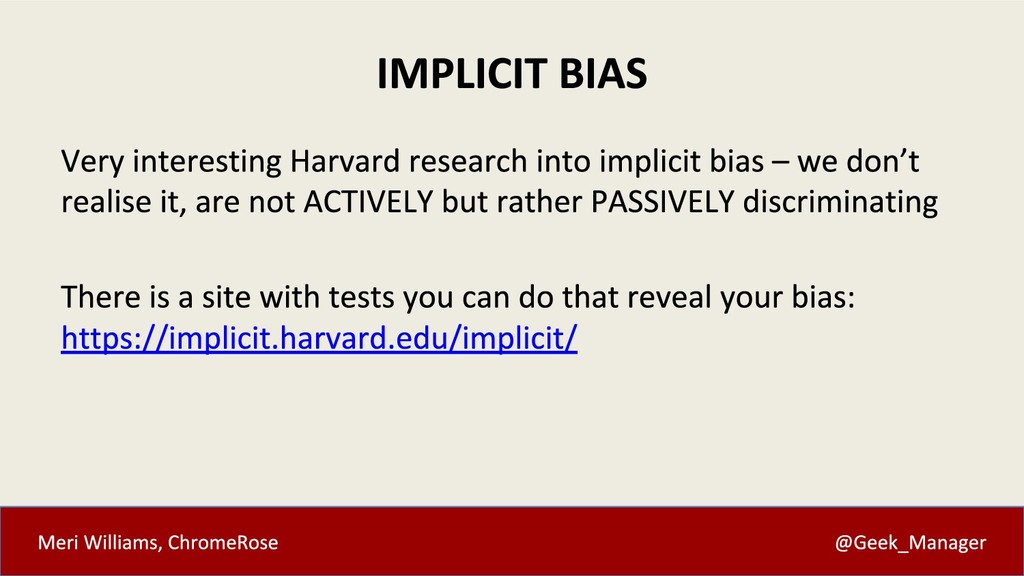
And you see how different the starting point is for for all different people. If you want to check check-in on yourself, the Harvard have published a thing where you can, like, check your own biases. Do it not in the middle of a noisy coffee shop.
It the way it works is it measures your, like, the micro differences in your reactions. And so being someone where you're not distracted by Slack or somebody shouting for a latte every two minutes is important. Otherwise, you're gonna get weird results. But it's worth having a look at.
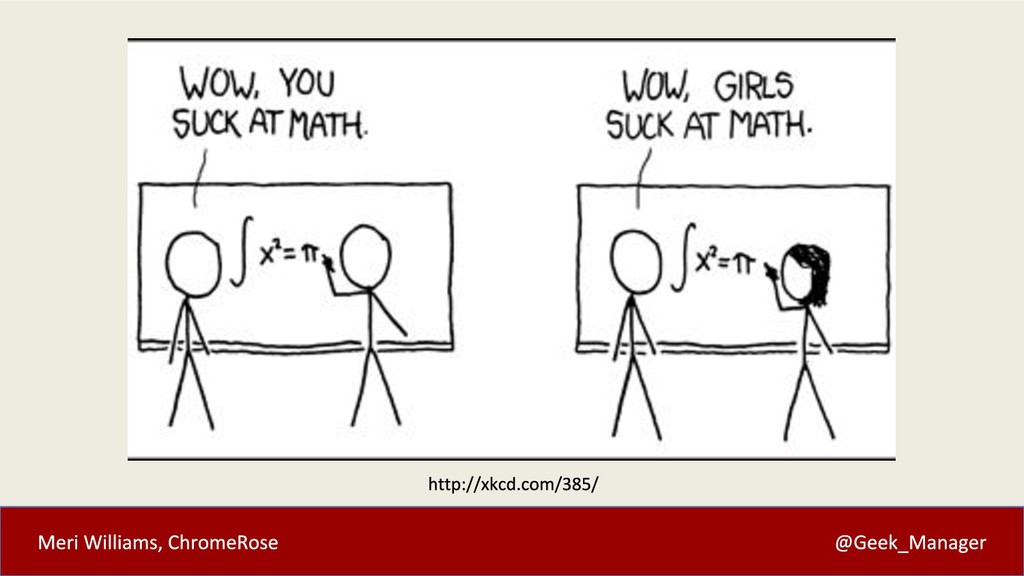
And remember that the stakes are higher for people who feel like they are the only representative of people like them. I love how Randall at x k c d has he has like a comic for every occasion. Any point I ever wanna give, I'm like, there must be a comic for this.
I just gotta find it. So if if if someone who is in a a group that's normally seen is, you know, **** at maths, then they individually are bad at it. If the only representative of a group is there, then they are seen as the entirety of that group.
It's also true when you have a shortlist for hiring, if you only have one person who's different from the rest of the list, they're very statistically almost impossible that they're going to be hired. And that's because that one person, if you for instance, if you have one person of color and everybody else in the shortlist is they are compared that one person is compared to the strengths of the combination of all the others.
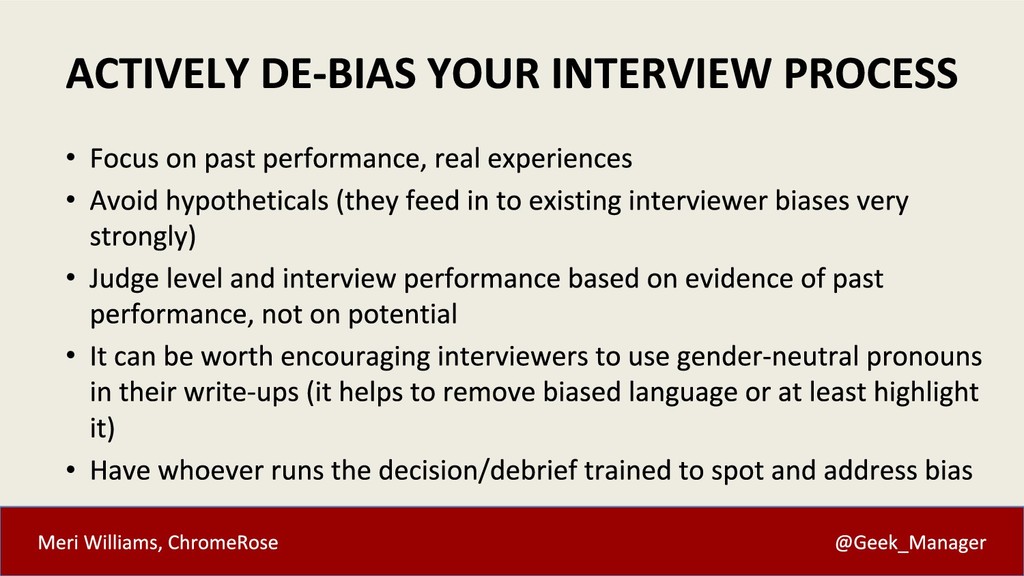
And nobody can compete with like, I mean, maybe some people can compete with seven other people's best bits, but I don't think most people can. Actively debias your interview process. Make sure that your interviewers are trained on on unconscious bias. Focus on past performance. Avoid hypotheticals.
They feed into people's, oh, is that how I would do it? So strongly, they're they're really, really derailing. Judge level and interview performance based on evidence of past performance, not on potential. We're terrible at judging potential people who aren't like us, which is why there's there are these stats that women are often promoted only on past performance, and men are much more frequently promoted on potential.
Because you can pattern match to someone who is now senior, who five years ago was like this dude much more easily if you don't have a representation all the way up than you can for for the woman that you're that you're looking at.
A small thing that that I've seen that Monza folks started doing just after having sort of spontaneously after doing unconscious bias training, they they use gender neutral pronouns that say they. So when you're reading something through, it stands out a bit more if somebody's using discriminatory language.
And make sure whoever's running debriefs and decisions is trained on this stuff so they can go, hang on a minute, like, we're not we're not assessing this candidate the way we're assessing other candidates. Let's stop and talk about that. And think about even in the way that you communicate about the interview.
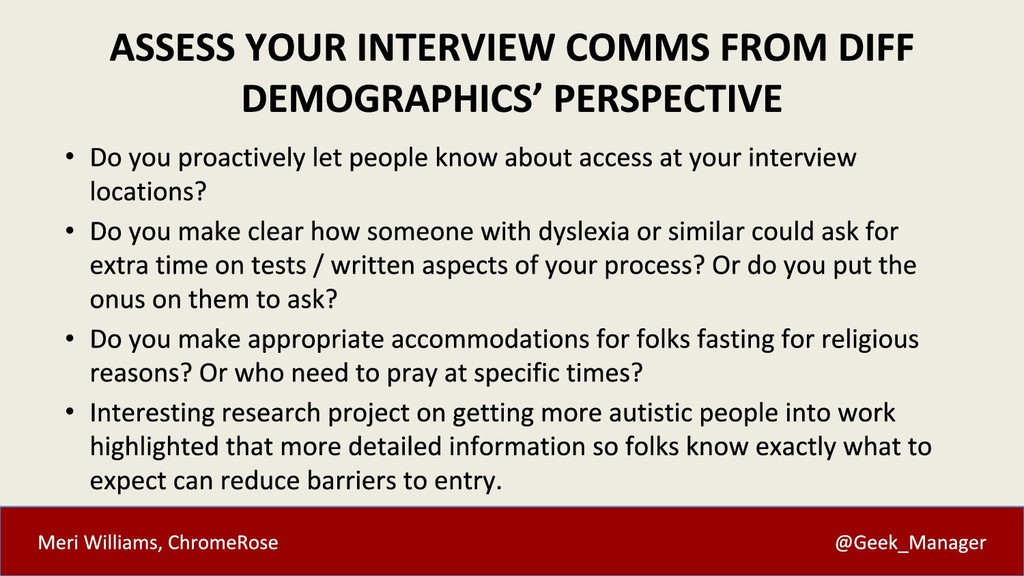
Think about someone like me who really needs to know that they're not gonna have to walk up three flights of stairs to to get to the interview. Be clear upfront that you'll give extra time for someone who who's got dyslexia or dyspraxia or similar.
Don't make don't put the onus on them to ask. They might never apply because they're so scared of asking. Do you make appropriate accommodations to people fasting during religious festivals or or periods? If somebody came for interview and you had three back to back interviews and they needed to stop to pray, would they have to have a really awkward conversation with you about it?
Or have you opened the door and made it really easy to to make that have that conversation? And there's some interesting research on how employing more autistic people actually being much more explicit about what they can expect in their journey and how noisy things will be and that kind of stuff can actively break down barriers.
There's a really interesting research project happening at UCL right now about that. Everybody with me so far? Another deep breath? All good. I've lied to you so far. I said that number one was expected, number two was respected. Three is the most important one Because frankly, if somebody can't be themselves and be successful, you have no ******* right to bring them into your company in the first place.
You are you you cannot bring someone in to a situation where they are, like, unable to succeed and be like, well, we tried. Everybody does this though, and it's really, really frustrating. So though I've given you these in order because that's how a candidate might experience you, three is the one to work on first.
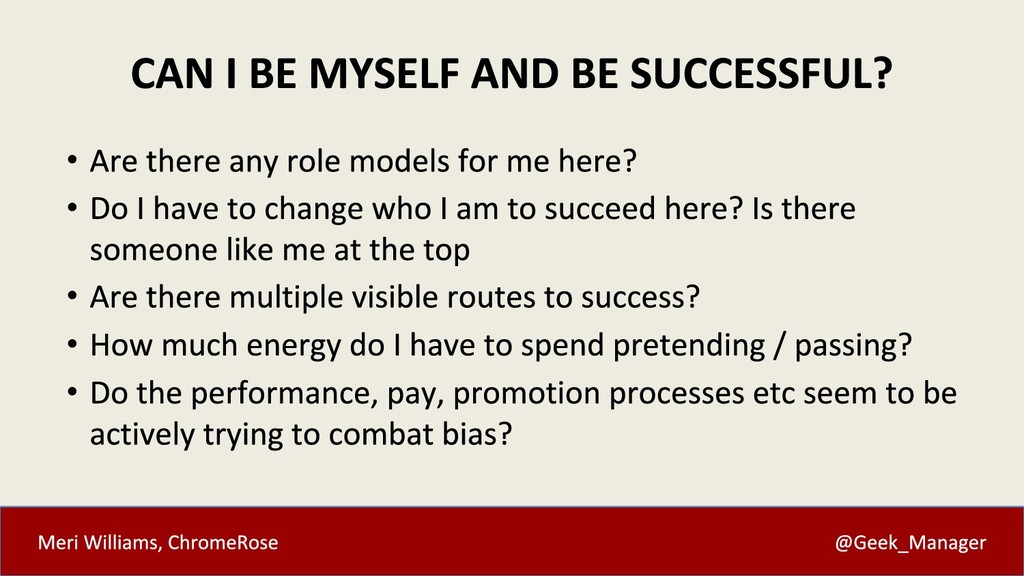
Make your organization, make your team actually a great place for a really broad range of people to be. That's the table stakes. So when people are asking this question, like, what evidence do I see that someone like me can be successful here? And who gets promoted? And who's at the top table?
And how the policies are written? And how customers and clients interact? And there's an underlying principle here, which is basically like, people do best when they have the opportunity to do what they do best every day. And we need to just stop leveling people out to be kind of equally and consistently mediocre.
And this is like the the nineteen eighties management style. Right? Like, you're great at four things, you're **** at one. We're only gonna talk about the thing you're **** at for the next seven years. And we're gonna spend a lot of effort to make you go from **** to okay.
Like, we should focus instead on the four things that you're already great at and make you world class at them, and find somebody else who think can be good at the the fifth thing, unless it's a controlling weakness. Because we're not interchangeable resource units.
And for the record, if if you're somebody who gets called a resource, I suggest you start referring to your manager as overhead. They quite quickly adjust their terminology. Please do actually take that and run with it. It genuinely makes a big difference. With colors, with flavors, like, don't think of this as how do I find a whole bunch of perfectly exactly the same shape people.
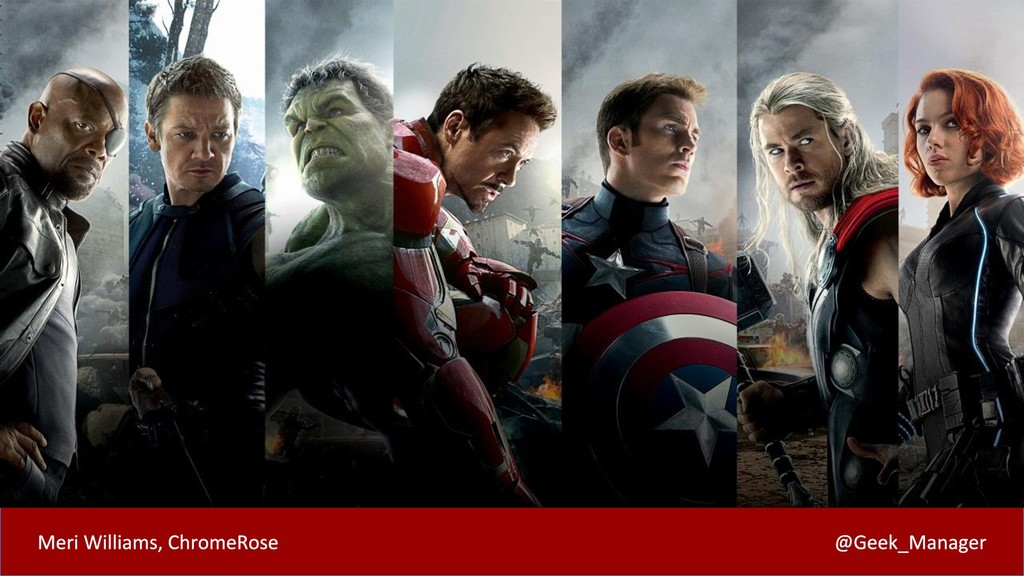
I would watch the **** out of a Avengers movie with seven Hulks in it, but let's be honest, the Avengers are cool because they can do different things really well. And, like, by their powers combined, they are Captain Planet. Right? Half of you are too young for that reference, and I'm very, very sad about it.
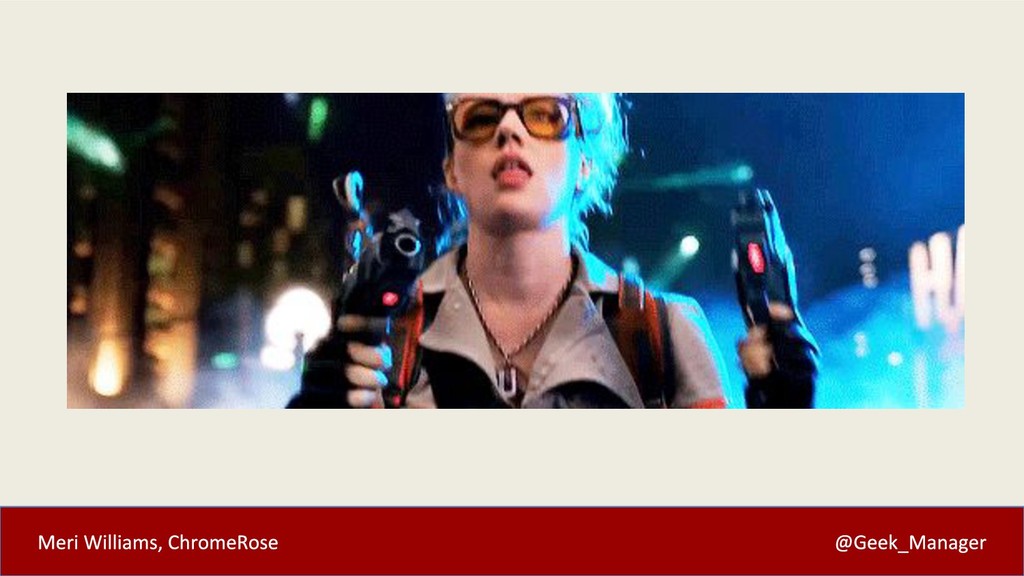
So let's think about people and roles as a matter of casting. Assemble a great team with complementary abilities. Anybody who follows me on Twitter knows I got slightly obsessed with this film, man children on the internet claiming that girls trying to be funny was ruining their childhoods really annoyed me.
There is a sign data scientist somewhere in the middle of the Odeon still completely perplexed as to why Ghostbusters run for fifteen weeks at Leicester Square Odeon. If they're ever watching any of these talks, you're welcome. I took a hundred people to watch this with me because I was just so angry about, people being ****** on the Internet.
If you haven't seen it, please watch it. It's actually genuinely hilarious, and I promise I will, like, pay you back the money you spent on the Blu ray if it genuinely ruins your childhood. It will come with a reeducation conversation, so you have been warned.
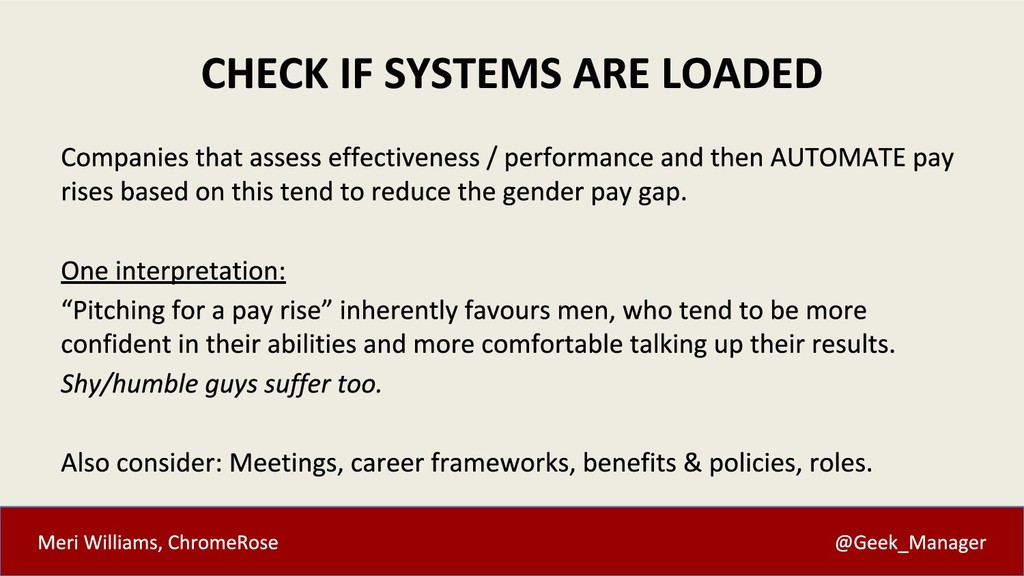
So what do we do with this, on this side? Apologies for this. I'm gonna go, like, two minutes over. We need to check if systems are loaded. If gender pay gap is worse in companies where people have to pitch for a pay rise.
Somebody who I used to work with at P and G actually did their entire masters research on this topic. Pitching from pair of eyes inherently favors people who are rewarded for confidence or overconfidence, and hurts people who are tend to talk about the team first or tend to blame in and praise out.
And that isn't just women, it's also people from cultures that are less individualistic, for instance, the the Far East. And shy and humble guys suffer too. So think about in all of your systems, are they like we've talked about the job ads, are you accidentally biasing for arrogance?
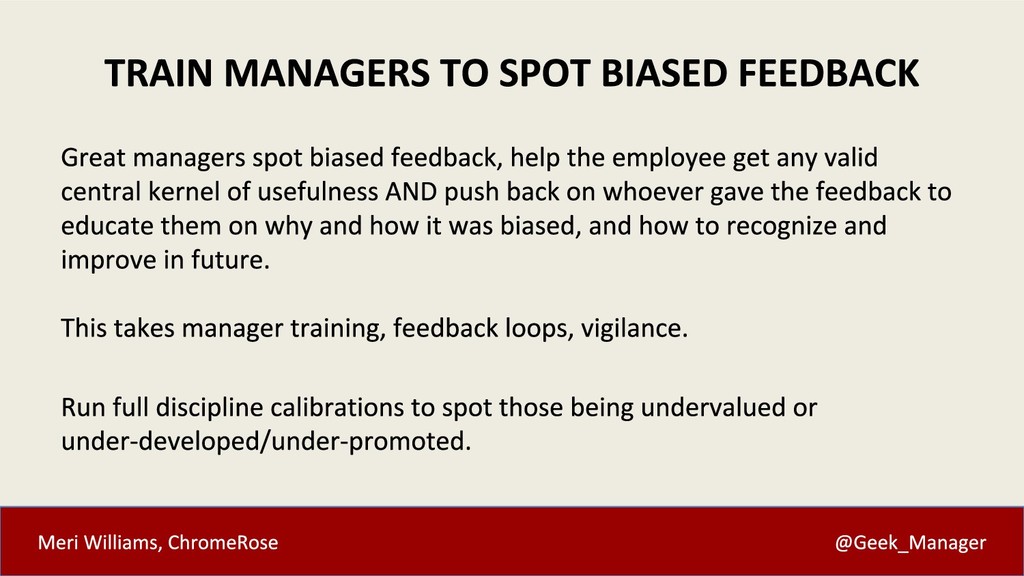
And is that really the core value you want to have in any of these systems? Train managers to spot biased feedback. A good manager spots that it's biased. A great manager goes, here's the kernel of truth in this sexist ******** or this homophobic ******** or this, you know, racist comment someone's made about you.
Here's the one useful thing to take from it. And then they go and have the conversation with the person to get that feedback about why it's not appropriate, how they need to, you know, probably do some soul searching and do some some training and do better at it.
It's a genuine problem that some people only get what feels like very biased feedback, and they lose out in two ways. They're experiencing discrimination, and they feel like they can't trust any of the feedback. And you can't learn and improve if you if you don't have a feedback loop.
You need to give your managers training. You need to help reward them for this behavior. And the safety net that you can apply is to do kind of full discipline calibrations. Be have other managers be the safety net for each other when you go like, let's look at everybody and compare and contrast their performance and potential, and then let's let's discuss whether we're not investing in anybody well enough.
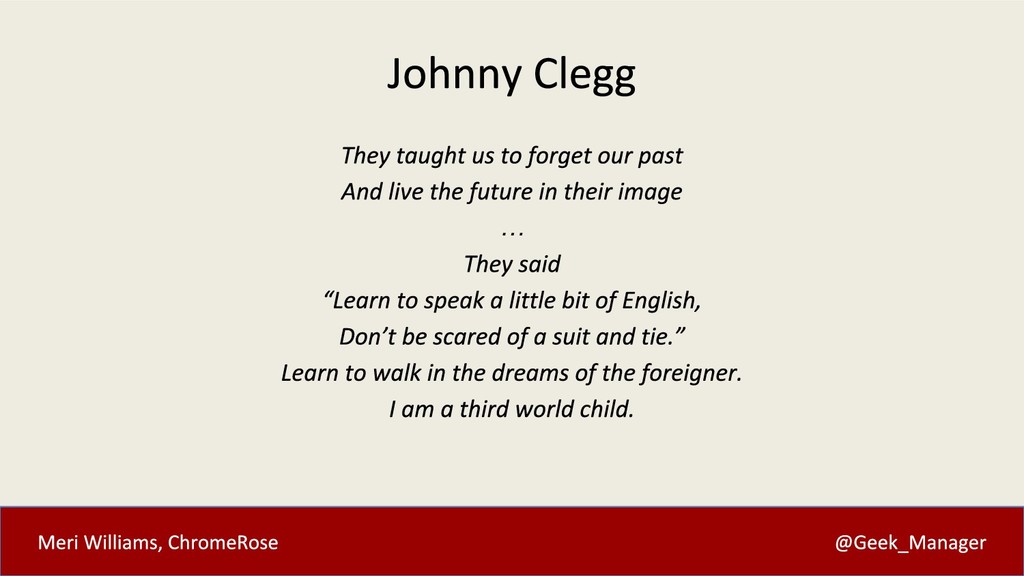
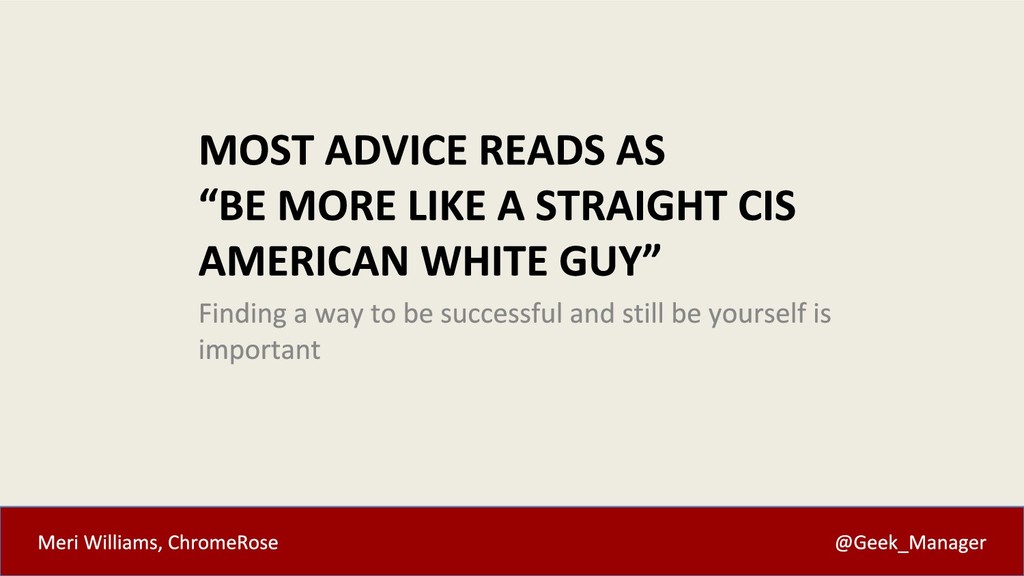
Think about the advice you're giving and whether people can take it. I'm not gonna read this out because it will make me cry. It's a song I find very emotive. But a lot of advice just reads like, be like more like a straight cisgender, which means the the same gender as your kind of assumed sexes at birth.
American white guy. Right? Like, not all of us can do that and get away with it. And so your reaction to feedback that you can't, like or advice you can't follow is either like, oh, run away, or this one is my patron saint.
I used to be a bouncer, and apparently, it shows in how I react to conflict. I actually the last time I was in Edinburgh, some little punk they're always little, but some little punk decided to, like, shout homophobic **** at my wife and I because we were holding hands walking down the street.
And apparently, my bouncer mode can still turn on so effectively that when I turned and looked at him, he ran and hid behind a bouncer outside a club that we were walking past. And the bouncer like just exchanged looks with me and did this.
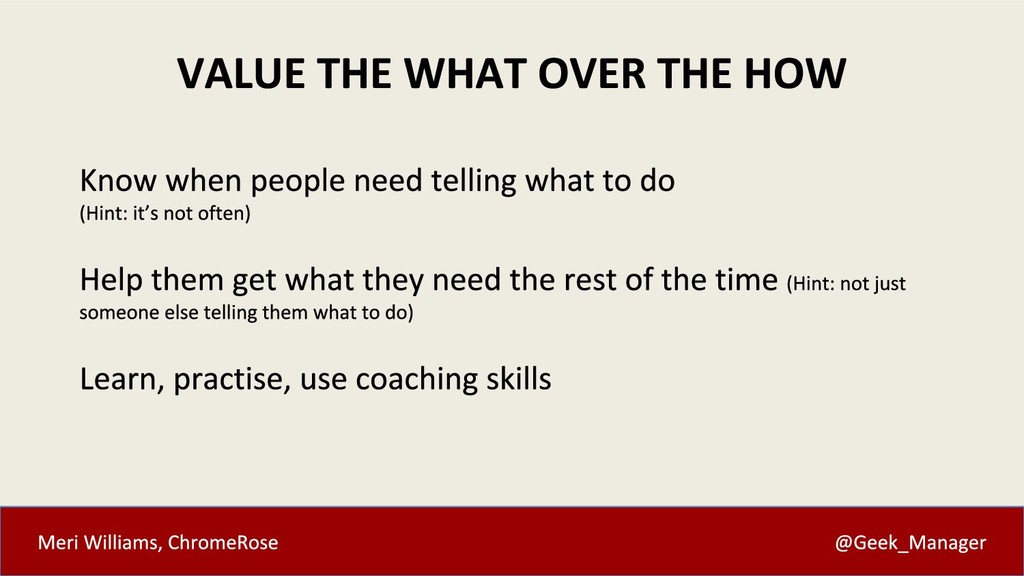
And I was like, you're on your own, you little ****. Anyway, you're mostly a lovely town and I'm usually very happy to be here. But so don't give people advice they can't follow. Value the what over the how. Help people find their own way.
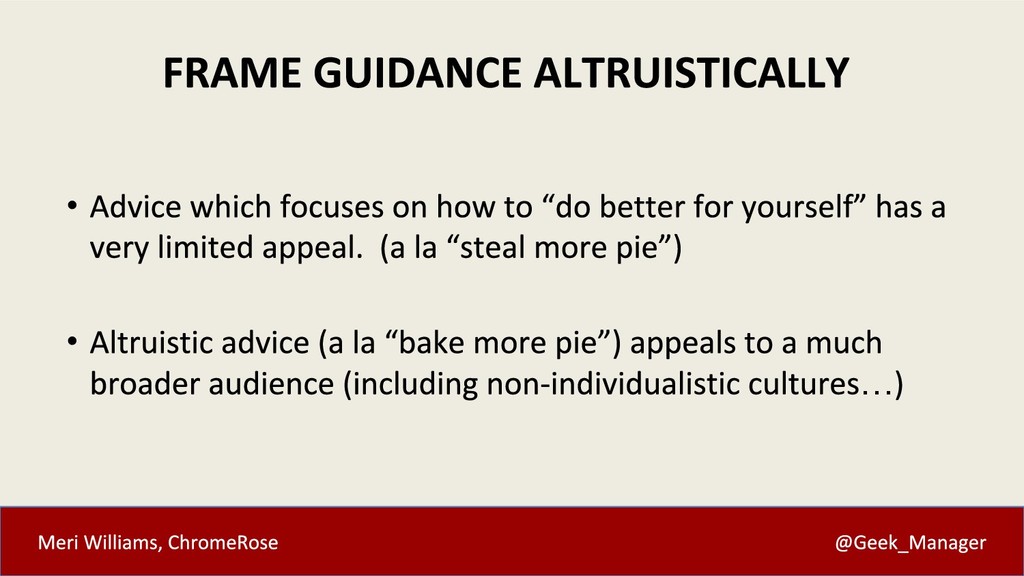
Invest in coaching skills. Invest in you having them, and your peers having them, and your managers having them. Because coaching is about helping someone figure out the best way that they want to approach something. Frame guidance altruistically. Baking more pie is a much more accessible message than stealing more pie.
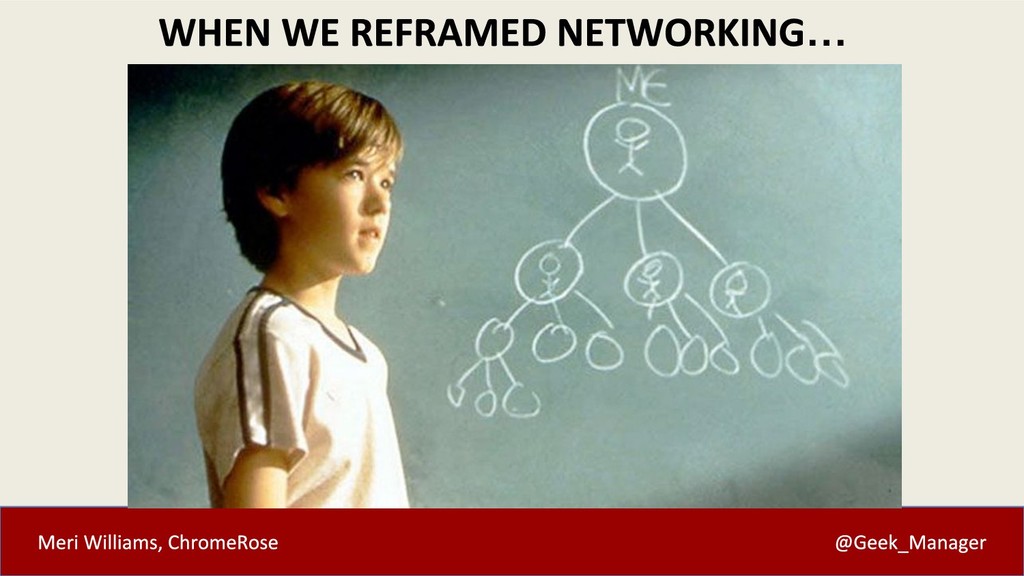
When we reframe networking as get to know everybody because you never know who you might help, we saw a marked improvement in performance in our in our interns that year than when we when it had been described as talk to everybody because you never know who you might be able to use, which was literally how someone had framed it before.
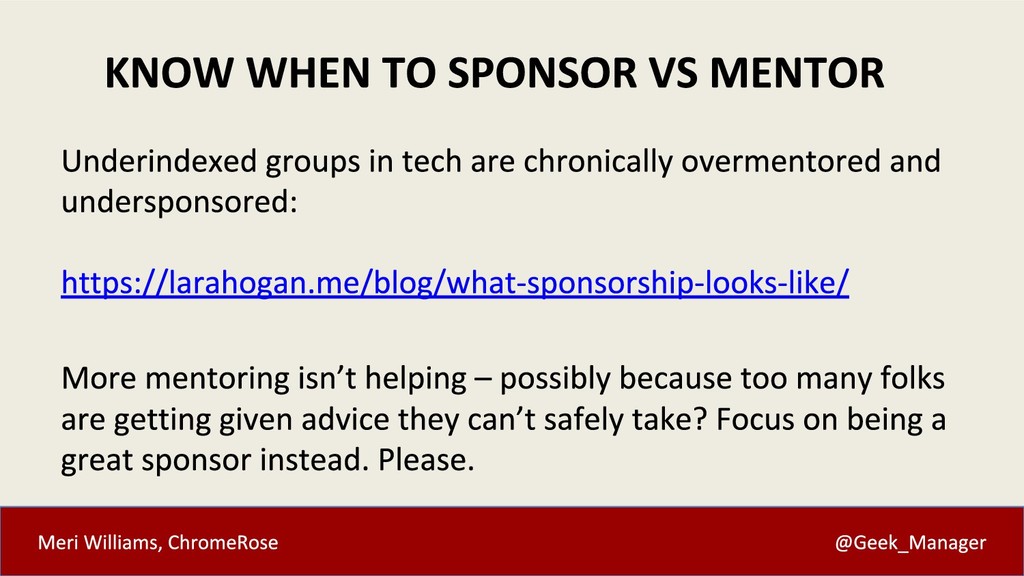
And know when to sponsor versus when to mentor. Laura Hogan has written on this topic much more eloquently than I can cover in my minus three minutes. I'm really sorry, Brian. And so, just know that people are chronically many people are chronically over mentored.
They've been given lots of advice that maybe they can't take. And under sponsored. Figure out what sponsorship looks like in your organization. And if you are in any position of power, that is privilege you can lend. You can help people find the right opportunities.
You can put them forward for things. You can make sure that it's not the same people every time getting given the the extra opportunities. Be an amazing sponsor, and you will change people's lives and their careers. And so think about this whole thing of like, are there role models for me here?
I'll be honest, I don't often find anybody above me in a on a board or in a company hierarchy who is exactly the same set of daily male hated characteristics as I am. I look for whether there's any evidence that people at the top don't wear have matching haircuts and wear matching ties and underwear.
Right? Like, see some variation in how people succeed is sometimes what you're what you're looking for. So let people be more human and show that that those different things are there. Because fundamentally, every role is capable of virtuosity. Every person wants to be good at what they do.
Nobody gets up in the morning going, today, I am aiming for just south of mediocre. And if I can **** everybody else up along the way, my day will be perfect. Right? Like, maybe some people who are really that assholic do exist, but on the whole, people wanna like, people feel good when they're good at what they do.
Most people want to come to work and be great at it, so our job is to help them do that. So, in crafting inclusive environments, remember to think about how people would answer how a broad range of people would answer the question, am I expected here?
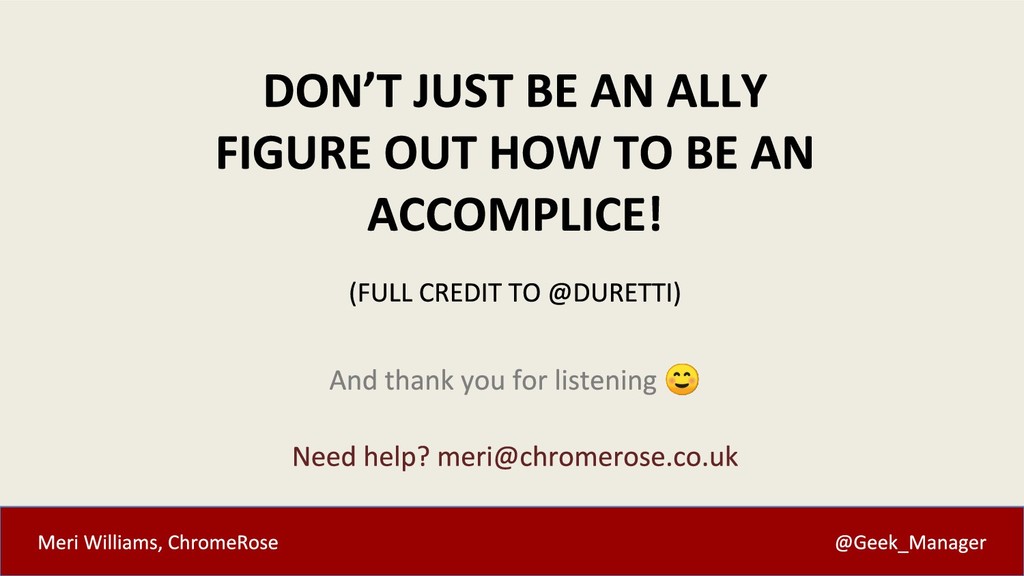
Am I respected here? Can I be myself and be successful here? And most of all, don't just be an ally. Doretti Herpa, who's a who's an amazing engineer, and and I think is the origin of this, said she's not looking for allies anymore.
She wants accomplices. Like, let's figure out how to how to be accomplices rather than just allies. Help us commit the crimes. Help us actively dismantle these these systems and make it better for for everybody because that will be a way better world for all of us to exist in.