Every B2B company wants more leads, but most lose them somewhere in the messy handoff between marketing and sales - leads sitting unworked in a CRM nobody checks, forms that ask for too much, reps insisting there are "no leads" while hundreds sit filtered out of a report.
Meagen Eisenberg, CMO of MongoDB and formerly at DocuSign, lays out what it actually takes across people, process and technology: partnering tightly with sales, optimizing the website and streamlining forms, scoring leads so reps work the hottest ones first, and building automated nurture streams that keep prospects engaged. She's generous with specifics - from mapping the lead flow end to end to low-budget tactics like influencer outreach and turning customers into advocates.
1 / 20 Use ← → to navigate
Auto-generated transcript - may contain errors.
Tap a timestamp to jump the video.
Hi, good afternoon. Megan Eisenberg. Excited to be here and share a little time with all of you on a topic that's near and dear to me, getting more leads for your organization. A little bit about myself. I've been a CMO of MongoDB for the last three years.
Prior to that, I was at DocuSign as their VP of Demand Gen and Customer Acquisition. We grew from thirteen million people on the platform to over fifty million in about three and a half years, and now they're way past that, over one hundred million.
I also love to advise tech companies. I've been doing that for about seven years. Every company that I have worked at full time has been acquired or gone public. The DocuSign and MongoDB went public this year. So, exciting to see the different stages of companies and the different exits.
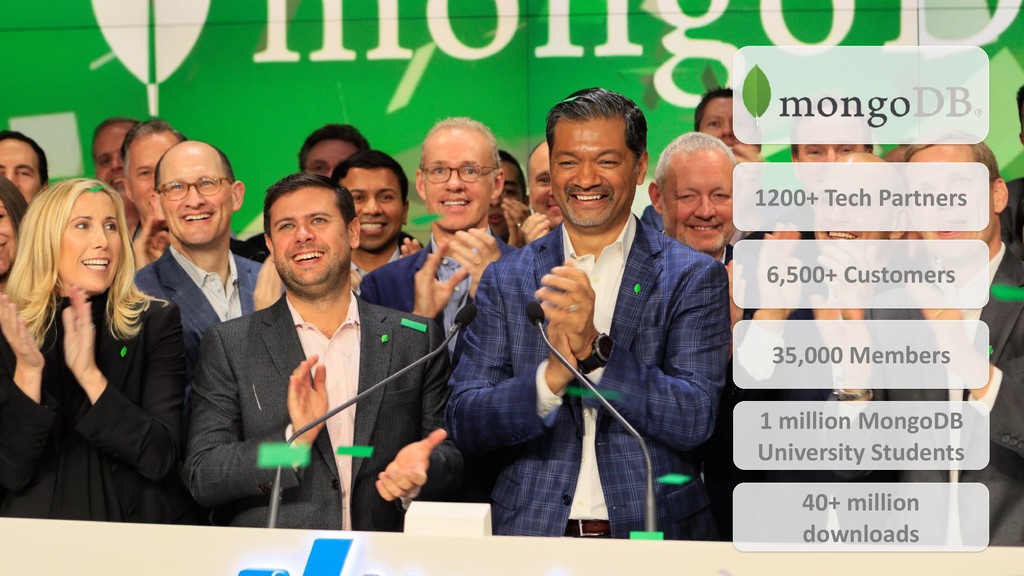
A little bit more about MongoDB. We have over forty million on our platform, and we just hit a million on our universities. So, anyone running online education knows. There's a lot of work around also just driving education and users to participate in that.
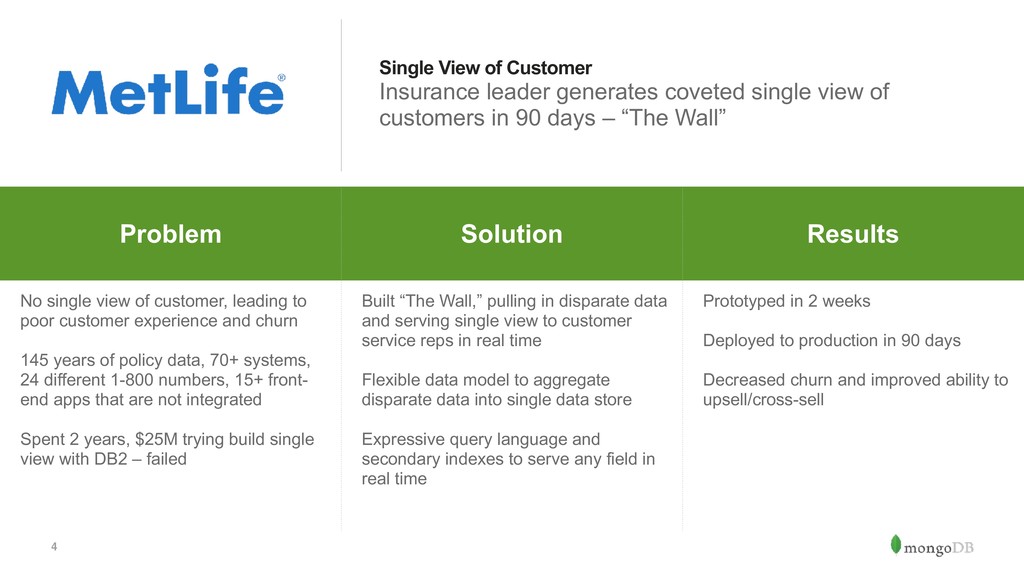
More about MongoDB. We are used by hot brands like Coinbase, Epic Games, to storied brands like HSBC, Air Lingus, Barclays. A quick little use case, as Ollie says, don't show your products, show them in use cases. MetLife spent few years and twenty five million dollars working with a database called DB2 to try and get one view of the truth.
There were seventy disparate databases, and if you were to call in to get some information, the customer support person would have to look it up in seventy different locations. So they were really trying to bring this all together to create a much better experience.
We worked with MongoDB, did a two week prototype, and in ninety days, we're up and running. And they designed it after Facebook, an interface that many are familiar with to make it very easy for customer success. As you can imagine, call volume times went down and satisfaction went up.
And so, it's just MongoDB is about working with a lot of data and really today's modern apps. So, enough about that. You know a little bit about me. You know about MongoDB. But what am I gonna talk about in the next twenty minutes?
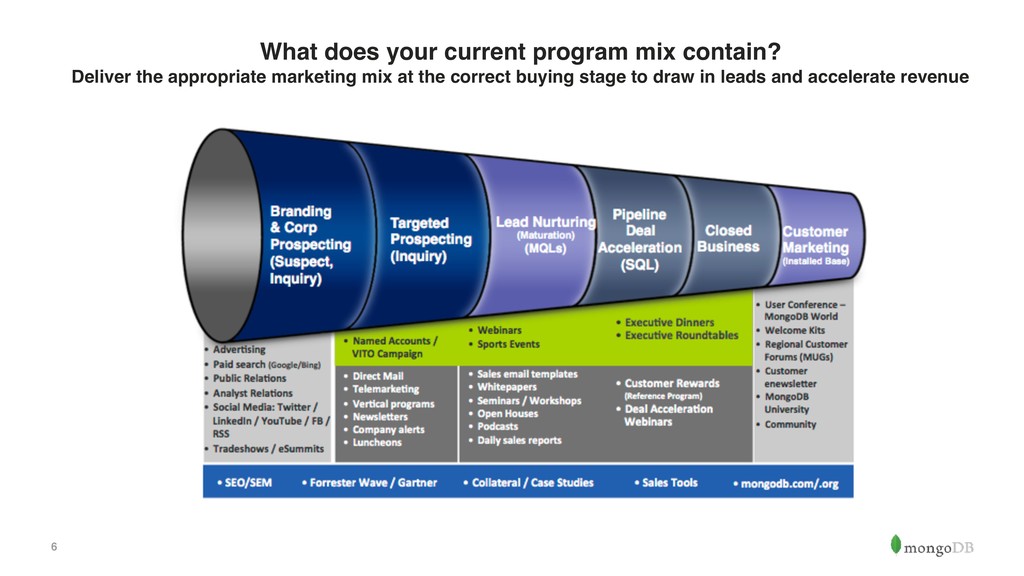
I'm gonna talk about what most companies, certainly in the B2B space, have in their marketing mix, what it takes to drive leads, people process and technology, and some measures of success. So diving in, this is definitely an eye chart, but for those of us that are in marketing, this is the mix that it takes to really take care and onboard customers.
Whether you're trying to get them at top of funnel to learn more about you, to search for you, to organically find you, There's a lot of things involved with content, with analysts, with media. Once they're in your funnel, there's a lot of education involved.
You're supporting a sales team possibly, all the sales enablement content. And there are certain gates they're going through to find out if they really want to buy and use your product. And then once they come on board, you want to keep them, of course.
So, what is the mix that you need to do to keep your customers happy and on board and advocating to bring on more customers. So, I think this is an important part of generating leads and then keeping them. So, start with people. Marketing, it's not just marketers who are involved in driving leads.
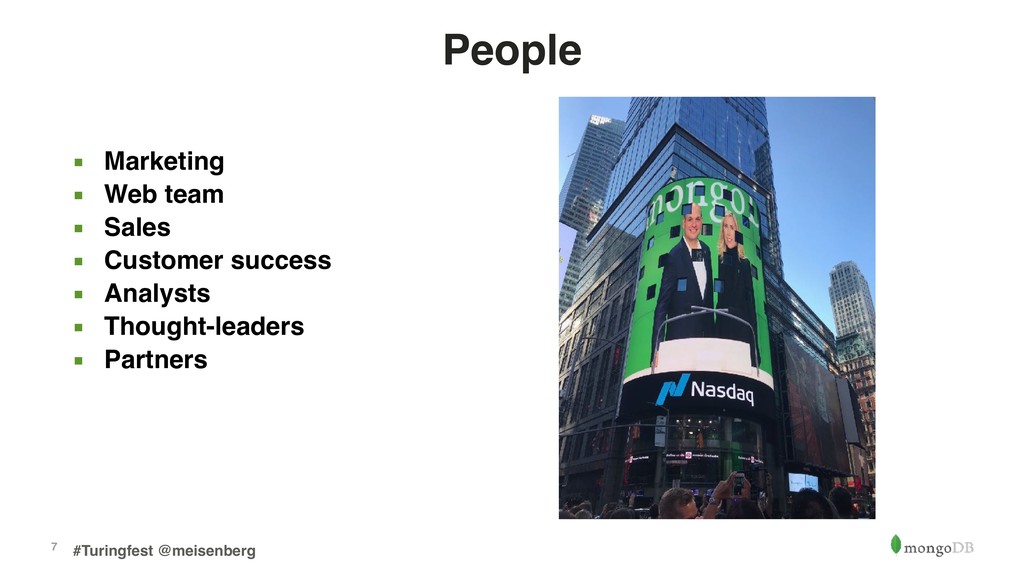
It's this whole mix. I think the closest partnership you've got is with your sales team. Certainly, this is my head of sales CRO, Carlos. Over the last three point five years, we've partnered very closely to figure out what we needed to do to build and drive leads within the organization.
There was a lot of conversations. What was the typical lead? Who were they wanting to talk to? When I joined MongoDB, it was one, all about developers, which we still are, but the people at that time that were buying our enterprise product were not the developers.
They were C levels. They were VPs of engineering. They were head of operations. And so we had a mismatch between marketing and sales and what we needed to deliver. Two years ago, we released our database as a service, which is direct to developers.
So now we have a lot of conversations not only on C level, but how do we go direct to developers for the future of the product. And then, of course, there's a lot of influencers that people go to learn. You come to conferences to learn from different experts.
You're listening to what they're talking about, what products they use, and you're walking away and you become a lead for that organization. You want to work with influencers, there's media you're talking to, there's analyst relations that are all helping you create content to get people to come and learn more.
And then, of course, you've got your partner ecosystem that you're working with to help spread the word, bring in more leads or work leads that are coming in. So, technology. Obviously, a lot of our stuff comes in through our website. When I joined MongoDB three and a half years ago, we had multiple sites.
We were not mobile optimized. We were not it really it was really a white sheet of paper with some text on it and what I was told is we want to look like Apple. And so, thought, oh, wow, we don't look like Apple.
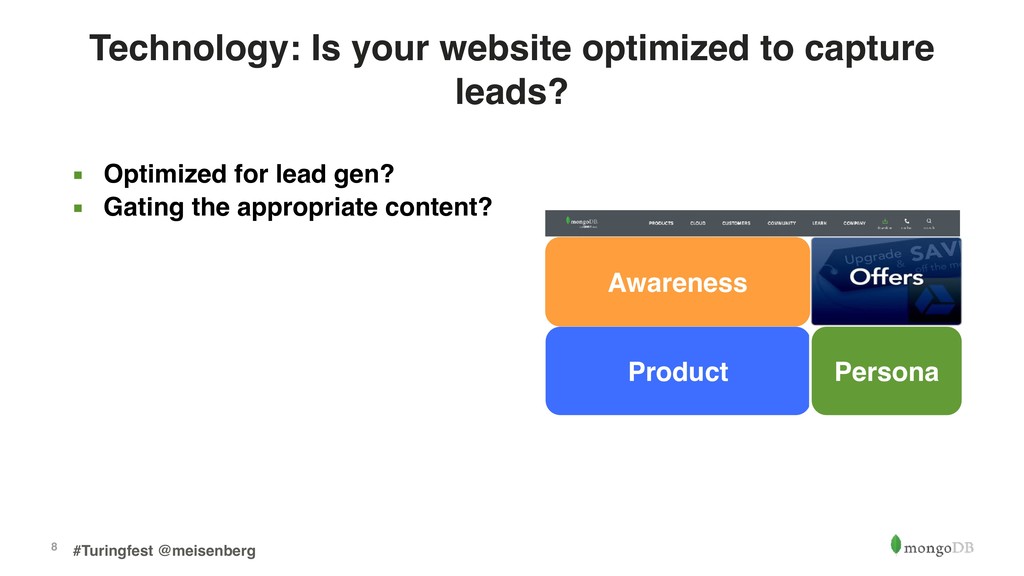
We look like a Word doc with some text on it. So, how can we get closer to that vision? And did a lot of thinking around call to action, awareness, what were we trying to do? Simple things like putting the download button in the upper right hand corner, having one call to action, highlighting our customers, highlighting information and how tos.
We went from our enterprise download that was our main product three years ago, one hundred of those a week to over nine thousand a week today just by optimizing. Since then, we've introduced many different products. And in fact, if you go to our website, you won't even see enterprise, you'll see Atlas, our database as a service, unless you're over a billion in revenue, we use technology that will serve you enterprise.
So, we've gotten a lot more sophisticated. The other thing is Google does, it does matter to be mobile optimized. They rank your website and if you fail mobile optimization, you will get ranked lower. And so, we had a lot of work around mobile optimizing our website.
And a little bit about content. I think giving content away is incredibly powerful. People learn, they come to you. But there are things that I think are worth gating to capture leads if your sales team is starved. Educational material, white papers, things people are learning, analyst reports, those types of things that cost money, I think it's okay to gate and ask for some information.
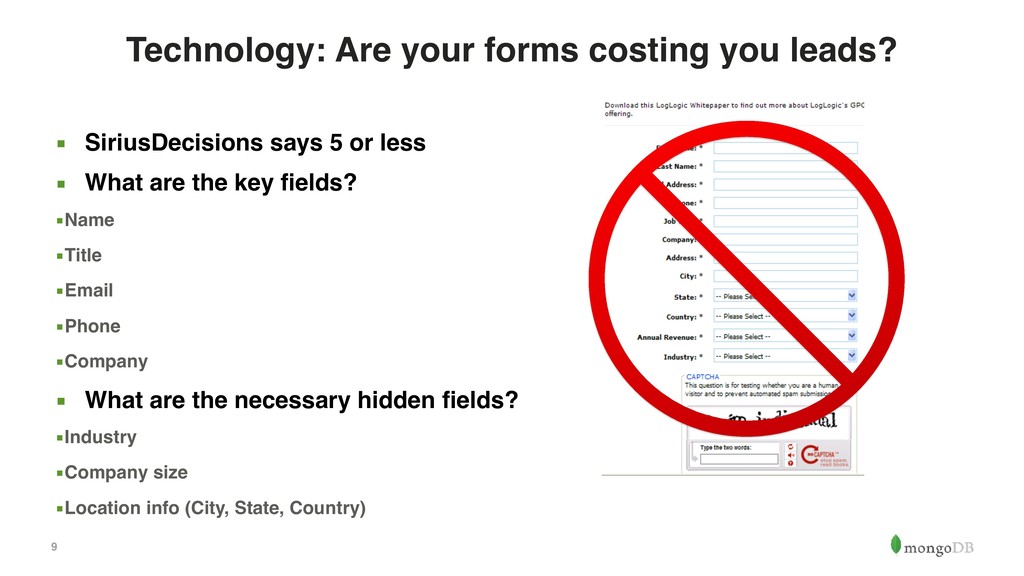
Forms, I would say these are your most important asset on your website. I've certainly seen companies ask way too many questions, and the more you ask, the less people fill out. Obviously, when I see a form, I don't want to fill it out.
I think at a, max, you really shouldn't be more than five fields and really today, you can ask for one. You could ask for email address and get so much information. If you're feeding a sales team, my sales team thinks it matters to have a phone number and a title.
Because if they're reaching out to someone and it's a developer, they're gonna have a very different conversation than if it's a C level exec or a business analyst or an architect. So, by capturing title, for them, that matters on the conversation. If they get them to even answer the phone or respond to an email, it's because they personalized the message or they had ten seconds to say something that mattered to that particular title.
But with things like Clearbit, Demandbase, Zoom, InsideView, all these different technologies out there will actually, via IP address, reverse lookup, tell you immediately anything you want to know about that company if it's of a certain size. Things like industry, revenue, website address, the actual company name, address information to find them.
So, I wouldn't waste time asking that type of information. I would grab it in real time. On our website, we certainly do. If we know your industry, we serve up a different image, whether it's your government, government pillars, retail, you have a story experience, manufacturing.
People like social proof. They wanna know that you're there for their industry and their business. We also serve up different logos based on the industry that we pull up from the IP address that resonate to you. So it makes you feel like this is somewhere that my industry buys, uses and works with.
And so, certainly, the easiest thing you can do to increase leads is to streamline your forms. And, if you only ask for email address, then progressively profile them, ask for more information along the way when they get to know you a little bit better.
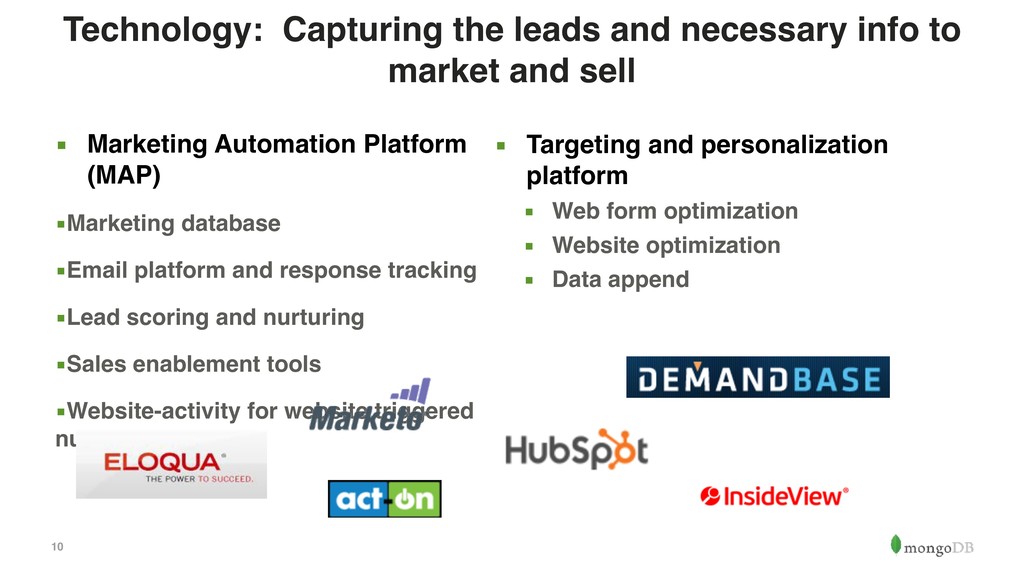
So, technology, once you capture the lead, how are you using that information to make sure that your sales team is armed and ready? One, we use a marketing database. I specifically use Eloqua, but there's a handful of them out there, Marketo, HubSpot, Acton, several different ones that I've got up here.
But what matters from a marketing standpoint is you don't want to put a bunch of noise in your CRM system. Salesforce, a popular one that we use. If I just loaded things into Salesforce, into my sales team, eventually I hear these are junk, they don't respond, why did you put this in front of me?
So of course, I don't want to lose their trust. I want to put people that are ready to talk to sales into the CRM. So I host them in a marketing database and I continue to nurture them and grow them until they hit a threshold that says, hey, I think they're ready to talk to sales.
So they come into the database, and I need to figure out in an automated way, we get one hundred and eighty thousand leads a quarter at MongoDB. Certainly, they're not ready to talk to sales, and certainly, sales can't even keep up with one hundred and eighty thousand.
So, I score them to make sure they got the relevant ones, and I have to create that scoring model, which I'll talk about in the next couple slides with the sales team to make sure they're getting what they want. And I have to have an automation platform in order to give me that technology, in order to nurture them to score them.
And then I talked a little bit about personalization. We use demand base, but you've got Clearbit and others. When they hit the website, that experience matters right away. We had several speakers earlier today saying personalization gets them to engage and click through a lot better.
So, making them feel like you have a solution that's for them. We certainly saw this at DocuSign when we gave them information. If you were a real estate agent and we made you feel like you're at home where other real estate agents came, that was very different than if you were in high-tech and you were at Salesforce or one of these tech companies and you wanted to use DocuSign to sign documents.
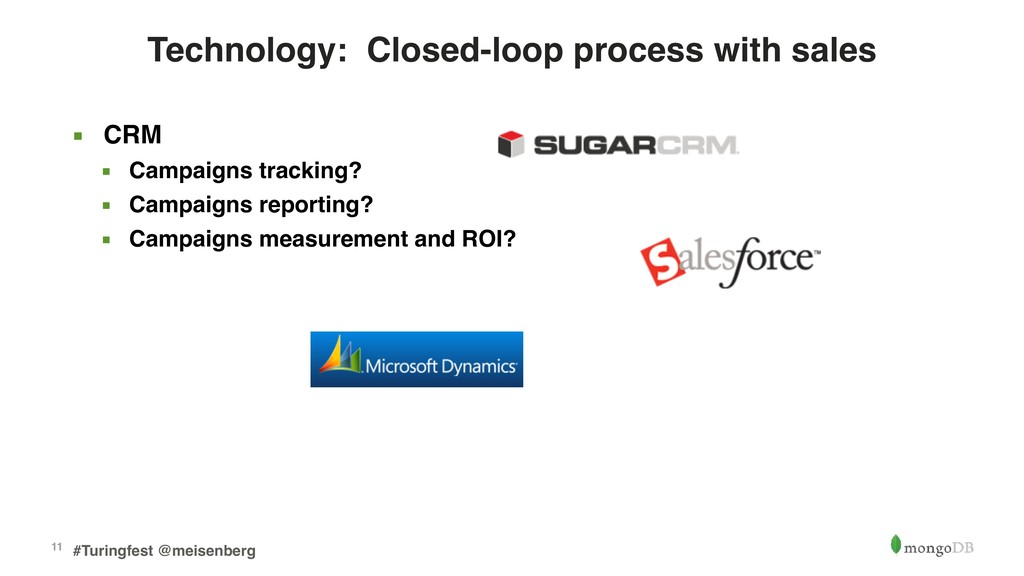
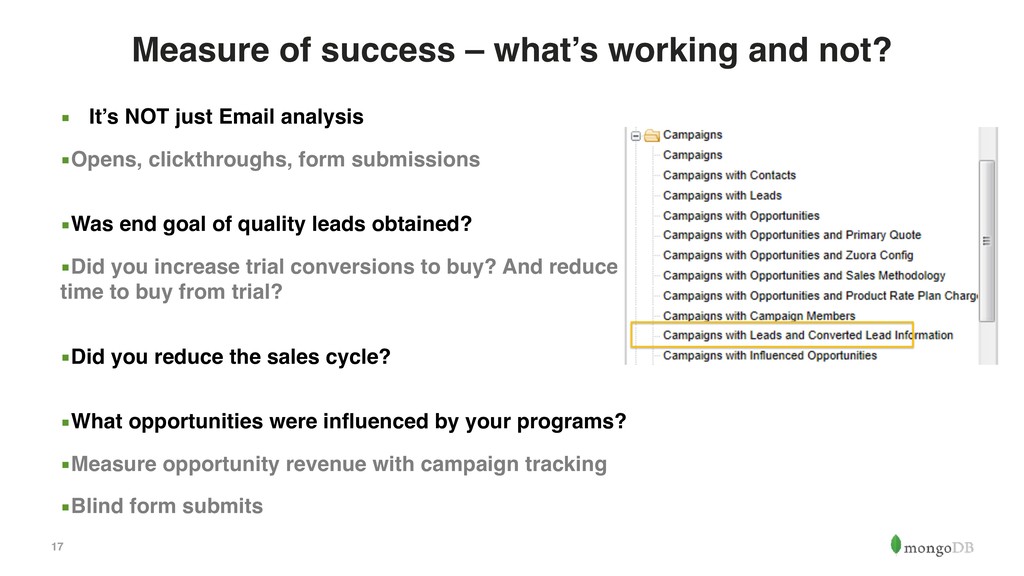
And then your CRM, it matters a lot. I find when I talk to startups that are using Salesforce, they don't even realize 's a campaigns module. And why that matters is Salesforce is divided up into two really main databases. You've got leads and you've got contacts and accounts.
And it wasn't initially designed for marketing, it was designed for sales. And so, in order to track what leads actually convert into business, so as a marketer, can figure out where to spend my budget and what's actually converting and working, you've gotta use the campaigns module, which connects the two databases and allows you to figure out influence and information.
There's other tools like Full Circle CRM that will also allow you to look at attribution and get a lot more information. And why that matters is if I can figure out what's bringing in the leads that actually convert, I can shift my budget and do more of that.
Is it webinars? Is it coming to events and people networking? Is it social media? Is it content that they've downloaded? I need to track that all the way through to close and in order to do that, I need systems like this to make it happen.
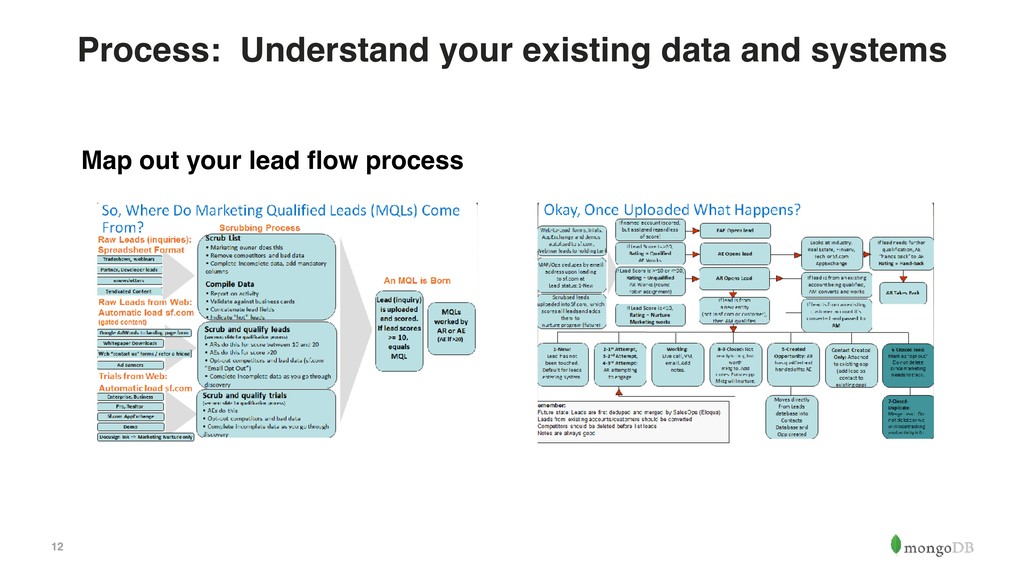
And then process. Always the first thing I do when I go to a company is I actually map out the lead flow because there's a lot of drop off that occurs when leads come in. For many, when you're at a company, the original person that set up CRM or Salesforce, all that knowledge when they leave goes with them if it's not really well documented and how many startups are really well documented on what they're doing.
And so, me, it matters to list out all the fields that I've got in the CRM and all the fields I've set up in the marketing automation platform, how do they sync, how does the information transfer. Oftentimes, leads will come in, they go to a qualification team and then they go on to sales.
You'll find things like, I will look in the marketing database and see one thousand leads for New York. I will talk to the SDR that covers New York and he or she will say, I have one hundred leads. I don't have anything to work.
And I'll say, I have one thousand, you have one hundred, why is that? Well, they set up the report in the CRM system using a category field that we don't use anymore. So, it actually filtered out nine hundred very leads, maybe not highly qualified, but leads that have been passed over.
And so, it matters to go sit and watch that manufacturing flow. Out of college, I joined Cisco Systems as an IT engineer and I was supporting master schedulers. I went and got APIC certified so I could understand their job a lot better and it really made me think about bottlenecks and how things flow through.
I guarantee you will deliver more leads just by mapping out the flow and sitting in the seats of your SDRs and then your AEs. I've had other situations where, okay, SDRs are working the leads, they see them and they're handing them off, and nothing gets worked.
And, I've gone to the sales leaders, and I've said, okay, why, you you keep saying there's no leads. And, the sales leader, yeah, I don't get any leads. And, I'll run the report and I'll go, well, you have one hundred and seventy specific to this territory.
Where are you seeing these leads? And, I'll show them the report and they're like, is that Salesforce? I'll say, yeah. They'll say, oh, don't use Salesforce. Ah, there you are. So, great. We've got this system. We've got this, but they don't actually look in it.
They want to email. So, now I've got to figure out with sales, okay, here's the leads. How do I get them to you? What's the best delivery? Do I integrate with Slack? Do you want to get Slacked when the lead comes in so you can go and work it?
Can I train you how to use Salesforce to find your leads? And you'll find this amazing thing that happens just by setting this up. So, a little bit about lead taxonomy and scoring in the funnel. How do you know if what you're sending is going all the way through?
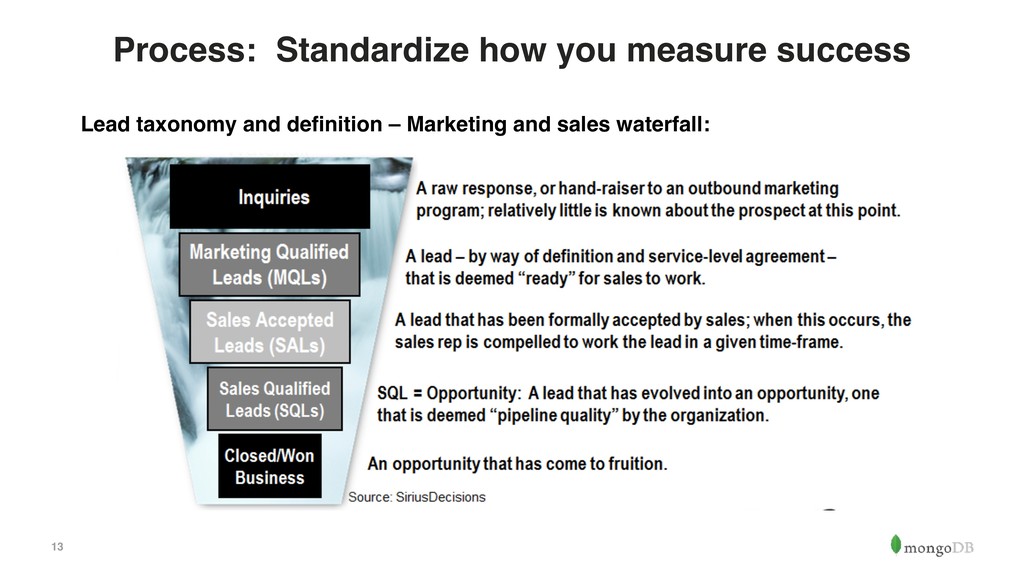
Okay, you've turned module, but there's multiple stages, often time when you talk to sales, they a lot of pipeline, but at least 4x 5x pipeline, and they really are looking at sales qualified leads. And what I'll say is this taxonomy is serious decisions.
It's sort of like a Gartner for B2B marketing, but it's a great way to look at your funnel to see where the leads are either leaking or not converting, to find the bottlenecks so you can improve it and to have a language that you can use between marketing and sales on the handoff.
And so, leads will come in, we'll agree upon a definition with sales, what makes a qualified lead. If they come in and those fields, it's this industry, it's this title, it's this activity, they downloaded the product, they went to this webinar, we all agree if they take those actions in there of this firmographic information, sales wants to try and talk to them, that's the MQL.
Well, then you have a qualification team, which is the middle of the funnel. If they accept a lead, a sales accepted lead, now we know it's made it that far. And as they've dispositioned the lead and qualified it, did it actually make it to your sales team to go work it and then closed one.
And what I often see at companies is there's not a lot of work in the middle of the funnel looking at the qualification process. Marketing's saying, hey, here's some qualified leads. And the sales reps are saying, hey, I don't have enough pipeline and you work really hard to enable your sales team and marketing works really hard to try and deliver qualified leads, but we don't spend enough time on that hand off and the group, the SDRs that are actually working the leads and where they're getting stuck.
Because you'll find that some of your reps, they can really handle five big deals at one time and they'll get leads coming in and they don't have time to follow-up or take the meeting because they're focused on closing business. And so, what do you do in that process when nobody is there to follow-up, your qual team got it ready, but they can't take it.
And then there's others that are not even looking in the system and looking at it. So, really cleaning that up and having that partnership with sales is gonna matter a lot on if you can make a predictable revenue engine and have leads flow through.
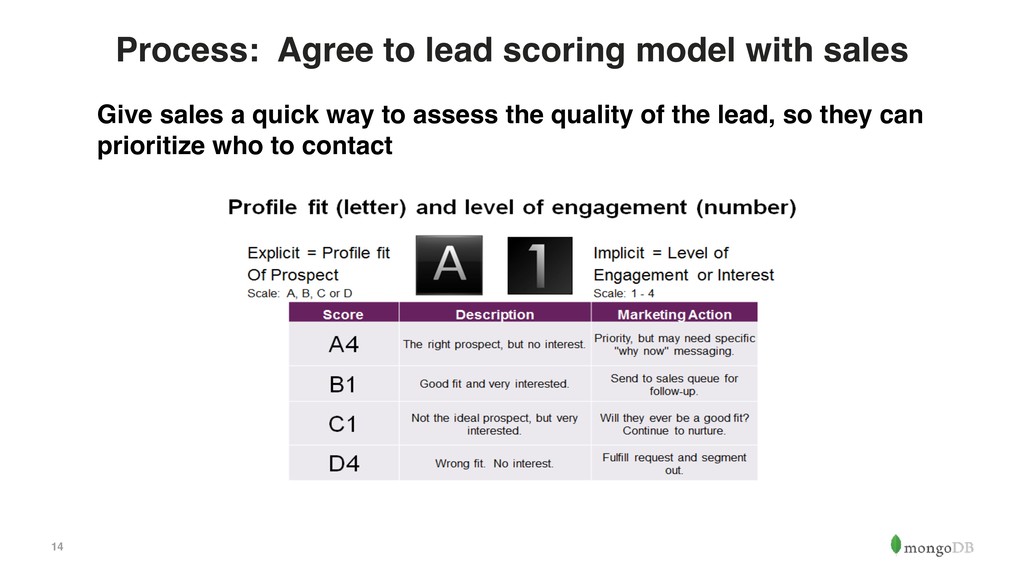
And scoring, there's different scoring models. I like firmographic and engagement. In Eloqua, we use if you match the demographic of what sales wants to talk to, you have A through D. A being the perfect person to talk to. D maybe is a student or consultant, not someone that would typically buy, but maybe learning and educating themselves?
And then one through four, how active are they? I can give you A four's all day. Well, in Europe, I can't buy a list, but in the US, I can still buy a list and make you a bunch of A four's looking exactly like who you want, but they've never heard of us and they've never been on our website and they've taken no action.
So, what you really want is A one's. They look like who you want to talk to and they're highly active. They've been on our website, they've read the blog, they've signed up for a webinar, they've download the product, they're in the trial, you name it.
But, what we need to do is agree between marketing and sales what is the best scoring lead, and they want to work the A1s and the A2s, maybe some B1s and B2s. And with the rest, marketing is going to continue to nurture them until they hit the right threshold or they opt in direct to go.
But, if I'm a sales rep, how do I know which leads to prioritize? If I get twenty that day, do I focus on the ones that are the Ds? No. But, if I give them a score and they can go, oh, I'm gonna go work the hot leads, the As and the Bs, then they can reach out.
Because we also know leads, if you don't follow-up with them within less than five minutes, they pretty much die. If you do, they have a ten percent higher chance of converting out of the gate just by getting them when they're in the moment signing up, thinking about you.
But every hour that we delay, the conversion rate drops significantly and we know that. So, scoring I think really matters in the handoff and making sure the leads you do get actually convert into business. And then, this is back to the campaigns module.
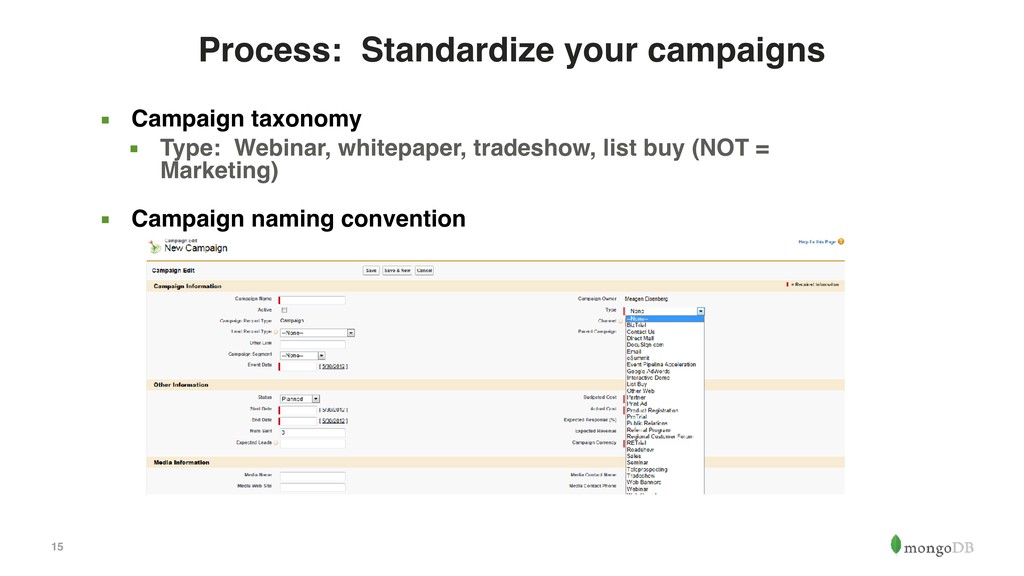
A lot of times I talk to companies and marketing, the lead will come in and they'll just say source marketing and they'll track through. It's like, okay, this came from marketing. But as a leader of a budget, back to the conversation, I actually wanna know, did it come from a webinar and which webinar?
An event? Which event? A white paper? Which white paper? Social media? Facebook? Digital ads? I need to know that level of detail in order to shift the budget around, and I need to track it all the way to close. So this is specific to Salesforce, but when you're setting that up, or an easy fix is create categories when leads come in, mark them.
So now I can run a lot of reports to understand what actually converts into business. And then, middle of the funnel, nurture programs and why we do that. So, earlier today, there was a talk and it talked about, you know, we really want targeted messaging.
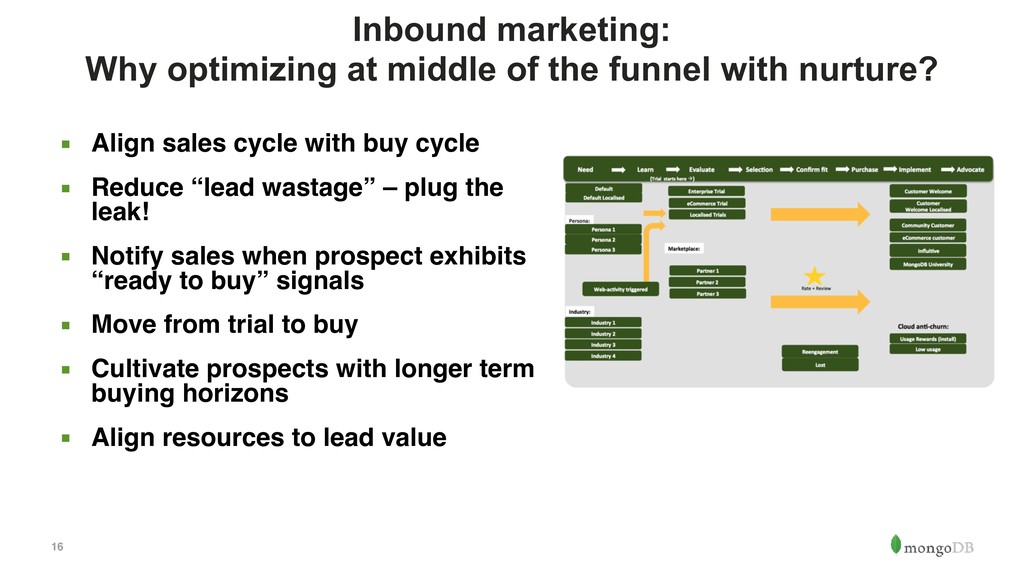
And, if you actually have to set that up, there's a lot of automation involved and triggers that you have to set up to route emails. So, what we've done, and we did this at DocuSign and we've now built this out at MongoDB, is we have over eighty different nurture streams you can go that's automated.
We have an air traffic control system, I mentioned was Eloqua. And what it does is first it looks at your geography to understand language and customer case studies. Then it looks at your title to understand if I'm gonna route you as a developer, an architect, biz, C level.
Then it looks at your industry to give you relevant case studies, where you are in the funnel, and if you're a customer. And before every email goes out, so out of these eighty nurture tracks, there's six to ten different emails depending on how much content we have.
It checks where you are in the funnel and it says, okay, this is a developer. Developers in retail. Second email about to go. Have they signed up for a trial? Oh, they have? Kicks them out, puts them in a trial nurture program. If not, it sends them the next email.
Next email's about to go. It checks. Did they actually buy the product? Yep, they're a customer. Don't nurture them anymore. Now put them into the customer track. And we've sent over twenty five million emails last year just within our nurture programs, routing people through.
And our open rates are great, they're personalized, and our unsubscribe rates are not higher than industry. And people are getting targeted messages so they can figure out a little bit more about MongoDB. And do they actually want to work with the product? And these emails are not buy now.
These are here's a customer case study. Here's an analyst report. Would you like to try a trial? And at the very end, we may ask them, hey, would you like to talk to someone in sales? We're happy to talk with you. But every email has one call to action.
And this gives a lot of air cover. When your reps don't follow-up right away, if you don't reach out and talk to people, they're gonna leave or go to the competitor that follows up with them. So, having this automated system really keeps people engaged with you and gives them the information they need.
The other thing it does is often I'll talk with sales, what are the gates you have to get someone through to buy the product? Well, they wanna know if we're secure. Okay, we've got some good assets on security. Let's make sure we allow them or give them information on our security practices.
For DocuSign, it was like, well, is electronic signature legal? Well, that's one of the content. We're gonna drip out to make sure they see the document on why it's legal to use electronic signatures. Does anyone in my industry use this? I'm in banking.
Okay. Here's some case studies around banking. So, we have that conversation with sales to understand what are the things they have to do to get people to finally decide to buy the product. And sometimes it's competitive. Well, they wanna know, are you better than these other products?
Okay. Let's give them some sort of wave or quadrant or grid so they can see us compared against our competitors. And by automating that process, it sort of like allows every lead to get some information. For us, we have a volume issue, so they're not all followed up by a human.
This allows us to get more people to eventually contact us because the one lead sales always follows up with is contact us. I think conversion rates are over fifty percent on that. And they always ask me for more contact us leads, which is impossible to say, yes, I will give you ten more tomorrow.
But the goal is to get people to that point when sales talks to them, they're ready to actually buy your product or they have less questions. And then measuring success in the email world, I'm less interested about clicks and open rates. I mean, I certainly want the teams that are writing these campaigns to make sure they're not sending out something that are causing people to unsubscribe.
But I think more important is it actually turning into opportunities or business. Are we shrinking the sales cycle? We look at the velocity of these leads coming through. Are we increasing the deal size? Because as we nurtured them and educated them with information, they said, oh, I didn't realize that you also have a BI connector or that you have a charts tool or you have all these other products that as a sales rep, how much time you get with them can you cover all of this?
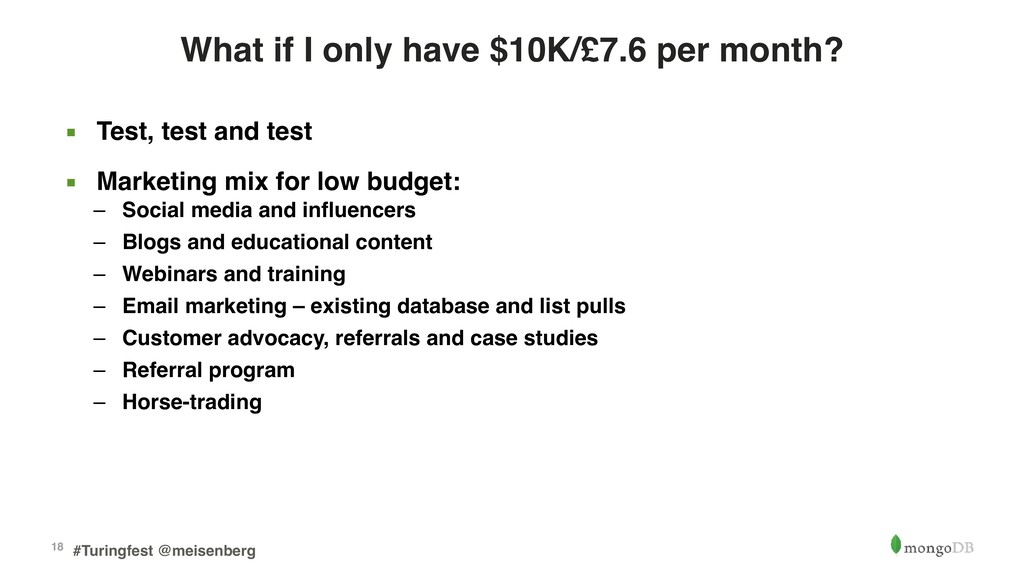
And so, job in marketing is to drive engagement, get them educated, make sure they know about all the products. And so, did we do that in this system? And then, another question I get is, well, okay, I'm a start up. I don't have a lot of money.
What can I do to really drive awareness, get leads? Well, I mean, I think the first six months, I didn't spend that much money externally at MongoDB. I did a lot of work on the website. We had traffic, we just weren't capturing it.
So, a lot of website optimization can certainly boost leads, just giving people compelling content they want to exchange their information for. That's one thing that doesn't cost money. It takes time and it's AB testing and being smart about it. I think another thing is there's a lot of influencers out there.
At DocuSign, I joined, we were one hundred and fifty people. I had one person reporting to me. I didn't have a large budget. I was buying some technologies. So, I quickly started doing research. Who are the influencers in the field? I started calling sales reps, who do you talk to?
Because one of our big buyers was sales ops to help automate the close of the quarter with deals and contracts. And I just interviewed people and did primary research of where do you go for information? Who do you listen to? Who are your influencers?
Then I reached out to those influencers and those websites and I tried to educate them, brief them on my product. So they, one, were aware of it. Two, would they write about it? Could I give them the DocuSign product? With serious decisions, I couldn't afford the license, so I made a trade with the head of the West sales.
I would give his team licensing of DocuSign for free in exchange for us to have a license so I could start educating the team on best practices. I exchanged white papers for DocuSign. So there's some horse trading that you can do to extend your product out there.
And as they start using it, hopefully they find value and eventually they buy larger deals. And then of course as we grew, I could afford to pay for their services and information. Email marketing, there are a lot of emails going out there, but we still get a lot of people responding to email and engaging with us as long as we're targeted.
Social media, that takes time, but it's a people cost. So, can you find ways? We bought tools like Gaggleamp where everyone in the company would sign up and it would automatically tweet things out just to get some reach going and to get them used to getting information out there.
And then your customers, can you get them to speak? I heard a really good idea from the guy that runs marketing over at Otho. What he was saying was that he pays for his customers T and E and conference passes if they're not included in the talk and he flies customers all over the world to go to conferences.
And, they love it because they get to speak at the conference. He loves it because they're authentic, they're telling the story, their talks get accepted, and the cost of T and E is minimal to the cost of some programs and that customer voice and advocacy matters more than anything.
And so, there's definitely a lot of things you can do when you have no money. I think people used to say do list buys. We know that's really limited now and often doesn't convert well anyway. So, these types of things I think are a great way to do it.
And then, of course, content. Can you generate a lot of content from your company and write blogs and different things that will bring people to you organically? I've seen other great ideas where companies like Digital Ocean will do have people submit content, and if that content gets posted on their blog and it's technical content, they pay two hundred dollars So, now they have a bunch of people writing content for them and getting that on their website to beef it up because they don't have enough people in marketing or engineering to
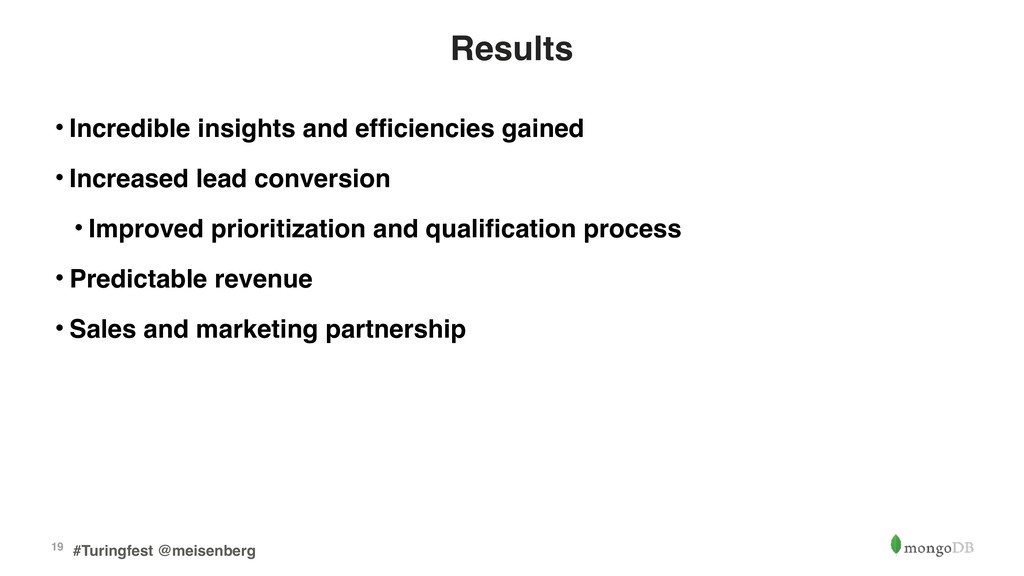
write all of that. So, with this, you'll get more insights on your business. You'll drive more volumes of leads. You'll have a better relationship with sales. It's definitely no fun when I see businesses where sales sales marketing is not doing their job, and marketing says sales is not doing their job.
One, it's not fun to work there. And two, it's not great for the business. So, you need to find out a way to partner with your sales team, treat them like an internal customer and really listen to what they're needing and then layer in your expertise and show them what you're doing really brings that for them.
And then, of course, the predictable revenue, if you can bring the leads in and get them converted and you use these technologies to help automate that process and having that just partnership with your sales team. So, thank you for today. For those of you who are familiar, we have MongoDB Atlas.
I have a promo code for you if anyone wants to try it. We also have a free tier. It's on Amazon, GCP and Azure. And, we are hiring all the time. So, if anyone wants a job in New York, please come and, you know, ring me up or something.