What’s the overriding reason cause of startup failure, and what causes so many successful startups to later break when entering the scale-up phase?
Hint: it isn’t funding and it isn’t product/market fit. These are symptoms of a deeper cause.
What is that cause, and how do we navigate past it?
1 / 38 Use ← → to navigate
Auto-generated transcript - may contain errors.
Tap a timestamp to jump the video.
There'll be no M and M impersonations today, but the welcome of them to the session. They were all at this event, obviously, because we want to make our businesses successful. It's what each of us strives to do every day. But if you want to talk about success, then you also have to talk about failure because of course the two are inextricably connected.
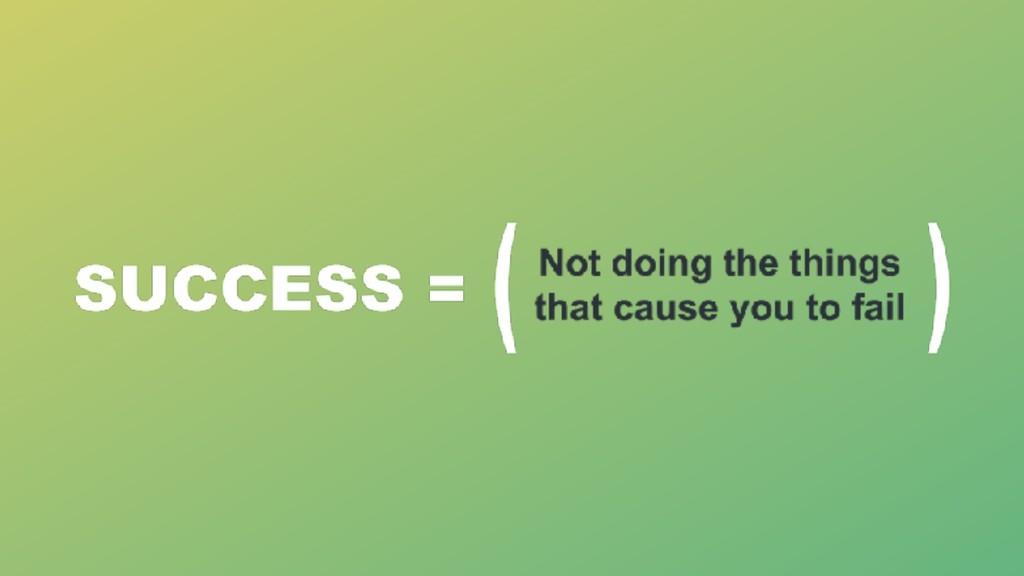
Specifically by this relationship, which says that success is what you're left with once you stop doing the things that cause you to fail. Now that may seem like a, you know, a slightly depharious definition there but actually in practice it's very helpful and a large part not all of success but a large part of success is honoring this code.
But if we look at both sides of this equation, on the left there's a huge amount of information out there about how to directly be successful biographies, podcasts, listicles, squeezy balls with advice printed on them. But that advice is actually quite hard to apply in practise.
It's difficult to take advice given in the here and now and reconcile it with a goal so distant and abstract to success. For one thing, we have to wait a very long time before we find out if that advice was right. And the nature of success speak is such that often that advice is airbrushed or overly simplified or laced with various kind of hindsight biases.
Now, you contrast this with the right hand side, failure is a far more concrete concept. And there's a whole history, sadly, of start ups and scale ups that have failed, from which we ought to be able to derive the failure patterns and then derive from them, learn how to avoid those in our businesses.
And if we can do that, it will take us a lot further down this path to success. But the industry doesn't serve us very well in this regard, and we don't like to contemplate and talk about failure. So pretty much the only tool we have in the toolbox in this area is fail fast.
And that is, of course, very good advice, but only for a certain category of problem. For example, if you can configure your business to recognise a roadmap that doesn't resonate with customers and recognise that early and take corrective action, that's a huge asset.
But there are many things in a business, many things in a startup or scale up, that don't lend themselves to fail fast. In particular, if you've ever experienced or witnessed a failure of a business, that's not fail fast. Whatever anyone in the book says, it's a slow, torturous human journey.
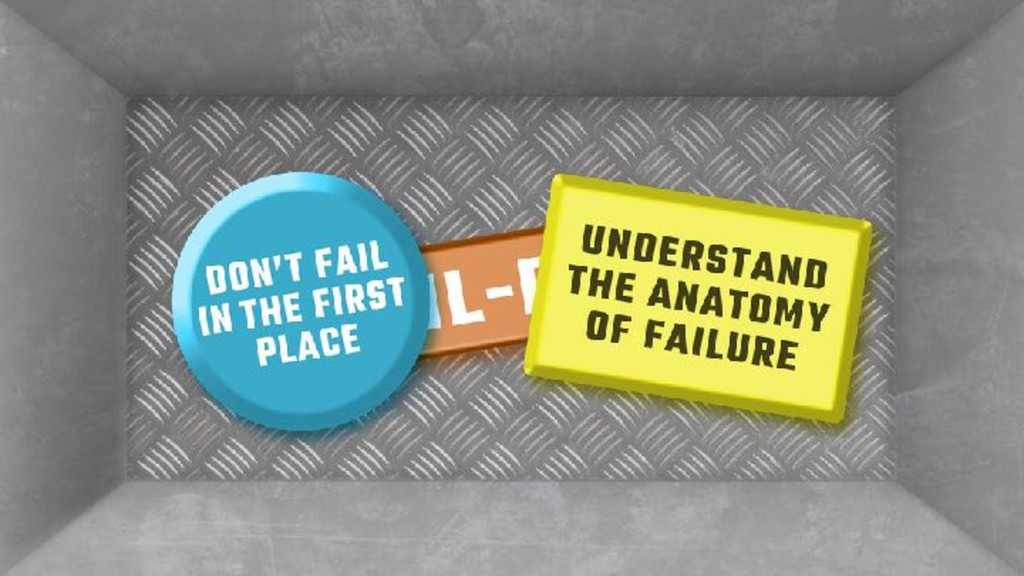
So we want to have some other tools in the toolbox for those kind of situations. And of course, the obvious one is don't fail in the first place. You know, for some things in business, you don't get two shots at them in the same business.
And if we're going to avoid failing in the first place, then we have to get better understanding the anatomy of failure. You know, it is something that can be processed and distilled, and that's what we're going to talk about in this session. And it's worth noting that, as with many things in nature, failure patterns are not evenly distributed.
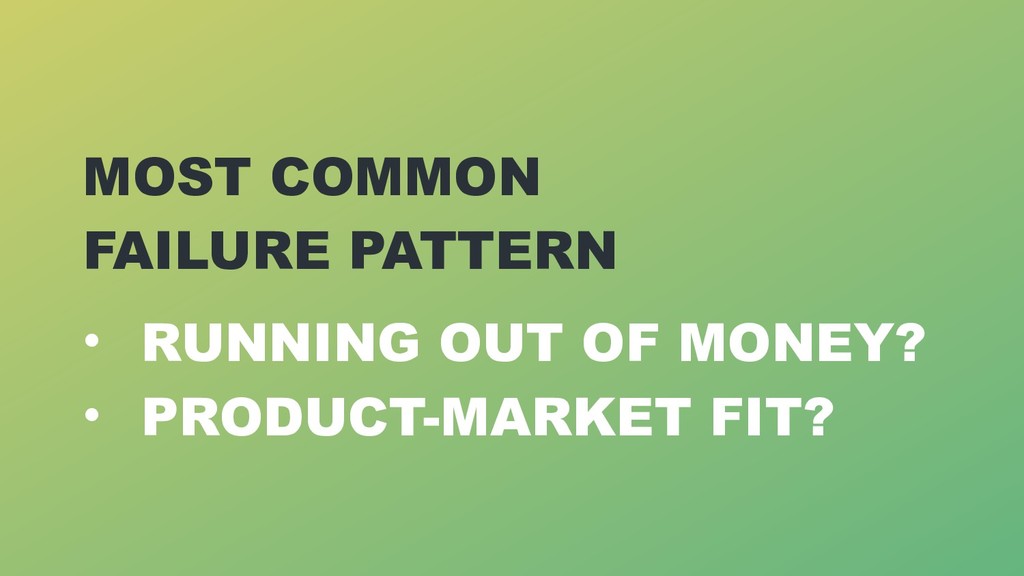
They don't all occur with equal frequency. In fact, one failure pattern dominates all the rest. And it isn't what you might expect it to be. It's not, for example, running out of money. That's clearly symptomatic of deeper issues. But I think many people would say, and I would have said this as well for some time, that that deeper issue is issues with product market fit.
It's the failure to find product market fit. But it's striking that, you know, there's so much advice out there about how to find product market fit from some really great people who've really been there and done that. And yet, most start ups are struggling to find it.
And many of the scale ups that are now scaling and spending investors money to do it don't actually have it and are eventually brought back to ground. So why is it that we have such trouble with product market fit? Well, it's possible, and I believe that it's because there's a still deeper issue and that product market fit issues are only symptomatic of that deeper issue.
So let's see if we can start to unpack what that deeper issue is. And to do that, I'd like you to join me in a journey, not a physical or geographical journey, but a time travel journey. We're going to stay in the same physical space, and we're going to go back about a thousand years, roughly, until this land that we're on looked more like what you see here.
So uncultivated, unexploited land, waiting for the first human settler to arrive. Now, let's imagine the first human settler comes, and he offloads his horse and cart and decides he's going to try to make a subsistence on this land. So he builds himself a little house.
It's not a very good house because he can't lift very big logs, he can't lift big boulders, etc. So it's a pretty modest house, probably not as nice as this one, and I'm sure he didn't paint it red. And his cultivation of the land is equally limited.
He can't, for example, have cattle because when he has to make the long journey into market, the cattle would be killed by wolves or stolen. And that long journey into market is a time when he's not being productive in his farm. So it's a very difficult life, and every day is about generating enough calories and storing enough calories to get through the annual seasonal cycle.
But then one day, another settler arrives, and everything changes. Now together, they can lift much larger logs and build much nicer houses for each other. One of them can go to market on behalf of both of them, while the other one tends the cattle.
So suddenly, life is more productive, life is more fulfilling. And this trend continues, other settlers arrive. Eventually, a blacksmith comes into town, then a grocer. And now the settlers in this new town don't have to go to market nearly as often, so they're even more productive.
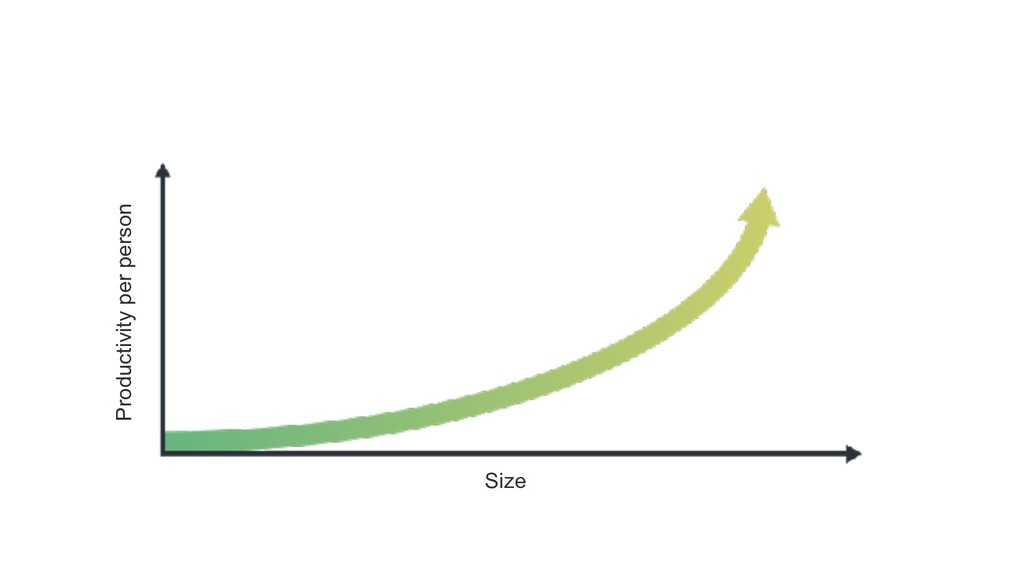
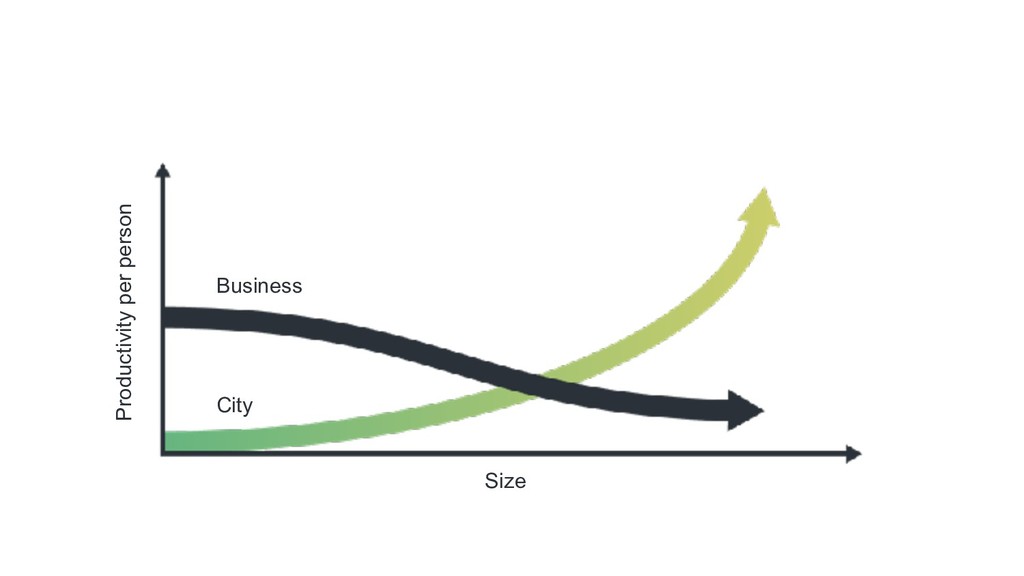
Then, in turn, that settlement attracts other skills mechanisation skills, automation skills. Eventually, agriculture gives way to industrialisation. And all the time, of course, the output of the settlement as it moves from a village to town to a city and beyond is increasing. But something much more profound is happening, which is that the productivity per person is rising, not just as a total, but per person.
Now think about the implications of that. Ten people are far more productive per person than one person than a human settlement. A hundred people are far more productive than ten. It's quite an extraordinary concept when you think about it. And if you think also about what's happening to the value of the land in this settlement, then when we start off, a square meter of land is worth literally nothing.
But the square meter of land I'm now standing on here is probably worth thousands of pounds. And that's not because I can dig it up and plant carrots on it or, you know, mine it for copper, neither of which, I'm told, go down well with the facilitators of this event.
It's because of the collaboration value of the land. And if you think about your own business, it's valued in exactly the same terms. Investors won't come to your business because of what you've done. They come because of what you say you're going to do.
And that is a function of your ability to collaborate in your office space. So what's a square meter of land worth in your office in collaboration terms? And does your business get more productive per person when you add more people to it? Really?
Well, sadly, what most businesses experience is they may get more stuff done in aggregate. It's not always, but they may do. But they almost certainly don't get more work done per person. They get less done over time. And it's this gap between what's achievable in the very imperfect world of cities.
You know, there's lots of inequalities in cities. But in terms of productivity, what's achieved versus what's achieved in companies and start ups, scale ups, where the average IQ is higher than the city at large that it's in. This gap gives us an insight into the real reason that start ups fail.
Our organization models take away human agency. They don't work. You know, if we can't afford to scale our company with these dynamics, and we're going to have to find solutions to that. So let's see if we can start to uncover what's going on here and try to generate some heuristics that we can can take away.
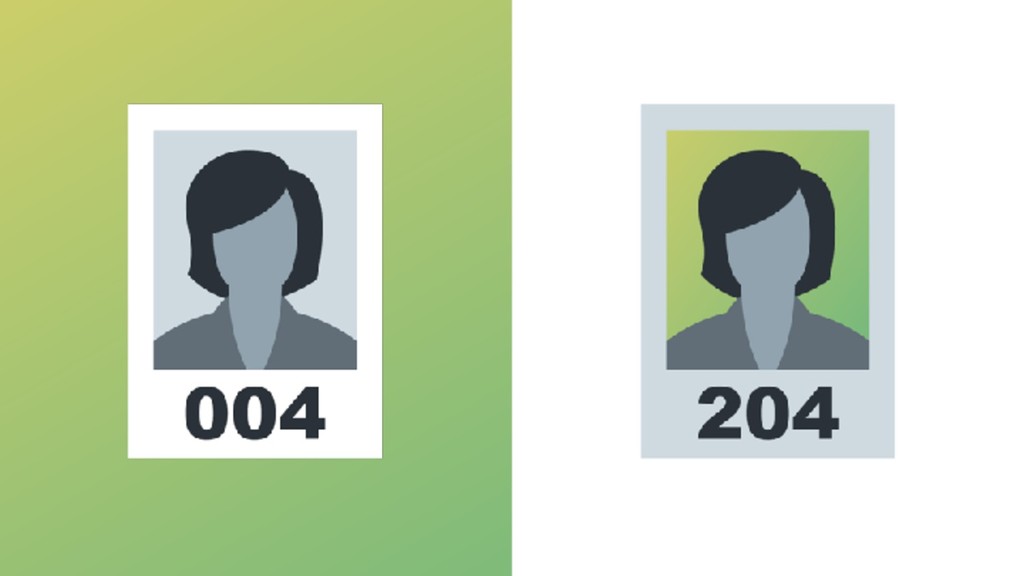
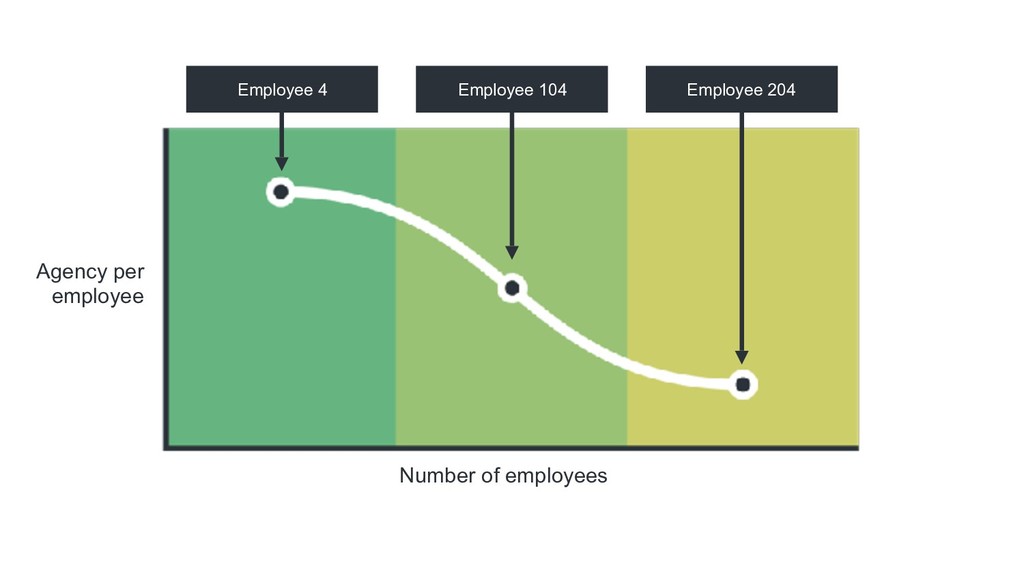
And to do that, let's follow the journey now, not of settlers in an early village, but let's look at settlers in an early company. So here we're looking at two. We're looking at employee four and employee two zero four. And let's follow their fortunes briefly.
Now employee four is either co founder or she's the first employee after the co founders. So she's a very strong idea of what the business is trying to do strategically, both fundamentally and also in detail. And because of that, she's very well aligned and she doesn't go off in the wrong direction.
She probably owns a whole function of the business, so her ownership is clear and she knows what decisions she can make. And she is her own resource, so she doesn't have to ask anyone or negotiate with anybody to get things done. So she has very, very high personal agency.
And we'll all remember those golden moments in a start up when there's only five of us. It's just a great time. Contrast that with employee two zero four on the other hand. Employee two zero four has a very different experience. Because the founding teams are pretty busy, they can't really spend any time talking to her except for a cursory lunch or a conversation in the corridor.
So she has to rely on the slide pack from the HR team, which has got strategy and culture notes in it. But it's a bit out of date, so she doesn't really know what the company is doing in detail or fundamentally. She's been told that she owns a new customer care process replacement, but she also heard that there's actually another person in another office who also thinks they might own part of that.
So she can't get started until she's negotiated her ownership, and she's not clear what decisions she's allowed to make. And she's pretty sure that the decisions that she isn't allowed to make, she doesn't know who to ask about that because the company doesn't know.
Now it's not hard to see we could develop this example further but it's not hard to see that employee three zero four has much lower personal agency than employee four had. And it's actually worse than it looks because, you know, as you plot this graph, it's not just that the new employees have a lower agency than the earlier employees.
As you add people to a business that's operating to the wrong models, everybody's agency drops. Think about this from an employee force perspective. If a hundred people join and they don't know what to do and they come to me and ask me all the time, or I have to go and fix their mistakes, that I can't get my job done and my agency is dropping also.
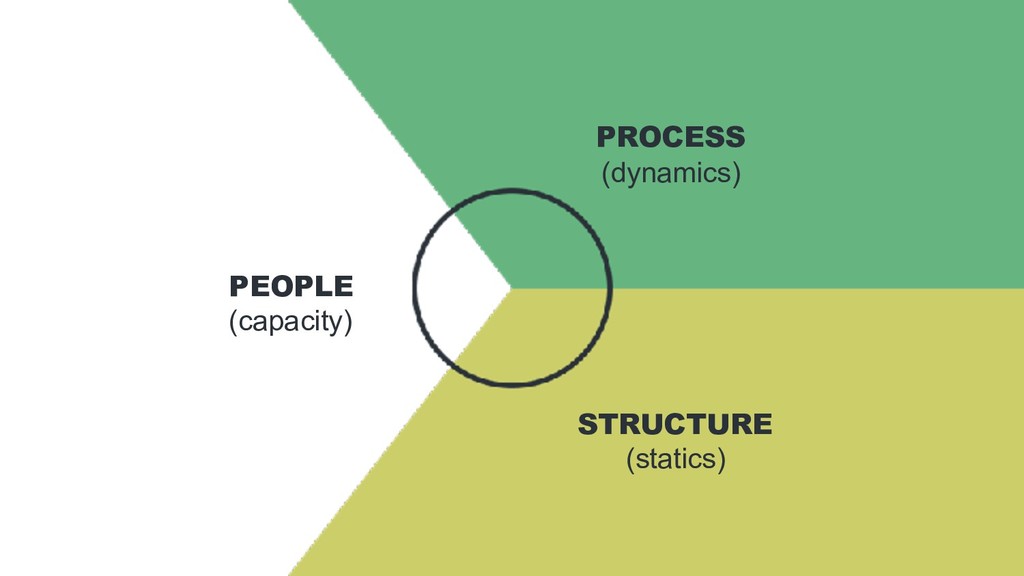
Now, when you build an organization, either at the outset of your business or as you continually update it, there really are only three elements that you can you influence. There's the people in the business and the extent to which you can influence their capability and culture.
There's the structures you ask those people to work in. And there's the processes or dynamics that they work within those structures. And if you're doing any kind of organisation design, you better make sure you're doing it with something you're trying to optimise in mind.
Otherwise, you'll take away personal agency. And it better not be things like convenience or political expediency, which all too often it is, or some other arbitrary reason. What you're trying to do here is optimize for human agency, for personal agency. So you're trying to hold personal agency as a mathematical constant as you grow your business.
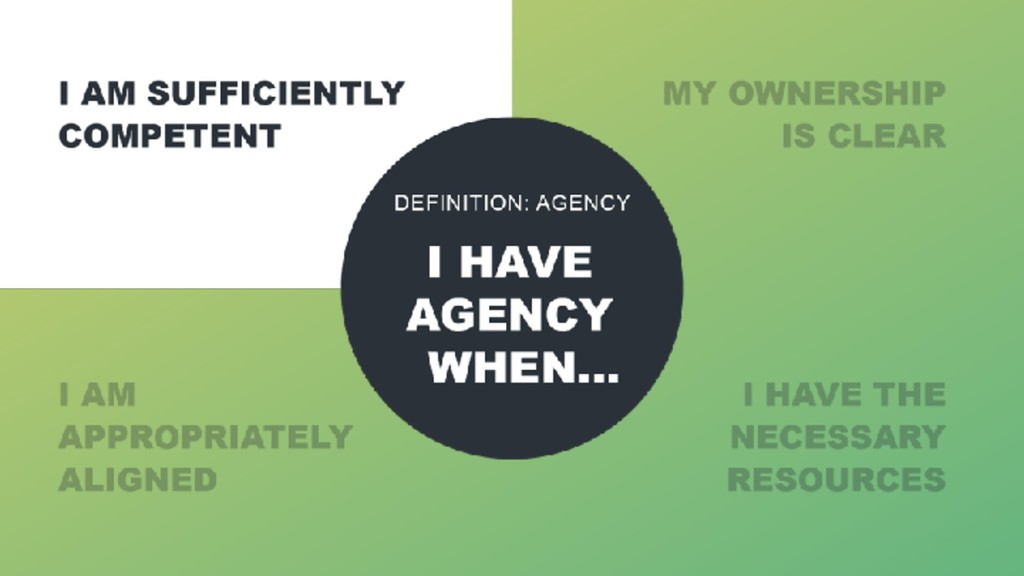
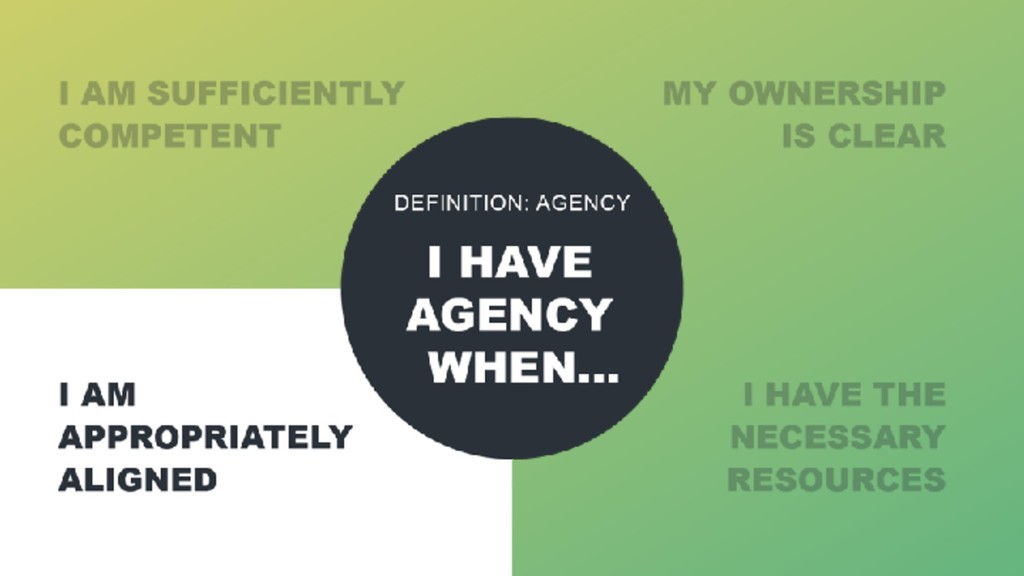
Now, and if you don't do that, you'll start to see these productivity issues kick in. So how do we actually do that? It's fine to state it, but how do we actually do it? Well, for that, we need a better definition, a more formal definition of agency.
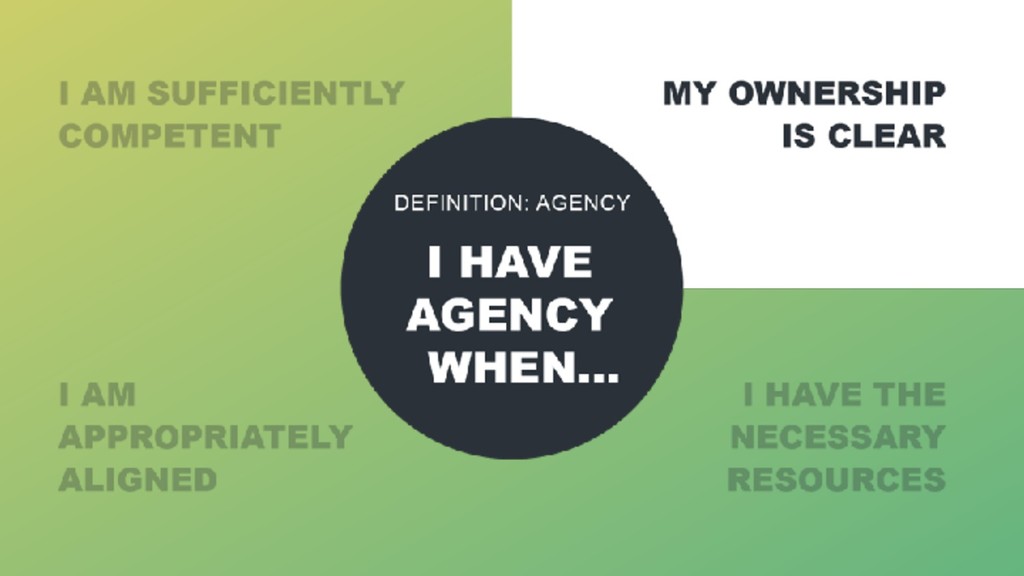
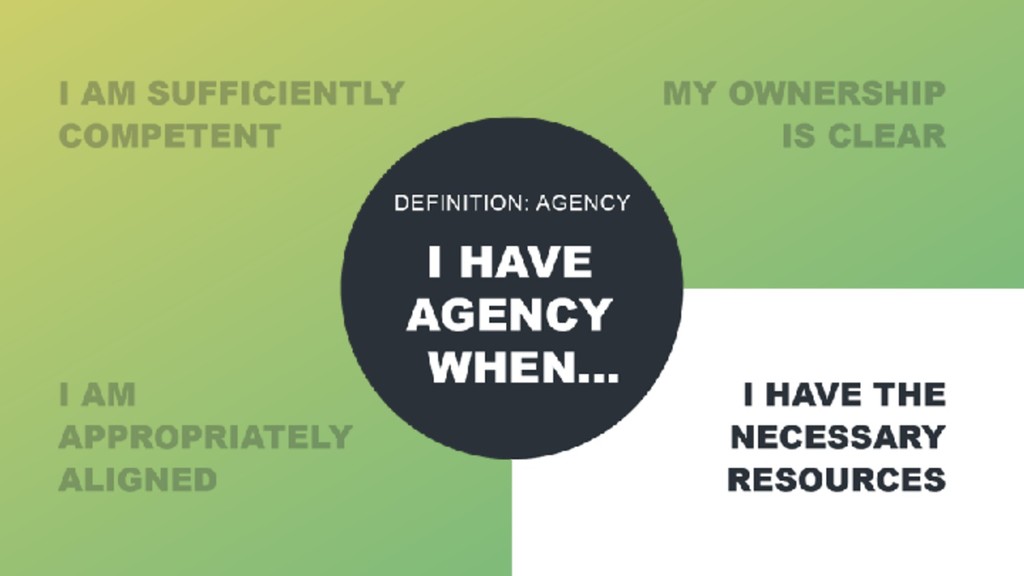
And luckily, I've prepared one earlier. So the first thing here is not meant pejoratively. I have agency when I am sufficiently competent. Now, what does that mean? Well, think about the dynamics of competence. Managing two people versus managing twenty people versus managing two hundred people.
These are very different jobs. They have commonality, but they're very, very different jobs. Working with five developers versus fifty versus five hundred. Very, very different jobs. And what these two these two examples illustrate, of course, there are there are many more, is that competence goes out of date.
And your business needs to be built around restoring competence as the company grows, not just in the leadership but also in everybody else. And if you're a leader, if you're a founder, your job is not to do or direct. It's to educate the front line of the business as it grows, to have the same competence and confidence that you had when the business was much smaller.
Because if you don't do that, you're going to find that ownership suffers. And if my ownership's not clear, then I can't have personal agency. Now, rhetorical question, but how many people here have been told they own something? When it comes to actually trying to do something about it, it turns out they can't actually make any decisions about it.
The antibodies of the organization come out and stop you. Obviously, a few people. Ownership means I can make decisions about something, and that's super important. Let's go back to our city for an example. Let's say I wanted to start a book club. So what would I do?
Well, I'd phone a friend and say, Do want to start a book club? We might create a website, invite some friends. If it turns out that there's a book club around the corner, we might merge or we might do something else. The point is we would figure it out.
What we wouldn't do is we wouldn't go to the Prime Minister of Great Britain and ask if it's okay to have a book club or go to the HR department and ask they've got an opinion on that. But we would in a company, you know, we would go to the founder and say, What books do you think we should read?
Or the HR department would have a discussion with other functions and would come up with an answer. This is a silly example, but there are so many decisions that should be made on the front line of a business that are made centrally. And that has a catastrophic effect on agency.
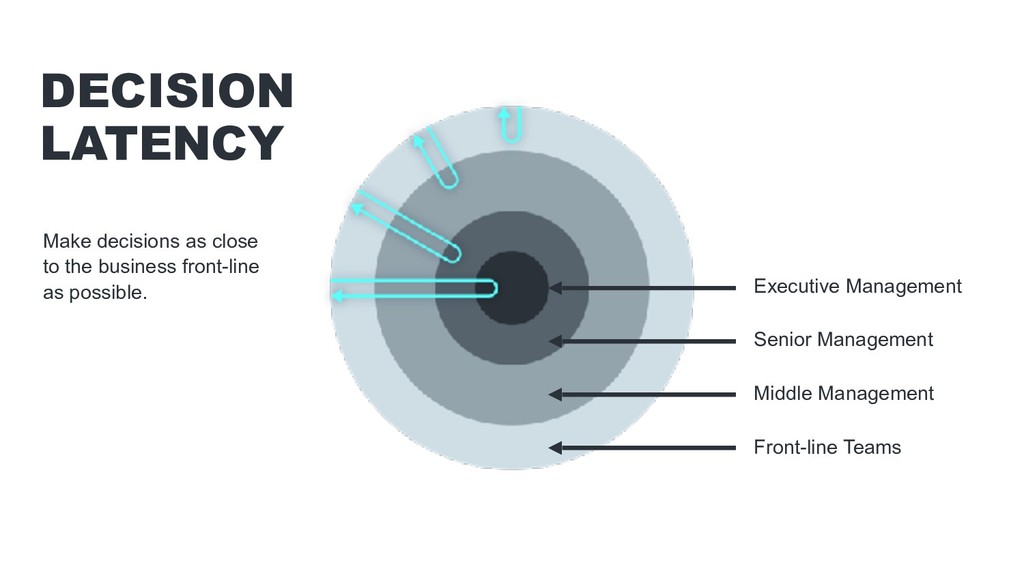
Let's see if we can try and quantify or at least get the dynamics of that better positioned. This is a picture of a company laid out with concentric circles. The outer circle is where all the frontline people are who actually do the work in a business.
The outer edge of that circle is the frontline itself where the work is done. And as we move into the centre, we're seeing increasingly higher levels of management. Until we get into the centre itself, the black circle where the executive management resides or the original founders, Now consider that when you started your business, there only was the black dot, and its outer edge was the front line.
So decision latency, the time from raising a decision being required to getting an answer, was super short. But as you grow your business, the front line moves out, and it moves out very, very quickly. And if you don't push decision making out with it, then decision latencies increase.
And what are the implications of that? Well, first of all, people at the front line have to wait. Secondly, the quality of your decisions reduces because you're too far from the front line. Thirdly, they're stale because they don't get made more quickly enough.
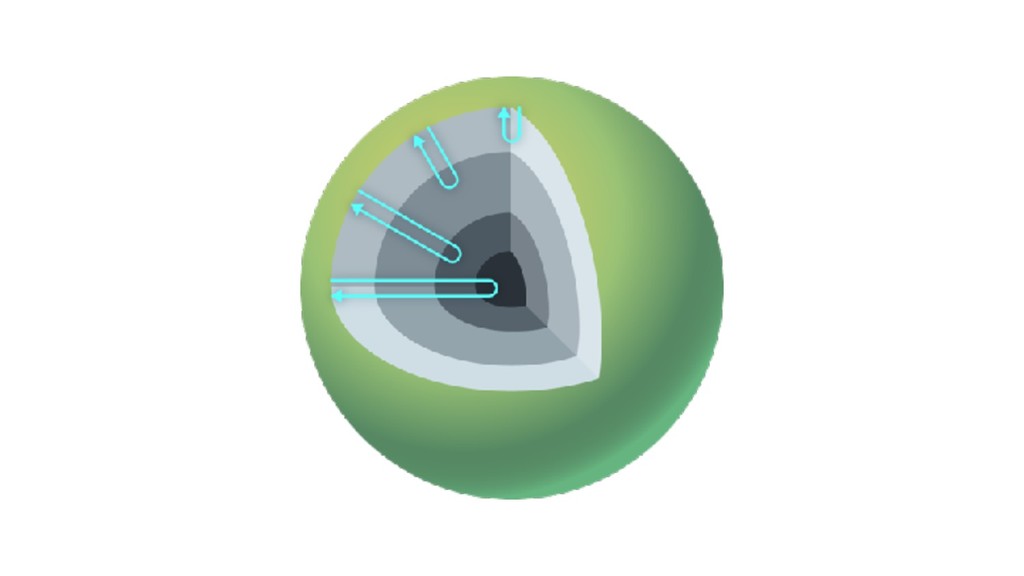
And the most catastrophic thing that happens is the front line of your business becomes passive. If you send me a signal every day that I don't own this business and it's evolution, but you do, then I'll reward you accordingly. Now, if we want to understand the aggregate system effect of this issue, it's better to think of the business more as a surface, a decision surface.
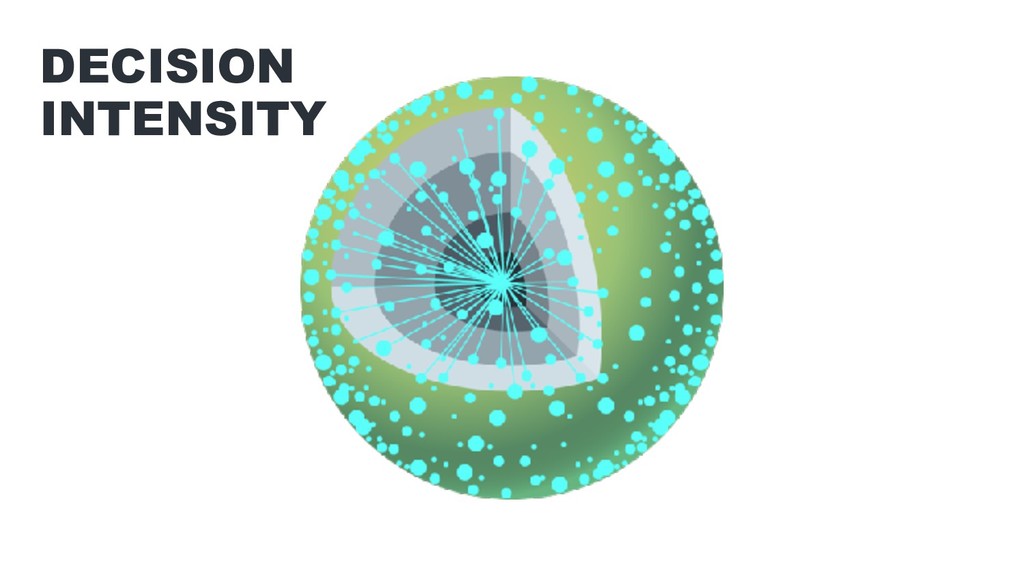
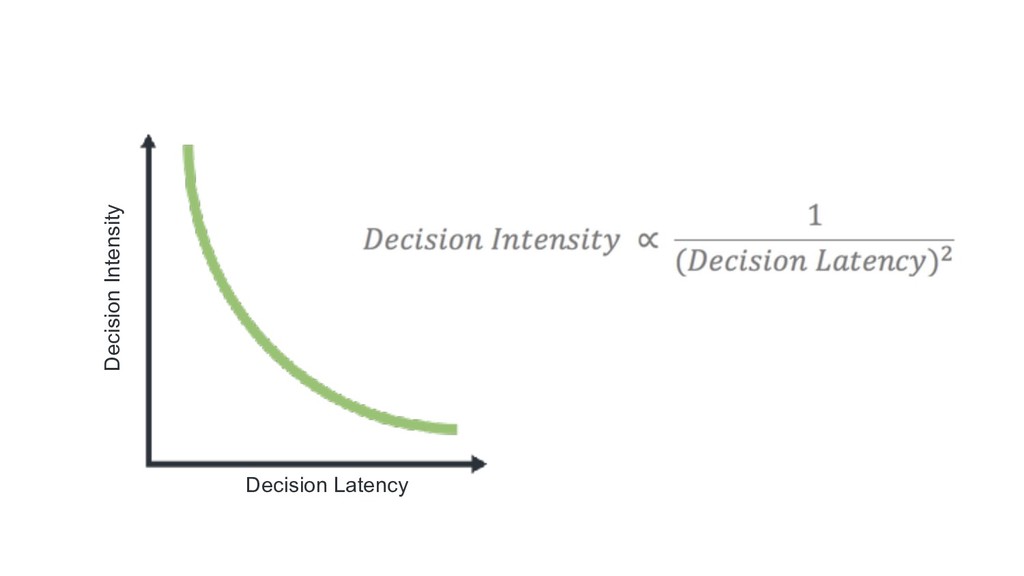
And across this surface here, we want to make sure that we can get a certain decision intensity, because the rate at which a business moves is proportional to its decision intensity. Now, let's imagine that we concentrate decisions that ought to be made in the front line.
I'm not suggesting all decisions should be made there, of course. But the decisions that should be made there let's say that they're still being made centrally, which is not actually a theoretical thing, it's actually all too common in growing businesses, then you have a conceptual situation a bit like this, where all these decisions are blasting into the center and waiting for responses.
The center becomes overloaded. Eventually, human spirit fades. And if you do the mathematics on this and this is by no means the full analysis, this is actually an understatement but the decision intensity drops with the square of the latency. So there's a catastrophic reduction in latency, and that means there's a catastrophic reduction in agency and productivity.
So if you want to have high agency in your business, you're required to have high decision intensity, which means you're required to push decision making out, and you require your people to be competent enough to take that ownership. Hence, the first point. Now, let's move on to the third item briefly.
I am appropriately aligned. I have agency when I'm appropriately aligned. Now, everybody understands that a lack of alignment is a big problem. You know, I can't have agency if I can't act with confidence that I'm doing the right thing. But we should be very careful with this example.
Let me illustrate why. Let's say two of us here start a business, and after we've grown a little bit, we decide to have some company goals, which is a sensible thing to do, so other people joining can see what we're trying to do.
That's all great. Eventually grow a little bit more. We add in some major teams and we give them goals to align to the company goals. Again, a sensible thing to do. Eventually we grow some more. We add some sub teams within the major teams and we give the sub teams goals to align with the major team goals to align with the company goals.
Then someone suggested it would be a good idea if we gave everybody personal goals aligned with sub team goals. So I'm not going to keep going through that, but we've now got a chain of goals. One day someone says, you know, wouldn't it be a good idea if we review these on a monthly or quarterly basis, say quarterly basis, to make sure we're all aligned?
We'll have an off-site and we'll review all the goals. And we'll also have to do the same thing at the end of the quarter. And someone says, Well, we need a slide pack for that that's standardized. And a few executives are pining about what should be in that slide pack, so it gets a little bit thicker over time, but that's all fine.
The process is getting a little bit unwieldy, so we have to hire someone to run the process for alignment. So, you know, you'd laugh, but it does happen. And that person obviously has to fill the full week, so they start to innovate on the process.
And before long, team leaders in the front line of the business are updating their percentage completions on a sort of semi real time basis, so the executives can feel full control. Now, that's all, you know, we could add things to that, but what's happening to agency here is pretty bad.
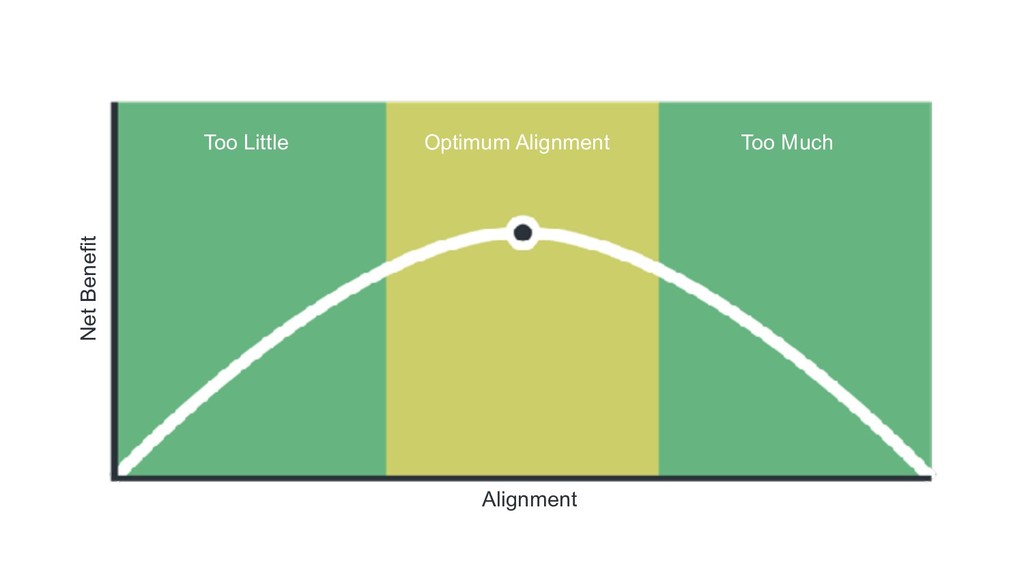
You start off sorry, alignment you start off in the left hand side, and as you add alignment, you get net benefit because people are starting to pull in the same direction. Some of those artifacts I talked about, they are very beneficial to that.
But you eventually get to a sweet spot, and after that, more alignment artifacts reduce net benefit. What's happening there? Well, eventually the goals of the business that we're all here execute become secondary to running the bureaucracy of alignment. And people start to that slide pack that the executives want to see presented to them at the start of each quarter, that actually takes two weeks to create and pulls in a whole bunch of people to get it done.
And people start to get suspicious of other teams because they might be gaming the metrics. So they start gaming the metrics and there's an arms race to see who can game the metrics. And eventually, this takes over and net benefit drops. And if you ever wonder why there's cynicism in large corporates, it begins, seeds are planted and you're growing scale up with these kind of mechanisms.
So it's important to remember that too much alignment is bad for agency. You've got to have some wiggle room. Too little and too much are both bad. Remember, software is a people problem. It's not a technology problem. If you manage to crush out the human spirit in the interest of management control, you get what you deserve.
So you've got to be very careful with that. So let's look at the final element of agency. I have the necessary resources. Now, we all know what resources means, you know, time, etcetera, etcetera. The most important resource here is that I need someone to help me do my job, a designer or a tester, I'm a developer, let's say, and I've got to be able to get access to those skills effectively and efficiently.
Now, it's hard to design an organization to make that work well, but it's actually striking how easy it is to completely screw this up in fundamental ways without even realizing that you've done it. And I said earlier that issues with product market fit are perhaps symptomatic of a deeper issue.
So let's come back to that point now and see how that how product market fit is undermined by these type of issues. Now, first of all, we need a definition for product market fit. So we can't do that full justice in the time we have, but most experts would agree that product market fit has something to do with users who come back to your product.
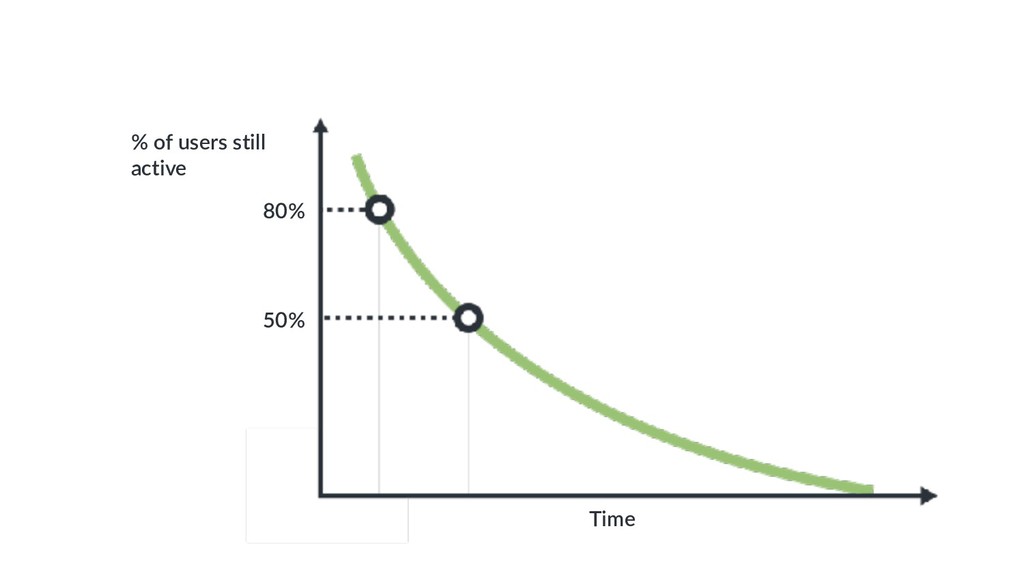
If I come back regularly, the market likes the product you're offering me. If I don't come back, it doesn't. So in other words, retention of customers. So let's take that example and take it forward. Here's a graph. It shows a couple of points in time of a start up's retention rate.
Now, let's say that I'm a VC and I come to a founder in a new business and say, What's your retention rate? And the founder says, It's really good. It's eighty percent after a month. That sounds great. I'd probably invest in that business.
Let's say I had delayed that conversation. I was busy doing something else that day. So I have the conversation at a different point in time. And at that point, the founder says to me, It's fifty percent retention after three months. I can build a business off that. That sounds great.
But what if these are just two points on a chart that does this? There's no business there. And the point here is that retention is not a number, scale or number, it's a trend. And because product market fit is based on retention, product market fit is not an event.
We have product market fit lit off the fireworks. It's process, a never ending process. And that's a fundamental point in the context of this discussion. What is that process? Well, it's something like this. Now, let's start off in the in the left there.
Let's not forget to make sure there's enough users to meet the market and we can afford to attract them. We often forget that, but let's say we haven't forgotten. The process then is you attract me. You help me form a habit around your product.
You need to know that I formed a habit. So you need data to tell you that. And once I've got that habit, you help me sustain that habit, and you help me increase that habit by perhaps new use cases, all that sort of stuff.
And while I'm in that habit mode, you can work to monetize me better, and you can encourage me different ways to tell my friends about the product. So this whole thing repeats. Now, users never leave this process, and this process requires engineers, marketeers, producteers, sales engineers, salespeople, data scientists, project managers, all to be working together with access to each other's skills if they're going to run this process properly.
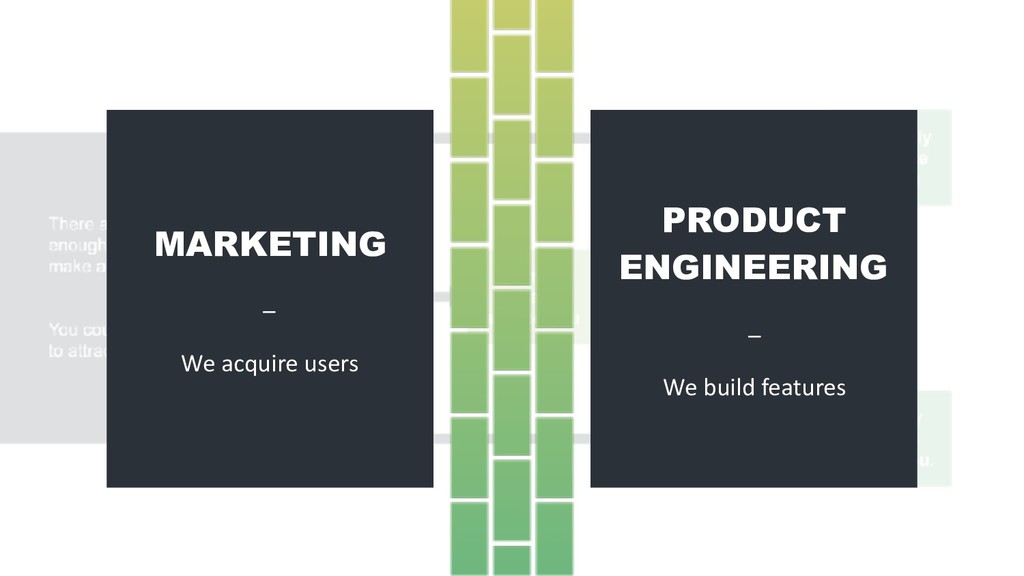
And they need to be arrayed around this process. But what do we do? What's our normal response from the early stages of a start up? We stick a functional structure on top. This is obviously a part of the functional structure. But for example, within my walled garden and product engineering, I build features.
Some of those features may not help growth, they may actually reduce growth, but I build features. And another side of the diagram here, in the left hand side, I'm in marketing, I acquire users, and we've put a wall between the two teams. And this functional structure has nothing at all to do with the process we just looked at.
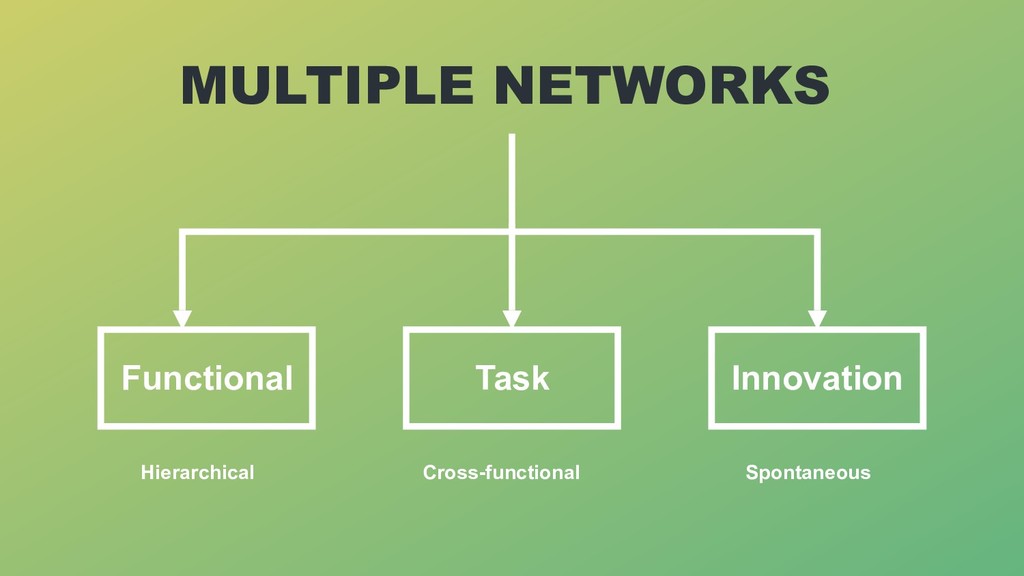
And it's this kind of functional focus that often undermines product market fit, and we start it from the earliest days. And it's important to remember in a start up, there are three networks at least. In any business, there are three networks. There's functional hierarchy, which is an important network, but equally important is a task network that brings cross functional people together and then raise them around the processes that matter.
Product market fit being one of them, but there are others as well. And neither of these networks does innovation well. The response to innovation from these two networks on the left here is we'll have innovation meetings at three o'clock on a Friday after the staff meeting.
But innovation gets done in the gaps between life, you know, informally, spontaneously, coming together with people. And if you look at this diagram and you haven't got a response for your own business as to how you implement each of these, then that's the job to be done after this conference, I would suggest.
And when you're doing that, don't focus on the structural aspects of what you're doing. That's important, but don't start there. Start about the dynamics. Life is better when you started from the dynamics. What you're trying to achieve, optimize for that, and then work the structure out in support of it.
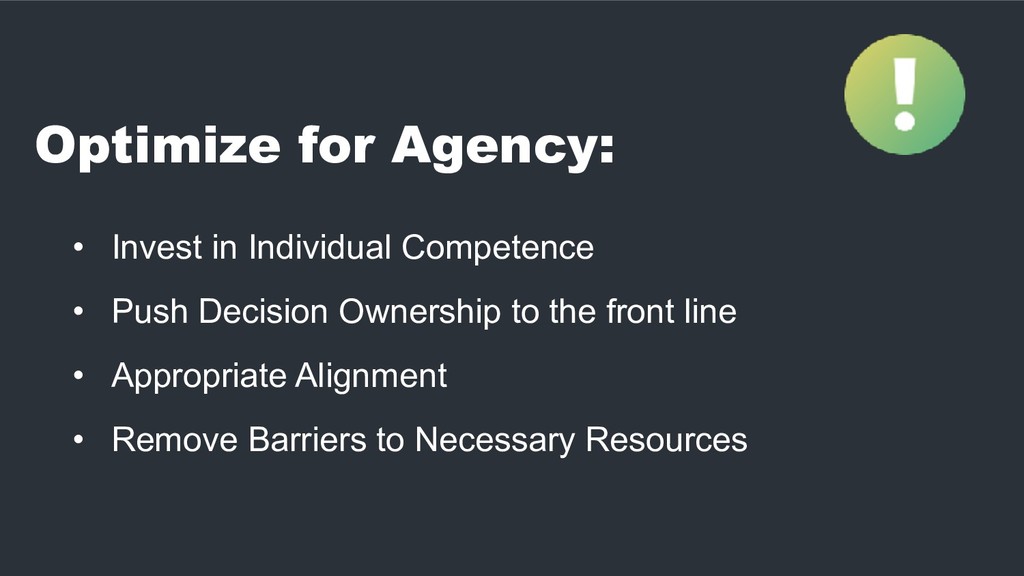
Now, we've talked in summary here about agency. Agency, or lack of it, is what undermines most startups and scale ups, in my very strong view. You want to get these elements here in place. If you can do that and always ask yourself, Do I have them in place?
Have I damaged these things? Then you're going to be fine. So invest in individual competence, build your organization around that. It's not about having one week's training per year in the calendar. It's something much, much deeper than that. If you've got that, you can push decision making to the front line.
You know, management is about not control, but enablement of your people. It's about having responsibility without control. That's maturity in management. Appropriate alignment is not too much and not too little. And remove the barriers to necessary resources. Think about the different ways you're conspiring to take that away.
Now, I've talked here about agency in deficit terms. So restoring agency or making agency a constant. But what if we could create a surplus of agency, just as a final thought? So this is Florence in the Renaissance times. Now, when you think about cities that we talked about earlier, all those cities have got that productivity dynamic we talked about, but some cities become extraordinarily creative extraordinarily creative.
Scottish Enlightenment is a great example of that. You know, Leonardo da Vinci's time in Florence and Naples, etcetera. And what they managed to create in these cities was something like hyper agency. Let's think about Leonardo here as he's now rendered in stone looking down at us.
He wasn't an engineer. He wasn't an architect. He wasn't a painter. He wasn't an anatomist. He wasn't a naturalist. He was all of those things and much more. And it's having access to all of those skills that made him such a great painter.
Study of optics, study of anatomy, study of mathematics for perspective. In your business, do you encourage people to be like that? Or do you encourage them or do they encourage themselves to be very tightly segmented? I only write content for the newsletter. I don't write content for that page.
What if your people were more like Leonardo? Is it really true that some cities had extraordinary genius pockets just by chance, or was it just that the latent genius was able to come out by these belief mechanisms? And when Leonardo went out into the market square, what did he find?
He found that there were people just like him, with different emphasis of skills. They'd come together, they'd talk to each other, they'd share their knowledge. I think great things happened there. Supposing you could create a market square in your business, in some form, physically or virtually, it's possible you could start to get the elements of hyper agency.
So agency is not just a restorative game. It can be something much more than that. And I'd just urge everybody, as a takeaway from this session, optimize for agency, look to restore deficits where they're coming, look to maintain agency as a constant, and then dream a little bit and see if you can create hyper agency in your organization as well.
Think what you could get done then. And whatever path you take there, I wish everybody here the very best on that journey. Thank you.