
We do much better work when we feel valued and respected. Research shows that our brains respond to criticism as a threat and narrows its activity. Focusing on shortcomings or mistakes does not enable learning, it hinders it. So how can we have difficult conversations, and give constructive feedback, without impairing learning? In this evidence-based talk, Kirsty will provide specific tactics, tools and a framework for positive, professional communication.
← All talks 










Lead Turing Fest 2019
Avoiding Feedback Failure: Brain-Based Techniques For Getting the Best From Your Team
Auto-generated transcript - may contain errors. Tap a timestamp to jump the video.
Very good. Hello. Come in. Welcome. Sit at the front and be my friend. Yes. Excellent. Whilst you are all finding your seats, I just wanted to quickly say I was just stood in the wings watching Paddy's excellent talk. He's a man I know and admire well, and there are a couple of points in his deck that I am putting a slightly different flavor to.
So, hopefully that can, if you were in Paddy's talk before, that can kind of give some nice discussion points and things that we can talk about. So, thank you so much for that introduction. My name is Kirsty, and I'm going to be talking today about, hello, avoiding feedback failure.
So, some brain based techniques to get the best from your team. A lot of what I'll be talking about today is based on recent research from what we know about the brain, recent research in neuroscience and cognitive psychology. If, like me, you are a raging nerd, then I have put all of the research papers in the slides which I'll be sharing later.
So, feel free to go and have some light boring boring reading of some heavy duty kind of neuroscientific research. Okay. Cool. So, I will begin. People are sitting. Okay. Cool. Yes. Let's start. So, I'm gonna be talking about two things primarily today. So, I'm gonna be talking about why feedback, as we commonly do it in businesses, currently fails when we think about the minds, when we think about human psychology, when we think about who we are and how we work.
But it won't all be doom and gloom. I will also position some ways in which we can make our feedback even better. When we can use brain based techniques, when we know about the human mind, when we know about human psychology, we can get even more from our teams and facilitate better conversations.
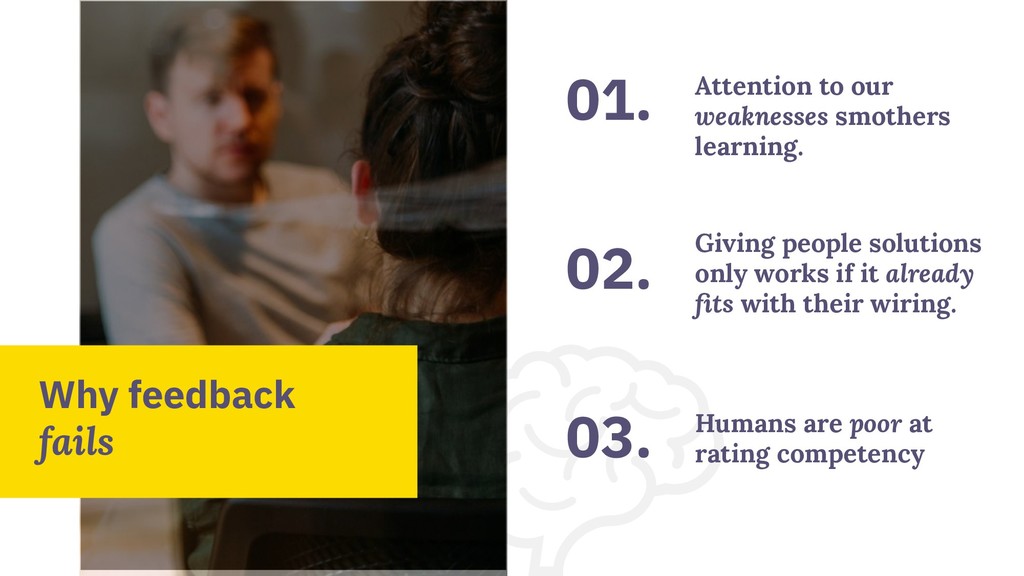
So firstly, I've got three suggestions as to why feedback fails. Firstly, attention to our weaknesses. Talking about people's misgivings actually smothers learning. Pointing out what people aren't very good at, hinders people's ability to get better. Second, giving people solutions, telling people what to do, giving people advice only actually works if that solution, if that advice already fits with the person's wiring.
We'll talk about how very unlikely that is. And then thirdly, humans are poor at rating competency. We're not very good at rating other people. So those are some suggestions of why it fails. We'll talk about those. But then I will position some solutions so we can create positive visions of the future.
Empathetic delivery is often more important than the content, and we can use powerful questioning to help people find their own solutions. So firstly, a note on what I mean by feedback. So when I talk about feedback, there's various different kind of things that we're referring to.
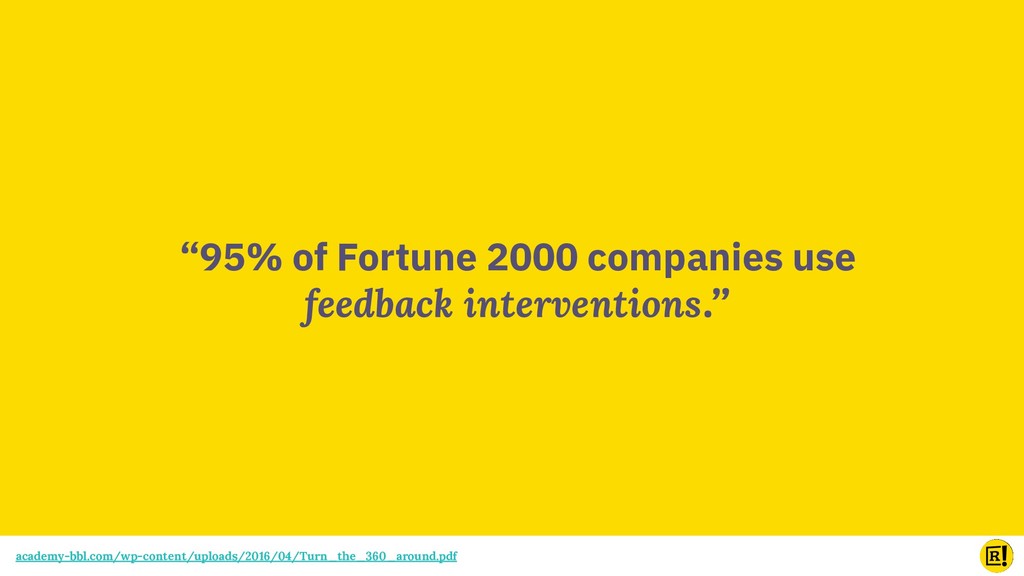
Feedback is systemic in businesses. I'm sure you all work in some business that has some kind of either formal or informal feedback process. Ninety five percent of Fortune two thousand companies use feedback interventions. These can look like things like three sixty feedback, annual reviews, quarterly reviews, one on one feedback, multiple different ways.
I hold a belief that that kind of feedback will fail in businesses in the future. Having a system and a process to tell people what to do is incredibly useful if there is one way of doing things. For example, there is one right way to give an injection.
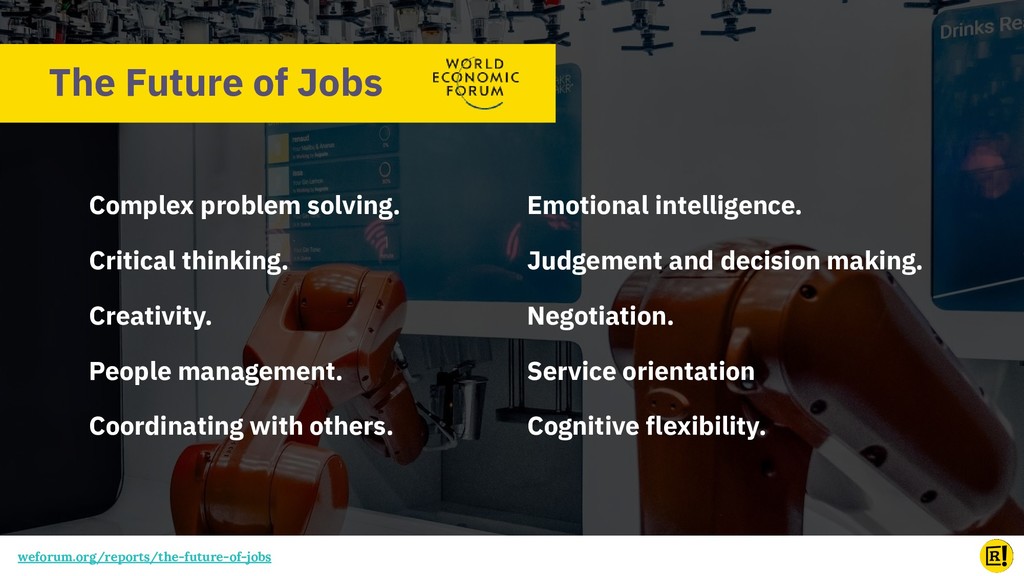
So in hospitals, there should be checklists as to how you do it. But for most of us, in our jobs today, there are multiple solutions to multiple different problems, and it isn't necessarily a specific inputoutput. One thing gets a particular result. Some research from the World Economic Forum shows us what skills in the professional environment are likely to be the most impactful and the most important in businesses in twenty twenty.
These include things like problem solving, critical thinking, creativity, people management, coordinating with others, emotional intelligence, judgment decision making, reading a list is tedious, negotiation, service orientation, and cognitive flexibility. These are things that traditional feedback is not very good at facilitating. How can we possibly tell someone how to be a complex problem solver?
How can we give people advice or have a three sixty review on how to be a critical thinker? It goes against the way that the world of work is changing. We no longer work in an environment where there are necessarily very specific things and specific actions to create these kind of skills.
So there is absolutely a place in businesses for feedback. Of course, there is. There is certainly a place for feedback in businesses with junior members of the team who are learning. But what I'll be talking about is in the future, when these are the skills that we're trying to nurture, we need a new approach.
And I really believe unless as businesses we start considering a different approach to how we work with our teams, we'll start to be at a competitive disadvantage. As managers, business owners, whatever it is, we have to get better at understanding human psychology because it is human psychology that is the future of the workplace.
Okay. So firstly, my first point is that attention to weaknesses smothers learning. So this is me. Thank you. This is me when I was about seven. I school photo day, got my name headband on the wrong way around, didn't I? Did very well there. So, nailed it.
So, when I was about seven, I got put down into reception. I think seven's like year two. I got put down to reception to do maths. My school teacher said to me, she was like, Kirsty, you're not very good at maths. You are very, very behind.
Therefore, we need to take you out from your friends and put you in this class of four year olds. I was just like, numbers, give a ****, mate. Don't care. I was just not interested. I was a slow learner. I had more important things to do, like putting my headband on wrong.
So and I remember this so vividly. I remember sitting in this class with all of these babies. The difference between four and seven is big. Sitting with all of these babies going, I must be terrible at maths. Pan to twelve years later, I didn't even bother doing my maths GCSE. Give a ****.
More important things to do. Didn't even try. Now, the reason for that was because the school system failed me. I was told I was bad at maths. I was just a slow learner. I decided at twenty eight to six my maths GCSE, and I got a B.
Thank you. Thanks. Thanks. And I tried to test that because I thought, am I actually just bad at maths, or was told I was bad at maths and so believed it? And it was the former. When I was so little, my synapses were still forming.
I was understanding who I was. A system told me I couldn't do something, so then I couldn't do it. Anecdotal evidence tells us that focusing on our misgivings impedes learning. But it isn't just anecdotal evidence. Science also agrees. So now we get into the nerdy research part.
So some research recently out of Yale, you can see the link there. They did MRI scans for a group of control students. It's always psychology students they do these experiments on. So if there are any psychology students in the audience, I hope you're okay.
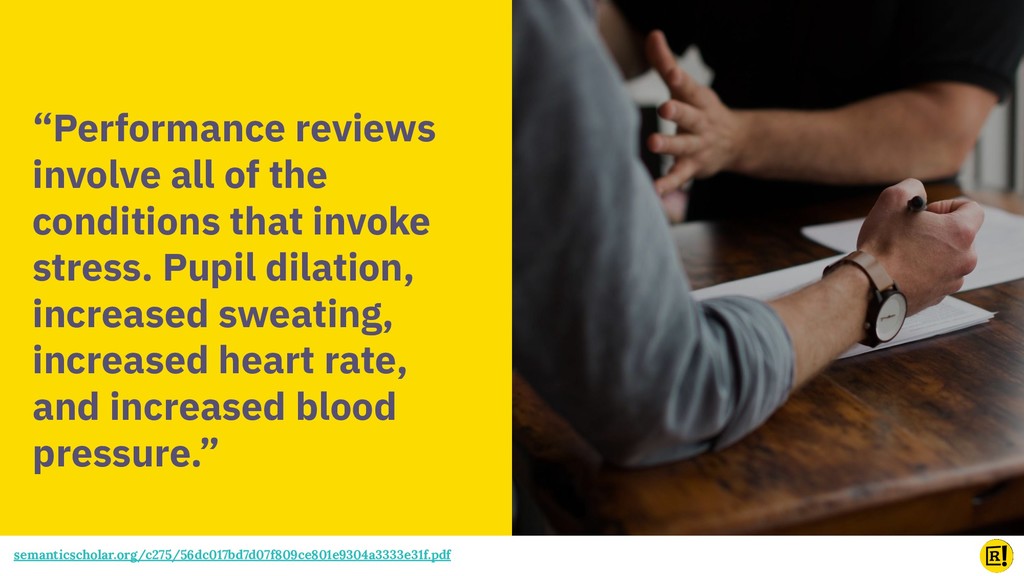
So they did some research, and they identified that performance reviews, traditional performance reviews, involve all of the conditions that invoke stress. Physiological responses, including pupil dilation, increased sweating, increased heart rate, increased blood pressure. The research refer refers to a synaptic nervous system response.
In other words, what we might call that is a fight or flight response. Receiving feedback induces a stress state in us. Not only receiving feedback, but also giving feedback makes us feel like that. As humans, we are innately social animals. There's variations within that, but we need to be part of a group.
If we're not part of a group, we will die. And this is the kind of monkey brain that we're working with. So feeling though we're in a situation where we're going to be told we're not good at something or we're doing something wrong, we might as a result be excluded, initiates this kind of response in us.
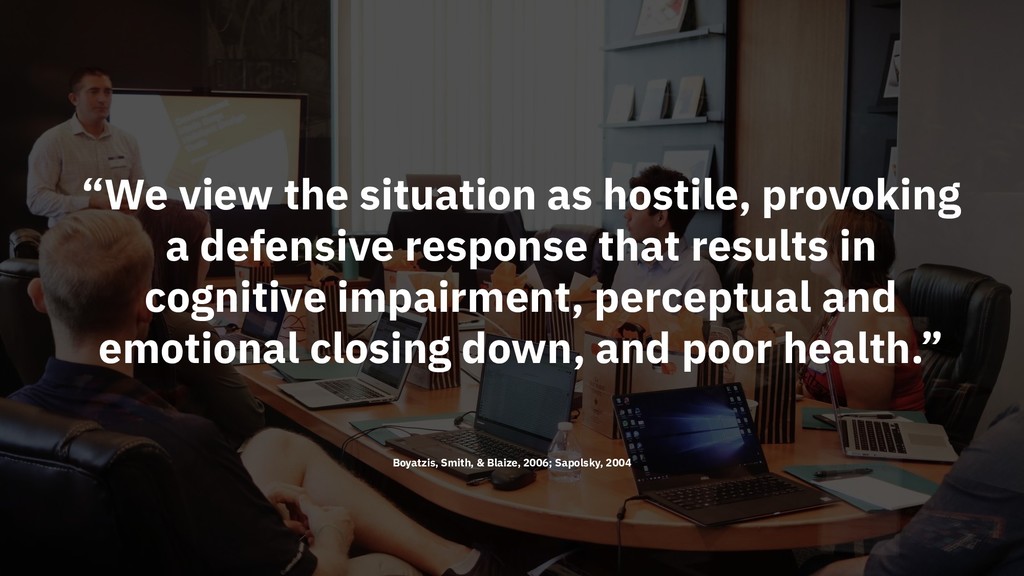
We know this. This is empirical. Research has told us this over and over again. And because it initiates this response, we view the situation as hostile. When we review a situation as hostile, it provokes a defensive response in us. And that defensive can't speak.
That defensive response thank you for your patience. That defensive response results in cognitive impairment, perceptual and emotional closing closing down, and poor health. I think we all kind of know we've been in that dynamic where somebody is telling you that you're not doing something right, and somebody is telling you that you're not very good at something.
We sit there going, how dare you? It is rare. It is rare that if somebody is saying, no, no, you did that absolutely wrong. And our minds are thinking, oh, but hold on. Wait. Well, the circumstances that that I was in, that is a very natural response to have because we view the situation as hostile.
More so than this, once we give someone negative feedback, we have less of a desire for further feedback in the future, and that makes sense. If we've been in a situation that harms us, we have a genetic predisposition to avoid those kinds of situations.
You can start to see how this becomes problematic, particularly for junior members of teams who are starting out on their careers. We also know that we need dopamine to learn. This has been shown through extensive studies by people who suffer from Parkinson's that have reduced dopamine levels.
It is hard dopamine encourages and invigorates actions to desired goals. We may also know dopamine as a happiness chemical to learn, to store information, to be open, to be like cognitively aware. We have to feel safe. And often, unless we're in really, really great businesses and really, really great teams, which unlike Patti, many of us are not fortunate enough to be in, that can be incredibly stressful for us and actually do the reverse of what it is that we're trying to do.
So putting people in a stress state, putting them in a situation where they're focusing on their weakness, causes people to emotionally and cognitively close down. And as a result, it hinders learning. That's the first point. Secondly, this is my favorite because I'm belligerent.
Giving people solutions only works if that solution already fits with your existing wiring. Let me give you a bit of context to this. So research from Harvard has recently shown that our brains make over one million new connections every second. This varies throughout life. It goes up and down.
But for a long time, until the late nineties, we thought that our brains kind of developed in younger age, and then we were kind of left with it in adulthood, but it's not the case. Research on people with degenerative diseases has uncovered something called neuroplasticity.
The brain's amazing ability to change and rewire itself constantly. We have all these connections constantly changing. It's levels of incredible complexity that's really difficult to visualize, but we'll try. So what I want you to do, everybody now, is picture Edinburgh as a city in your minds.
Are you doing that for me? I can feel it. Great. Thanks. So picture Edinburgh in your minds. What I want you to do is picture every single path to every single door. Then I want you to picture every single road on every single street.
Then I want you to picture all the roads that then turn into A roads, motorways. Then I want you to picture every single person walking on every single path on every single road. Then I want you to picture every single car on every single road on every single A road and every single motorway in all of the city.
And then I want you to picture all of the interactions between all of these people, all of these cars. I want you to picture the traffic systems, traffic lights, and then I want you to picture that for the world. Then we start to get to the level of complexity of our brains.
Our brains are so complex that they have the same level of uniqueness as our fingerprints. There is not one person in this room. There is not one person in this world who has the same brain as you. Anatomically, all of our brains are different, and they change anatomically according to what we're doing.
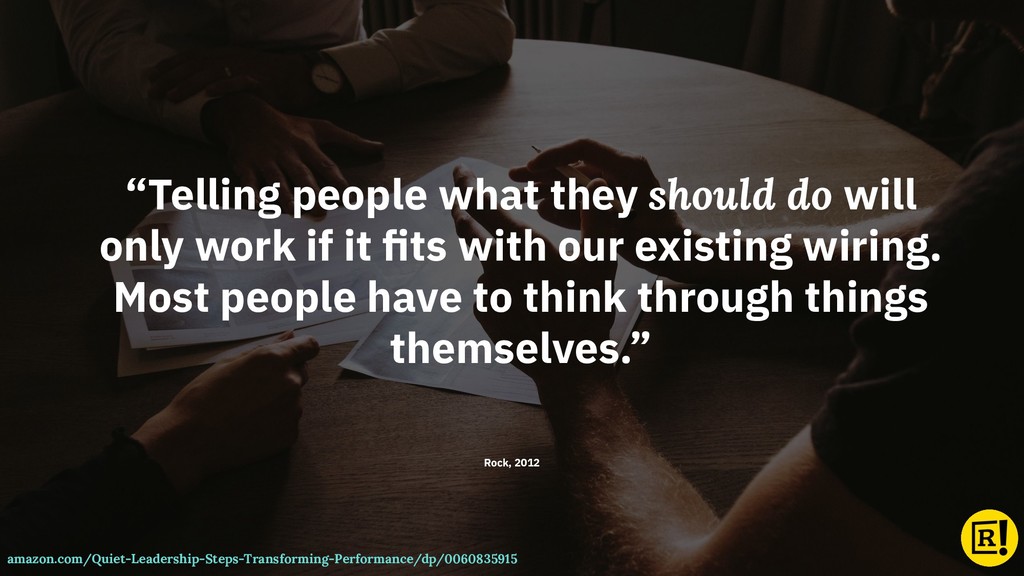
Up close, everybody's brain is different. Isn't that wild? So it makes sense when we think about that, that telling people what they should do will only work if it fits with our existing wiring. Has anybody ever been in a dynamic where you've been having a conversation with somebody and you thought you were on the same page and you thought you were speaking about a similar kind of thing, and you walk away and you realize later you were like worlds apart?
It's so common. It's because there are unlimited ways that we store and code information. And because of this, all of our brains are different. We perceive things so so differently. So as a manager, as a boss, as a leader, sitting someone down and going, this is what you should do in this situation.
When we're thinking about abstract concepts such as critical thinking, if it's not a specific process, it doesn't work. We're much better off as leaders to help people find their own solutions. I'll talk about how to do that in a minute, but I mean, it's like this woman here.
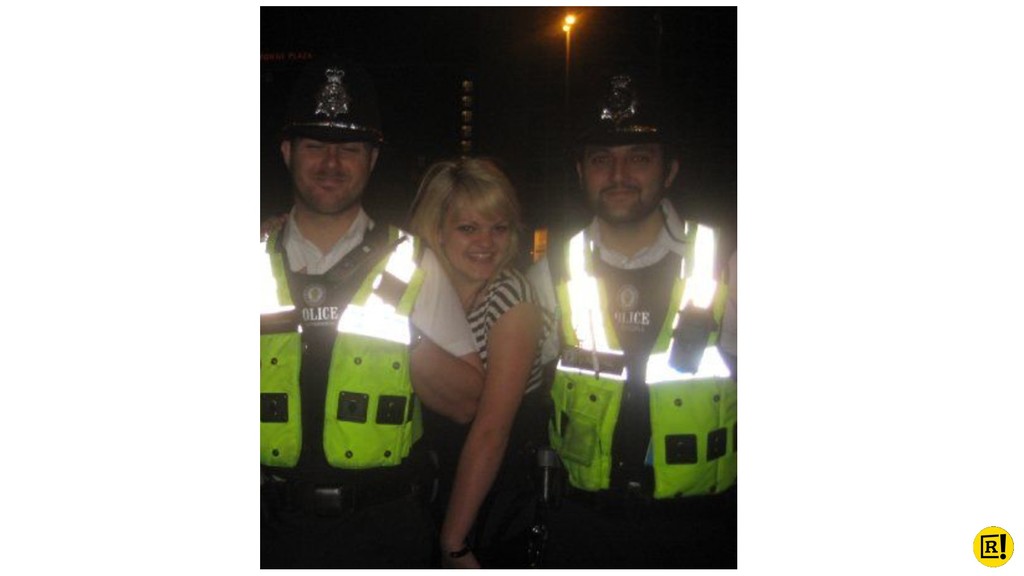
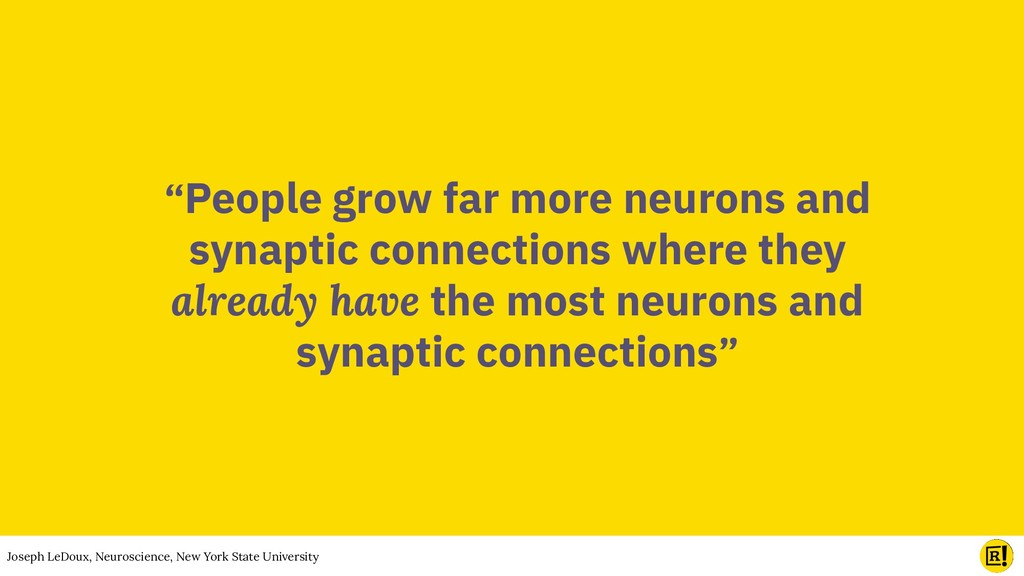
Here's a photo of me, little bit older this time, learning that you shouldn't experiment with recreational marijuana. I had to figure that out for myself. My mom told me, but it did not fit within my own wiring. More so, even more powerful, is that people grow far more neurons and synaptic connections where they already have the most neurons and synaptic connections.
So think of the brain as clusters. We have clusters of connections that are thriving. It is within these patterns, within these maps, that it's easier for us to learn, it's easier for us to grow. So if you're trying to tell someone what to do, and they have very different mental maps to you, which is highly likely, if not guaranteed, then it's really hard for people to take that on.
It's much harder for somebody to take your solution than it is to find their own. So when we think about learning, when we think about feedback, when we think about growing teams in this context, what it looks like is true learning is positively building on our own patterns.
As managers, as leaders, you don't know what your employees' patterns are. The only person that knows is them. So we need to get better facilitating people to know their own patterns and work with that. We'll talk about that in a minute. So thirdly, humans are poor at rating competency.
You probably kind of know where I'm going with this, but think back to that big complex map of the world, of all the roads and the cars and the interactions. Three hundred trillion constantly changing connections means an unlimited way the brain can store, experience, learn, and encode information.
We are all so incredibly unique in the way that we think and the way that we experience. We're kind of all becoming more aware now that we all come with biases, we all come with preconceptions. We see the world through our own filter and our own lenses, and it is different for everybody, sometimes wildly so.
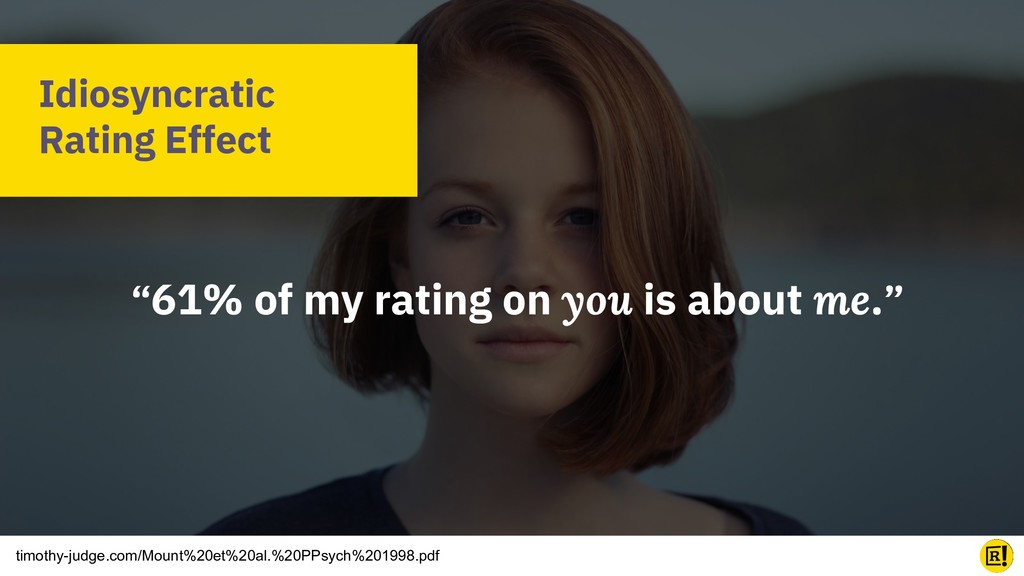
What this creates, something that has been shown heavily throughout tons and tons of research called the idiosyncratic rating effect. What that means is if we are trying to rate someone on something abstract and subjective, such as critical thinking or being innovative or being a good worker, those kind of concepts.
When we rate people on that, research has shown that sixty percent of my rating on you is reflective of me. So what this means, if I'm a manager and I'm saying, oh, Kelly isn't very good at showing initiative. What I'm actually saying is according to my experiences and my subjective standards of what initiative is, which doesn't really exist because it's a vague concept, then Kelly isn't very good.
But this is really, really problematic because it isn't real. So what we have done, we what we've done in the world of work, we've gone, okay, I recognize that an individual person has certain levels of bias. There are preconceptions there. There are things that might get in the way.
So what we have done is we have said, okay, well, we will broaden it out, and we will get feedback from all of the team on this particular person. But my maths GCSE tells me that statistically, doesn't quite work because we can only random out an error if the error is random.
If it's a systematic error, then just adding more people probably gets you further away from the truth. It's like asking a color blind person what red is, getting to a grayish color and going, okay, I'm gonna get closer by asking more color blind people what the color is.
In business, we are color blind about this kind of stuff. We are color blind about this kind of stuff. So asking multiple people to try and get closer to the truth actually probably gets us further away. And this is really difficult when we think that sometimes these kind of processes are legal to define whether somebody can keep their job or get a promotion.
There is a fly on the stage. That's weird. Okay. So let's move on to some solutions. So those are the kind of the things why feedback is problematic when we're dealing with abstract concepts now and even more so in the future. So I'm gonna propose three solutions.
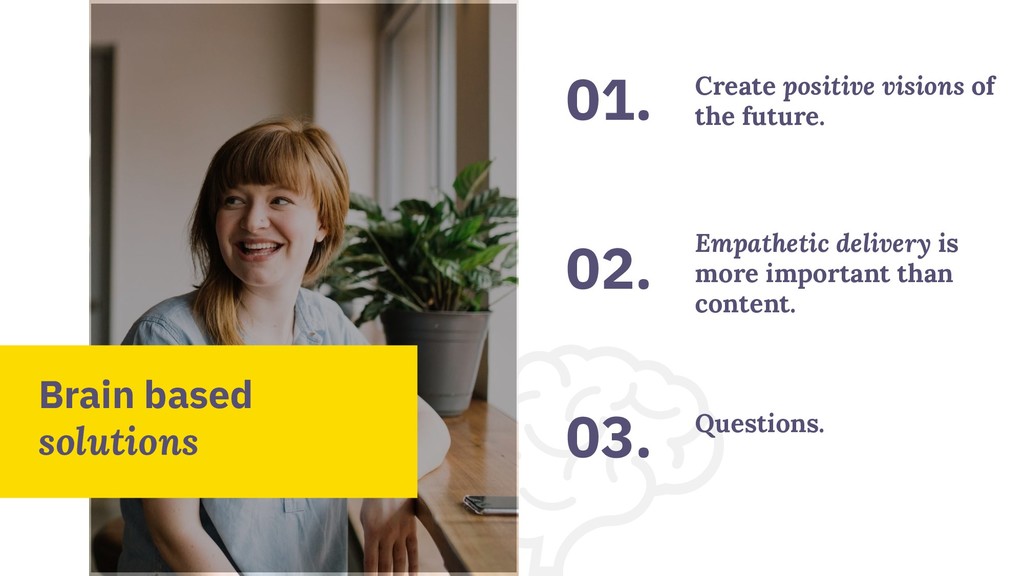
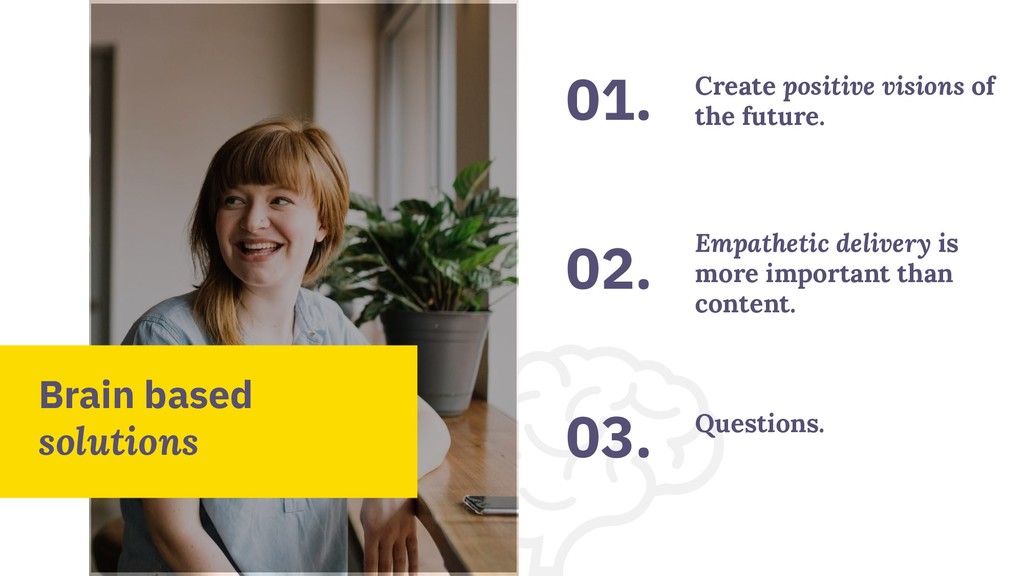
Firstly, create positive visions of the future. Two, empathetic delivery is more important than content. And three, questions. Questions are the most powerful thing we have at our disposal. And I'll talk about that, and I'll get too enthusiastic because I love it. So firstly, create positive visions of the future.
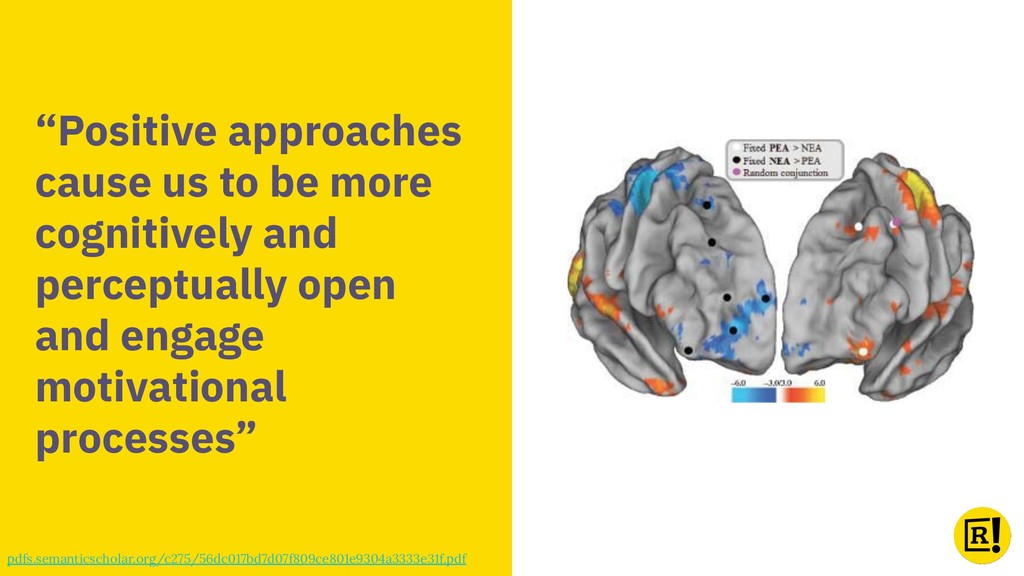
Those same neuroscientists from Yale that told us that we have a negative physiological response to feedback also told us what happens in the brain when we focus on positive approaches. It's worth caveating, it is unrealistic to always give people positive feedback, of course.
What this refers to more is a distinction between saying to somebody, what are the difficulties that you face in this role versus what opportunities do you have to develop? It's a subtle nuance in language that creates a huge shift in our perceptions and how we perceive the situation.
The research found that positive there's a picture of a brain to show you it's science. Positive approaches positive I'm making myself laugh here. I'm having a nice time. Positive approaches cause us to be more cognitively and perceptually open and engage motivational processes. This has been known by professional athletes, not me, for a long time.
Emily Cook is a US Gold Olympian medalist in some kind of sport. And she I was reading an article with her in the New York Times that talks about how she uses a process of visioning, I e, positively imagining the future to help her win.
This has gone so far in athletics that if you watch track and field, you can see the runners at the side on their hands and knees, feeling the victory, celebrating the win before the race has even started. This has been happening since the sixties.
Since the sixties, athletes have been aware that by positively visioning success, it will help us get there. The science also agrees with this. The research says that visioning works by arousing hope, resulting in an increase in openness, cognitive function, our brains work better, and flexibility.
So trying to help people work out what their idea of success is, and then help them feel it emotionally and motivate them, you're so much more likely to get them where you want them to be than focusing on where the areas that they're missing out on.
Research also shows MBA students who envisage the process of good results are more likely to attain them. So it's not just about hitting an end goal, picturing it, feeling it, feeling great. We also have to know the steps in between, picturing yourself doing whatever it is that you need to do to get to where you want to be.
So as good leaders, good managers, good coworkers, we want to be doing three things. We want to be seeking out strengths. The really, really good managers are the ones who watch their employees, the subtleties in their behavior. What tiny thing did they do well?
Did they do email did they do that email well? Whatever it is. Find it and work on that. Help them build on the things that they're doing well. Help people vision reward. Particularly earlier on in your career, you might not know where you want to go.
You might not know the things you want to do. Help people find that out and then work out a process in between. So two, empathetic delivery is more important than content. This is some research that shows us we really are just chimps in suits.
So researcher called Mary Dasbara, she's a professor at the Miami Business School, had two different control groups. And she observed these groups. One of these groups was given positive feedback, but with negative signals such as shaking heads and frowns. Another group was given negative feedback but with positive signals such as openness, empathy, and nods.
Probably no spoilers when I tell you that the group who received the negative feedback but with positive signals reported feeling better about the feedback that they were given and better about their ability than the group who received the good feedback but with negative signals.
That's hard to get out. Hopefully, you followed. But the TLDR of this is that delivery is more important than the message itself. We read body language and signals so much more than we read actual words. Of course, we have to tell someone that they're messing up sometimes.
Of course, we do. But if we do it with empathy, if we do it with positive physical signals, they are so much more likely to feel positive about it afterwards, and you'll see better results from it. I was just gonna make a point that I've forgotten.
It doesn't matter. That will go. Maybe it will come back. I'll tell you at the bar. Okay. So the third is questions. So questions are so powerful. Questions are one of coolest things that we have as humans, and I believe we don't use them enough.
I am somebody who is a talker, you might be able to tell. So the idea of listening to someone was weird for me, and asking a question. But I have recently kind of done some stuff where I've learned loads about this, and it's really, really, really powerful.
So let me remind you that telling people what they should do will only work if it fits with our existing wiring, and that is super unlikely. Most of us have to think through things ourselves. Most of us have to come up to our own solutions.
There's something called the Columbus complex. We're so much more likely to follow something through if we found it ourselves. So I'll give you an example from my previous life. So I ran a marketing agency for a long time. And when you run a marketing agency, you often become the ultimate point of escalation.
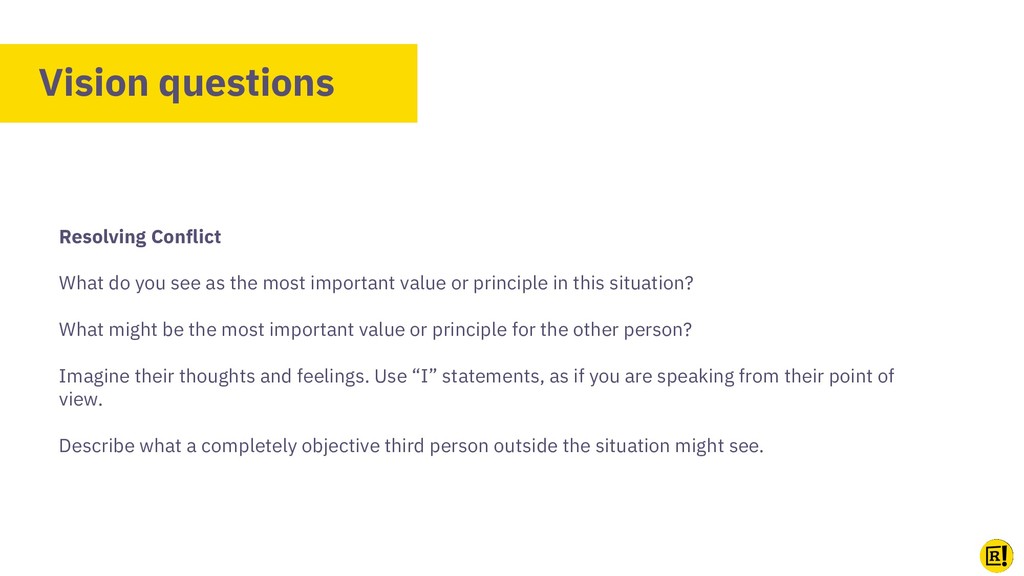
The kind of person that people go to when they're really angry and frustrated. One of the most difficult things to deal with as managers, leaders, people who run business, people who grow teams, is dealing with conflict. When we're trying to deal with two people who are arguing, when two people are having a really bad time and not seeing this kind of same side of the story.
So I worked with an agency about six months ago because they were having a difficult time with their clients. Their clients were giving them lots of no's. Their clients were saying no to everything. Their clients weren't letting them get any good work done.
Every time they suggested an idea, the client was like, no, thanks. And they were getting more and more frustrated. Does this sound familiar to anyone? Yes. Some nods. And that can be incredibly difficult, but what do we do in that situation where you've hit a stalemate?
So I worked with a chap called Matt. I'm sure he won't mind you telling me his name. So he became incredibly frustrated with one of his clients. We'll make her name up. She was called Kelly. He became incredibly frustrated with Kelly because she was just giving him no, she was being negative, she wasn't letting him do anything, she wasn't pushing anything through.
So I said to him, I was like, Matt, what is the problem? His response was like, well, she's just an idiot. She doesn't get it. She doesn't get how important it is. We've all said that. We've all said that about some people in business.
So I asked him to reframe it, and I asked him to do the small thing that feels super hammy. So I was like, Matt, can you do me a favor? And I want you to picture that you are Kelly. Imagine that you are her, and tell me how she's feeling by saying I.
And he was like, oh, no. So look, you have to, and he did anyway. So he sat there and he was like, Okay, well, I feel really annoyed because my boss doesn't tell me anything. And I feel really vulnerable because my boss doesn't tell me anything.
I don't know if I'm any good at my job. So because I'm super worried about my job, then I like I'm really averse to taking risks, I just don't sign anything off. And so I'm really worried and I don't really know what to do, but I feel really insecure on my job.
Suddenly, he'd opened the whole thing. His perception had completely changed. Kelly was no longer an idiot. She was just a person who felt vulnerable and scared, and that is much easier to deal with. He then went away and he called her, and I got a call from the CEO of that agency last week, and he said that they've increased their retainer, they're getting work done, they've signed off from a small thing of increasing our empathy by understanding the other person's perspective.
And if you're in a situation where you're having an argument with someone and you've hit that stalemate, and this this works in relationships too. Make my husband do it. He hates me. This is really good to if you say, I feel this, I feel that, as the perspective of the other person, it is huge.
There's loads of different kinds of questions we can ask people. If someone in your team is underperforming, say to them, what would be your vision of being, like, super successful and really excelling in work? Get them to answer, okay, great. What steps do you need to take to get there?
This is so much more productive than telling people. So what I did was I, this morning, created a list of potential questions that maybe you can go away and you can trial with some of your team. So there's some questions in there, and I've broken it out by if people are underperforming, if there's conflict, helping people work out what their vision of success is.
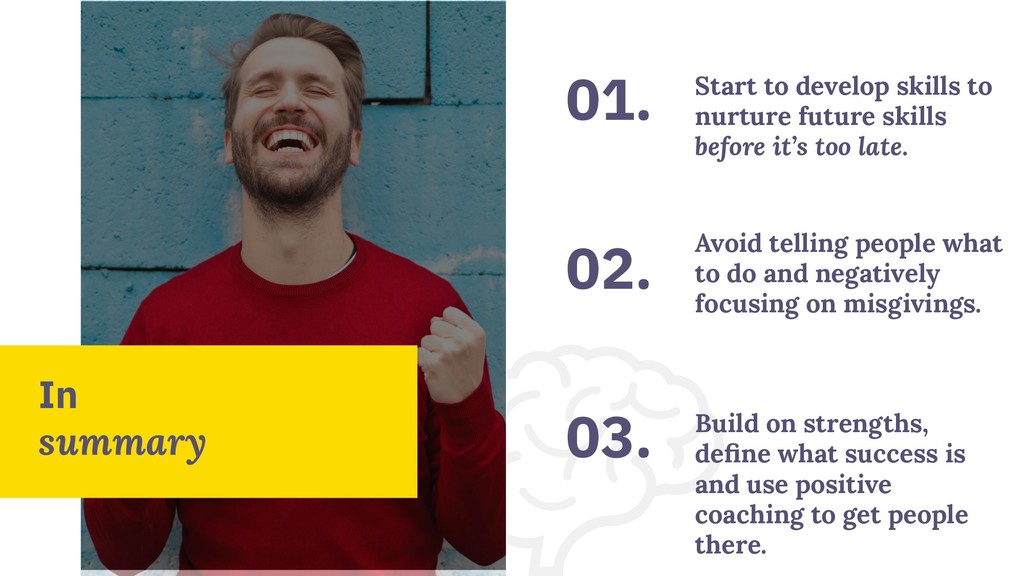
And you can find it there, raw. Training for TuringFest feedback. I'll leave that up for a second for some photos. Great. But in summary, there's kind of three things that I want you to take away from this talk today. Firstly, we have to start to develop these skills to nurture what we've always kind of thought as soft skills.
As businesses, we have to start investing in it. We have to start taking it seriously, and we have to learn more about human psychology because it is human psychology and human behavior that is important when we move into a world of increasing automation.
Automation. So we need to be able to get better at nurturing creativity, nurturing critical thinking, nurturing problem solving, and we won't get there in the traditional methods of feedback. The world of work is changing, so we have to change the way we communicate with our teams.
One of the ways that we can do that is avoid telling people what to do and asking questions. Download the template. Try it. Let me know what you think. It actually kinda changed my life a bit, which makes me a nerd, know, but that's fine.
And we need to stop negatively focusing on people's misgivings and helping people build on their own patterns and their own strengths. Yes. So third, build on strengths, define what success is for people, and then use positive coaching to help people get there. Thank you so much.