
The product world is awash in frameworks-hundreds of them. Most of the frameworks are re-hashes of the same ideas (over and over). Yet what defines great product teams are HABITS, not frameworks. In this talk, John will explore 5 key habits that every product team should work to develop. For each habit, he will discuss all the things that get in the way, and how to fix those problems.
← All talks 


Keynote Keynote Turing Fest 2023
5 Essential Product Habits (That Every Team Should Learn And Do)
Auto-generated transcript - may contain errors. Tap a timestamp to jump the video.
So my name is John Cutler. I have a background in product management and UX across a couple different companies. I like to write about product a lot. And I've had the benefit over, you know, my role prior to my current role, I had the benefit of meeting hundreds and hundreds of teams which was great.
I worked at a company called Amplitude, and my role was to kind of go out and work with customers. I might have worked with some of your, saw some Fanduel people. There's some folks who I've probably worked with or done workshop with. And in my new role, I flipped the script and now I sort of serve a thousand person plus product organization at a company called Toast, which does point of sale things, massive scale, but internally, as opposed to externally, very excited to be speaking with you today.
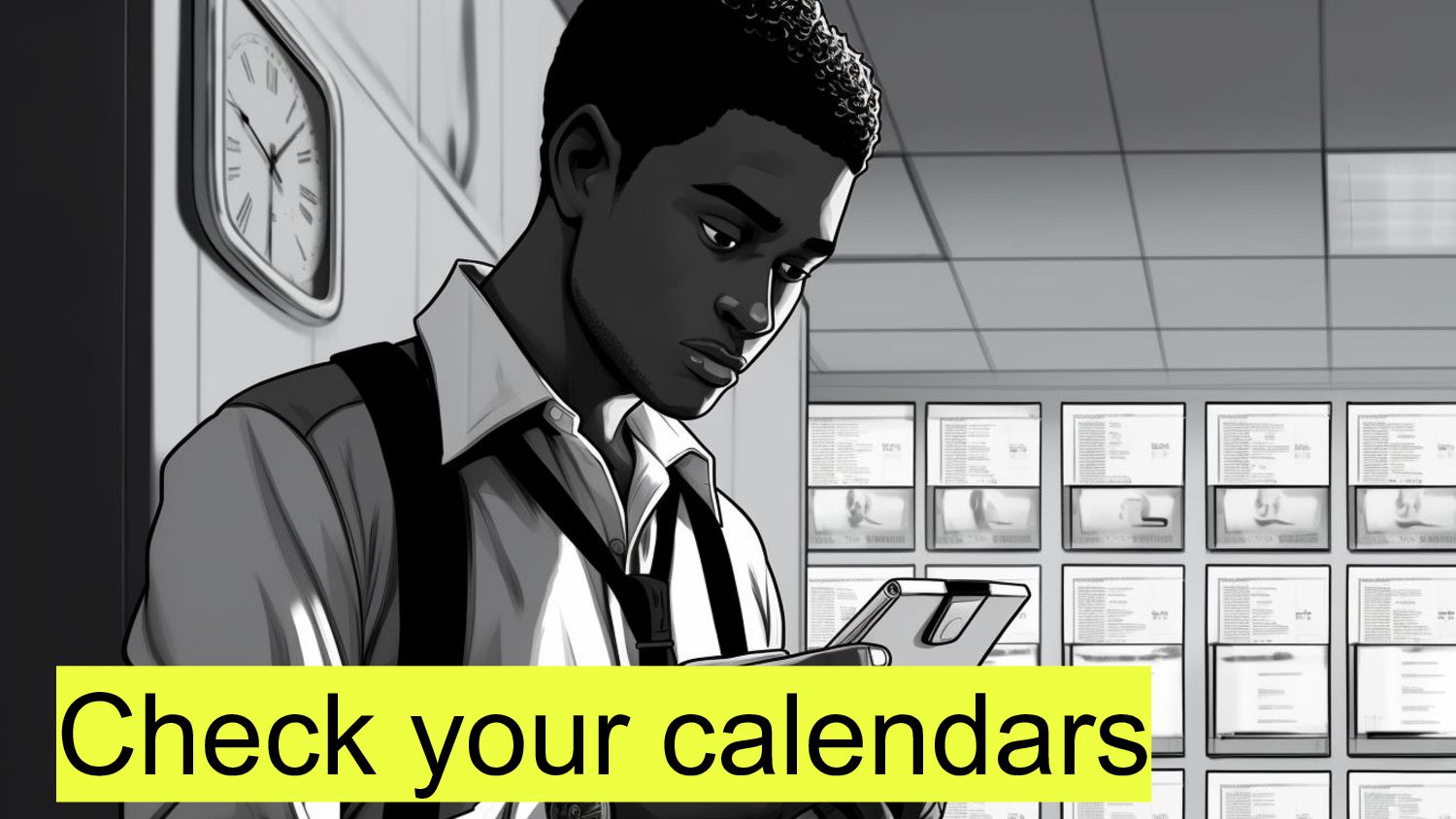
First activity of the day, take out your phone. I want you to look at your work calendar. It's gonna be stressful. It's purposely stressful. So take it out and I want you to check your work calendar and answer a couple questions. I wanna look look at your meetings, maybe for last week or next week, look at all the scheduled time blocks that you have, you know, your regular meetings, I want you to look at how you spend the first sixty minutes caffeinated minutes of the day, your power hour.
So check that out. Some of you, you don't need to look. You probably have it burned into your head. And I want I want to imagine that I'm an alien or I'm John and I come and visit you and and what what will I determine that your company prioritizes?
What do you value? What does your company value looking at your calendar? Anyone? Bureaucracy. What else? Customers, that's a good one? What else? Money. Oh, learning. Same thing. Learning and money are the same things now anyway. Okay. Great. Okay. Next experiment. So I call these the new the New Year's product resolutions.
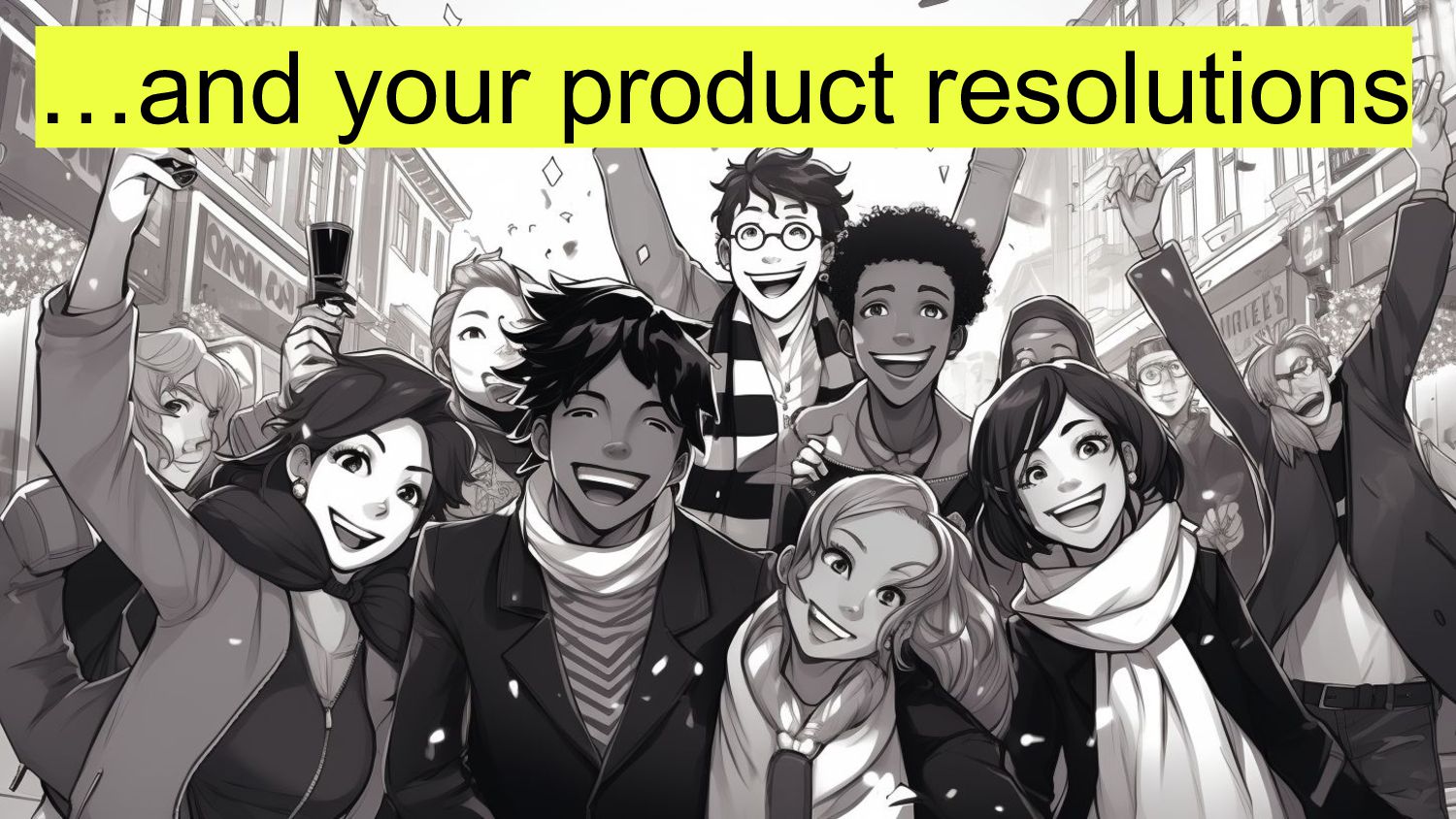
So these are the things that you you know, it's December. You're like things are gonna completely change next year. We're gonna operate in these new ways. We're gonna use these new documents. We're gonna do all these new workshops. And and I want you to imagine those.
And then we all know what happens to New Year's resolutions. Right? These are the things that sort of fade away It's May or June. They're like the the sad mural boards that no one ever looks. They're like the trees falling in a forest.
Or the documents that no one ever updated or that spreadsheet. We're like we're all gonna put in our things in there and no one ever looks at those particular things. So these are these are your new year's product resolutions. I want the you don't need to shout those out because they're too embarrassing, but I want you to keep those in your head, as we go through this as well.
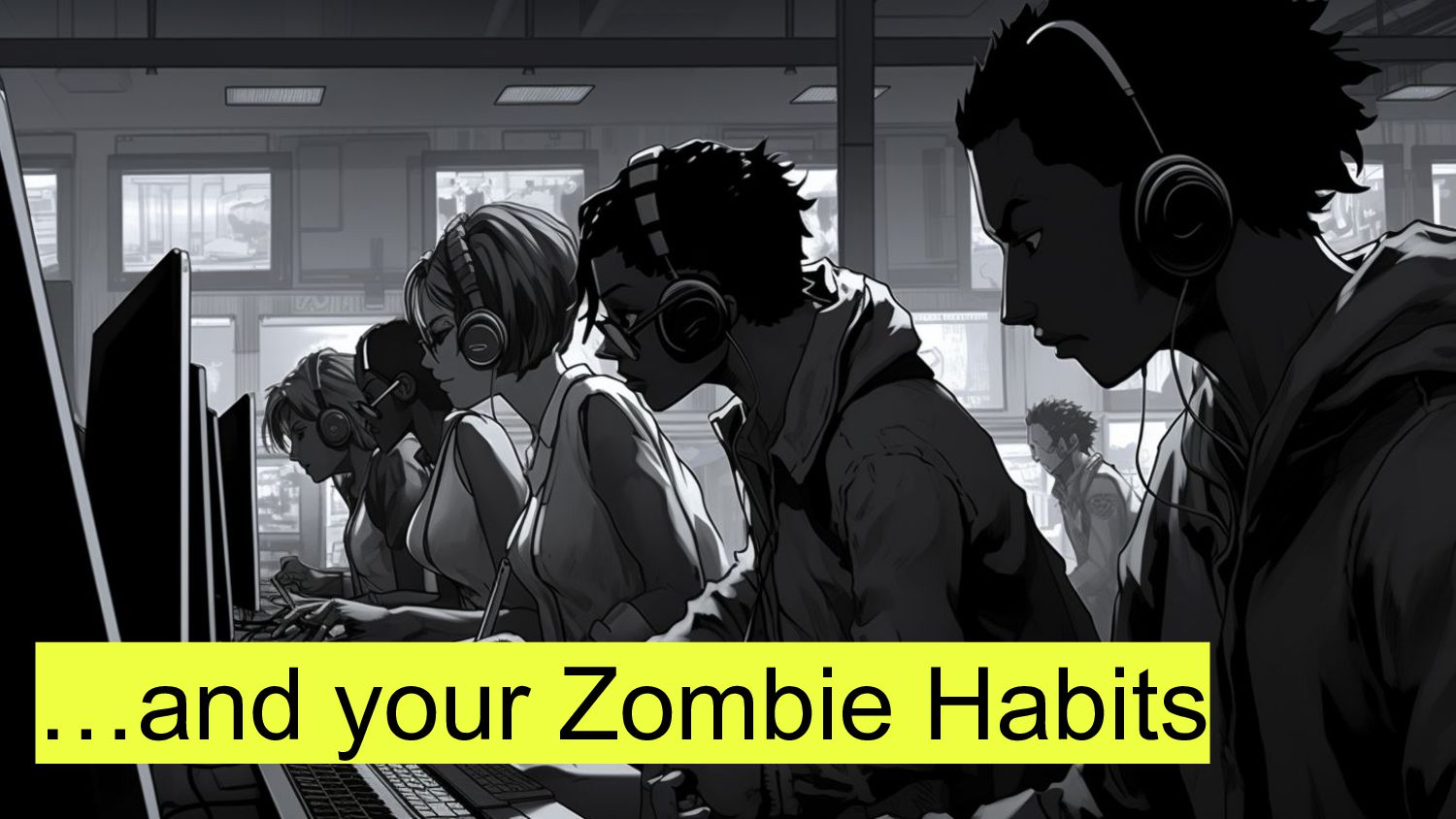
Okay. Final task. I want you to think about your zombie habits. So these are the things in your company Just no one knows why you do them anymore. You've been showing up at that meeting for three years and you're just like I still don't know why I'm here.
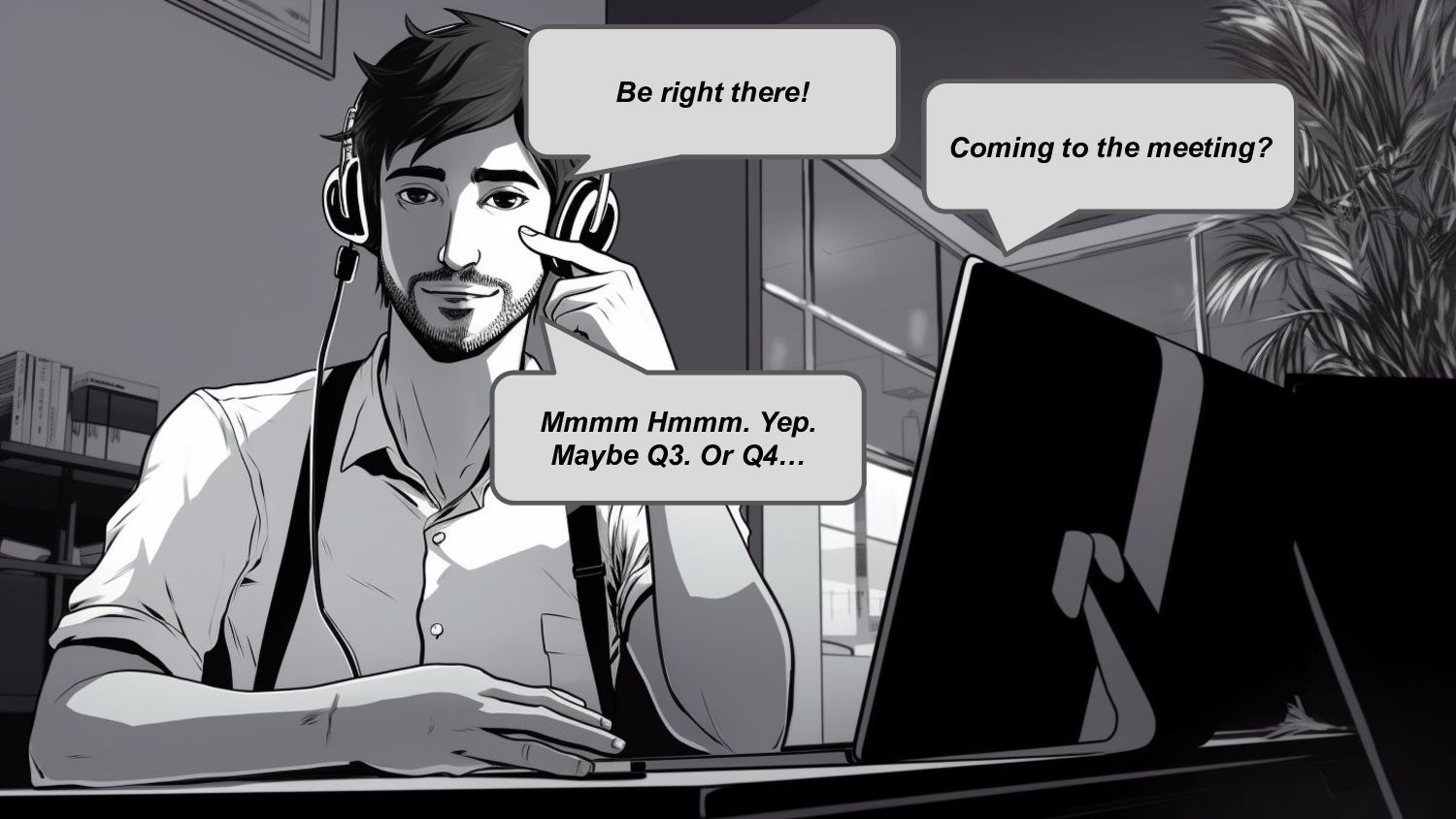
Your brain is completely turned off while you're in this particular meeting. You're kind of in execution mode. You're just going through the motions. You turn around at the end of each quarter. You sort of wonder where your time went, you're in these zombie habits.
So I want you to reflect on your zombie habits for a second. Anyone have a good example of a zombie, you don't need to think You could just project it to me with thought if you want. Okay. I got that one too. I have a lot of these meetings.
Frank, we all have all these meetings. Okay. So we've gone through some zombie habits gone through your New Year's product resolutions that don't go anywhere. And we looked at your calendar in the aliens say that you, either prioritize customers or bureaucracy. Okay. Where am I going with this and what's the purpose of today's talk?
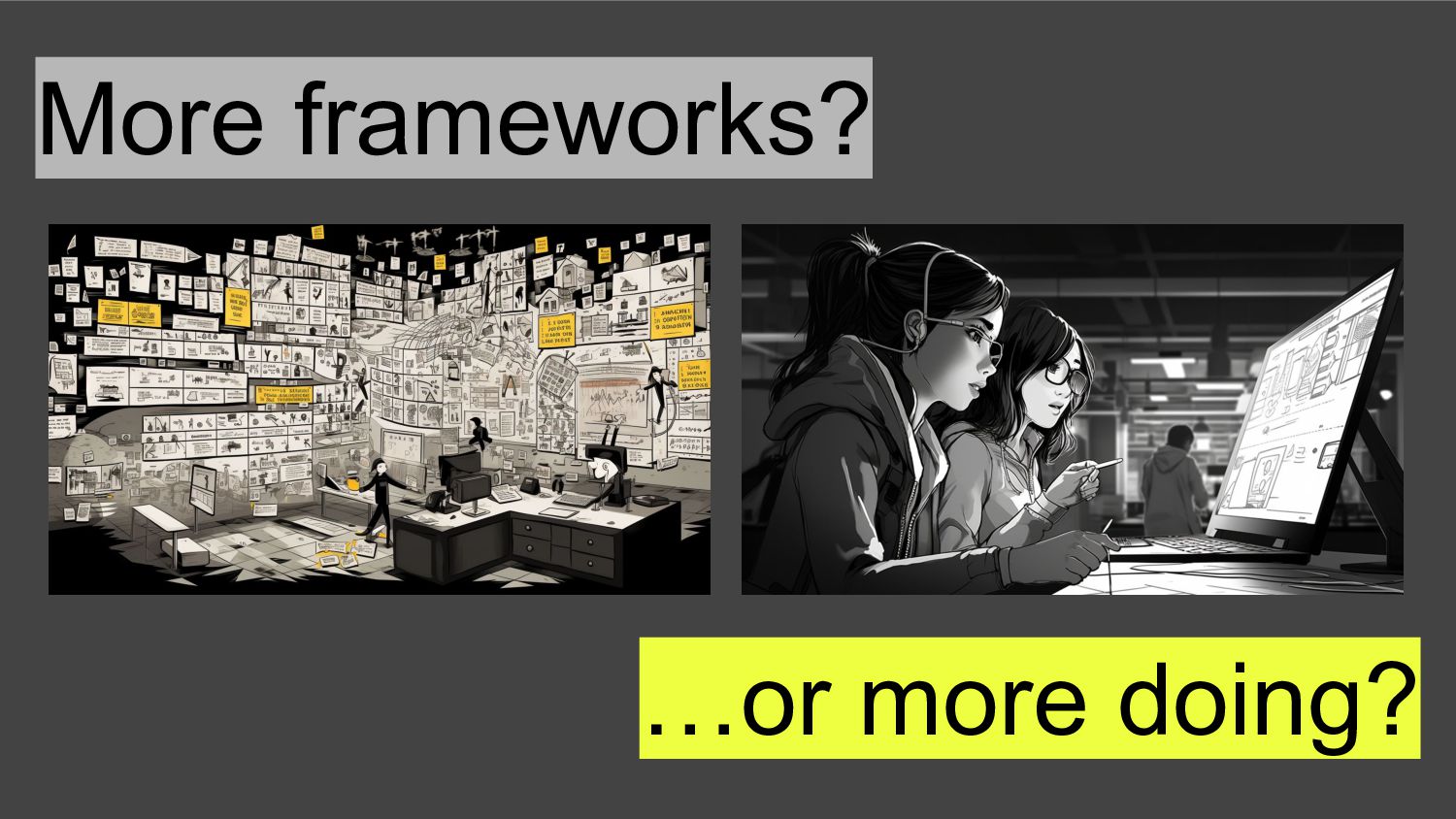
If you have wandered into this place called LinkedIn recently or Twitter, you all know that we are absolutely swimming in frameworks. In fact, anyone with Miro is a framework creator. You see them everywhere. It's like a mosaic on LinkedIn and we're drowning in these frameworks.
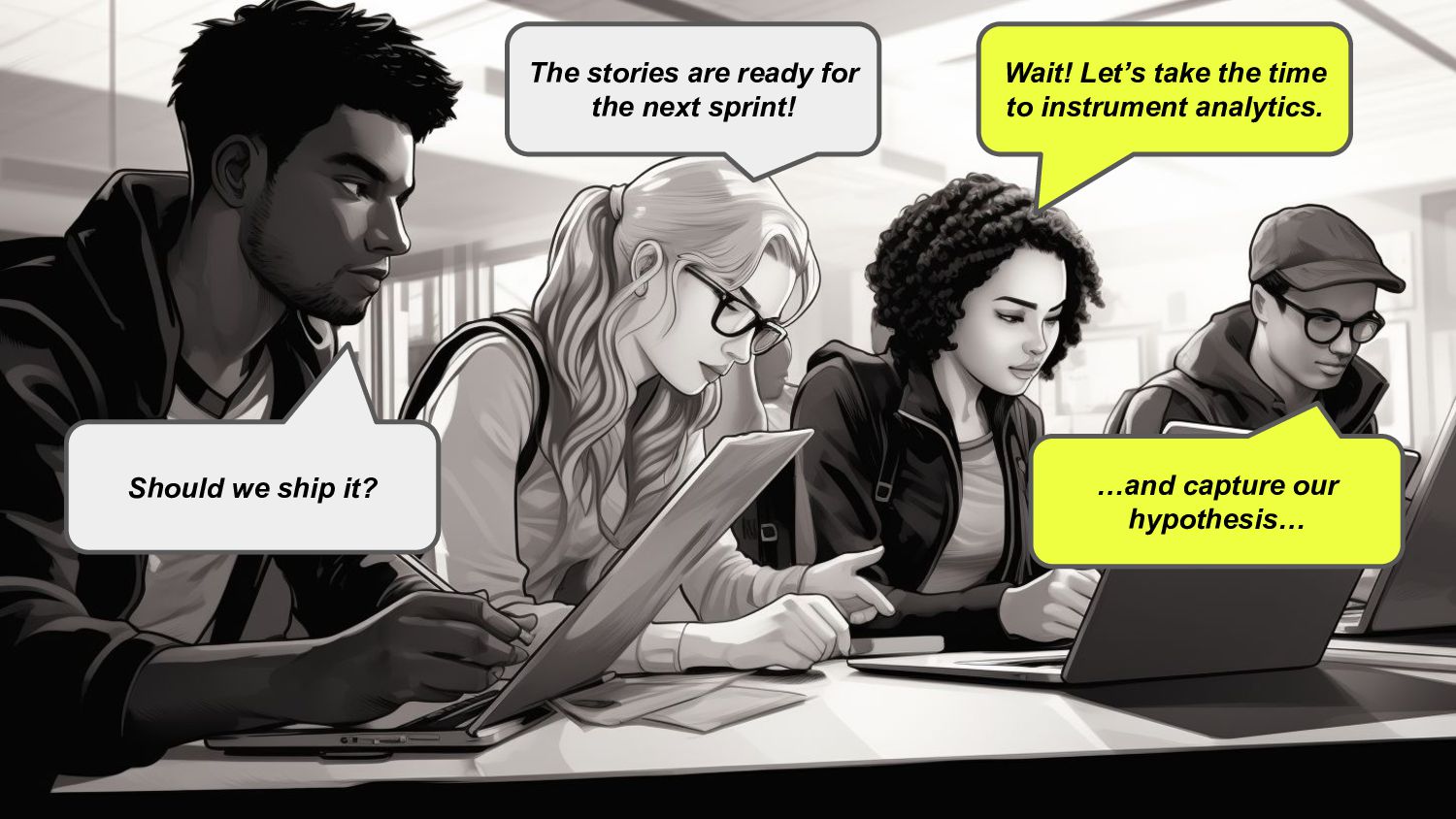
We're drowning in this product advice. We're drowning in all this knowledge of all the stuff that we're supposed to apply in our particular company yet My hypothesis is that very, very, very little of it translates into anything actionable in your companies. It's not translated into doing.
And when you look at successful product teams and maybe within your company or if you've seen lots of teams, what actually defines product teams are not the frameworks they use, but It is the habits. It's the things that they do regularly that they apply their energy to.
They apply their their brain to. That defines teams for good and bad, right, to mention those back in those zombie habits, but other things. A couple key habits probably define your whole teams. You probably listen to podcast and you'll hear that one little nugget where they say there's recently a podcast where someone said it's Stripe, you know, every manager tries to deploy against the API.
That's like that one little habit, or maybe you work at who who requires product managers to like sit in a support queue for a little bit once in a while. Anyone? Okay. So one person, right? So these are these habits that like one out of a hundred companies have or one out of twenty companies have.
So there's all sorts of different versions of these and you might use them but my my theory here is that it's those habits that define companies not necessarily the hundred different frameworks that we have, at our disposal. So here's my current inspiration, you know, my current job is basic.
I'm in the habit business. And I have data on a thousand people. So I'm the person who sits there and I'm I'm I'm watching them try to adopt new habits oh, we're gonna try to up level our work this way. I'm watching them trying to kill old habits.
We're gonna stop doing this. In some cases, I'm trying to make everyone do something. I'm trying to make a thousand people do a particular thing. And the inspiration for this talk is just observing how powerful these habits are in our day to day work and also how challenging it is to create new habits no matter how, you know, you've been on LinkedIn.
You say that's a good idea. There's a huge delta between that being a good idea and then in the next coming weeks actually putting it motion into your company. So I've been observing the power of habits over words at a a sort of very, very large scale at my company, and this is why I became fascinated in this topic.
I don't have a belt. I didn't I lost all my clothes and I bought everything yesterday except I did not buy a belt. So apologies for that. Okay. So in this talk, we're gonna do a brief thing. You know, what are habits in general?
We're not gonna do that. You know, there's there's books like atomic habits by James Clear or BJ Fogg. There's the in the in the hustle culture, we've we know about habits. You can learn about habits all day. There's a lot of stuff there.
So we'll go briefly into what habits are. And then we'll talk about five habits that I believe every product team should have and you'll make excuses why you already do it and don't, but I'm just gonna reiterate that. And then we'll end by talking about some obstacles that show up, and how to get around those particular obstacles.
So my goal for the end of today is we're gonna actually do this ritualistic thing at the end just to prepare for where I'm gonna ask you to delete a standing meeting and then we're gonna celebrate and clap. So I'm just seeding that in your brain right now to create the cue so that the habit will come true.
So I'm gonna say delete it And then so start filling with your phone and finding that meeting, but I'm just seeding what we're gonna do at the end. It will be a great way to finish the day is deleting a meeting. To do this thing. Alright.
So what is a habit? There's lots of definitions for habits. One is you could think about it as an automatic script that gets turned on by a queue. So I give you a queue, and then you are gonna do a certain set of things in a certain order.
Another definition of a habit is sort of the neurological one, which is when a habits in place or certain neurons that are firing in your brain, that they're closer together. It's a well worn path in your brain. There's a little less, load to get into the habit And that's another good definition.
But for today, I'm gonna keep it super practical. You know, habits are regular activities. They're more ingrained. They're just how we work, in a particular company and they do feel like muscle memory. There are things that you do without a lot of without a big load to get started, that's sort of my definition of habits.
It's probably not the proper one, but for today's thing, we're talking about product habits, gonna talk about the things we just do, and that's why we do them. Very importantly, habits fit into a stack of other things. And so you can think about this stack.
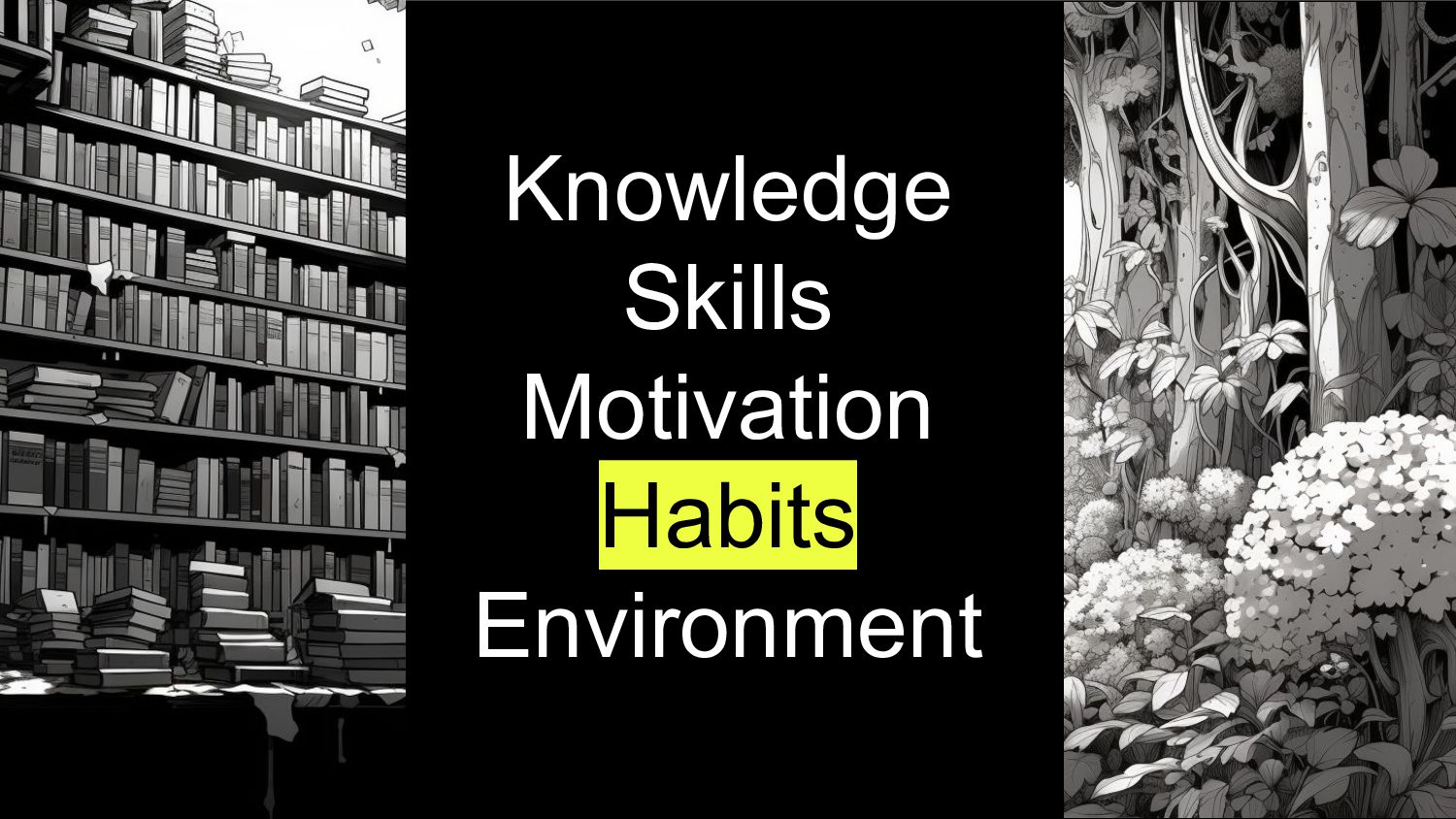
It's like knowledge, skills, motivation, habits, and environment. All these things work together. To improve performance in your company, but here's the fascinating thing. The LinkedIn posts all those frameworks that's just knowledge. That's just the thing. But really at the end of the day, knowledge and skills tend to only be about twenty to thirty percent of the big picture of performance.
When they've done this research on it. This is why habits are so important because you could think about habits as the catalyst for practice, which is how you develop skills. So habits times practice equals skills. You can also think as habits as lowering the motivation load to do something when you've developed a habit, you don't you don't go to bed each night and say, I gotta motivate to brush my teeth and spend ten minutes.
You just do it because it's a habit. You don't really need to necessarily be motivated to do it. And if culture is what you do, not what you say, and habits are often what we do automatically. They are your environment as well. So if you work in an environment where people routinely talk down on people or say that that's not a good idea, that's habit that's getting that thing.
So they also control our culture and how we're working. The final point and we got to this a little bit earlier is a lot of the habits we have are just automatic and we do we do the script without really thinking. I would argue here that what I'm talking about are turned on habits.
So maybe starting them is easy. You know, the to give you an example, if you do support and every PM sits in the support queue, After they've done it a couple times, you don't need to nudge them and kick them through the door and doing it, they're just gonna do it more automatically.
But when they're on the support queue, they're not sitting there in like a mindless state. You know, they're picking up information. So as we go through the particular examples, I want you that in mind that we're talking about things that are both easy to start, but not mindless while you're doing that as we're going through these things.
Cool. Alright. Let's get to it and hear the habits. Boom. Okay. You go and you ask product managers what habit is most important. They're gonna say talk to customers. Customer customer centricity, this is important. But talking to customers is the like, yeah, I work out or yeah, I go to the gym of product. It's like, oh, do you work out?
Yeah, I work out? Yeah. Do you go to the gym? Yeah. Yeah. Kind of do that. But when you actually talk to teams and you ask them, you know, are you interacting with customers? Yeah. Yeah. I'm doing that. All the time. Yeah. I know when I can.
Are you processing any of that information and turning it into things you can Yeah. Take some notes sometimes. Doing that thing. Kind of go down the stack. Can you trace any decisions to when you actually talk to the customer? Well, you know, I have a UX researcher who sometimes does that.
They're pretty good at it. I'm just generally just scoping things out. I make fun of product managers a lot because I work with but that's generally what a product manager will do is it's it's yeah it's is the I go to the gym of product but it is absolutely the most important habit that you're doing.
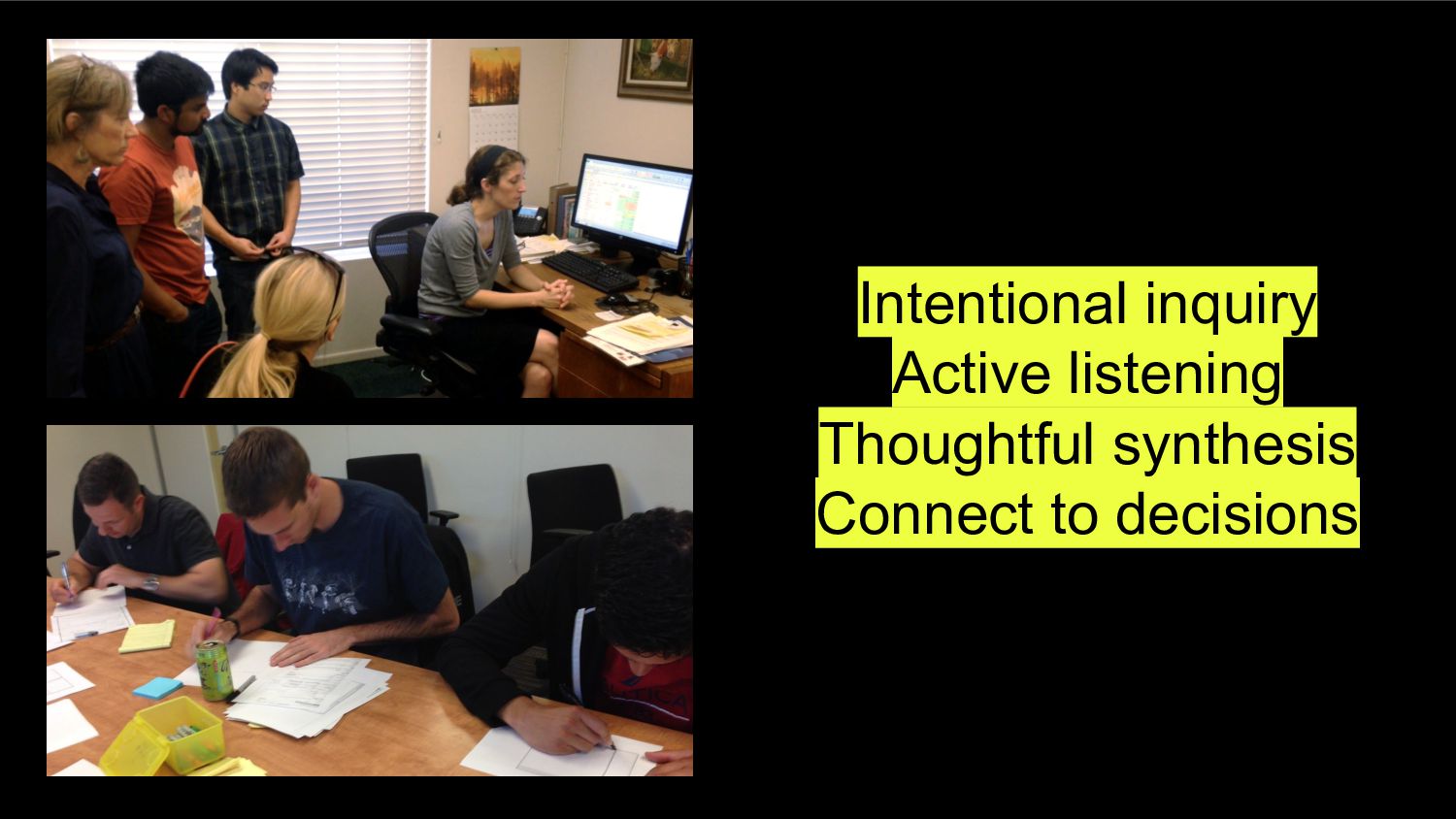
So here is a picture of a team that I worked on and I love this picture for a couple reasons because it demonstrates a couple of the key things about what I'm talking about developing that habit connecting with customers. This is a team of engineers and one designer and we are on-site visiting a customer.
Notice everyone is listening intently they are watching someone do the work in their particular environment. Right? This is not a passive conversation. This is not everyone kind of listened to some loom calls. I mean loom and Gong are great, but you get oh, it'd be Gong, not So you get the idea, right?
This isn't this is active processing. Now the second picture is the team immediately taking that feedback and processing through it. It's synthesizing this particular information. They're doing some mock ups and some drawing exercises not to design the product. And none of them would claim to be a designer, but they're doing it to process what they just heard and turn it into artifacts that they can just use.
So that level of active listening, the note taking you see, the processing, the synthesizing, connecting to decisions, that's the habit at a high level. Now how do teams do it? So how do teams I work with do it? So here's some examples of habits that we have in our particular environment.
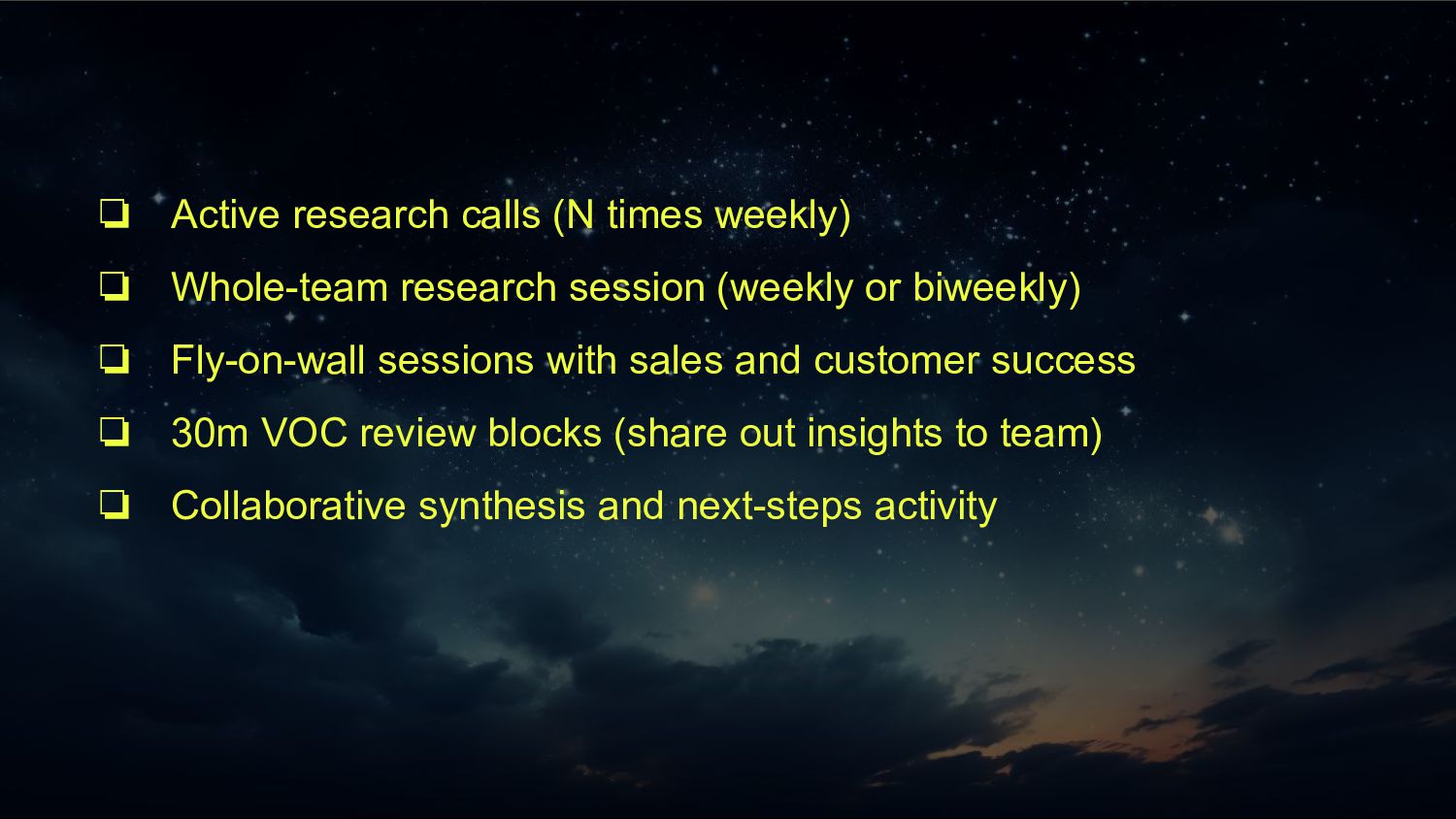
PM number one. They set themselves four times a week minimum. I'm gonna do an active research call where I'm taking that particular information. I'm synthesizing it. I'm boiling it down. Team two, a whole team research session. They commit to a whole team, engineers, and designers, and PMs at least once a week for one hour to listen to a couple of customers.
Team number three, they they do the fly on the wall sessions. A lot of the problems if your product manager, someone in sales will say, can you just show up on the call? What that means translation is can you show up and don't see anything wrong?
And then when I need you to sell the product, I'm gonna queue it over to you and then you're gonna be the fancy product. So, no, this they committed to real fly on the wall sessions, which is I'm listening. I'm observing. I'm processing feedback as we're working.
A lot of people in B to C don't have the benefit necessarily of walking out and seeing a representative customer, but another team. We have lots of different teams in my company. So There are examples of B2C as well. A real commitment to listen to the voice of customer stuff.
So three times a week, thirty minutes each processing that VOC feedback. And then the final thing is a co synthesis session. Extremely powerful, not just the PM saying, I'll just process the notes but it's two people looking through the notes together and synthesizing it.
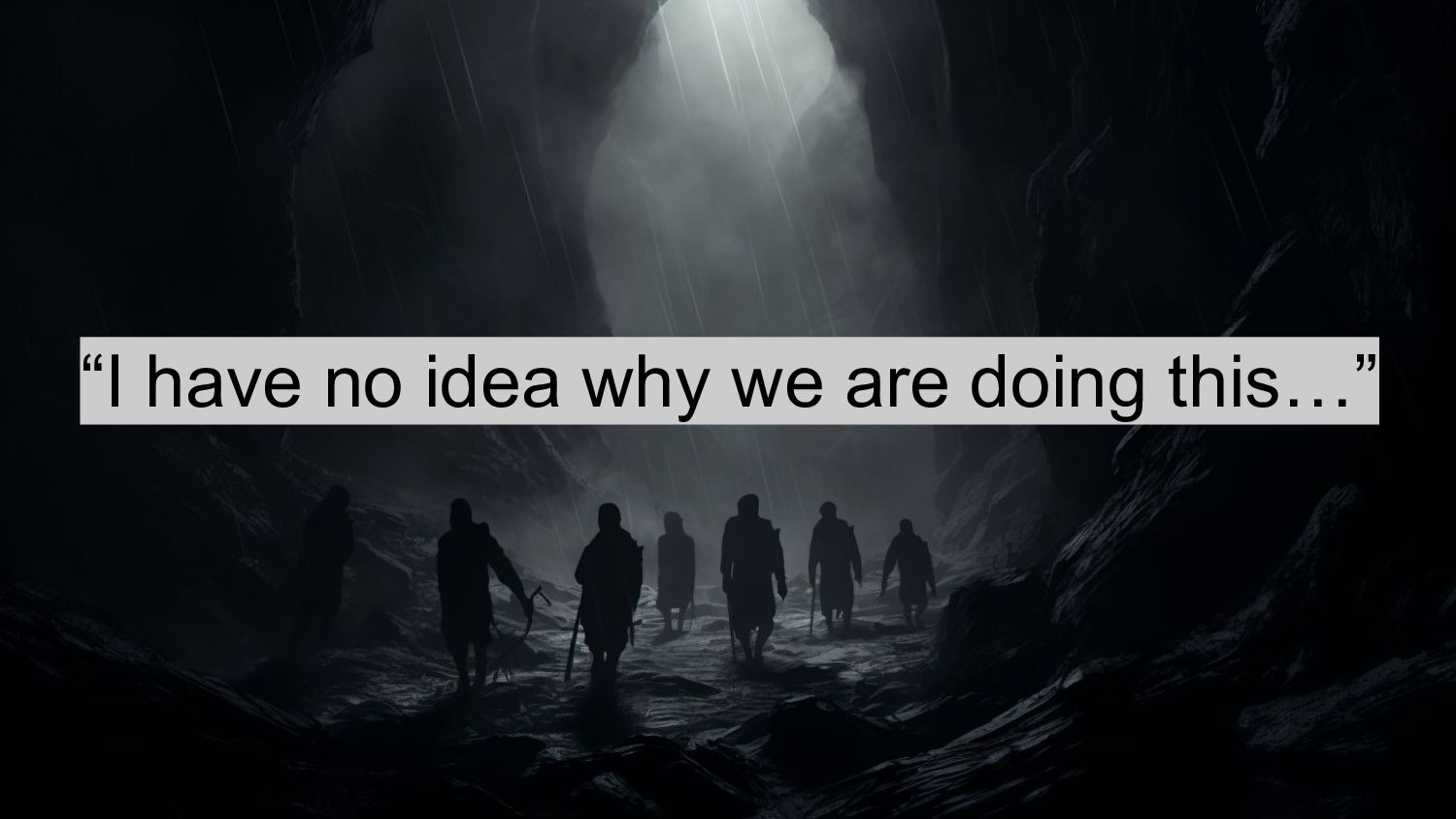
So I'm giving you a real habit. So think which one you're gonna do next week and which one you do already? Awesome. Okay. You got that in your mind. Next one, the next habit. If you've ever been on a team like this, you know exactly how it feels like feels like walking into the like fog ridden abyss.
It's you're the they they probably been eating their own flesh for for months as they go through and and somewhere in the distance. And if you work in a company that has like that one slide with the three strategic pillars on it, and still it's still in May and people are like I don't know what the fuck those mean anymore like I get them but this is just architecture.
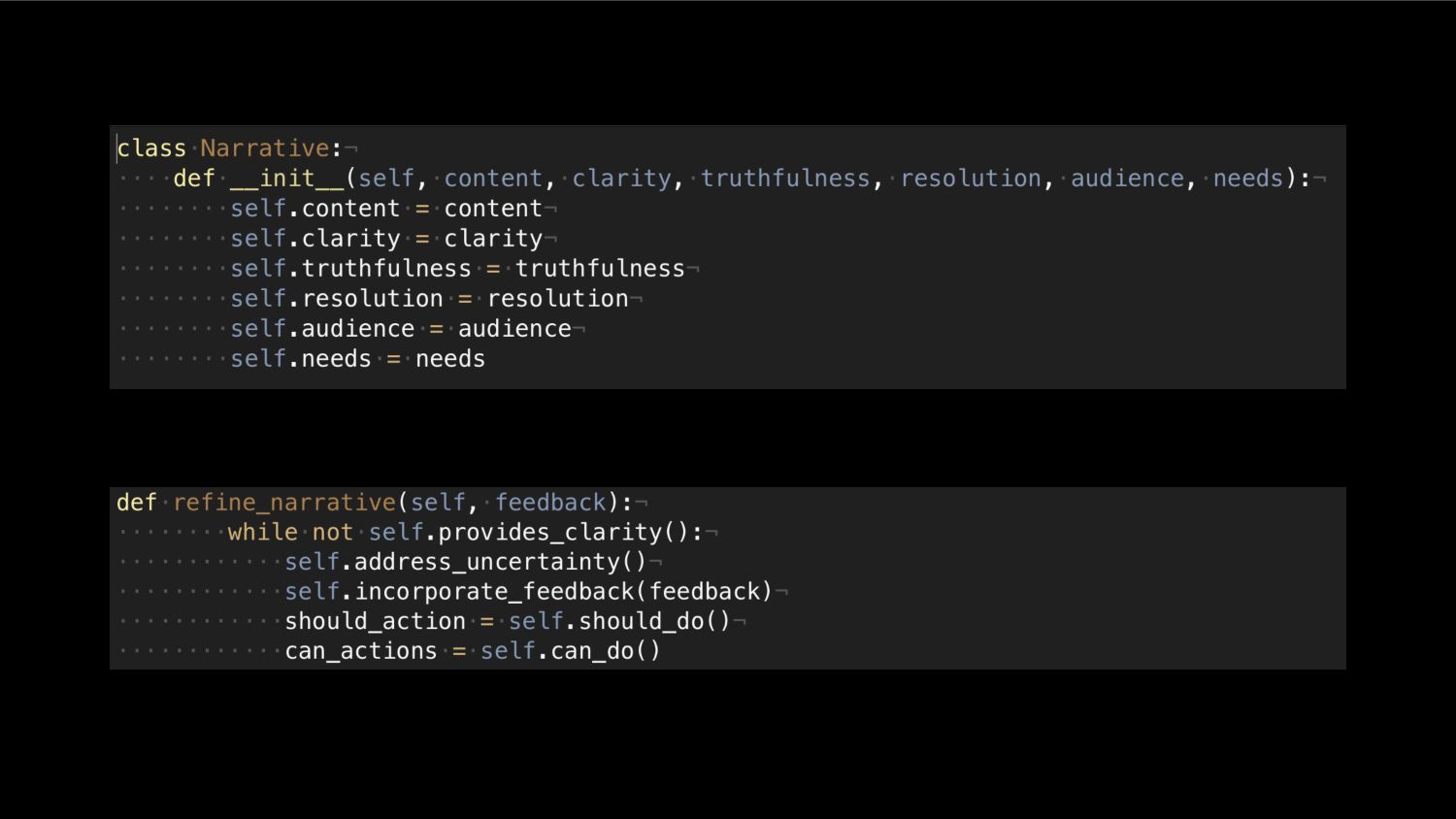
It's just no one gets it. This is what it feels like to be on this thing. We've all been there at a certain point. So what is this habit and how we relate So I kind of I broke down being a product manager into these two routines.
One is called narrative. So we deaf then we can instantiate narrative. And the other one is refining the narratives. This is the code for being on a product team, the pseudo code. But what this about is if you are any kind of developer, you're in the narrative shaping, coherence, checking, coherence resolving storytelling business every day.
Every day you are refining that story from the stuff you're working on right now at the smallest level, all the all the way to like why the company exists what you're doing for your customers, how you're gonna, you know, up level the team, how you're gonna up level the lives of your customers.
You're doing it to all levels all at once. You're doing it from the CEO down the people on your team and importantly to the second function there, your narrative checking at all times. So when things feel off, you're in that thing and you talk about it and people like, well, I don't really don't really get the strategy.
You're going back to the drawing board and you're thinking about what's off here. What am I not getting? So you're always doing that coherence checking as you're working. That's the high level habit. You have to run these routines over and over and over and over again.
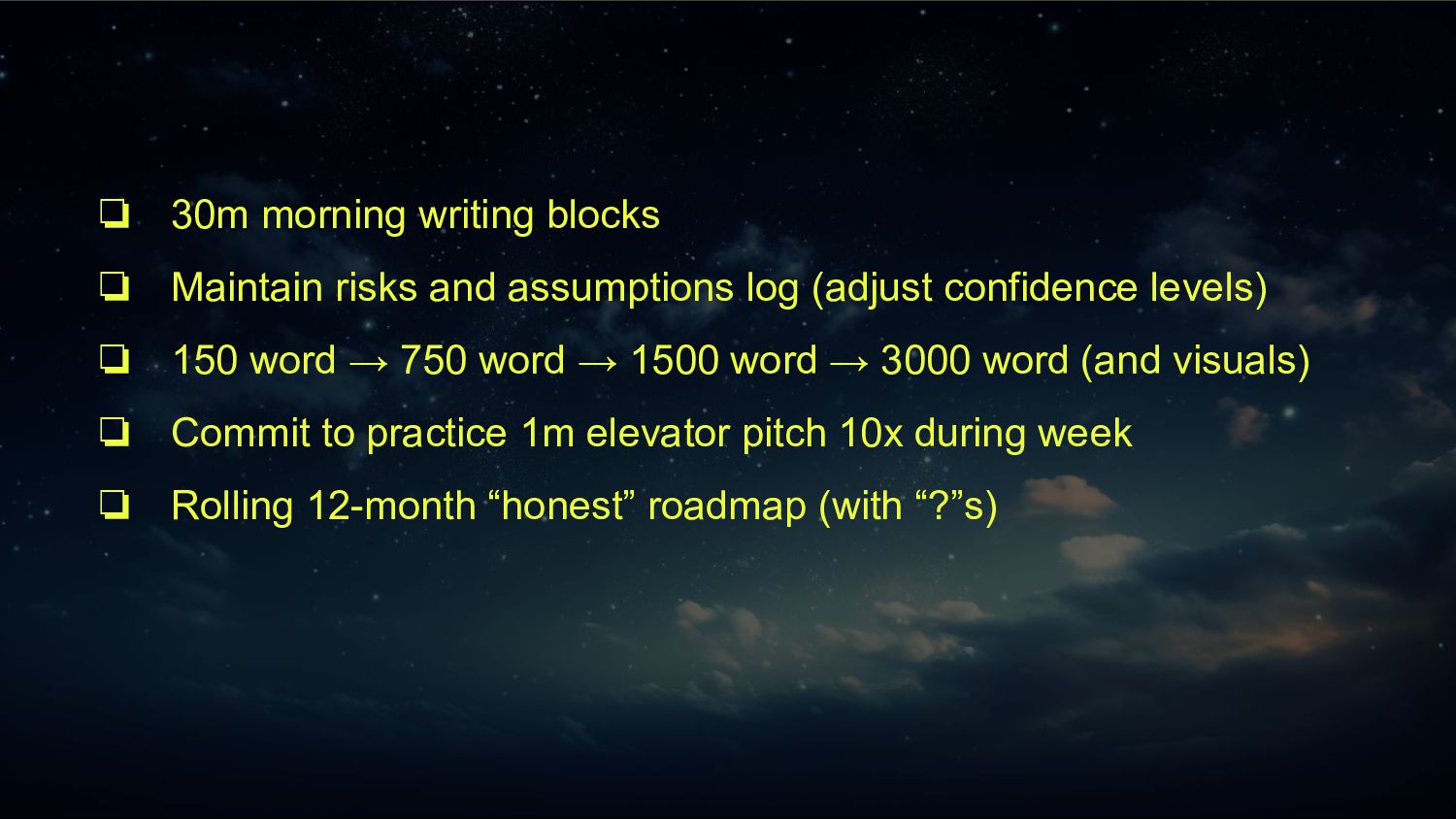
So what does it look like to do this? If you are in the product management business, part of this, I believe is writing. So specific examples from teams, three times a week, thirty minute writing, where a PM just writes and they carve out the coffee time to make sure they're doing that narrative and getting it down.
The second thing, they maybe we have teams that are maintaining a risk in assumption log that they commit to go back to every two weeks. So let's say you have an assumption that the customer world looked like this, the new data, you know, now your priors have changed, Now you calibrate your assumptions based on that.
Third one is called the hundred fifty word to three thousand word thing that every PM should be able to do. Which is I need one hundred and fifty words is one minute. Three thousand words, there's like twenty minutes or something. You have to be able to go up and down that stack like that.
In any situation, in any hallway to do this. This takes a lot of practice and a lot of habits. So you have teams kind of committing to that particular narrative The elevator pitch thing is you never know when someone's gonna be like, can you just what the thing about being a PM is if you're down the level to asking you a high level high level, they'll ask you to go low level, if you're in the middle, they'll ask you to go high level, low level.
If you're kind of mid to low level, they'll ask you to go mid to high level, they'll ask you to super thirty thousand feet and Like you've never won. So you have to practice this narrative over and over again. And then the final habit is just what we've got some teams working on this now is just the rolling twelve month on road map.
You always have the road map done. It's not a performative activity to like okay everyone time to get your road maps in. We just make sure that it is a habit revising that all the time. I'm presenting real world habits so you can see real world product and help people do this.
The next habit. So I do believe that a bias to action is an important habit for any product The problem is the way that many people interpret a bias to action is I just need to make the team shipped faster. So it's this idea that a lot of product managers have that their job is to somehow eek out the most amount of output from the particular teams that they work.
This has gotten even worse by the way with the economy. And when finance starts asking questions, this all this all gets bad. But I do think there is a kernel here that's important that if you're involved in this, you need to figure out how to encourage a bias to action on your team.
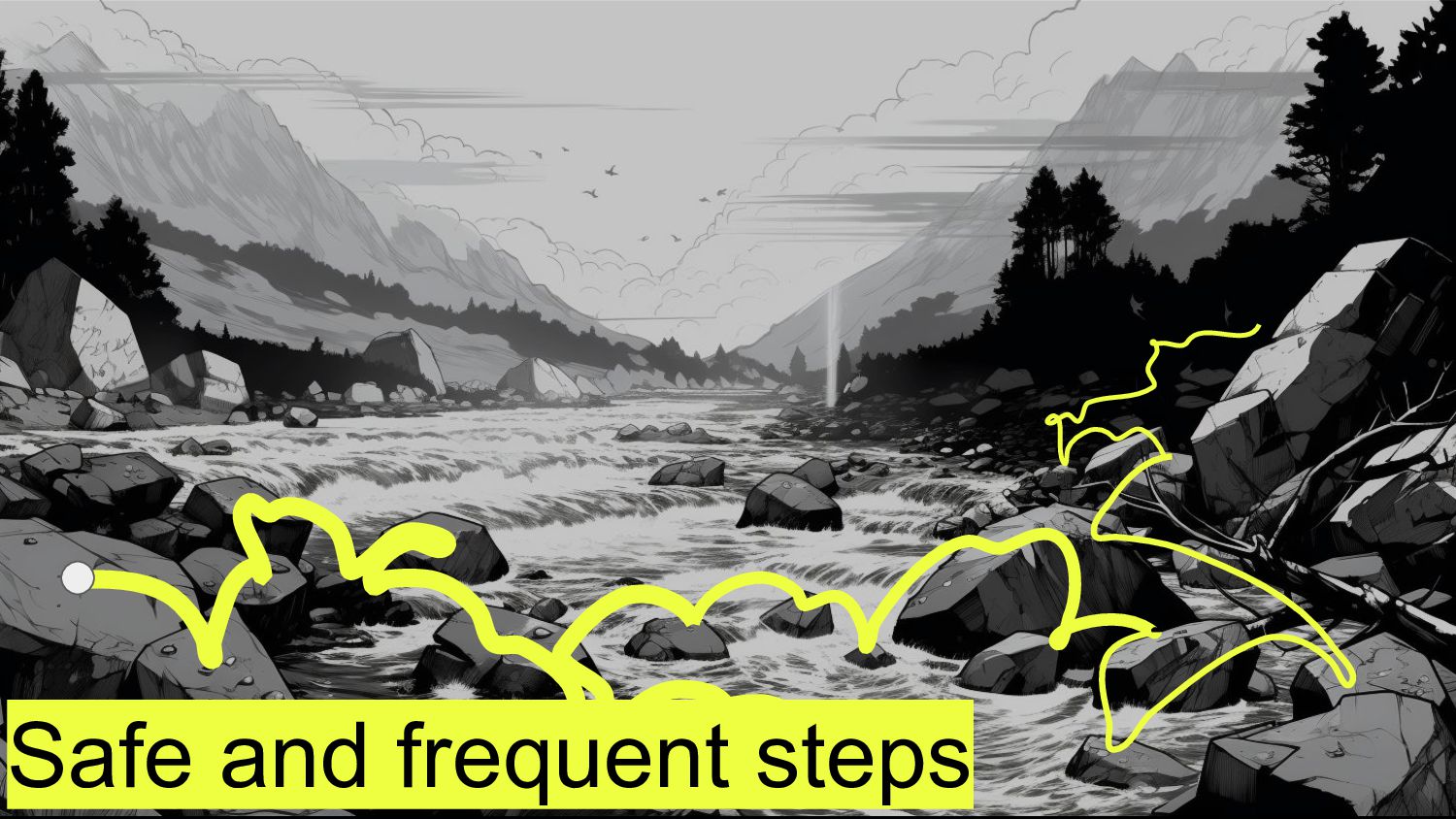
That is habit. Action is the habit that you want, but you can't be in the business of pushing the team or, you know, getting them to ship That starts to get these anti patterns coming up. Here's the analogy that I use in my coaching or my work And that is of a river with stepping stones.
And I think that this is a very, very good analogy for what you're trying to get the team to do. You're trying to create an environment where there is a collective bias for action. And you notice here they know where they wanna go.
They wanna get across the river. That much is known. You know where you are, you're in the starting point, but it is not one path across that river. There's a series of stones across the river. You might get to you see them kind of doubling back.
You get to some wrong steps. Part of the environment you're trying to create as a product manager is an environment where it's safe to make the steps. That's what you're trying to do, and it's safe to walk back. What you realize is that most teens are hesitant about action when they feel they will never be able to reverse their steps.
They just they're scared as you are in your river. If you think you'll never be able to walk backwards, you're gonna be very, very worried about your first step. So the the lever here, the habit you're trying to get with your team is to get that safe action, safe forward momentum.
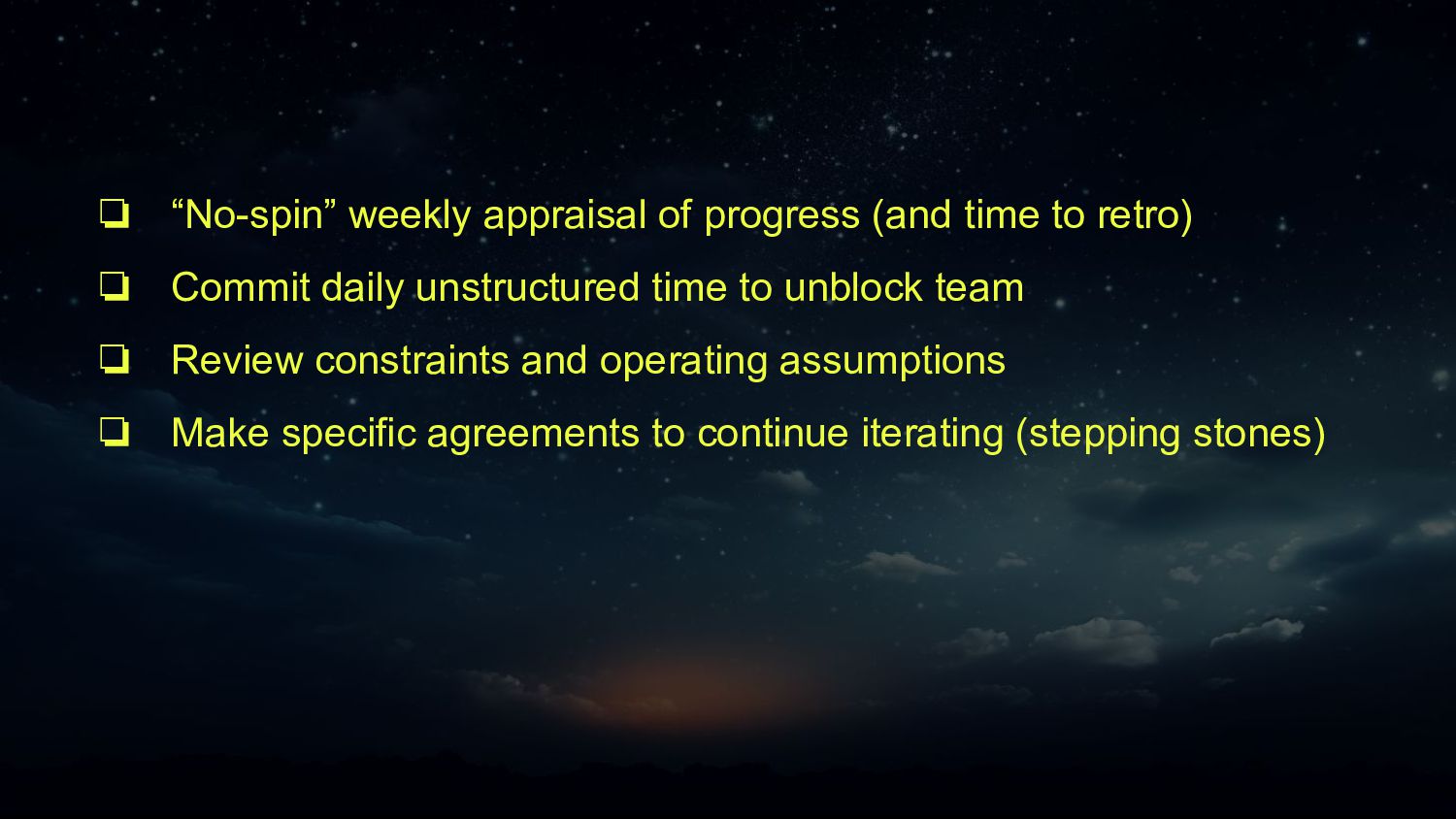
So you continue to learn You continue to do. You see how these habits are related. So what are the specific actions that you can do? The specific habits. I love this one from a PM. They work with their designer PM, and engineering leads.
They call it like their no spin weekly appraisal. Which is the no bullshit appraisal of where you are at. If nothing happened, that's what they encourage people to think about. And the the no spin part's important because once you start creating that spin, it gets very difficult.
The next one is extremely important in this remote world is you know, PM said I block out thirty minutes a day unstructured time that I will always be available for those questions that come up And this is important. If you have to, like, get on someone's calendar three or four days to from now, to answer a basic question, or you need to ask, you know, you know, in Slack when someone's so stressed and they write their question, and you can see that the other person's super busy.
They respond with one line, like, I don't know. Setting aside this time for synchronous review super important. The next thing back to that point about safety The operating assumptions part is important. The habit there is continuously going back to revise the operating assumptions.
So that the team feels safe to take those steps. If they can see that you've done that and see that you're revising it, they feel more likely to be able to do it. And then finally, just figuring out the working agreements. This is very basic, but if a team is worried, they will never be able to go back and iterate.
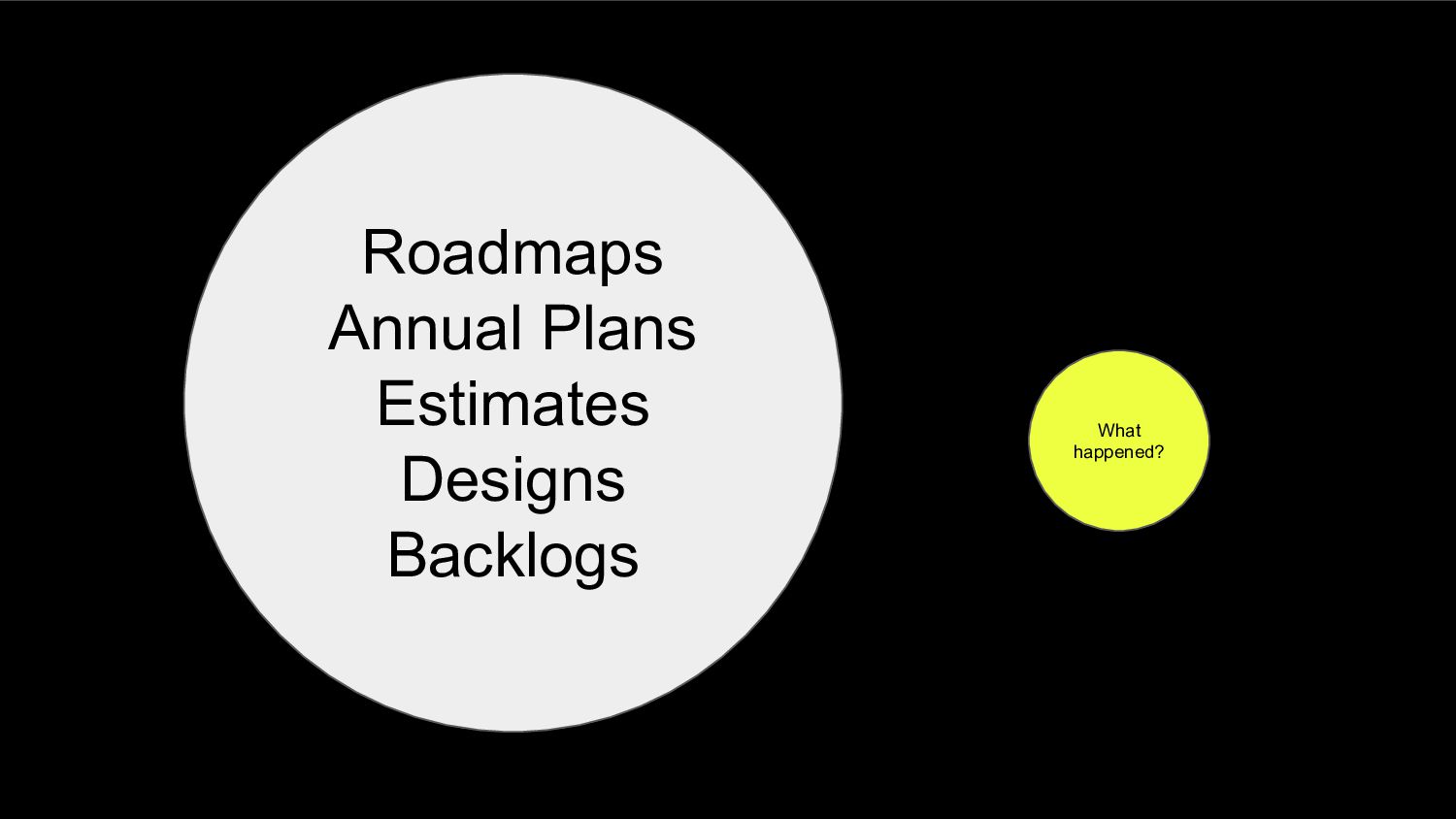
Just making an agreement with the team that, like, yes, we will go back and iterate can go a super long way. So those four things are habits that you can do. This is one of my favorite ones. I don't know if when you looked at your calendar, if you were to break down the time you spent doing your roadmaps, your annual plans, your estimates, your designs, your backlog, and you compare that to actually thinking about what happened.
In most companies, I think this would actually be a generous interpretation. The ratio is way way way way off. The amount of time spending talking about what you're going to do and how long what you're gonna do is going to take and the designs and things that you're gonna do or what the statuses, the watermelon charts are, the things you're doing, compared to what actually happened and what is the impact of the thing.
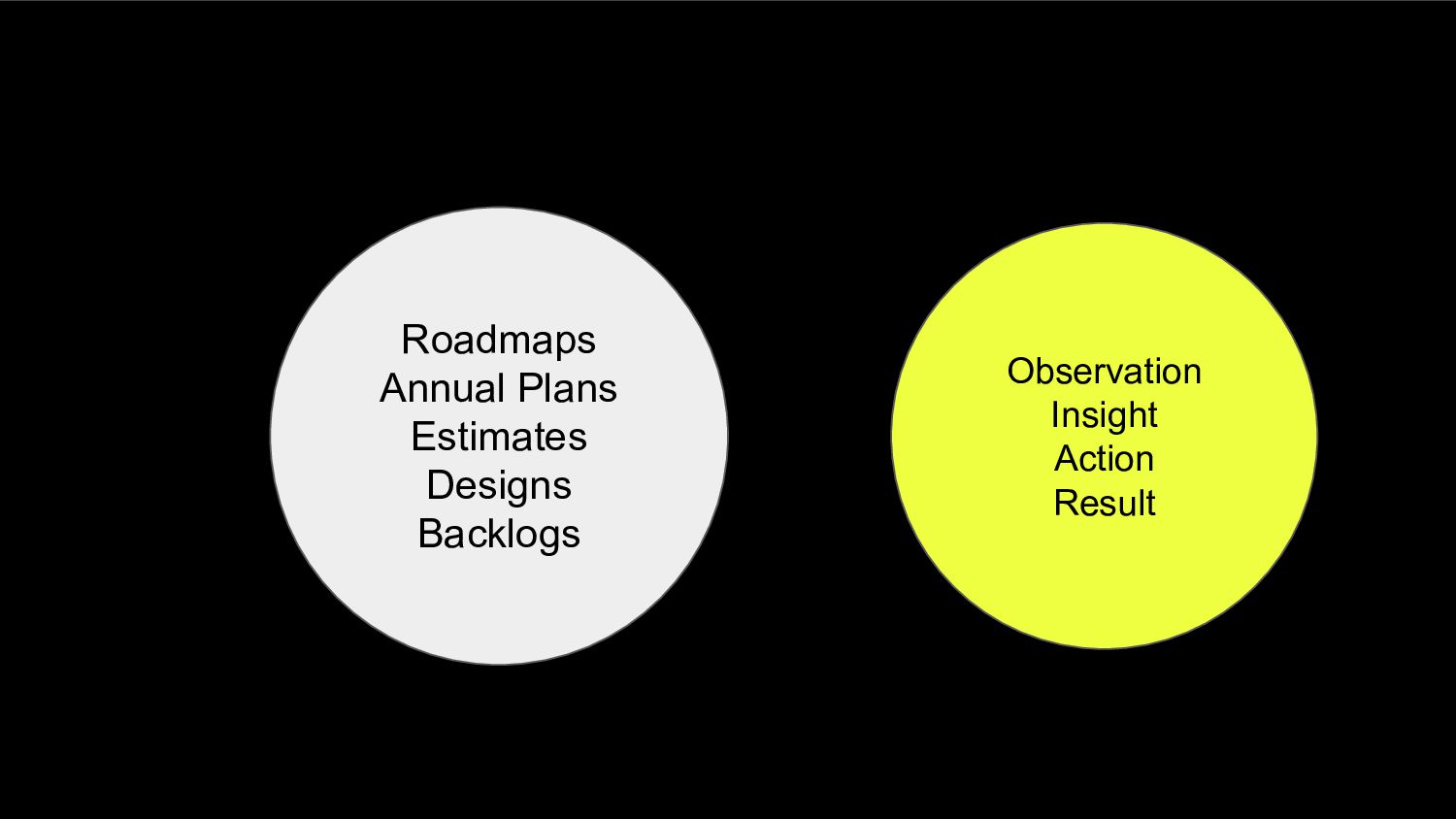
And this is a super habit for product managers and basically the whole team of leveling these together is just get some balance here and close the loop. What's very important here is this doesn't matter if it's for your company or for your own career.
Having sat in now dozens and dozens of interviews in the last couple weeks, when a PM says and at that job, I created the road map, you don't listen very much. Right? What you're listening for is here's what we observed. Here was the insight.
This is what we tried. This is what happened and this is what we did next. That's what you're listening for. So this is beyond just at your current company. If you can combine, if you can get this muscle going on your right, I guess.
This is a huge level up for your particular team. It's just closing the loop. This is how you get better decision quality at your team. One mistake that happens is I think we've used this word product sense and product mindset as these like mythical things, high agency, high product sense mindset genius.
It's not genius. It's reps. It's just reps. It's like why firemen know that there's gonna be a back draft. It's like They just have the priors to know, I think we're getting into a sticky situation here. That's what I'm gonna do. So you have to create the reps for yourself.
So what are specific things you can do? So I think everyone generally knows, well, you should do product reviews. You know, and I think I don't know whose teams do product reviews at the moment looking retroactively to the past versus the what are we gonna ship next week?
Anyone? Let's see. Okay. Good. I'm speaking to the right. So this is the thing. You know, I'm sure you have some dumbass company meeting that no one's actually getting any value out of. And in that same hour, you could be talking about the decisions you made in the last month and reflecting on what did we observe?
What were our insights? What did we try? What happened? Our next step. It's painless. It's painless, but you need to make it painless, right? You need to create a safe environment where that is not frowned upon One tip here is if you only do this every quarter, if you do it around promo time, guess what?
Not very safe. Right? But if you make a regular habit of it, it's better. The other thing is you can hijack existing meetings to do this and this is one of the main tips here. You don't need to ask permission for anyone in your company to do this.
Just start the meeting and say, Hey, before we jump in. I wanted a stall to reflect on that thing we shipped last month it's not what we expected to do and and no you're not gonna get fired for that. You know, people might look at you kind of funny like why are they doing it?
But if you spend three minutes doing that, no one's gonna you know, sweat the things. Another thing that's super interesting that people underestimate. I worked at amplitude and people under use this particular feature is just getting just making it easier. Like if you have to go into a product, click on a thing, click on a thing, click on the dashboard and look at the data, most people won't do it.
But I found even for my own work at amplitude if you create the chart and then you create the email notification and you create the trigger and you just get it into your email, you check it. So don't underestimate the value. Not all habits are created by having to change a lot of things up.
Some can just be by hijacking existing things like email or Slack thread to say, Hey, we hit a thousand actives or something like that. And it and the products are so easy to use now with slack in between those things. There's no excuse.
That people don't have channels where they see some update on a metric that they're interested in doing. No peaking though. No peaking if you're doing your AB tests, I guess. Cool. So those are specific things. The final habit, the final habit is about celebration.
And there's a story here I did an activity with a team recently is scavenger hunt and we went through. I said let's retell the story of the last year. And it was incredible. They they went back and they said, we never celebrated any of this.
We didn't have fun. We was always the next thing. It was always the next thing, the next project, the next thing. And it was kind of a big moment for the team that said, you know, damn it, like, we did a really good job year.
They're really hard on themselves, but what you notice especially in a remote world where people are all business and all meetings all the time you tend to get a lack of celebration. Celebrating real progress makes up for all the setbacks that you have and I'm talking about real celebration like guttural, laughing, savoring the progress, being in the moment things, not like the success theater stuff because everyone writes the email.
It's like things are going great and if you work on that effort, you're like things are not all going great. That does not feel like real celebration to me. We're talking about the real celebration moments and this is huge because work has gotten a shit load harder because no one, you know, it's not like, oh, in two thousand nineteen, it's like, cash money.
Everything's going great. This not like works hard. Right? You don't have that in those motivations to do it. You really have to savor the moments, the successful moments that you're having with your team. Specific habits ditch the perform the performative celebrations, the email ones like hello executives.
Our team is rocking it. You can eliminate those. I mean, don't maybe just send it just to them. If you send it to the team, they feel terrible. They're like we're not completely rocking it. We're just kind of rocking it. Schedule a monthly celebration just kind of unstructured time.
And this is a huge one. Just reach out to someone you work with and say I I met I did this coaching internally and I said they said I'm loving my team and I said have you reached out to any person said thank you.
I really like working with you. I'm really happy of the results we got. No. And then I thought about myself and I was like, I have not done that in the last two weeks. So I send out these messages and think people of how productive and like how happy I was to work on that, how good it felt.
And they wrote back and they're like, and I felt that too. That's great that you're talking about that. So these things go a long way And then finally, that time machine exercise, you really should put your wins in, like, message in a bot and mail them to you.
Now schedule in slash or schedule the email, you can be like send it to me at a random date when everything's going to shit and you can remind it how awesome this time was when we did it. These are things you can do right now.
Okay. The three things that make this tough is you probably have like one or two percent of people's brains left in most companies. The cognitive load is super, super high. The second thing is is that there's diverse motivations. You think, you know, you'll go I always fell for this trap.
Like, hey, shouldn't we try this and a person says, yeah, that sounds great. And in four weeks they didn't care apparently but people's motivations vary a lot and a lot of luck is involved to make this work. Even the best ideas. I remember one thing I did at this company Appfolio is I finally was like I'm gonna go and print this thing and pasted in the bathrooms.
That was my hack and that was it. That was the thing. Everyone's like, I love that. And I think they did that for years later. They're like we love that practice to do the things and it took me failing a bunch of times to think I'm gonna paste it in the toilets to be able to do this Let's go through some of the blockers and get to it.
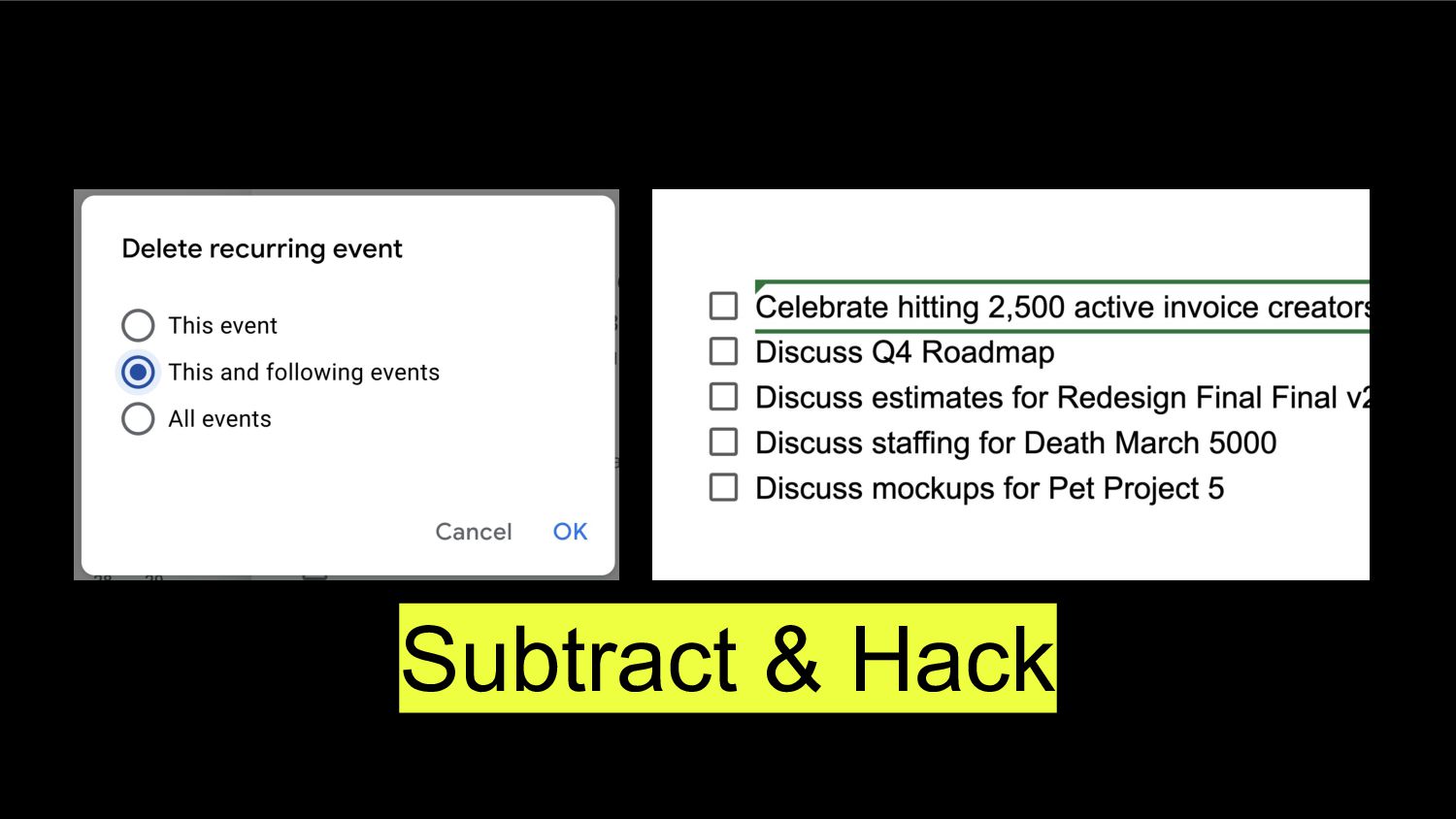
The first is subtract and hack. In most of these cases, people are saying got this great idea. In addition to the forty to eighty hours you already work, we're gonna do this new amazing process that I read about in this book it's amazing.
We're gonna do team topologies. I'm just joking at this because yes it's awesome but then you're like well who's gonna run the workshop? Really? And then you start looking at calendars and people are like, oh wait eight weeks out. Can't I just read the book? Oh my god.
So people so the first thing is I made a rule subtract for every new habit the other day we eliminated a meeting that cost people two thousand hours a year. Boom. Then I knew that I had the leverage to go in and say, why don't you try this other thing?
That would be effective. The hack thing is what we discussed before. No one is gonna fire you for going in and adding that item. Celebrate hitting two thousand five hundred active users in addition to discussing these things. So hack existing meetings, existing structures versus trying to do all new things can be super important.
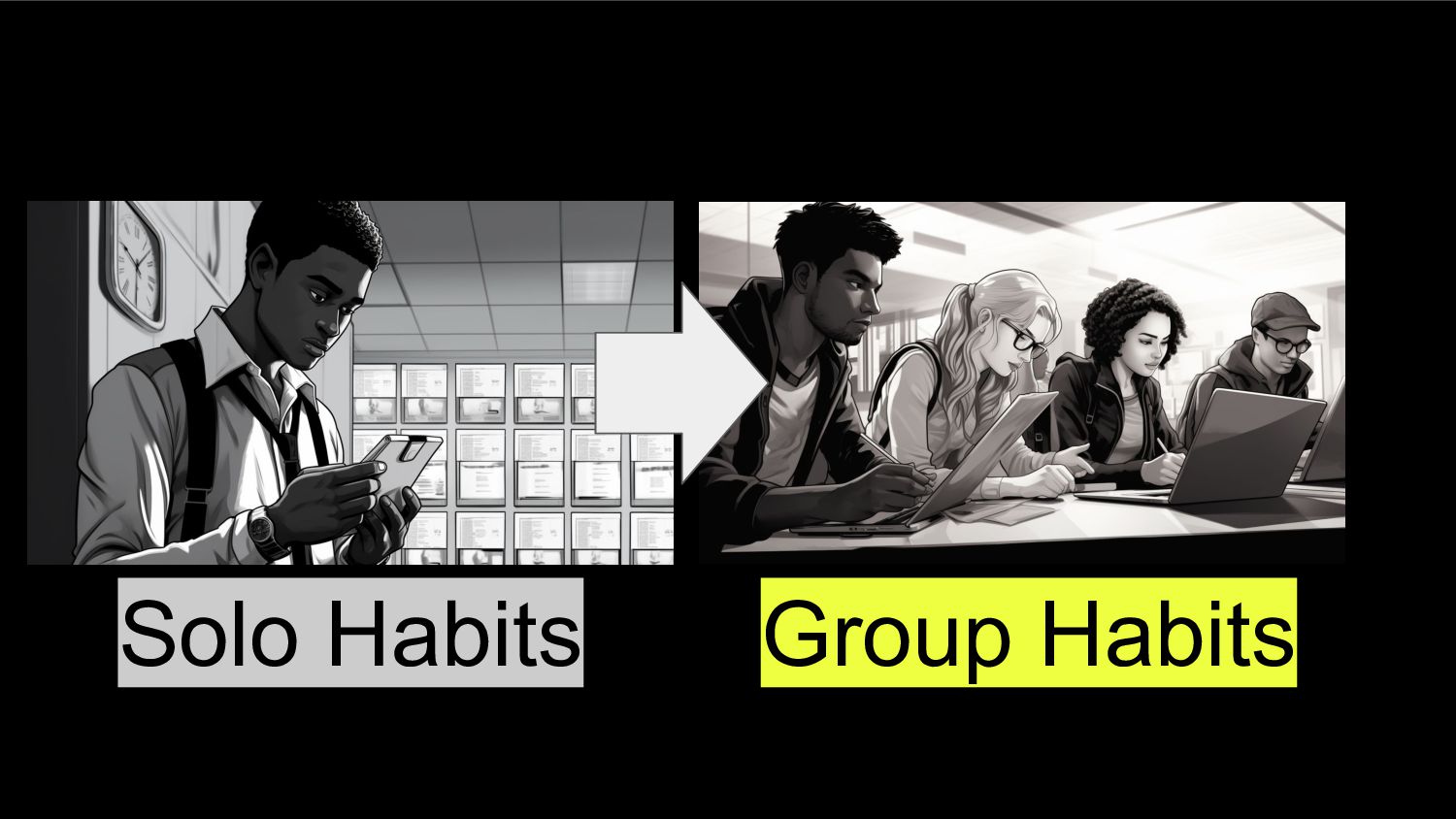
The next one is solitude. I think this is a huge thing that's impacting companies where for a lot of there's a lot of talk about solo habits like, okay, when everyone's ready, go and add your lines to the dock. And you know, you kind of see people get in the dock and you see their little avatars in there and you're like it's it's very very lonely.
There's a lot of solitary habits that we're creating in companies just due to async work or remote work. You cannot underestimate the value of engaging us, the social network within your company to encourage these things. Like if you ever been to a hotel and you saw the towel thing and they said, eighty percent of customers do not use different towels every day.
Well, you go and you start to, you know, you reuse your towels or you're in a study group or you're in an exercise class, all these things, making these things social really, really, really help. So anytime you can get multiple people together to do it is a bonus.
And I think the final thing is, yes, it's real work. A lot of these interesting practices and interesting habits, people treat them as these New Year's product resolutions, and they say, we're gonna try this thing about sitting in the support queue and then you say, well, can you show me everyone's performance reviews?
Can you show me how many people actually motivated to do that? Nothing. And meanwhile, you know, so the reality is in most companies, you know, the sort of We ship x, we ship y, and you demonstrated impact here and that takes up a majority of the things.
But I would say it's amazing what you can do if you're a leader in the audience and you add one line into your leveling or whatever you're doing that says engages the team in like productive celebration. Like, we should savor our wins, and I wanna see that from you, engineering manager, or I wanna see that I used to be pretty like no it's not just incentives because there's a lot more to it, but it's pretty important to these things.
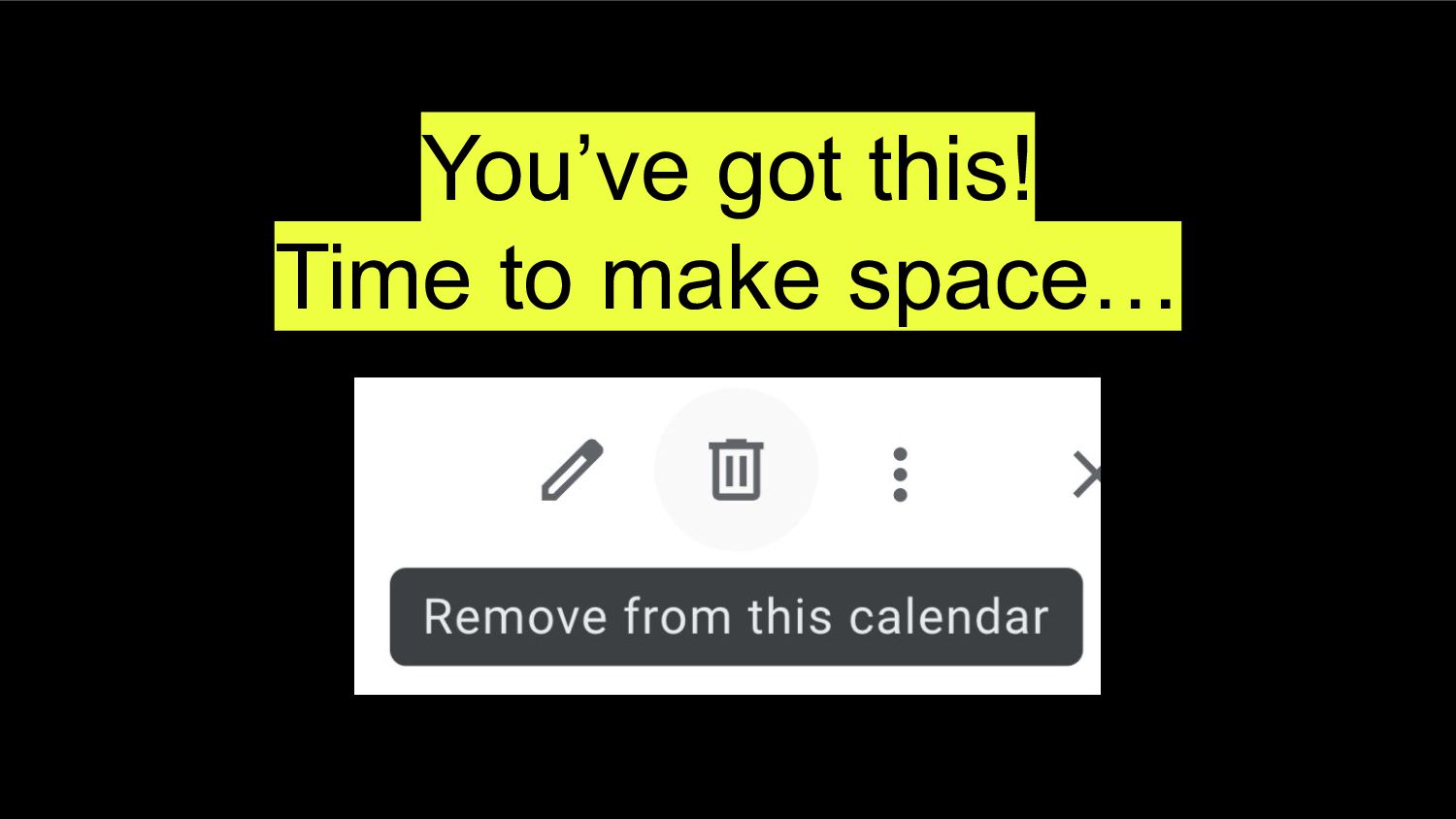
Okay. So in the last two minutes, this is the moment you've all waited for. So he's gonna is someone gonna do it? Someone volunteers let it out. Ready? Can someone delete? I if I could get one person to lead a standing meeting. That's all that counts.
Maybe even two. Maybe one or two. Let's make it a social activity, a social questionnaire. One standing meeting. One, can I just get one person to do it? One meeting. One shout out when you've done it. Come on. Come on. Come on. One meeting.
You did it? Did you? Yes. Okay. Two. Oh, we got this thing. It's good. I realize now that you're on this like fancy trip to go to a conference. It's probably not the best time to be like canceling all thirty five instances of watermelon chart meeting five, inspect the orange items.
But you get the idea. This is something you can do later. I really appreciate chatting with you about this stuff. You know, really the message here is we're just awash in frameworks and awash in people telling you how you must work. To be good at this.
And when you boil it back and you're dealing with people, you know, what we are doing on a day to day basis is probably the real indicator. The actions that we're taking in our environments are the super powerful things, and that's what you should try to make happen.
Thank you so much.