
Humans release billions of tons of CO2 into the atmosphere every year, global temperatures are on the rise, and greenhouse gas emissions are hitting new highs every year. COVID19 may have curbed GHG emissions for a while, but are now on the rebound. Despite the facts and alarm bells ringing loud and clear for swift action, much of the world seems to have adopted a business-as-usual stance. Turning the tide on climate change requires urgent and deep societal change, and for everyone to pull their weight - starting with corporations. The tech sector alone is responsible for 3-4% of the world's greenhouse gas emissions. If it's part of the solution, it is now also clearly part of the problem. When it comes to something as devastating as climate change, where do you even start? What can tech companies do to begin their own sustainability transformation? And what kind of concrete measures and actions will help drive meaningful impact? Join Guilhem Isaac as he discusses the role of tech in building a more sustainable future, and how he's helping one tech company become part of the solution.
Guilhem Isaac-Georges - Self-Awareness And Responsibility: The Role of Tech in Sustainability Transition

Auto-generated transcript - may contain errors. Tap a timestamp to jump the video.
Hi, everyone. So I'm Guillem. I'm working for ConanSquare. You maybe heard about this company. And just one funny thing about why I joined this company. I first met this guy. His name is John Serkey, he's our CEO. That was in twenty sixteen in New York.
He was on a trade show and he was just trying to sell and to make demos like catching people, you know, in the corridors to make a demo of its product. And I talked with him and he told me that in the next ten years, this company will become the next sales force of the UX design.
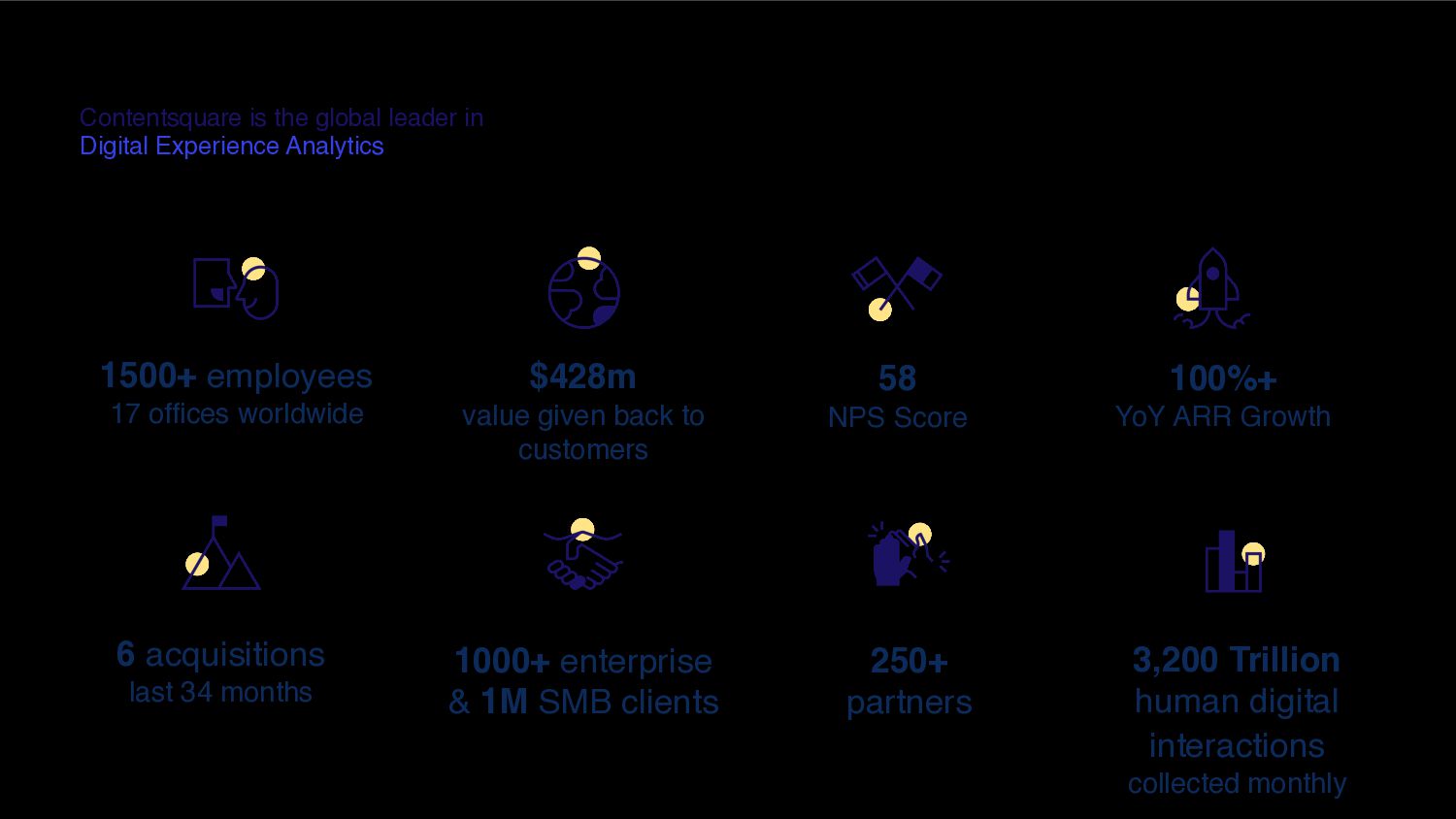
I was like, okay, this guy is probably crazy. And well, six years later, this company is here and maybe you heard that last week, we just closed a new round in funding of six hundred million dollars in total, it makes it one point four billion dollars in funding and evaluation of five point six billion dollars.
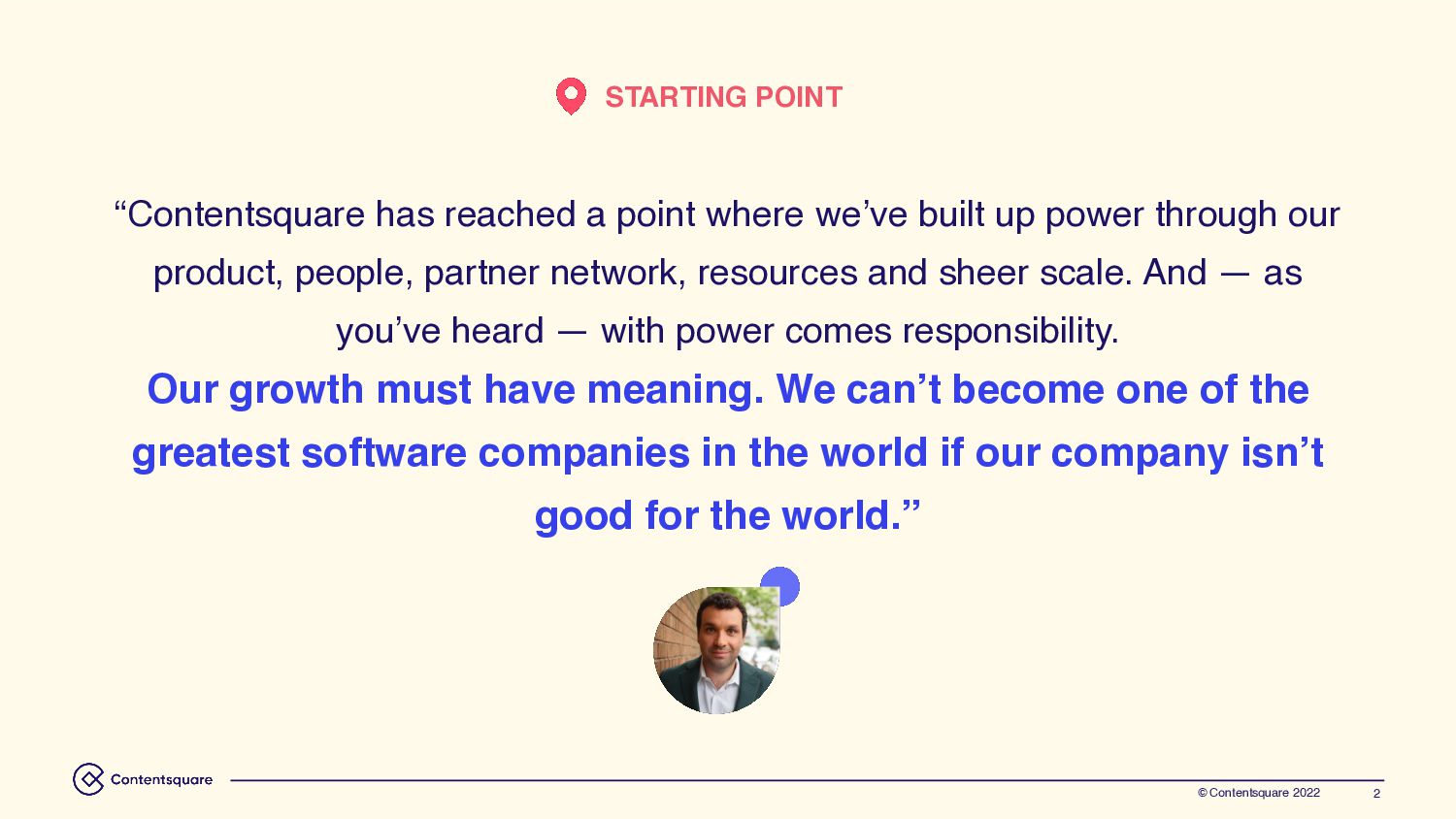
So I started to trust this guy to say, okay, you're probably a serious guy. So John called me six months ago and basically he said me something like this. And I said, okay, go for it. We're gonna make some great sustainability stuff at Conant's Square.
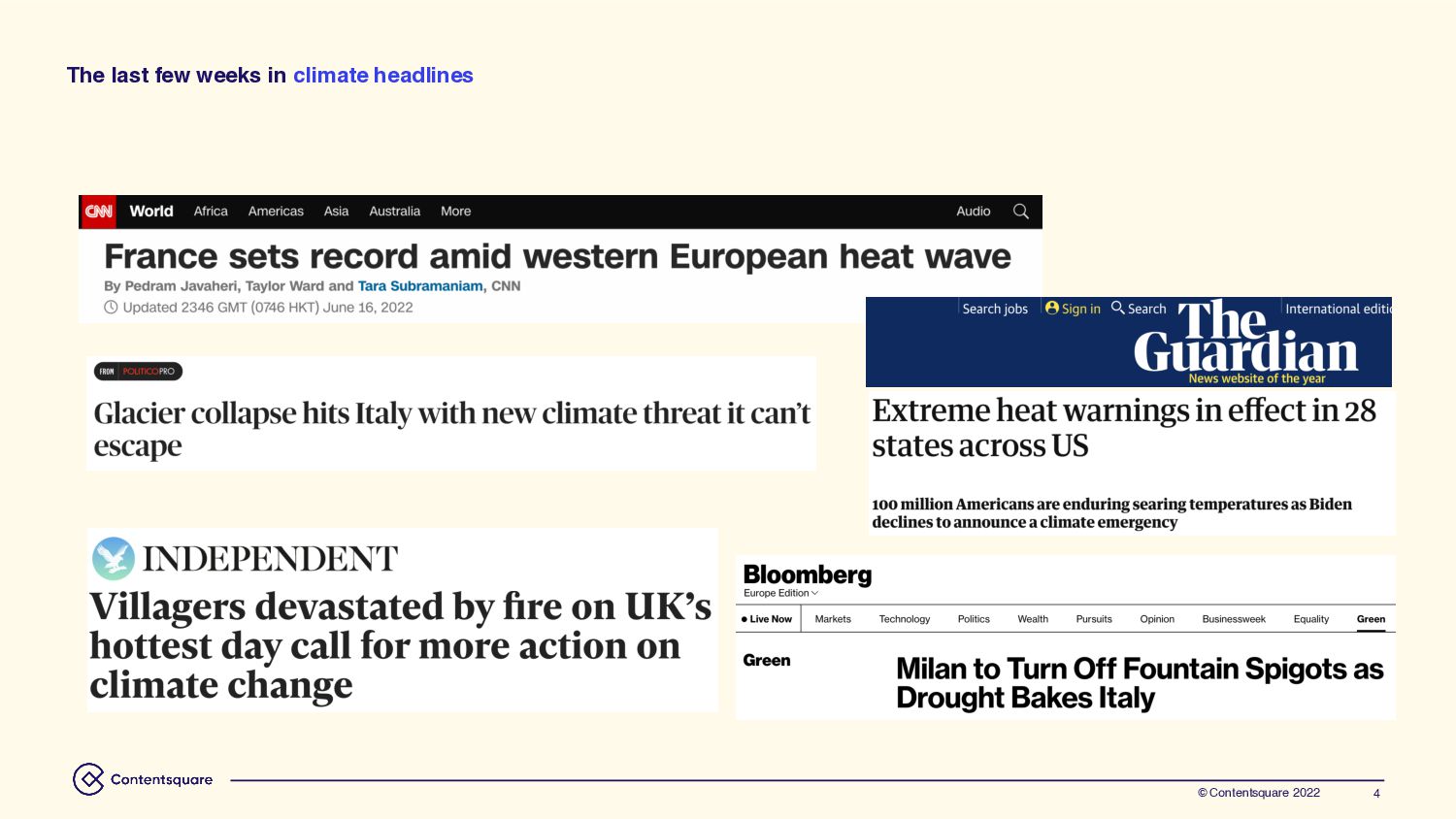
So let's turn now to the main topic of this presentation. If you watched the news on the last week, you've probably seen that you have really concrete effects of climate warming. Now even in the UK, I think you reached more than forty degrees for the first time in history.
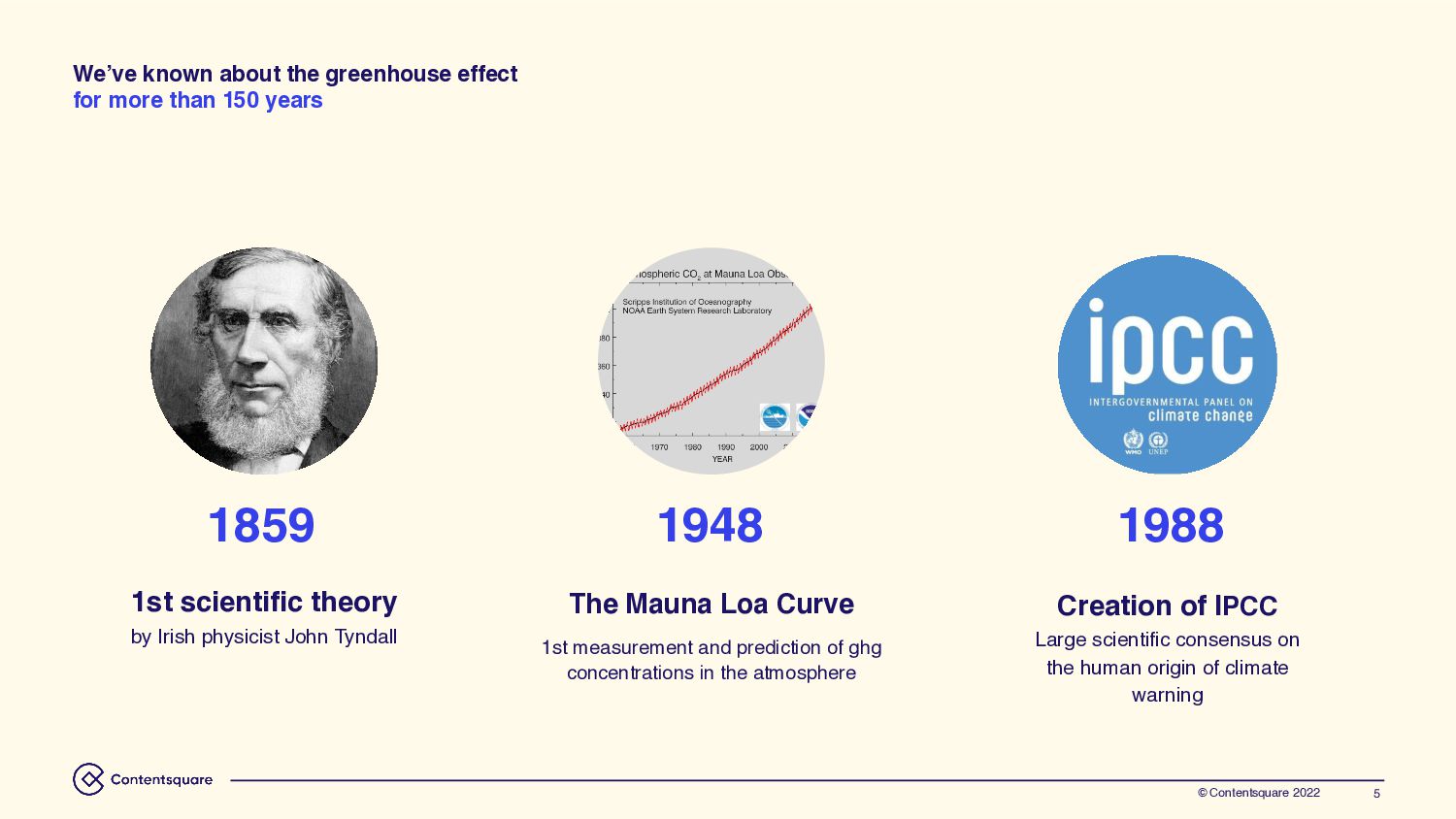
So that's important. Well, here you can see that we've known about the greenhouse effect for more than one hundred and fifty years. The first scientific theory was established by an Irish physicist called John Tyndall in eighteen fifty nine. Then you can see that in nineteen forty eight, the first scientists began to measure concretely the concentration of greenhouse gas in the atmosphere.
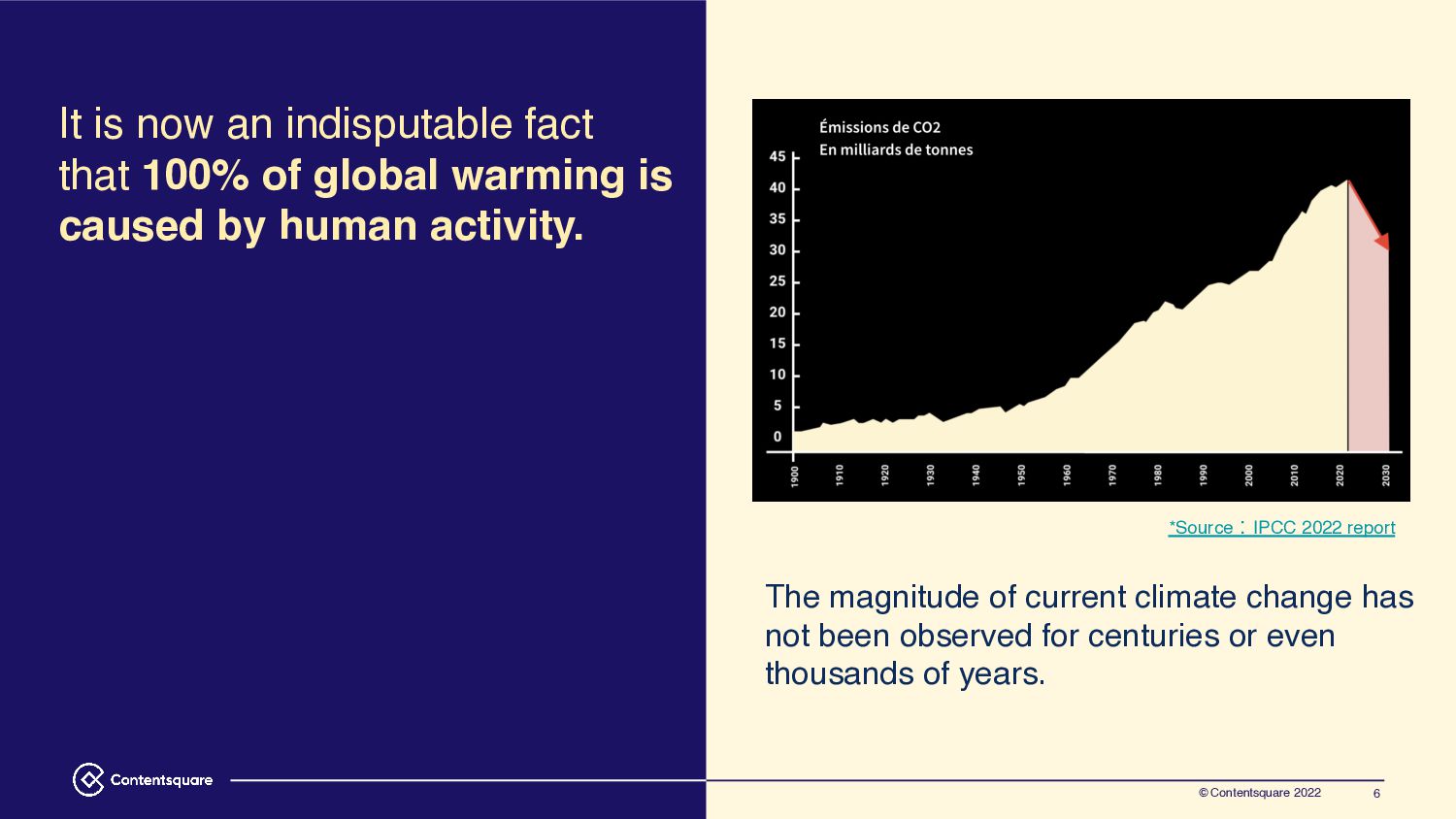
And they designed this curve, called the MonaLoa curve, to project those concentration of greenhouse gases in the atmosphere over time. And in nineteen eighty eight, there was the creation of the IPCC, so the Intergovernmental Panel on Climate Change, And this is the gathering of hundreds of scientists from different disciplines around the world, and they definitely stated that climate warming is now one hundred percent caused by human activity.
And you can see on this curve, which is quite similar than the one designed seventy years before, that the concentration of greenhouse gases are increasing extremely fast in the atmosphere. So what's the risk? The risk, I don't want to be too depressing, but the risk is definitely the collapse of the human civilization.
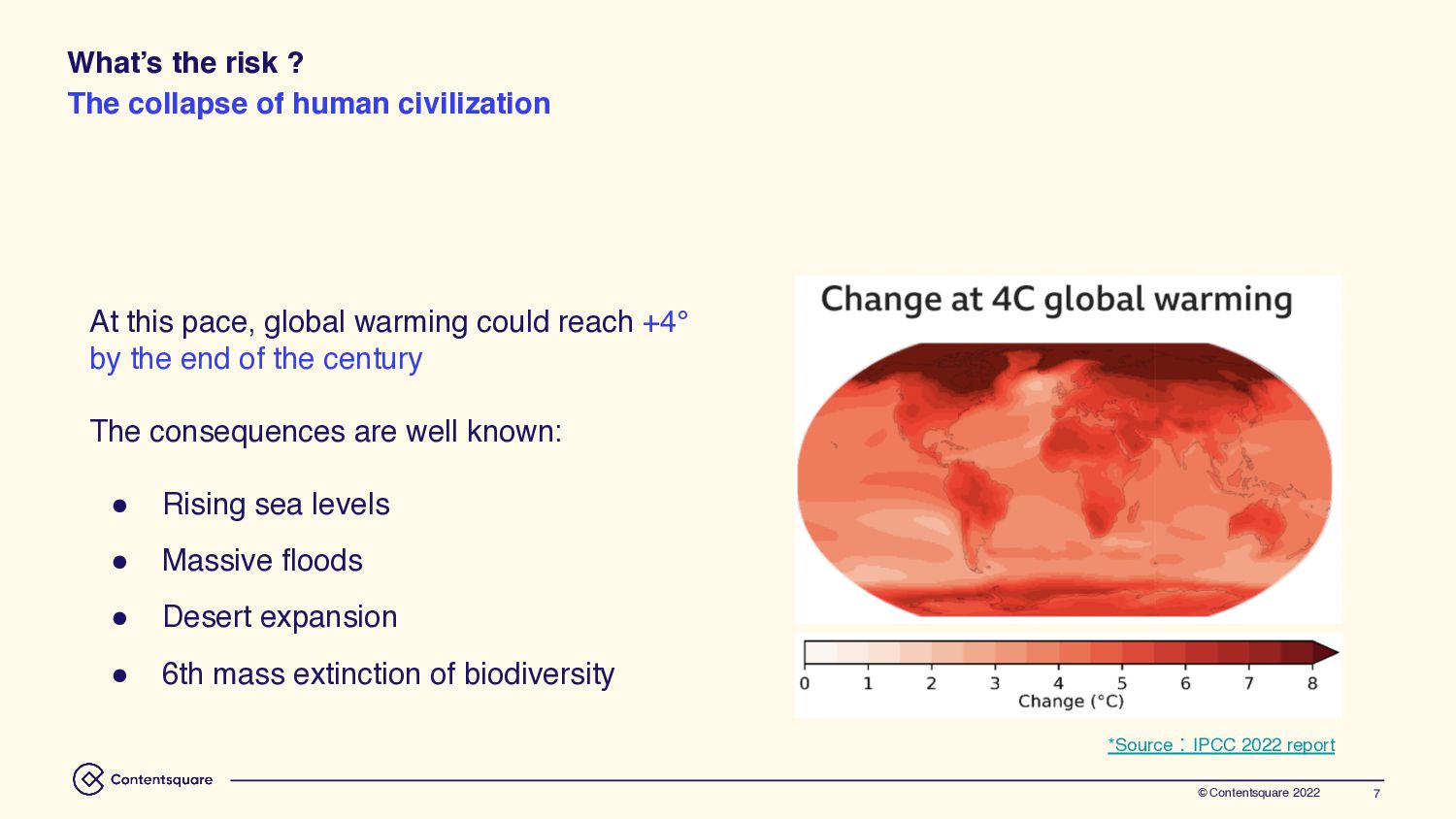
Okay. So you can see here that if we follow a business as usual scenario, we could reach by the end of this century a plus four degrees in climate warming. Consequences are well known. It's a rising of sea levels, massive floods, desert expansions and a mass extinction of biodiversity.
And you can see on this graph from the last IPCC report that climate warming will not affect different areas of the world in the same way. Northern Europe is particularly sensitive to really hard warming, more than five to six degrees. You may heard about this anthropologist called Jared Diamond.
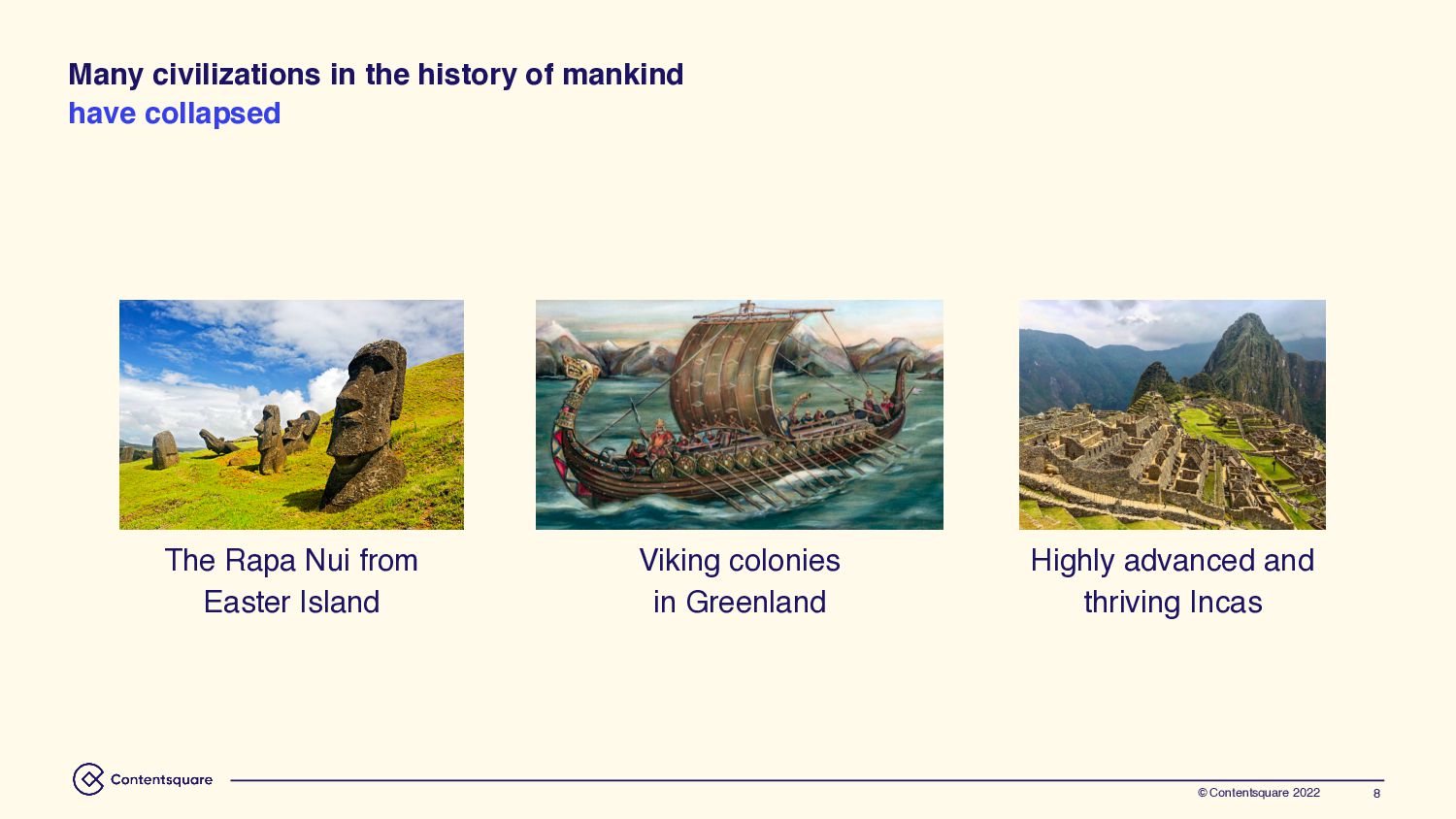
He wrote some really interesting books about how in the history of mankind many civilizations have collapsed. This is the case for the Rapa Nui, the civilization of the Easter Island, also for Viking colonies in Greenland, and also the Hinkas. And in all those situations, there were always an environmental and also a climate factor in this collapse.
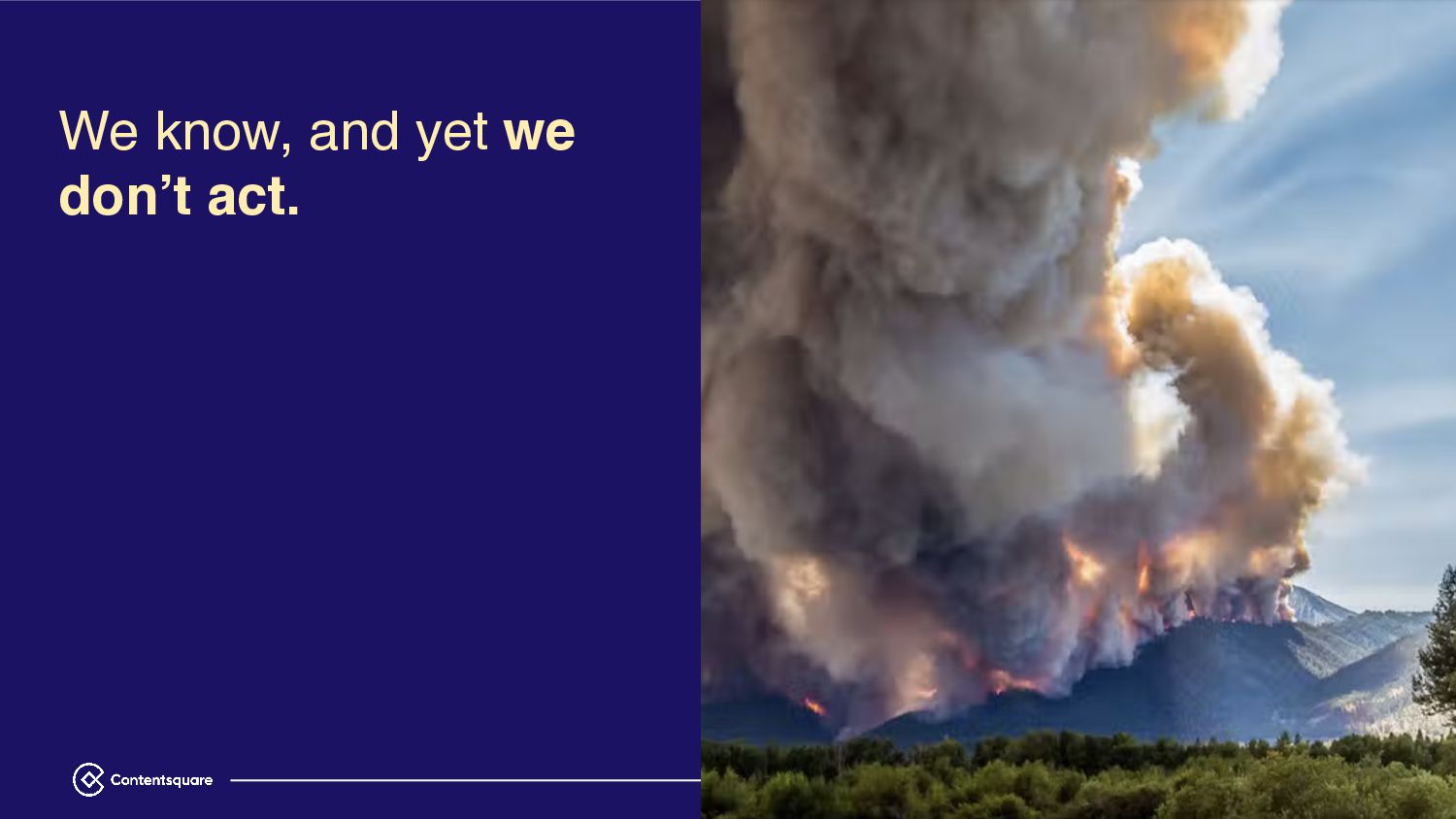
And most of the time, they used too much wood before nature could reproduce this resource. And we are doing exactly the same. So we know and yet we don't act really. So I've been wondering for a while why it's so difficult for us to change in regard to global warming.
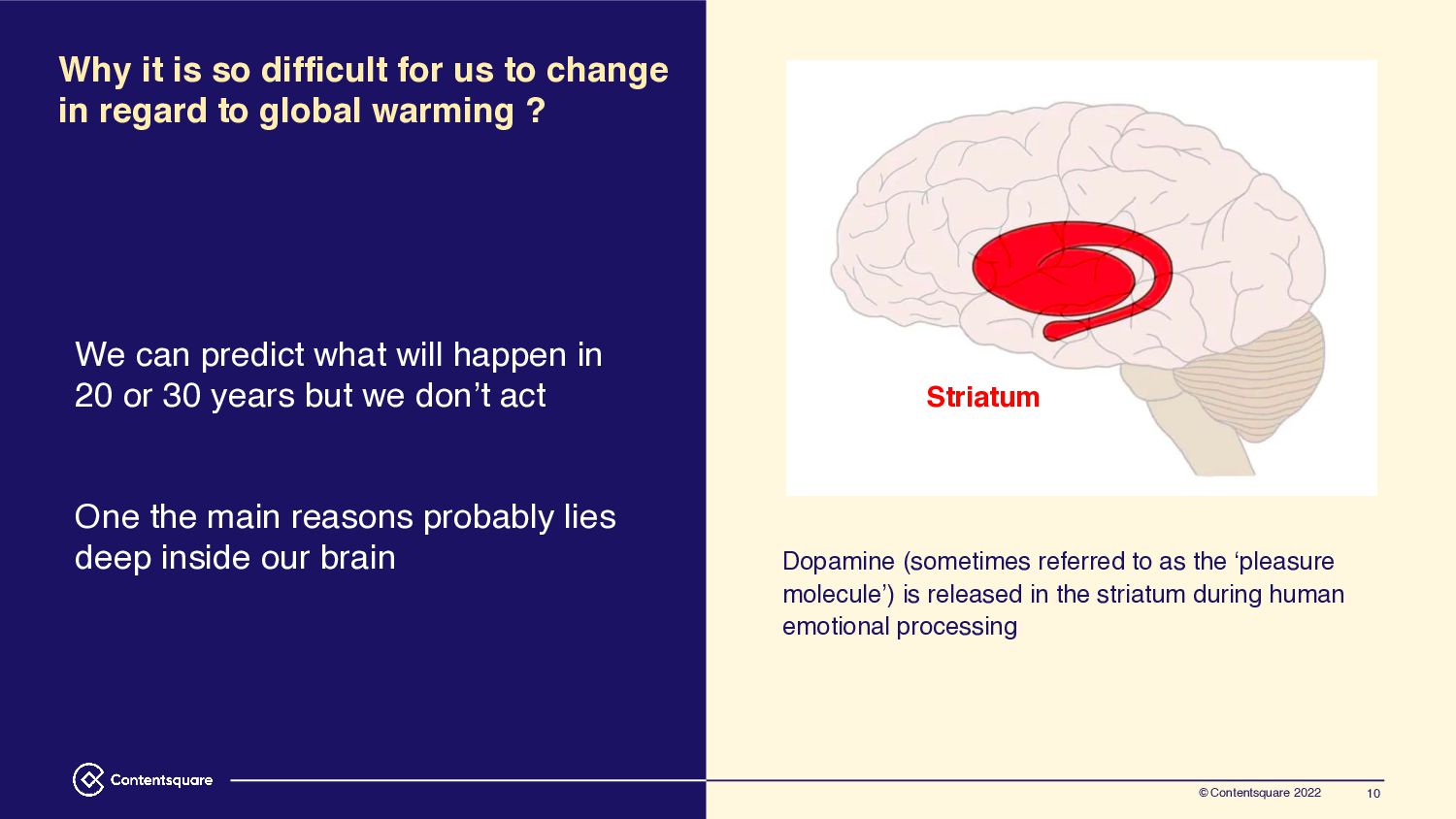
We can predict what will happen in twenty or thirty years very accurately now. And I read in twenty twenty a book from a French neuroscientist called Sebastian Bohler, and he claims that one of the main reason is probably deep inside our brain. You can see on this graph the striatum.
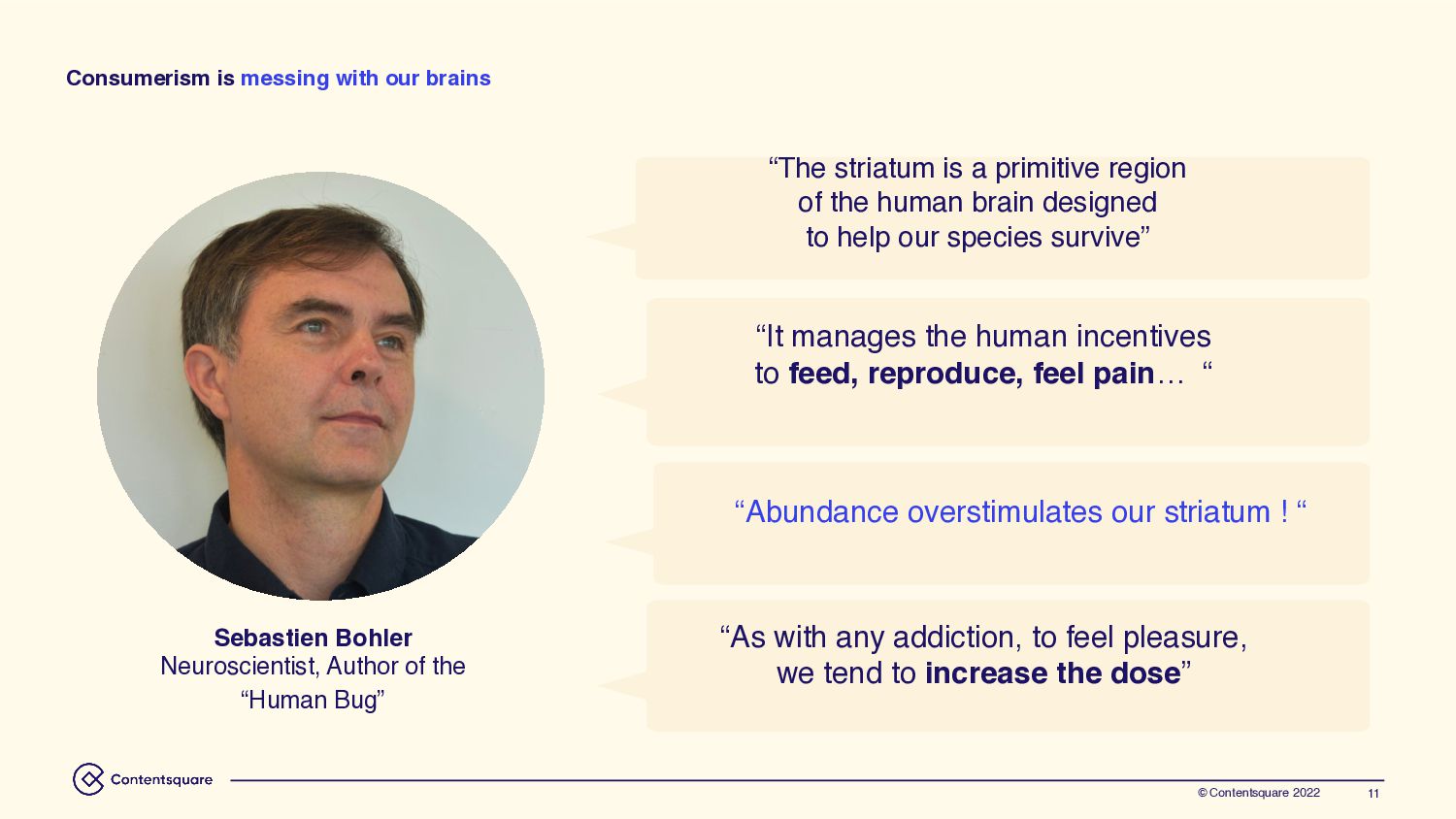
The striatum is a really primitive part of our brain and it's the pleasure. It's called the dopamine. It's called the it's managing the dopamine injection in our brain system. And dopamine is called the pleasure molecule. So Sebastien Baudelaire is stating that the striatum manages the human incentives to feed, reproduce and feel pain.
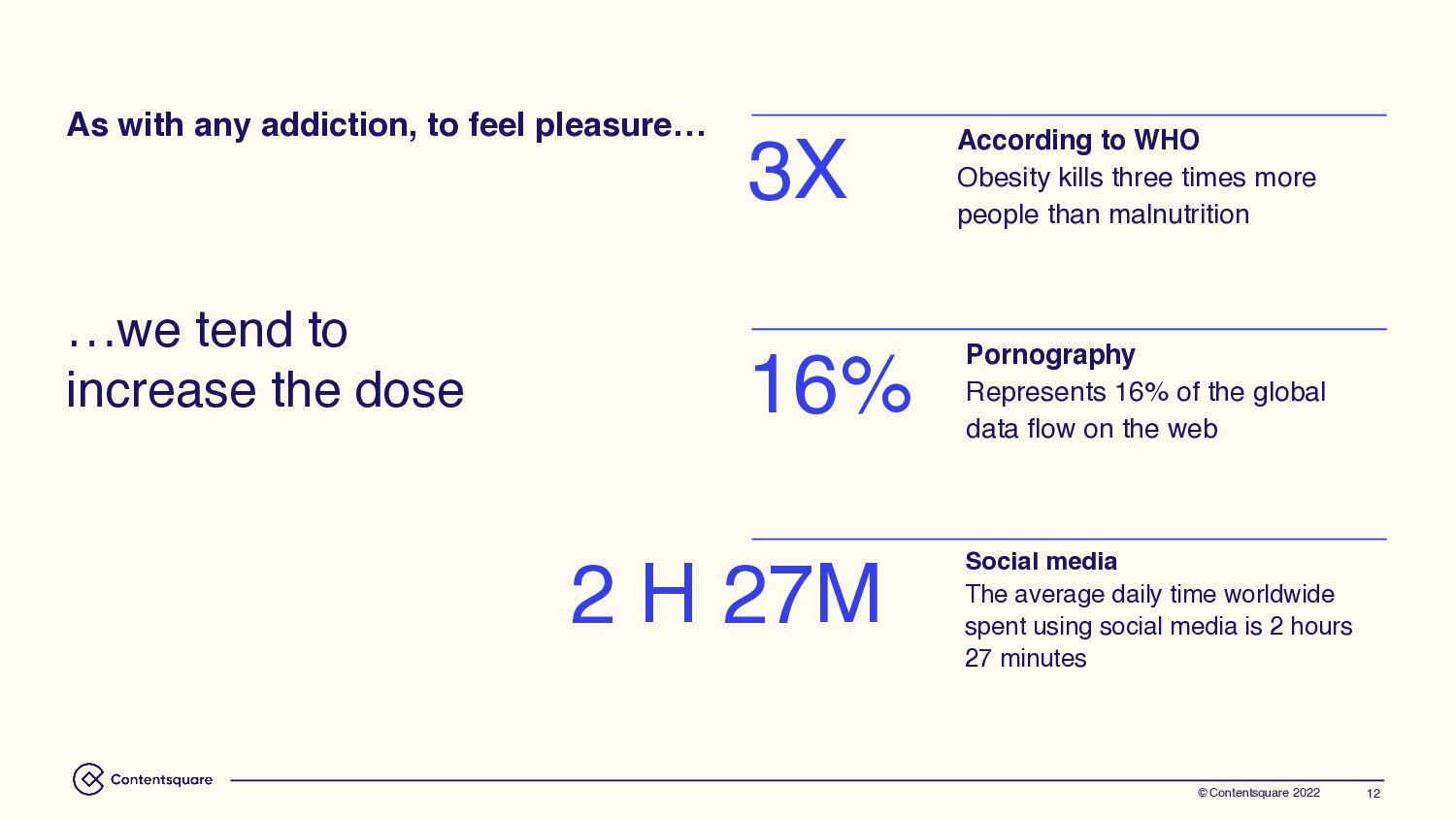
Basically, our striatum is probably one of the main reason of the human race success on earth. But today, with the abundance of almost everything, mostly in some areas of the world, but with this abundance, this is overstimulating our striatum. And as with any addiction to feel pleasure now, we tend to increase the dose.
Here you have some example on how it works. According to WHO, obesity kills today three times more people than malnutrition. Pornography represents today sixteen percent of the global data flow on the web, which is absolutely huge. Two hours and twenty seven minutes, this is the average daily time worldwide spent using social media.
Do you have an idea of what this average time was just ten years ago? That was five hours per week per week and that was only in two thousand and ten. Facebook, LinkedIn, Twitter were already existing. So what could we do? What is the answer?
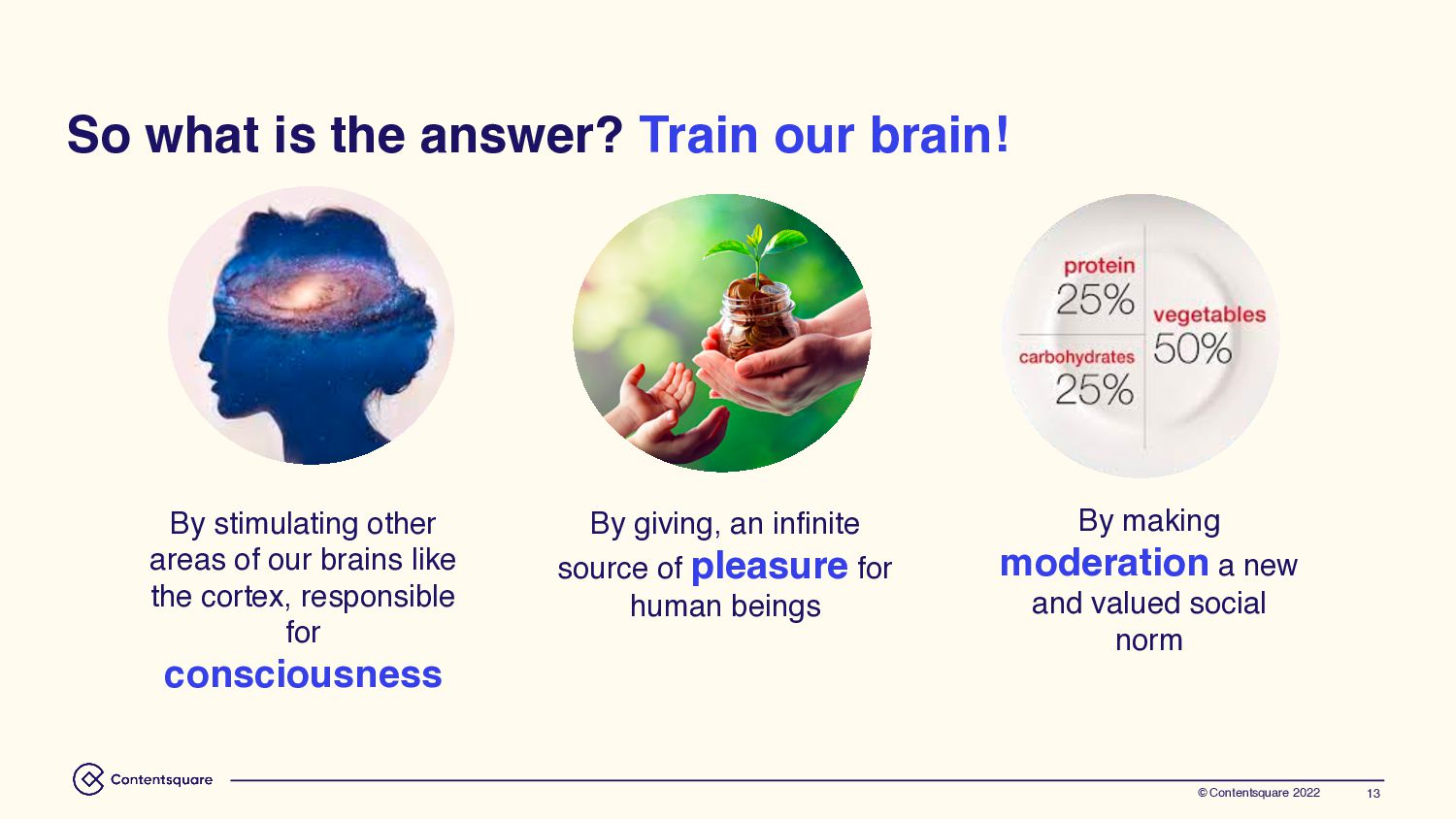
Probably train our brain. And how we can do that? First by stimulating other areas of our brains like the cortex which is responsible for consciousness. Also by giving which is an infinite source of pleasure for human beings. And also by making moderation and sobriety a new and valued social norm.
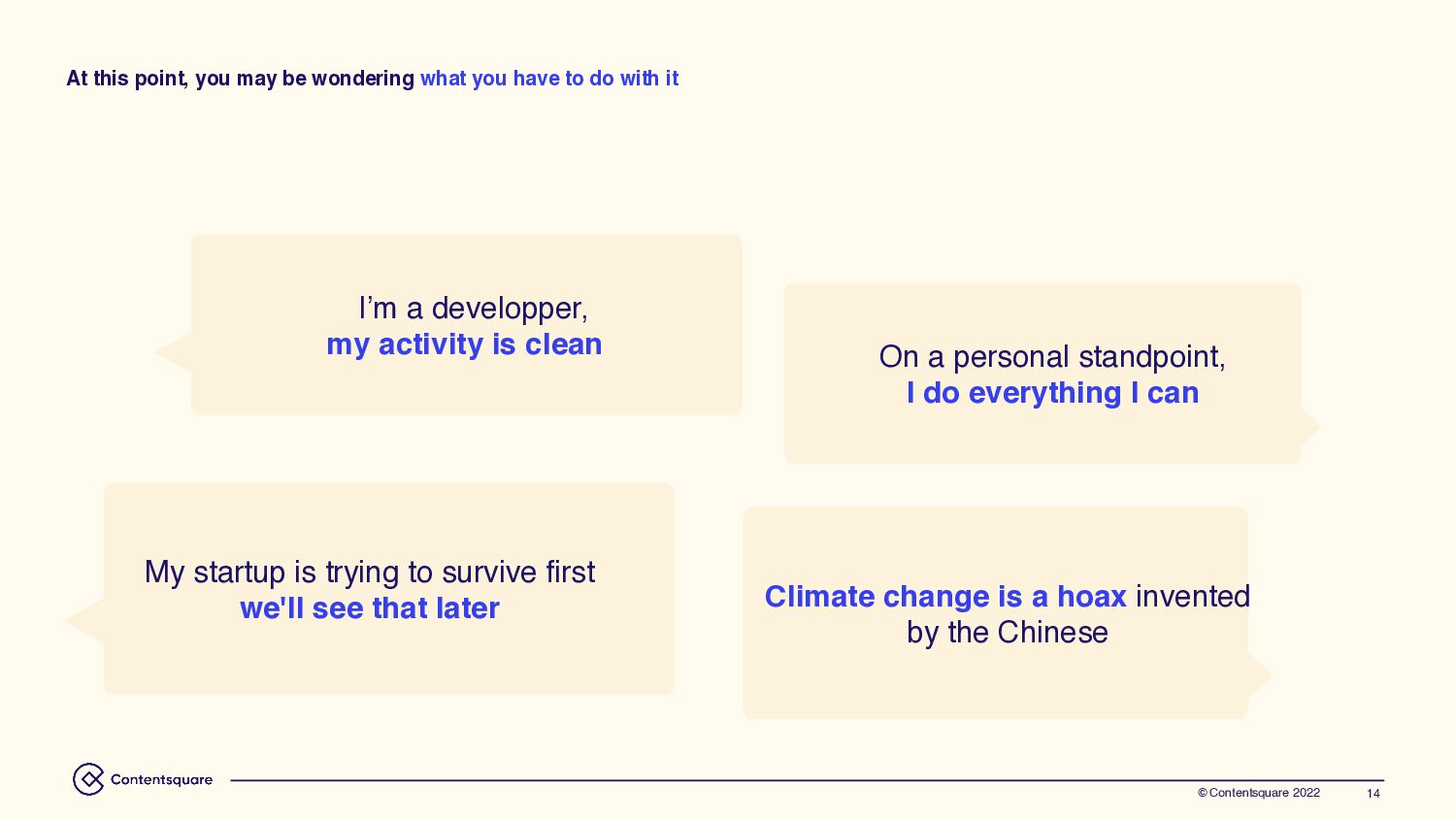
At this point, you may be wondering what you have to do with it. You may say that you're a developer and your activity is already clean. You may think that your startup is trying to survive first and that you will see that later.
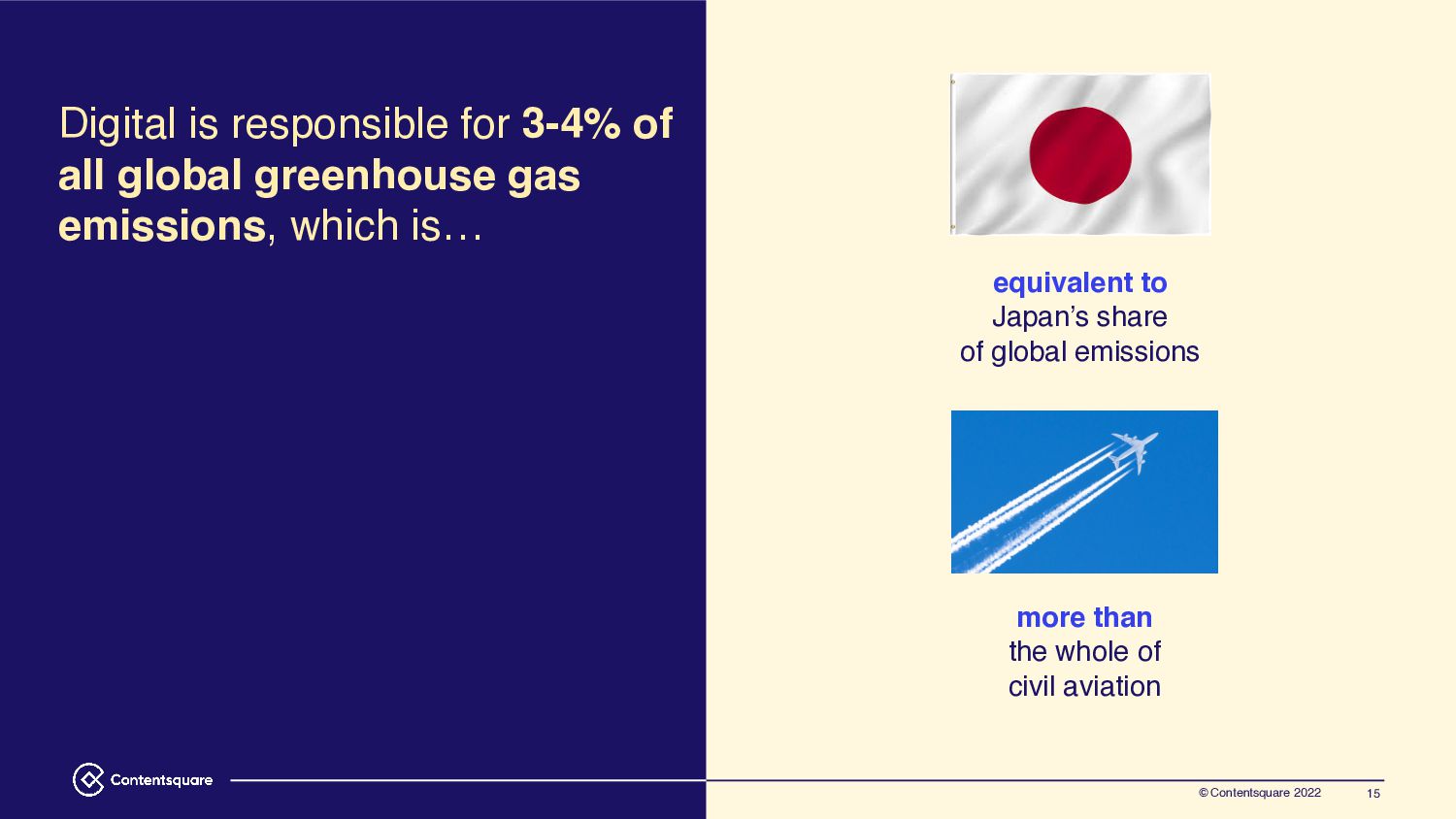
You may also think that on a personal standpoint you already do everything you can and maybe you believe your dummy cousin would state in the Sunday branch that climate change is invented by the Chinese. But that's not the case. Digital is responsible for three percent to four percent according to different studies of the global greenhouse gas emissions.
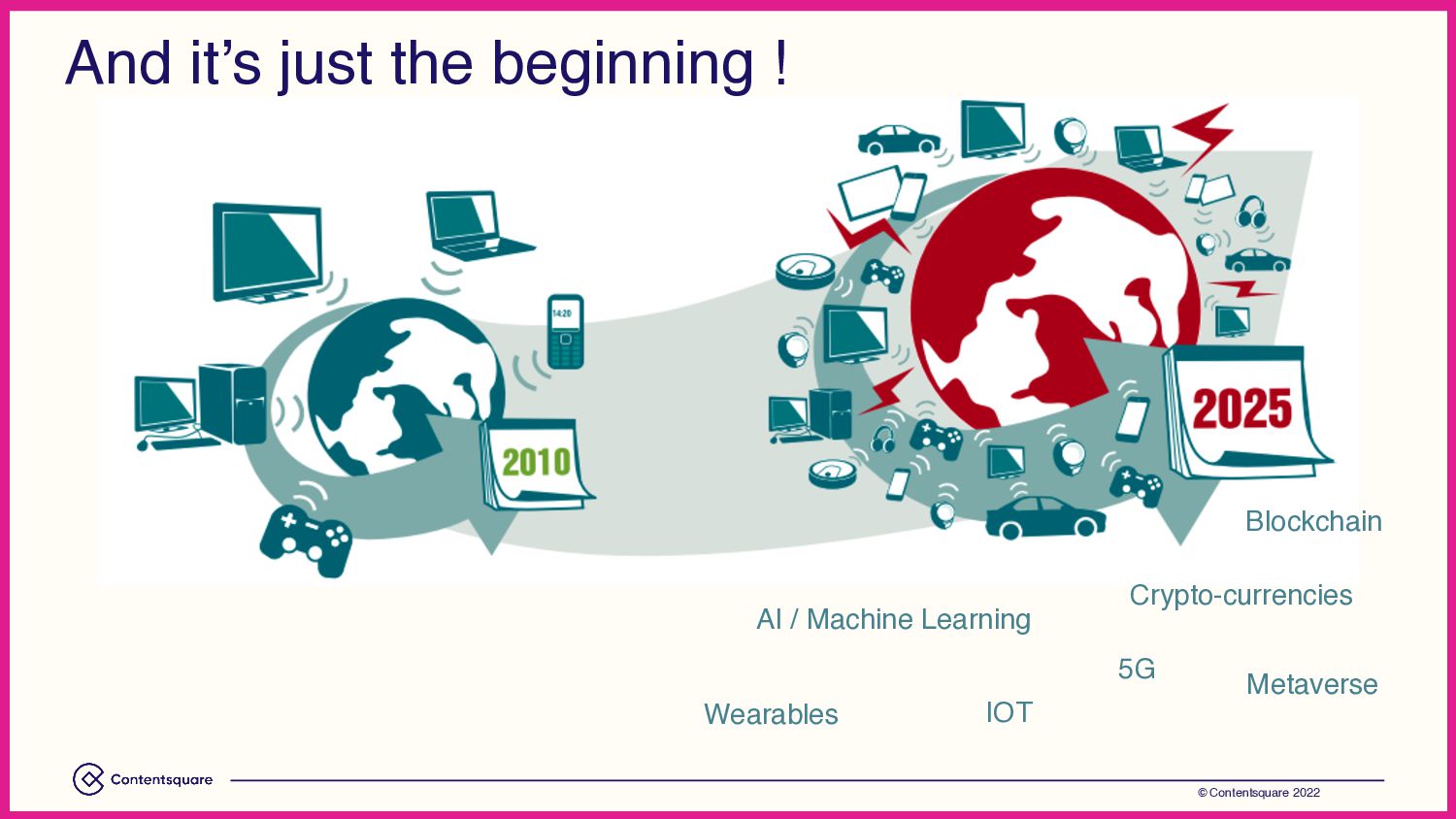
This is equivalent to the Japan's chair of global emission and this is more than the whole civil aviation emissions. So it's already huge. And the problem is that it's increasing extremely fast. We are seeing now new usage of digital industries like the blockchain, like the five gs, like all the IoT and this could lead to a share of seven percent in the global emission related to the digital in just twenty twenty five or maybe by the end of the decade.
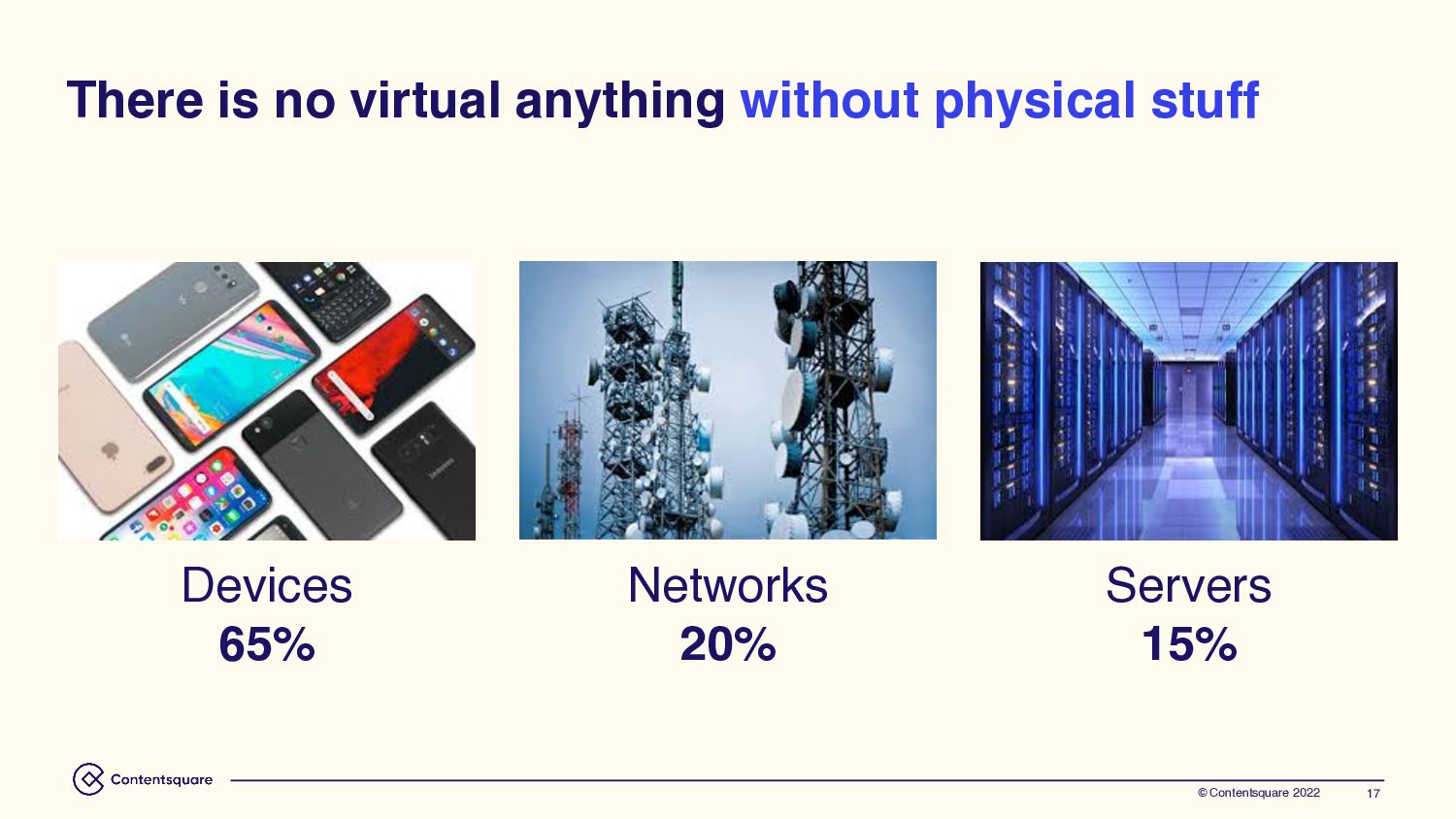
So that's one of the only sectors which is increasing that fast. And just to remind you, there is no virtual anything without physical stuff. All the digital industry is relying on the physical architecture. Here you have the share of the digital emissions for the different parts of this physical infrastructure.
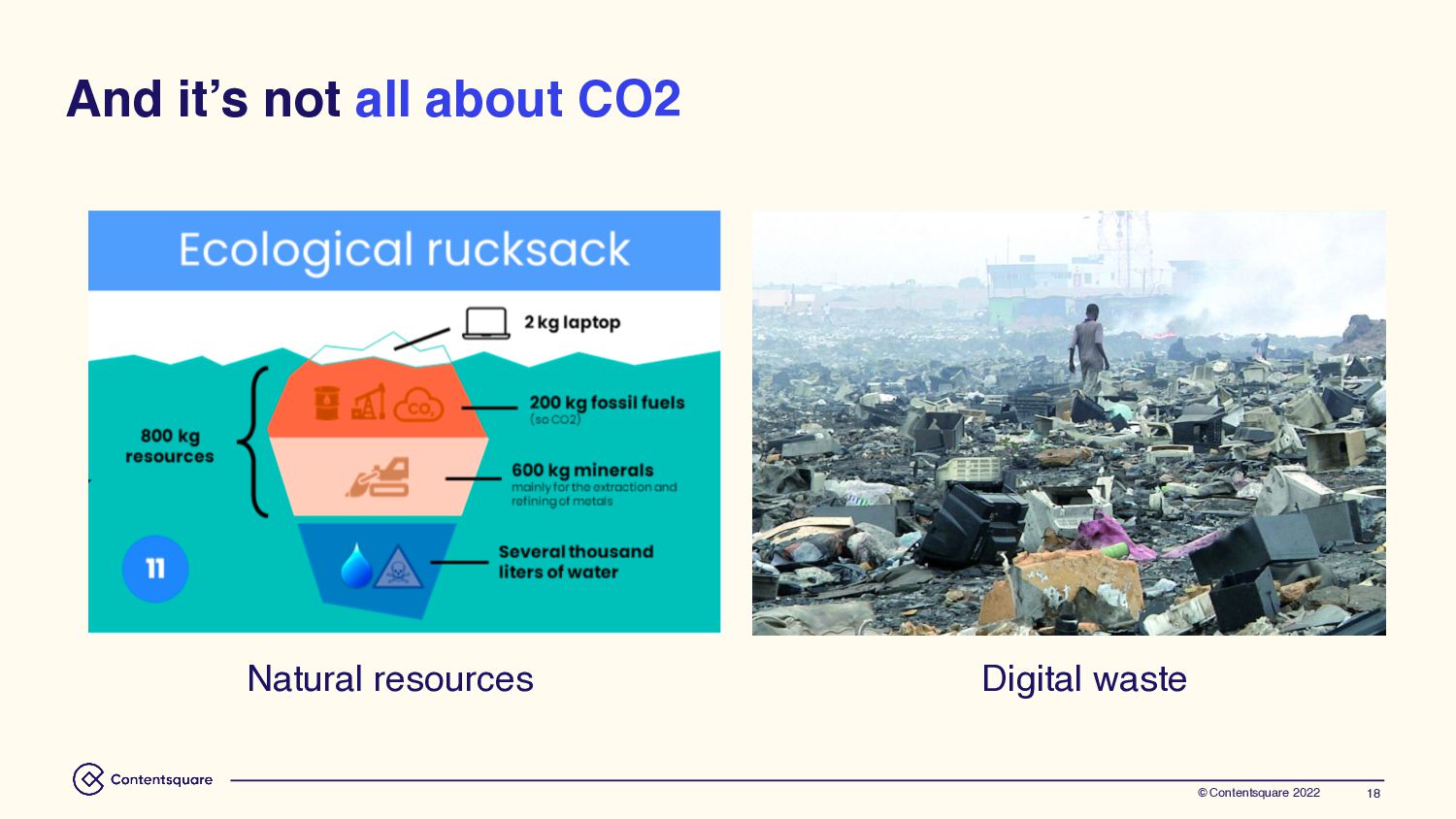
Sixty five percent for the devices, twenty percent for networks and fifty percent for servers. And it's not just all about CO2. You know, you probably heard about these statistics, terrifying statistics, that to produce a two kilogram laptop, you need eight hundred kilograms of material including rare metals and this kind of thing really hard to recycle.
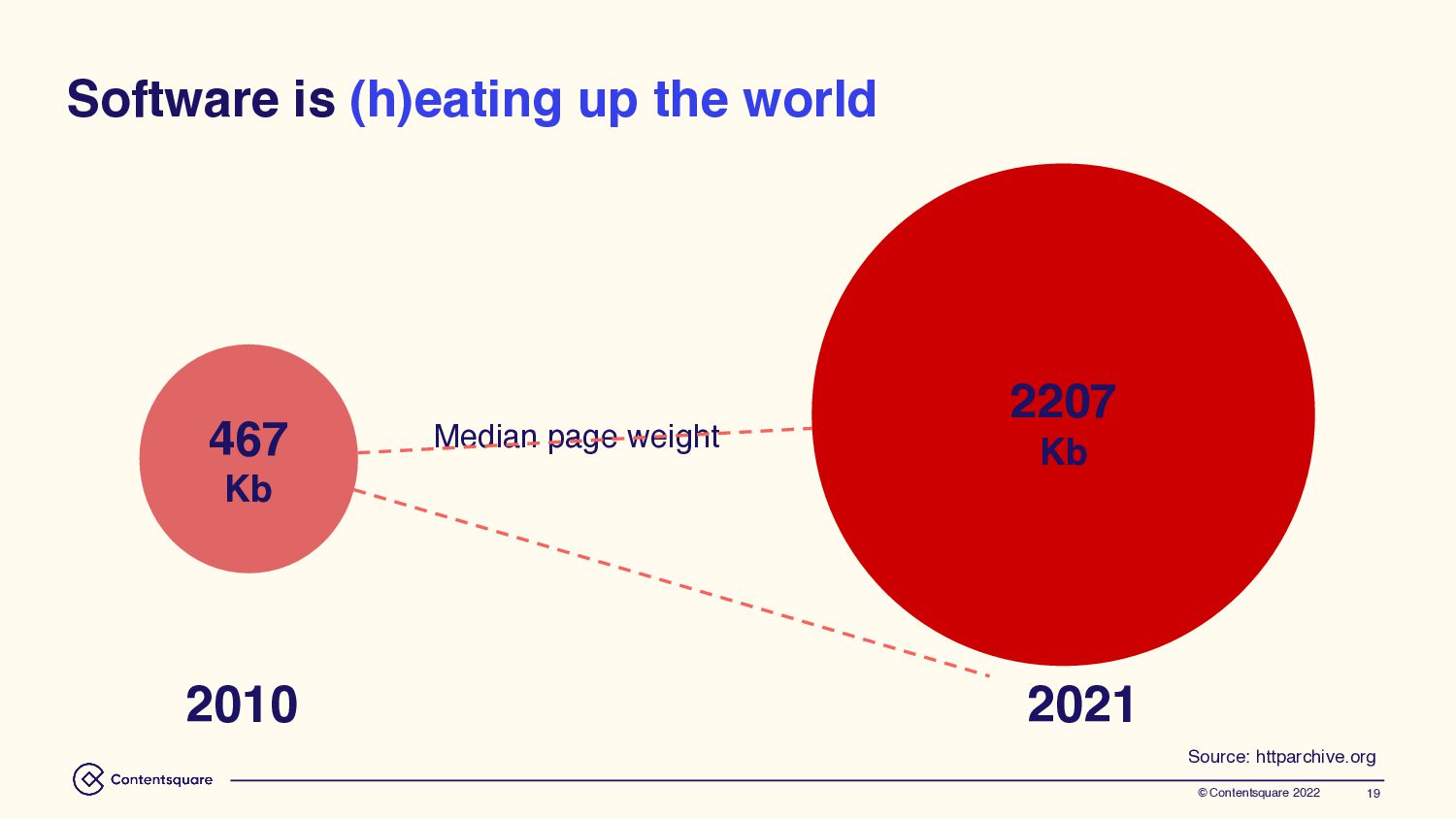
And it's also about digital waste. You can see on this picture a huge problem mainly in Africa, in Ghana where we export quite many old digital devices to be recycled and at the end they're not. Software is also part of the problem. You can see that just ten years ago the median page weight was around fifty kilobytes five hundred kilobytes, sorry.
And ten years later, it's more than two megabytes. So this has a really important influence on different things, on operating systems, on browsers, on the device obsolescence. So we really have to focus on this to reduce the digital footprint. This is quite a fun fact.
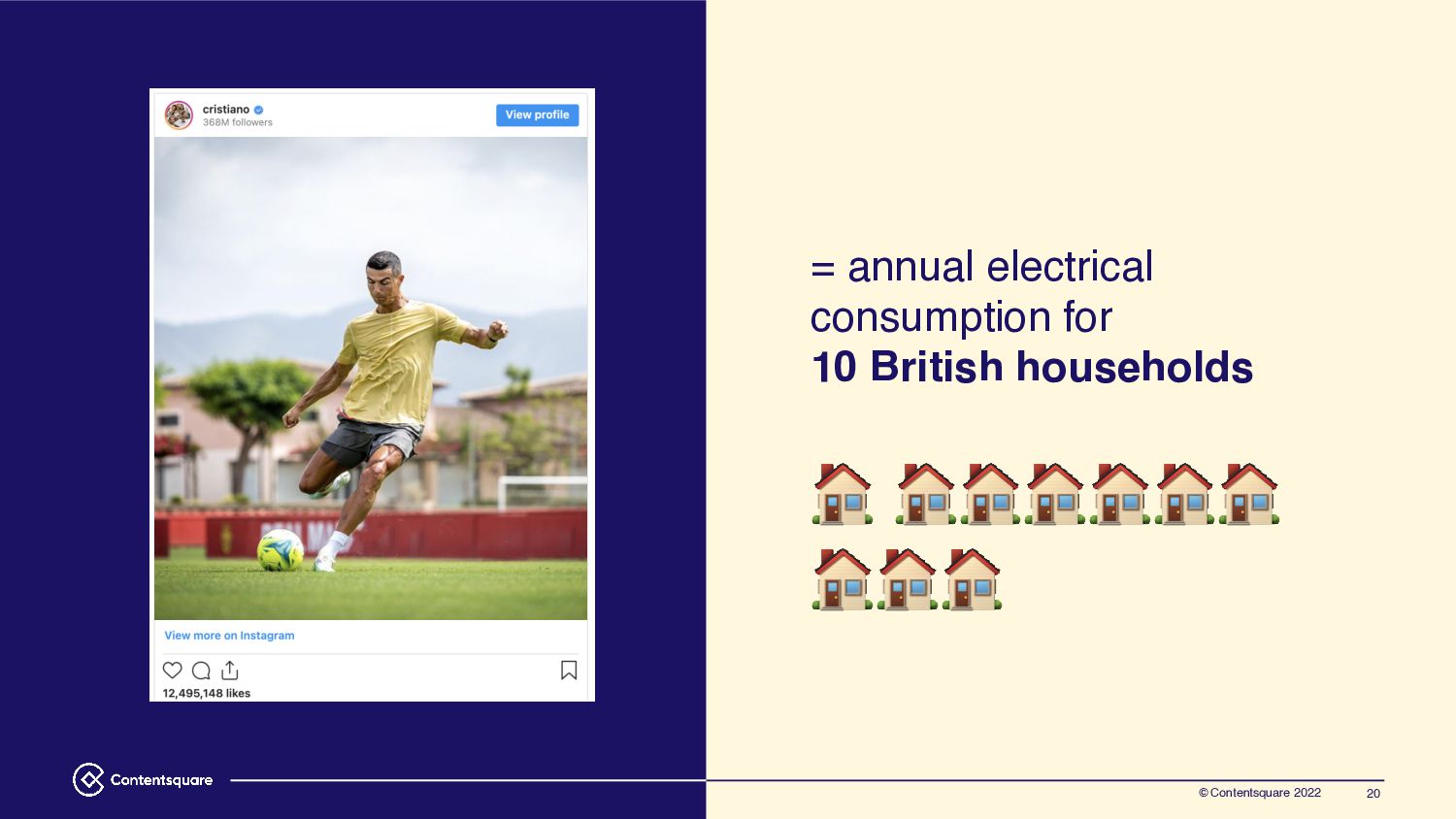
You know that Cristiano Ronaldo is the most followed people on earth And with this single post liked more than twelve million times, represents the equivalent of the electrical consumption for ten British households over a year, which is on a single picture. Okay. So let's turn now to what you can do with this.
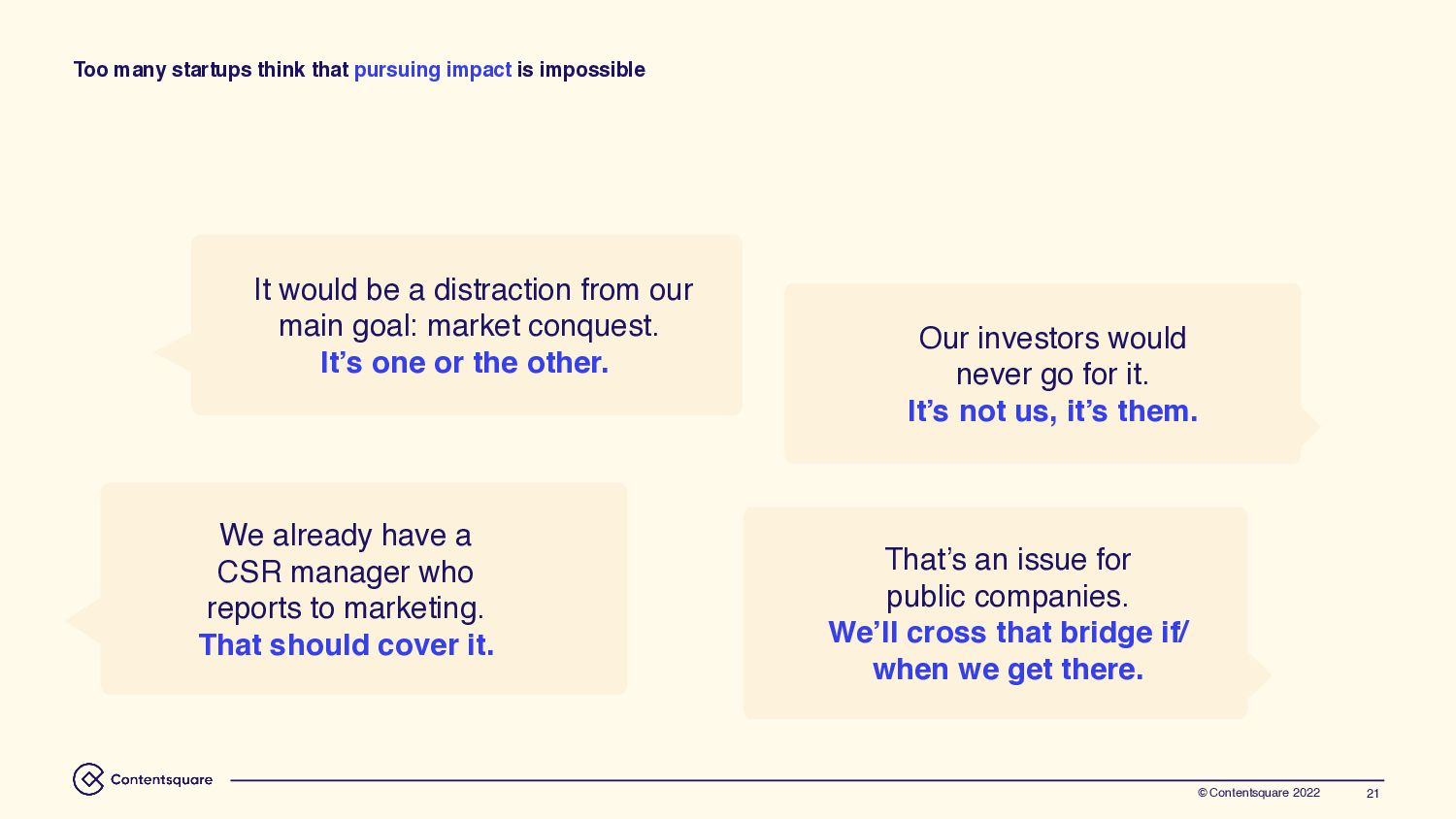
Too many startups think that pursuing impact is just impossible. Some will say that it will be a distraction from your main goal, market conquest, and it's one or the other. Others may say that we already have hired a CSR manager, we report to marketing, and that should cover it.
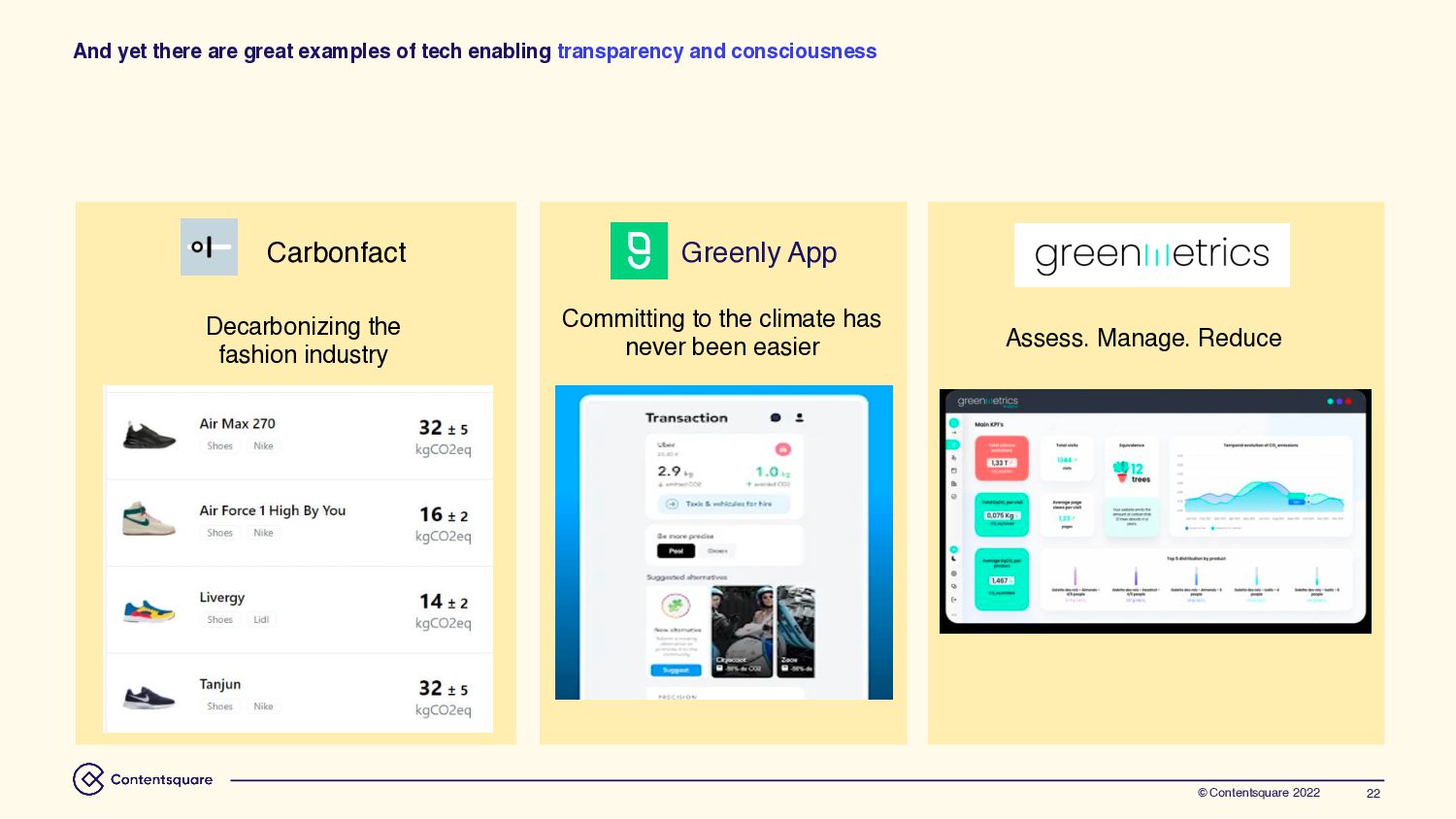
Others should say that investors will never go for it and others could say that's just an issue for public companies and we will see that later when we get there. But yet, there are some great examples of tech enabling transparency and consciousness. We'd like to stress three examples.
These are three French examples. Sorry about that, but they're good. So the first one is carbon fact. Those guys are collecting carbon data for started with sneakers. This is a great example. And they allow you to compare the CO2 weights of different sneakers models.
And you can embed their technology for all the e commerce sector. And they are growing fast and those guys are really, really smart. Second, you have Greenly app. Greenly started to measure the individual carbon footprint by analyzing your expenses. Basically, they are connecting the app to your bank application and they're screening your expenses and they multiply every kind of expense by an emission factor.
And at the end of the month, it gives you your score and you can see where you have consumed a lot of carbon and what you can improve. Last one is Greenmetrics. That's a startup that we're incubating at Conant Square. And they are analyzing the different ecological impacts of digital activities, of a webpage, of an application.
I know that last year at Turing, you had a great presentation from Izzy Smith from this company called Wright, and they do this quite well. And this is more or less the same perspective. They are using the same guidelines and the same methodology to analyze those impacts.
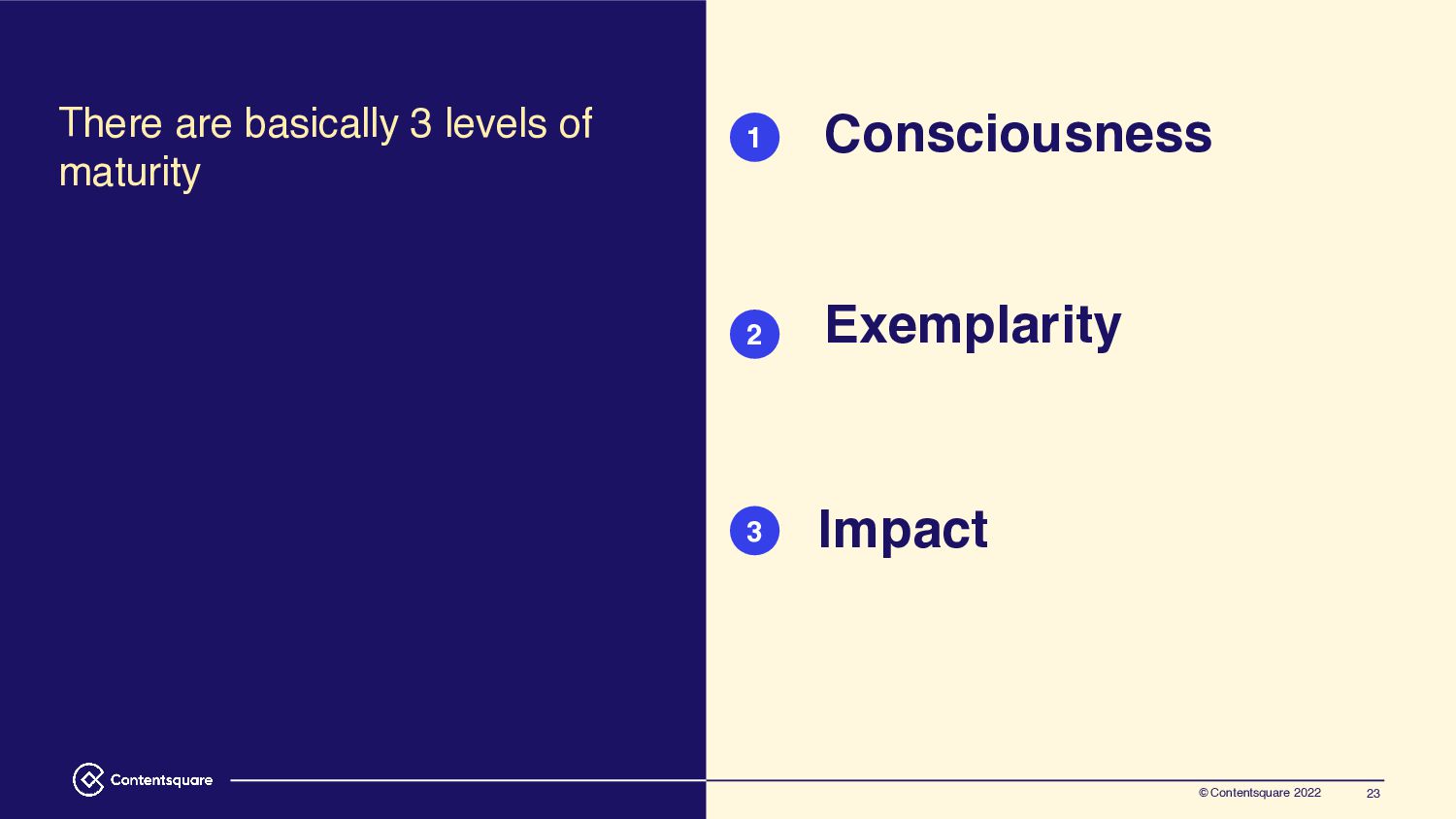
And that gives you a score for every single web page and every website that could allow users to see if they are on a committed website or not. And this is really useful for transparency. So, well, if you're not, let's say, an impact startup by design, There is for me three levels of maturity to become one impact startup.
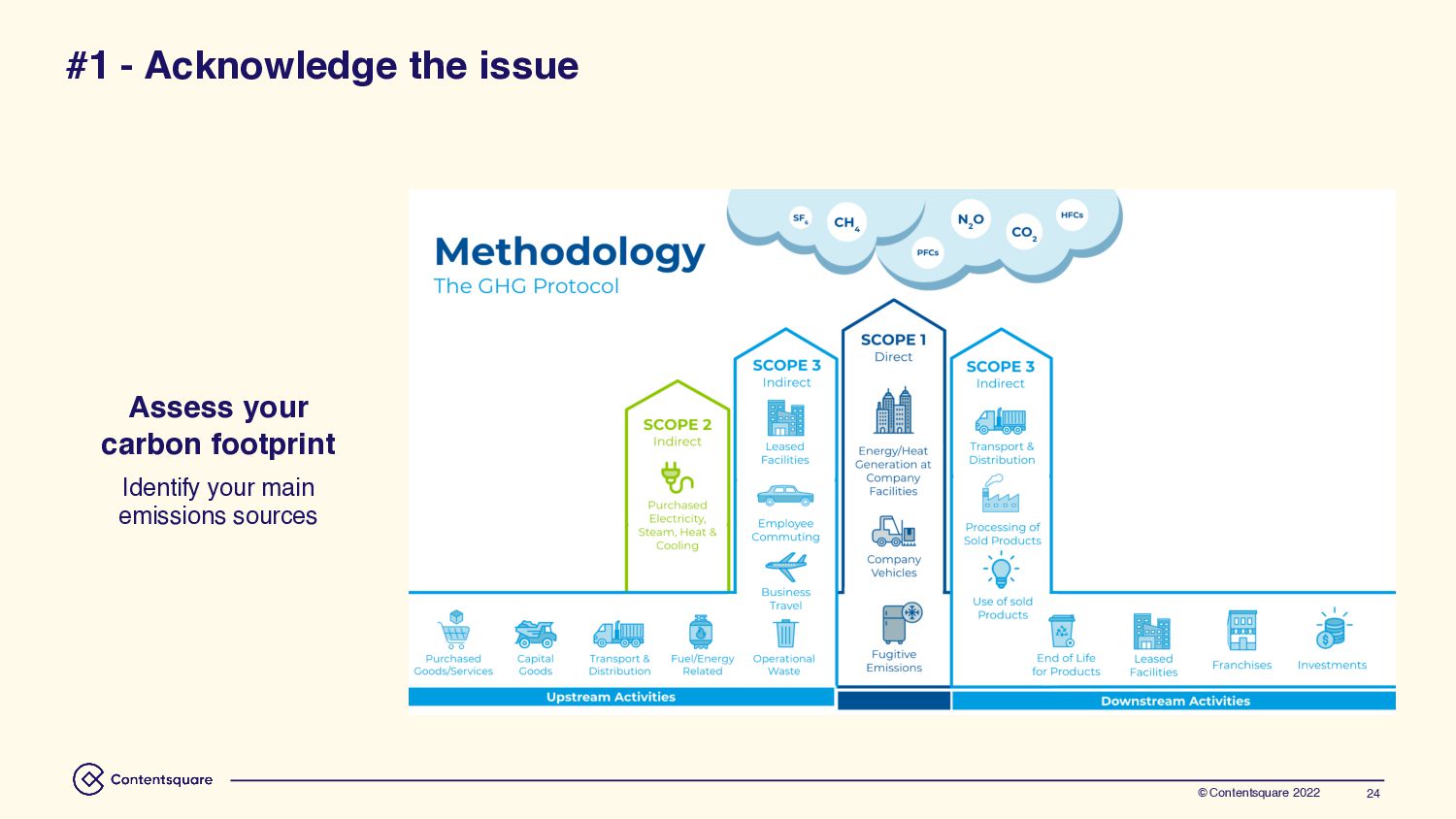
First one is consciousness, second is exemplarity, and third is impact. So first, you have to acknowledge the issue. First, of course, you have to assess your carbon footprint if you have not already done that. So you know that carbon footprint relies on a methodology by the GAG protocol, which is the relevant body to define this methodology and it relies on three scopes.
You can make one, two and three scopes. And if you want to go beyond, you can also make the scope three downstream, which represent the emissions of your clients when they're using your products. And this is also really interesting when you start to think about how you can help your clients to reduce their own emissions.
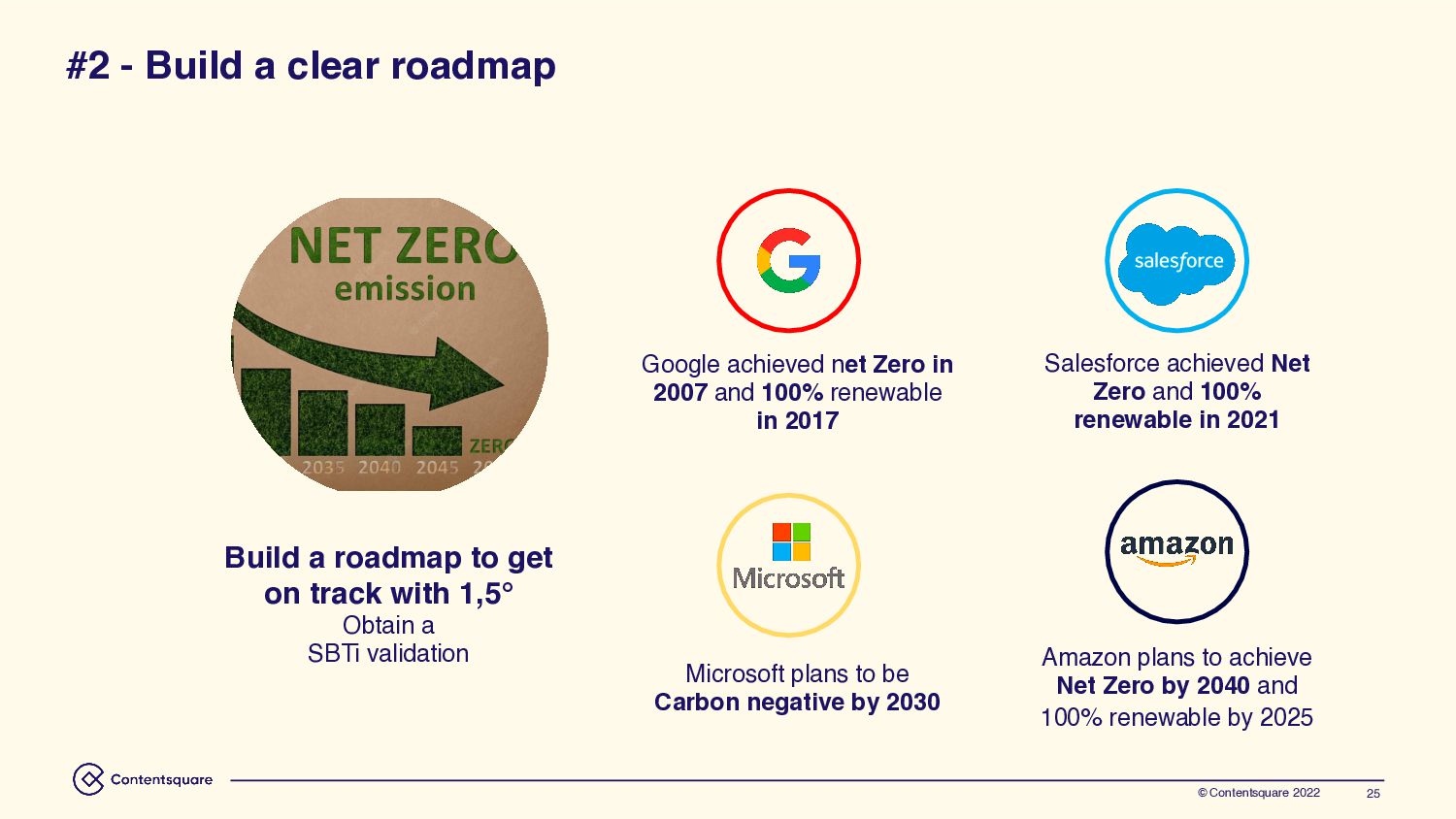
Second, you have to build a clear roadmap. So you can see here that now the market standard is definitely the net zero. Net zero means that you reduced strongly your emissions on all the scopes to reach just a residual emission that can be absorbed by the natural ways of storing carbon on the planet.
And you can help this by financing, for example, different offsetting projects like planting trees, reforestation, and these kind of things. So you have to set targets and you have to be on track to respect the one point five trajectory, which is the objective of the Paris Agreement signed in twenty fifteen at COP21.
So this agreement is the most widely signed international treaty and every signatory country has to publish national contribution to explain how they will reduce their emission and reach the carbon neutrality by the middle of the century. So by extension, all businesses have also to commit to net zero.
Third, try to use business as a driver. So try to identify solutions to help your customers to reduce their impact. At ConantSquare, we are investing on annual hackathon, which is really popular at Coneste Square because winners win stock options. So they're really keen to develop good projects.
So the idea here for us is, for example, to make evolve our products to embark new metrics. We have, for example, one product called SPILD analysis, which is basically measuring your download speed and tells you if you have two big pictures or these kind of things.
And you can imagine that every slow downloading is related to another consumption of energy and probably to extra CO2 emissions. So the idea is to embark a new energy and CO2 metric on this existing tool. But then we probably can have more great ideas to develop new products and features about this.
Fourth, you can try to go beyond, focusing on what you're good at. Every company has an expertise that could be mobilized to solve some problems of humanity. At ConantSquare, we think we're pretty good in UX design. And so we thought about it and lead to a conclusion that could be useful to mobilize this expertise not only to improve e commerce transformation rate but also probably to help billion people with visual disabilities around the world to access the web normally.
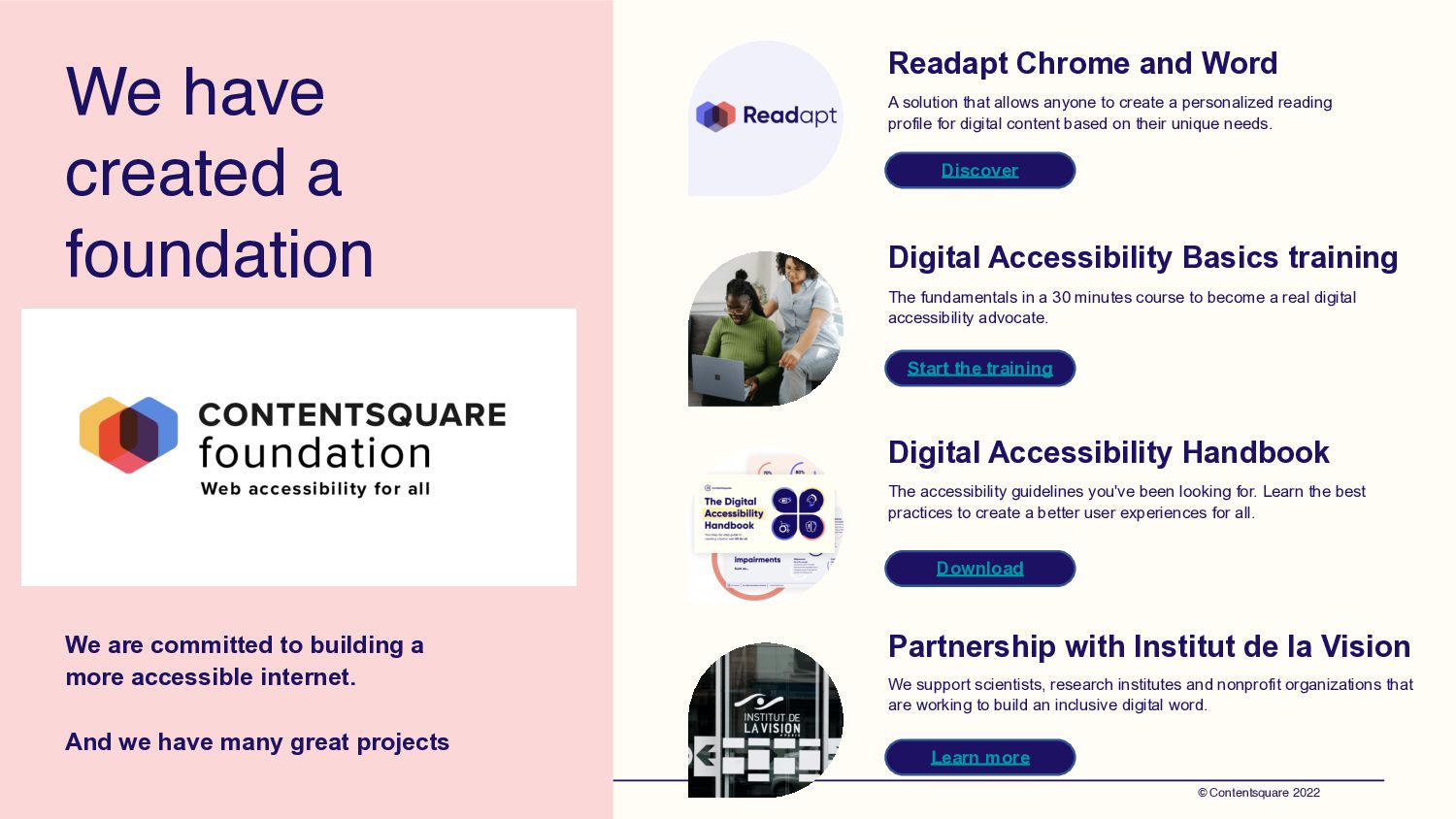
And so we decided to focus on digital accessibility. And for that, we have created a foundation, the Content Squared Foundation, and we have quite many great projects. We just released the first one, Redapt. This is an add on for Google Chrome and Microsoft Office, and basically this allows you to change fonts, to change background colors, and this allows people with, for example, dyslexia to access many, many contents quite normally.
We're also providing digital accessibility basic trainings to our customers to help them to improve their accessibility. This is absolutely non profit. We make this free. All the videos are available on our website. And we have partnered with important players in this field, Institut Lavignon in France and also Institut Les Jeunesseveurs.
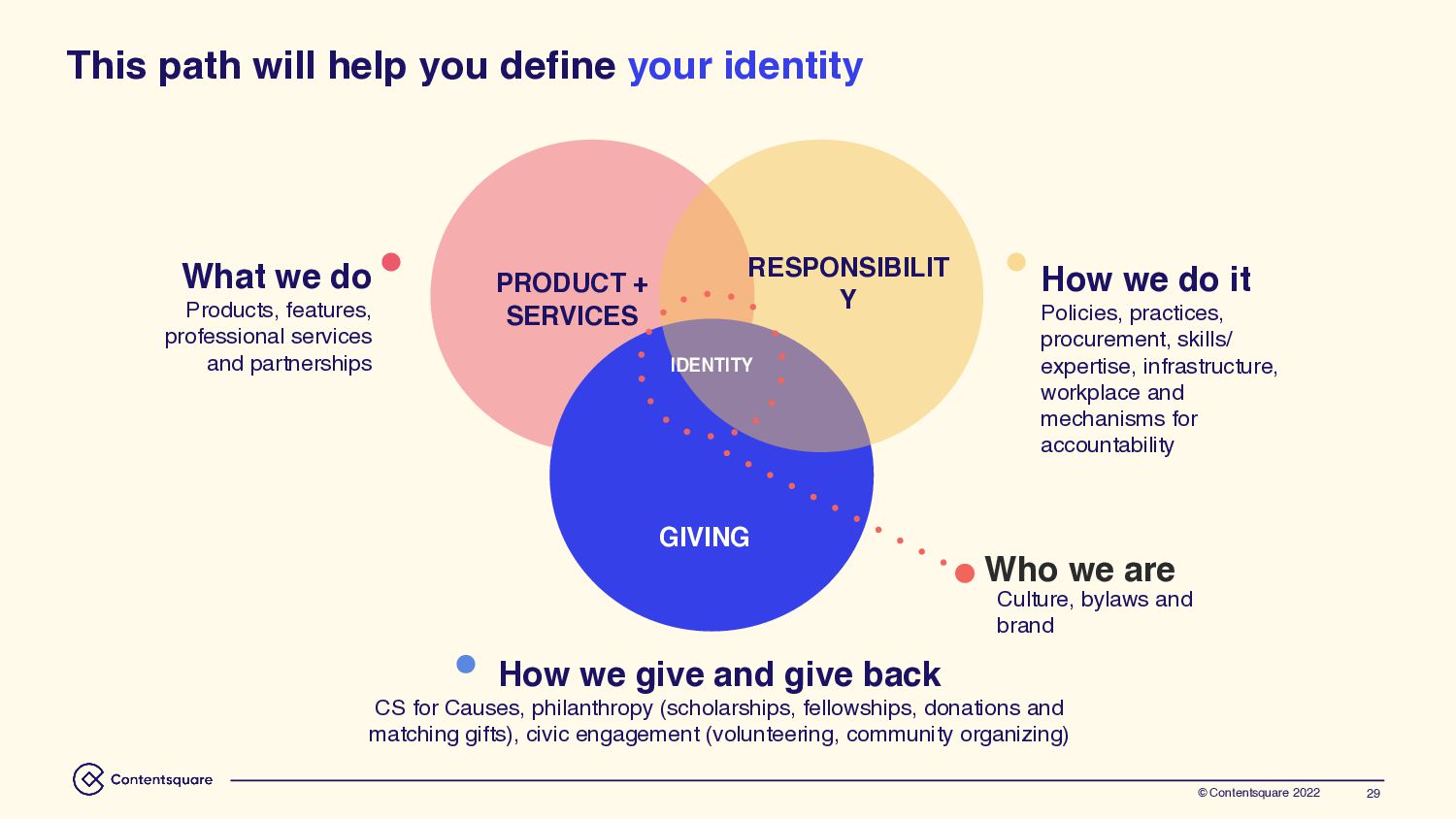
And we're trying to analyze how we can answer in the best way possible to those problems. We have hired a PhD which is testing all of those new features and products with people facing those disabilities. So, to conclude, if you follow this path, this will help you to define your identity.
So sustainability and impact is about what you do, what are your products, your features, your professional services and partnerships. Responsibility is about how you do it. What the policies you define, what are your practices, how you manage your procurement, how you manage the skills and expertise of your teams, or you train them or you build your infrastructure, manage your workplace and so on.
So this is about responsibility. And then it's also about giving. All you give and give back. And that's about the CS Foundation, of course, but we are also developing some partnerships, mentorship programs to contribute to a more inclusive world. We are giving one day per month to our employees to help them to contribute to causes.
We are giving for free access to all our services to NGOs. So we are working now with the Red Cross. They're using our different tools to improve their UX. And that's all about giving back. And in the middle, this will define your identity or what you want to be.
And I think that's it. Thank you.