
Startups are fragile organisms, perennially underfunded compared to the their giant incumbent competitors, dependent on a few talented and dedicated individuals and generally a mess. Yet they consistently outperform and sometimes end up reshaping entire industries.
← All talks 

Turing Fest 2019
How to Leverage Chaos for Superior Performance
Auto-generated transcript - may contain errors. Tap a timestamp to jump the video.
Okay. So I fund startups. And startups are like this misshapen organisms that come out of the swamp and, you know, they're underfunded and they look awful and they're chaotic. And somehow, they constantly and consistently outperform industry behemoth. Right? So hundreds of millions of dollars are spent by competing legacy incumbents.
And still we disrupt them, and still we grab the new business opportunities that they go after despite our lack of resources, our lack of experience. And, you know, I'm personally fascinated by why that happened. So why is it that startups fundamentally, systematically outperform?
And part of the reason, or part of the reason why, is that we've entered an age that is really characterized by the speed of change that we've never seen before. And I don't know if you've ever thought stopped to think about that, but my parents grew up in a stable postwar environment where you'd go to Colgate or IBM and you'd have your career mapped out.
And we have this quite a really privileged, I guess, to live in a world where we are seeing this fifth revolution being unleashed around us and this incredible speed of change and this incredible opportunity, which also means that you as younger, younger people or even older people are able to thrive because of your organic leadership or your skills, you know, which is really unprecedented.
So it's kind of the breaking down of social barriers and hierarchies and and allowing talent to flourish, which I find fascinating. So this age of chaos is how I like to think about it. It's characterized by this deluge of information, high speed of change, and then unpredictability of change.
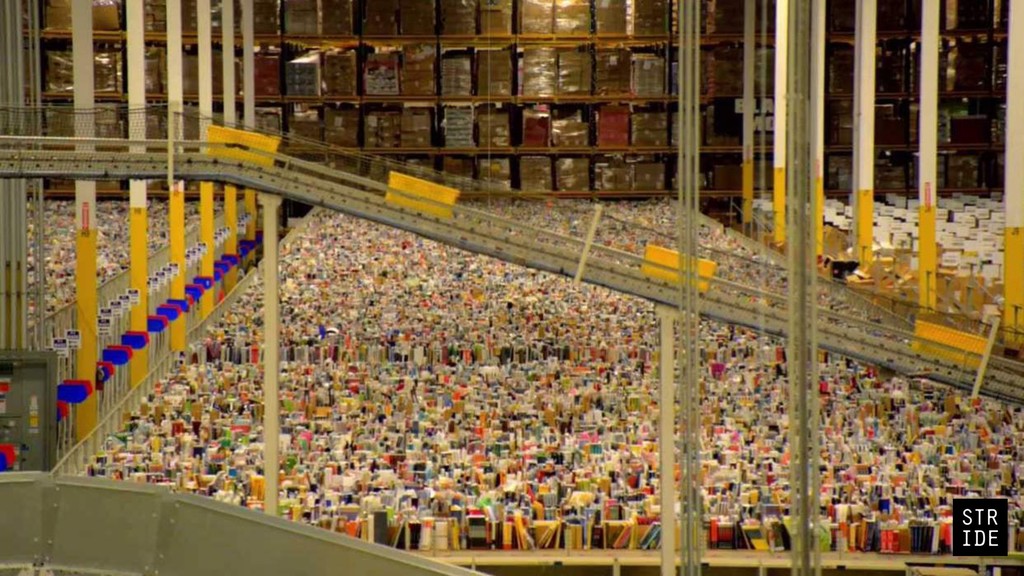
It is impossible to plan, which is fundamentally the problem that we're all grappling with as we're trying to execute on projects. So you guys probably will recognize this. It's an Amazon warehouse. Now, I could talk about Amazon as being the totemic company of the age.
You know, they started the cloud. They're the superstore. They're the leading company in the world, probably in AI voice research. I mean, they're an incredible organization. But the reason why I put this slide up is because of my perfect the perfect example of how to harness chaos.
If you look at this beautiful warehouse and incredible depth of it, you'll notice that none of the packages look alike. So Amazon would have crumbled at under its own scale had it not harnessed chaos. And what they did was they used chaos mathematics for the way in which they managed the packages.
So this is an example where no human could find any package in there. It's impossible. But the machines and the humans together are able to do the pick and pack of the products that you want delivered to your door. So chaos mathematics used to harness complexity, perfect example of what we're talking about.
Another example here, which I love, which I've always used on my blog, is fractals. Now fractals, strictly speaking, not fully chaotic, that's kind of semi chaotic, but what they are is they're made up of infinitely small repeated units of the same thing. So the statistical characteristics of the large fractal are the same as the statistical characteristics of the small components of the fractal.
Now this sounds very abstract. It's like VCs love to theorize things to an extreme. But actually, you have fractals around you. Like, I think of Instagram as a fractal. You do like, share. You do it do it, which is an infinitely small unit of action.
You do it enough times with virality and all that stuff, and you build a giant company and social network called Instagram. It's a fractal. And so what I like the reason why I like to use fractals is they're both about living at the edge of chaos, and also they help you think about non linearity.
Some fractals are gonna be just little circles and unexciting and some of them just become this thing, right, in this beautiful, almost poetic constructions. So let's get into tech a little bit. So we are just at the beginning of this, which is quite exciting.
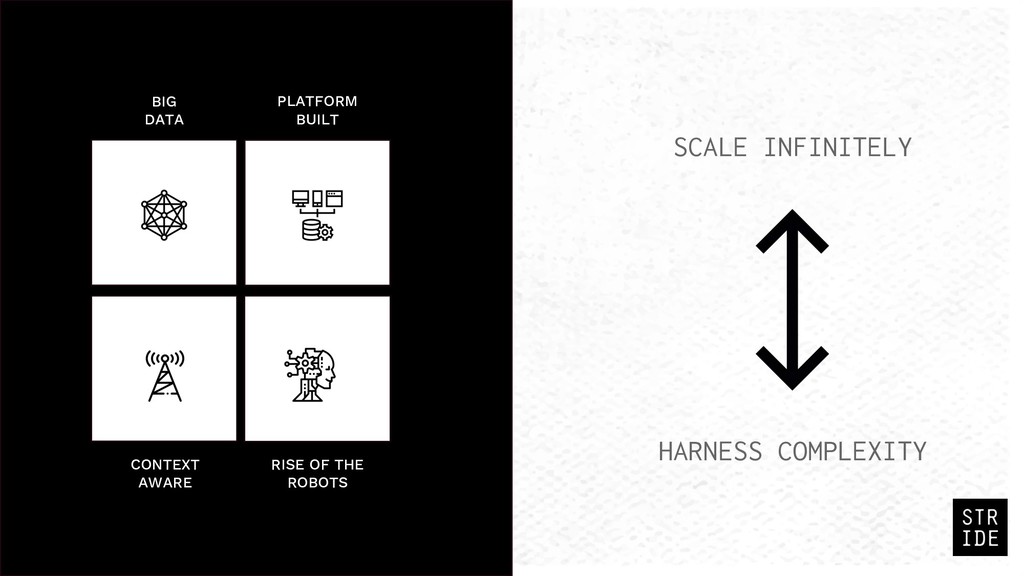
So it started with big data. I think of big data, simply speaking, as the time in history when the complexity and size of data sets started to overwhelm any human design algorithm. And so you had to let the data learn. Right? And now we're even moving to genetic models, which don't even need training, by the way.
So big data harnessed by machine learning and then weaponized, if you like, by AI. Right? So that's the trend number one. Trend number two, everything, of course, is platform build. We have the cloud. We can build on the shoulder of giants, which allows us to focus on what we're really good at and outsource everything else.
And now we're seeing new things come in. So for the first time, software, the software brain, has context awareness because of sensors. So now they can sense their environment. It could be quantified self. It could be an industrial environment. So now we're seeing that we're moving to a stage where software can sense the world around it and harness that data, which is quite unique.
And finally, we're seeing finally the arrival at scale of software robots. Now, if you see a Tesla factory, it's all robots. Software automation is no different. Just think of them as as dematerialized robots. There is a company out of Europe, which I think will be a foundational company for the software era called UiPath out of Romania, of all places, that is basically takes all the legacy software in the world, observes how humans use it, learns, and then starts to either augment or replace the human.
It's fascinating, and it's an incredibly fast growing company that is that is sort of taking the world by storm. So if you run a company, you have a challenge and an opportunity, which is, you know, you can scale infinitely fast, close to, but you need to harness complexity.
And fundamentally, this is why digital native companies, as they call it, are taking over the world. Ten years ago, the list of top twenty companies in the world by market cap were all natural resources, effectively oil, financial services, etcetera. Today they are all technology companies, all of them.
Because if you're going to harness data and leverage data, you win. And then, you know, I live in the world of finance, and I'm constantly I remember when Facebook did its IPO in 'five, and you know, I actually was interviewed on Bloomberg TV, and they were like I'm mixing up my stories. Never mind.
When they did its IPO in 'five, a lot of investors were talking to other investors, and people were like, this is crazy. How could this company be worth ten billion, and it was worth one hundred million a few months ago? Well, it's actually irrational.
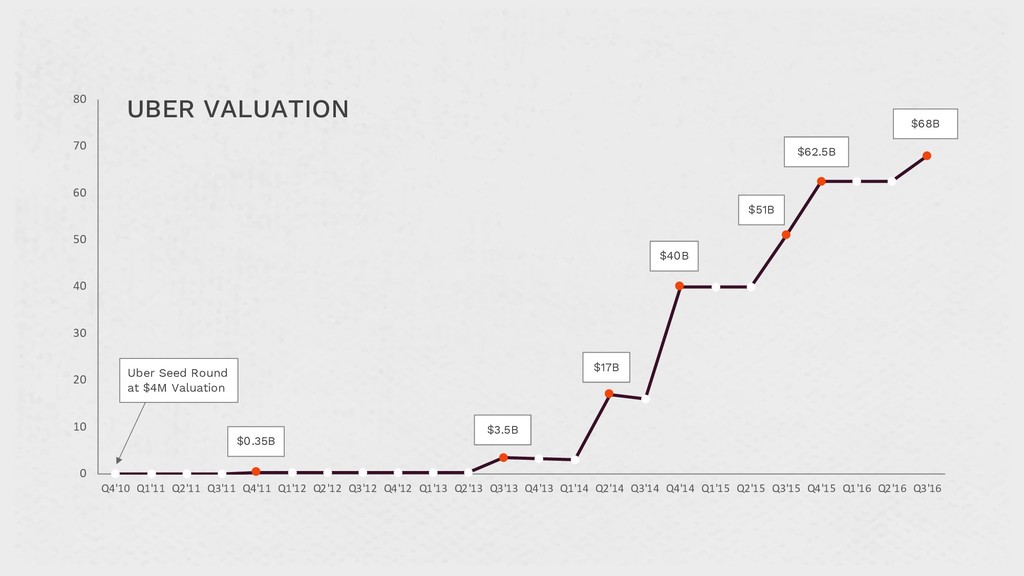
In fact, Facebook's a one hundred billion company today. And if you look at Uber, you know, this is a more almost more extreme example. Four million dollars at the seed round, and five years later, it's worth forty billion. You want to see nonlinearity at work? This is it.
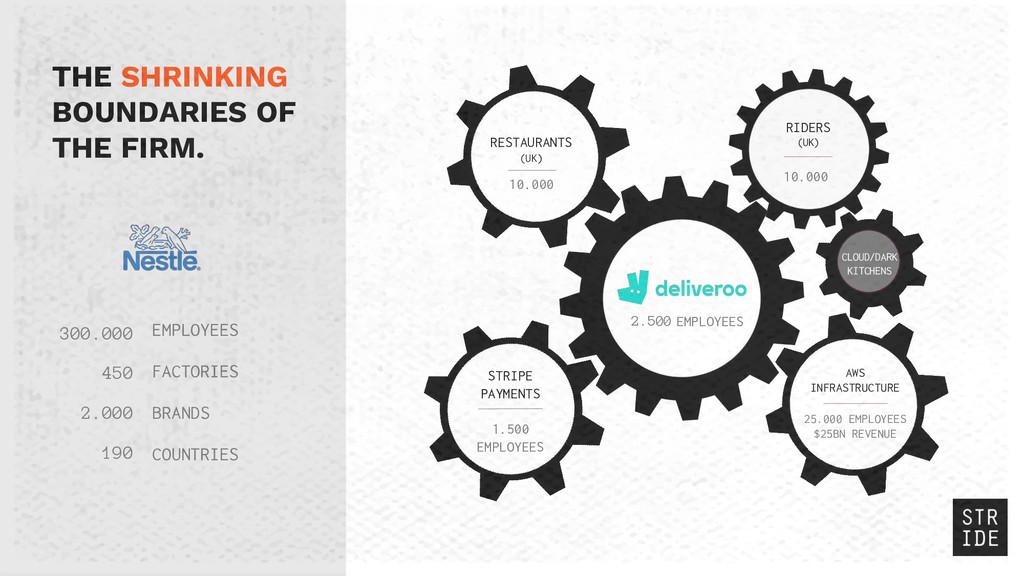
I'm not saying you want to be Uber, but So if we try and break that down into something that's a bit more practical, let me compare Nestle and a startup. And I chose Deliveroo because, hey, I used to be on the board and they're sponsoring today.
On the one hand is Nestle. So both of these are full stack companies. Deliveroo is a full stack managed marketplace services food delivery company, and Nestle is a full stack food producer. Nestle is and I chose Nestle because it's the most stable example of a company I can think of.
From milk production in China all the way to the store, they have control over the value chain all the way. As a result, three hundred thousand employees, one hundred and ninety countries, four hundred and fifty factories. This is a company that is a monolith, right?
Now if you look at the world we live in, API enabled, data enabled, of course, the boundaries of the firm shrink. And Deliveroo is a three thousand employee, I think today, company about to grow in Scotland by the way, as you know. And it's building its infrastructure on top of others.
So obviously AWS infrastructure, obviously Stripe payments, but also even it's then you get into the changing nature of work, All the riders are outside the boundaries of the firm. And so anything that you can dynamically price that you don't need to renegotiate every day ends up outside of the firm.
And the only thing that's left inside is your core working relationships with your core talent, which in this case is five hundred developers and what is a relatively small team for what is probably today a five billion dollars company. So for you as people, so like if you think about careers, I mean, man, you know, you go into one of these established companies, you don't know there is no career anymore.
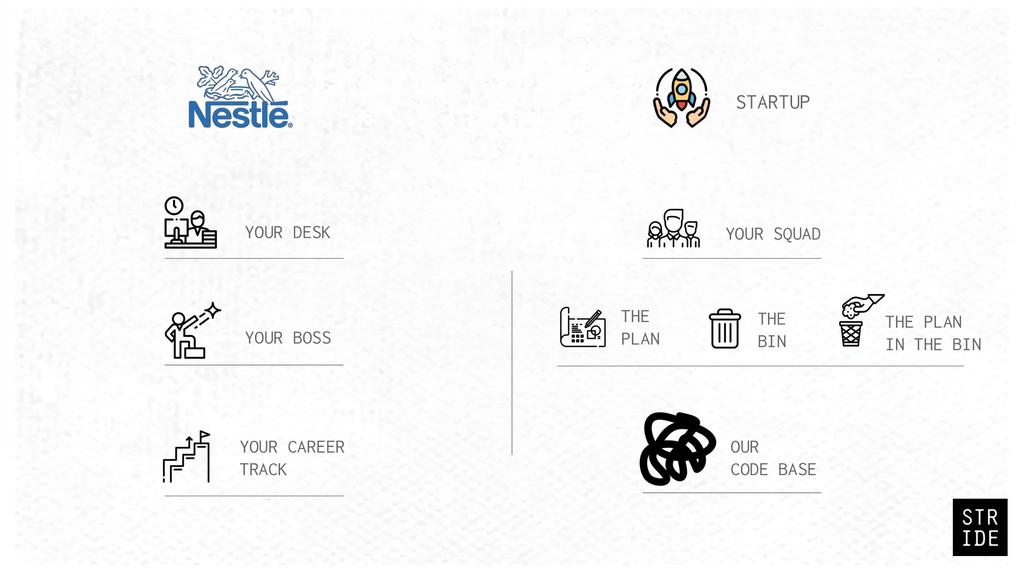
You don't know if it's going to be around in five years. If you go to Nestle, it's probably the only place where you can still have a career. They'll show you your desk, your boss, and your progression, and maybe how much pension you're gonna get at the end.
And they can probably deliver on that for most of their people. When you go into a startup, it's like, hey, here's your squad for this month. The plan I told you we're gonna execute on, well, we kinda had to bin it because everything changed since last month when you agreed to join.
And our code base is a mess, and we're doing a full refactoring. And you're like, oh, okay, great. And you know, that's life inside a startup. Actually, it's kinda how it should be. So that in itself is, you know, it it requires it also comes with challenges for individuals because we weren't designed to deal with that speed of change.
Right? We were designed to deal with an occasional attack from a tiger, and then we'd, you know, fly away and run as fast as we could, and then we'd chill and pick berries for three weeks. Now we live in a world where the the the chaos is constant, we're clutching at straws, and this is why kind of stress is killing us, which is a talk for a different day, but you know how you effectively survive personally and thrive in environments of chaos.
So in any event, this is the reality you live in. So you have to design oh, I forgot a slide. This is the first time I ran this, so thank you for your patience. The other thing is the questions you're trying to answer are fundamentally more interesting and more complex.
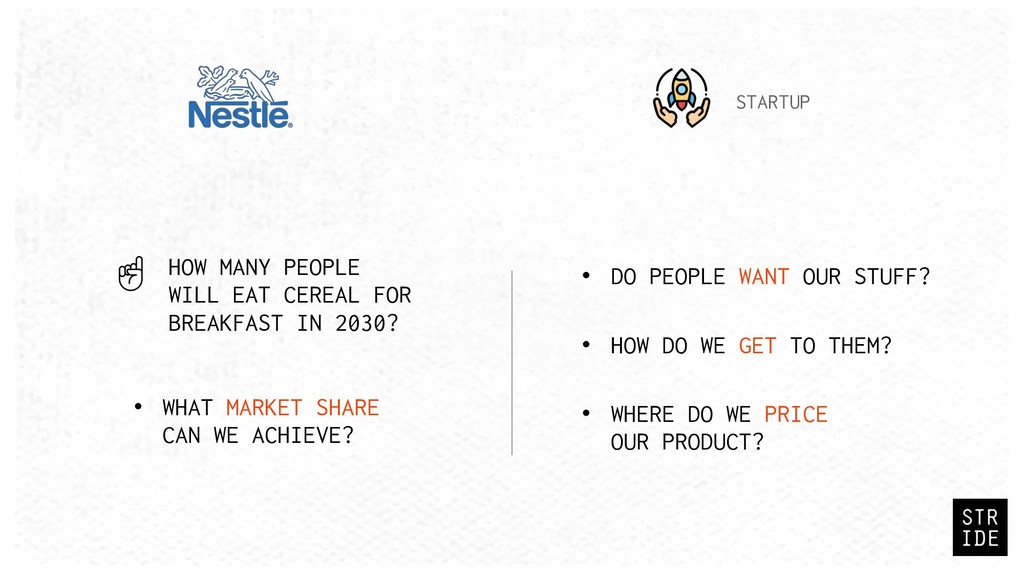
If you're a brand manager for cereal at Nestle, your biggest threat is how many people go gluten free or eat yogurt, but you're basically trying to find out in two thousand thirty how many people still breakfast on cereal, and then how do I maximize market share against company B and C?
If you're at a startup, you're like, okay, fundamentally, am I solving a problem worth solving for my users? Am I solving something big and interesting? Do people want it in the way I've instantiated it into product? How do I get it to them? How do I price it?
And these are existential questions that I find our companies ask themselves on and on and on. So there is no stability in that. It's gonna change so much and so fast. So you have to fundamentally design. If you think about organizational design, the personal way you deal with chaos, you have to design things that only survive through chaos, but actually thrive on chaos.
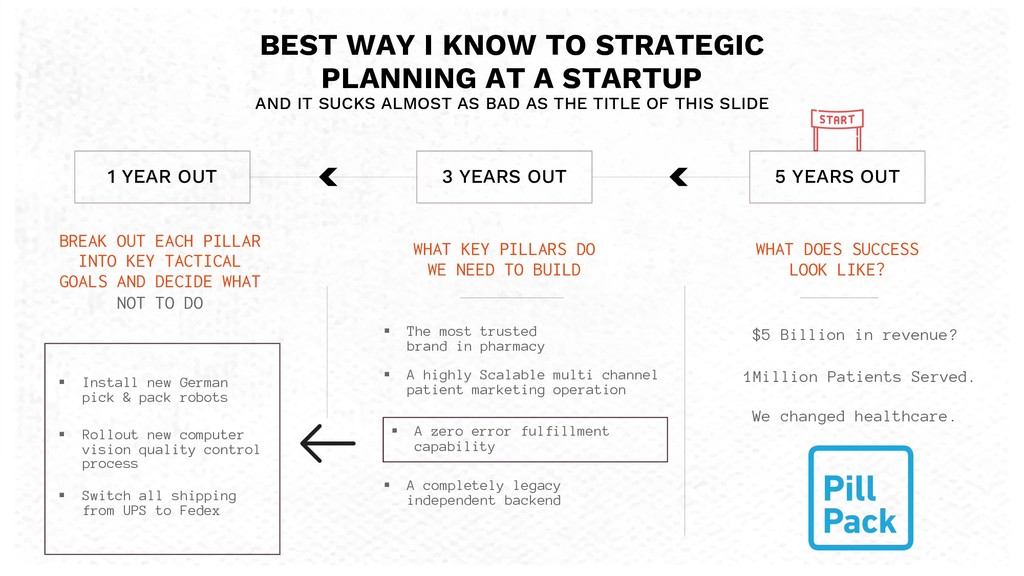
Because now flip it around, it's a competitive advantage if you're able to harness this stuff and move faster and quicker. So I it's really, really hard to think about planning inside startups. The best way I know how to do it is this method.
So you start five years out. And the reason why you start five years out is you're trying to get to a common understanding with your team and your people as to what success looks like. Are we all rowing in generally the same direction?
So I use the example of PillPack, a company that did this extremely well. You know, I backed them in two thousand thirteen. There were five people out of Techstars. We sold it for a billion to Amazon in two thousand eighteen. Incredible outcome, but really well deserved.
Now if you told Pell Package, you said, oh, to the team, our objective is to have five billion dollars in revenue, which they could have done. I don't think that was aspirational for people. If you told them, we're going to serve a million patients and help people with complex conditions live better lives and will change the lives of a million people, I think the whole team could get behind that.
That was measurable, that was something they could touch, had impact, and it still sounded like a business. Now if you said, oh, we're going to change health care, which is part of the underlying mission, by the way, it's like how do we break open the margin structure, How do we reduce the influence of the PBMs and the pharma manufacturers and make health care more affordable?
I think it was a bit too lofty for most of the team, and we would have lost people going, what the ****? Yeah. Change health care. Great. Wanted something I can explain to my grandma when she comes for Thanksgiving. Right? So then you do that, and you agree on the language and what the objective should be, and that already expresses your culture.
Am I a money driven company? Am I an outcome driven company? Am I a dreamer type of founder who who can't articulate a goal that people can get behind? Then you bring that three years in, and you say, are the key pillars of our business?
What do we build around that's somewhat stable? So in their case, was like, number one, we need a great brand. We need the most trusted brand in pharmacy. And pharmacy fundamentally is something that impacts your health. You need trust. Number two, it is difficult to get patients to adopt a new pharmacy and to trust them with their health.
So de facto, we needed a multichannel acquisition strategy of patients that would both be respectful of the patients, so don't get on the people that you shouldn't get on the platform. Number two, that actually worked from a business standpoint. Number three, most importantly, zero error fulfillment.
You know what pharmacies do? They kill people. Statistically, CVS and Walgreens and everybody in the pharmacy business on occasion delivers the wrong meds and people die. It's life. Zero risk is unavoidable. Now if you're CVS, you can blame the local pharmacist and say, well, he's a drunk.
If you're PillPack, you're an online company with an identifiable brand mostly run by robots, so it's going to land on your door. So both because of the desire to protect the patients, but also the desire to protect the brand, you effectively have to build a zero error fulfillment capacity, which is really hard.
So that was always going to be one of the pillars. And then finally, in the case of PillPack, you know, there's a lot of legacy and awfulness in the background of how you get drugs information, etcetera. So how do we build a legacy free software infrastructure that would allow us to move at the speed we needed with the data we needed to implement the patient experience that we wanted for our patients?
So we had to build a legacy independent back end, which we called Pharmacy OS, which generally people say today half of the value Amazon ascribed to the company was not the consumer business but was the Pharmacy OS part, which was, by the way, built by twenty eight engineers.
So you had Walgreens and CVS spending hundreds of millions trying to build this, and we did it with a team of thirty people and probably ten to fifteen million bucks in spend. Then you take that and you say, okay, these are my stable goals.
Now I'm gonna bring them in into common objectives for the company that we can execute on six months to a year out and that we can all agree on. So the key here is to get engineering, sales, logistics, ops to come together and again agree on what the objectives are, how you describe them, how you measure them.
So for example, I took the zero error rate fulfillment capacity. It's like, you know, this gets quite practical. We need to get our new German robots in. We need to roll out a new computer vision model because we were effectively doing high speed photography to check what was inside the packets, make sure was the right pills, right color, right shape.
That's how we did error detection. And we're going to switch all our shipping to I forgot what we did. This is a theoretical example to FedEx because they're much more reliable in terms of not making mistakes. So this is where you bring it down into what the team's actually gonna do.
And then you also decide what not to do, right, which is half the battle here is, I'll give you one example. In the early days, we had no mobile app for delivery. And people thought we were crazy. We're like, well, actually, mobile web works pretty well.
We're not wasting any time building mobile app. We're actually using all our best engineering resources on the routing algos so we can deliver food in under thirty minutes. So it was more important to deliver food in under thirty than it was to have people have a snazzy mobile app experience with photos of the menu.
So we decided, for example, also not to have photos of the menus. Why? Because we could acquire restaurants way faster. And so some of our competitors had beautiful apps and ratings and blah blah blah. And in the meantime, we just we just stormed the market. Right?
So that's how I think about strategic planning. Then the other thing you want to do is design think about processes that don't break. And the difficulty with startups is every year, they look like different companies. You know, we're ten deliver twenty three people in two thousand fourteen, three hundred people by the end of two thousand fifteen, three thousand people today.
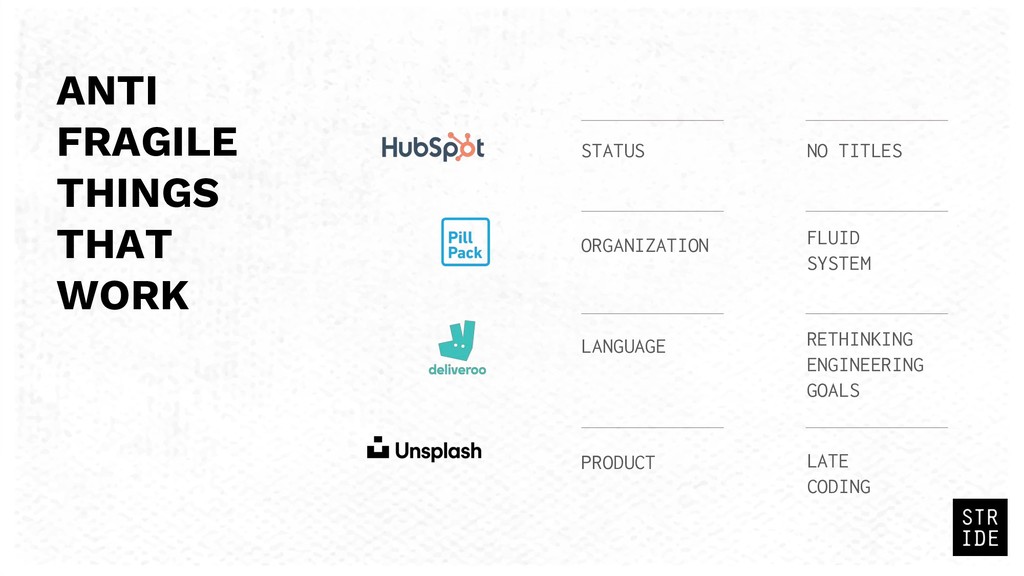
So you can't design systems and give, you know, kind of that that survive that kind of growth. Right? So you have to think about antifragile things that work well. So a few quick examples. HubSpot, so under the influence of Darmesh Shah, their CTO, very big on culture, famously refused any internal titles for I think about four years.
The problem with internal titles is they immediately crystallize the organization. If I have to change your title, I'm demoting you, which is not what I'm trying to do. So why don't we get rid of titles, write people precise job descriptions, but then they change all the time as the needs of the company go, and you just don't have a title.
And by the way, organic leadership is allowed to thrive that way because you can rise up through the ranks of the organization just because of your talent or your ability to mobilize people around you. Now they had titles externally, because you know when you need to sell through XYZ, you need to be SVP of blah, because people care about that in the outside market.
But internally, no titles, which I thought was quite fascinating. PELPAC did a variation of that. So we had we wanted to avoid having commercial product, engineering, logistics, ops as silos. People start building their own culture. They use their own language. They have different objectives, and it becomes a mess.
So we would do things like we would create teams that were task focused. What are eight to ten things a company needs to deliver that are absolutely core to a strategic plan? And then these teams would have people from typically product and engineering and then adding on logistics or sales or whatever according to the task at hand.
And then once the task was done, they would dissolve or the team would be modified. Actually, these people worked even physically in the office in pods of eight that were the task team. And it worked beautifully well with the key being to break them down often enough that you avoided tribes and groupthink.
Right? Deliveroo, when Mike Hudak came in, he did something that I thought was incredibly effective because of the way he did it, which is he changed the language engineering used. So instead of delivering feature x y z, he literally changed the objectives of engineering into business objectives, but that the engineering team could sort of own and understand.
So for example, if you have an order that's between the app and the person receiving the order, that's called an order in flight. If you can reduce the number of people that are in customer service that touch that order, statistically, you're doing great things, A, for the consumer, usually means we're going faster, and B, for the organization because you're not overloading your customer service function.
So instead of saying we're going to ship a feature that does real time alerting of the customer, they basically redesigned the objectives by saying we're going to reduce the number of orders in flight touched by human by X percent. And then once that got done, I think they reduced it by like ninety percent was a real success.
Engineering could say we reduce orders in flight, human intervention by ninety percent, and they could walk with their head high. Finally, Unsplash. Two things. So it grew out of a company called Crew, and Crew was a services marketplace for design services started by Mike Cho out of Canada.
Really fantastic. So what they did was they did everything with people until they'd really fully understood a process, then they'd commit to code. They were really religious about we don't commit to code before we've understood what to code. And secondly, they kept on running marketing experiments, and one of them was Unsplash, which allowed creatives to publish high res images.
And that took off, that became the entire company. So then they're selling Crew and doing Unsplash instead, which is a classic radical pivot. Now these are all tactics. Tactics are great. The only thing that's really sustainable is culture. And when people talk about culture, it's always fluffy and woolly.
I guarantee you, this is your only sustainable competitive tool. And the people like if you look at the great companies of our era, Reed Hastings at Netflix, Reed Hastings put culture front and center when it started. The culture doesn't need to be soft and woolly.
It could be a hard culture of delivery, and you know, you just need to be cognizant of it. You need to define it well, and you need to live it every day. And it's like a code for how people interact with each other, interact with the outside market, interact most importantly with the customer.
When you have culture, you don't need to constantly redefine how things get done because people know what they're thriving towards and people know how they work together. Now culture is primarily the role of the CEO. So let's talk about the CEO of the startup for a second.
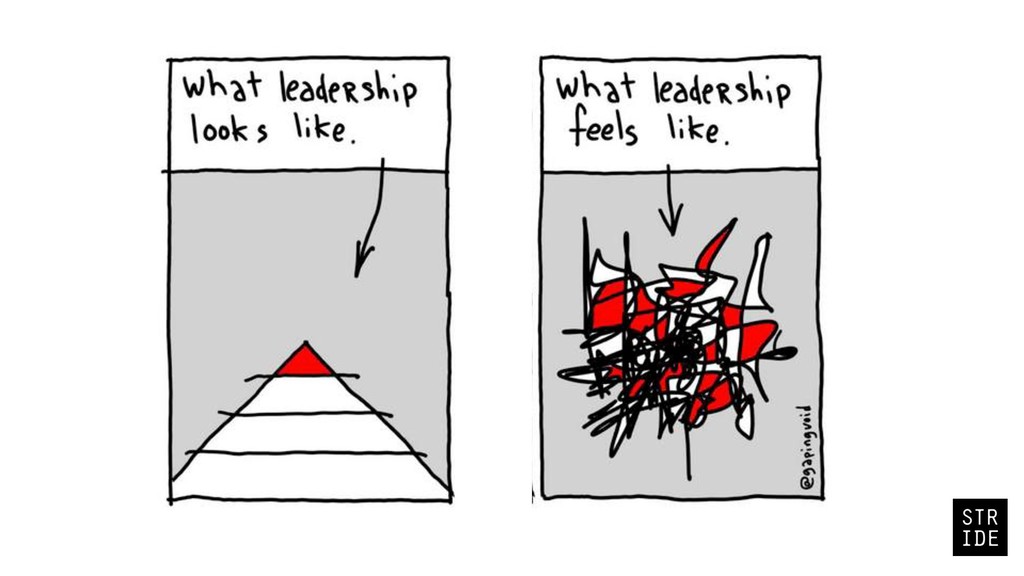
This is a human cloud graph, and it is so true. So I have so much sympathy and, you know, empathy for founders because, my god, what a ******* hard job it is. All the decisions you have to make are hard decisions. If the decisions are easy, they've been made by someone else in your team, and you have imperfect data to make them so the best you can hope for is a batting average that's somewhere above fifty percent.
And everybody's relying on you for their livelihood, and you know it's lonely as hell because you can't really share what's wrong with the business with anyone. So it's just a hard and lonely place to be. And so the role of the CEO in a startup is a little bit different.
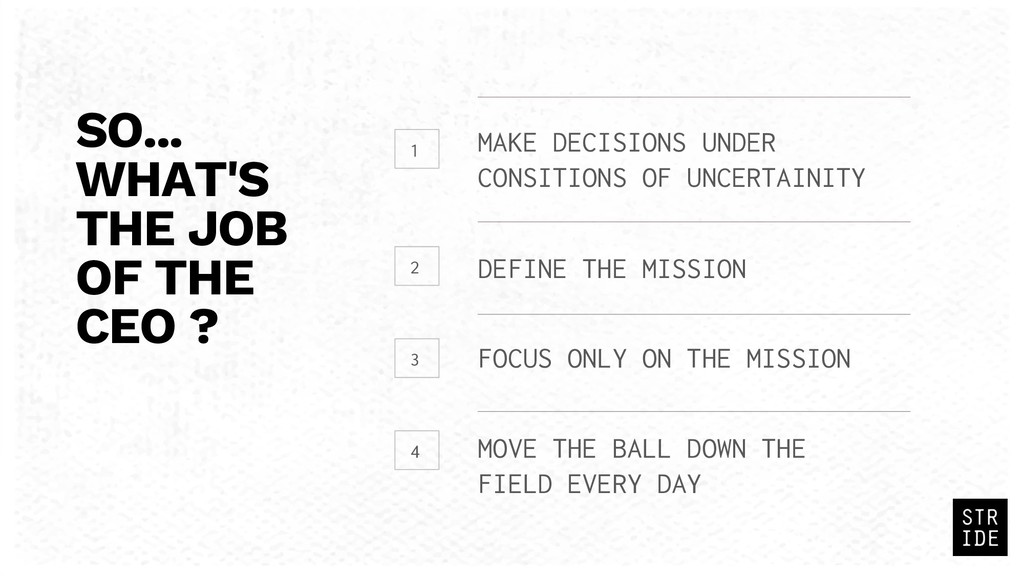
It's really number one, making decisions under conditions of uncertainty. Your decisions will never be perfect. However, your best strategy to cope with chaos is to make decisions fast. Most of them are reversible, but it's your primary job is to make decisions under conditions of uncertainty.
And again, the best strategy you have to hand for not failing. Number two, define the mission. In a way, that is the unique role of the CEO is to define the mission of the company together with the community that composes it, but that's primarily what you're trying to do.
And then you have to get everybody, help everybody focus only on the mission. Avoid organizational drift. Avoid loss of focus. Avoid complexity. You have to fight complexity like a maniac to keep your company operating well. And finally, and this a lot of founders I work with will tell me is the hardest thing by far, is actually moving the ball down the field every day.
And what that means is doing things that are truly meaningful to the success of the business. There is only one way to do this. Every day when you wake up, you list five important things that need to get done, and you willfully understand that you're not gonna get to the rest, which means **** email, you know, **** everything else, just do the five things.
And if you pick them well and if you're good at prioritizing, you will ultimately achieve success. But you kind of have to let go of perfection and pleasing everybody and actually what people think of you. And it's a hard mindset to be in, but it's the only mindset that makes great CEOs successful.
Alex Jesserman's my favorite, probably founder I've worked with from an execution standpoint. A, he makes decisions insanely fast, and he's got a great nose for it. B, he has an ability to focus that is insane. He's never been to a conference, I think, in his life.
He never goes to a panel. He doesn't talk to the press. He just moves the ball down the field every day. And look at what is built with Zoopla. It's incredible. So now talk about people for a second. Man, we're all like struggling under stress and this constant, like, you know, nothing's ever done and nothing's ever finished.
And, you know, the demands are endless and, you know, you kinda it's easy for your for your your mind to fry. And and then you kind of think you need money and all that stuff, which, you know, of course, you you do need some.
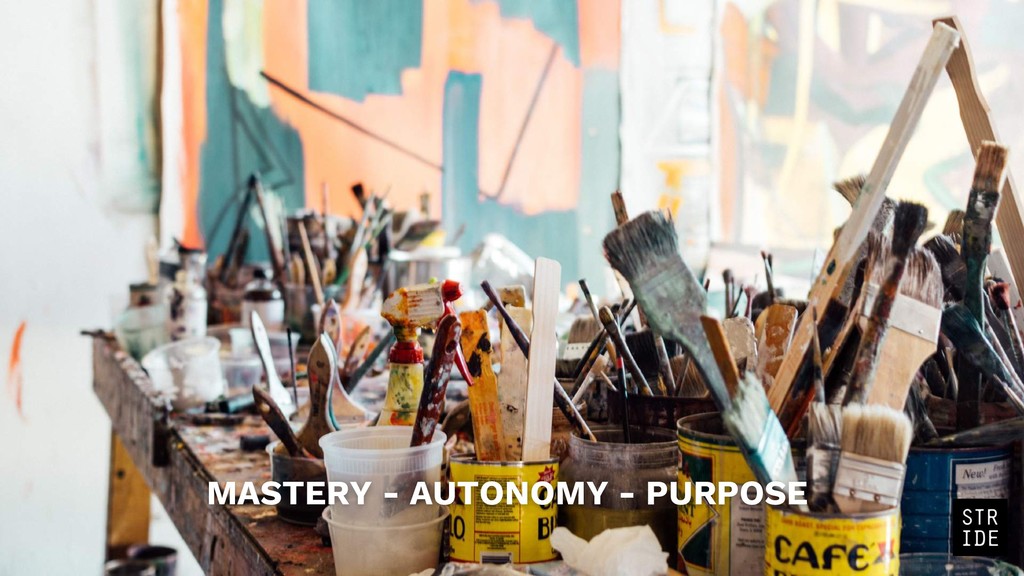
But if you go back to neuroscience and what people have learned about happiness and about actually, happiness is the wrong goal, and and about how to live a purposeful life, then you go back to three these three things, which Dan Pink, if you wanna read Dan Pink, is probably the best author to read off on that.
People really enjoy mastery. Define your craft. Get good at your craft. I consider venture capital to be a craft. I'm an artisan. You know, the reason why I run a small fund with a small team is because I'm an artisan. I work. I turn wood. Right?
And whatever your craft is, get really ******* good at it, and you will derive benefits from just enjoying that. Right? And the same is true if you're learning the trumpet or if you're coding. Secondly, autonomy makes people happy. Go work at companies where autonomy is real.
You can have impact, the impact is measurable, and you feel like you own it. Feeling ownership of outcomes is something that fundamentally fulfills human beings. And then number three is a sense of purpose. So happiness, I don't want get into Zen talk, but happiness is a fleeting concept.
Right? So life's going to throw **** at you. We're not even chemically designed to be happy continuously. It doesn't work. Like, you know, there's a reason why kids recover from war, by the way, which is that we're not designed for extremes, whether they're down or up.
Quadriplegics are happier than lottery winners nine months after the fact. Like, let that sink in for a second. It's insane. And the reason, by the way, is because lottery winners tend to be socially disconnected from their circles, feel like they don't belong in the world they live in, and feel that they did nothing to deserve what happened to them because there's no purpose.
It's dumb ******* luck. So so the only thing that carries you through actually is a sense of purpose. And my favorite example is Danae Ringelman from Indiegogo. She's a former banker, and then she set up this first, I guess, big crowdfunding platform besides Kickstarter.
And she couldn't get funded forever. I mean, describes the journey as a grueling marathon of no money. And at some point, she just let go of, I need to raise money to do this and blah blah blah. She just said, I fundamentally care about crowdfunding great ideas and allowing these people to express their creativity.
And that purpose carried her through, I think, roughly eighteen months of running on fumes and an incredibly hard journey. So if you have purpose, you can go through a lot of ****, and **** will come. It could be sickness. It could be failure.
It could be anything. And purpose is really the only thing that carries you through all of that. So I think chaos is nice to talk about. Stress will kill you. You have to learn almost to stand in the stream. You know, let the chaos wash over you.
Luck, by the way, comes to everybody. So the difference between successful people and unsuccessful people generally has to do with your mental preparedness or openness to seize luck when it comes. Right? This is not about planning and career. We just talked about how that's impossible.
It's about being ready for unexpected opportunities, right, and being able to seize them. The same in a way is true for startups, and that is why I think they outperform. So that brings us to the end of my talk. I'm happy to say I'm on time, even though I prepared this for forty five minutes.
And a word on us. So we started a venture capital firm called Stride. Vc. I used to be at Excel, so did Pia, who's at the front. Harry is a self made podcaster, the twenty minute VC. Have primarily, we're trying to do VC without jargon.
So we're trying to be like real people you can talk to and no ********. If things are going wrong inside the company, you can come and talk to us. We're also trying to not think in patterns. So in other words, we are open.
We think entrepreneurs are the best at finding white space. We are merely watching what they unleash. And so it's really kind of, I guess, trying to be as humble as we can as capital providers and say, we fundamentally know nothing. We posit our own ignorance as a starting point, and then we learn and evolve.
And so we try to not be right, but discover the truth together with the founders that we back. And so I love what I do. I think it's a very privileged thing, and I wanted to start a firm that sort of reflected that.
We're partners only. We have no junior people. We want founders to talk to us directly and you know, be able to immediately engage with us. And we're, again, like I said, we are artisans of venture capital. So you can follow me on fdestin.
And, you know, may you thrive in chaos. Thank you.