
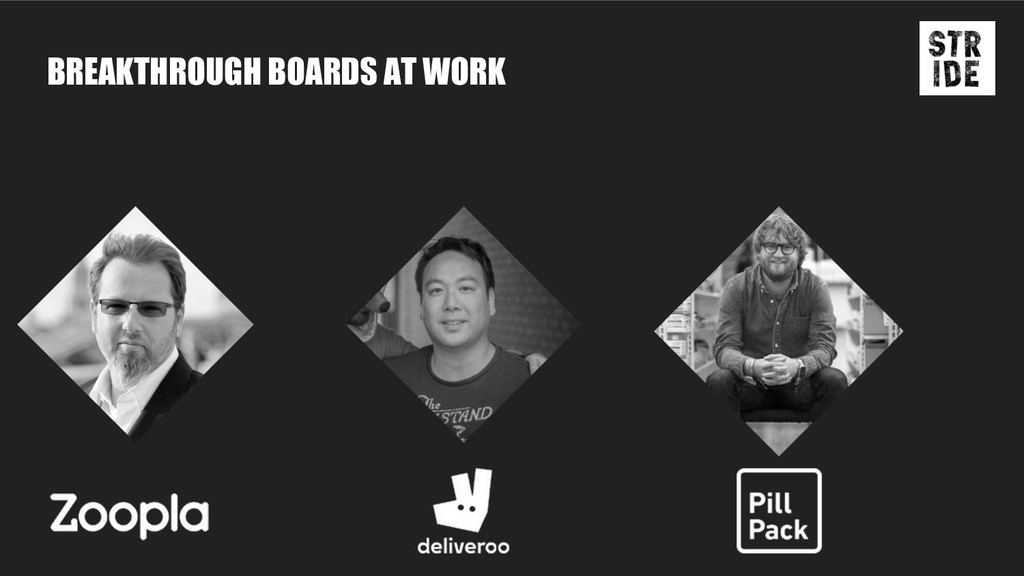
We'll explore the good, the bad and the ugly of venture-backed boards and talk candidly about what can go wrong with venture investors and more importantly how to nurture high performing boards, in a hard-hitting session grounded in real-life experiences of failure and success. From Zoopla to Deliveroo and Pillpack, we will also explore the lessons learned from some of the best founders in the business.
← All talks 

Lead Strategy Turing Fest 2018
Boards That Don't Suck
Auto-generated transcript - may contain errors. Tap a timestamp to jump the video.
You know, I've had in my experience, in my career, I've had the experience of boards that were terrible and toxic and damaging, and boards that actually really worked. And when they worked, they were a beautiful thing, and they really helped entrepreneurs build better companies.
And so there's some fairly systematic learnings from these experiences that I want to take to you, as well as some stories, because anecdotes are fun. Two words of intro. So I've been a venture capitalist for a long time. I actually love it. I think I've done well.
It's a wonderful job, and I'm very proud of it. And I used to be with a large firm called Xcel, but I really like early stage. So I went and partnered up with a twenty one year old university dropout you might have heard of, called Harry Stebbings.
And we're creating a new fund called Stride. Vc. And effectively, we're trying to be sort of high conviction investors in companies that don't have any data yet, right? So we like to come in early, backing entrepreneurs, men and women who we think can reshape industries, and we're happy to come in when there's no data available and write fairly large checks.
And we think that type of conviction investing is sort of missing. Great. So I've been fortunate enough to back my slides aren't moving there, but they're moving there, which is great a bunch of companies that ended up being leaders in this space, and we're going to talk about some of them.
Zoopla from Seed to IPO. Pellpac, first two rounds out of Techstars Boston. Deliveroo, second round after Index, to give credit where it's due. Secret Escapes at Seed, which is a travel company. Cowow, and others. So basically, our mindset is we don't want to take founder risk, in the sense that what I mean by that is we're trying to back people who we think can reshape industries and who we never have to change.
And we don't care if they're nineteen years old or forty or sixty, but we're sort of trying to find these unique individuals who we think can go all the way and reshape an industry. And then we'll take as much market risk as we can.
We want to back really ambitious companies and some crazy ideas, but ideally with founders that we know we can back all the way. And that's because we think founders are magical, and when they go and get stuffed, they can pull white rabbits out of the hat and they hold the soul of the company, and we love our founders.
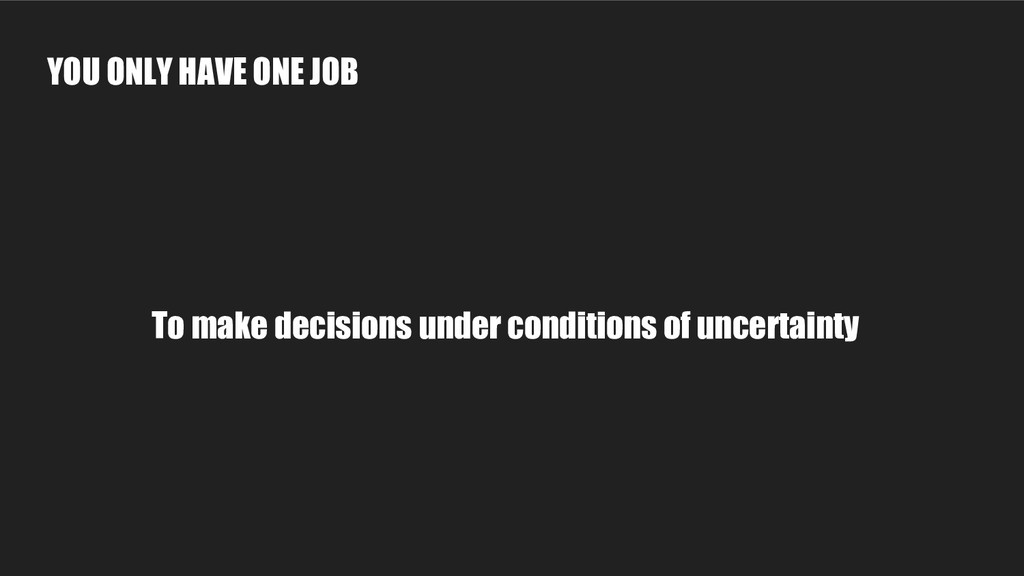
So we try very hard to find people that we don't ever need to replace. I'm fdestin on Twitter, if you want to quote, and Harry Stebbings from the wonderful twenty Minute VC podcast is my co founder. Right, so as a startup founder, you really have four jobs, but the main one is to make decisions in conditions of extreme uncertainty.
So when I say you have four jobs, is one is define the vision, or define the focus. Number two is focus only on the mission. Number three is communicate the mission to everybody every day all the time. And number four is make the decisions that matter under conditions of uncertainty.
Everything else is poetry, right? It's like, am I moving the ball down the field every day and making the decisions that count? Now what's tough about startups is people who are outside the startup industry think the strategic issues are not that complicated to grasp in a way.
We always deal with the same ****. What is really difficult is to make hard decisions in conditions of uncertainty. Decisions that can sometimes mean that you're risking your company. I'll give you one example. I used to be on the board of a company called Recorded Future, which is a cybersecurity, sort of ops in, open intelligence company out of Boston.
And we are basically plugging ahead on a ten million dollar budget for the fourth year that the company is in existence. And we have two lines of business. One is government and cybersecurity, and the other one is financial services, and we sell to hedge funds.
We sell this kind of real time event intelligence to hedge funds. And halfway through the year, and our budget's roughly six to four, and halfway through the year, CEO comes back and he says, I think we should jettison financial services. And you can imagine around the board, you know, the VCs and some of the VCs were fairly traditional, they're like, well, we have a budget.
We have to hit the budget. And it was like, how can you cut out four million dollars and increase your burn and reinvent the company in the middle of a year when you have to hit your ten million dollars budget? Well, turns out it was the right thing to do for the company, but this was an example of making decisions in conditions of extreme uncertainty.
So the reason why I mentioned that is I think the role of the board, fundamentally, is to help you do that well. Like everything else is kind of poetry. The problem is the board has effective power, right? You have to run your budget through the board.
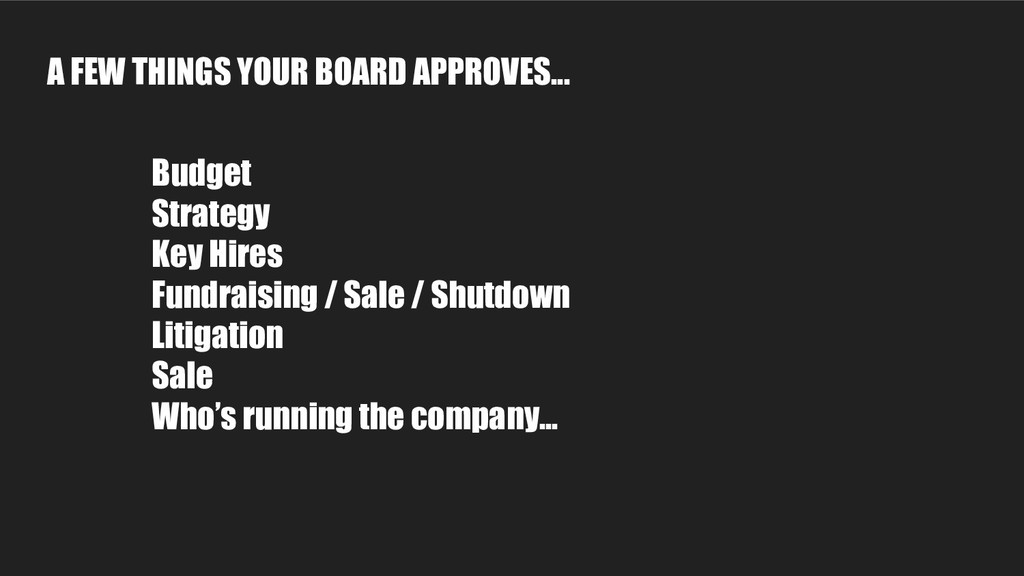
You have to agree on the strategy. You have to agree on your key hires. Know, above certain thresholds, you have to go back to board to get approval. And in some cases, these investor consent lists run so long that you basically have to ask for permission every time you leave the room, right?
So it gets, in practice, it can get pretty hairy. Especially when you have a board member in the room who's a VC, and the VC basically may hold the key to your funding on the next round, and he can get you fired. So that's why founders tend to over listen to their investors because, man, the power is effective.
Which is why I always say part of the role of VCs is to understand that and actually use, wield that power very, very responsibly. So that last thing, decide on who's running the company, sounds threatening. Actually think it's a positive because if you look at Brad Feld and Fred Wilson and me and other people, we're always like, we will let you run the company until one day we decide you don't.
Because sometimes you have to replace people, they underperform, they whatever. But effectively we'll say, we will let you own your company. It is your company. And our ultimate job is not to tell you how to run it, what to do, what the strategy should be.
It is to advise you, help you, challenge you, but we let you run it. And if at some point in the future you're not the right person to run it, we should have that conversation. So I view this as actually a positive thing, is the only power I really want to exercise is one day to decide, hey, we need a new CEO.
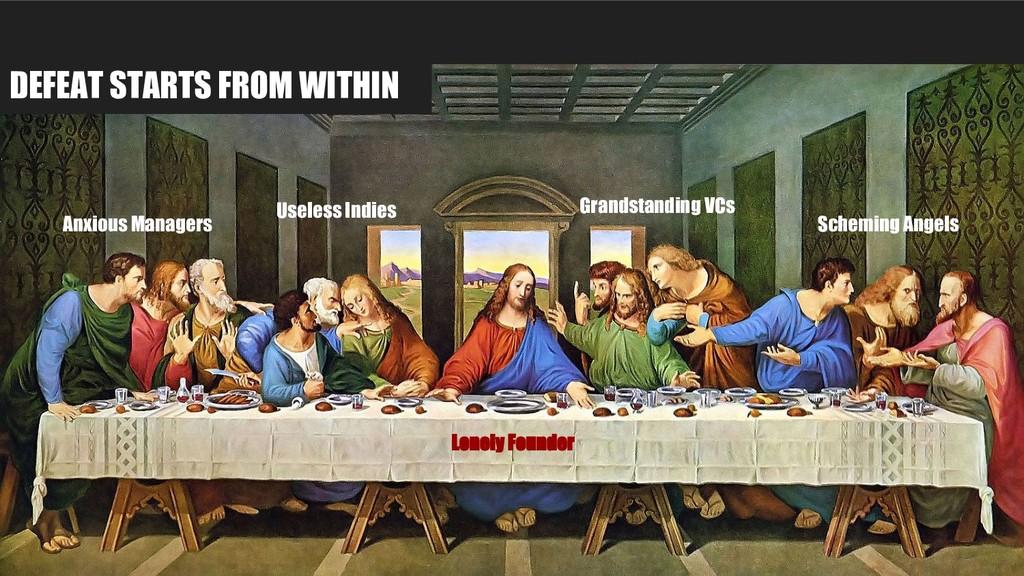
And by the way, it won't come as a surprise, you'll probably know both of us that for the last eighteen months we've been heading that way, right? Now, you bring it all together and you think about all the constituents around the board. Most entrepreneurs think the board is like a terrible ordeal to go through every other month.
You know, it takes two full days of prep for the team. They have to generate giant slide decks. The management team is being asked to present product, and the next guy presents sales, and the next guy And you know, everybody's like The managers are anxious.
Sometimes they will backchannel with some of the investors, because some of the investors are paranoid and they like to go talk to the managers and they like to understand what's going on behind the scenes. How ****** is a company really? The answer is most startups are pretty ****** up, This kind of normal state of being.
So you have these guys, then you have your independent board member. So usually, he's a little bit portly, you know, he's got a couple of houses, he's an expert in his field, and he shows up at the board, and he's like, blah de blah, blah, blah.
And he really doesn't want to piss off the VC, because the VC will give him his next board role, and so instead of having an advocate who's going to be a sort of low impact person you can go talk to about challenges and strategies, you have some guy who takes point twenty five percent of the company every year, and you kind of wonder why.
Then you have the angels. So, I've seen some weird behavior for angels. I was once invested in a company called Fashion Project out of Boston, and I remember this. They were backed by a female angel group, a female founder. And one of the ladies who ran the angel group called me up, she goes, I don't like the quality of reporting.
And I think she's not reporting often enough, and I'm very unhappy, and blah blah blah. And I'm like, you know Anna's fighting for survival of the company on these sets of issues, right? She's like, well, reporting should be on time and faster, etcetera.
And I was stunned to see an angel basically call a VC and undermine an entrepreneur who's trying to save the company. I'm like, woah, I thought you were angels, right? So people get in their own way all the time for different reasons. Then we have the worst offenders, by far, are the VCs, because they actually wield power, right, like we talked about before.
I'll give you some examples of behavior I've seen, because some of them are I don't know if they're funny or dramatic, but I was once in a company, which shall remain nameless, and we had a new head of sales. And he'd been hired, I think, the Friday before he started, and we had a board on the Wednesday.
And so we're sitting in the board meetings. These board meetings used to last for six hours. They were sort of a smorgasbord of people shouting at each other and drama. And one of my co investors says, well, we're missing our numbers again. I want the head of sales in this room.
Why is he not in this room? And the CEO said, look, we hired him. It was a six month process. It was tough to get the guy. He's just started. I'll bring him at the next board. And so my co investor proceeded to say, I want him in the room now. I want him in the room. Find him.
Find him. Turns out the guy was in meetings with clients. They took him out of the meetings with clients, brought him to the board, and my co investor, I kid you not, said, you're not sitting down. You're gonna stand in front of us.
And they had a weird semi circular board table, and he made him stand there like he was a four year old or an eight year old. And he's like, you're not allowed to stand when you're showing these numbers on the board. Now explain to us why we're missing numbers.
The guy's like, I've been here three days. I'm getting to know the accounts. And my co investor proceeded to destroy him systematically, effectively humiliate him, which resulted in the CEO calling me at the end of the day going, he's just given me his letter of resignation.
Let's go grab a drink with him. Which we did. So we took him to the bar, we got a couple of bottles of wines in him, and we sort of turned him around and go like, he's actually a good guy when you get to know him over time.
But I mean, talk about value destruction, right? And again, the VCs you can't fire. So, you know, this can be a bit of a problem. Now, the good news is it doesn't really have to be that way. And there are some lessons that I've learned from, I guess, quite a few years of doing this stuff on things that tend to work relatively well.
Now, the first obvious lesson is, you know, choose your partners well, right? So I always say, for me, the brand name of the investor vis a vis the personality of the partner you're taking money from is very important. One step beyond that, I talked a lot about fear as being a massive enemy of startups, and fear in particular in the mind of the investor.
So for you as the founder, it's a pretty lonely job. You are responsible for people's livelihoods. You know everything that's going wrong with the company. You may not have that many people to talk to. You might even have tension at home with your partner, who's like, you know, you're working too hard and this company is never going to make it.
And you might yourself be, I don't know, you might have psychopathic tendencies. You might be bipolar, God knows, right? I mean, it takes a special kind of person to be a founder. So there's all that pressure on you, and the first step would be, you know, choose well, and in particular avoid investors that are going to bring their own issues to the table.
So what I mean by that is, if you choose a partner who's a bit shaky inside his venture firm, and the venture firm is not maybe the most culturally wonderful environment, you might find a guy that's starting to get anxious about all these companies performing.
And fundamentally, a startup, like, don't know, right? We have to embrace chaos, and we have to embrace the possibility of failure as actually our friend. You know, when they teach SWAT teams in Iraq and so forth to deal with fear, they don't teach them to ignore fear.
Right? They teach them to accept the fear as a presence in them and then to turn it into something else, like a source of energy, etcetera, and you effectively accept it in their body. And you as an entrepreneur effectively have to achieve the same thing.
When the fear of failure moves from here to here and it's starting to stop you from breathing, you sort of have to accept failure as a possibility, and then you can kind of flourish. Now VCs, it's a little bit the same thing. I have to give you permission to fail so that we can be bold and build great things, and make choices that are difficult, like the example I gave before where we killed forty percent of the business mid year.
And if I don't have that level of comfort in myself, then it's going to be hard for me to think rationally about what is the right thing to do for the company. Now, when you're a VC, it gets even worse because I'm at the board, I hate the cheerleader VCs.
They're my favorite, my most hated type of VC. They're at the board, they're like, fantastic, this is great, love it, it, love it. They go back home, they sit around the big table, and their more senior partners are pounding the table going, your numbers are ****.
And the guy's like, well, yeah, you know, I'm not sure the guy's up to it, and next fundraising's going to be tough. And they gradually build a narrative inside the partnership that's quite different from either the actual narrative of the company or what they told the CEO.
And so they're a cheerleader, they're a cheerleader, and then a moment comes where they actually need money, and they go, actually my partners didn't like it, I'm so sorry. Right? And they flip on you like that. That's the kind of behavior you'll see.
So step number one is find people who are courageous, have conviction, are passionate about your business, understand it, love it, and you feel like they're part of the team. Now, what can we learn from people who do this stuff well? So Alex Chesterman, so I backed Alex.
It was basically William Reeve, myself, Robin Klein, and we did the seed of Zoopla. And so it's a team of people that knew each other very well from the beginning. Alex is the most ruthlessly efficient CEO I've ever worked with in terms of running boards.
So the lessons from this guy are, number one, him and I designed a KPI set. We had one for finance, one for marketing and commercial. They're an Excel spreadsheet each. They're about fifty lines long. They're not that many. And we didn't change them for four and a half or five years.
Didn't change a thing. From the moment we started the company, we thought about it really carefully. And the same KPI set was used every month at the board. We had monthly board meetings for about three years. And then it was used inside the company.
So we designed from the outset a very thoughtful set of simple KPIs that we used at the board, that we used inside the company, that we used by line managers. And so everybody had always the same set of numbers, same visibility, same objectives.
Number two, if you looked at his board minutes, I know it's a bit down in the weeds, but his board minutes were about years short and they usually had seven action points. So Alex would, he would show up with a slide deck that was about twelve pages long.
He liked to do a CEO update. I think the CEO update was his way of having this metronomical review of the business every month. Always the same slide deck, just modify the numbers. Then we'd have the Excel spreadsheet. And then we'd have the minutes, which were basically eight action points.
That's it. If there was other material to be used, it was produced by outside agency, head of product, etcetera. He never did any more work than that, nor asked his management team to do any more work than that. So we had this hyper repeatable process where the board for him was almost zero prep.
The numbers would come right off the production line. And all he did was do his little slide deck, which probably took him thirty minutes. He also was wonderful at only coming to you really asking for advice when there were strategic decisions to be made.
So we would, most of the time, our board meetings were very quick on the numbers review, and then he would pick a topic for every board and say, you know, I'm asking myself, do we go into cars? At some point, had a discussion about whether we went from homes to cars because we had quite a bit of leverageable technology.
But it would always be one topic per board like that that he would pick, only one. And I think what I learned from him was this ability to just run boards at speed. You know, two hours max, incredible. Now Deliveroo is a different beast.
So you have to put yourself in the feet of Wilshoe. Wilshoe competes with who? Uber. It is the most formidable competitor I've ever come across because of their brutality. I mean, they do street by street recruitment of your drivers. It was insane. Full court press all the time for about six months.
So you have a company, in the case of delivery, that is growing super fast in many countries. And so the organization goes from twenty one people when we invested to three hundred people a quarter later, to three thousand people by the end of that year.
Just like fathom that for a second. And you've got the world's most aggressive competitor attacking you in your core market. So Will had two primary methods of dealing with this. Will would come in his shorts, and he was like, you know, maybe did a few deliveries by himself, and he was kind of sweaty, and he'd arrive, and he was just a giant mess.
And he'd sit at the table, he's a big American guy, right? And he's like, okay, okay, company's ******. He would basically outline the three or four things that were real issues at the time. And I think this kind of, he was so radically transparent.
He was so radically transparent about what he didn't know, what was working, not working, that he almost disarmed the board. Because we were all like, you weren't going to second guess this guy on are you trying hard enough? Because he would tell you exactly where they failed.
And he was always taking responsibility for things that weren't going right. So this is a person who was only interested in building the best company possible. Didn't care what you think, didn't care what he thought, you know, didn't care how you felt. It was just like, we're going to build the best company that we can.
And radically transparent. And I think it's an underestimated tool on the part of founders. You know, very often they hear, well, know, but you have to be a little bit smart as to how you talk to your investors because you don't want to be naive.
You know, you're sort of trying to basically represent a certain vision of the truth to them. And, you know, even when I give that kind of advice, people have told me that's naive advice. I disagree. I think you want to get, this is back to the fear point, if you're going to fail, fail on your own terms and proudly.
Right? So in other words, you as an entrepreneur, you walk in, you're like, this is what I'm good at, this is where I suck, this is where we need to execute better. And if your investors can't take it, you know, in a way, screw them.
Right? Because this is the reality of the company today. And you have other things to do to manage their perception, what they have to go tell their partners, or how they feel that they are, or whether their wife was angry with them in the morning.
So it's just not your problem. You're the one with the problems that are there to help you. The other thing that Will did, which was amazing, was, oh my god, every month we'd have another, okay, are we launching in ten more countries? Should we do the Rue boxes, the kitchens in a box?
And by the way, here's the CAPEX model. This was a founder who had no compunction coming to his board and constantly changing strategy and asking for decisions. Now in a way he was lucky he had Martin Minio at Index, who's not exactly a wilting flower, and myself and we're both pretty much risk takers, at least at the beginning, and Neil Reimer from Index.
So this was a group that was sort of you could kind of deal with that kind of pace. But the lesson from him is, you come to the board to ask for guidance, advice, and challenge. You're not asking the board to set your strategy.
Right? So this is another really classic mistake by founders. They go to the board and they're a little bit, you know, they've got the nice little copy of the report and they're a little bit scared, you know, and you understand why. I mean, can be pretty daunting sometimes.
But then what you make the mistake of doing is you say, dear board, here's three strategy choices, or four or five. Here's a few things we could do. What should we do? And it's really not what people are expecting of you. What people are expecting of you is to say, we consider these three things.
We have a fairly firm belief among the management team that we should do that. And, you know, please come and challenge us so we can make the right decision. But fundamentally, we're not asking you what we should do. Don't go ask your dad what you should do with your life.
Go ask your dad for advice. Don't go ask your board what the strategy should be. Come with a strategy recommendation, and if your board really doesn't want to approve it, there's probably something wrong with it, and you should think about it. But it is your job as a founder, again, to build a company on your own terms.
People who are outside your business fundamentally will not know your business better than you. So what I see very often is people say, well, I committed to these numbers, right, or to this objective, or to this KPI, or to this milestone, and I have to deliver, right?
And so they keep trying to deliver, and they're like hitting their head against the wall. And you know, in their heart of heart, they know the company should be doing something else, or should be abandoning an initiative, or whatever it is. And I understand why there's so much pressure on them to perform, they've raised money, and there's a pre money they're trying to protect, or whatever it may be, that they don't stop and pause and say, like, okay, I'm going to take three days away from the office and just
reconsider whether, in my gut and in my mind, whether we're doing the right thing. Because there's that month by month pressure to perform. And so you find companies that are running super fast until they smash their skull into the wall without a cash, and everybody's like, what the **** just happened?
Well, what happened is you followed the strategy that you all agreed on that was wrong for the company, and nobody hit the brake. By the way, I also think that's the role of the board members sometimes to say, woah, woah, woah, woah, I know we agreed on that altogether, but let's just reconsider.
Now, PillPack. PillPack's like my favorite venture experience, because these people have become personal friends. My delightful girlfriend who's in the room designed their office. It's become like a holistic thing that's like part of my life, and I feel part of the team, and I love these guys.
They also ran the best board in my experience for a different set of reasons. It was very much a what they did was, I guess, they had radical transparency, but through the organization. So there was a level of honesty and humility that was quite striking.
And then they would let the entire company know exactly where they were at any point in time. And everybody used the same language. So if you want to talk to a line manager, he would tell you where the company was at using the same words and the same data, etcetera, as top management.
Right? And they had this culture that permeated through, they're quite thoughtful about, of making sure that everybody was always on the same page. Right? And as a result, I think we always felt like we were all rowing in the same direction across the company, including at the board.
And then they would embrace board feedback to an extreme extent almost, which is like we are looking for ways in which we're going to be better. And you're going to trust us because we are so open and so transparent. You're going to trust us that we're trying to do the right things together.
And they sort of managed to foster quite a unique alignment, even when the going got tough. Because we were scaling this online pharmacy with a pharmacy operating system on the back end, which is the reason why Amazon paid a billion for that company.
It's just sort of two businesses and a strategic asset. But we had to double our engineering team to deliver on pharmacy OS. And at the same time, our unit economics weren't what they should be, and this was like a giant feast of a company that had to move forward with a lot of operational complexity.
And I think that the way, I think in their case, the way they were thoughtful about culture across the organization from day one from the board all the way down to employees in the pharmacy in New Hampshire, was sort of one of the keys to sort of maintaining that level of trust and engagement and sort of the holistic behavior.
And then when we had more and more investors, because we ended up so I did a three point five million series A with small series A with Founder Collective. Then I did the B when I moved to Excel. I actually funded them out of two funds.
And then we took money from Charles River Venture, about a sixty million round, and then we added another sixty, right? So we had one hundred and sixty odd million in funding by that time. Now you're starting to get more investors around the table, people aren't necessarily as close.
So what T. J. Was really good at was using his allies. So for example, Menlo Ventures, which is a great fund, Menlo had, I guess, more focused on can we nail the unit economics, right? And many of were observers on the board. And so TJ would be like, hey Fred, why don't you go sit down with them?
Not because he was trying to manage them, because he's like, I really want to understand what they want and what their message is. And, you know, once you go collaborate with them so you guys can come back in a way that's structured and aligned, and so that we can take in their feedback.
Instead of having a kind of free for all, where all the investors are like hating on management, and where sometimes what happens is the investors start to align themselves without management in the room. Right? And that can have quite negative consequences because investors can work themselves into a frenzy.
And I think these guys were always, and again, back to this culture point, inclusive, open, honest, and trying to do the right thing. So across the board, you know, the theme with these people is they don't ask you to set the strategy, they set the strategy.
They are not afraid of their mistakes and their shortcomings, they put them on the table, including as people. So when you're accepting to be vulnerable, you tend to elicit the same response from your investors or from your board members. And I think it is, yes, it's more risky.
Yes, you could say, I don't really trust my investors. But I mean, again, life is too short. Startups are too hard, you know, to have boards where you have to sort of play a song and dance every month, and that's going to be soul destroying to you.
I just don't think that's the right way to operate. We have enough **** to deal with inside startup companies to have to worry about our own internal infighting. So how we make that go away? I wrote a blog post about small boards. I mean, I think fundamentally, and this is maybe the lesson to leave you with, or the thought to leave you with, complexity is the biggest enemy to start ups.
Right? So you want to take away anything that stops you from operating perfectly and at speed. This is true for legal docs. This is why my legal docs, my term sheets are like the cleanest you're ever going to see, because I don't think there is any value in me getting some kind of insurance protection, insurance policy out of legal documentation.
My only protection against underperformance is to build amazing businesses. Right? So no legal complexity, and then keep your boards tight, controlled, trusted. You will find that anything you put in the way of speed and decision making is not helpful to you. And one example maybe would be the independent board member.
A lot of people think, well I need an expert from the field of, I don't know, say Skyscanner. I need an expert from online travel, or I need a guy who really knows how to negotiate with the airlines, or whatever it may be.
So they think from a feature standpoint about who they're trying to add to the board. I'm like, ********. That's not what you need. What you need are people who can make decisions in conditions of uncertainty. What you need are people who know how to build companies alongside you and help you as a founder make it through the journey with your team of what that is.
If you want an expert in negotiating with airlines, give him advisor shares and take him on as an advisor. Right? So your board is something that I think you want to build with great care, with people you trust, with people who are not ********, and with some people who are going to have your back.
That could be one of your VCs, could be your independent, but you know you will need this is also one of the few places where you can go and cry sometimes, you know, if your board works well. Because you can go cry to your spouse, but at some point you'd be like, well that's great, but I'd love to go to Crete and have a bit of fun.
So not a bad idea to try and have some of that for your board members. So anyway, my learnings are, you know, we always say in Silicon Valley this old saying, bad boards kill companies every time, good boards do not make companies. I think if you're thoughtful, careful, and yourself, if you have the courage to be yourself in these environments, you can actually build boards that really help with we have good examples of strategy shifts that fundamentally altered the path of companies, of hires that we made together.
TJ and I hired six or seven people together, and some of them were hard to get. And in the early days when the company was tiny, we could go punch above our weight because the board members there selling alongside the founder, and, you know, I wouldn't sell the company, I'd sell the person.
I'd tell these people, come into the start up community because even if that one fails, which it's not going to do, but even if it fails, you're going to be in a new world of, you know, startups, VCs, etcetera, and there'll be so much learning and so much development.
That's how I used to pitch these big corporate guys who didn't want to join to startups. I'm like, you're forty five. You're going to be on a path where you're going to fight for every little job that's more senior, it's going be horrible politics.
Come and learn instead. Come and reinvent yourself. And, you know, we'll embrace you inside a startup community. If the first one fails, we'll recycle you. And that's what then could go back to the spouse or, you know, just go to think about their financial obligations, and he or she could say, actually, I got this. I'm ready to join a startup.
So I think when you do it well, there's a lot of value, but it ain't easy. That's all I had for you guys. Thank you very much for your attention.