
Drawing on behavioural science and her own experience of burnout and recovery, Evelina Dzimanaviciute explores how leaders can build high-performance cultures that don't come at the cost of wellbeing. She shares practical tools for aligning individual values with organisational strategy, sustaining resilience under pressure, and designing employee experiences that are good for both people and performance.
← All talks 
Lead Turing Fest 2024
Building a Culture of High-Performance Without Burnout
Auto-generated transcript - may contain errors. Tap a timestamp to jump the video.
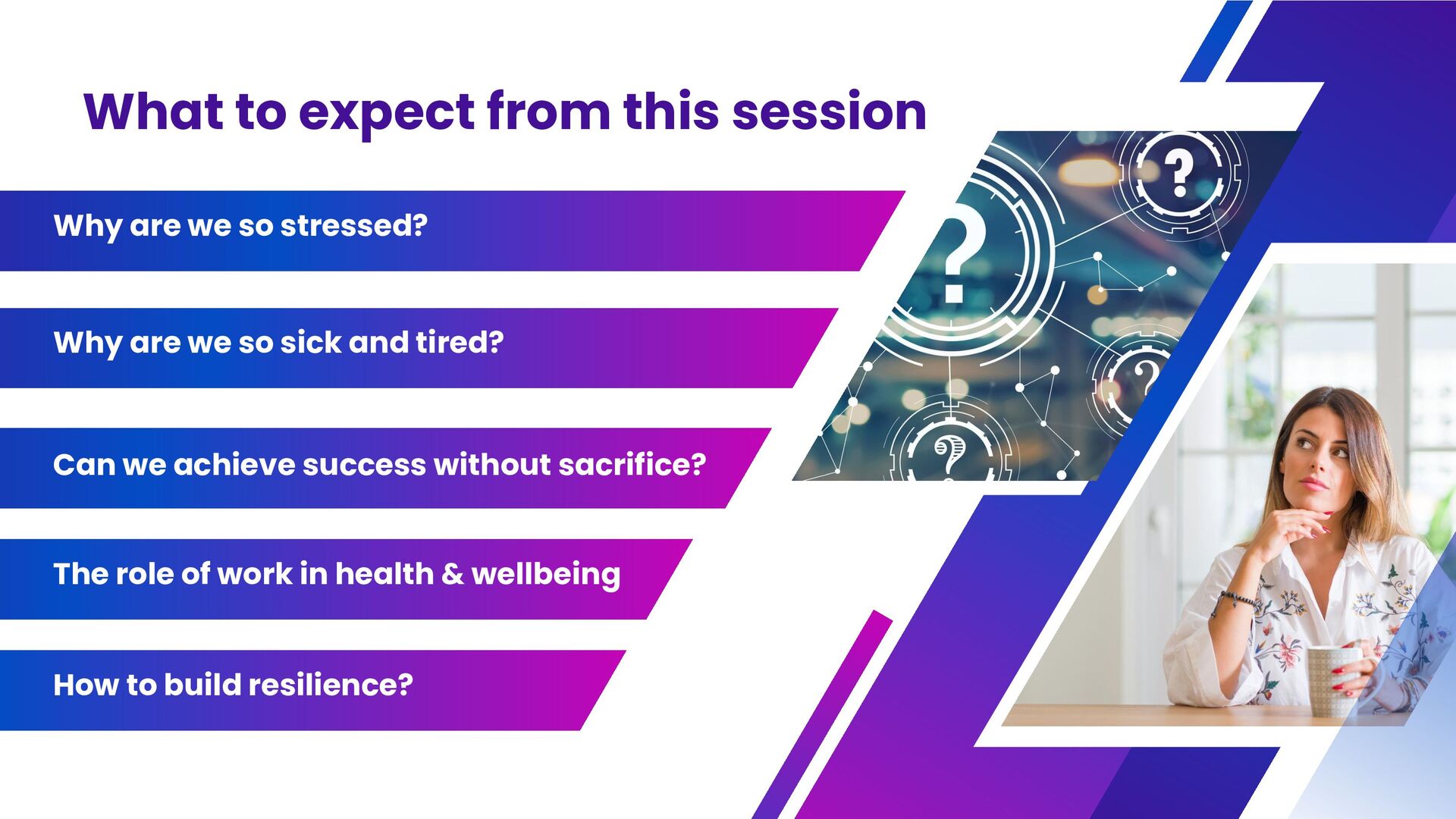
So how do we build a culture of high performance? And how can we achieve that success in a way that doesn't come at the cost of our personal sacrifices, that we don't have to burn out on our journey. So what can we expect from this session?
We know now that we live in a world where we have all of these advancements in technology, innovation, AI. We have, you know, health care innovation, and yet we are still more stressed, more burned out, more sick and tired than ever. Why? We will be asking questions about how to achieve that success without personal sacrifices and looking at the role of work in that.
And most importantly, how to build resilience in the face of the change, in face of evolving innovation and technology, how can we stay resilient, and how can we still stay human? How can we still be ourselves on the journey? So who am I, and what entitles me to preach on this important topic?
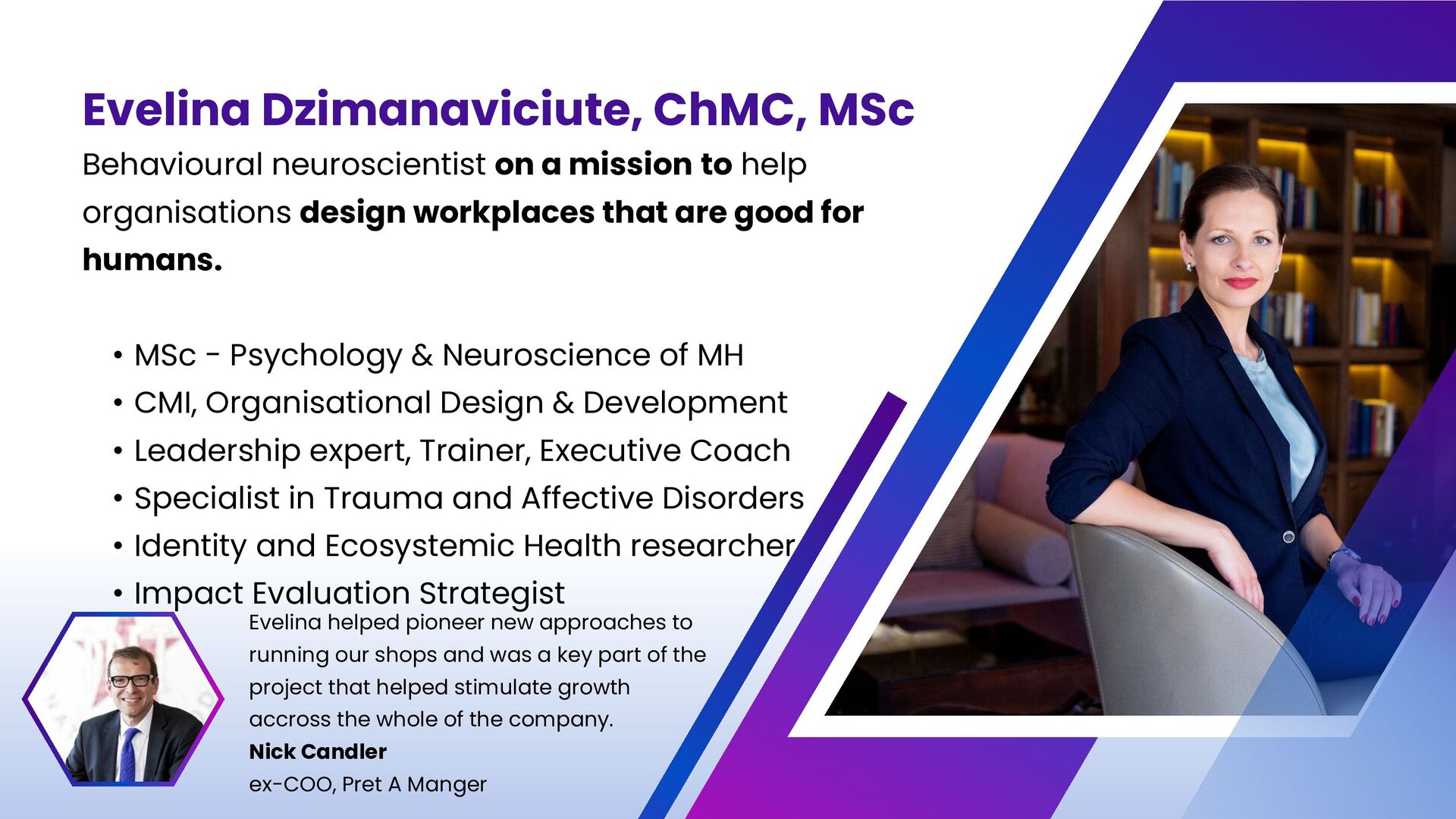
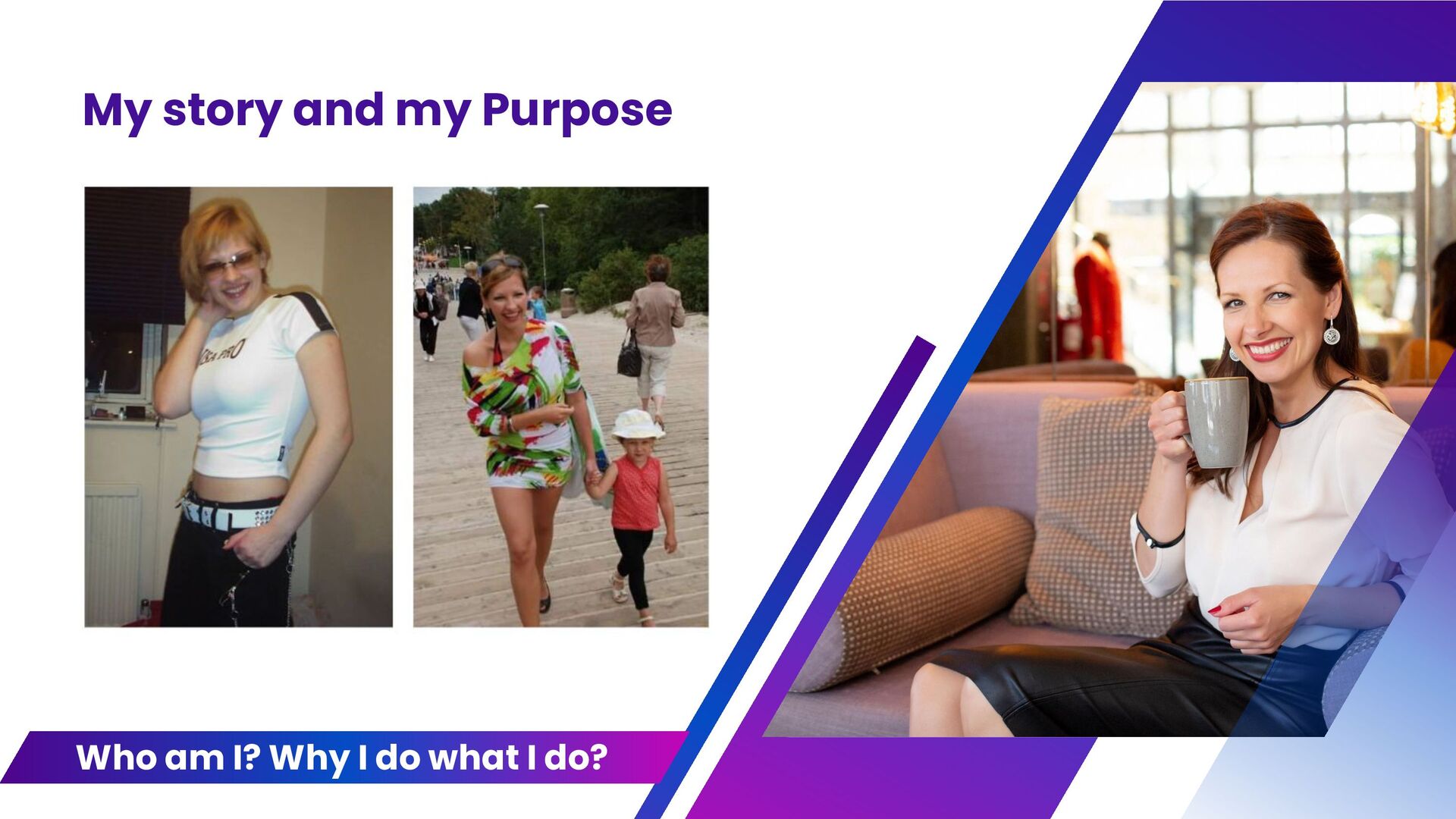
Well, I could tell you all of my background and what I do, but instead, I would rather tell you the story of why I do what I do. Now, I'm originally from Lithuania, and I came to UK now more than twenty years ago.
I was nineteen years old. I'm supposed to stay in UK just for a couple of months. I came here as a tourist on a summer holiday. I didn't speak English. I didn't have any money with me. I didn't have any family support. And I got myself into the situation where I couldn't go back home.
So I decided that if I have to stay here, I want to make sure that I get more out of this than I left behind. So off I went on this journey, learning the language and going to university, had a child, started building my career, and I was hungry.
I was hungry for learning. I was hungry for life. I wanted it all, and I wanted it now. And of course, we all have sometimes this naive energy when we believe that, you know, everything is possible. And I was one of those people that believed that I can do it all.
I never doubted myself. I never asked, is it possible or is it not? I only asked how, and off I went. So I had those crazy few years where I was sleeping four hours a night for many, many years, working at several jobs while raising a child, while studying at university, while also volunteering for charities that works with suicidal people and support homeless.
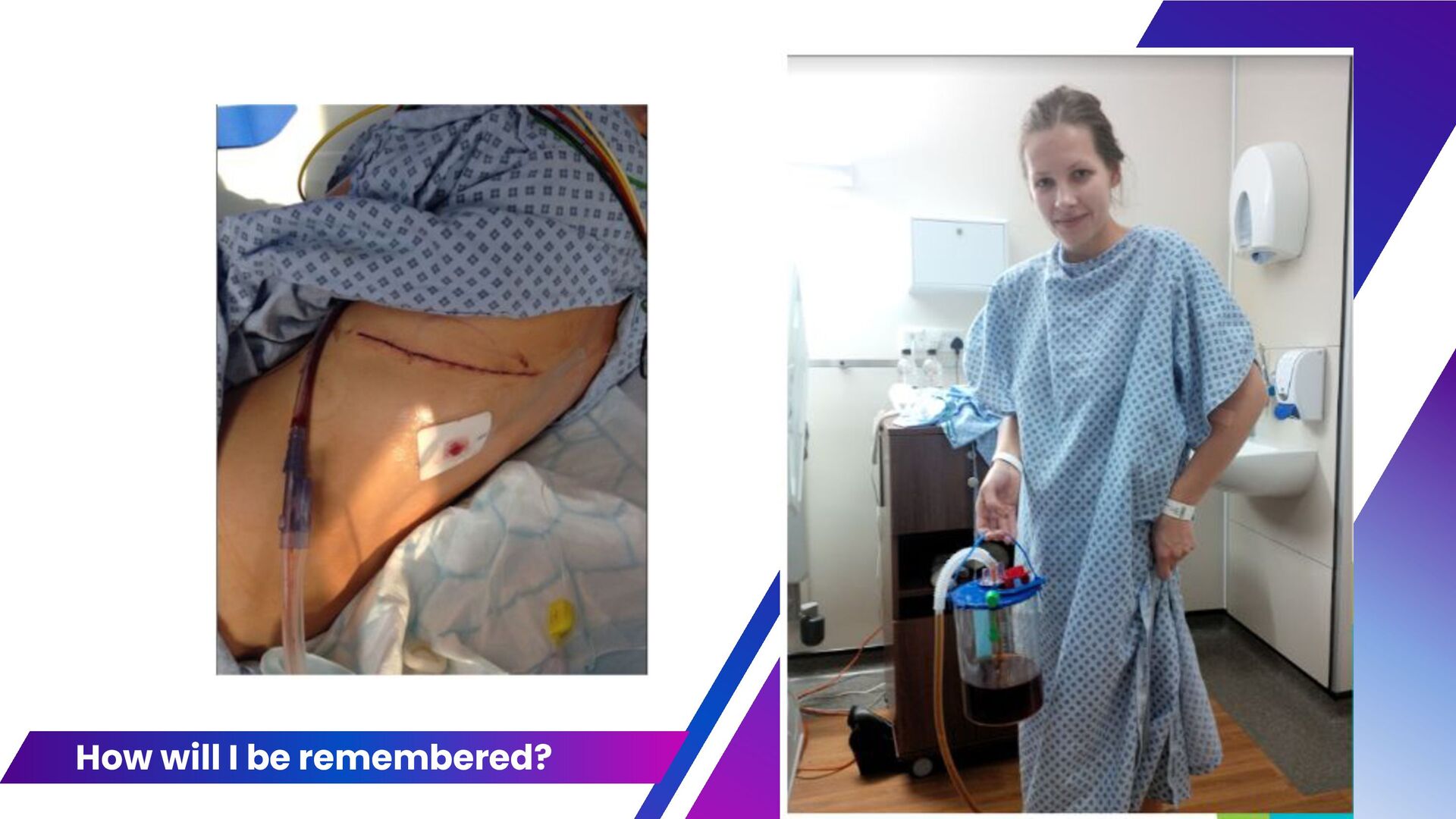
And where did that take me? Just a bit of warning of a graphic content coming up. That's where it took me. One day, I collapsed at work. I wasn't able to breathe. I couldn't walk. My body just gave up, and I was seeing myself as a strong, powerful person who could do it all, and then suddenly, my body said, No, I'm not having it.
And I've learned that I have this huge tumor inside my chest growing into my lungs, pushing into my rib cage, and I had to have this horrendous operation to remove a couple of my ribs, a big portion of my back. And the night before the operation, when the team of doctors come in and they explain to you all that's about to happen, and you are given this document with a small print to sign that says, I agree with all the consequences of this operation, including my own death.
And that night, I looked back on my life, and I thought, okay, so I came here from a foreign country without even speaking the language, with nothing. I've built my life. I've built my career here. I built successful business. But at what cost? At what cost did I do that?
I sacrificed my health. I sacrificed all the things that I loved. I sacrificed my relationships. And the one thing that I regretted the most was not spending time with my daughter. She was six at the time. She was coloring in in a corner of the hospital room.
And I looked at her, and I thought, if this is really my last day here, how is she going to remember me? And I thought, what is she going to say is that mommy was always working. That's what she's going to remember. So I knew that if I wake up after that operation, I'll have to find a new way.
A new way to live, a new way to achieve my goals, a new way to define success on my own terms, not somebody else's, not what others expect of me. And I had to go then on the journey to discover what that is, and how am I supposed to live.
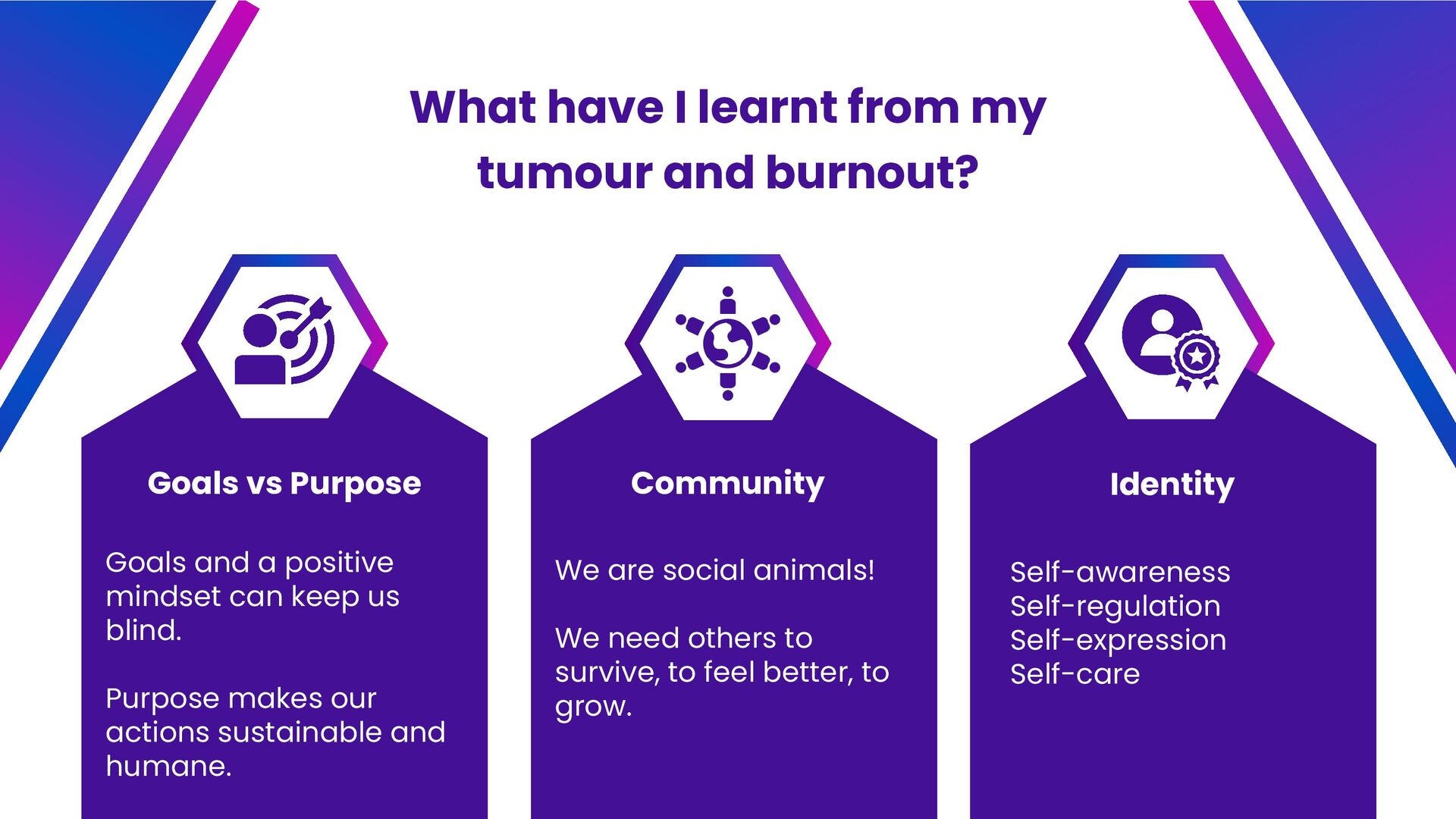
So what have I learned throughout the journey? Well, first of all, that the way we set goals and the way we set intentions is wrong, is very often really damaging. When we set very focused goal and intention, it narrows our mindset. It narrows our focus. And we can become blind.
We can become blind to opportunities. We can become blind to options around us and choices. And most important, we become blind to the needs of our own body. So that positive mindset that I thought was my strength, you know, saying that I can do it all, and it's just the matter of how, never saying no, always working through to achieve whatever I wanted to.
We hear this all the time, right? Let's build a positive mindset. Let's believe that everything is possible. But any positive taken too far can become destructive force. And I've learned that, that it is my positive mindset and my can do attitude that led me to burnout.
And you will see this is quite common in tech, in product development, that people are actually most productive just right before they burnout. So it's very important that we learn how to set goals holistically, and instead of just setting direction that keeps us focused, it's much more sustainable to set purpose.
Because this way, our actions become much more sustainable, much more human and much more humane. The other thing I've learned that in our modern world, we keep promoting this idea of individuals. Right? You can do it all. It's all about individual choices, and, you know, it's all about who you are as an individual.
But that's not how we have evolved to survive. Over millions of years, we would have not been able to survive on our own. We are really social animals. We need others to survive. We need others to regulate our emotions and our levels of stress, and we need others to challenge us to grow and support us to pick us up when we fall down.
So that community is really, really important. But for us, in order to have support of that community, we need to have courage to be vulnerable, because I realized that when I was playing that role of a superwoman, someone who can do it all, no one would dare to offer me help and support.
Right? They'll probably think I'll be offended. Right? So it takes the level of vulnerability to admit when you are struggling, to admit some of your weaknesses and to share your vision, to share your purpose, so that other people can come on board and help you make it happen, help you translate it into reality.
Now, after this, I've spent a lot of time, actually, even before my burnout, when I was working in a charity working with suicidal people, I spent a lot of time researching resilience, and that is still a big area of my interest in research.
And it's really interesting to look at what makes the difference between people who struggle and people who can thrive and grow with exactly the same challenges in exactly the same environments? And for a very long time, I thought that it's really that mindset, it's that positivity.
Right? Whether you believe you can or you cannot, you are right. And that mindset comes a lot from your upbringing, from your childhood, from support that you have around yourself. But what it took me a long time to realize that most of those things can be shaped and reshaped, and the biggest difference that it makes for our resilience is our identity.
To what ex who we think we are and how we attach different labels of identity to ourselves will shape our levels of self awareness, will shape our values, our beliefs, and that will determine levels of resilience. But identity is not just about the mindset.
It's also about self care. It's also having the level of self awareness and knowing how to listen to your own body, knowing how to take care of yourself, how to express yourself healthily in a way through your products, innovation, whatever that you are creating, to make sure that you can give, but you can also do not pour from an empty glass when you go and do that.
So, after my operation, I was filled with questions. Who am I? Where am I going? How am supposed to live from here? How do I define that success? What is direction? How am I supposed to live? How am I supposed to work? I was filled with questions and doubts.
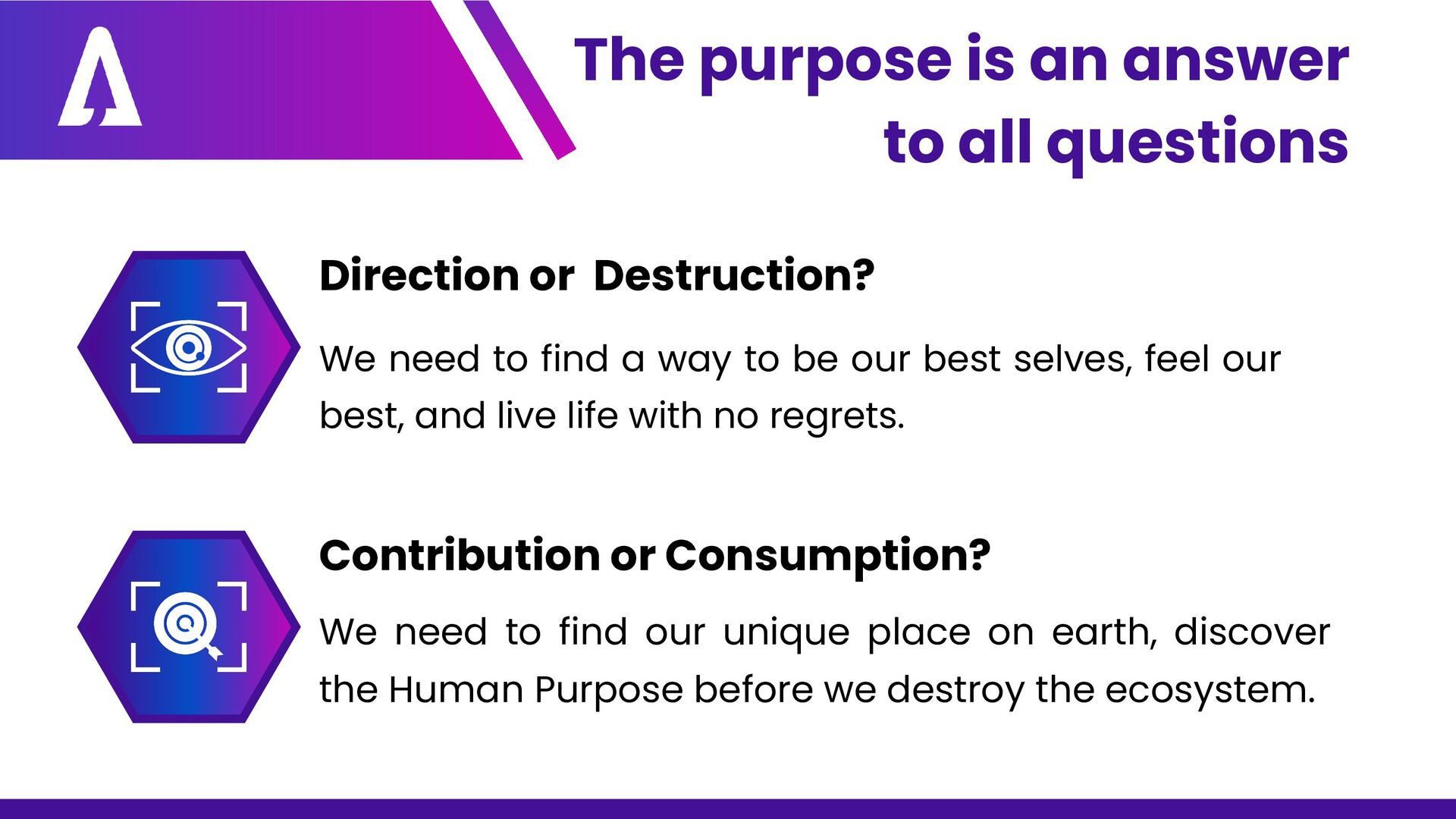
And I believe that when we get lost, the biggest answer to all of our questions is purpose. Purpose makes all the difference at individual level between direction and destruction. If we don't have meaning and purpose in our life, we end up chasing some of the superficial goals and ideals.
We end up working in a way that is just not sustainable, that's not helpful for us, for our health, for our well-being. So we need to find a way to be our best selves, to feel our best and live life with no regrets.
But also, purpose at the business level, at organizational level, makes the difference between adding value and contributing to the society and the world and just driving consumption. So we all need to find that unique place on earth as individuals, as businesses, and discover the human purpose before we destroy ourselves, our health, and before we destroy the ecosystem along the way.
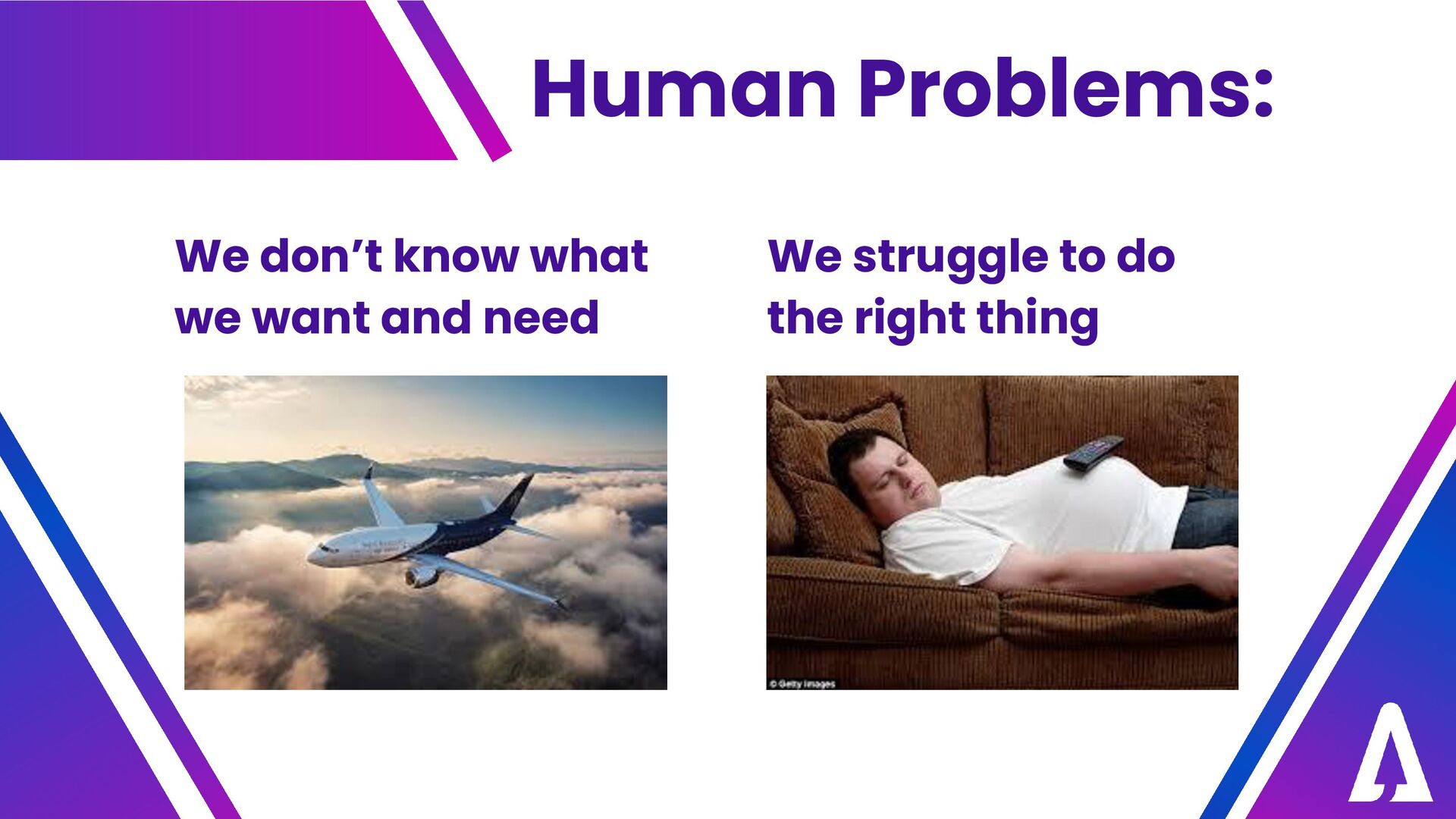
But of course, we have some obstacles along the way, all of the problems that comes with simply being human. Now, most of the time, we don't know what we want and need. We think we do, but in reality, and again, many of you probably work in product, in tech, and you go and do the research when you ask people, what do you want?
What do you want from your product? What do you want from the next tech development? And there's been very interesting research done by Boeing, where they did interviews and surveys with first class flyers, and they asked them what is it that you want from us to define this service and to create this first class experience?
So, of course, there's been a huge list of criteria that came up. Things like, you know, I want more leg room, and I want better service, and I want faster service, and I want a little bit more tastier food, and I want more choices of wine, and all of those wonderful things, right, that would be nice to have.
But then if you are given a choice to fly commercial airlines or to have your private jet, which one would you choose? It's a no brainer, right? And private jet has no any of those things. Right? It's small, cramped spaces. Of course, you have you have some other private jets that are somewhere in between, but most most of them really go against all of these things that we said we want.
So what does it tell us? What does this research tell us? That really there are some values and human drives that we have that we don't even aware that it's driving our choices and decisions. We have all of these evolutionary drives, the way we have evolved to survive as human beings, and all of those needs have priorities, and all of those values have priorities, and some of them we are not even aware of.
So in case of that Boeing versus private jet, the value is freedom. The value is autonomy, is choice of traveling on your own terms and time scales. Right? And that is way more valuable. And yet, there is a different research that needs to go to elicit that.
And just by asking people, we don't always get those results. So, of course, the problem is that first, we sometimes don't know what we need and what we want. The second thing is that even when we know what is good for us and what is right, we don't do this.
How many of you have set up goals and New Year's resolutions at the first of January, and then, you know, a couple of weeks down the line, you've gone back to old routines and old diets? Sounds familiar? Why? We all know that we should be eating kale salad, but we still choose to have chocolate cake.
Right? We know that we should be going for a run, but we still choose to binge watch entire Netflix series throughout the day. Right? Why do we do this? We know it's good for us, and yet we fail to act on it. Why is it so difficult to do the right thing?
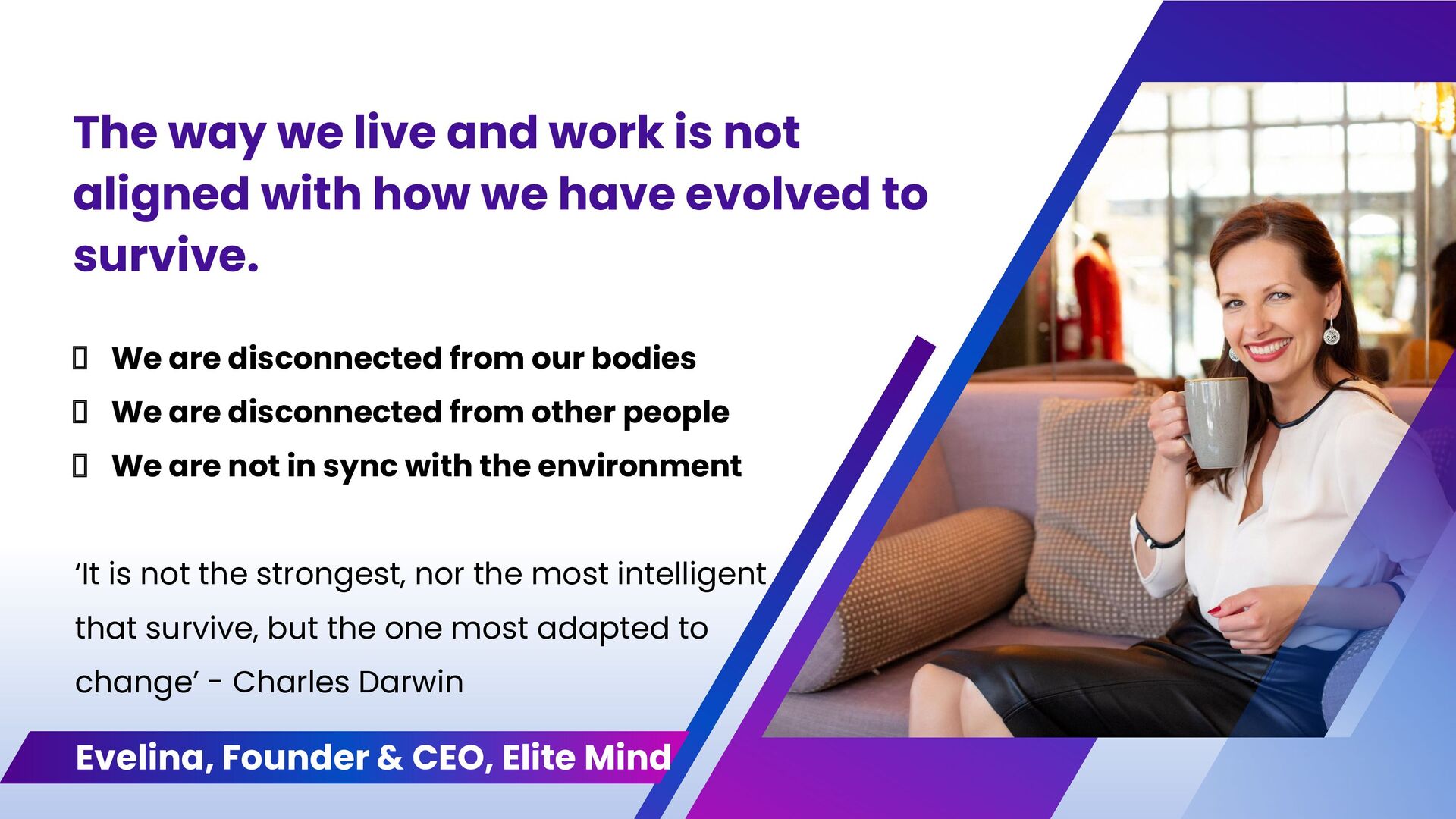
So what I've realized that the reason why we don't know what we want, need, and the reason why we're really struggling so much is because the way we live and the way we work is just simply not aligned with how we have evolved to survive over millions of years of evolution.
So first of all, we are completely disconnected from ourselves. We're disconnected from our bodies. We're living in our heads. We think we are these rational, intelligent human beings able to make all of the choices and decisions at will. But in reality, we have all of these other centers of intelligence in our area of our heart, in our gut, our microbiome, our skin biome.
These are entire intelligence ecosystems that have their own needs, their own drivers, their own choices. And believe it or not, your composition of microbiome can affect how introverted or extroverted you are. It can affect your behavior. It can affect how you feel. And yet, if we are not looking after our bodies, if we are not living in sync with our bodies, we don't know how to utilize this huge intelligence for us.
Right? So we end up fighting ourselves. How many of you felt this inner conflict where you set a goal and you think, you know, my head is telling me to do one thing, but actually my heart is telling me to do something opposite?
Or you say, you know, my head or heart is telling me to go this direction, but actually I have this gut sense that something is not okay. I shouldn't do that. Right? So it's a sign that these intelligence centers from nervous system point of view, they have their own unique decision making with their own needs.
And if we don't understand those drivers behind it, then we just end up fighting ourselves. And that what cost us all of our energy, that what takes so much effort, that can cost us burnout and affect our productivity. We're also disconnected from our people, like I mentioned that community.
It's so, so important that you know we don't live as individual human beings. We need to belong. We need to be part of that community. We need to have that field intelligence, and we are not in sync with our environment. We're disconnected from nature.
We are not aware of surroundings and the impact of light, color, touch, all of these physical sensations and how it's affecting us. So there's one of my favorite quotes by Charles Darwin, and he said, That's not the strongest nor the most intelligent that survive, but the one most adapted to change.
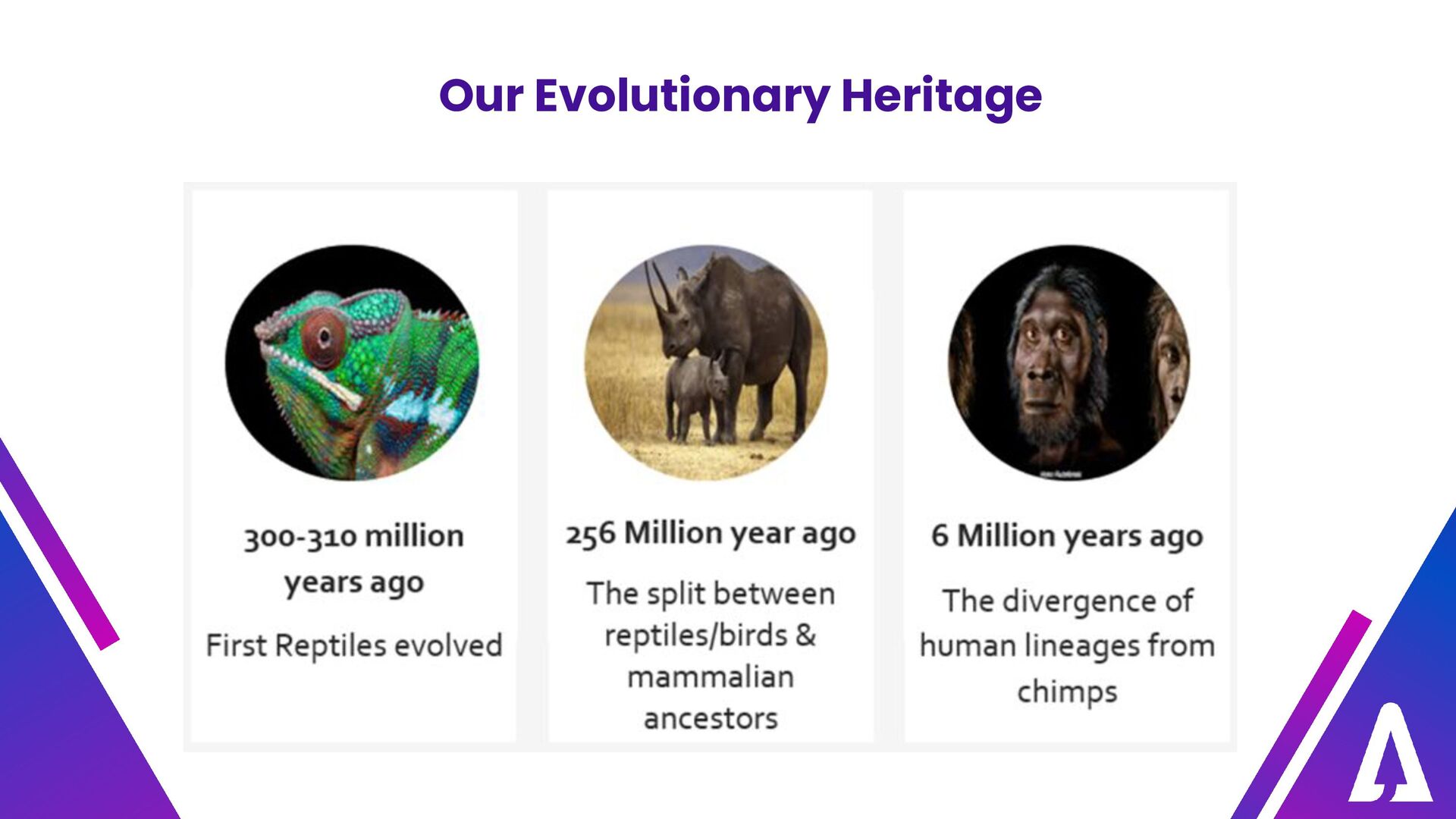
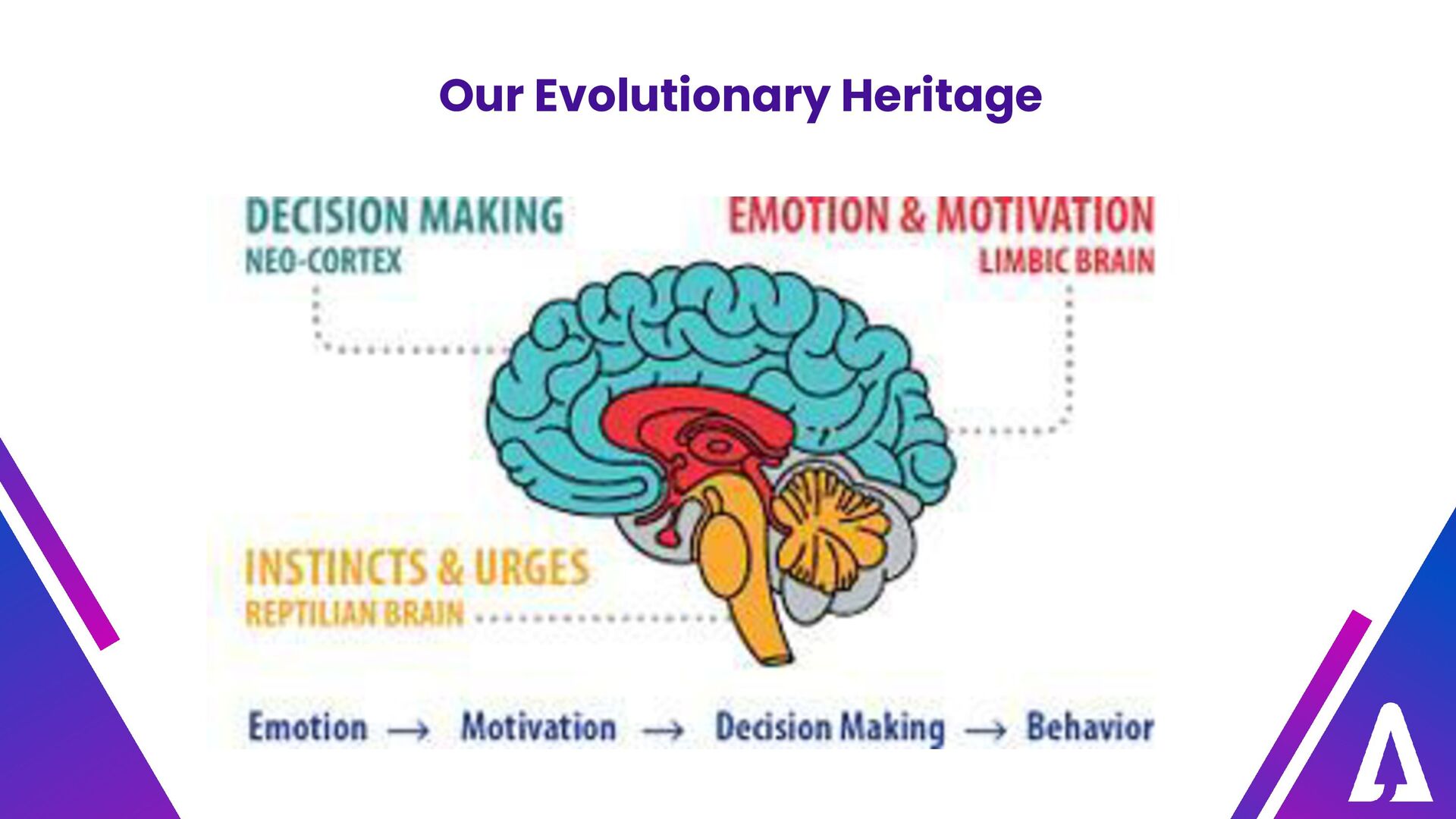
And I think it's true for individuals as well as for businesses. So when we look at that evolutionary heritage, we still have parts of the brain that have evolved over three hundred million years ago. We still have the same structures of our brain that came from these reptile years of evolution, from these mammalian years of evolution.
We still have the same brain centers that drive those urges, instincts, emotions. And our behavior is really driven by these hidden emotions and motivational drivers that then shape decision making, and then influence how we act. Right? I'm sure you've heard before that we buy with emotion, and then we just justify with logic and reason.
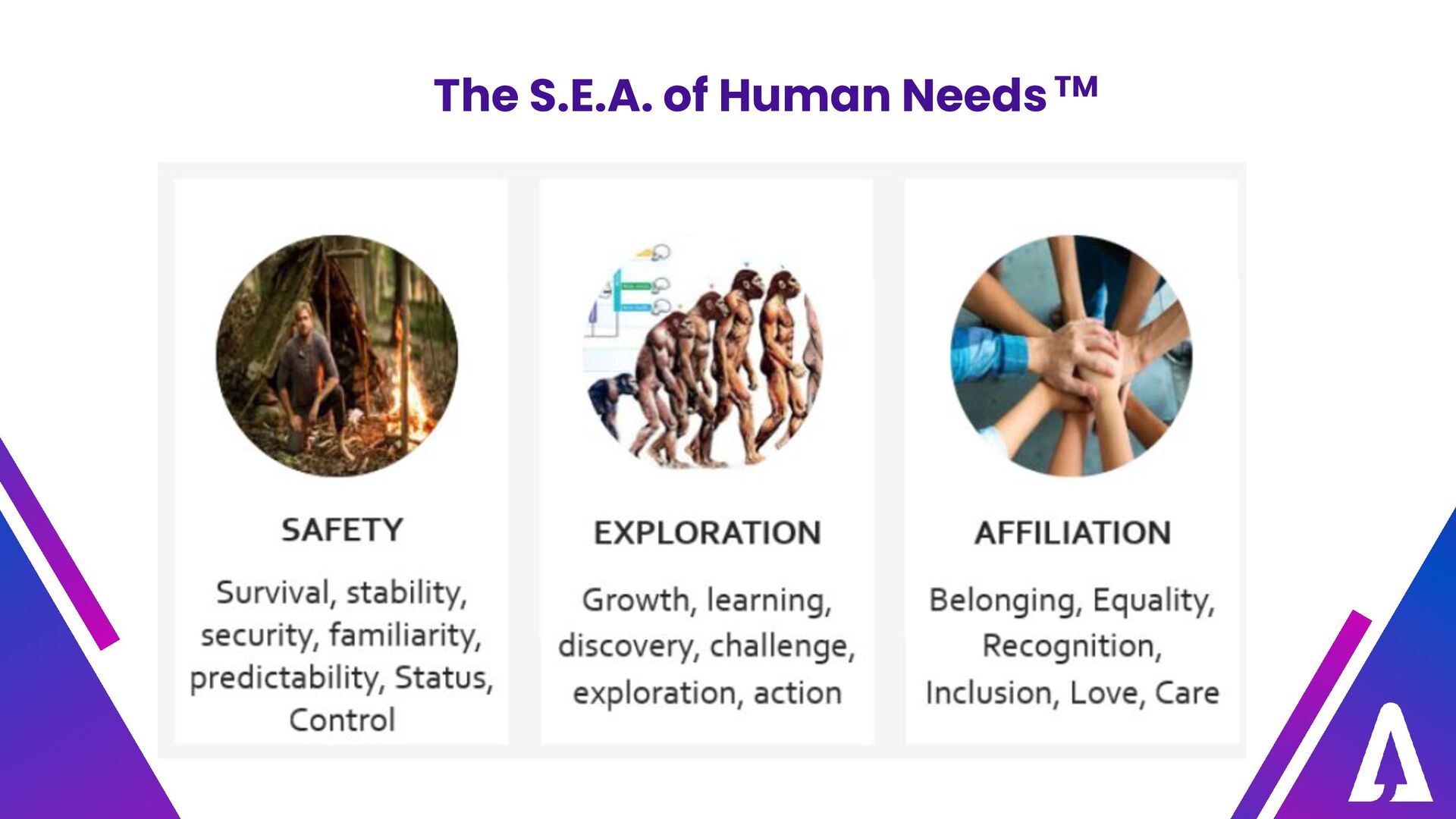
Right? So emotion always comes first. There's all of these emotional drivers. So at the back of this, we have those human needs. In sync with these three stages of evolution of this kind of reptilian, mammalian and human parts of the brain, we have those human needs that we need to fulfill for ourselves, we need to fulfill in our workplace.
And the core and the start of everything is the safety. We just want to survive. We just want to be alive. We just want to pass on our genes and our existence. So safety in our modern environment manifests as stability, security, familiarity, predictability, knowing what is expected of you tomorrow, having certain level of status and control.
So this certain level of sameness in our life that gives us that sense of psychological safety. But on other hand, we have something opposite. We have that yearning to explore and to grow and learn and to discover something new. So we're kind of constantly looking over the horizon and thinking what else is there and what else is beyond that boundary that I cannot see?
So we are keen to learn and grow. And those things are in a way in conflict. They're completely opposite, but we still need both of those. And then affiliation is all about that belonging. So for millions of years, we would have not been able survive on our own.
So that's why social rejection is so painful, and we need that recognition. We need to be valued. We need to be recognized that we are adding value to the community, because if not, we are at the risk of being excluded. We want to be loved. We want to be taken care of.
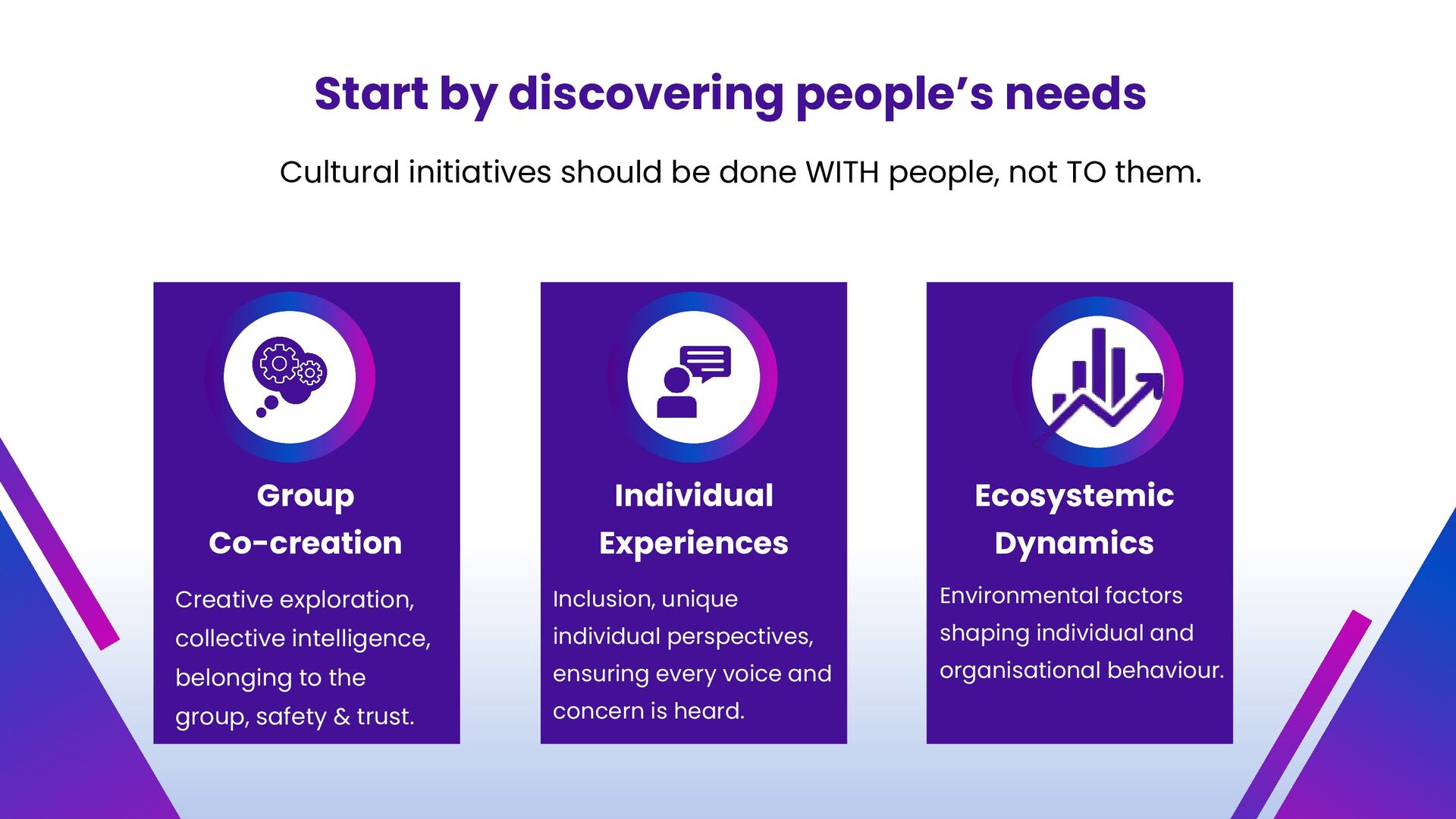
We want to be part of that bigger group. So if we want to start creating those inclusive, healthy working environments, we need to start by discovering people's needs. And all of these cultural initiatives should be done with people, not to them. Very often I see in companies, you know, some of these are kind of top down initiatives where people just say this is what we're going to launch and people are not involved.
So it's very important that we work with groups, because it has that field intelligence and we can exchange ideas in a way that generates new innovation. It's also important that we consider those individual experiences, and we consider people's individual needs, their personal drivers, their unique perspectives, and we give them opportunity to contribute in one to one.
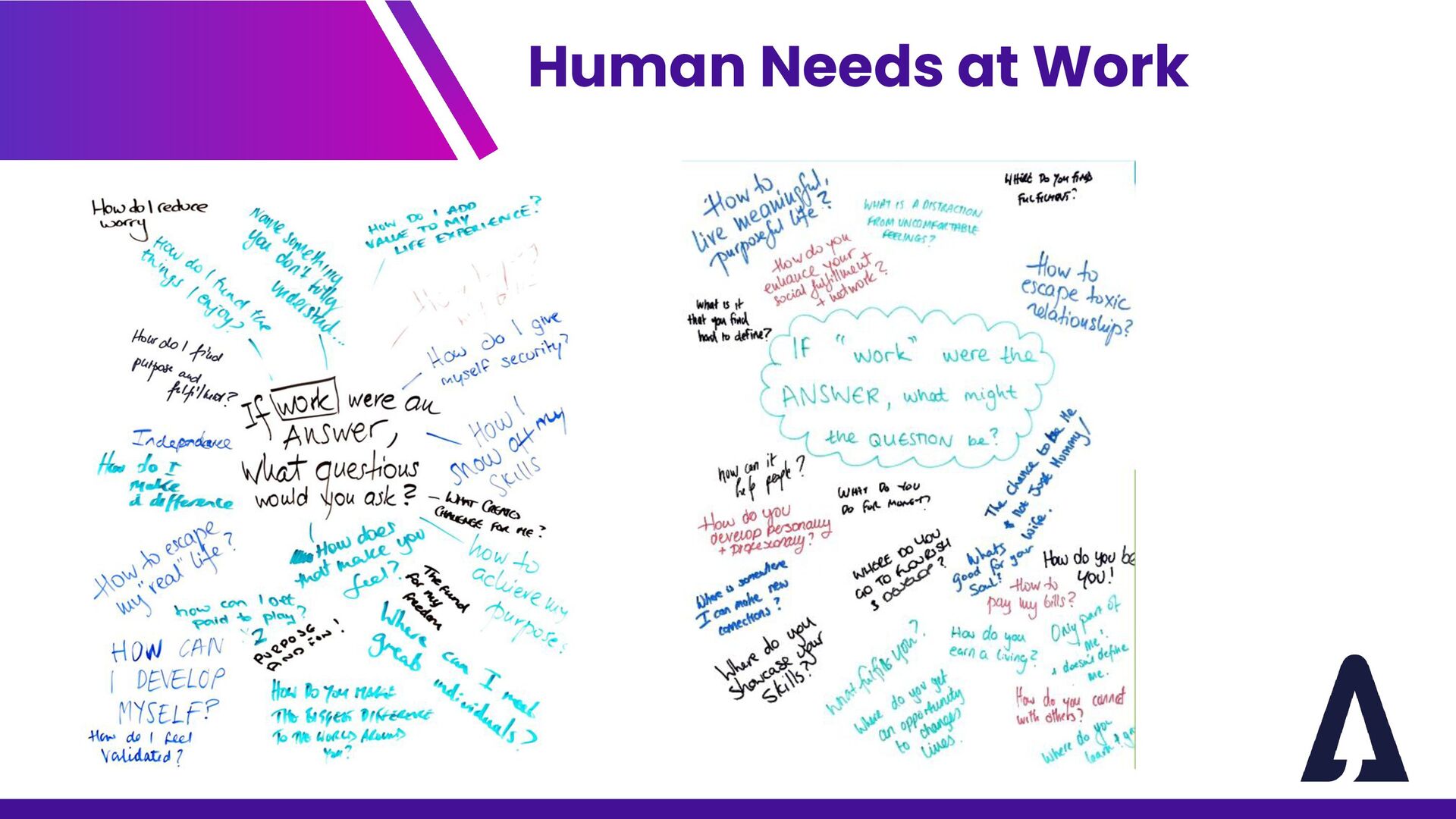
But we also consider all of that in the wide ecosystem dynamics. So we understand all of the environmental factors, all of the market forces that are shaping our actions, decisions, and behaviors. So when we do some of those work workshops, I sometimes ask people questions about if work were an answer, what questions would you ask?
Why do we come to work? Right? What needs does the work fulfill for us? And of course some people come to work, because they need to pay the bills. Some people come to work, because they want to grow and learn, and they want to fulfill themselves.
But there are some other people who are there to escape abusive relationship for example. So what does it mean for you as a leader when you lead others and know that people are there for work for very different needs? What questions you are asking in your one to ones?
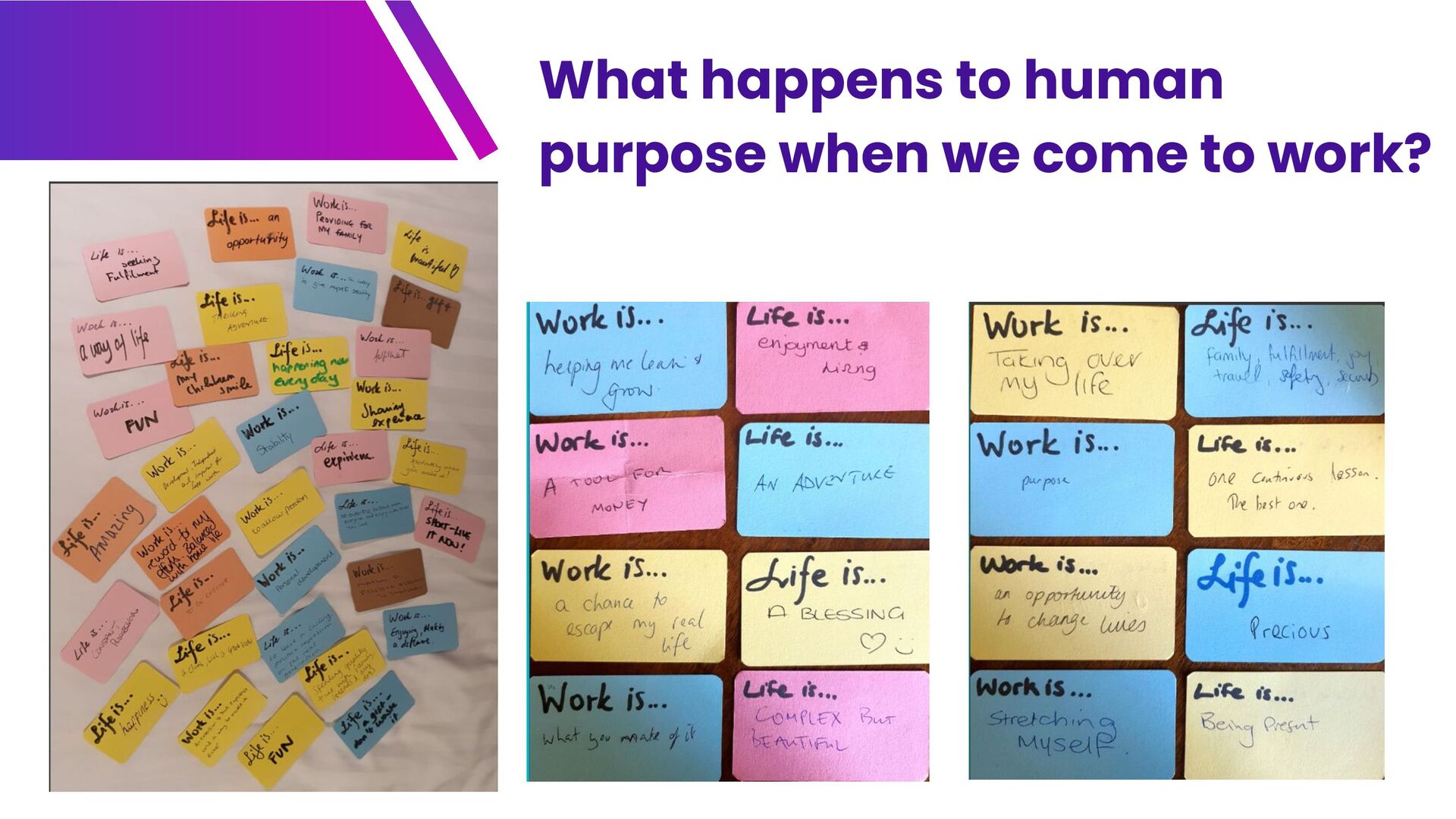
What questions you are asking of your teams? And when we have that human experience and we bring it to work, and we ask questions about what is the difference between work and life, I had this card saying work is on one side and life is on other side.
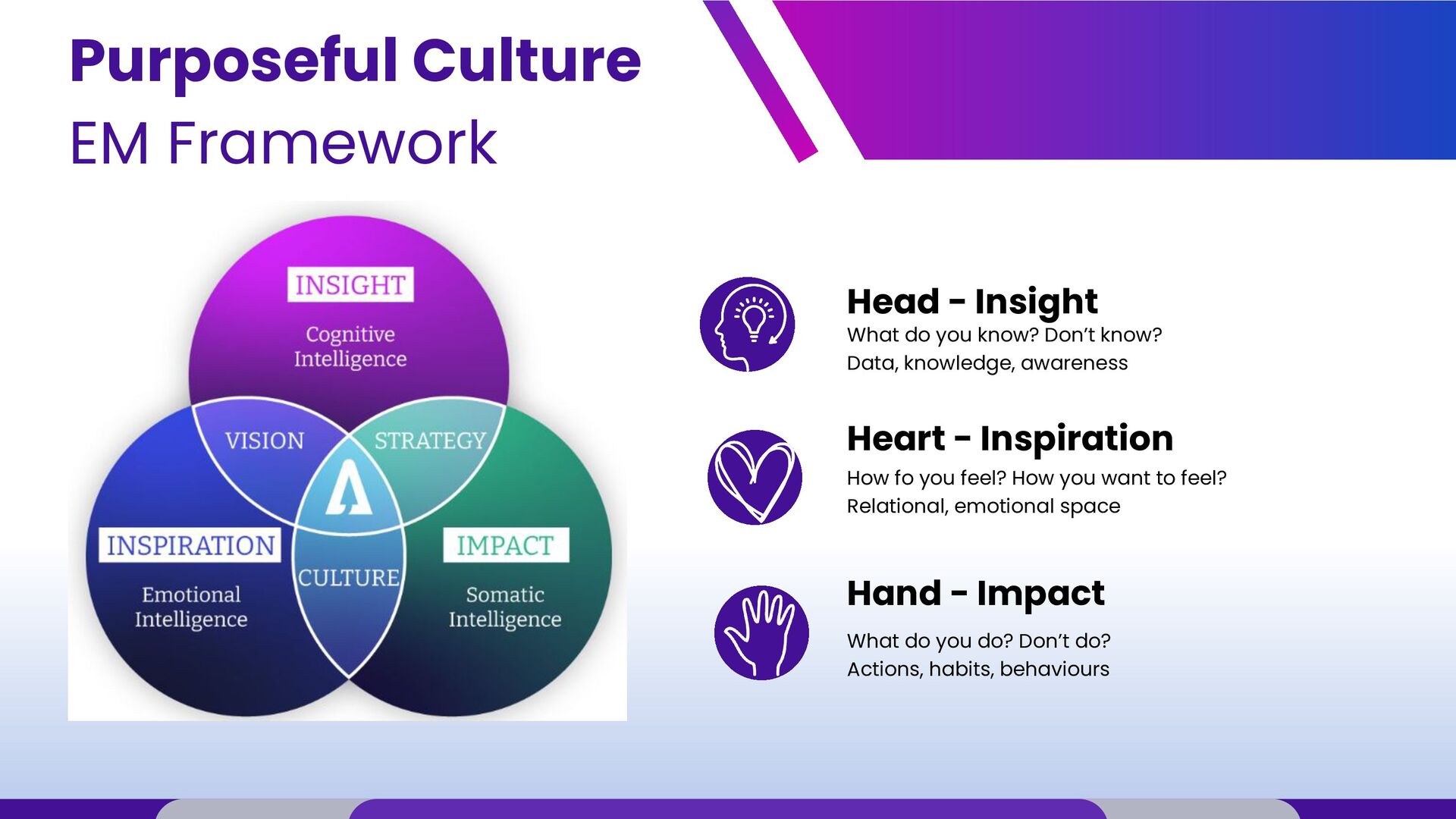
Nobody said the same. It's always different, but should it be? So work is such a big part of our lives, and yet it's in constant conflict. So how do we bring it all in balance? So if we want to build purposeful culture, this is our elite mind framework that we use to design our workplaces.
We need to work with these different levels of intelligence at individual and organizational level. So we need to work with our cognitive intelligence, so our head. So what do we know? What we don't know? What data information awareness assumptions that we have on which we make decisions?
Then we have emotional intelligence. How do we feel? How do we want to be feel? This whole relational, social, emotional space. And then we have our somatic intelligence. So we have that hand, that impact, what do we do, what we don't do here to define our actions, habits and behaviors.
And in the context of organization, we have these big questions, When you say, so what is company's vision? And you know, what is culture? How do you even define that? So if you combine what you know with how you feel, you infuse that with inspiration, you have company's vision.
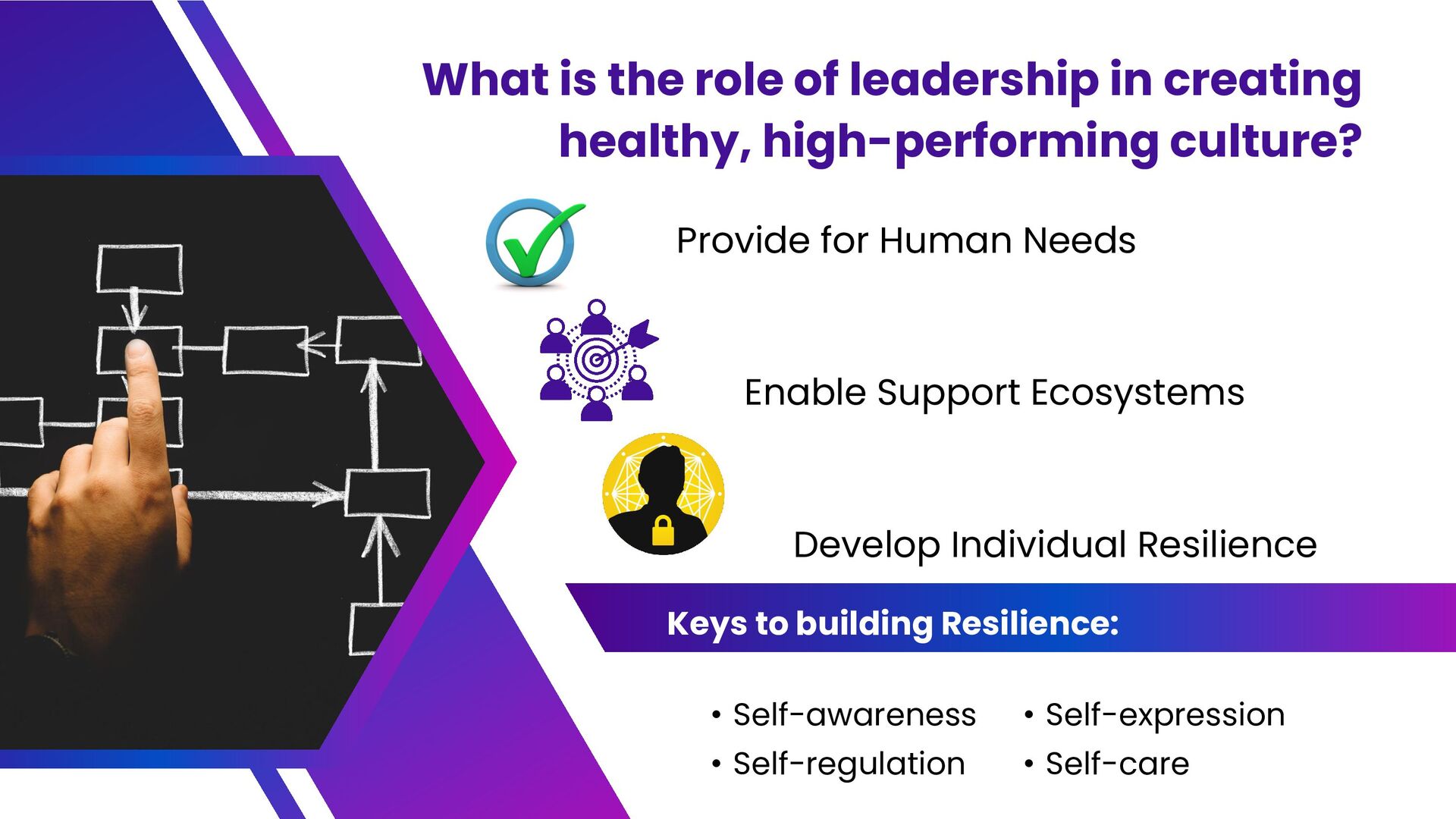
You take what you know with what you do, you have your strategy. And you combine how you feel with what you do, and you have company's culture. So what is the role of leadership in creating those healthy, high performing cultures? So first of all, we need to provide for those human needs.
Second, we need to enable support ecosystems. We cannot operate on our own. And finally, we want to create environments that will develop individual resilience. And there are these four keys to building resilience that we all can embed in our workplaces that we can build for our people.
So helping people to develop self awareness, helping them to develop better self regulation, so the level of stress, level of emotions, healthier self expression of themselves, their identity, of their unique ways of being and showing up in a world. And finally, self care, making sure that whatever we do, whatever we try to work on, we don't pour from an empty glass.
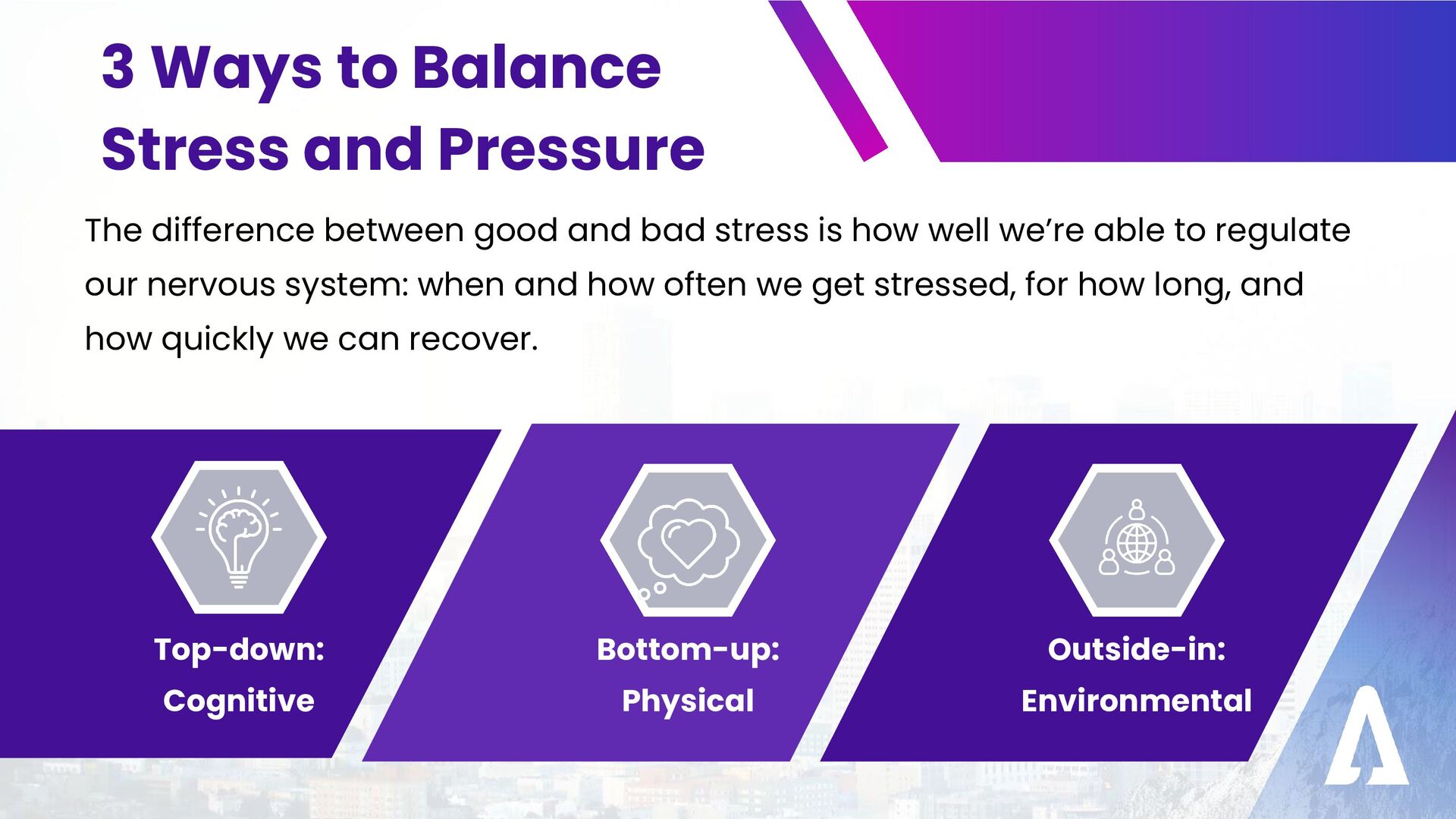
And what does it mean at individual level? What are different ways to balance that high performance and pressure and stress in a way that balances our sympathetic and parasympathetic nervous system, so it doesn't cause illness and burnout. Now, the difference between good and bad stress is really how well we are able to self regulate that nervous system.
It means knowing when and how often we get stressed, for how long do we get stressed, how quickly we can recover. And from neuroscience point of view, there are three ways how we can regulate our nervous system. So first approach is a so called top down cognitive approach.
So this is through our head, your mindset. You can regulate the rest of your body. So things like visualization, your values, beliefs, what you think, what you imagine will help even like knowledge and awareness can help calm the stress down. The opposite approach is the bottom up. So through the body.
So this is your exercise, your diet, looking up after your microbiome, skin microbiome, cardiovascular health, right? And knowing how to regulate that to balance your levels of stress. And finally, the biggest and the most important is the outside in, is from our environment.
Think how differently do you feel when you are at the beach looking at the sunset. How listening to different pieces of music make you feel. How surrounding yourself with some people make you energized and rejuvenated and other people will drain all of your energy, right?
So we need to make sure that we have that environment and we can design it and choose which environments we need for different states. So your rest environment should be looking completely differently and designed in a very different way than your high performance state.
Right? So, do a lot of damage by eating lunch in the front of our desks, by watching TV in a bedroom, by working from our kitchen table. Right? We need to make sure that we have a dedicated spaces for specific performance states. So you perform, but you rest, you eat.
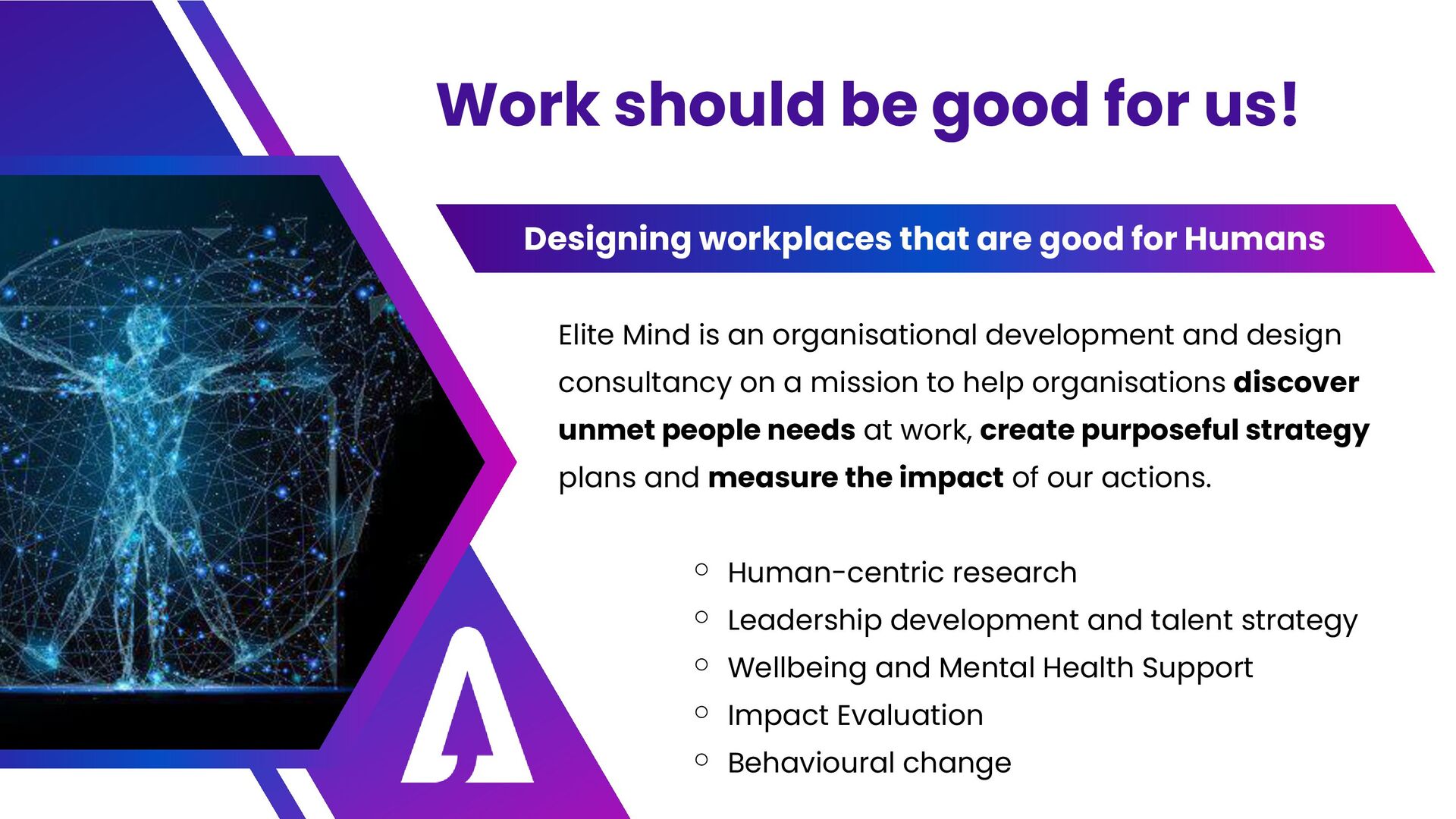
All of the activity is supposed to have their own designated spaces. So if we do this right, work should be good for us. And for me, my company and Elite Mind is my way to live on purpose. For me, I believe that if we design those workplaces that are good for us, we can find a way to provide for people's needs.
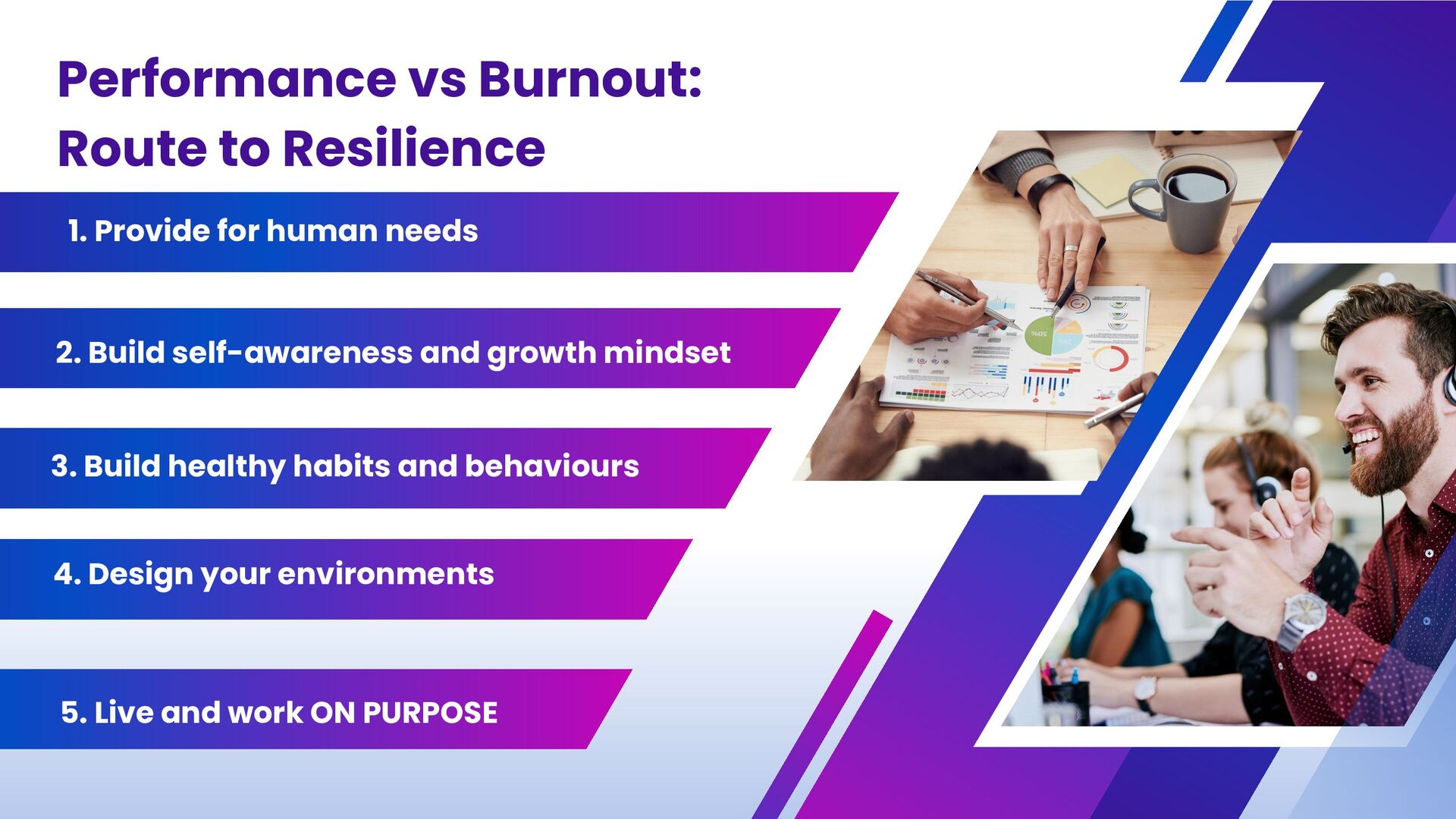
We can find that purposeful strategy, and we can make an impact with our actions and through our businesses. So to summarize, what is it that we need to create that high performance in a way that prevents burnout? What is that route to resilience?
So first of all, we need to provide for human needs, and we need to consider those evolutionary needs, not just what we think we need, but really dive deeper into these evolutionary drivers of what really drives our actions, behaviors, and understand how we really make emotions from that perspective.
We need to build self awareness, awareness of our body, tap into those different levels of intelligence of our body, develop that growth mindset, but not take it too far where it becomes our blind spot. We want to engage in building healthy habits and healthy behaviors, and we want to design specific environments that will support specific performance states, and most importantly we want to live and work on purpose.
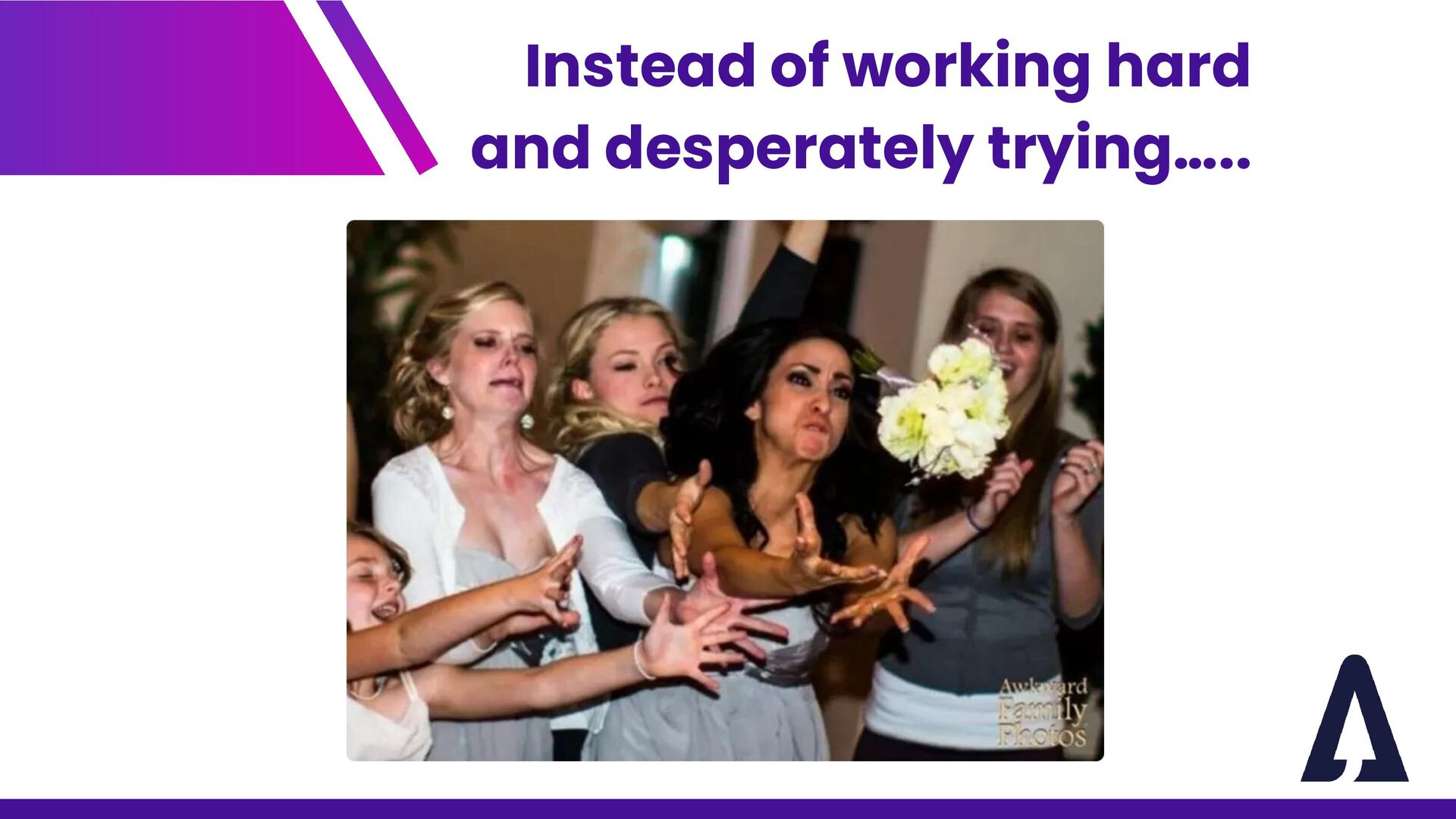
We want to have cultures that are designed and not just evolved by default. So how do we know that we get there? How good looks like in that culture? So if we do this right, instead of working really hard and desperately trying, if we get this right, it should be easy.
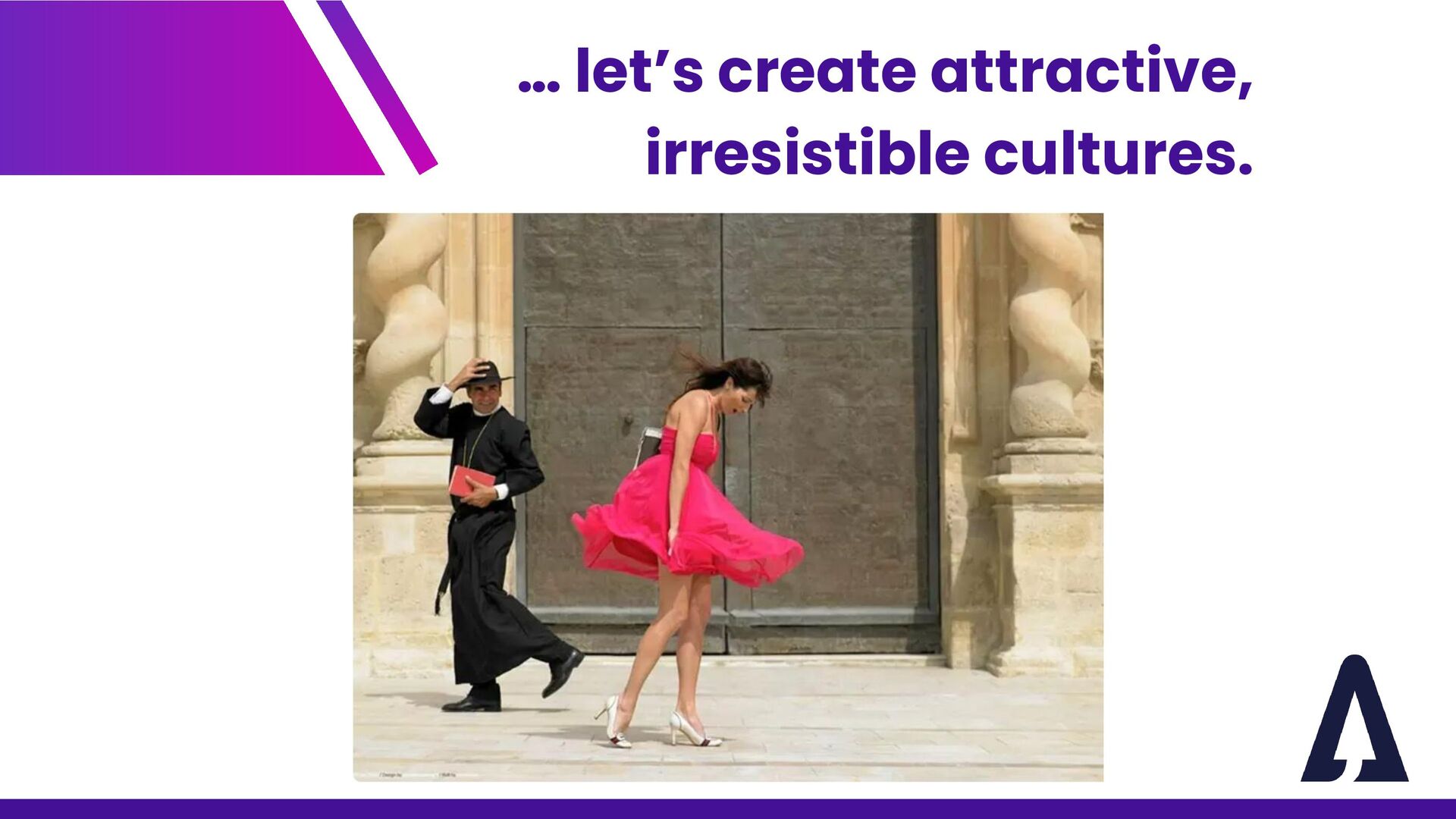
And instead of trying, we should create attractive, irresistible cultures where that drives those automatic behaviors, and we can tap into that nature of what it means to be human. So if life feels like a battle, we are probably not on our path, and we probably end up fighting ourselves.
So thank you very much. I know this is just a very brief pit stop into a very, very broad topic, So I'd love for you to connect with me. If you have any questions, feel free to send them my way. And I will also see you at the roundtable for any questions you might have.
Thank you.