
In the race for talent and growth, it can feel urgent to find “rockstar” employees that will 10x your business. But are we all falling prey to 100-year old assumptions when we set out to recruit? Some of the most essential skills needed in modern companies are overlooked, undervalued, and not listed on the job ads we all see. This talk will explain how you can change your hiring approach to target those overlooked skills, gaining a competitive edge in the hiring market that will help you hire faster, retain more team members and get stuff done.
← All talks 


Lead Turing Fest 2019
The Skills You Really Want to Hire For, and Why
Auto-generated transcript - may contain errors. Tap a timestamp to jump the video.
Thank you for that. Thank you very much. Thank you. You very much, everybody. I am so excited to be here today, and thank you for my entourage for the big cheer. That was super exciting. That's like a local home advantage. So yeah, I am so excited to be here today to talk to you about really about a different way of looking at hiring and recruitment.
And my job here today is I want to reset the context for how we think about hiring and recruitment. And my big goal here today is for all of you to leave this room with a new set of skills that you're thinking about and that you're looking for.
And I probably mean by clicker. So that new set of skills that you're you're looking out for, not just when you hire, but also when you go back to your existing teams and you look at them in a different way. So that's my goal. Okay. So yep.
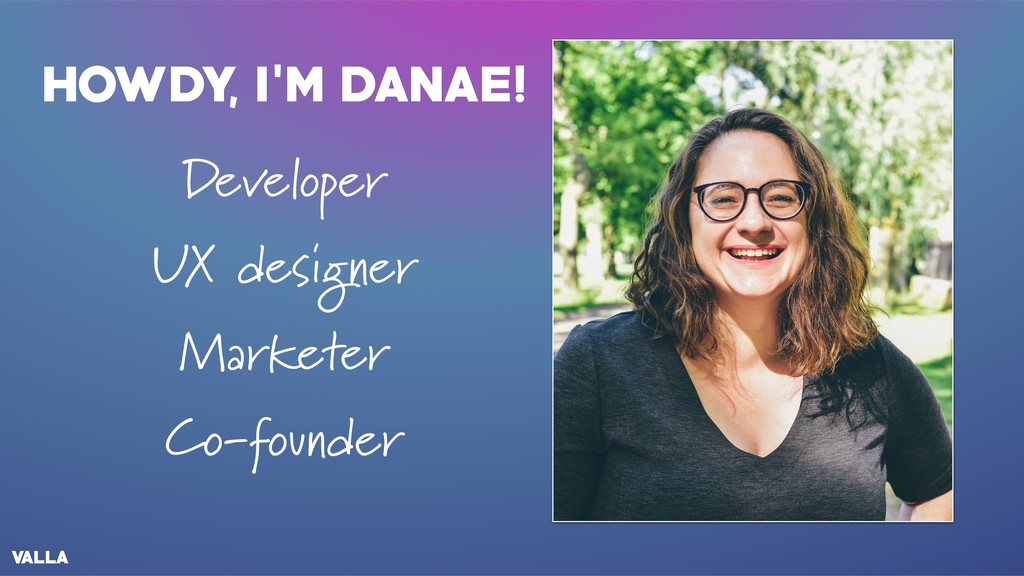
Slides are showing. So first, just a little bit of context. Leah's already given me an amazing intro, I'll just give you a little bit of context about who I am and why I'm talking about this topic. So I've been here in the Scottish tech scene for the last sixteen years.
I've had a lot of different roles. I started out as a web developer, I did a lot of UX design and then I transitioned over into marketing where I was more of a technical marketer, was CMO, a care sourcer and most recently, yes, I'm starting new stuff which I wasn't actually planning to talk about but Vala is a start up that helps or helps people find legal advice when they need it the most and we're starting with women in the workplace.
So yeah, so through my whole career I've been working at scale up companies and they were pretty much hiring all the time. So I've actually been able to get involved in a lot of hiring for a lot of different roles because I've had so many different roles.
So I've been able to hire marketers. I've worked with designers. I've been able to hire engineers, product managers, and then I've been able to lead some of those teams. And it's really because of that that I'm here today. Because I really started to see a big difference between what my experience was telling me a great hire was and what the industry was telling me that I should be looking for when I hired someone.
And once I started really thinking about this, I decided, I've got a real bone to pick about this. Like, I think I've got, It's really frustrating to see what's being said out there because it's just not matching with my own experience. And so I think we're being given really bad advice when we think about hiring.
And if I could sum up all of that bad advice and put it all into one place, I would put it here. The rock star. So we all know, right, like this is kind of old news. We know we're not really supposed to be using rock star or ninja or that kind of stuff in our job ads anymore because they're not inclusive.
So why am I still talking about the rock star? Well I think we changed the word but I don't think we changed the underlying idea behind having some all knowing, all seeing person come in and solve all of our problems for us. I think we literally just changed the word to something that was a little bit more inclusive and that's because we're still seeing things like this.
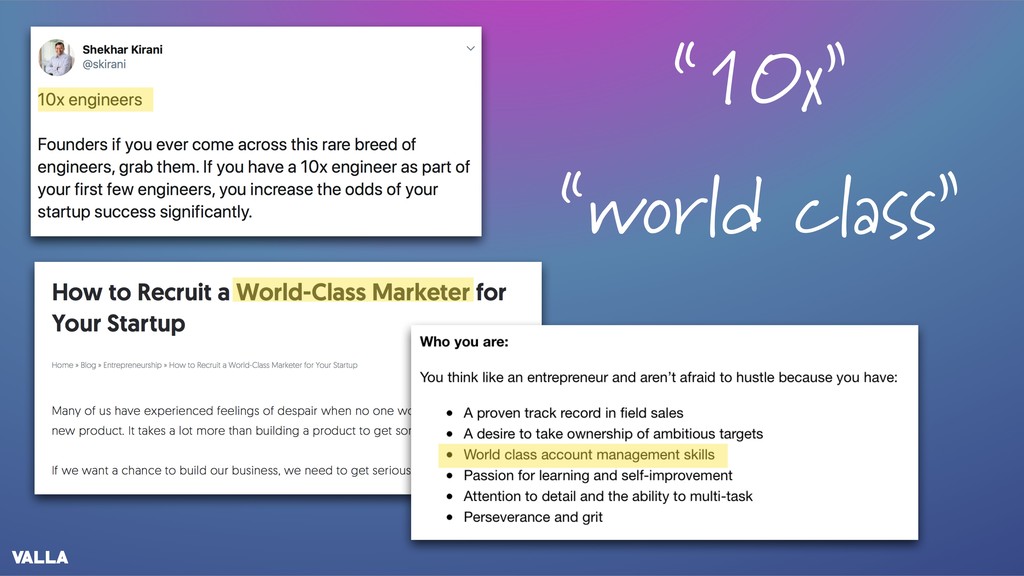
I don't know how many of you saw the 10x developer controversy that went around on Twitter about a month ago. It was absolutely hilarious. The idea behind that one so 10x is one of those new words. The idea behind that one is that there is an engineer out there who is ten times better than all the other software engineers.
And if you find this engineer, like, out in the wild or something, that that you need to, like, grab them and hold on to them and you want to put up with any kind of ******** behavior they have because they are gonna ten x your company.
So that was that was that controversy going around. And that one's a little easy to dismiss. But the one that I'm seeing a lot more of is this term world class. A world class marketer, a world class engineer. I've had VCs and board members tell me about a world class hire.
I've seen it in Medium posts. I see it in job ads. And I think that functionally, this world class term is basically the same as rock star. Just pulling back the curtain is the same basic idea. We're still looking for this rare breed.
We're still looking for this perfect person who's gonna come and solve all of our problems. So why is that wrong? Right? Like, why am I picking on exceptional people? Surely, that's the way that the world just is right now. Well, that's the thing.
I don't think that's the way the world is anymore. I think the world moved on, but we didn't move on with it. I think we've actually been applying some pretty old ideas to a pretty new world. And I think Gary Hamill, I think he summed it up best in the future of work.
That right now, we're building twenty first century businesses with twenty first century processes solving twenty first century problems. But underneath all of those twenty first century things, we still have nineteenth century assumptions about the way that we manage people and the way that we look for talent.
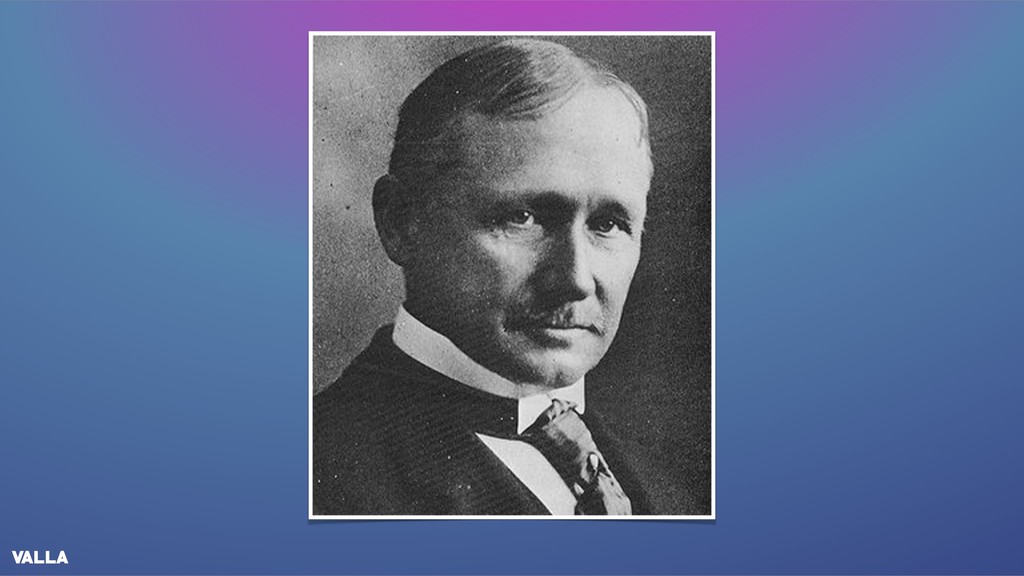
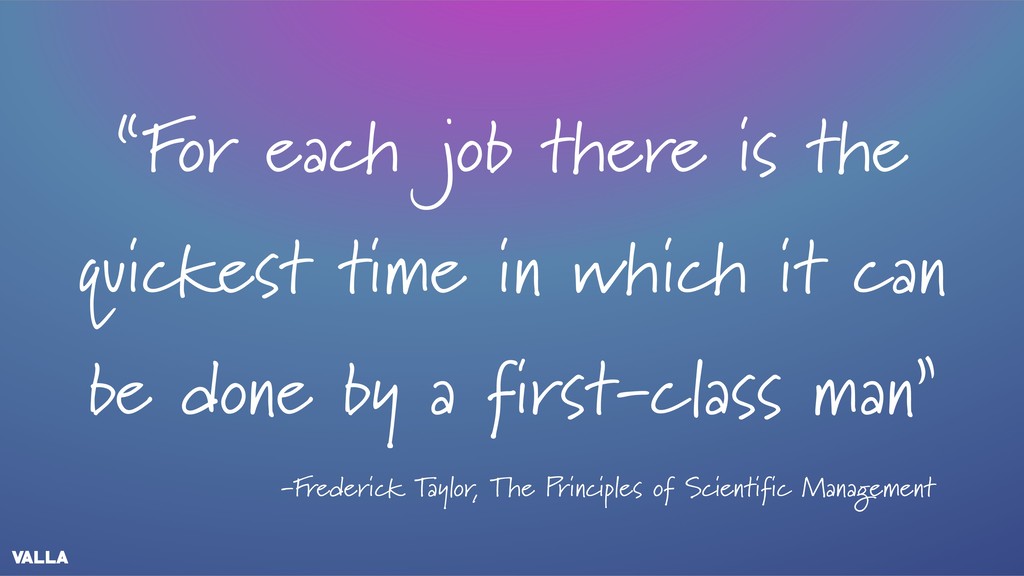
So what are those nineteenth century assumptions that I'm talking about? Well, it really all comes back to this guy. This is Frederick Taylor. He was a mechanical engineer who worked in factories back in the late eighteen hundreds, early nineteen hundreds. And when he was working in those factories, he saw a lot of inefficiency around him.
He saw a lot of things that he thought that he can improve. And he thought, actually, I think I can make management a lot more scientific. I think we can create some laws and principles that are gonna hold for managing of people and to get more efficiency.
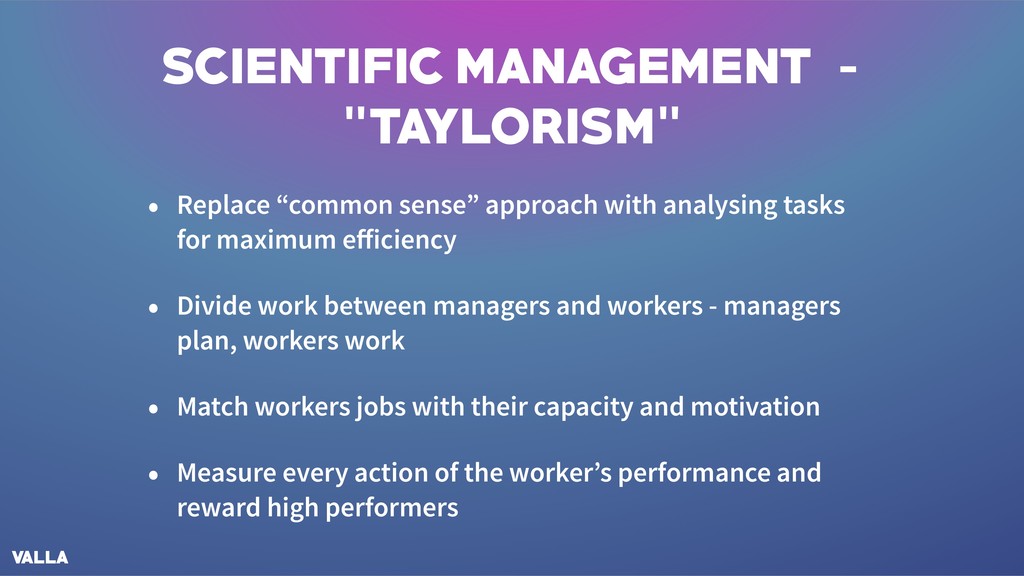
And so he created Taylorism, scientific management. And his goal was to create this pure and true actual scientific law around management. This idea that all you had to do was take a task, break it down into its simplest parts, find the optimal path for it, find the right person to do the job for you, and then measure absolutely everything that they do so you can keep optimizing and keep making that more and more efficient.
And that worked. That worked really, really well on that factory line environment, and Taylorism caught on like wildfire. Taylorism is basically the the the kind of blueprint for a lot of the management theories that we have today. We still do optimal path analysis.
We still have planning departments. We still measure how many pull requests a software engineer does in any given week. We still manage the call reports in Salesforce for a salesperson. We're still looking for that optimal efficiency. But it's this part. It's this part that I really wanna focus in on with Taylor today.
The idea that for each job, for each thing that needs to be done, there is like a platonic ideal of the best way of doing that just out there. It's waiting for us, and all we have to do is find a first class man who can do it for us.
And really, I think that's basically this. Right? So when we're sitting there and we're pulling our hair out because we don't have product market fit or the data doesn't make any sense or our velocity is slow or whatever it is, and we're thinking, surely to god someone's done this before.
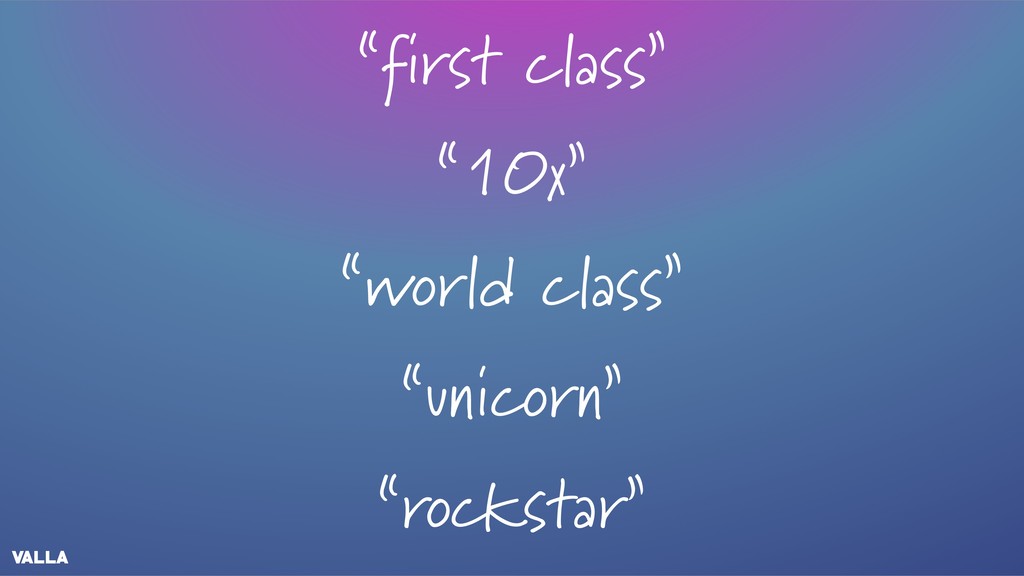
Like, hasn't hasn't someone done can't we hire someone who has done this and will just tell us how to solve this problem? I think that's fundamentally what we're looking for when we say this. And Taylor called them first class. We might call them unicorns or ten x or rock stars or things like this.
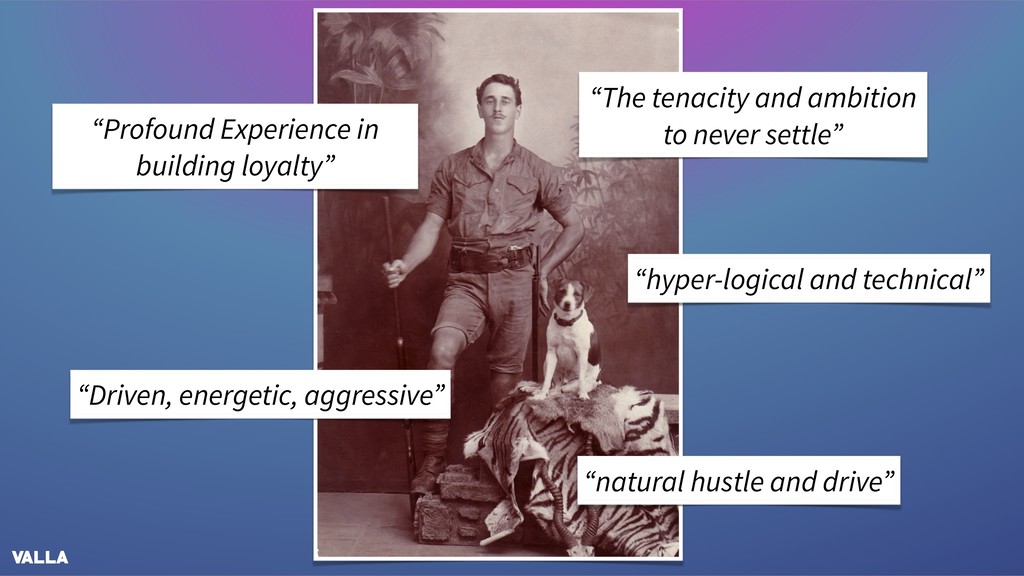
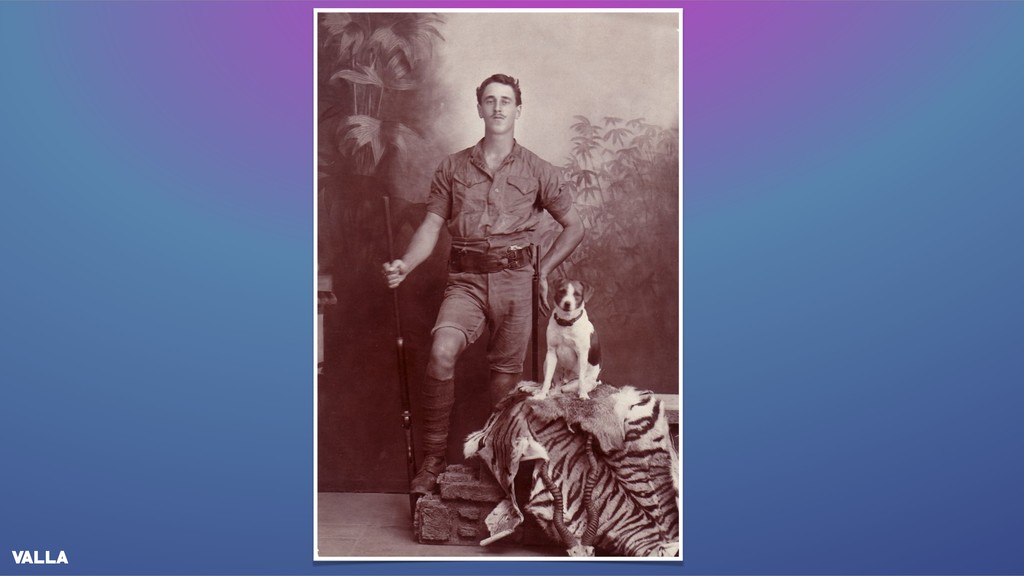
But once I really started looking into this and reading the job ads and thinking about it, fundamentally, I think what we're really all looking for is this guy. This pioneer. He's been to the jungle. He's seen it all. He knows the way. He's like, follow me everyone. I've got my dog.
By the way, this is an actual photo from nineteen ten and it is not just a hipster with his dog. This is for real. And I I think this is the guy that we're looking for. Like, juxtapose him with some job ads that I've pulled out from one challenger bank down in London.
I just went through all of their job ads. He's got tenacity. He's profound. He's not logical. He's hyperlogical. He's aggressive. And look at that hustle. Look at the hustle. Like, I think this is who we all keep searching for all the time, or at least that's what I see when I'm looking in the job ads.
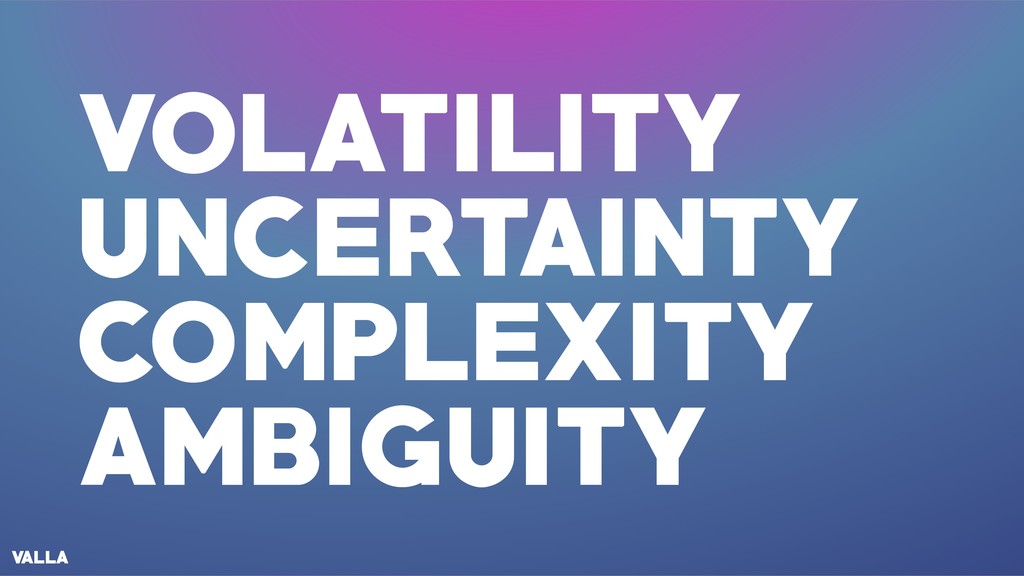
So what's wrong with this? Right? Why am I picking on mister hustle ambition guy? Like, why can't we just keep using mister hustle ambition guy to solve all of our problems? What's changed? Well, I think it's because of this, VUCA. So VUCA stands for volatility, uncertainty, complexity, and ambiguity.
And this is a term, an acronym. The US military loves acronyms. It was coined by them back in the eighties, and it was coined by them as they were starting to try to understand what was going on in the world after the Cold War.
Because the Cold War had finished, and they didn't really have an enemy anymore, but all the threats kept coming. And they kept coming from, like, a lot of different places now. But everything that they used to assess the threats before didn't make any sense anymore, and everything was changing all the time.
And they were like, this is new. This is VUCA. And doesn't that kind of sound familiar? Like, I don't know how much work I have to do to convince you that we live in a volatile, uncertain, complex, ambiguous environment sitting standing here in Scotland in the year of our lord twenty nineteen with, like, all of this stuff going on right now.
But what I what I will point out and, of course, technology is changing. Like, there's so many different things that I can tell you about it, but I think we all know and agree that this is this is fundamentally this feels right. But what I will point out is that all of these things are working with each other against us.
So it's not just that things keep changing all the time and technology is changing at a massive pace. It's not just that actually knowing whether or not you're interpreting the data correctly and ambiguity is is right. It's all of them are working together.
So it's basically like you're trying to fly fly an airplane and it's heavy fog, and there's a lightning storm out, and your instrument panel keeps telling you, like, different readings, and then sometimes it just tells you that you're underwater. I mean, that's that's basically VUCA.
And unlike Taylor's world, you can't efficiency your way out of VUCA. You can't that's not how you get out of that problem. In fact, the research overwhelmingly agrees that the way to get out of VUCA is with innovation. And this is great because we know this. We know this. Right?
Eric Rees, he completely changed the way that we started running our companies ten years ago when he wrote The Lean Startup. I think it was ten years ago. And so we know that we're supposed to innovate our way out of all that uncertainty even if you didn't call it VUCA.
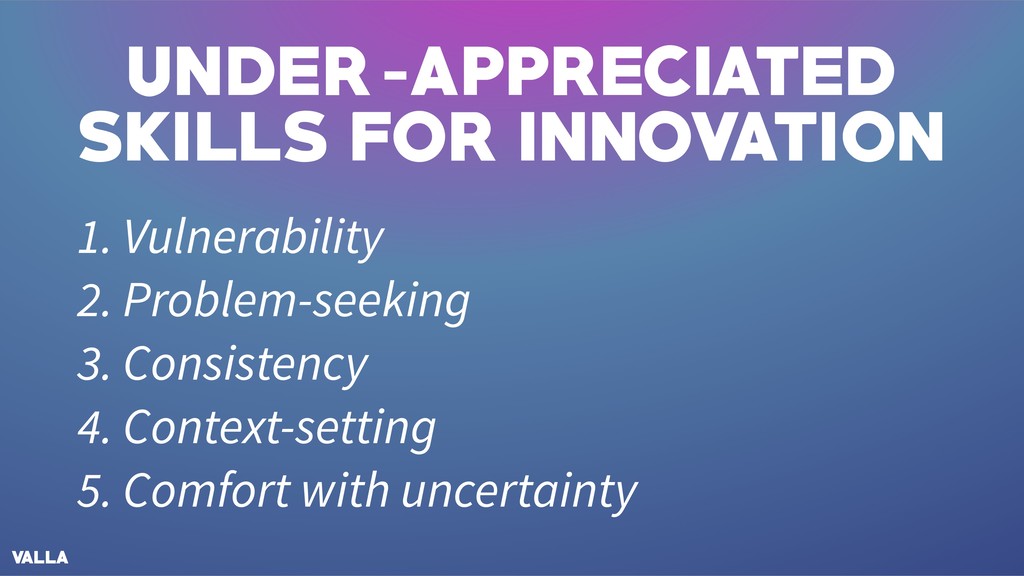
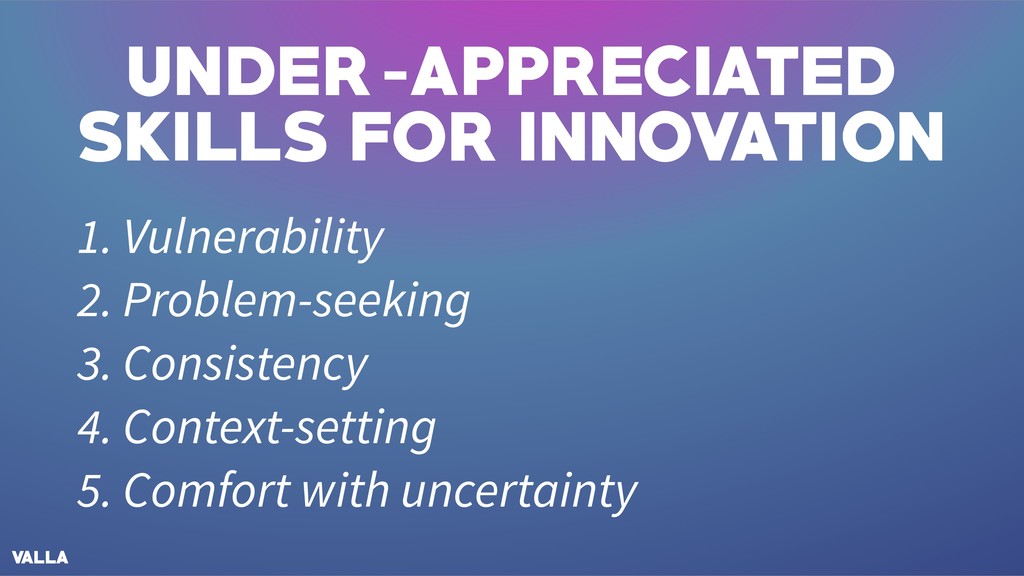
But the thing is, we didn't update our hiring and our talent handbooks in the same way that we updated our operational handbooks. So so I'm gonna take you through five VUCA friendly skills that we want to hire for. I'm gonna tell you how you can spot them, and then I'm going to give you a few interview questions that you can use to, to find them and once you're interviewing them.
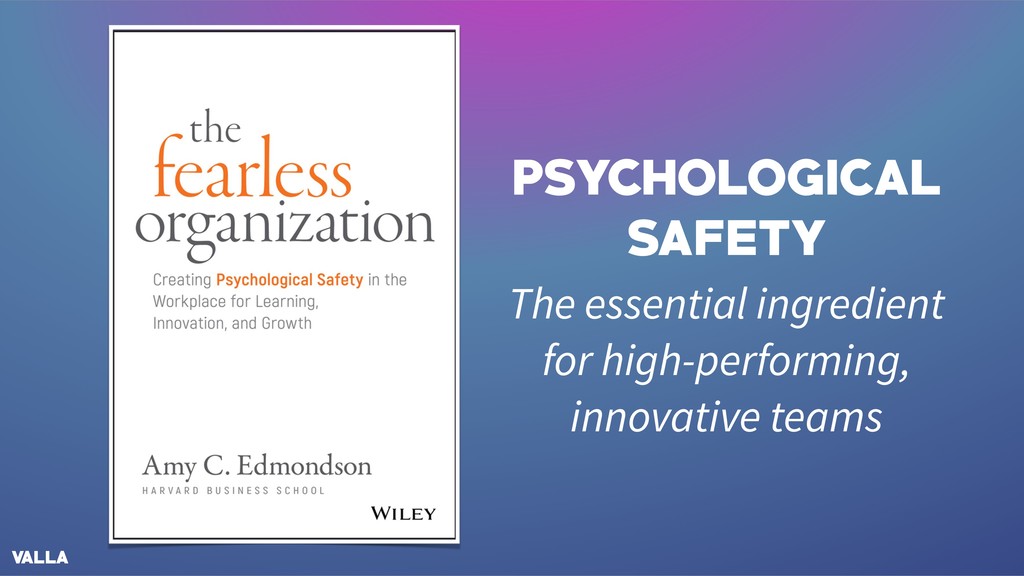
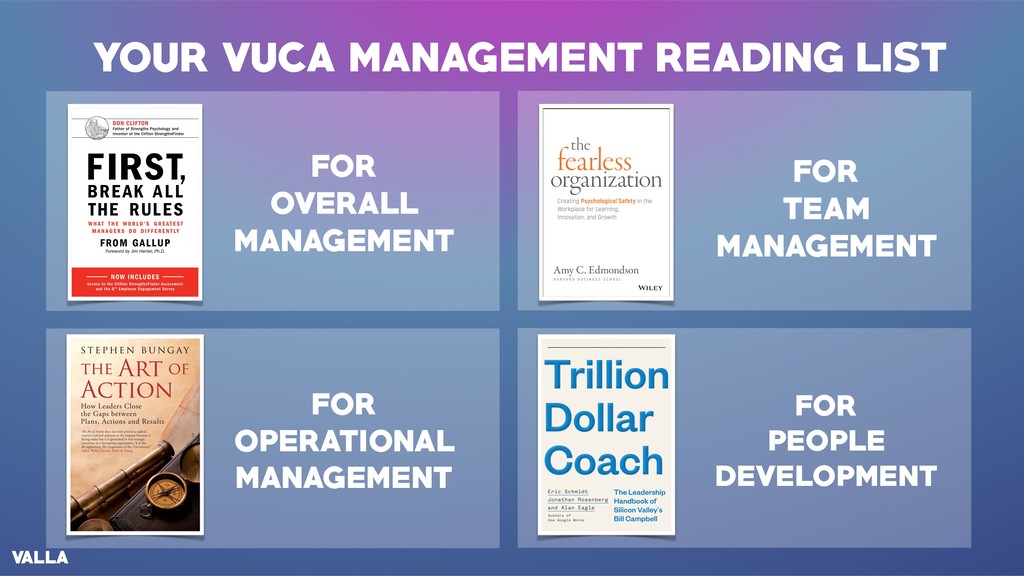
And I'm also gonna introduce you to two books along the way that will help contextualize these questions or these skills. So the first book is The Fearless Organization and this book is all about how to innovate through uncertainty, how to innovate through that VUCA environment and it says that the key ingredient that you need to do that innovation is a term called psychological safety.
So if you've never heard of psychological safety, it's basically the ability to have conflict at work without fear. So if you can put your hand up in a meeting and say, this is what I think, without worrying that people are gonna make fun of you, or if you can ask or challenge your boss without worrying that they're gonna yell at you late later, that's psychological safety.
And it turns out that this lack of interpersonal fear, it's key to everything. Google did a massive study across all of their best performing teams across all their different geographies, and they found that this is the one thing that was common amongst all of their highest performing teams.
So let's look at some skills that make sure that you establish psychological safety. The first one is vulnerability. Now we always want people to be confident, and we talk about vulnerability, but I think it I think it gets a lot of lip service, but nobody actually wants to do it because it can make us appear weak.
And that makes sense. Right? If you're in a tailored context, you can't appear weak. You're supposed to have all the answers. You're a first class man. But, but yeah, it turns out that in one person they can't innovate their way out of VUCA alone.
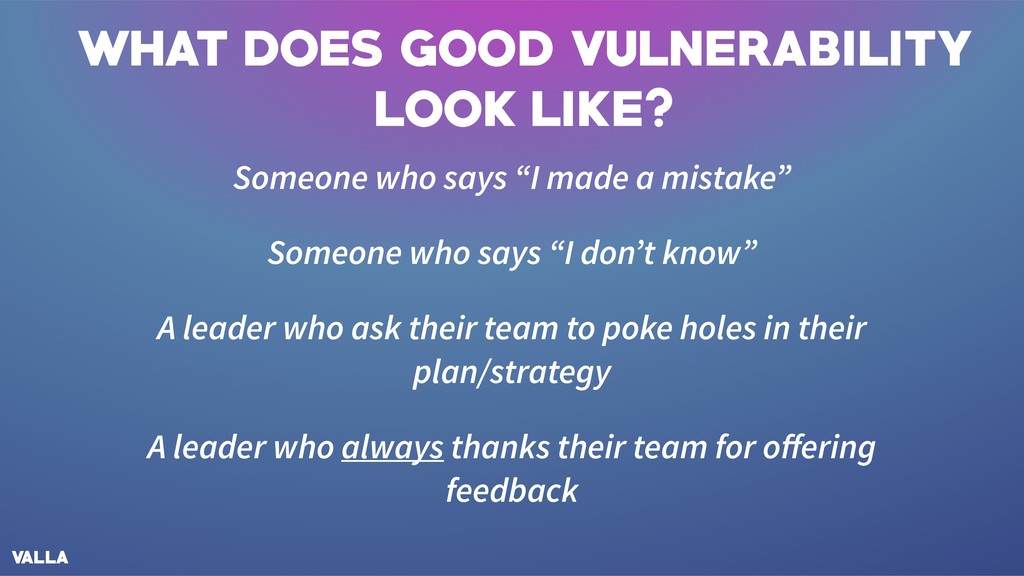
Like, when you're in a company, you have to work together. And one of those foundations for building that team together is the ability to be vulnerable. So what does vulnerability look like if you were looking at your existing team? In a lot of cases, it's someone who is willing to say, made a mistake or I don't know.
And that's simple. Right? But it's hard to do it's hard to do, and it's actually really hard to consistently do. So if you see someone who's always willing to be consistently vulnerable, that's a really good sign. It's also you can also look for people who are inviting feedback.
So a team lead, a leader, a manager who's putting themselves out there and asking people to rip down their plans, to poke holes in it, and then thanking them for doing that. Because those people understand that in a VUCA environment, to innovate, the raw material that you need to innovate is that feedback and that input.
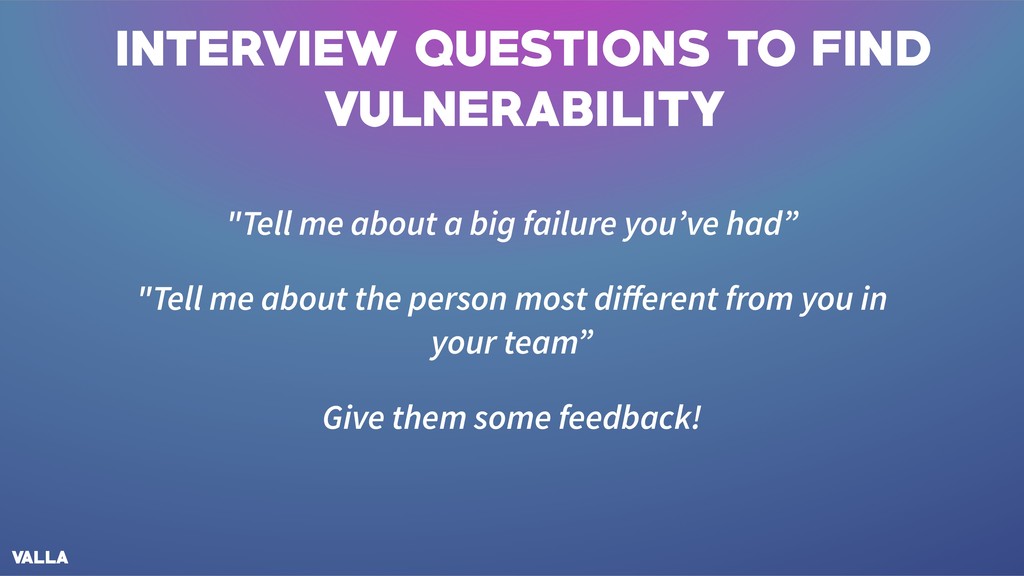
And they understand that they have to have it to move on. And in order to get it, they have to invite it. They have to open themselves up and be vulnerable. So if you were interviewing someone, I find one way to check to see how much vulnerability they have is to talk about failure.
So it's great to ask someone about their biggest success. That's a really normal interview question. But you can also say, well, tell me about your biggest failure and see how vulnerable they're willing to be and also see how emotionally intelligent they are about that failure.
It's a really useful one. The second one is one of my favorite interview questions. It's a new one that I've started doing, recently. I like to ask people, tell me about the person most different from you and your team. Now what I'm hoping to hear is a little bit of vulnerability.
Someone who understands that they can't be everything. They can't solve all of the problems. And actually someone who's quite different from them, they're covering a lot of bases that that person can't do themselves. What I often hear is a candidate telling me about how this other piece of person just doesn't understand them.
And that's for me a red flag. That says to me that they're not they don't have a lot of vulnerability. The other thing that's really useful is to just give them some feedback in the interview and see how they react. I mean, if you're in a good management relationship, you're gonna be giving difficult feedback anyway.
So say to them something like, you know, this skill set is obviously really developed, but I'm not sure about this skill set. Can we talk about that? If they react badly in that kind of a situation, it probably means that they're not going to be very very vulnerable in other kind of high stress situations.
Okay. So the second skill that we need to develop that psychological safety, to develop that innovation is problem seeking. So we talk a lot about problem solving. There's a lot of job ads that are looking for a talented problem solver, but we don't talk a lot about problem seeking.
So problem solving makes sense in a tailor word. Right? You just you just need someone to come and solve the big problem for you. And it even makes sense now in a way because we've got a lot of problems to solve. Like in the startups that I've worked in, there's a lot of problems that come up all the time.
But the thing is, in a VUCA environment, you can't solve them all. You I mean, it's fruitless to try and solve them all. And it's really more about assessing and prioritizing those problems. But you can't prioritize what you can't see. And it might be that the one that you didn't see was the key problem that you needed to innovate through or the key problem that was gonna sink you.
And that's where these problem seekers come in really handy. They're constantly scanning. They've got the right mind for picking out all the little flaws. Sometimes it's really annoying in what you're trying to do, and they'll tell you. They'll tell you where your problems are if you listen to them.
And actually, in the fearless organization, Amy Ed Amy Edmonson's research shows that the highest performing teams were the teams that reported the most problems. The lowest performing teams reported the least problems. And that's because they know that they need to get those problems out there, triage them, and then work on the most important ones.
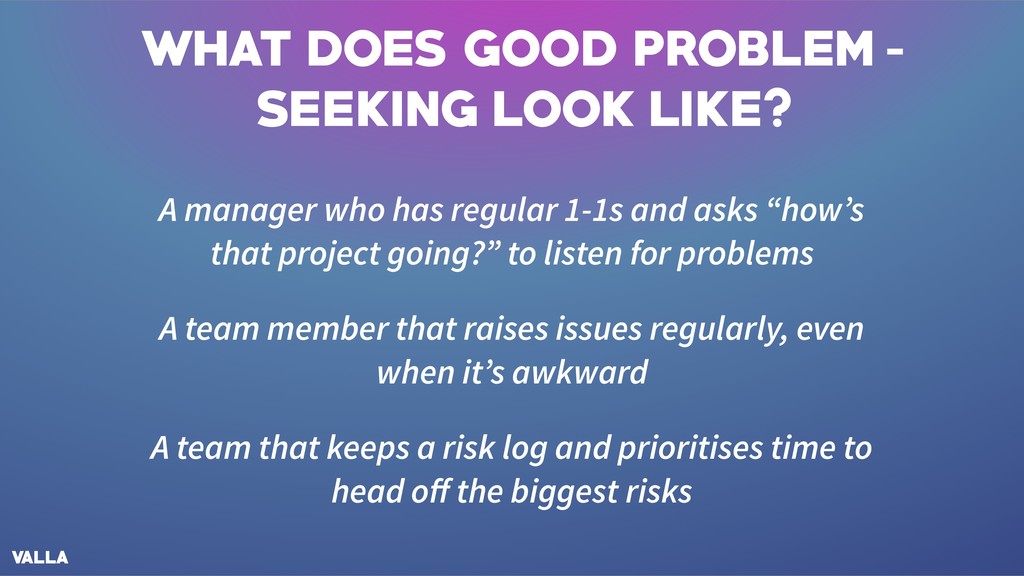
So what does this good problem seeking look like? Well, one thing I look for is scanners. So managers, team leads, anybody who's working with other people, who's actively inviting these problems, who has put time into their day to try and find them so that they know what to do with them afterwards.
Maybe they escalate them, maybe they decide to do nothing, maybe they help them solve them. So that's one thing to look for. Another one would be an awkward questioner. Someone they're probably in this front demo or the town hall. Someone who always puts their hands up and says, what about this?
Why aren't we doing this? And asks that really awkward question. That's a great person because they can help remind you that you should be looking out for these other problems. And then there's also the team that logs the risks. So sometimes I've seen risk logging can be seen as something that holds back velocity or things like that, But it's really essential in that VUCA environment.
And I found that this can be a massively underappreciated skill. Like, I think when you're trying to move forward and you're trying to set direction and you just want to get something done, pointing out all the problems can feel like it's slowing you down or like you're a naysayer almost.
I've heard people say, you know, like, you need to be more committed to the mission and things like that. But actually, if you learn to work with these people, that's where you're in really good shape. Because if you can use them to scan for you and then you can use you can escalate the problems that you need to, you're gonna be much better suited for all the uncertainty around you.
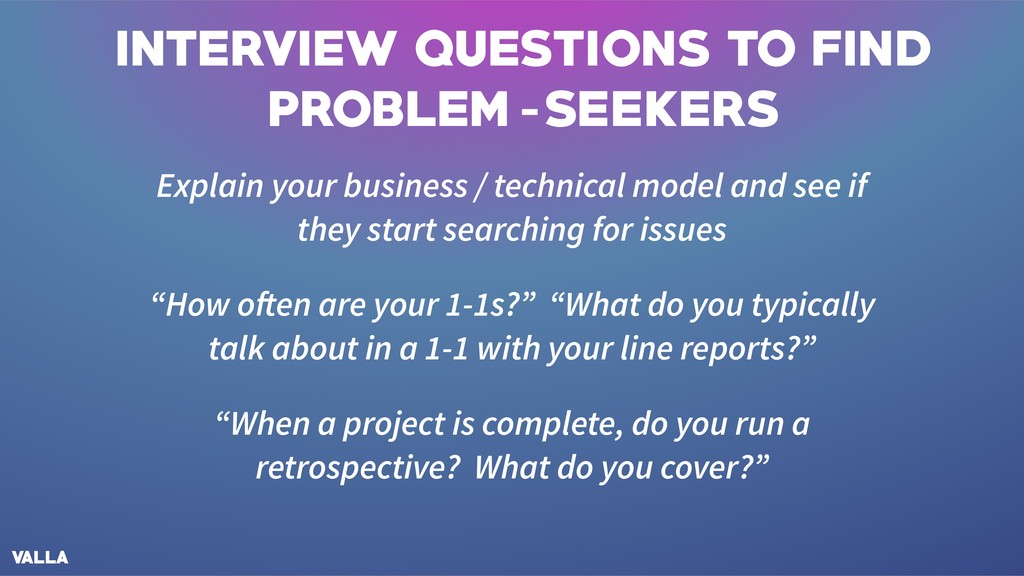
Okay. So how do you find a problem seeker in an interview? Well, I find you just explain what you do and then wait for their questions. And they've got great questions. They're gonna poke all kinds of holes in what you do. So just explain your business and see what kinds of interesting questions come back to find a problem seeker.
And also, if it comes to someone who's leading, I like to find out how they scan and whether they scan. So what do they ask people in their one to ones? What are they doing in their one to ones? Or how do they find out what needs to be addressed in the team?
And then finally, I like people I think problem seekers thrive in a retro. They love a retrospective because that's a place where they have all the permission in the world to bring up problems, and then we even add structure to them. So if someone's eyes light up when they talk about retrospective, I think you've got a problem seeker.
Okay. So so far, we need to be vulnerable, to find mistakes, and we need to feel comfortable to point them out. So the third skill to build psychological safety as part of innovating out of VUCA is something that we also need, and that's the ability for people to just be consistent.
Now this is, I think, a skill that is really looked down on sometimes or it's seen as boring or not very dynamic and things like that. And I think it gets a really bad rap. I think the conventional wisdom is that we need dynamic people to match the dynamic situations that we're in.
But that actually doesn't make a lot of sense because you want if you're in this environment where lots of things are changing at the same time, you want to be able to rely on your teammates. You want to be able to know that they're not gonna love your idea today and hate it tomorrow, or they're not gonna have one reaction to bad news today and a bad reaction the next day or something like that.
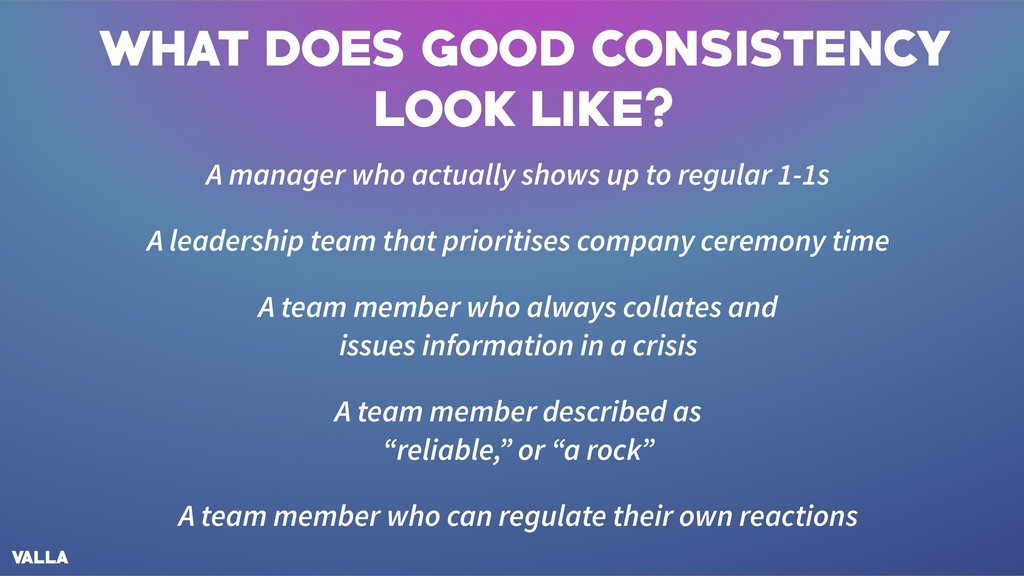
You want to be able to know that they're coming back for you. So what does good consistency look like on a day to day basis? A lot of it is showing up. So you'll see a good consistent person if in team leads or leadership teams who are actually honoring their one to ones, they're actually showing up, they understand that it's important to establish that consistency, or they're having their ceremonies regularly.
And that's actually pretty hard to do in some companies. And in that case, it's not as common as you might think it might be. The other thing I'm just looking. Oh, the other thing is look in a crisis. So when a crisis happens in the company, who is the person that is updating the Slack channel every ten minutes to let everybody else know what's going on?
That is a good solid rock in a crisis who is keeping you consistent. And another good way of being consistent is by controlling your emotional labor or by performing emotional labor. So emotional labor is the ability to basically regulate your emotions to get whatever it is that you're trying to get done, done.
And take for example me. I am not a consistent person. I am the furthest from a consistent person that you could ever have. But I know that it's so important for my team to be able to come to me with problems and to be able to come to me with feedback.
And so I work very hard to react consistently even if I'm not consistent. And that's because I do that emotional labor because I know that the alternative, it's a killer. In a VUCA world, it means that they're not gonna bring me input. They're not gonna bring me that raw material that means that we can't innovate, and I've accidentally created a black hole in the middle of my team.
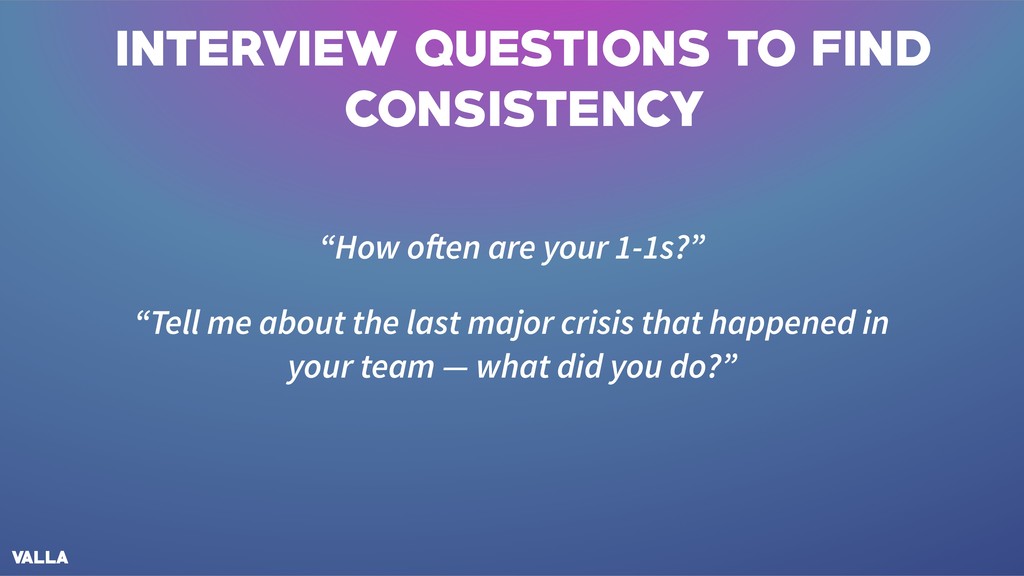
So I've found that it's harder to ask for consistency in an interview because it's something that I've always observed, but I do think asking them about their ceremonies and whether or not ceremonies are important to them is a really useful one. And then ask them about a crisis that they've been in.
Ask them what's been going on or what did they do. And what you don't want is someone to say for this skill, you don't want someone to say like I led the charge to solve this problem. It's much more about they were in the background, They were the center of the information.
They were the command and control who were issuing information. That's what Amy Edmondson talks about in this fearless organization. When a crisis comes, don't issue orders, issue information. And that's what a good consistent person is going to do for you. Okay. So there's two more skills and for these two skills I want to turn to another book that I highly recommend to give you a little bit more context.
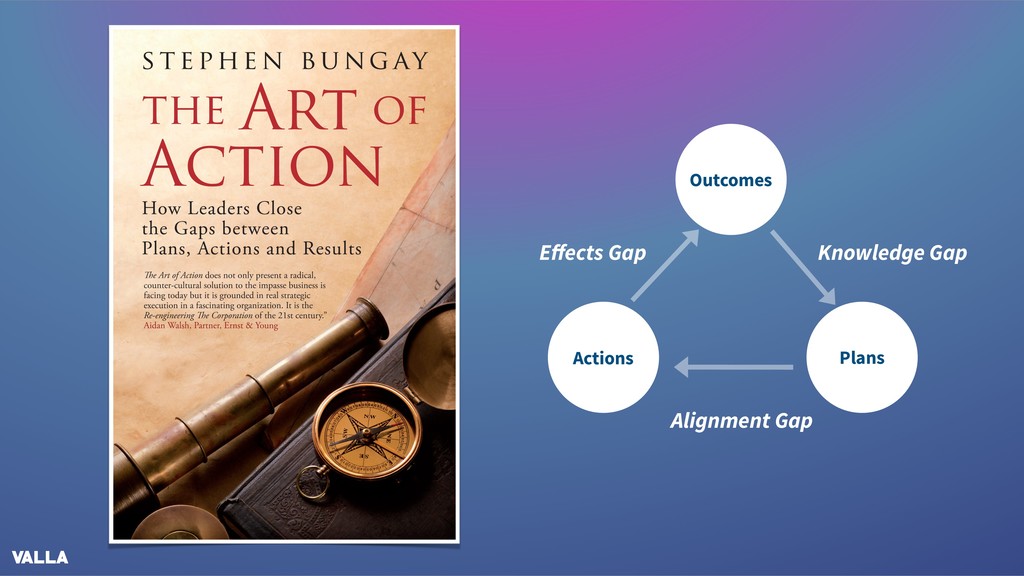
And this is more just signposting so you know, something you might want to look into later if you're interested. So this book is called The Art of Action and it's again about how to innovate through a VUCA environment. And this book is amazing.
Like, I cannot recommend this book highly enough. It was introduced to me by the COO at CareSourcer. It's how we, it was our operational blueprint for that company. I know Skyscanner uses it as well. Like, definitely read it. Super interesting. So what this book basically says is that there's always going to be gaps.
There's always gonna be gaps between what you are trying to do and what actually happens. And instead of fighting these gaps, instead of falling into these gaps, we need to innovate our way out of these gaps. So really similar idea. And one of the key ways that you do this is by setting context.
So the art of action says that one of the key jobs of a leadership team is to set the intent or the vision and set the context. So we know a lot about the vision. Right? We've seen a lot of job ads and we've written a lot of job ads saying you need to be able to communicate the vision and the mission of the company.
But we never talk about setting context. And that's weird to me because it's the context that changes all the time, not the vision. The vision is a fairly fixed point. I mean, we might update it here and now, but the context is changing all the time, especially in a fast paced environment.
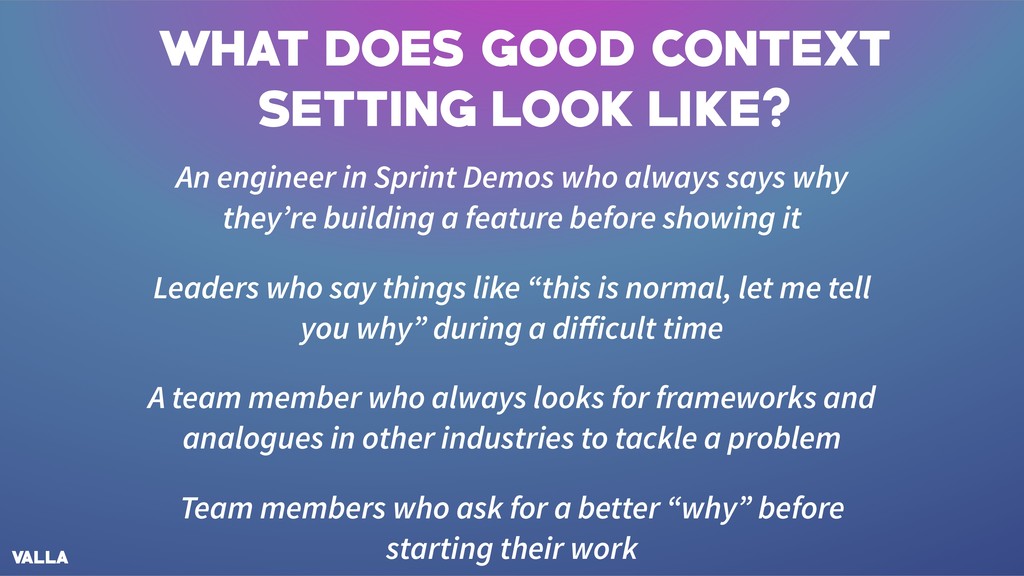
So how do you see good context setting? Like, what does that actually look like? Well, across an organization, it's usually the people who are asking and saying why. So you can find really great context setting in sprint demos or town hall meetings. If somebody's standing up and they're saying, I built this feature because of this company need or I built this feature because.
They're not just telling you about the feature. That's great context setting. You could also see it in leaders. So in a VUCA environment, problems are really common. Right? And if a leader is sitting down and saying, this is normal because, then that's great context setting.
And also it's just oh, this one's really good. I've also seen team members who when you come up against a problem, they go and look for analogues elsewhere. They go in looking trying to solve those problems by looking at how other industries did it.
They're looking for a new context. That's really valuable and can really speed up your decision making. And it's also just the people who ask why. Sometimes it's even annoying, but it's actually a really good reminder that that maybe the context has changed. And if the context has changed, we're all making bad decisions because we haven't communicated that out.
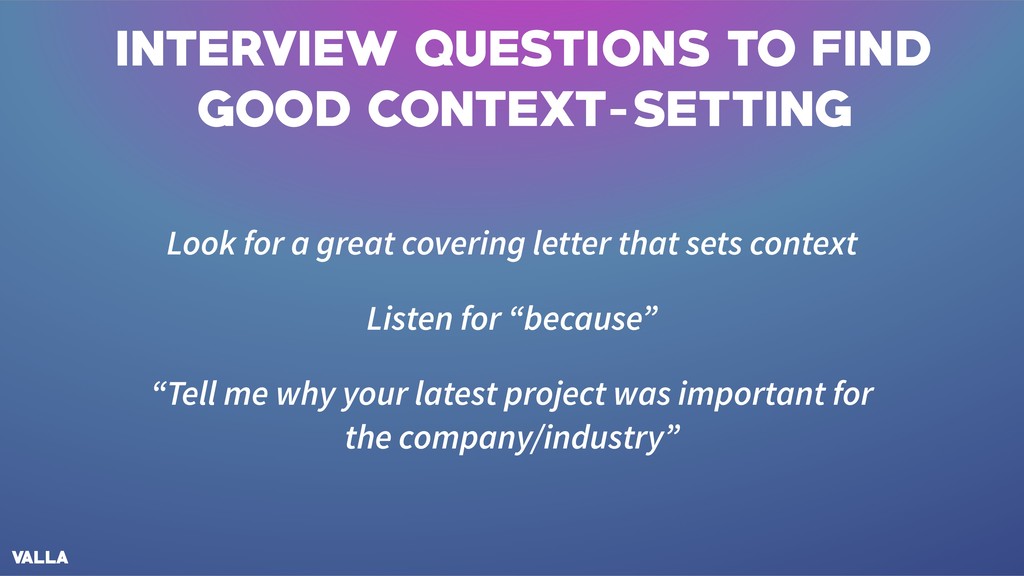
And so that's a really useful way of reminding yourself to reset that context. So how do you find a good context setter when you're hiring? Think one of the first things is look at their covering letter. For me, I love that's my secret weapon for hiring.
I always make sure they have an amazing covering letter. And what the covering letter's job is is to contextualize their CV. To say, yes, these are all the things that I've done, but let me tell you why that's important to you and why it would be great for this job.
So that's great context setting. Also, can just listen for the word because. So if someone said, we did this project because or because of this commercial change, then that's someone who understands that they need to set that context. And then finally, you can just ask why.
You can ask them why did you do that and go listen for how deep they go when they actually explain that context, and that's really valuable. Okay. Final skill. Stay with me. So if this one's a little bit harder to explain, but I think it really boils down to confidence with uncertainty.
Because when we hire right now, especially if we're in the thick of it and everything's really difficult, we're looking for someone to come in and confidently say, like, I can definitely do this. I am certain that I can do this. But we know that's not true. Right?
We know that even when someone has a lot of expertise in something, which is massively valuable, you can't apply the same context over and over to different companies in different ways. So what you're really looking for is people who don't just know that there is uncertainty out there, but they know how to navigate it.
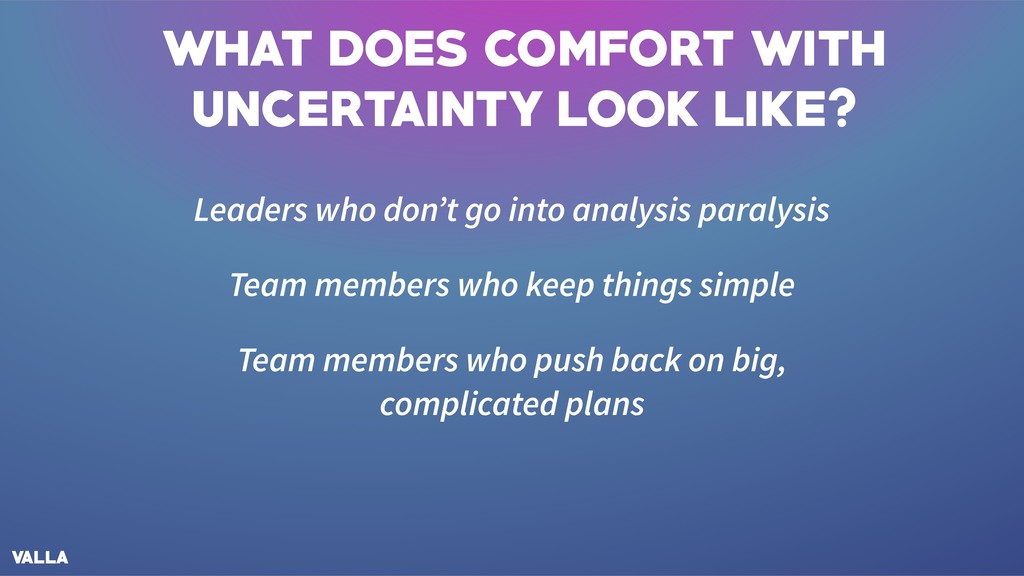
So what does that comfort look like? Well, the thing that I think is the biggest sign of comfort with uncertainty is people who don't go into analysis paralysis. So the art of action calls this the knowledge gap that you can fall into. But it's basically the idea that you wanna go and do something, you wanna make sure you get it right, so you do a lot of analysis, but then it takes a long time because you want to do it right.
And then by the time you actually finish the analysis, the situation has changed. So now you've to go back and you've to go do it again. But then you've got to go all the way through it again and in the end, you probably just don't do anything.
Or maybe you do but it's based on old information. That's the knowledge gap. That's an analysis paralysis. And people, some people are way more comfortable making decisions on just the best data that they can find. And that's someone who's a lot more comfortable with uncertainty.
It's also the team members, and I've worked with some amazing team members, who keep things simple. So they put their hand up after I've done this massively complex presentation trying to dot all these i's and cross the t's, they say, why don't we just do it this way?
And they're just focusing on the next step instead of a big complex plan. Those people are super valuable. Okay. So we've gone through our five skills. We've reset our context. I just want to leave you with two final thoughts before we go. And the first one is to look at your existing team.
There are so many underappreciated, interesting, talented, valuable people languishing in our teams right now because we've been applying tailor context judgments to them. They don't look like this visionary rock star. They're not standing like this. Like, they they're just getting their jobs done.
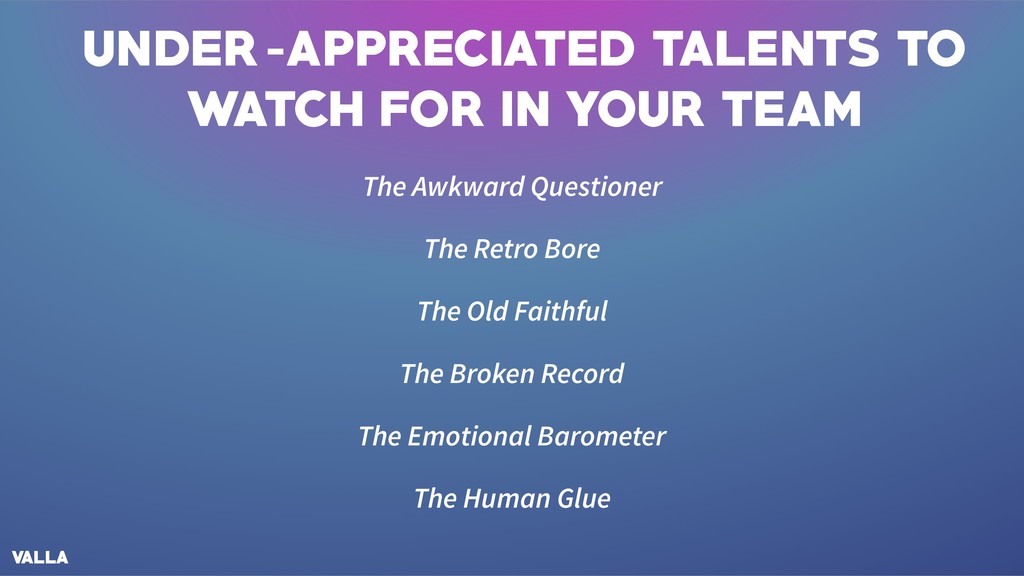
And I think that we can get so much more out of them and empower them so much more if we look at them in a different way. So I made a little list of people that might be in your teams. So we've got all kinds of people who are super interesting and maybe worth taking another look at.
So I've worked in my last team with an awkward questioner. He was amazing. He would ask the best awkward questions, and I would actually just sit down with him once a week and ask him, what are you worried about? And then I got all kinds of new problems that I needed to figure out whether whether or not I wanted to do something with him.
He was fantastic. I've built an entire team around an old faithful. Like, they are not flashy. They do not want to do public speaking. They would rather die. They do not want to go up and do the sprint demo, but they will make sure that your team runs well.
They are consistent. And I think human glue pretty much runs all start ups. It doesn't matter what organizational design you have. There's always a problem getting teams to communicate. But I've seen product managers, engineers, content writers. Doesn't matter what their role is. They're the people who go to the other team members and say, hey, can we figure this out together?
And they're literally binding those teams together, going outside of their day jobs to get that working. And that's super valuable in that VUCA environment. And the second thing that I wanna tell you is that good hiring is absolutely nothing without good management. We can't apply that Taylor era context to our management either.
We can't throw these people in the deep end and expect them to behave like a rock star. And so I could talk about this for ages, but instead, I'm just gonna give you some of my favorite management books. And I want to point out this one in particular, Trillion Dollar Coach, because it really matches the management style that I've found works best.
And it's actually about Microsoft, Google, Apple. And it turns out a lot of the secret sauce behind some of those companies succeeding and some of those executives succeeding was good old fashioned love, support, that kind of stuff. So that's a really great book to read.
And to finish off, I wanna finish with this guy. Now I know I've picked on him today, and I've been a little mean to him, but I completely understand why we're all looking for him. Because uncertainty is terrible. Our brains hate uncertainty. Studies have shown that we would rather that we can go into something knowing it's definitely going to fail rather than having to not know whether or not it's going to work.
So of course, we're looking for someone to tell us all the right answers. So all I'm saying today is the uncertainty is not gonna go away. The complexity isn't going to go away. So instead, let's take another look at the people out there.
There are way more of them than there are of him. And let's figure out how we can work with them in a different way. And they'll help guide us through the dark, and they'll help guide us home. Thank you very much. If there's anything you need, come there.