
The rise of Product Operations was no accident, and while some questioned it’s relevance during and after the Pandemic, it’s becoming more defined and a critical focus. Between the growing importance of product-led growth as a core business model and the significance of the product manager, we are seeing the need for alignment, transparency, and a strong system for high performing teams on the rise across all types of companies. We’ll take a look at both the evolution of product management and the role of the PM that have led to the emergence of this new practice and role. We’ll explore what it looks like across the industry today and what product ops professionals are focusing on to help teams deliver on business outcomes.
← All talks 
Build Turing Fest 2023
Embracing Product Operations As Our Landscape Matures
Auto-generated transcript - may contain errors. Tap a timestamp to jump the video.
Cool. I will not tell bad jokes, but I have really funny things to show you. So hopefully it all plays the way I need it to, but Chris has helped me out, so I think we should be good. I am Christina Tewaru. I'll give a little background on myself in a little bit.
Before I start, I wanna say thank you all for spending the time here with me today. I know there's a ton of really great content and a lot of things you could be doing right now. Time is non renewable, that resource, so I appreciate you giving it to me today, so thank you.
My talk is gonna be on embracing product operations as product management landscape matures. Does anybody here know what product ops is? Show of hands. Okay, I'm not surprised. And who here has product operations in their organization? Lovely, very small. Guess what? We've all done this job as product managers, Every single one of us.
So who's a product manager here or who has been a product manager or a product leader? We've all done it. Okay, before we go deep into this chat, I am gonna introduce myself like I mentioned and just talk a little bit about me.
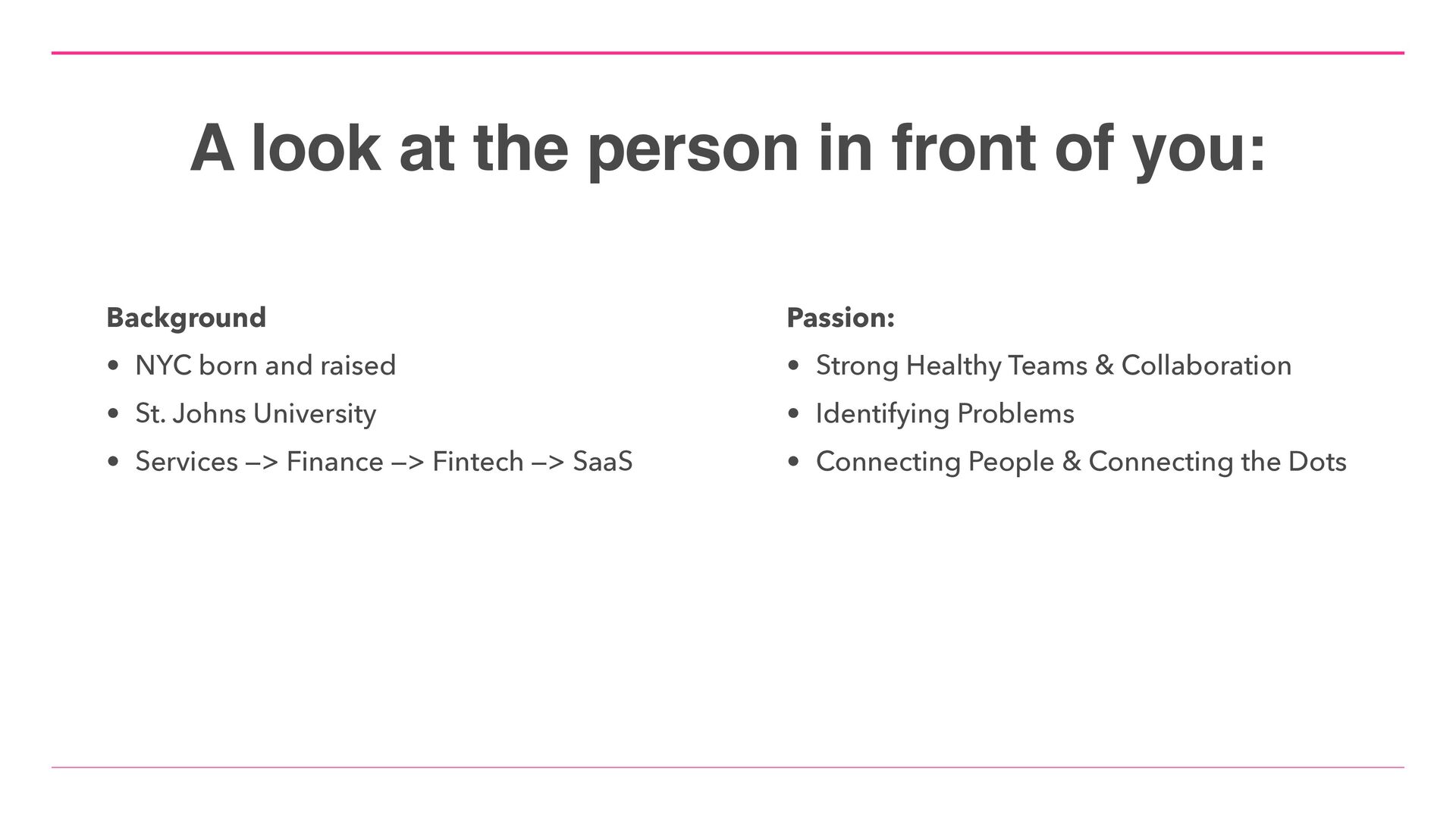
So Christina Tewarro, New York City, born and raised. I now live in Raleigh, North Carolina, so a different change of pace in all the things from New York City as many things are. I went to St. John's University in New York and I studied marketing and finance.
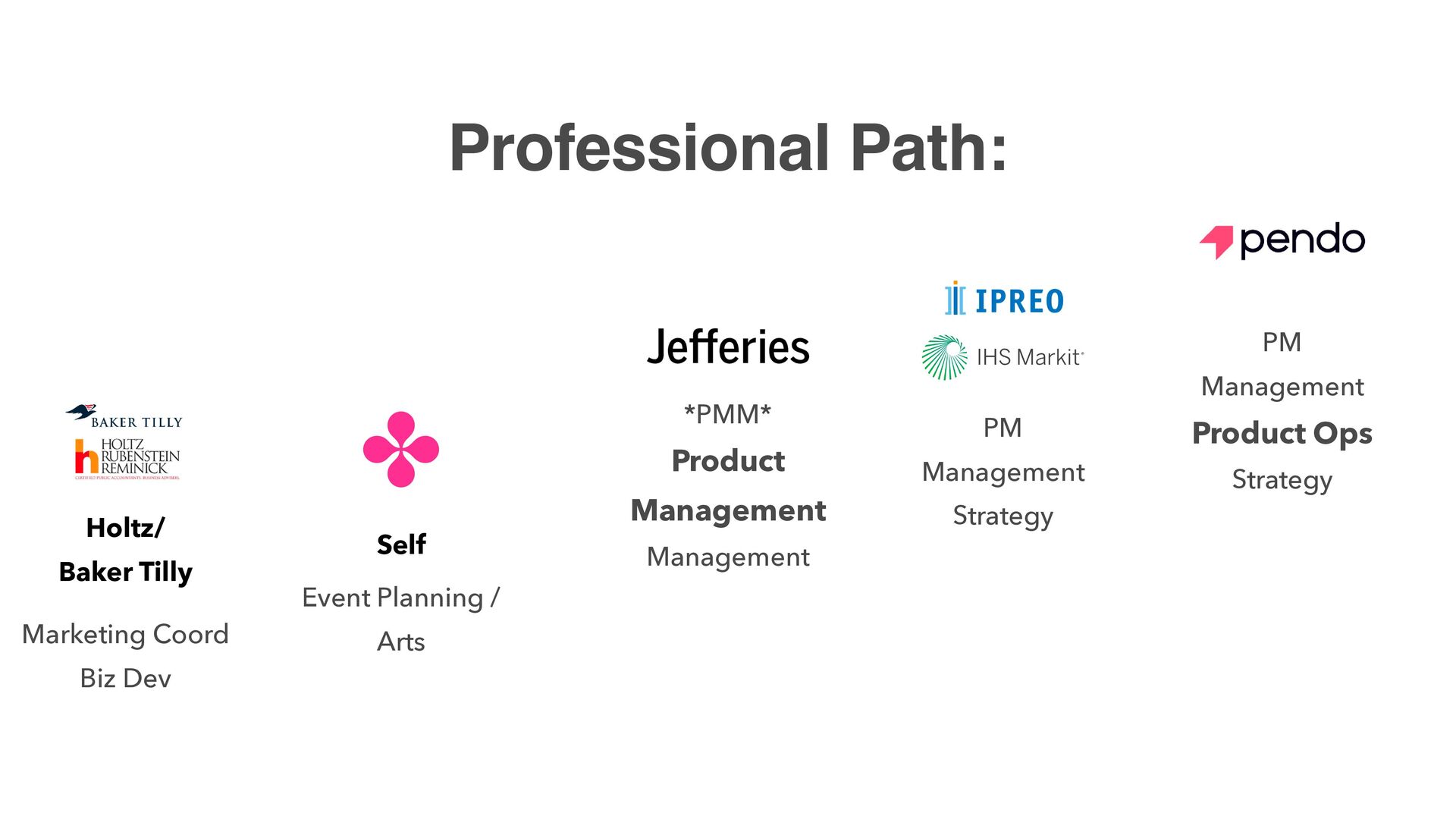
My professional path, I started in services, went into finance on Wall Street, and then moved into FinTech, which is where I fell into product. I'll show you that in a little bit. And then SAS, where I'm at Pendo and also for community with Mind the Product.
And I have a couple of passions. Some of them are creating very strong, healthy product teams and fostering a culture of collaboration and creativity and amazing outcomes for customers. I love identifying problems and identifying creative ways to solve them with my teams. Most importantly, I believe in human connection and I believe in connection overall.
Connecting people, making new acquaintances, and connecting the dots. This here was my path. So I went through a couple different companies in my time. First was a small company in Times Square called Holtz Rubinstein Remenik. It's where I started in marketing and business development.
They were acquired by a company called Baker Tilly. I moved on when I was really bored and I started working for myself in event planning, just took the best bits of marketing there and applied it to whatever I wanted to do. And a little bit of the arts, have some cool stories around that but not for right now.
I went and moved on to Jefferies. This is where I started as a product marketing manager or an enablement manager there and about five weeks in accidentally fell into product and I have not looked back since then. April mentioned yesterday in her talk that her job was to build or sell software for Wall Street companies, a CRM software.
My product that I built was CRM internal proprietary software for a company called Jefferies on Wall Street and it was real fun. I fell in love with teams, I fell in love with problems, I was sitting with a research analyst, this is my how I fell in story.
Sitting with a research analyst in London, five weeks into my job at Jefferies, not knowing anything about the product because I was trying so hard to just onboard from a compliance perspective on Wall Street was ridiculously hard. And so I probably spent a week or two in the product and my boss said, Go to London, train all these people.
And I was like, Oh my gosh, what am I supposed to do here? And I sat with this gentleman named Jeff and he said to me, how am I supposed to use this? Oh wait, hold on phone call. How am I Oh wait, turret system.
Oh my gosh, somebody from my team is coming in. And that moment I looked at him and I said, how is this guy gonna use this product? And he's got all this stuff going on. I don't need him to use my product, I need my product to fit his needs.
I need him to be able to pull this into his world in a way that feels natural. And that's how I realized, wow, maybe the thing I was doing about training people is not the right thing. I think I want to do this other thing because my boss then said, you're a product manager all of a sudden.
That's my story and I didn't look back. I moved on to Ipreo which then was acquired by IHS Markit which is now S and P Global so lots of change. Product management grew team I had three teams with sunsetting a product, building a brand new one and keeping the lights on for one.
Just managed a couple global teams which was really fun and then moved into strategy. Again, team side is what I really crave. And then I moved on to Pendo. And Pendo is where I've been for almost five years now. Came on as the first director of product, grew the team from our first three PMs in our Raleigh office to massive amount of people and then moved over to start product operations about three and a half years ago now or four years and then I moved on to strategy for both product and business.
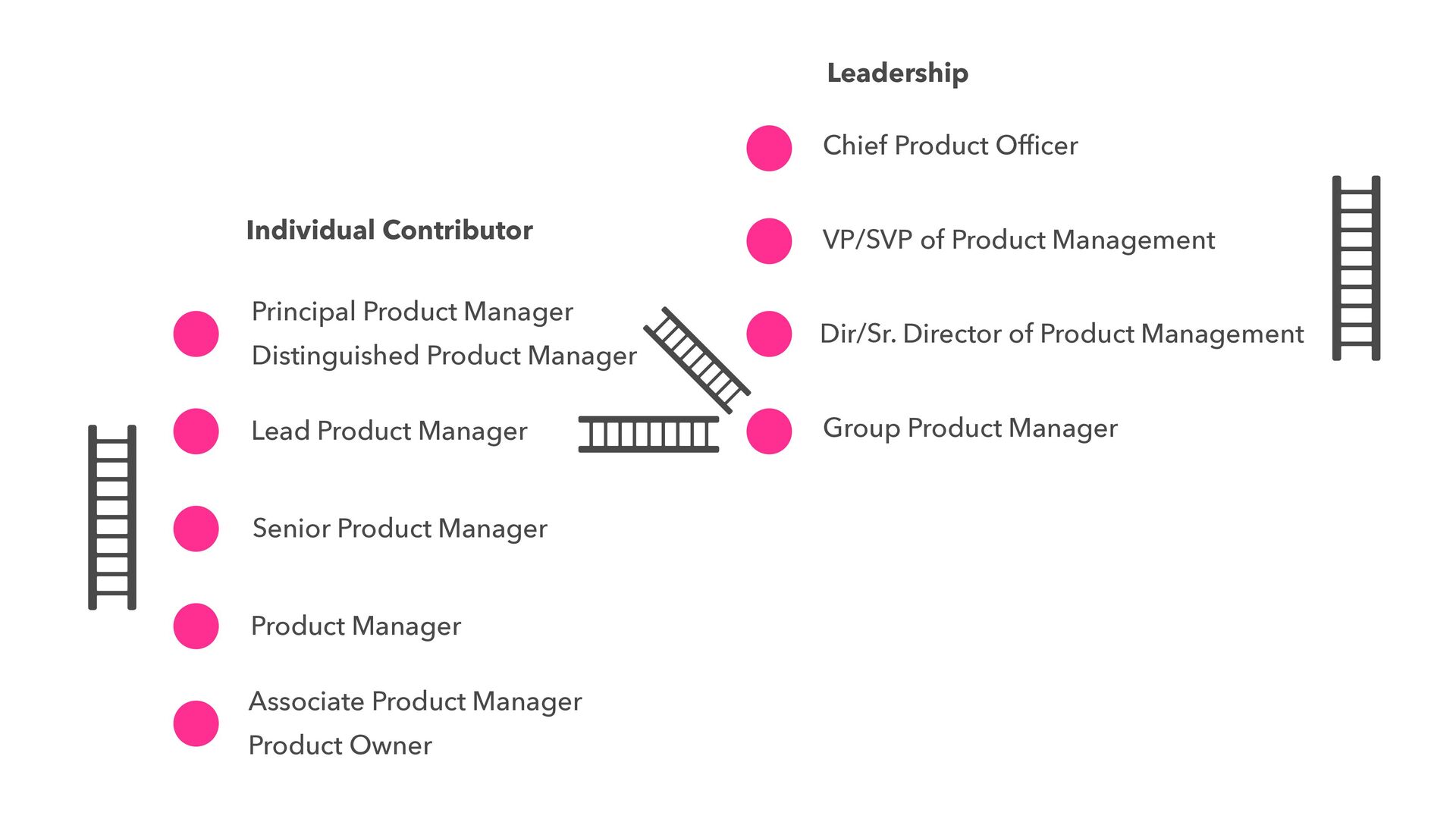
That's where I am today for Pendo and for Mind the Product. So that is my path and that's a lot of change, right? So that's my path but for some folks who are looking at career laddering today, this is traditionally or more recent tradition I think for product people what it looks like to grow in this ladder.
Sorry, I'm not really creative when it comes to putting these images in here. Just did a lot of right. Okay, so terms may shift, right? For those who are from Europe in general, I'm finding and I would love it if you all connect with me after this whoever's from this region and teach me about what terms you're using today for product because I'm doing a ton of research on it.
It seems like it's not transferable across the US and the UK or in Europe and even in Asia. So what we're seeing in broad swats is associate product manager, product owner and then moving up the ladder to a product manager, then senior, getting into a lead.
And if you're gonna stay on the IC path, what we're seeing in the US is something called distinguished product manager or a principal product manager. This is the furthest you can go in my world today or in the US today where you don't have to go into management.
That's okay. And by the way, for people who are thinking that the next step is management, we can talk. It's another talk. You don't have to go into management to keep growing as a product person. Just remember that you have many different ways to keep growing and pushing influence.
You can go this way and move up to a group product manager that is your first step as a manager of product people and then you can keep going up all the way to CPO. Some people's ultimate goal is to become the CPO if they follow what we look at today as more of a traditional or today's traditional product path.
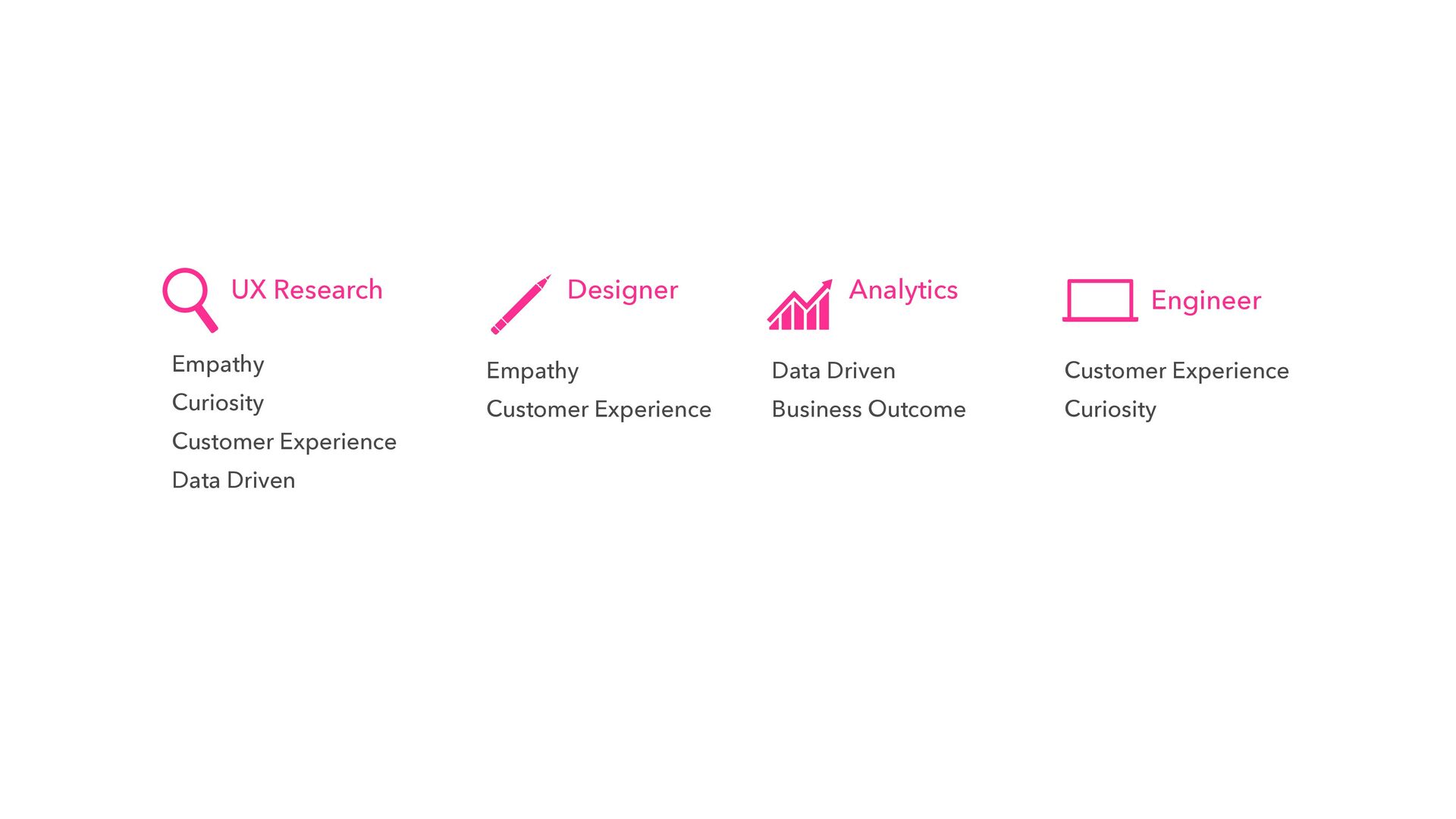
What we're seeing as the space evolves and businesses grow and shrink, people start to find this niche or this passion in product. Right? And product people like myself can fall into it. How many of you accidentally fell into it here? That's the common story, right?
You can fall into it or there are roles that actually have worked adjacent to the product manager historically where they find this passion and they're like, wow, I wanna do this thing. Or sometimes product managers decide, I don't wanna do this thing anymore.
Anybody felt out of product and moved into something else? Okay. Yeah. There's a couple of you and that's okay, that's awesome because we're still serving our customers. Today we see a lot of to and from for these roles from product and then out of product.
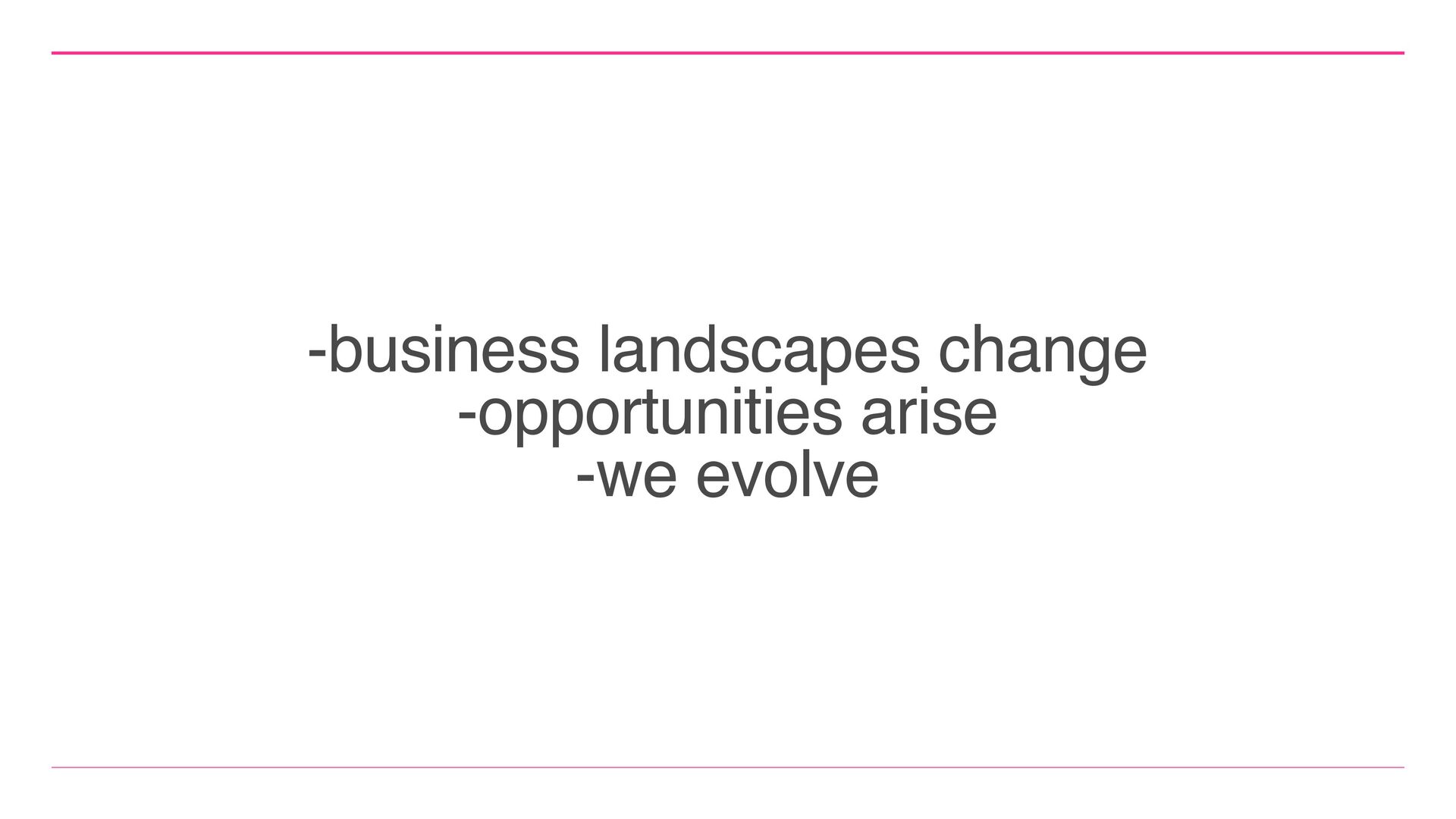
The ability to take different routes in life happen when things change, opportunities arise and we can evolve as a result of them. When I think about evolution, a really important thing comes to mind. Anybody watch Step Brothers? Oh my gosh, this is breaking my heart.
Okay. Maybe it's big in the US. Will Ferrell. Anybody know Will Ferrell? Really important. Alright. That scene was from a movie called Step Brothers which I hope you all watch. He evolved. He finally grew and left his his parents house and he went to a Costco wholesale club for the first time in his life and bought toilet paper.
That was his evolution and there's a little bit more Will Ferrell coming up but it's really important to me. I thought it was gonna make you guys laugh. I also think about this quote. This is more serious. This is from Michelle Obama. So becoming isn't about arriving somewhere or achieving a certain aim.
I see it instead as a forward motion, a means of evolving, a way to reach continuously towards your better self. The journey does not end. And the same holds true for this amazing space that we are so lucky to be a part of called product management.
Now, the gentleman on stage before me mentioned, for those of you who are here, he was ending and saying that his world, things haven't changed very much in twenty years. That's not the case for product. We are sitting here today listening to so many people talk about AI and the shifts that it's going to bring to our world, not just to technology and everything shifting because of that.
And on top of it, there's a long history behind product management. So anybody here know how old product management is itself or as far back as we have it recorded? Thirty years, anybody think thirty? Sixty? Okay, it's almost a hundred years old. So for those who don't know the story, I'm gonna go through a little bit quickly today.
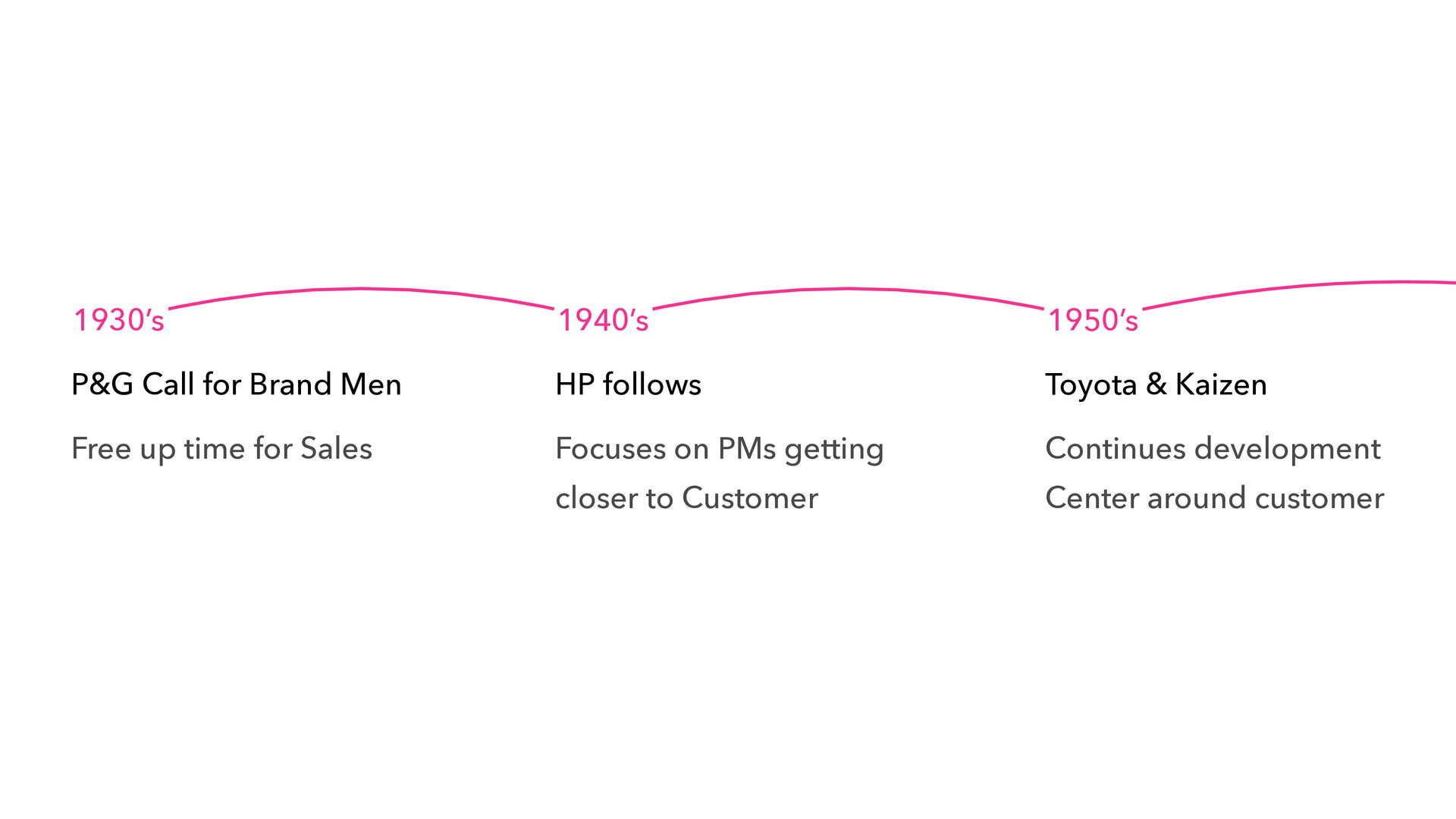
So In the 1930s, Neil McElroy had this call for something called brand men. These brand men or people should have freed up time for sales to get to their activities. So the product person, product manager or brand man back in the day needed to go through and say, okay, I'm gonna do all these activities so that our salespeople can just go sell.
Cool. And a decade later, HP started following model or that model. They liked the concept of brand man, brought product manager out. But what they wanted to do is they wanted to have the PM focus on getting closer to the customer. So instead of having sales focus on time with the customer, they really wanted to have the PM get back in the game, which was a really interesting shift, but we always wanna make sure we're staying close to customers.
And a decade later, we see the emergence of Kaizen, right? Anybody familiar with Kaizen? It's basically this just continuous development and you're centering around the customer, which was incredible for back then. We wanna make sure that we're always doing that today, but it was Toyota's way of making sure innovation kept happening.
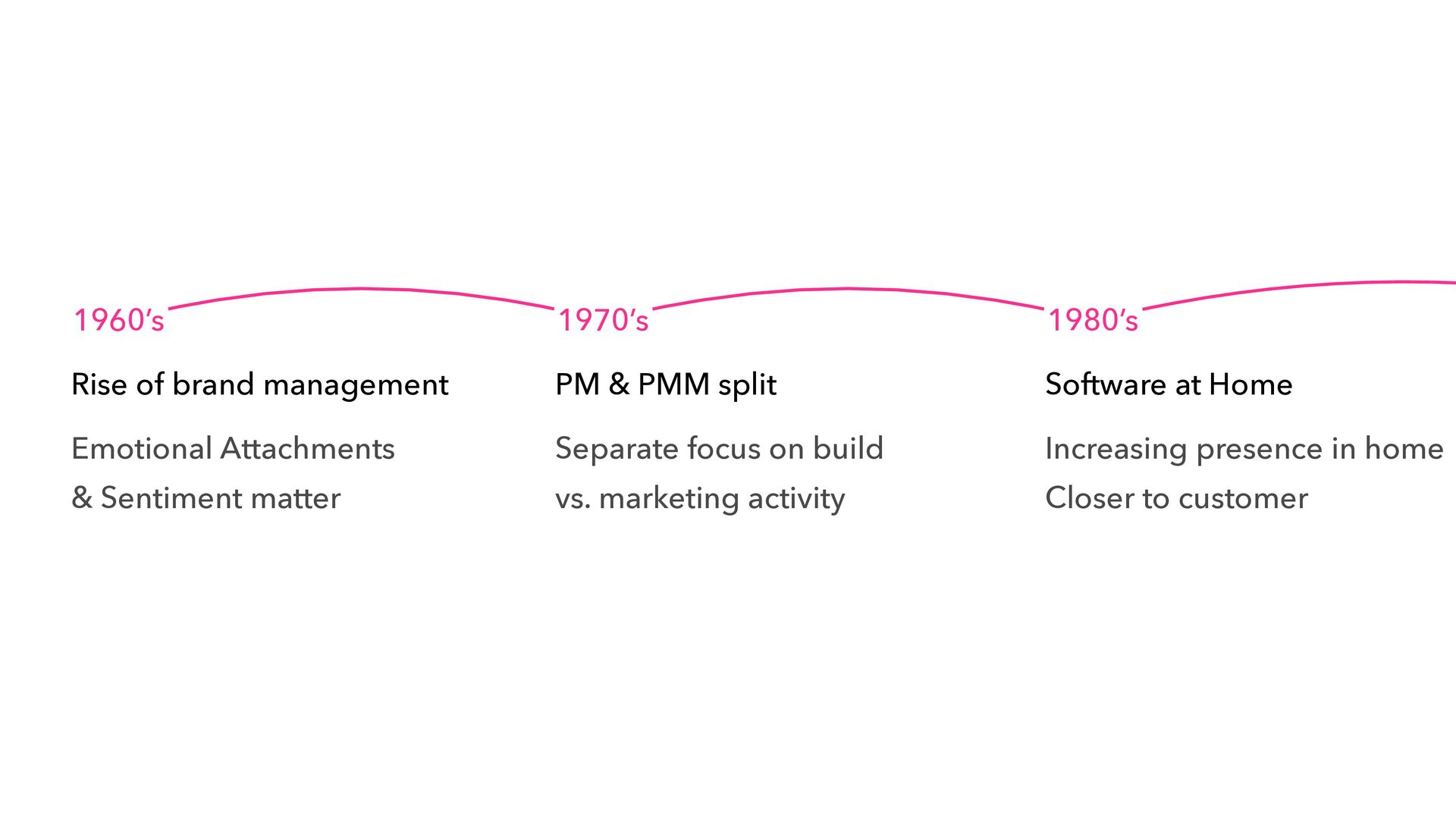
And the entire company rallied around it, making everything different and new so the customer had what they needed and the business continued to grow. In the sixties there was this incredible rise of the brand manager. And you know, if you look at the way we measure success today, sentiment comes to mind for some people.
It's it's still happening today but in the sixties it started to emerge so you started to see these commercials around. How does this soap make you feel? And, oh my goodness, have this slice of cake and you're gonna be like just in tears, right?
Everything made you feel a certain way or people had, you know, like these commercials that had children that made you cry all the time. It's all about feeling. In the seventies, we started to see, because there was such focus on this brand manager and these people also bringing these products to light, that the roles converged.
But in the seventies, there was this split where the product manager and the PMM, the product marketing manager, actually decided to decouple for a lot of companies. And that was cool because everything started to grow, competition was growing, there needed to be this separate focus on build versus marketing activity, which was a really critical moment in our history.
In the 80s, software started to become more common in our houses. Intuit was one of the first companies that brought this thing called the Follow Me Home or Take Me Home program. Anybody heard of that before? It was really cool. Remember the old way of delivering software where gosh, okay.
Who remembers the old way of delivering software with CDs and floppy disks and these manuals and all these things you'd put on big old shelves, right? This is how Intuit and a lot of other companies and I mean companies that still exist today delivered software for a while.
Intuit started sending their product people into their homes of customers who were using their software to watch them and get closer. So that story I told you is near and dear to my heart where Jeff showed me his pain. I sat in his home, in his element and I was able to see everything around me and that's how Intuit started to grow their product practice so much quicker.
And then in the 90s, tech was booming. We saw computers and Apple and Mac and all these different things come up where these roles and tech started to become the thing everybody wanted to get into. And there were very technical product people out there.
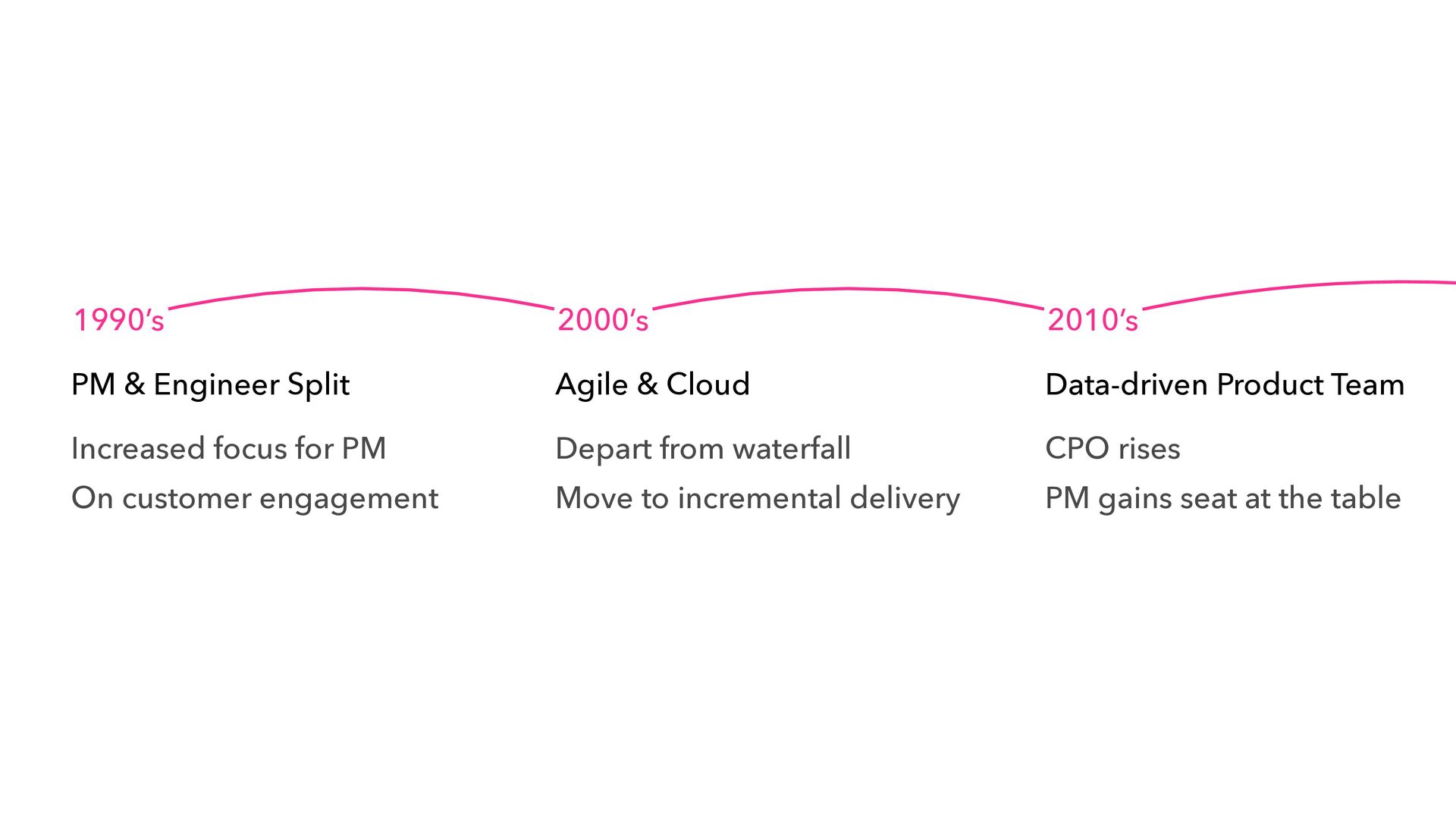
And what we saw similar to the product marketing manager splitting from the PM, the PM and the engineer split. And then we started to see two different disciplines emerge. So there was this increased focus for the product manager on customer engagement again. You see a trend across the decades, it's product managers spending time with customers and making sure that they are customer centric.
It's something that we all need to be focused on. If you're in an organization that is not allowing you to spend time with customers, get out, just leave. Agile and cloud emerges in the 2000s, right? So we're moving faster, everybody's moving over to a different way of deploying software.
We also depart from waterfall which is phenomenal so we're no longer worried about long BRDs and then measuring outcomes after or impact after. And in the twenty tens, we see because of all the influx of data driven insights, the data driven product management team comes to light.
All of a sudden, everybody's like, how do I use data to drive my decisions? What am I gonna do? The CPO ends up rising during this time which is an amazing critical moment for our business and our space. The product manager finally gets the seat at the table which is important.
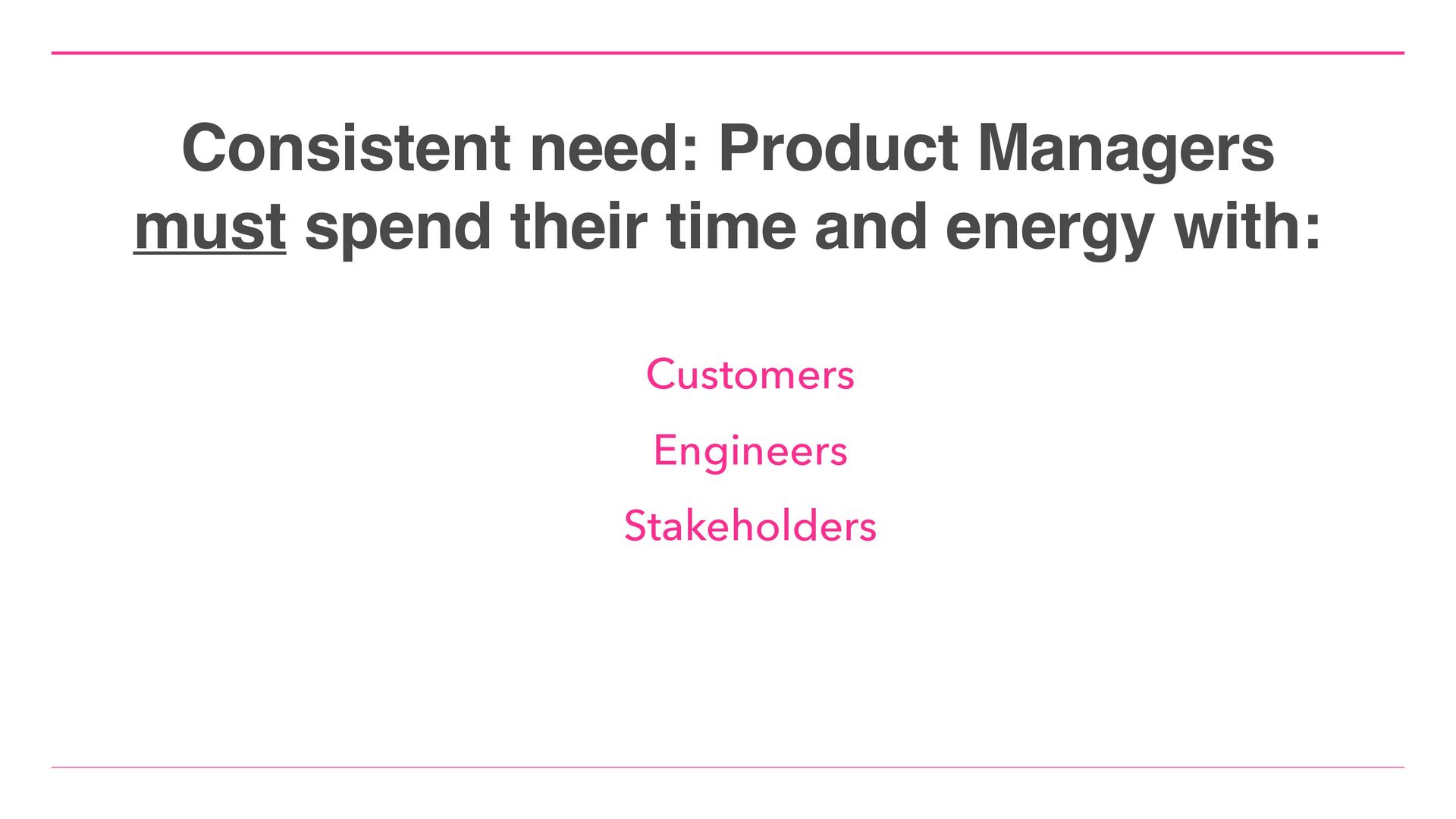
But there's a consistent need I kept mentioning across the decades. The first one is that people, product managers need to spend time with customers first. The next set of individuals that product managers need to spend time with are engineers. They need to influence and inspire engineers to take action.
They need to partner with engineers and give them their time so that they can drive solutions forward together that are going to meet the needs of the customers in their business. And they also need to spend product managers time with stakeholders. I speak to hundreds of customers in my seat in my new role at Pendo.
I have the privilege and then the sadness sometimes arise in me when a lot of my customers say that they feel as if they're just being told what to do versus being given a seat at the table where they're able to influence what to do next on their roadmap and for their customers.
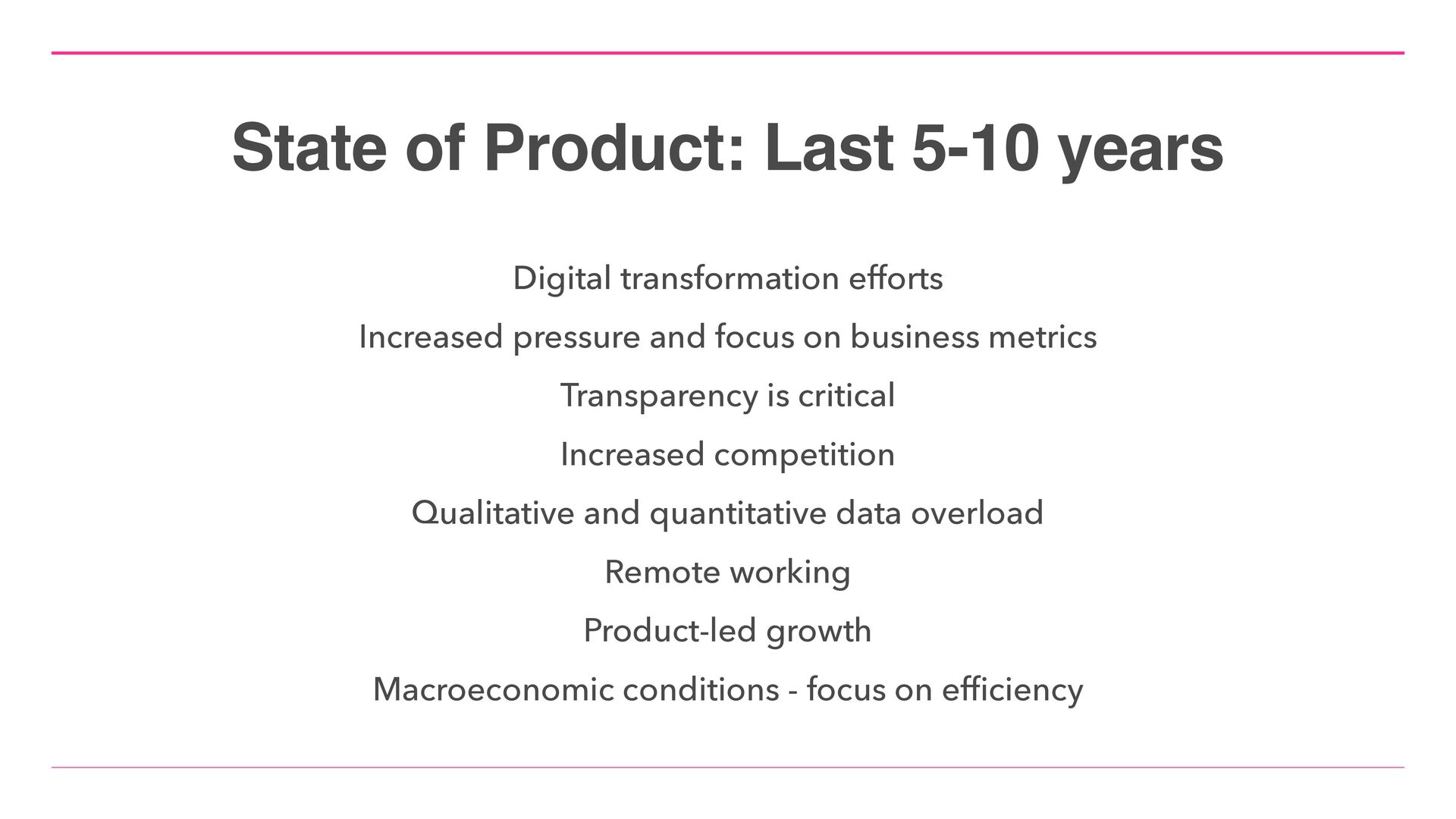
So the more you are influential with your stakeholders, the better chance you have at being an autonomous PM or a product leader. The worst seat you can be in is just being given things to do. So we bring it closer to today, the last five to ten years, digital transformation.
Anybody going through that right now with an older type of company or a couple hands over there? Increased pressure and focus on business metrics, transparency is really critical. We have all these ways of communicating so we need to stay aligned. There's increased competition everywhere.
This was particularly prevalent, I would say pre pandemic, maybe even into twenty twenty one as alternatives started to boom and all these little companies started, yeah, can do that too. I can do it for cheaper. There's a qual and quant data overload that we started to see everything just, okay, where's the data that just keeps coming up more and more.
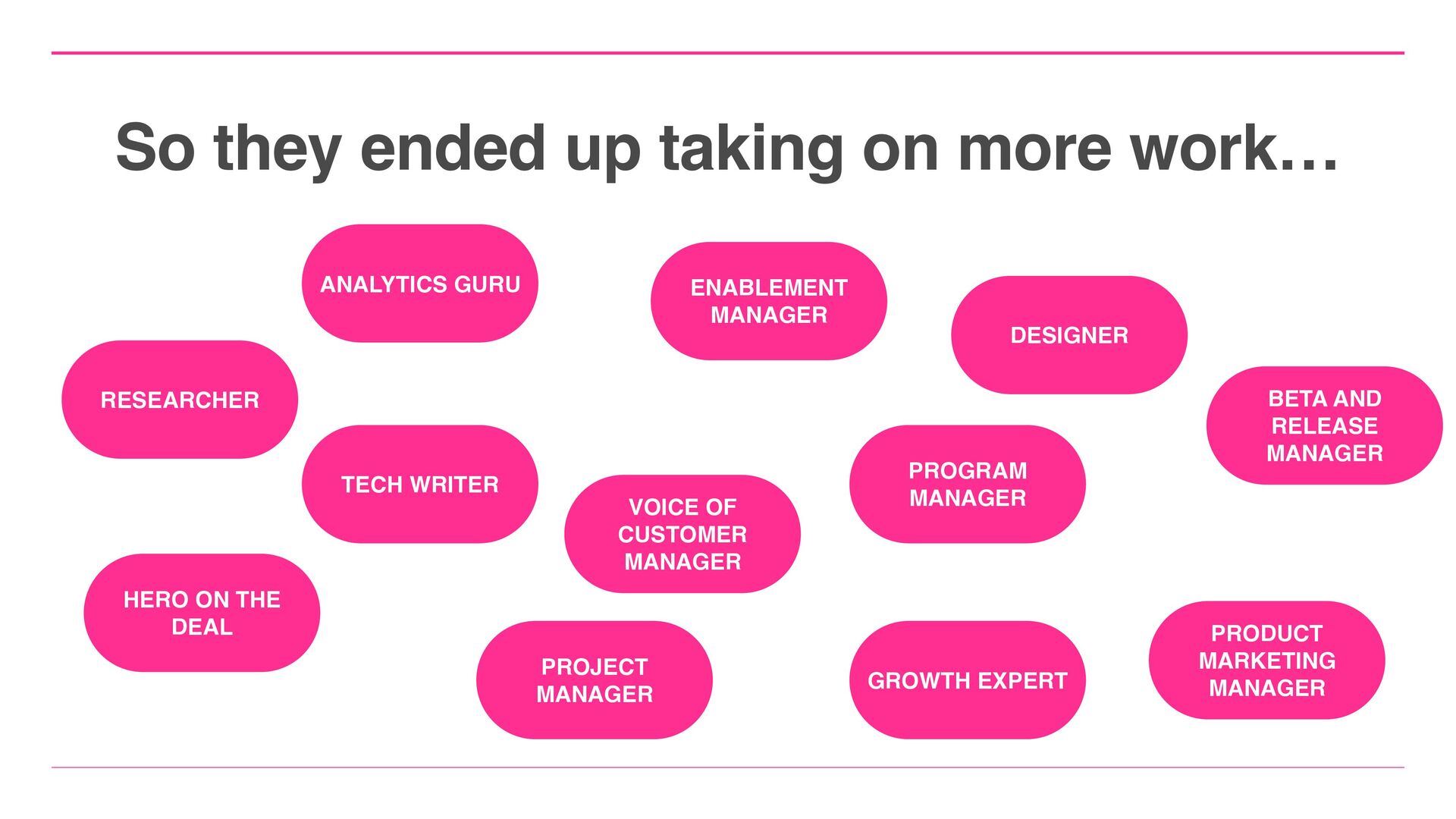
Remote working happened in PLG, right? We talked about PLG with Leah yesterday. And then macroeconomic conditions today are making everybody focus on efficiency, focus really **** ** efficiency. And with all the opportunities and shifts that we've seen throughout the decades leading up until today, this is what a product manager's workload looks like.
Anybody disagree? I bet some of you even have more little bubbles that you can add to the screen. You're feeling like you have on all these hats and it's really painful so burnout ends up becoming a problem for product teams and for product managers first and then it further impacts product teams.
Engineers feel it because their product manager is stretched so thin. Designers feel it because their product manager is stretched and pulled in so many different directions and they're trying so hard to focus. So your burnout becomes so real and so critical and your mental health takes a toll.
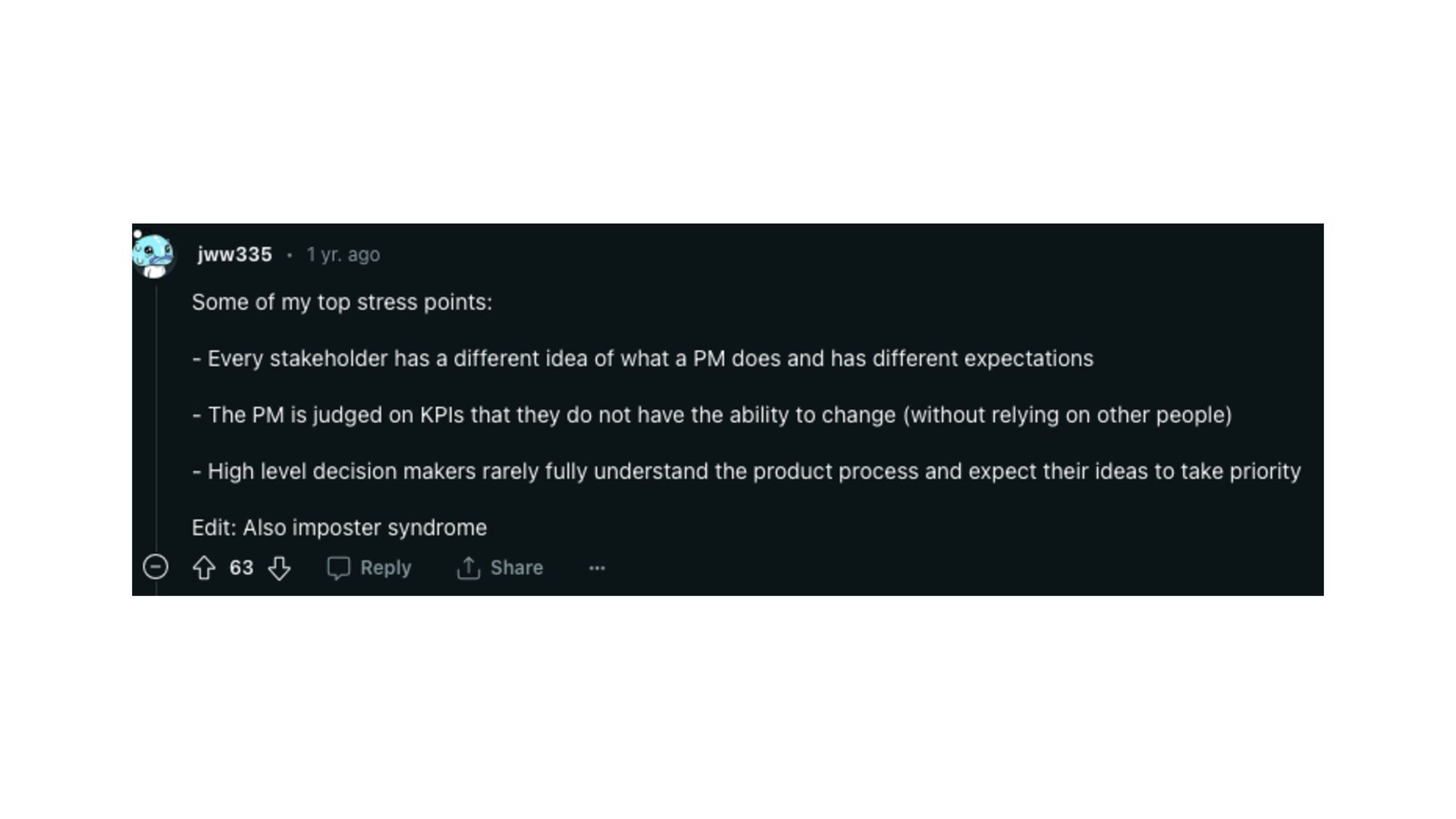
If you Google right now, you can pull out your phones and say, is product management a great place to be today? This is like the one of the first things that popped up on Reddit. What's a stress point? Stakeholders have different ideas or a PM does and has different expectations.
Nobody does product the same. So everybody's got different expectations of what a product manager is gonna deliver. The PM is judged on KPIs, they don't have the ability to change. Yeah, absolutely. High level decision makers really understand the process and expect their ideas to take priority.
Not just high level decision makers. I will tell you that salespeople have different expectations. Customer success, they have no decision making power yet. They want you to do all the things for them as product manager. And then this person said, edit also impostor syndrome. Right?
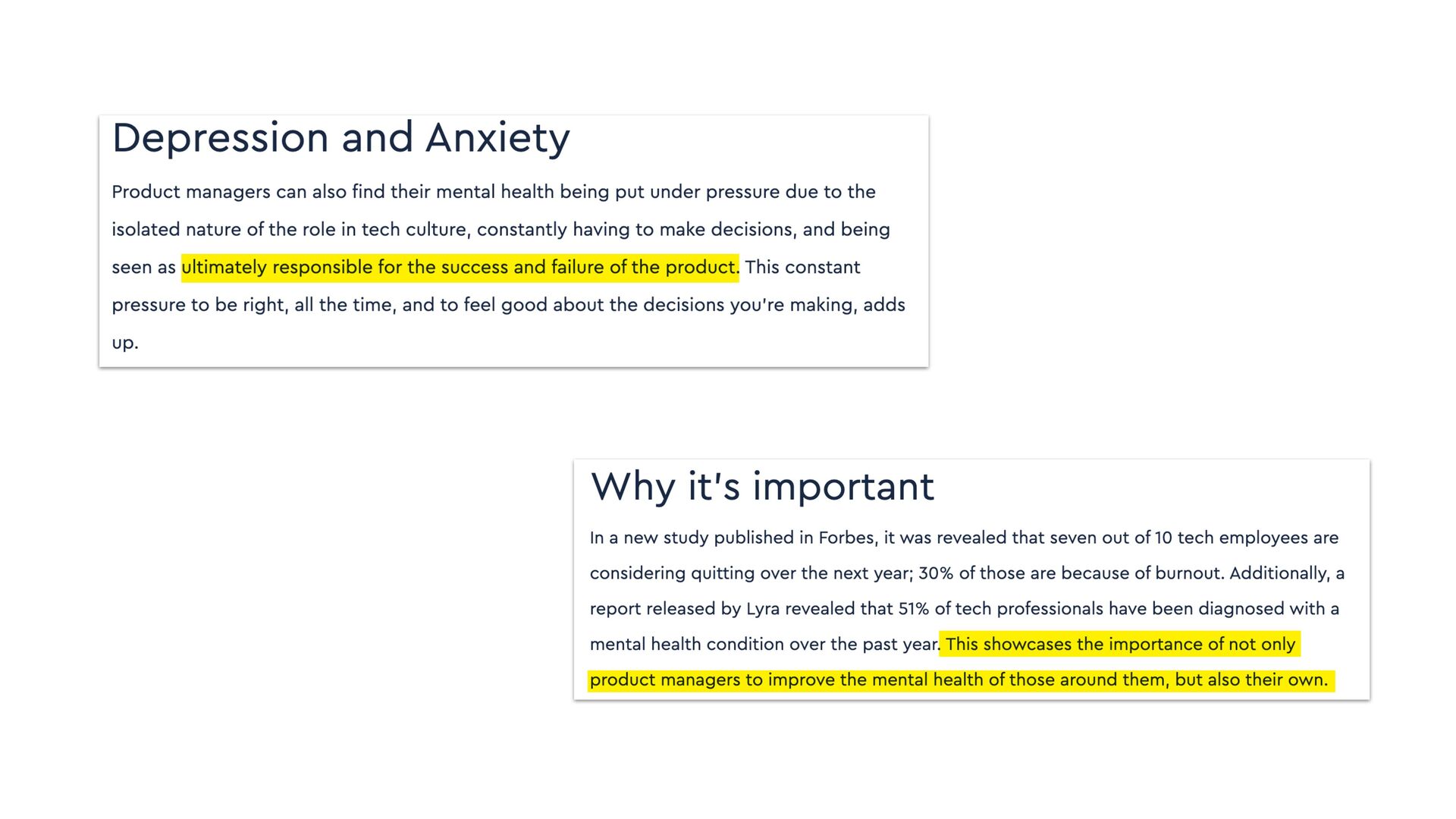
We all feel that. I feel it all the time. This this is pulled from two articles on Mind the Product. And this is just really simple, like showcasing the importance of product managers to improve their mental health, not just for themselves, but also for the strength and the health of their team so that they can drive outcomes together.
You can see that, again, the depression and anxiety that comes up in product managers is attributed to the fact that they are responsible for the success and the failure of their product. They also operate, we also operate with no authority at times. I think this is from Psychology Today.
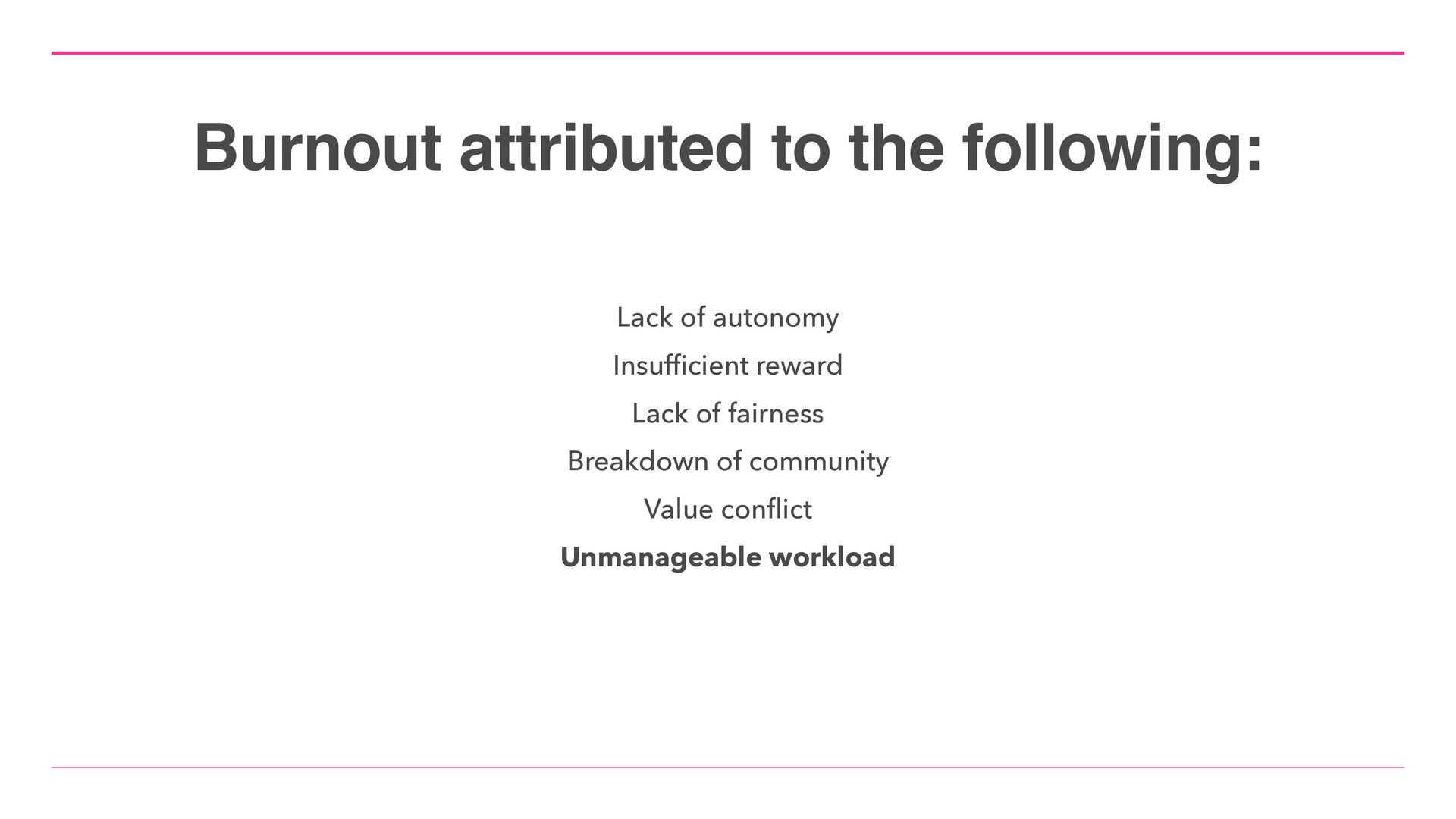
Six causes of burnout in the workplace. I went through a couple of them but the last one is the most important for this talk today. There's unmanageable workload for product managers as we're seeing it. If you're in a company that has the ability to hire enough product managers to take over the amount of work that exists across what you need to do to solve your problems to grow your business, that's awesome.
But there are still other things that product managers are expected to do that should not fall into the customer and engineering and stakeholder category. This is why a storm of all these changes has brought on this thing called product operations. So the new kid on the block has been product operations and we're seeing it emerge from the business as some people are saying we want this as a new role or Christine, come and talk to us.
We need you to help us understand how to stand this thing up in general with the people we have. More than ever, I am pleasantly seeing that former product managers and product leaders are raising their hand and taking this role on themselves. That's because they felt the pain that product managers have gone through.
I always told my product operations managers that you need to think and operate like a product manager when you're building out your product ops practice. You have to lean into the pain and the pain starts with the product manager and everything that they're responsible for.
Most of my calls with my customers are because people have had enough among all the changes that we've seen and they're eager to learn more about what product ops could end up looking like for them. So what is it? I mentioned there's two things, right?
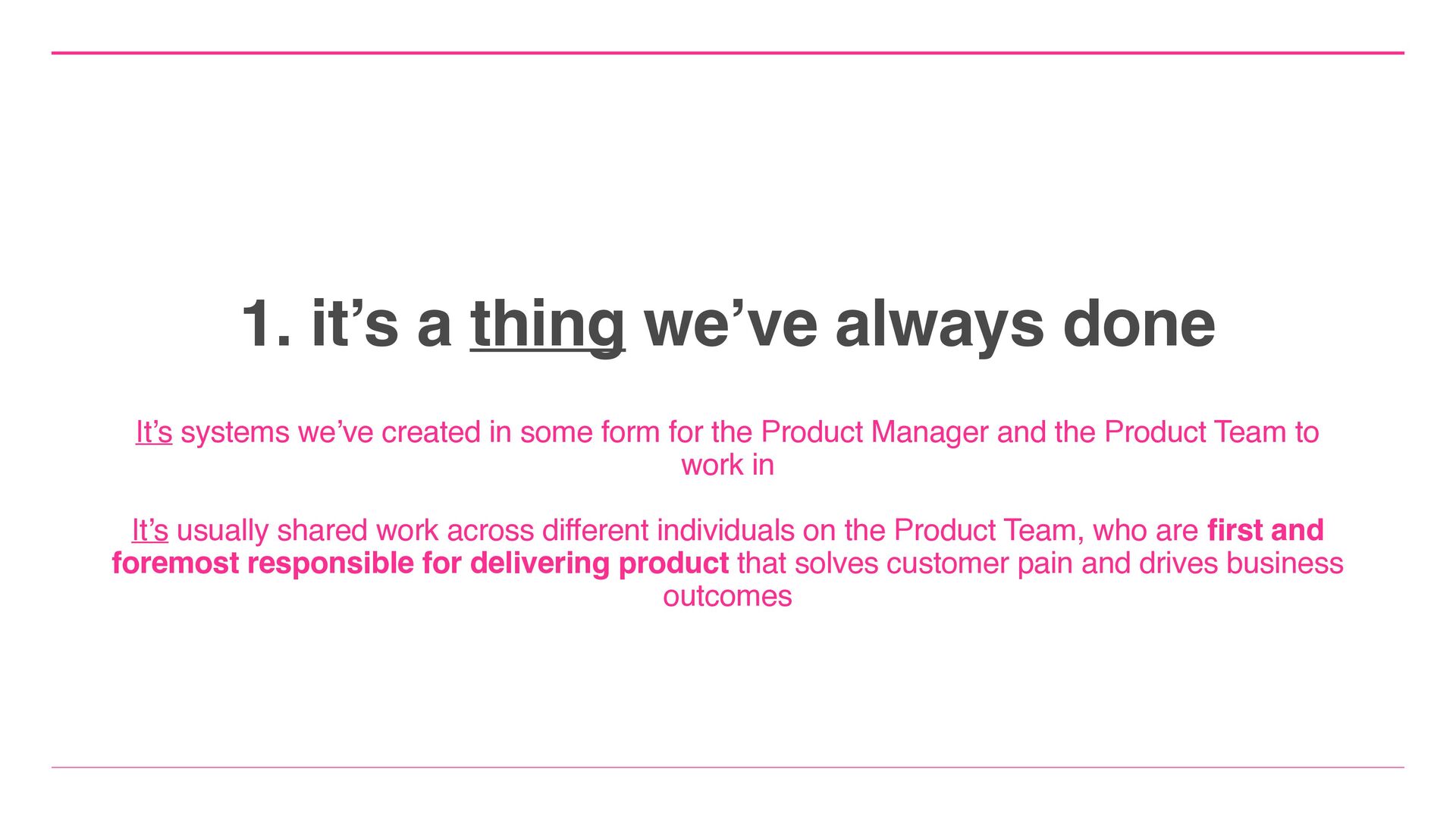
One, it is a thing that we've always done. Every one of us has done this thing. Even if we've done a slice of it, we've all done product ops as a product manager. It's a system we've tried to create or we've created in some form for the PM and for the product team in general to work in.
And it's usually shared work across different individuals on the product team who are first and foremost or they should be responsible for delivering on outcomes for the product and for customers and for the business. They need to solve that customer pain and business outcomes.
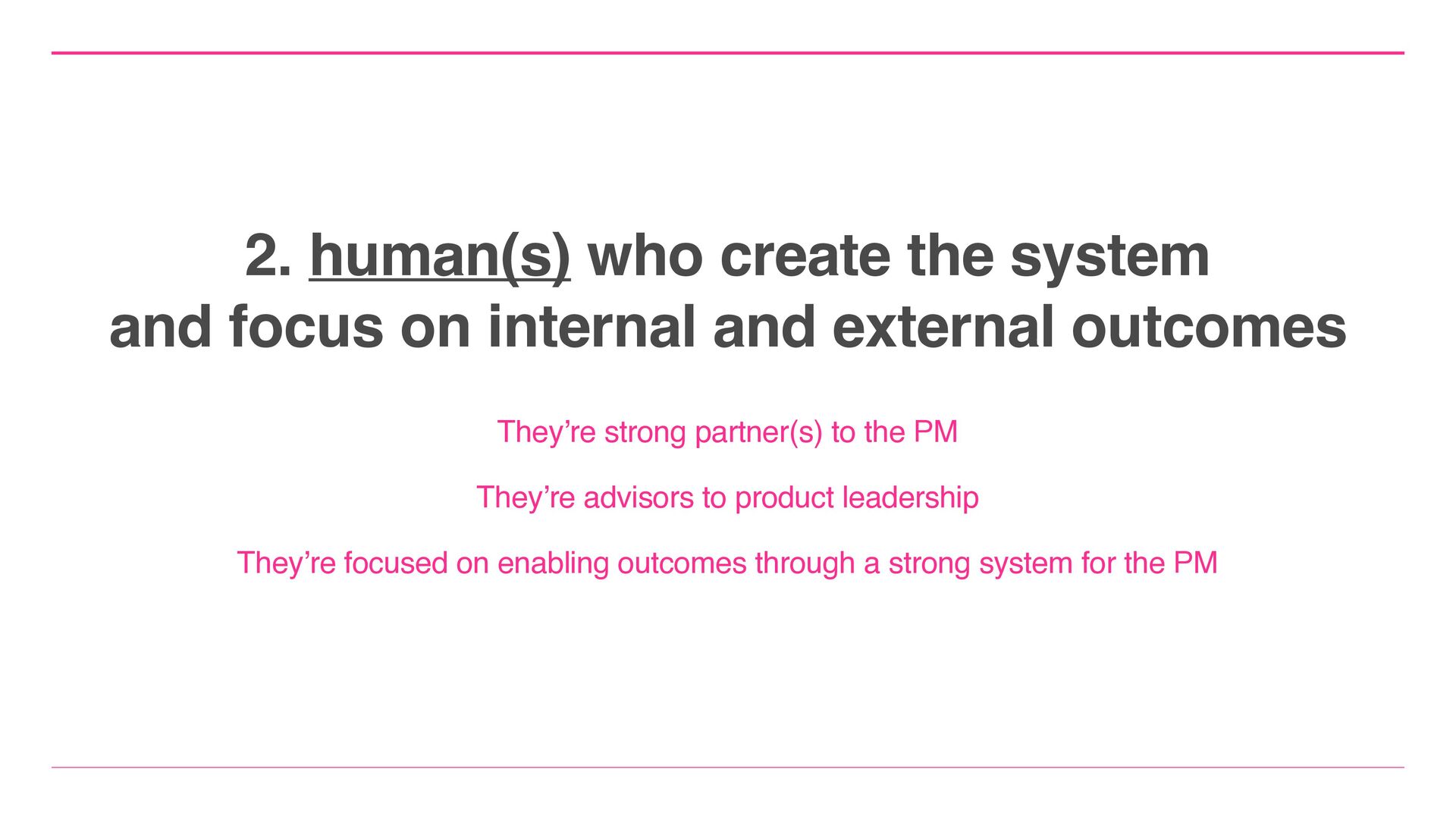
Number two is that product ops today is a human or a set of humans, a group of people who create the system and focus on these internal and external outcomes. The things that I'm finding are consistent across my customer base and within industry is that they are strong partners to the product manager on a day to day basis.
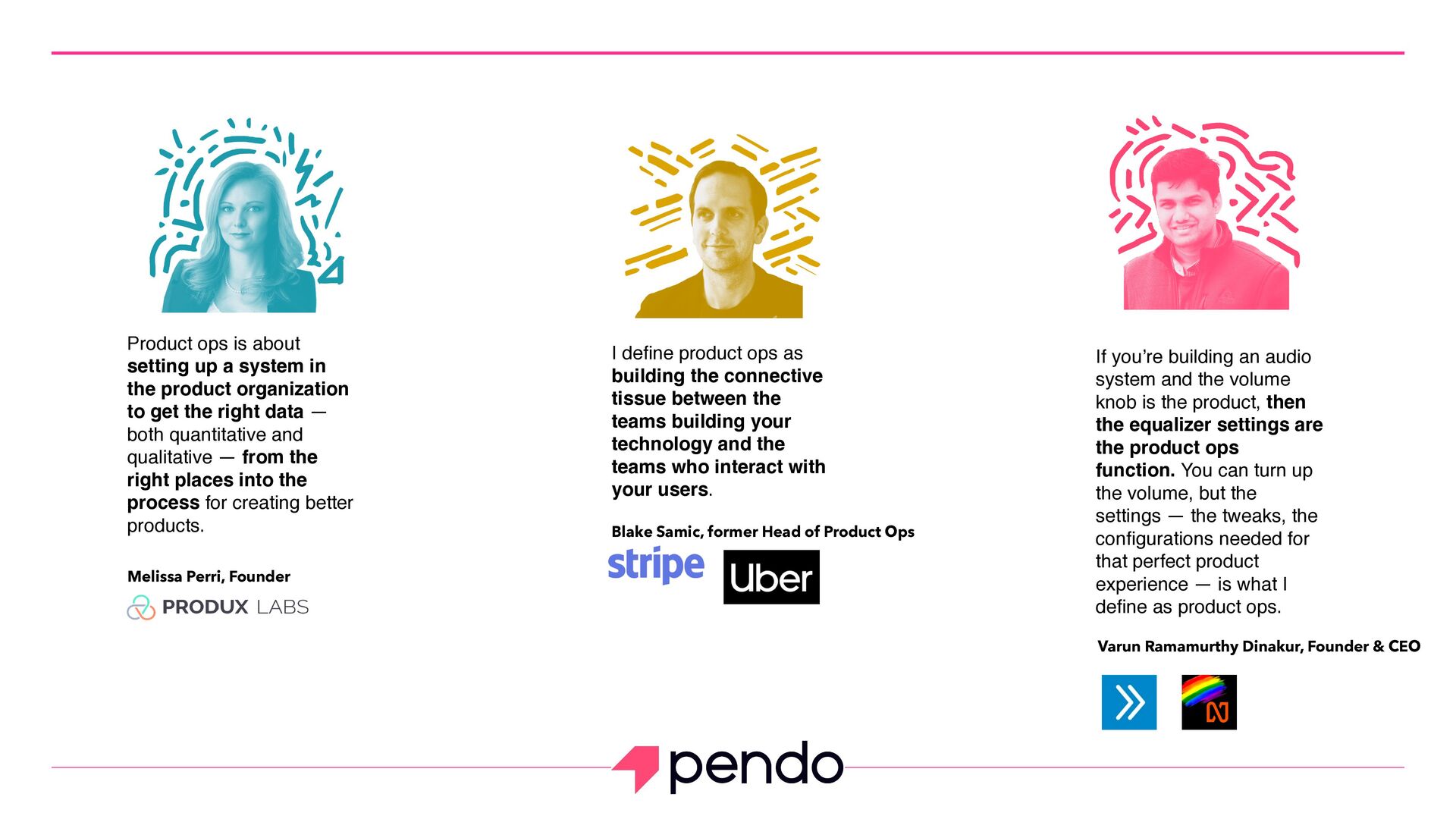
They are advisors to product leadership depending on the type of organization that they're in and the space they're given to actually be strategic. And they're focused on enabling outcomes through a strong system for the product manager. This is what three leaders in our industry have recently said about what they think of product operations.
This is from an e book. For those of you who are now interested in exploring what it is, you can download our e book online. Some of you know Melissa Perry, She believes it's about setting up a system in the product org to get the right data to and from.
She's also writing the first product ops book, so that's gonna come out soon. Very excited for that. And Blake, he mentioned that it's building the connective tissue between your teams, the technology teams and the internal teams who interact with users. That is how I described mine when I owned it over at Pendo.
And then Varun mentioned that they feel like it's the equalizer settings, that's the product ops function. They're tweaking and they're perfecting the experience so that it's perfect for the customer at the end of the day. They're working with the PM to do that.
Now what do people in this role do? I want to be clear first before I go into this and not every product ops person or team handles all of these responsibilities. I also want to be clear in saying that sometimes people do try to put all of these responsibilities on their product ops people which is really unfortunate.
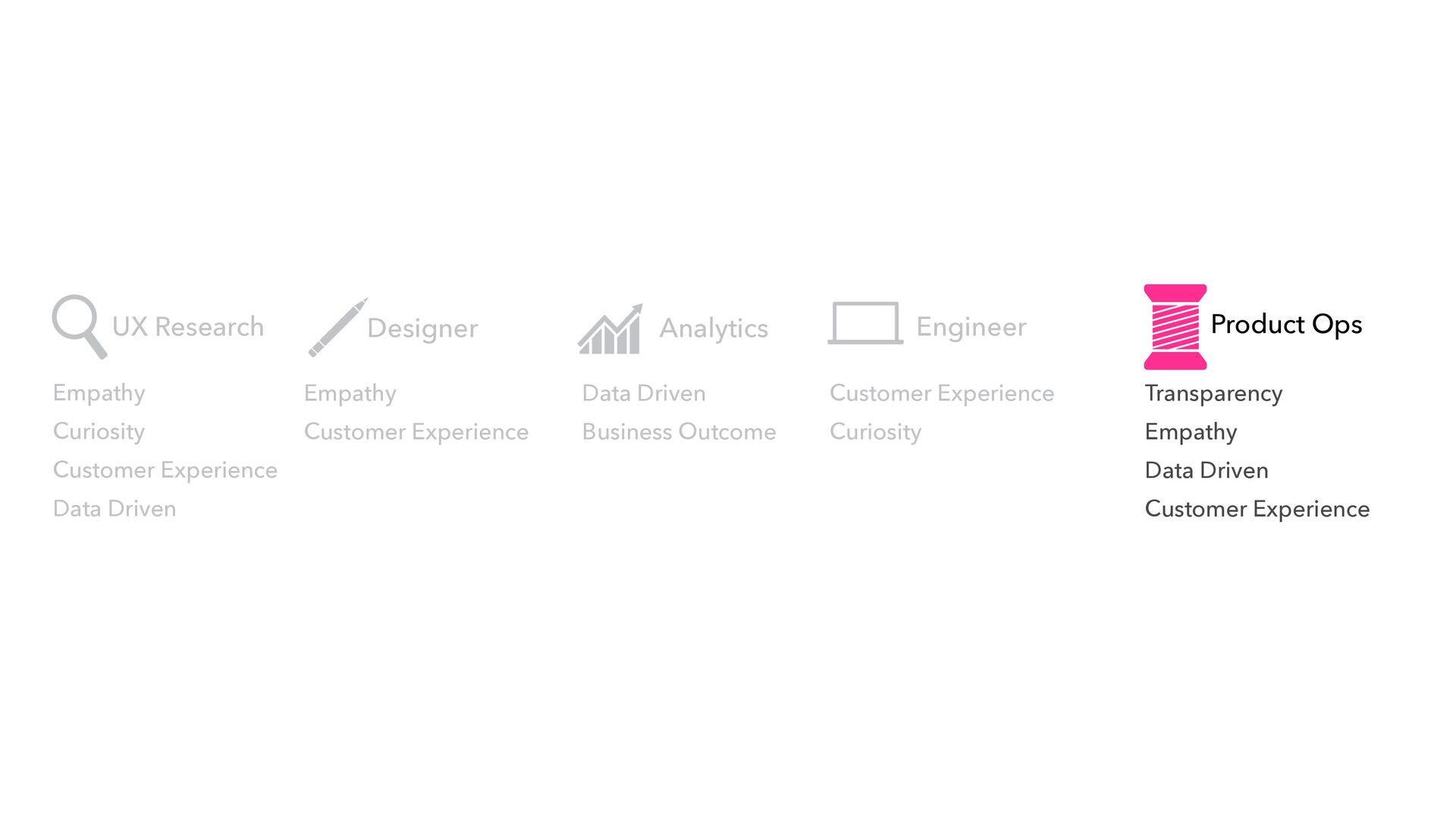
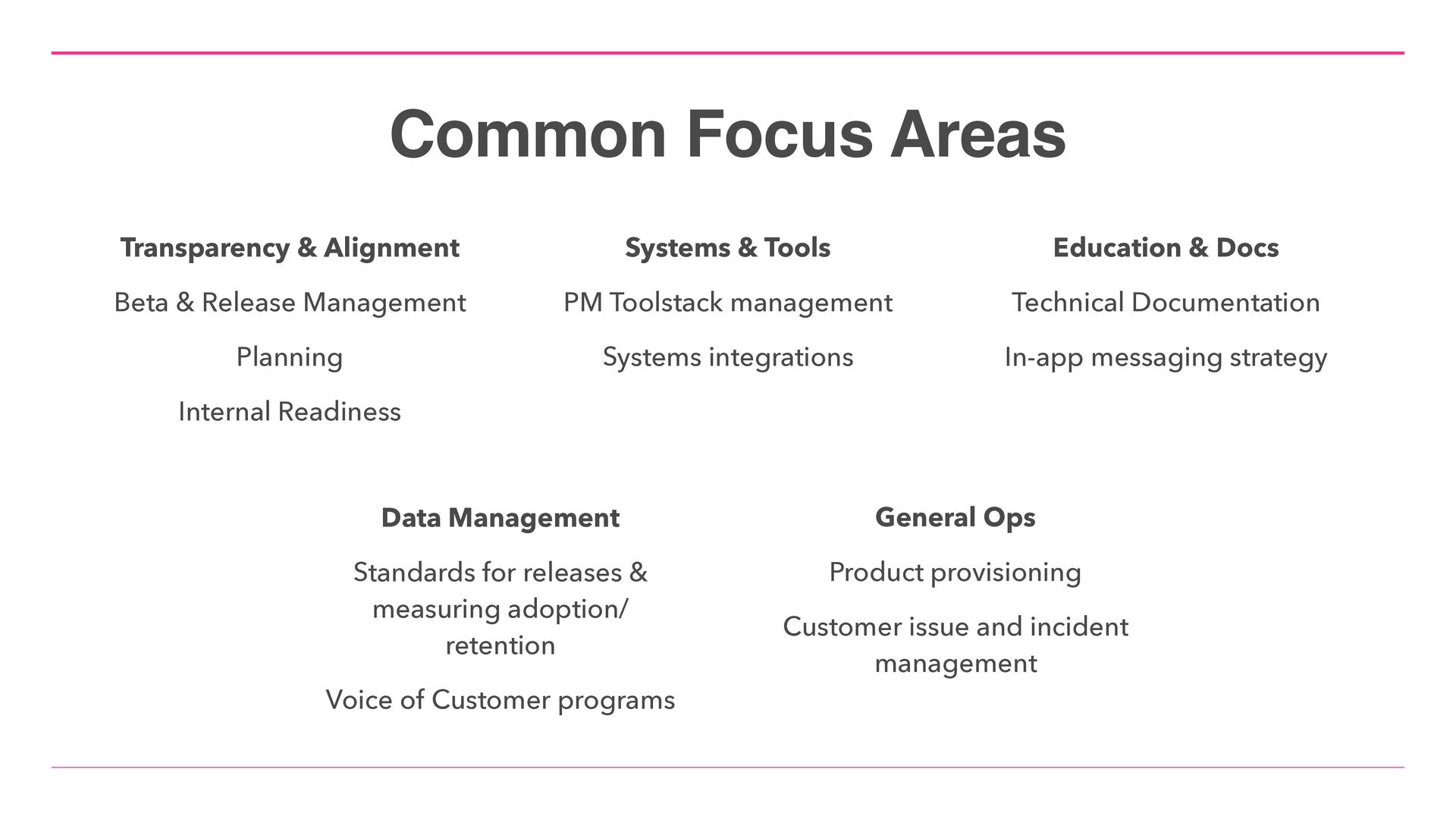
But they are common focus areas across the companies that we're seeing today. I bucketed into these categories, so transparency and alignment. They're managing betas and releases. They're working on planning, making sure there's consistency across teams. If you think about a portfolio of products or larger product team as your team starts to grow and scale, this is really an area where people start to bring in product operations.
Internal readiness, so it's not just about building the product and then throwing it over the wall. Making sure everybody at the company is ready to do their part is something that the product ops manager focuses on. Systems and tools, they work on tool stack management as the team grows, anything that plugs and plays with the product team and the engineering team.
Systems integrations, education, documentation, we're starting to see this arise more in product ops teams. Which PM any product manager here write their own technical documentation all the time. Are you responsible for your own docs on top of all that? Yeah, exactly. And updating them and making sure support has all of that falls on you in addition to your work.
Data management, so voice of customer programs is starting to come up as a really cool area for product ops teams to manage. AI is making this a whole lot easier and a whole lot more interesting for us, it's really cool to watch. And then general operations, we're starting to see some teams, Depends on the type of company, it's less common but bring in incident management, product provisioning, things that are generally outside of the product team.
Some people are moving to in the product team and want an ops unit to work on. Again, less common but we're starting to see it. It's because we have different needs for different businesses. We're finding that each company is identifying areas of focus based on many different factors including their age, location, growth rate and size and many other different factors.
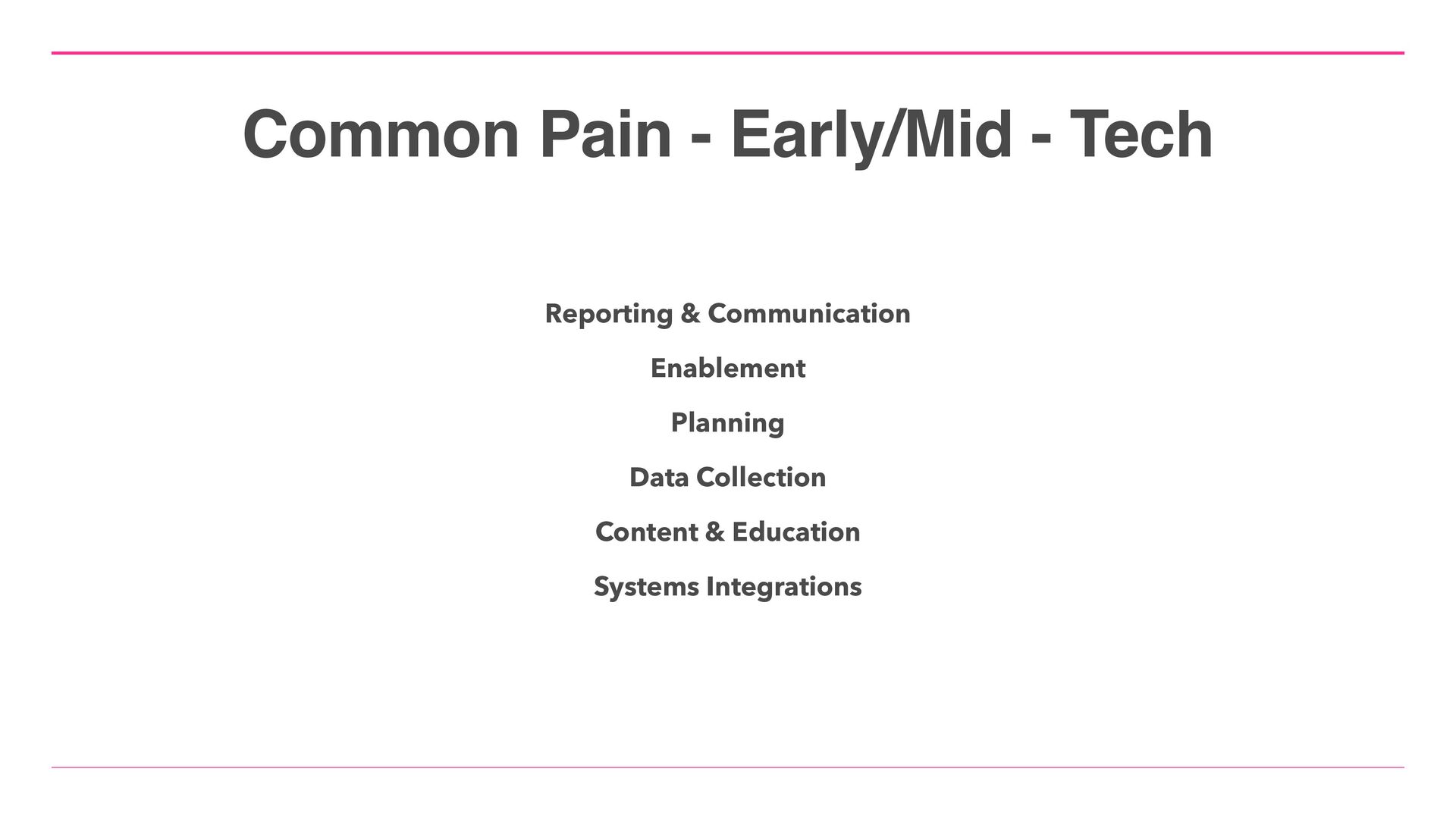
Here's an early mid tech. These are commonalities that we're finding across companies that are early and there's maturity or mid stage in tech. Reporting in comms, so alignment is really critical. Enablement planning, again, collecting data, making sense of all of this data as the PM is working with customers and engineers.
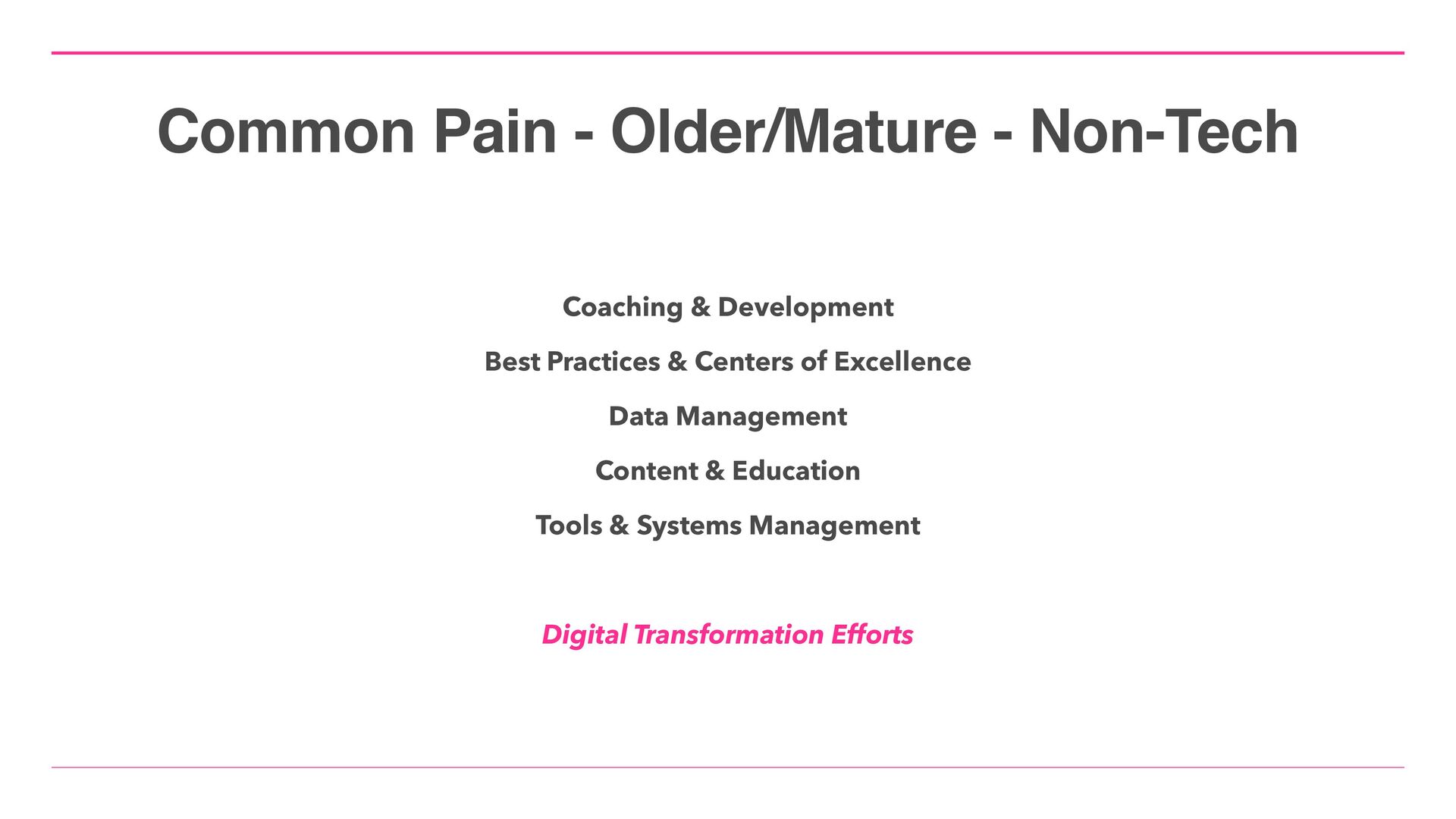
Content and education and again, systems and integrations as the company starts to grow and the product team starts to grow. And then I'm finding, this is where I'm finding a ton of my customers at Pendo and mine the product are really interested, is the companies that are going under digital transformation, the older companies who are trying to grow their product team while the product manager is maturing and growing the product and the experience for the customer.
They want people to focus on coaching and development. They want people on best practices and building centers of excellence. They want them on content and education, data management, tools and system management. So again, these are people that are finding themselves going under this wave of digital transformation and we're all in this Every company I was a software company, right?
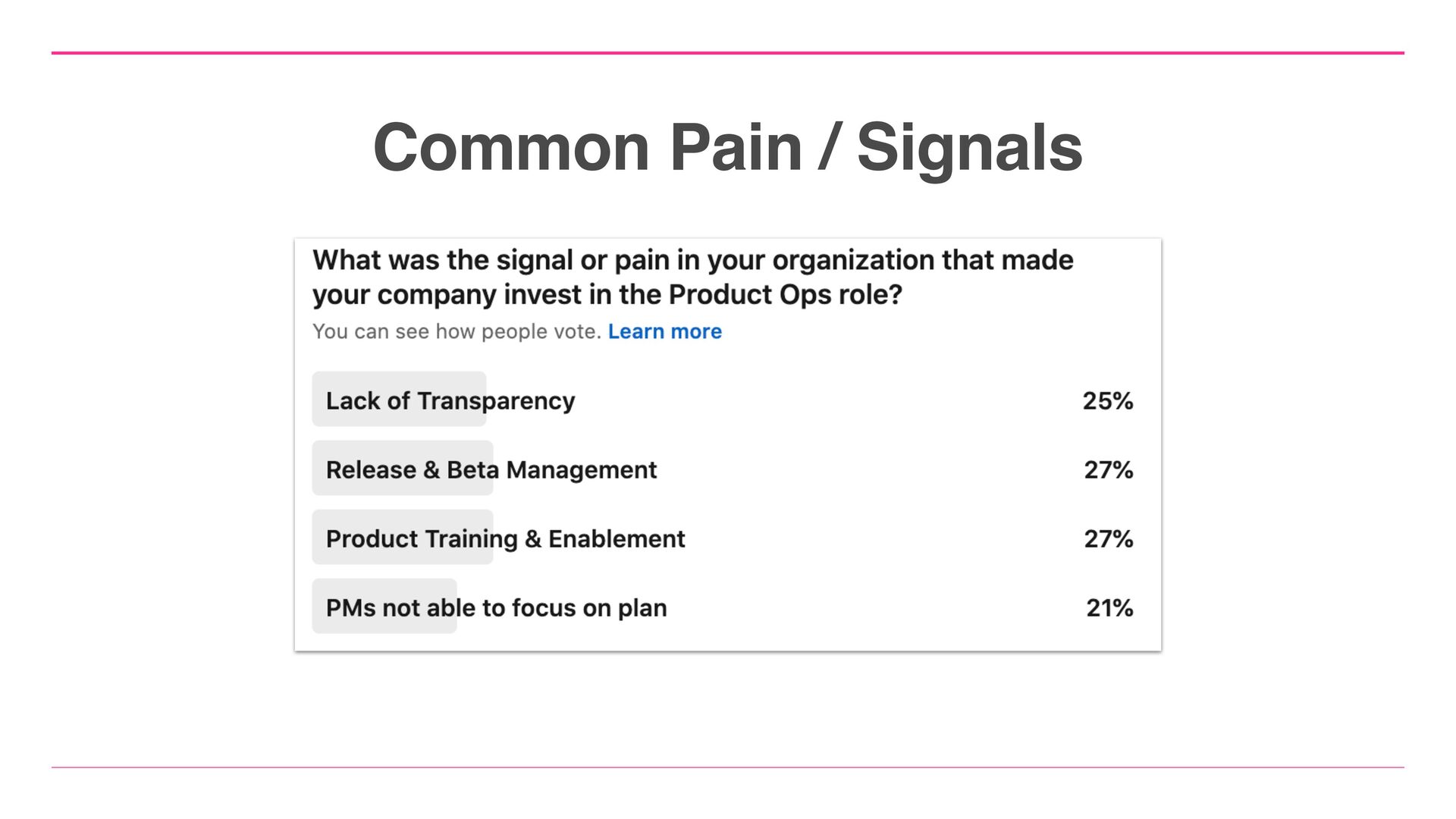
So whether you're a newer company and you're already in it or you're an older one moving things over to like finance, insurance, accounting, these are the companies we're starting to see go through it. This was a poll I put out a while back on LinkedIn when the role started to go on the rise or a little bit after.
It's interesting here the top three in terms of what was the signal that the org made a decision to invest in the role, they're very much aligned. A lot of them also feel those top three align around the same thing which is transparency and alignment and being on the same page.
So that's critical because you never want to be unprepared and misaligned in front of customers. Please, that's the biggest thing I need you to take away from today or two things. One is your healthy team matters the most and second is don't ever make this happen.
I have sat on a phone call once where I watched the product person not know what the heck the account team was talking about and the customer just ripped them apart. Ripped them apart. It was terrifying to watch. You don't ever want to be in this position.
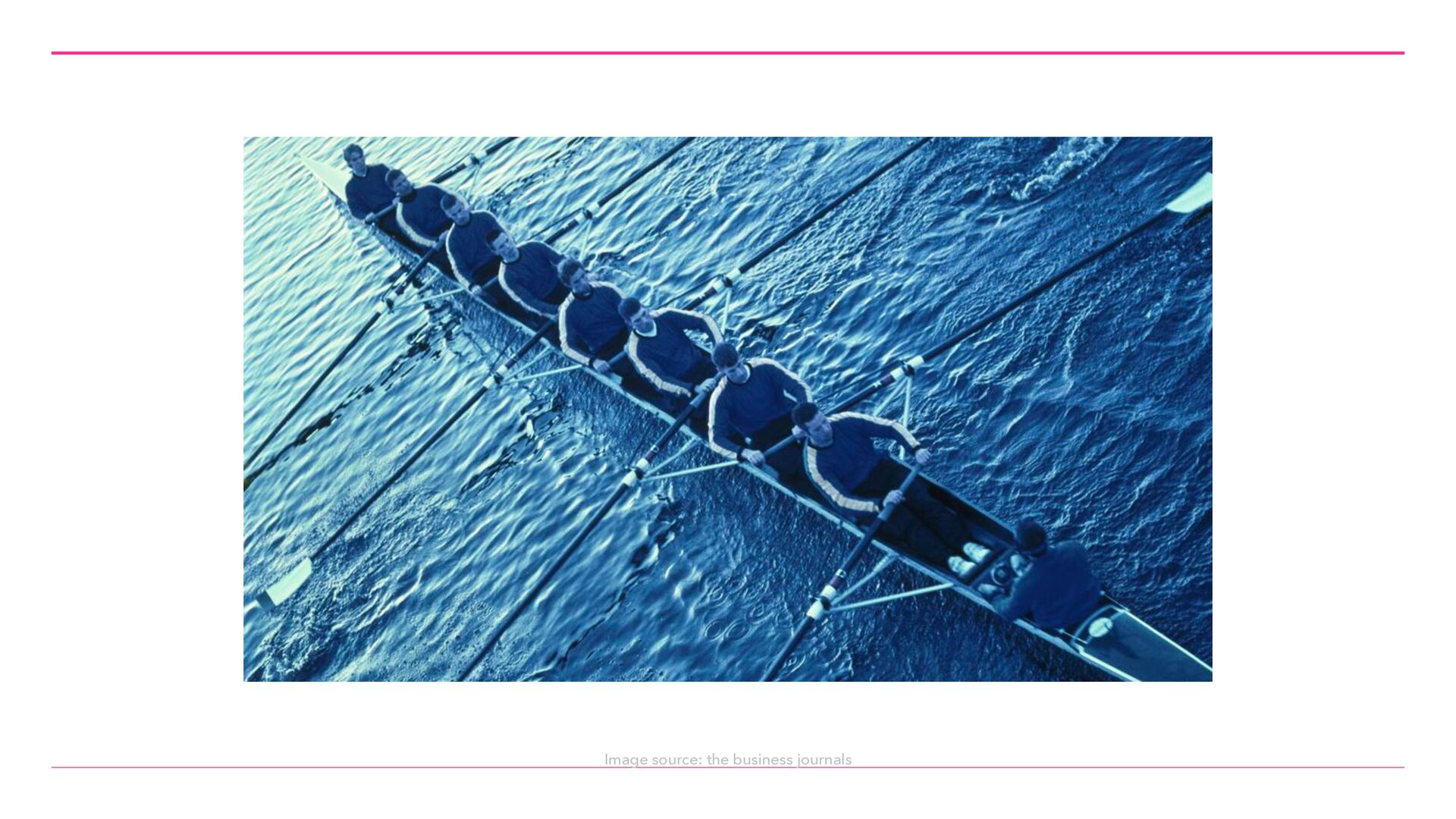
Everybody needs to be rowing in the same direction. Everybody needs to care about the product, what the product manager is doing or not doing so that they can do their part in growing the business. This all takes rigor and being very much aligned to do that.
While companies, a lot of companies have these central operations orgs that they feel like a lot of this work can go into, it's important to remember again that every company is a software company now. So we need to prepare sales to sell the product, we need to make sure we're preparing our customer success reps and technical support reps to do the right thing.
We need to make sure that marketing is in a great position to grow that funnel. This is mostly true for companies not going through PLG or their growth is coming from PLG, right? We watched Leia do her talk the other day, yesterday. These are companies that are trying to get to that stage or they are gonna be getting to that stage at some point.
So traditional sales models and support models. What's really important is you need to make sure your leadership teams are confident in the decisions that your product managers are making to drive business outcomes with the product. And it takes so much more work than just spending time with customers, engineers and stakeholders to do that.
It's all the other activities around it as well that partner with it. Some passionate individuals like I mentioned have been working on solving the pain of the product manager because they felt that pain themselves. Here is an amazing piece of information that I wanted to share with you.
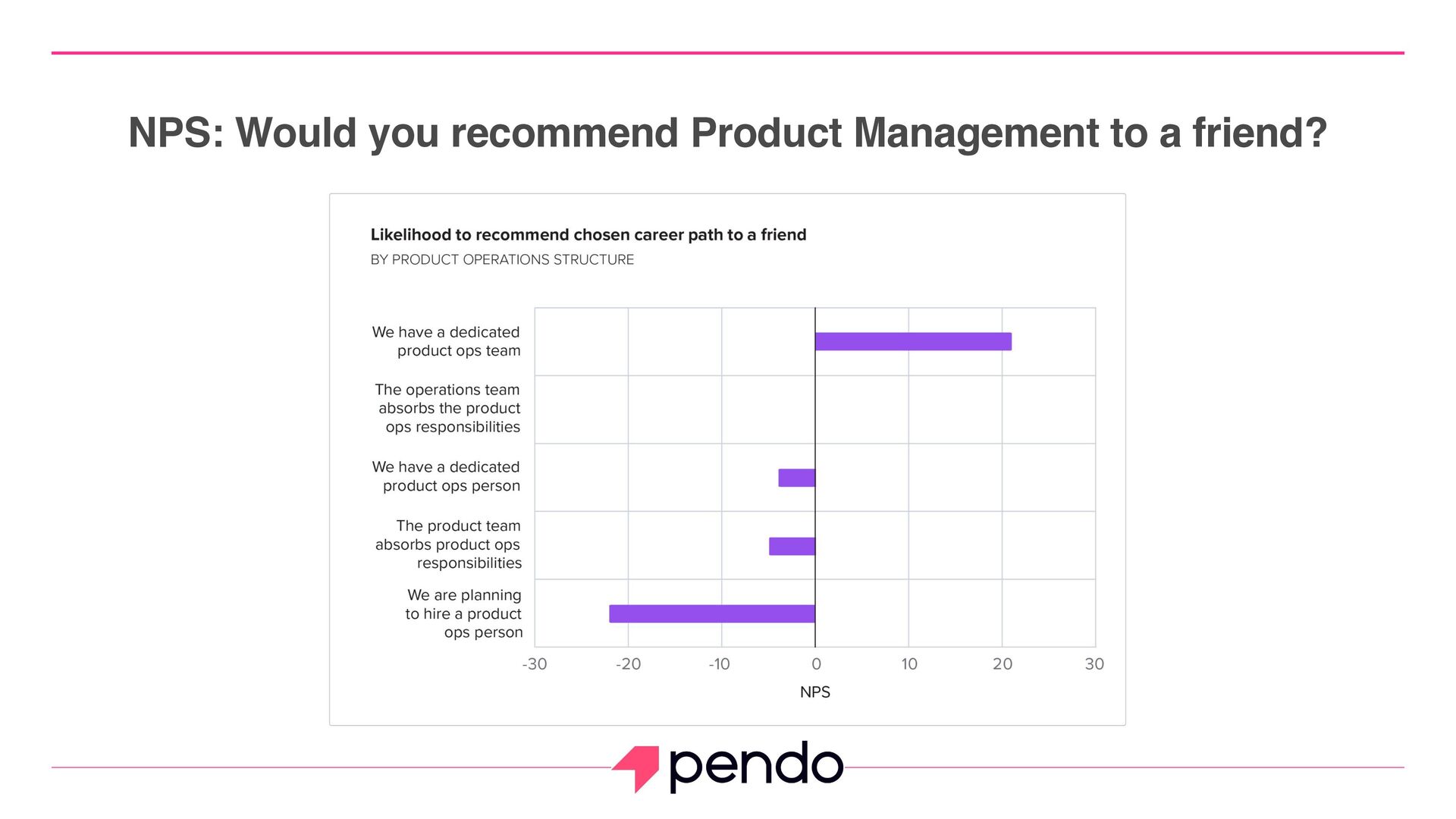
We did a state of product report a little while ago and we asked product managers, would you recommend product management to a friend? And think about that Reddit screenshot that I showed you. A lot of people say, nope, not if you wanna have a life.
The only people that recommend it are ones that have a dedicated product ops team. This is really critical. I think it was like six hundred plus companies that we polled that said this. The lowest on this was people who were anticipating that they were going to get the role.
So in anticipation you're feeling this anxiety or this sadness maybe that you're not having this partner in place. I've also spoken a lot of customers who've had the partner and then they shifted to a company that doesn't and they know they're gonna get it at some point but they feel that tension and they feel this kind of overwhelming workload coming their way and that's what gets them a little nervous.
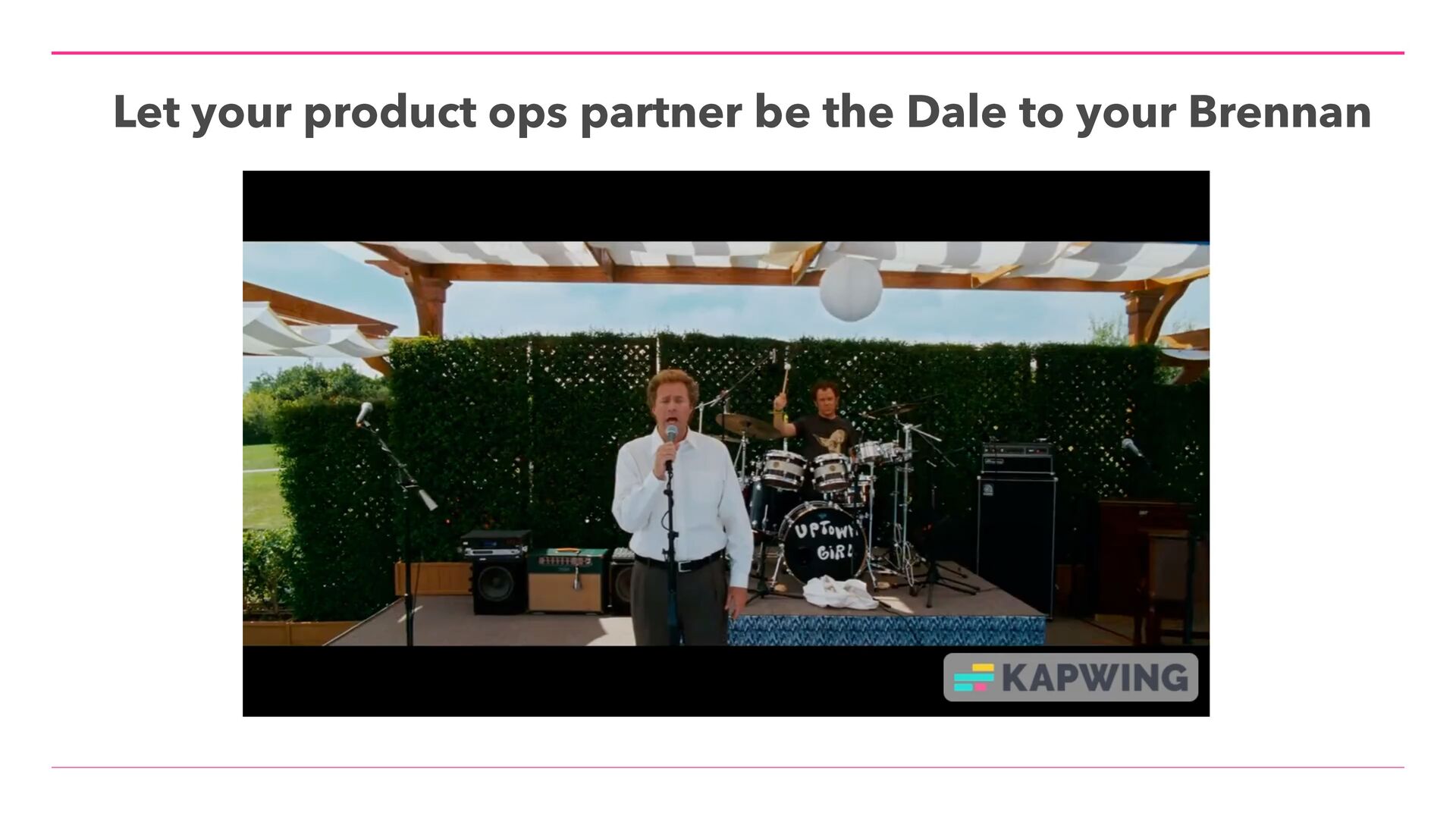
What I want you to do, if you're thinking about it is, again I go back to Will Ferrell is, I want you to let product operations be the Dale to your Brennan. So for those of you who have seen this, you'll understand. So it's called Step Brothers and the two brothers hated each other.
I'm not saying product ops people and product managers do. These two compliment each other so much and this is the outcome from this movie at the end. So when you do watch it, you'll appreciate this. Should I cut that last part out? So did you see how is it Dale is the one in the back is playing the drums?
That's what we say about our product ops people, one of whom sitting in the audience today. They're there to compliment the product manager, they're there to make them shine, they're there to make sure that their outcomes are just ready and just you're driving all of them for the customer.
So whether you have somebody in house doing it or you're thinking about doing it, make sure you invest time in standing up this system. I want to conclude to say, I want you to walk away with this feeling that you need to focus on how your product team is operating.
Whether you're going to hire a product ops person or you're going to focus on the role, make sure your operational practices are in place. And I'm not saying hard structure and hard process, but the right rails and the right systems so that your product manager feels supported.
So that their workload doesn't feel overwhelming. So that their mental health and their ability to deliver for customers, everything is taken care of. It's really important as things shift in our industry that we put this in place so that they can thrive. That is basically my talk today.
You can find me, productheart dot com is my website. I work for Pendo. You can find a ton of resources there as well and I'm sure a lot of you know my product being in this region. I'm also on LinkedIn and Twitter, but please, please please provide me some feedback here.
It's a really quick, I think it takes like thirty seconds on this one. And that's it. I hope this was informative for you today. Thank you.