
In any early-stage company, there are so many competing priorities and it is often difficult to know which ones to focus on first. Building a diverse and inclusive culture is usually one that is deprioritized, partly because there are few tools and resources relevant to early and growth stage companies, partly because it doesn’t feel urgent. However, having a diverse and inclusive culture and workforce is increasingly giving companies a competitive edge in the war for talent. This talk will focus on practical tips and advice on fostering diversity and inclusion in early-stage companies.
← All talks 



Lead Culture Turing Fest 2018
Building With Diversity
Auto-generated transcript - may contain errors. Tap a timestamp to jump the video.
Thank you. Thank you so much, Kirsty. And yeah, it's awesome to be here. I'm first time at Turing Fest, and I'm really enjoying it. And it's amazing to be alongside so many awesome speakers. So today I'm gonna talk about building with diversity. Why it matters and why it's really important to start from day zero when you're an early stage company.
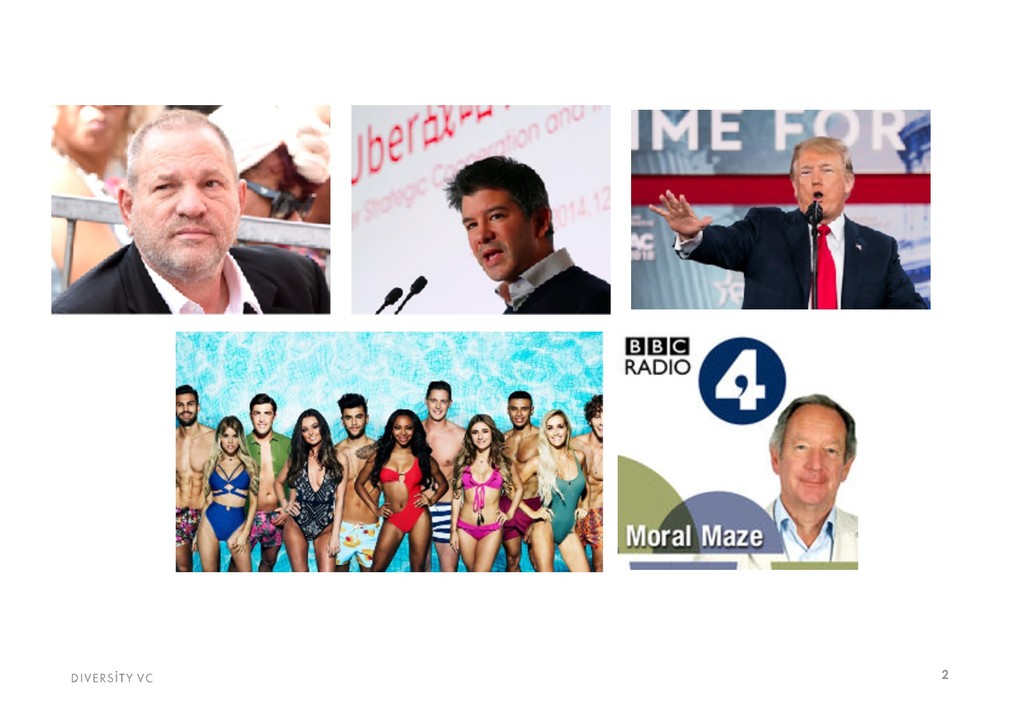
So we've had a lot of discussion this year about diversity. You would have seen probably Love Island in the last couple of weeks. There's been a lot of talk about it. Twitter feeds have been dominated. We've had obviously Weinstein. And we've actually, in the last couple of weeks, had an episode of the moral maze on the topic of diversity, which I think is kind of peak hysteria, peak mania about the topic.
So, in that context, thank you very much for coming to this talk. Because I know the word diversity can often prompt some eye rolls. But just so I can get a sense for who's in the room, it would be awesome just to start with a couple of questions.
So, I'd love if you could put your hands up if you are in the senior team of an early stage company. Okay, lots of hands. Great. If you are in the senior team of an early stage company, has anyone in that team mentioned the word diversity or the topic of diversity in the last year?
Yep, hands up. Okay, lots of people. Great. And do you feel that you at the moment have the requisite tools and resources and know how to actually do something about making a change, a positive change in your company around diversity and inclusion? A few, no.
So, we've got sort of three semi hands going up there. So, okay, that's good. I hopefully today will be about giving you some of those practical tools and resources. So, what I'm gonna talk about is who I am, what I mean by diversity, and why embracing it could be the best way to supercharge your business.
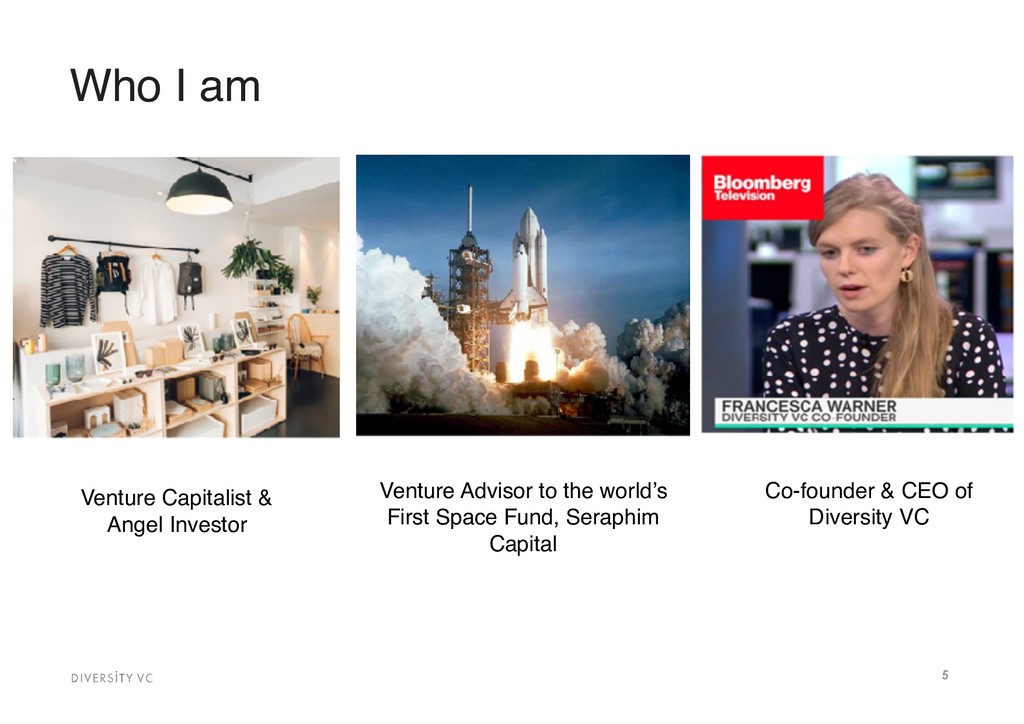
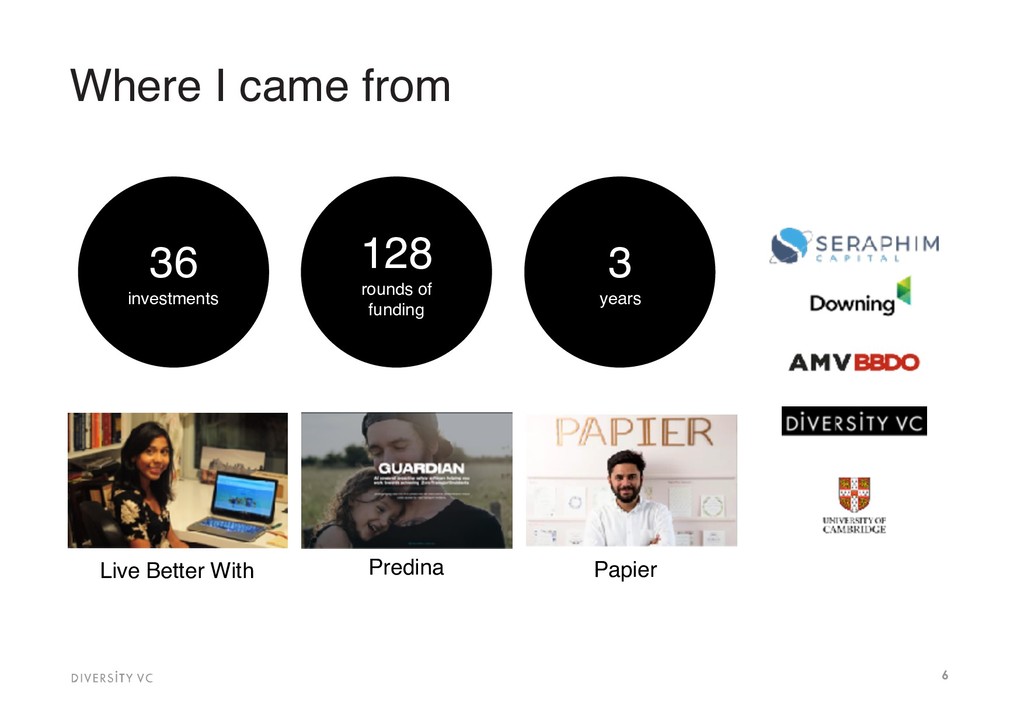
And I'm gonna talk about practical, tangible advice in building diversity from day one. So, who I am, first of all. So, as Kirsty mentioned, I'm a venture capitalist, unfortunately. I invest in early stage companies. So, I've spent the last three years investing in thirty six companies, previously at Downing Ventures.
And now I work at a space focused fund called Seraphim Capital. So, it's the world's first and only space fund. So, if there's anyone in this room who is working on an actual moonshot, I would like to talk to you afterwards. Please come and say hi.
But I also am the co founder and CEO of Diverse TVC, which is, as Kirsty said, the first nonprofit dedicated to promoting diversity and inclusion in venture capital and entrepreneurship. And I only have one dress, as you can see from this picture. So, I've invested in a bunch of companies.
And so to that extent, I kind of know about what it's like to be in an early stage company. Most of the companies I invest in are about sort of five to ten people. And these are some examples. But you might be wondering why I'm qualified to talk about diversity.
I am a white, privately educated person from London, not very diverse. And in fact, I think the most diverse thing about me is probably my name, which is Czech, which is a bit weird. But I'll tell you a bit of my story, because I think that brings to life kind of why I'm really passionate and really care about this topic.
So, I started out when I was fifteen. Wanted to be an actress. I spent five years sort of working out that I was actually really bad acting, and you can probably tell by this talk that I am really bad at acting. But I then went into working in an advertising agency, which I, you know, this is a real picture from a Monday morning meeting in an advertising agency.
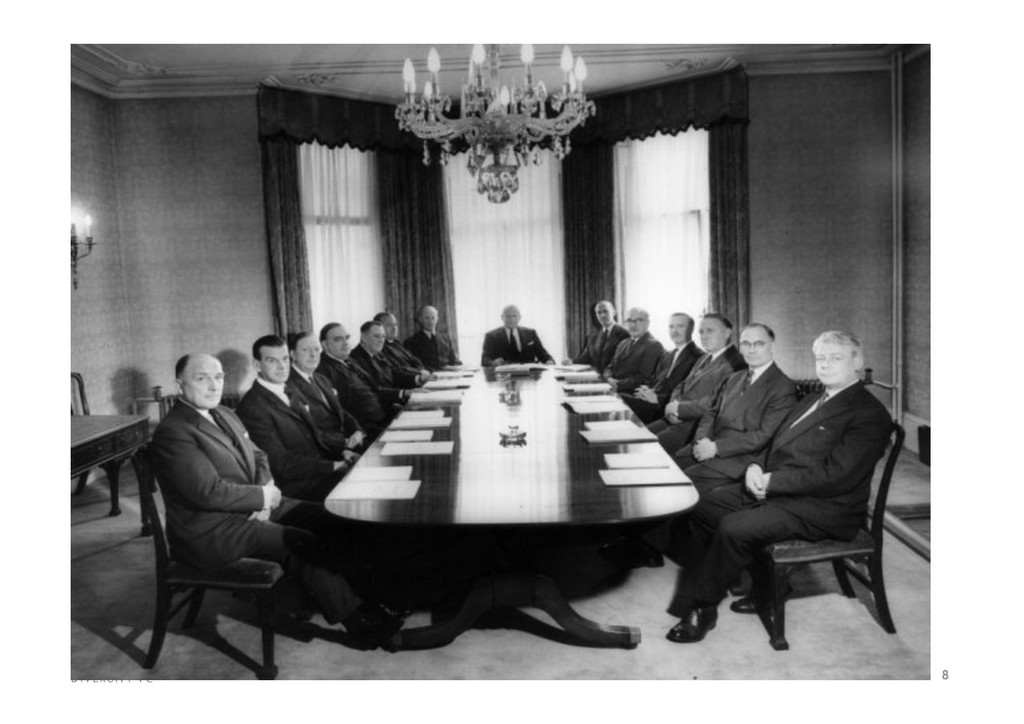
It's quite different. It's quite diverse. There's lots of different kinds of people, and lots of different people kind of welcomed. And then sort of just over three years ago, I did a total career pivot. And I went into an industry which looked a little bit like this.
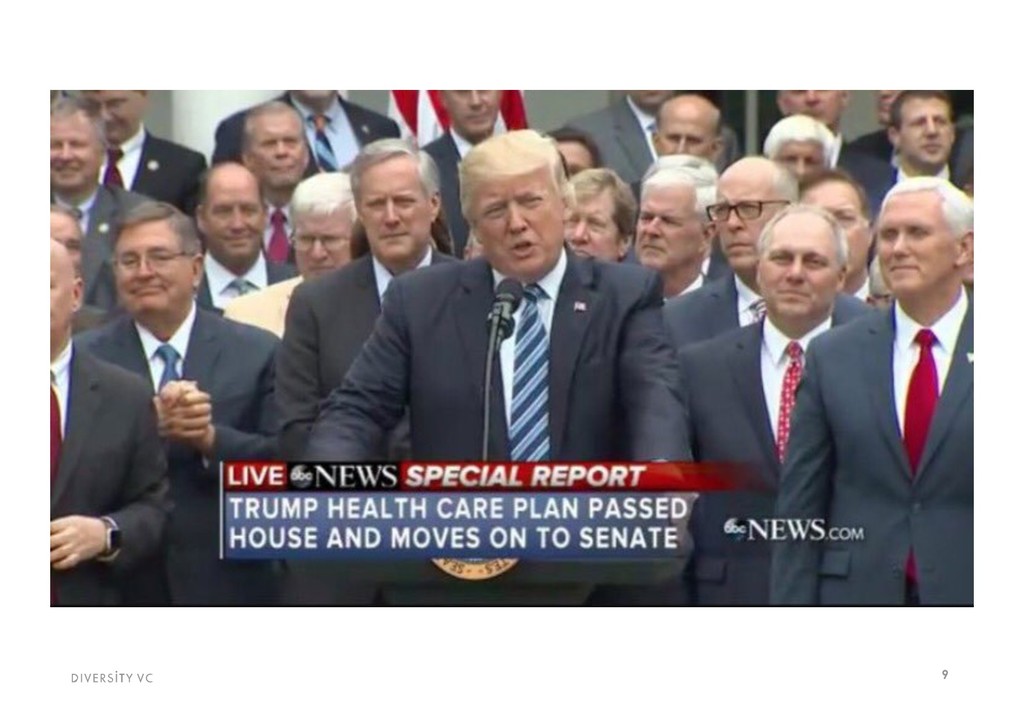
And so this really was a kind of an image that reflected a Monday morning meeting in the VC firm I joined. And I had a few experiences in the first six months of joining. Going along to a conference where the lineup of speakers looked quite a lot like this.
And then on one occasion, I was at a conference, and I went up to a group of sort of suited and booted men. And one of them just passed me their drink because they thought that there was no possible way that I could have been there for actually the conference.
I was just there to take their drinks away. And I saw how much this feeling of being an outsider and not being part of something was compounded for people who were from much less privileged backgrounds, and had many more challenges around diversity than me.
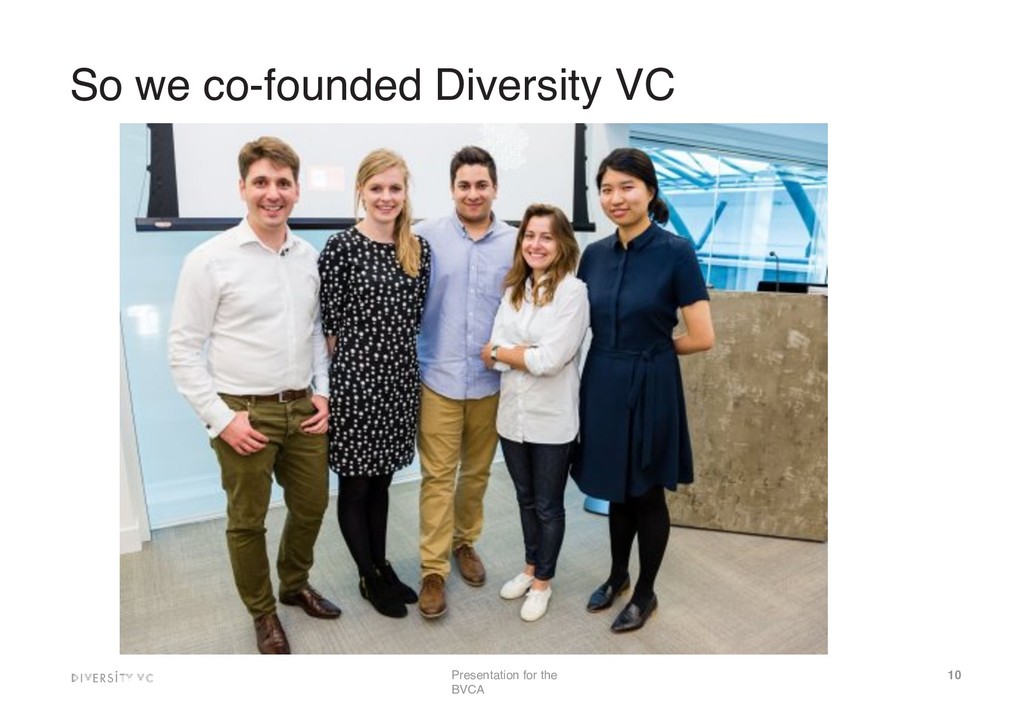
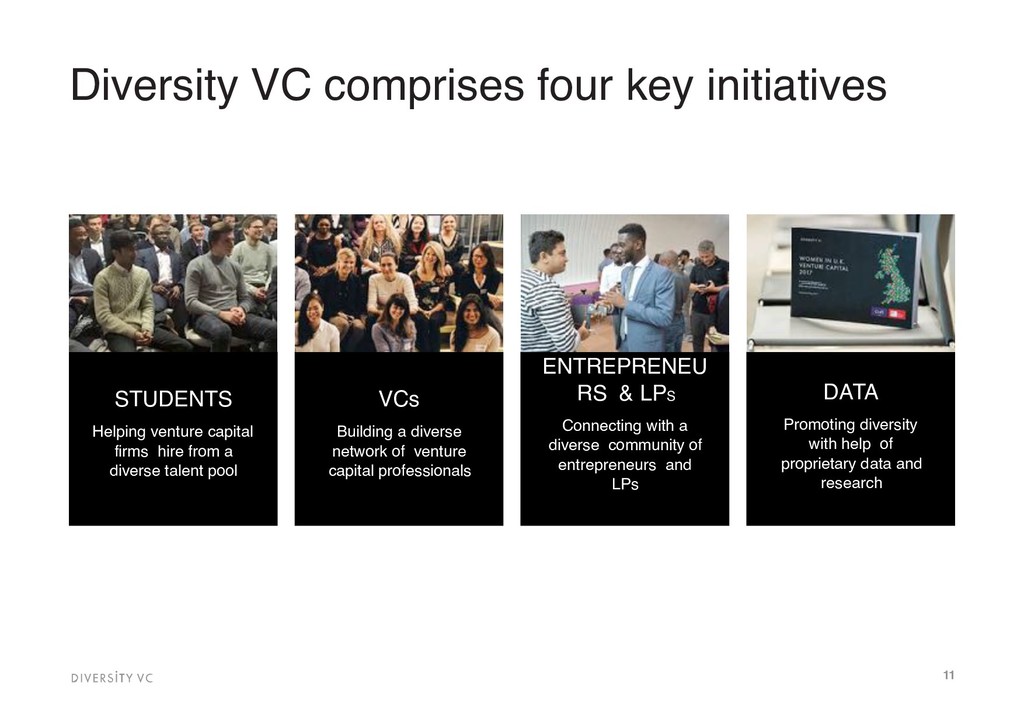
And so, I got together with a group of venture capitalists called Travis, Lillian, Farooq, and Anna, and we formed Diversity VC. And we're a nonprofit which is dedicated to promoting diversity and inclusion. We work in four ways. We help young people get into the industry.
We help VCs to think about the issues around diversity and inclusion. We help entrepreneurs access capital from diverse backgrounds. And then we collect and publish original data on the subject of diversity and inclusion. So, this year we've done a few things. We've created a VC training course where we had twenty two VC partners across Europe doing social justice training.
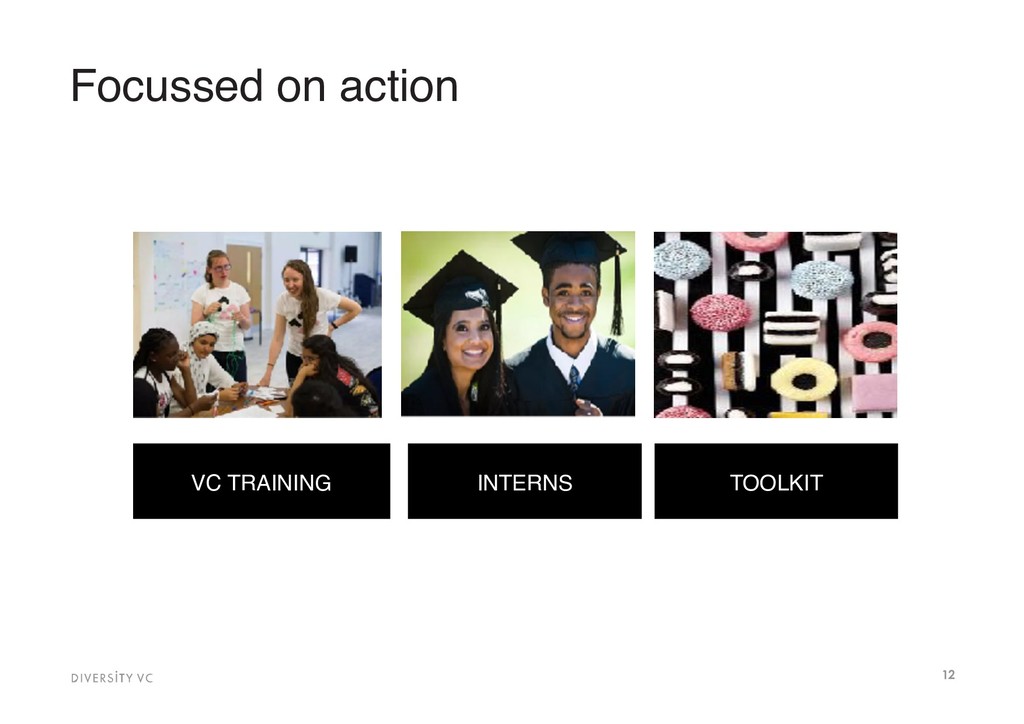
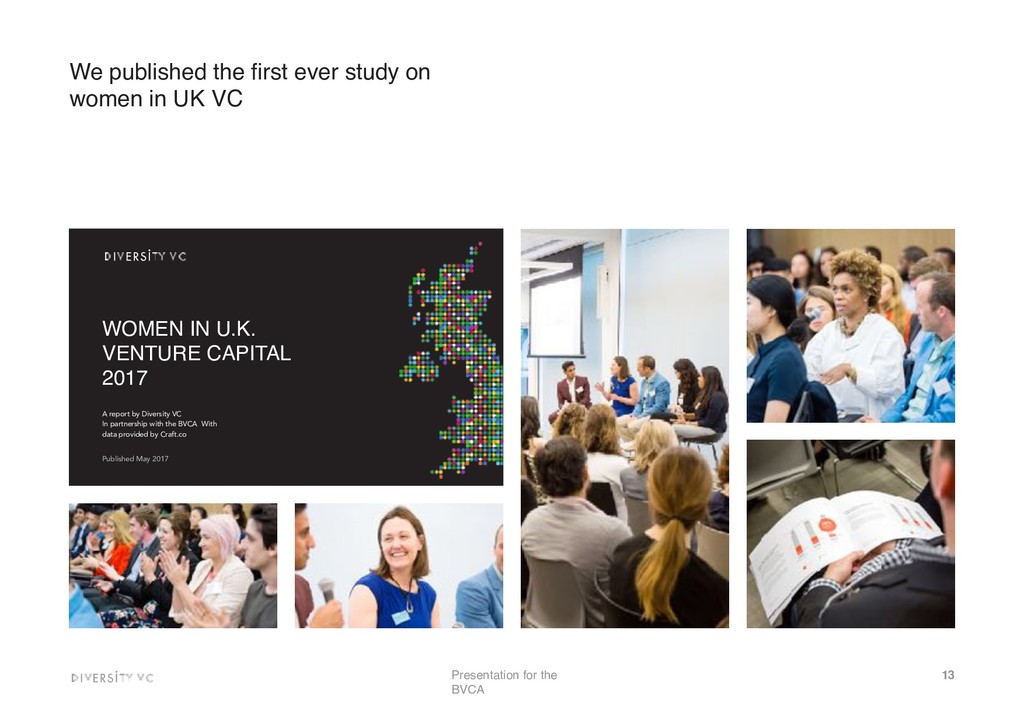
We have an internship program. We've got two people working full time in VC through that program. And we created a tool kit, practical tool kit for funds. And we also published the first ever study on the number of women in VC, which I'll come on to you later.
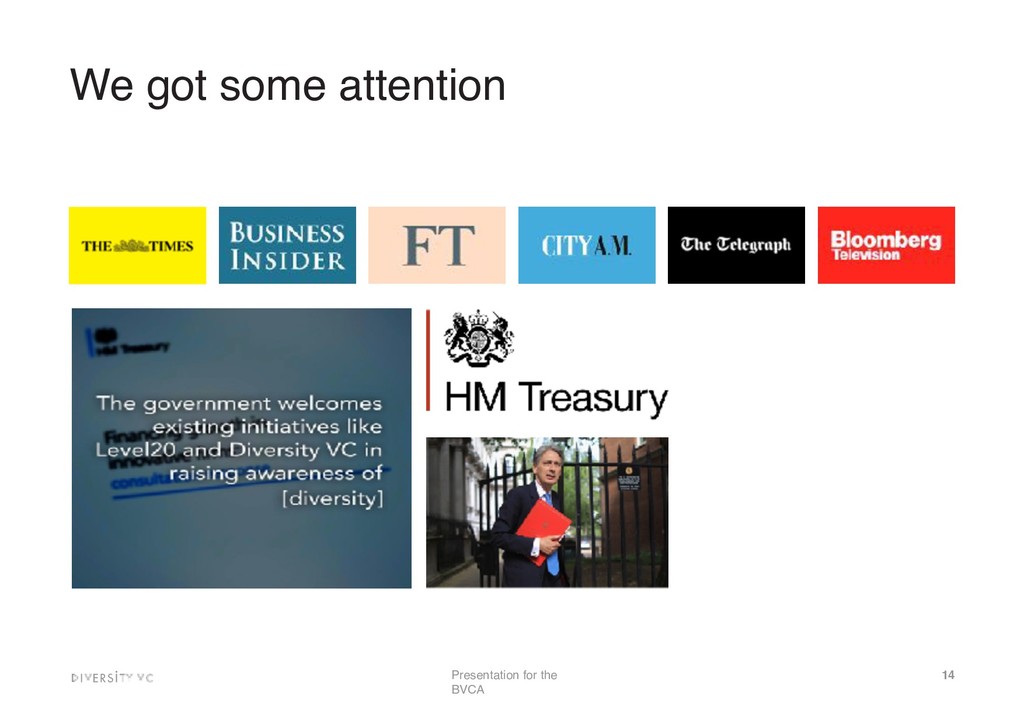
Which got us some attention, and we got mentioned by the chancellor Philip Hammond in the autumn budget last year, which was quite exciting. But let's get onto this topic of this word that often sort of prompts a sigh or an eye roll, this word diversity.
What does it actually mean for early stage companies? So, the way that we talk about it and think about it is, it's about many different things, types of things, or people being included in something, a range of different things or people. So, by this, we mean cognitive diversity, diversity of thought, which is about bringing in different perspectives, and all of those perspectives leading to better decision making.
But I like this quote by Vina Myers, which is, Diversity is being asked to a party. Inclusion is being asked to dance. And diversity is completely useless if you don't also have inclusion. So, the two things need to come together. You need to have diverse employees, but also to include those people, make those people feel like they can bring their whole selves to work.
So, let's talk about early stage tech companies. This image to me sums up kind of what I know of early stage tech companies, and maybe sort of familiar to some of you. It's really crazy. I'm married to an entrepreneur, and I know that there are a lot of fires to fight constantly, and there are so many different competing priorities.
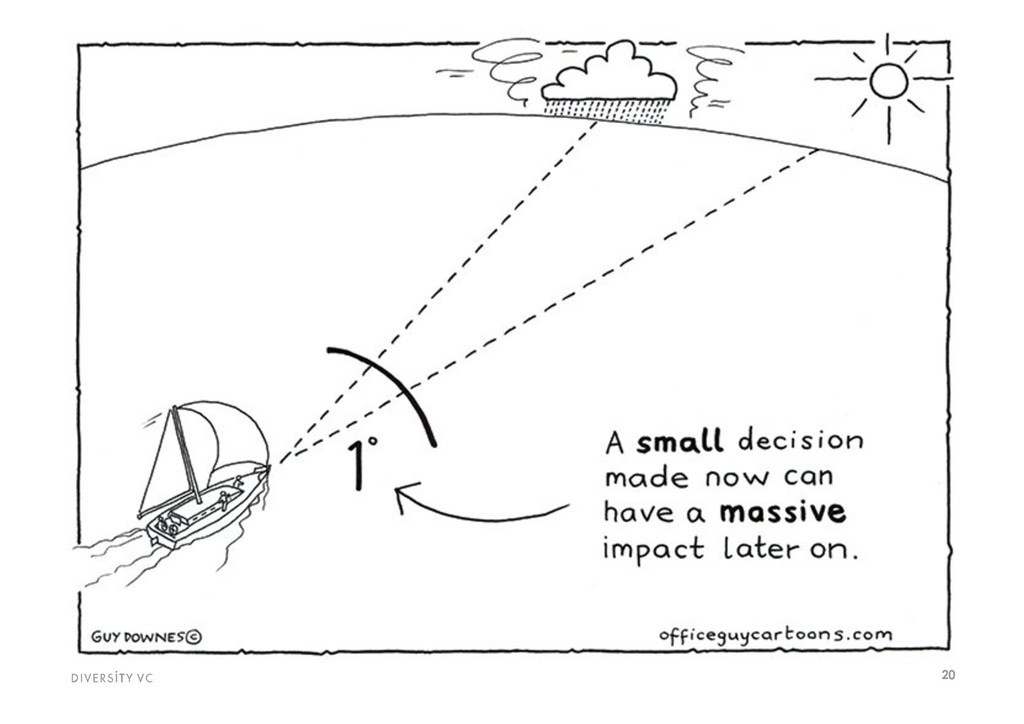
Your customers are leaving, your investors are pissed off about something, your metrics aren't working. Why should you prioritize diversity inclusion from day one? Well, I think this is a good chart because it shows that if you are just basically one degree off when you first start out at something, you can end up being a really far distance away from where you need to be.
So, this is the equivalent of sending a missile from the US, and it hits Tokyo rather than North Korea. So, it's really crucial that you lay the right foundations, even when you're a company of one or two people. Otherwise, you end up with this concept, which is diversity debt, which is quite similar to this idea, I'm sure you're familiar with, of technical debt, which is, if you don't lay those foundations correctly in the first place, then it's gonna take you so much longer to unravel all of that later on.
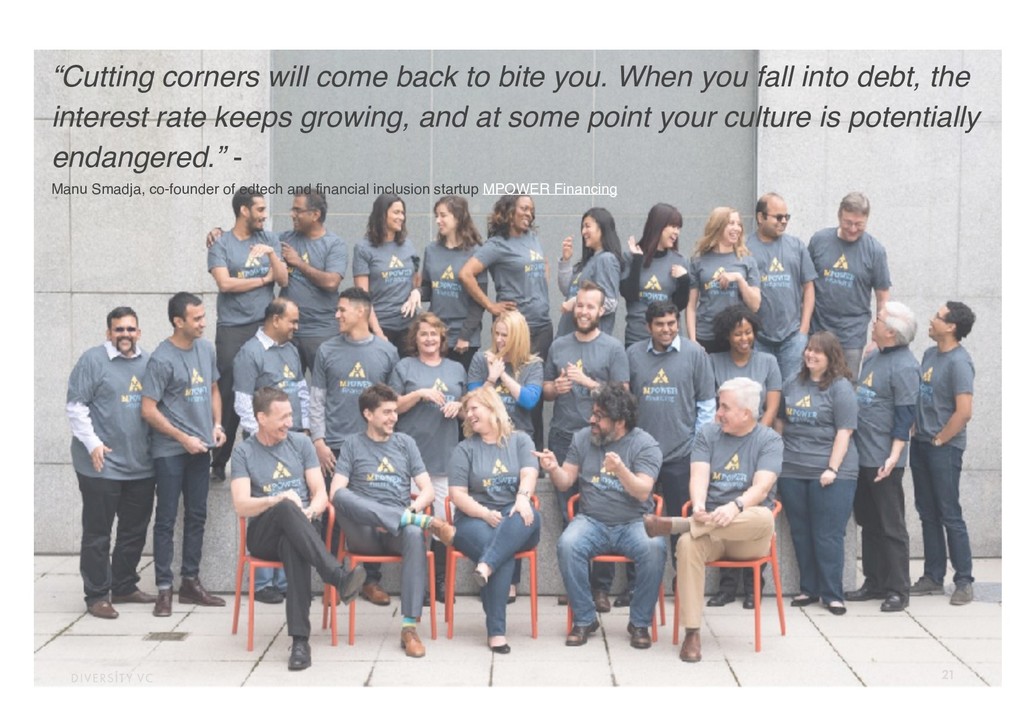
And this is a good concept. Think cutting corners will come back to bite you. When you fall into debt, your interest rate keeps growing. And at some point, your culture is gonna be endangered. And this is so important because we're in an industry which is creating the biggest companies of the next ten years.
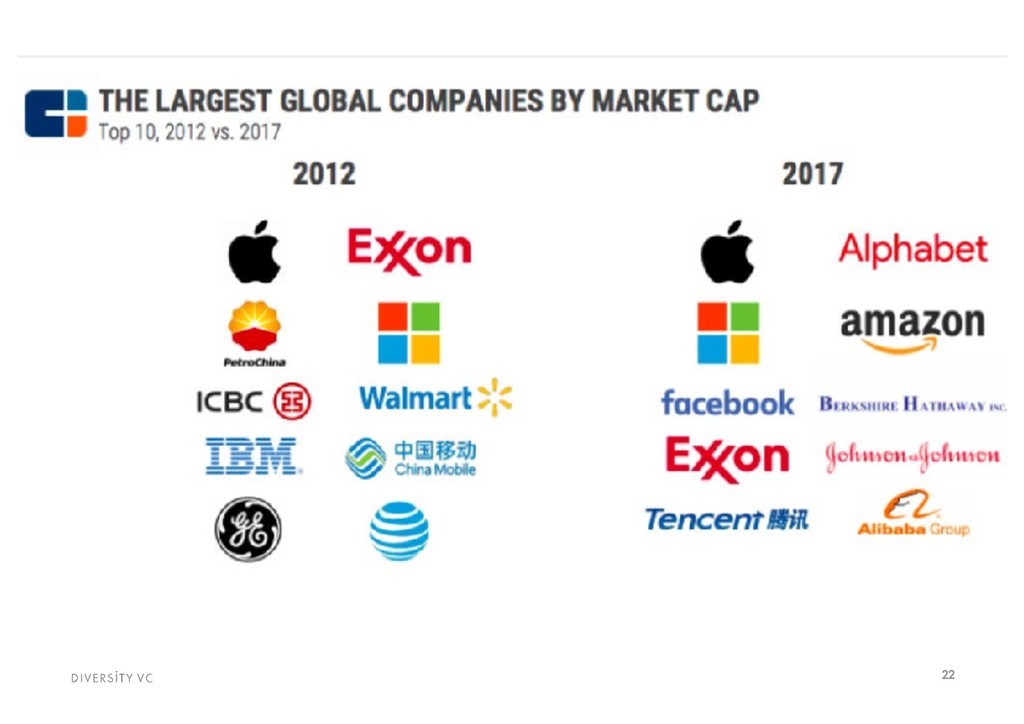
This chart comes from CB Insights shows that just two of the companies in twenty twelve, biggest companies in the world by market cap were tech companies. Whereas last year, seven out of ten of the biggest companies in the world were tech companies. So, these are gonna be the biggest employers of the future.
People in this room might be building the companies of the future that are gonna employ hundreds of thousands of people. And I, for one, want the children of this generation to be included in all of those companies. So, in fact, actually, it's worth mentioning that one of these companies on the right hand side here actually emailed me in the last couple of months saying, please, can you help us?
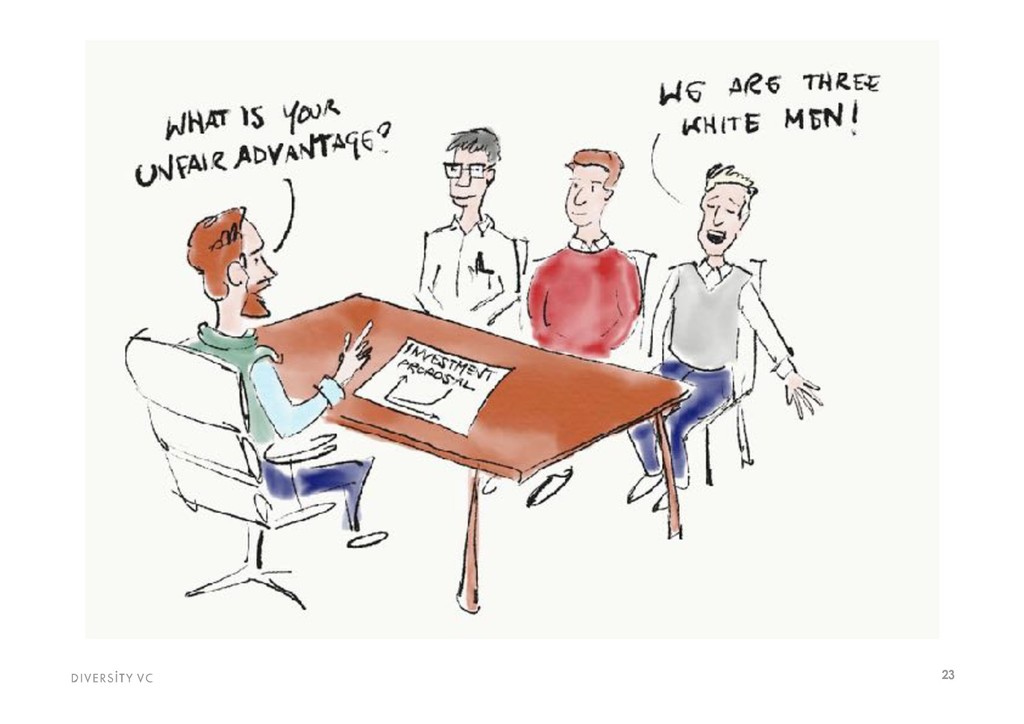
We're trying to find more diverse engineering teams. So, it's not just startups that struggle with this problem. Some of the biggest companies in the world have it too. And then, coming on to startups. I mean, this cartoon I saw on Twitter the other day, and actually was written by a friend of mine, And it really shows a venture capitalist on one side of the table saying, what's your unfair advantage?
And the team on the other side saying, we are three white men. And that is the truth. I mean, that is what I see on a daily basis, and I've had a few conversations while I've been at Turing Fest with a few people who said a very similar thing.
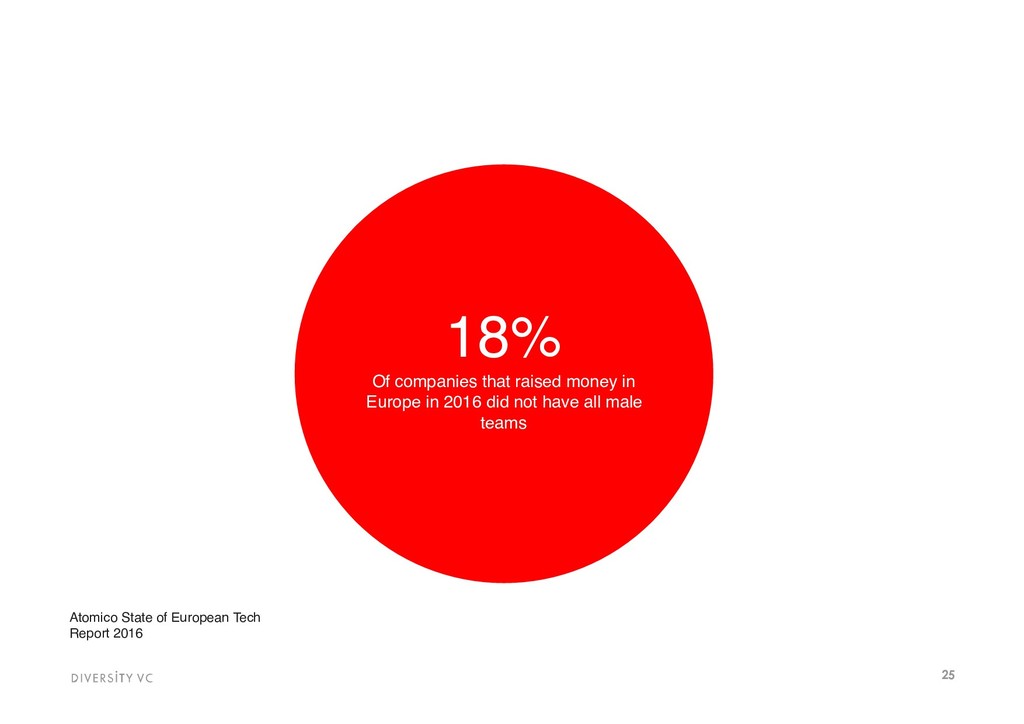
So, it's really not a good situation in startups at the moment. And just to come on to what the numbers actually look like briefly. We had eighty six percent of companies that raised, eighty two percent of companies that raised money in Europe last year were all male founding teams.
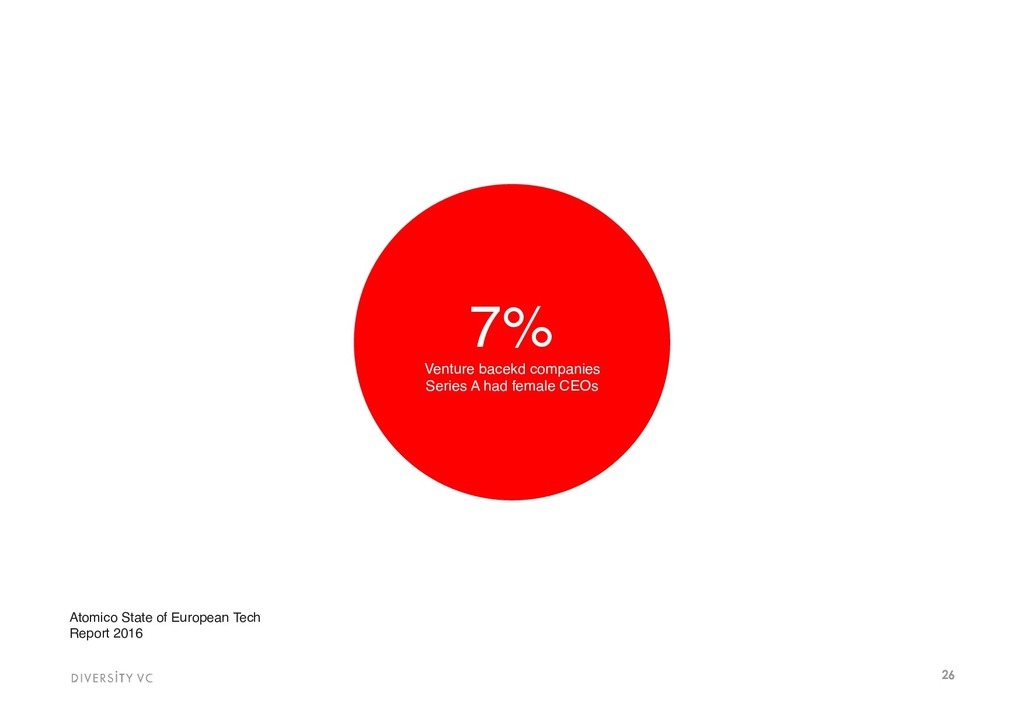
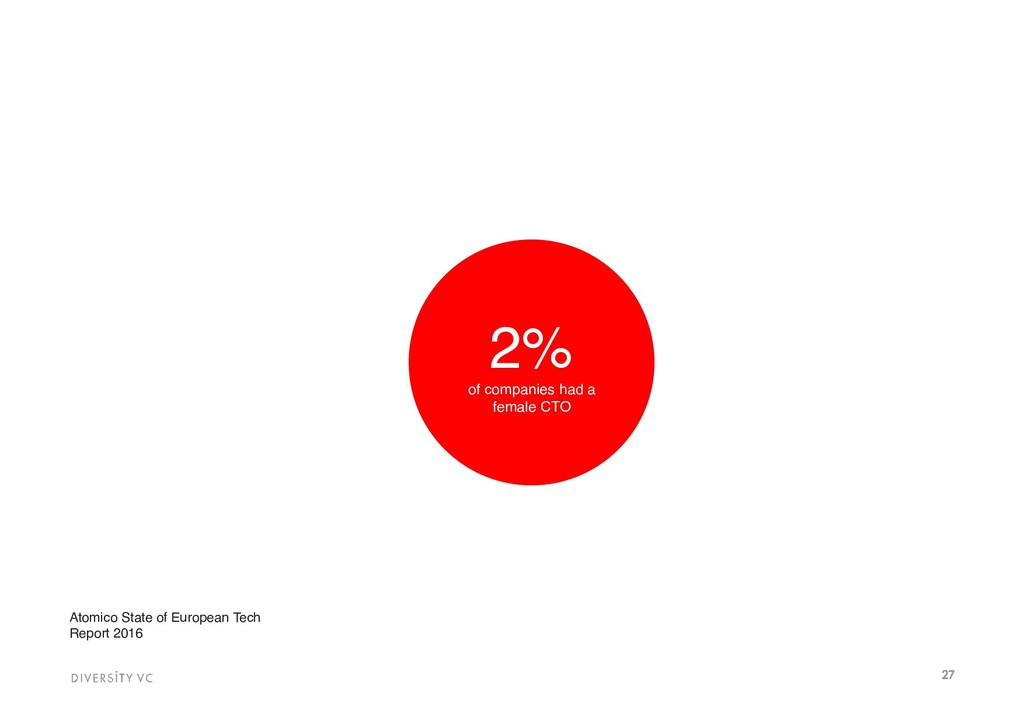
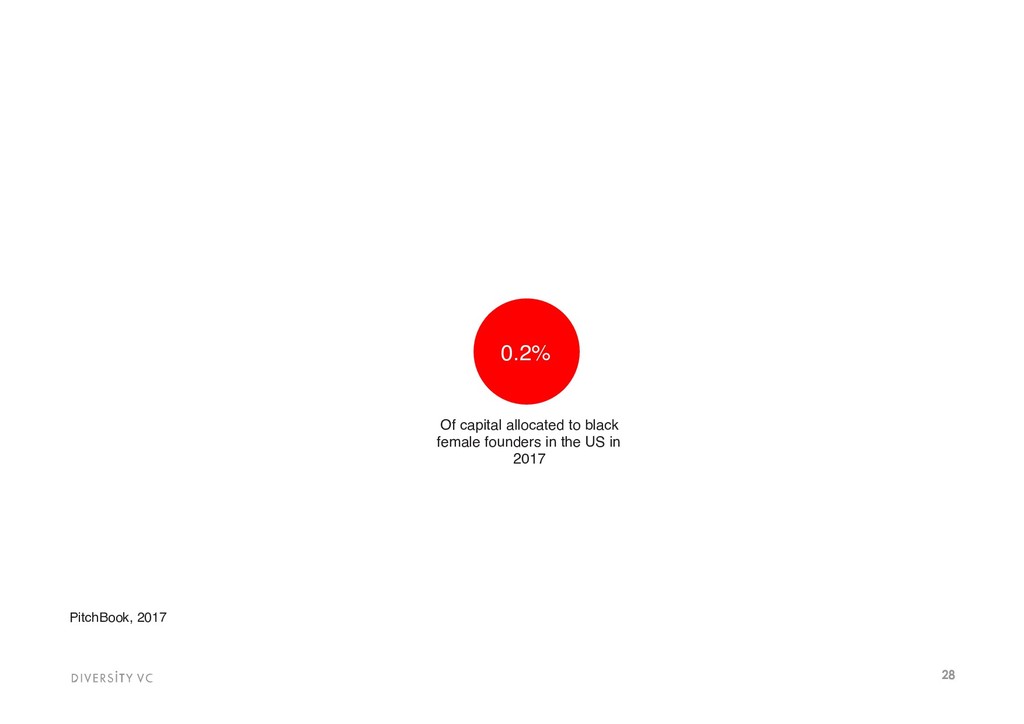
So, really, really homogenous there. And just two percent of CEOs of, sorry, seven percent of CEOs of companies are female, and just two percent of CTOs of companies are female. And just zero point two percent of funding last year went to founders of color.
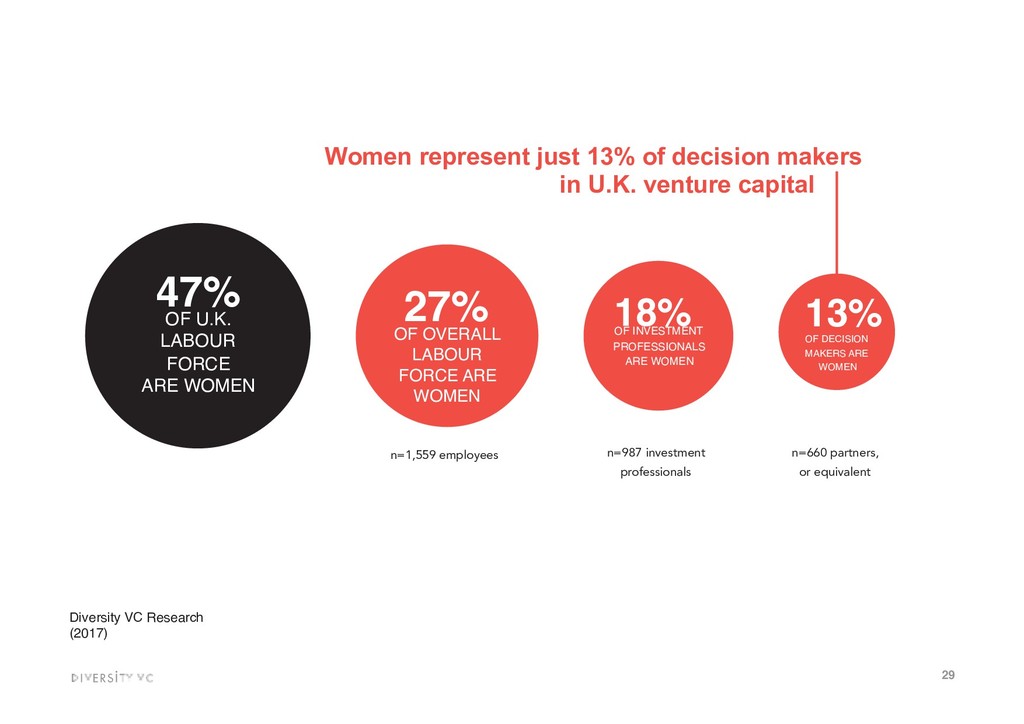
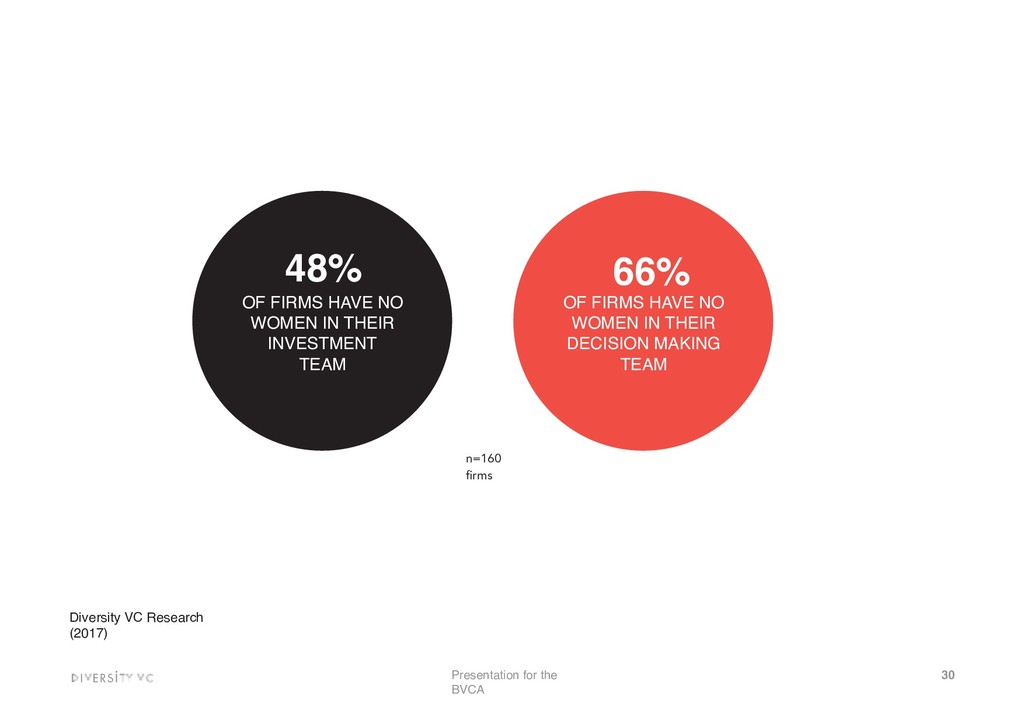
So, we did some looking at the data in the venture capital industry, and we're not that much better. So, just thirteen percent of decision makers in venture capital are women. And I think most shockingly for me, two thirds of funds have no senior women in their investment teams.
So, this is talking about one issue in diversity, and of course, we look at an intersectional issue. So, we don't just focus on gender. And in fact, we're doing this study again this year. We're looking at industry background, and socioeconomic background, and schooling.
And I don't know if anyone saw this week that there was some data that came out from the US, which was saying that forty percent of venture capitalists in the US went to either Harvard or Stanford. It's just absolutely mad. But why does it matter in small companies?
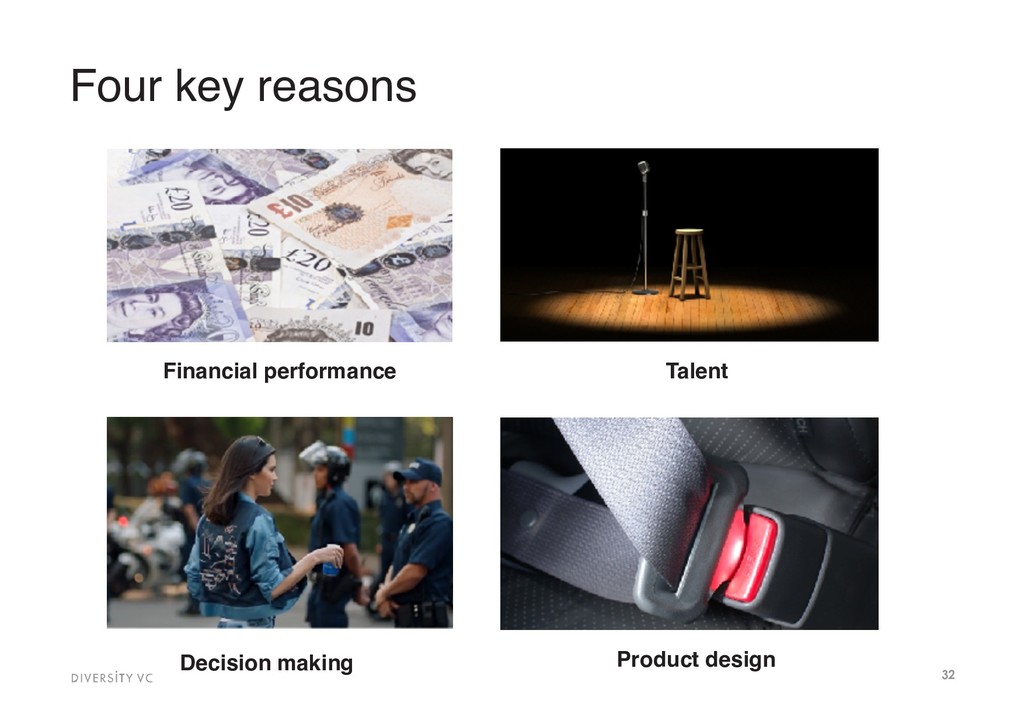
And these are four things I'm gonna try and kind of arm you with, so you can have the conversations with your senior management team, with your investors of saying, this is why we're prioritizing this. So, it's four things. One is financial performance, pure and simple.
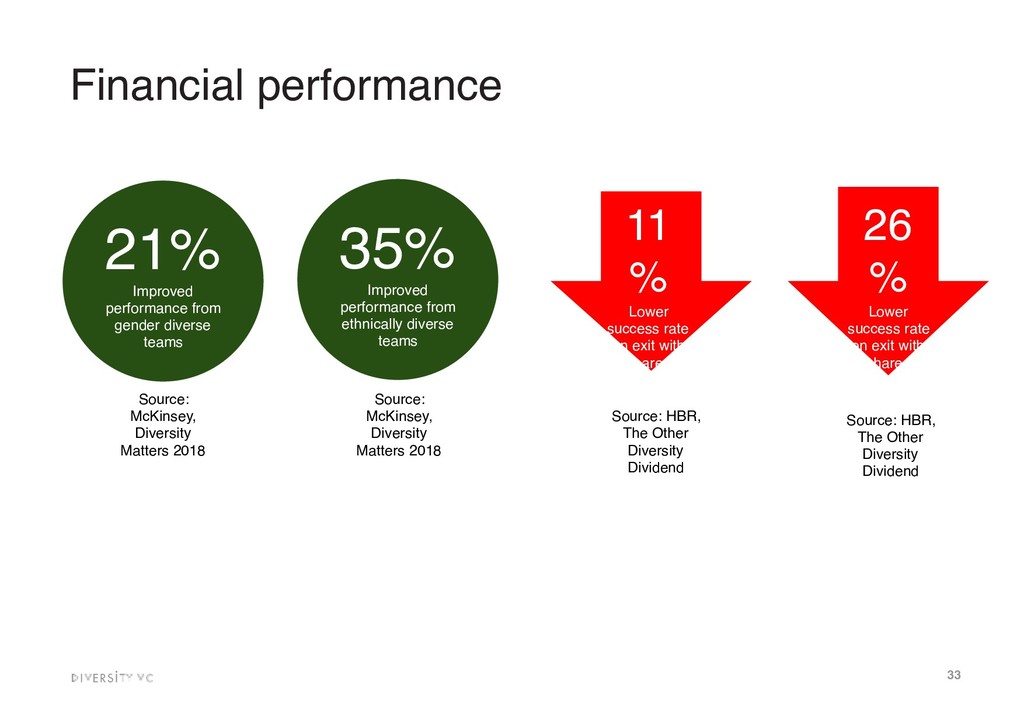
The second is talent, which is so important for early stage companies. The third is decision making. And the fourth is product design. So, first of all, financial performance. So, if you don't know these numbers, I'd encourage you to kind of memorize certainly the ones in green, which is the McKinsey Matters study, which came out again this year, which showed that gender diverse teams performed twenty one percent better, and ethnically diverse teams performed thirty five percent better than their homogenous counterparts.
So, that's really powerful numbers. But more recently, there's been a study from Harvard called the Other Diversity Dividend, which actually linked the exit performance on venture capital exits to diverse teams. So, this is even more directly relevant. So, it showed that groups of venture capitalists that have the same educational background, actually the exits that they got from their companies were eleven percent lower in value.
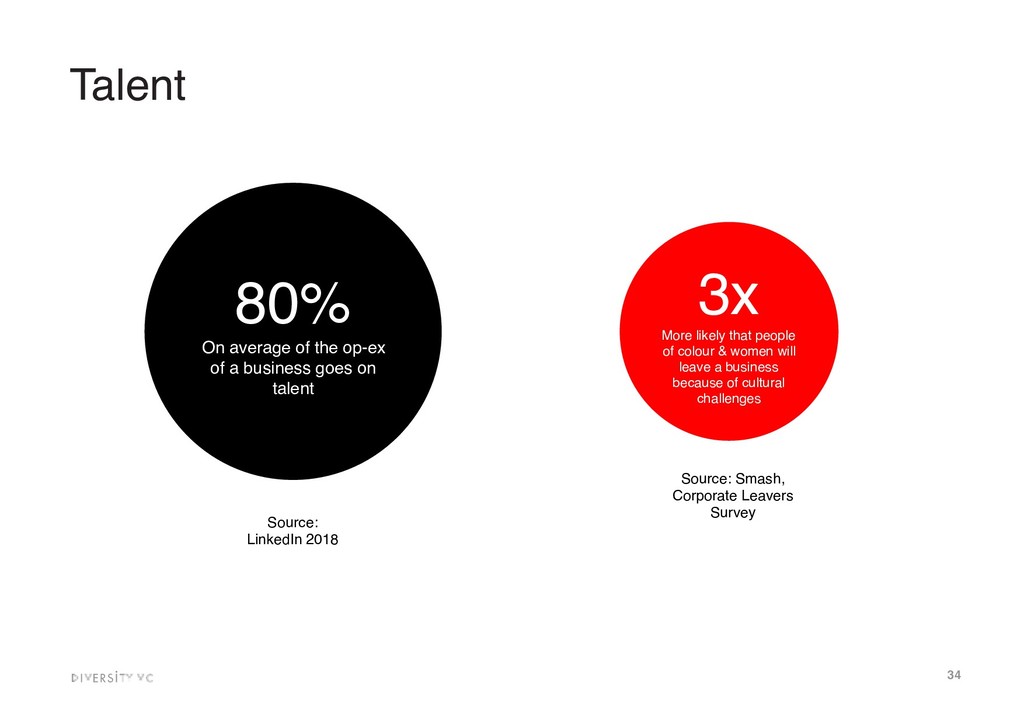
And with ethnically shared backgrounds, the exit value were twenty six percent lower. So, this is really heavily impacting your bottom line. Secondly, talent. And this is, as you all know, such a big part of your businesses. In fact, there was a study from LinkedIn that said that eighty percent of a company's operational expenditure went on talent.
So, this this is a massive amount of your budget. And people who are struggling with cultural issues, women and people of color, are three times more likely to leave your business. So, getting this right means you're saving so much money on retention, and on hiring in the future.
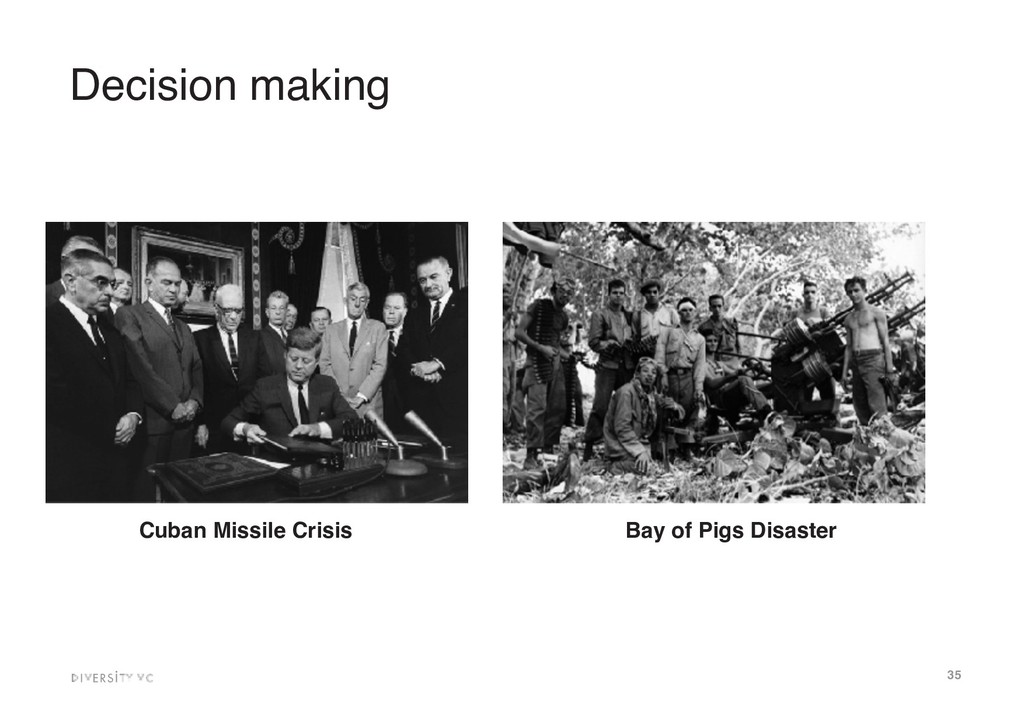
Thirdly, decision making. So, these are two pictures of two of the worst military crises in US military history. The Bay of Pigs disaster, and the Cuban Missile Crisis. John F. Kennedy describes these two disasters as things that made him feel sick. They were an abject failure.
They were described by one historian as that rare thing, a perfect failure. So, not good, basically. Not what you want in your early stage company when you're making decisions all the time. And a historian, an academic from Stanford argued that the reason why these two things went so wrong were because the groups making a decision about what to do were completely homogenous, and he called it groupthink.
And that can be really problematic, and then you compound that over all the decisions that are made in an early stage company all the time, it just gets worse and worse and worse. And then, what are startups and companies for? They're about building products.
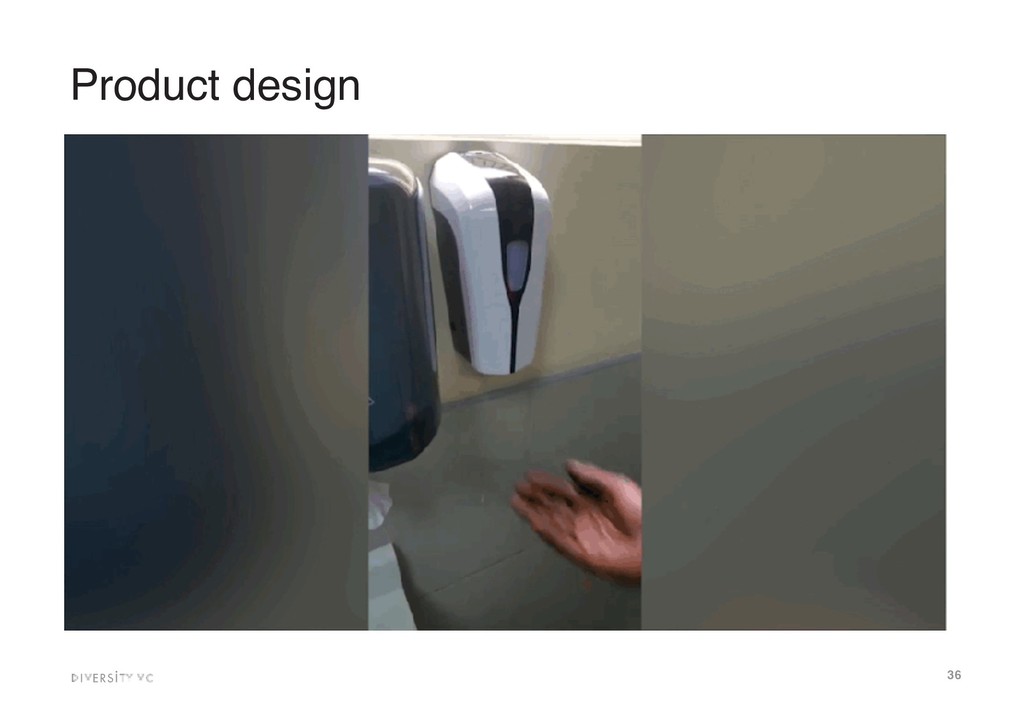
Product design is completely flawed if you don't have the right people around the table who reflect your customer base, reflect the people that live in the world around us. I'm sure some of you have seen this video, or this GIF of somebody trying to use a soap dispenser, which was designed for the hand of somebody who had white skin, and it doesn't work with other people.
So, this person is not able to get the soap out of the soap dispenser. That's just one example, but it can be much more dangerous than that actually. So, the seat belt was created with a dummy, which was a fiftieth percentile man in mind.
And that meant that even now today, women are forty seven percent more likely to have more dangerous car accidents than their male counterparts. So, it's really important to incorporate all that thinking and all those diverse use cases into that product design from day one.
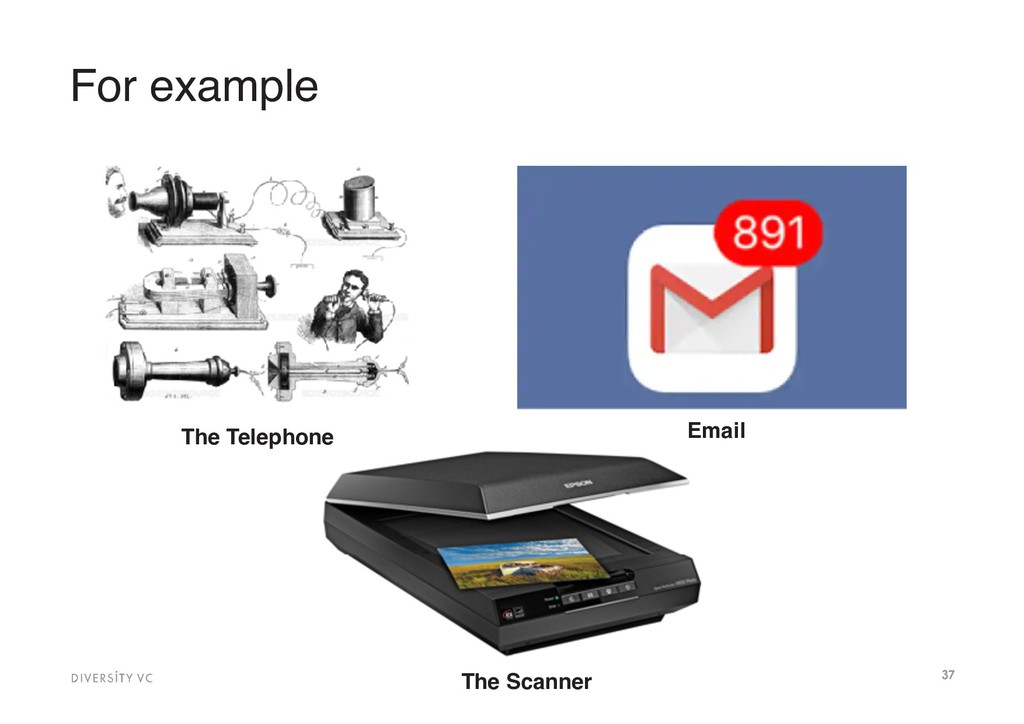
And then even more, it's actually useful for creating more interesting and more innovative products to think about that niche use case. So, these are three products that were all created for a diverse audience. The first one is the telephone that was created for disabled people to allow them to communicate with one another.
The second one is email, which was created, the inventor of email actually created it to communicate with his wife, who was deaf. And finally, the scanner was created because it was looking at people who were blind, and trying to help them. So, it's not only something which is a kind of downside risk mitigation tactic, but also something that could lead you to really exciting, innovative areas of product creation.
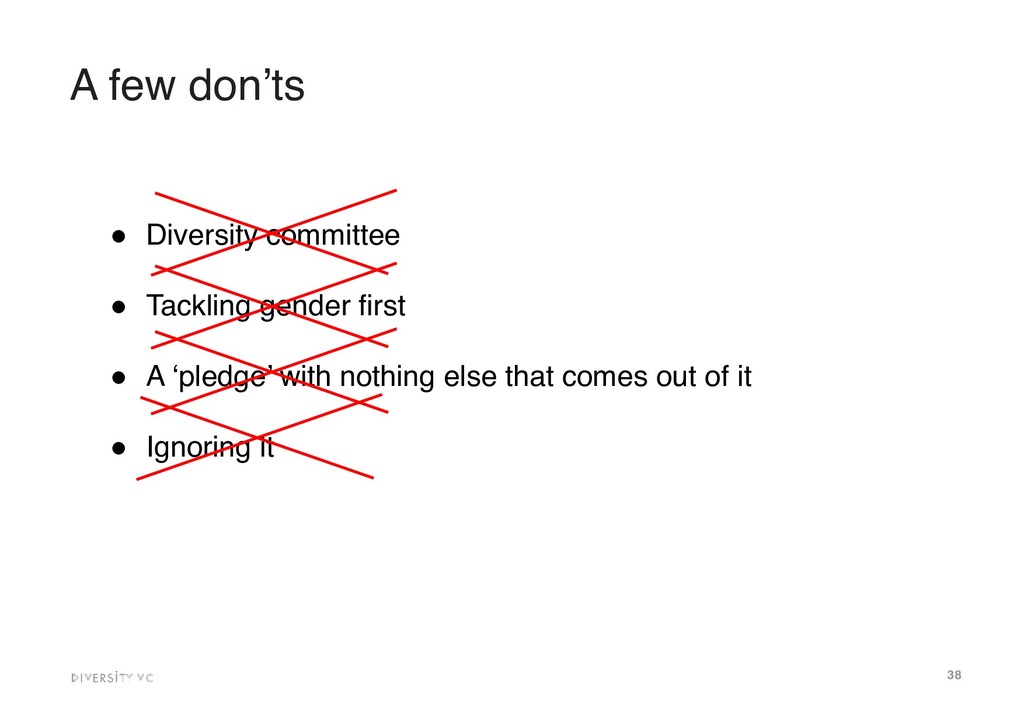
So, let's get onto the practical stuff. What can you and should you do? Well, I've put initially a few don'ts up here, and I'll caveat this by saying that I'm still on a real journey of learning what are the good and bad things to do here?
So, I think the first thing is forming a diversity committee, which just includes the people who in your company are diverse, is probably not a great way to start. It just makes people feel like the problem is all kind of with them, and they need to solve it, and it doesn't actually come across to the rest of the organization.
The second thing is tackling kind of a single issue first, because it makes other people who maybe don't have that challenge feel like, well, when are they gonna get to me? How come I'm kind of fourth or fifth order down to the priorities?
And a lot of the things that affect one different kind of diversity affects all of them as well. Thirdly, signing some sort of pledge can seem really tempting. It can seem like, yeah, it's great. We know we're committed to something, but often they don't really come with anything behind them, action, anything tangible.
So, making sure that if you do do something like that, it's linked to something that's really tangible and really actual. And then finally, ignoring it. Again, this is something which could potentially be quite tempting, because it is a really difficult, big issue, but I'd encourage you not to ignore it, to embrace it early on.
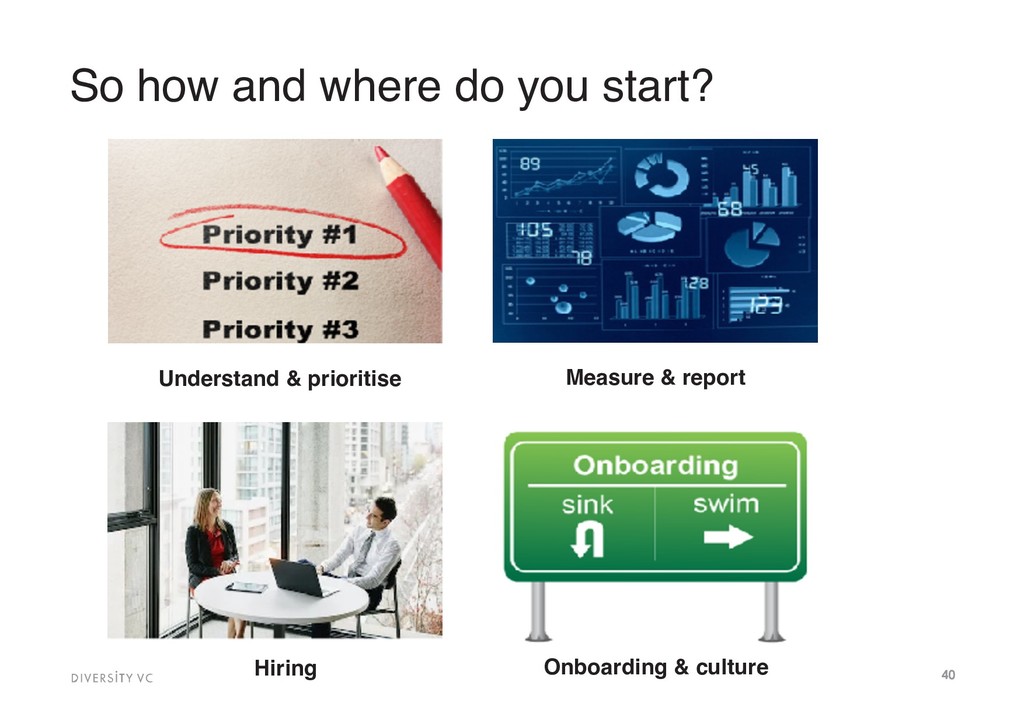
So, how? So, I'm gonna talk about four things. And each one of the things that I mention here, I'm going to highlight a supplier that I've worked with, that we've worked with, that we think are kind of good people to help you on this journey.
And most of them are startups, as you can imagine, because I love startups, and why not promote them? So, the first thing is understanding and prioritizing. And that means deeply understanding these issues and the drivers. The second thing is measuring and reporting. The third is how you hire.
And the fourth is onboarding and culture. So, understanding and making something important. So, diversity and inclusion, as we've talked about, a multi layered issue. It's not something that can be read in a blog post, and instantly understood, and then just kind of dealt with and moved on.
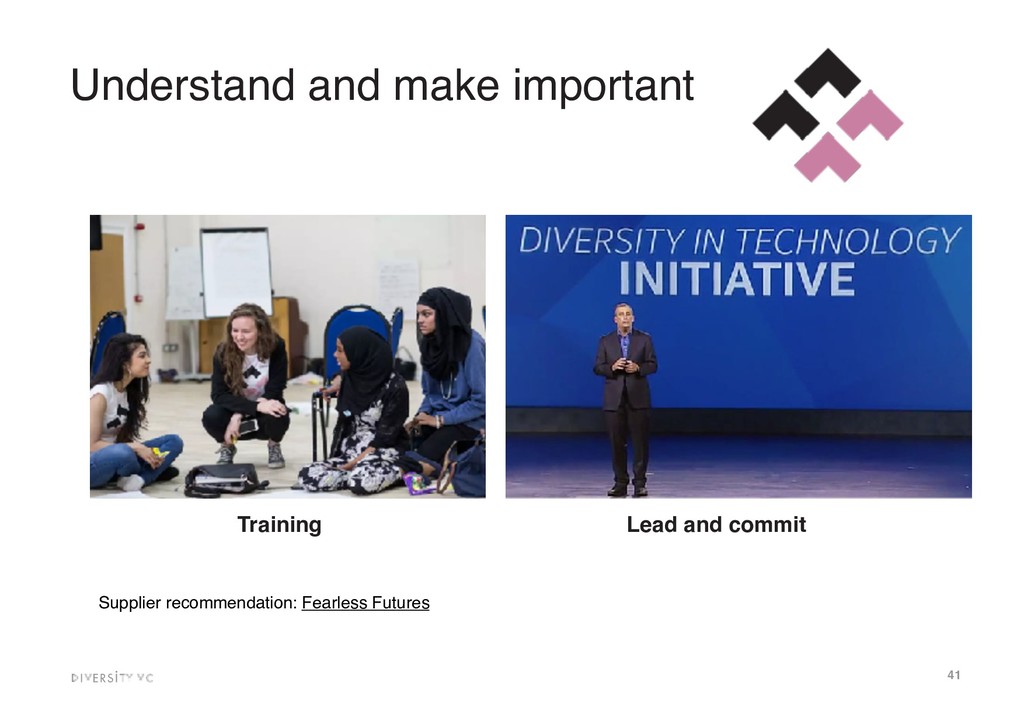
So, I'd encourage you to think about executive training in your company. And one supplier that we've worked with is called Fearless Futures, and they look at social justice, and they look at all the underlying causes of a lack of diversity and inclusion. They're a brilliant company, very happy to introduce you to them if you want to meet them, and they do something called the Design for Inclusion program, and that means that if you go through that program, anything you then subsequently create is going to have best
practice thinking kind of running through it. Because what you don't wanna do is design something which actually makes the problem worse. So, once you've done the training, tick, then it's about, as a leader, standing up and talking about why it's so important to do this.
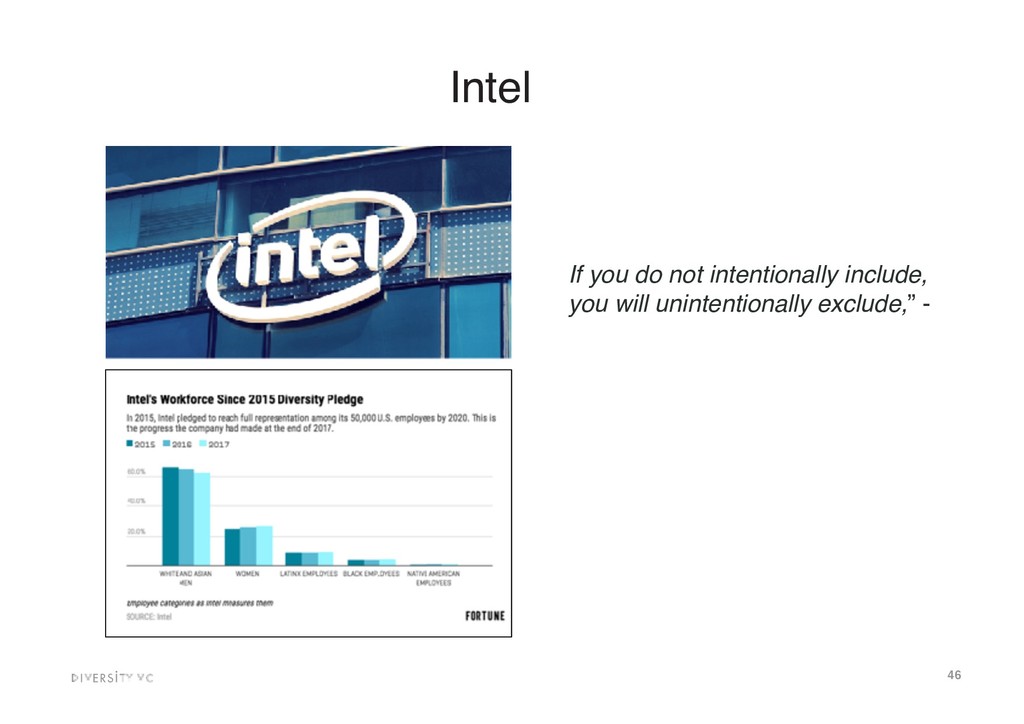
And this is a picture of the CEO of Intel that stood up at CES in twenty fifteen, and talked about their diversity in technology initiative. And he actually pledged three hundred million dollars to this initiative, and he also made a target on it.
He said that we want to have representation throughout all levels of the organization by twenty twenty. So, I think that's a really great example of actually committing serious funding and resources to something, and standing up and talking about it, and then having a target.
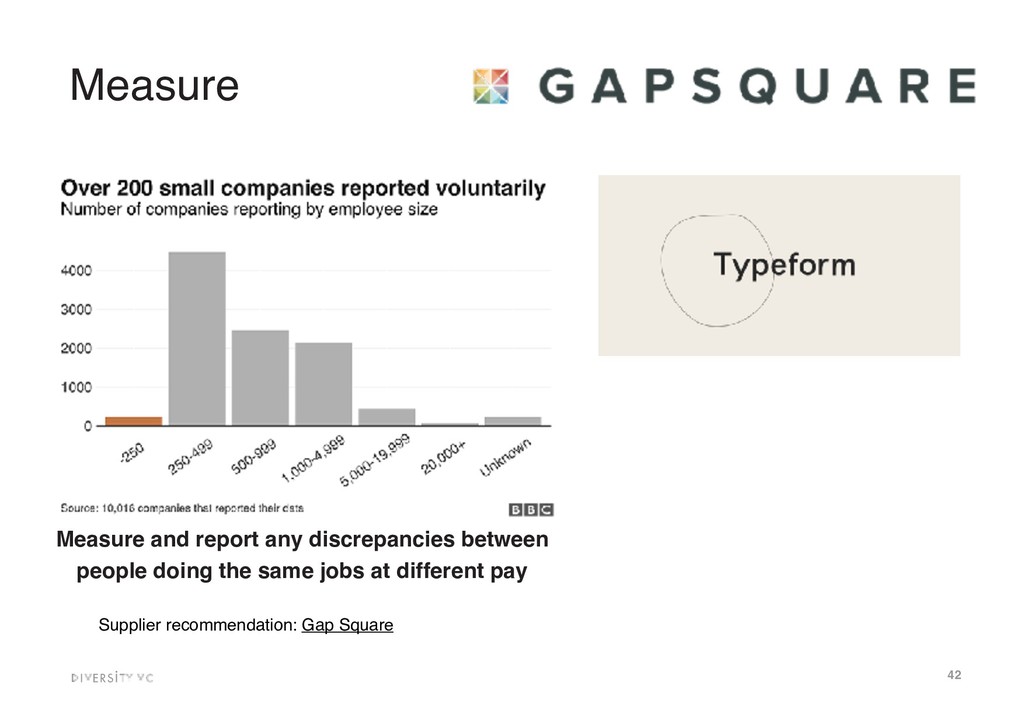
So, I would definitely do that in your company. The second thing is measurement. So, this could be as simple as actually asking people questions in your company about whether they feel that they can bring their whole selves to work. Whether they feel that their voice is heard properly.
Whether they have any challenges in the office, or being in the environment that you're perhaps not aware of. Just as simple as designing an anonymous survey. Typeform, I think we heard from them yesterday, which is great, and I'm sure you're all aware of it, but it's a super simple surveying tool that you can use to do that.
And then the second aspect is looking at pay gaps, and we've had a lot of conversation again this year about the gender pay gap in particular, but obviously that's only affected two fifty person companies plus. But over two hundred companies who are fewer people than that have actually reported their gender pay gaps.
And you can calculate your pay gap using a piece of software. The one that we work with is called Gap Square, and they're a Bristol based company, and again, very happy to introduce you if you want to look into that. But that's again something that as a company and as a leadership team, it'd be great to arm yourself with that understanding of what your organization looks like from a pay gap perspective.
Then hiring. I think this is probably the number one thing that I talk about and get asked about by most of the companies that I talk to. So, I think one of the fundamental issues, which I was discussing with a couple of entrepreneurs yesterday, is this question of what are requirements that we absolutely need when we're hiring?
And what are things that are nice to have? And actually, what are the fundamental attributes that we're looking for in people? I think one of the biggest barriers to hiring a diverse team is putting in place too many barriers about what are requirements for people before you're even able to get them in the door for an interview.
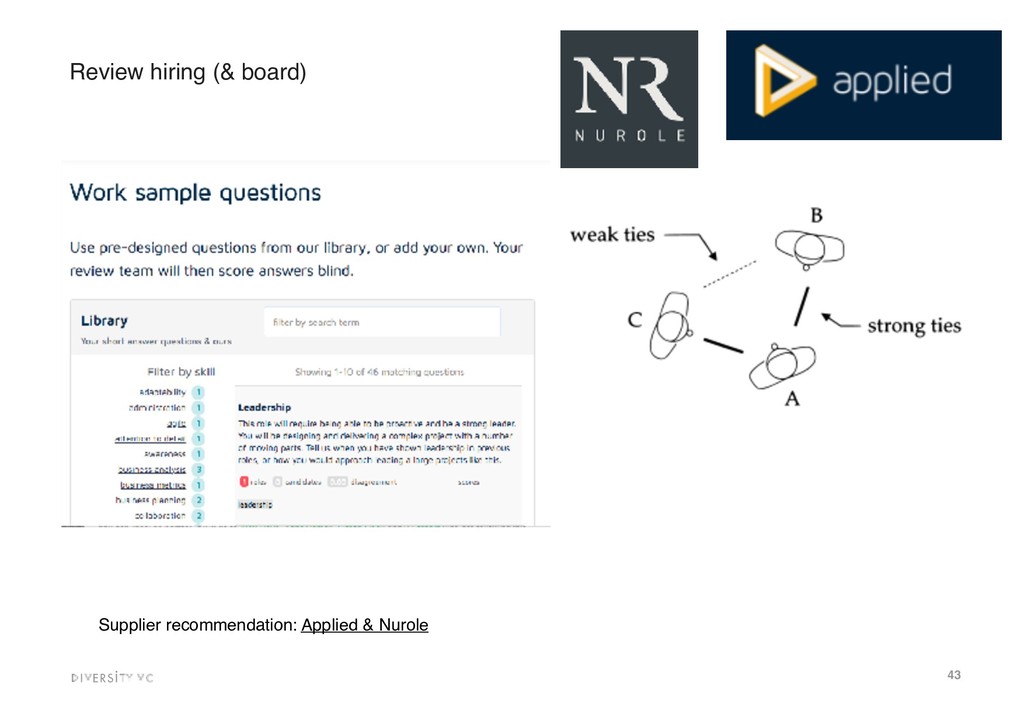
So, one way you could think about this is by using a tool called Applied, which is, again, a piece of software. It came out of the Behavior Insights Unit of the government. So, it incorporates a lot of good thinking about how to encourage behavior and understanding, how to understand how people use products.
So, it uses competency based interview questions, and it pulls all of those things out, and it takes away your kind of CV requirements, or CV screening, and it takes away looking at, oh, we need X and Y before we will actually interview someone.
And I recently had a conversation with a group who were a rail company, an engineering rail company, as an example of this. And they had a engineering set of roles, and one of their requirements was you had to have rail engineering experience. And they had two percent of the applicants were from women.
Because they just had that requirement. And actually, when they thought about it, they thought, you know what, we don't need that. We can train people on that. If they've managed, it was a project management kind of task, and if they've managed projects before, we can teach them the rail stuff afterwards.
And so, they took that requirement away, and suddenly their applications from women shot up. So, Applied is a great tool. The other thing I just wanted to touch on was board recruitment, because I'm sure a lot of you will have early stage boards, and that is a real problem, again, from a diversity perspective.
We don't really have very diverse boards, and NewRole is a software company, which also helps you with board recruitment, and specializes in looking for more diverse candidates. And then finally, looking at culture, and particularly looking at this moment when you're hiring, which is the onboarding process.
When you have made that hire, bringing someone to your company is a great time to understand whether they feel included, whether they feel that the sort of social events that you run, that perhaps have alcohol, or like a football tournament, or things like that, are things that include them, or whether they feel that there's anything that they could suggest or change, which would make them feel more included in the company.
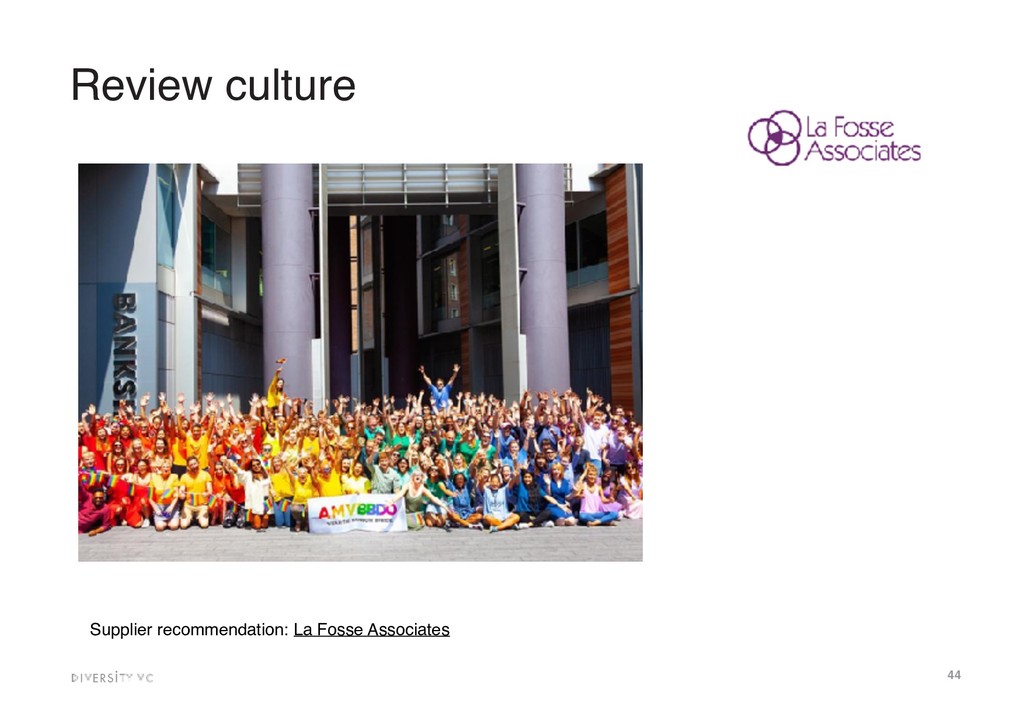
So, this picture's actually from my old advertising agency, and they did a big kind of picture for Pride last month, so I thought it was quite a nice example of nice culture. But I've mentioned here Lafoss Associates, which is a recruitment company. They're based in London, but we've done a bit of work with them on that onboarding process, and how to make that as inclusive as possible.
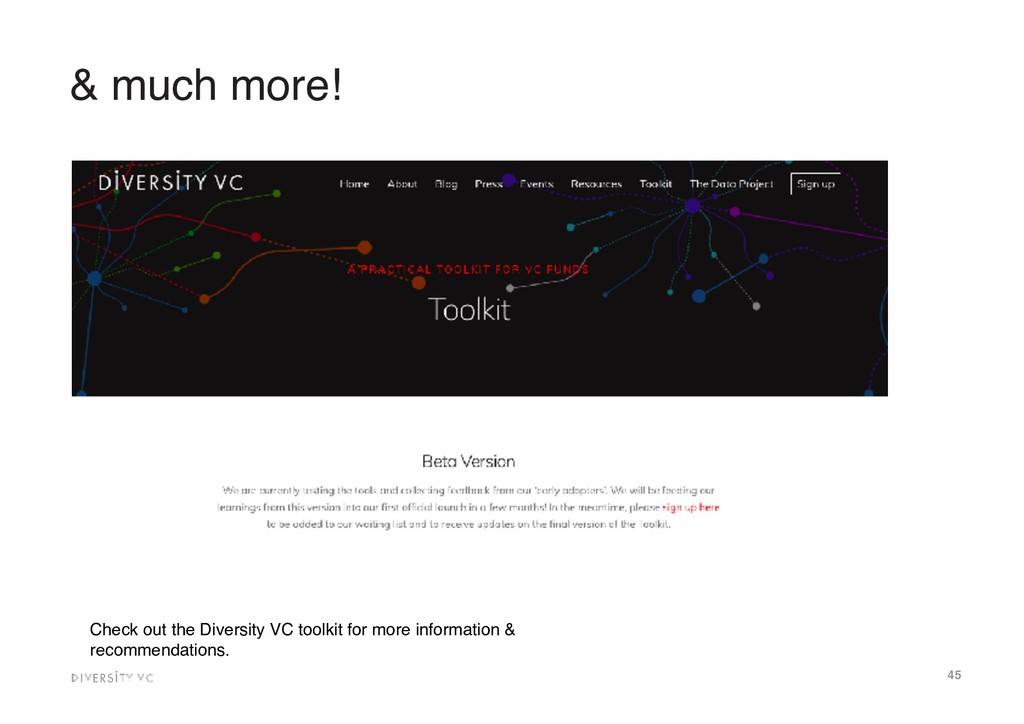
So, that's just four things. There's so many more that I could talk about. I would encourage you, if you are interested and you want to find out more, go to our website. That's where our toolkit is. It has a bunch more recommendations for software tools, and sort of tactical things that you can incorporate.
It's tailored to VCs, but a lot of the stuff is relevant to startups as well. So, I just wanted to finish on sort of two examples. I mentioned Intel earlier. I think it's a really interesting case study, if you wanted to sort of look it up in more detail.
They linked manager bonuses to these diversity metrics. They actually linked seven percent of manager bonuses to actually achieving this parity in pipelines. And the head of HR and people there said, if you do not intentionally include, you will unintentionally exclude. And I think that's a really powerful quote.
And then finally, one of the things that we, one of the people that we talked about in our process of creating our toolkit was the head of business operations at a startup called Habito. And this is just a very tactical example of what you can do.
And the head of business operations said that she added her email signature. The accessible entrance to the building is next to the cafe. If you need any additional information, please let me know. And immediately, just by writing that in the email signature, she ensured that anyone who had accessibility requirements was going to be able to come to the interview.
And just think for a second, do you think anyone with any kind of accessibility requirements could even get into your office today? They may not be able to. And what this also did was it wasn't just about the people who had accessibility requirements.
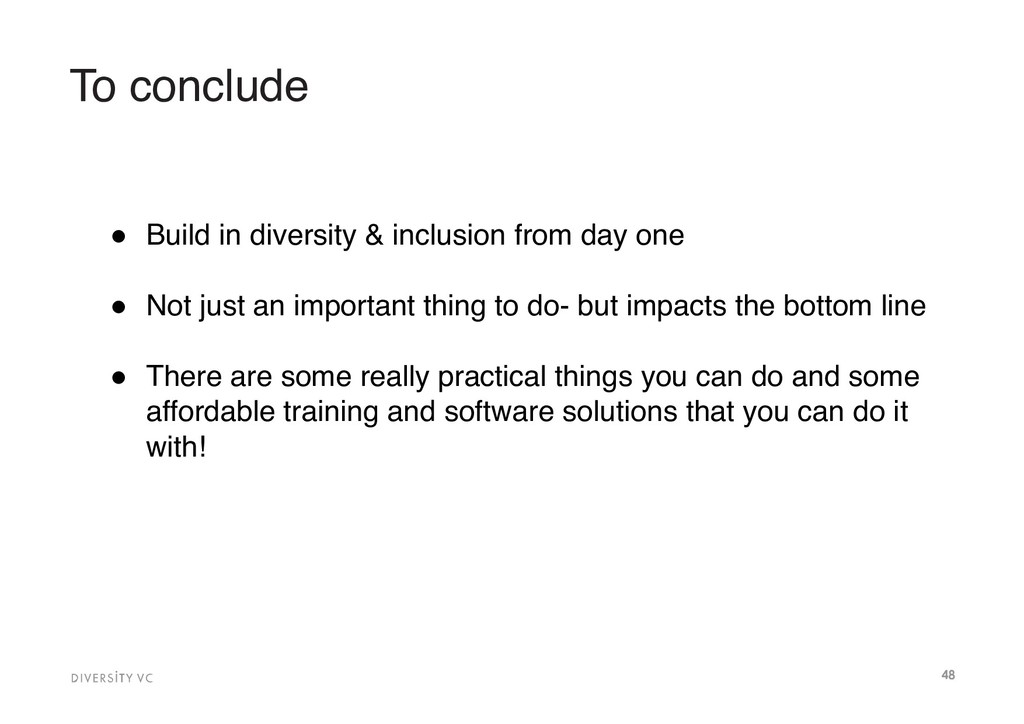
It was about everyone who read that and thought, you know what? I will be included. My needs will be catered for if I come and work at this company. So, I think that's really powerful. So, that is it. Unfortunately, I've run out of time, but I just wanted to kind of recap, build in diversity and inclusion from day one.
There are tactical and much bigger strategic things that you can do. It's really impactful to the bottom line. It really affects your company's performance. And yeah, hopefully, you can start looking into some of those tools and resources, and I wish you the very best of luck with trying to create more inclusive organizations.
Thank you very much for having me. Thank you so much. That was really interesting, thank you. We have three minutes, so do you mind if I just ask you a quick question? Yeah, of course. Something that kind of like personally stood out for me.
So in my business, I try and think about diversity quite a lot, but the distinction between diversity and inclusivity is one that I'd never even really thought of or it occurred to me. Do you have any tips on how people can kind of consciously think about inclusivity as well as diversity?
So if they get to the point where they have a relatively diverse team to ensure that they're creating as an inclusive environment as possible. Yeah, absolutely. I think the two things, you have to look at them together, and again, something that I've learned in the last couple of years as well.
I think it can be lots of things down to flexible working. It can be about understanding people's circumstances around childcare. And really, it's back to what I said earlier around surveying people and really speaking to people and helping understand what their needs and requirements are.
I think another thing is allowing people to report and self report when something doesn't feel right. Another kind of question I'd ask yourselves is, can everyone in your business ask someone a question, is this normal? Or what can I do about this? And that's quite a good way of thinking through, is there a kind of outlet for some of these concerns, complaints, and do people feel like they could do something to change something if they didn't feel included?
Amazing, thank you so much. Can we have a huge round of applause? Thank you. Thanks.