Machine Learning is becoming more and more accessible to non-technical individuals & will free you up to work on more strategic efforts.
The biggest bottleneck in Machine Learning/AI is people like YOU with domain expertise and great ideas! Help your industry innovate by attending this Machine Learning crash course. You'll walk away with a foundational understanding of ML, the tools necessary to implement ML models and the confidence to consider ways in which it can be applied to help you with everyday work.
1 / 72 Use ← → to navigate
Auto-generated transcript - may contain errors.
Tap a timestamp to jump the video.
What's up? Oh my gosh. I'm so excited. This could be so much fun. This is my favorite thing in the entire world to talk about, so we are going to have lots of fun. So machine learning and AI in general are sort of this black box.
Right? It doesn't seem very attainable or reachable to incorporate into maybe our jobs or our everyday lives. My goal today is to try to just completely demystify that. This stuff is getting so much more accessible to all of us, to every single person in this room.
And I'm just excited to hand over some of the tools and resources so you can start to pave the way and think of the next big, brilliant ideas moving forward. So super excited. Some of you might have heard about OpenAI. So OpenAI was founded by Elon Musk, and their whole goal was to create this open space in the world of AI and machine learning and start to do high level research.
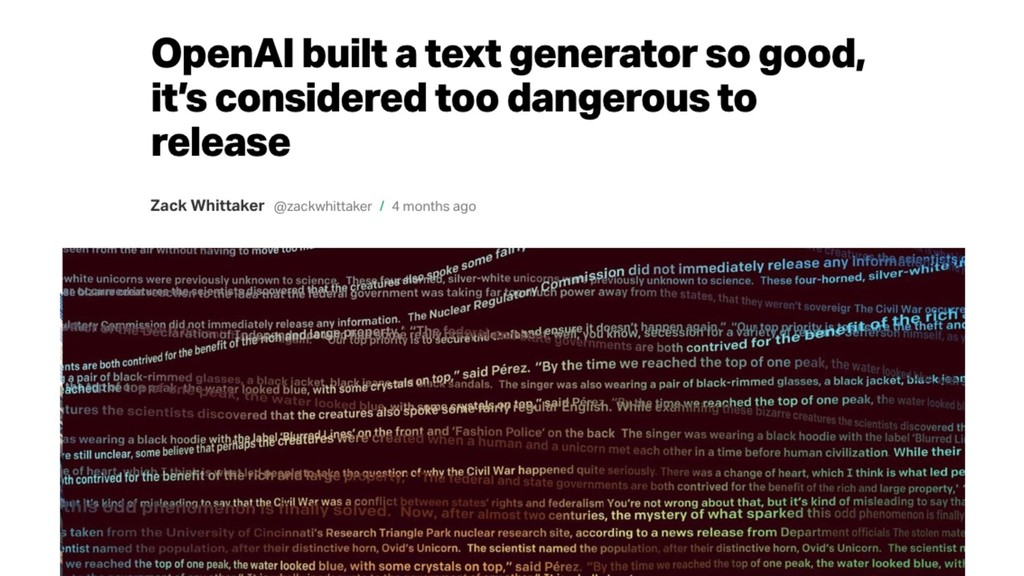
And what came out a couple months ago was that they built a text generator. This essentially generates content on its own too powerful, and they deemed it dangerous to release to the public. It's crazy. Right? What a time to be alive. But they did release a rolled back version that you can check out and play around with at talk to transformer dot com.
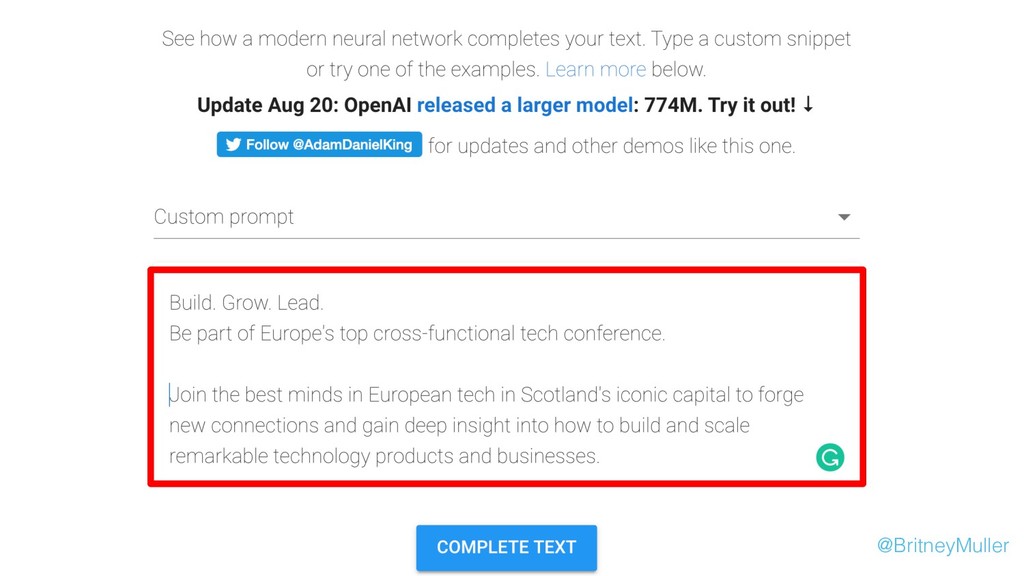
And so something I wanted to do for this talk was what what would this generate if we were to put in the text of TuringFest dot com? Right? The the con the first content that you see on the conference website. What would generate next?
So the way that these things work is you have to prompt them with a word or hopefully a sentence or a paragraph or two, and then they generate additional text. So I entered Build, Grow, Lead, Be Part of Europe's Top Cross Functional Tech Conference, the entire thing on the website, and this is what it generated.
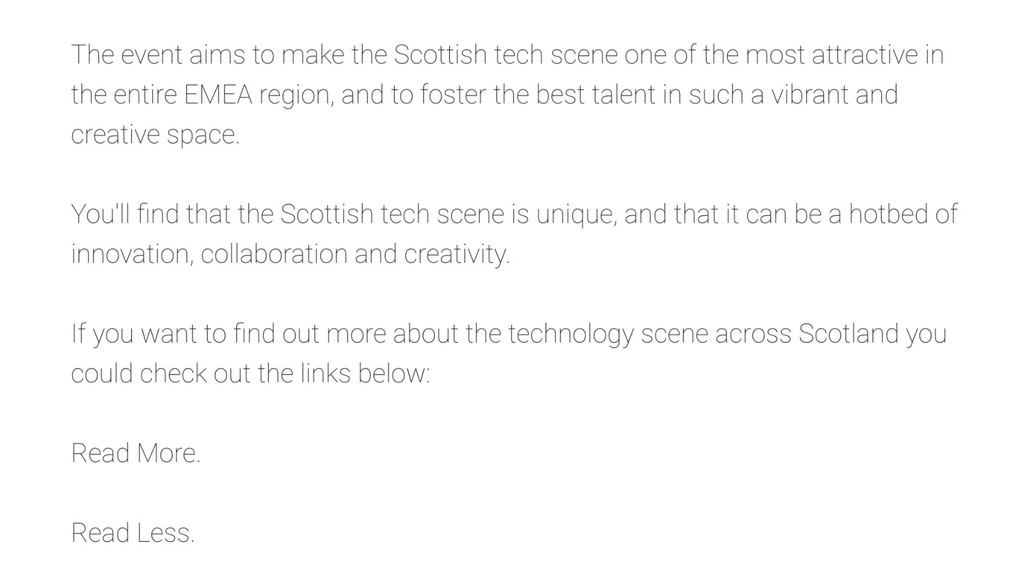
The event aims to make the Scottish tech scene one of the most attractive in the entire EMEA region and to foster the best talent in such a vibrant and creative space. You'll find that the Scottish tech scene is unique and that it can be a hotbed of innovation, collaboration, and creativity.
If you wanna find out more about the technology scene across Scotland, you could check out the links below. And, of course, these aren't links. It just says read more, read less. But this is something that a machine generated, and it's not bad. I wonder how many of us wouldn't be surprised to see something like this on the website.
Right? This stuff is crazy, and it's getting more and more accessible to all of us. This stuff is here. It's coming. And it's also there's a huge gamut of things it can do. So what I want you to take away today is that this is all becoming more and more accessible, and it's gonna free all of us up to work on much higher level thinking and tasks.
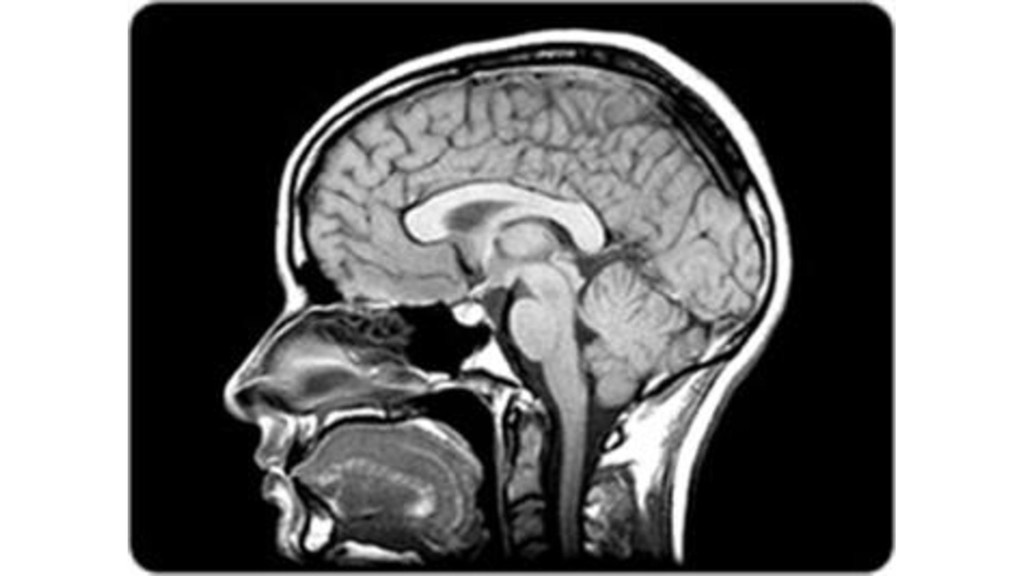
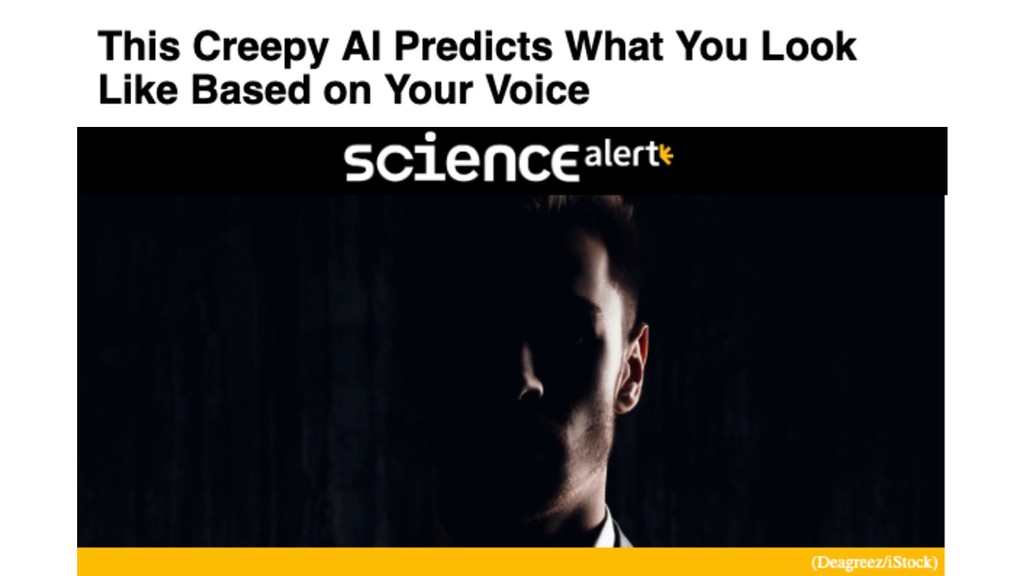
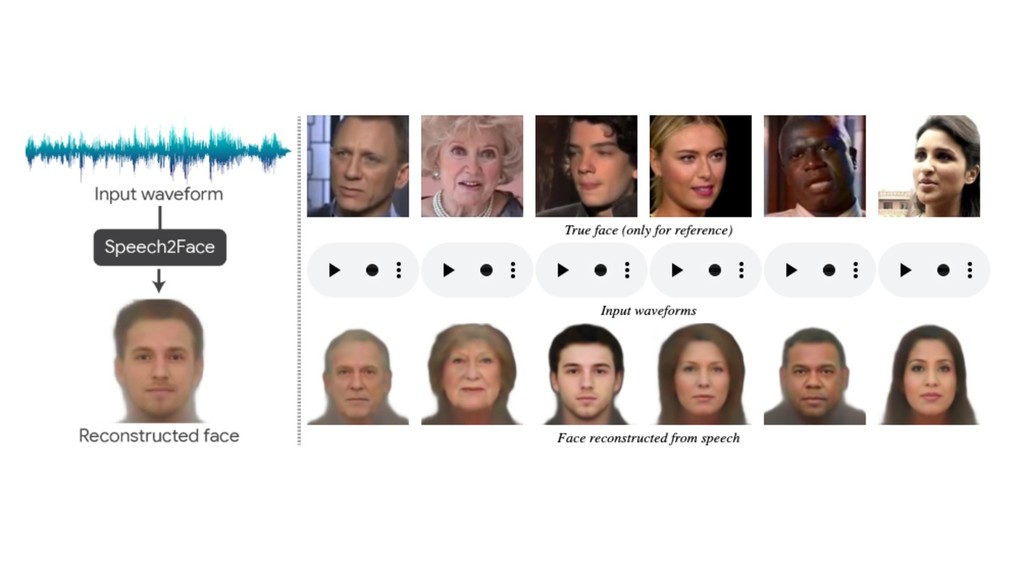
It's exciting. This stuff is already saving lives in the field of medical. Right? It's doing image recognition and diagnosing patients that way more accurate than doctors, saving time and money. And again, it's all over the map. It can predict what you look like based on your voice, which is a little creepy.
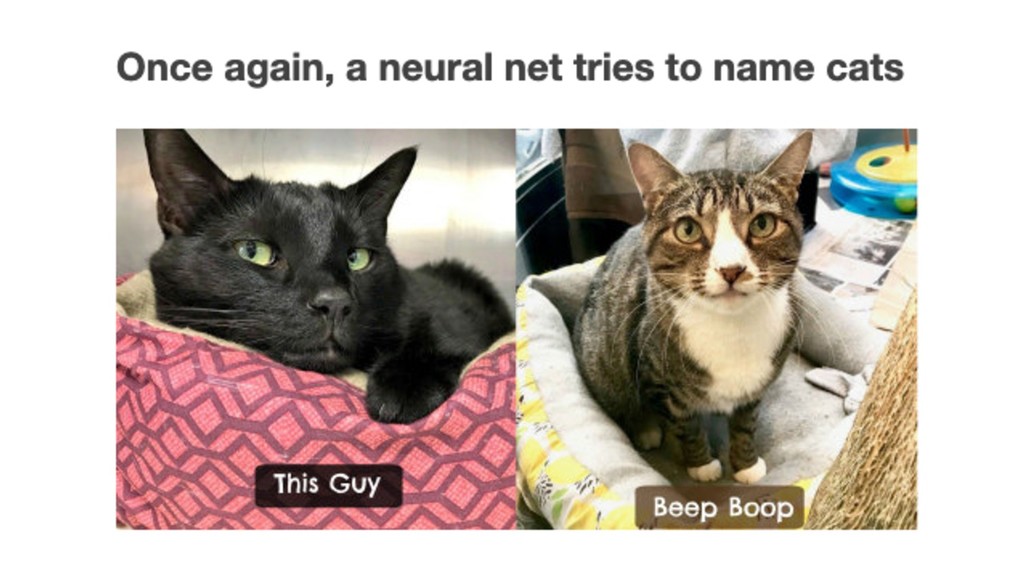
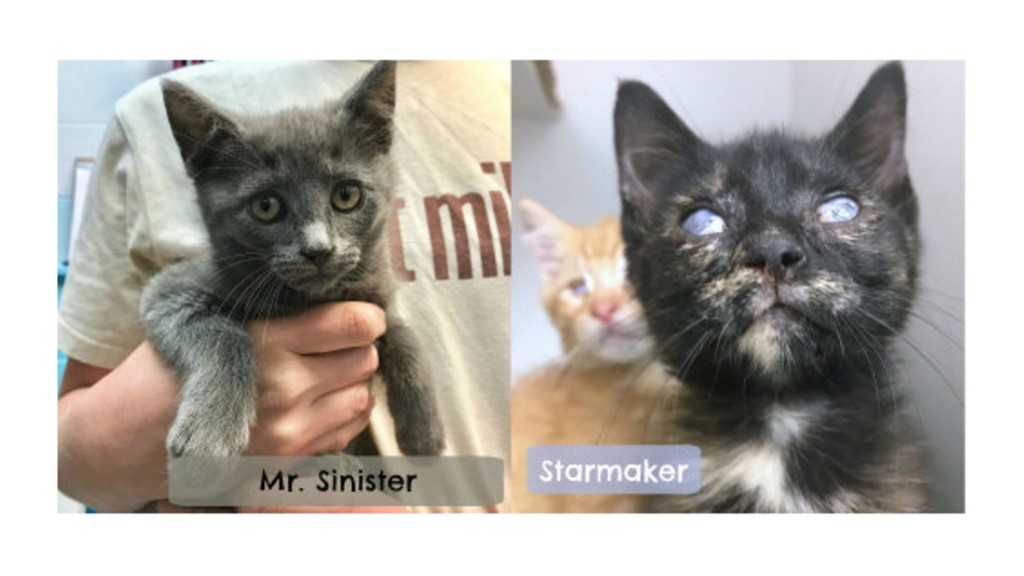
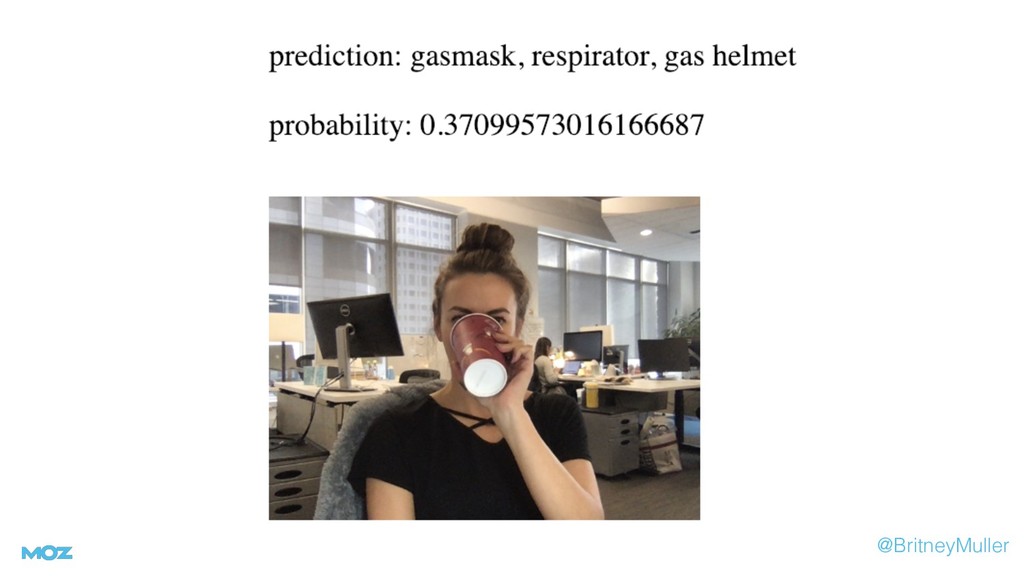
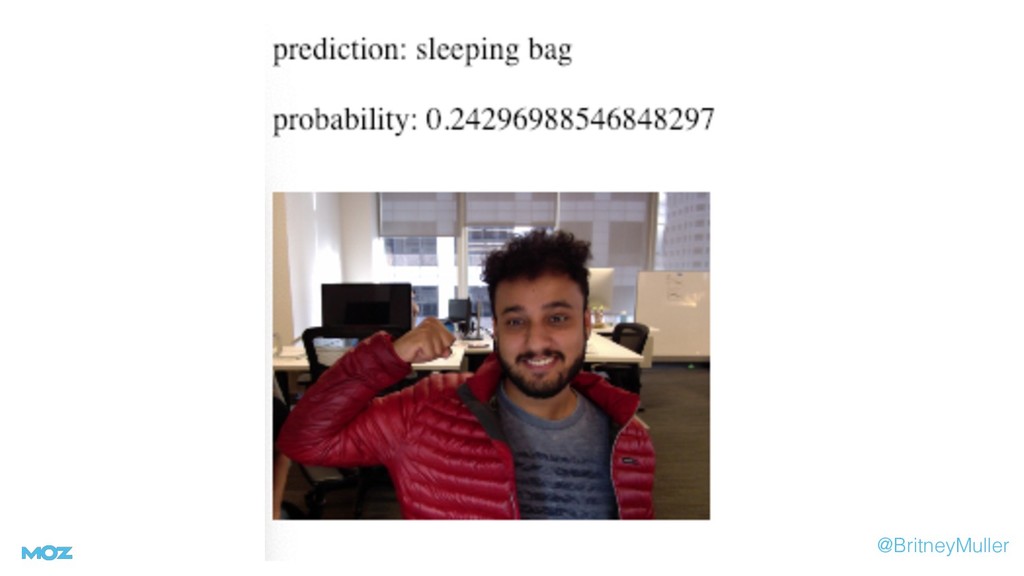
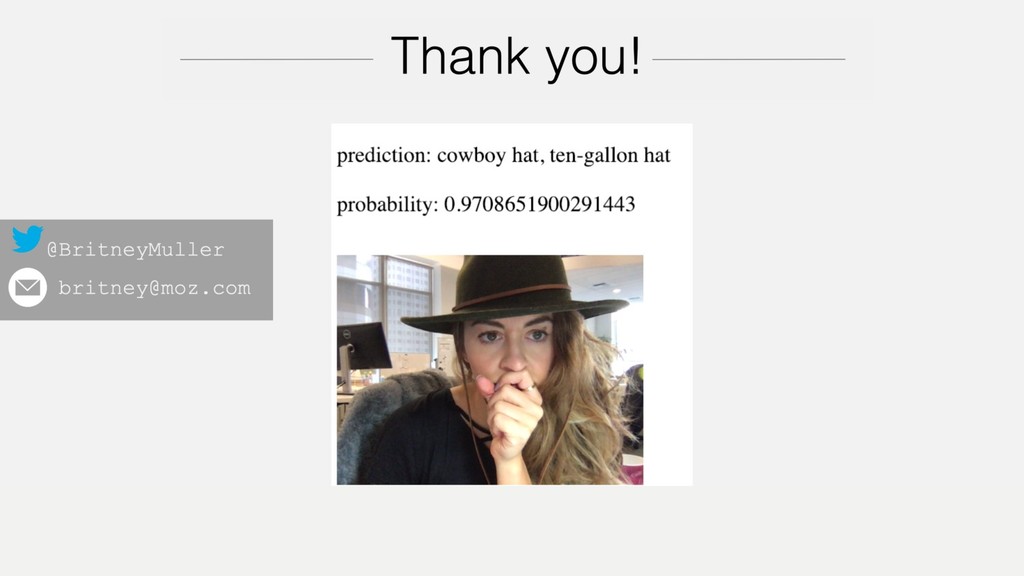
Right? This one was released recently. It can also just name your cat. Like, really silly stuff. I'm telling you. The range here is all over. I just thought these were so funny. I built one on my computer to use my camera to basically predict what was in front of the of my computer camera.
And you can tell it's not that great. Right? It's it's funny. It thought that was a gas mask. It thought that my friend was a sleeping bag. So it's you know, we still have a ways to go. You know, I get really excited about this stuff because I see the possibilities, but we definitely have a ways to go.
And I wanna make one thing very, very clear, and that is I literally have no idea what I'm doing. I am not a trained data scientist. I am not machine learning expert. I just am so obsessed with the field. I'm a hobbyist. I like to break things.
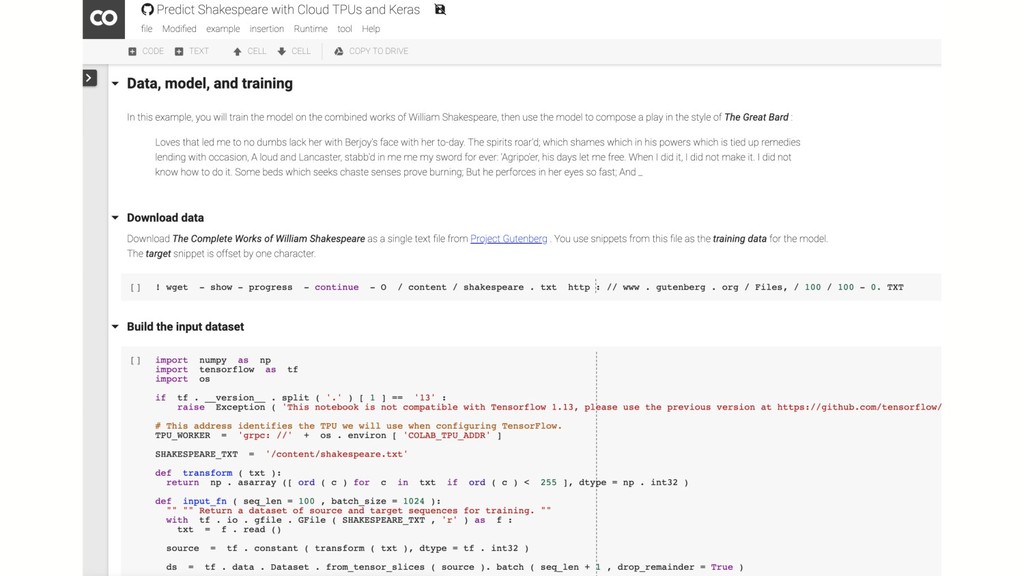
And something that apparently I'm not too bad at is just stealing. So I find these models that do something already that interests me, and then I make it do something else. Here's an example. So this is a Shakespeare model, and it reads the entire text of Shakespeare.
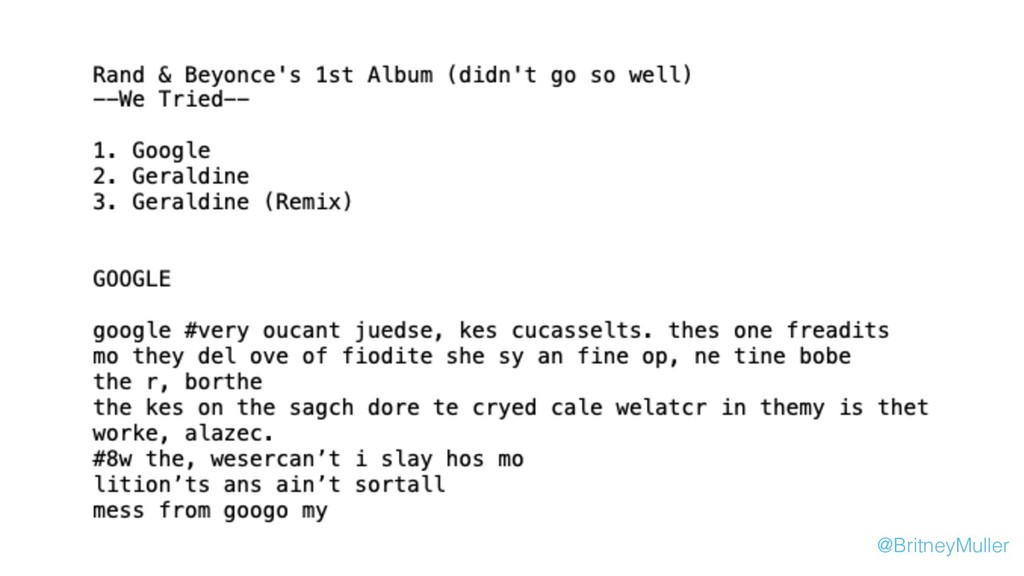
And what it does, similar to OpenAI, is it creates new stories, new characters, entire new dramas. And I thought, what could I do with this? Not anything particularly useful, but I thought, what if I combined Beyonce and Rand Fishkin? What would it do? You know? Would this be kinda cool?
So the whole Lemonade album and a couple of Rand's articles go into this model. And I trained it over twenty times, and it was making up words. The first album was a bust. It wasn't very good. It was just generating complete gibberish. Right?
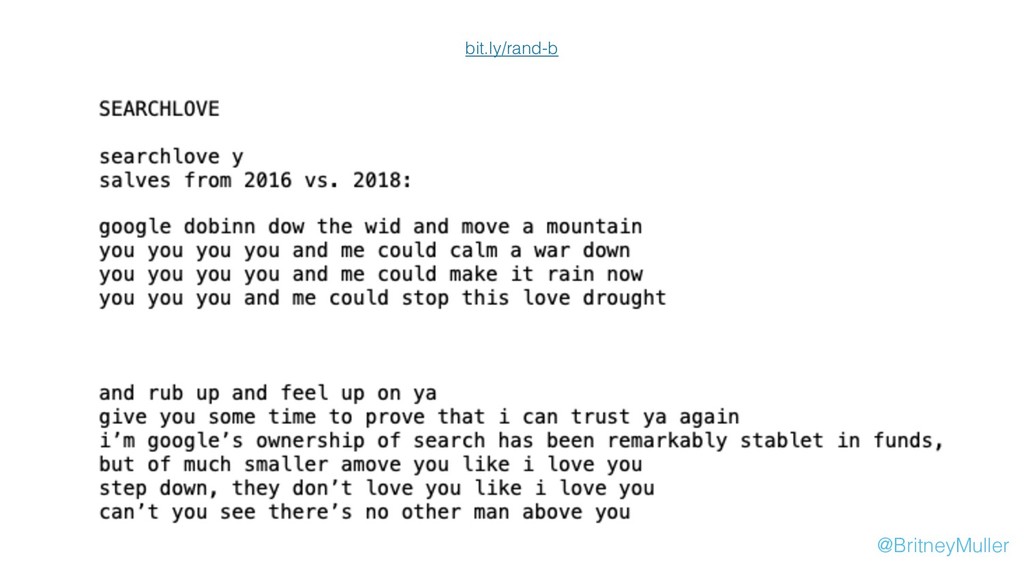
And then I thought, okay. I gotta train this longer and see what happens. So after a hundred training sessions or what's also referred to as epochs or epics, I get some rhymes. I get some actual lyrics, and it comes out in the format of a song incorporating SEO content.
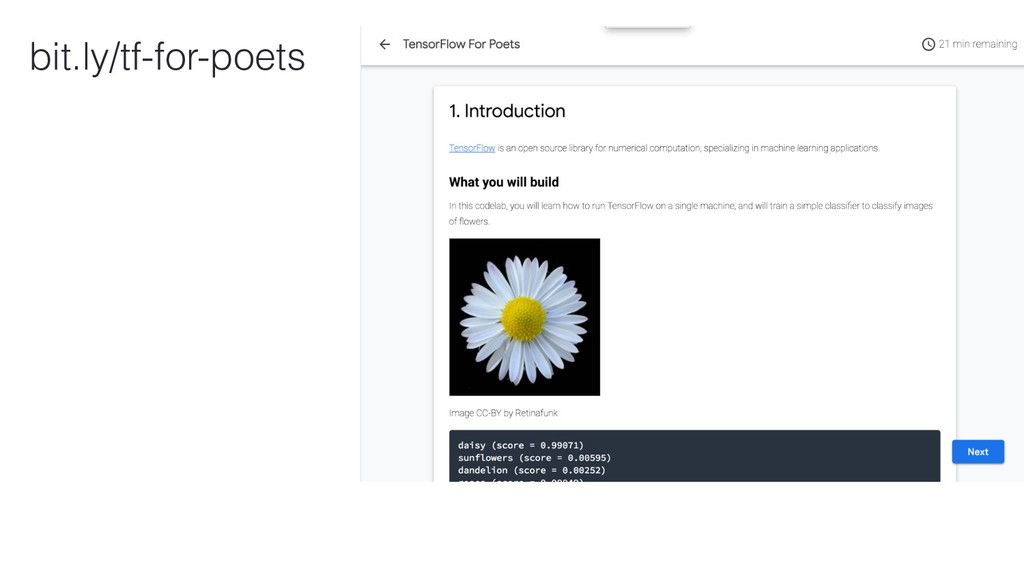
You can find their whole album at that Bitly link that I created. It's just hilarious, completely useless, but fun and fun to start to dabble in and think about the ways in which you could apply these things to your everyday life. Another quick example, TensorFlow for poets.
It's kind of a great hello world of machine learning model. I suggest you all check out. It's really easy. You just build it on your local computer. This link will take you to all the steps. And after I built it, I realized, okay.
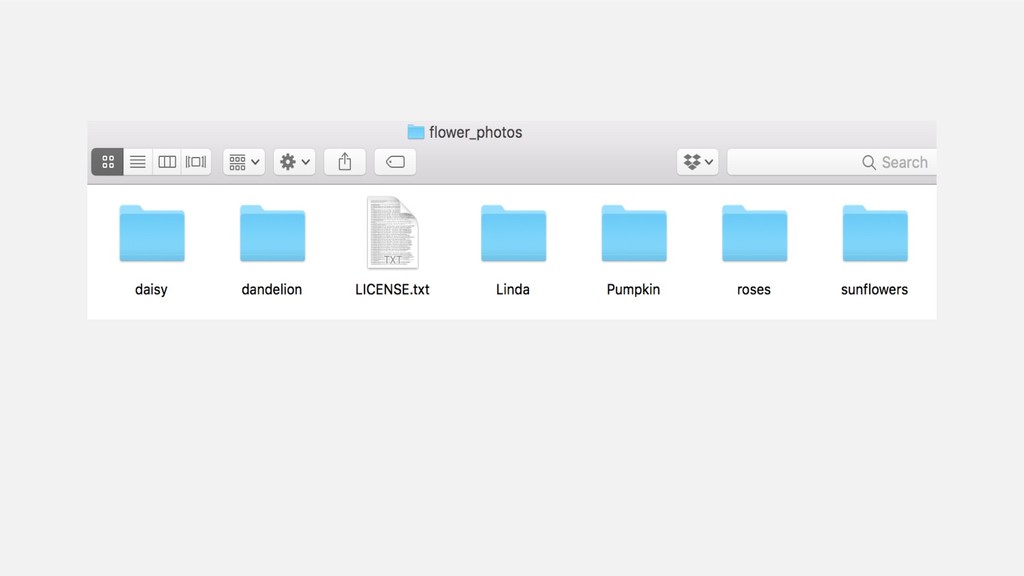
So this is just basically recognizing and classifying images of flowers. It's telling me what type of flower I put in the system. I wanted to take it apart. So I look on my local computer, and I find this folder. And I'm thinking, this is just a bunch of folders of flowers?
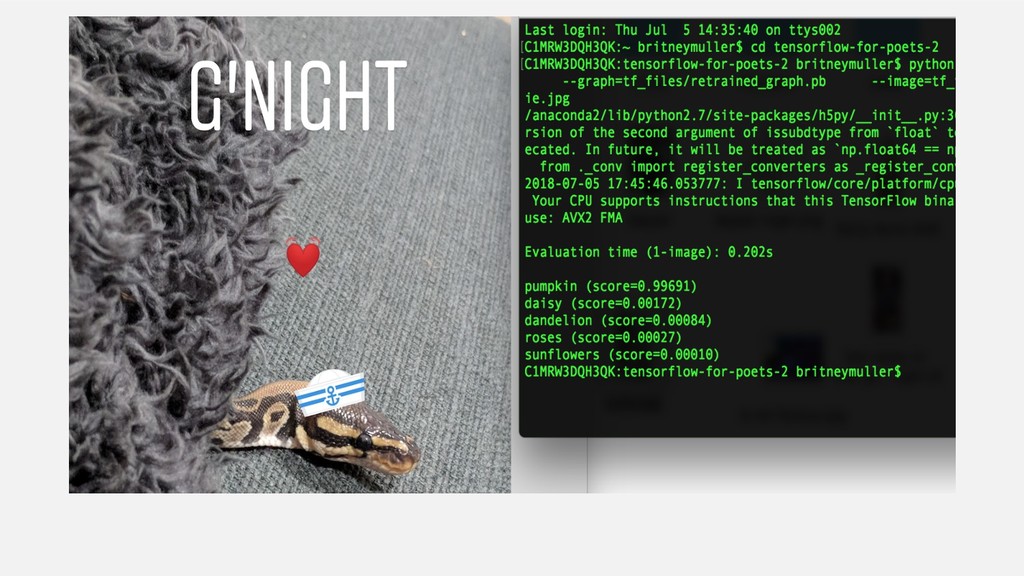
Like, that's how this works? So I add those two middle ones, Linda and Pumpkin. Linda is a wild pet duck that I have. She frequents the boat that I live on. It's hilarious. And then Pumpkin is my pet ball python snake. And so I uploaded about thirty, thirty five photos of each into these folders.
And with that little amount, it was able to, within ninety nine percent confidence, say, oh, that's your snake pumpkin. Even though that's not a super clear image that she's a snake. Right? It's amazing how little you need to feed some of these models to do the things you want them to do.
So again, this is just going to free us up to work on higher level things. Consider the tasks that you do in your job or that could assist you in making things easier. Right? If you have to label images, if you work on really large websites, this can automate and get you most of the way there.
It's not going be perfect, but again, it's just going to help us out. So wanted to get you fired up with some fun examples. And then I want to give you all the tools and the basic one hundred one how this stuff works and what it can and cannot solve because I think that's really important moving forward, that you're able to understand what it could apply to and what it can't.
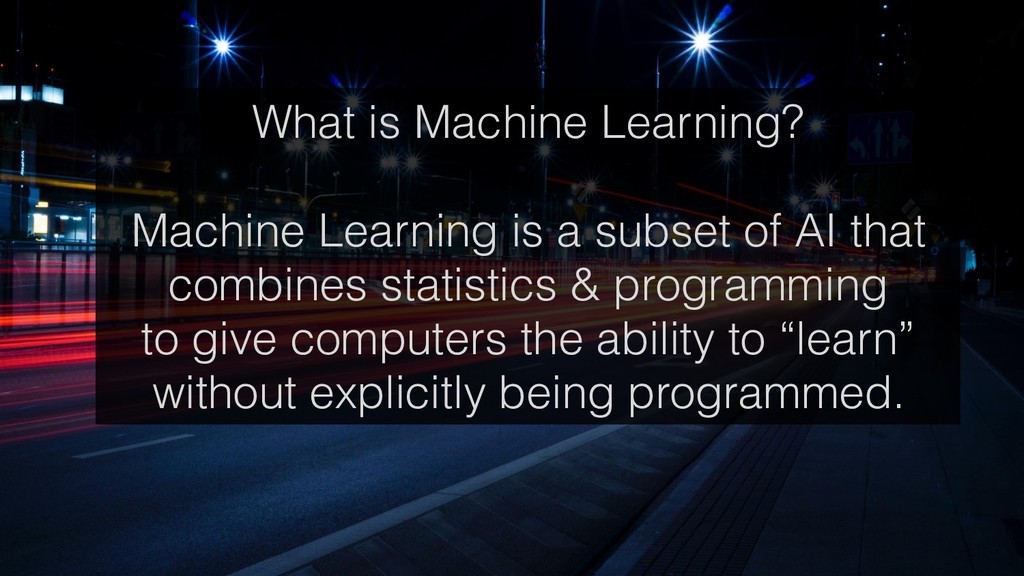
And then from there, I got a bunch of tools and resources that are all yours. That'll be really cool. All right. What is machine learning? What actually is going on? So this is a subset of AI. And quite frankly, anytime you hear the word AI, ninety nine point nine nine nine percent of the time, it's just machine learning.
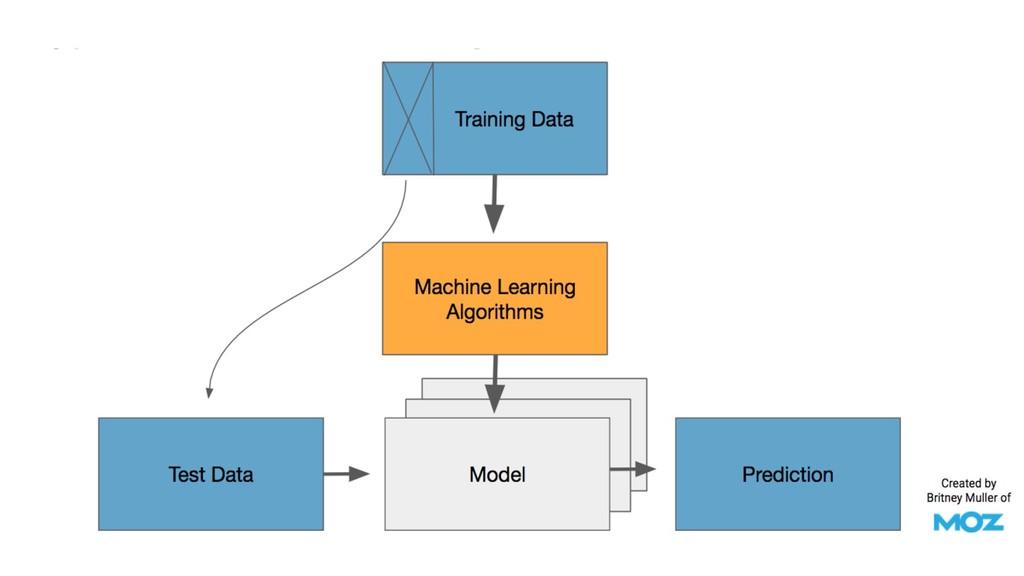
And machine learning, it combines statistics and programming, and it allows computers the ability to learn about things. This is a super basic way that it works. You feed it training data. It literally trains on that labeled information, and then you test it. And maybe you need to run it some more. Maybe it's fine.
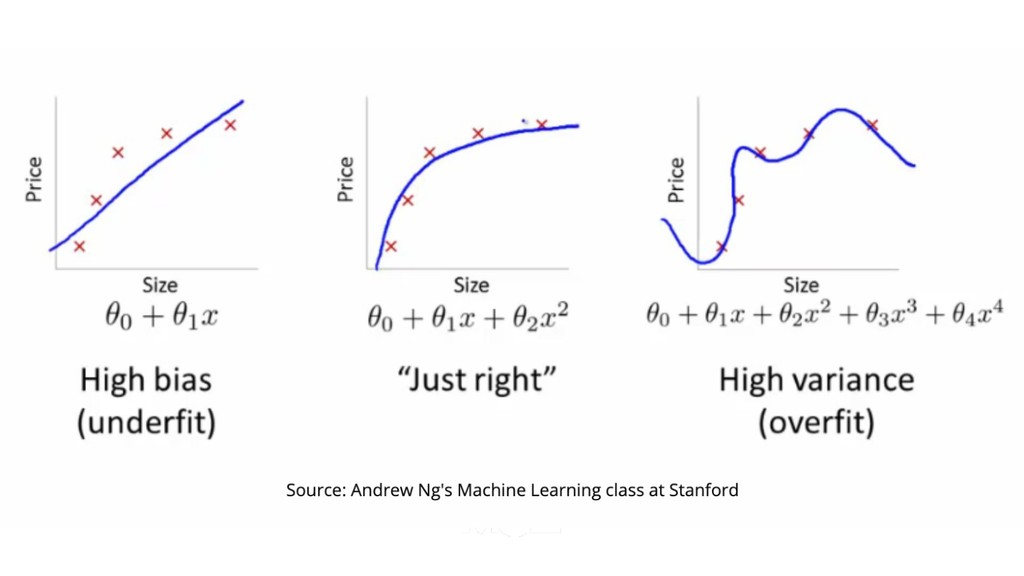
You just get to kind of play around in that space. But how do you know it's working? How does it learn? At a super basic level, this middle graph is what's hopefully going on. So you have your training data. And you want the model to fit to the data, not perfectly.
You don't want it to account for every single thing you put into the model. That's what you see on the far right. That's overfitting, which also looks like this. It's the best description. It doesn't allow for new positions. It doesn't allow for new data points.
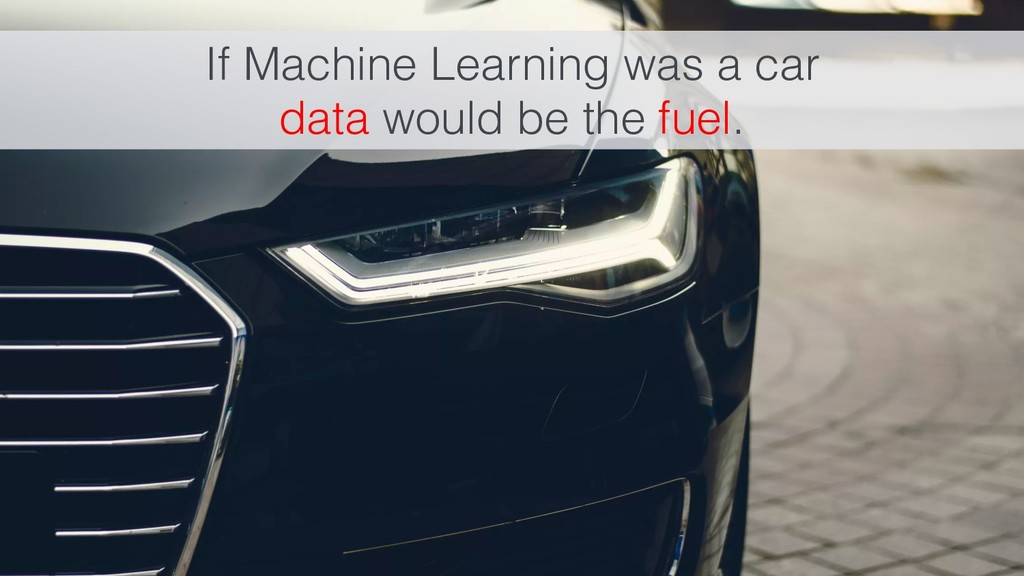
It constrains you. But you want to find that nice even fit. And there's tons of resources at the end that explain how that works in terms of the loss function. But the main thing is if machine learning, if these models were a vehicle, data would be the fuel.
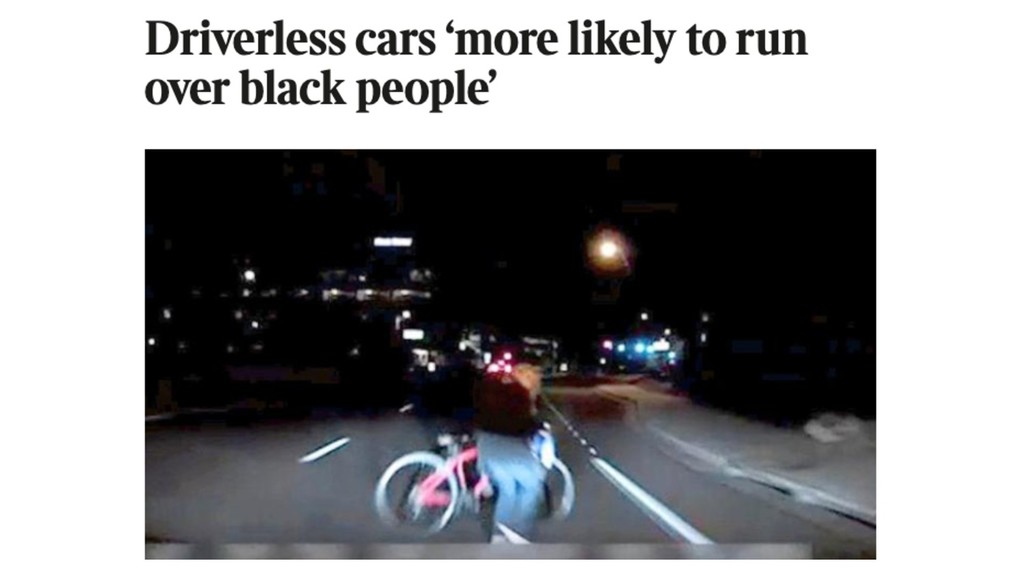
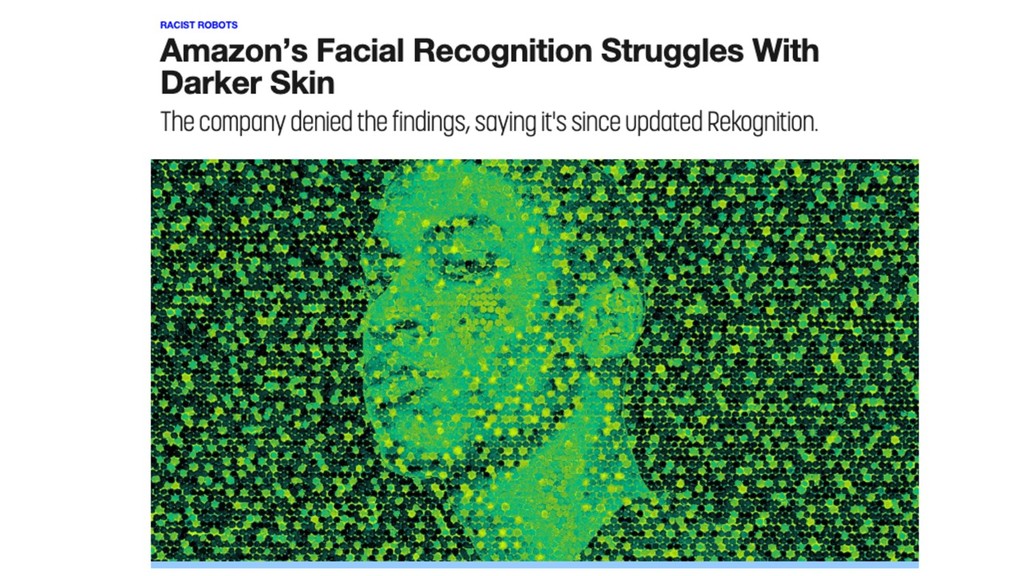
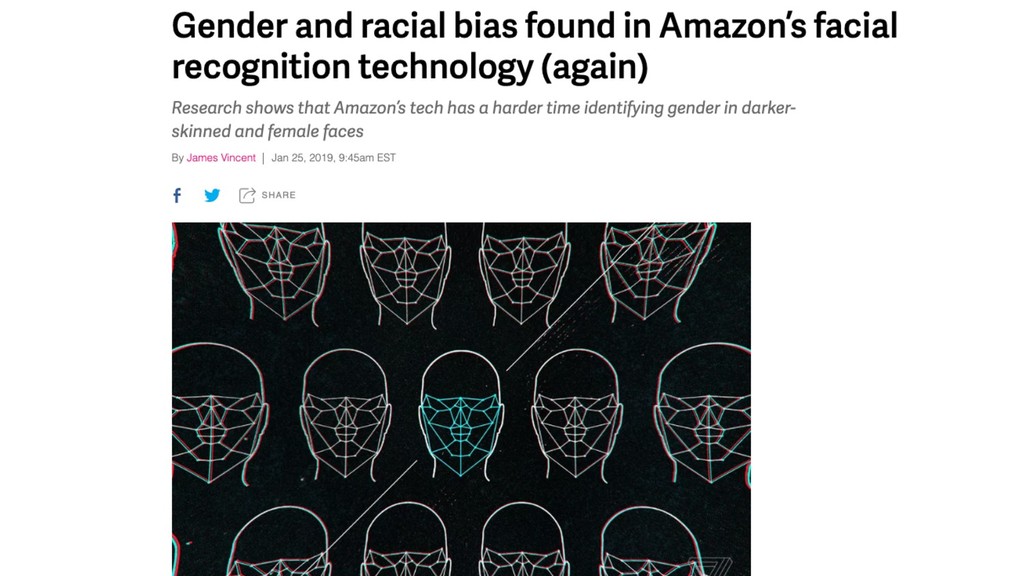
Data powers this stuff. Machine learning and AI, computers aren't racist. Data could be racist. Right? And that's the things that we need to think about moving forward so that we create safe systems. So because data is the fuel, what are we all doing for Google?
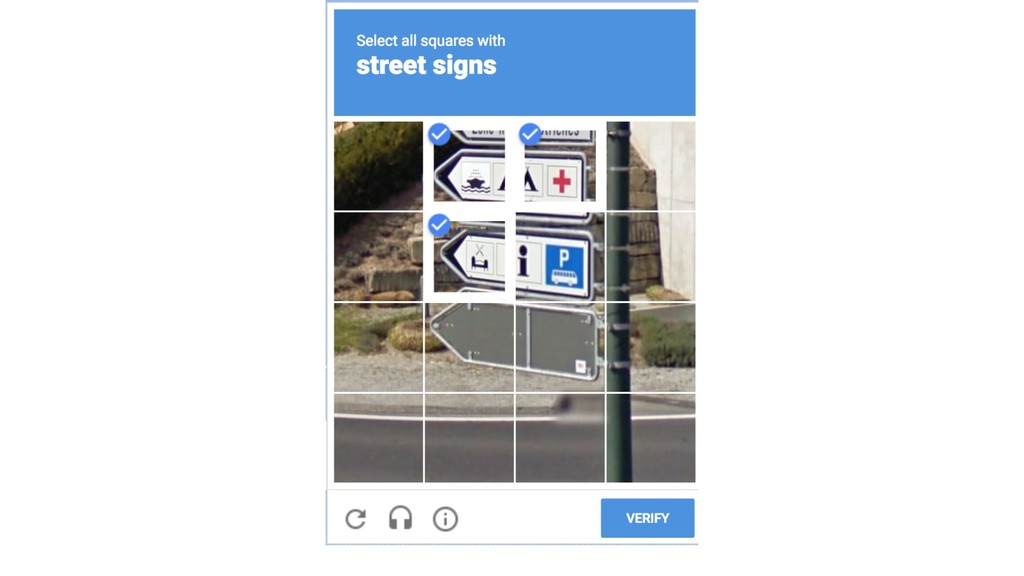
We're labeling this stuff for everyone all the time. We label training data for Google. We do ten year challenges on Facebook. Facebook's using that right now in an age model. The stuff is wild, we're doing it every day, and we don't quite realize it.
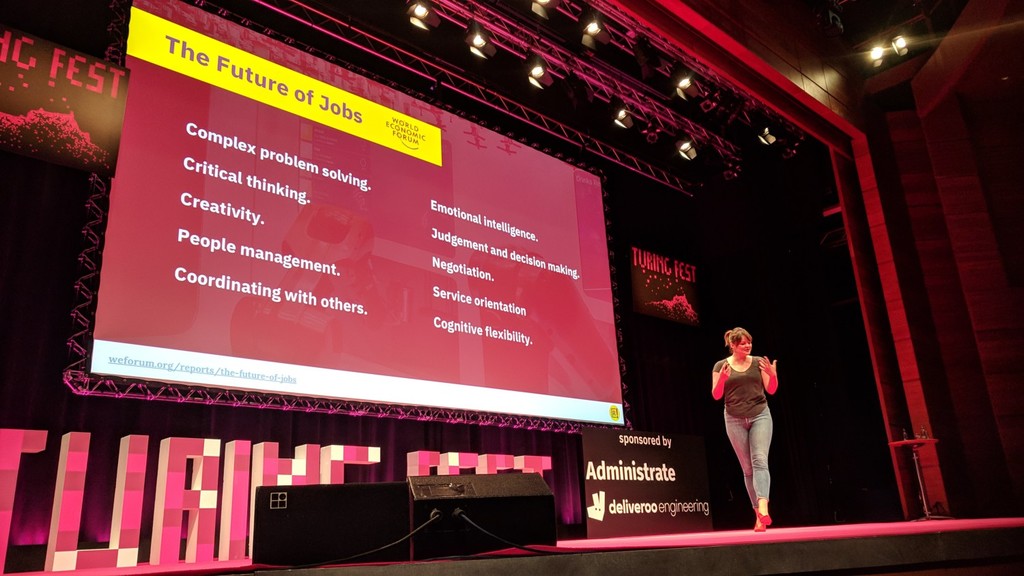
But one thing it doesn't do is it doesn't solve well for soft people skills. So if any of you were in Kirsty's talk yesterday, she talks all about these soft skills. These are so important moving forward. Machine learning AI cannot come near this stuff, nowhere near it.
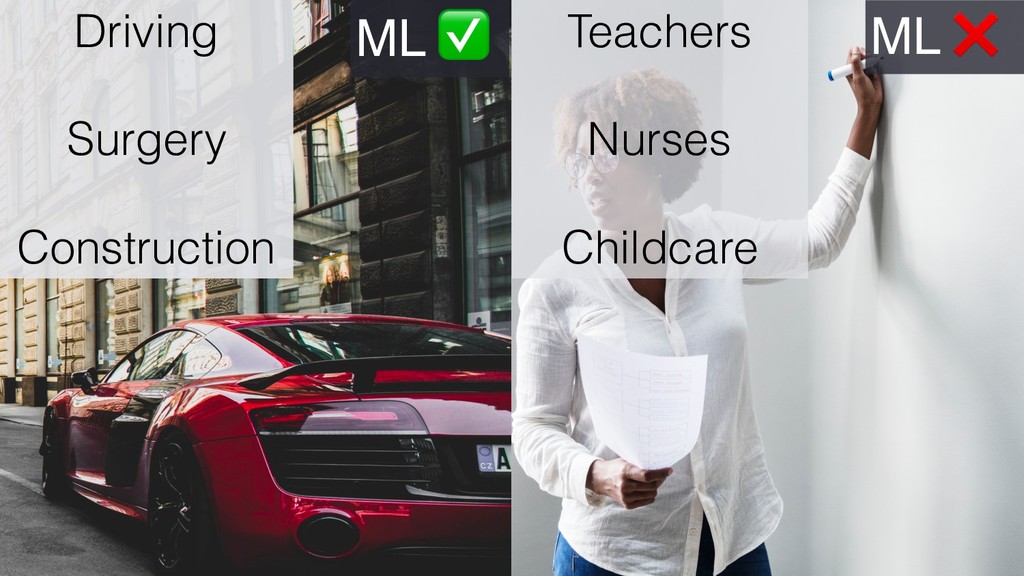
If you look at it in terms of professions, it's gonna start to disrupt things like driving and surgery and construction. It's not going anywhere near teachers, nurses, childcare, the professions that take that extra human element. Right? It's really good at this stuff. It's really good at summarizing a bunch of data and text and information, but it's not so great at the things that Kirsty was talking about.
And I really want all of you to understand and realize that you truly, truly don't have to be some sort of PhD genius to play around or use this stuff. You really don't. And especially any person in this room, any AV person, anyone in this building could think of the next big application.
In the world of AI and in the world of machine learning, they talk about three areas that power all of this. It's the hardware that these things compute on. It's the data. And then it's the people. And currently, we are seeing a bottleneck.
And it's because there's not enough people in the space. These sort of talks inspire me to sort of spread the word so that you guys can come up with the next cool ideas because, quite frankly, anyone can. Yeah. So so much fun. I'd love this.
So let's dive into the tools and resources for you to play around and start to consider what can you do with all of this. Right? How can you start applying this into your everyday life? And I would like you to start thinking of it as a plug and play system.
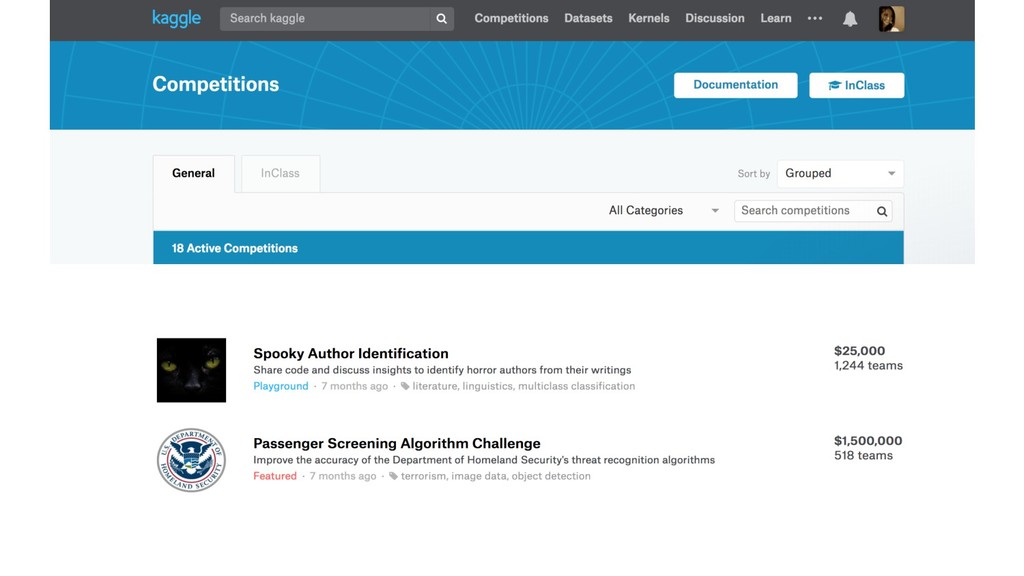
So some of the tools I'll present really just allow you to plug in different models into data and help you speed up different tasks. One site I highly recommend you frequenting is Kaggle dot com. This is the largest data science competition website in the world.
And what's so interesting about this is that it helps kind of fire up your brain. Right? You get to see what other people are seeking data science and machine learning for. The fact that TSA has put up one and a half million dollars for a screening algorithm, right, to detect potential risks is interesting.
It's also a bit scary, But it's interesting. And you'll also find Quora has recently put up a lot of money to figure out how to dedupe questions. So it starts to get you thinking, oh, could I potentially use machine learning for that for my business or for my profession?
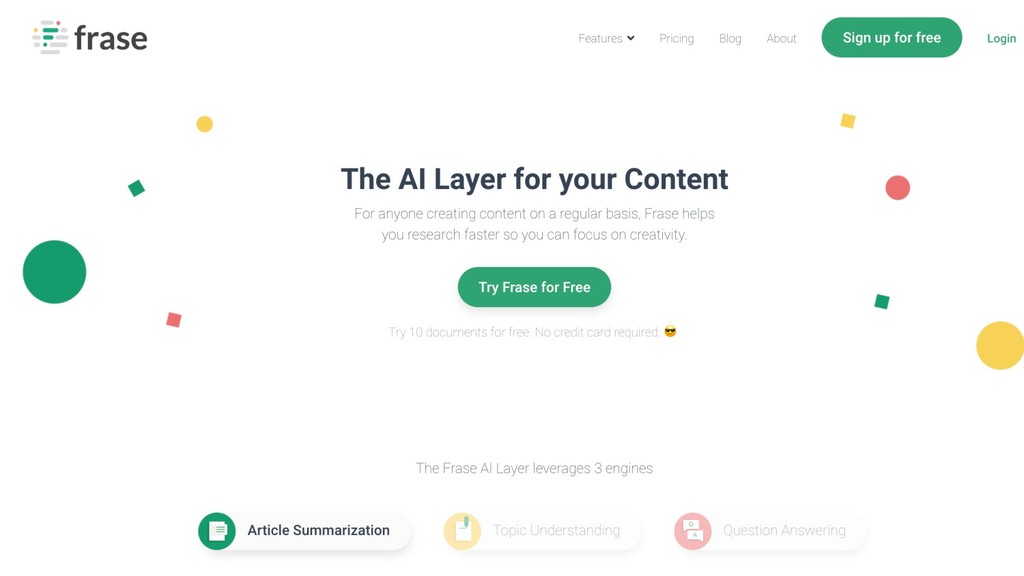
It's a really neat and interesting space. For those of you that are marketers in the room, this tool automates content research. It summarizes content and topic areas for you. And it literally puts together questions and answers that they foresee people seeking. And it gives you a really, really rich topical understanding without having to do all of the digging yourself.
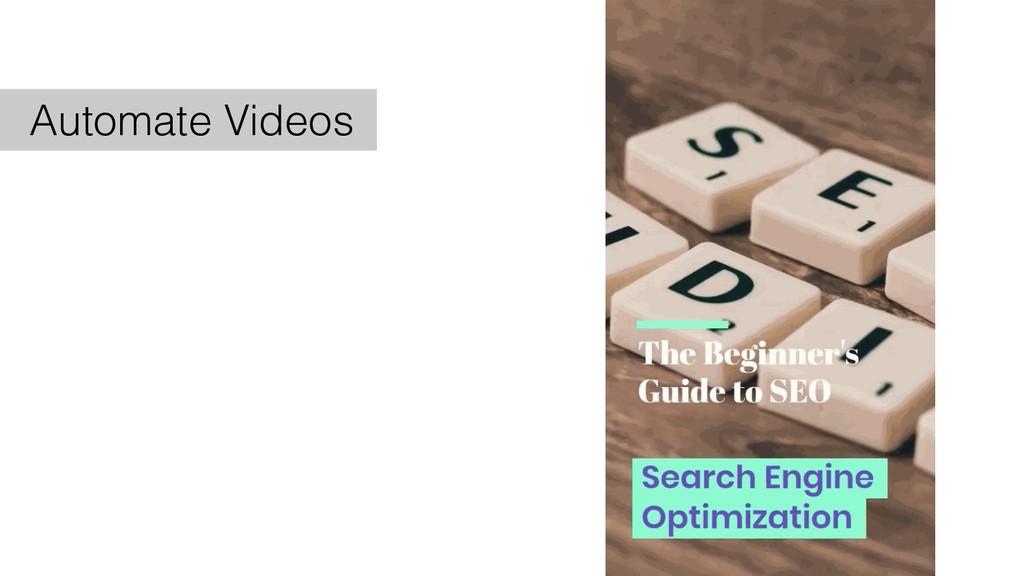
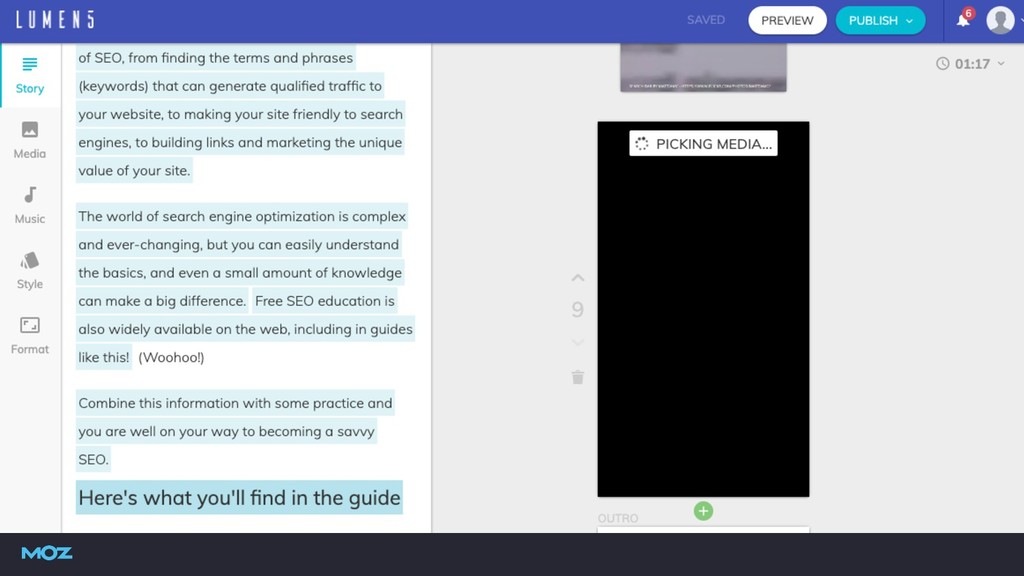
This is just automating some of those processes. One of my favorites is this. You can automate videos now. This was a video that was completely automated just by text that I put into it. It's called Lumen five, and I put in the first chapter of the beginner's guide to SEO.
And you can see it's picking media based on the context, based on the natural language processing that's occurring and the entity extraction. And it does pretty well. It's not gonna be perfect. Right? But it's gonna get you part of the way there and start to make your job a lot easier and free you up to do other stuff.
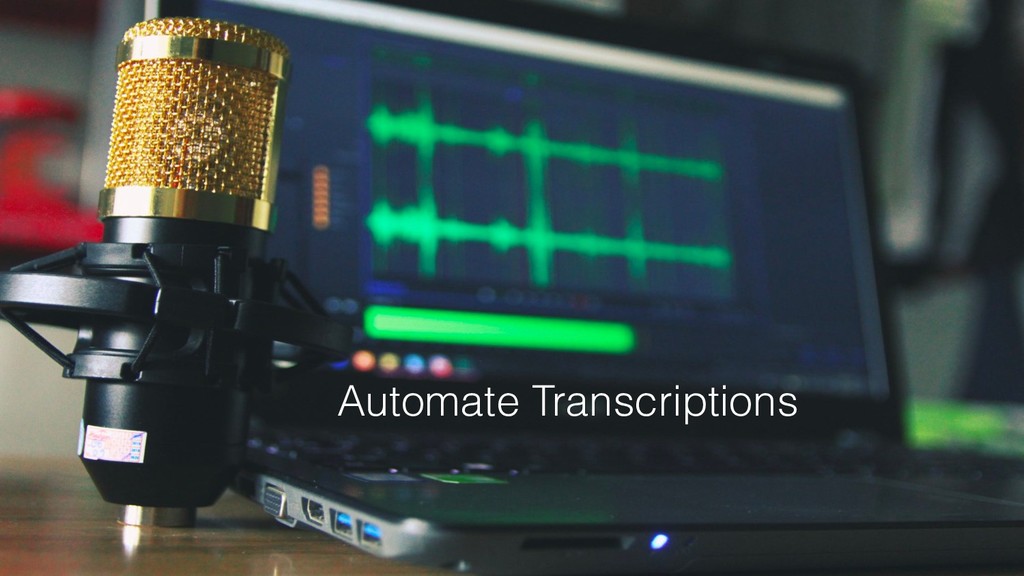
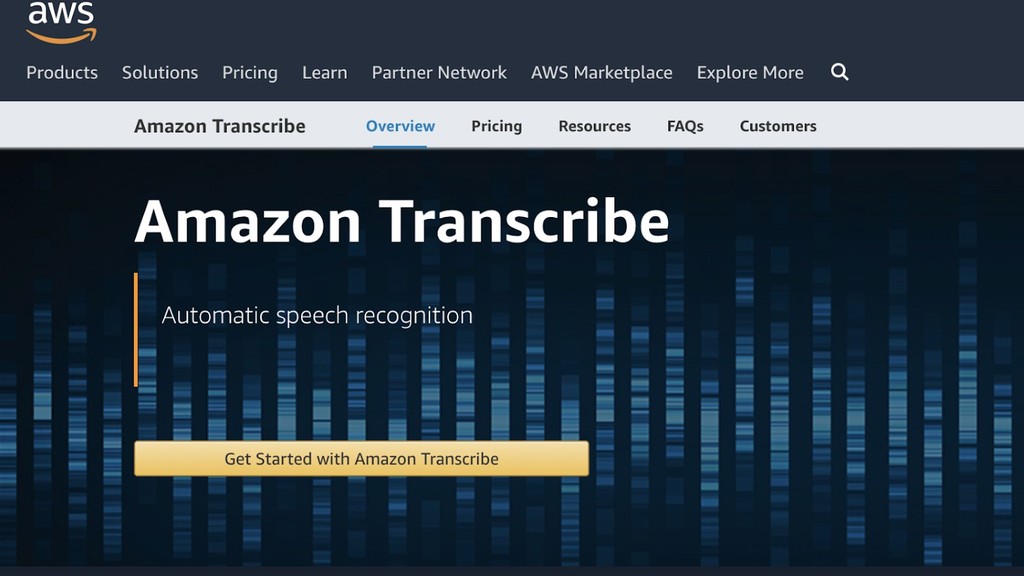
So highly recommend checking us out. There's a free version that is really fun to just play around with. You can automate transcriptions. For those of you that do video or podcasts, I understand that transcription services are so expensive. They're so expensive. But they really don't have to be anymore.
Amazon has this thing called Amazon Transcribe. And pennies, I have paid thirty cents to transcribe an hour and a half of podcast audio. And the cool part is that because this uses machine learning, it can decipher person one from person two all the way up to ten people.
It's powerful stuff, right, if you have to pay and you want to provide the content for different media types, which I highly suggest you do. Search engines are still very much favorable in terms of content and being able to understand what's in this other media.
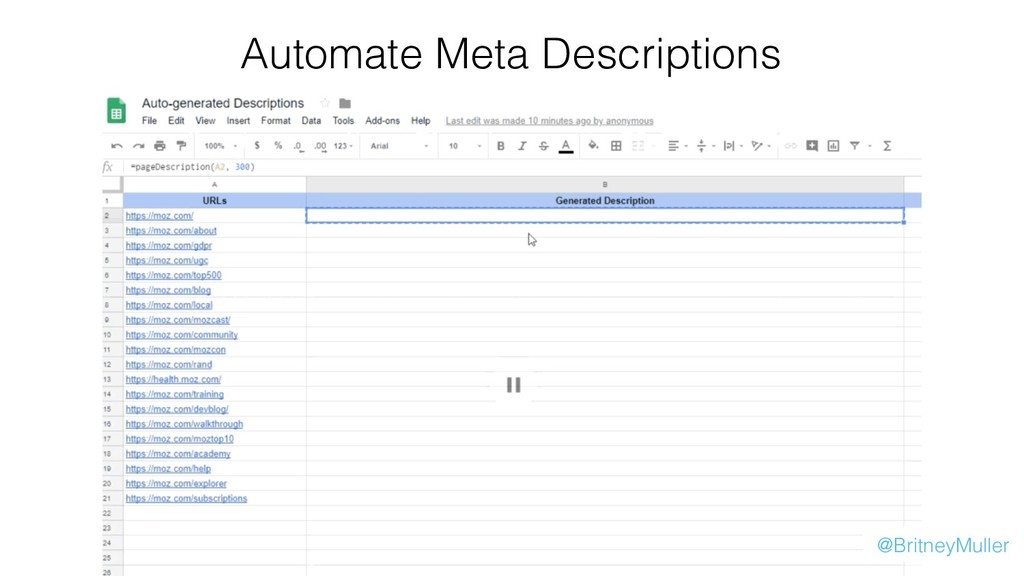
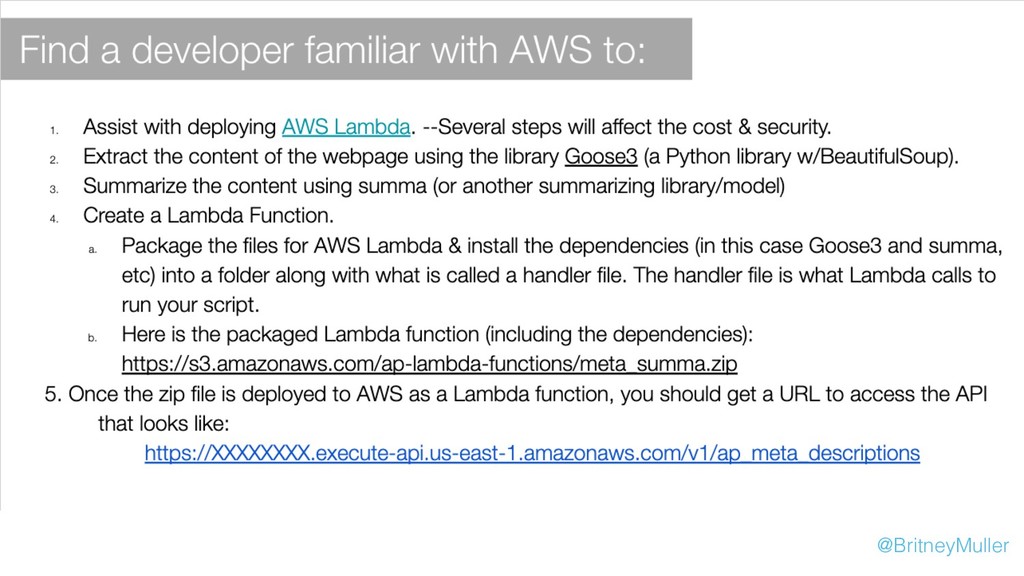
Something I built a couple years ago is automating meta descriptions. If you have those huge, huge websites, if you have hundreds of thousands of pages or even a couple ten thousand pages, you can't write descriptions for every single one of those pages. And to clarify, the meta description is what shows up in Google search results.
So if you search for something, you see that blue title and then the black text underneath it that describes the page, describes the content. It's exactly what this is automating. And this is just using a summarizer model that I found on Algorithmia. Super cool.
And I had two friends of mine help me plug this into AWS. Because, again, I'm not the machine learning expert here, but I know enough to sort of be dangerous, right, to play around in this space. But they plugged in some of these things for me.
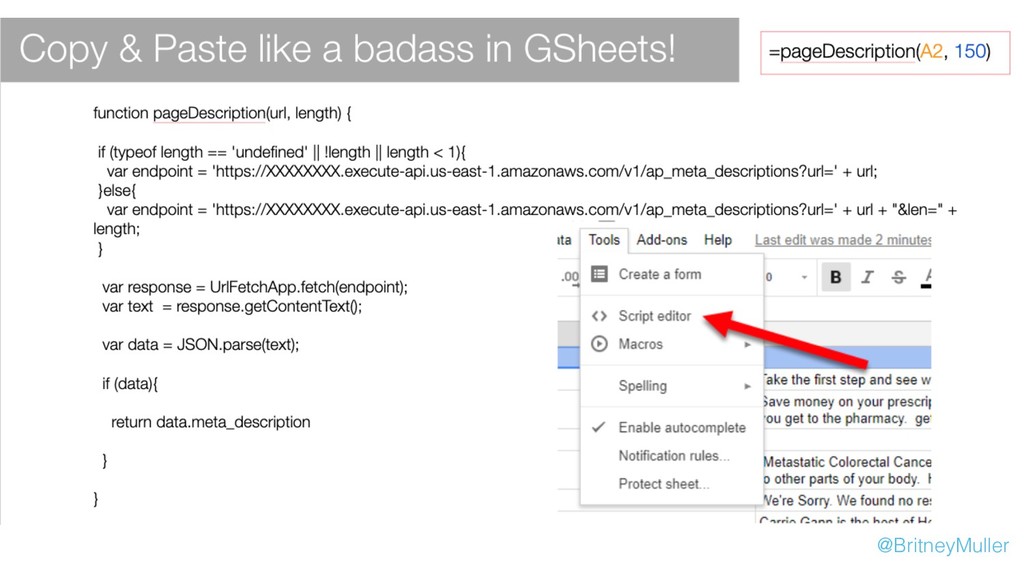
So I highly suggest if you wanna do some of these things, find a developer who's familiar with AWS or familiar with this space. And then all I had to do was copy and paste the script into Google Sheets, which I love. And it made it so easy to automate those things just based on the URLs.
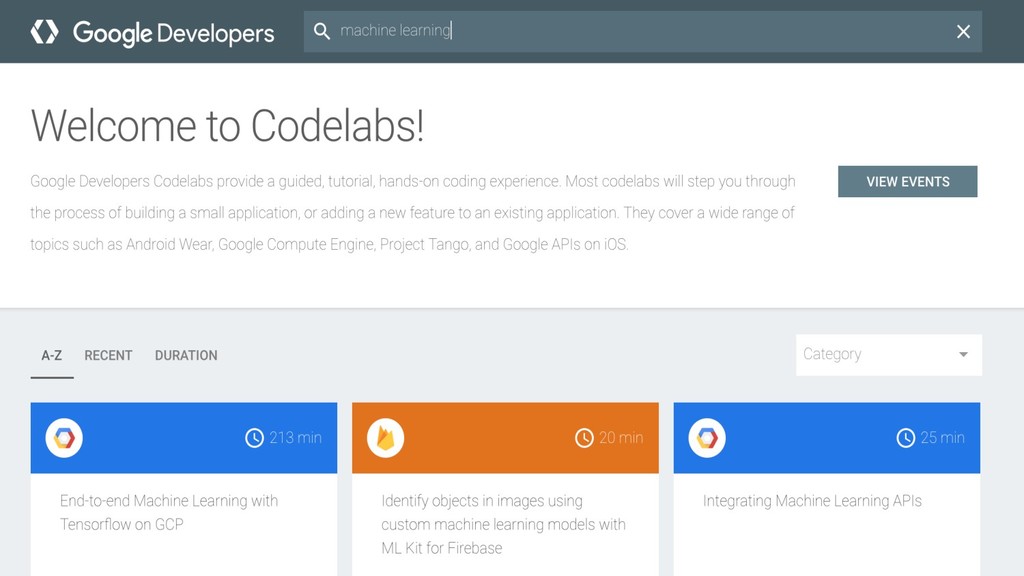
Super easy. These are the two gentlemen that helped me with that. They are amazing. If you're interested in this space, I highly suggest you follow them. JR Oaks published something yesterday that is just mind blowing as well. And to get you in the realm of machine learning, Google Code Labs is incredible.
So these are open source tutorials that Google provides, and it walks you through step by step how to do some of these things. And it's how I've gained some comfort around building and breaking these models. I highly suggest you filter by machine learning or by TensorFlow.
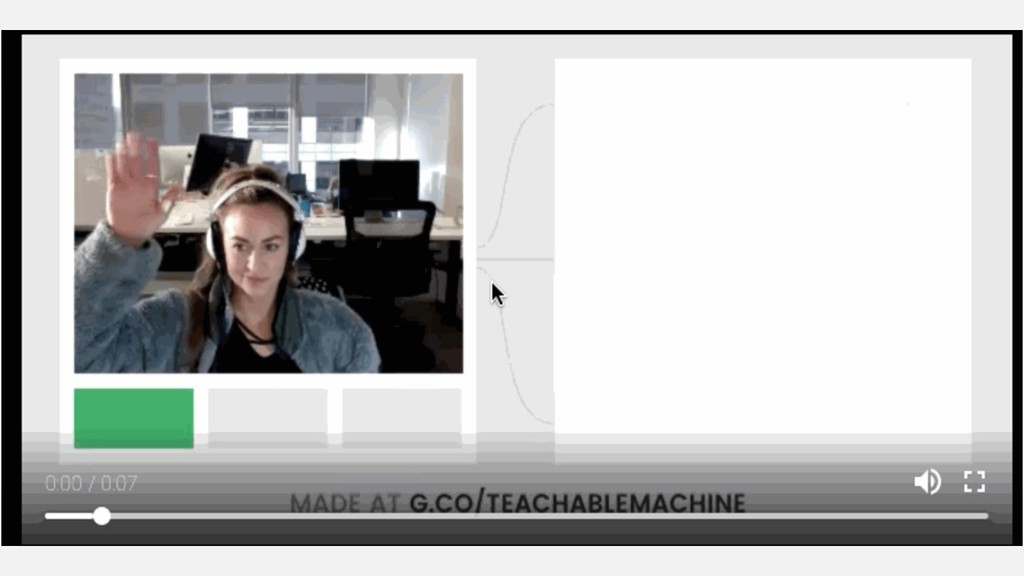
TensorFlow is the framework that Google provides for machine learning. It's great. But they will literally walk you through things like that TensorFlow for poets. So it's really, really fun to play around on this website. If you want to go super, super basic, don't touch any code, do this, g dot c o slash teachable machine.
It just takes in, you know, movements and matches them to a specific type of image. Super simple, kind of silly, but fun to sort of play around and, again, start thinking of the ways in which you could apply systems like this for the things that you do.
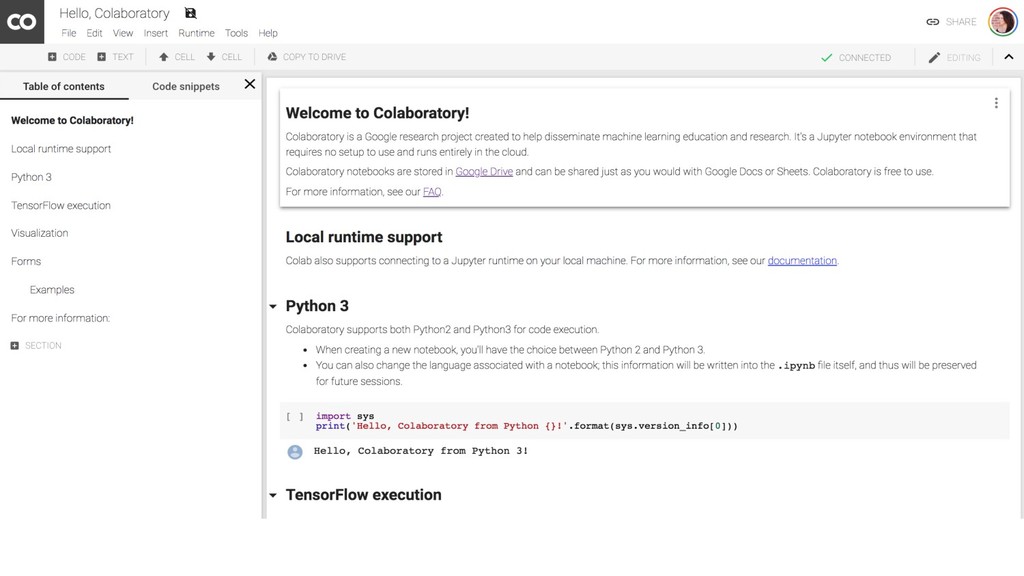
This could apply to anything. You could literally apply some of this stuff to absolutely anything. It's so much fun. Colab Notebooks is a great resource to do some of this machine learning on. Google makes it scary easy to do it. They provide free GPU.
That green check mark is Google saying, hey, we'll give you the extra compute power so it'll be faster for you to build these things. They're definitely looking at what you build on here. But if you're interested in this space and you're constrained, you know, to not having a whole lot of hardware, it's fine to play around and learn in here.
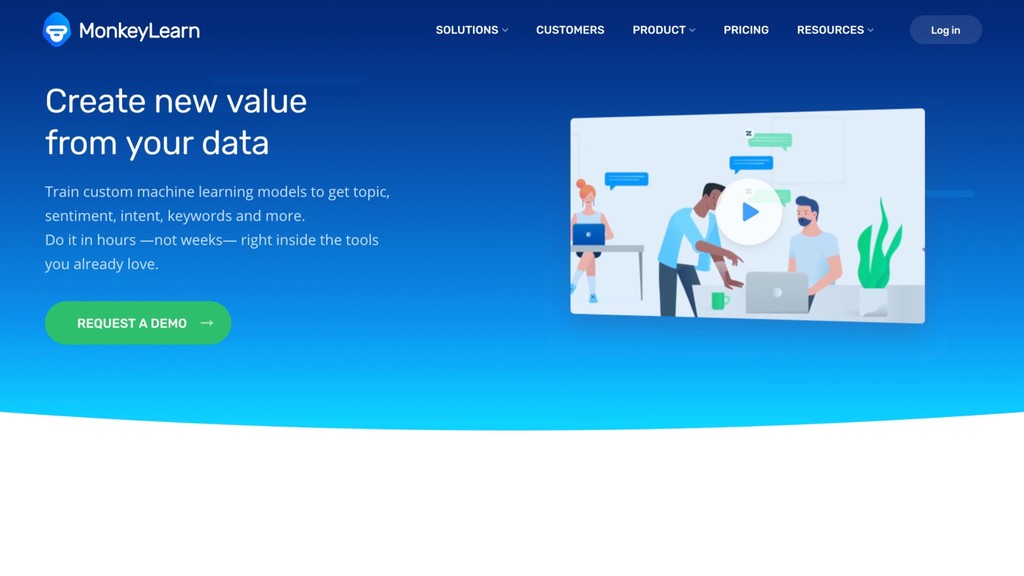
I I love using this. I love collaborating in here. It's a great resource. And for any of the developers in the room, this is basically the Google Sheets of Jupyter Notebooks. Does the same sort of thing. And Jupyter is great as well. Monkey Learn is one of my favorite machine learning tools because it just basically packages machine learning models.
And then they make it so easy for you to plug this into Google Sheets. So for any of you, if you want to look like just a total badass and a genius in your next meeting and perhaps you're doing competitive research or you're trying to do some sort of analysis in your space, it is all too easy to pull in Twitter API into Google Sheets and then run this on it.
Right? Oh, within the last month, here's the sentiment analysis on the tools we provide. Here's the topic extraction of people talking about this space. You can do high level research so damn fast. It's crazy. And it's just getting easier and easier to do these things.
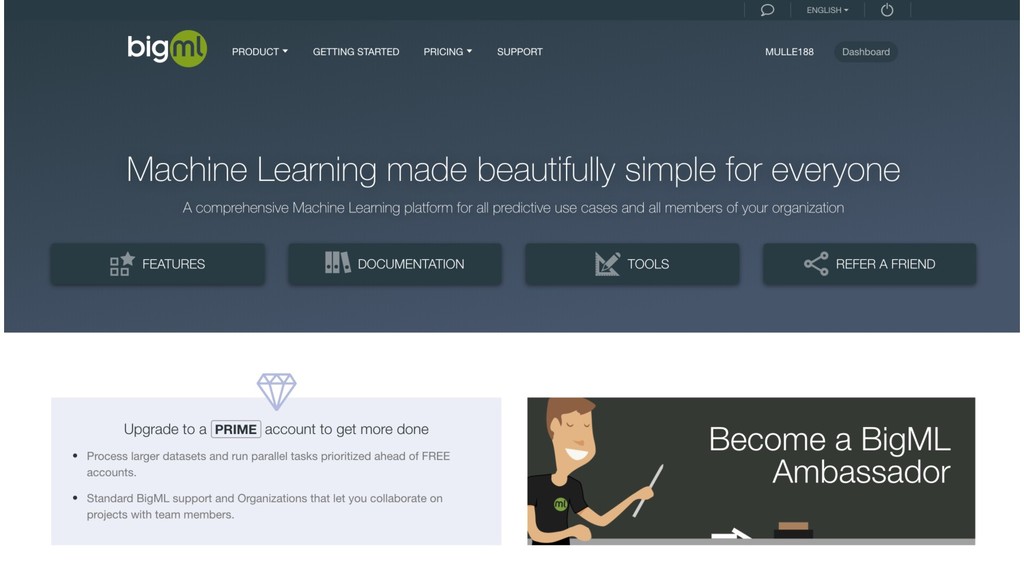
Big ML is somewhat similar. I typically use their platform to run some of the models that they have pre trained and pre built, and it's really nice and easy to use. They've got great educational content as well. Algorithmia is similar to Monkey Learn in that you can easily plug it into Google Sheets.
And what's really neat about this tool is that they allow you to play around with these models for free on the front end. So if you again, this will get your brain working as far as what can I do with this stuff? That content summarizer to build those meta descriptions, I thought of that by playing around here.
I came across one of their models called just content summarizer. And I thought, that's interesting. Why would someone want to summarize content? What could we use for that? And then I thought of meta descriptions. And I thought of all these other things. But that's kind of the inception point.
You get to play around in this space and start to connect dots together. And again, all of you are subject matter experts in your own right, and you will have insights into what could be applied to these models. So highly suggest you go check that out.
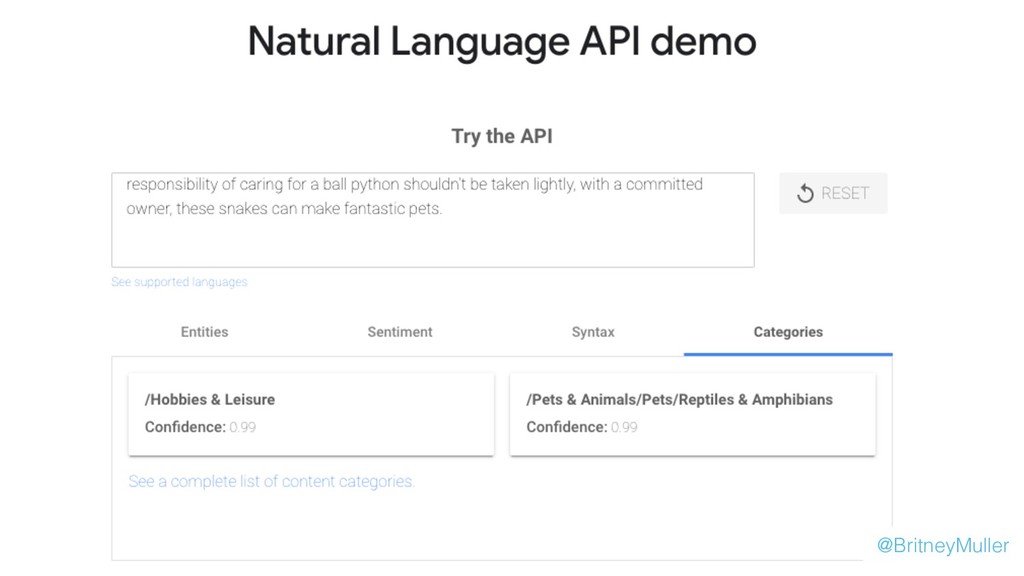
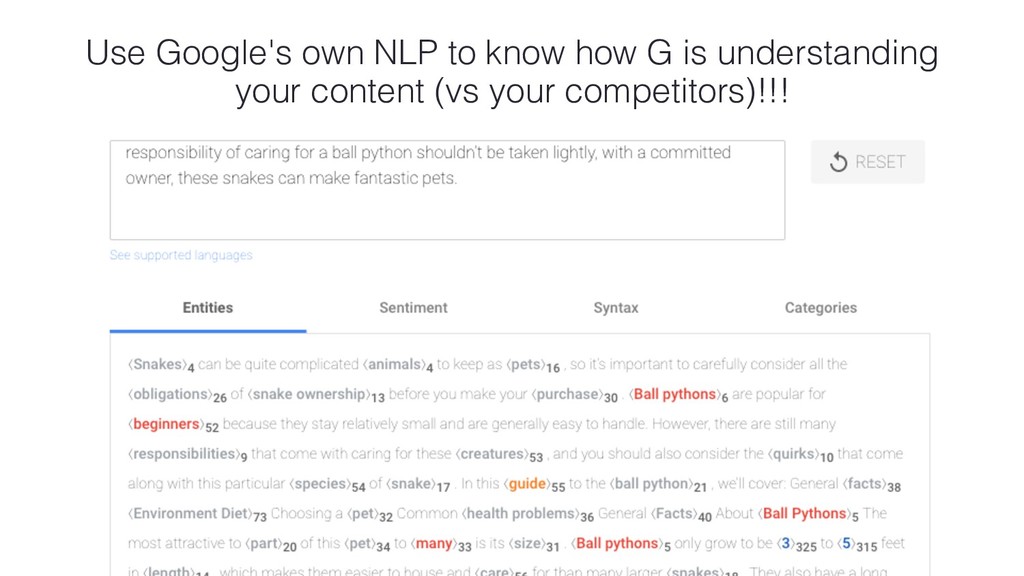
This is interesting. So we always talk about Google as sort of this *** ***** box, right, with their NLP and all of the algorithms. Their natural language processing is an API. You can literally import it, play around with it, see how it's categorizing your content.
So for any of you marketers, play around with this front end API. If you're at competition with someone else and you can't figure out why they're outranking you, why they're outperforming you, maybe just check and see what Google's NLP is categorizing you as.
I did this recently with Car Rental Company who is in competition with another car rental company. And the one who wasn't doing as well had three diluted categories, and their competitor just had the one car rental category. And it was very insightful. You know?
If you start to create content that specifies exactly what it is you do and makes it clearer for Google and for users, you could really see an ROI. It's really cool. It does entity extraction. You can see all sorts of neat things here.
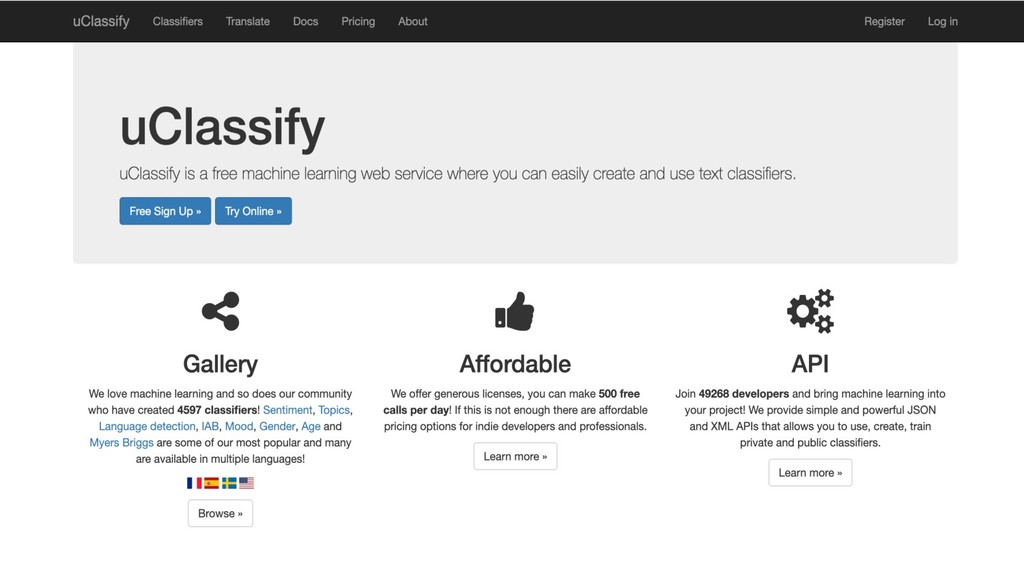
The sentiment analysis is somewhat interesting. You literally just get to see how it's taking in your content. And if you want to find it, you literally just Google Google's Natural Language API. And then scroll down the page, you'll see this. Cool stuff. You classify, I just found out about maybe twenty four hours ago from Russ Jones.
We were in a situation at Mars where we thought it would be really useful in this particular case to classify a couple million websites, a couple million backlinks, and see if there's any particular topic distinction between the majority of them. So it's really interesting.
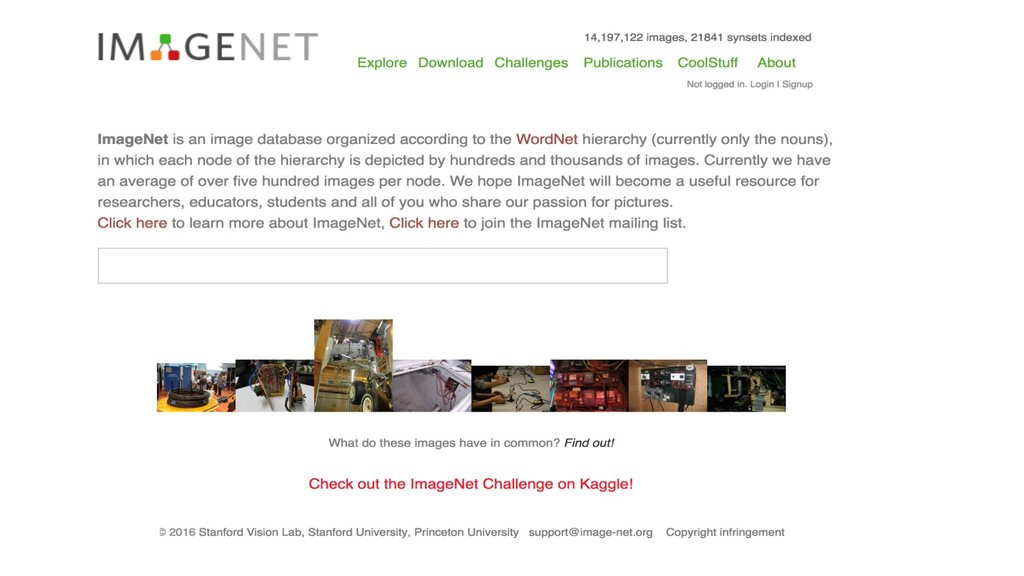
It can do powerful things like that. And there's all sorts of ways to use this tool as well. ImageNet is where I got those images of the duck and the ball python. Super easy. If you're trying to classify a particular I mean, you name it a particular animal, a tree, or whatever, ImageNet is the largest resource available to us in the world of labeled training data for free.
So you can just type in what it is that you want to perhaps classify, what it is that you perhaps want to see, And then you can bulk download these images and incorporate them into your model. You could also just take your own photos.
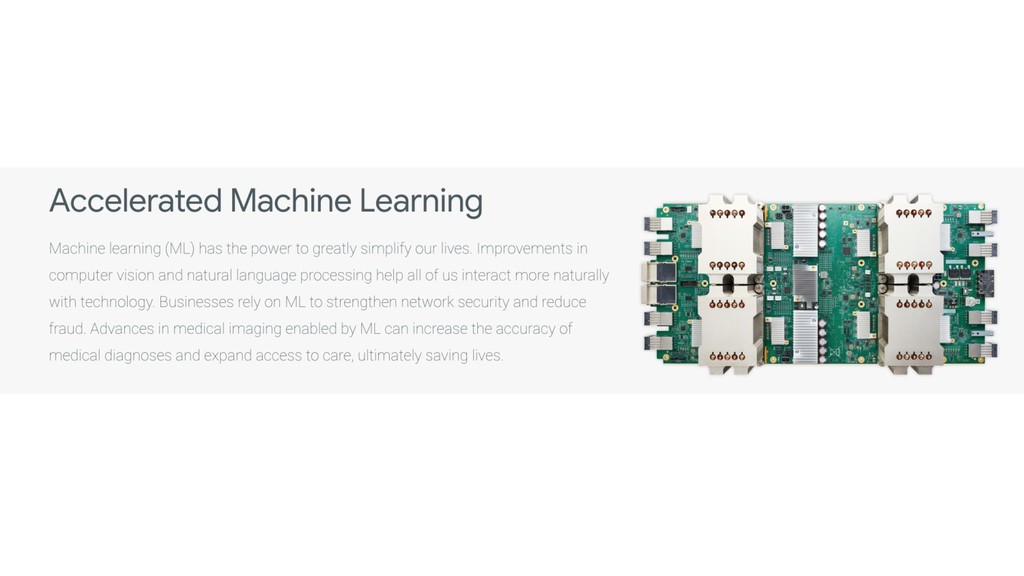
I always think that's interesting too if you start to get into this space. But this is a great way to shortcut that whole process. So the hardware is getting so much faster, so much more powerful. Right? We went from CPU to GPU to TPU.
And now we're attending these big AI conferences where they're talking about disposable AI. That's a dollar. And you can literally use it, throw it out. One example was a Lyft or an Uber driver, right, taxi driver, and it was on a piece of disposable AI connected to a camera.
And the camera was pointed at the back seat, and it could, without pulling privacy information to the cloud this is all running just on the device it could identify if any passenger left anything behind in the back, and it would alert the driver.
And if it, you know, if it started to break or get it's disposable. Stuff is wild, and it's just getting better and better and better. It's so much fun. So I'm so excited to think of you know, it seems like a silly application, but it could make that driver's life so much easier.
So I challenge you to think about the ways in which you could use it in your everyday life. I am completely allergic to selling. My biggest pet peeve is watching speakers sell products and things. But I want to just mention this super briefly and that I am so proud to be part of an incredible data science team at Moz where we get to play around in this space and innovate for marketers and for SEOs and that we do have some cool things coming soon if that applies to you.
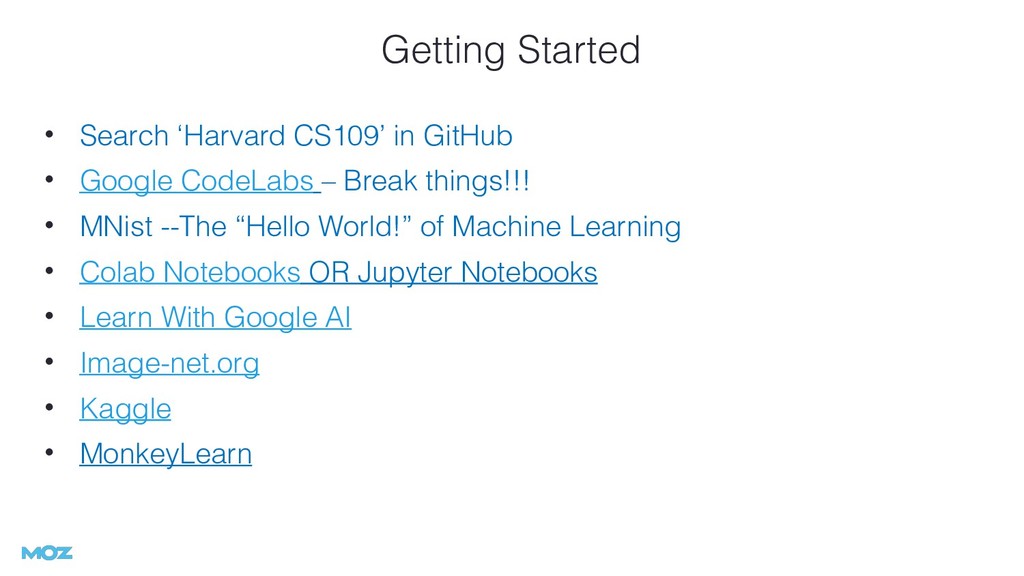
If not, don't worry. Getting started. These are some of the things I mentioned. Super high level type stuff. The MNIST is very interesting. I'm curious to know if that applies here as well. So the MNIST basically classifies handwritten numbers, and it's what's used in the US Postal Service to automate the sending of mail.
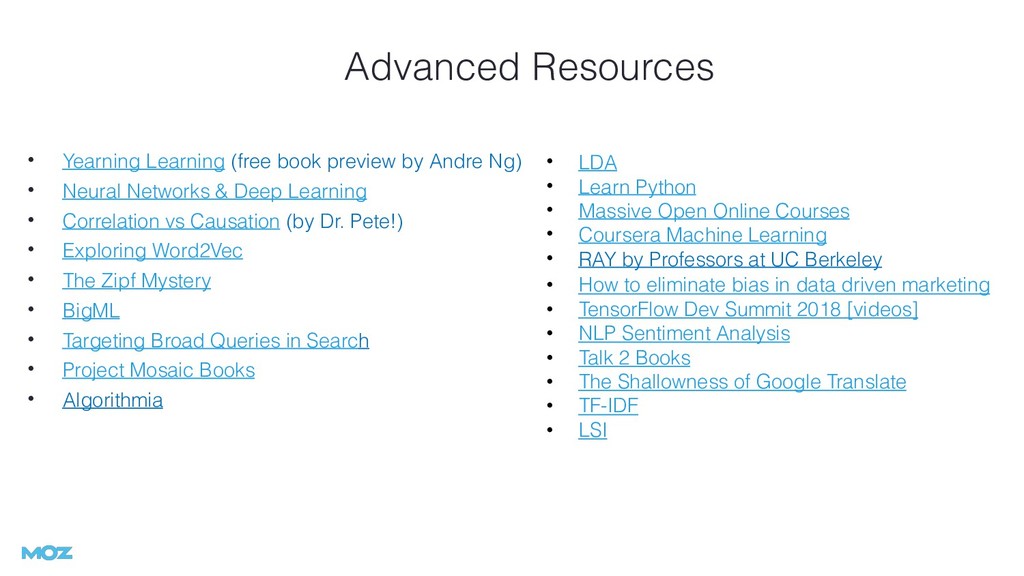
It's honestly one of the, again, the hello worlds of machine learning. It's really easy and fun to play with. Some of the more advanced resources are here. If you're not super interested in this stuff and you just are curious or in I suggest anyone check out this Zip Mystery.
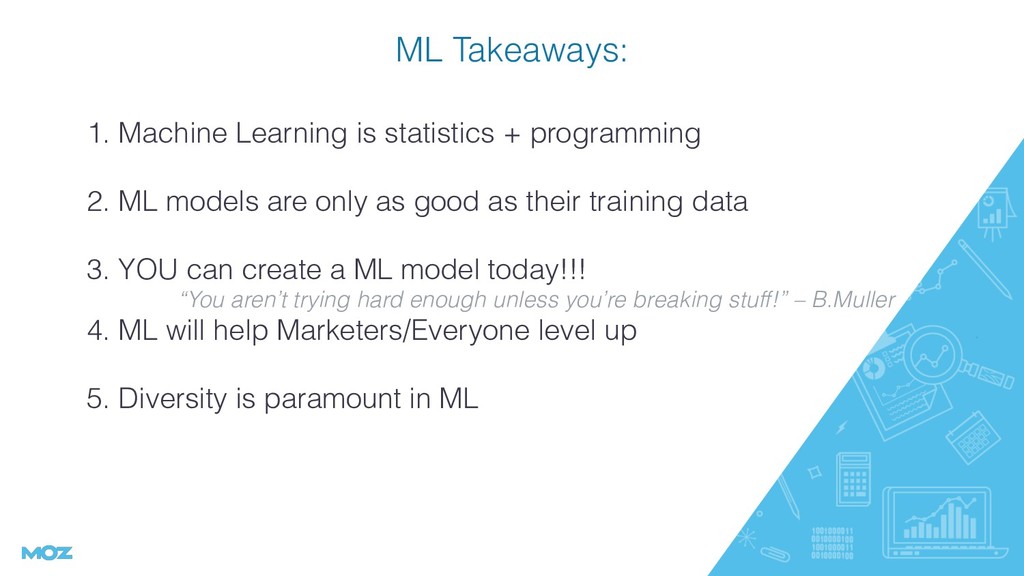
If you're bored or can't fall asleep one night, it's just gonna blow your mind. It's the craziest thing ever. This stuff is so much fun. So some primary takeaways I hope you can glean from this talk is that machine learning, a lot of it is just statistics and programming.
It's a lot more simple than we make it out to be. And that these models are really only as good as the training data. Any person in this entire building could create a model today if they wanted to. And if you're interested in doing that, if you're interested in employing some sort of simple model on your computer, come find me after.
I could talk about this stuff forever. It's so much fun. And I want you guys to get excited and play around with it, too. It's going to help all of us level up. It's getting so much more accessible. If you don't want to touch any programming, any code, it is still available to you.
It's still available for you to think about and to apply to different things in your life. And diversity is so, so paramount in this space. I can't express that enough. That deserves an entirely separate talk of its own. And it's a concern we have moving forward.
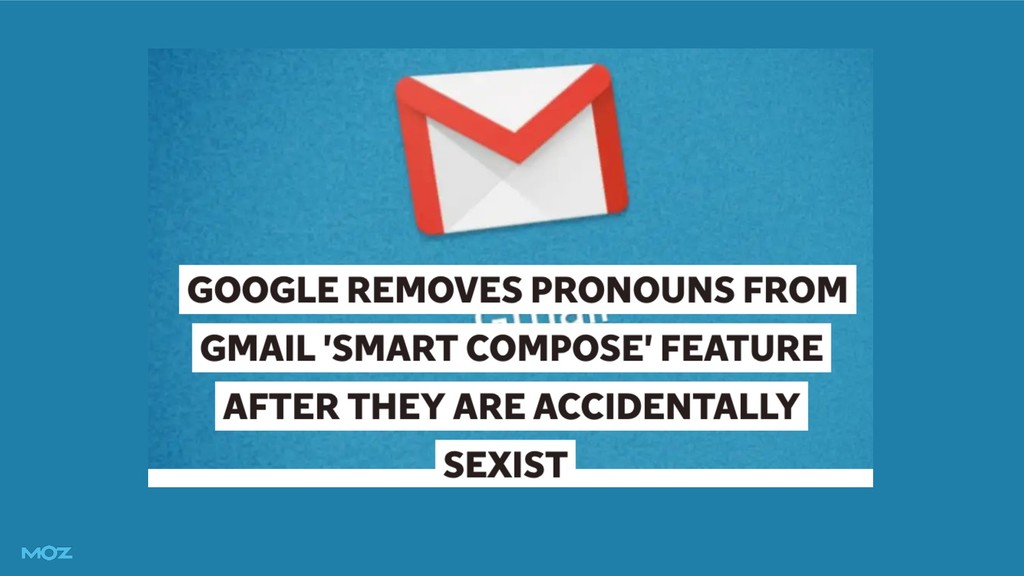
We see lots of models struggle with sexist and bias and hand dispensers that don't work for dark colored skin like car. It's crazy. We absolutely need diversity in this space, and there's people working on that. So that's so, so important. I'm really curious to hear and to see after this.
You know, what would you like to solve for? What are the things in your life that you would like to automate or to make easier? You know, and this, again, could be anything from a stay at home mom or dad to any of you that, you know, maybe deal with different things at your profession.
So that's it for me. Thank you all so much for having me. I'll see you guys after this. Right? Thank you so much.