The click is dead, according to some industry commentators. Whether or not that's true, we're entering a time where tracking the results of our digital marketing activity is more complex than it's ever been and it's only going to get more complicated.
In this session, Arianne will take you through what you need to know about privacy, browser ad blocking and talk about whether or not it's perhaps the nature of our campaigns that needs to change, rather than how we track them.
1 / 67 Use ← → to navigate
Auto-generated transcript - may contain errors.
Tap a timestamp to jump the video.
It's hard work following Aidan's slides. They were some really good looking slides. But I'm hoping this session will be a good companion piece to Aidan's, although I am going to start off by telling you that maybe everything isn't going to be okay. Because it's been a bit hard recently.
If any of you were in Chris's keynote this morning, you can kind of look at the state of the industry as we see it now, and feel, if any of you are in digital marketing in the room, quite responsible. You know, I've been doing this for thirteen years now, and I kind of look at where the industry's gone, how the Internet's changed, and I kind of feel like it's all my fault.
It doesn't help that sometimes I'll go to SEO conferences, and SEOs I know will stand up on stage, and they'll put me out in the audience and say, it's her fault. Her and people like her. So, yeah, you know, it's been hard recently.
But while it's been a period of crisis and change so far, there's actually a lot more to come. And so part of this talk is to try and prepare you all for everything that's coming down the horizon. This was something, this phrase, the click is dead, that I read in an article where the author was using it as an example of marketing hyperbole, how we love to say, this is dead, that is dead, you know, it's all broken.
But as I read it, I thought, well, maybe you just kind of have a point about things. Because in a world of increasing automation, where clicks are just not as necessary anymore for things like determining intent, what does that mean for campaigns? Microsoft, for example, through their advertising platform, you can run campaigns that don't use keywords at all, that uses behavioral signals and data to determine someone's intent and the performance on those is actually as good as keyword driven campaigns.
And we're also in a situation now where using clicks as a way of measuring tracking probably isn't going to be that effective for us any longer. So let's talk about why. And that's because our cookies are under threat. The click may not be dead, but cookies are very much in danger.
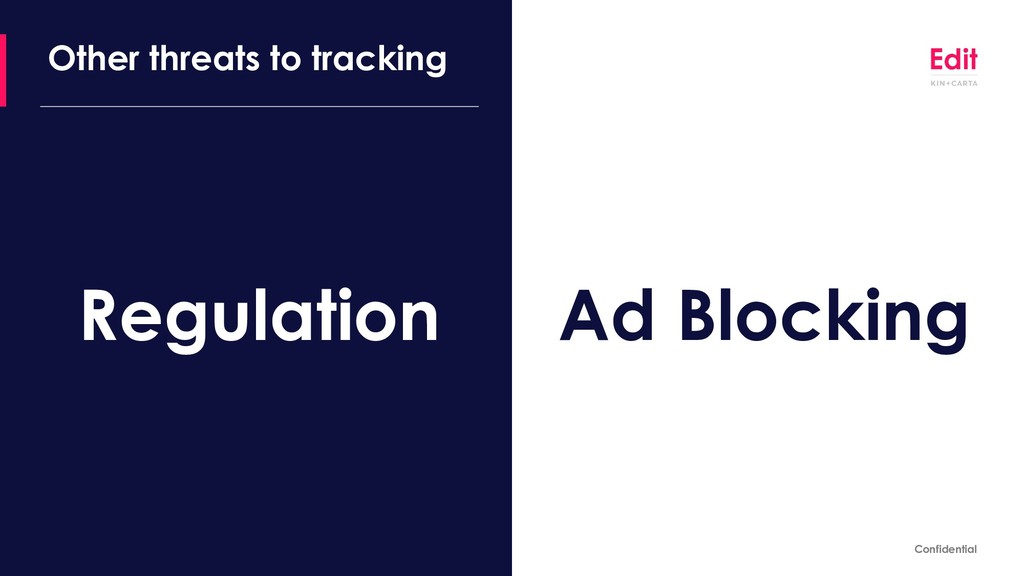
There's also a lot of cookie less solutions that people have been working on in light of some of the things that we're going to talk about. But the challenge that we have is even those aren't necessarily going to save the day either. Because we've got to think about regulation and we've got to think about ad blocking.
We've got these two twin threats coming up that are significantly shaping our industry and are set to do so even more in the future. So I'm going give you a quick primer on some of these. Obviously you should definitely go away and do your own research.
I've been told very specifically I'm not allowed to give actual advice for legal reasons, so you know, going to stray away from that. Nearly got in a lot of legal trouble earlier by nearly nicking some cake at lunchtime. It was on one of the stands, and I thought you could help yourself to these cakes after lunch as part of the food.
And then a man went, oh, that's five pounds please. And I nearly just walked off without paying, so that was awkward. Anyway, so while there's no easy solution to these challenges that we're facing, I believe that there are things that we can think about doing that are going to prepare us for the future, and hopefully go some way towards fixing some of the holes that we've dug for ourselves.
So, first things first, regulation. Everybody's favourite. Hopefully, you're all aware of GDPR. A bit late in the day if no one is, it's a bit awkward. But this has had huge impacts for how we store and process customer data. Even in digital, although the impacts have also been felt hugely in any sort of offline media such as direct mail, but GDPR has had a huge impact on cookies and how we handle information.
But the reality is that's only the first in a number of things that are going be happening that impact how we're going do our jobs. Next one is the e privacy regulation. And this for me is more worrying than GDPR. Now, at this point, I need to mention the Twitter poll that I did, and then forgot to put the results of in this deck, because I'm an idiot and I forgot.
But I wanted to ask people on Twitter who knew what this was? And I had four options of, yeah, I know what it is, and I'm prepared for it. Yeah, I know what it is, and I don't think it's going have an impact.
No, I don't think anything's going to change. And then the final option was, what's the EPR? Scarily a third of people ticked the what's EPR?' box. So that reinforced to me that there was a need for this talk and to give some information to people as to exactly what it is that we've got going on.
So the e privacy regulation is something that's going be coming down the pipe fairly soon. Regardless of the outcome of Brexit, it's probably still going to impact all of us in this room, particularly if we do any kind of business with the EU.
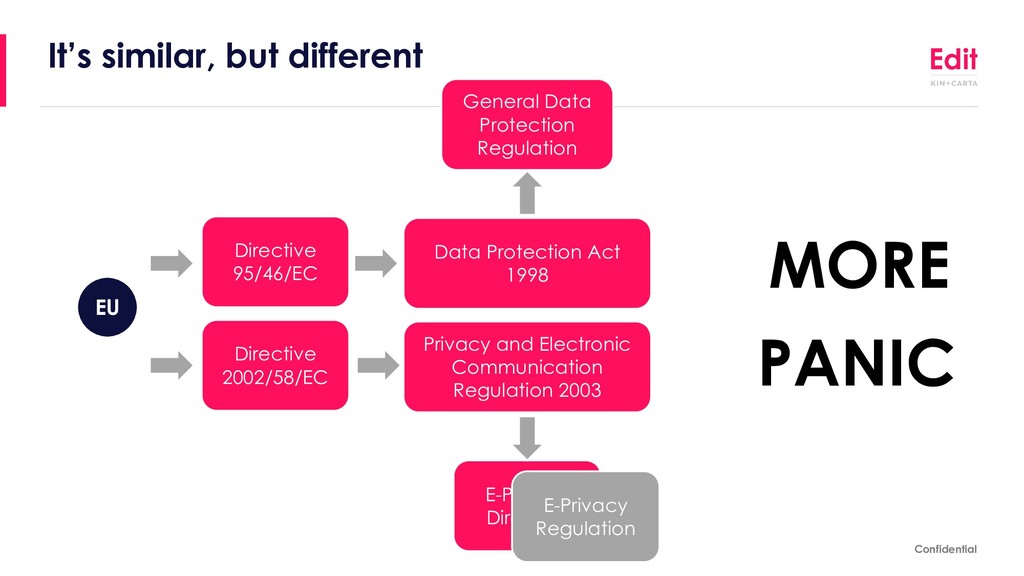
And when it comes to digital, it's going to be even more disruptive than GDPR. So a quick little legal history primer. We started off with these two regulations that became the Data Protection Act in 'ninety eight and the PECR in two thousand and three.
The problem with the PECR is the internet and the way we handle information and communicate has changed so much in the last fifteen years that it just isn't valid anymore. And so the top one got replaced with GDPR, which caused panic. I think Aidan kind of covered that off quite nicely, the panic that people have felt often off the back of the stuff that we've been dealing with recently.
And then we currently have the e privacy directive out at the moment. Now, because it's a directive, it's very much, oh, it would be nice if you maybe did these things. You don't have to obey it. It's kind of optional. A bit like the way do not track requests, which we're going to talk about in a second work.
It's very much optional. However, this, the e privacy regulation, when that comes in, that will not be optional, that becomes the law and you must obey. This is going to include cookies and it's going to include a lot of the cookie less alternatives.
There's going to be more panic. And this is one to really be worried about, I think. Scared? Maybe just a little? Ad blocking. Let's lighten up a little by talking about ad blocking. Ad blocking's fun. So I'm going to admit that I use an ad blocker for the reasons that Aiden described, know, showing some of the ads.
There are some sites that are just unreadable, unusable without an ad blocker. So I will admit that as someone who derives a living mostly from working in advertising, that I use an ad blocker. I used to get a little grief for that in my last job, like it was somehow hypocritical, don't know what the problem was anyway.
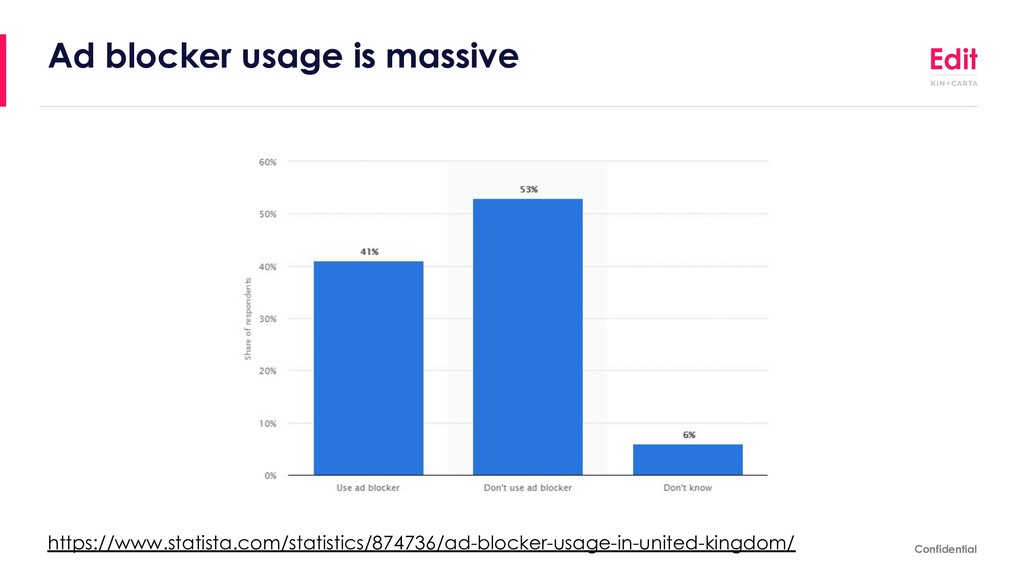
Problem is usage in the UK is growing, and this is a stat from last year, I believe, and that number is only going to increase as time goes by. Software, using a plug in in your browser or something on your computer isn't the only way to block ads.
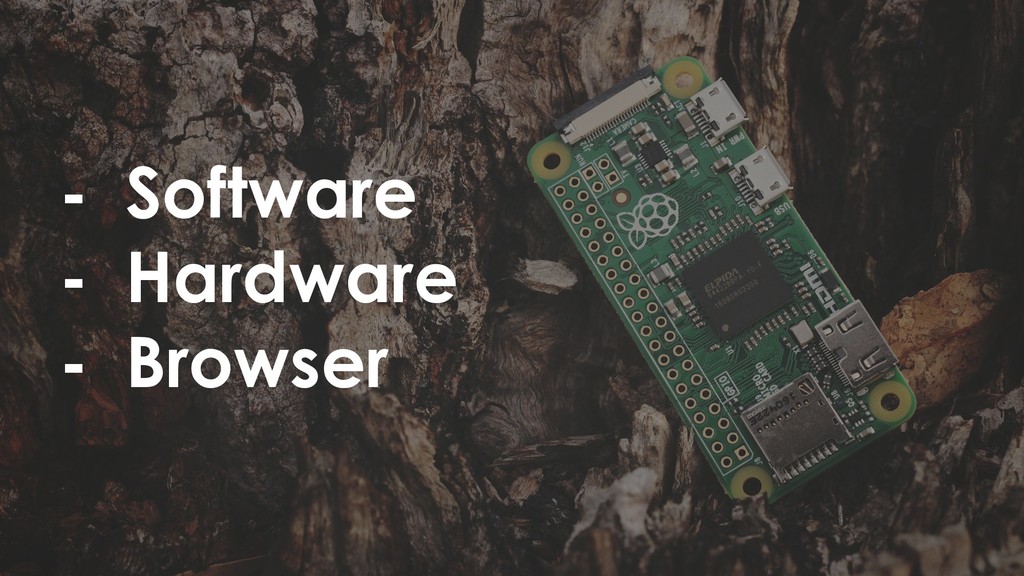
There's a whole number of other things that you can do that will block ads, will block trackers, will block any of this other stuff that you might not want following you about online. In terms of hardware, has anybody heard of a Raspberry Pi? Does anybody own a Raspberry Pi?
And I don't mean a piece of baking, mean a tiny little like credit sized yet microcomputer. This is a Raspberry Pi Zero, it costs five pounds You can put some open source software on this called Pi Hole, great name. And you can plug this into your network and stop an ad ever even getting onto your home WiFi for you to have to block it in the first place.
So you don't even need an ad blocker because there's nothing to block. The price of five pounds And then we've got browsers. So I'm going talk about browsers for a second because there's a ton going on with the browser market at the moment.
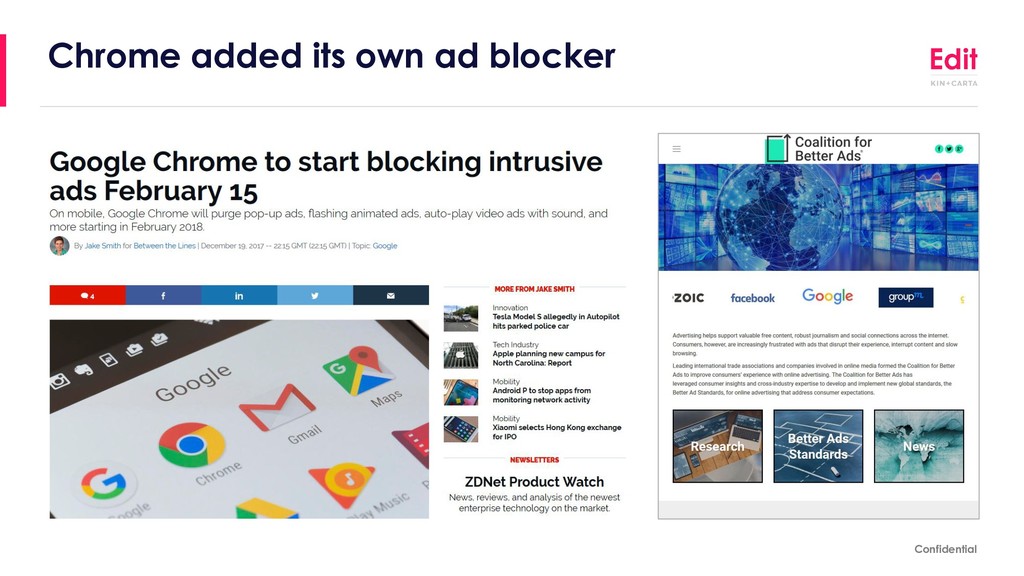
Browser market? Browser situation? Browsers. So Chrome added in its own ad blocker. Hilariously, Chrome have done this in conjunction with a company called the Coalition for Better Ads. So they're not going to block all ads, they're just going block the bad ones. It's probably not going to include most of Google's, because look at who's on the Coalition of Better Ads.
I don't know if you can see that. Google's on it. Oops. And they made some changes to Chrome a little while ago that actually meant a lot of the most popular ad blocker extensions that people use no longer functioned. So essentially, if you wanted to use Chrome, Google are gonna be, you know, judged during executioner when it comes to determining what ads you will and won't see.
Firefox. Any Firefox users in the room? I love Firefox. Your hand went straight up there. You must love Firefox. You work for Firefox? I'll admit that I used to use it years ago. I switched from IE and then Chrome came out and Firefox got so slow.
So I switched to Chrome, but now I've come back because it's amazing again. I actually donate money to Mozilla every month because the work they do is really important in maintaining a free and open internet. Anyway, that's a whole other net neutrality talk for another day.
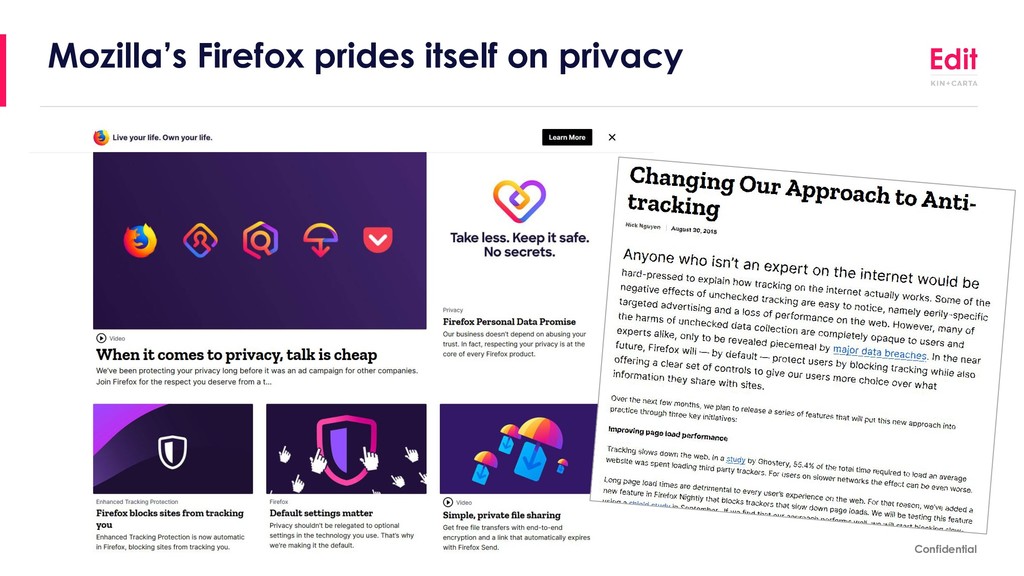
But they sell themselves on privacy. They have recently changed the way Firefox works, so that when you download and install the browser for the very first time, automatically by default, the privacy settings are flipped on. They don't think you should have to dig around and root around in the menu to turn them on to be protected, it should be very much opt out, not opt in.
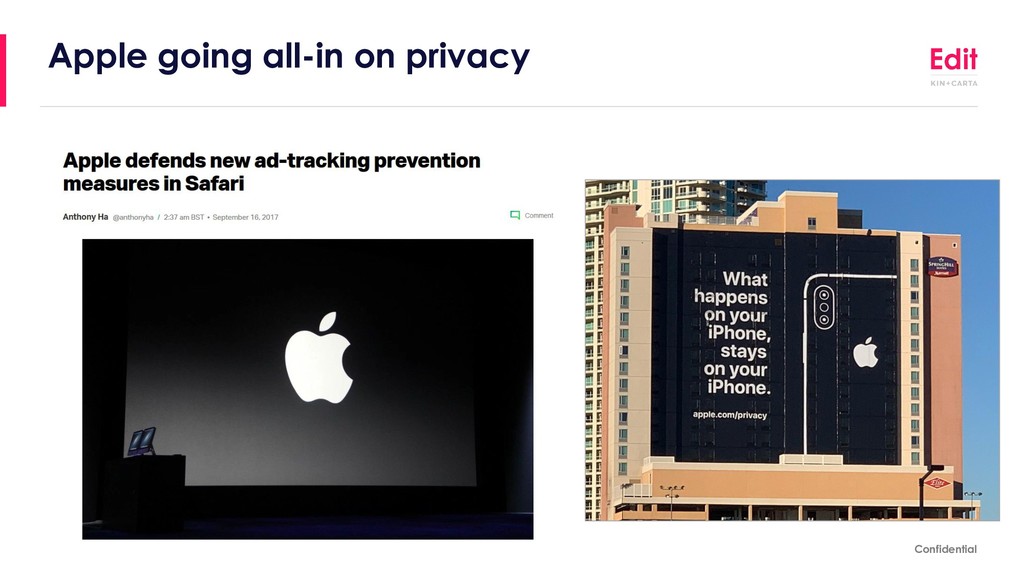
And they have a number of other tools and services that you can use that help secure your data and share things that you want to share in a way that is safe and secure. And we can't forget Apple. Apple are going all in on privacy, basically calling it a fundamental human rights, putting up big banners in Vegas at consumer electronic shows saying what happens on your iPhone stays on your iPhone.
Of course, hilariously, this was the same week that the FaceTime bug happened, and so nothing that happened on your iPhone was private if someone wanted to video call you. But they have had something in Safari called Intelligent Tracking Protection for a while, which causes huge problems for any of you wanting to target or track users who are based within that Apple ecosystem because you just don't have the ability to collect the information and to monitor them in the way that you would have done historically.
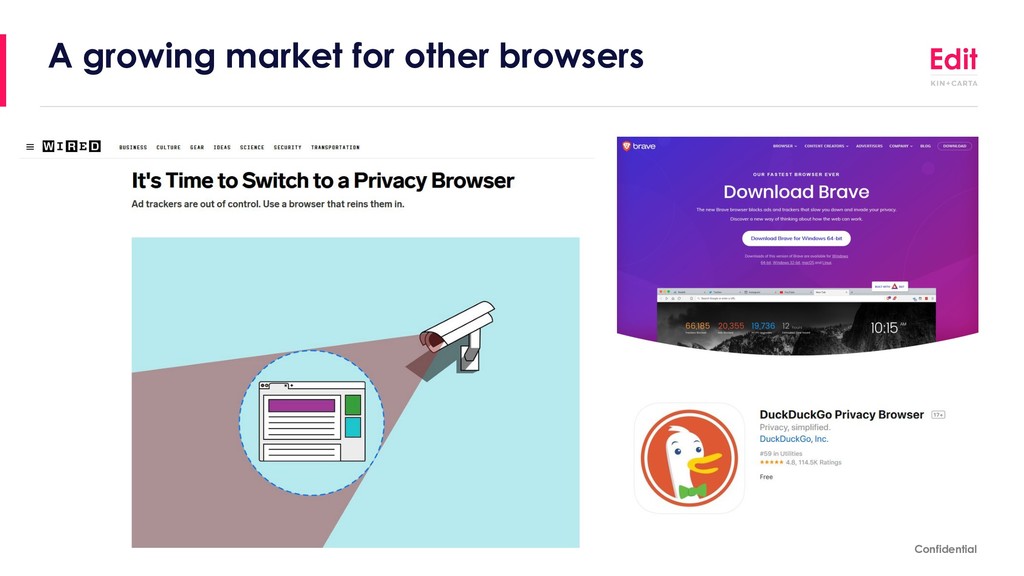
And there's other browsers out there too. So there's articles out all the time about what you should do if you want to protect your privacy, and one of the most popular alternatives is a browser called Brave. I don't know if everybody's heard of Brave or Vivaldi or any of the other browsers out there.
And it runs on Chromium, which is the same code that runs Chrome, so you get the advantages and the look and feel of Chrome, but without it being tantamount to a piece of spyware, as some people like to describe it. Uses the same extensions and works as is.
So that's something that people are talking about switching to, to try and preserve their data privacy. DuckDuckGo also has their own browser for mobiles. So as well as using their privacy focused search engine, you can use a privacy focused browser. And this ties in really nicely with a piece of technology called Do Not Track.
This is something that's built into web browsers and you have to usually go in and switch this on, although Firefox now has it enabled by default, and it sends a request to websites saying, hey, I've got do not track turned on, would you please mind kindly not tracking me?
And the challenge with this is a website can go, now you're alright, I'm going to track you anyway. They don't have to respect that request. Now, under EPR, they're going to have to respect that request. And if you have do not track turned on, they're not going be able to track you.
And so in a world where browsers by default are having these settings turned on and people buy new devices and they download new things and the settings have to be turned on, we're increasingly going to have a pool of people that we can track that's shrinking in terms of the permissions and what we can do with the data.
So this is gonna have huge impacts for tracking and attribution because how are we gonna be able to track without cookies or any of the other methods that we've used for the last, you know, certainly fifteen or so years that I've been doing this?
Well, there are ways we can track without cookies. One of them is called browser fingerprinting. The more research I did for this talk, the more terrified actually I got by what browser fingerprinting is and what it represents. It turns out that you don't actually need cookies to track people online.
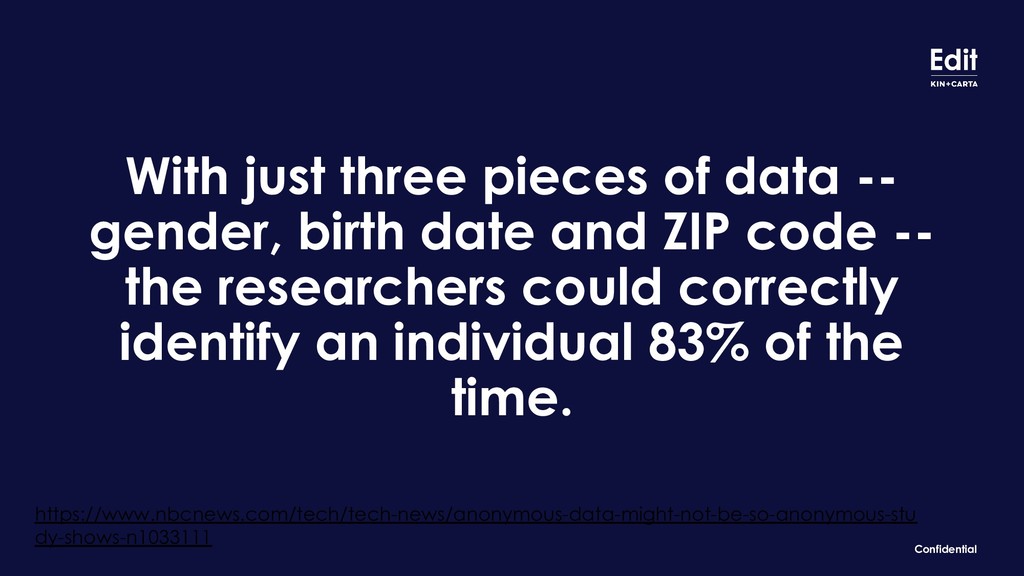
You can track people with a surprising degree of accuracy, with a surprisingly small amount of information. For example, this piece of research done by, I think it's NBC News, with three facts about someone, so their gender, their date of birth and their zip code, they could identify someone eighty three percent of the time, and that's in the US.
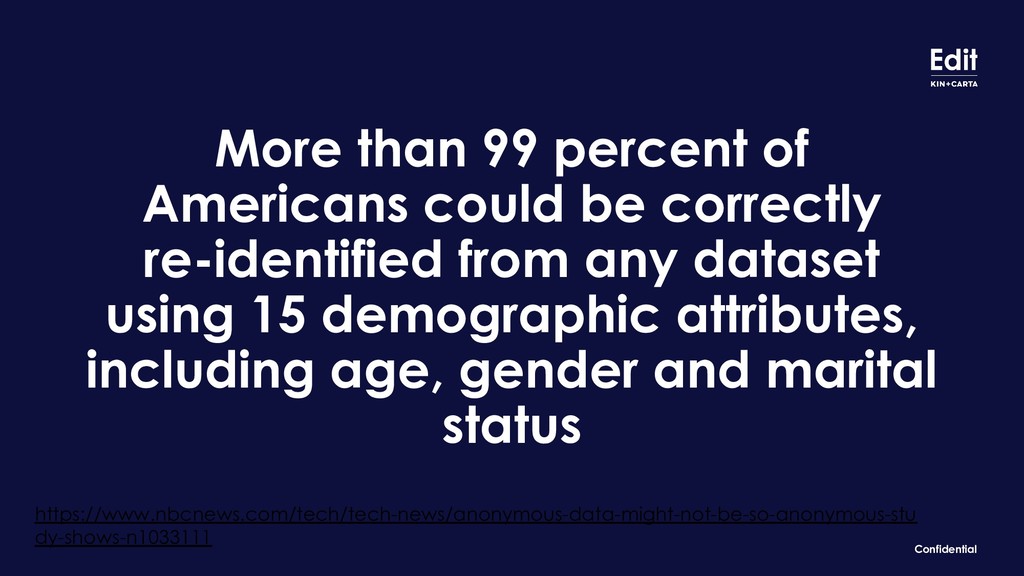
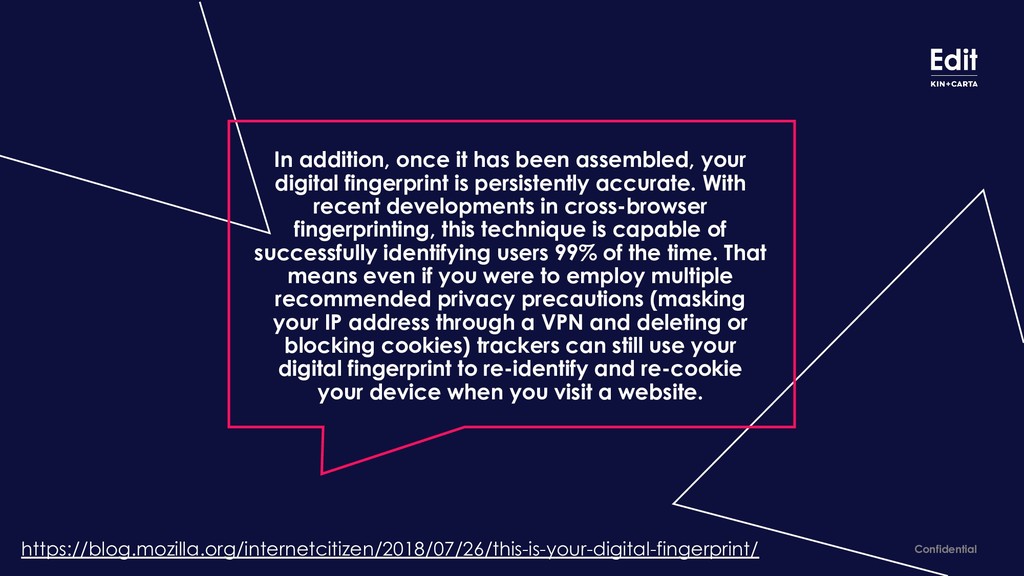
In the UK, a postcode covers a much smaller geographic area than a zip code, so in theory, you could identify even more people with just those three pieces of information. With fifteen pieces of information, you can identify someone ninety nine percent of the time.
And think how much information we've volunteered to sites like Facebook and Google over the years that they know about us. They don't need cookies to be able to track us online. So this is where browser fingerprinting comes in because browser fingerprinting is able to pick up a load of different signals that your browser puts out.
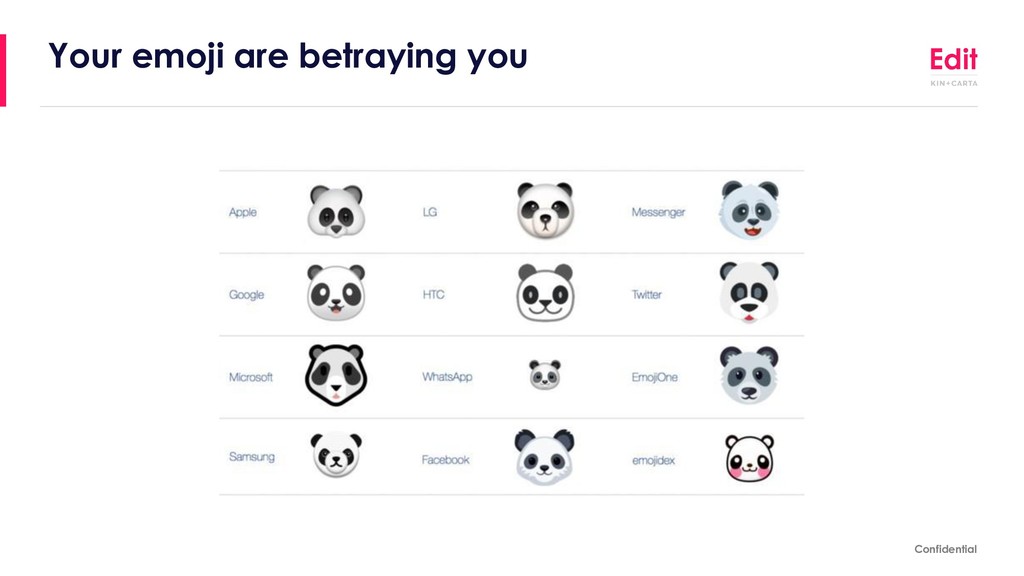
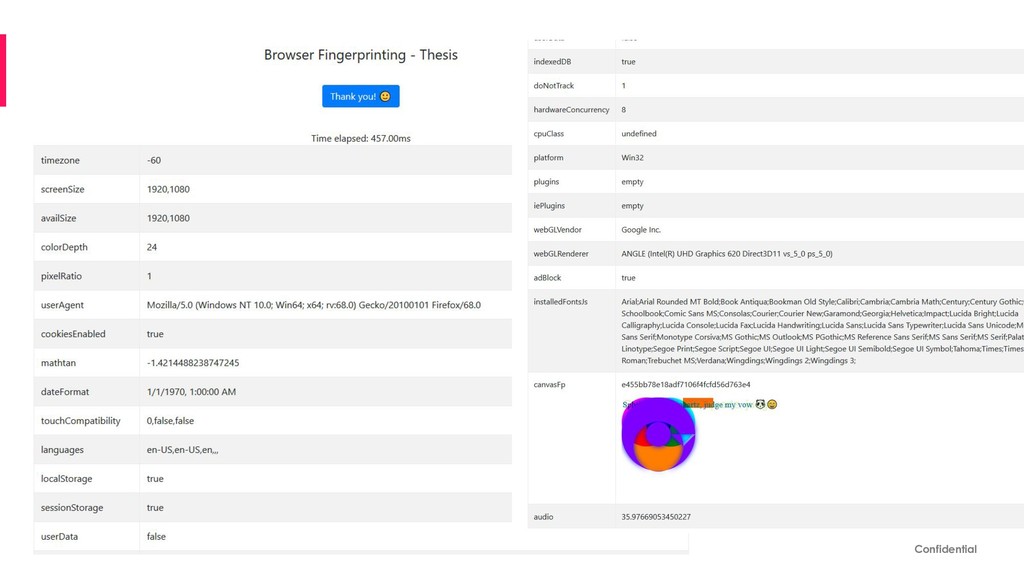
Even your emoji. Your emoji can be used to track you online. It's probably not a sentence you thought you'd ever hear anybody say, but they can. So you have all of these different fields that you can track here, and I appreciate this text is small so you're not going to be able to see but it looks at things like am I using an ad blocker?
Yes I am. What platform are you on? I'm on Windows. Are you using a certain screen resolution? And it tracks all of this information, what fonts you're using, even the emoji you're using right there on the end. That all gets collected and stored by the browser and used to create a unique fingerprint of who you are.
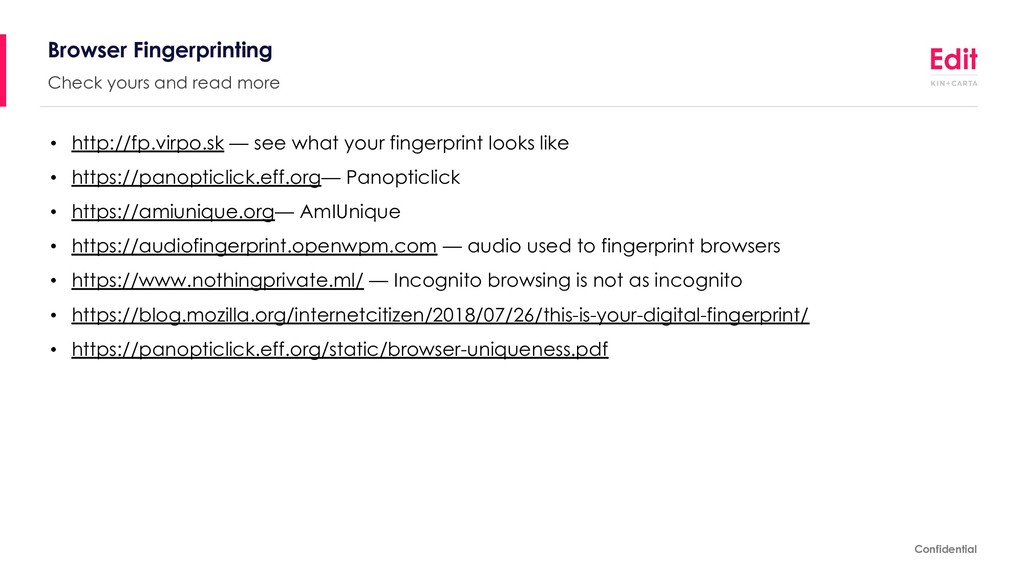
The terrifying thing about this, it's really easy to go and get your browser fingerprint checked. There's a bunch of links in the appendix where you can go and do this. I've just tweeted out a link to them actually. I say just. I scheduled a tweet, which hopefully went out.
So if you put firstnamelastname on Twitter, because I forgot to put my Twitter handle on my slides, you can get a link to the slides and follow the link to the checkers. But you can have a look at your fingerprint and chances are it's going to be unique.
And the real scary thing about browser fingerprinting, as elaborated on by this quote which is quite long, but what it essentially says is the challenge with browser fingerprinting is if you're using a VPN or an ad blocker, it doesn't matter because you can still be tracked.
It doesn't ensure your privacy. Your browser fingerprint will supersede all of that. So when you think about the democratising power of the Internet, and I think Chris talked this morning about movements like the Arab Spring and Me Too and how important things like social media and the Internet have been to those, in companies, countries where people don't have the ability to speak as freely as we do here.
Think about what that means for democracy, if people can't speak out in anonymity knowing that they can be tracked. Huge implications for what that means for the online ecosystem and how it develops. However, there's good news and bad news. The good news for consumers is that browser fingerprinting is covered under EPR, which is bad news for us as advertisers.
So where does it leave us? Well, we're going to have to change things up. I'm a big believer in jumping before you're pushed, and I think we've got the opportunity now to figure out what we want the future to look like and take our destiny into our own hands before we're forced to by the threat of regulation.
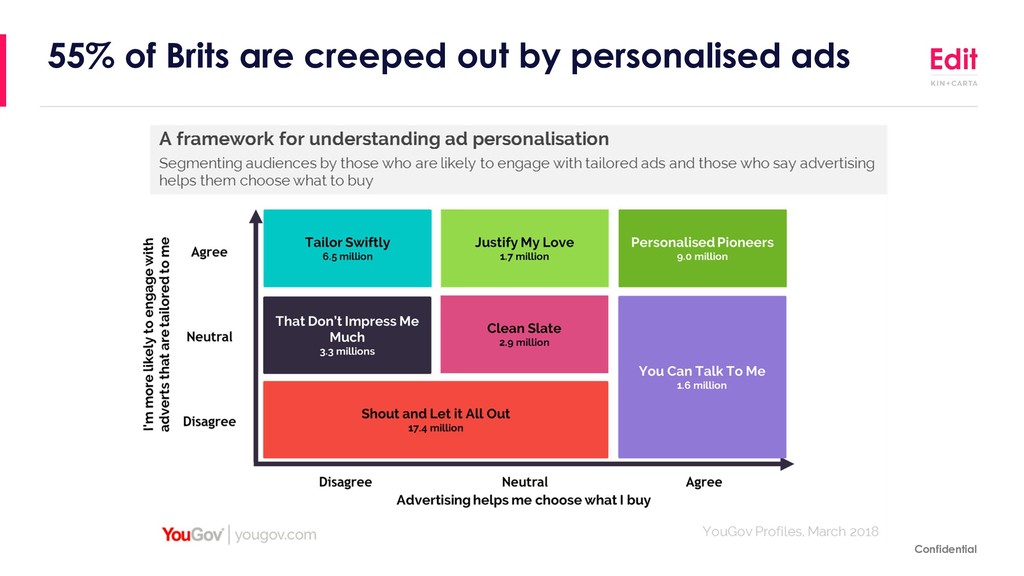
This is why you see Mark Zuckerberg coming out and saying, Here's four ways you should regulate Facebook. Hoping that they'll take him up on his suggestion and not come up with anything more punitive that might not be as beneficial. Because the reality is people think personalised ads are really creepy.
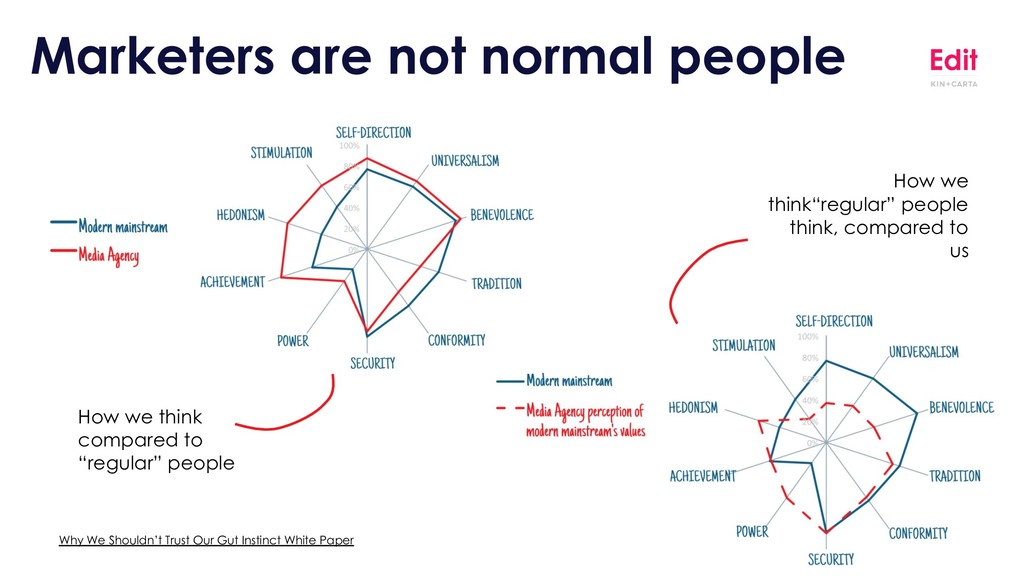
I'm a marketer, I quite like them because I'd rather have a personalised ad that was useful than a random crap one. But as I'm going to show you in a minute, I'm not a normal person. None of you in this room who work in marketing are normal people.
I hate to break it to you, but you're not. And most people don't like personalised ads. And it's really difficult because we've built an internet that runs on data. It runs on advertising. That is how we fund this Internet machine that people don't want to pay for because they've never had to pay for it.
And how we solve that problem is again a topic for another day. But if you think about digital, and I think did you use the word Aidan Bear Trap? That we have this problem where part of what makes media so great is that it's so trackable, but we've also made a rod for our own backs because it's so trackable.
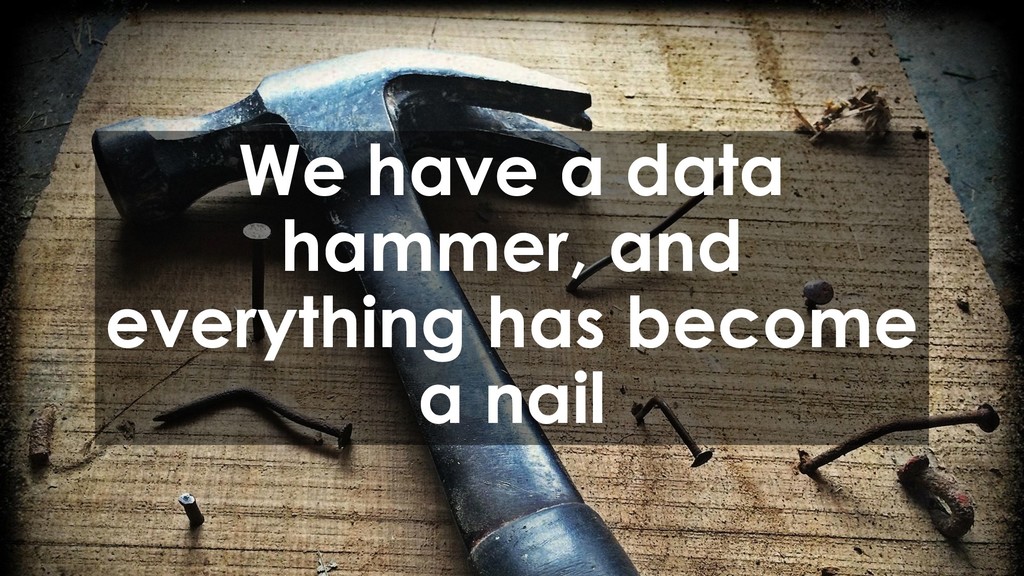
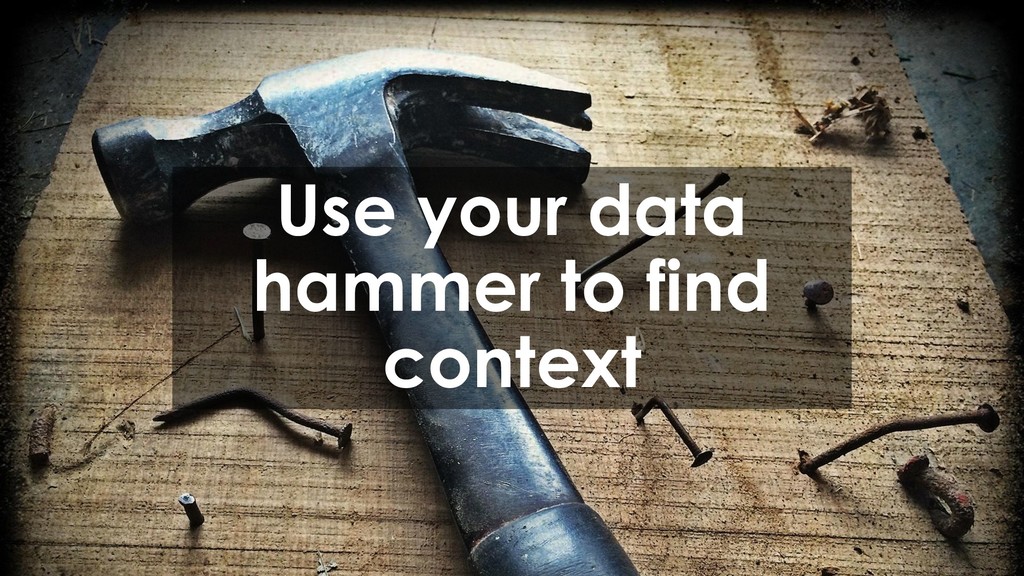
We've found ourselves in a situation where we have a data hammer and we treat everything like it's a nail. Every problem gets solved with data, whether it's the right solution for it or not. And this means that our campaigns are now more personalized than they've ever been.
They use more data than ever before. But in some ways, I also believe they've become impersonal as a result because you can have your forty million ad variations, but no one's actually thought about the detail or the, you know, the human context that goes along with that.
It's just data you're just feeding the machine. And we've probably wound up in this situation. Right? We probably once saw ourselves as the hero, but the reality is we're now the villain. It used to be a badge of honor to tell yourself that you worked for Facebook or to tell people that you worked for Uber.
Right? But now if you tell people you work in digital marketing, you probably get a look similar to what you would tell someone, I don't know, if you were a debt collector or, I don't know, something quite unpleasant. It doesn't necessarily have the same kind of cache anymore, but we've done this to ourselves because in terms of what we've done with the industry and what we've done with data, we've turned ourselves into the villain.
We had great power, and we haven't used it responsibly. And I think it was Chris who used this quote this morning as well. But the reality is we haven't. So it's not really any wonder that people now feel how they do about advertising and about data and privacy.
And it's funny because even with the data, and even with all the advantages that we've had, I still often feel like this. When I worked client side, we'd be in situations where I don't know if any of you have ever experienced this, where you get to see your brand colleagues, you know, who do fluffy stuff, spend millions of pounds on a TV campaign.
That doesn't actually have to deliver any real results. Just branding, just eyeballs. Right? That's easy. But if I want ten percent of that number to spend, I either have to track it to within an inch of its life or promise some insane ROI because the whole point of digital is that it delivers an ROI.
Right? Which isn't true because not all digital campaigns are created equal. But it means that even with all those data advantages, I'm sometimes feeling like I'm there like, little over with my bowl going, please can I have some more budget? And the reality is that we're probably not going to wind up being the king of marketing.
Not now with the changes that's coming down the pipe. Because the way that we use data is going to be constrained. If you take away our unique selling point of data, where's that going to leave us? So the reality is moving forward, we may only know our start points and end points for our campaigns.
We won't know the detail of what happens in the middle, we won't know maybe the channel mix, the specific journeys, you know, in terms of the way attribution works. It's going to be much more like traditional media. You're going know your inputs and you're to know what came out the other end.
And you're going to have to use a mix of art and science to try and draw a relationship between the two. And so we're still going to need data for that. Data is still going to be important, but it's not going to be the overriding priority that it has been.
When it comes to understanding who our audience is, what motivates them, where they are, what their problems are, we're still going to need data, but we're just going to have to start using it in a different way because the way we've been tracking and targeting people is just not going to work.
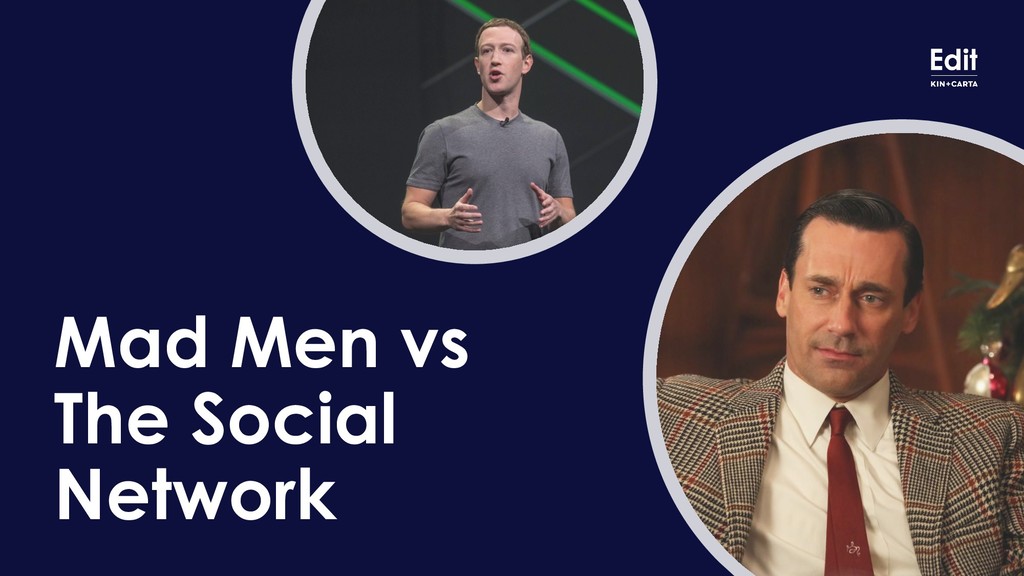
So what if we change their approach? So I want to give a shout out to a talk that a friend of mine did last year called Mad Men versus the Social Network. And what this talk was, he talked about the fundamentals of marketing and how much of that knowledge that we might see as old fashioned still holds true today.
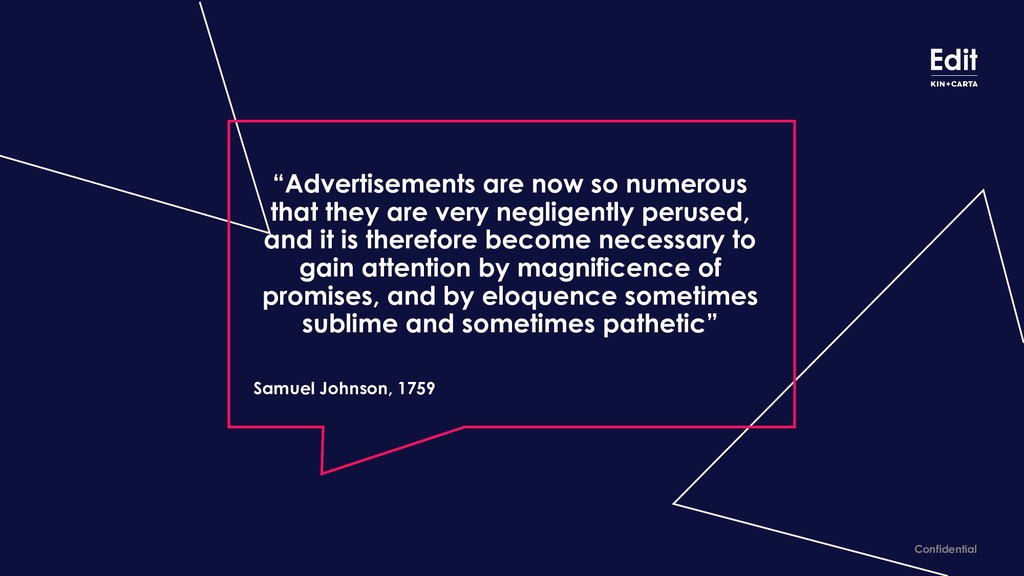
And this is a big quote, so I'm going to summarize. It's a quote that basically says, there are so many ads that people ignore them, and so companies make increasingly more mental claims to attract attention. That's two hundred and fifty years old. And that same attitude to advertising from both marketers and consumers is still true today.
That's two hundred and fifty years of marketing. You know, we haven't changed that much. And the reality is in many of us in digital, including myself, I kind of fell into this career with no formal training. I've always seen digital as being somehow superior to the rest of marketing because it was so, you know, ROI focused.
But the reality is it isn't. It's not actually better. There's a lot that I can learn from my marketing colleagues because really it's all just converging, it's all just becoming marketing. Consumers don't view it as separate, and so there's a lot we should look to learn for traditional approaches.
And back to my earlier point, marketers aren't normal people. This is part of the problem. We work in an industry that's moving at a thousand miles an hour, and sometimes we think that people want to move and change that quickly. But the reality is that they don't.
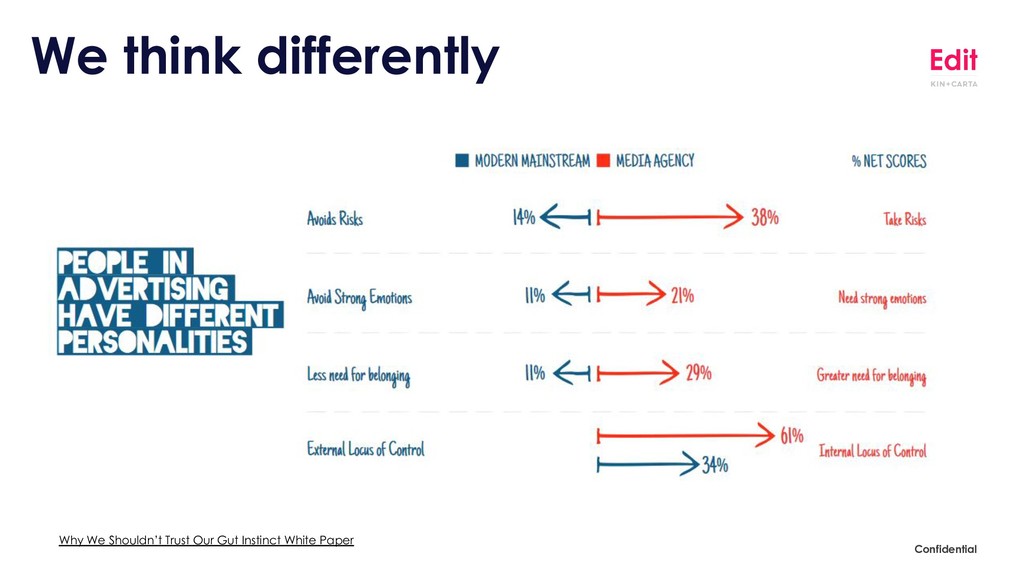
This is a chart that maps how people actually think versus how we think people think. And there's a huge difference there in terms of how people actually think and feel about different issues. Fundamentally, we do think differently. And so we are not the best judges of what is a good marketing campaign for the average person.
Mark Zuckerberg might think that people want personalised ads because he does. But if you go out and you ask people, the reality is they prefer no ads. But again, we've built an internet that runs on ads, so what do we do? Because people just don't evolve this fast.
That earlier quote proves that. And so I think as a result, sorry, a very real chance in light of this, that what we've been doing is focusing on the wrong things with our campaigns. This is a really creaky spot. I noticed it when you were on here.
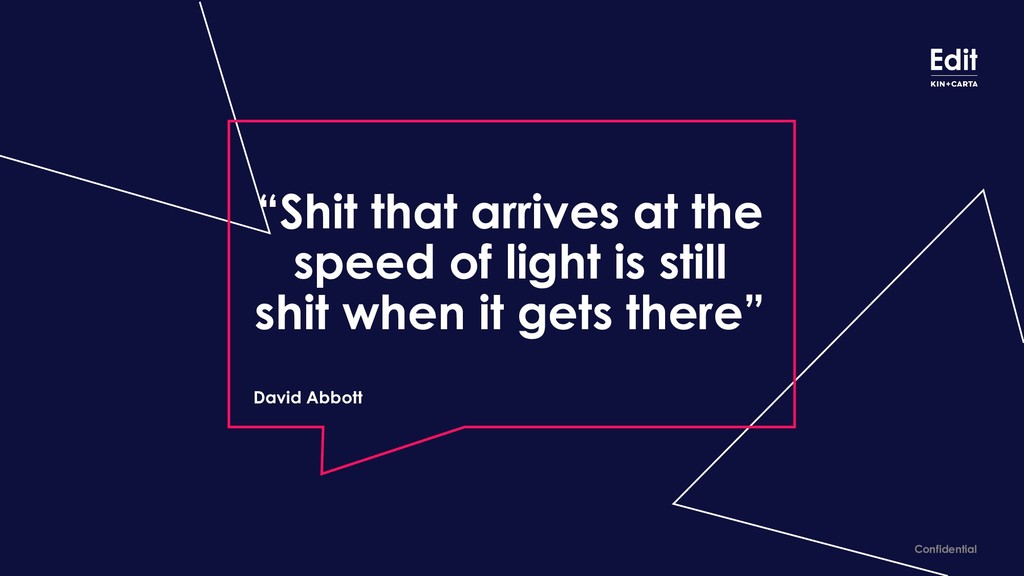
I'm going to not stand there. Now it's all creaking. Just gonna here we are. Just gonna stay here. So I think there's a very real chance that we've been focusing on some of the wrong stuff. And there's a great quote, gives me permission to swear on stage, **** that arrives at the speed of light is still **** when it gets there.
By David Abbott, very famous man in the world of marketing. And what this ultimately means is, it doesn't matter how good your tracking and targeting is, because if your message is crap, or your product is crap, it's not gonna matter. As Aidan said, you've got to give people a reason to be in their lives.
What problem are you solving for them? It doesn't matter if it's been brilliantly targeted and perfectly tracked. If it's crap, it's not going to work. Can't believe I've got to put a poo emoji in a slide at conferences. Great. The other reason I think we've got problems is this was a survey done earlier this year that analysed what people wanted to spend time on in their marketing roles.
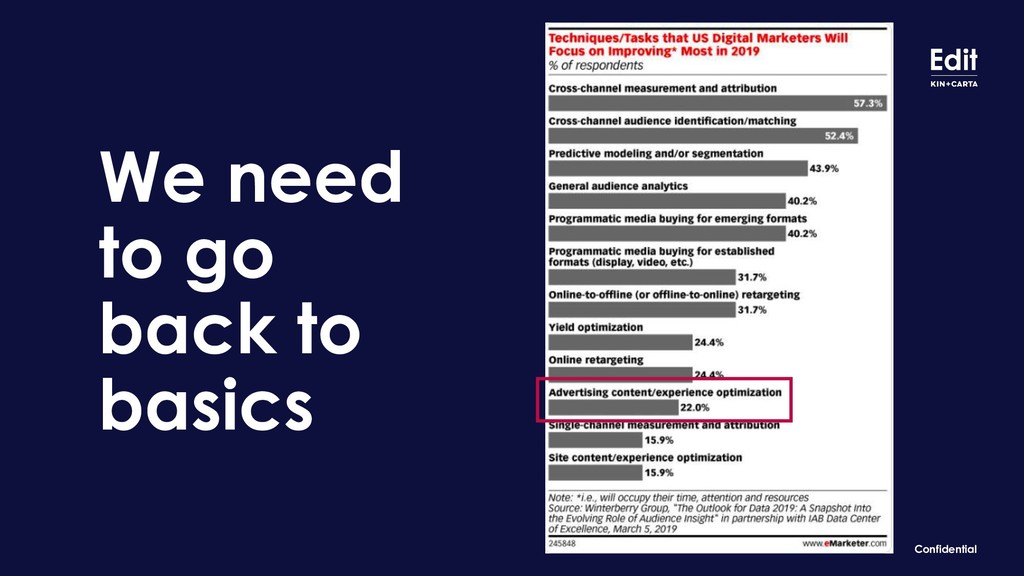
And the top two, there's a huge amount of people, over half of people, want to spend more time on cross channel measurement and attribution, and audience identification and matching. So again, data, data, data, and that's fine. But only twenty percent of people wanted to actually spend time on the advertising content or the experience.
So the message, the bit that's important, the bit that has emotion, bit that moves people to do something that they then post rationalize after the fact. The only emotion that everything we do with data is likely to elicit from people is anger. Right? And that's not where we want to be focusing.
We should be spending more time on the message, and That's something that in digital, we've probably never done. All too often, the creative is just the afterthought. We spend more time focusing on the tracking and the targeting, and then, oh yeah, I suppose we should throw a creative together.
Let's just build something in paint, or we'll get a studio to run up a GIF. Right? And thankfully things are beginning to move on, but the message has never been the focus that it should have been. So what are we going to do if we're not going to be hyper targeted instead?
What's the alternative? Context. So a few people have mentioned it today already, which is good because it'd be dead awkward if I had to get up here and contradict everything that Aiden just said. Though we've been having an awkward off today, it's been quite fun.
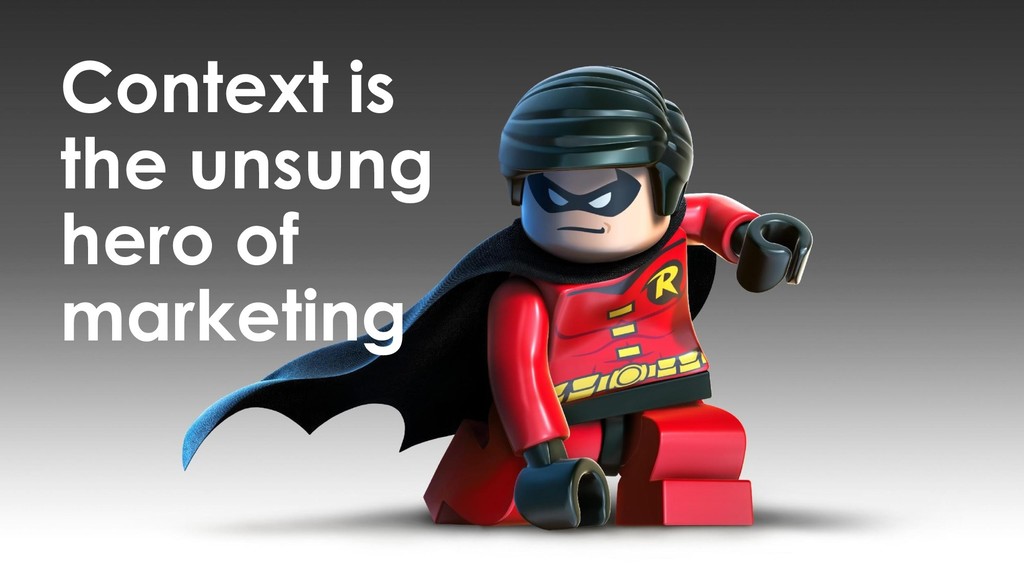
I think I'm winning. Am I still winning? Well, at one point. And the reality is context is the unsung hero of marketing. Little Robin picture there, little Lego Robin. Because the reality is it's probably not the hero we deserve, but it's the hero that we need right now.
The reason context is so important is because we have these tribal lizard brains. Kirsty, I think, talked about this in her session that we crave connection to people. We want to feel part of a group. It's part of our evolutionary desire. And so we don't exist in a vacuum, and yet our targeting treats people as if they're individuals living in a vacuum.
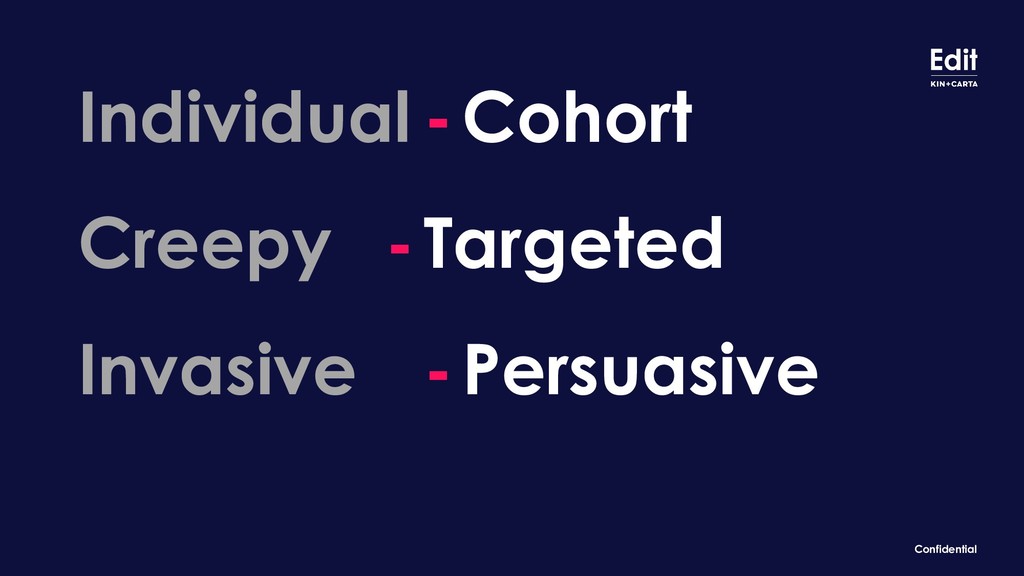
We ignore everything else that goes on in this, and there is a huge middle ground between broadcasting to everybody and targeting individuals. And that's the area that we should be looking to focus on. Because hyper focused targeting can be so impersonal, and it can forget all the other things that make context important, you know, the situation that someone's in, how they might be feeling at a given time, all these other things can help make people receptive or unreceptive to what we want to say, even if they are the right person to be targeting.
And so context helps us avoid some of this. It helps us to be targeted and persuasive, but without being creepy and overly invasive, which isn't something that anybody wants. And the reason things like influencer marketing exist is because of the power of tribes.
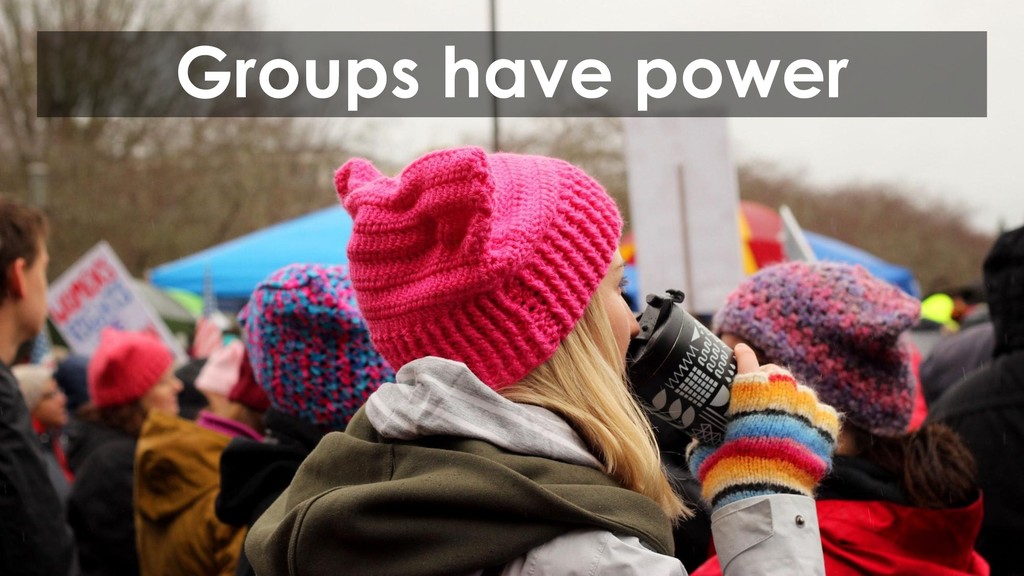
People like to identify with something, they like to feel connected. And against the point that Chris made this morning, the groups have huge power. Things like the Me Too movement, you know, the Arab Spring, Black Lives Matter, they work the way they do because groups are so much more impactful than individuals.
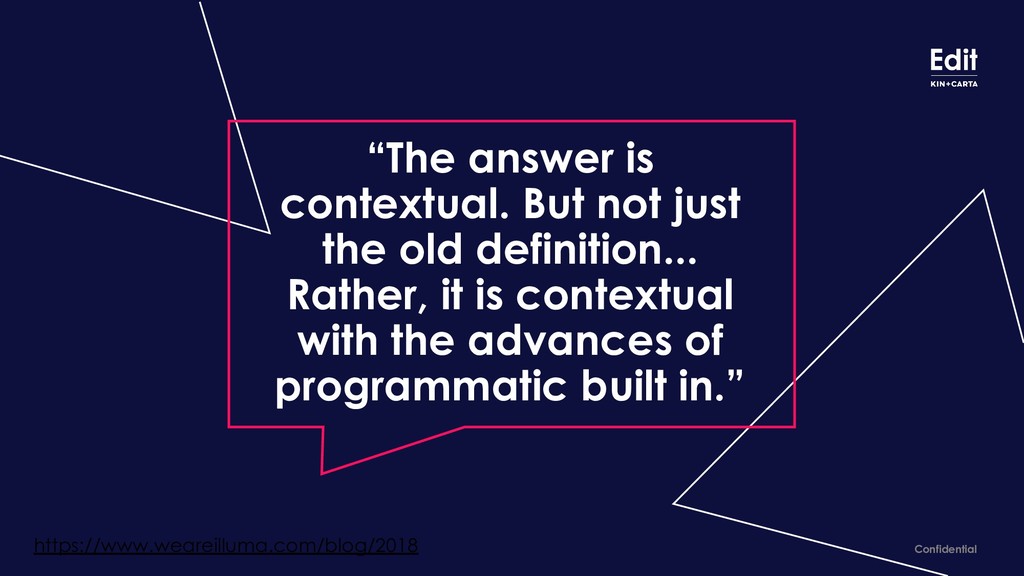
If history has taught us anything, we know that to be true. And so this is a really interesting quote. I think it's by someone at P and G, but they're talking about the way that the industry needs to move, and they talk about contextual.
But essentially, is contextual, Jim, but not as we know it? You know, it's contextual with all the benefits of programmatic, The ability to still apply some data and to use some targeting to be smarter, but without going as far down that rabbit hole as we have been.
And the interesting thing is that you don't actually have to sacrifice anything with a contextual approach. It might feel like I'm asking you to give so much up, but you don't actually need to. The reality is when you look at the results, it's actually more about what you stand to gain.
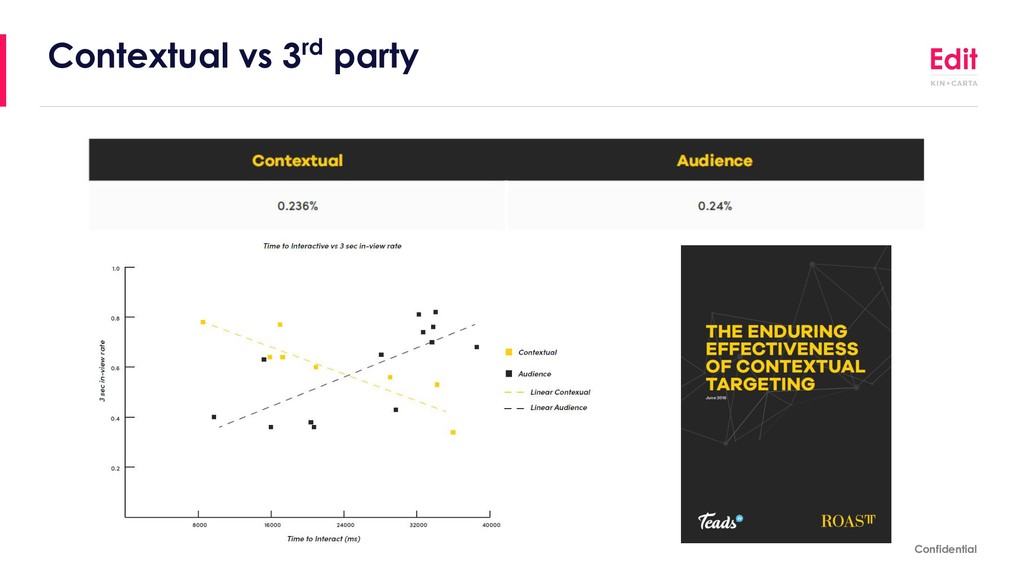
So Roast did a study in conjunction with Teeds, where they had a look at the effectiveness of contextual marketing. And they found that in terms of things like click through rate, site speed and the impact that it had on user experience, contextual was just as good, if not better, in some instances in terms of performance.
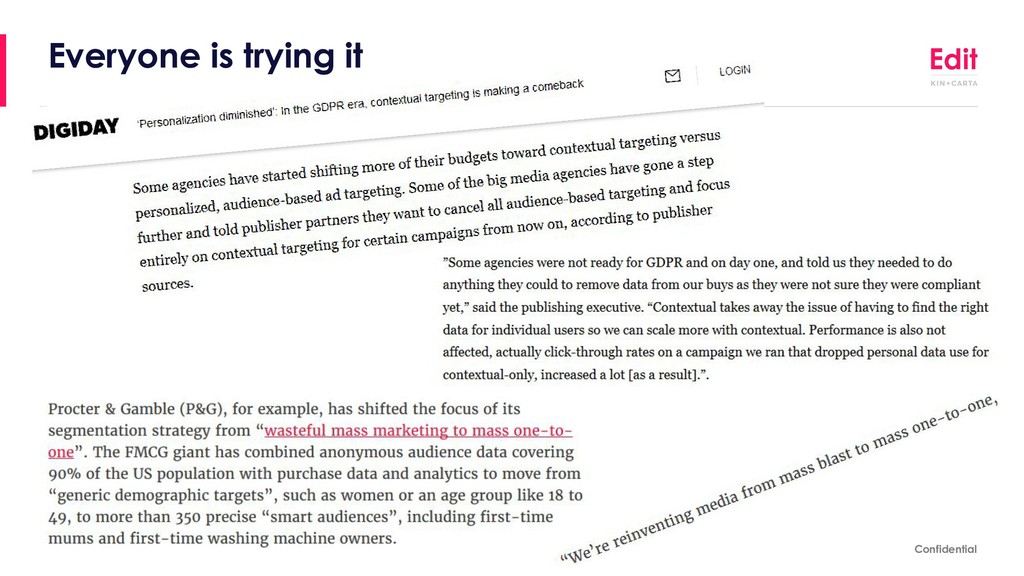
So you don't actually have to lose anything with this approach. And there's a number of different brands trying it. People have even coined a name for it, Mass one to one, that gap between targeting everybody and targeting individuals. So to wrap up, I know it's been bit doom and gloomy, but I want you to reframe a little bit the context of what I've said, because I want you to think about all the things that we stand to gain with these changes, and not with what we stand to lose.
Because any of us who refer to ourselves as a digital something, and I count myself in this, we're actually doing ourselves a disservice. We're not digital marketers, we're marketers. Consumers don't really see the difference between the two in maybe the way we like to define it.
It's a bit like the way we separate paid and organic search. Users just go on to Google and search for something. They might think they're not clicking on ads, but the data shows otherwise. So really, it's just search. And what we do is just marketing.
So why do we treat it so very, very differently? For years, I thought myself so superior to my mad men colleagues on account of all the data. But the reality is I have so much to learn. I've been quite wrong, you know, as I've matured, first I understood that view through conversions were a thing and they had value.
Things like TV and radio, they're always going to be the most impactful media. People trust them, And it works in a way that digital never can. So how we track and how we measure and report should be much more using some of the branding based metrics that, you know, Aiden mentioned.
Yes, it's important to think about whether or not you've won at the end of the day, but did you make friends? Did people see it? Did they enjoy it? All those things are really important and it's worked for the world of TV, radio and press for hundreds of years.
And it's not like we have a totally clear view of everything anyway. You might feel like we're losing attribution, but do any of us really, really have attribution? Even Google have shelved their attribution product because they couldn't get it to work. And if Google have failed, it shows how difficult a problem it is to solve.
So we've also not nailed down things like cross device tracking. I thought that maybe someone like Apple or Facebook or Google would be the ones to do that. But with the changes we've got coming down the pipe, we're probably never going to see a cross device solution in the way that we might have wanted to.
And the funny thing is, I'm okay with this now in a way that I never used to be. I would have, you know, howled at the moon at the thought of losing all my data and all my tracking, but the reality is the approach we have probably does need to change.
The click might not be dead yet, but it probably is dying, and as a PPCer, you know, died in the wallpaper search advocate, I'm also okay with that in a way that I wouldn't have been a few years ago. So keep your data hammer, but use it to find context.
Apply that same rigor and that same scientific approach to researching your customers, how to find them in the moments that matter. Actually thinking and caring about your customers as people, not data points. What problems do they have that you can solve? What message is right for them?
Do you actually have a product that solves a problem? Because again, marketing on its own isn't going to solve problems. You actually need a product that does the job too. Remember about what makes us human, what we can do better than machines. It's that desire for connection, things in which a machine is never going to be able to do better than us.
A more human focused approach, in my opinion, is the way to go for that reason. You know, read more, learn more, broaden your horizons because I know that I certainly need to. And again, ties in really nicely with Aidan's talk. Mentioned about getting all your people together.
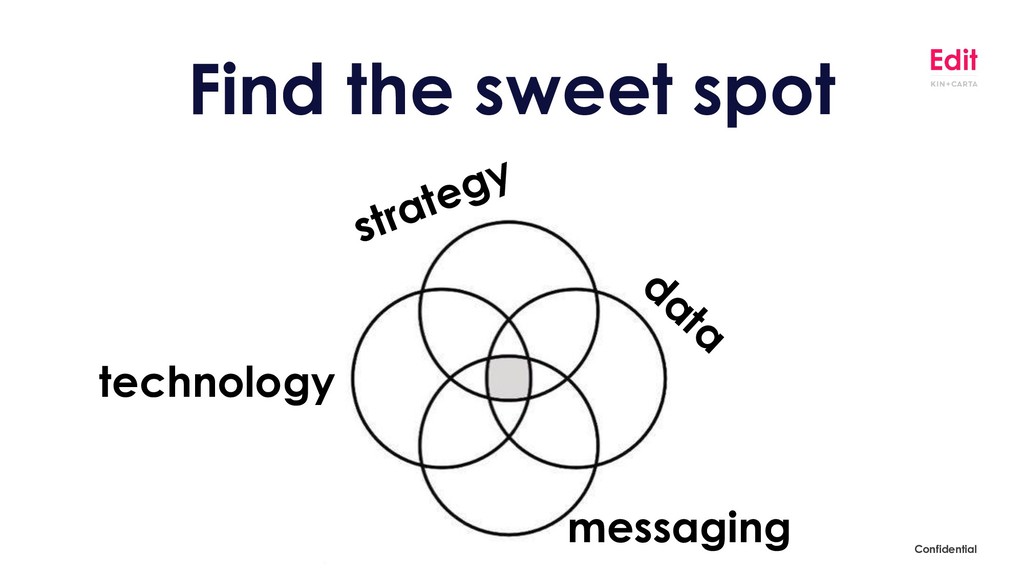
We need to do the same. We need to get your data people, your strategy people, your creatives. Get all of your people together and find that sweet spot in the middle that actually works and delivers on all four points. Because that right there, I believe is the future of our campaigns.