We all know we should have a strategy, but how to create a good strategy and drive it is not always obvious. In this talk Anna will give you tools and techniques to analyse your context, decide your strategy, and then execute it. She will cover some specific models, with examples.
Analysing the situation: how to reach a diagnosis, including models like PESTLE, S-curves, Five Forces, VRIN, and value chain analysis.
Making a strategic decision: how to make a strategic choice, including Three Horizons, Ansoff matrix, Blue Ocean strategies, and weighting and scoring.
Making it happen: how to implement your strategy, including communication, managing change and showing progress.
These tools, techniques and actionable advice will set you up to be able to create and deliver an effective strategy.
1 / 83 Use ← → to navigate
Auto-generated transcript - may contain errors.
Tap a timestamp to jump the video.
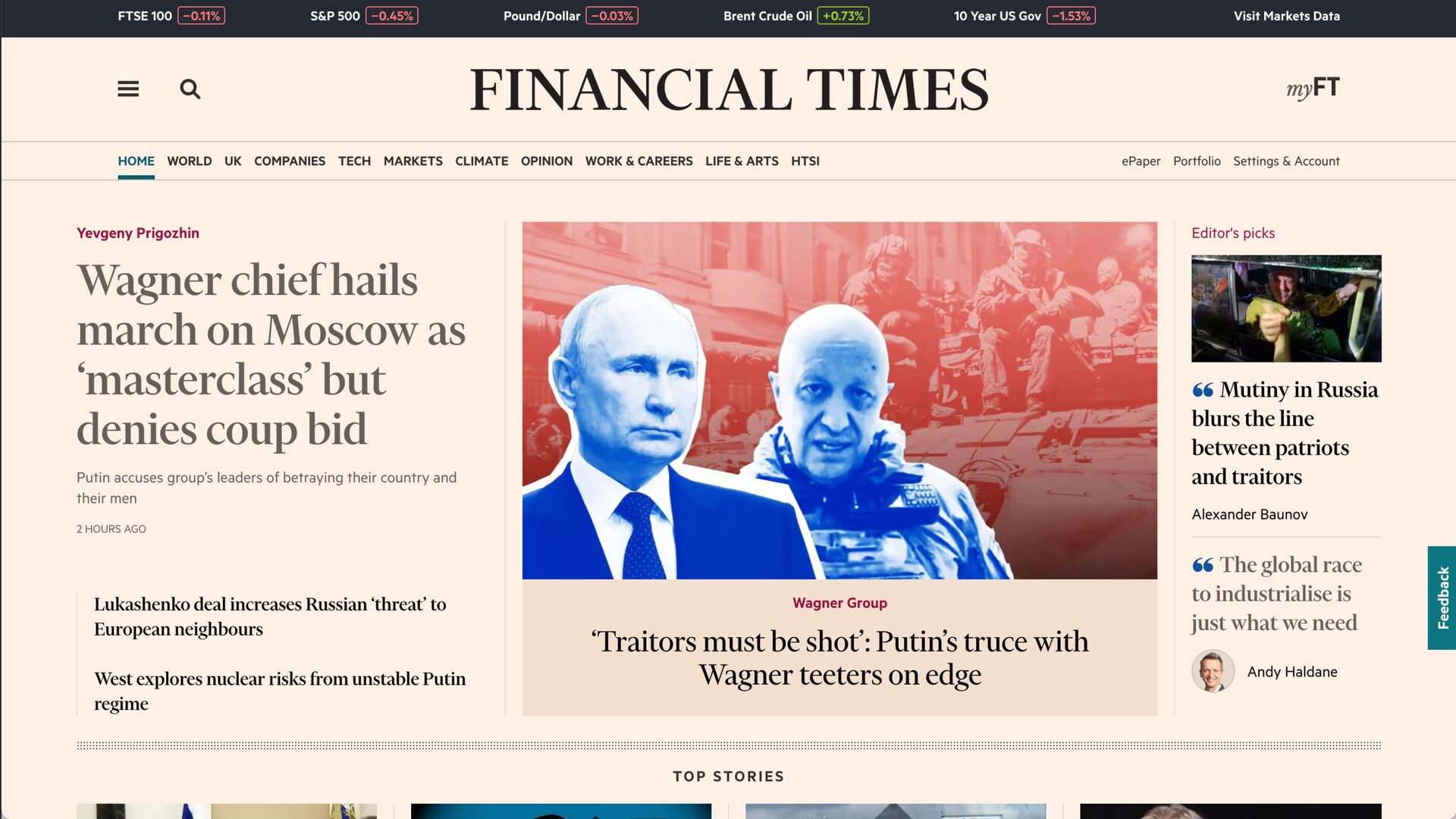
Hi. I work for the Financial Times. We're a global news organization. We've got a newspaper, which you might have seen, it's the pink one. And we mostly focus on business news, but we do other things as well. We're also a digital subscriptions site, and this is the ft dot com website.
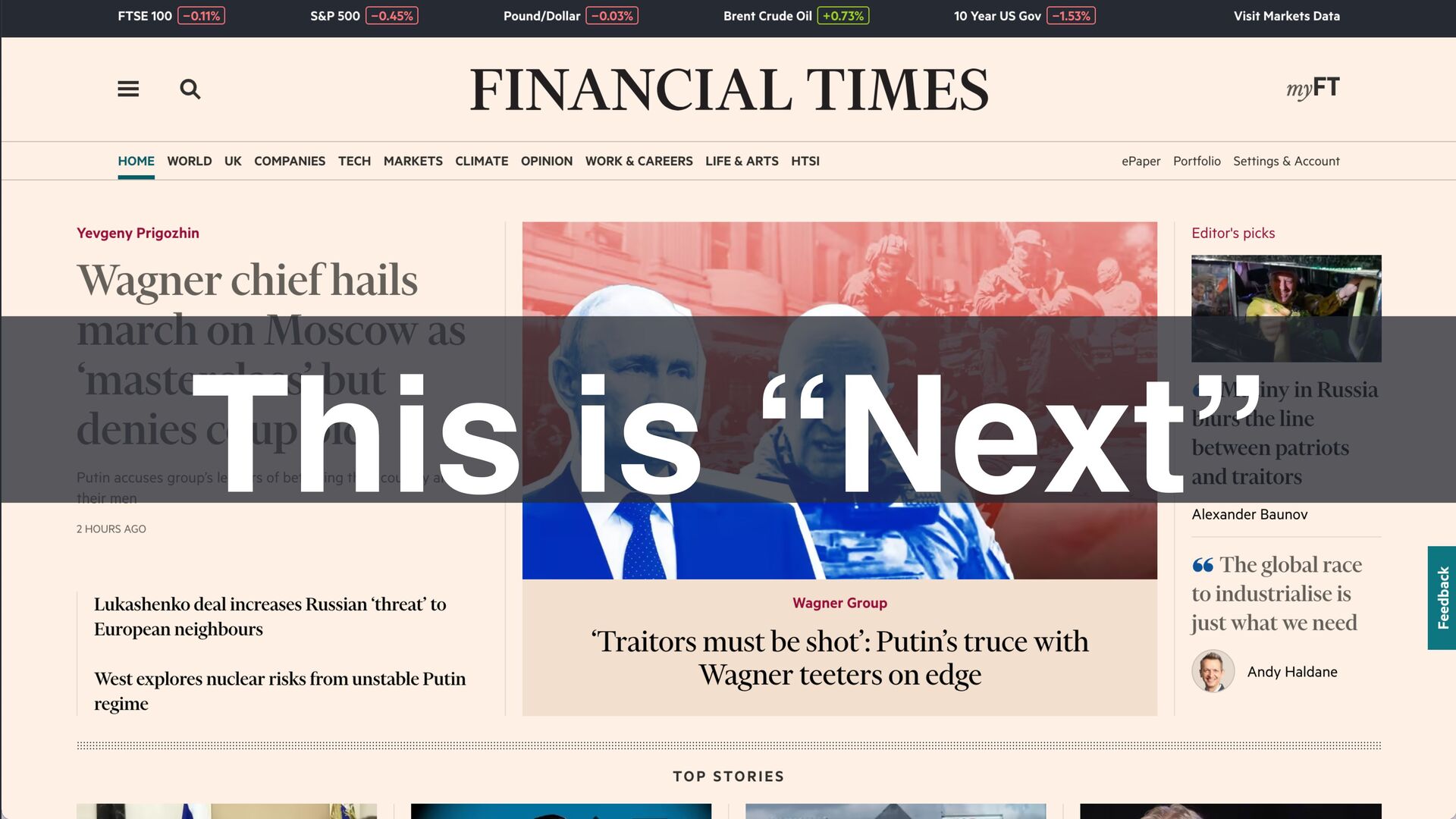
So internally, this site is called Next, and the reason it's called Next is because it replaced the previous site. So it was new in twenty sixteen. The old site was very slow, it was a monolith, it could only be deployed monthly. And the new site was great, microservices architecture, responsive on small devices, very, very fast, much better user experience, and it was a great success.
I joined the Feet in twenty eighteen, so a couple of years after launch, and it had started to drift. So we had about three hundred repositories of which eighty percent didn't have an assigned technical owner. So we didn't know who owned it. Somebody did, we didn't know who it was.
There were only five people on our out of our support router, and teams were heading in different technical directions. So one team told me they were moving away from a particular API because it was being deprecated and another team told me they were actively working on developing and improving that API.
So teams were just like, the tech was drifting. And Next cost ten million pounds and it took two years to build. And that was two years during which the business couldn't get what they needed from the website and everything had to be on hold.
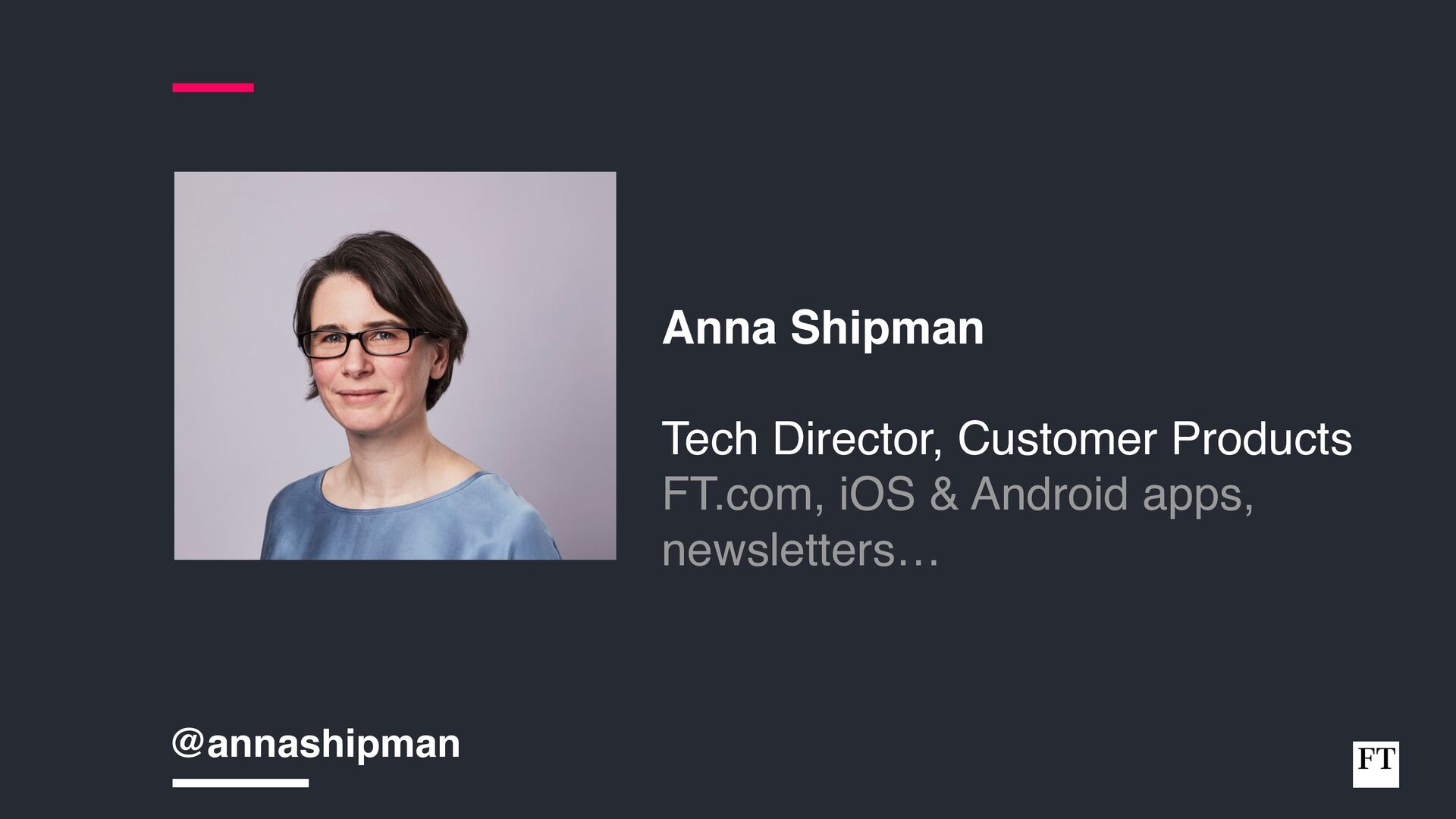
And so what we really didn't want was the tech to drift so far off track that we then had to throw it away and do another Next. So our tech strategy is No Next, Next. So I'm Anna Shipman, I'm the technical director for customer products which is a team that's responsible for the ft dot com website, our iOS and Android apps, newsletters, other customer facing products.
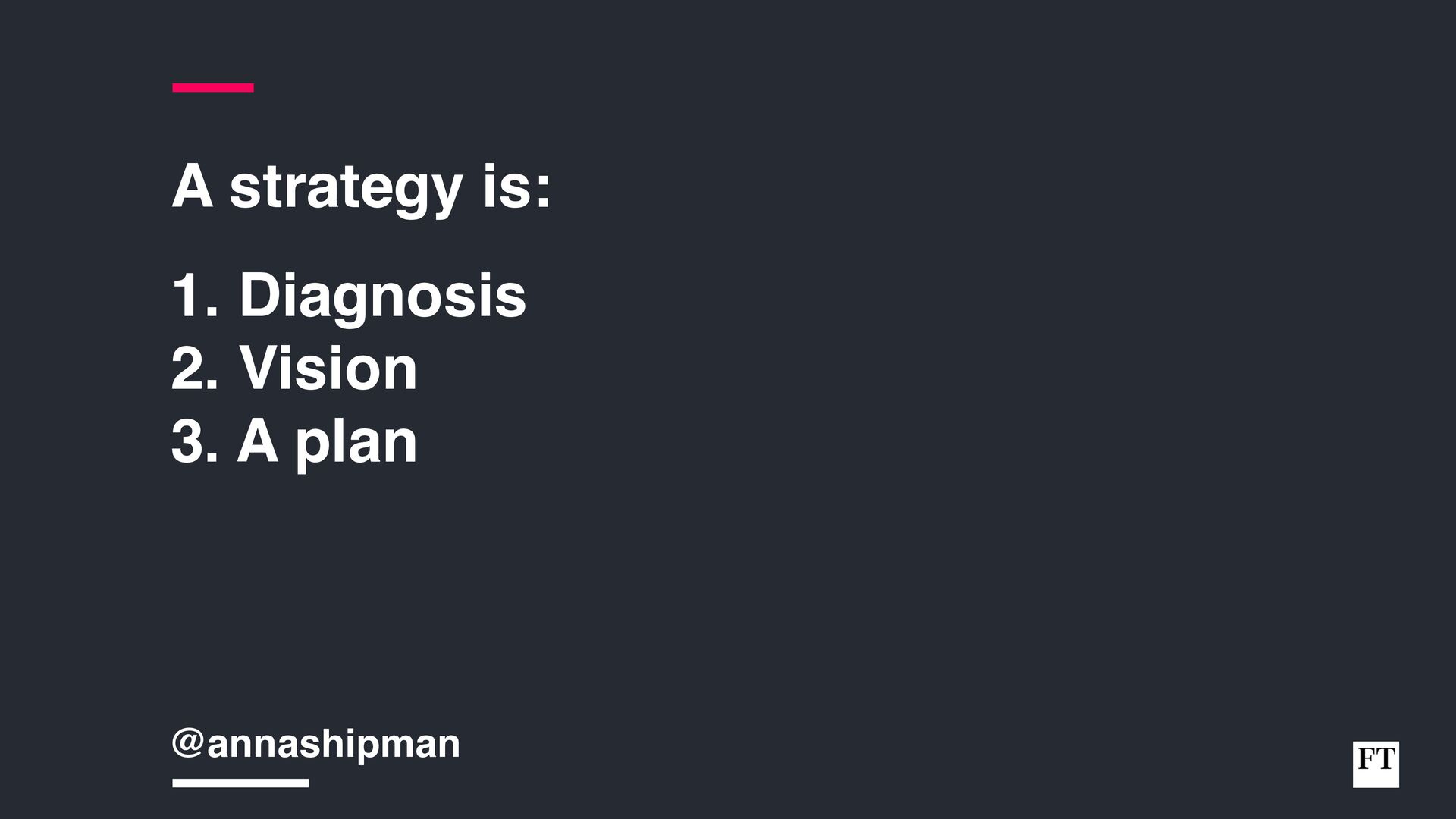
And what I'm going to talk about today is a little bit about what a strategy is, a little bit about why you want a strategy, but the main thing I'm going to talk about is how do you create a strategy. So very, very briefly, a strategy is a diagnosis, the context of the current situation that you find yourself in, a vision, where do you want to get to, and a plan, how do you get from your current situation to where do you want to get to.
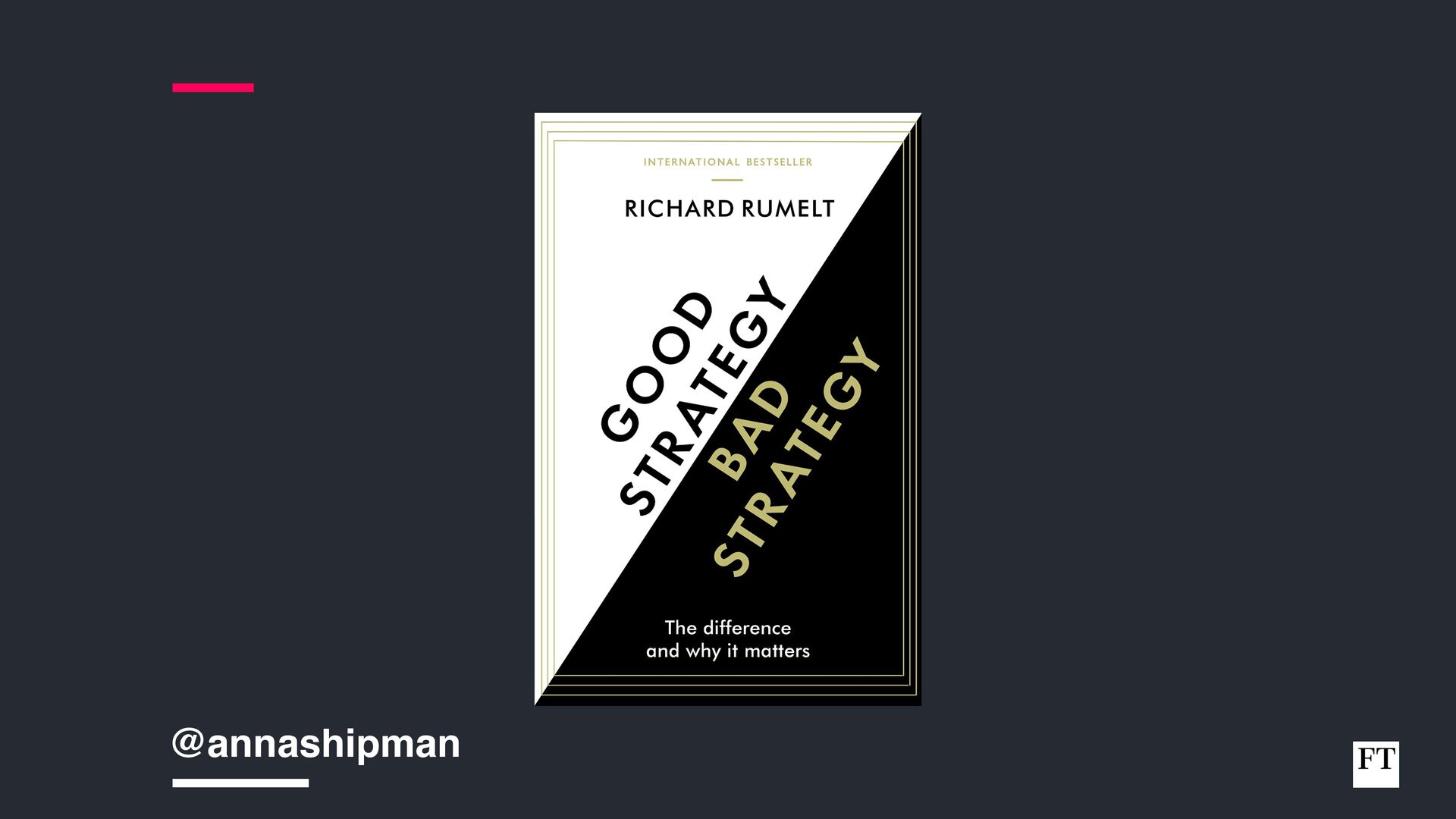
And that is very roughly taken from this book, Good Strategy, Bad Strategy by Richard Rumelt. This book is excellent, and if you haven't read it, I really highly recommend you do. So that's basically what a strategy is very briefly. And why do you need a strategy?
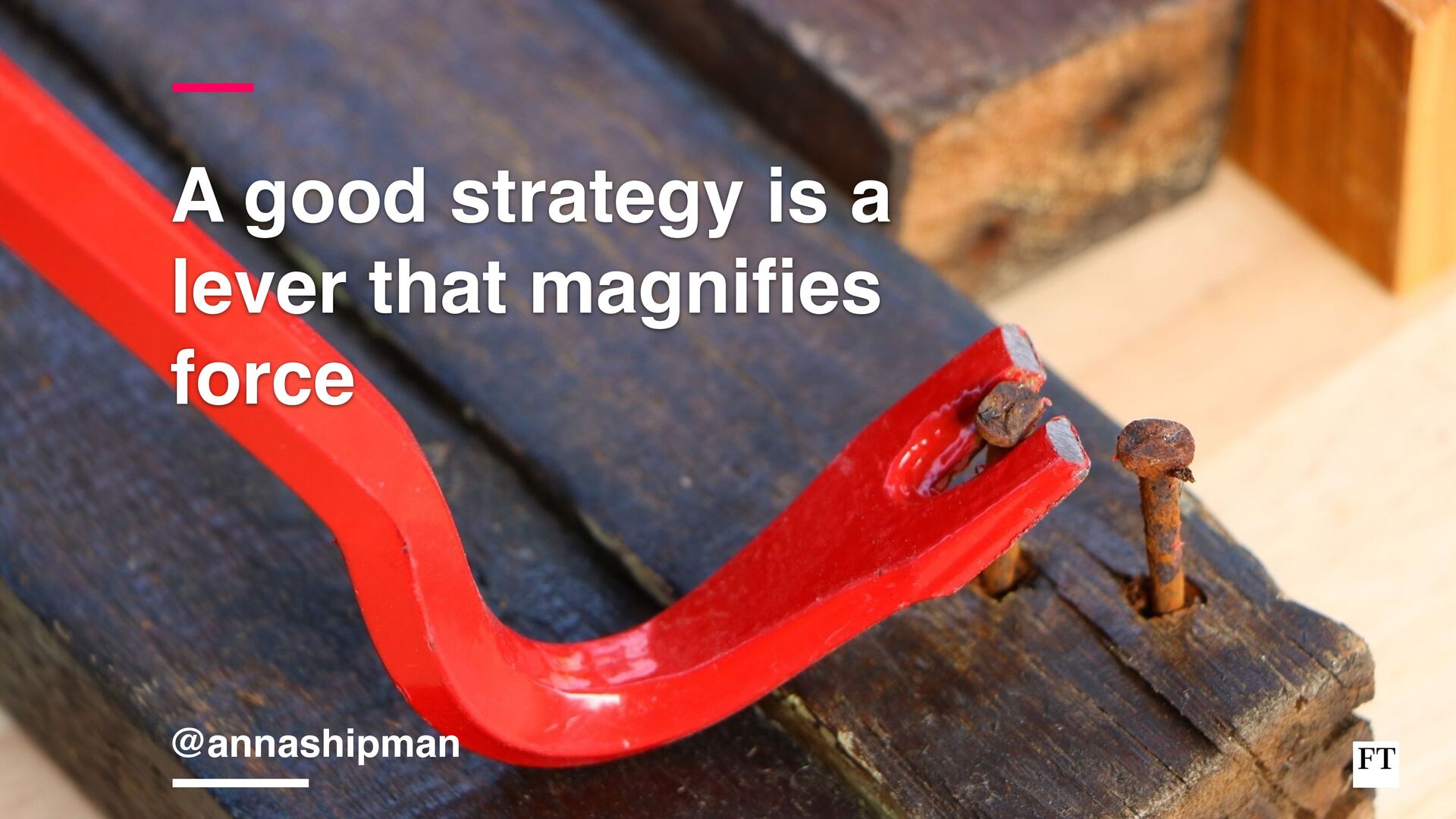
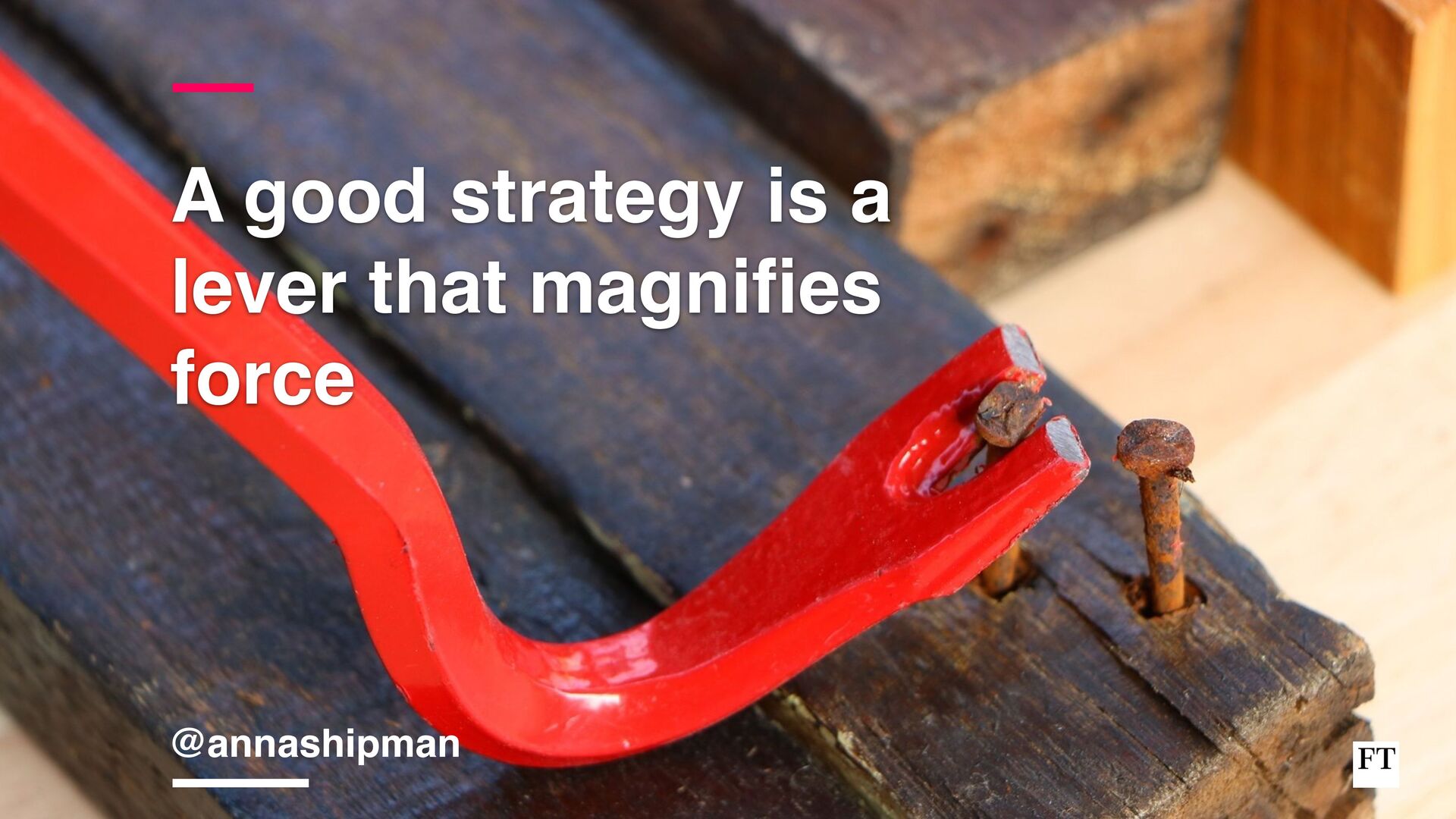
A good strategy is a lever that magnifies force. It shows you where to apply your efforts so that you can really achieve the outsized results you're looking for. That was a very, very brief overview, but what I'm going talk to you about today is how to create a strategy.
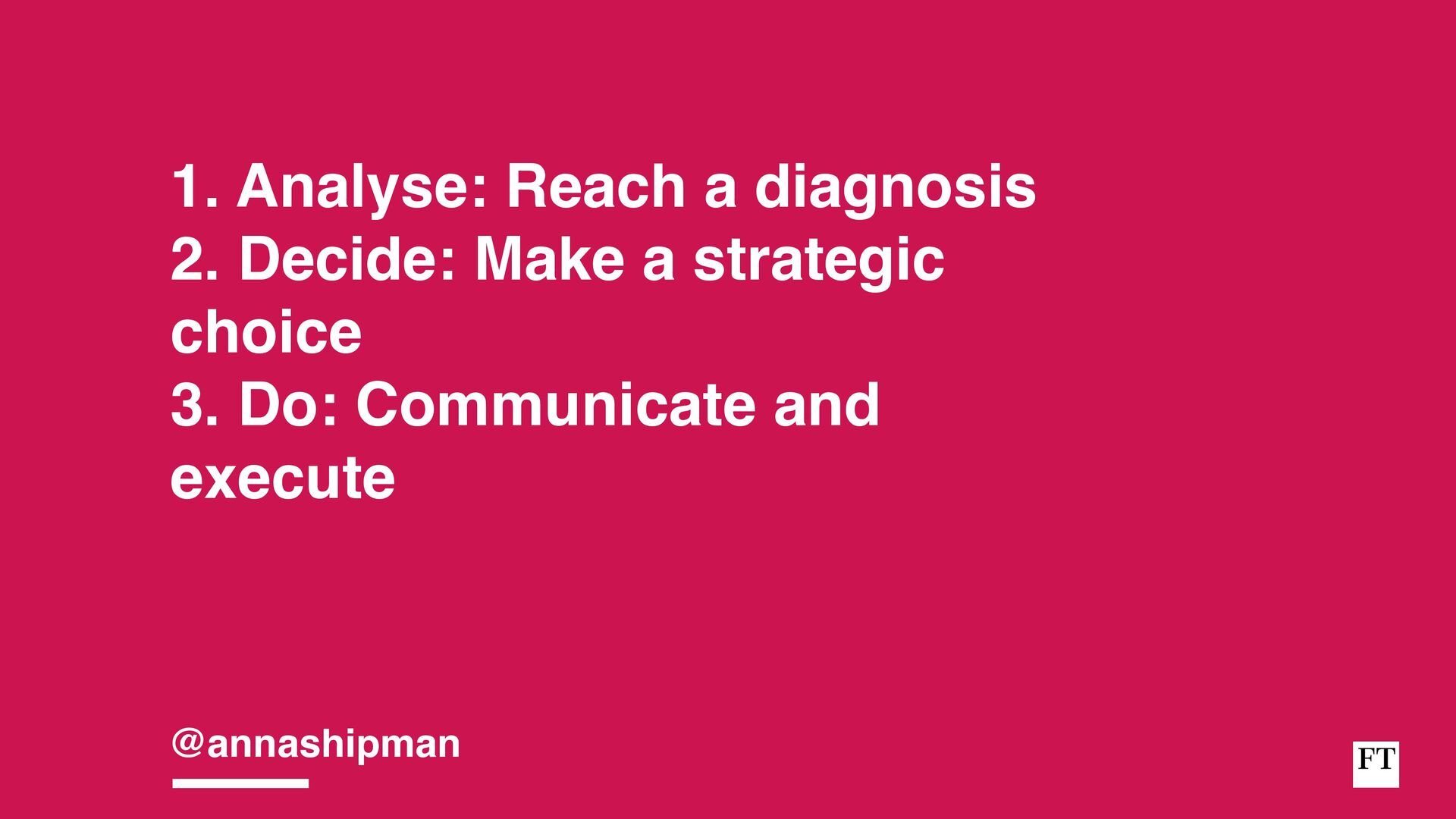
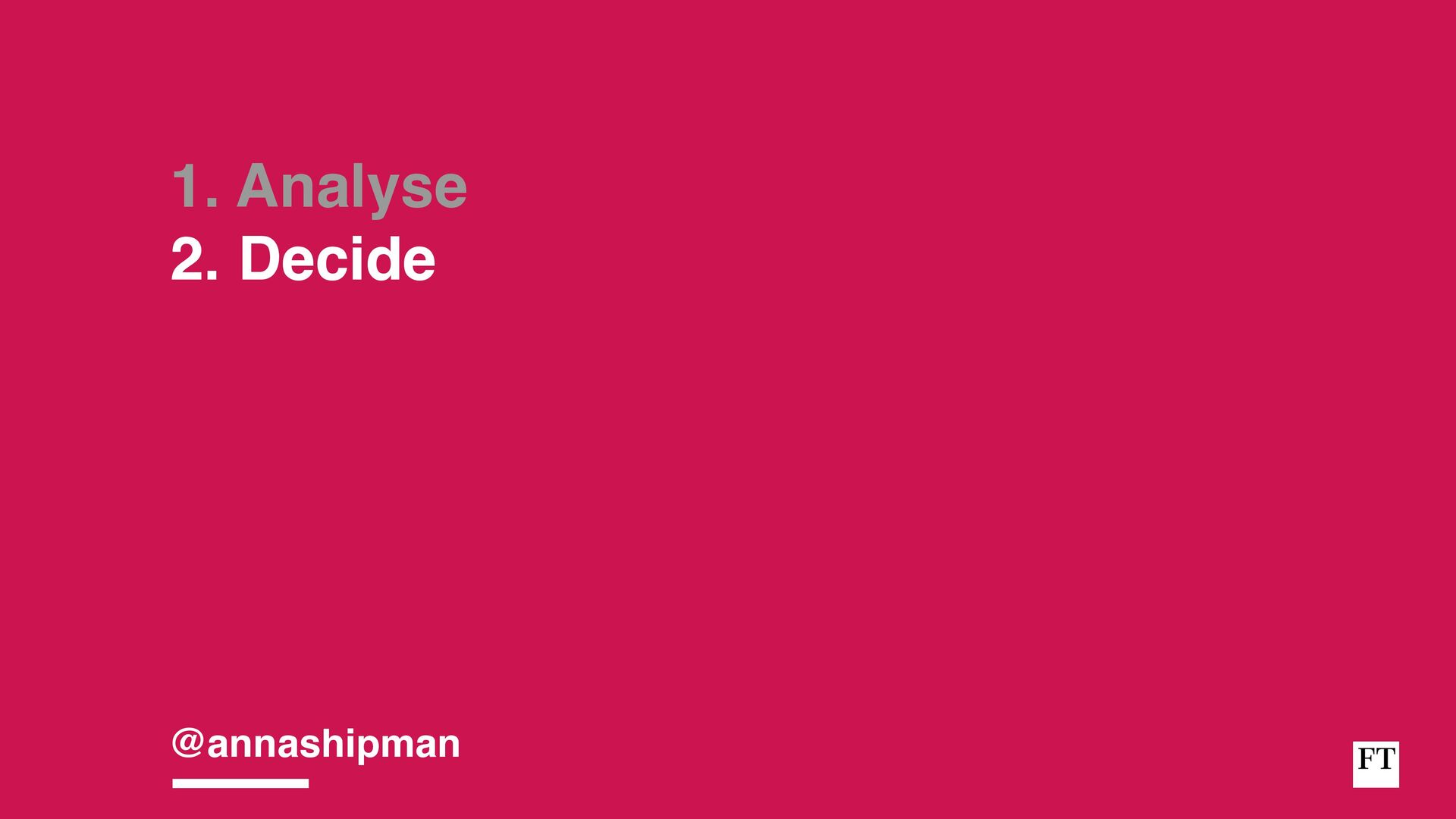
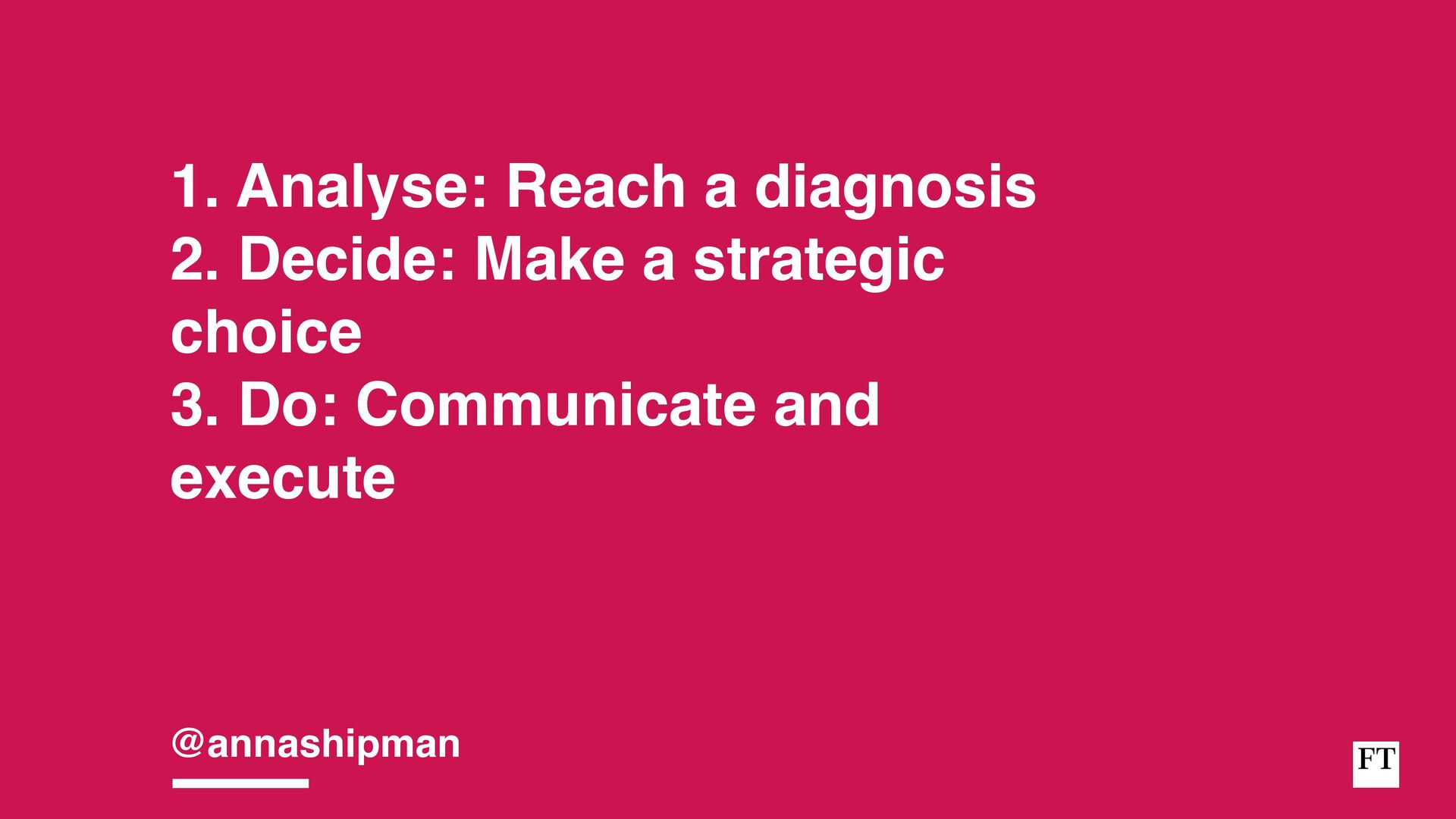
And essentially, there are three stages: analyze, decide, then do. So analyze is reach your diagnosis, decide is make a strategic choice, and do is communicate and execute. Before I dig into the meat of it, just want to talk a little bit about who you are.
So you might be responsible for defining a strategy, but you might not be. You might be somebody who just sees that a strategy needs to happen, and that's also fine. And you might be working on your own, but better is working with other people.
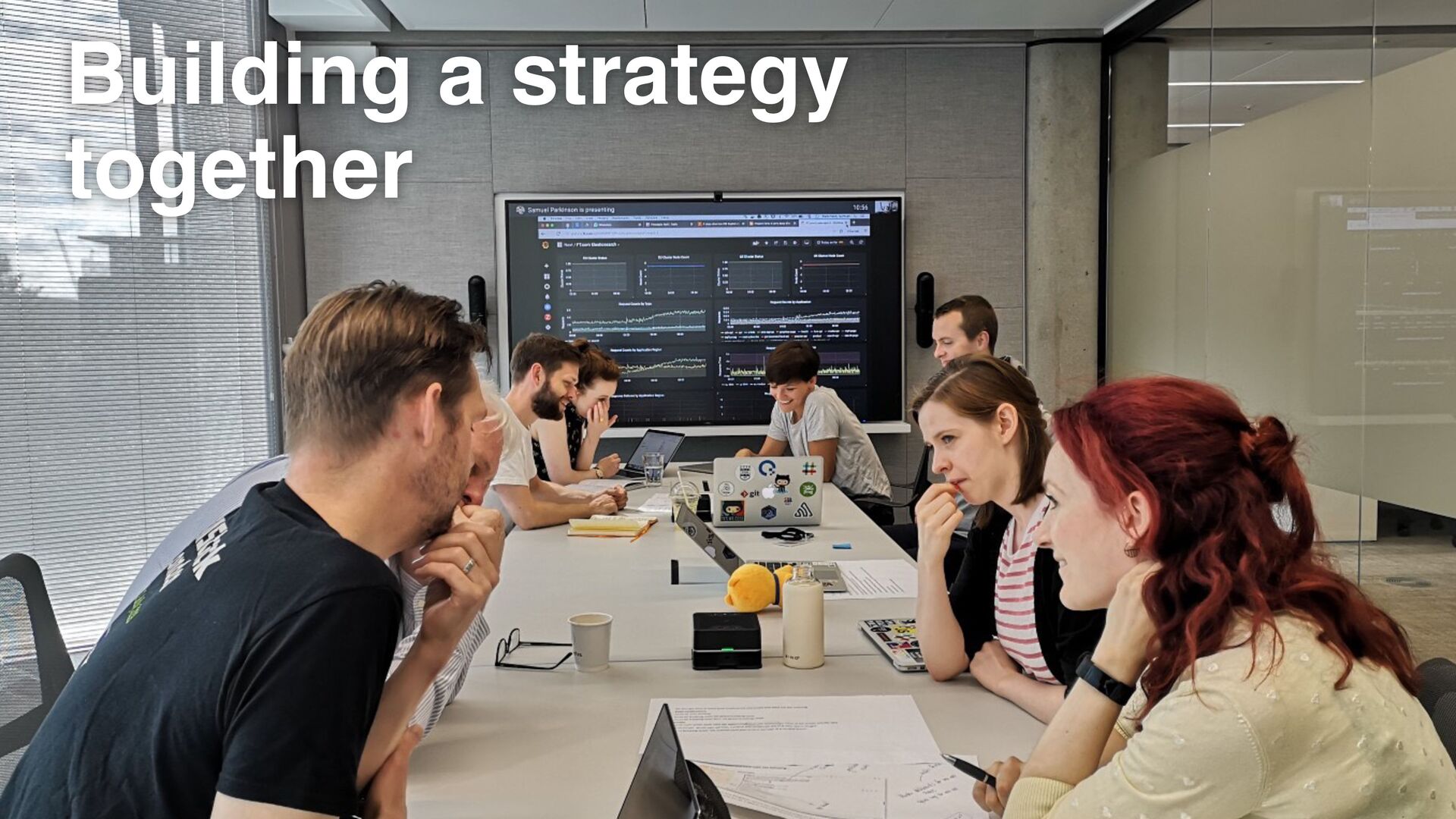
So it might be your peers, so if you're in C suite, then your C suite peers, or it might be your team, your reports, perhaps if you're an engineering leader, I mean I worked on the no next, next strategy with my senior engineers.
And what I'm going do is take you through some models and tools, and they're tools that help you think about and talk about what your strategy will be. They're useful for you to think about things in a structured way, but they really come into their own when you're working with other people.
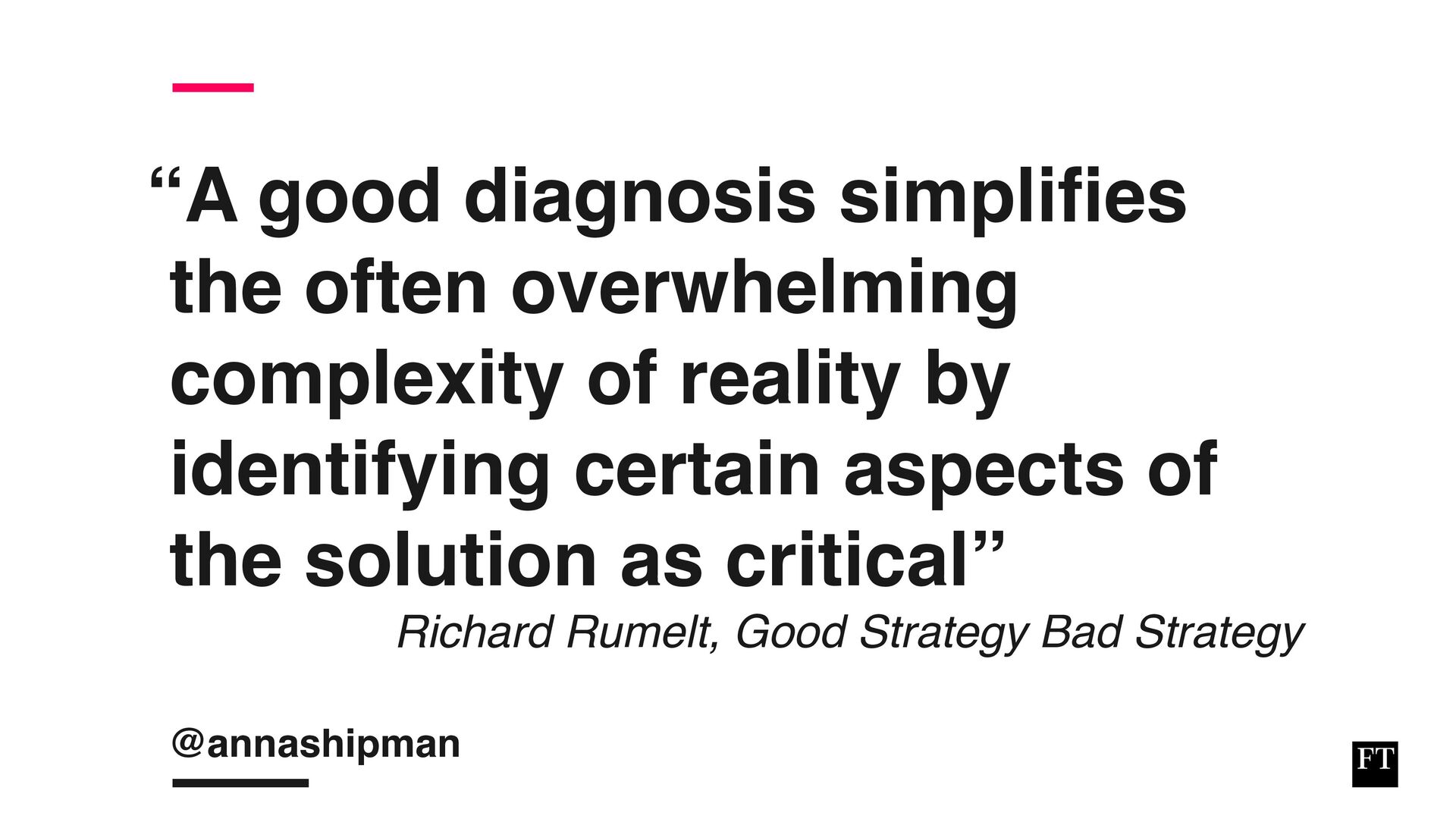
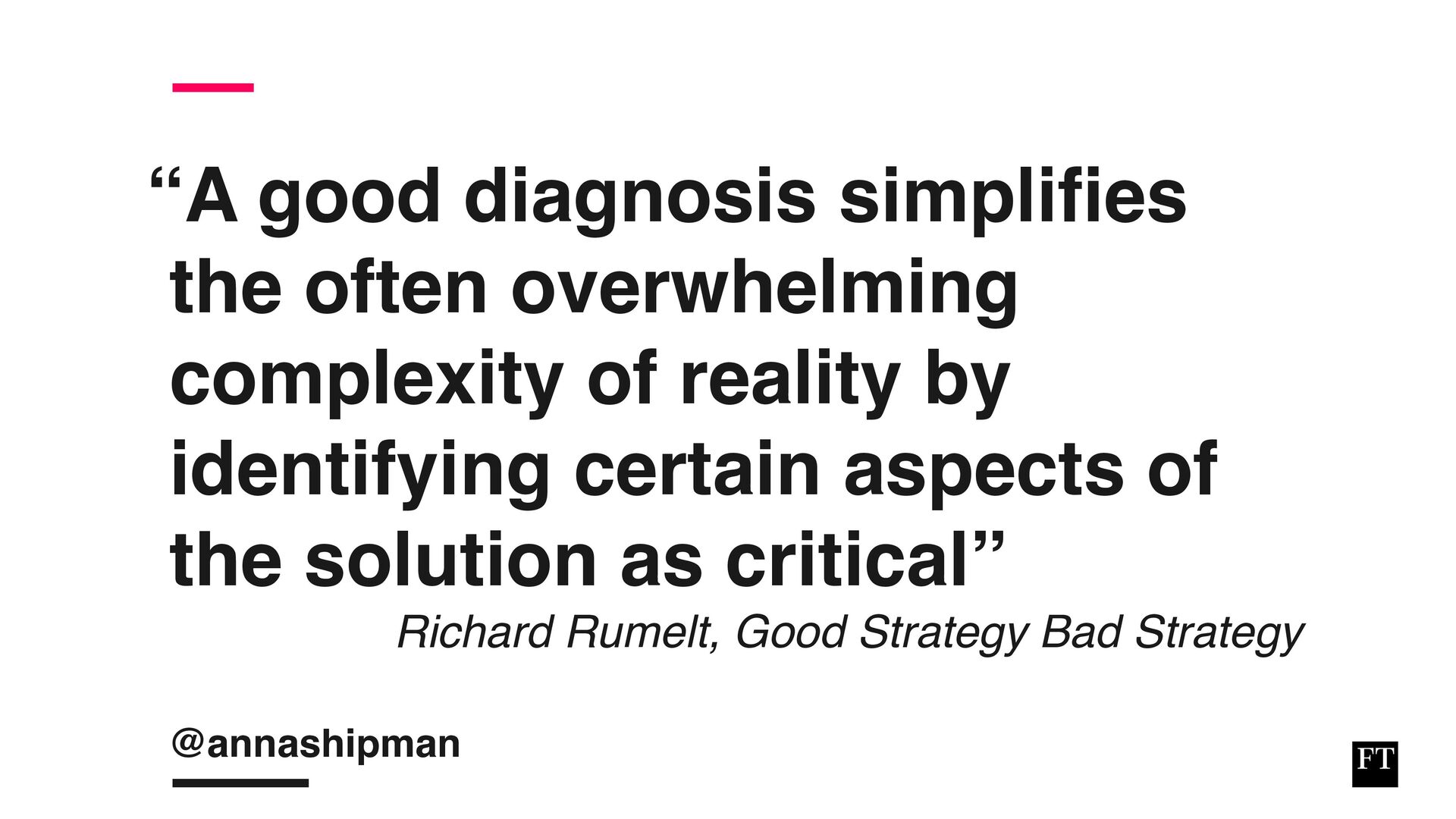
So, firstly, we'll talk about analyzing. And this is a quote from the book that I mentioned: A good diagnosis simplifies the often overwhelming complexity of reality by identifying certain aspects of the solution as critical. And so that is the bit that I'm going to talk most about is the analysis, because when you know what your context is, it becomes clear what your strategy is.
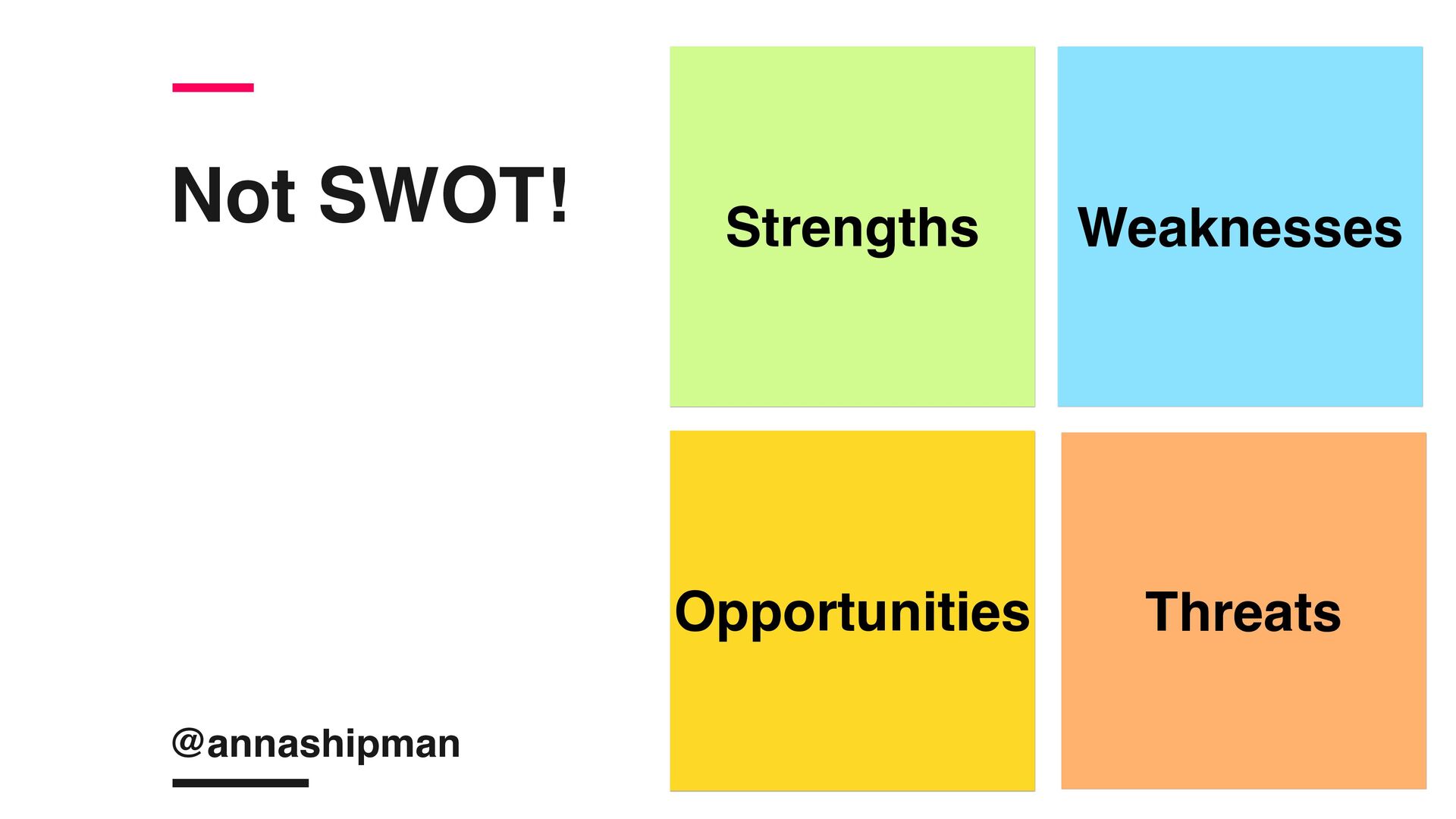
It's really important to get that bit right. The first tool that people often reach for when thinking about the context is SWOT, but we are not going to talk about SWOT right now. I'll come back to that. Instead, what we're going to talk about is some tools to look at your external environment, some tools to look at internal factors, and then we're going bring it all together.
So for the external environment, I'm going to talk through three things. I'm going to talk about PESEL, S curves and five forces. So PESEL is an acronym. When you read a lot about strategy, they love acronyms. I've got another really great one later.
PESEL stands for political, economic, social, technological, legal and environmental. And this is a structured way of thinking about your external environments. And for what you do is, for each of these factors, you identify what you think the trends are going to be, and then what the impact is on your market.
And the value of this is because people are often making assumptions about what's going to happen in the future, but they're not talking about them. So this kind of allows you in a group to bring those things out in a structured way. So I mentioned that I joined the Feet in twenty eighteen, and so when we were thinking about our tech strategy, the situation in twenty eighteen so politically, it was a couple of years after the Brexit vote.
Trump had been in power for a year, so there was a lot going on. Politically, was quite turbulent. Economically, we had a potential impact of Brexit coming up. Socially, there was a rise of populism in the UK and the US. It was kind of the advent of the post truth world, fake news.
Technologically, people were using apps more than websites. Audio was becoming more of a thing. There was more data journalism happening. Legal, it was just before we had GDPR, the General Data Protection Regulation, which was changing the way we were all thinking about how to store user data and how to manage consent.
And environmentally, it was a lot about sustainability and net zero. And so the things that that made us think about were: we needed to think about things around user data and consent, that had to be a theme. Because of the turbulent news cycle, we needed to think about different content formats.
So breaking news, because there was a lot of breaking news, but also deep dive so that we could give the Feet's analysis and help people understand the changing situation. We also had to think about how to make it clear the authenticity of our news because of fake news, how speak with authority and authenticity.
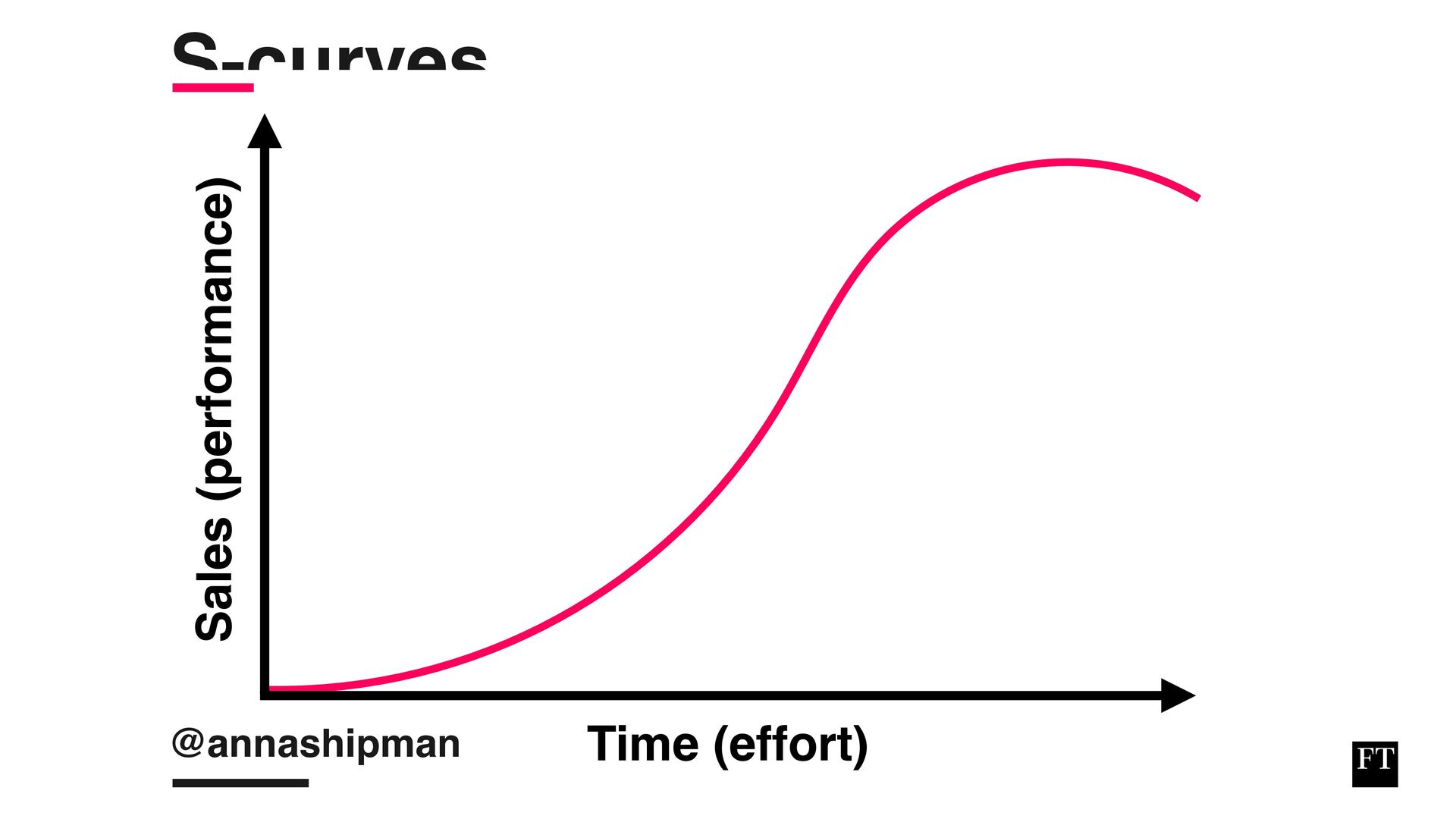
So those are some of the themes that we had to think about. The next model I'm going to talk about is S curves. So this describes the development of your business model or your market or your technology from experimentation they say from experimentation to exploitation.
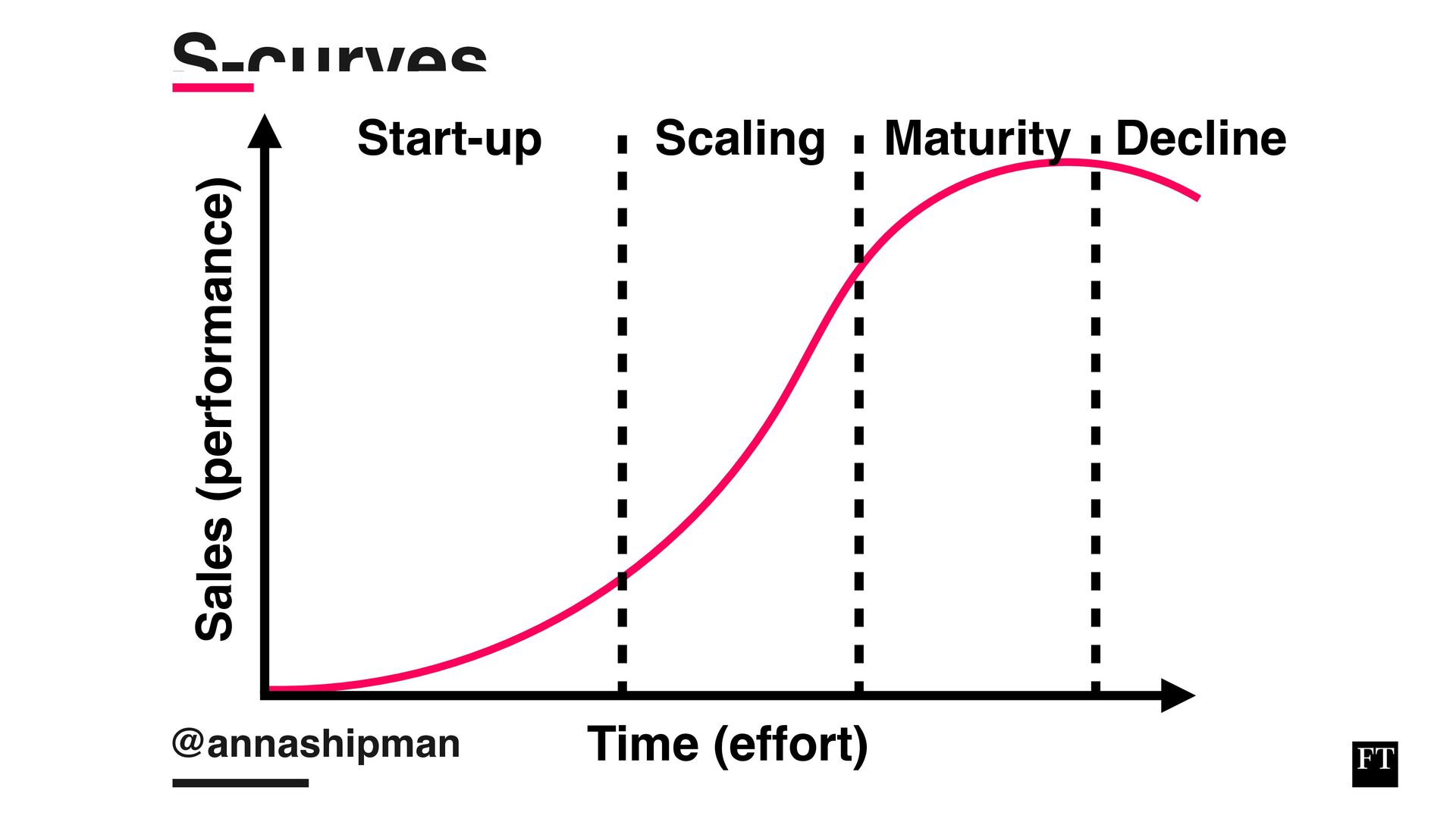
So it's in phases. And the point of thinking about S curves is you need to know where your business model is or where the technology you're using or thinking of using is on the S curve so you can make the right kind of strategic choice.
So for example, with Next, we were at maturity. We'd gone through the start up and scaling phase. This was the website we were using. And so the aim was to prolong maturity as much as possible, to renew it, not to go into decline too quickly, but also to be able to make it ready for whatever the next business model was going to be, whatever the next product strategy was going to be.
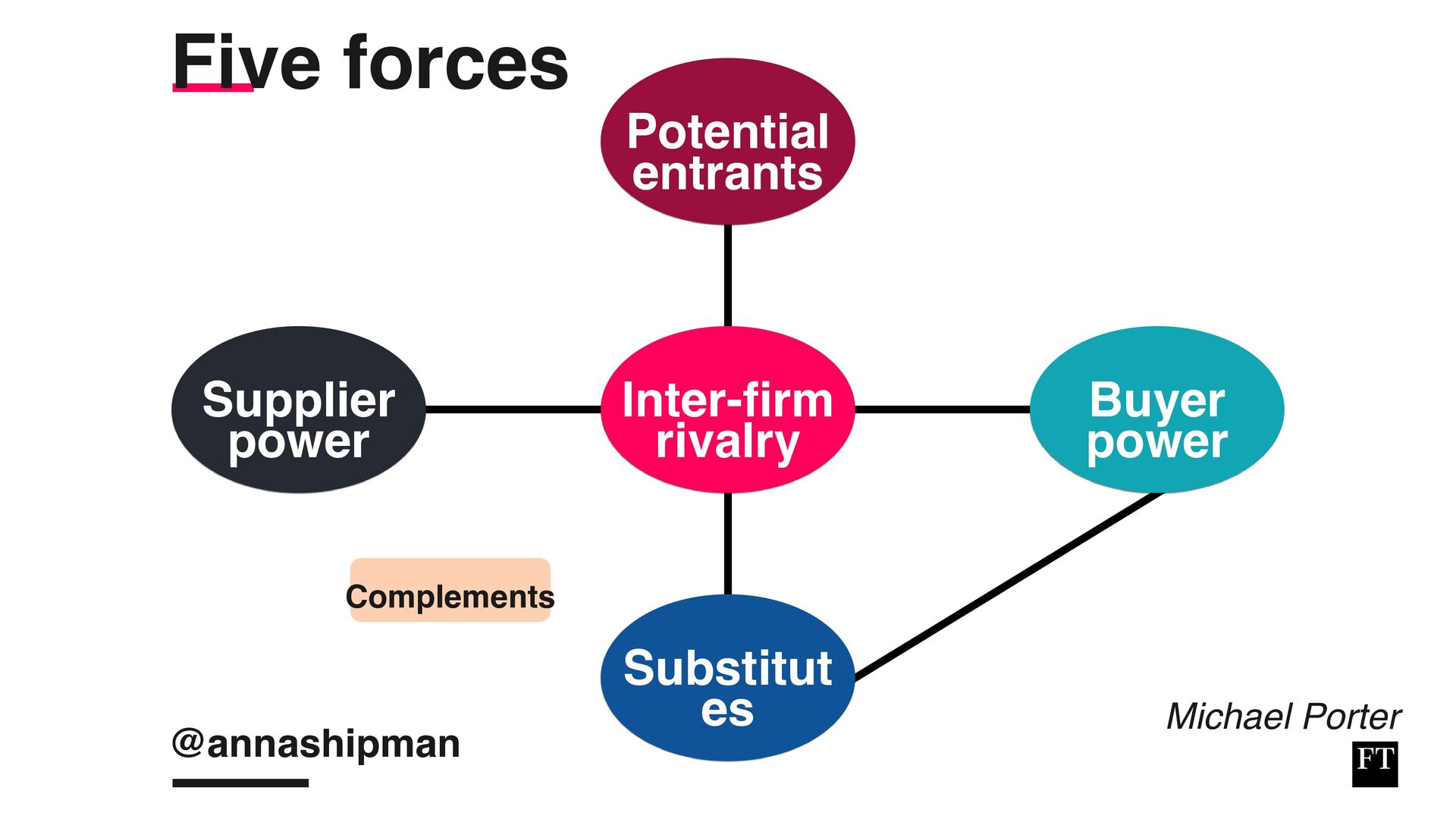
And the last external model that I would like to talk about is Five Forces. So this is by Michael Porter, and this is forces on a business that affect profitability. So, inter firm rivalry is competition with your competitors. Supplier power is where suppliers have more power.
So for example, there's a high switching cost or the customer really cares about the supplier. So for example, if you're buying a PC, if you're a customer of PC you care about whether it's got an Intel processor, so the supplier has power there.
Buyer power is where there's low switching costs for the customer and there are viable alternatives in the market. Potential entrants are people who are not yet in the market but might be joining. And substitutes are another way of solving the user's problem. The canonical example of substitutes is online subscriptions as a substitute for newspapers, but actually we haven't found that at the Financial Times.
Subscriptions are rising, but people still like having a physical newspaper, so actually our circulations, particularly of our weekend, are also rising. So we haven't found that, but that's what a substitute is in theory. And then complements, they're not forces on a business, but they're something else to think about with this model.
These are other businesses that enhance each other. So a good example there is with apps and smartphones. Apps make smartphones better, smartphones allow you to deliver apps better, so they're separate businesses, but they enhance each other. So for the Feet, for NeXT, the things that were relevant to us: we thought about Interfirm Rivalry.
Were our competitors' websites better than ours? And actually, at that time, they definitely weren't. Ours was the fastest, it was the top of the web page test performance rankings of article pages. It very good user experience, was responsive, had a good design, and so we had to make sure that our strategy was about maintaining that.
We did have issues with supplier power. For example, we used Heroku we still use Heroku and we use other suppliers where we're slightly locked in because of the way we've developed. That's something to think about. And then the other things that were relevant to us were thinking about substitutes.
So in twenty eighteen, Substack had just been launched, so newsletters is another way of getting news. And there's also Apple news and things like that. So those were the kind of things we were thinking Okay, so I've talked about some models of thinking, structure thinking about the external environment.
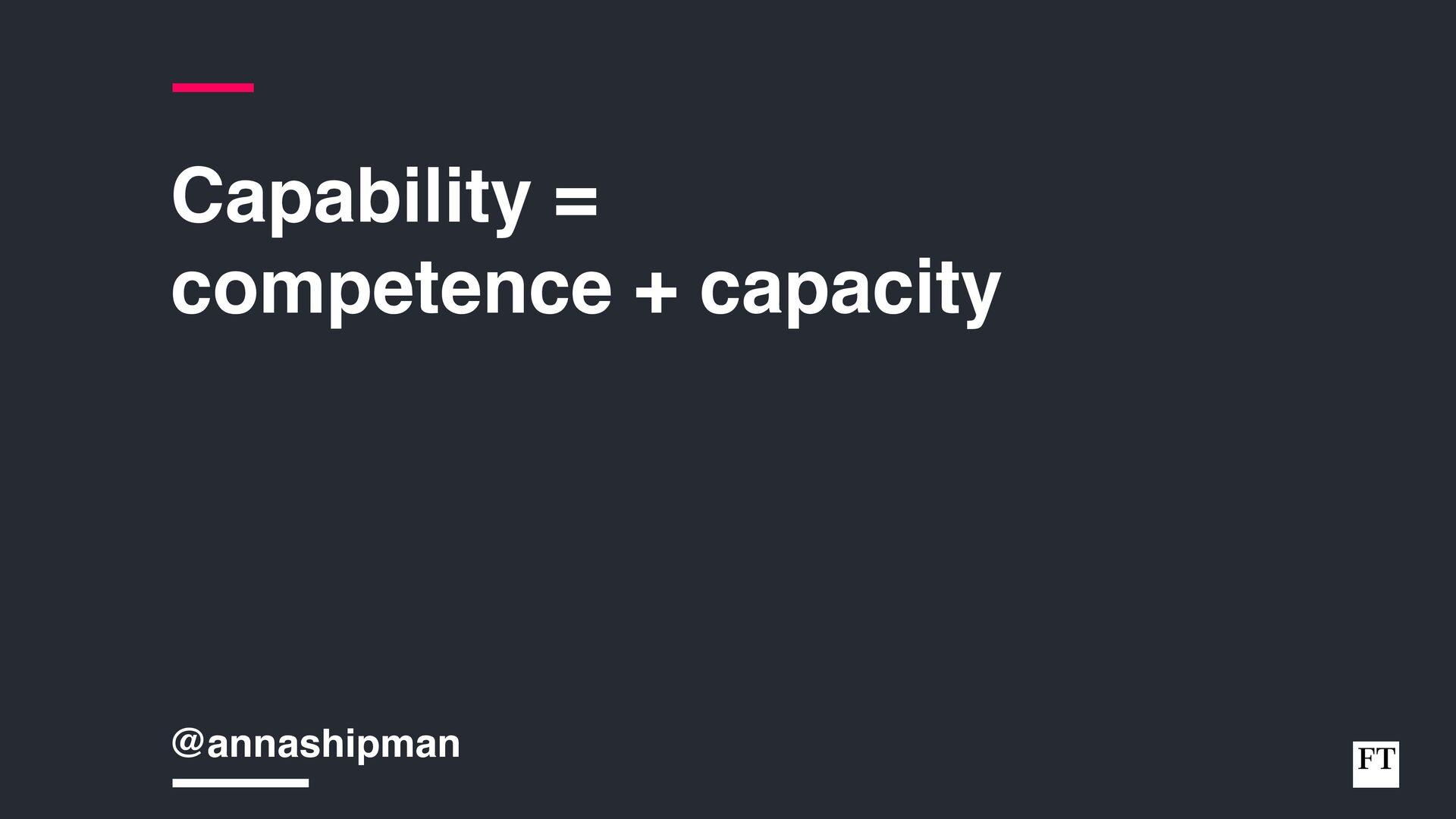
The next thing I'd like to talk about is your internal factors. And I'm going to talk about two things here: distinctive capability and value chain analysis. So capability is what can you do? And it's made up of competence, which is being able to do something well, and capacity, which is how much of it can you do.
And you need to know what your capabilities are. Sorry, what I was going say was capabilities can be tangible, so they can be like machines in the factory, or they can be non tangible, so things like culture or brand. And the reason you think about capability is because you want to understand your underlying strengths and weaknesses.
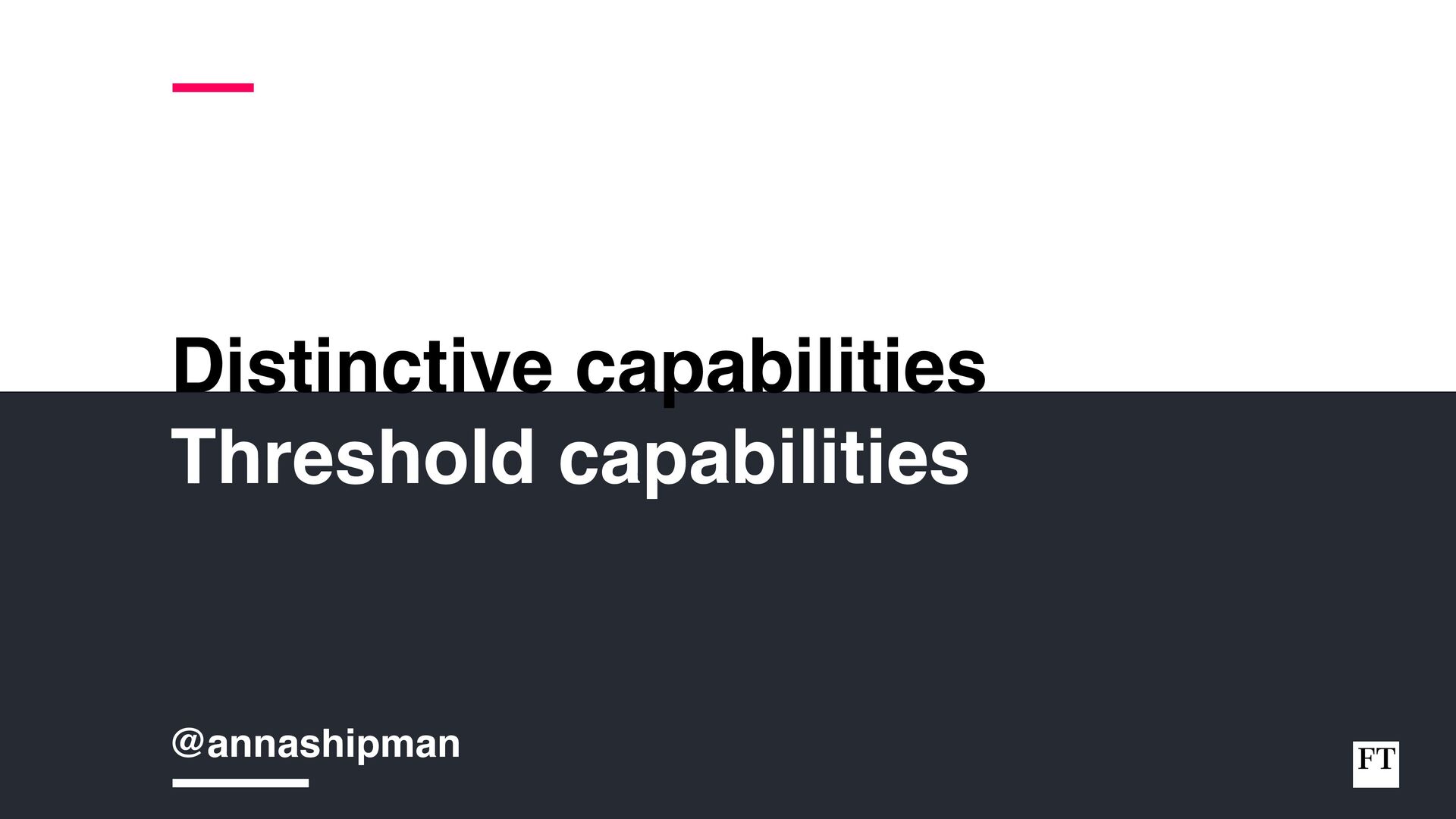
Capabilities can be distinctive or threshold. Threshold capabilities are what is needed to participate in your market. Distinctive capabilities are the ones that give you competitive advantage. But distinctive capabilities become threshold over time. The point of identifying your distinctive capabilities is you want to know what the things are that give you competitive advantage, and then your strategy is do something with those things.
And so this is my second brilliant acronym, VRIN. So VRIN is a way for thinking about what your distinctive capabilities are. This is by Jay Barney. So VRIN stands for value, rareness, inimitability and non substitutability. Value is: can you monetize it? Rareness is: do other people have it or is it just you?
Is it hard to imitate? And non substitutable: is there another thing that could undermine this capability? So a really good example of using Vrint for distinctive capabilities is with the launch of the iPod. So before the iPod, Apple visited one of their suppliers who had created a really very small hard drive as a proof of concept, they didn't know what to do with it.
And Apple bought up all the production capacity of those hard drives and made the iPod. So, it's valuable, people will buy it. It's rare because they've just bought up all the production capacity. It's inimitable because the smallest is the point of the iPod.
And it is non substitutable because the way to achieve the same result is to put fifty CDs in your pocket and use your Discman, so you can't substitute it. So that was a distinctive capability. But that became threshold over time. Small hard drives were no longer a thing.
And now it's irrelevant, like we use flash storage. So you can't rely on distinctive capabilities forever. So we didn't actually think about distinctive capabilities when we were working on our tech strategy and I wish we had because one of our distinctive capabilities is around data journalism.
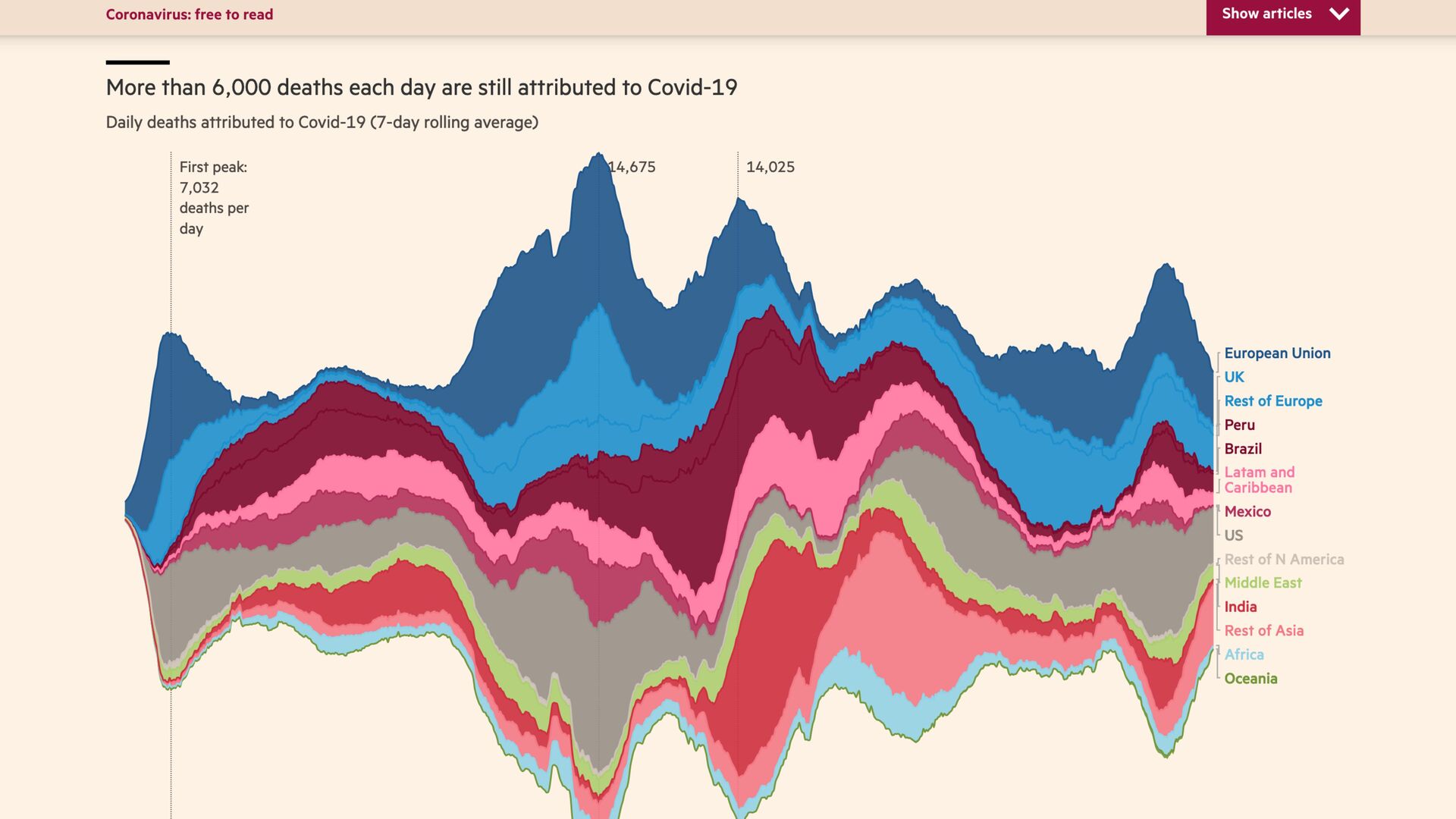
This is the coronavirus tracker and there a lot of graphs on this page tracking various data about coronavirus. This page is our most viewed ever page. It has had over twenty million visits. Our data journalism is one of our distinct capabilities, but I didn't think about that when we were working on the strategy.
And so even now, we're struggling to bring data journalism into the rest of our content. So I wish I'd thought about it then and wrapped it up more with our strategy. The other internal factor that I'd like to talk about is value chain analysis.
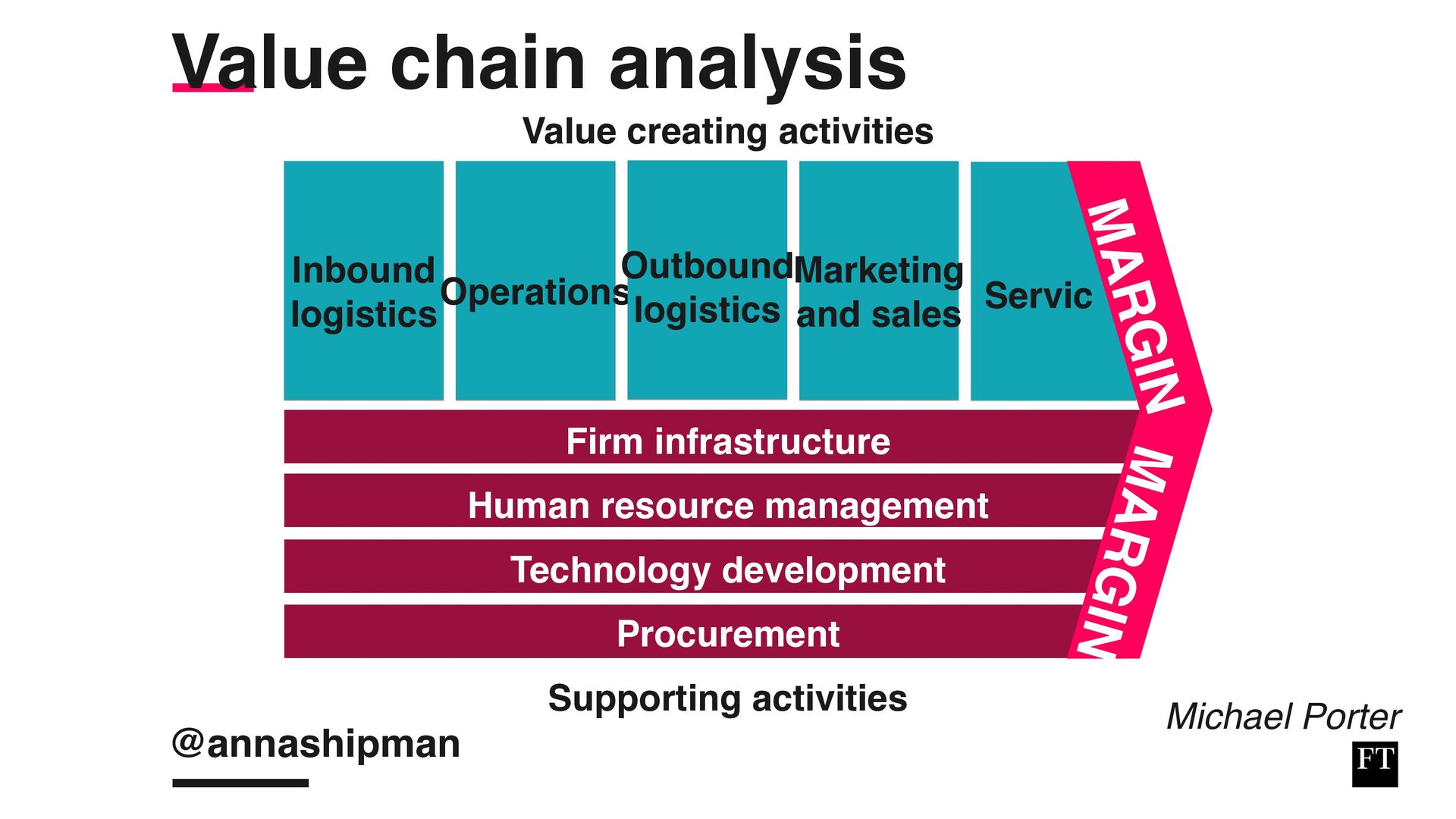
This is Michael Porter again. What you do here is you identify where in the business value is created. This is a sample diagram. This one's from nineteen eighty five. You do one for your own organization. You can tell it's from nineteen eighty five because technology development is a supporting activity, but I think we'd probably all put it as a value creating activity now.
What you do is you look at each of the value creating activities and think about where you can add more value. Technology is great for this because you can always add, you know, make things more productive and more efficient. But it's also about making sure you're focusing your resources in the right area.
So if you think about something like elite fashion, the value of high fashion is in the branding and the customer service and the marketing. It's not in the manufacturing. So a value train analysis means focus much more of your resources on marketing and sales and much less on manufacturing.
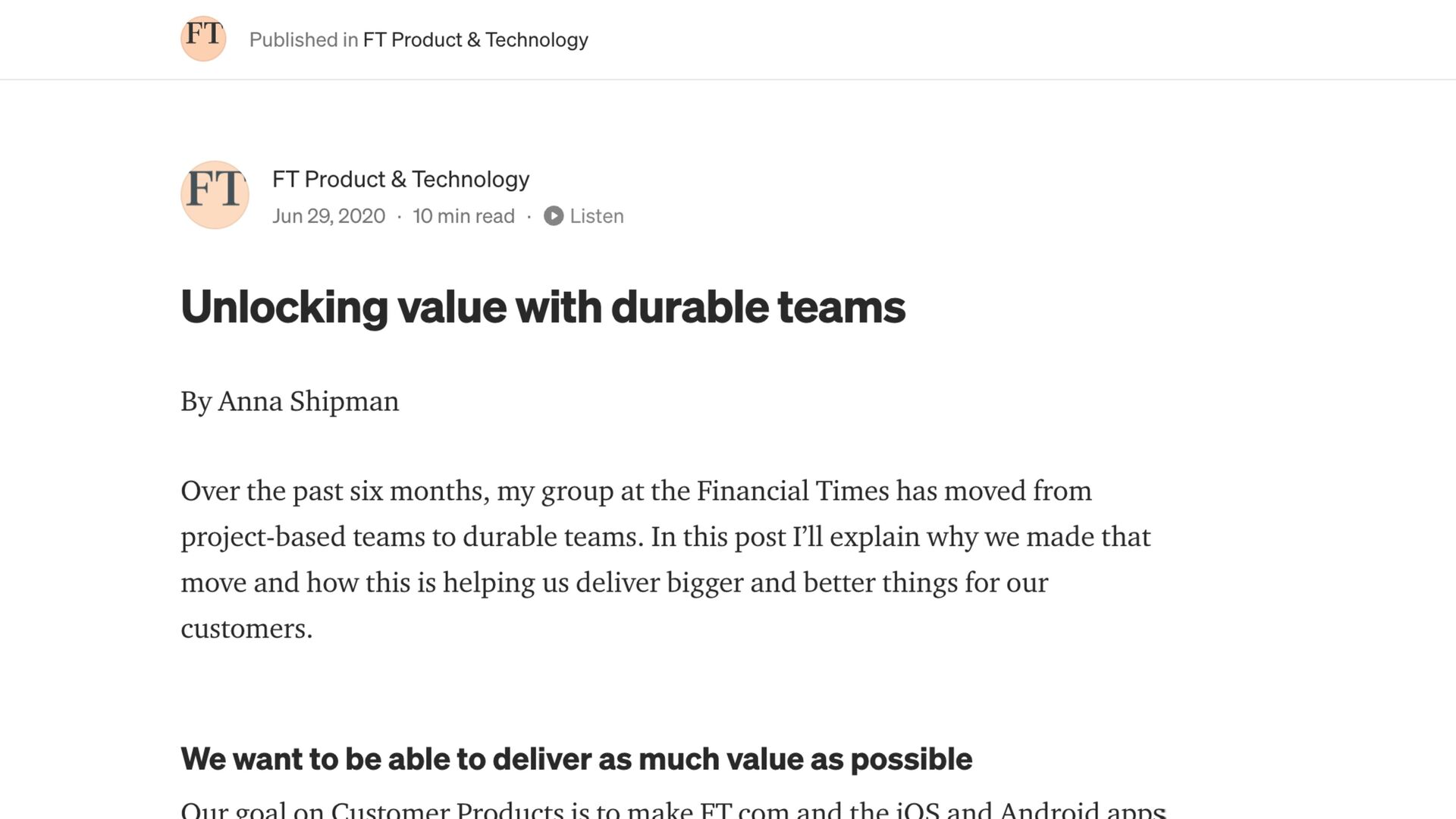
With NeXT, we realized that we kept forming teams around projects and then disbanding teams to work on other things, and we could add a lot more value by having stable teams who owned a domain and could think about that in the longer term.
And so we restructured to do that, so to have stable teams in areas because we realized we'd add a lot more value that way. Okay, so we've looked at external factors and internal factors, and now bring it all together, and now we can turn to SWOT.
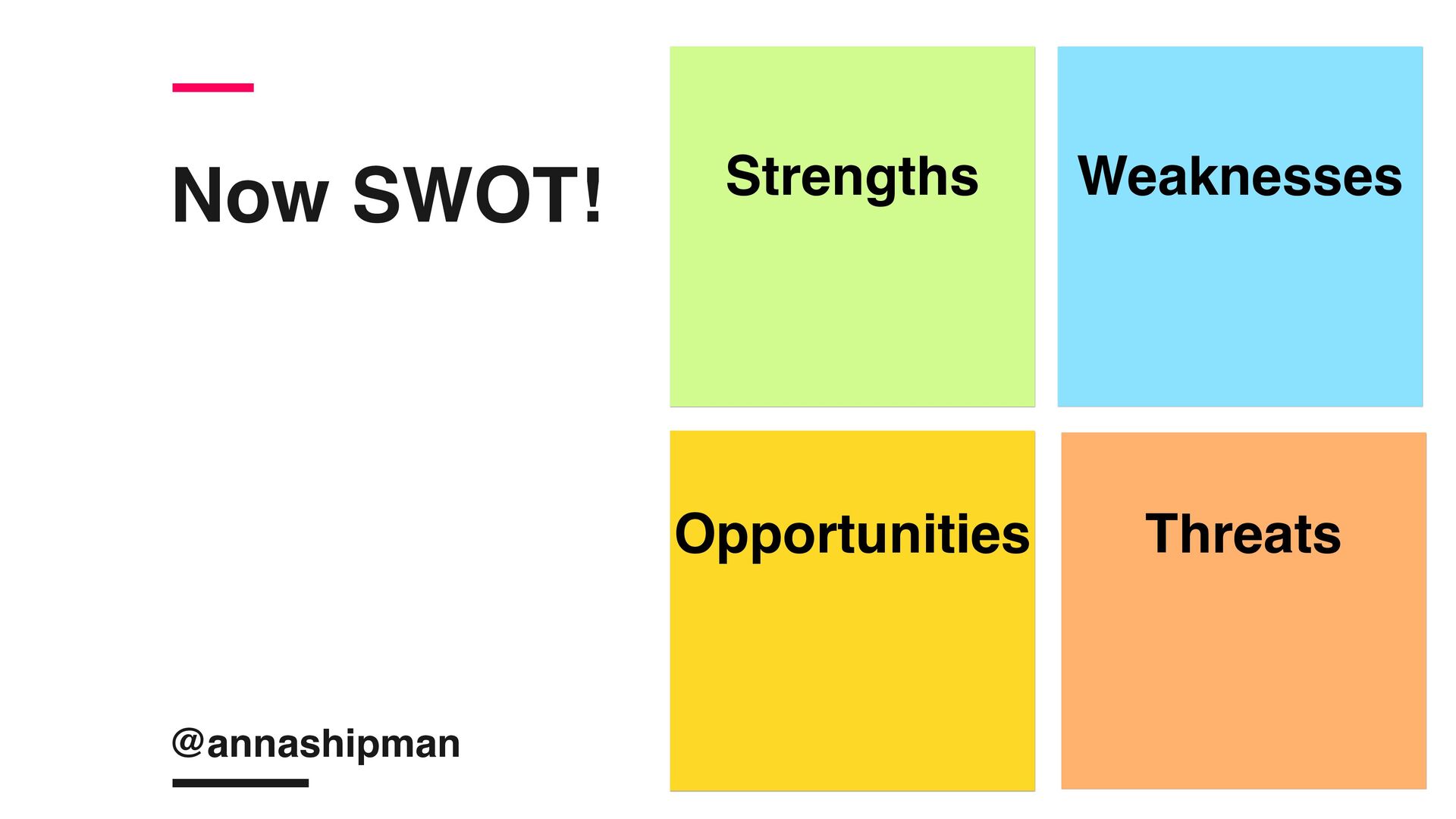
So if you start with SWOT, you haven't really done the structured thinking, but now you've gone through some models and you can start thinking about what your strengths, weaknesses, opportunities and threats are. SWOT is really good for bringing together the conversations you've had using those models and coming to conclusions.
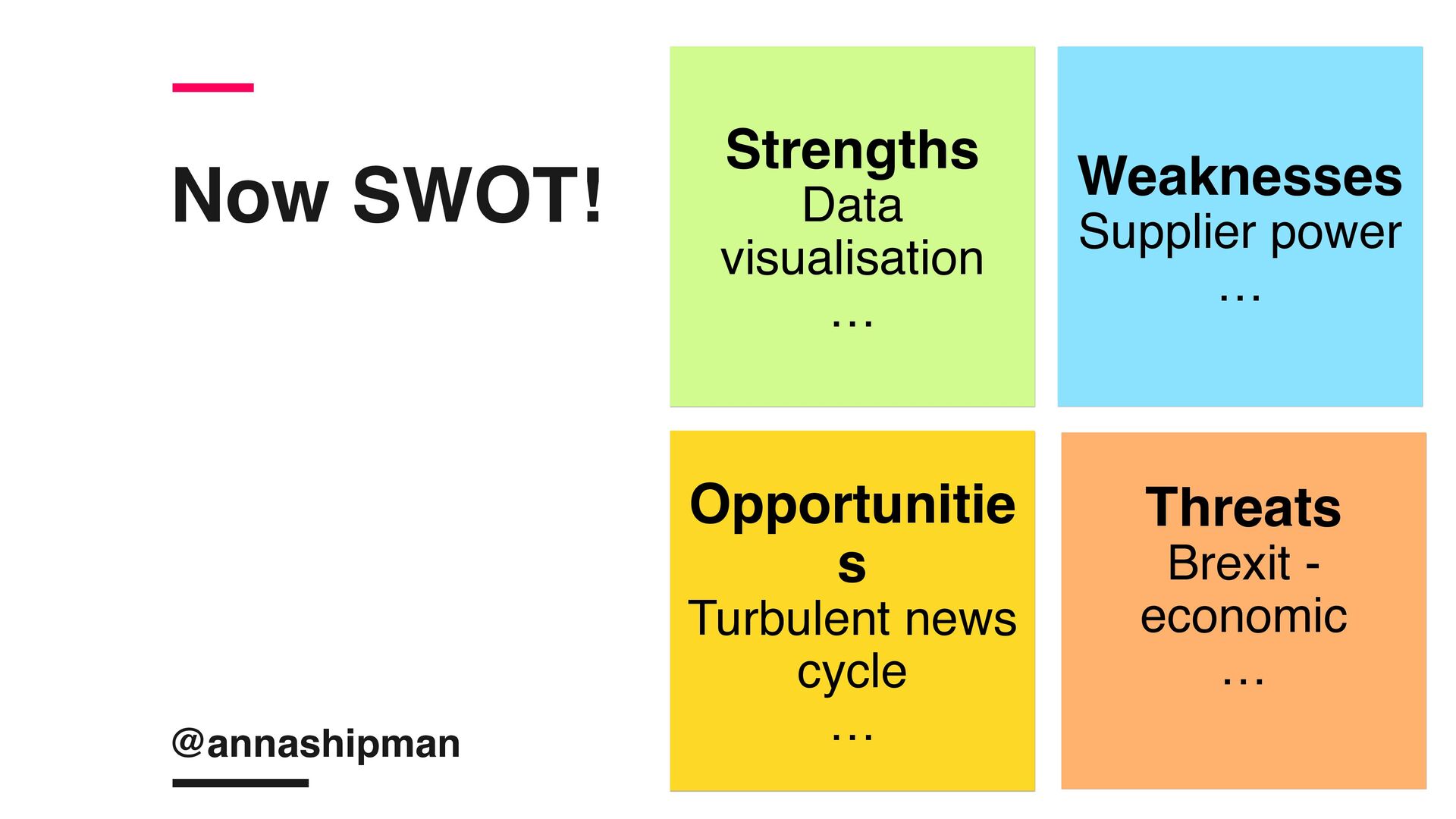
So, for example, we have strengths in data visualization, one of our weaknesses is supplier power, an opportunity for us is a turbulent news cycle, and one of the threats was economic threats around Brexit. So now you've got your diagnosis, perhaps not your diagnosis, but you've got an understanding of the context.
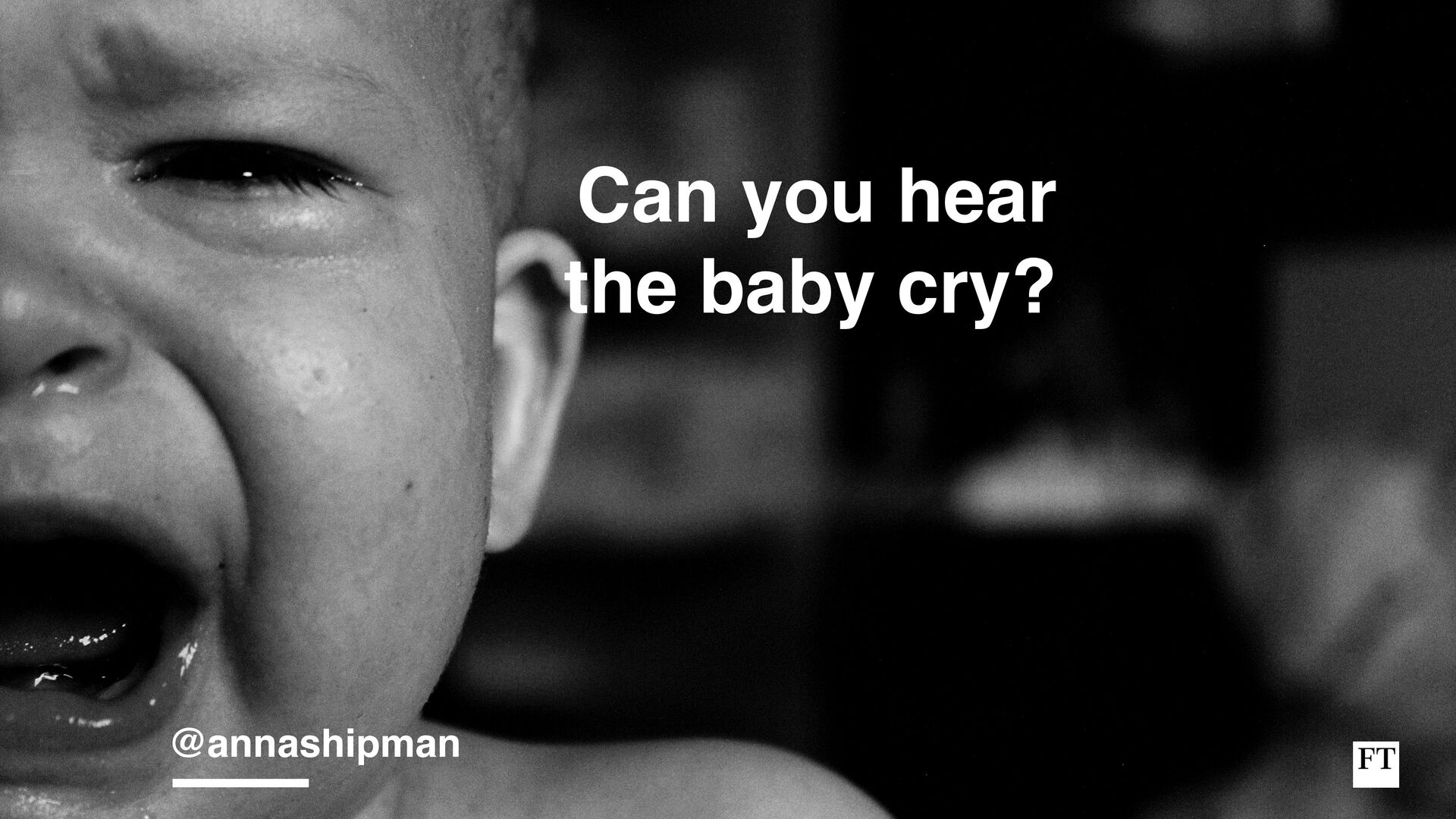
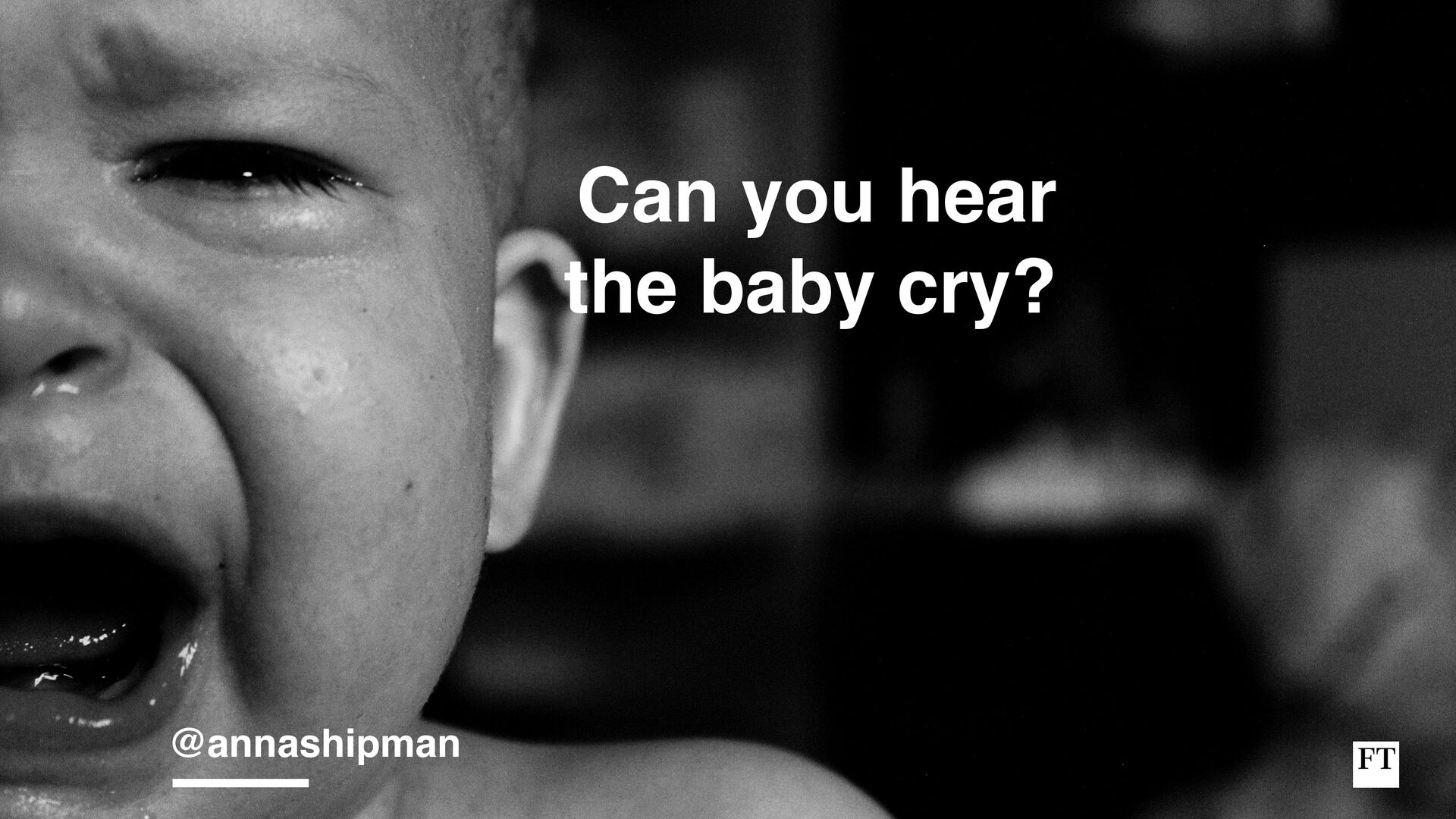
You need to hone in on the critical aspects. So if we return to the quote, A good diagnosis simplifies the often overwhelming complexity of reality by identifying certain aspects of the solution as critical. And there's something that people talk about when talking about strategy, which is, Can you hear the baby cry?
What that means is there's a lot of noise, and the baby crying is the noise that you need to address, and you need to understand what you need to do. Do you need to feed the baby? Do you need to pick up the baby?
But the point is, you need to identify what is the critical noise that you need to pay attention to. If you've heard me talk about strategy before, you'll know that it's not worth anything if you don't communicate it. You can have the best strategy in the world, but if nobody knows about it, it isn't worth anything.
So I'll come back to it, but at this point, you've got your diagnosis, you need to communicate the call to action so that everybody can hear it. You want everybody to hear the baby cry. Okay, so you've analyzed, now you're going to decide.
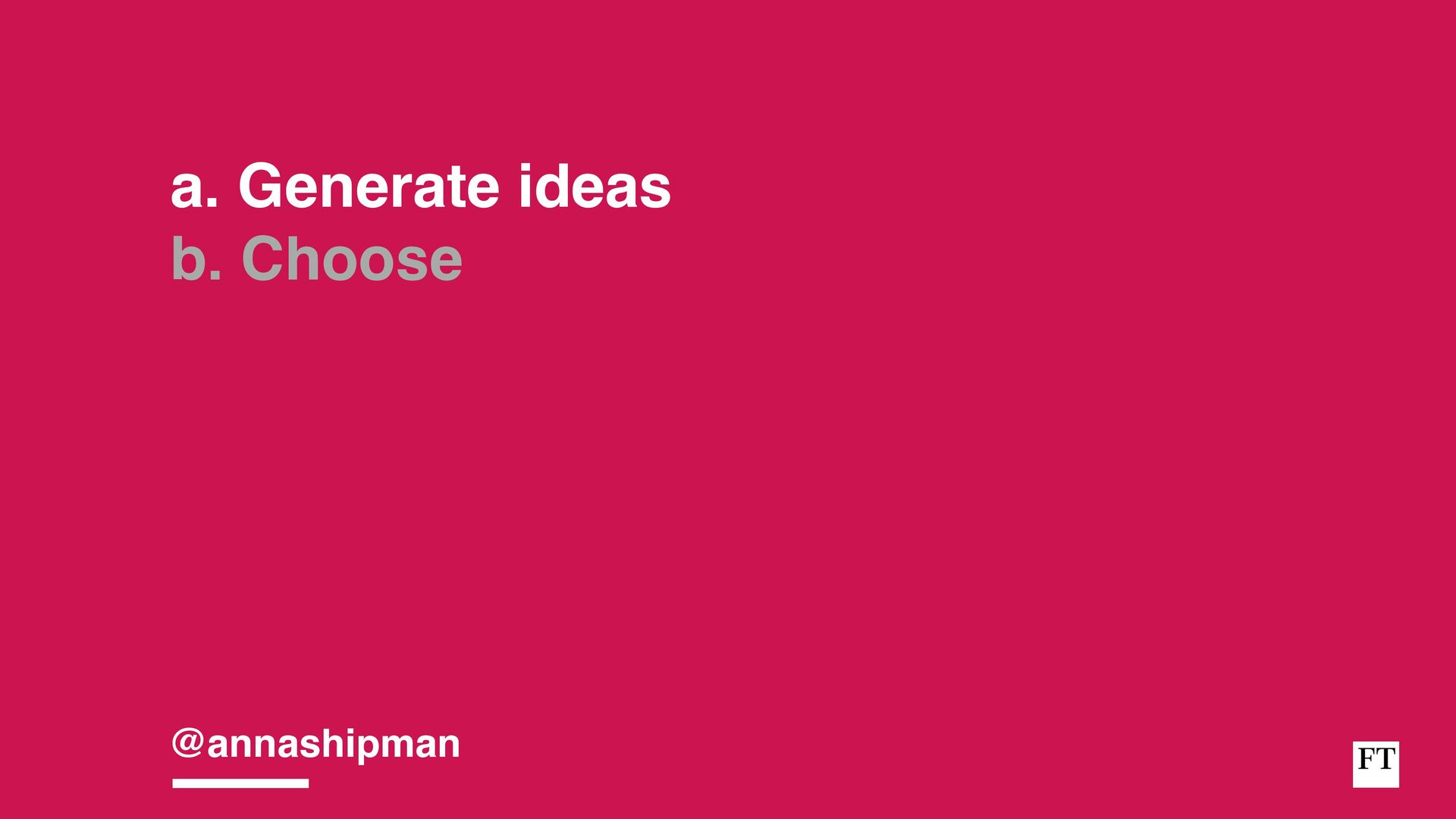
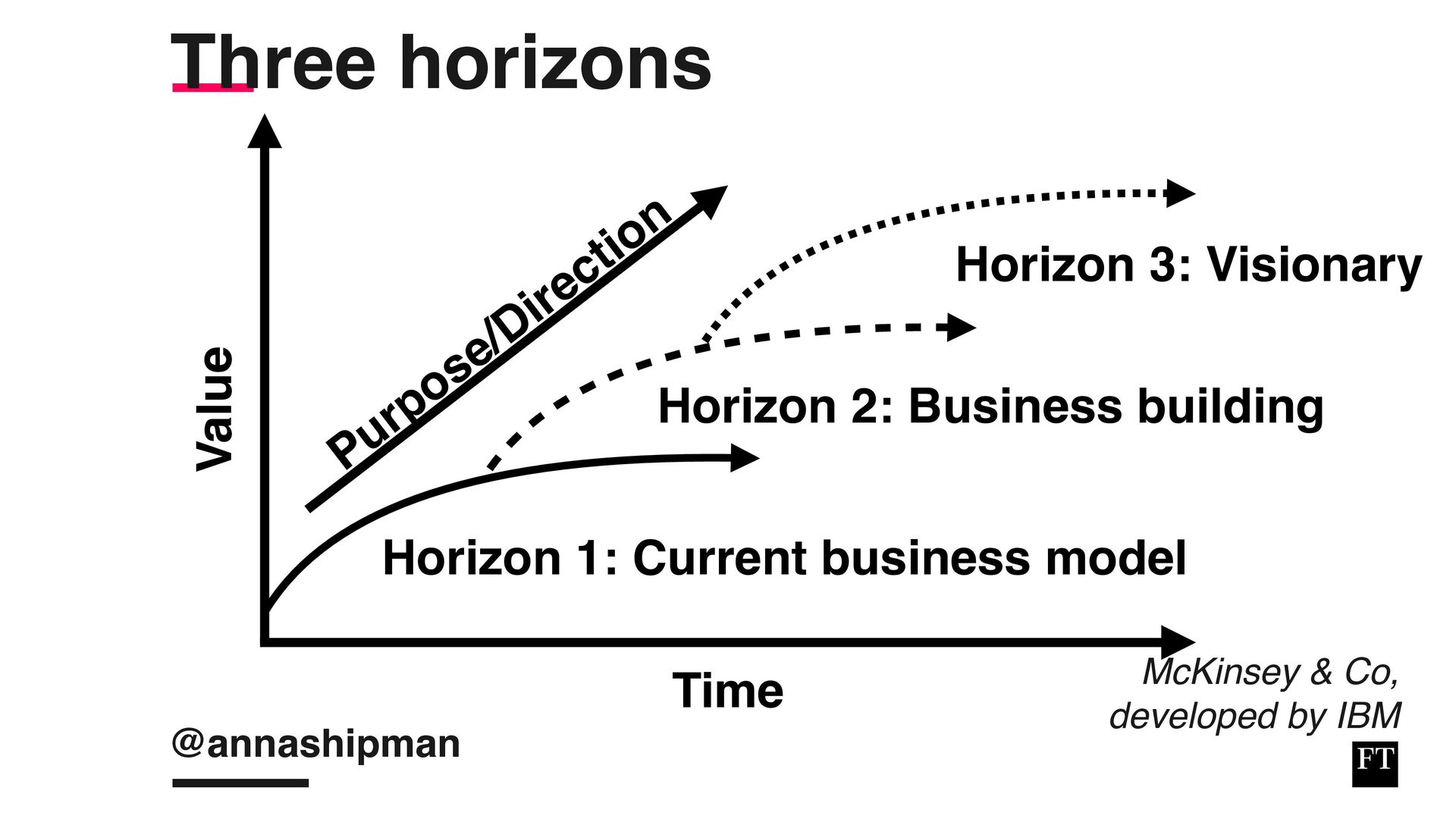
And I'm going to talk about two things here. I'm going to talk about generating ideas and then choosing. And so to generate ideas, I'm going talk through three models: Three Horizons, AnsophMatrix and Blue Ocean. Three Horizons is McKinsey and Co, developed by IBM, and this is three horizons that you should be thinking about your business model.
And this is something you should be thinking about all the time, not just when you're doing strategy. Horizon one is your current business model. We saw from the S curve that every business model eventually goes into decline, so horizon two, you're thinking about what's going to be your next business model when your current business model starts to decline.
And then horizon three is really the visionaries out there, You might not get a return on your investment very quickly, or you might not get a return on your investment at all, it's really thinking about what might be coming up. And as things progress, they move down, so as you move on, horizon two becomes horizon one, horizon three becomes horizon two, and you start thinking about a new horizon three.
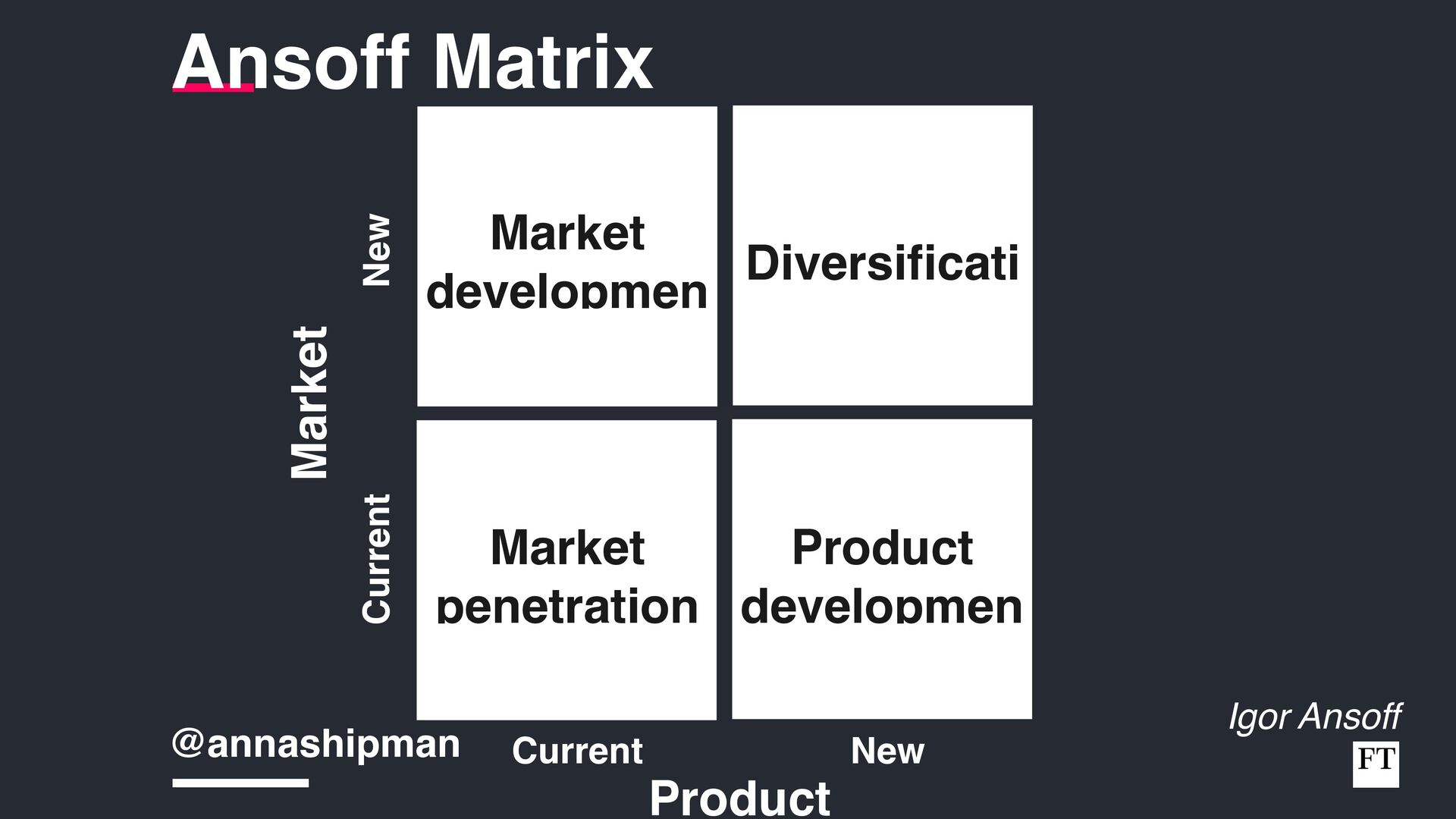
So this is something you should be thinking about all the time. And then when you're thinking about strategy, you use that thinking. The second thing I'd like to talk about is Ansof Matrix. So this is Eagle Ansof. And the point here is that growth can only come from two places: more customers or more products.
So when you're thinking about your current product in your current market, that's market penetration. So the Feet, for example, with subscriptions, we've got a paywall and the conversion on our paywall is actually quite low compared to our competitors. And so what we're doing is we're improving our paywall technology to improve the possibility of getting more customers from our current market.
So that's market penetration. Your current product in new markets is market development. So that's new customers. And so the Feet, for example, we now give the Feet to schools. So that's current product, the Financial Times, but new market: schoolchildren rather than business people.
The idea there is when they leave school they might then go on to become a customer. So that's market development. New products in your current market is product development. So one of the things we're doing there is we have enterprise customers and at the moment they get a kind of bulk discount to the Feet, and we are working on developing new products that actually share our content in a different way, more usefully for enterprise customers.
And then new products in new markets is diversification. Diversification is a very risky strategy because you don't know the product and you don't know the market. It can be successful. A good success story of diversification is the Xbox. So that was a new product for Microsoft, a gaming console rather than a PC, and a new market, gamers rather than business people.
But there are loads and loads of unsuccessful examples. Virgin Cola had Virgin Space Travel but I read this morning that they're doing another one next week so maybe not fair to say that's not successful, but there's lots of Virgin ones. There are loads of examples of diversification that you haven't heard of because they fail so quickly.
And it's also like you need to be careful because arguably, Royal Bank of Scotland diversified into capital markets and arguably that is what brought them down. So if you're not careful, diversification can bring the whole company down. And the third thing I'd like to talk about is blue ocean strategies.
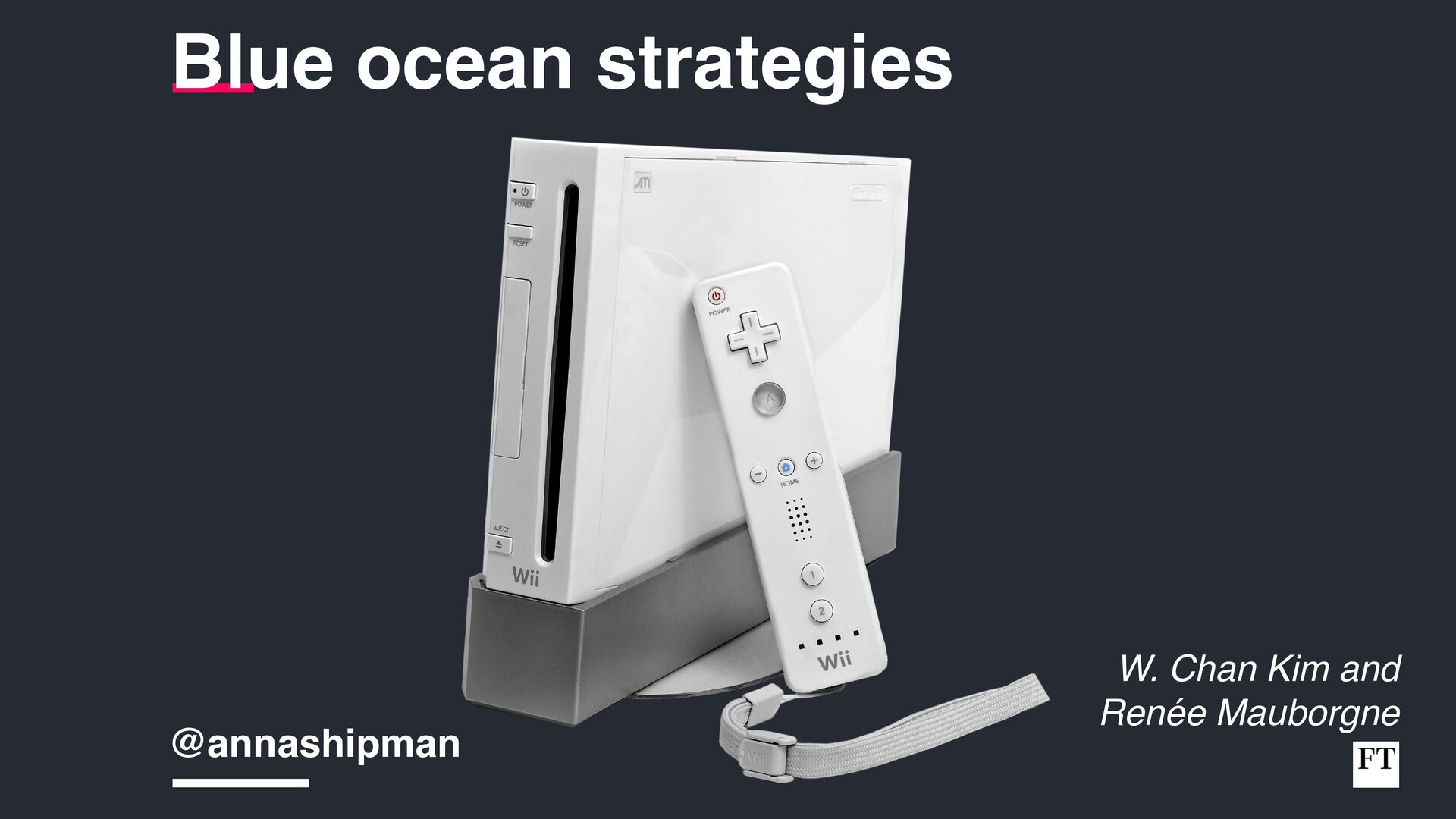
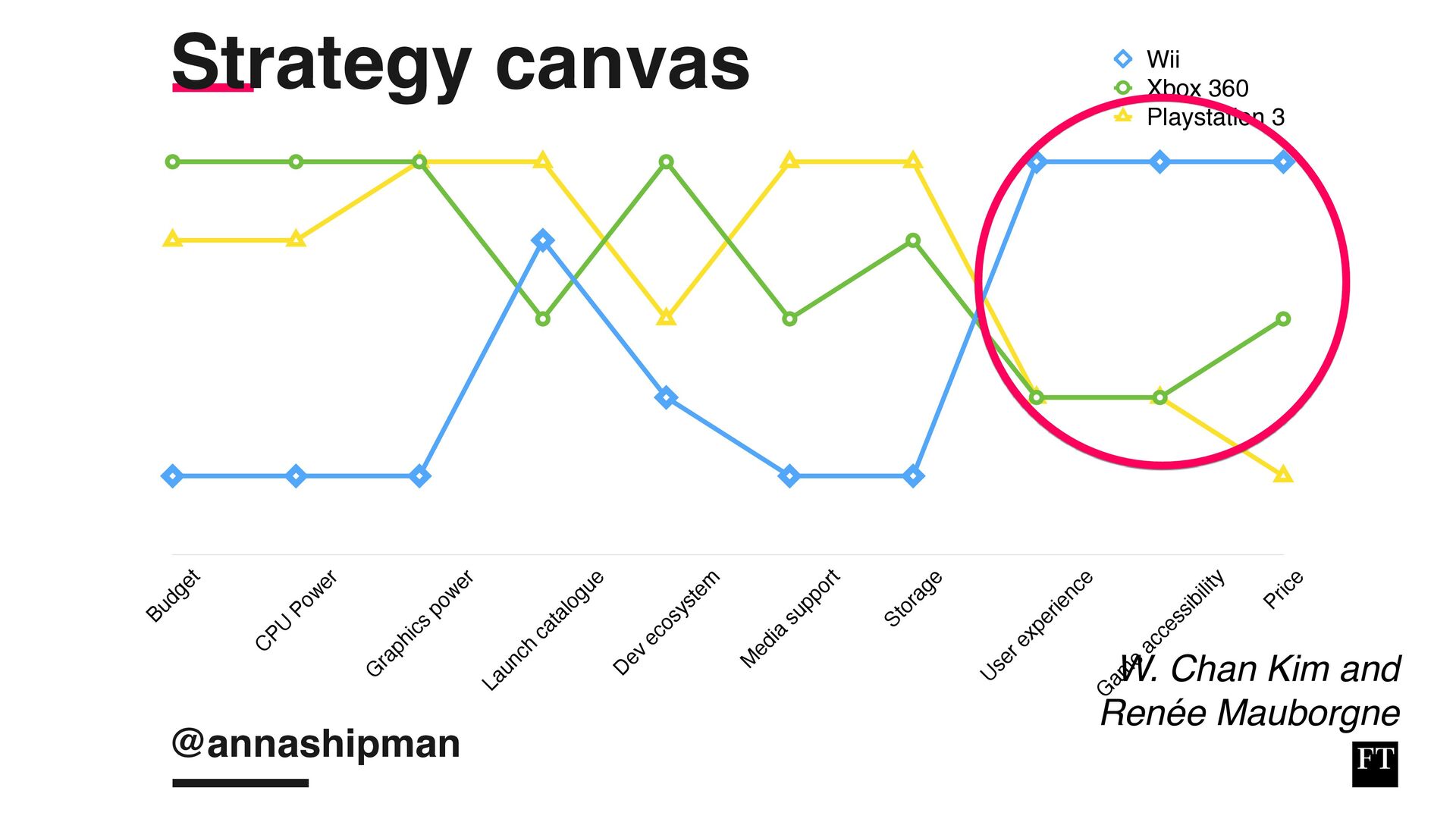
This is W Chan Kim and Renee Marborn. And this is where you compete in an area where you're not competing over the same things as your competitors. The classic example is the Nintendo Wii. So before the Wii was launched, competition in gaming was around better graphics, faster GPU, faster CPU, and that was how to be competitive.
And what they did instead was focus on different kinds of gameplay and more accessible gameplay and games, motion controller and games that were more understandable to people who weren't already gamers. So things like Wii Tennis and Wii Bowling. And so they started competing in a different market for different gamers.
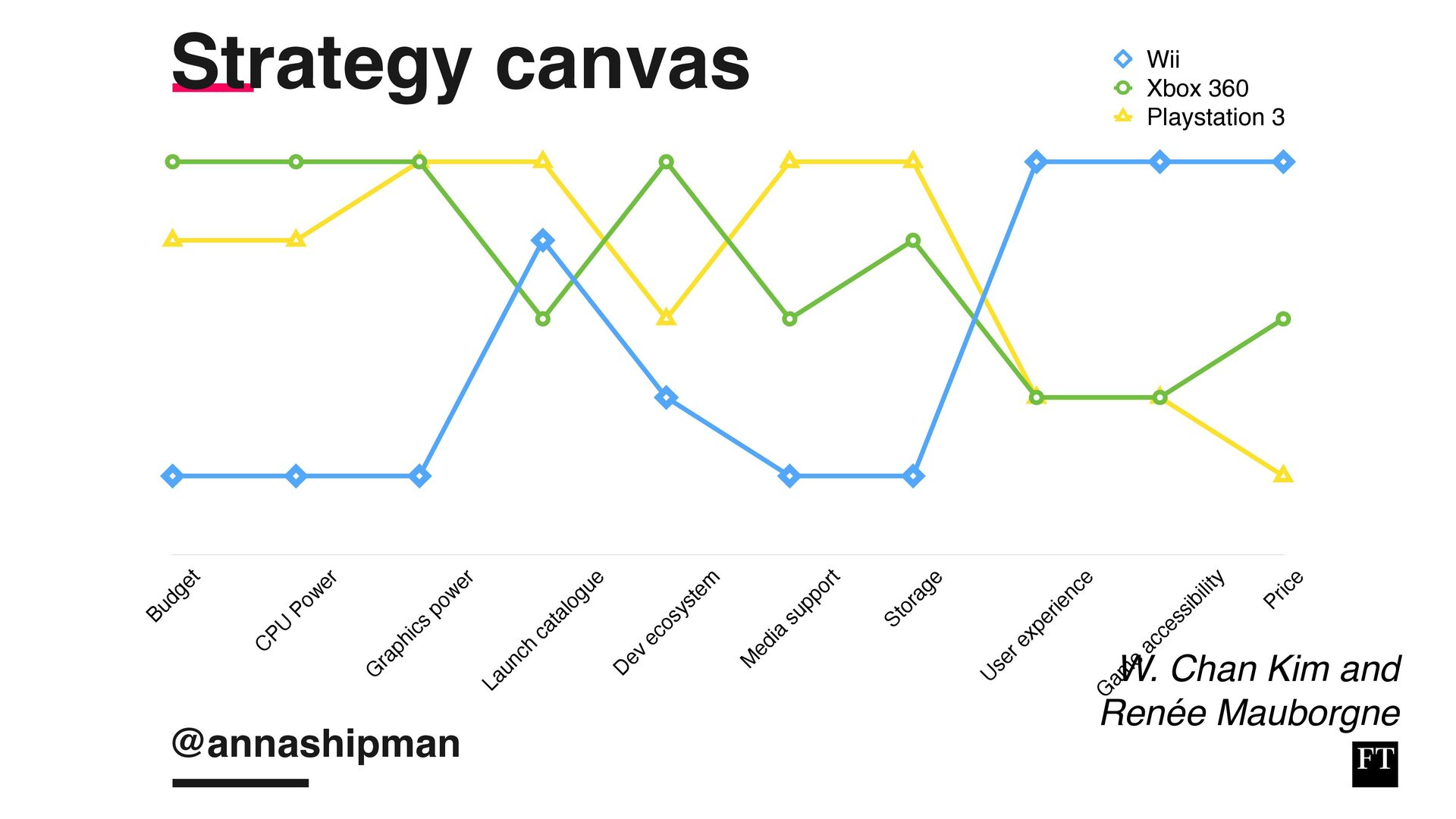
And because that was the way their focus was, they then didn't have to spend as much on the GPU and CPU. The tool for thinking about blue ocean strategies is the strategy canvas. The idea of the strategy canvas is you list out the factors and you look for the area where there's no competition, that's your blue ocean or where there's a big gap between the competitors.
I'm not totally convinced though that this would get you to a blue ocean strategy because you have to know what factors to think of already. What it is very useful for is communicating your blue ocean strategy once you've thought of it. Okay, so these have hopefully generated some ideas and now you need to choose.
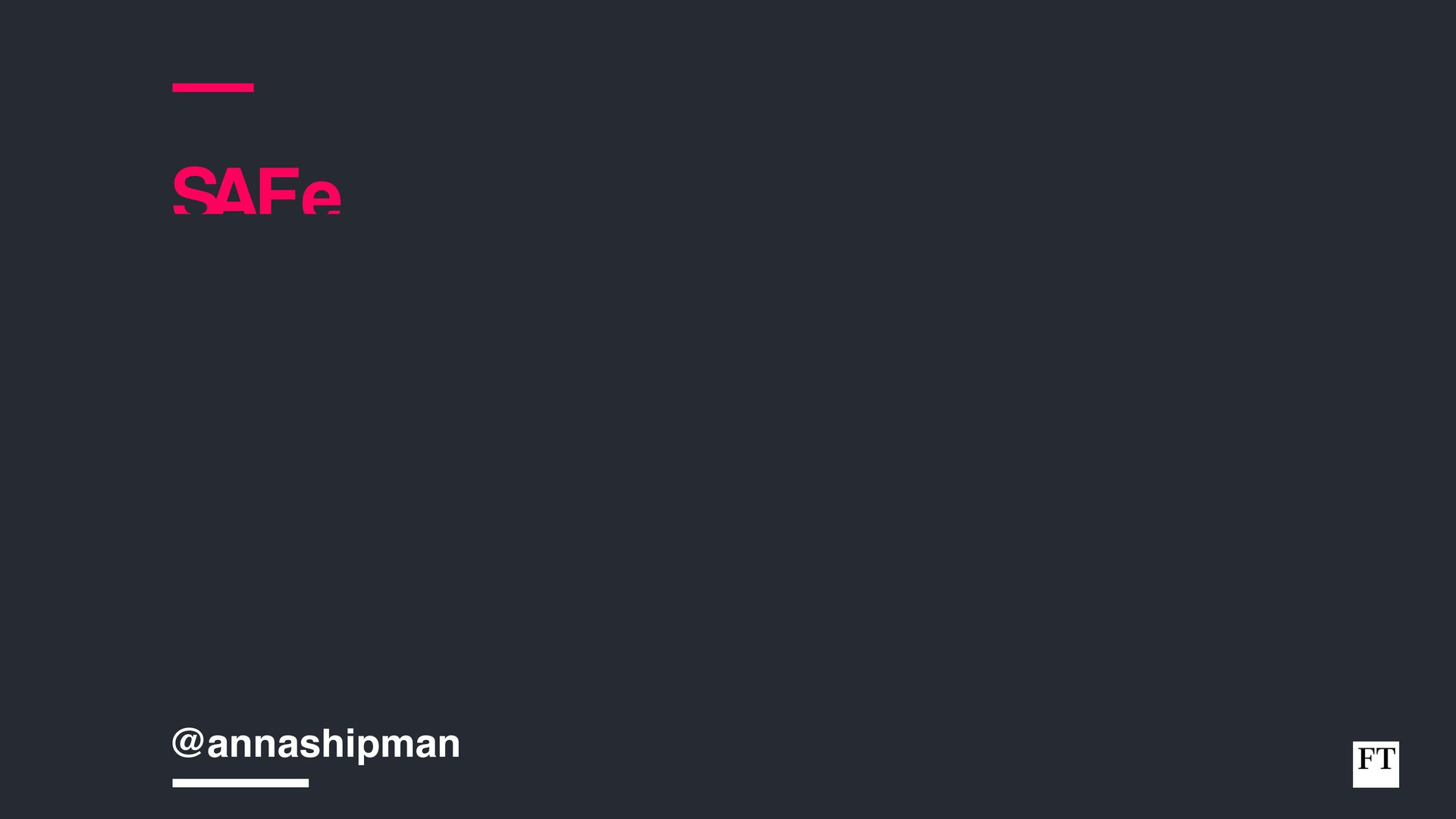
So I'm going to talk about another, I forgot about this one. I'm going to talk about two models for choosing, and this is, I think, my last acronym: SAFE and weighting and scoring. So the first one is SAFE, it's not the scaled agile framework.
It is suitable, acceptable and feasible. So is it suitable? Does it address the strategic challenge? Is it acceptable? So is it, for example, within your organisation's risk tolerance? And is it feasible? Is it something you actually have the capability to do? Is it something you can get financing for?
And again, when you're going through all these models, they surface information that people haven't necessarily thought to share, and even at this point, you might start to hear information, your CFO might talk about something around financing that you hadn't heard that has a big impact on your strategy.
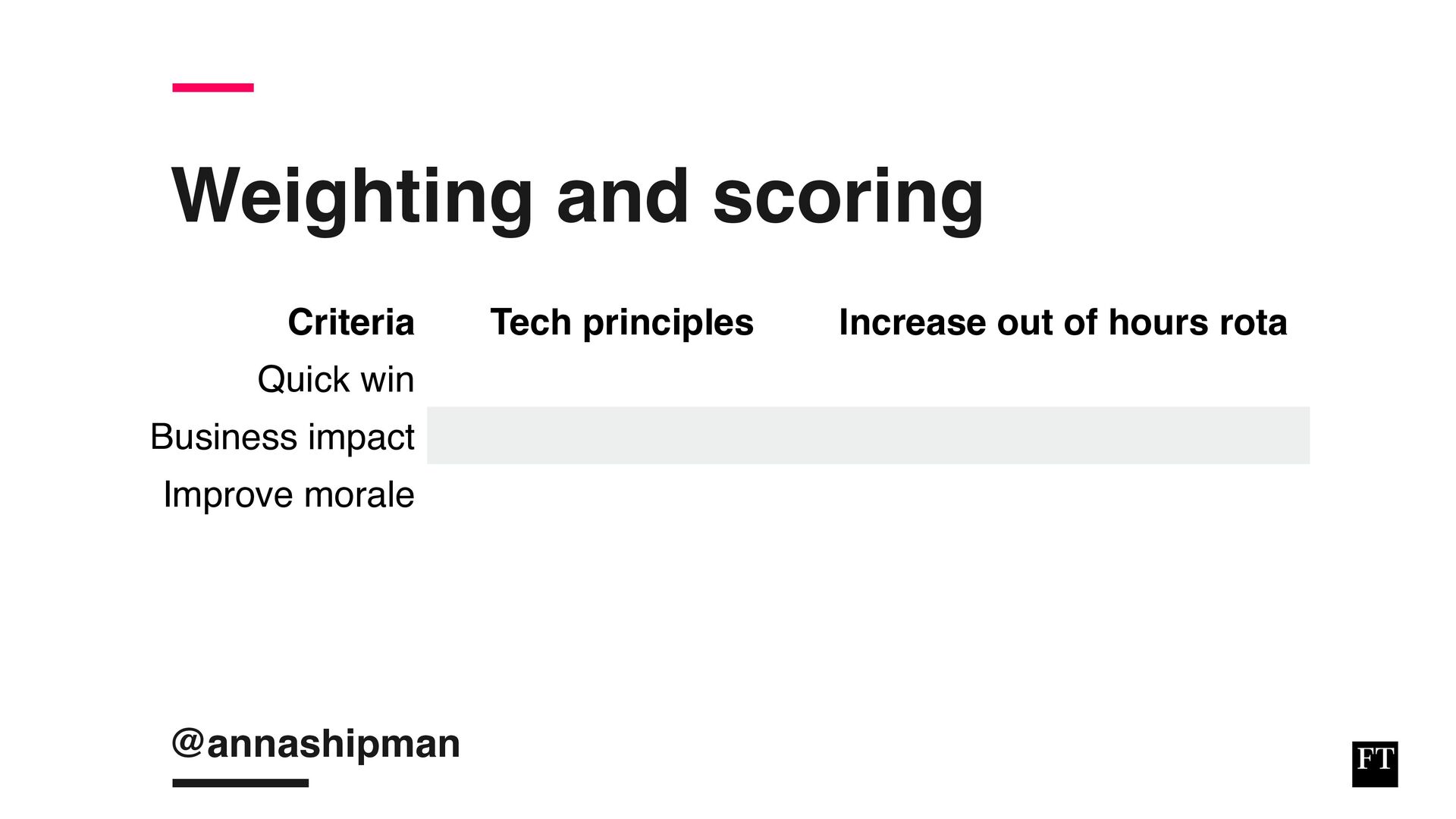
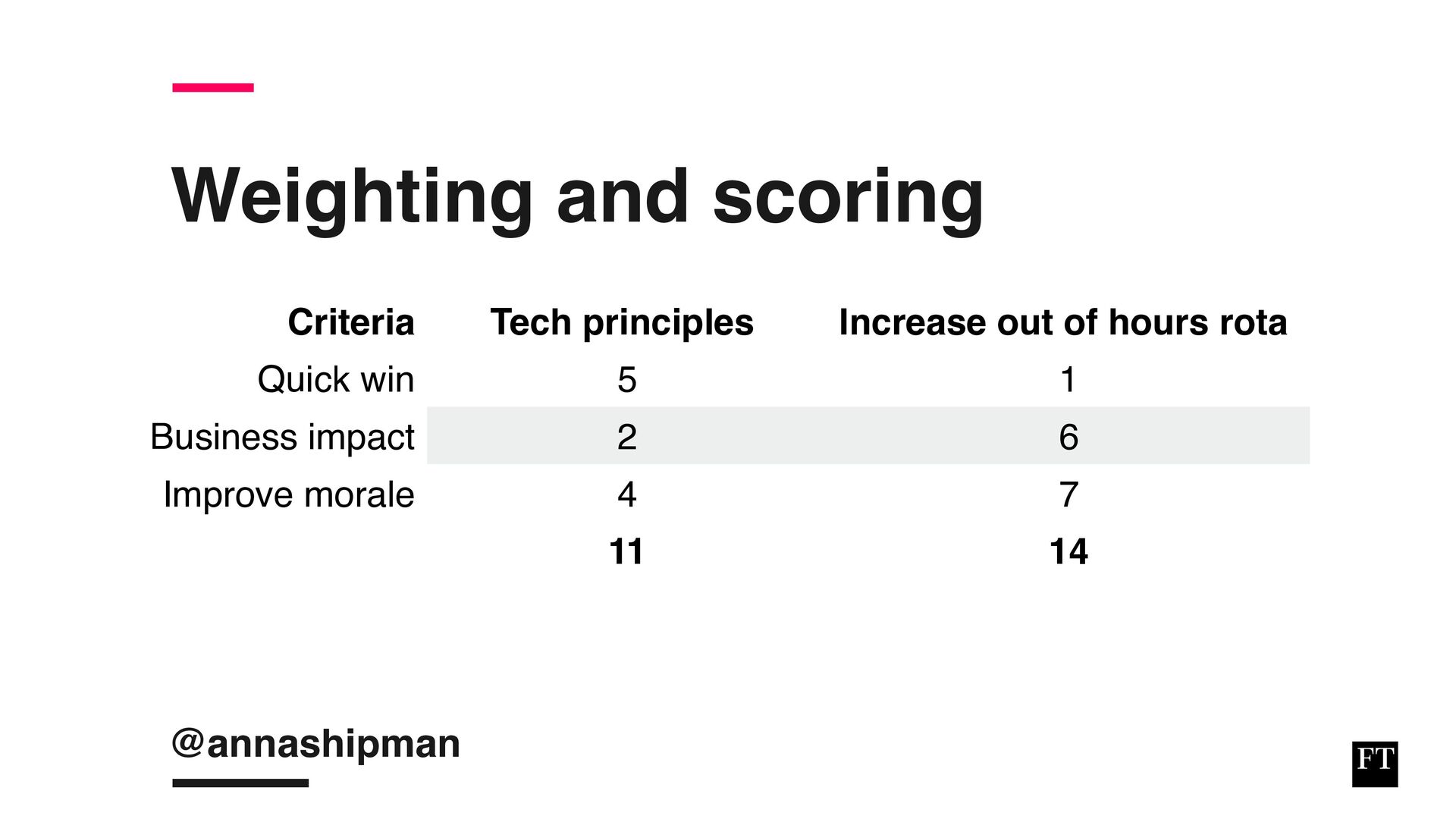
And the second model I'd like to talk about is weighting and scoring. And so this is where when you're thinking about various things, you might compare them on certain criteria. So when we started with tech strategy, a couple of things we thought about doing: I mentioned teams were heading in different technical directions, we thought about agreeing some technical principles, and I also mentioned we only had five people on the out of ours rotor, so we wanted to increase the out of valves rotor.
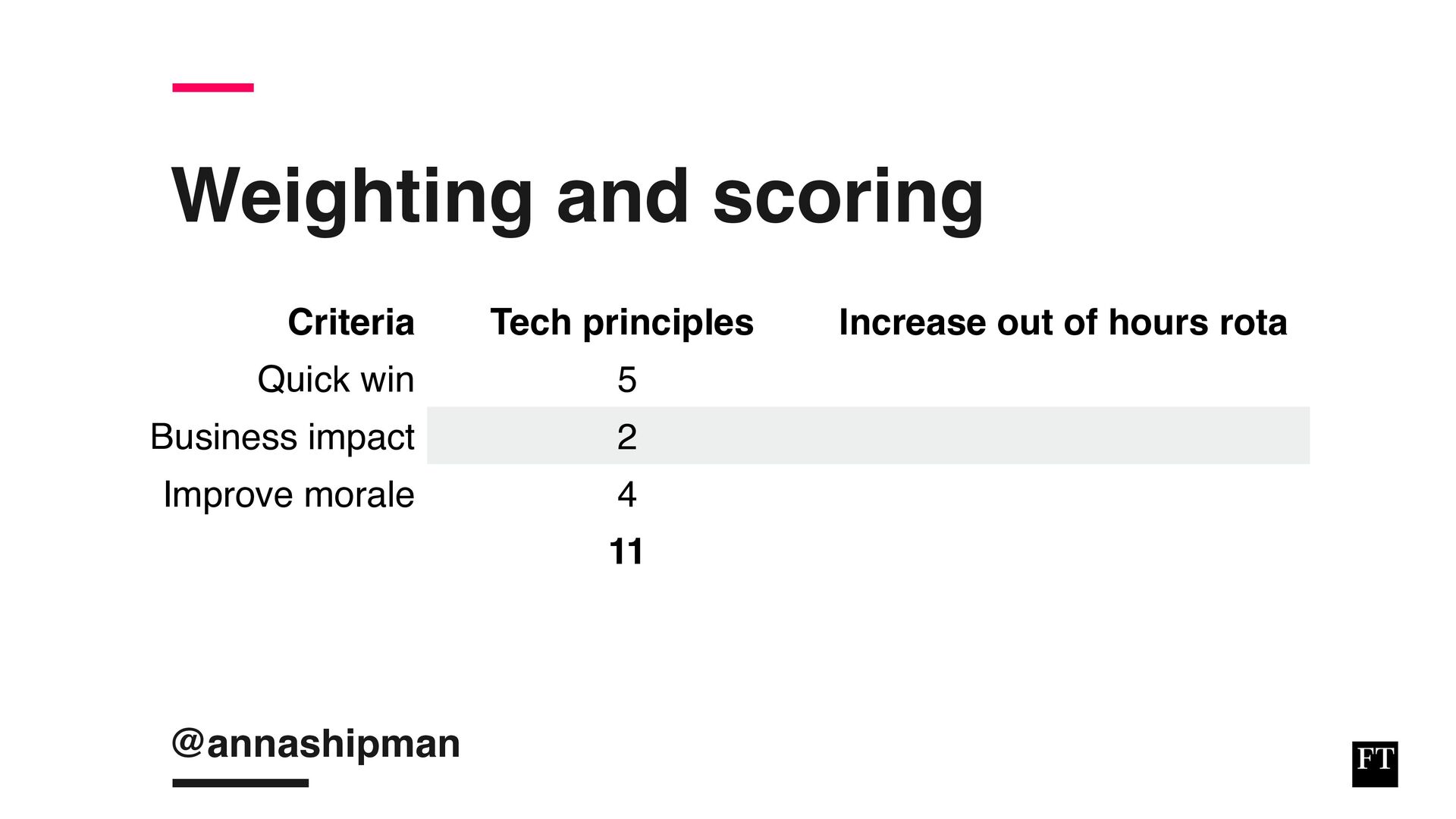
And the criteria we were thinking about was: is it a quick win? Does it have impact for the business? And will it improve morale? Because morale was quite low with the tech drifting. So with tech principles, it's a relatively quick win. The business impact is quite low.
Your customer is not going to know if you have tech principles, and it would slightly improve morale. So that adds up to eleven. Increasing the out of valves rotor is not a quick win. However, the impact to the business is higher because eventually it's going to lead to more reliability and it would definitely improve morale because it's pretty demoralizing being one of only five people on the out of valves rotor.
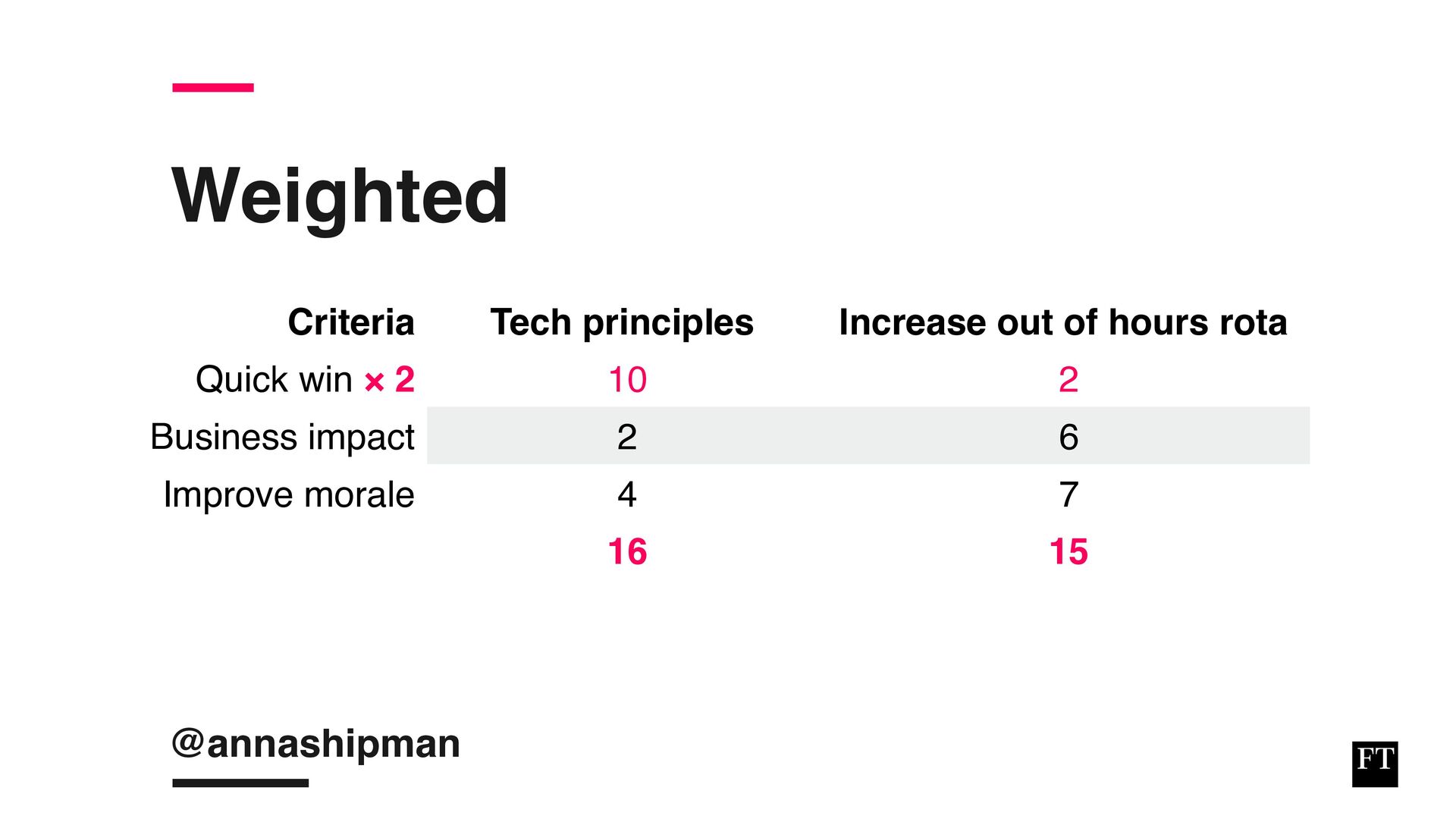
So that kind of suggests Now with all of these models, you don't have to do what they say, it's useful for information, but that suggests we would start with increasing the out of valves rotor. Weighting, though, is where you think something is maybe more important, and so you give it extra weighting.
So for us, we were thinking about what's the first thing to do, and so the fact that it's a quick win is more important, so we say that's double. And then that means that tech principles actually edges forward. And that's actually what we did.
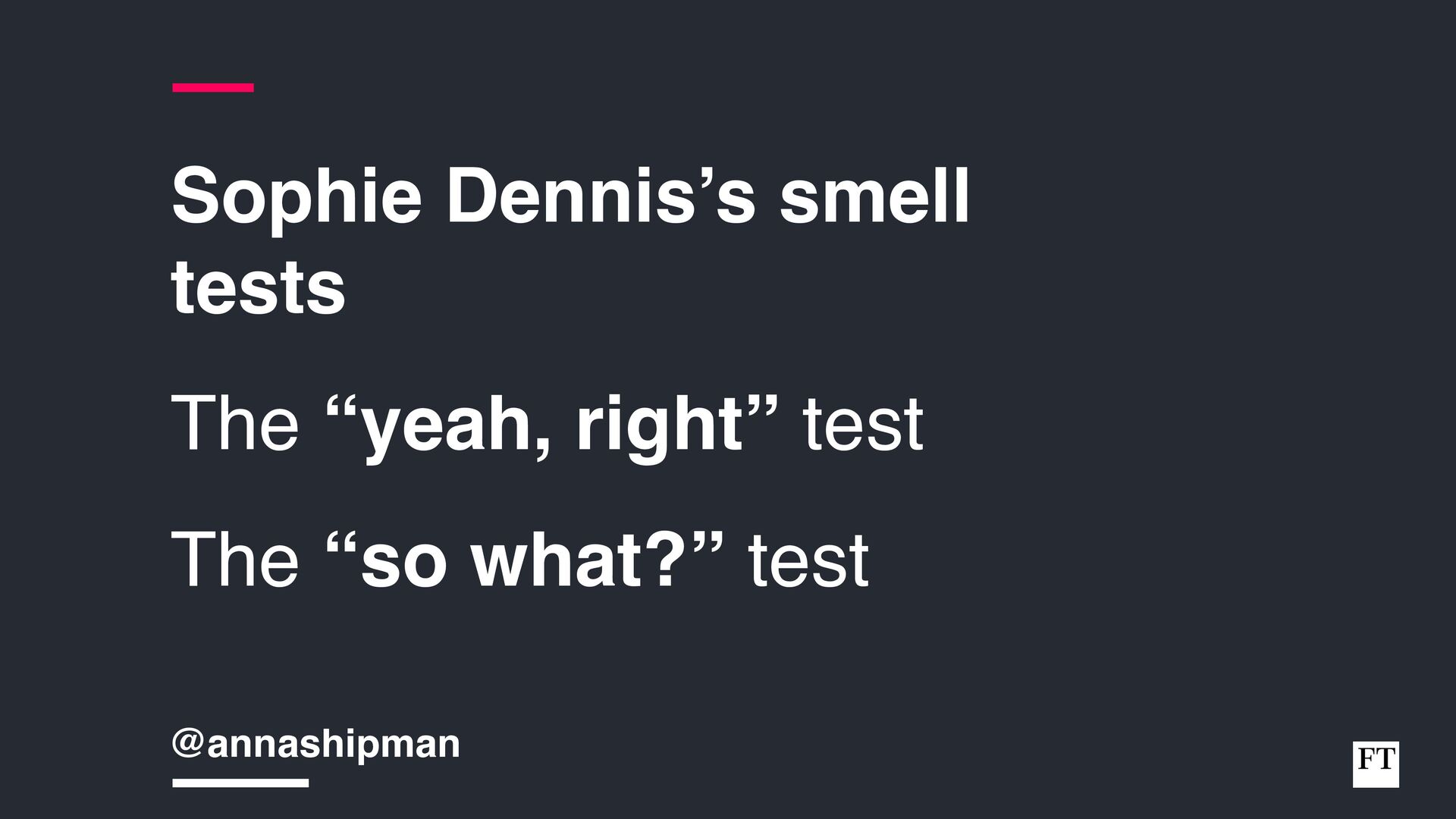
We started by defining tech principles and then we moved on to working on the out of our structure. And the last thing I'd like to talk about when you're thinking about what to do is once you've got your idea of what your strategy is, you should apply these smell tests.
This is Sophie Dennis, she works in government, and she has these smell tests for your strategy. So the 'yeah, right' test is: your strategy is so visionary, nobody believes it's going to happen. The so what test is your strategy is so mundane, nobody thinks it's really going to make a difference.
And the yes, and test is it sounds great, but what does it actually mean? So digital is a good yes, one that fails a yes and test. Great. What are we actually going to do? Okay. And then, you need to communicate. So you've defined your strategy and you need to make sure that everybody knows about it.
Okay, so the last thing I'm going to talk about is doing. Remember this, a good strategy is a lever that magnifies force. So I'm not actually going to tell you how to follow your strategy. Your job is to marshal the force to apply to that lever.
So, there's three kind of things to think about here. Firstly, communication. Secondly, a little bit about managing change. And then thirdly, using it. So, as I mentioned, you need to communicate. You need to inspire people to hear the challenge and know what to do.
You need everybody to hear the baby cry and know what action they're going to do, what are they going to do to solve that problem. You need to communicate your strategy. You need to communicate your strategy until you're sick of the sound of your own voice talking about it, and you then still need to carry on talking about it.
Because every time you talk about it, there's going to be somebody in the room who has not heard it before because they're new to the company, or they weren't there before, or they were there but they weren't paying attention. And so you need to keep going on about it.
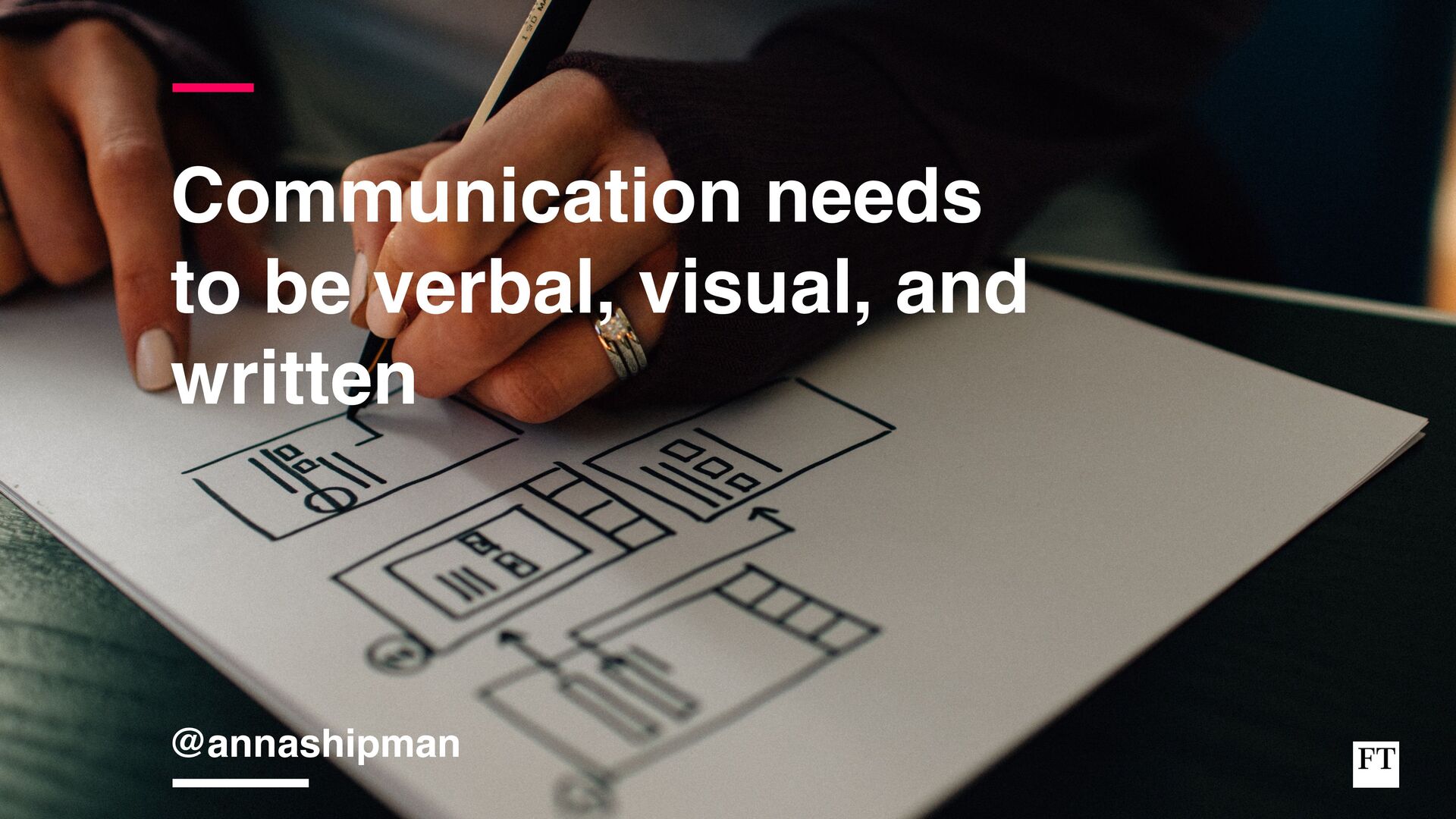
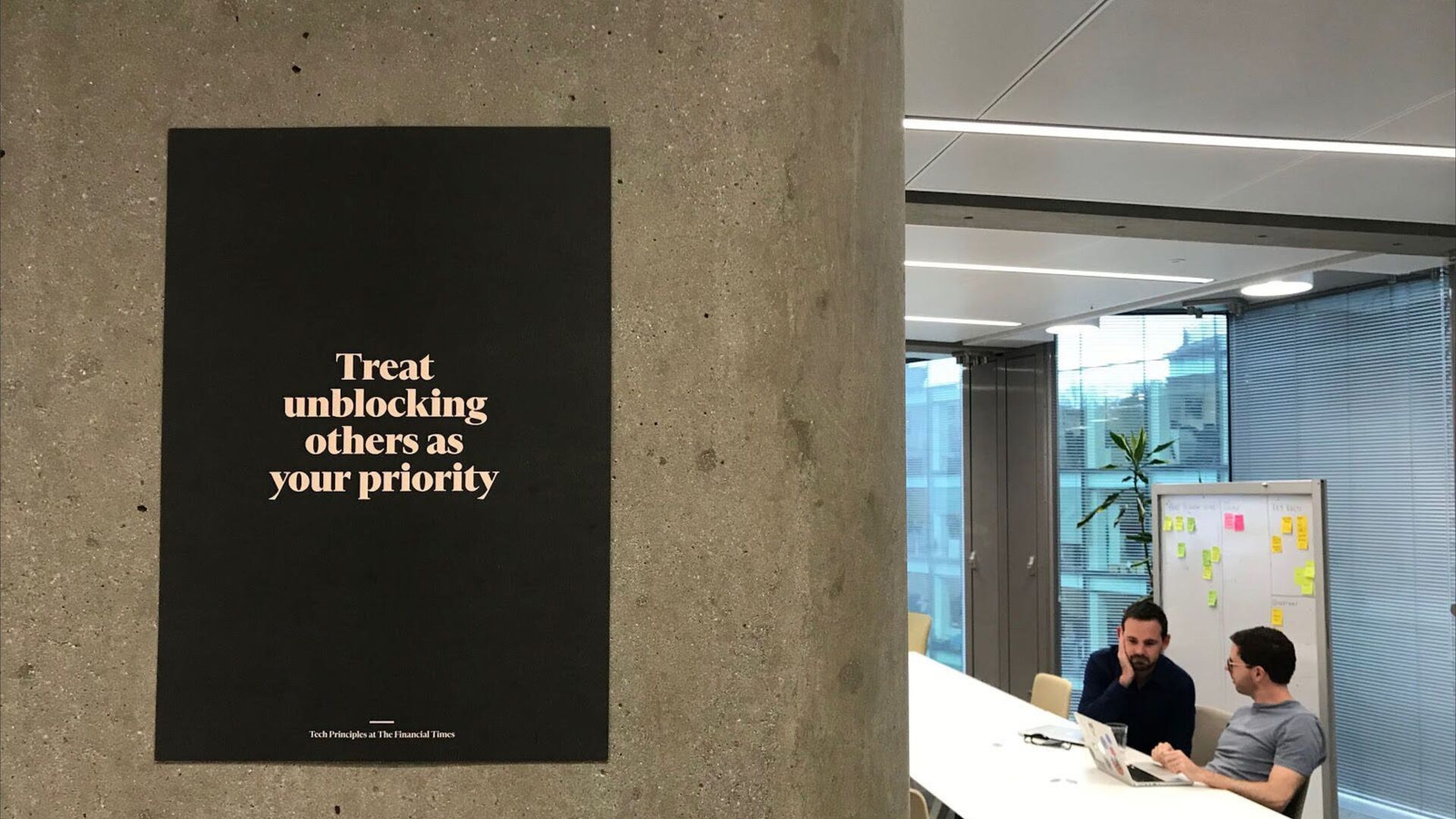
And people take information in different ways. So you need to communicate verbally, visually, and in writing. So not just talking about it. Also do some diagrams, also write some documents. We actually did posters as well, like everything is great. Somebody at the government digital service, the director of strategy told me, It will feel like propaganda to you, it doesn't feel like that to anyone else.
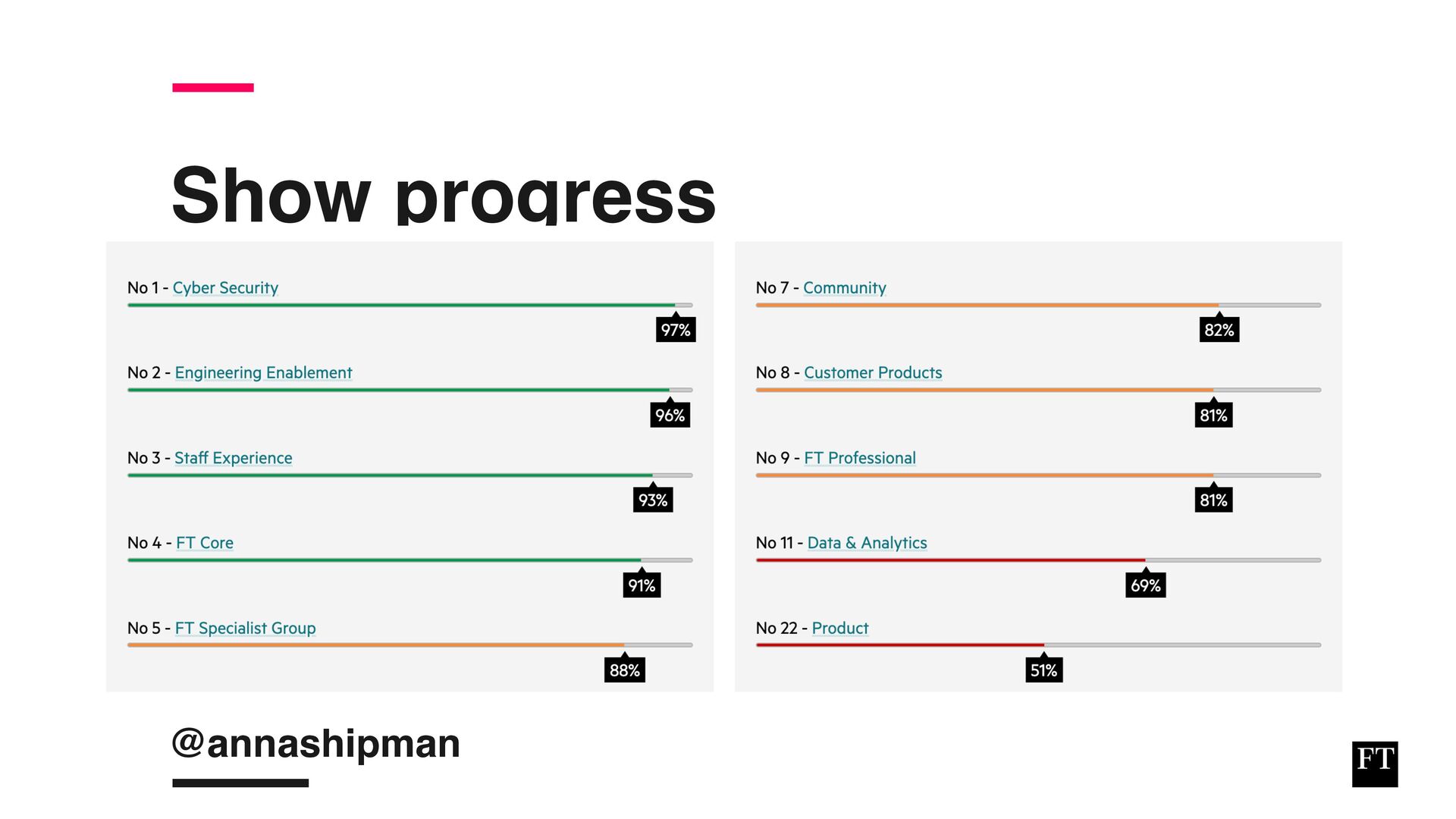
And the last thing that's really important to do is show progress. And this is something that I didn't do very well with the No Next Next strategy. I was really hung up on trying to make it super accurate, like how do we measure the quality of the code base.
It doesn't have to be super accurate, it just needs to be something. Now what we do is we have a document with just what we're doing and like red, amber, green of how they're progressing. And that's fine, You just need to show progress.
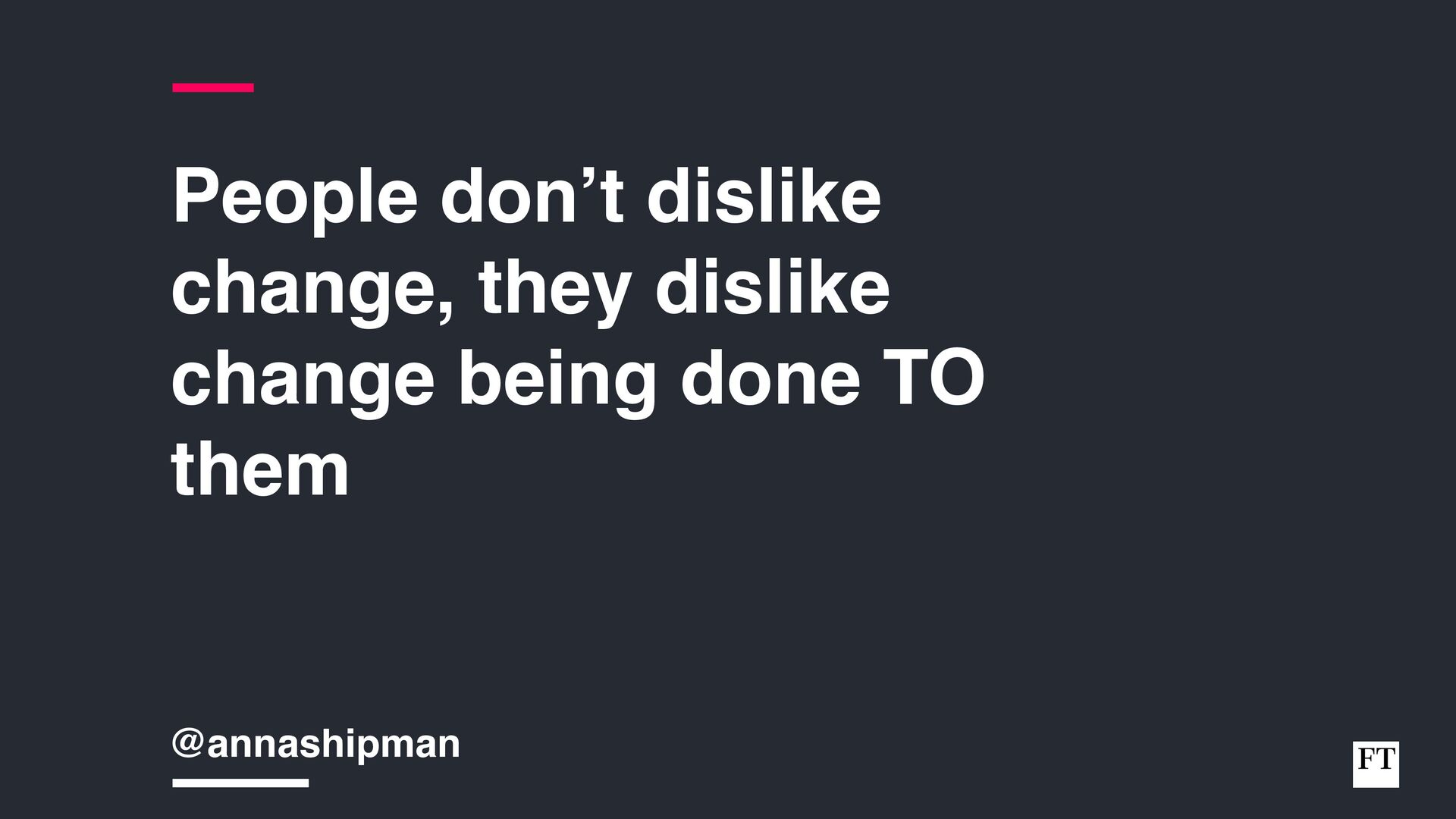
I'm going to talk briefly about managing change. So you're launching a strategy and so you're making change. And there's an idea that people don't like change. Actually, people don't dislike change, they don't like change being done to them. So this is about involving people, making sure they feel heard.
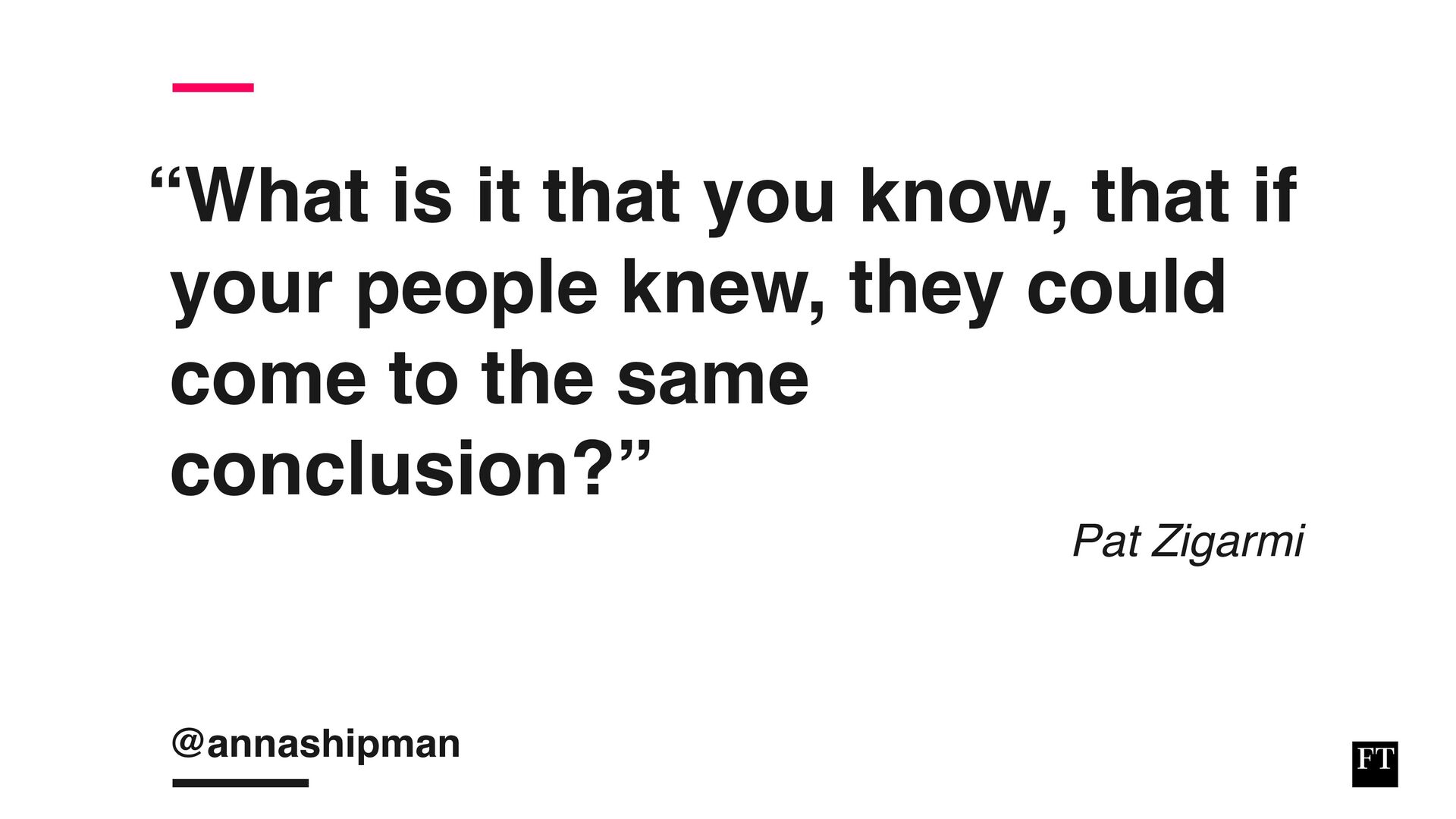
This is from Pat Zagami, not a direct quote. Pat Zagami has a lot of very useful stuff to say about change. This is a quote. She says, What is it that you know that if your people knew, they could come to the same conclusion?
And the last thing to mention on this is that early wins build trust. So it's the opposite of how you might approach a tricky software project where you might do the hardest thing first to check it works. Don't do that with a strategy.
Do easy things first because that will build trust. If you start with the hard things, then people will see nothing happening and they'll start to lose faith. And you need to use your strategy. Don't just do your strategy once and put it in a drawer.
It should be used to make decisions. So for example, with no next, next, people would start using it to justify decisions. Everything we were talking about doing, we're like, is this part of this fulfill no next, next? Does this fulfill our goals to be sustainable?
And revisit your strategy regularly. We work on it every quarter, so have a regular cadence, whatever it is, and then look at it again when things change. So, to create a strategy, you need to analyze, you need to reach a diagnosis, you need to decide, make a strategic choice, and then you need to do, communicate and execute.
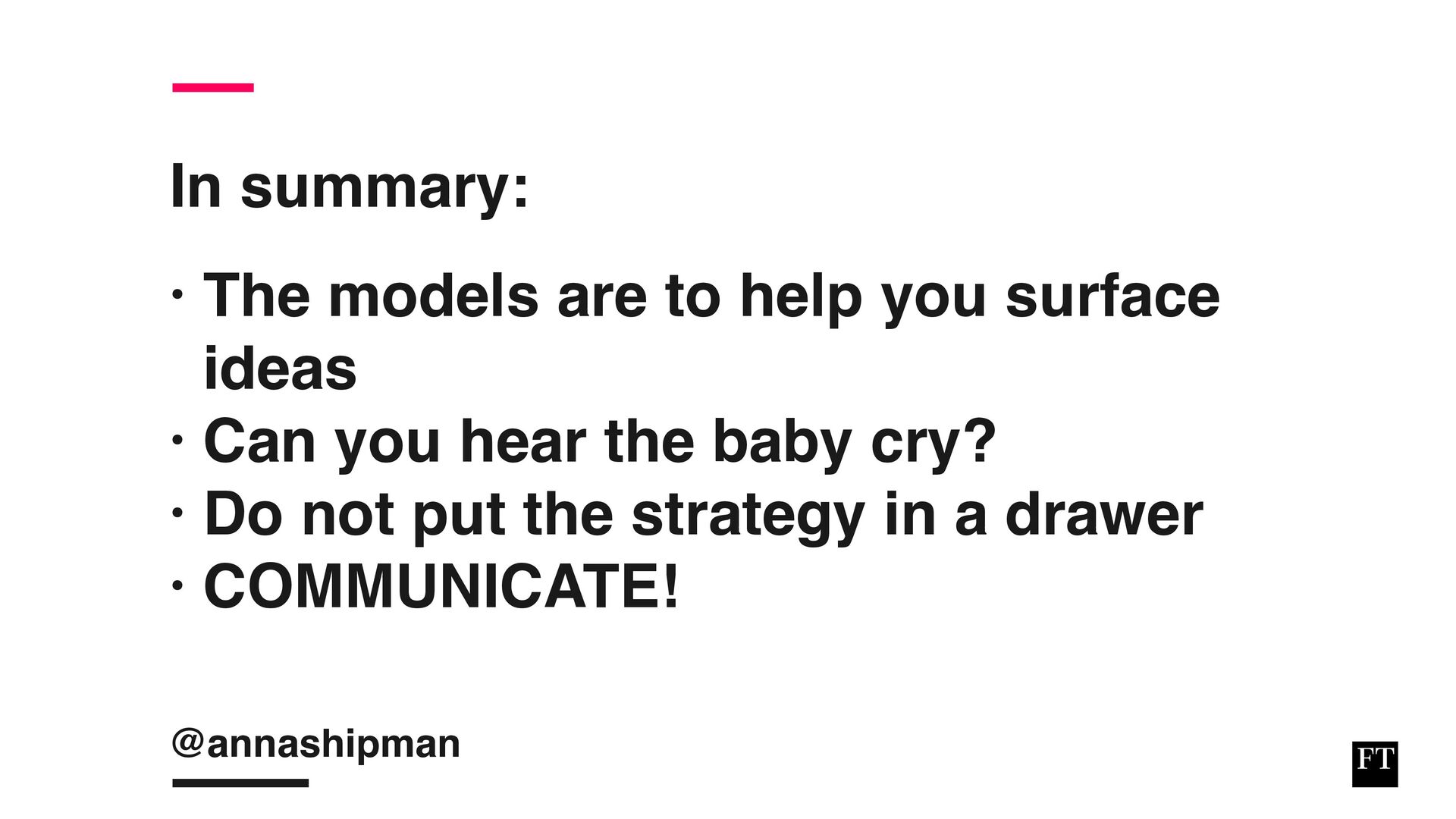
So a few things in summary. The models are there to help you surface ideas and to have those conversations. Can you hear the baby cry? Have you identified what the critical factors that you need to address? Don't do your strategy and just put it in a drawer.
And communicate. And if you were only going to take one thing away from this talk, it would be communicate. Thank you.