
The web is filled with endless stories of the infamous tricks and “growth hacks” apparently utilised by famous startups and enlightened others to achieve the holy grail of exponential growth. Andy will cut through the noise to examine the truth behind real growth stories and explore strategies we can all use to grow sustainably without sacrificing ambition.
← All talks 









Lead Strategy Turing Fest 2017
The Myth of the Hockey Stick: How Growth Actually Works
Auto-generated transcript - may contain errors. Tap a timestamp to jump the video.
Cool. Hey everybody, thank you for having me. It's really awesome to be here. I had a lot of fun at Turing Festival last year. So I was very grateful when due to what I can only imagine was some kind of administrative error, was somehow invited back to be here again this year.
So thanks for having me and looking forward to the next couple of days. Today, so I'm here to talk a little bit about the myth of the hockey stick. It was interesting to me that both the two previous speakers this morning have used this phrase.
You know what I mean about this mythical growth curve where things start off and then there's some kind of magic inflection point that we suddenly hit and just take off, beyond which all of our dreams come true and we never have to worry about anything else.
So hopefully today I want to do a couple of things. First of all, try and cut through some of the noise that we might find online when reading about stories and how various startups and products have grown, dispel the myth of the hockey stick, and talk about what growth actually looks like in real terms.
And my hope in doing that is to so that you can help get a slightly better idea around thinking of the vision for the growth of your own products or services. And then after that, let's go on to talk a little bit about the different ways in which products or companies can grow, the different models, to give you some more food for thoughts that hopefully we'd able go away at the end of the day and think about applying to what you're working on.
So to introduce myself quickly, I'm Andy. This is my Twitter handle. Please feel free to use it. Actually, I'd really appreciate if you could keep any heckles on Twitter. It's much easier for me to deal with the heckles afterwards in the comfort and sadness of my hotel room versus in real time here in the room.
For the last couple of years, I've been consulting, working with a whole bunch of companies, early stage folks in the portfolio at five hundred startups, much later stage company. I was out with Comcast in San Francisco for about nine months. Before that, I spent two years at Stripe.
Before that, I had my own start up as a founder. Rode the emotional rollercoaster journey that John was talking about. Way, way, way back, I created the side project Selective Tweets, an app that some of you may have encountered that help people connect their Facebook and Twitter accounts.
And somehow, despite nothing that I particularly did, it ended up with over a million users. That's one of the stories I'm going to share with you this morning about what that looked like. Cool. So what is this about growth anyways? What do I mean when I'm talking about growth?
First of all, when I talk about growth, I'm typically talking about growing our active customer or user base. But really what the question is is whatever's driving value in our business. I'm not necessarily talking about growing revenue, Optimizing to try and get as much revenue as possible out of the customers that we have is a different set of problems entirely.
It may be that growing revenue is the top goal, but typically when we're just getting started, we may get revenue through our growth, but what we're really trying to do is get that first few customers or start scaling our traction and really growing our footprints to get as many customers as possible.
The key question is we're trying to grow whatever's strategically important to us right now, whether it's get more customers, get more users, or whatever. What I'm not talking about this morning is this phrase, growth hacking. I'm not quite sure what this phrase might mean to you.
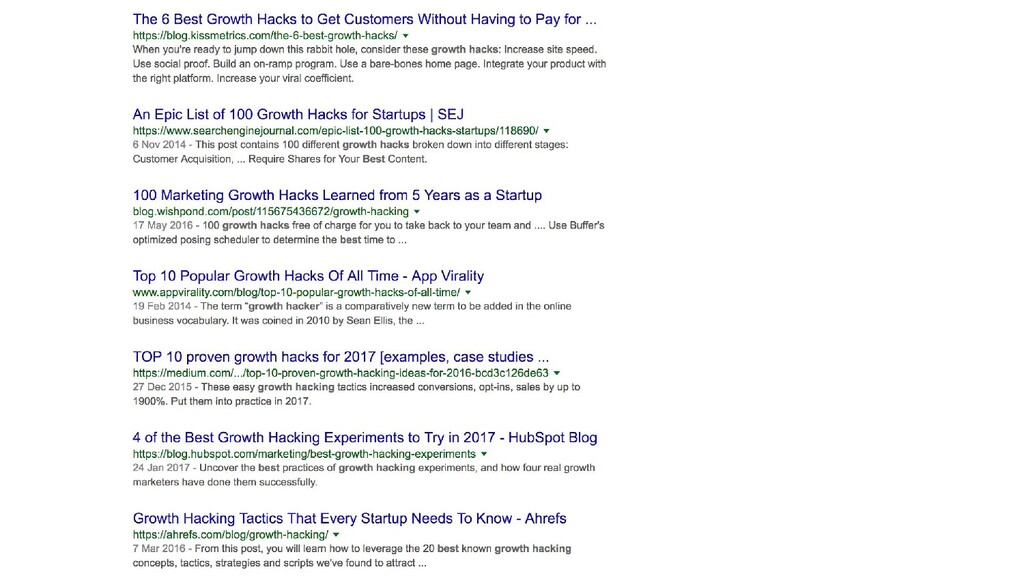
I'm not even sure what growth hacking means to me anymore. To some people, it's a very exciting phrase. There's a lot of exciting new developments going on. To other people, it's a terrible buzzword that's a real turn off. If you search Google for growth hacking, you get the six best growth hacks to get customers without having to pay.
Fantastic. An epic list of one hundred growth hacks. There's a lot of interesting stuff that you can read about here, but this is not what I'm here to talk about. It can be very interesting. You know the sort of things I'm talking about.
Change the button color to red. Experiment with a heading on the page. Make sure you launch your press release on a Tuesday, and then your business will be a runaway success. It can be interesting to read about the journey other people have gone through.
But just because something worked for other people doesn't mean it's going to work for us in growing our businesses. And also, all these little tactics, these little tricks that people have tried, these aren't really what cause the businesses that we read about to become the big runaway successes that they are.
Some of these are really useful small optimizations, but what I'm interested in is what's the big picture for how we can build a big successful product? So let's talk about something real. Think about all the brands we're familiar with, the Facebooks, the Airbnb's, the Twitters, the Dropboxes, etcetera.
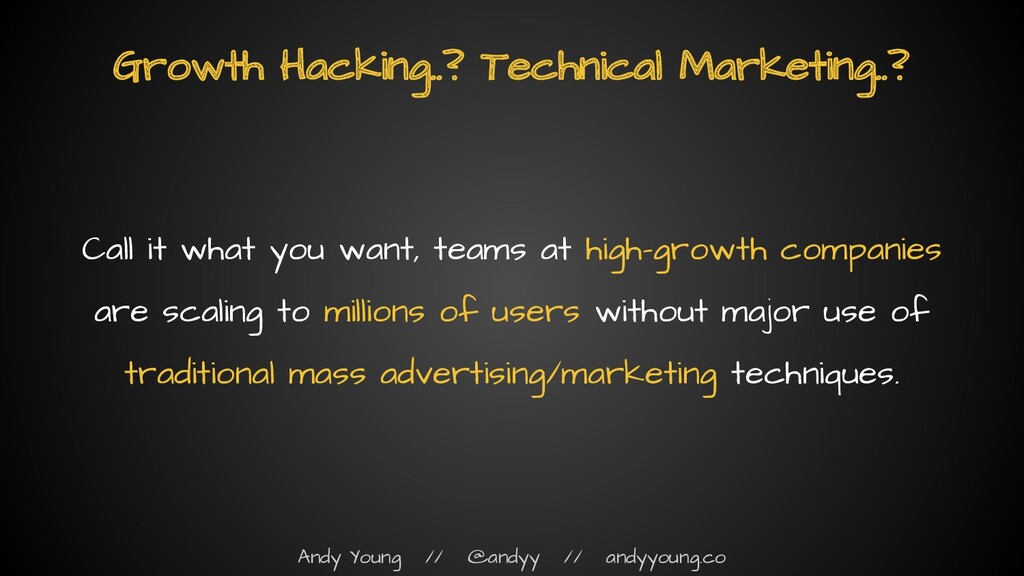
So I think probably most, if not all of us here, would love to have the kind of growth that these companies have enjoyed. So call it what you want, growth hacking, technical marketing. Teams at these high growth companies have been scaling to millions of users, interestingly, without using any of the traditional mass advertising or marketing techniques that came before.
Facebook didn't grow by TV advertising, etcetera. LinkedIn didn't. So let's dive into this. So the myth of the hockey stick. So the first problem I had in understanding the hockey stick was that I'm British. So this is what a hockey stick looks like to me.
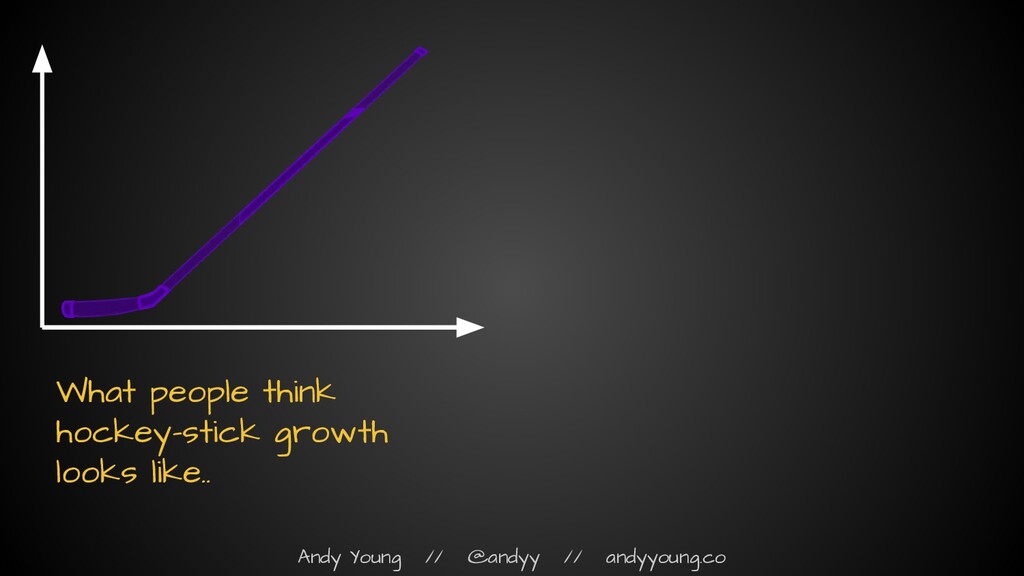
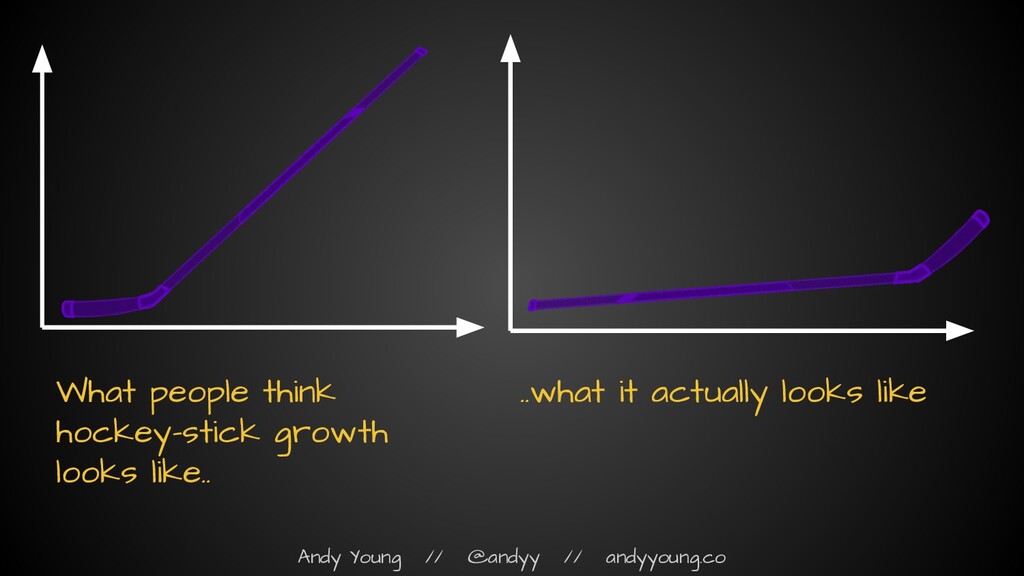
Hockey stick growth? I don't even know what's going on at the end here. So of course, the first thing is that this is a term that comes from North America, and we're talking about ice hockey, not field hockey. So this is what people think hockey stick growth looks like.
The first thing to get your head around is this is not what hockey stick growth looks like. This is what hockey stick growth looks like. We're not talking about the quick search for that immediate inflection point. It's about that journey to, over time, grow, grow, and eventually, hopefully along the way, we'll get these bumps as the speed of growth increases.
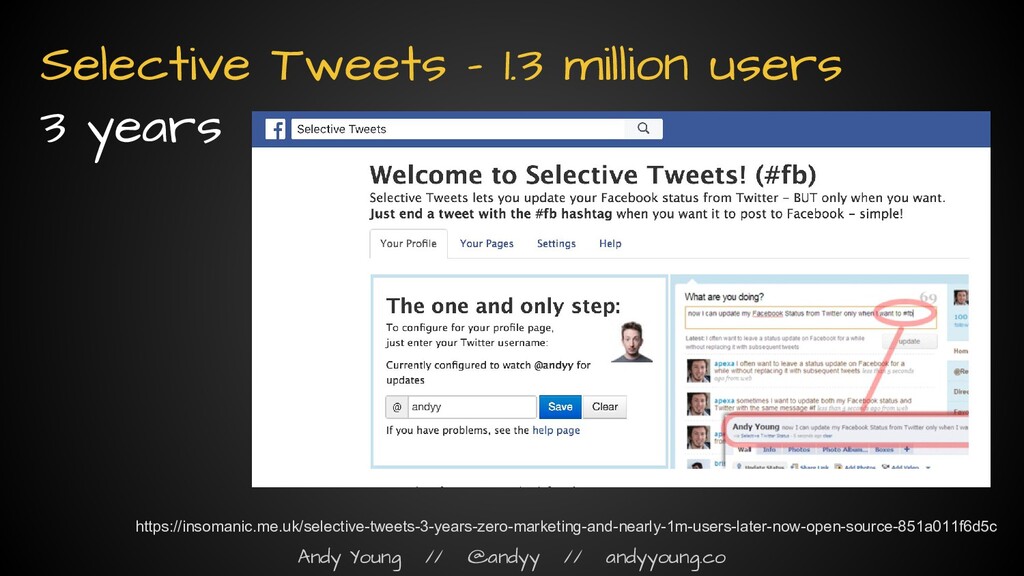
So from here, I want to dive into the first example to show you what the real journey of growth has looked like, starting with this application that I mentioned, the side projects I built, selective tweets. So this was something that way back in around two thousand and nine, I was having drinks with some friends in the pub, and to be fair, I was ranting about back in two thousand and nine, if some of you may remember, the functionality came out that you could connect your Twitter
and Facebook accounts such that all the tweets you posted on Twitter would automatically be cross posted onto your Facebook page. And I was getting really annoyed. God looking back, God knows why I was so annoyed by this. I mean, come on. But was getting really annoyed about all the crap that I already read on Twitter turning up on Facebook.
And over a few drinks, was saying, you know what? The things that should be on Facebook should just be a subset of everything that we put on Twitter. And so I went home, and that weekend in just a few hours, I created this app that let you, if you posted a tweet on Twitter and added the hashtag FB on the end, then and only then would it take that tweet and post it onto your Facebook page.
And the punch line is, over three years, well over a million people ended up signing up to use it. What's interesting about this story is that the only marketing or advertising I ever did was go back and tell those six people that I was hanging out with over drinks that I actually went away and created this and that they should check it out.
And I promise you this is true. This was only ever a side project for me. I just wanted to solve it for myself. That's the only way I ever promoted it. Maybe I told a few more people over time casually as I was just talking with them.
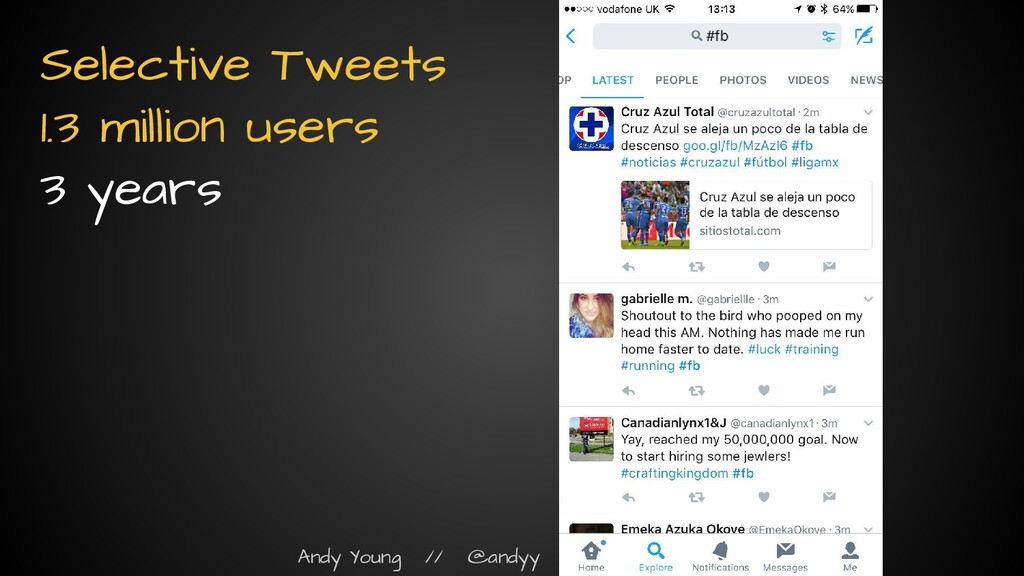
But the interesting thing here is how this grew. So this is an example of just how it's used, by the way. People would use it to post fantastic insights like, shout out to the bird who pooped on my head this morning. Nothing has made me run home faster to date.
Hashtag luck, hashtag training, hashtag running, hashtag FB. So the interesting thing is how this grew, because this was just by word-of-mouth. And not just word-of-mouth. I'm sure a few people proactively told their friends about it. But the interesting thing is here, because there was this hashtag FB, people would see other people using this app and then say, what's this hashtag fb that you keep including in your tweets?
What's that all about? And I can actually see people talking and responding on Twitter and asking people this question. So a really interesting question I often ask companies I've been working with, and I would ask to you. How can people discover that your product exists and be constantly reminded about it through your existing users using it?
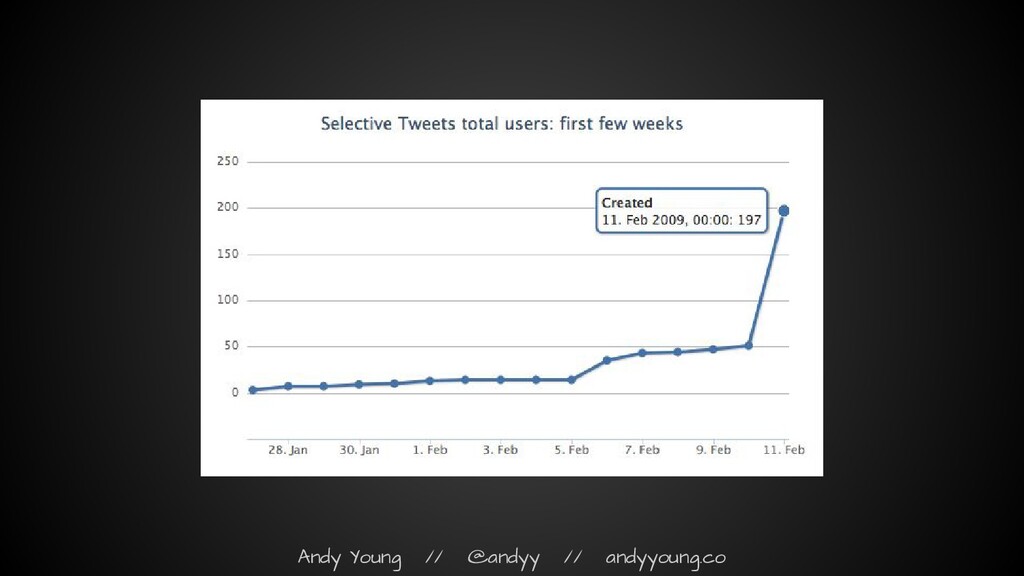
Because this is what happened with selective tweets. Seeing this hashtag there. So let's look at what happened. It was at the beginning of two thousand and nine, and here's at the beginning of end of January, and I told these six people. And they signed up, and then a couple more people signed up.
And this is the first interesting thing. I think at the beginning of February, suddenly over a couple of days each point on this chart is a day here suddenly we got up to about fifty people signed up. So this was just from word-of-mouth.
So the first thing was it was interesting that it didn't grow immediately the first time someone used it. It was only after people had been using it for a few days, and that cycle allowed them to see the hashtag, see it a few times, right, that engagement, the reminder that existed, ask the question, and then discover it.
And then a few more people started signing up. The second interesting thing is you see here on the eleventh of February. Back then, I think someone used it for the first time who had a particularly large following on Twitter. So inadvertently, I discovered influencer marketing.
In this way, I think maybe they'd sent a tweet about how they thought the app was great, and in that one day, another hundred and fifty people signed up to use it. So so far so good. And as I say, I wasn't really paying that much attention.
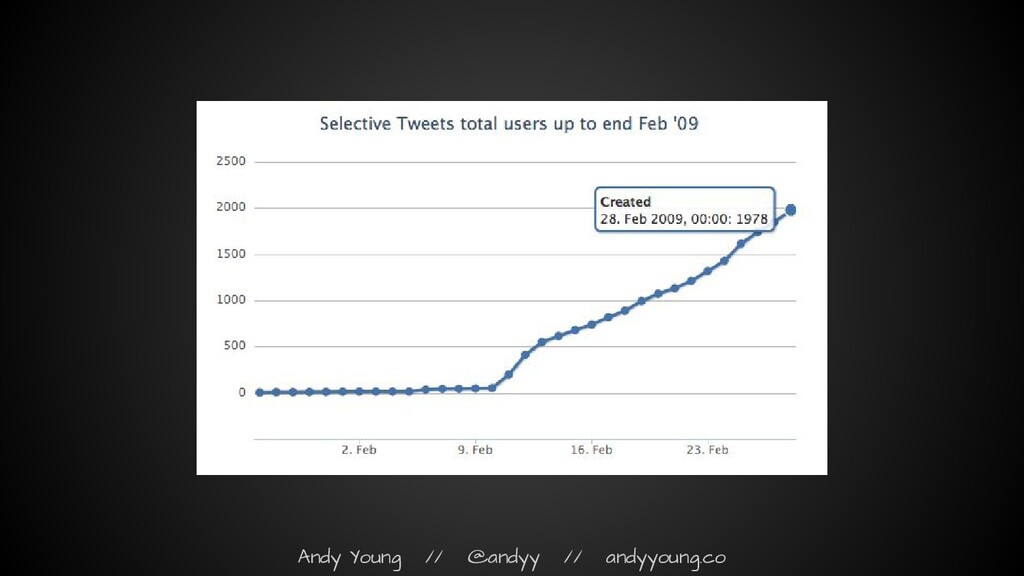
And if we go out another couple of months, from there it took off in this kind of linear growth curve. So the next couple of months I got up to maybe nearly a couple of thousand people that had signed up to use it.
So you see we got this initial momentum where people started using it, other people would find out about it, and sign up and make use of it themselves, and the cycle continues. Notice what this isn't is this crazy exponential growth curve. We got that little bit of initial momentum, It was seeded with these few users, and then essentially, I'd probably describe this as kind of like a straight line.
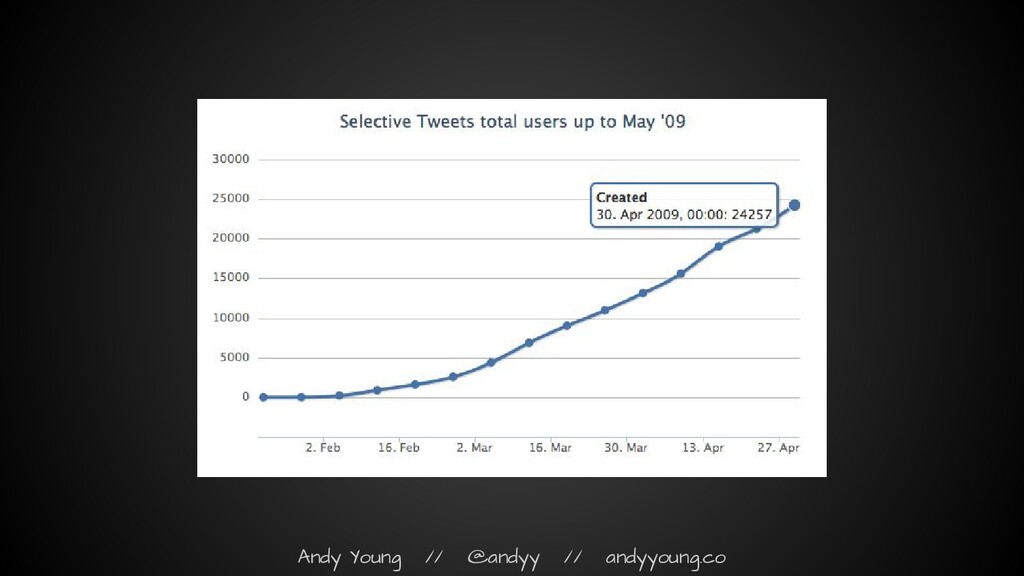
Right? Linear growth. Zoom out even further, and this is what the chart looks like. And you can see up to the end of April, we're up to twenty five thousand people have signed up to use it. And again, I would say the slope of this chart is kind of straight line.
Right? It's again, it's linear growth. It's a you know, that the sort of cliche of the exponential growth curve that everyone talks about like the holy grail. For most companies, I would suggest they never achieve exponential growth. And even for the companies that do achieve a period of exponential growth, they're only in this exponential growth phase for a very short amount of time.
Because if you think about it, if you remain in exponential growth, very quickly you run out of humans on this planet. Right? So what I would encourage you to be thinking about is not how you can look for this, you know, one magic way to get to sort of exponential growth mode, but rather how can you keep looking for the milestones that will increase the rate of your growth?
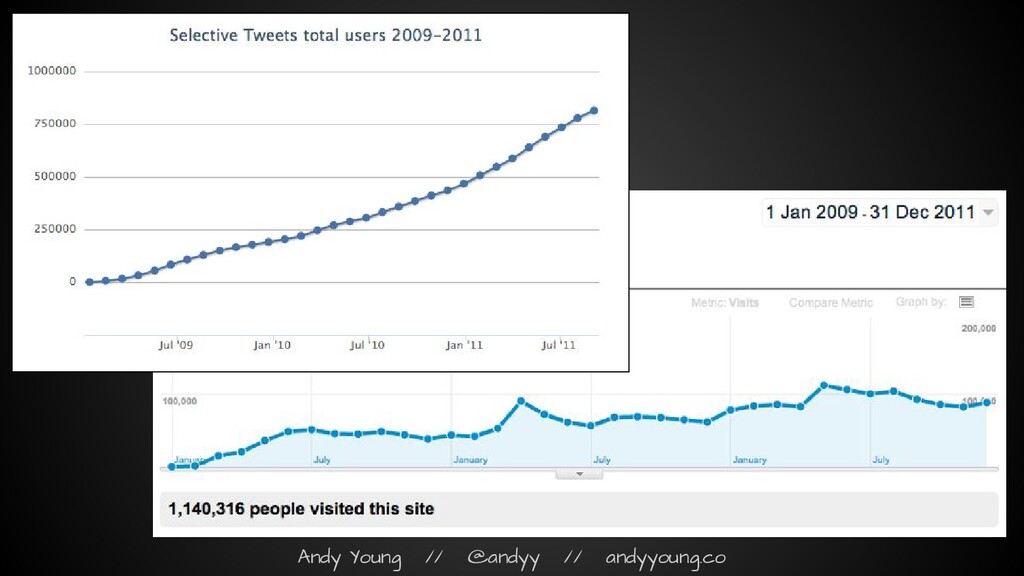
So here you can see that the slope was sort of linear, and then as we zoom out, it changes to maybe another straight line that's just a steeper gradient. It's just growing faster. And this is what happened over the next couple of years to the end of twenty eleven.
You can see that's essentially what the growth looks like, and on this chart we got up to just over three quarters of a million users. Again, contrast with down here, I've got the Google Analytics view of people who are hitting the sign up page.
So this is the people who are coming along, how many people per I think this is per month here, how many people who are coming along to actually sign up for the app, install it, and set it up. And you see what's interesting, compare the slope of the chart.
So the total users signed up versus the new people coming along each month. And you can see here that what happens is we bump along and then we get an increase, and maybe perhaps a big spike, and then the number of people signing up settles and remains sort of flat.
Maybe we have a big spike, but then it settles at a bit of a lower level than before, and then you have another spike and another spike. And so this is a pattern of what getting to one million users can actually look like.
You know, this was my learning experience. Another couple of interesting things here. So initially, remember, the thing that was significant for me at the beginning was getting just telling those first six people. Right? Because when I had zero people using it, six people was an incredible growth rate.
And then when that one person tweeted about it and a hundred and fifty people signed up, that was very significant. Later on, I didn't do any promotion, although inevitably it got picked up picked up by a few blogs. So I've got these spikes from press coverage, for example, in the blogs, and you see this pattern of of of the spike and then returning to continue to grow, but at a higher level than before.
Next, I wanna show you another example. So how many of may have heard of Weebly, the website creator? Right? That started out around about two thousand and six. And the reason I pick up Weebly is because the founder of Weebly, David, posted a blog at some point where he shared some similar charts of Weebly's growth.
So at the top here, we have the total number of sign ups per day with Weebly, and then the bottom, it's the total users. So the total number of people have signed up since the beginning of time. And so you can see here Weebly has that similar pattern to what had with selective tweets, where they would get a series of tech press coverage being featured in TechCrunch, TechCrunch again, and then miscellaneous coverage.
And you see this pattern again repeated of this big spike, and then the number of sign ups per day falls, but you can see it falls, but it falls to a level that is higher than it was before. And you can see the slope of the effect it has on the total sign ups per day.
And again, we've got these series of straight line growth, linear growth, but the line every time we get a spike and then return, it's ever increasing. And again, when Weebly zoom out, it's really interesting how successful they were. So as you expand the curve, and they went just from the online blogs to offline PR with Newsweek and print, Time dot com featured in Time again, and you can see how, you know, when you zoom out, this looks like an exponential curve.
Right? What's interesting for them is they didn't just benefit from this phenomenon of getting these spikes and then falling back to a newer growth rate, but it combines with another thing that powered their growth, which was because they're a website creator, the more people that signed up and created websites on Weebly, the more people were browsing those websites and could see Weebly powered by Weebly in the footer of those sites.
So the more they grew, the more they have this other channel of growth starting to come to the fore, which is why you can see that the growth really accelerates. They went up to think this is hosting about three hundred thousand websites by the end of this chart.
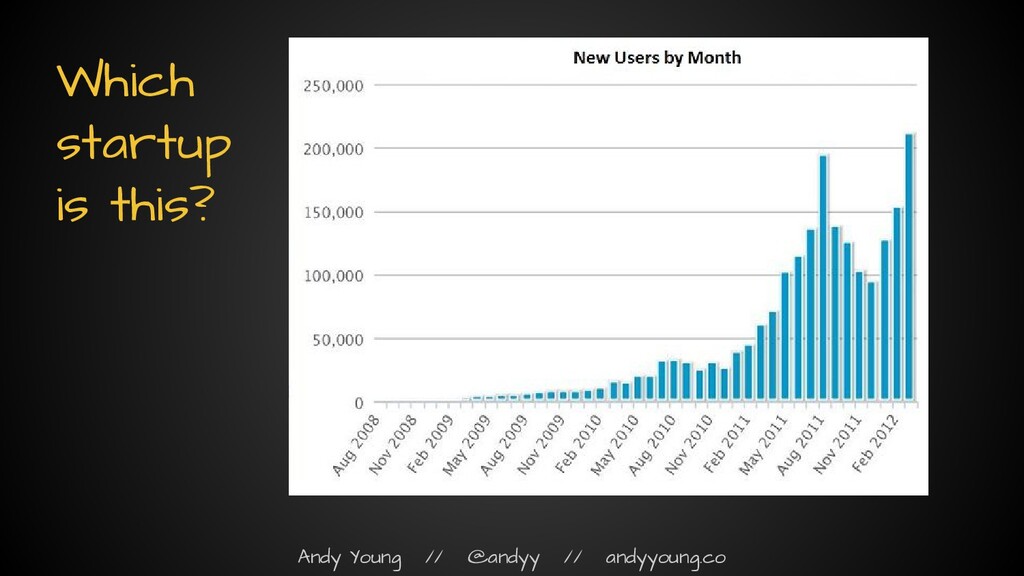
Right? Cool. Another example. Which startup is this? Right? Starting around two thousand eight, two thousand nine? Any guesses? The brands we've probably all heard of. Shout out. Don't be shy. Airbnb. Could be Airbnb starting around then. Any other guesses? Twitter. Twitter. Yep. Stripe. Stripe, potentially.
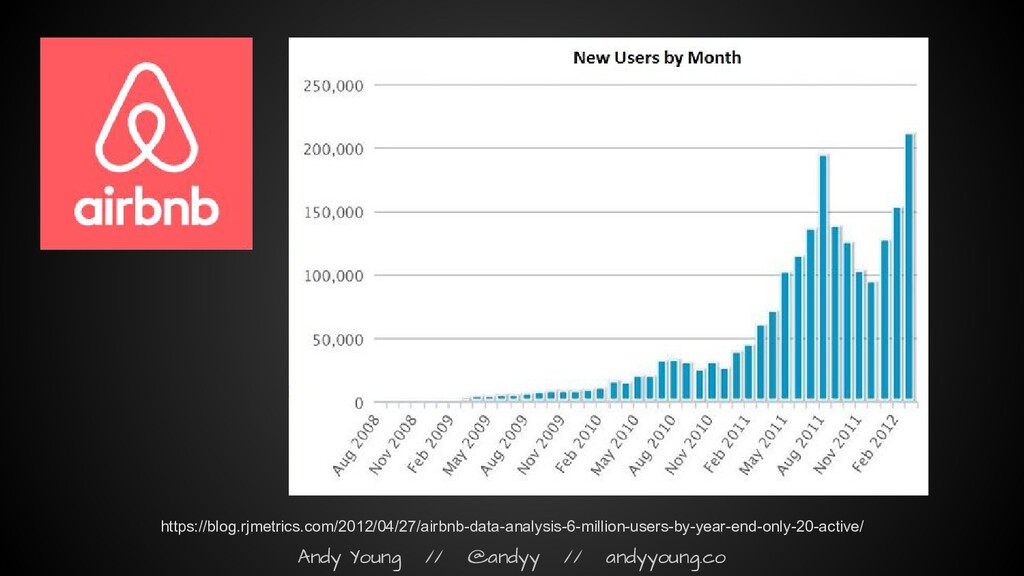
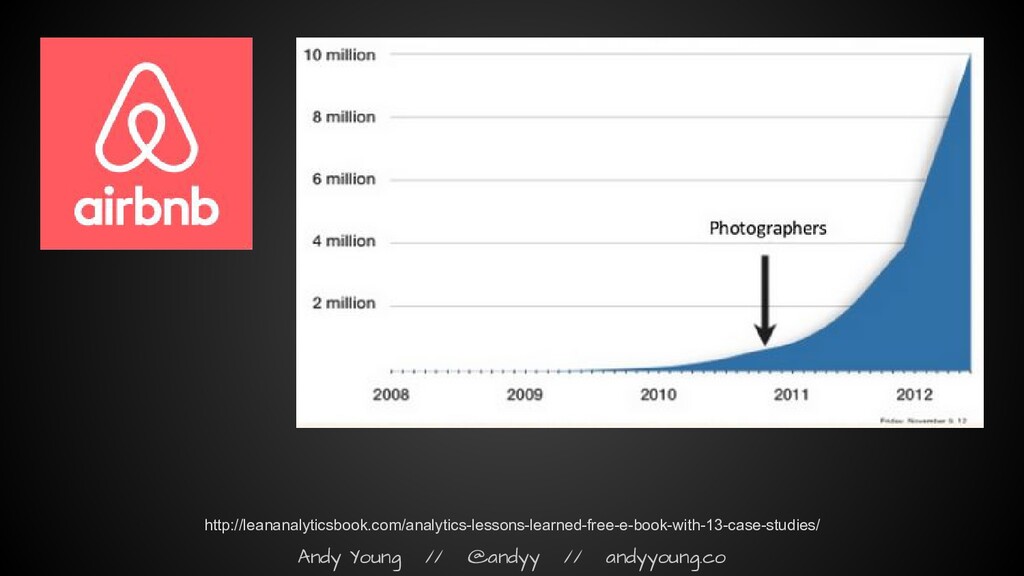
So this is new users per month. Any other guesses? You know, these famous examples of growth. Dropbox, HubSpot. Right. So it turns out, yes, you were right in the first place. This is Airbnb. I was I was showing this slide the other day, and I said, why do you think it's Airbnb?
And they said, because it's always Airbnb. So fair enough. Yeah. Right. So this is really interesting. So we here we've got the real number of users that Airbnb signed up. Right. So what I want to look at here is I don't just wanna share with you, like, the classic examples.
Right? Let's together dive in and figure out how is this interesting. How did Airbnb Airbnb really grow? What's the famous example of how Airbnb grew? Conferences. Conferences? Yep. There's another couple as well. The famous examples of how Airbnb grew. The Craigslist example, yes.
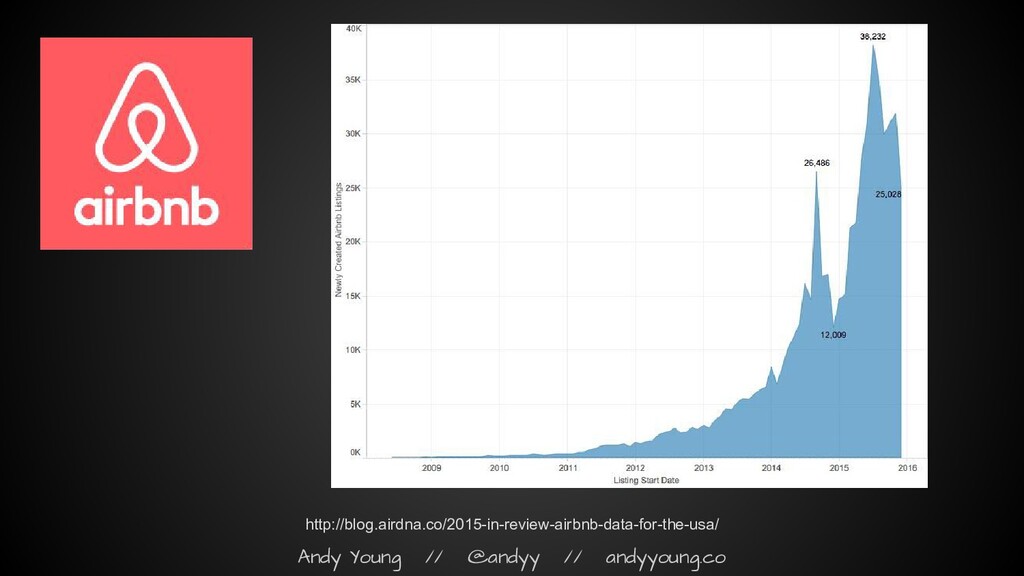
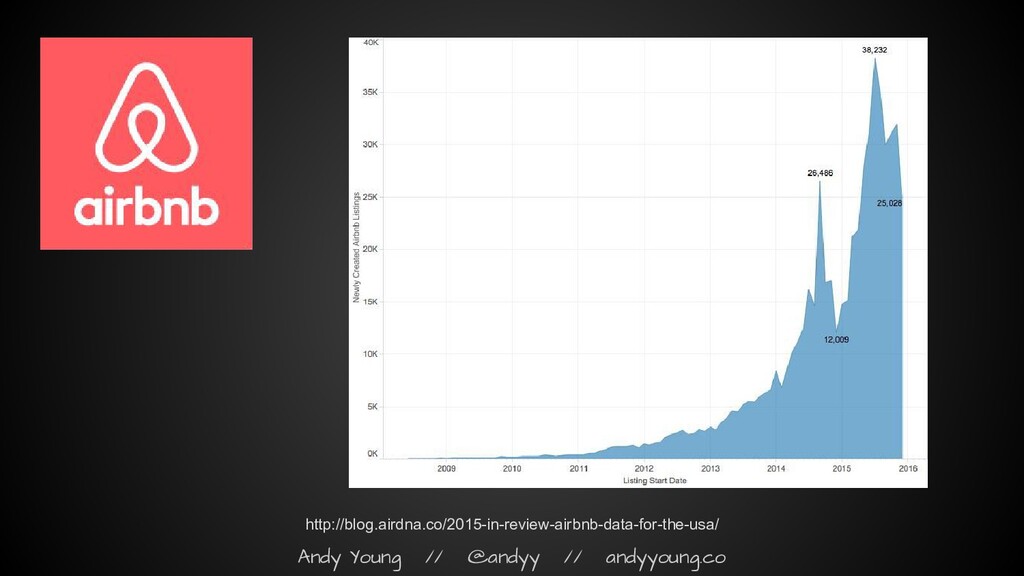
If people have heard about that, where you posted they built the functionality where you could cross post your Airbnb listing onto Craigslist. Right? So what's interesting about that is it's a famous example. Oh, here's some more data. This is not just users signed up, this is the total number of listings posted on Airbnb.
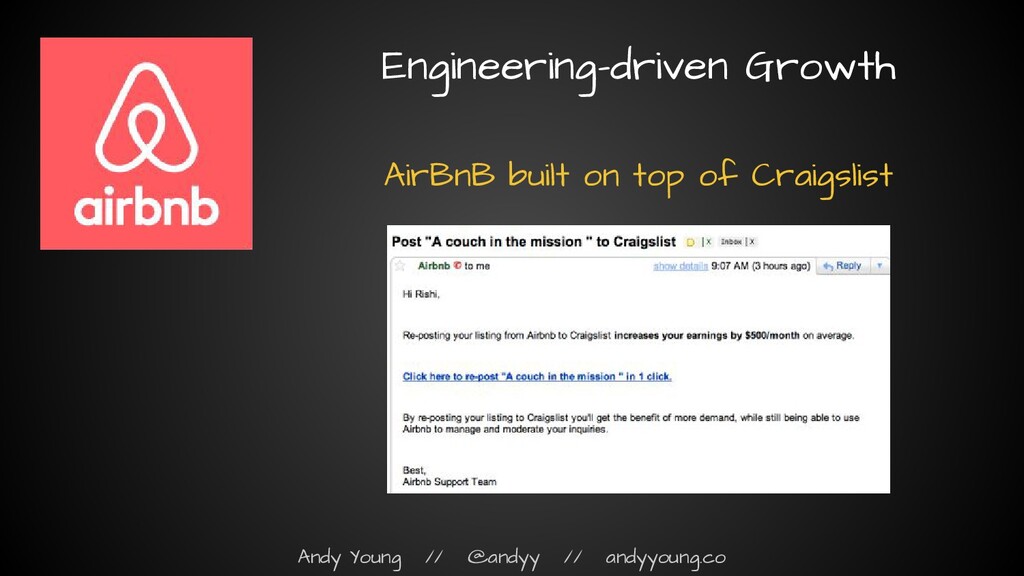
So pretty great looking growth curve here. But if we take that Craigslist example, this is what it looked like. It's where Airbnb, this famous example many of you may be familiar with, where Airbnb identified that they could build this technology that made it really easy to promote your Airbnb listing onto Craigslist with just one click.
Right? And in doing so, they could take advantage of all the people that were searching Craigslist for listings or somewhere to stay, and they got a lot of growth that way. So this is the famous example. Right? But in terms of what can we learn from this, is this what was responsible for Airbnb's growth?
When did Airbnb use this? Three hours ago. Three hours ago. Good guess, but unfortunately not. The interesting point about this Craigslist example was that eventually, you know, it wasn't a partnership with Craigslist. Eventually, Craigslist got upset by Airbnb doing this and shut them down.
Right? So this was something that Airbnb did, and they found it very useful, but they actually did it in around two thousand nine, two thousand and ten. Right? So it was all the way back over here. So if we think about Airbnb and the company is today and all this crazy growth over here, it would be all too easy to read about that Craigslist example and think that that was what caused this crazy growth.
Right? That's not actually the case at all. It was very useful for them, and remembering back to my selective tweets example when I just told a few people through word-of-mouth and I had no users, that was very impactful. For Airbnb, this Craigslist hack, right, was really impactful when they were much smaller.
But the key thing is it was only one of many hundreds of things that they were trying over this period of time, and while it had a big impact for them down there, it was not what creates all this growth. What's one of the other big examples that Airbnb is known for in terms of the stories how they grew?
I think someone mentioned it before. Negative get. Negative PR, they get. Anything else? That wasn't what I was thinking of. Photography. Yes. Thank you. Right? You may have heard that story about how Airbnb realized that some of their listings were getting far more bookings if they had great quality photographs.
So they decided to expand the products with the ability to send photographers to your apartment and take pictures so that they could get more listings with high quality pictures and better bookings. So what's interesting about that story, right, is when they started doing that.
Right? Because that was at a later stage in their growth. So if we contrast like the different examples of how they grew, again, this was just one of many things that they worked on. But the photographer's example was something they did later on.
At that point, they were already growing pretty well. They had well, they were putting on like a million nights have been booked on Airbnb at that point. So they were already on a growth curve. If they hadn't added photographers, what would have happened?
They probably have continued to grow. Right? Maybe they wouldn't have been as big as they are today, but that was kind of a multiplier effect on a business that was already working. So another thing I'd like to sort of help you take away is the difference between what these stories that we read out there, like the cliche examples, and the difference between what it takes to get a fundamentally good business that's growing, contrasted with the hundreds of things we can try, the Craigslist example being one,
to get initial traction when we're starting out, contrasted with things like adding photographers, which just fundamentally improves the quality of the products to make it grow faster than it otherwise would, but itself isn't sufficient to make or break a successful product. Right? Another classic example to end on is Dropbox. Right?
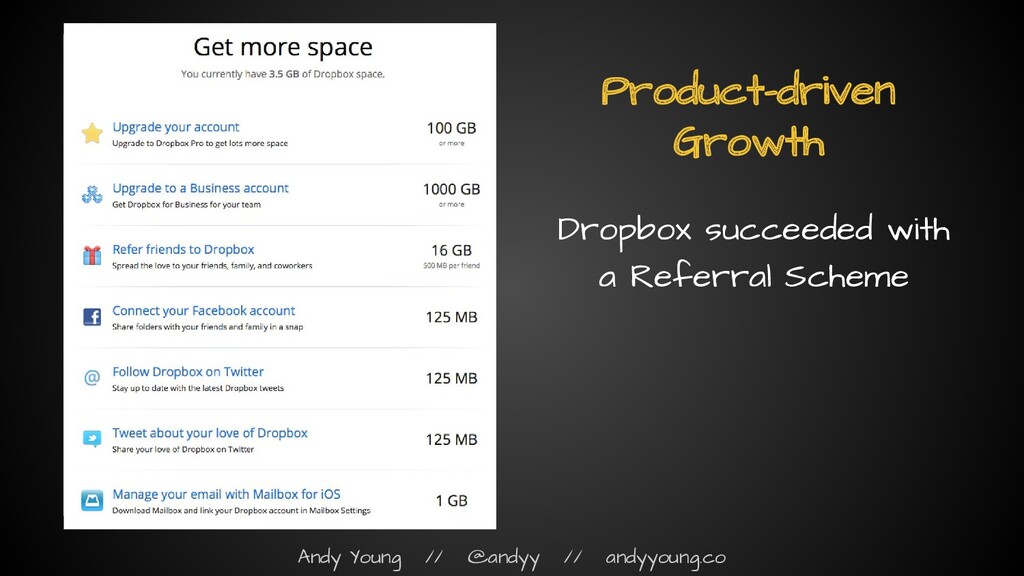
And how Dropbox added a referral scheme. You may have heard about this. A referral scheme, the idea of encouraging your users to refer their friends to use the product. So that's a pretty straightforward example. What's the different about Dropbox? Like, why was it so successful for Dropbox though?
Is that they didn't just add a referral scheme into their products. There wasn't just a button they added which was like, hey, if you want, refer your friends. Dropbox integrated the referral scheme into the product. So if we imagine the user journey for someone with Dropbox, you sign up, you check it out, you start using it, you upload some files, you discover it's useful.
Over time, you start running out of space, at which point you're prompted to upgrade. Right? At that point, what's the situation? You're already an engaged user. You're already a fan of Dropbox. You're motivated because you want to upload more files, but you don't have sufficient space.
Right? So at that point, you're prompted to either upgrade your account, pay some money, or they're in the third position refer friends to Dropbox and get more space. Right? This is how Dropbox made the referral scheme incredibly effective. Contrast with if they just added a referral scheme, but hadn't integrated into that user journey and how people actually use the product, it wouldn't have been anywhere near as successful.
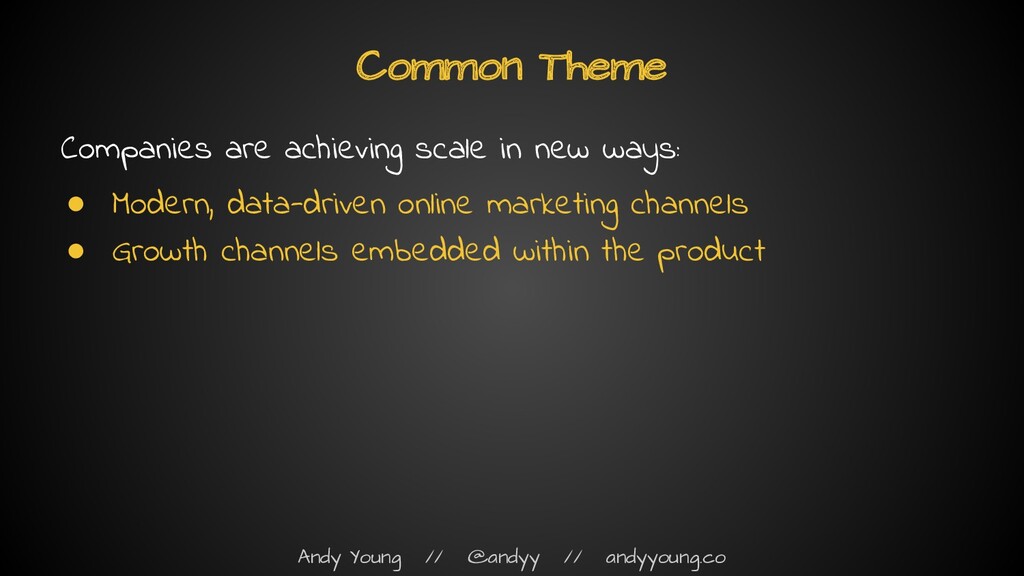
So again, thinking about these growth mechanisms and the stories that we hear about other examples, but how can we make it fit deep within how people use our products rather than just bolting it on the side? Cool. So there's some common themes here that companies achieving scale in these new ways.
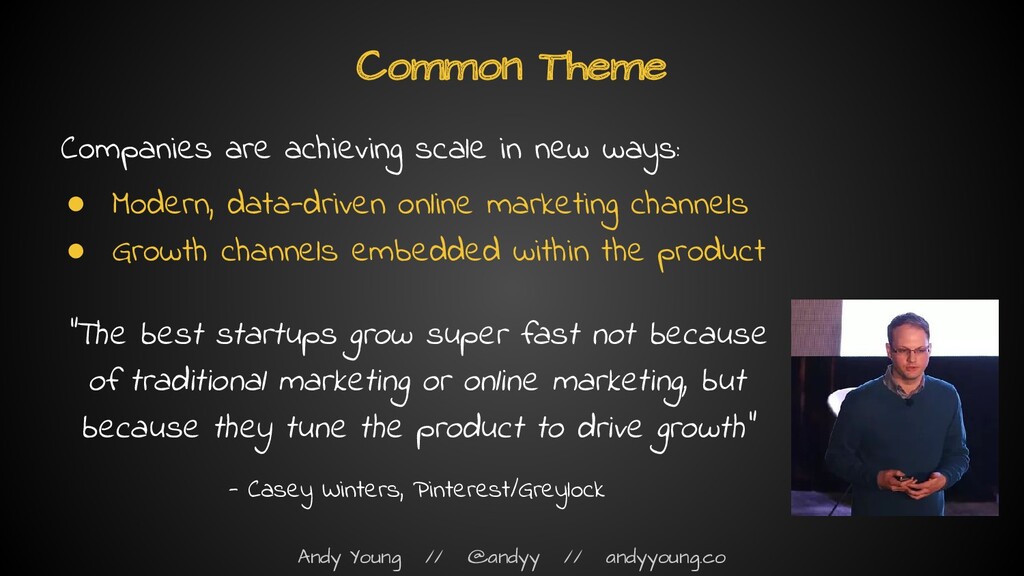
First, through a combination of modern data driven online marketing channels, you know, the Google Ads, the Facebook Ads, etcetera, but also like we've with the Dropbox example, or with how people see the selected tweet hashtag of embedding growth directly within the product. I really love this quote from case quote from Casey Winters, who was at Pinterest and now is an investor at Greylock, that the best startups grow super fast, not because of traditional marketing or online marketing, but because they tune the products to drive growth.
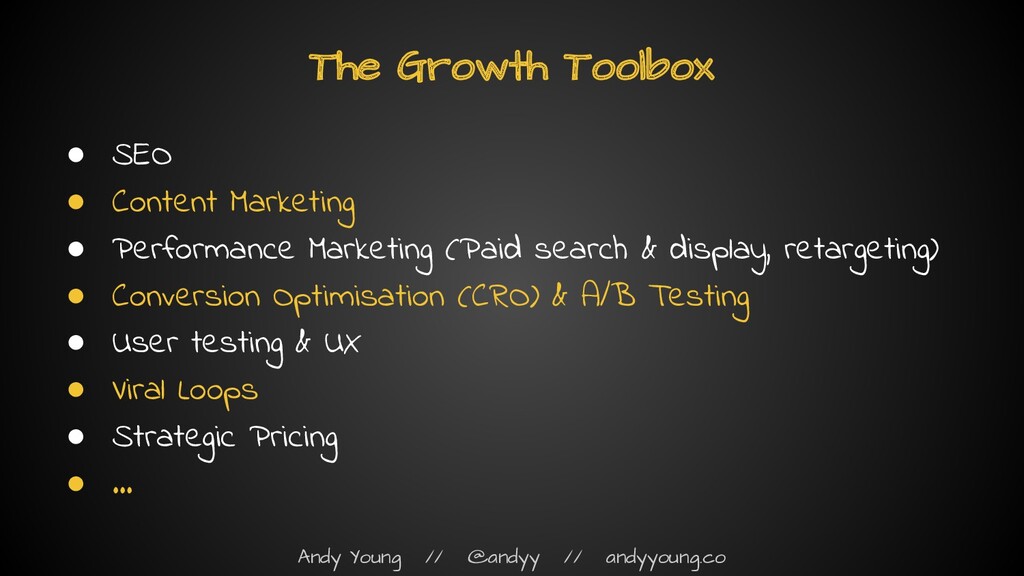
Cool. Right. So in summary here, what we're talking about is growth by the intersection of products, marketing, and engineering, as opposed to growth through more traditional sales or business development. Right? Growing using all of these things we're familiar with, SEO, content marketing, and the like.
But the key thing is these things, these Craigslist hacks, they're not a silver bullet. Right? Just I said with Airbnb, they worked on hundreds of different things to drive growth. There's lots of great things out there. You know, There are many things that we can read about online, but following them won't in itself drive success.
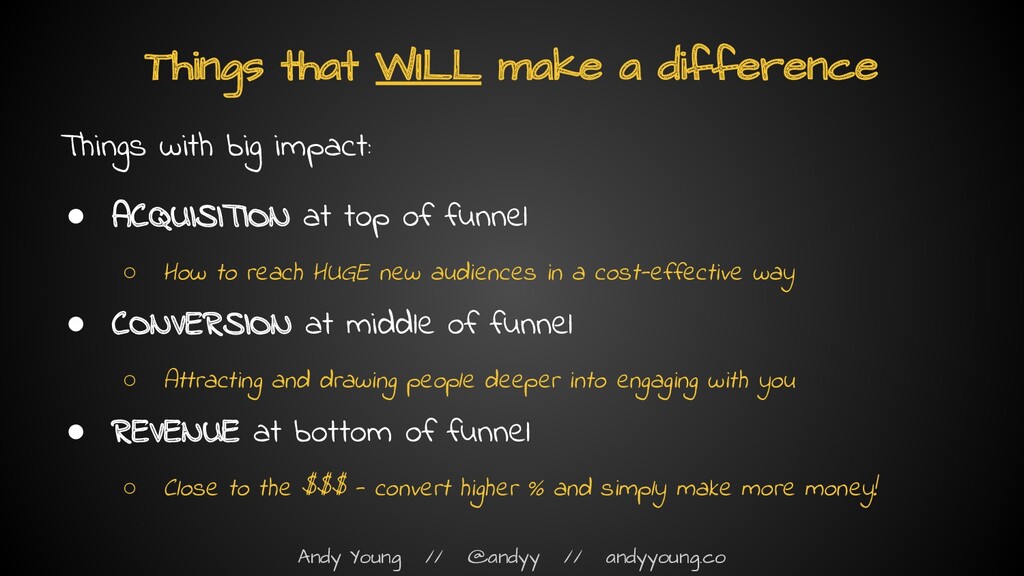
Right? What I encourage you is to think about things that will make a huge difference. Right? Things with really big impacts. Right? At the top of funnel, focusing on acquisition, how can we reach huge new audiences in a cost effective way? In conversion in the middle of the funnel, it's all about attracting and drawing people deeper into engaging with us.
Do they understand what we're talking about? Does it make sense? And then at the bottom of the funnel, wherever you knew, it's all about conversion, ultimately driving to get those dollars. So in terms of thinking about how we can grow, I often think about these goals.
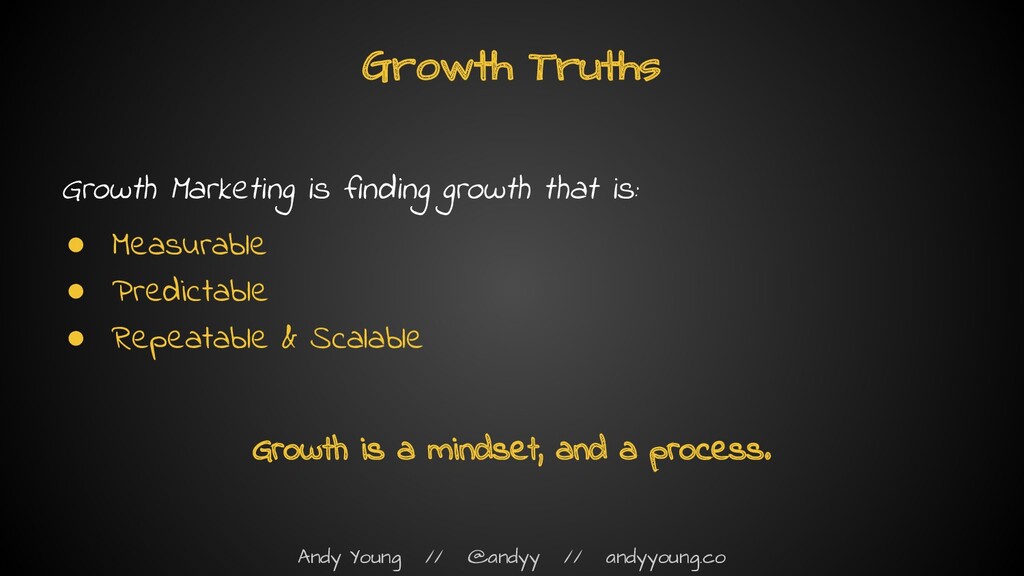
Understanding how we can grow already, understanding how we're growing already so that we can do more of it, but also ensuring our growth is sustainable. Right? So growth marketing, which is what what I work on these days, is finding growth that's measurable, predictable, repeatable, and scalable.
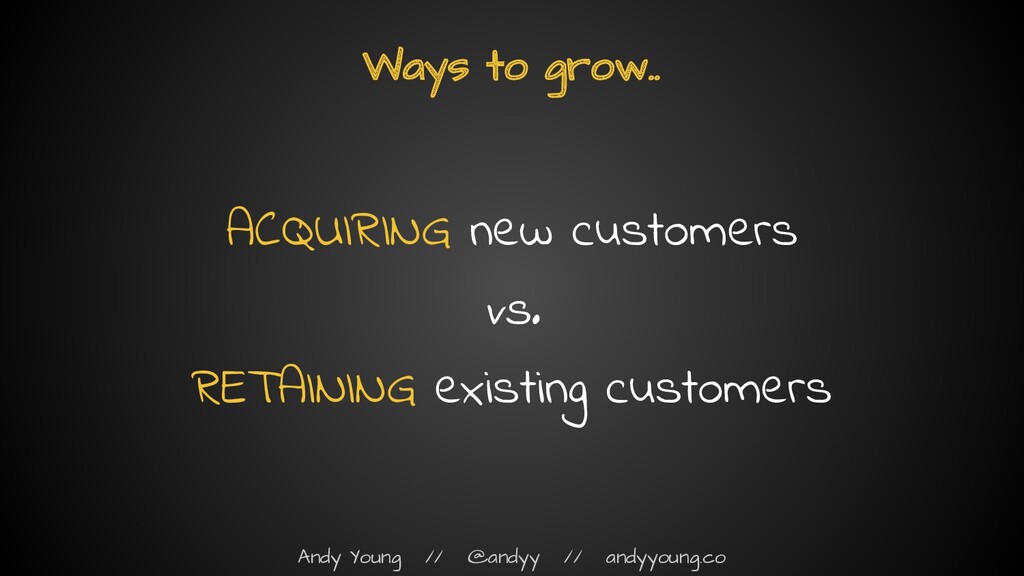
Right? So let's very quickly, I'm gonna rush through this, I only got a few minutes left, think about how we can grow in general. So two ways to grow. Right? We can grow by acquiring new customers, or we can grow by retaining existing customers, either as people who continue paying us a subscription product or in an ecommerce or transactional products, people that come back and buy from us again.
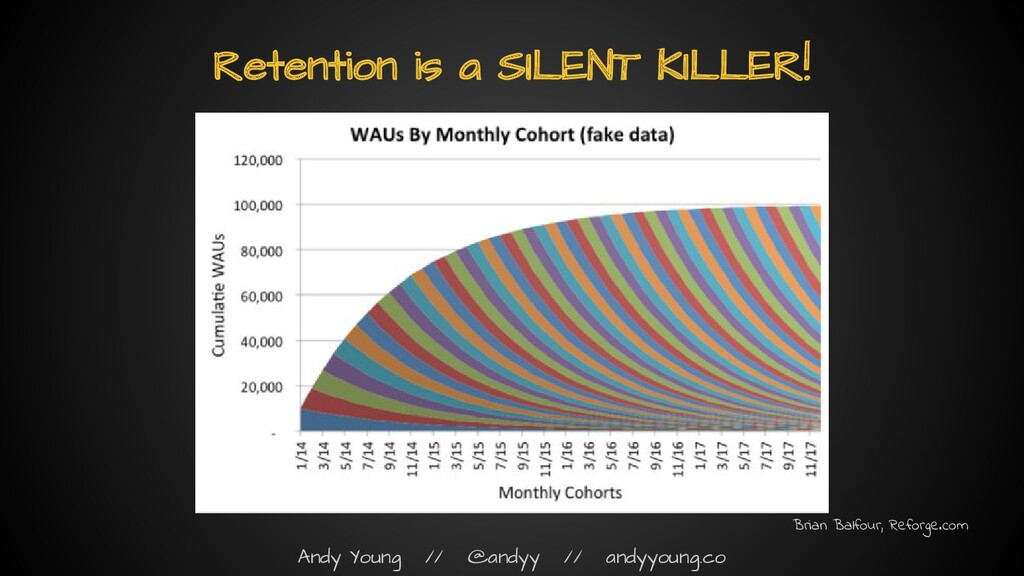
Which one's more important do you think for growth? Which one's critical to get right first? Acquiring new customers or retaining existing customers? Everyone said everything. Right? It's retaining. Retention is a silent killer. I wanna make sure everyone understands this. So here what I've got is a chart of different cohorts of people.
So each different colored bar is a group of people that signed up. Imagine it's for your products. Right? And imagine that of all the people that signed up and used your products, eventually over time, they all many of them drop away. Now as time goes past and you keep layering on cohort after cohort of people using your products, look at what happens.
The more time goes by, the more total cohorts we have of people that we sign up over time, each of which is shrinking because people are dropping off, and so eventually growth completely stalls, and if this gets particularly bad, we can even be shrinking despite increasing our rate of acquisition ever faster.
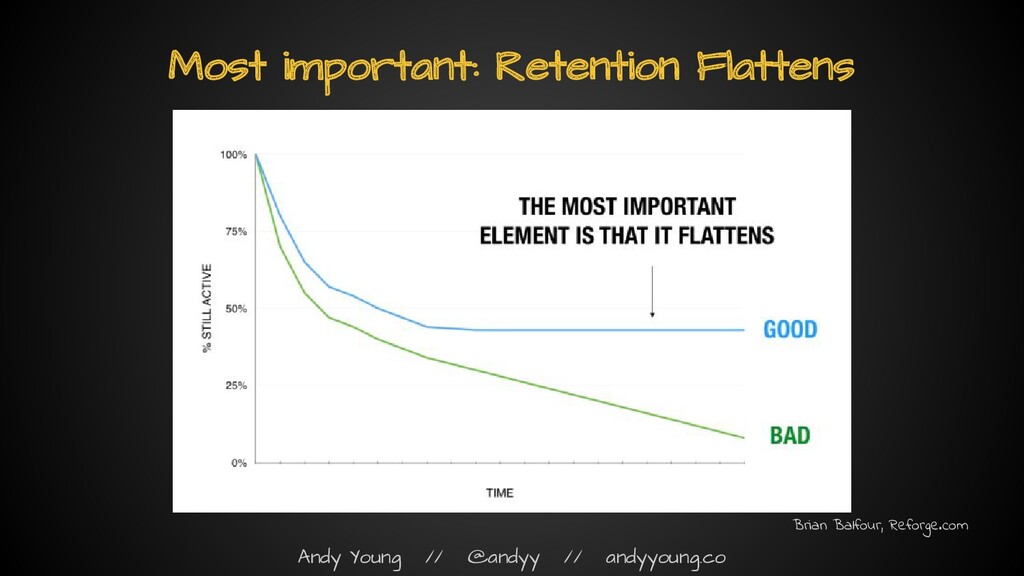
Right? Because we've got more and more people who are leaving. So retention is a silent killer. So the key thing before you work on anything else to ensure you can grow sustainably is to make sure your retention curve flattens. You see a bad retention curve is when over time on day one we have a hundred percent of people sign up, and over time, if eventually that curve is going down, so with every cohort, every group of people that signs up, eventually we we lose all of them, that's bad.
As soon as we can make this retention curve flatten, in my start up group spaces, we reached the point where after six months, about fifty percent of users have dropped off, but the fifty percent that stuck with us at that point were pretty much with us for forever.
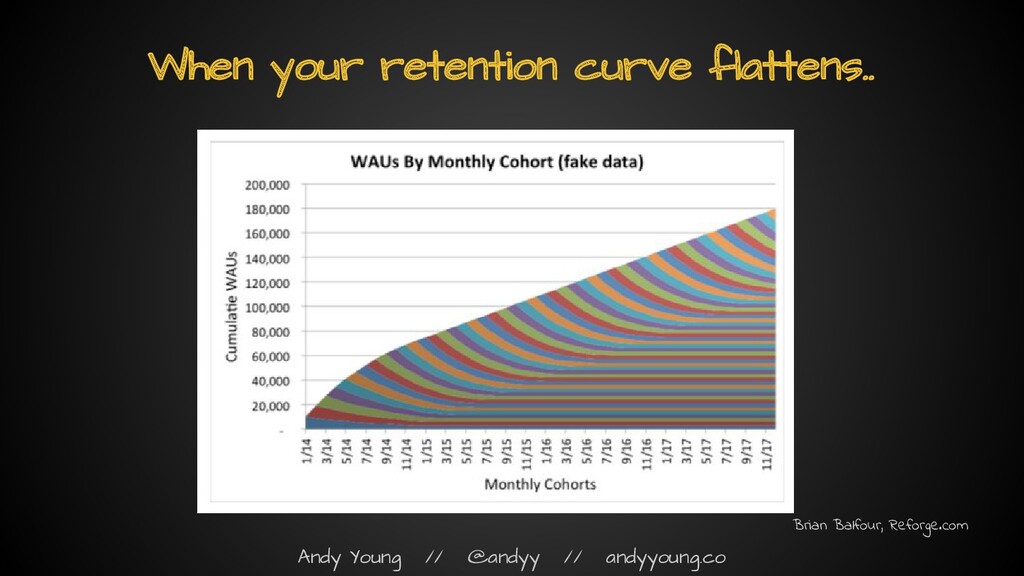
So it matters less where that curve flattens off. Right? It could be much lower depending on the business. Five, ten percent of people stick with you. But as long as some of them do, you end up getting this pattern where even though each cohort shrinks, eventually you're just stacking up each cohort of users on top of each other, and here we can finally grow sustainably.
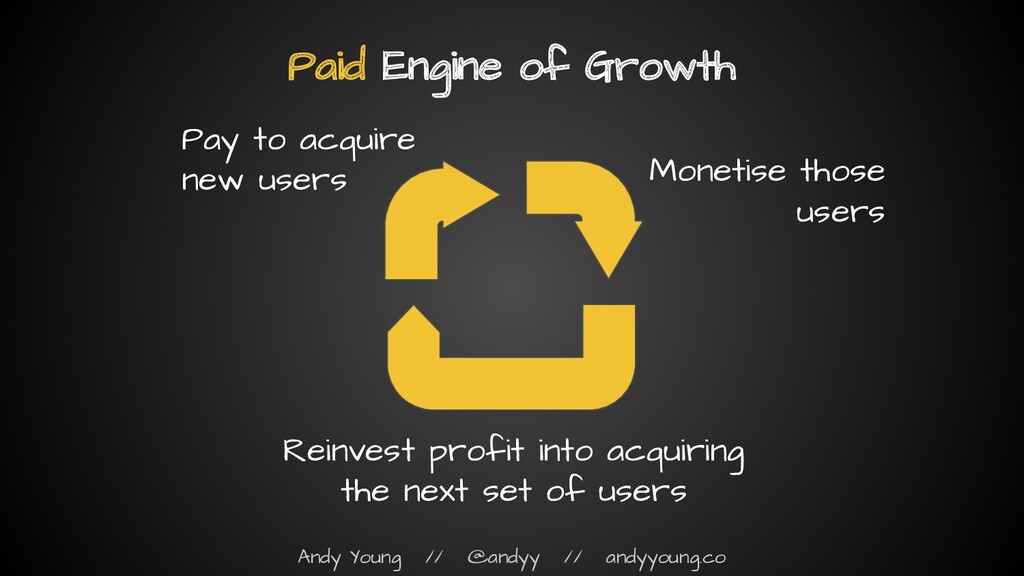
So retention is super important to get right. So finally, I've got three minutes. I'm gonna run through six growth loops and engines. Let's go. First of all, so think about how you grow in your business. Right? Pretty straightforward, paid engineer growth. We pay to acquire new users, maybe on Facebook or Google Ads.
We monetize those users. We reinvest profit into acquiring the next set of users. Pretty simple. Right? How can this go wrong? Right? This can go wrong if, well, maybe we don't make sufficient money, so we have an ever smaller amount of money we can spend.
Eventually, we run out of money to spend and acquire more users, and it's no longer sustainable. Right? So it's the difference between, oh, we should have a Google Ads strategy with, is our online paid marketing a sustainable growth channel for us? Right? Are we profitable on each cohort of users so we can reinvest?
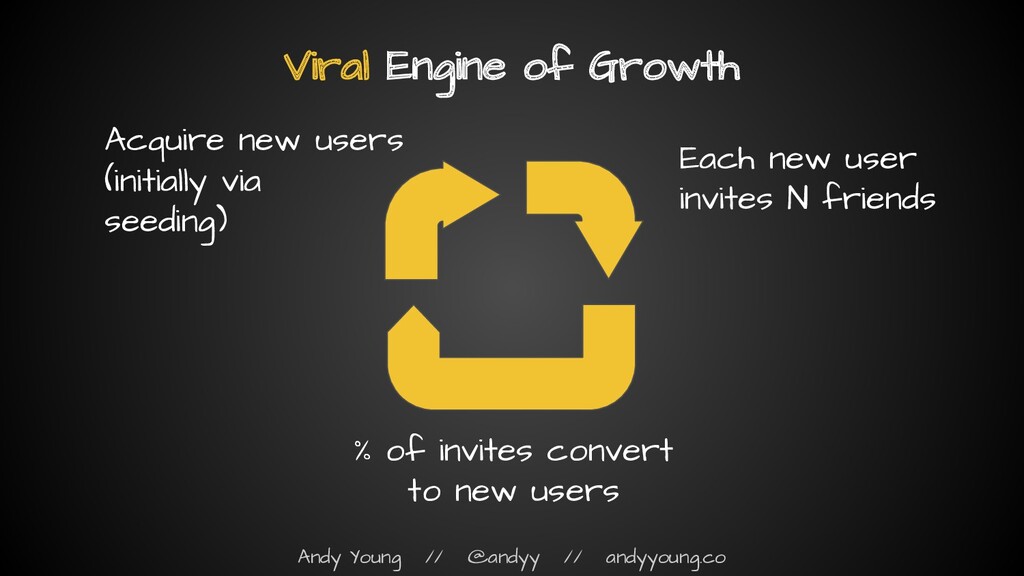
Another question is, how quickly do we get that profit? So one question is how much money we make in the long term from each customer, but from a growth perspective, how quickly do we break even so that we can reinvest that money? Second, the viral engine of growth. Pretty straightforward.
Right? Acquire new users, each new user acquires end friends, and a percentage of those refer. How can this go wrong? You know, I was talking about bolting a referral scheme or just trying to bolt viral invites into your products. It will go wrong if it's not a key part of your product, and then maybe people don't actually bother inviting their friends, it'll fall down there.
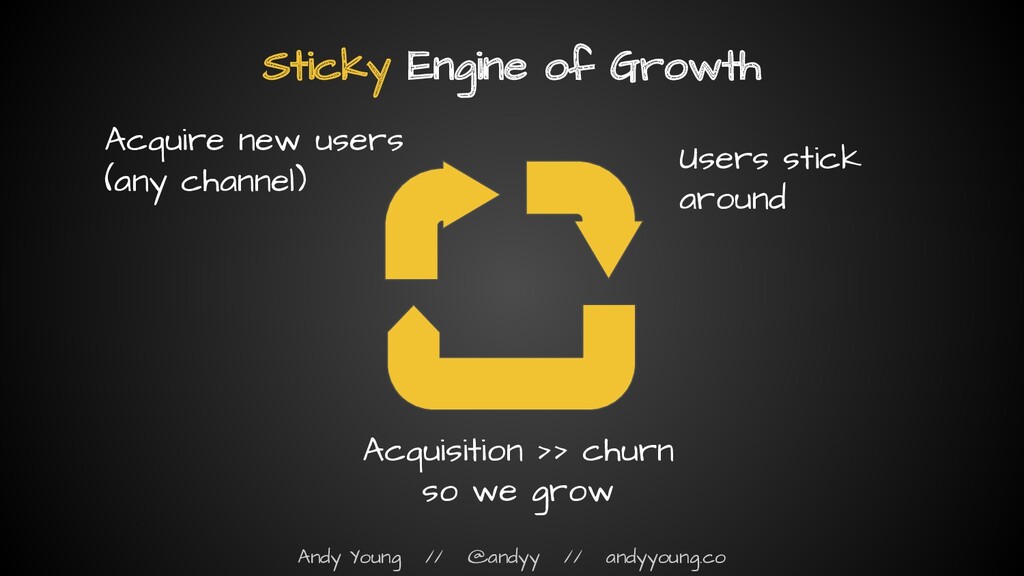
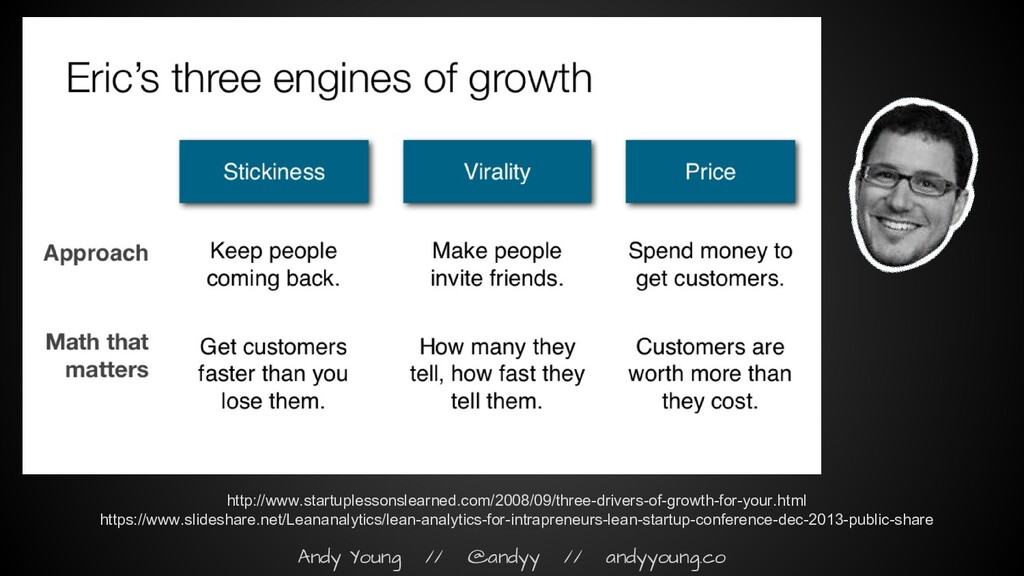
The sticky engine of growth, pretty straightforward. We acquire users through any channel, they stick around, and then our acquisition is higher than our churn, like that chart I just showed you. Right? So if we're signing up new users faster than we're losing them, we're going to grow.
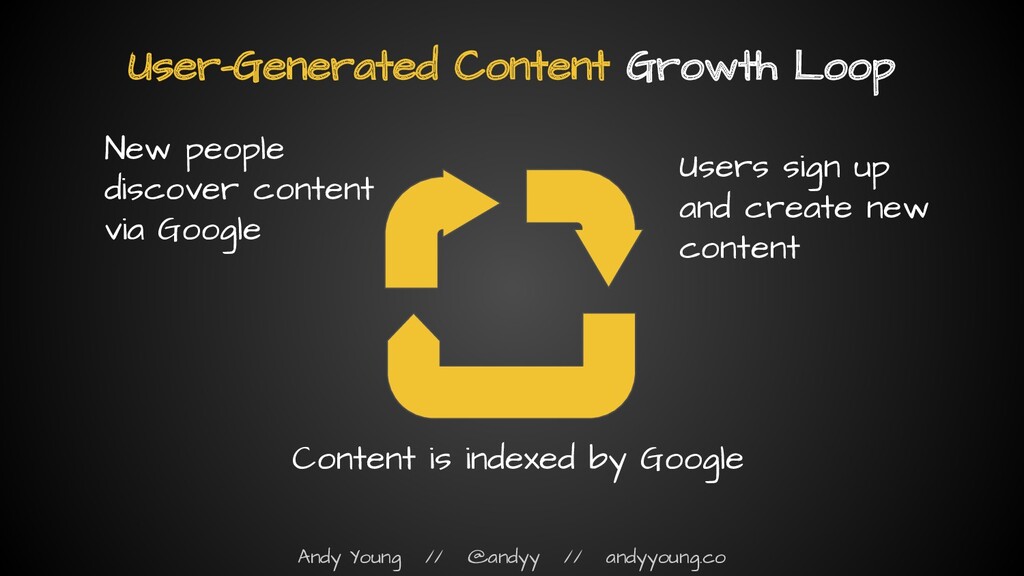
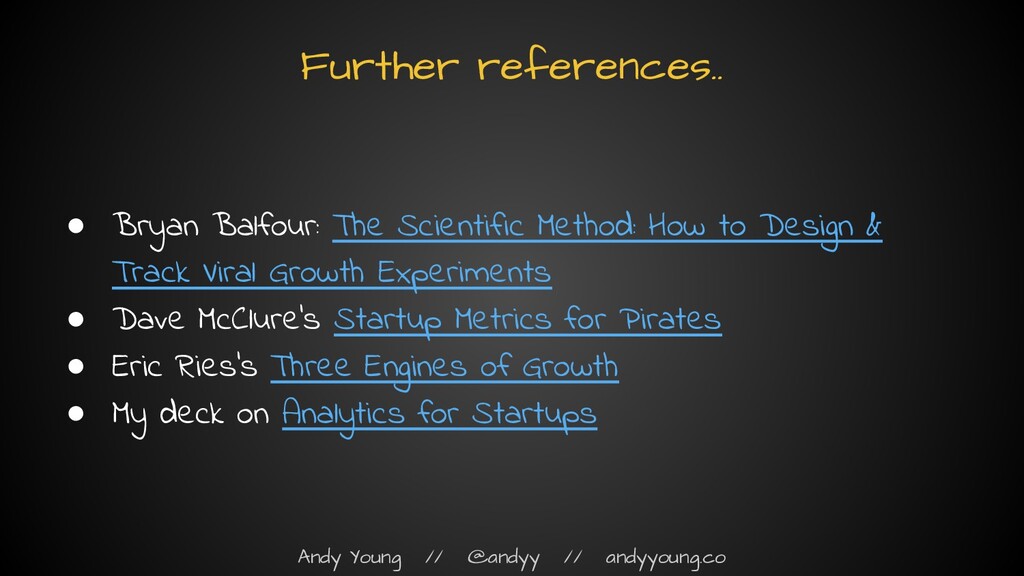
So in summary, you may have recognized these from Eric Reeves of the Lean Startup, his three engines of growth. Right? And what matters for each engine. I'll add two more to those in the last minute. So first of all, the user generated content growth loop.
So think about something like LinkedIn for example, where you may be googling for someone. You're like, who is this Andy Young guy on stage? So you search for me, you find my LinkedIn profile through Google. You sign up and create new content. That content is indexed by Google, right, and the cycle continues.
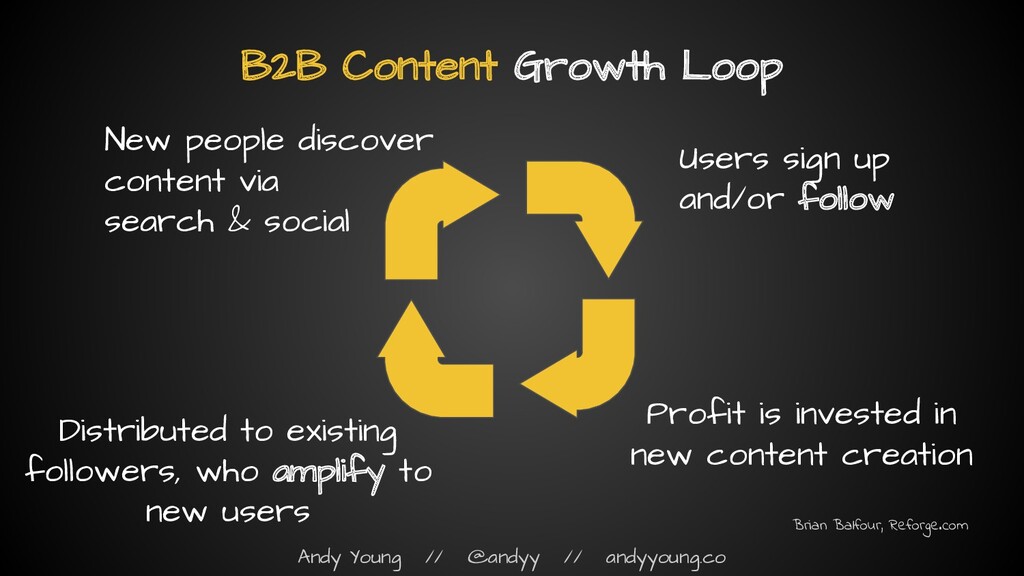
This can be really interesting thinking about how different businesses like LinkedIn, for example, growing this way. Yelp's another example. Or in a business to business context, content marketing, people discover your content via search and social. Users sign up or follow you based on that, the profit you get from these sign ups is reinvested in creating new content, and then you can distribute that content to existing followers who amplify it.
And this is the key thing that people often forget in this loop, is that it's too easy to focus on just driving sign ups for your service, and forgets that if you're doing content marketing, one of the key things is to be building your audience so you can keep amplifying new content that you create.
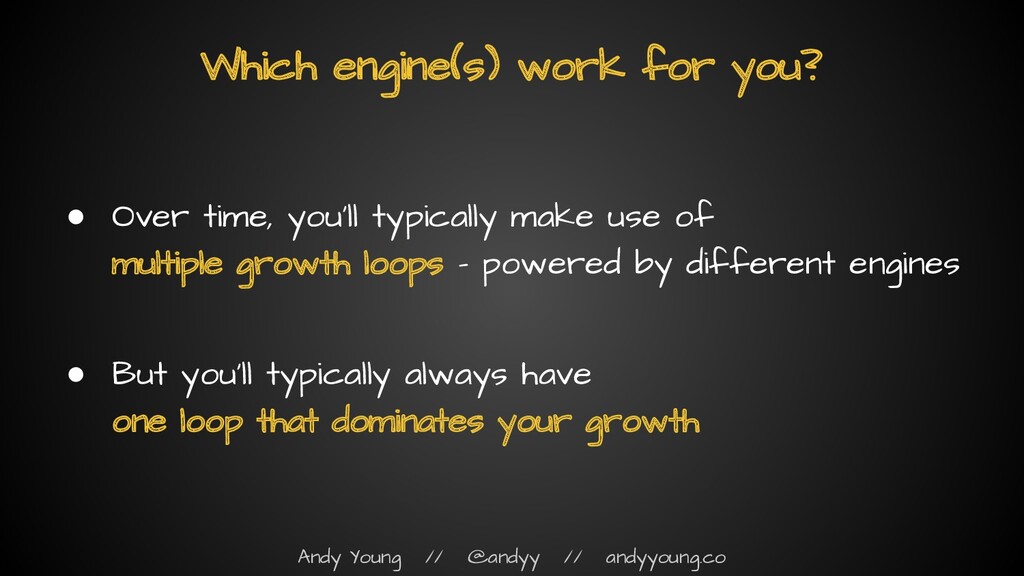
So over time, you'll typically make use of many of these growth loops in your products or companies. Powered by different engines. But typically for companies that reach super super scale, there's one dominant one that drives your growth. So I'd encourage you to think about which one that is for you.
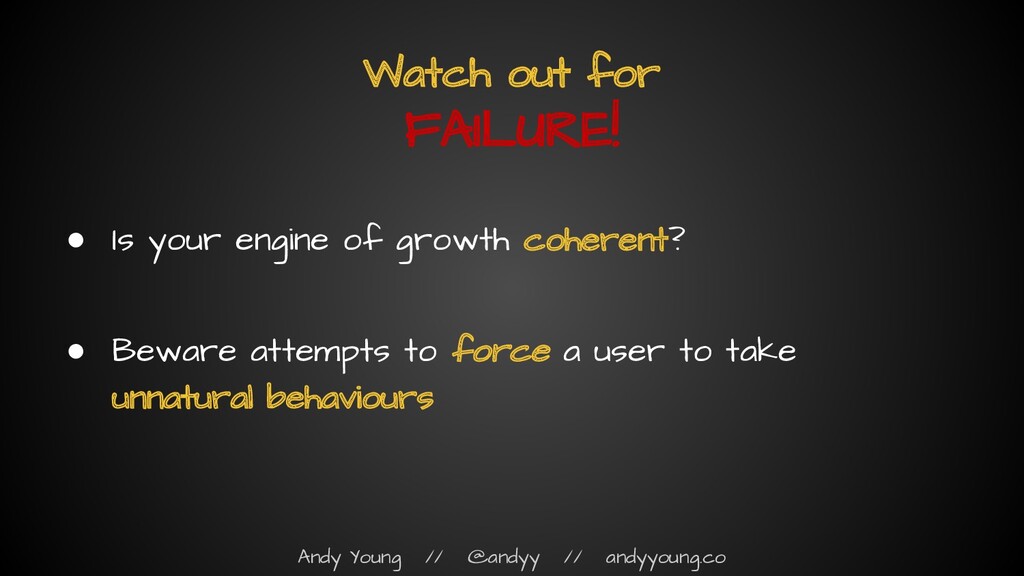
Watch out for failure. I've talked about how these loops can fail. Right? If you end up not being profitable on a cohort of users in paid acquisition, and don't attempt to force your user to take unnatural behaviors, like trying to get them to invite their friends when it doesn't make sense for them.
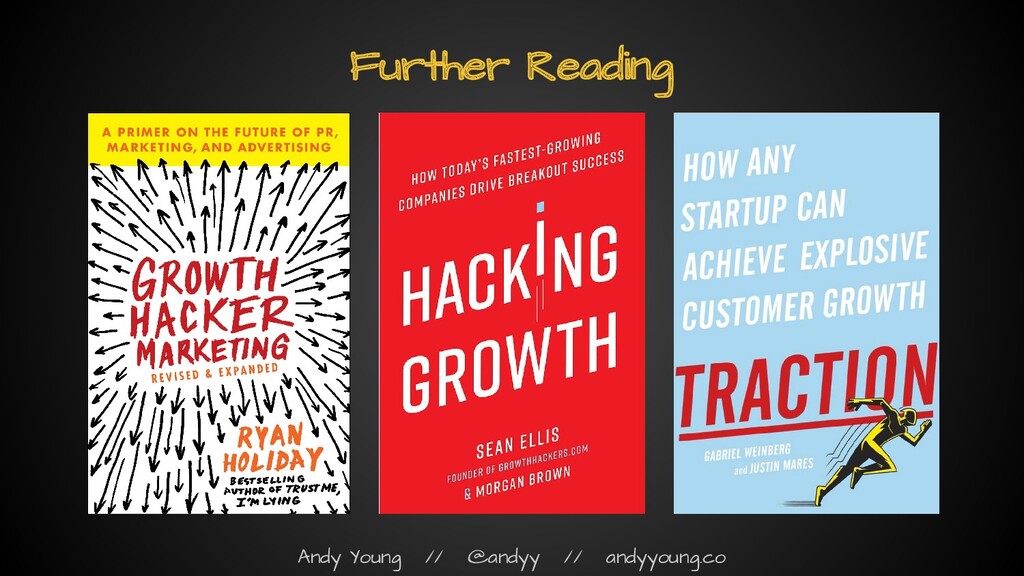
And so thank you. I'm basically done. There's some further reading for you. I really recommend these three books, Growth Hacker Marketing, Hacking Growth by Sean Ellis, or Traction, really great book on marketing. By the way, I will upload these slides. They're already on SlideShare at bit.
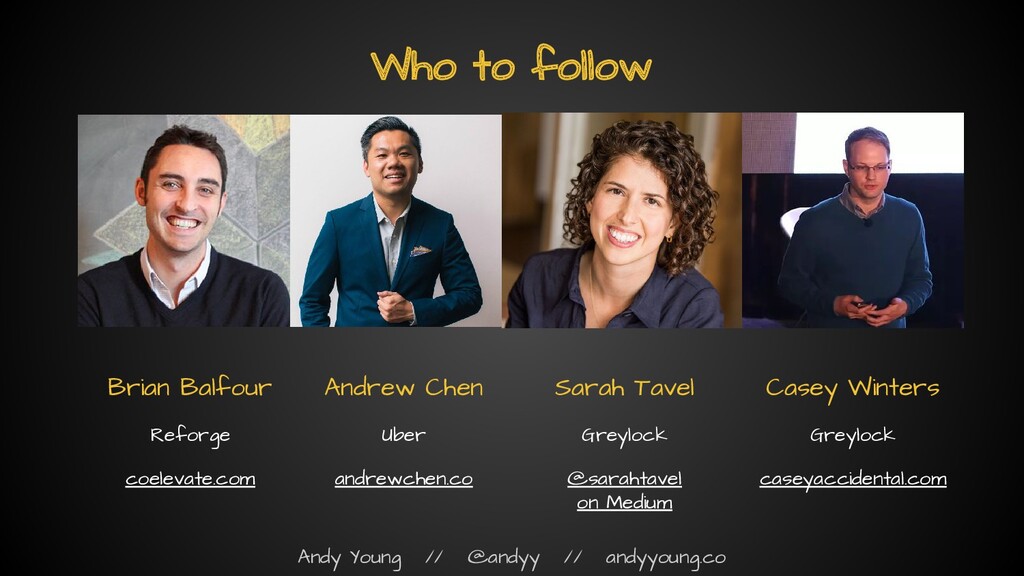
Lyhockey stick myth. Bit. Lyhockey stick myth. So these books recommended some people to follow, Brian, Andrew, Sarah, and Casey. And I hope there's been something for you to take away here. So hope it's been enjoyable. Thank you very much.